
Bharat Mata ki Jai and Shobha De's Defense of War Criminals
When Arjun Rampal said Bharat Mata Ki Jai after playing the ISI handler who planned 26/11, Shobha De found it worrying. This essay unpacks what that reaction reveals about a class that has ruled, judged, and shaped India — and cannot forgive India for finally speaking in its own voice.
Arjun Rampal attended the HELLO! Hall of Fame Awards, where he received the Outstanding Performer of the Year award for his role as Major Iqbal in the film Dhurandhar. While receiving the award, he narrated what 26/11 meant to him and why.
After all, he had spent months playing the man who planned it. The ISI handler. The architect of 166 deaths. He inhabited that mind with the full commitment serious acting demands — and said it made him sick.
And then, as gratitude to his motherland, he raised his hand and let out his love for his mother - "Bharat Mata ki Jai."
India's quintessential rag writer Shobha De, however, found that unpalatable. This is what she wrote.
 Shobhaa De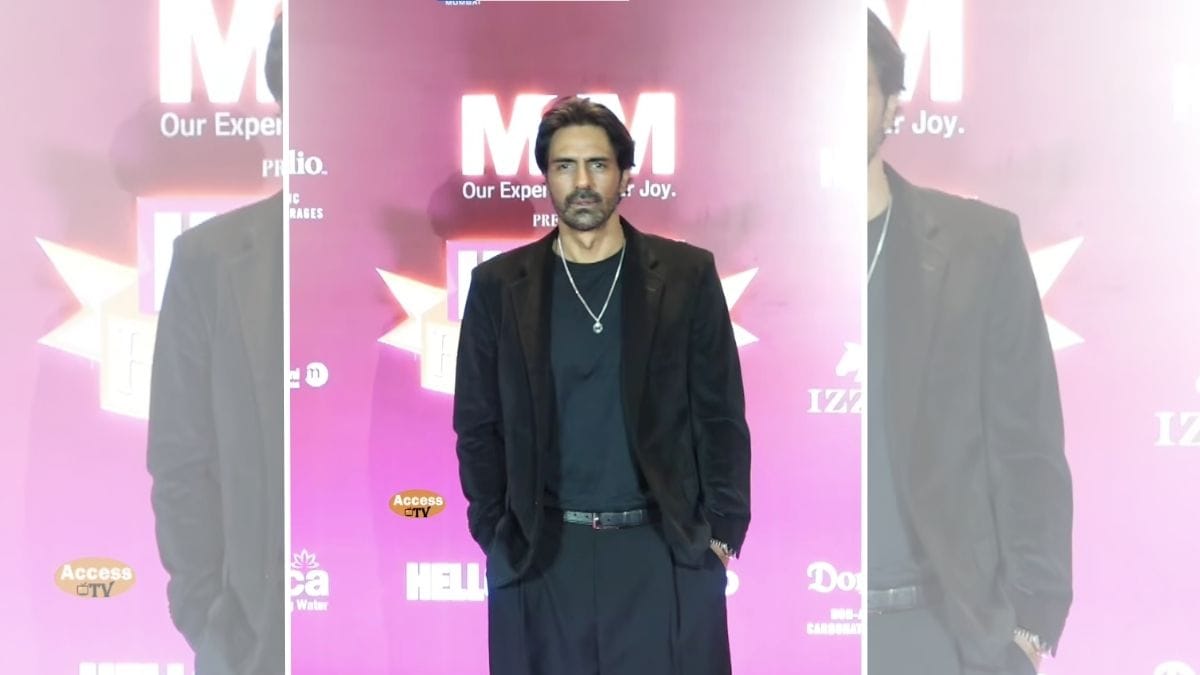
One could dismiss it as the mindless banter of a cynical woman running out of relevance. If only she were alone in this affliction. She is not. She represents a phenomenon — a class that has ruled, pontificated, and sat in judgment over the rest of India for seven decades. That has confused its own narrow coordinates for the coordinates of civilisation itself.
So as we unpack De's polemical screed, we will also dissect the malady that besets those who have felt entitled to shape India in their own image — and cannot forgive India for finally declining the offer.
Unpacking De
There is a follow-up question that De's piece demands, and it is one that her framing carefully avoids.
When Shah Rukh Khan, Salman Khan, and Aamir Khan dominated Indian cinema for two decades — when they were the unquestioned faces of the industry, when their films set box office records, when their stardom was a global phenomenon — was that a statement about Hindus?
Was anyone writing columns in The Print (or similar rags) asking whether the prevalence of Muslim actors at the top of Bollywood reflected a bias against Hindu performers? Was there an alarm about the 'Muslim takeover' of the industry?
Were there pieces worrying about whether the Khan era represented a dangerous ideological capture of India's most powerful soft power?
No. There were not.
Why?
When the Khans dominated, it was widely understood as the result of extraordinary talent meeting the right vehicles at the right cultural moment.
Shah Rukh Khan's combination of wit, vulnerability, and romantic intensity was fresh in Indian cinema of that generation.
Aamir Khan's perfectionism and willingness to disappear into a role produced films that were genuine artistic achievements.
Salman Khan cracked a formula for mass entertainment that appealed to popular youth sensibility of his generation.
Their success was chalked up — correctly — to skill, appeal, timing, and the specific alchemy of star and material that very few performers achieve in any industry.
That was the right analysis. It remains the right analysis.
The answer, of course, is that it does not.
But De needs it to, because if the market is simply doing what markets do — responding to what audiences want, rewarding what works and declining to reward what doesn't — then there is no story about Hindu cultural aggression to tell.
And without that story, her entire framework collapses.
Actors Age. Audiences Move. This Is Not a Conspiracy.
Let us be specific about the numbers, because specificity is what this argument requires.
Shah Rukh Khan is 60 years old. As is Salman Khan. Aamir Khan is 61.
All three are at an age where, in every film industry in the world, the transition from romantic lead to character actor or producer is not merely expected but inevitable.
Tom Cruise — arguably the last major Hollywood star who has defied this transition, and only through an almost pathological investment in physical performance — is the exception that proves the rule.
Actors age. Romantic leads age out of romantic lead roles. This is not ideology. It is biology.
De's own piece inadvertently acknowledges this. She writes that the Khans will be 'smoothly eased out' with the justification that 'they are too old' and 'their movies aren't bringing in the numbers.' She puts this in scare quotes, implying the justification is manufactured.
But she does not engage with the obvious possibility that the justification is simply true.
That 60-year-old men playing 20-year-old romantic heroes is a formula with natural limits regardless of their religion.
That audiences in 2026 have tastes that have evolved beyond what any of the three Khans have consistently been able to meet in their recent output.
Pathaan worked because it leaned into Shah Rukh Khan's age and experience — it made him a seasoned spy, not a college romantic. When the Khans have struggled, it has been in films that asked audiences to accept them as ageless Bollywood heroes in genres that require a physical and romantic conviction that becomes harder to sustain at 60.
This is not a Hindu conspiracy. This is the physics of stardom.
The demand that Hindu audiences must keep choosing Khan vehicles to prove their secular credentials — that their box office preferences are a referendum on their religious tolerance — is perhaps the most revealing aspect of De's framework.
No other audience in the world is required to demonstrate its tolerance through its entertainment choices.
American audiences are not accused of racism when they stop watching aging stars. British audiences are not accused of anti-immigrant sentiment when crossover films underperform.
Only Hindu audiences — choosing, with their own money, what they want to watch on Friday night — are required to demonstrate their inclusiveness through the specific configuration of which actors they prefer.
This is an impossible standard designed never to be met.
Its function is not to promote inclusion. Its function is to keep Hindu communities permanently on trial, permanently defensive, permanently required to justify their existence to a class of commentators who have appointed themselves as the permanent jury.
How Bollywood's 'Secular Consensus' Was Actually Built — With Jail Cells
But before we can fully understand what De is defending, we need to understand how the consensus she mistakes for organic cultural evolution was actually constructed. Because it was not organic.
Let us begin at the beginning.
In 1949 — just two years after Independence, in the infant republic that was supposed to embody freedom — the lyricist Majrooh Sultanpuri (who had written for KL Saigal and Aamir Khan in films) wrote a poem.
It was performed at a Progressive Writers' Association event in Bombay.
The poem drew a comparison between Jawaharlal Nehru and Adolf Hitler.
The comparison was contestable.
Nehru was not Hitler.
But in a democracy — in a republic that had just fought a freedom struggle in the name of the right to speak — a poet making an unflattering comparison between a political leader and a historical tyrant is precisely the kind of speech that freedom of expression exists to protect.
It is not incitement. It is not violence. It is a poet's pointed political criticism of the man running the country.
Sultanpuri was offered a way out: recant the poem, issue an apology, and he would be released. He refused. He served nearly two years in Arthur Road Jail rather than surrender his artistic and political judgment to the demands of political power.
Let that sink in. One of the most gifted lyricists in Hindi cinema's history was jailed by India's first prime minister — the man whose portrait hangs in every government office as the father of Indian democracy — for writing a poem. Not for inciting violence. Not for organising insurrection. For writing a poem.
Balraj Sahni — one of the finest actors Hindi cinema has produced, a man whose work in films like Do Bigha Zamin and Kabuliwala represents the highest achievement of Indian cinema — was a communist and a member of the Indian People's Theatre Association. He was arrested, surveilled, and subjected to sustained state harassment for the political crime of being on the left of Nehru while also being honest about what he saw.
Utpal Dutt — one of the towering figures of Bengali and Hindi theatre and cinema, whose range from political farce to Shakespearean tragedy was unmatched — was imprisoned in 1965 for his play Kallol, which depicted the Royal Indian Navy Mutiny of 1946.
The mutiny was an act of anti-colonial resistance. Dutt's play celebrated it. The Nehru-era government, which liked to position itself as the heir to the freedom struggle, found the actual memory of the Naval Mutiny, when depicted too vividly and too honestly, inconvenient as the real reason for India's freedom.
Dutt was jailed. The play was suppressed.
These are not footnotes. These are the foundation stones of what became the Bollywood 'secular consensus' that Shobha De is today mourning the passing of.
The relationship was that of master to slave, and the slaves who refused their role — the Sultanpuris, the Sahnis, the Utpal Dutts — paid for their refusal with their freedom.
The Emergency of 1975-77 made this explicit. Indira Gandhi's government, having suspended democracy and imprisoned the political opposition, turned its attention to the film industry.
Kishore Kumar — the most distinctive, the most irreverent, the most impossible-to-categorise voice in Hindi film music, a man who could not be forced into any ideological box because his genius was fundamentally allergic to boxes — refused to perform for a Congress party programme.
The government's response was to ban his songs from All India Radio and Doordarshan. The most beloved singer of his generation, whose voice was woven into the daily emotional fabric of India, was silenced on state media after he declined to sing at a political rally.
This is the ecosystem from which the 'secular consensus' of Bollywood emerged. Not from free creative exchange. Not from the organic development of a pluralist artistic community. From a regime of surveillance, arrest, blacklisting, and broadcasting bans that sent a message to every creative person in India: your art exists at the pleasure of political power, and the price of that pleasure is ideological compliance.
What Shobha De mistakes for a golden age of secular creative expression was a managed cultural space from which dissent had been systematically expelled. The 'consensus' she mourns was built on the suppression of every voice that deviated from it.
The apparent harmony of the Bollywood establishment's liberal politics was the harmony of a room from which all dissonance had been removed by force.
Understanding this changes everything about how we read the current moment.
The filmmakers De calls "Right-wing propagandists" are not corrupting a previously free industry.
They are the first generation in seventy years to operate outside the system of political patronage and ideological compliance that Nehru built with jail cells and that Congress maintained with broadcasting bans.
What looks to De like a takeover is, from another angle, simply what Indian cinema looks like when political coercion is no longer the primary organising principle of who gets to make what.
The Slaves Who Finally Walked Out
There is a further dimension to this history that De's framing completely obscures.
The relationship between the Congress establishment and the Bollywood industry was, for decades, one of elaborate mutual dependence masquerading as intellectual kinship.
The industry needed political protection — from censors, from tax authorities, from the licensing regimes that governed everything from film stock to theatre construction. The Congress needed the industry's glamour, its reach into mass culture, its capacity to shape the emotional vocabulary of hundreds of millions of people. The transaction was real and it was ongoing.
But the terms of the transaction were always set by the political side.
The industry's role was to provide entertainment that did not challenge the foundational myths of the Nehruvian state: the myth of a secular India that had transcended its communal past, the myth of a Congress party that represented all Indians equally, the myth of a foreign policy of non-alignment that was in practice highly partial, and above all the myth that the wounds of Partition and of subsequent communal violence were best healed by not speaking of them too loudly or too specifically.
Challenging any of these myths — depicting Partition's organised violence too honestly, naming ISI's role in Kashmir too clearly, showing Hindu bodies on screen with the same unflinching attention that was given to the bodies of others — was not merely commercially inadvisable. It was, as the examples of Sultanpuri, Sahni, and Utpal Dutt demonstrated, potentially dangerous to the person who attempted it.
The industry internalised this.
It did what captive industries everywhere do: it developed a sophisticated instinct for what was safe and what was not, and it dressed that instinct in the language of artistic principle.
The avoidance of Hindu victimhood was reframed as sensitivity. The romanticisation of Pakistani adversaries was reframed as humanism. The systematic erasure of the documentary record of communal violence against Hindus was reframed as the responsible management of explosive material by a mature creative community.
The Agnihotris and the Dhars and the Kanganas are not, in this context, an intrusion from outside. They are the industry's first serious attempt to produce work outside the terms of that original transaction. They are, in the precise sense, the first generation to walk away from the arrangement that Nehru imposed and that Congress maintained for seven decades with varying degrees of subtlety and varying degrees of force.
De calls this a Right-wing takeover.
What it actually is, is an industry in the early and painful stages of decolonising itself from a specific form of political captivity — one that presented itself as liberalism while practising, at its foundation, a form of censorship by coercion that would be recognised as authoritarian anywhere else in the world.
On Pakistan's Army and What We Are Actually Defending
Now let us turn to the part of this conversation that De's framing most urgently requires us to address directly, because it is where the stakes move from cultural politics to something far more serious.
So let us be very precise about what is actually being defended when Pakistani military action is placed beyond the reach of honest cinematic depiction.
In 1948, Pakistani-backed tribal militias led by Pakistani Army regulars and funded by the state treasury invaded Kashmir, committing massacres and rapes documented in India's complaint to the United Nations Security Council and in international observer reports.
In 1971, the Pakistani Army launched Operation Searchlight — a systematic campaign of mass killing, rape, and cultural elimination against the Bengali population, with Hindus targeted for specific brutality.
American diplomat Archer Blood's telegram to Washington described what he saw as selective genocide.
The International Commission of Jurists agreed. Between three hundred thousand and three million people were killed.
Between two hundred thousand and four hundred thousand women were raped in state-sanctioned "rape camps". Ten million refugees fled to India. This is not Indian propaganda. It is the documented record of international bodies, foreign diplomats, and journalists who were present.
In 1999, during the Kargil conflict, Pakistani soldiers captured Lieutenant Saurabh Kalia — twenty-two years old — along with five of his men. What was done to them before they were killed has been documented in the testimony of the doctors who examined their returned bodies and in the decades-long campaign for justice by Saurabh Kalia's father.
Every provision of the Geneva Conventions — to which Pakistan is a signatory — was violated. Pakistan has never been held accountable. The international community has offered no justice.
In January 2013, Lance Naik Hemraj Singh was beheaded by Pakistani soldiers and militants who crossed the Line of Control. His severed head was taken into Pakistan. In 2000, Sepoy Bhausaheb Maruti Talekar of 17 Maratha Light Infantry was killed, and his severed head, according to the testimony of captured militants, was kicked around like a football on Pakistani soil.
These are not statistics.
They were men with names and families and photographs and mothers who are still alive. What was done to them constitutes war crimes under every applicable provision of international humanitarian law.
And then there is 26/11.
Ten Pakistani nationals, trained by Lashkar-e-Taiba in Pakistani camps under supervision with documented links to Pakistani military intelligence, arrived by sea in Mumbai. They were in real-time communication with their handlers throughout the four-day attack.
When the terrorists at Nariman House asked their handlers whether to kill their hostages — a Rabbi, his pregnant wife, and other Jewish visitors — a handler directed them to proceed and explained the symbolic value. One hundred and sixty-six people died.
Let us be precise about the nature of this operation. These were soldiers — trained, equipped, handled in real time, and deployed against India's largest city with the operational objective of maximum civilian casualties and maximum symbolic damage.
The only distinction between them and a Pakistani Army commando unit was the uniforms they wore, and the absence of uniforms itself was the operational strategy — providing the Pakistani state with the plausible deniability that Dhurandhar's ISI handler so accurately depicts.
Shobha De finds it troubling that a film depicts this accurately. She worries that audiences cheer when the perpetrators of this operation are defeated on screen. She treats the cinematic depiction of Pakistan's documented record as Islamophobia and cultural sickness.
She is not defending Pakistani Muslims, who are themselves the primary victims of the Pakistani Army's political dominance — an institution that has staged four coups, imprisoned elected prime ministers, and maintained an intelligence apparatus that murders its own country's journalists and activists.
She is defending the Pakistani military-intelligence complex. She is arguing, in effect, that its crimes should be protected from the emotional force of honest cinematic representation.
To position this as a liberal position — to present the protection of war criminals from artistic scrutiny as a form of secularism — is not merely intellectually dishonest. It is morally obscene.
And we should say so plainly, without the softening qualifications that have allowed this position to present itself as principled for too long.
The Measure of Health in a Sick Society
J. Krishnamurti once said: "It is no measure of health to be well-adjusted to a profoundly sick society."
Shobha De is well-adjusted to that section of the society in India.
Entitled. Profiteering. Judgmental. Fascist. And, ideologically strongly knit.
She attended a glamorous awards ceremony in a beautifully decorated ballroom, champagne flutes clinking, and came away worried — not about Lt. Kalia's gouged eyes, not about Lance Naik Hemraj Singh's severed head being kicked across Pakistani soil, not about the 166 people who died at the Taj and at CST and at Nariman House — but about an actor saying Bharat Mata Ki Jai.
That specific configuration of what is and is not worrying is the diagnosis.
The society De is well-adjusted to is a society constructed, as we have shown, on the coercive suppression of inconvenient artistic voices — from Sultanpuri's jail cell to Kishore Kumar's broadcasting ban.
There are two societies here. There is the society of the well-adjusted — the ballrooms and the champagne and the columns in English newspapers worrying about the wrong things — that has made its peace with the coercive management of creative expression and the protection of war criminals from honest depiction.
And there is the society that simply wants to survive with dignity.
The families of Lt. Saurabh Kalia, Sepoy Bhausaheb Maruti Talekar, and Lance Naik Hemraj Singh who have never received justice. The Kashmiri Pandits still in exile thirty-five years after their expulsion. The 166 families who lost someone on 26/11 and have watched the architects of that operation remain protected in Pakistan. The audiences who take their children to see Dhurandhar and feel, for the first time, that what was done to them has been named at full volume in a public place, without apology, without forced symmetry, without the managing hand of an establishment that has always known better than they do what they should be allowed to feel.
That society — and its money, and its voice, and its Friday night choices — is what Shobha De has decided to worry about.
Here's the bottom line: The industry's slaves walked out of the arrangement.
The audiences found filmmakers willing to tell their story straight.
And Arjun Rampal stood at a podium and said Bharat Mata Ki Jai.
And the well-adjusted found this worrying.
Jiddu Krishnamurti would have easily recognised the moment immediately.
If this essay reached you, you are probably already part of the community that has refused the managed silence. You have read against the grain of the editorial consensus, sat with uncomfortable facts, and asked the questions that the dominant cultural apparatus has preferred you not ask. That community — stubborn, heterodox, unwilling to exchange honest reckoning for social approval — is what Drishtikone exists for.
Drishtikone writes unapologetically about civilisation, memory, and the politics of who gets to narrate what. The factual record on Operation Searchlight, on Kargil, on Sepoy Bhausaheb Maruti Talekar, on Lance Naik Hemraj Singh, on 26/11, and on ISI's documented role in Indian terrorism is sourced and verifiable.
Share this piece with someone who has been told that caring about Hindu history is itself a form of extremism. The most important intellectual work right now is not convincing opponents — it is finding the people who already sense that the dominant framing is wrong and giving them the vocabulary and the evidence to say so clearly.
And hey - Bharat Mata ki Jai!
Comments ()