
Dhurandhar and the "Facts are the Horror" Cinema
We discuss how Bollywood's intellectual complicity, the Politics of Denialism, and the Misreading of Savarkar Have Paved the Way for Hindu Massacres — and What the New Cinema is Doing About It
Before We Begin
A student came to the master and said:
"Master, there is a man in the village who has been struck by an arrow. His family weeps. His neighbors have gathered around him. But the elders are arguing whether the arrow came from the east or the west, whether the archer was justified, whether the wounded man provoked it, whether speaking of the arrow will cause more arrows to be shot."
The master said, "And the man?"
"He is still bleeding," said the student.
"Then," said the master, "the arrow is the only fact that matters. Every argument that postpones the removal of the arrow is not philosophy. It is complicity. And the most dangerous man in the village is not the archer. It is the elder who says: " We must not speak of arrows, for speaking of arrows encourages archers."
The student was silent.
Then he asked: "But master — what if the wounded man begins to name the archer? What if he describes the bow, the fletching, the direction of the shot? What if he tells others so they may take cover?"
The master smiled.
"Then," he said, "they will call him a troublemaker. They will say his grief has made him irrational. They will say he is inflaming the village. They will form committees to study whether arrows, in general, are a matter of sufficient concern to warrant public discussion.
And while the committees sit, the archer will notch the next arrow. And the elder will draft a statement of concern."
Facts Are Horror Genre
There is a genre emerging in Indian cinema that the critical establishment does not have a comfortable name for. They have tried propaganda. They have tried Hindutva cinema. They have tried majoritarian spectacle. None of these labels stick because none of them explain the most important thing about these films: they are, in large measure, simply true.
The Kashmir Files is true. The Vaccine War is true. Uri is true. Dhurandhar is true. Emergency is true — one could sometimes debate their craft, but facts are true. The Bengal Files, which revisited the organised slaughter of 1946 Calcutta and the Noakhali massacres, was also to every detail, true.
These films are not true in the way that propaganda is sometimes accidentally accurate. They are true in the way that a forensic reconstruction is true: rooted in testimony, documentation, the public record, and survivor accounts that India's dominant cultural apparatus spent 70 years treating as too combustible for mainstream representation.
Today, we will discuss why the truth, told in this particular register — about Hindus, about what was done to them, about the state and non-state actors that did it — is considered by a very powerful section of India's cultural and intellectual life to be a form of violence. It is about how that classification serves interests that are directly opposed to the prevention of the next wave of mass violence against Hindus.
The Three Directors and the Hues Within the Genre
Before we analyse the ecosystem they are challenging, it is worth being precise about what each of these filmmakers is doing, because they are not the same thing. The Facts Are Horror genre — my term for cinema that takes documented Hindu trauma as its raw material and refuses to aestheticise, relativise or distribute blame to achieve multiplex palatability — contains at least three distinct approaches, represented by three distinct artistic personalities.
Vivek Agnihotri: The Scholar-Filmmaker
Vivek Agnihotri is, in my estimation, the most rigorously factual of the three. The Kashmir Files, The Vaccine War, and Bengal Files — bear the marks of a man who researched before he wrote, who spoke to survivors before he scripted, who understood that his job was not to dramatise history but to let history speak through cinema with the minimum of distortion that the medium requires.
What is remarkable about Vivek is precisely what frustrates conventional critics: he refuses the crutches of cinematic exaggeration. He does not need them. The reality he is working with is so starkly horrific that fidelity to it is, by itself, more shocking than any dramatic amplification a screenwriter might invent. When The Kashmir Files shows a Pandit woman being cut into pieces, it does not slow the sequence to operatic effect. It simply shows it — the way it happened, as it was reported, as survivors described it. That restraint is the work of someone who understands that manufactured horror cannot compete with documented horror. His films are a scholar's work wearing a filmmaker's clothes.
The critics who call his cinema 'blunt' or 'lacking in nuance' are, without realising it, revealing their own preference: they would like the horror to be softened, given context, diluted with equivalences. Vivek declines. He has understood something his critics have not: that the long insistence on 'nuance' in the representation of Hindu suffering has itself been the mechanism of its erasure.
Kangana Ranaut: The Actor Who Became a Director
Kangana is a different creature entirely. Emergency is a film made by someone who is primarily an actor of great stature. Someone whose primary gift is inhabiting a personality with total conviction.
Her portrayal of Indira Gandhi is the most arresting thing about the film: the voice, the posture, the particular combination of maternal warmth and authoritarian steel that made Indira simultaneously beloved and catastrophic.
Kangana gets that. She gets the character from the inside.
The film's weakness was its script. The dramatic architecture is uneven, the supporting characters are sometimes thin, and the deeper institutional and political analysis that the Emergency as a historical episode deserves never quite arrives. The facts are present — the suppression, the arrests, the sterilisation camps, the demolition of civil liberties — but they sit in the film without the connective tissue of rigorous storytelling that would make them land with the force they deserve.
But to dismiss Emergency for these reasons is to miss what Kangana accomplished. She made a film about one of modern India's most consequential political catastrophes that no major studio had touched in five decades.
The fact of its existence, in the current climate, required a courage that the critical establishment has not acknowledged. The facts are rooted. The script maybe weak. She is, after all, an actor first and a director second.
All of that is true, and none of it changes the essential thing: she chose to make this film when no one else would.
Aditya Dhar: The Cinematic Architect
Aditya Dhar is the third kind.
Uri: The Surgical Strike and the Dhurandhar duology represent something different from both Vivek's forensic fidelity and Kangana's character-centered intensity.
Dhar is a cinematic architect. He takes documented events — the 2016 Uri attack, the surgical strikes, the IC-814 hijacking, the Parliament attack, 26/11, Operation Sindoor's strike on Lashkar's Muridke complex — and constructs around them an experience that is both viscerally accurate and cinematically world-class.
The intelligence tradecraft, the ISI handler networks, the Pakistani state's plausible-deniability architecture, the operational details of Indian counter-terrorism — all of this is present in Aditya's films with a specificity that rivals the best of the global spy thriller genre. He has found a way to make documented geopolitical reality as kinetically compelling as anything Hollywood or the BBC has produced.
What unites all three — despite their profound differences in method — is a shared refusal to accept the terms on which the previous Bollywood consensus required Hindu suffering to be represented: quietly, abstractly, symmetrically, always apologetically.
They have decided, each in their own way, that the story deserves to be told in full.
And, just that decision has made them the targets of a system that thrived on the erasure of the Hindu voice.
The Ecosystem That Thrived on Erasure
To understand why these three filmmakers have provoked the reaction they have, you need to understand what they are disrupting.
This is not a conspiracy theory. It is a structural observation about what was made, what was funded, what received critical approval, and what was condemned. The structure was self-reinforcing: filmmakers who wanted festival prizes, multiplex distribution, and elite critical approval understood intuitively which kinds of stories were welcome and which were not.
Stories about state violence against Muslims: welcomed, celebrated, called brave. Stories about Pakistani and Islamist violence against Hindus: suspect, potentially inflammatory, requiring very careful framing to be acceptable — if acceptable at all.
The results are visible in the archive.
Partition cinema spent seventy years dwelling on 'shared tragedy' and the romance of loss without ever seriously depicting the organised violence of the Muslim League National Guards, the mechanics of Direct Action Day, the targeted massacre of Hindu and Sikh communities in Rawalpindi, Lahore, and Noakhali.
The 1971 genocide in East Pakistan — where international legal bodies documented the deliberate killing of hundreds of thousands of people and the particular targeting of the Hindu minority — does not exist in Bollywood's emotional vocabulary.
The Kashmiri Pandit genocide and expulsion were for nearly thirty years invisible on the multiplex screen despite producing one of the largest internal refugee crises in independent India's history.
When “Facts Are Horror” in a Gaslit Culture
For most of independent India’s cinematic history, the biggest truths about Hindu suffering were either erased, relativised, or treated as too dangerous to put on screen.
The Partition massacres in Punjab and Bengal, Direct Action Day, the systematic targeting and ethnic cleansing of Kashmiri Pandits, the mass rapes and killings of Hindus in 1971—all of this lived on in survivor memory and scattered scholarship, but not in the emotive center of mainstream cinema.
 Shweta Keshri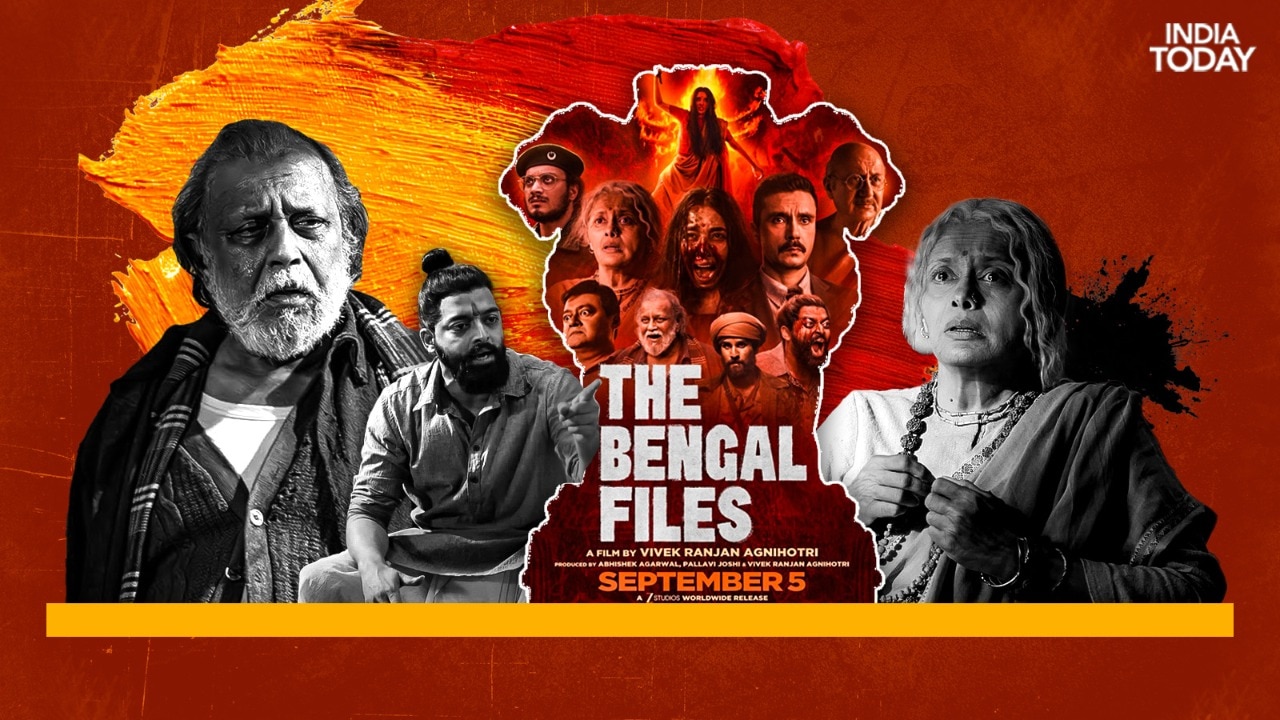
In that vacuum, films like Haider could present a morally lopsided picture of Kashmir that centered one community’s pain and virtually erased another’s.
When films such as The Kashmir Files, The Bengal Files, and Dhurandhar finally foregrounded Hindu trauma and named Pakistan’s deep state as a central actor, they were immediately branded “propaganda” by many of the same voices that had once praised one‑sided narratives as “humanist.”
Bollywood’s Overton Window: From Erasure to “Facts as Horror”
Let us walk the journey of cinema that saw Bollywood's Overton Window move within a matter of a decade.
Pre‑2014: soft secularism, hard silences: The pre‑2014 mainstream Hindi cinema consensus could be summarised as neoliberal, soft‑secular, and selectively blind.
On Pakistan and ISI:
- Academic analyses of “Pakistan in Bollywood” show that post‑Kargil and post‑26/11 films often portrayed Pakistan and ISI as duplicitous sponsors of terrorism, but still left room for reconciliatory narratives, cross‑border love stories, and “good Pakistanis” as counterweights.
- That posture was consistent with a broader project: present India as a secular democracy beset by extremists, but avoid dwelling on atrocities on Hindus or on the full scale of Pakistani jihad and ISI’s proxy architecture.
On Hindu trauma:
- Partition cinema largely focused on “shared pain” and romantic loss, not on the Muslim League National Guards or organised massacres of Hindus and Sikhs in Bengal and Punjab.
 Desh Kapoor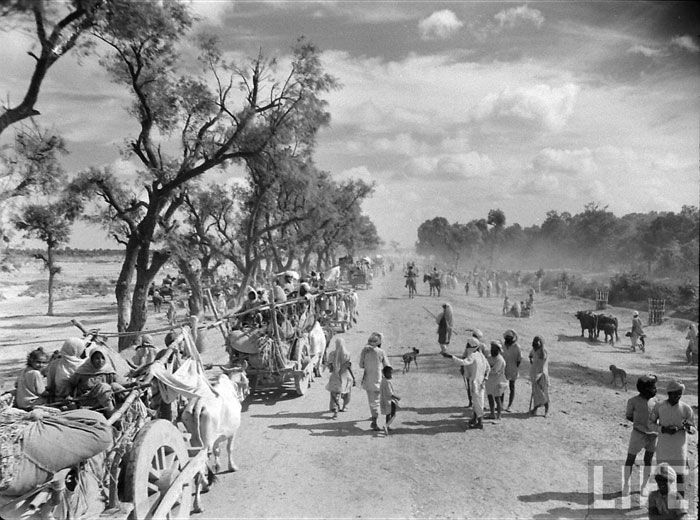
- The 1971 genocide in East Pakistan—where hundreds of thousands of women, including disproportionate numbers of Hindus, were raped and millions displaced or killed—rarely appeared in mainstream Hindi films.
- Kashmiri Pandit displacement and targeted killings were almost entirely absent from big‑ticket Bollywood for decades, despite ample documentation of threats, assassinations, and orchestrated terror that drove them out.
In other words, Islamist and Pakistani violence against Hindus was structurally under‑represented, and Hindu suffering was kept at the margins. Silence here was not neutral; it was a political choice.
In fact, a study by Professor Dheeraj Sharma of the Indian Institute of Management (IIM) Ahmedabad (IIMA) indicated a pattern of negative stereotyping against Hindus and Sikhs in Bollywood films, while often portraying Muslim characters more positively.
The research, which analyzed 50 films from each decade between the 1960s and 2010s, highlighted a number of specific representational biases:
- Corrupt Politicians/Businessmen: 58% of corrupt politicians in the films studied bore Hindu Brahmin surnames, and 62% of corrupt businessmen bore Hindu Vaishya surnames.
- Sikh Characters: Around 74% of films presented Sikh characters in a "laughable" light.
- Muslim Characters: In contrast, 84% of Muslim characters were depicted as strongly religious and honest, even if their role was that of a criminal.
- Portrayal of Countries: In 20 films featuring Pakistan, 18 showed Pakistani people as welcoming and open-minded, while Indians were largely projected as narrow-minded and conservative in the same movies.
- Audience Perception: When the religion and caste-wise descriptions were presented to 150 school students, 94% felt the stereotypical representations were authentic.
Professor Sharma suggested that these findings could influence the audience's perception of different communities and questioned whether Bollywood was presenting reality or attempting to create it.
 Anonymous
Analyzing Haider, Kashmir Files and Dhurandhar
We believe that Vishal Bhardwaj's Haider (2014) is the paradigmatic instance of selective humanism.
Haider: The Signature of Selective Humanism
When Haider was released in 2014, it was widely praised as a bold, humanist film that “finally” showed the dark side of India’s counter‑insurgency in Kashmir—custodial disappearances, torture, and the psychic costs of militarization. At the level of craft, much of that praise was deserved: the performances, visuals, and music.
But if we are honest, Haider is also the purest example of how Bollywood’s pre‑2014 Overton window handled the Kashmir story: one community’s suffering is visible and even romanticized; another’s is almost entirely absent.
What we know from serious scholarship and reportage is not ambiguous:
- By the late 1980s and early 1990s, Kashmiri Pandits were targeted through threats, specific hit lists, and massacres. Walls and mosque loudspeakers carried explicit calls that Pandits must convert, leave, or die; known figures were assassinated; families were given hours to leave or face violence.
- Pakistani intelligence and jihadist organisations—JKLF and then more Islamist groups like Hizb‑ul‑Mujahideen and others—trained cadres across the LoC, supplied arms, and framed the struggle in increasingly religious terms.
- The end result was a mass exodus; in many neighbourhoods of Srinagar and across the valley, Pandit presence was reduced to tiny enclaves or vanished altogether.
All of this forms part of the lived experience of Pandits and is documented in academic work, fact‑finding reports, and journalistic accounts.
Yet in Haider:
- The viewer hears almost nothing about this targeted campaign; Pandit characters are effectively absent.
- Pakistan’s role is flattened out; the principal antagonists are Indian security agencies and local collaborators, not Pakistan’s deep state or its jihadist assets.
It is also a film that almost completely erases the campaign of assassination, rape, and loudspeaker intimidation that drove the Pandit community from the valley — the 'Raliv, Chaliv ya Galiv' ultimatums, the killings at Wandhama and Nadimarg, the Pakistani state's central role in arming and directing the jihadi organisations that carried out this campaign.
These omissions are not accidents of screenplay. They are choices. And those choices were rewarded.
Other movies like Pathaan and Jawan made a different kind of erasure available.
No interest is taken in ISI's documented history as the state sponsor of the 26/11 attacks, the Parliament assault, the Kashmir insurgency, the Khalistan revival, the decades-long proxy war that has killed tens of thousands of Indians.
Movies such as Pathan or Jawan are spectacle films that float above geopolitics on a cushion of Computer Generated Imagery (CGI) and star power, and in doing so, they continue the naturalization of the audience's ignorance about what has actually been done to them.
Yes, a film is not a textbook; it cannot show everything. But what it chooses to dramatize and what it chooses to omit tells you whose suffering is considered central to the moral narrative.
In Haider, Muslim victimhood and Indian state violence are the core; Pandit victimhood and Pakistan’s role are off‑frame.
Yet Haider was portrayed as accomplished and emotionally powerful. It was in their eyes (Secular junta) an account of militarization in Kashmir, of enforced disappearances, of the claustrophobic brutality of counterinsurgency. All without context of what the terrorism did and what alternatives, between the political pressures (dictated by collaborative relations with terror groups!) and limitations on the military, were afforded to the jawan who was in the crosshairs.
Such a distorted, narrowly crafted ideological movie was called "courageous".
The Kashmir Files: When Hindu Victims Enter the Frame
The Kashmir Files demolished the arrangement put forth by Haider by putting Pandit corpses and terror at the centre of the screen.
It doesn’t ask the audience to infer trauma from a statistic; it makes them watch the killings, rapes, forced conversions, and mass flight in detail—through composite scenes that blend multiple documented incidents into single set‑pieces.
From the standpoint of factual core:
- Even many of the film’s sternest critics acknowledge that Pandits were subject to targeted killings, that most of the community fled, and that life in exile has meant decades of marginalisation.
- The debate from its critics is about framing and omissions—not whether the killings and terror campaign happened.
Yet reactions often slid from cinematic critique into casting doubt on the legitimacy of the core horror or dismissing its cinematic depiction as inherently fascistic.
That is what many Pandits and other Hindus experience as gaslighting:
- For 30 years, their trauma was barely portrayed in mainstream cinema.
- When it finally was, the loudest criticism in some quarters was not “yes, this horror happened, but let’s also talk about other victims”; it was “this horror should not be portrayed so starkly, because it fuels hate.”
Dhurandhar: Exposing the Deep State Architecture
Dhurandhar and its sequel extend this “facts as horror” approach to the level of institutions and strategy.
Its spine is built from:
- The 1999 IC‑814 hijack from Kathmandu to Kandahar.
- The 2001 Parliament attack.
- The 2008 26/11 Mumbai attacks.
- The 2025 Operation Sindoor strikes on Muridke and other terror infrastructure in Pakistan.
Independent of any film, open-source documents that:
- Groups like Lashkar‑e‑Taiba and Jaish‑e‑Mohammad have enjoyed long‑term support, training, and funding from elements of Pakistan’s ISI and army, especially in the context of the “proxy war” in Kashmir and Afghanistan.
- The 26/11 operation involved handlers based in Pakistan who directed the attackers via phone calls; subsequent investigations, including David Headley’s testimony, pointed to ISI officers’ involvement in reconnaissance and planning.
 Desh Kapoor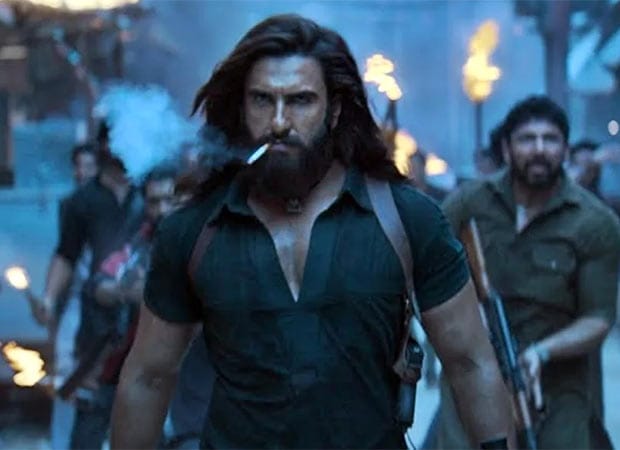
Dhurandhar compresses and dramatises this but does not invent the underlying pattern. Its fictional intelligence chief and Karachi underworld are built on well‑known realities: Muridke as a real compound; Karachi’s gangs overlapping with jihad networks; ISI’s obsession with “bleeding India by a thousand cuts.”
The shock for Indian audiences is that, for once, the camera stays with the architecture. We see the safehouses, the handlers, the state patrons, not just anonymous gunmen. That is what makes it feel like “facts are the horror.”
Just Double Standards or Wilful Targeting of Hindus?
If we juxtapose Haider, The Kashmir Files, and Dhurandhar, the double standard becomes obvious:
- A film that foregrounds state abuses against Muslims and erases Pandit suffering (Haider) is widely praised as morally serious.
- A film that foregrounds Pandit suffering and Pakistani/jihadi agency (Kashmir Files), or Pakistan’s deep‑state jihad and India’s covert response (Dhurandhar), is rapidly labelled “Hindutva propaganda” or “jingoism” by many of the same voices.
What changed is not that the latter films abandoned truth; it’s that they insisted on showing truths that had been locked out of the narrative.
Selective outrage defines the response: only films that foreground Hindu suffering are branded as dangerous or irresponsible.
A double standard emerges in how “context” is invoked.
Earlier works—such as Haider or several Partition narratives—were not burdened with demands for exhaustive contextualization, even when depicting violence or grievance.
Yet, when a story risks evoking Hindu anger or highlighting Hindu victimhood, calls for nuance, balance, and restraint suddenly become non-negotiable.
This asymmetry suggests that standards are not applied consistently but are instead shaped by the identities and political implications of the narratives being portrayed, raising questions about fairness in cultural critique.
The critical vocabulary that maintained this consensus was not complicated. Any film that seriously depicted Hindu victimhood and named the agencies responsible was liable to one of three charges.
- First: Islamophobia, implying that the factual depiction of violence by Islamist organisations against Hindus is equivalent to hate speech against Muslims as a community.
- Second: propaganda, implying that the fidelity of the film to documented events is itself evidence of ideological contamination.
- Third, and most sophisticated: dangerous truth — Al Jazeera's formulation for The Kashmir Files, which managed in two words to simultaneously acknowledge that the film was largely accurate and condemn it for the accuracy. The 'danger' lay not in any factual error but in the community that the accurate facts centered.
This apparatus had a purpose. That purpose was not pluralism. Pluralism would have required the equal and full representation of all communities' traumatic histories.
The purpose was the selective management of Hindu memory: ensuring that Hindus remained available as a demographic for political mobilisation but not as a community that had processed its own history of victimisation, drawn conclusions from it, and organised around those conclusions.
The ecosystem that Vivek, Aditya, and Kangana have disrupted understands this very clearly. That is why the reaction to their work has been so visceral and so coordinated.
When Hindu Genocide Is Treated as Righteous Endeavour
Here is the sentence that the polite vocabulary of Indian intellectual life struggles to say directly, so let me say it plainly: within a significant and influential section of India's left-liberal ecosystem, and within the international human rights infrastructure that takes its cues from that ecosystem, Hindu suffering is not treated as suffering that demands the same moral urgency as the suffering of other communities.
Worse: the assertion of Hindu suffering, the naming of its perpetrators, the political organising that might prevent its recurrence — these are treated as the real danger.
Hindu victimhood is framed as aggression.
This inversion is not accidental. It has a genealogy.
Within this framework, the worst thing a Kashmiri Pandit can do is speak about his expulsion too loudly.
The worst thing a Bengali Hindu can do is name the Muslim League National Guards in any discussion of Partition.
The worst thing a Dhurandhar can do is make an ISI handler a villain without providing an equivalent ISI heroine or a R&AW villain.
The intellectual scaffolding for this is borrowed, imperfectly, from postcolonial theory.
But postcolonial theory was developed to describe the relationship between European colonial powers and their non-European subjects.
Its application to the subcontinent requires an extraordinary sleight of hand: it requires treating a dharmic civilisation that was itself colonised — first by Turkic and Mughal invaders and then by the British — as though it occupies the structural position of the coloniser relative to the Muslim communities that were, in significant part, the political inheritors of that earlier imperial project.
Quite simply, it is a politically motivated category error, and its consequences are lethal.
They do not engage because genocide prevention infrastructure is calibrated to protect communities that are recognised as victims.
A community whose victimhood is ideologically disqualified before the evidence is examined has no access to those mechanisms.
It is left with what it can build for itself, which is precisely why the Savarkar project, for all its imperfections, was not paranoia. It was triage.
Hindutva as Scare‑Word: How Savarkar Is Used to Gaslight Hindus
Vinayak Damodar Savarkar wrote "Hindutva" while imprisoned on the Andaman Islands by the British government that feared his revolutionary anti-colonialism. He was not writing a theology. He was writing a political diagnosis of civilizational vulnerability.
Savarkar explicitly distinguished Hindutva from “Hinduism,” calling Hinduism only one part or attribute of a larger Hinduness (Hindutva) that included history, culture, and politics.
His central argument is almost embarrassingly simple once you strip the polemical apparatus from it:
Far from being bigotry, this is the observation that any serious student of genocide prevention would make from the same historical data.
The fact is that Savarkar repeatedly downplayed theology and metaphysics to stress political identity.
Savarkar's definition of Hindutva wasn't framed as a religious test. It encompasses Sikhs, Jains, and Buddhists. It is a civilisational-territorial identity: those for whom the Indian subcontinent is both their fatherland and the land of their deepest cultural formation.
The exclusion he draws — between communities whose sacred geography is rooted here and communities whose deepest spiritual loyalty is oriented toward a revelation and a geography located elsewhere — is a political argument about the compatibility of different community loyalties with a common territorial nationalism.
You may disagree with the argument. You cannot honestly call it equivalent to a doctrine of extermination.
What Savarkar had seen, and what his critics, then and now, have tried very hard not to see, was the asymmetry in the doctrinal architecture between dharmic and Abrahamic traditions, and the specific political consequences of that asymmetry in the context of colonial-era communal mobilisation.
Dharmic traditions — Hinduism, Buddhism, Jainism, Sikhism — are, as a matter of both their texts and their sociologies, structurally pluralist.
They accommodate multiple paths, multiple truths, multiple identities without requiring excommunication or the erasure of difference.
This makes them extraordinarily rich and extraordinarily vulnerable: rich because they do not need to conquer to feel secure; vulnerable because they do not, historically, organize for collective defence with anything like the efficiency of traditions built around a single revelation, a single law, and a single community of the faithful.
The medieval record is not ambiguous.
The Ghaznavid raids, the Ghurid campaigns, the Delhi Sultanate's systematic iconoclasm, Aurangzeb's temple destructions and jizya reimposition, Tipu Sultan's forced conversions — these are documented in the chronicles of the very courts that commissioned these campaigns. The chroniclers boasted. They kept records. The burning of Nalanda, the destruction of Somnath, the towers of skulls at Delhi — these are not "saffron myths". They are the written testimony of those who did the burning and the building.
Savarkar looked at this record and simply asked: why did this keep happening?
His answer — that Hindu society's caste fragmentation and philosophical non-combativeness rendered it repeatedly unable to mount organised resistance — was harsh and arguably simplistic.
But the diagnosis was more honest than the alternative on offer, which was to pretend that the pattern did not exist, or that it existed but was not worth naming, or that naming it was itself the problem.
“Hindutva” as a bludgeon
Today, “Hindutva” is often deployed as an all‑purpose pejorative:
- Western NGOs, activist academics, and some Indian commentators use it to label everything from lynch mobs to any Hindu who questions the old secular consensus.
- Under this usage, a Kashmiri Pandit recounting his family’s expulsion, or a Bengali Hindu talking about Noakhali, or an analyst describing ISI’s jihad architecture can all be tarred as “Hindutva propaganda” if they don’t sufficiently dilute their account with “context.”
'Hindutva' is used to disqualify any argument that originates in the Hindu experience.
A Kashmiri Pandit who names the ISI's role in his expulsion is engaging in 'Hindutva propaganda.' A filmmaker who depicts the Noakhali massacres with full emotional weight is 'weaponising Hindu pain.' A commentator who notes the doctrinal asymmetry between dharmic pluralism and jihadi exclusivism is 'stoking communal tensions.'
That is exactly the gaslighting Hindus have been subjected to:
- Hinduism as a civilisation is treated as suspect the moment it demands full recognition of its wounds.
- Savarkar becomes a mascot of “hate” used to disqualify any argument that begins from Hindu experience of centuries of invasion, iconoclasm, and targeted violence.
It is a systematic effort to make a community doubt the validity of its own experience and the legitimacy of its own political conclusions. Its function within the cultural ecosystem is to ensure that Hindu memory remains managed rather than free — acknowledged in principle, denied in emotional and political reality — so that the community remains available as a demographic for mobilisation while being incapable of the kind of organised historical reckoning that might make it harder to victimise next time.
RSS and BJP: political projects built on civilisational language
The RSS and later the BJP built on a civilizational language
- RSS seeks to unite and discipline Hindu society so it can defend itself and sustain a Hindu rashtra, which is envisaged as a society of pluralistic inclusivity. It emphasises ending caste fragmentation, building physical and organisational strength, and cultivating pride in the inclusive Hindu civilisation.
- BJP formally invokes Integral Humanism and constitutionalism, as it draws ideological energy from the same civilisational story: India as essentially Hindu, which enables a pluralist society where exclusivism cannot be allowed to run roughshod over every inclusive group.
Remember, RSS is a social and BJP is a political program.
They can, and should, be criticised for specific acts, policies, and rhetoric. But conflating every assertion of Hindu trauma or civilisational pride with “RSS fascism” is to create a proxy for continuing Hindu gaslighting.
Asymmetry Matters: Exclusivist Jihad vs Dharmic Pluralism
A humanist realism must start from doctrinal differences:
- Mainstream Islamic theology is exclusive about truth and salvation (one final prophet, one final revelation). Classical law differentiates clearly between believers and non‑believers and, historically, often between Muslims and dhimmis.
- Dharmic traditions are inherently pluralist: multiple accepted paths; no single revelation binding all; arguments between schools without excommunication; porousness of identities over centuries.
If you force these onto the same moral plane and demand identical political treatment without considering how they have behaved in history, you ensure that pluralists will be repeatedly overrun by exclusivists and annihilated, as is their mission.
The historical pattern: from Ghazni to Partition to Kashmir to 1971
The subcontinental record is brutally clear, even if numbers are debated:
- Medieval invasions and sultanates involved systematic destruction of temples, mass enslavement, and murders of those who resisted. Chroniclers boasted of idols smashed and “infidel” heads piled; Chittor’s towers of heads after Akbar’s siege are emblematic of this ethos.
- Direct Action Day, Noakhali, Punjab/Bengal Partition saw Muslim League cadres and National Guards unleash targeted violence on Hindu and Sikh populations to force political demands, not merely spontaneous riots.
- 1971 in East Pakistan involved a state‑directed campaign of mass killings and rape against Bengalis, with Hindus singled out for special brutality and expulsion.
- Kashmir saw Pakistani‑backed jihadist groups target Pandits for extermination or expulsion, leading to an exodus that has still not been reversed.
To call a Hindu thinker or filmmaker “extremist” for taking these patterns seriously and drawing political conclusions is perverse. The burden of proof is on those who claim these patterns don’t matter.
Savarkar as the sharer of a Proto‑Early‑Warning System
Genocide prevention scholarship — from Gregory Stanton's Genocide Watch framework (Ten Stages of Genocide) to the work of Barbara Harff on politicide risk (No Lessons Learned from the Holocaust? Assessing Risks of Genocide and Political Mass Murder since 1955) — identifies a consistent set of structural indicators that, in combination, significantly increase the probability of mass atrocity against a targeted community.
Here is the reality - Savarkar and later Hindutva writers were, in a rough way, doing what modern conflict scholars might do more systematically: watching for signals of another wave of mass violence.
Savarkar’s insistence on a Hindu nation is not an attempt to mimic Islamic exclusivism at the doctrinal level; it is an attempt to prevent a civilisationally plural, often politically naïve Hindu society from being carved up and dominated by more tightly organised, exclusivist blocs.
He is saying, in effect: “If we continue to treat this as a purely spiritual pluralism game while others treat it as a power game, we will be partitioned and massacred.” That’s not hatred; it’s a strategic reading of the environment.
Savarkar's view is expressed in his 1937 speech.
He was merely acknowledging what was already the writing on the wall.
The fact is that the idea of Hindus and Muslims as two distinct nations was shared and popularized the Muslim leaders long before Veer Savarkar came on national stage.
Sir Syed Ahmad Khan articulated it for the first time in 1876 in his speech in Benares. Savarkar was born (1883) 8 years after that first articulation!
In 1876, one year after the inauguration of the Anglo-Oriental College at Aligarh, he made a speech at Benares in which he referred to Hindus and Muslims as two separate nations that cannot become one. Even during the revolt of 1857, he was loyal to the British and criticised the rebels. However, interestingly he also faulted British Rule, which had united the Hindus and Muslims and was responsible for their unity in the rebellion. Again, at Meerut in 1888, he addressed a gathering of local Muslim elites and reiterated his political vision of the Two-Nation Theory. By this time, the Indian National Congress had already been formed in 1885. Not only did he describe Muslims as a separate nation, but even more nefariously he dubbed Congress a Bengali Organisation. Thus, his goal, as it appears, was to keep Muslims united and to divide the Hindus on caste and regional basis. (Source: "Two Nations Theory- Whose Brainchild Is It, Who Adopted It and Who Nurtured It? Time to Decide?" / India Foundation)
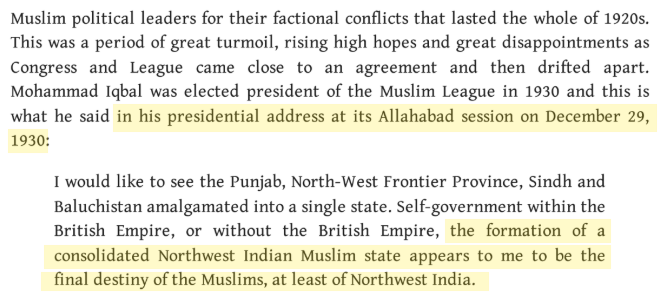
In 1930, Mohammad Iqbal shared the same sentiment in Allahabad (now Prayag).
So let us look at what Savarkar and other "Hindutva" writers were trying to do, in a quantitative, more structured manner.
What if a serious sociologist or conflict researcher were to create a concise set of KPIs/metrics to forecast “another 25‑year window to mass atrocities,” especially against a historically targeted group like Hindus in the subcontinent?
Let us try to suggest one set of metrics.
Ideological and textual environment
Metric #1: Normalisation of extermination/subjugation rhetoric in mainstream religious and political discourse
- Frequency with which sermons, pamphlets, madrasas, and political speeches invoke classical doctrines of supremacy and conquest (e.g. language of jihad against kuffar, idol‑destroyers as heroes, “polytheists have no right to exist”), not as history but as live obligations.
- Movement from abstract doctrine to targeted labelling: specific communities (Hindus, Sikhs) are routinely described as shirk‑practising enemies, deserving of punishment in this world, not just in the hereafter.
Metric #2: Popularisation of “two‑nation” or “incompatibility” narratives
- Growth in media, social media, and educational content arguing that Hindus and Muslims are “separate nations,” “incompatible civilisations,” “can’t live together,” framed from the side that has historically driven separation.
- Echoes of Iqbal/Jinnah‑style arguments (and their modern successors) gaining traction again: the idea that Muslim “honour,” “purity” or “sharia space” requires demographic or territorial separation.
These are the kinds of currents Savarkar was tracking at the level of polemic: noticing that an exclusivist political theology was becoming a live script, not a static piece.
Organisational and logistical build‑up
Metric #3: Growth and arming of communal militias and “guards”
- Emergence or revival of uniforms, drills, and paramilitary formations under religious banners (League’s National Guard equivalents, Taliban‑style youth wings, local lashkars), including their numbers, funding and training.
- Evidence that these groups have access to weapons, bomb‑making knowledge, and cross‑border support networks.
Metric #4: Penetration into policing and bureaucracy
- Increasing sympathiser presence in police, local administration, and lower judiciary, creating zones where violent actors expect sympathetic treatment or impunity.
- Visible patterns of non‑intervention by police when mobs from one side attack the other; disciplinary actions against officers who do intervene.
Historically, Direct Action Day, Noakhali, and later pogroms against Hindus/Sikhs were made exponentially worse where state organs either colluded or stood aside.
Social‑psychological indicators
Metric #5: De‑humanisation and moral disengagement
- Spikes in language that portrays the target group as impure, animal‑like, conspiratorial, or demonic, making violence against them a virtue.
- Popular jokes, memes, and “folk wisdom” that suggest the target group’s suffering is deserved or even divinely mandated.
Metric #6: Memory erasure and denial of past atrocities
- Active denial or minimisation of previous massacres and ethnic cleansings (e.g. brushing aside Partition massacres, 1971 mass rapes, Pandit killings and exodus).
- Framing any attempt to talk about those histories as “hate,” “communalism,” or “extremism,” thereby blocking catharsis and warning signals.
This is where our discussion about gaslighting comes back: a society that refuses to let victims name past horrors is one that refuses to immunise itself against their repetition.
Structural and geopolitical factors
Metric #7: Cross‑border sanctuary and support
- Existence of a neighbouring state (or strong transnational network) providing training, arms, ideological reinforcement and safe havens to actors who explicitly name Hindus/Sikhs as targets.
- Evidence of military/intelligence doctrine in that neighbour treating proxy war and demographic/religious engineering as legitimate tools.
One can see why, after Ghazni→Khilji→Sultanates→Partition→1971→Kashmir, Savarkar‑type thinkers concluded that ignoring this pattern is suicidal.
Metric #8: Demographic and institutional tipping points
- Local areas where the targeted community is shrinking fast, losing land ownership, or being systematically pushed out of professions and offices.
- Places where the combination of demographic change + armed cadres + sympathetic local administration starts to look like pre‑1947 “laboratories.”
From a conflict‑prevention perspective, the answer is yes:
- A humanism that refuses to see asymmetry—that demands the same reading of dharmic pluralism and exclusivist conquest doctrines—is not neutral. It structurally favours the side that has no problem using violence to annihilate the other.
- A realist humanism accepts that some ideas, networks, and preparations are strong leading indicators of mass violence, and that ignoring them in the name of “tolerance” or “both‑sides‑ism” is a betrayal of the people likely to die.
The point is not fatalism; it is prevention.
Realist humanism says: if you really want to stop another Muzaffarabad, Noakhali, or Wandhama, you don’t close your eyes to these measures; you build political, legal, and cultural responses around them.
A Humanist, Not “Hindutva,” Case for Hindu Self‑Assertion
Pulling all of this together:
- Hindu suffering has been systemically under‑represented in the cultural sphere, especially cinema, while other narratives (state abuse, Muslim victimhood) received far more airtime. Haider vs Kashmir Files is a paradigmatic contrast.
- When films like Kashmir Files, Bengal Files and Dhurandhar finally center Hindu trauma and name Pakistani/Islamist agencies, much of the criticism treats this very act—showing Hindu pain—as inherently suspect, “Hindutva,” or “propaganda,” rather than engaging honestly with the underlying facts.
- Historical reality supports the core claims: centuries of targeting by more exclusivist forces, culminating in the 20th‑century Partition and post‑Partition massacres and the late‑20th‑century jihad in Kashmir, are not figments of “saffron imagination.” They are amply documented.
- Savarkar and other thinkers identified this pattern early, and tried—imperfectly—to provide a political grammar for Hindu survival. Reducing their entire project to “hate” erases the realist core: a refusal to be naïve in the face of doctrines and movements that openly seek to dominate or eliminate them.
It is: “How can any honest ethical system demand that a civilization lie about its own wounds, or speak of them only in self‑denigrating tones, while treating others’ trauma as sacrosanct?”
An honest, humanist path forward requires moral clarity and consistency.
It must fully acknowledge Hindu trauma without dilution, while equally recognizing the suffering of Muslims, Sikhs, Christians, and others, including harms caused by the state.
It should avoid forcing false equivalence between fundamentally different doctrinal traditions, allowing pluralist systems to remain distinct from exclusivist ideologies.
At the same time, it demands vigilance: building political, cultural, legal, and, where necessary, defensive safeguards. The goal is not reactive empathy after crises unfold, but proactive awareness—so that humanism is upheld before violence escalates, not discovered only after irreversible damage has already begun.
The humanist case, properly understood, does not impose symmetry on asymmetric situations. It insists on following the evidence wherever it leads, applying consistent standards across communities, and being honest about doctrinal and historical differences that have political consequences. The doctrinal architecture of dharmic traditions is structurally pluralist.
This is a textual and sociological observation that scholars across the political spectrum have made. The doctrinal architecture of classical Islamic jurisprudence is structurally exclusivist in ways that have historically generated pressure toward the subordination of non-Muslim populations when political conditions permitted.
Noting this is not Islamophobia — it is the same kind of honest doctrinal analysis that we routinely apply to Catholicism's historical exclusivism, Protestant sectarianism, or the caste system's own oppressions.
The films that this essay has examined are humanist in the deeper sense.
They insist that Hindu lives matter — that the Pandits of Wandhama, the Hindus of Noakhali, the passengers of IC-814, the victims of 26/11 — deserve to be seen in full, in their terror and their blood and their humanity, not managed into abstraction for the comfort of an intellectual establishment that has confused the suppression of Hindu memory with the promotion of national harmony.
The Arrow Is Still in the Wound
The Overton window of Indian cinema has shifted. It has not shifted far enough or fast enough, but it has shifted. A community that was for seventy years required to absorb its historical losses in silence — to receive the news of its expulsions, its massacres, its targeted killings as events too divisive to narrate at full emotional volume — has found, in these films, a mirror that finally reflects its face.
The critical establishment's reaction — reaching for 'propaganda,' 'Hindutva,' 'dangerous truth' as though these words were analysis rather than condemnation — tells you everything you need to know about what the shift threatens. It threatens the comfort of an order in which Hindu suffering was a variable that could be managed: acknowledged enough to forestall political explosion, suppressed enough to prevent the kind of historical reckoning that might generate organised resistance to the next wave.
Three filmmakers — working differently, with different emphases and different gifts — have decided that the comfort of that order is not worth the price it extracts in amnesia and vulnerability. Agnihotri with his scholar's refusal to aestheticise, Dhar with his architect's construction of documented horror into world-class cinema, Kangana with her actor's insistence on inhabiting historical character regardless of professional cost. All three have been called propagandists. All three have been labelled Hindutva instruments. All three have been more honest about what happened than the silence they replaced.
Savarkar was right about the diagnosis, even where the prescription remains open to argument. The civilisation that cannot name what has been done to it, that cannot organise around the memory of its wounds, that accepts the framing of its grief as aggression — that civilisation remains the arrow still in the wound, waiting for the elders' committees to finish their deliberations.
The committees are still deliberating. The films are still being made. The wound is still open. And there is, in all of that, something that might yet be called hope: that the removal of the arrow — the full cultural and political reckoning with what was done and who did it and how it was enabled — is finally, imperfectly, belatedly, underway.
If this essay reached you, you are probably already part of the community that has refused the managed silence. You have read against the grain of the editorial consensus, sat with uncomfortable facts, and asked the questions that the dominant cultural apparatus has preferred you not ask. That community — stubborn, heterodox, unwilling to exchange honest reckoning for social approval — is what Drishtikone exists for.
We write long essays like this one because the questions deserve more than takes and threads. A civilisation's memory is a living thing that requires tending — not through nostalgia or triumphalism, but through the patient, rigorous, sometimes painful work of looking directly at what happened and refusing to look away until we understand it.
Share this piece with someone who has been told that caring about Hindu history is itself a form of extremism. The most important intellectual work right now is not convincing opponents — it is finding the people who already sense that the dominant framing is wrong and giving them the vocabulary and the evidence to say so clearly.
The arrow is still in the wound. The least we can do is look at it clearly.
Comments ()