
Iran War and the Thucydides Trap
Applying Graham Allison's Thucydides Trap to the 2026 Iran war. Blending asymmetric war economics, $3T market distortions, alliance fractures, and revealing the deeper US-China power struggle beneath the conflict.
On February 28, 2026, the United States and Israel launched Operation Epic Fury — a decapitation strike designed to collapse the Iranian regime in days, sever China's energy supply lines, and demonstrate that American hegemony remained non-negotiable.
Twenty-three days later, the Strait of Hormuz is still closed, the global oil supply is down eleven million barrels per day, the Federal Reserve has revised its inflation forecast upward, TSMC is counting its helium reserves in single digits, and a $3 trillion market swing happened in 56 minutes because a Truth Social post moved faster than the truth.
The war that was supposed to freeze the world order has instead accelerated its unraveling.
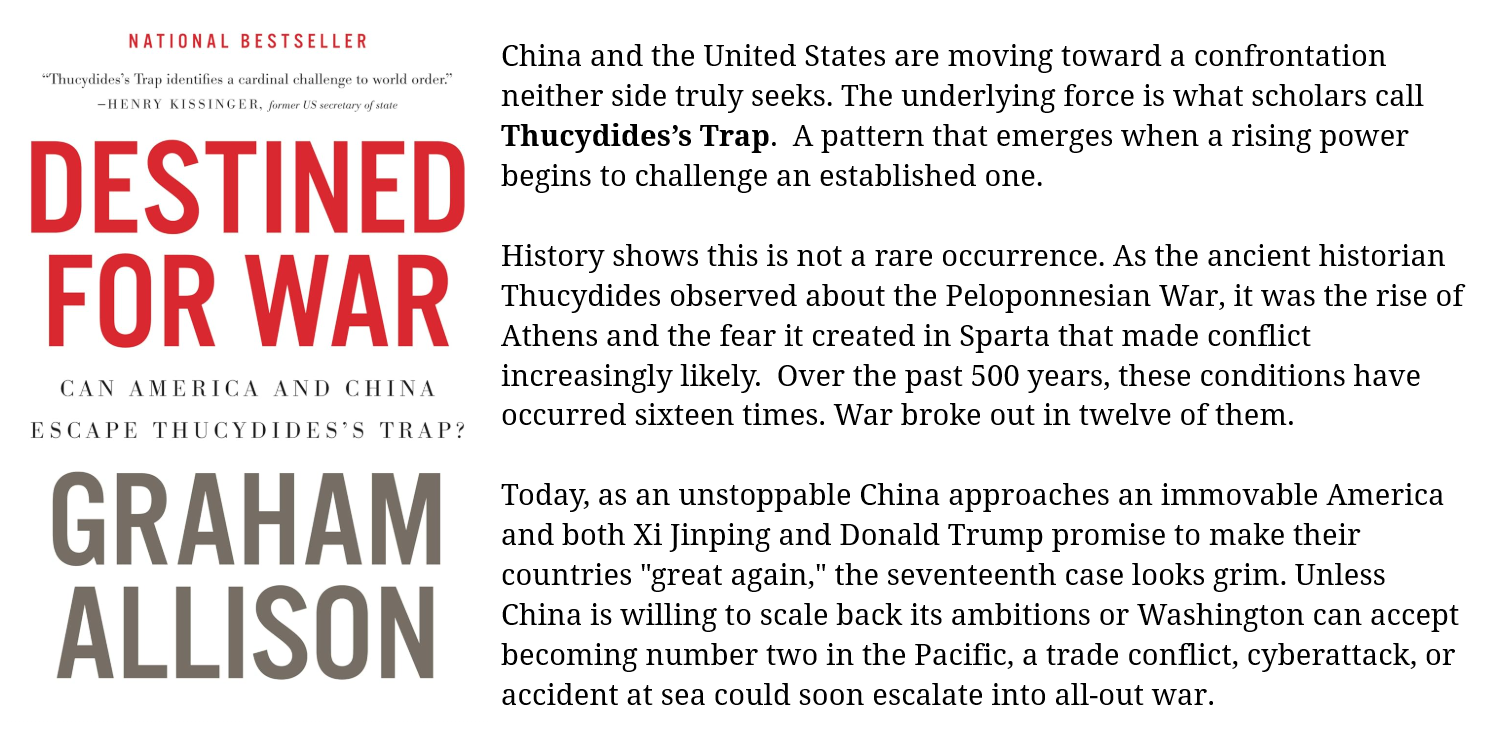
In this note, we apply Graham Allison's Thucydides Trap framework — the structural pattern that has produced great-power war twelve times in the last five centuries — to everything we now know about this conflict at the moment, and ask the question that Washington has not yet found the courage to answer: what happens when the ruling power discovers the trap has already closed?
Let us start by assessing the veracity of the question being posed.
I. The wrong question
Everyone is asking whether Trump will strike Iran's power plants. That is the wrong question. The right question is the one Graham Allison has been asking for a decade: which structural pattern does this conflict fit, and where does that pattern end?
The answer, assembled from the wreckage of the past twenty-three days, is this. The United States launched a war on February 28 to prevent a rising power's energy architecture from consolidating. Instead, it has accelerated the very multipolar shift it was designed to halt. The Iran conflict is not the Thucydides Trap. It is the preliminary engagement — the July Crisis of 1914, the Fashoda incident of 1898 — that marks the moment the trap began closing in earnest.
Allison's warning, drawn from 500 years of great-power history, is precise: when a rising power challenges a ruling one, the structural stress between them is so severe that a third-party crisis — one neither principal chose or fully controls — can trigger a war neither wanted. Of the sixteen times this pattern has appeared in the last five centuries, twelve ended in catastrophic war. The Iran conflict is where the seventeenth case is being stress-tested, and the early results are not reassuring.
Kenneth Waltz, writing in 2000 with what now reads as prophecy, put the structural logic plainly: "The American aspiration to freeze historical development by working to keep the world unipolar is doomed. The very effort to maintain a hegemonic position is the surest way to undermine it." Operation Epic Fury, launched on the morning of February 28, is that effort made kinetic. What the past three weeks have revealed is that the effort is failing faster than almost anyone anticipated — and that its failure is producing consequences that extend well beyond the Persian Gulf.
II. What this war is actually about
The surface narrative is Iran's nuclear program. The structural reality is China's energy supply chain.
Kharg Island handled approximately 90% of Iran's oil exports. The overwhelming majority of those exports flowed to Beijing. Destroying it was not a message addressed to Khamenei. It was a message addressed to Xi Jinping: the United States can physically sever your energy supply lines at a time of its choosing. The strikes on Bandar Abbas simultaneously threatened the International North-South Transport Corridor and the Belt and Road Initiative — the physical infrastructure of the alternative world order that China has been constructing for fifteen years.
Read through this lens, the five structural conditions of the Thucydides Trap are not merely present in the 2026 conflict. They are the conflict.
The ruling power's fear of displacement is Washington's animating logic. Beijing's technological acceleration — in semiconductors, in AI, in hypersonics, in the drone warfare that this conflict has now demonstrated at an industrial scale — is perceived in Washington not as competition but as an existential challenge to American hegemony. Moscow and Beijing have transitioned from diplomatic allies to technological anchors for Iran, providing S-400 air defenses, Su-35 fighters, and BeiDou navigation systems specifically designed to negate American stealth and electronic warfare advantages. Every capability transfer that degrades US military superiority is a data point in the longer rivalry.
The rising power's patience as a deliberate strategy is Beijing's operating posture. China condemned the strikes, called for a ceasefire, and did nothing militarily. Beijing's priority is to survive Trump's presidency without a major trade war or escalation, quietly solidifying its advantage in rare earth metals and doubling down on import substitution. China is watching the United States spend billions on ordnance while Beijing accumulates gold reserves, grain stockpiles, and oil storage. The patient power does not need to win the battle. It needs to survive the ruling power's overreach — and on current trajectory, it is doing exactly that.
Third-party entanglement as the tripwire is Iran's structural role. In Allison's historical cases, the great-power war is rarely triggered by the principals themselves. The Peloponnesian War began with Corinth and Corcyra. The First World War began with the assassination of Archduke Franz Ferdinand in Sarajevo. Iran is playing this role now — a third-party crisis neither the US nor China fully controls, whose escalation dynamics are determined not by the strategic intentions of Beijing or Washington but by the autonomous launch protocols of thirty-one IRGC provincial commands.
The irrationality premium — the failure of rational-actor modeling — is the feature of this conflict that most consistently surprises Western analysts. Post-Khamenei Iran is not irrational. It is executing a deliberately asymmetric strategy that rational-actor models built around Western deterrence logic cannot adequately capture. The Viet Cong used it. The Taliban used it. The IRGC has now used it at an industrial drone scale. What looks like irrationality from Washington is a perfectly coherent strategy from Tehran: make the war too expensive to continue without making it expensive enough to justify escalation to a decisive threshold.
Overextension of the ruling power is the condition Waltz most clearly predicted and the one now most visibly materializing. It is the subject of the next section.
III. The arithmetic of defeat
Six simultaneous pressures have converged to produce the five-day pause. None of them is temporary. None will be resolved by a ceasefire announcement.
Together they constitute the most comprehensive demonstration of ruling-power overextension since the Suez Crisis of 1956 — when Britain discovered, in real time, that its imperial reach had exceeded its economic capacity.
The bill arrived. The Pentagon requested over $200 billion in supplemental funding for a war that cost $11.3 billion in its first six days and $16.5 billion in its first twelve. At $1.38 billion per day and accelerating, congressional resistance is real. The war that was supposed to take "days not weeks" now requires a vote that may not pass. Secretary Hegseth's comment — "it takes money to kill bad guys" — does not constitute a fiscal strategy.
The Fed killed the rate-cut thesis. On March 18, the Federal Reserve held rates at 3.5 to 3.75 percent and revised its 2026 PCE inflation forecast to 2.7 percent from 2.4, explicitly citing the Iran war energy shock. The dot plot shows one cut in all of 2026, down from two. Every basis point of delayed easing is compounding pain for housing, credit markets, and technology valuations. The war that was supposed to demonstrate American strength is instead demonstrating American inflation.
The allies revolted politely. Twenty-two countries signed up to coordinate on Hormuz. Zero committed a warship during combat operations. Japan is releasing strategic reserves. South Korea's Kospi has fallen 12 percent. Europe's gas prices surged 35 percent after Qatar declared force majeure on LNG deliveries, a disruption that may last up to five years. Trump called NATO "cowards" and received a press release in response. The coalition of the willing has become a coalition of the waiting.
TSMC sent the signal. Taiwan imports nearly 97 percent of its energy. Its LNG reserves cover eleven days of consumption. Qatar supplies approximately a third of global helium, which TSMC requires for chip fabrication. The helium is bottled behind a closed strait. Every Nvidia GPU, every Apple chip, every AI training cluster depends on a fabrication facility in Hsinchu that is now counting its gas reserves in single-digit days. The Magnificent Seven have shed hundreds of billions in market capitalization as energy rotation crushes technology valuations. The war started to contain China's technological rise has created the conditions for a global semiconductor supply crisis that will hurt American technology firms far more than Chinese ones, which have been building domestic alternatives for years.
Birol named the damage. The IEA chief told an audience in Australia that 40 energy assets across nine countries are severely damaged, that global oil supply has fallen 11 million barrels per day, and that the crisis exceeds both 1970s oil shocks combined. He specifically named fertilizers and helium as interrupted flows. The war that was supposed to protect the energy order has produced the worst energy crisis in modern history. The planting window for Northern Hemisphere crops is closing. Fertilizer-dependent farm states in the American Midwest are beginning to understand that the Iran war has a direct line to their soil.
The midterm arithmetic. Gas prices are up 93 cents per gallon. Sixty-six percent of Americans describe this as a war of choice. Sixty percent disapprove. Fifty-seven percent say it is going badly. The numbers that matter in Washington are not barrels per day. They are approval ratings in swing states where voters fill their tanks every Tuesday morning.
These six pressures are not independent. Together they constitute a system.
The ruling power has walked into a feedback loop of its own construction.
IV. The drone revolution changes the calculation permanently
In his program Fareed’s Take, CNN’s Fareed Zakaria looks at Iran’s response to U.S. and Israeli strikes and argues that it reflects a new kind of warfare—one that challenges the old idea of military dominance built on expensive, high-end systems. More importantly, he suggests Iran is turning the economics of war on its head, forcing the U.S. to spend far more to defend than Iran spends to attack.
Fareed Zakaria's commentary identifies what is arguably the most consequential military development since nuclear weapons: the permanent inversion of the cost-exchange ratio in conventional warfare.
The attacker can sustain this arithmetic indefinitely. The defender cannot.
Lockheed Martin produced approximately 600 Patriot interceptors in all of 2025. The goal is 2,000 by 2027.
Meanwhile, Russia is now producing 404 Shahed-type drones every day, with a target of 1,000 per day.
Ukraine, out of wartime necessity, has built an interceptor drone that costs $2,000, flies at 280 kilometers per hour, and is being produced at more than 10,000 per month.
The production differential is a chasm, and not merely an inconvenient "gap".
Michael Horowitz of the Council on Foreign Relations calls this the era of "precise mass" in warfare. For decades, precision meant a handful of Tomahawk missiles or stealth bombers — technologies that required great industrial nation capacity to produce and operate. Now it means one-way drones built from commercial components and launched in swarms that overwhelm point-defense systems through volume alone. The side that wins tomorrow's wars may not be the one with the finest platforms. It will be the one that can field enough adequate platforms cheaply enough, quickly enough, and network them intelligently enough.
The implications for the Thucydides analysis are direct.
There is also a software dimension that the hardware numbers obscure. Ukraine has opened its battlefield data to allies for AI training — millions of annotated images from tens of thousands of combat flights. Ukraine's Defense Minister describes this as a dataset unmatched anywhere in the world.
Right now, neither the United States nor China has that data in the volume that two years of drone warfare in Ukraine has produced.
V. The leaderless war machine and the negotiation illusion
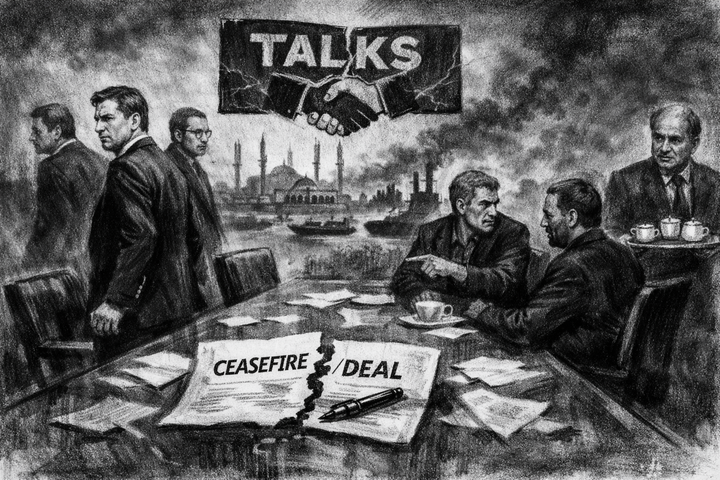
Trump's Truth Social post on Monday morning produced one of the most extraordinary market events in financial history. At 7:04 AM ET, he announced "very good and productive" discussions with Iran. By 7:10 AM, the S&P 500 had surged 240 points, adding $2 trillion in market capitalization. Twenty-seven minutes later, Iran's foreign ministry denied all contact. By 8:00 AM, the index had fallen 120 points, erasing $1 trillion. A $3 trillion swing in 56 minutes — in the S&P 500 alone.
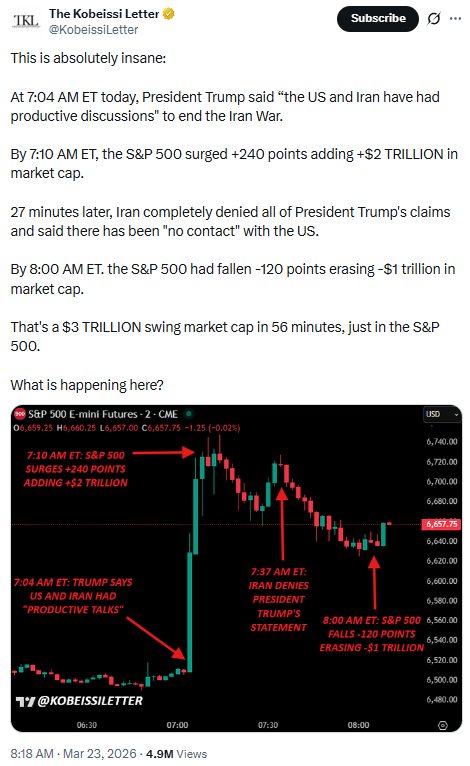
This event is not a footnote. It is a diagnostic. It tells us several things simultaneously: that markets remain acutely sensitive to any signal of de-escalation; that Trump's statements about the war have become price events rather than reliable strategic signals; and that whoever knew about the post before 7:04 AM had access to a trading opportunity of historic proportions. The University of Tehran professor Seyed Mohammad Marandi said it plainly: "Every week, when markets open, Trump makes these kinds of statements to drive down oil prices. Even his five-day deadline aligns with the closure of the energy market."
Iran's parliament speaker Ghalibaf was equally direct, calling the negotiations "fake news used to manipulate financial and oil markets and escape the quagmire in which the US and Israel are trapped." Whether or not the specific claim of deliberate manipulation is accurate, the structural observation is correct: the United States is trapped. And the way trapped ruling powers behave in Allison's historical cases is precisely what we are observing — a search for narrative exits that preserves the appearance of strength while acknowledging, in the arithmetic of postponements and pauses, that the original plan has failed.
But there is a deeper problem with the negotiation premise that goes beyond Trump's credibility. Even if genuine back-channel talks are underway, the fundamental obstacle is architectural.
This article discusses IRGC's "Mosaic Doctrine."
 Share Get link Facebook X Pinterest Email Other Apps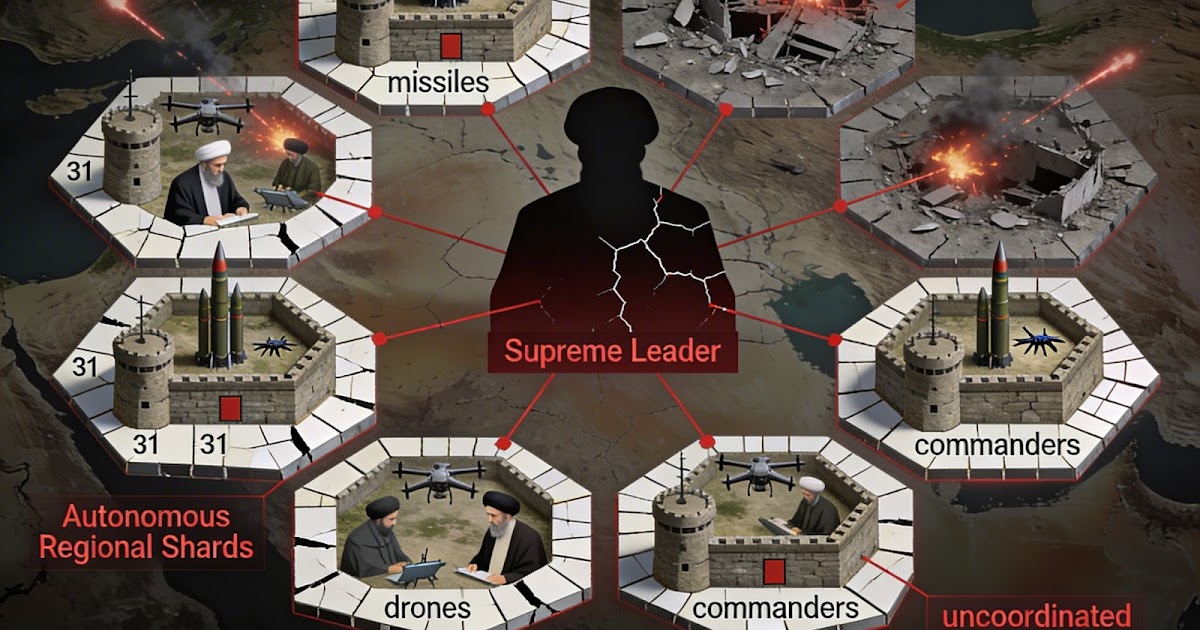
The “mosaic defense” framework of Iran is a deliberately decentralized military architecture built by the IRGC after observing how centralized regimes like Iraq and Afghanistan collapsed under U.S. strikes. Instead of a top-down command, Iran divided its military into 31 semi-autonomous provincial units, each with its own intelligence, weapons, logistics, and—critically—pre-delegated authority to act independently if central command is disrupted.
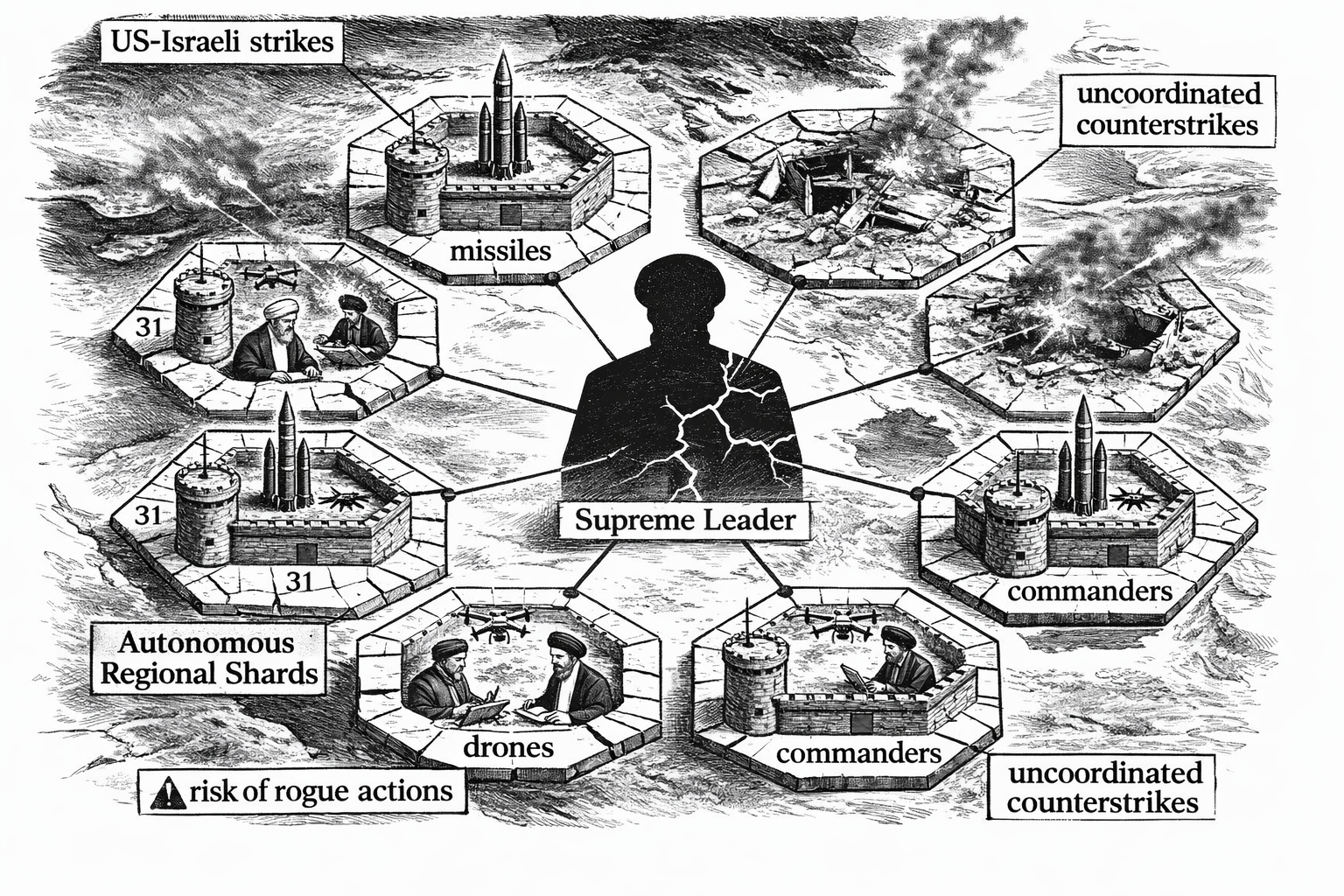
The IRGC's mosaic doctrine, formalized in 2008, created 31 independent provincial commands each with its own weapons stockpiles, drone assembly facilities, and pre-delegated launch authority. When the opening strikes killed Khamenei, the IRGC commander, the defense minister, and over a dozen senior officials simultaneously, the new Iranian system was simply activated.
In the current conflict scenario, this system has been fully activated the IRGC units continue operations based on pre-programmed instructions rather than real-time orders, leading to sustained but often uncoordinated strikes.
Not effectively—at least not in the conventional sense. Negotiation requires a central authority that can control escalation and enforce compliance. The mosaic model undermines this. Even if Tehran agrees to de-escalate, it cannot reliably stop all units, some of which may continue acting on prior directives or incomplete situational awareness.
Bottom line: The mosaic framework makes Iran resilient to military decapitation but structurally resistant to negotiated restraint. It increases survivability, but at the cost of control.
This creates a dangerous paradox: Iran can keep fighting even when it may want to stop, making diplomatic resolution with the U.S. far more difficult and uncertain.
Foreign Minister Araghchi acknowledged this on the first day of hostilities: "Our military units are now, in fact, independent and somewhat isolated, and they are acting based on general instructions given to them in advance." This was not a warning. It was a confession of structural reality — and simultaneously Iran's most powerful deterrent. You cannot negotiate a ceasefire with a party whose military apparatus does not have a centralized off switch.
The Israeli intelligence head who served as head of the Iran branch said it clearly: Trump and Netanyahu assumed that decapitating Khamenei would collapse the regime. They didn't think about what would happen next. They could see the trees — the leadership locations, the command centers — but they couldn't see the forest. The Islamic Republic is not a personalistic dictatorship. It is an institutionalized system specifically designed to survive exactly the kind of strike launched on February 28.
 Ashkan Hashemipour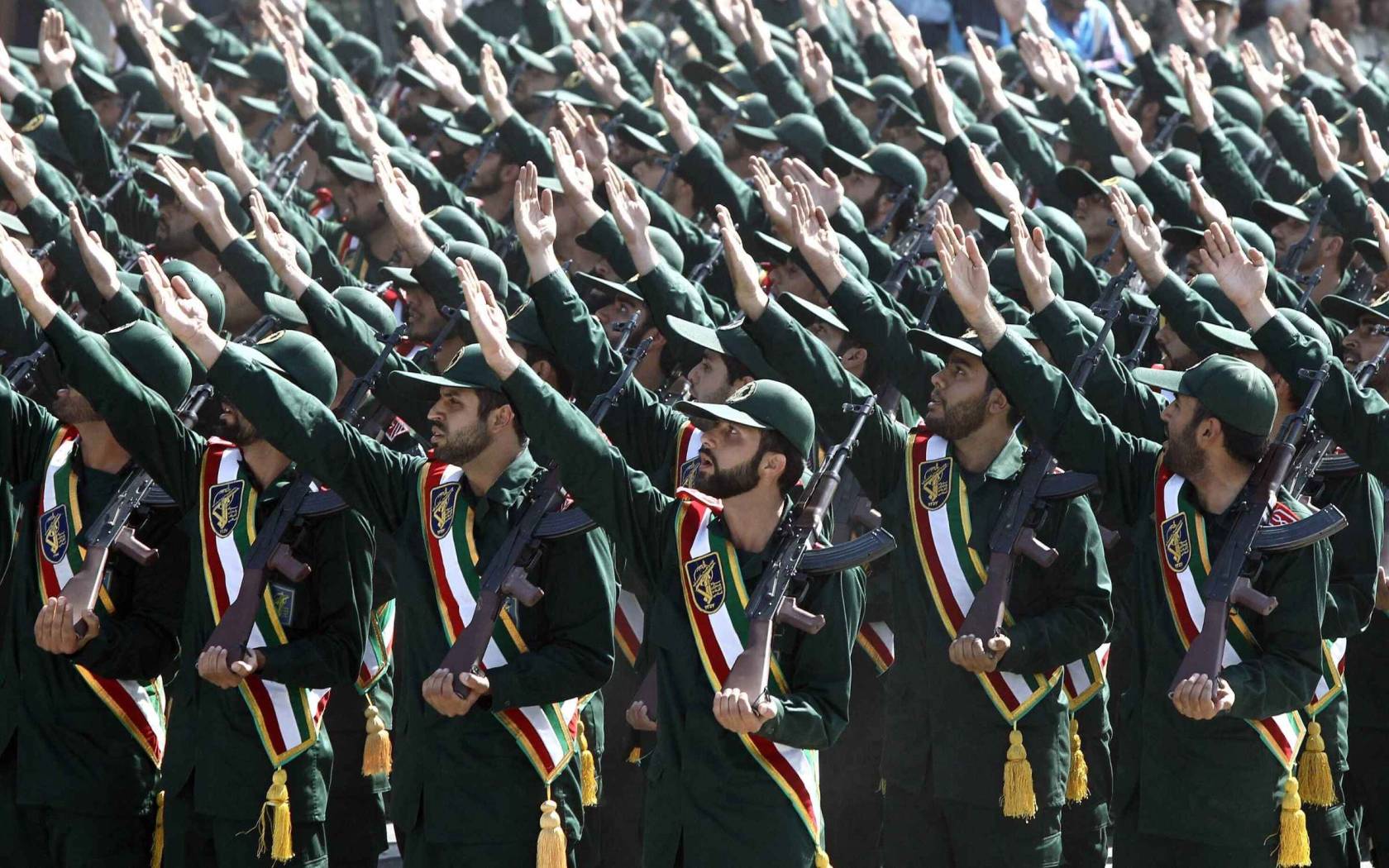
So, what happens to the Thucydides Framework?
Well, the Thucydides framework is built on the assumption that both principals are rational, command-unified actors capable of signaling, committing, and ultimately negotiating.
The Iran conflict has introduced a variable that Allison's model did not fully account for: a trigger-state whose military apparatus has been structurally decoupled from civilian political authority.
Even a genuine Iranian desire to de-escalate cannot translate into a cessation of strikes, because the provincial commands are executing pre-authorized strike packages that cannot be recalled by a foreign minister's press release or a supreme leader's instruction.
VI. The nuclear threshold: the war's most dangerous long-term consequence
The Israeli intelligence veteran's analysis on Zakaria's show deserves to be treated as the most important strategic warning in this conflict.
The logic is structural. Until the February 28 strikes, Iran's nuclear posture was governed by Khamenei's fatwa against nuclear weapons — a religious prohibition that functioned as a de facto red line, keeping Iran permanently at threshold status: capable of building a bomb but choosing not to. Khamenei is dead. The fatwa died with him.
Mojtaba Khamenei, formally elected supreme leader on March 8, is a young, radicalized figure who has watched his father, mother, wife, and daughter killed in the opening strikes.
He is not his father.
The IRGC elements that control him are not interested in the clerical pragmatism that kept Iran at threshold status for two decades. They have watched every conventional deterrent they possessed — the proxy network, the missile program, the air defense systems, the strategic leadership — fail to prevent the strikes.
The conclusion they are drawing is the same one every state draws when conventional deterrence fails: the ultimate deterrent is the only one that cannot be degraded by superior airpower.
The strategic question is no longer whether Iran can build a nuclear device. It is whether Mojtaba Khamenei and the IRGC leadership have concluded that the survival of the Islamic Republic requires them to.
This is the dimension of the conflict that the Thucydides framework predicts with grim consistency.
In Allison's historical cases, the ruling power's attempt to prevent the rising competitor's consolidation frequently accelerates the very development it sought to halt.
Britain's attempts to contain German naval power before 1914 accelerated German militarization. America's containment of China has accelerated Chinese technological self-sufficiency. The attempt to permanently degrade Iran's conventional deterrent has created the conditions for Iran's acquisition of an unconventional one. The trap springs not just in the direction of the US-China conflict. It springs in every direction simultaneously.
VII. The shadow architecture: what Russia and China are actually doing
Both have condemned the strikes. Neither has sent troops. Neither will. This is not a restraint born of weakness. It is a strategy born of structural confidence — the posture of powers that understand they are winning without firing a shot.
Russia signed a comprehensive strategic partnership treaty with Iran in January 2025, covering trade, military cooperation, science, and education. The pair conducted joint military drills in the Indian Ocean the week before the US-Israeli strikes began.
 Nils Adler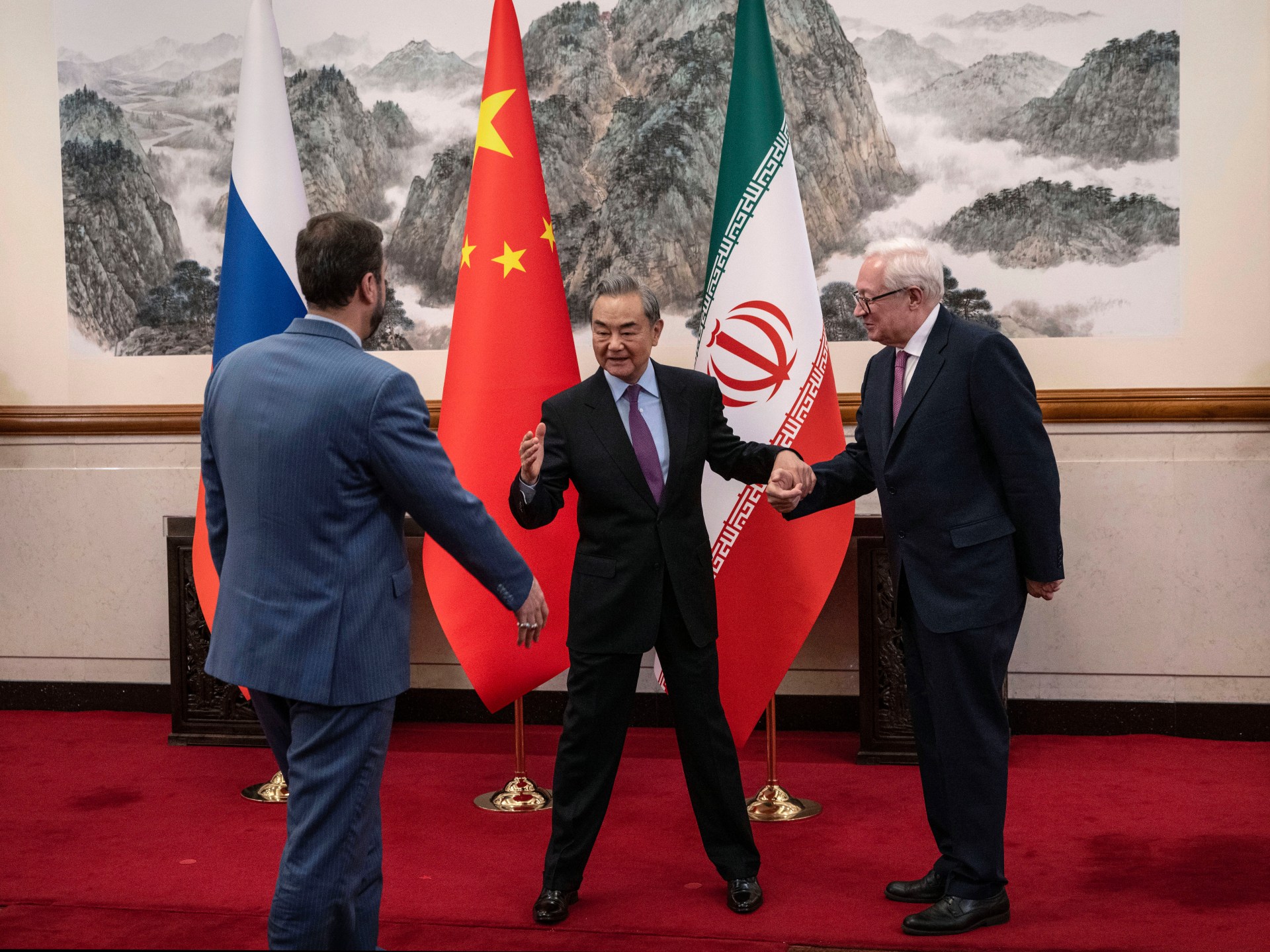
Russia supplied the Khayyam spy satellite — a Kanopus-V instrument providing high-resolution imagery that allows Tehran to monitor specific US and Israeli bases — as well as Su-35 fighters equipped with electronic warfare pods designed to detect low-observable aircraft like the F-35.
 Silvia Boltuc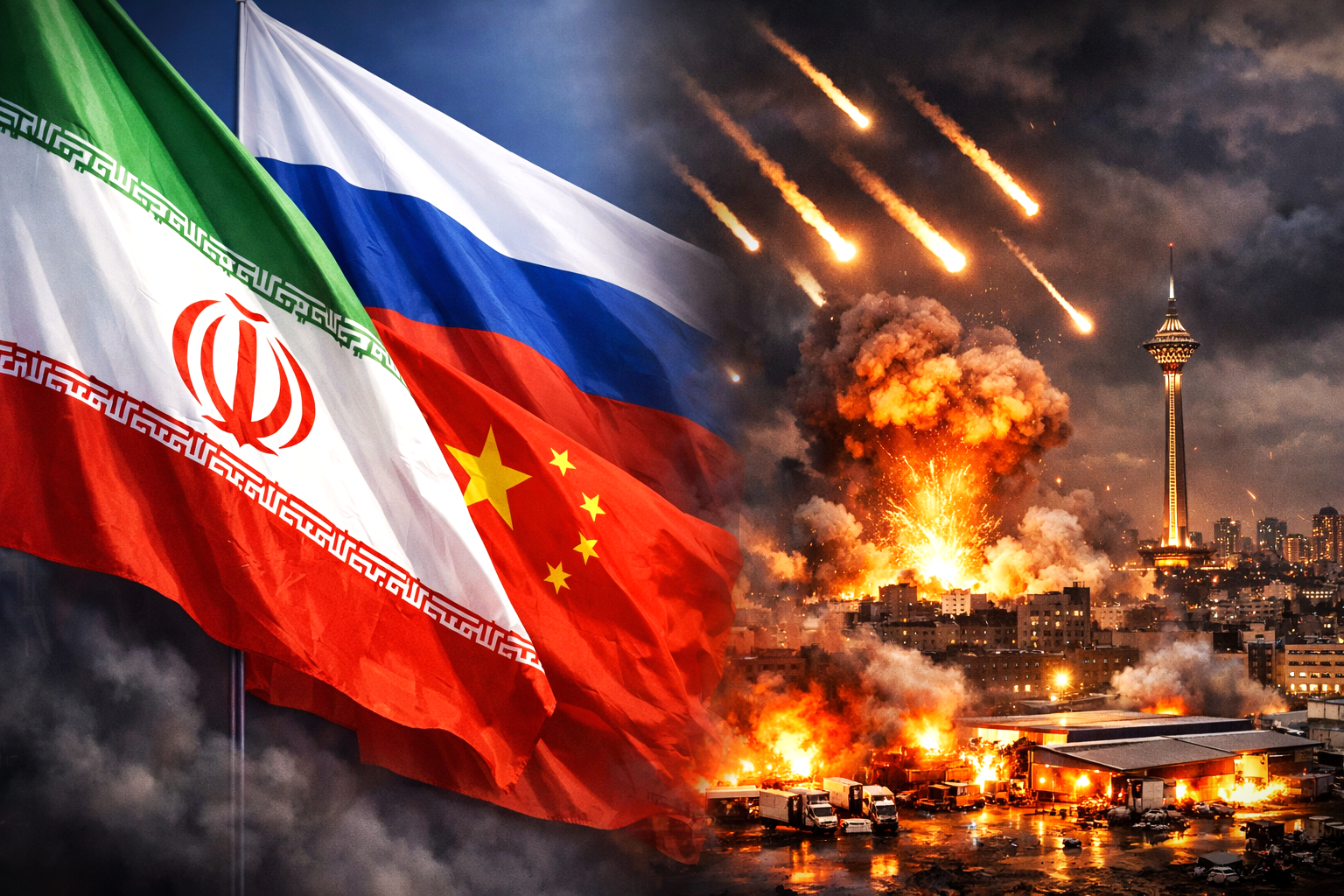
Iran's Foreign Minister Araghchi confirmed that his country is receiving "military cooperation" from both Russia and China: "We had good cooperation with these countries — politically, economically, even militarily."
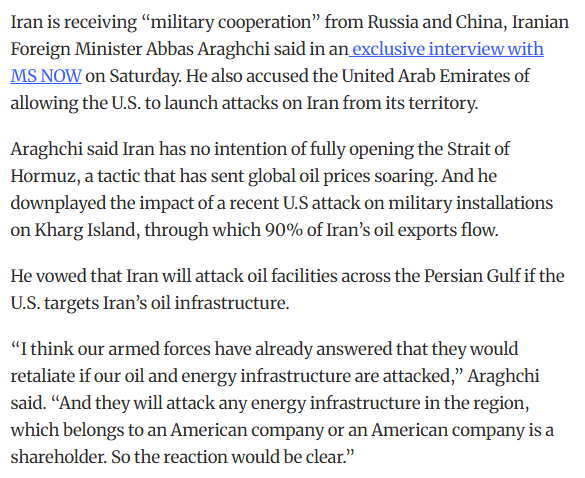
China provided radar systems, navigation technology, and missile components. Chinese radar and BeiDou navigation technology, exported pre-war, enhanced Iran's electronic warfare capabilities against the most advanced Western platforms.
It’s too late for the United States to rescind the security guarantees it has handed out to its allies: that would inflict too much reputational damage. But China never provided such guarantees, and—observing the United States’ current difficulties—has no intention of starting now. Indeed, Beijing does not even officially use the term “ally,” preferring “friendship without limits” or “all-weather strategic cooperation.” (Source: Why Are China and Russia Not Rushing to Help Iran? / Carnegie Endowment)
Beijing was conspicuously absent for Russia in Ukraine, for Maduro in Venezuela, for Pakistan against the Taliban. What China is doing instead is something more consequential than military intervention: it is watching the United States demonstrate, in real time, the limits of hegemonic power against a distributed, asymmetric adversary.
Every day this war continues is a live-fire experiment for Beijing's Taiwan calculus.
The drone cost revolution Zakaria describes — the inversion of the cost-exchange ratio, the industrial-scale production of autonomous systems, the compression of find-decide-hit cycles to under ten seconds — is being studied with meticulous attention in Chinese military planning centers.
Taiwan sits ninety miles off the Chinese coast. The lessons of the Persian Gulf are being annotated and filed.
The Gulf states, meanwhile, are reviewing trillions of dollars in sovereign wealth fund commitments to US markets. Three of the four largest Gulf states were already reconsidering $1.2 trillion in US investment commitments made after Trump's May 2025 visit.
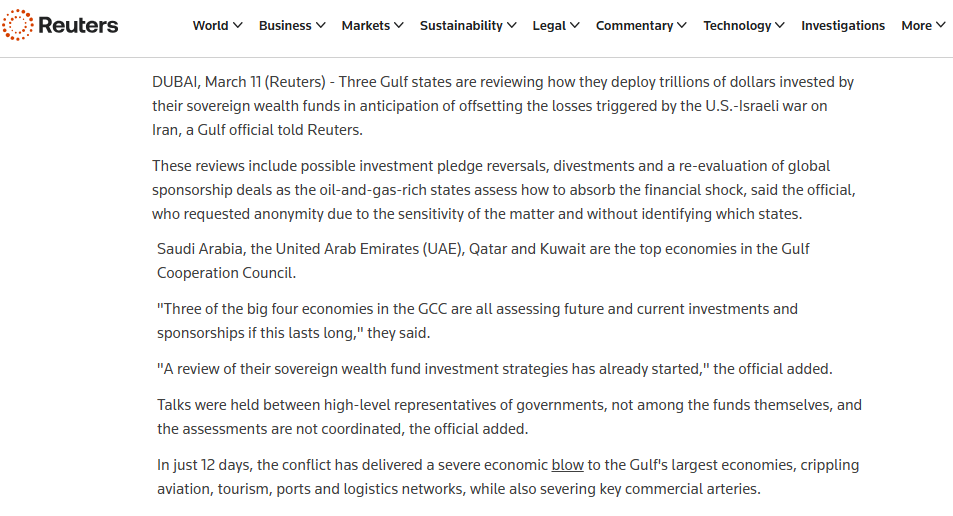
The reported $5 trillion demand — pay this if you want the war to continue, half that to end it — has not been officially confirmed, but the structural dynamic it describes is real: the US is attempting to offload the financial burden of a war it initiated onto states who are simultaneously being struck by Iranian drones and losing oil revenue because the waterway is closed.
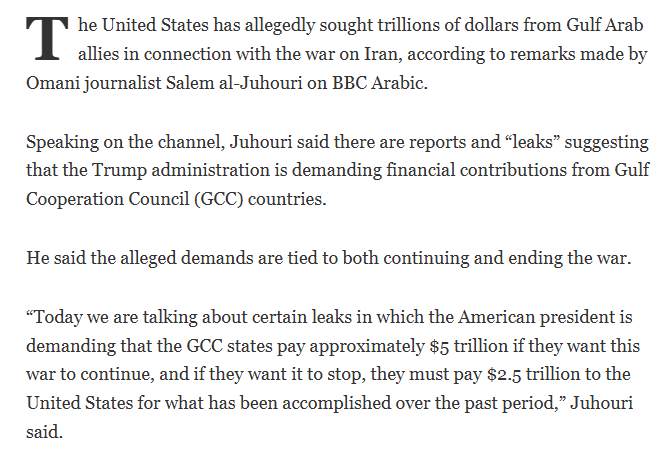
What was supposed to be a coalition is anything but. It is a protection arrangement under terminal stress.
VIII. Three trajectories, one dominant direction
The Thucydides model, updated with everything we now know, points toward three possible trajectories. But the new information from the past week has significantly changed the probability weights.
Trajectory one: managed retreat dressed as victory. This remains the most likely near-term outcome, but it is now more clearly a defeat than a negotiated settlement.
Trump announces a framework — probably involving Iranian "commitments" on the nuclear program, some face-saving language about regional security, Gulf state money rebranded as reconstruction investment, and a partial reopening of the Strait. Iran claims it forced the US to back down. Trump claims he achieved his objectives.
The IRGC provincial commands, having received no actual order to stand down, continue low-level strikes for weeks.
This is the Fashoda model: a standoff where the weaker side held its ground, the stronger side retreated with its dignity nominally intact, and the underlying power dynamic shifted permanently in favor of the party that refused to blink.
Core idea: if the weaker actor credibly demonstrates willingness to risk escalation, the stronger power may choose restraint, in order to preserve face, avoid costs, and inadvertently shift the long-term balance toward the side that refused to blink.
Britain remained dominant for another decade after Fashoda. The moment of its eventual decline had been marked.
Trajectory two: the economic fracture accelerates before a deal can be reached. If the Hormuz blockade continues beyond 30 days, the damage to the global economy will be done regardless of what any ceasefire agreement says.
Even a successful negotiation — if one is achievable — will produce a world in which the costs of American hegemony have become visible to every state that previously accepted the Bretton Woods bargain on faith.
The price of the American security umbrella has been revealed. Some will conclude it is too high.
Trajectory three: the nuclear escalation path. This is the least likely in the immediate term and the most consequential in the long term.
If Mojtaba Khamenei and the IRGC leadership conclude — rationally, given the evidence — that conventional deterrence has permanently failed, and that the United States will strike again once it has rebuilt its strike capacity, the decision to enrich to weapons-grade becomes a matter of institutional survival rather than ideological choice.
An Iranian nuclear test, or a credible public declaration of nuclear capability, would restructure the entire strategic landscape of the Middle East and the Thucydides rivalry simultaneously.
It would trigger an Israeli response calculation, a Saudi proliferation decision, and a US-China confrontation over whether Beijing would tolerate the outcome.
IX. The Thucydides prediction: where the trap leads
Allison's framework ends with a question and a warning. The question: can clashing powers take the painful steps necessary to avoid catastrophe? The warning: historically, they usually cannot, because the structural pressures of the trap produce domestic political constraints that make the necessary concessions politically unsurvivable for the ruling power's leadership.
The painful step in the current case is American acceptance of a multipolar energy and trade architecture — a world in which oil is priced in multiple currencies, maritime chokepoints are not controlled by US-allied navies alone, and technology standards are set in Beijing as well as Washington. That is precisely what Operation Epic Fury was designed to prevent. It is also, at this point, what the arithmetic of the conflict is producing, regardless of military outcome.
Consider what has already happened in three weeks of war.
The dollar's petrodollar architecture has been visibly stressed by a closed strait, and Gulf states are reconsidering their US investment commitments.
The US Navy's claim to control the world's maritime chokepoints has been challenged by drone swarms that cost less than a single Patriot intercept. America's coalition-building capacity has been exposed as a coalition of press releases.
The Fed's monetary independence has been complicated by a war-driven energy shock. TSMC's supply chain — the physical foundation of American technological superiority — has been shown to be eleven days of LNG away from catastrophic disruption.
None of this is fatal to American power. All of it is cumulative.
Thucydides did not describe Athens' fall in a single battle. He described a long war of attrition in which the ruling power's resources, alliances, and domestic political cohesion were gradually consumed by a conflict it could not win decisively and could not afford to lose publicly.
China needs to do nothing except wait and watch. It has the gold. It has the grain reserves, at 50 percent of global wheat and 60 percent of global rice. It has 1.2 billion barrels in strategic oil reserves — 150 days of total autonomy even if the strait stays closed. It has floating storage of 40 million barrels in the Yellow Sea, up 20 percent since the war began.
And crucially, it now has a live-fire demonstration of the asymmetric warfare model it has been building for a decade, complete with cost-exchange ratios, production benchmarks, electronic warfare performance data, and a detailed record of how American coalition management fails under real pressure.
Waltz's structural realism predicts the outcome with the dispassion of a physicist describing gravity.
Let us look at the prescriptive scenario.
The forces of multipolarity, once released, do not reverse.
The question is not whether American unipolarity ends. The question is whether it ends through managed transition or catastrophic discontinuity.
What the Iran war of 2026 has demonstrated, in twenty-three days of strikes and counter-strikes and $3 trillion market swings and closed straits and helium shortages and Fed rate revisions, is that the managed transition is going to require American leaders to publicly accept constraints on American power that no American leader has yet been willing to accept.
The trap is not a metaphor. It is a structural condition that produces specific, predictable behaviors — and the behaviors we are observing in Washington, Tehran, Beijing, and the Gulf capitals are precisely the ones Thucydides described 2,400 years ago, watching Athens and Sparta consume themselves in a war that neither had wanted, and neither could stop.
This essay is part of Stratega — a series at Drishtikone that maps the intersections of geopolitics, technology, economics, and war that the mainstream conversation consistently arrives at too late, frames too narrowly, or avoids entirely.
We are living through a structural transformation of the kind that happens once in a century — when the rules that governed the previous order stop working and the rules of the next one have not yet been written. Stratega exists to name what is happening while it is happening, using the best frameworks available and the best evidence on the ground, not after the verdict is in.
If this changed how you are thinking about the war — share it with at least one person who needs to read it. Not to convince them of a conclusion, but to give them a framework. In a moment when a single Truth Social post can move $3 trillion in 56 minutes, the most valuable thing any of us can offer each other is clarity about the structure underneath the noise.
The trap is closing. The more people who understand that, the better.
— Desh Kapoor, Drishtikone
Comments ()