
Nirupama Rao and the Art of Appeasing the Unappeasable
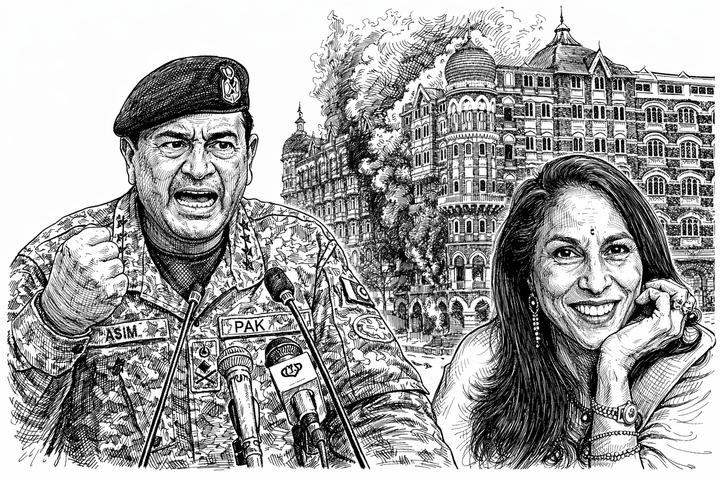
For years, Pakistani Generals have had great collaborators - the hopelessly foolish Indian diplomats. Pakistani generals had them exactly where they wanted them - their vassals. Nirupama Rao’s Dhurandhar review shows exactly what was wrong with Indian diplomacy!
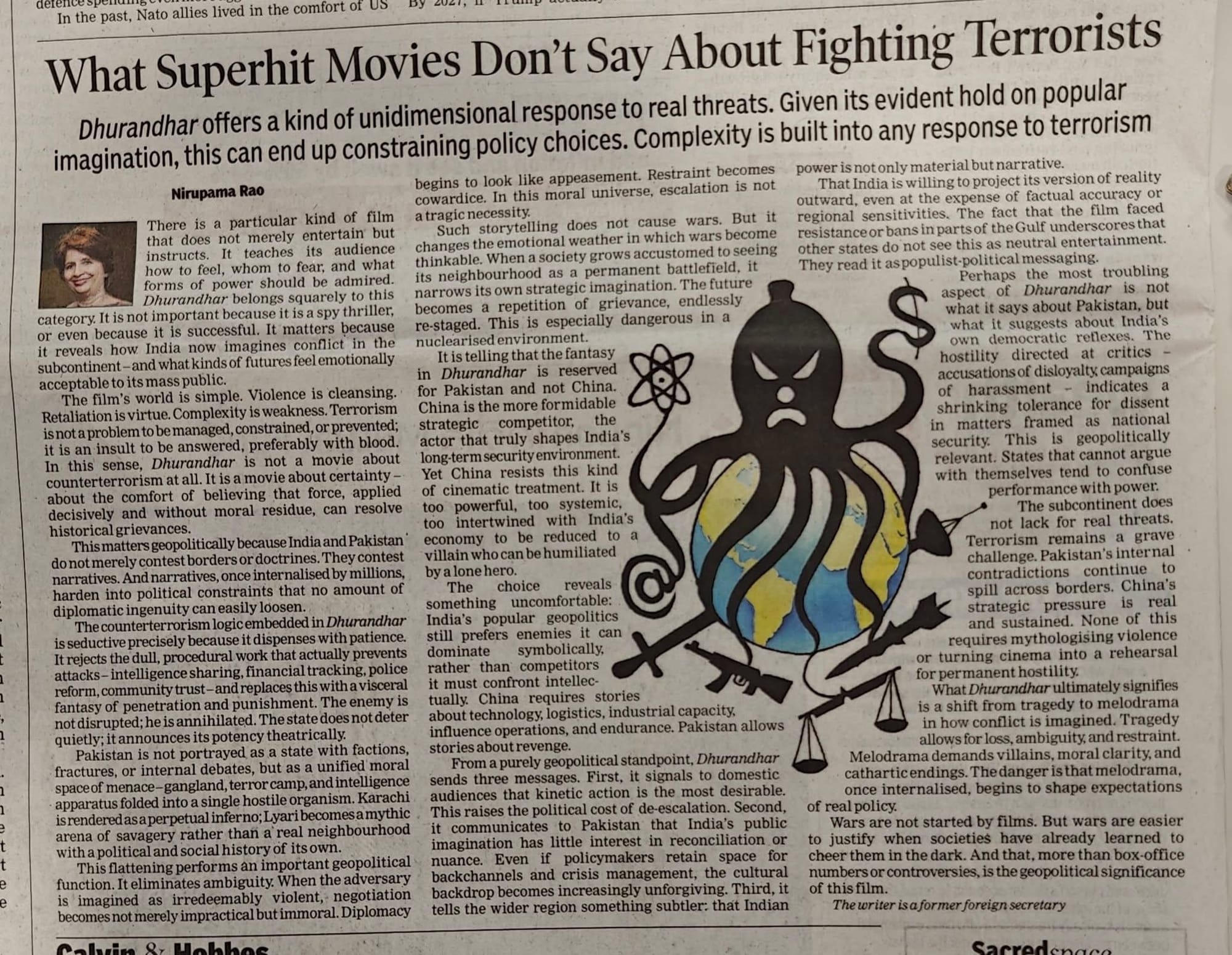
The central flaw in Nirupama Rao’s review of Dhurandhar is not aesthetic. It is epistemic. It mistakes moral comfort for strategic wisdom, and diplomacy-as-theory for security-as-reality.
The article laments a cinematic universe where force is decisive, ambiguity is minimal, and mistakes are fatal. But this is not a fantasy imposed by filmmakers. It is the actual operational reality of counterterrorism and espionage in South Asia.
In intelligence work, a single compromised asset does not produce “learning moments.” It produces dead agents, burned networks, and emboldened adversaries. The movie does not exaggerate this truth; it merely refuses to sanitize it.
To criticize such a portrayal is, in effect, to criticize reality for being insufficiently polite.
What is most striking is the author’s insistence that restraint, ambiguity, and dialogue are somehow the higher moral plane.
Even when the adversary in question has demonstrated decades of bad faith, strategic deception, and calibrated violence.
Pakistan is not a misunderstood neighbor trapped in tragic complexity. It is a state whose terror infrastructure is structurally embedded in its military and intelligence services, with civilian politics operating largely as international-facing decor.
This raises the question the article carefully avoids:
With whom, exactly, is India supposed to negotiate?
- Terrorist groups who openly proclaim mass-casualty intent?
- The ISI, which incubates, trains, funds, and launders those groups?
- Civilian governments that neither control territory nor constrain the security establishment?
Diplomacy is not conducted in the abstract. It requires a counterparty with agency and credibility. Pakistan’s repeated cycles of deniability followed by escalation have destroyed both.
The critique also performs a subtle inversion of moral burden. It implies that India’s refusal to endlessly “engage” reflects a shrinking democratic reflex, rather than strategic exhaustion.
This is not only analytically wrong. It is ahistorical.
India tried engagement. Composite dialogue. Track-II diplomacy. Cricket diplomacy. Cultural outreach. Backchannels. Confidence-building measures.
Each initiative was answered with Kargil, Parliament attack, Mumbai 26/11, Pathankot, Uri, Pulwama. And a relentless and an unbroken stream of lesser-known attacks that did not make international headlines but reshaped Indian internal security doctrine.
At some point, restraint ceases to be virtue and becomes negligence.
What Dhurandhar reflects, and what unsettles critics like Nirupama Rao, is a shift in Indian strategic psychology.
From performative restraint to deterrence through clarity. From pleading narratives to enforceable red lines. From the illusion that escalation is always worse than inaction, to the recognition that unchecked terror metastasizes.
This is not melodrama replacing tragedy. It is realism replacing denial.
Wars are not caused by films. They are caused by adversaries who calculate that violence carries low cost. If cinema helps normalize the idea that such calculations will be punished, not debated into submission, that is not a failure of imagination.
It is a correction of it. Undoing decades of false narratives funded by ISI’s goons controlling Bollywood.
That link stands broken and, through critics like Nirupama Rao, the exposed as well!
And finally, a hard truth:
Those who spent decades talking to Pakistan’s establishment with nothing to show in reduced terror do not earn moral authority by scolding those who finally chose results over rhetoric.
The world of diplomacy is not superior to the world of espionage.
It is merely safer. For those who never have to clean up the consequences when diplomacy fails. Which it did since 1947 for many decades with respect to Pakistan.

Comments ()