
The Bangladesh Trap
Burning of Dipu Chandra Das, attacks on Indian consulate, and global bias of media and the open challenge from the Western consulates and government to India are acts calibrated for one thing - trap India in a proxy-of-a-proxy war!
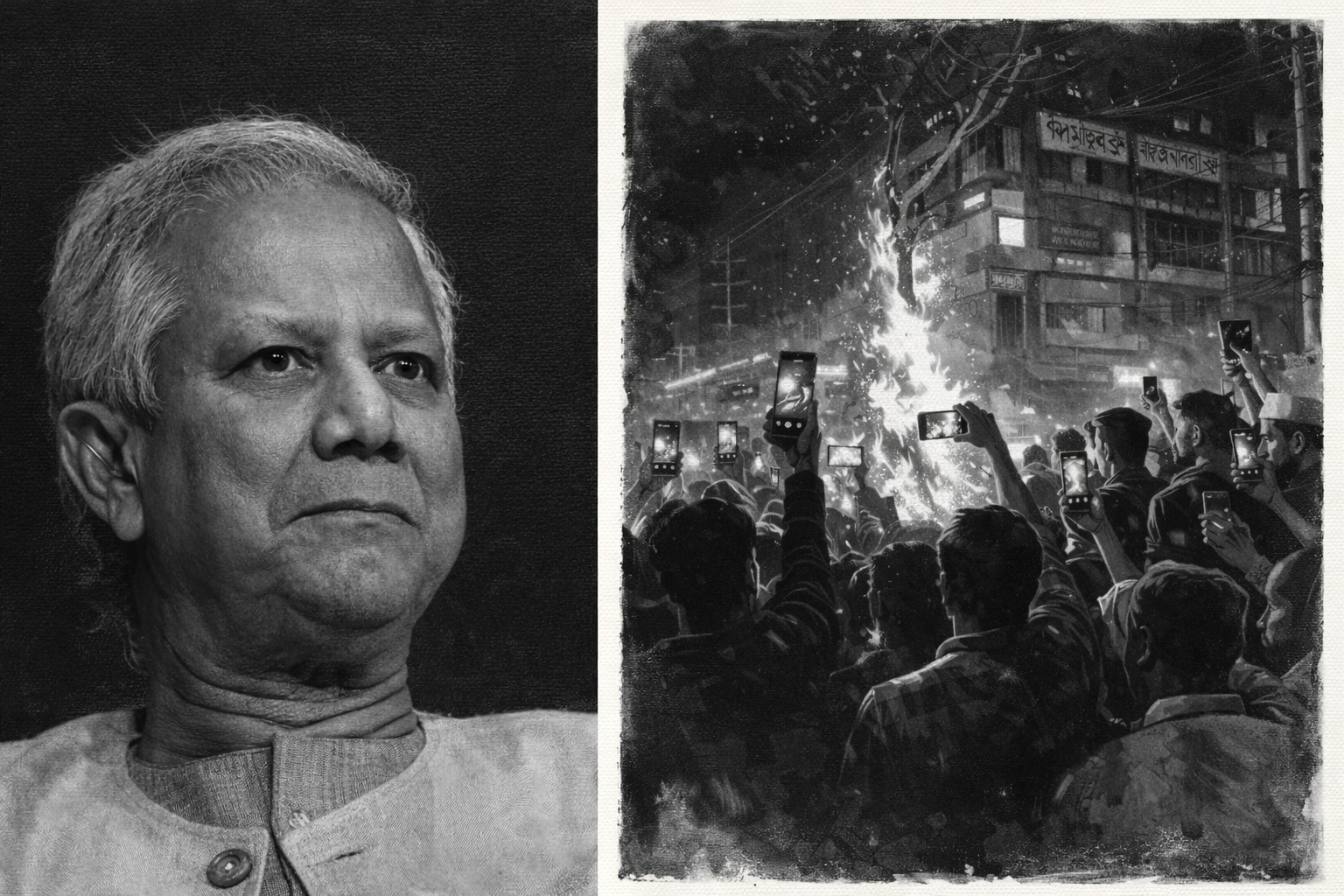
The Man Who Said the River Had Many Names
There was once a man who lived by a river.
He was poor, so poor that the river knew his footsteps better than any king did. Each morning, before the birds spoke, he crossed the water to work with his hands. He fed machines that wove cloth for people who would never touch the river, never hear its name.
The man believed a simple thing.
He believed the river was one—
even though the villagers called it by many names.
One day, while resting under a banyan tree, he said this aloud.
A listener frowned.
“The river is not one,” the listener said.
“It has only one true name.”
The man smiled, confused.
The river flowed on.
That night, the village gathered—not to ask, not to listen, but to correct.
Words became stones.
Stones became fire.
The man was taken to the gate where the guards stood. He told them he meant no harm. He told them he only spoke of water.
The guards listened, nodded, and stepped aside.
The river heard screams before it heard silence.
The next day, a drumbeat rose in the capital.
A different man had fallen—a man of fire and slogans.
Crowds wept for him.
Banners were lifted.
Foreign messengers lit candles and spoke of justice.
The river carried the smoke from the first man’s body downstream.
No one spoke his name.
A monk watching from the hills turned to his student.
“Master,” the student asked, “why do they mourn one death and ignore another?”
The monk replied:
“Some deaths feed the story.
Others expose it.”
The student asked, “What is the story?”
The monk said:
“That only certain voices may name the river.
That some waters are holy, and others expendable.
That truth may be spoken—
but only by those already forgiven.”
The student asked, “What should the river do?”
The monk answered:
“The river does not ask permission to flow.
It remembers every footstep.
Every burning.
Every silence.”
“One day,” the monk said, “those who tried to dam it with words will discover that water does not forget its course.”
And the river flowed on—
with many names,
and one truth.
SUPPORT DRISHTIKONE
In an increasingly complex and shifting world, thoughtful analysis is rare and essential. At Drishtikone, we dedicate hundreds of dollars and hours each month to producing deep, independent insights on geopolitics, culture, and global trends. Our work is rigorous, fearless, and free from advertising and external influence, sustained solely by the support of readers like you. For over two decades, Drishtikone has remained a one-person labor of commitment: no staff, no corporate funding — just a deep belief in the importance of perspective, truth, and analysis. If our work helps you better understand the forces shaping our world, we invite you to support it with your contribution by subscribing to the paid version or a one-time gift. Your support directly fuels independent thinking. To contribute, choose the USD equivalent amount you are comfortable with in your own currency. You can head to the Contribute page and use Stripe or PayPal to make a contribution.
Islamist Hindu-Burning and the Great Game
A poor Hindu man named Dipu Chandra Das went through an ordeal and met an end that no one should ever be subjected to.
Dipu Chandra Das probably woke up the way poor men always do. Before the world even noticed them.
In a narrow room in Bhaluka, in Bangladesh’s Mymensingh district, he would have risen quietly so as not to wake his child. His father would have been laying nearby, his body already broken by disability and age. His mother waited for medicines that never seemed to last. His wife counted the days by meals, not calendars.
Dipu was the only one who earned.
One can only imagine how that non-descript day would have started.
He washed his face. Said nothing. Picked up his lunch tin and walked to the garment factory where his hands fed machines that clothed people who would never know his name.
By evening, Dipu would be dead.
At the factory, Dipu worked alongside men unlike him. He was Hindu. Dalit. Poor. All signs of being replaceable in an Islamist society.
A Muslim co-worker held a petty grudge—something small, something personal. Not worth a raised voice. Not worth a complaint.
But in Bangladesh, some accusations do not need proof.
In public, in front of others, the man said the words that end lives:
“He insulted the Prophet.”
That was all.
There was no evidence, no witness and no question asked.
A sentence was delivered without a trial.
The mob did not wait for confirmation. Mobs never do.
They came at Dipu with fists, sticks, and boots. He fell. He tried to shield his head. He begged—first for reason, then for mercy.
Police arrived, not to protect him from the lie, but to remove him from the scene. Dipu briefly believed that the State had intervened.
At the police station, Dipu spoke clearly.
He said:
- He had made no such remark.
- The accusation was false.
- He was being targeted.
- He feared he would be killed.
The police did nothing.
No case was filed against the accuser, and no protection was given to Dipu. Instead, he was handed over to the bloodthirsty mob.
What happened next is heart-breaking!
He lynched mercilessly there. He was dragged almost dead by a mob of Muslims to be killed and burned.
His father, Ravilal Das, learned of his son’s death not from the State, but from Facebook.
“No one from the government has given any assurance,” he said.
“No one said anything.”
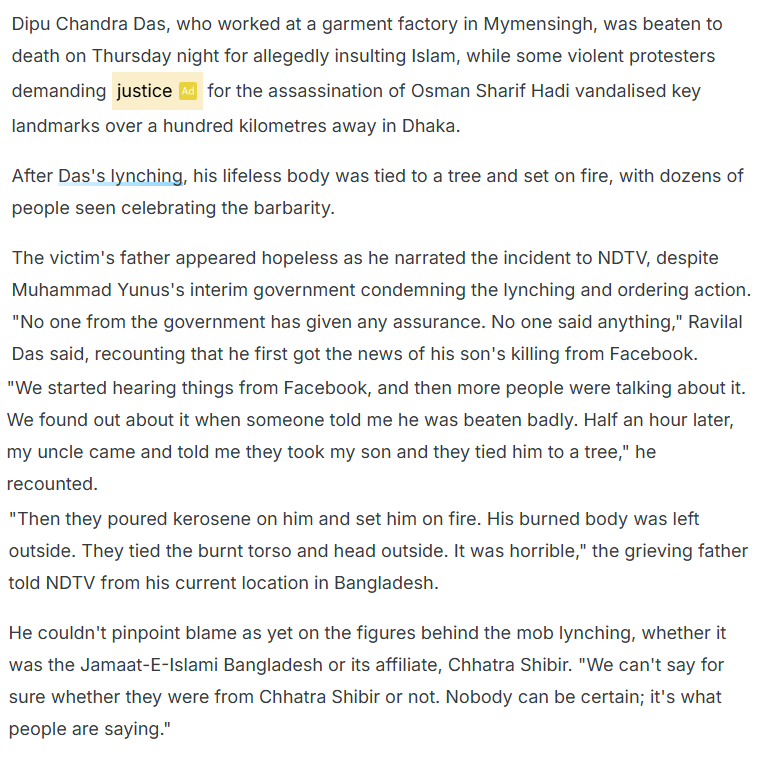
Dipu died because he existed. His mere existence and his belief in an inclusive mirage in the civilizational desert that Bangladesh has become was enough to kill him. He was poor, Hindu, Dalit, and unprotected in a country where a word can kill, and silence offers no refuge.
Farce that is Indian Secularism - Pluralism Vs Absolutism
One account says that during a discussion or an event possibly linked to the World Arabic Language Day at his factory, he suggested that:
This was interpreted as blasphemous to Islam, Allah and his prophet. Because it denied the uniqueness and superiority of Allah and his Prophet.
This fight against pluralistic and inclusive (and, in real terms, equal and secular) theology vs. exclusivist and absolutist ideology is not new.
The pagans in Greece and Rome faced the same fate at the hands of fanatic Christians as well.
Here is almost the exact same quote that is also reflected in the verse from Rigveda (1.164.46) - "Ekam sat vipra bahudha vadanti," which means "Truth is One, the wise call it by many names."
These two quotes were made at the same time - one of these speakers remained alive and is known today as one of the greatest Christian "Saints". Mobs inspired by him would have burned and killed so many Dipus in Greece and Rome during the 6th century!

Dipu Chandra made the same mistake that Symmachus and his friends would have made, which led to being targeted, killed, and tortured.
Islamist Takeover and Violence
After Hadi’s assassination, protests erupted across Bangladesh. But these were not ordinary demands for justice.
Former MP and ex-Information Minister under the Sheikh Hasina government, Mohammad Ali Arafat, has warned that radical Islamist forces are rapidly occupying Bangladesh’s streets under the cover of protests over Hadi’s death.
Referring to a sit-in at Shahbagh on December 19 demanding justice for Sharif Osman Hadi, Arafat said the gathering soon devolved into a show of strength by jihadist elements.
Interestingly, Arafat shared the presence of extremists such as Jashimuddin Rahmani and Ataur Rahman Bikrampuri of Towhidi Janata, alongside members of other radical outfits delivering inflammatory speeches in those sit-ins, in a post on X.
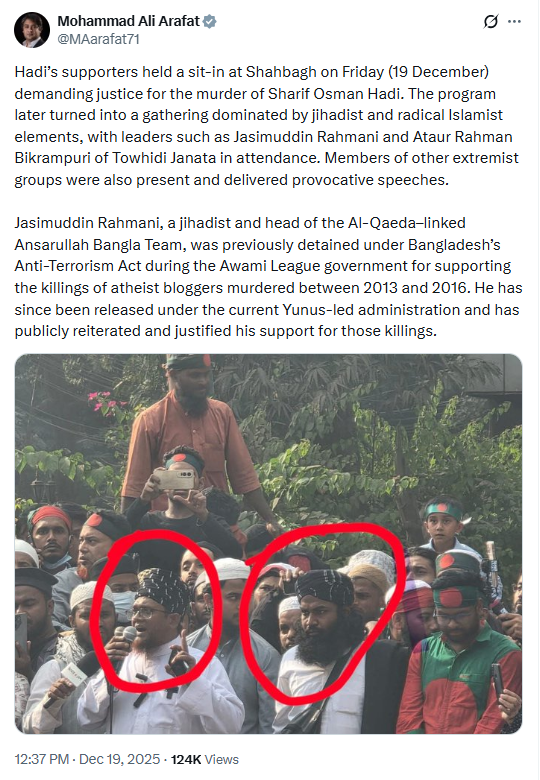
In a way, while Sharif Osman Hadi’s death became a mobilising symbol for the jihadis in Bangladesh, Dipu Chandra Das’s brutal torture and killing became an unimaginably morbid release valve.
Let us understand who Osman Hadi is.
Who was Osman Hadi?
Sharif Osman Bin Hadi, better known as Osman Hadi, was not merely a student leader or a political activist. He was a product of post-Hasina Bangladesh, and in many ways, a harbinger of what followed.
Born on June 30, 1993, in Nalchity Upazila of Jhalokathi district, Hadi emerged from a deeply conservative milieu. His father was a madrasa teacher and a local imam; religion was not incidental in his upbringing—it was formative. The worldview that shaped him was steeped in orthodoxy, grievance, and moral absolutism, traits that later became unmistakable in his politics and rhetoric.
Educated in political science at the University of Dhaka, Hadi worked briefly as a teacher and writer. But classrooms could not contain him for long. He was drawn to the street, to slogans, to confrontation. When Bangladesh convulsed during the July 2024 student uprising—often euphemistically called the “July Revolution”—Hadi was initially a peripheral figure. The fall of Sheikh Hasina and the Awami League government in August 2024, however, created a vacuum. And Hadi stepped decisively into it.
From Protester to Ideologue
In the aftermath of the uprising, Hadi co-founded Inqilab Moncho, a youth-driven cultural-political platform that claimed to reject all forms of domination, foreign and domestic alike.
Hadi emerged as its principal spokesperson and most visible face. He cast himself as a “frontline fighter” of the revolution, even as he positioned the movement against nearly every existing political force. The Awami League was branded criminal and fascist. Opposition formations were dismissed as opportunists seeking to hijack the uprising. Traditional politics itself was portrayed as irredeemably corrupt.
But rhetoric is revealing not only for what it says, but for what it targets.
Targeting India
Hadi’s speeches and social media interventions were incendiary, often deliberately so.
He accused the Hasina regime of “cultural fascism,” allegedly propped up by foreign powers. He welcomed judicial actions against Hasina, including capital punishment pronouncements by Bangladesh’s International Crimes Tribunal, and demanded sweeping purges of the old order.
Yet his most consistent obsession was India.
Hadi framed India not as a neighbor but as a hegemon. An occupying force operating through proxies in Dhaka. He organized protests against Indian infrastructure projects, especially dams on transboundary rivers, blaming them for floods and ecological harm. He amplified deeply provocative material online, including distorted “Greater Bangladesh” maps that absorbed India’s Northeast, West Bengal, and Bihar, while depicting Kashmir as Pakistani territory.
This was not casual provocation. It was strategic antagonism, calibrated to resonate with a generation steeped in resentment, grievance politics, and Islamist-nationalist fusion. Anti-India rhetoric became the emotional glue binding radical youth networks together.
At the same time, Inqilab Moncho increasingly intersected with Islamist spaces. Hadi addressed madrasa audiences, shared platforms with groups advocating Sharia-influenced governance, and employed the language of insaf—justice as divine reckoning rather than institutional reform. His politics spoke less of constitutionalism and more of moral purification through rupture.
Assassination and Aftermath
On December 12, 2025—one day after Bangladesh’s election schedule was announced—Osman Hadi was shot point-blank in Dhaka’s Bijoynagar (Box Culvert) area. Masked gunmen on motorcycles targeted him as he traveled by rickshaw after Friday prayers. A single bullet to the head was enough.
He was rushed to Dhaka Medical College Hospital, later airlifted to Singapore General Hospital on government orders. Six days later, on December 18, 2025, Hadi was dead. He was 32.
His death has unleashed nationwide chaos.
Media houses such as Prothom Alo and The Daily Star were attacked. Cultural landmarks were vandalized. Diplomatic sites were targeted. Streets echoed with anti-India slogans. Protesters accused India of orchestrating the killing, alleging that the assailants had fled across the border. Evidence was secondary; emotion ruled.
Radical Islamist groups once again attempted to demolish what remains of the Dhanmondi 32 residence, openly waving ISIS flags. When these extremists first attacked the house, Yunus neither took steps to protect it nor ensured that those responsible were held accountable. Instead,… pic.twitter.com/8qRLcM9kwW
— Mohammad Ali Arafat (@MAarafat71) December 19, 2025
The interim government under Muhammad Yunus declared national mourning, promised to carry forward Hadi’s “vision,” and accorded him a state funeral. On December 20, 2025, hundreds of thousands gathered as Hadi was buried beside Bangladesh’s national poet Kazi Nazrul Islam at the Dhaka University Central Mosque—a symbolic canonization that elevated him from agitator to martyr.
Who killed Hadi
It will be important to understand after all who killed Hadi?
The day Hadi was killed, he was campaigning in Dhaka-8 constituency as an independent candidate.
As Hadi was returning after campaigning in Motijheel, he was targeted by motorcycle-borne gunmen on Box Culvert Road, Purana Paltan.
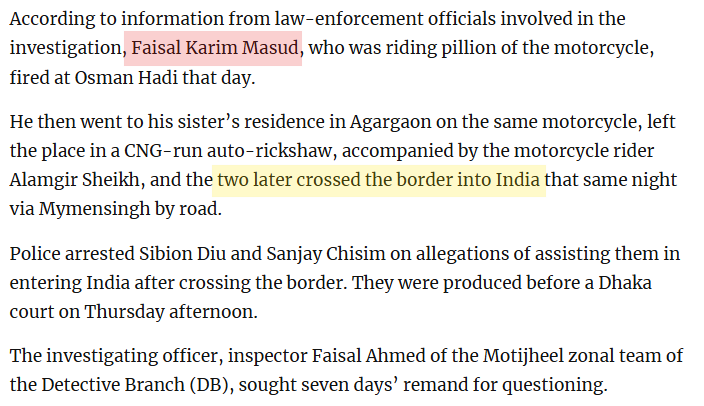
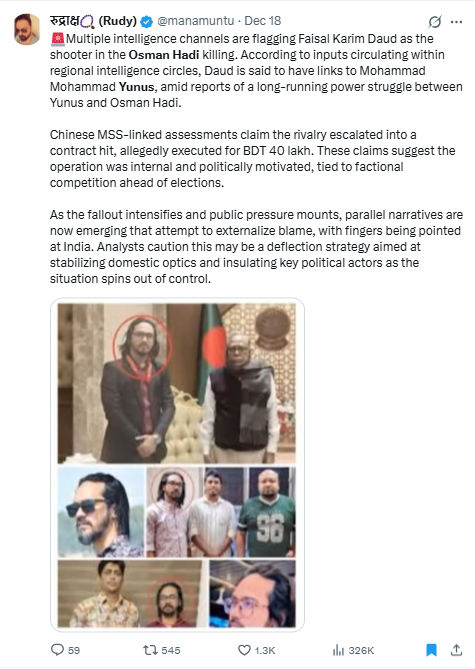
Some accounts are sugesting that Masud was linked to Yunus while there was a long running tussle between Yunus and Hadi. It is also claimed that the Chinese MSS-linked narratives suggest it may have been a contract hit by Yunus, allegedly for BDT 40 lakhs.
Violence and mob action not just brutally killed Dipu but has also led to burning down of the at least two major media outlets.
This DD News clip reports on attacks on the offices of media outlets Prothom Alo and Daily Star. The latter's offices were completely burned down.
#Bangladesh’s worsening law and order situation took a grave turn late Thursday night as angry mobs targeted leading media houses in Dhaka, vandalising the offices of Prothom Alo and setting fire to The Daily Star building in Karwan Bazar amid heightened unrest following the… pic.twitter.com/N7brsAysHc
— DD News (@DDNewslive) December 19, 2025
The harm to the journalists, their livelihood, and their work is incalculable. Look at the plight of Prabir.
This is Prabir, a journalist with Daily Star in Dhaka, Bangladesh. He broke down after Islamist radical illiterate thugs and goons burnt down their building in Dhaka. His entire career’s work in Hard Disk destroyed. Cameras and lens destroyed. pic.twitter.com/ZmqbAfeu1H
— Aditya Raj Kaul (@AdityaRajKaul) December 19, 2025
One would think that such atrocities and open attack on the press by the jihadi mobs aligned with Osman Hadi would lead to severe admonishment from the Western media and establishment regarding freedoms and democracy, right?
WRONG!
They, instead, are on another path altogether.
The Dichotomy and the Hypocrisy
Across Western capitals, diplomatic missions and major outlets have reacted to the death of Sharif Osman Hadi with an intensity that sits uneasily beside their near‑silence on the lynching and burning alive of Dipu Chandra Das.
Hadi, a radical student leader whose politics openly rode on anti‑India sentiment and collaboration with Islamist networks, has been treated in much Western coverage as a pro‑democracy martyr or at least as a one‑dimensional victim of political violence.
Statements from Western governments and multilateral actors have focused on his killing, subsequent riots, and press‑freedom concerns, with little context on his extremist positions on India and Hindus.
By contrast, the torture, lynching, and public burning of Dipu Chandra Das, accused without hard evidence of blasphemy, have received limited attention in flagship Western platforms, even though the crime has been documented in detail by South Asian and a handful of international outlets.
His murder and the broader pattern of anti‑Hindu violence around the unrest remain marginal in the very forums that frame themselves as guardians of minority rights.
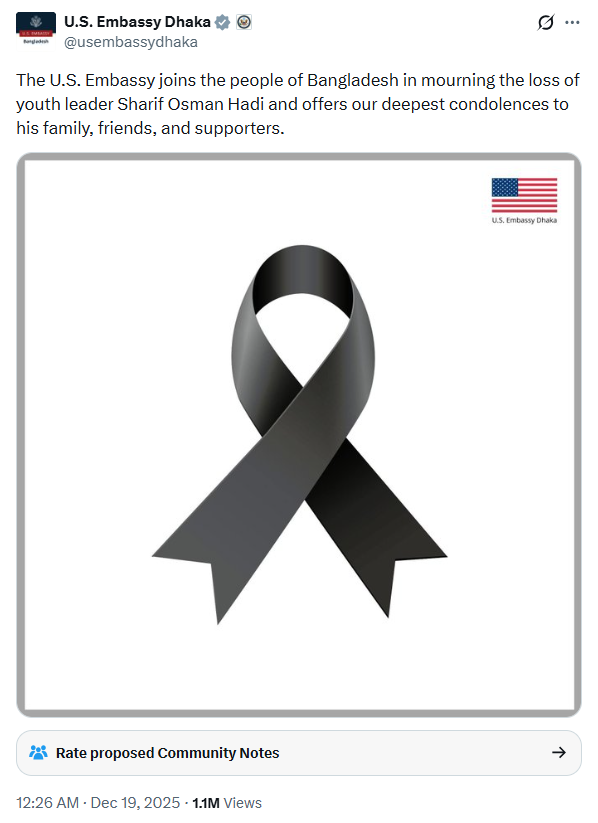
See this post on X by the US Embassy in Dhaka.
Hadi's supporters - the same mobs that are burning down newspaper offices and minorities while lynching them are the ones who get the deepest sympathy from the United States!
Go figure!
This is the statement from UN Human Rights which is speaking eloquently about the rights of a jihadi and his death that has unleashed tremendous violence. Dipu's human rights, of course, are an inconvenient topic.
#Bangladesh: We call on the authorities to conduct a prompt, impartial, thorough & transparent investigation into the attack that led to the death of Sharif Osman Bin Hadi, a prominent leader of last year’s demonstrations.
— UN Human Rights (@UNHumanRights) December 19, 2025
Everyone should refrain from violence. Retaliation &… pic.twitter.com/In5w5l6IwF
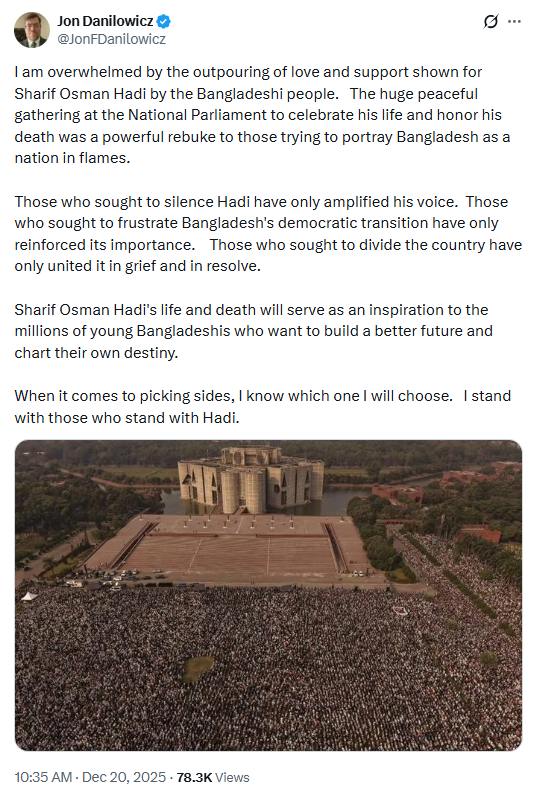
Here is another guy who has been an American diplomat and has a history of anti-India and anti-Hindu posts and stances.
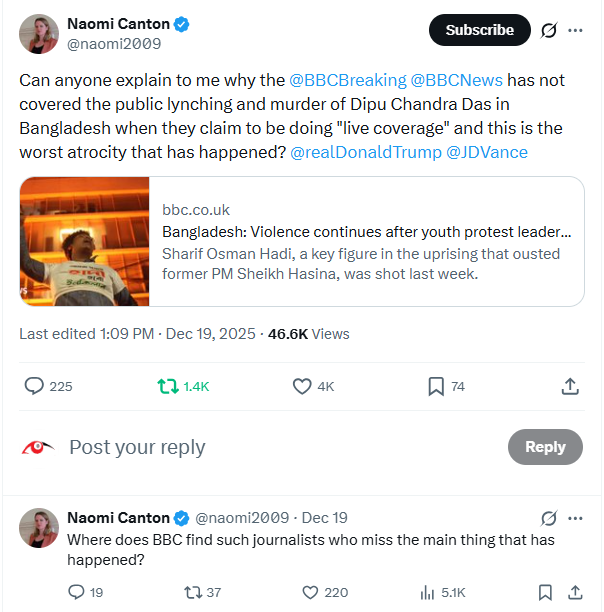
BBC was equally criminal in its prejudice. Something that Naomi Canton (a London Journalist who Covers the UK for the Times of India) ultimately had to call out the in-your-face hypocrisy of BBC.
Here is the coverage of BBC, CNN and the outlet which is now known for anti-India and anti-Hindu reportage - The Wire. One can see how an assassination of a bigoted, anti-Indian jihadi arouses the journalistic interest of these media outlets but the brutal lynching and burning alive of a Hindu makes them extremely uncomfortable.
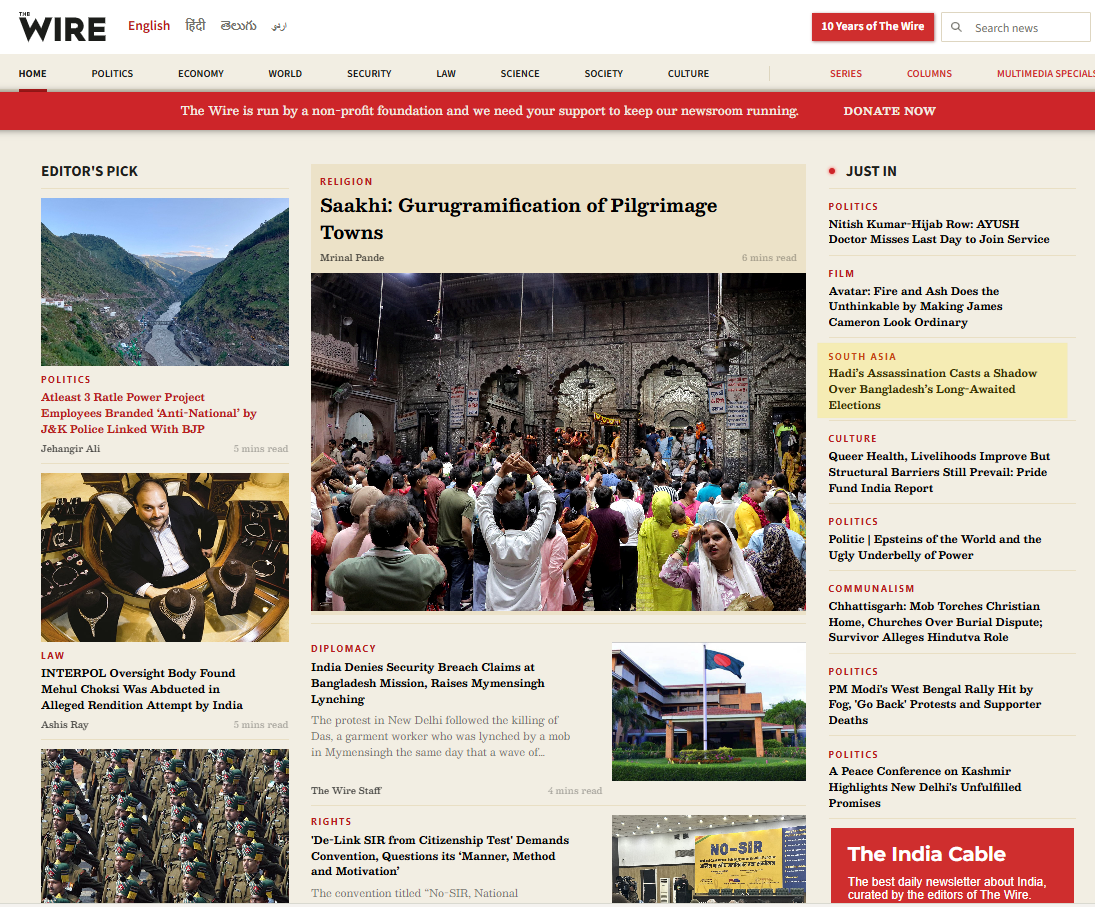
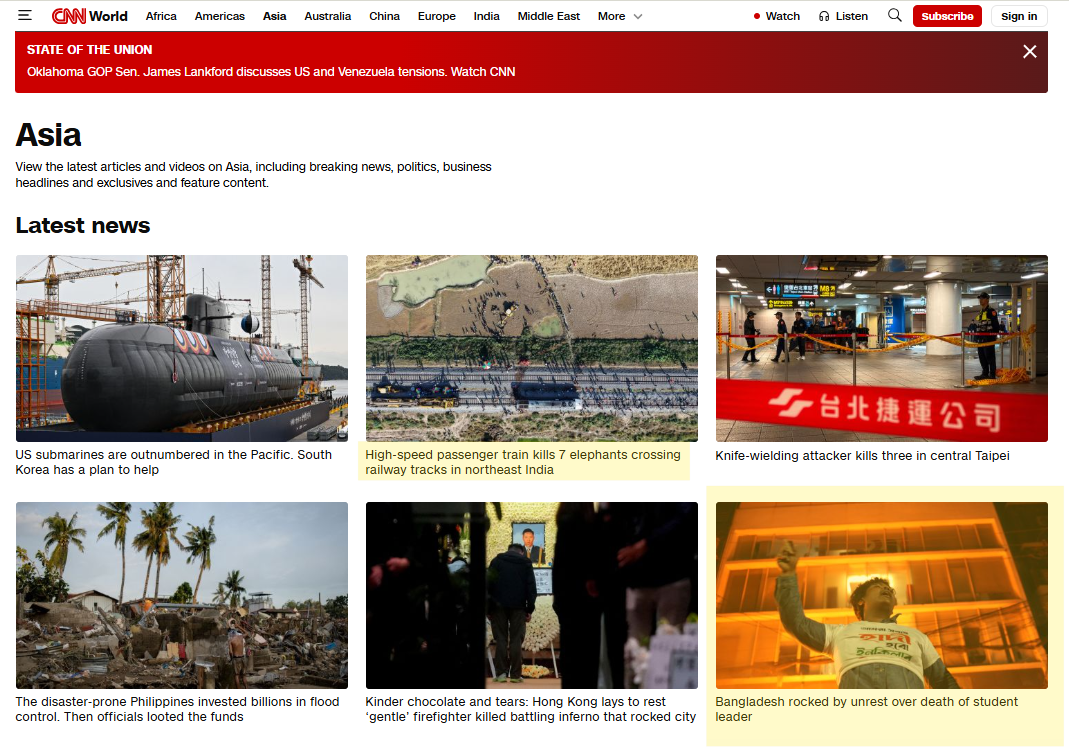
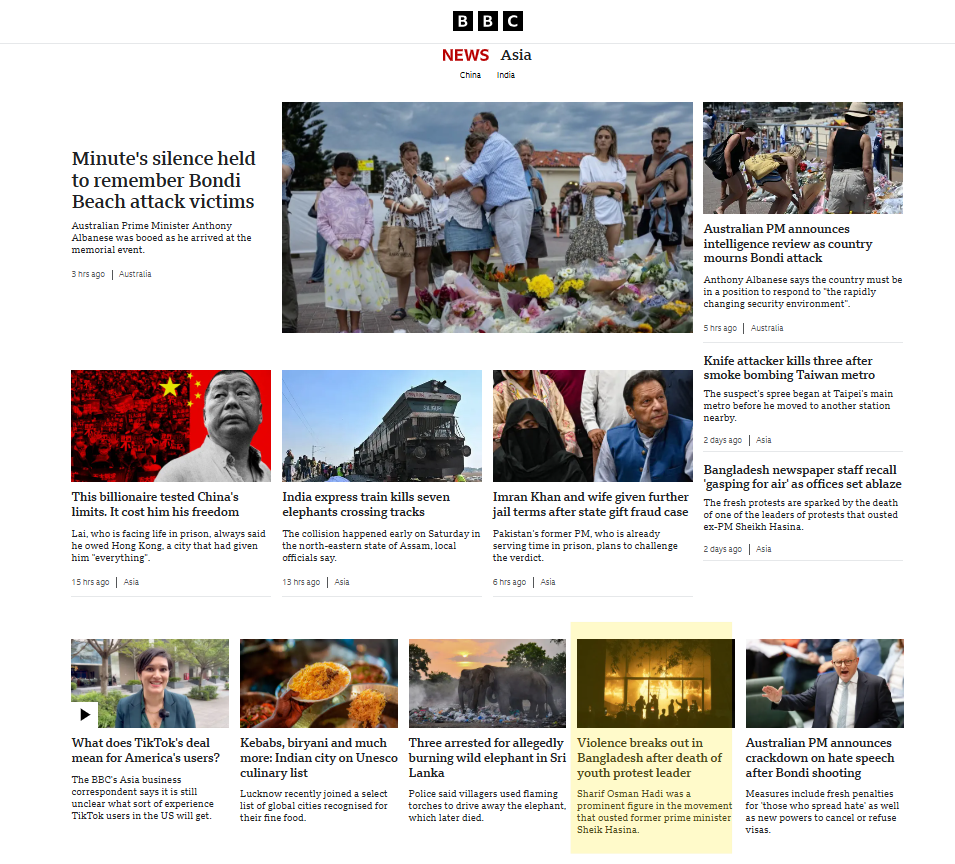
Across the board, the story is the same.
BBC: The lynching is referenced indirectly via Times of India, which notes that “BBC Bangla” reported a Hindu youth was beaten to death and his body set on fire in Mymensingh amid unrest, but there is no easily visible, dedicated English‑language BBC World headline specifically on Dipu Chandra Das.
CNN (US edition): No standalone CNN.com news article headline specifically on Dipu Chandra’s lynching is visible in the surfaced results; coverage that does exist is on Indian broadcast sister‑brands like CNN‑News18, with headlines such as “Hindu Man Lynched And Set On Fire Amid Anti‑India Protests” and “Mob Lynches Hindu Man Over Blasphemy Allegations…”.
Reuters: Current Reuters search results show older Bangladesh hate‑crime pieces (for example “Hindu priest hacked to death in Bangladesh” from 2016) but no clearly tagged 2025 wire item headlined on Dipu Chandra’s lynching.
Al Jazeera: The lynching is mentioned, if at all, within broader pieces on Hadi’s death and Bangladesh unrest, rather than as a primary headline; a visible Al Jazeera headline is “Bangladesh holds state mourning, funeral for slain uprising activist,” which centres Hadi, not Dipu.
This is when the anti-Hindu and bloodthirsty jihadi mobs are not even close to being done as yet.
Another poor Hindu, Gobinda Biswas, a rickshaw puller, was also lynched for simply wearing a red thread on his wrist. He is critically injured.
Gobinda Biswas—a rickshaw puller. A red thread on his wrist was enough for extremists to brand him an “RAW agent.” He kept saying he was just a rickshaw puller, but no one listened.
— Sahidul Hasan Khokon (@SahidulKhokonbd) December 20, 2025
The young man from Jhenaidah was brutally assaulted and left critically injured—his survival… pic.twitter.com/9qvDNgl7FA
Al Qaeda and ISIS are openly backing the slaughter of those who "killed Hadi' - perceived or real killers. For the way things are going, facts and truth are the biggest casualties.
Dhaka jihadists waving flags of Al Qaeda and ISIS are calling for slaug-htering ki-llers of Osman Hadi. Activities of Al Qaeda and ISIS are reaching an alarming level in Bangladesh. pic.twitter.com/a11W6pAoQ6
— Salah Uddin Shoaib Choudhury (@salah_shoaib) December 20, 2025
What does this mean for India and the Hindus?
What this framing signals for India
This selective empathy effectively normalises a hierarchy of victims in which an anti‑India Islamist mobiliser is centred as the crisis figure, while a Hindu lynching victim is peripheralised.
For India, the pattern raises hard questions: the same governments and newsrooms that underplay Dipu Chandra’s fate are also amplifying narratives that paint India as a malign actor and potential external conspirator in Bangladesh’s turmoil.
Here is Veena Sikri, a retired Indian diplomat, academic, and former High Commissioner of India to Bangladesh, who challenges the calling of what happened that threw out Sheikh Hasina as "revolution" is tantamount to denial of reality. It was a regime change meticulously planned and one that Yunus shared on the stage of the Clinton Foundation program.
Former Indian High Commissioner to Bangladesh, Pinak Ranjan Chakravarty, has stated that credible evidence points to renewed foreign interference in Bangladesh, involving a convergence of American, Pakistani, Chinese, and Jamaat-aligned elements—mirroring the coalition that operated during the 1971 crisis—now seeking to influence and control developments on the ground.
Had something like Dipu Chandra happened to any person in Europe or the US, it would have been a major news item and controversy. But BBC, UN, US, France, UK, NYT do not even mention his torture and burning alive - why?!
Ignoring the killing of a Hindu man, while bleeding endlessly and siding with an openly anti-India and anti-Hindu jihadi, is a choice that these outlets, countries, and their consulates and the UN have made.
This choice has stark ramifications. So, what does this choice say for India and specifically the Hindus?
There is one clear message: India is on its own. More importantly, India cannot outsource its moral narrative to Western institutions. Its people will have to stand up and be counted.
There is not one message but a layered narrative that is being communicated, that is saying:
- Your suffering does not qualify as universal suffering.
- Your dead do not merit global grief.
- Your killers can still be framed as political symbols.
By endlessly amplifying the death of an openly anti-India, anti-Hindu radical while erasing the lynching and burning alive of Dipu Chandra Das, Western media, diplomatic missions, and institutions like the United Nations are communicating something far more profound than bias:
They are communicating hierarchy.
Generally, such acts of omission in the media are termed as gatekeeping bias.
But this is not about individual journalists “missing” a story. That explanation collapses instantly. So, let us look at it clearly
This is about narrative filtration instead. That operates on three gates:
Gate 1: Victim eligibility - Only certain victims are deemed:
- politically meaningful
- symbolically useful
- ideologically compatible
A poor Hindu Dalit laborer fails all three filters and is inconvenient, destabilizing to the preferred narrative, and most critically, impossible to instrumentalize without exposing their contradictions.
Gate 2: Perpetrator protection: When violence emerges from Islamist or “anti-establishment” ecosystems, Western institutions apply contextual cushioning, which brings up things like “anger,” “provocation,” “structural grievances,” and “backlash.”
This is why killers can be indirectly reframed as protesters, resistance figures, or as voices of the oppressed.
Once these champions of global morality have activated this framing, calling out their crimes becomes ideologically costly.
Gate 3: Strategic alignment: Outlets like the BBC, major Western newspapers, and diplomatic missions do not operate in a vacuum. They are embedded in Western strategic unease with India’s rise, discomfort with India’s civilizational self-assertion, and most importantly, India's desire to retain leverage over the Indian sub-continent, which has suddenly become a contested global hot zone.
Many in India are wondering - Why side with a jihadi narrative?
We need to understand that they (Western Media and the establishments) do so because the jihadi narrative is useful, not because it is moral in their eyes.
An openly anti‑India radical’s death lets foreign actors depict India as a destabilising, rights‑abusing power, weakening its regional standing and influence.
In contrast, the lynching of a Hindu labourer exposes Islamist violence and India’s vulnerability, undermining that narrative and eroding their human‑rights leverage over New Delhi.
Message to Hindus?
The message to the Hindus by these Western media outlets and the establishments is even more morose. They are effectively saying:
Your lives are never allowed to become international concerns; your pain does not globalize into hashtags or campaigns. Your deaths are dismissed as local noise, while your killers may still be romanticized and canonized.
This is certainly not accidental neglect. It is actually an intentional, disciplinary silence imposed on your existence and suffering.
Is this a "declaration of war" on India?
India is being targeted now because timing is strategic. India is economically rising, increasingly geopolitically autonomous, unwilling to play client state, and resistant to Western moral arbitration. That profile makes India a “problem” to be managed, not a partner to be trusted. The preferred instrument of constraint is not kinetic conflict but narrative isolation.
Narrative isolation works through a layered playbook.
- First, India’s moral claims are delegitimized, especially when it speaks about civilizational concerns, border security, or the persecution of Hindus.
- Second, India’s adversaries—whether state, non‑state, or ideological—are amplified as “resistance,” “civil society,” or “democracy activists,” regardless of their record on extremism or violence.
- Third, Indian victims who complicate this script are silenced or minimized so that their suffering never acquires global salience.
- Fourth, India is continually pushed into defensive postures, forced to explain or apologize rather than define the terms of debate.
- Finally, any robust Indian response is immediately framed as “majoritarian aggression,” “Hindu nationalism,” or “authoritarian overreach.” This is information warfare without uniforms, fought through headlines, resolutions, and selective outrage instead of tanks.
So let us ask the question that needs asking -
Not in the conventional, kinetic sense perhaps.
At least not yet.
What has been declared instead is a stable posture of narrative hostility.
It operates on a few chilling assumptions: that outsiders will decide whose lives matter, whose deaths count, who is elevated as a martyr, and who is erased as collateral.
And that these determinations will be made independently of inconvenient facts on the ground.
Be very clear that the deeper target of this posture is not Bangladesh, nor any single episode of violence.
The core question, then, is stark:
Yunus is not an innocent bystander. He is part of a greater game.
Yunus is not alone, but puppet
Recently, Elon Musk shared this video where Mike Benz bares the shenanigans of how the US establishment uses USAID.
Muhammad Yunus, with the help of the Democrats (Biden, Clintons, and Soros) and through funding from USAID and IRI, played a role in toppling Sheikh Hasina from power in Bangladesh. Eventually, this money was funneled to Grameen Bank through the Clinton Foundation.
Yunus had introduced the masterminds behind the removal of Sheikh Hasina at the Clinton Foundation stage.
IRI, which is a Republican institute, found that the way to overthrow Sheikh Hasina's government was by using gays and students. That is why they funded rappers who riled up the youth to go after Hasina and her government.
In a May 2025 interview with Al Jazeera, Muhammad Yunus did not deny his financial links to the Clinton Foundation, nor did he deny allegations that significant resources were deployed during the 2016 U.S. election in support of Hillary Clinton against Donald Trump.
So lets understand why is what's going on in Bangladesh being orchestrated.
Europe is moving from a “low defense, high welfare” posture toward a rearmament and readiness posture.
- NATO itself says allies have been increasing spending, and (per NATO’s own topic page) all Allies are expected to meet or exceed the 2% of GDP target in 2025, versus only three in 2014. (Source: NATO)
- Reporting in 2025 also shows only a few exceed the newer, more ambitious levels under discussion (e.g., Reuters notes Poland/Lithuania/Latvia above ~3.5%). (Source: Reuters)
- Germany is an illustrative case: the FT reports major new approvals and huge multi-year procurement intentions as Berlin accelerates its build-up. (Source: Financial Times)
The core issue: defense spending is recurring, not just one-off закупки. Ammunition stockpiles, readiness, troop levels, air defense, drones, cyber, logistics, and industrial capacity all require steady budget lines.
Now overlay the welfare-state reality, and the reality for Europe is an economic disaster.
As the preparation goes on, Europe is being faced with the “guns vs pensions” option.
Europe, as it prepares for a deeper war against Russia, is heavily dependent on the US for its military preparations.
NATO VS Russia: Time for Reckoning and India
The U.S. and NATO viewed Ukraine as a battlefield of convenience—a proxy theatre meant to bleed and exhaust Russia, which they see as an obstruction to their so-called Liberal World Order.
What they failed to calculate was Russia’s long-term preparedness—and the decisive role of China in enabling Russia’s industrial and military revival.
While Western defense industries had been hollowed out over decades of offshoring and financialization, Russia, backed by Chinese manufacturing depth, reactivated and scaled a resilient military supply chain.
NATO, by contrast, discovered that it had no comparable industrial spine. Europe’s dependence on the United States for defense supplies has translated into unsustainable debt, internal political strain, and growing doubts about NATO’s long-term viability.
To offset these pressures, European policy is increasingly reverting to neo-colonial extraction models, seeking resources, influence, and leverage across Asia and Africa. In this renewed scramble, the Indian Ocean has re-emerged as a strategic prize.
Within this geography, the Bay of Bengal occupies a central place in U.S. and EU calculations—not merely as a maritime zone, but as a pressure point for containing and shaping India. Bangladesh, in this sense, is not incidental; it is a laboratory and testing arena.
Bangladesh and India: Intelligence Wars
So, the Bay of Bengal area is the primary test arena.
What is the aim of these forces with respect to India?
Going to war against Bangladesh will be the biggest folly for India!
But that is precisely what these atrocities - inhuman, brutal and unforgivable - are calibrated to achieve. Just as CAA, so-called Farmers' protests, etc, were designed to do.
India cannot fight on someone else's timeline and trigger. That independence should be kept by India with itself. Bangladesh is a laboratory of intelligence operations.
Recent reports suggest that over the past two to three months, several foreign intelligence operatives have been neutralized in lethal counter-operations, primarily within Dhaka’s hotel cluster zones.
Those reportedly killed include:
- 17 American nationals, linked to intelligence and defense contracting networks
- 7 to 9 Pakistani operatives, directly associated with the Inter-Services Intelligence (ISI)
- 5 to 6 Turkish intelligence agents
The deaths occurred abruptly and within a compressed timeframe.
Security analysts observing these incidents point to a distinct, systematic pattern. According to them, these were not random crimes or isolated murders, but appear consistent with a coordinated counter-intelligence operation—possibly conducted by an unknown entity hostile to the emerging Bangladesh–Pakistan–Turkey–U.S. nexus.
If accurate, the implications suggest a silent intelligence war underway beneath the surface, invisible primarily to public discourse.
That is precisely what India needs to engage in - intelligence wars.
It cannot enter into a kinetic action.
However, every group, every ally and every part of the Indian society will be activated to ratchet up the drums for an action against Bangladesh.
The unusually charitable to the Pakistani and Islamist causes - Indian National Congress - is also standing up for that narrative to aid the external forces.
Here is Priyanka Gandhi, who asks in the Parliament.
What exactly is the Government of India’s strategy on the ongoing communal violence in Bangladesh? Forget action—has Narendra Modi even issued a clear, unequivocal condemnation? And where is S. Jaishankar? Is he still India’s External Affairs Minister, or have the famed laser eyes gone dark?
.When the Gandhis start saying something, one should be able to discern the adversary's strategy against India clearly because they would be amplifying the psyops needed to execute it.
That is why it is imperative for India to counter Bangladesh by means other than a kinetic war. Whether it is to throw Pakistan completely off its game or take an action that shuts Bangladesh down will remain to be seen.
Comments ()