
The Bengal Files: Tale of the Direct Action Day - the Hindu Genocide
The Bengal Files unearths the forgotten horrors of Direct Action Day, exposing the demonic brutality, the silenced voices of Hindus, and the systematic desecration of the feminine that history ignored. Vivek Agnihotri’s masterpiece is a searing confrontation with truth.
Vivek Agnihotri, through his movies such as The Tashkent Files (2019), The Kashmir Files (2022), and now The Bengal Files (2025), has single-handedly forged a new genre of filmmaking in India.
What did these movies really do?
These movies faithfully reconstruct the tragedies that befell India and the Hindus, that no one talks about - heck Hindus have been gaslighted on even talking about these events and carnages unleashed on them.
Just talking about them was akin to a criminal act of disturbing harmony and offending those belonging to the community that had no qualms in committing those genocides.
By reconstructing untold tragedies—whether it was the mysterious death of Lal Bahadur Shastri, the ethnic cleansing of Kashmiri Pandits, or the blood-soaked horrors of Bengal—Vivek has shifted the cultural discourse.
His work is not "propaganda" but a demand for truth and justice, piercing through the intellectual smokescreens of political correctness.
Vivek moved the Overton Window.
There was a time when the Kashmiri Hindu voice was delegitimized. The Kashmir Files gave it the legitimacy that it deserved. Now, it is tough in India to disregard the Kashmiri Hindu voice when discussing Kashmir.
Vivek's movies transcend the mere craft of filmmaking.
They go into forcing the Indian society to face its conscience that had been battered, compromised, and falsified.
If cinema was imagined as the voice of the creative, Vivek's movies have become the first bold articulation of the tremulous voice of the masses. Subjugated masses.
What has Vivek done?
I attended the premiere of The Bengal Files in Atlanta. Today's newsletter shares my experience and a review of the subject matter at hand - the descration of the Bengali feminine during the Direct Action Day, Partition and today.
If Kashmir Files Shocked You, The Bengal Files Will Haunt You
SUPPORT DRISHTIKONE
In an increasingly complex and shifting world, thoughtful analysis is rare and essential. At Drishtikone, we dedicate hundreds of dollars and hours each month to producing deep, independent insights on geopolitics, culture, and global trends. Our work is rigorous, fearless, and free from advertising and external influence, sustained solely by the support of readers like you. For over two decades, Drishtikone has remained a one-person labor of commitment: no staff, no corporate funding — just a deep belief in the importance of perspective, truth, and analysis. If our work helps you better understand the forces shaping our world, we invite you to support it with your contribution by subscribing to the paid version or a one-time gift. Your support directly fuels independent thinking. To contribute, choose the USD equivalent amount you are comfortable with in your own currency. You can head to the Contribute page and use Stripe or PayPal to make a contribution.
The Bengal Files: A Cinematic Confrontation with Evil and the Desecration of the Feminine
Vivek Agnihotri’s The Bengal Files (2025) is not merely a film—it is a historical reckoning. With unflinching courage, Vivek reconstructs the horrors of Direct Action Day (16 August 1946) when Bengal bled under a pogrom engineered by Huseyn Shaheed Suhrawardy and his foot soldiers.
At the heart of this carnage stood men like Gholam Sarwar Husseini, the face of unadulterated evil. But Vivek goes further, showing how this evil has not died; it thrives even today in the politics of hate and desecration.
His symbolic character “Sardar Husseini,” (a play on the full real name of the original evil Gholam) modeled as a spiritual successor to Gholam, embodies the same malignant ideology. This force continues to violate the very soul of Bengal.
The Bengal Files is more than a political narrative. It is, at its core, about the systematic rape of the Bengali feminine. Through history, the feminine—revered in Bengal as Kali and Durga—has borne the brunt of Islamist brutality.
Direct Action Day, the Partition genocide, and the monstrous Operation Searchlight in 1971 (where over 300,000 women were raped in camps until their bodies broke) reveal a chilling pattern: sexual violence as a weapon of jihad.
This is not random savagery; it is a theologically sanctioned war tactic to desecrate what Bengal holds sacred—the divine feminine.
Vivek’s film pierces through decades of whitewashing and denial. It forces Indian society to confront not just historical crimes but the ongoing assault on its civilizational core. By daring to tell these stories, Vivek has not just moved the Overton Window—he has shattered it.
We, the People
One of the most striking themes of The Bengal Files is its evocative invocation of the fundamental force of any democracy—“We, the People.”
This reinterpretation is both novel and deeply rooted in India’s civilizational ethos. It reminds us that the state was created to protect these rights and safeguard the voice of the people. Yet, as the movie shows with unflinching boldness, the state, through its rulers, administrators, and politicians, has systematically silenced, betrayed, and even extinguished that very voice.
The film confronts us with an uncomfortable truth: the hypocrisy of the state mirrors the cowardice of its citizens. Ordinary people, conditioned to look away, have allowed narratives of betrayal, violence, and injustice to persist unchallenged. Vivek turns this indictment into a mirror held up to society, forcing every viewer to ask: “Where were we when the truth was buried?”
This message—that democracy is meaningless if “We, the People” remain mute spectators—is one of the film’s most powerful and unsettling revelations. It is a call to awaken and reclaim that voice.
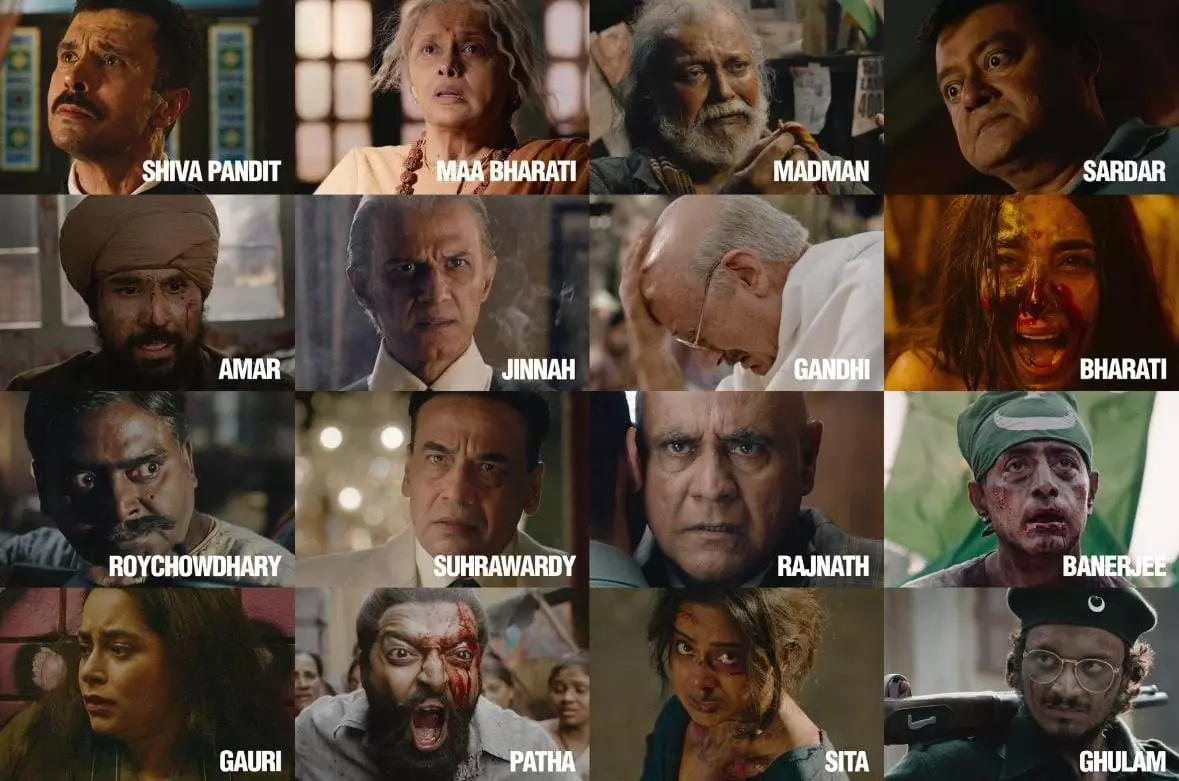
The performances in The Bengal Files are nothing short of extraordinary, carrying the film’s emotional and philosophical weight with raw brilliance. Pallavi Joshi, as Maa Bharati, embodies not just a character but a living metaphor for the collective Bengali Feminine—wounded, desecrated, yet unyielding. Her portrayal channels the pain of generations of women who have borne the brunt of violence and bigotry, while also reflecting the indomitable strength of a civilization that reveres the divine feminine in Kali and Durga. Every glance, every silence, every tremor in her voice strikes deep, making her performance both visceral and spiritual.
Mithun Chakraborty, on the other hand, delivers one of the finest performances of his career. His character is the personification of the brutalized, castrated citizen—stripped of agency, silenced, and condemned to watch as evil triumphs. His dysarthric (silenced) demeanor speaks louder than words, revealing the suppressed rage and helplessness of an entire society.
Both actors have distilled decades of cinematic mastery into these roles, crafting performances that are worthy of National Awards on their own merit. They elevate the narrative, transforming The Bengal Files into an unforgettable cinematic experience that resonates beyond the screen.
Another towering performance in The Bengal Files comes from Anupam Kher as Gandhi. Kher has gone beyond himself, crafting a portrayal that strips Gandhi of the overly sanitized, saintly aura and brings out the conflicted, deeply human man beneath.
His command over diction, body language, and the nuanced frustration of a leader torn between his moral self-image and the grim consequences of his choices is breathtaking.
Kudos to both Anupam Kher and Vivek Agnihotri for this layered and courageous portrayal.
Darshan Kumar, fresh from his acclaimed performance in The Kashmir Files, once again delivers with profound intensity. His character embodies the conflict between ideals of just governance and the crushing weight of evil, depicting the struggle between mere survival and living with honor.
Eklavya Sood as Amar, alongside Roy Choudhury (Dibyendu Bhattacharya), becomes the face of Hindu resistance, standing defiantly against Islamist terror. Vatsal Seth as Jinnah and Mohan Kapur as Suhrawardy bring chilling authenticity to their roles. Namashi Chakraborty’s Gholam Sarwar Husseini and Saswata Chatterjee’s Sardar Husseini exude cold, calculated villainy that lingers in memory.
Puneet Issar as Rajnath and Sourav Das as Gopal Patha offer two contrasting faces of power—compliance versus rebellion. The ensemble cast, including Palomi Ghosh (Gauri) and Saurav Raj Vermaa (Choto Miyaan), shines brilliantly, making The Bengal Files a masterclass in ensemble performance.
- Mithun Chakraborty as the castrated and dysarthric ex-policeman
- Pallavi Joshi as Maa Bharati
- Darshan Kumar as Shiva Alok Pandit
- Sourav Das as Gopal Patha /Gopal Chandra Mukhopadhyay, a professional butcher in Calcutta
- Eklavya Sood as Amar
- Anupam Kher as Mahatma Gandhi
- Puneet Issar as Rajnath Singh
- Saswata Chatterjee as Sardar
- Dibyendu Bhattacharya as Rajendralal Roy Choudhury, a Zamindar from Ramganj, Noakhali, President of the Noakhali District Bar Association and the Noakhali Hindu Mahasabha in 1946
- Palomi Ghosh as Gauri
- Priyanshu Chatterjee as Banerjee, a judge at Dharmatala Magistrate Court
- Mohan Kapur as Huseyn Shaheed Suhrawardy, third Prime minister of Bengal Province, British India (1946-1947)
- Vatsal Seth as Muhammad Ali Jinnah
- Richard Keep as Lord Mountbatten
- Namashi Chakraborty as Gholam Sarwar Husseini, founder of his private army called the Miyar Fauz (Miah's army), provocateur and Chief mastermind/ rioter/ culprit of the Noakhali riots 1946
To truly grasp the unrelenting, demonic evil portrayed in The Bengal Files, one must delve into the brutal history of Direct Action Day (16 August 1946). Only by revisiting these blood-soaked chapters can we begin to understand the characters—their hate, bigotry, vulnerabilities, and the twisted complexities that shaped their thoughts and actions.
And yet, when the film ends, a chilling realization dawns—Vivek Agnihotri has shown us only a fraction of the darkness.
If this partial glimpse of the demonic can so thoroughly devastate the mind and soul, what would the full, unfiltered manifestation of that evil do to us? This is not just cinema; it is a confrontation with the deepest horrors of human history.
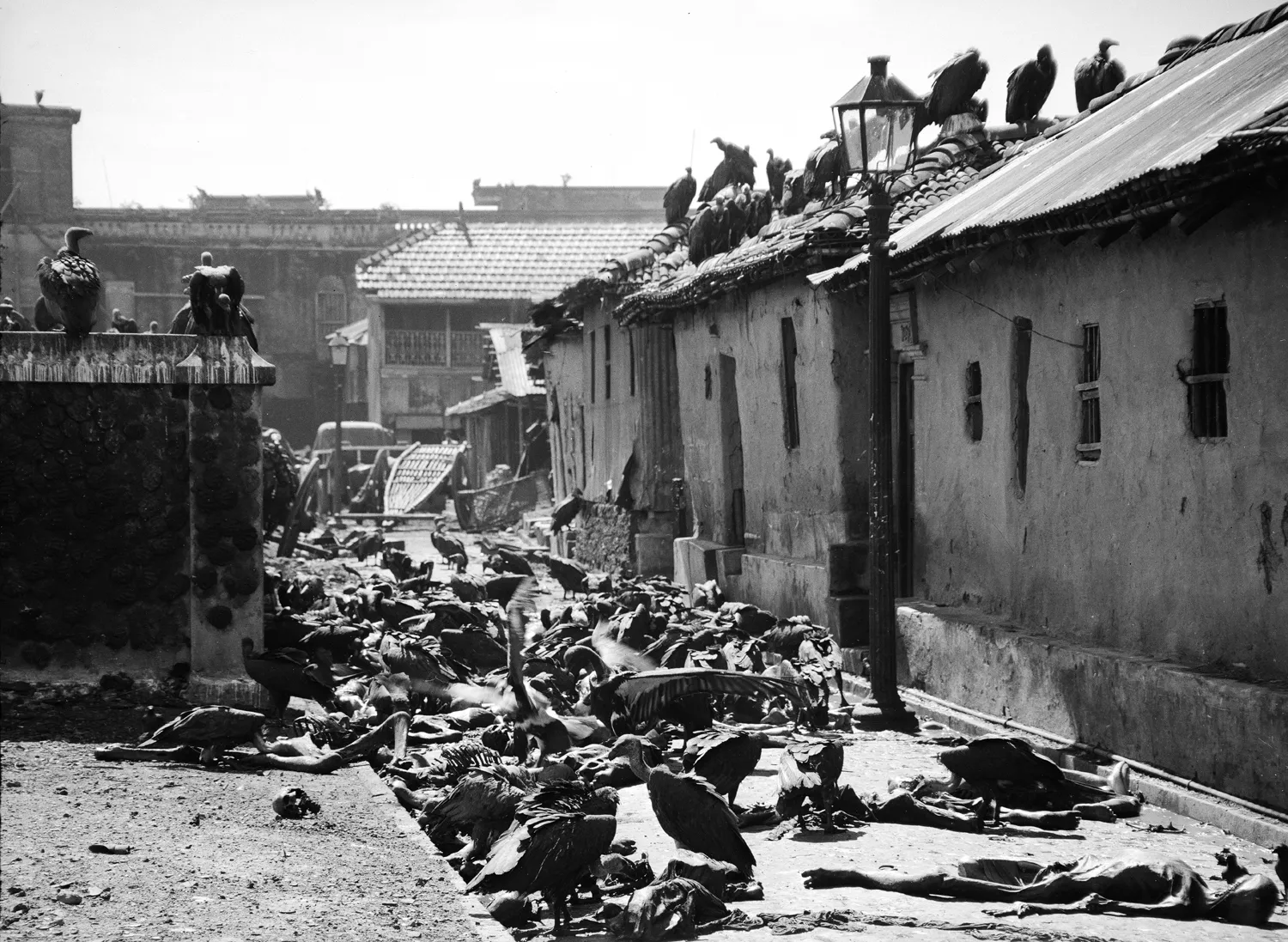
Direct Action Day: The Day India Burned
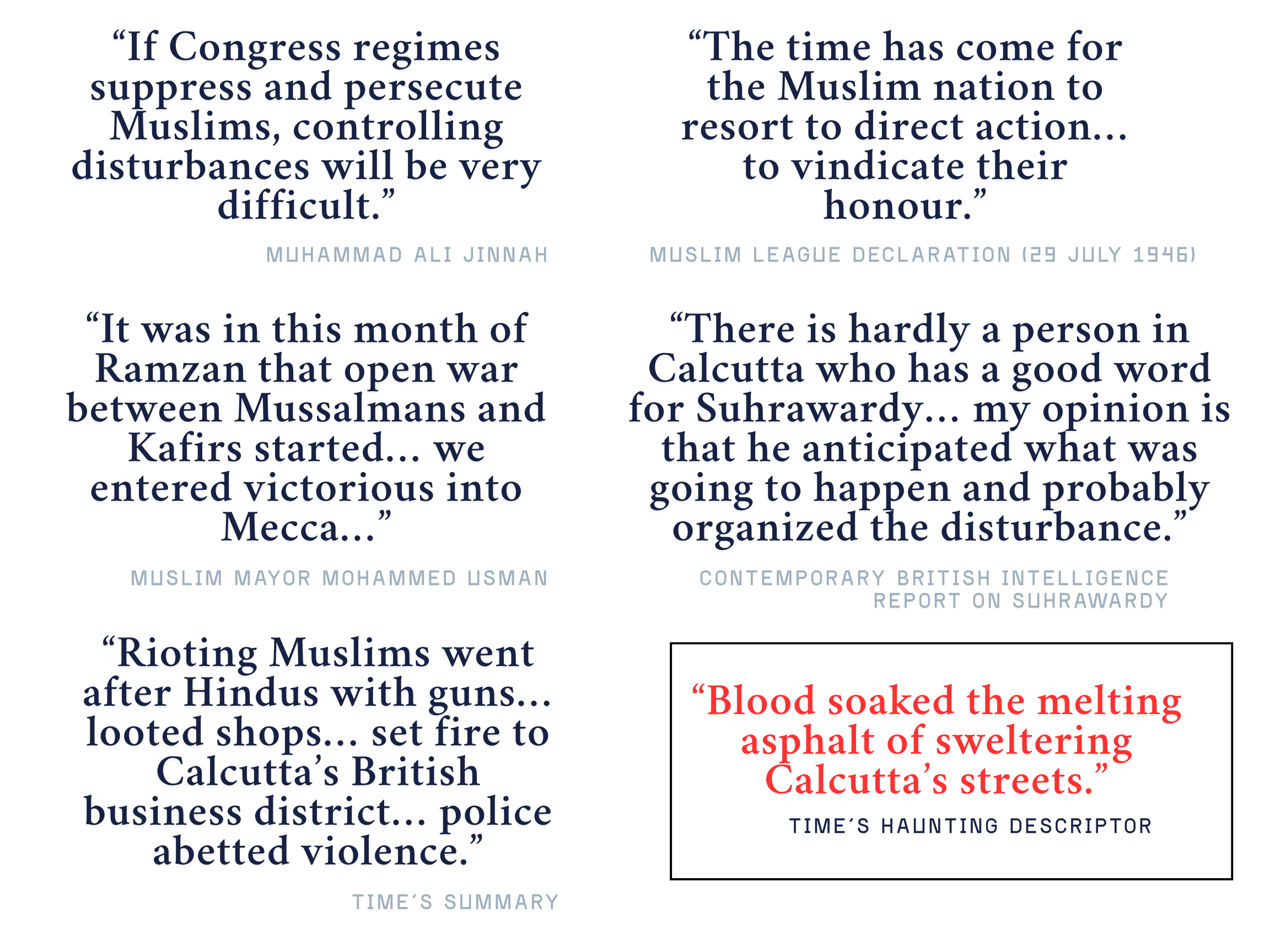
The summer of 1946 in Bengal was heavy with foreboding. The Muslim League, led by Muhammad Ali Jinnah, had declared August 16th as Direct Action Day—a chilling euphemism for what would descend into one of the most brutal pogroms of the Indian independence era. This was no mere political demonstration. It was a calculated move to coerce the British, and the Congress, into conceding the demand for Pakistan through intimidation, violence, and a showcase of Islamic solidarity.
The Call for Blood
The decision to observe Direct Action Day stemmed from the League's increasing frustration. Despite its claim to represent all Muslims of India, the League had fared poorly in non-Muslim majority provinces. The Cabinet Mission Plan had offered a vision of a united India. Still, Jinnah rejected it after initially accepting it, realizing that the League could never gain dominance in a united democratic India. The call for Direct Action was a decisive pivot—from negotiation to violence.
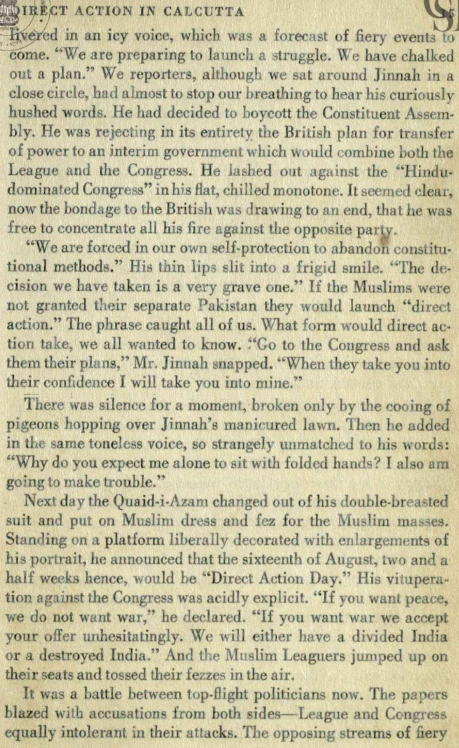
The Muslim League government in Bengal, under Chief Minister Huseyn Shaheed Suhrawardy, prepared the ground. Suhrawardy, who held both the Home and Information portfolios, not only failed to prevent violence but actively aided it. The day was declared a public holiday in Bengal so that Muslim crowds could gather in numbers. That decision alone paralyzed the machinery of governance, including the police. The intention, as The Stern Reckoning confirms, was never peaceful protest.
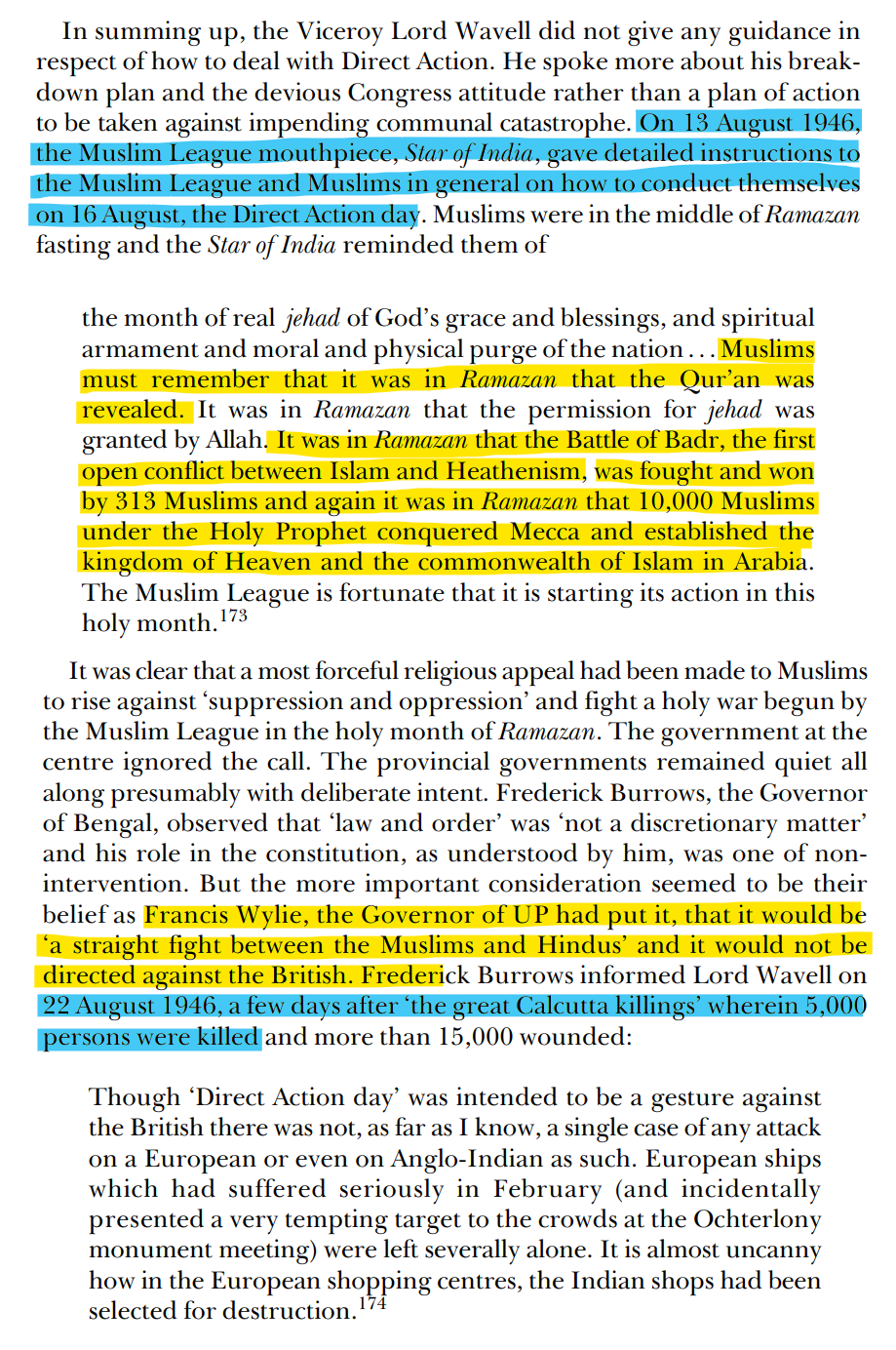
Pamphlets issued before the day made explicit references to the Battle of Badr—a 7th-century Islamic battle against the infidels. According to The Stern Reckoning, slogans like “Khoon ka badla khoon” (blood for blood) and references to Jihad were circulating freely in League propaganda. As Francis Tuker, then GOC-in-C of the Eastern Command, later recalled, the threat was not against the British—but against Hindus.
The Spark in Calcutta
On the morning of August 16, a large Muslim crowd gathered at the Ochterlony Monument (now Shaheed Minar). Among the attendees were Muslim League leaders and even some Communist Party leaders like Jyoti Basu, whose silence and passive endorsement at the rally has been called out by several historians including Tathagata Roy .
The rhetoric was incendiary. Suhrawardy assured the crowd that the government was “with them.” What followed was a well-organized campaign of looting, arson, rape, and murder—targeted almost entirely at Hindus.
Muslim League National Guards, described vividly in The Stern Reckoning, went on a killing spree, moving street by street, burning down Hindu shops, and slaughtering civilians. In some areas, Hindus were dragged out of their homes and killed in front of their families. Even hospitals were not spared.
The violence continued unabated for four days. Police forces—largely under Muslim officers—did little to stop it. In many instances, as documented by Margaret Bourke-White, they were reported to have stood by or even encouraged the mobs. In her interviews, she observed the horror of survivors and the deliberate targeting of women. The scale of the assault stunned the world.
The carnage was beyond human comprehension.
Retaliation and Spread
The Hindu backlash began after two days, largely unorganized and spontaneous.
Unlike the planned assault by the League's militia, the Hindu retaliation was brutal but lacked central leadership. Armed mobs sought revenge for the atrocities. In some areas, Sikhs and Hindus began attacking Muslim neighborhoods. The cycle of violence engulfed both communities.
The poison spread. News of the Calcutta killings travelled across Bengal and beyond.
Thousands were killed, women abducted and forcibly converted, and entire villages razed to the ground. Gandhi himself walked through Noakhali in a futile bid to restore calm.
According to My People Uprooted, the Noakhali genocide—often forgotten in Indian political discourse—was in direct continuity with the logic of Direct Action Day .
The Reaction from Leaders
Jinnah, when questioned about the massacre, disingenuously claimed it was a “spontaneous Muslim outburst of frustration.” Suhrawardy denied all responsibility despite his active role in the events. When the Governor of Bengal, Sir Frederick Burrows, tried to intervene, Suhrawardy obstructed police reinforcements from being sent to troubled areas.
In Lahore and parts of Punjab, retaliatory tensions began simmering. It was here that The Stern Reckoning offers another stark observation—Direct Action Day wasn't a single event but the opening salvo in a year-long campaign of sectarian cleansing leading to the Partition in 1947 .
Legacy of Blood
Direct Action Day shattered the illusion of a peaceful transfer of power. It revealed the depths of communal polarization, the duplicity of Muslim League politics, and the impotence of the British administration. It signaled that Partition would not be a mere drawing of lines—but a bloodbath.
The events also exposed the moral failure of India's secular and leftist intelligentsia. Many, including members of the Communist Party, continued to rationalize the League’s actions as “anti-imperialist resistance,” refusing to acknowledge the naked hate and bigotry that drove the violence.
In a perverse irony, Suhrawardy would later become a Prime Minister of Pakistan. The victims of Calcutta, Noakhali, and other towns received no justice. No reparations. No accountability.
Unbridled Hindu Hate
The events leading up to Direct Action Day were not a tragic accident of history. They were the deliberate culmination of years of ideological indoctrination, hate politics, and militarized communal strategy by the Muslim League. Under the leadership of Muhammad Ali Jinnah, Huseyn Shaheed Suhrawardy, and a cadre of increasingly radicalized supporters, the League not only envisioned but actively plotted a brutal display of Islamic dominance to force the creation of Pakistan.
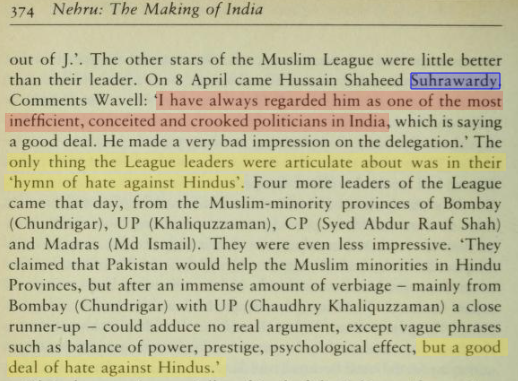
Jinnah’s transformation from a constitutionalist to a communal separatist was driven not just by political ambition, but by deep-rooted contempt for the Hindu civilizational ethos.
By 1940, at the Lahore Resolution, Jinnah declared Hindus and Muslims to be two entirely separate nations—“two different civilizations that cannot coexist”. This wasn’t simply rhetoric—it was a declaration of war on the idea of a pluralistic India.
His unbridled hatred for the Hindus was palpable as was its manifestation in the rank and file of the Muslim League.
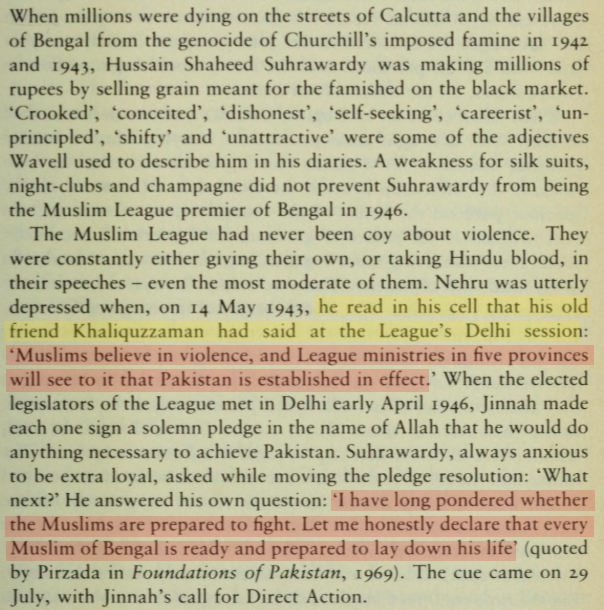
By 1946, the Muslim League had become militarized. The Muslim League National Guards functioned as a paramilitary force, openly parading with slogans like "Larke Lenge Pakistan" (We shall fight and take Pakistan). In The Stern Reckoning, G.D. Khosla documents chilling accounts of League volunteers being trained in weapons, crowd incitement, and arson techniques.
Pamphlets circulated in Calcutta in the days before Direct Action Day called for Muslims to take inspiration from the Battle of Badr—a 7th-century battle where Muhammad’s outnumbered army defeated the Quraysh infidels. The implication was clear: Hindus were the new infidels, and this was to be a holy war.
Suhrawardy, then Chief Minister of Bengal, played the part of a modern-day Yazid. He used his control over the Home and Information portfolios to disable the police, blackout news coverage, and ensure that Muslim mobs operated freely. In My People Uprooted, Tathagata Roy notes that Suhrawardy told the crowd at the Ochterlony Monument on August 16 that “the police will not interfere”—a green signal to unleash hell (Source: "Halfway to freedom: a report on the new India in the words and photographs of Margaret Bourke-White" / Bourke-White, Margaret).
Women were raped and mutilated. Children were stabbed. Hindu neighborhoods were burned to ash. This wasn’t a riot—it was ethnic cleansing.
Hindu Voices Silenced: Gandhi, Nehru, and the Betrayal
While Jinnah plotted with poison, Gandhi and Nehru operated with a sterilized utopianism that bordered on suicidal delusion. They refused to see the Muslim League as what it had become—a fascist religious organization with a separatist army and genocidal rhetoric.
Instead of preparing Hindus for self-defense, Gandhi lectured them on the principles of nonviolence and compassion. He went so far as to say that if Pakistan were created through violence, he would resist it—but passively, through fasting.
Nehru, intoxicated by the dream of modern nation-building, prioritized political negotiations over human lives. Even as Suhrawardy orchestrated killings, Nehru refrained from denouncing him publicly. His priority was to keep the Muslim League at the negotiating table—even if it meant abandoning millions of Hindus to the sword.
Most damningly, both Gandhi and Nehru demonized the Hindu Mahasabha, the only major political organization that warned of impending Islamist violence and organized some Hindu self-defense. The Congress branded them as “communal” and “reactionary”, while extending olive branches to the League.
This moral inversion—vilifying those trying to protect Hindus while legitimizing those plotting their destruction—is one of the most disgraceful episodes in modern Indian political history.
The Storm Warnings: A Deafening Silence
By early 1946, the signs were clear. The Muslim League, under Muhammad Ali Jinnah, had begun mobilizing not for cooperation but for confrontation. Its increasing reliance on communal slogans, call for "Pakistan or perish", and the militarization of its cadre (via the Muslim League National Guards) pointed to an approaching storm.
And yet, Nehru and Gandhi chose to look away.
Gandhi, so fond of moral lecturing, refrained from directly condemning the Muslim League’s violent rhetoric. Nehru, ever the architect of high diplomacy, dismissed the danger as temporary theatrics. In their minds, to recognize the nature of the threat would mean admitting the bankruptcy of their cherished dream—a united, secular India where Hindus and Muslims coexisted in harmony.
So they remained silent. Even when the League called for “Direct Action”, even when British intelligence reports warned of a premeditated plan for mass violence, there was no serious public mobilization by the Congress to counter or resist it. No calls to Hindus to prepare for self-defense. No diplomatic push to hold the League accountable. Nothing.
The Carnage and the Cowardice
When the killings began on August 16, 1946, the extent of the brutality should have jolted any leader with a conscience. Suhrawardy had ensured the police would stand down. League volunteers rampaged across Calcutta—looting, raping, beheading, burning. Hindu homes were marked and targeted. It was a pogrom in all but name.
While Jinnah and Suhrawardy rejoiced in the League’s “display of strength”, what did Nehru and Gandhi do?
They were more afraid of Muslim alienation than Hindu annihilation.
It was the moral cowardice of appeasers. They prioritized a fragile political process over human life, and in doing so, abandoned their own people to a slaughter.
The Aftermath: Whitewashing Genocide
The worst of the betrayal came after the violence.
Even when it was clear that the Calcutta killings were orchestrated with state complicity and Islamic religious fervor, Nehru and Gandhi sought to suppress these facts from public discourse. Their focus shifted immediately to restoring “communal harmony”, not accountability. There was no national mourning, no government commission to investigate the Muslim League National Guards, no reparations or restitution for the victims.
His statements from that period are laced with moral equivalence—comparing the Hindu reaction with the initial Muslim pogrom, despite the disparity in planning, scale, and intent. He refused to visit the affected families in Calcutta until weeks later and redirected his energy to preaching peace in Noakhali—after another round of massacres.
Their obsession with personal legacy and the image of India as a tolerant secular state blinded them to the truth—that the Muslim League was preparing for a civil war, not a debate. And in their blindness, they allowed the blood of thousands to flow.
The Price of Idealism Untethered from Reality
Both Gandhi and Nehru operated from lofty ideals—nonviolence, interfaith unity, secular nationalism. But when those ideals demanded the sacrifice of real people, when faced with the Islamic League's weaponized theology and organized violence, they failed to act in defense of those who trusted them.
Their idealism became a convenient cover for moral surrender. It’s easier to preach peace than to confront evil. Easier to appease the aggressor than arm the victim. In doing so, they set a precedent that would haunt India—Hindu lives were negotiable, expendable, dismissible.
This was not statesmanship. It was abdication.
Two Doctrines: Hatred vs. Hallucination
The contrast between the Muslim League and Gandhi-Nehru Strategy provides us with a context into how and why the greatest tragedy and genocide unfolded in a matter of less than a week.
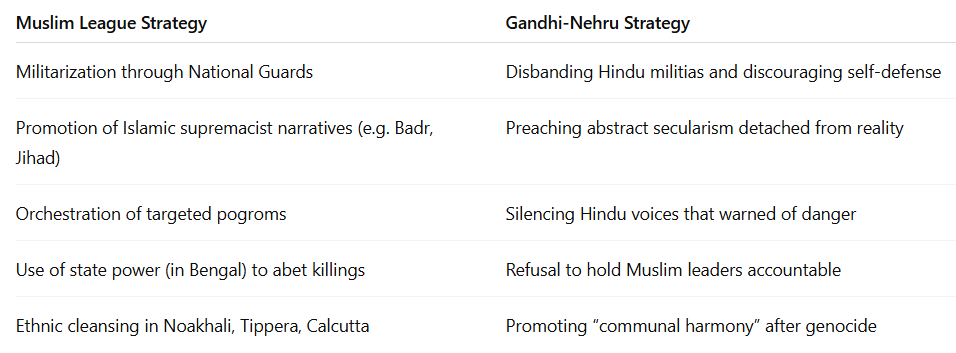
While Jinnah and Suhrawardy orchestrated violence, Gandhi and Nehru became the facilitators of inaction—intellectual enablers whose refusal to accept the nature of the threat cost tens of thousands of lives.
Moral Cowardice as Strategy
Even after the massacres, Gandhi blamed Hindus for retaliating. In Noakhali, where Hindus were slaughtered, raped, and forcibly converted, Gandhi called on them not to fight back but to win “love through sacrifice”. His response to the Calcutta killings was the same—fasts, prayers, and endless sermons. Not one concrete action to protect the victims or punish the guilty.
Nehru’s response was worse. As India’s future Prime Minister, he had access to intelligence, military resources, and public credibility. He could have exposed the Muslim League’s role, demanded British intervention, or resigned in protest. Instead, he chose silence, spin, and selective amnesia.
This abdication of duty, masked as idealism, allowed the ideology of Pakistan to be written in Hindu blood.
The Communist Perfidy
On 16 August 1946, during the infamous Direct Action Day, a massive rally was organized at the Ochterlony Monument Ground (now Shaheed Maidan) in Calcutta. The gathering, orchestrated under the leadership of the Muslim League and its Bengal Premier Huseyn Shaheed Suhrawardy, became a breeding ground for incendiary rhetoric. The speakers did not merely stop at political sloganeering—they unleashed a torrent of virulent anti-Hindu propaganda, explicitly inciting the crowd towards violence.
What remains deeply disturbing is the complicity and presence of prominent leaders who should have opposed such calls for bloodshed. Among them was Jyoti Basu, the influential Leader of the Communist Party of India (CPI) in the Bengal Legislative Assembly, who attended alongside two other communist MLAs, including Moni Kuntal Sen. Instead of condemning the hate-filled rhetoric, these communist leaders shared the stage with Suhrawardy, who brazenly incited his supporters to resort to violence in pursuit of the League’s divisive agenda.
The sight of communist representatives—who claimed to be the voice of the working class—standing shoulder to shoulder with Suhrawardy as he called for a communal bloodbath is a chilling testament to their ideological betrayal. Their silence in the face of this venomous mobilization effectively legitimized one of the darkest chapters of Bengal’s history.
What becomes even more intriguing is that the Communists of Bengal, including Jyoti Basu former chief minister of West Bengal), took anti-Hindu stances during this period. I am referring to the book Brothers Against the Raj to highlight the actions of the communists during the DAD period, including those of the veteran Jyoti Basu. Hashim, the secretary of the Muslim League and a key figure behind the rise of Suhrawardy mentions in his memoir Let Us Go To The War that he received assistance from Nikhil Chakravartti, a young communist, in setting up the program. Hashim identified himself as an “Islamic Socialist.” Jyoti Basu, along with two other CPI MLAs, attended the Muslim League meeting on Direct Action Day (16 August, 1946), which involved anti-Hindu speeches and led to violence. In fact, Jyoti Basu even shared the stage with Suhrawardy. (Source: "Horrors of partition of Bengal: Coming to terms with the unforgiving reality of pogrom of Hindus" by Aabhas Maldahiyar / FirstPost)
A violent machine was being set into motion that day. A fateful move that will take the lives of millions within a matter of a year in the most cruel manner. All with the connivance and collaboration of supposedly atheistic politicians.
The very politicians who would go on to run the most industrialized state into the ground.
The call for Direct Action Day was very clear. It was a call for violence against the Hindus on the lines of the Battle of Badr. It was part of the advertisements and pamphlets that the Muslim League had distributed to its base and to Muslims all over India.
Quite contrary to everything that the Communists were saying all along.
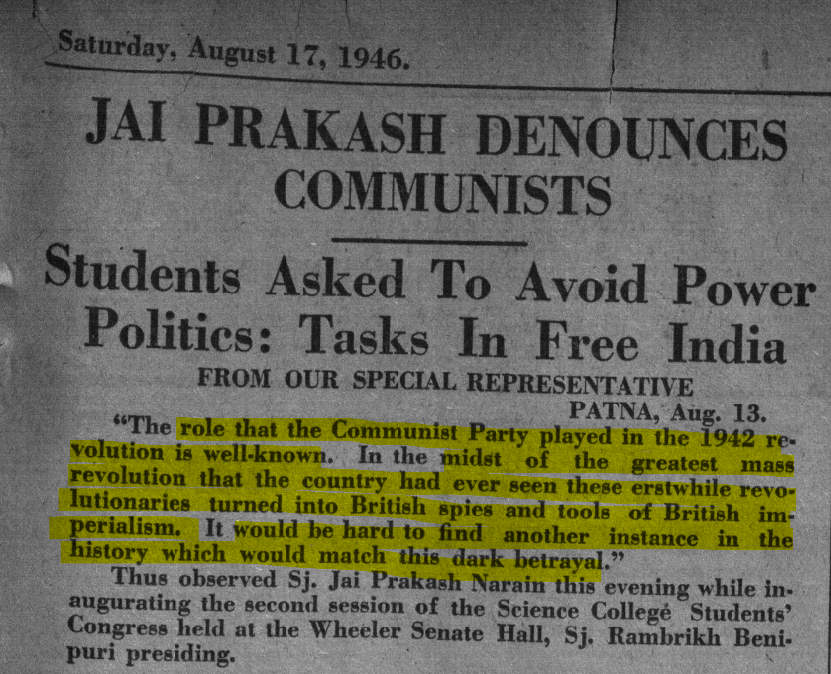
Despite the malevolent schemes of the Muslim League to divide the country and incite communal carnage, the Indian Communists were simultaneously complicit in laying the groundwork for an unimaginable wave of violence against the very masses they claimed to represent. Far from being champions of anti-imperialist struggle, these communists were, in reality, collaborators with colonial power structures. Their rhetoric of class struggle often served as a convenient façade while they aligned with British interests when it suited their ideological or strategic goals.
Jai Prakash Narayan, one of India’s most respected socialist leaders, openly exposed this duplicity. As the horrors of Direct Action Day erupted in Calcutta on August 16, 1946—leaving thousands dead in the streets—Narayan accused the Indian Communists of acting as informants and pawns for British intelligence. Instead of opposing imperialism, they chose to exploit communal tensions for political leverage, further deepening the fractures between Hindus and Muslims at a time when unity was desperately needed.
By tacitly supporting the violence of the Muslim League and failing to resist British machinations, the communists betrayed the spirit of the independence struggle. Their actions contributed to the chaos and bloodshed that preceded Partition, leaving a lasting scar on India’s collective memory.
To understand the sophistication of Muslim League, the Communists and the Schedule Castes' Federation, one needs to go through the different messaging that the Muslim League brought out with respect to the Direct Action Day.
Communists also had their own share of conflicting but useful (for their agenda) messages that would help the Muslim League conduct the dance of blood with absolute impunity!
Check here for example. While the Calcutta District Muslim League was talking about "anti-fascism and oppressed people" and also talking about equal freedom of Muslims, Hindus, SCs, the Adivasis etc, the "Programme of the Direct Action Day" from the same group was unambiguously anti-Hindu.
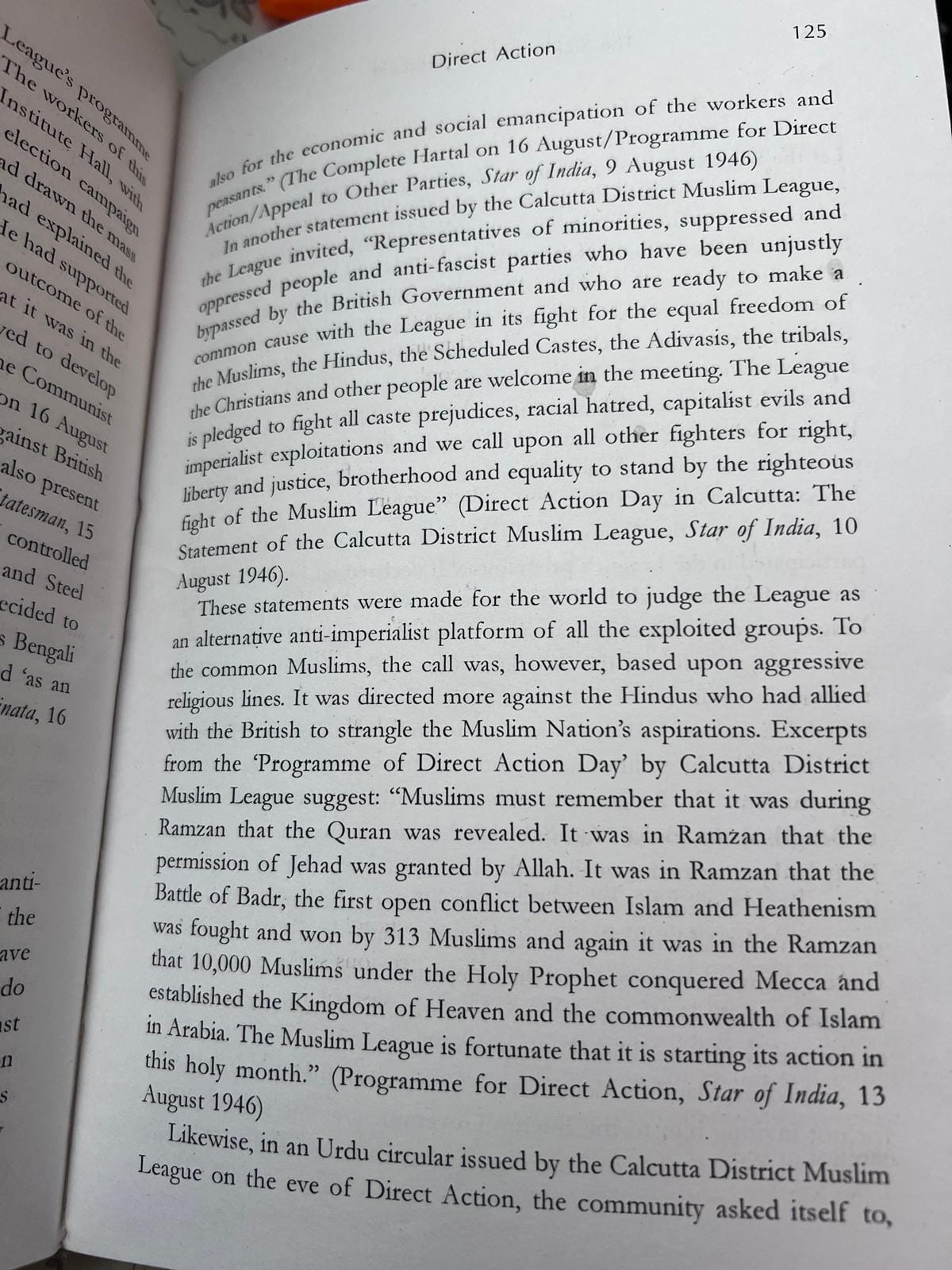
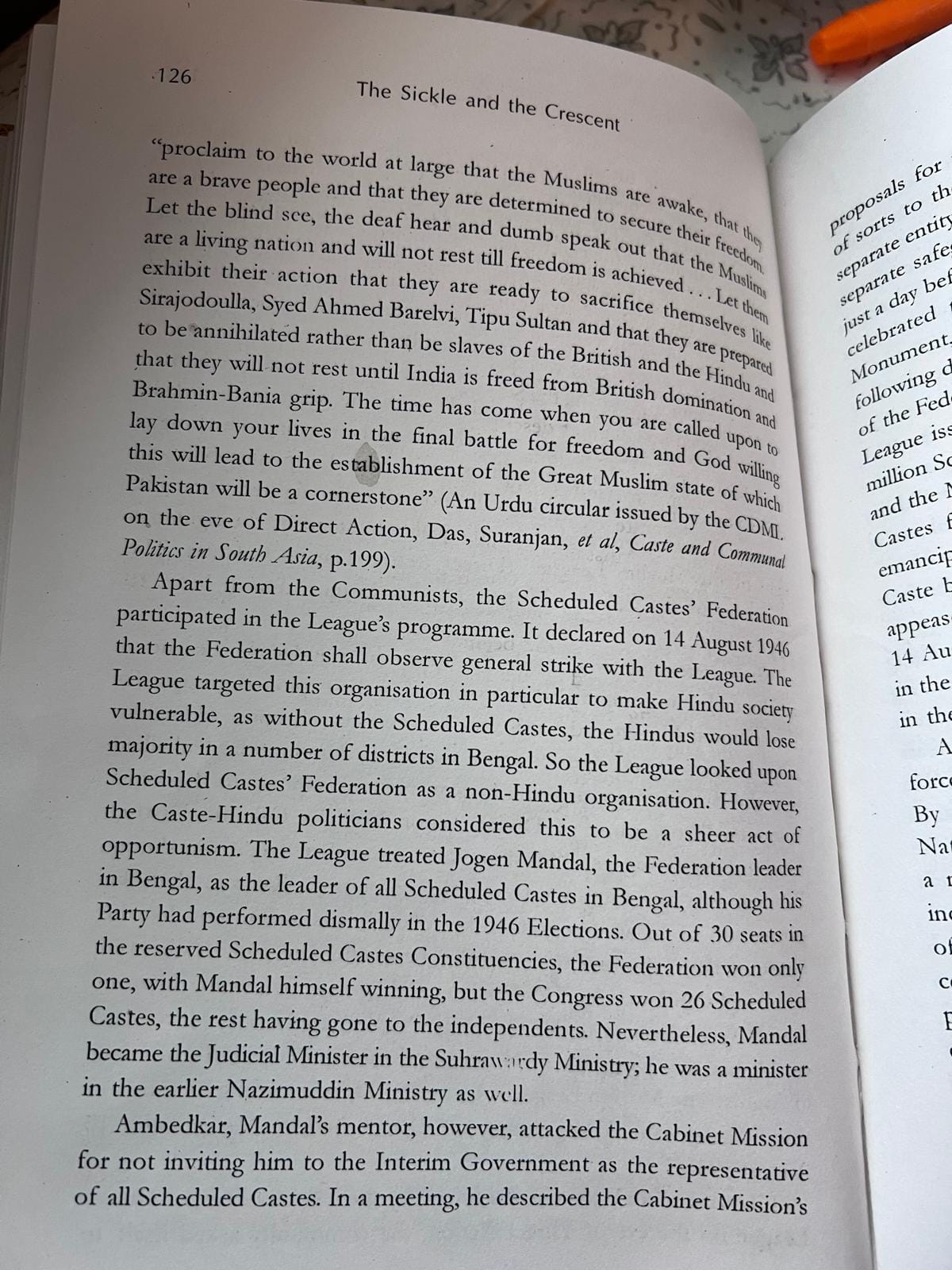
Source: Images from "The Sickle & the Crescent" by Sunanda Sanyal and Soumya Basu.
The same copybook can be seen in the actions of the Communists.
Jyoti Basu, who was to attend the Direct Action Day public meeting on August 16th with Suhrawardy, released this statement on August 14th in Amrita Bazar Patrika.
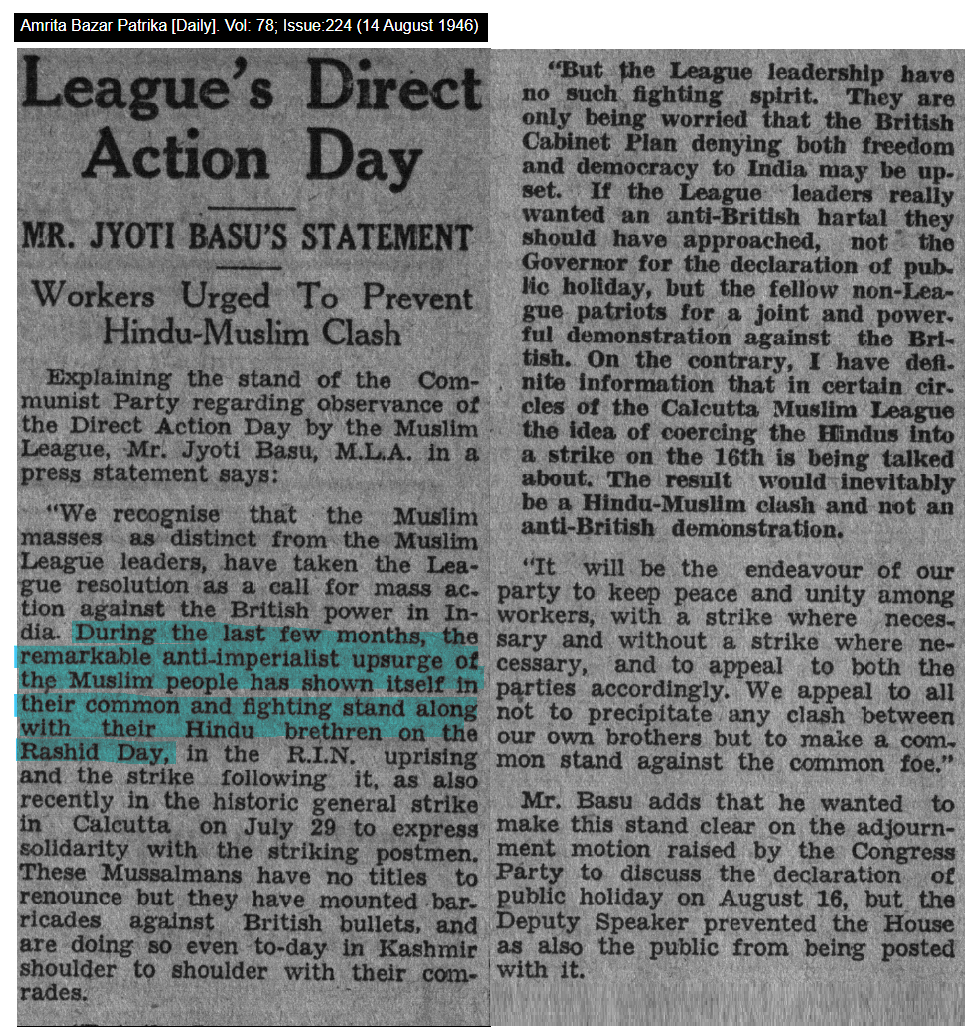
The call for Direct Action Day was unambiguous. As was the practiced ambiguity of the Communists.
It is worth reiterating the truth again and again.
The target was crystal clear, yet the Communists, who had long preached anti-imperialism, betrayed their own words. Their silence and complicity on that day stand as a damning indictment of their ideological hypocrisy.
The Muslim League National Guards
These were the shenanigans of the major players in Bengal.
Meanwhile, on the other side in the West, the Muslim League was playing another game.
The creation and preparation of a quasi-military assault force was being undertaken with the full involvement and sponsorship of the top Muslim League brass. Obfuscation and false claims were the order of the day from the Muslim League to provide cover, time, and resources for that force to come of age and become potent enough to carry out mass slaughters.
Anyone who has ever owned property in the Indian subcontinent – India or Pakistan – and has had the misfortune of renting a portion of it out knows what it takes to vacate that tenant.
These were inhabitants of that land. Living in their ancestral homes. For generations. In fact, for many a millennium. They could not be “persuaded” to just leave their homes and go. They had to be pulled apart from their homes and thrown out.
In that, the groundwork was the key. The rest was mere rhetoric.
The Muslim National Guards recruits were being trained in stabbing, arson, and killing. They were also tested and received certificates. Here is a copy of the kind of certificate given out. Thousands of such certificates were given out at various centers.
On January 24th, 1947, a significant event unfolded in Punjab, India, when the Muslim National Guards organization was declared an unlawful association under the Criminal Law Amendment Act by the Punjab Government, in parallel with a similar declaration issued against the Rashtriya Swayamsevak Sangh (RSS). This decision marked a crucial moment in the lead-up to the partition of India.
As authorities sought to enforce this declaration, the responses from the RSS and the Muslim National Guards differed markedly. The RSS, complying with the order, allowed its offices to be searched and sealed. In contrast, the Muslim National Guards members resisted when the police arrived at their headquarters in Lahore, leading to a tense standoff.
In fact, the Muslim League cadres doubled down. Several prominent figures from the Muslim League, including members of the Muslim League Working Committee such as Mian Iftikhar-ud-Din, Feroze Khan Noon, Mian Mumtaz Daultana, Sardar Shaukat Hayat Khan, and Khan Iftikhar Hussain Khan of Mamdot, hurried to the scene in an attempt to prevent the search and seizure operation. However, their intervention resulted in their arrest by the authorities. Subsequent searches of the premises unveiled a cache of over 1000 steel helmets, uniforms, and incendiary literature, shedding light on the extent of the Muslim National Guards' military preparation.
It is instructive to note that media of that day was giving its own spin to these arrests.
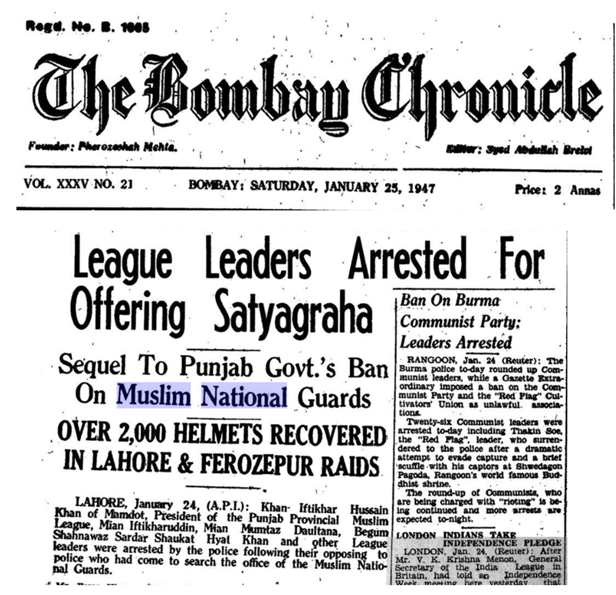
When vile and brutal violent actions or their precursors are articulated in a language that denotes "fight for truth" (satyagraha), you can rest assured that a large and violent calamity will befall society.
It is worth noting that the Muslim League leaders had arranged for Army Helmets from the Military Disposal Department to be supplied to the National Guards cadres. This action indicated a significant level of organization and planning within the Muslim National Guards, as they not only possessed uniforms but also received training in military drills.
The search had missed the main booty. It was later learned that various arms, including daggers and firearms, had been clandestinely moved to the residence of prominent League leaders.
In particular, the Mayor of Lahore, Mian Amir-ud-Din, played a role in this operation, with the arms being supplied from his house during the riots, raising concerns about the potential for violence and unrest in the region.
The Cruel Convergence
The story of the Hindu Genocide has many sides to it. Their dishonesty, hatred, practiced pusillanimity, cowardice, and unbridled bigotry converged together to enable a genocide of that proportion.
- Jinnah’s hatred gave the orders.
- Suhrawardy’s bureaucracy executed them.
- Gandhi and Nehru’s idealism gave it cover
- Communist double-speak and perfidy that slyly helped the killers
The Muslim League’s unbridled hatred was met not with resistance, but with acquiescence. Direct Action Day and the genocides that followed in Noakhali and later Punjab were not aberrations. They were the inevitable consequence of an asymmetry between an enemy willing to kill, and leaders too proud or blind to stop them.
A Reckoning
The Bengal Files is not just a film—it is a historical reckoning that compels us to reexamine the events of Direct Action Day.
A calculated act of terror that shaped the very destiny of the subcontinent.
The film does not merely depict violence; it explores the psychology of evil—the political betrayal, the complicity of leaders, and the silence of the very people who were meant to uphold justice. It brings to life the harrowing truth that the atrocities of Direct Action Day were not accidents of history but the manifestation of an ideology rooted in hate and dominance.
This ideology continues to echo in the modern-day politics of Bengal.
Gholam Sarwar Hussein never died. He still lives.
Comments ()