
The Daily Geopolitics Brief # 10
An F-15 is shot down over Iran. One crew member rescued, one missing. Oil hits $112 a barrel — its biggest single-day surge since 2020. The EU is rationing fuel. India scrambles for fertilizers. And US intelligence says Iran can still wreak "absolute havoc." Day 34.

"They are still very much poised to wreak absolute havoc throughout the entire region." — A US intelligence official, speaking to CNN on condition of anonymity, April 2, 2026 — referring to Iran's military capability despite 34 days of US and Israeli bombardment
What This Signals
This sentence — delivered not by an Iranian commander or a Global South critic, but by a senior US intelligence officer to CNN — is the most important one spoken about this war this week. It cuts through five weeks of White House triumphalism, Pentagon briefings announcing 12,300 targets struck, and presidential Truth Social posts declaring that Iran has "almost no launchers left."
The reality, confirmed by three intelligence sources, is that roughly 50% of Iran's missile launchers remain intact. Around 50% of its drone capabilities are operational. A large portion of its coastal defense cruise missiles — the weapons that threaten the Strait of Hormuz — were never meaningfully targeted. The IRGC's naval forces retain roughly half of their capability, including "hundreds if not thousands" of small boats and unmanned surface vessels.
The gap between what the White House says and what US intelligence knows is the central strategic fact of Day 34. When Trump claims Iran has been "decimated," he may mean it politically. But America's own intelligence community quietly tells a different story: Iran has been hurt, but it has not broken, and it can still wreak havoc. That assessment is what is driving the ground war planning, the Kharg Island deliberations, the deployment of the 82nd Airborne, and — most dramatically — the F-15E that fell over southern Iran on Friday morning.
For India, this intelligence gap matters in a specific way: it tells you that the war is not two weeks from ending, despite what Trump says. It is closer to a new and more dangerous phase.
Story #1: US F-15E Strike Eagle Shot Down Over Iran — One Crew Rescued, One Still Missing
The Full Picture
In the most dramatic single event of the 34-day war, an American F-15E Strike Eagle was shot down over Iran on Friday, April 3 — the first confirmed downing of a US fighter by enemy fire since the war began. One of the jet's two crew members was rescued by American forces and is alive and receiving medical treatment. The search for the second crew member continued through the evening, raising fears the aviator may have been captured by Iranian forces.
US officials confirmed the aircraft was an F-15E, a two-seat multirole fighter capable of air-to-air and air-to-ground missions. Iran's IRGC claimed responsibility for downing the jet, initially claiming it was an F-35, though CNN analysis of debris images indicated the wreckage was consistent with an F-15. The aircraft is believed to belong to the USAF's 48th Fighter Wing — the Liberty Wing — normally based at RAF Lakenheath in the UK.
The rescue operation was dramatic: geolocated videos from Khuzestan Province in southwestern Iran showed what appeared to be a C-130 refueling tanker and two Black Hawk helicopters flying at low altitude in search-and-rescue mode. Israel, which had been conducting simultaneous strikes on Iran, reportedly suspended its operations in the relevant area to avoid interfering with the rescue mission. Iranian state TV broadcast an appeal for citizens to capture the pilots, and a regional governor offered a reward. Local merchants reportedly offered 10 billion tomans ($76,000) for anyone who handed crew members to authorities alive.
CENTCOM had denied, just hours before, that any US aircraft was missing — a claim rapidly overtaken by events. This contradicted weeks of assertions by Pentagon officials about US air dominance. CENTCOM Commander Admiral Brad Cooper had said just the day before: "We don't see their aircraft flying, and their air and missile defense systems have largely been destroyed." Oil markets responded immediately: WTI crude surged 11.4% to $111.54 a barrel — its largest single-day gain since 2020, and Brent jumped 7.8% to $109.03.
Two US rescue helicopters involved in the search operation were also struck by Iranian fire, though personnel were reported safe.
🇮🇳 How This Impacts India
The F-15 shootdown is the most significant escalation event in India's risk calculus for the war. It demonstrates that Iran retains functioning air defense capabilities and can down sophisticated US aircraft — directly contradicting Trump's claims of Iranian military collapse.
For India, this means the war will not end quickly or cleanly. The April 6 deadline for energy infrastructure strikes is now more — not less — likely to be invoked, as Trump faces domestic pressure to demonstrate strength after this humiliation.
India must prepare for a sustained oil price shock well above $112 per barrel. More immediately, India deployed three naval vessels and a P-8I maritime patrol aircraft to assist in the IRGC Dena search-and-rescue operation earlier in the war. The F-15 shootdown sets a precedent: India's diplomatic investment in search-and-rescue goodwill with Iran is now more strategically valuable than ever, as India may need to play a quiet intermediary role between Tehran and Washington to prevent further escalation.
📎 References: NBC News | CBS News Live | CNN Live | The Daily Beast | NPR
Story #2: Marines, Kharg Island, Regime Change — Trump's Three Ground War Options
The Full Picture
As the air campaign enters its fifth week without breaking Iran's will, the Trump administration is actively weighing its ground war options — a deliberate and structured deliberation that has now moved from theoretical planning to detailed operational preparation, according to reporting by The Sun, The Washington Post, and Axios.
The broad outlines are now clear: approximately 5,000 Marines from the 31st Marine Expeditionary Unit have arrived in the Persian Gulf, sailing aboard the USS Tripoli. A second 2,500-strong unit from the 11th MEU aboard the USS Boxer is days away. The 82nd Airborne Division has begun deploying elements to the Middle East. The Pentagon is considering sending up to 10,000 additional troops, bringing the total US military presence in the region to over 60,000 service members.
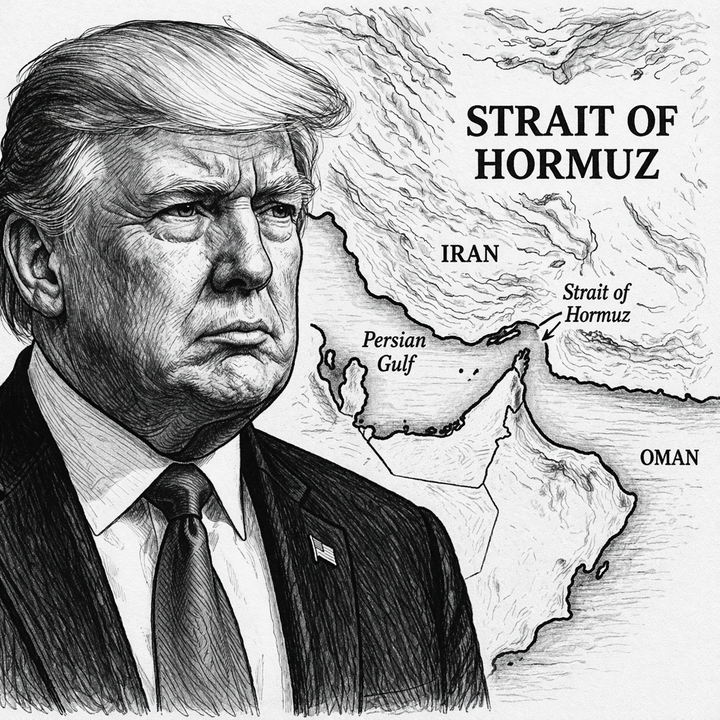
Three distinct ground operation options are reportedly being discussed. The first is a seizure of Kharg Island — Iran's primary oil export hub, through which 90% of the country's crude passes — to give the US economic leverage over Tehran. The second is coastal raids near the Strait of Hormuz, using special operations and conventional infantry to neutralize Iran's coastal missile and mine-laying capabilities. The third option is a direct push toward regime change by ground forces, though it is considered the most dangerous and least well-defined.
A source familiar with White House thinking told Axios: "We need about a month to weaken the Iranians more with strikes, take the island, and then get them by the balls and use it for negotiations." Iran's parliament speaker, Mohammad Bagher Ghalibaf, responded: "Our men are waiting for the arrival of American soldiers on the ground to set them on fire and punish their regional allies once and for all."
Experts have warned that Kharg Island — located just 15 miles off the Iranian mainland — would expose US forces to sustained fire from artillery, anti-ship missiles, drones, and mines. The island cannot be reached without traversing a hazardous maritime route, and US minesweeping capabilities have severely atrophied. Rear Admiral (Ret.) Mark Montgomery called it an unnecessary risk: "It's not like we control their oil production."
🇮🇳 How This Impacts India
If US Marines land on Kharg Island, the war transforms from an air campaign into a land occupation — with consequences for India that are immediate and severe. Kharg Island handles the loading of oil tankers that supply not only Iran's own exports but also much of the Gulf's logistics infrastructure. A US seizure would essentially freeze the Persian Gulf's oil export system, potentially halting Indian crude imports from Saudi Arabia, Iraq, Kuwait, and the UAE simultaneously. India imports over 4.5 million barrels per day — a halt of even half that volume would create a domestic energy emergency within days. India must immediately activate its strategic petroleum reserve release procedures, accelerate negotiations for alternative supplies with the US, Russia, and West Africa, and brief its energy ministry on emergency rationing protocols — not as contingency planning, but as immediate operational readiness.
📎 References: War on the Rocks — Folly of Seizing Kharg | PBS News — Expert Risks | Axios — Kharg Invasion | Washington Post
Story #3: Pentagon Prepares Weeks of Ground Operations in Iran — The WSJ Investigation
The Full Picture
The Wall Street Journal confirmed what has been circulating in defense circles for days: the Pentagon has moved beyond conceptual planning into detailed operational preparation for sustained ground operations in Iran — operations that could last weeks or months and would involve a combination of special operations forces, conventional infantry, and potentially the 82nd Airborne Division.
The plans, described by multiple US officials speaking on condition of anonymity, fall short of a full-scale invasion. They focus on raids against coastal sites near the Strait of Hormuz, seizure of strategic islands in the Persian Gulf, and potentially extended special operations campaigns against IRGC command nodes. A key feature of the planning is the inclusion of detention logistics — plans for handling Iranian prisoners — which analysts note typically only appear in scenarios involving sustained territorial control, not quick raids.
The plan also explicitly addresses Larak Island and Abu Musa — two Iranian-controlled islands near the entrance to the Strait of Hormuz, approximately 40 miles from both Iran and the UAE — as potential seizure targets that could give the US permanent leverage over navigation through the Strait of Hormuz.
The White House confirmed only that the Pentagon works to give the commander in chief "maximum optionality" and that no decision has been made. Trump himself has been characteristically inconsistent: on one day suggesting he doesn't want ground troops, on another saying, "Maybe we take Kharg Island, maybe we don't. We have a lot of options." Crucially, 62% of Americans in AP polling strongly oppose deploying ground forces, with only 12% in favor.
Iran's parliament speaker declared: "The enemy publicly sends messages of negotiation and dialogue while secretly planning a ground attack."
🇮🇳 How This Impacts India
A US ground incursion into Iran would create conditions that India has no precedent for managing in its modern history. Iran shares a 900-km border with Afghanistan — India's gateway to Chabahar-based connectivity to Central Asia. Any US land operation that triggers widespread Iranian civil mobilization, Iranian proxy activation across the region, or IRGC retaliatory strikes on Gulf infrastructure would simultaneously cut India's Chabahar access, endanger its 9 million Gulf workers, and potentially draw Pakistan (which borders Iran and is currently mediating ceasefire talks) into a more active role that could complicate India-Pakistan dynamics. India's National Security Council must game out this scenario now, not after it happens.
📎 References: Al Jazeera — Pentagon Readies Ground Operations | Military Times | Jerusalem Post | WSJ — via Washington Post
Story #4: Fuel Rationing Warning — Europe Braces for "Long Crisis," IEA Says April Will Be Worse Than March
The Full Picture
The global fuel crisis generated by the Hormuz closure has graduated from an economic warning to an operational emergency for several countries, with the EU's Energy Commissioner Dan Jørgensen issuing a formal warning that Europe is assessing "all possibilities," including fuel rationing, and the IEA Executive Director Fatih Birol declaring this the worst energy crisis in history.
Slovenia became the first European country to formally introduce fuel rationing. Spain approved a €5 billion aid package including fuel subsidies. The EU's bill for imported fossil fuels has jumped by €14 billion since the war began. Diesel and jet fuel are under particular pressure — TotalEnergies CEO Patrick Pouyanné reported jet fuel and diesel prices had surged $200 and $160 per barrel, respectively. Several European natural gas plants stopped quoting prices altogether because they couldn't set contract prices amid market volatility.
Birol's warning at the IEA was blunt: "The next month, April, will be much worse than March." He explained that ships carrying oil that transited Hormuz before the war are still arriving at ports. Once that pipeline empties, the physical shortage becomes acute. "In April, there is nothing. The loss of oil in April will be twice the loss of oil in March." The IEA previously released a record 400 million barrels from emergency stockpiles — but Birol noted this is "helping to reduce the pain" rather than solving it. "The cure is opening up the Strait of Hormuz."
Analysts at Bloomberg spoke to over three dozen oil traders, executives, and advisers who delivered a consistent message: "The world still hasn't grasped the severity of the situation." The comparison to the 1970s oil shock is now standard across trading floors. US crude reached $111.54/barrel on April 3 alone. Brent hit $112 in Friday morning trading.
🇮🇳 How This Impacts India
India sits at the exact intersection of all the dimensions of the fuel crisis described above. India is not only an oil importer — it is a fuel exporter, selling refined petroleum products across Asia and Africa. If European and Asian demand for Indian refined products simultaneously spikes, India's domestic refinery capacity faces competing pressures: supply India's own growing consumption or capture premium export revenue. India's petroleum product exports — petrol, diesel, naphtha, ATF — have become a significant revenue source and should be managed strategically rather than left to the market during this crisis. The government must simultaneously protect domestic fuel availability, capture export premium where possible, and begin actively modeling what happens if oil reaches $130 or $150 — the scenarios that Birol's "twice the loss in April" warning makes increasingly likely. India's Strategic Petroleum Reserve must be positioned for the worst case.
📎 References: Mirror/IEA — Birol Warning | CNBC — IEA April Warning | Türkiye Today — EU Rationing | Bloomberg — Oil Shock | EU Warns — PBS
Story #5: India Looks to Indonesia and Malaysia for Fertilizers — The Food Security Clock Is Ticking
The Full Picture
India — the world's second-largest fertilizer consumer — is actively scrambling to diversify its fertilizer supply chains away from the Middle East, as reported by Nikkei Asia. With the Strait of Hormuz effectively closed and LNG supplies from Qatar disrupted, India is in talks with Indonesia, Malaysia, Egypt, Russia, and even China to secure urea, DAP, and potash before the June kharif planting season.
The stakes are enormous. India produces about 87% of its urea domestically, but that production depends on natural gas as its primary feedstock, and roughly 70-80% of urea production costs are natural gas. India imports most of its LNG from Qatar through Hormuz. When Petronet LNG invoked force majeure in early March, declaring LNG vessels could no longer safely transit the strait, Indian urea plants began shutting down or advancing maintenance. Major producers, including IFFCO, have halted some facilities.
Urea prices have jumped 21% to a three-year high. India's fertilizer subsidy bill — already budgeted at ₹1.71 lakh crore — now looks severely underestimated. CRISIL has warned the government that higher international prices, combined with reduced LNG availability, will push actual subsidy needs well above the budget figure.
Globally, the crisis is severe: about one-third of the world's fertilizer trade transits Hormuz. Qatar halted output at the world's largest urea plant after attacks on its LNG facilities. China has restricted fertilizer exports to protect its own supplies. The Washington Post quoted farmers from Vietnam, Kenya, and Ohio reporting supply disruptions and rising input costs ahead of the planting season.
India's kharif stocks as of March were 37% higher than the previous year, providing approximately 1.8 months of urea cover and 3.4 months of DAP cover. This buffer is real, but it is not infinite. If the war extends through June, India faces a genuine food security risk heading into the primary planting season.
🇮🇳 How This Impacts India
This is the story closest to India's 700 million farmers and their livelihoods. The fertilizer disruption is not abstract — it translates directly into higher input costs, potentially reduced application rates, lower crop yields, and ultimately food price inflation at the point where India's population is most vulnerable. India must move on multiple fronts simultaneously: issue urea import tenders to Indonesia, Malaysia, and Egypt now (not after the shortage is visible); approach China diplomatically to ease its export restrictions on fertiliser, tying this to the broader relationship reset that PM Modi initiated with his Xi meeting last year; build emergency stockpiling for DAP and potash (where India has no domestic production); and review the kharif season's planting advisory to potentially shift some acreage from nitrogen-intensive crops like paddy to less input-intensive alternatives. The 2026 kharif season will define food price stability for the next 18 months.
📎 References: Nikkei Asia | Wright Research — India Fertiliser Crisis | Outlook Business — Urea/China | Washington Post — Global Shortage
Story #6: US Intelligence — Iran Still Has 50% of Its Missile Launchers and Thousands of Drones
The Full Picture
A classified US intelligence assessment, leaked to CNN by three sources familiar with the findings, reveals a picture of Iranian military capability that stands in sharp contrast to White House claims of decisive victory: roughly half of Iran's missile launchers remain intact after 34 days of bombardment, approximately 50% of its drone capabilities are operational, and a large percentage of its coastal defence cruise missiles — the weapons most directly threatening the Strait of Hormuz — have barely been touched.
"They are still very much poised to wreak absolute havoc throughout the entire region," one of the sources told CNN.
The intelligence assessment explains several things that have been puzzling observers. It explains why Iran can continue to launch daily missile and drone barrages against Gulf states, Israel, and US bases despite weeks of strikes — because it still has the assets to do so. It explains why the Pentagon is preparing ground operations: air power alone cannot finish the job. And it explains why Trump privately acknowledged through advisers that Iran's leaders "don't believe they're losing the war and therefore don't feel motivated to strike a deal."
The discrepancy between US and Israeli assessments is itself revealing. Israel counts launchers buried under rubble as "destroyed"; the US counts them as still potentially operational — a definitional difference that understates the real divergence between the two allies on how the war is going. One intelligence source told CNN directly: "You're crazy if you think this will be over in two weeks."
The White House dismissed the report as the work of "anonymous sources desperately wanting to attack President Trump." The Pentagon called it "completely false." But oil markets reacted to the intelligence, not the denial — WTI surged past $111.
🇮🇳 How This Impacts India
The intelligence assessment is the single most important data point for India's strategic planning. If Iran retains 50% of its launch capability and thousands of drones after 34 days of the most intense US air campaign since Iraq 2003, then the Hormuz closure will not be resolved in weeks. It will resolve only when a political settlement is reached — and political settlements take longer than military campaigns. India's planning must therefore extend its timeline: not two more weeks of disruption, but potentially two more months. India must mobilize accordingly: accelerate all alternative supply routes, activate diplomatic channels with every relevant party, and communicate clearly to its domestic market that energy prices will remain elevated for longer than initial estimates suggested.
📎 References: CNN — Intelligence Assessment | Times of Israel | Daily Mail | Business Standard
Story #7: France Plans Massive Missile Boost — A €36 Billion European Defense Revolution
The Full Picture
As Trump demands European allies do more and simultaneously threatens to leave NATO, France has unveiled the most ambitious European defense expansion in a generation: a comprehensive €36 billion defense budget increase for 2026-2030, anchored by a $10 billion munitions spending surge and plans to quadruple its stockpile of missiles and drones by 2030.
French Prime Minister Sébastien Lecornu described the plan as a response to lessons from Ukraine and the Middle East — conflicts that have revealed how rapidly modern warfare consumes munitions and how quickly European stockpiles are depleted. "The urgency is clearly munitions," Lecornu said. A central element is the creation of France Munitions, a new centralized procurement entity designed to aggregate demand, enable bulk purchasing, and give France's defense industry the long-term demand signals needed to ramp up production.
The plan prioritizes ground-based air defense, counter-drone systems, early warning drones, and loitering munitions. France is also developing a land-based ballistic missile (Missile balistique terrestre, or MBT) with a range of over 2,000 kilometers and a €1 billion development budget — the first such system France will have since the end of the Cold War.
Separately, President Macron announced in March that France would expand its nuclear deterrent and allow limited deployment of French nuclear aircraft to allied nations — framing Europe's nuclear security as something that can no longer rely on American guarantees alone. France and Germany have begun joint nuclear exercises. The EU's Defense Commissioner has called for a Europe-wide crash program to expand missile production, explicitly stating: "Europe can no longer rely on the US for air defense missiles."
🇮🇳 How This Impacts India
France's massive defense expansion is directly relevant to India in three ways.
- First, India has committed to buying 26 Marine Rafale-M jets and is in advanced negotiations for 114 Rafale MRFA fighters. A France that is investing €36 billion in defense and rapidly expanding its industrial base is a more capable, more reliable, and more strategically serious defense partner than the France of a decade ago.
- Second, France's new MBT ballistic missile program creates an opportunity for India to explore co-development or licensed production — India needs exactly this capability as it plans its own deep-strike systems under the Defense Forces Vision 2047.
- Third, the broader European rearmament story accelerates the bifurcation of the global defense market into US-aligned and European-aligned tracks. India — which buys from both — must manage its positioning carefully to remain strategically autonomous in an increasingly divided world.
📎 References: Politico EU | Defense News — France $10B | GovCon Exec | Newsweek — France Nuclear
Story #8: UK Convenes 40 Nations on Hormuz — Without the US in the Room
The Full Picture
In the most significant multilateral initiative since the war began, British Foreign Secretary Yvette Cooper convened a virtual meeting of over 40 nations on April 2 to coordinate a diplomatic and ultimately military approach to reopening the Strait of Hormuz — a meeting that was notable not just for who attended, but for who didn't: the United States.
The meeting included France, Germany, Canada, Italy, Japan, the UAE, and — critically for India — India's Foreign Secretary Vikram Misri attended as India joined the initiative. Cooper's opening framing was forceful: "We have seen Iran hijack an international shipping route to hold the global economy hostage." She accused Iran's "recklessness" of directly threatening global economic security.
The meeting agreed on a framework for collective action: increasing international diplomatic pressure on Iran, including through the UN Security Council; exploring coordinated economic measures, including sanctions; and working with the International Maritime Organization to free approximately 20,000 sailors and 2,000 vessels trapped in the Strait by the closure. Military planners from participating nations will meet separately next week to discuss defensive capabilities, including demining and convoy escort operations, for implementation once the active conflict phase ends.
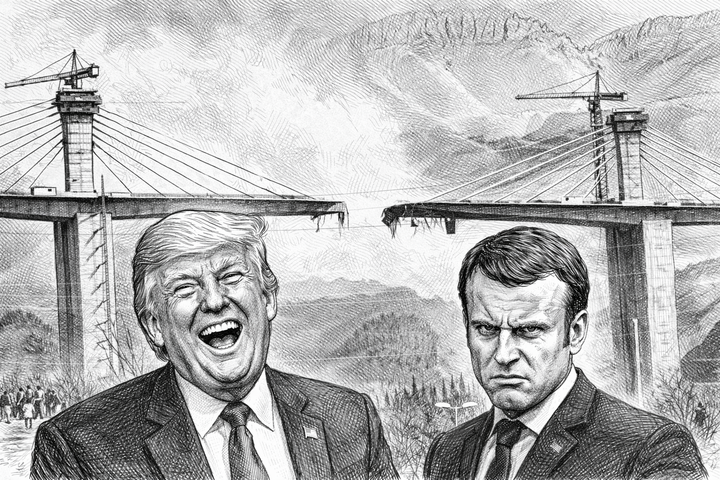
No concrete operational measures were announced — the meeting was explicitly a political and diplomatic exercise, not a military one. France's Macron explicitly called a military opening of the Strait by force "unrealistic." The GCC Secretary General called on the UN Security Council to authorize the use of force, but Russia, China, and France blocked any "all necessary means" language.
The absence of the US from the room — while 40 countries discussed reopening a waterway that the US war created the conditions to close — is a geopolitical landmark: the beginning of a post-American management of a crisis that America generated.
🇮🇳 How This Impacts India
India's attendance at the Cooper coalition is the right call and deserves amplification. India's strategic interest in a free, toll-free, non-IRGC-controlled Strait of Hormuz is absolute. India should now actively seek a co-leadership role in this coalition — not just attendance, but co-convening the military planners meeting, contributing Indian Navy demining and escort capabilities to the planning framework, and using its Chabahar leverage with Iran to advocate for a "friendly nations" corridor that keeps Indian-flagged and Indian-cargo vessels moving through the Strait even while the conflict continues. India's Foreign Secretary's attendance is step one. India needs to make itself indispensable to step two.
📎 References: UK Government Chair's Statement | Al Jazeera | Euronews | Foreign Policy | NPR
Story #9: Trump Requests $1.5 Trillion Defence Budget — The Largest in US History
The Full Picture
On April 3, the Trump administration officially submitted its fiscal year 2027 defence budget request to Congress: $1.5 trillion — the largest defence budget request in US history, representing a 44% increase over the current FY2026 base budget and the first time the base defence budget has surpassed $1 trillion.
The request is structured in two parts: $1.15 trillion through the standard appropriations process (which requires bipartisan support) and $350 billion through budget reconciliation (which Republicans can pass on a party-line vote). This comes on top of a separate $200 billion emergency war funding request for the Iran conflict, which has not yet been formally submitted to Congress.
Key priorities in the budget include $260 billion for weapons procurement, $220 billion for research and development, $17.5 billion for the Golden Dome missile defense shield, $65.8 billion to build 34 new combat and support ships, and a 5-7% pay raise for all military personnel. The administration explicitly calls for "dramatically expanded" investment in critical minerals and domestic supply chains — a direct response to the tungsten and rare earth crisis exposed by the Iran campaign.
The budget cuts non-defense spending by 10%, eliminating approximately $73 billion from health research, K-12 and higher education, renewable energy grants, and community development programs. Senator Patty Murray (D) called it "outrageous." The Pentagon separately flagged 12 critical munitions for accelerated production — an acknowledgment that existing stockpiles were insufficient for sustained warfare.
🇮🇳 How This Impacts India
Trump's $1.5 trillion defense budget — the largest in human history — has three implications for India.
- First, it signals a sustained, long-term US military buildup that will generate significant defense procurement and technology opportunities for India as a Quad partner and Major Defense Partner. India should position itself to participate in US defense industrial expansion, particularly in critical minerals processing, ammunition components, and AI-enabled systems, where India has competitive potential.
- Second, the budget's $65.8 billion shipbuilding program — 34 new combat and support ships — represents a massive naval expansion that will reshape power dynamics in the Indo-Pacific. India's own shipbuilding ambitions (INS Vishal, second carrier, Project 17B frigates) need to accelerate to remain credibly complementary.
- Third, the cuts to US domestic social programs, health research, and education to fund the military will have second-order effects on America's own social cohesion and long-term competitiveness — factors that India's strategic analysts should not ignore when assessing the durability of US power.
📎 References: SCMP | Breaking Defense | NPR | Al Jazeera | Washington Post
Story #10: India Plans a Future-Ready Military — Drones, Data, Cognitive Warfare, and Decision Superiority
The Full Picture
As the world watches the most drone-intensive, data-dense, cognitively complex conflict since Ukraine unfold over Iran, India is quietly but systematically building its own doctrine for the future battlefield. The Times of India's deep investigation into India's Defense Forces Vision 2047 reveals an ambitious and philosophically coherent military transformation plan that is directly informed by the lessons being written in real time over Iran and Tehran.
The centerpiece of the vision is a doctrinal shift from "net-centric warfare" (sharing information across platforms) to "data-centric warfare" (achieving decision superiority through faster, AI-driven analysis). The goal is not information superiority — it is decision superiority: the ability to observe, orient, decide, and act faster than any adversary.
Concretely, India is establishing four new tri-service agencies: a Data Force, a Drone Force, a Cognitive Warfare Action Force, and a Defense Growth Accelerator. These sit alongside existing plans for a Space Command and a Cyber Command. The vision proposes dedicating approximately 75% of India's capital acquisition budget to domestic defense industries in FY 2026-27 — a dramatic acceleration of Atmanirbhar Bharat.
On drones specifically, HAL is developing a large stealth multirole drone (RPSA — Remotely Piloted Strike Aircraft) under a ₹39,000 crore program targeting 80% indigenization, designed for "manned-unmanned teaming" with the AMCA fifth-generation fighter.
The Indian Army has already deployed over 200 indigenous FPV drones from DroneYards, and the Defense Acquisition Council has approved a $25 billion modernization package including additional S-400 systems, 114 Rafale MRFA fighters, and remotely piloted strike platforms.
India is also investing in Cognitive Electronic Warfare — AI-driven systems that detect, analyse, and jam enemy signals in real time — through DRDO programmes that learn from the electromagnetic war being fought between the IRGC and US systems over Iran daily.
🇮🇳 How This Impacts India
The war in Iran is the live laboratory for every investment India is making toward its 2047 vision — and it is providing both confirmation and urgent acceleration signals.
Confirmation: drones and electronic warfare have been decisive. Iran's drone barrages, costing $50,000 per Shahed unit, are achieving results against platforms costing tens of millions. India's decision to build a Drone Force was prescient. Urgency: cognitive warfare — the ability to process battlefield data faster than the enemy can respond — is now the decisive edge. Iran's "mosaic doctrine" of distributed, AI-cued launches has frustrated US targeting. India's own doctrine must evolve to counter similar capabilities from China and Pakistan while developing the same kind of distributed resilience.
The war is also confirming that the future of Indian defense is not in importing finished platforms — it is in mastering the sub-systems (guidance, propulsion, electronic warfare, AI targeting) that define modern combat effectiveness. Vision 2047, accelerated by the lessons of April 2026, must become Vision 2030.
📎 References: Times of India — Defence Vision | Drishti IAS — Vision 2047 | Indian Defence News — Drone Force | Defense News — $25B Modernisation
The Dispatch: Editor's Synthesis
Day 34. What do we have here?
The shape of the next phase is becoming visible: a ground operation or Kharg Island seizure that America doesn't want but may feel compelled to launch; a ceasefire deal brokered through Pakistan and Oman that neither side will publicly claim as surrender; a Hormuz that reopens with Iran's fingerprints on the management framework; and a world that emerges from this crisis permanently changed in its energy architecture, its defence spending patterns, and its great-power alignments.
India's task in this moment is not passive observation. It is active positioning. Every day that passes without India stepping forward as a bridge, a mediator, a mineral supplier, a coalition co-leader, and a market for the reorganized global energy flows is a day of strategic opportunity lost. The world is being reorganized. India must show up at the table with a strategy.
Comments ()