
The Daily Geopolitics Brief # 11
US is fighting a Christian War. US tried to stop Iran's nuclear bomb and gave it control of the world's oil tap instead. Day 36: a missing airman, a bombed CIA station, repaired missile bunkers, and a fertilizer crisis. Ten stories.
"In the attempt to try to prevent Iran from developing a weapon of mass destruction, the US handed Iran a weapon of mass disruption." — Ali Vaez, Director of the Iran Project, International Crisis Group
What This Signals
In one sentence, Ali Vaez of the International Crisis Group has captured the central strategic paradox of the entire Iran war — a paradox that US intelligence has now formally confirmed, and that every government in the world is quietly reckoning with.
The US went to war on February 28 to prevent Iran from eventually acquiring a nuclear weapon — a diffuse, uncertain, long-term threat that intelligence agencies themselves assessed was years away. In the process of doing so, it handed Iran something it has never had before and cannot be bombed away: operational control of the Strait of Hormuz, the world's most important energy chokepoint, and with it, a lever over the global economy that US intelligence now says is "much more potent than even a nuclear weapon."
Iran cannot threaten New York with a nuclear missile. But Iran can — and has — brought oil to $112 a barrel, triggered fuel rationing in Europe, threatened food security across the Global South, and put the entire global fertilizer market into crisis, simply by closing a 21-mile-wide waterway with drones that cost $50,000 each. No nuclear weapon has ever done that.
The deeper implication is that the war has not weakened Iran strategically. It has revealed Iran's most powerful capability, demonstrated that Iran can sustain it under 36 days of the most intense US air campaign since the Gulf War, and ensured that Iran — having tasted this power — will never voluntarily give it up without durable guarantees and structural economic compensation.
What this signals for India, specifically, is that the Hormuz is not a temporary problem to be waited out. It is the new architecture of Persian Gulf power. India's entire energy security model — built on the assumption of free transit through Hormuz — must be redesigned for a world in which a 35-day war has turned a shipping lane into a toll booth that Iran may never fully relinquish.
Story #1: Trump's "Holy War" — How Faith Has Entered the Pentagon and Why It Makes This War Harder to End
The Full Picture
The Mirror's investigation, confirmed by multiple outlets including The Intercept, PBS NewsHour, Rolling Stone, and Al-Monitor, has documented a phenomenon that would have been unthinkable in previous US military conflicts.
Hegseth — a former Fox News host who wrote a 2020 book titled American Crusade calling for a "holy war" to rid America of the left — carries multiple tattoos linking him explicitly to medieval Crusader imagery: a Jerusalem Cross (the coat of arms of the Crusader Kingdom of Jerusalem after 1099 AD); the Latin phrase "Deus Vult" ("God wills it," the rallying cry of the First Crusade in 1095); and a tattoo reading "kafir" — the Arabic word for "infidel."
These are not incidental aesthetic choices. They are a documented theological worldview applied to military command.
Since becoming Defense Secretary, Hegseth has hosted monthly Christian worship services inside the Pentagon, displayed Bible verses alongside military promotional footage, and framed the conflict against Iran in explicitly civilizational and religious terms. During a Pentagon prayer service attended by senior military leadership, he prayed: "Grant this task force clear and righteous targets for violence... overwhelming violence of action against those who deserve no mercy."
At the National Prayer Breakfast, he declared, "America was founded as a Christian nation. It remains a Christian nation in our DNA if we can keep it."
The Military Religious Freedom Foundation (MRFF) — which monitors constitutional separation of church and state in the US military — reported receiving over 200 formal complaints from personnel at more than 50 military installations, documenting commanders invoking Christian rhetoric to frame the war.
Some accounts described commanders telling troops the conflict was "all part of God's divine plan" and that Trump had been "anointed by Jesus to light the signal fire in Iran to cause Armageddon."
Pope Leo XIV, in his Palm Sunday homily, condemned the war as "atrocious" and said explicitly that God "ignores the prayers of leaders who wage war and have hands full of blood."
Even within conservative Christianity, unease has grown — one commentator described Trump's leading faith adviser, Paula White-Cain, as a "psychopathic doomsday cultist."
The strategic consequence is not merely symbolic: when a conflict is framed as divinely mandated, compromise becomes apostasy. Negotiation becomes a weakness before God. An off-ramp becomes a betrayal of sacred duty. This is why Vaez and other analysts argue that the religious framing around this war is making it structurally harder to end than any purely military or political conflict.
🇮🇳 How This Impacts India
India has the world's third-largest Muslim population — approximately 200 million people who follow Shia and Sunni traditions and have deep ancestral, commercial, and cultural connections to Iran and the Gulf.
India's MEA must publicly, explicitly, and repeatedly frame its position on the conflict in secular, national-interest, international-law terms — and actively challenge the religious framing in multilateral forums.
India's own pluralist constitutional tradition gives it the standing to make this argument with moral authority. Failing to do so is not neutrality — it is a default endorsement of a framing that damages India's relationships with 200 million of its own citizens and with every Muslim-majority government India needs for energy, trade, and diaspora welfare.
📎 References: Mirror | The Intercept | PBS NewsHour | Al-Monitor | Rolling Stone,
Story #2: Chinese AI Firms Are Selling Real-Time US Military Intelligence — The End of Battlefield Invisibility
The Full Picture
A Washington Post investigation published April 4 revealed a phenomenon that is simultaneously alarming, legally ambiguous, and a preview of all future conflict: private Chinese technology companies — several with documented ties to the People's Liberation Army — are commercially marketing detailed, AI-processed intelligence about US military movements in the Iran theatre to paying clients, using nothing but open-source data and satellite imagery.
One company, MizarVision, openly states on its website: "In the lead-up to the escalation of tensions in Iran in 2026, we quickly identified the locations of weapons and equipment deployed in the Middle East" and "exposed" the refueling patterns of US carrier groups.
It separately claims to have tracked the US military buildup ahead of the Venezuela operation "months in advance" and to be able to "track the entire transport process" of US medium-range missiles in the Asia-Pacific "in real time."
Think for a moment: if these firms can use publicly available open-source data and AI to create military-grade intelligence, then this technique can be used anywhere in the world for any conflict and adversary!
Since the war began, social media users on both Chinese and Western platforms have been posting granular, real-time details about US base equipment loads, carrier group movements, and aircraft assembly patterns for Iran strikes.
These posts are packaged by PLA-linked firms into commercial intelligence products marketed to clients worldwide. Beijing maintains an official non-involvement in the war in Iran — but these firms operate within China's civil-military integration strategy, which explicitly mandates that private-sector AI capabilities serve national security purposes.
The deeper implication, noted by Chinese military analysts: they are using the Iran conflict as a live laboratory to study US "kill chains" — documenting exactly how quickly US forces respond to Iranian strikes, how carrier aircraft sortie cycles are structured, and how precision strike logistics actually function under combat conditions.
This intelligence is openly being used to refine Chinese missile trajectories, radar capabilities, and electronic warfare for a potential future Taiwan confrontation.
🇮🇳 How This Impacts India
The methodology these Chinese firms employ — AI synthesis of open-source satellite, AIS, and ADS-B data — can be applied with equal precision to Indian military movements, particularly in the sensitive border regions where India has invested heavily in infrastructure since Galwan. China already operates satellite constellations with commercial imaging capabilities over the LAC.
Indian defense planners must urgently audit what can be inferred about Indian forward force postures from publicly available data, and take countermeasures — including deliberate signature management, decoy deployment, and emissions discipline — that India currently does not practice at scale.
More positively, India should be building exactly this kind of open-source AI intelligence capability domestically: monitoring Chinese and Pakistani military movements from the same public data China is using to track Americans.
📎 References: Washington Post | Free Press Journal
Story #3: US Arrests Soleimani's Niece — Immigration as a Weapon of War
The Full Picture
In a symbolically charged and legally provocative action on April 4, US federal agents arrested Hamideh Soleimani Afshar and her daughter — the niece and grand-niece of Qassem Soleimani, the IRGC Quds Force commander killed by a US drone strike in January 2020 — after Secretary of State Marco Rubio revoked their lawful permanent resident status.
"Hamideh Soleimani Afshar and her daughter are now in the custody of US Immigration and Customs Enforcement," the State Department confirmed.
The arrests represent the most direct targeting of Soleimani's family circle by US authorities since his assassination, and land amid an active war against Iran — making the symbolism unmistakable: the Trump administration views all Soleimani connections as IRGC-adjacent and within reach of US law enforcement, regardless of immigration status, years of US residency, or any demonstrated personal involvement in IRGC activities.
Soleimani remains Iran's most elevated military martyr. His image adorns murals across Tehran and Shia communities from Lebanon to Iraq to Pakistan.
The arrest of his family members on US soil is a message aimed simultaneously at three audiences: Iran's leadership (showing US willingness to target family networks), Iranian diaspora communities in the US (creating a chilling effect on any perceived IRGC association), and Trump's domestic political base (demonstrating maximum pressure).
Iran's media called the arrests "hostage-taking" and "state terrorism against innocent civilians."
The broader pattern: Rubio has been systematically using immigration enforcement as a geopolitical instrument since the war began — targeting Iranian students, academics, community organizations, and individuals with any connection to Iran's government or military for enhanced vetting, deportation proceedings, and now green card revocation on political association grounds.
🇮🇳 How This Impacts India
This is very consequential. The Rubio doctrine of "revoke legal status for political association with a sanctioned state" sets a precedent that could, in future iterations, be applied against Indian nationals with business or academic connections to Russia or other US-sanctioned countries.
India has fought hard — successfully — to maintain its autonomy in purchasing Russian energy, arms, and fertilizers.
If the precedent of revoking permanent residency for association with sanctioned-state entities is normalized in US law and practice, Indian nationals who maintain commercial links to Russia (including those buying oil, importing S-400 components, or operating joint ventures) become theoretically vulnerable. India should raise this as a principal concern in its bilateral trade and legal frameworks with the US.
📎 References: Yahoo/Reuters
Story #4: Germany on a War Footing Against Russia — Europe's Two-Front Anxiety
The Full Picture
While global headlines focus on Iran, a parallel and potentially even more consequential military mobilization is accelerating in Europe: Germany is implementing, at what officials describe as "full speed," OPLAN DEU — a 1,200-page classified operational plan for the potential movement of up to 800,000 NATO troops through German territory in a conflict with Russia.
The plan, first revealed through leaked documents and confirmed by German military officials, takes a "holistic approach" integrating civilian and military functions, and explicitly addresses the requisition of civilian trucks, hospital networks, and supply chains for sustained high-intensity warfare.
Senior German commander Lt. General Gerald Funke has publicly stated that Russia could be ready to attack a NATO member within two to three years, with Germany positioned "at the center of events from the first hours."
Germany has permanently stationed troops in Lithuania for the first time since World War II — Armored Brigade 45, equipped with Leopard 2 main battle tanks and Puma infantry fighting vehicles — and deployed engineering units to Poland to support the €2.5 billion East Shield defensive network. A wargame simulation published by WELT, modeling a Russian seizure of a land corridor to Kaliningrad through Lithuania, revealed alarming gaps in the speed of European collective decision-making without US leadership.
The backdrop: Russia plans to expand its armed forces to 1.5 million personnel, has raised defense spending to over €120 billion (more than 6% of GDP — nearly four times 2021 levels), and has been conducting extensive hybrid warfare against NATO's eastern flank, including drone incursions, infrastructure sabotage, and signals jamming. With the US military consumed by Iran and Trump threatening to withdraw from NATO entirely, the window of European vulnerability is widening precisely as Russian military capacity is recovering from Ukraine.
🇮🇳 How This Impacts India
India purchases defense systems from multiple European nations — France, Germany, Sweden, and Israel — and is in the midst of procuring several critical programs, including Rafale fighters, submarine technology, and air defense systems. European defense factories are now simultaneously meeting their own rearmament demands, NATO allies' requests, and export orders. Lead times are extending across the board. India's defense procurement teams must accelerate domestic production capacity and co-production agreements now, rather than wait for European factory queues to clear.
More broadly, a Europe on a war footing against Russia means Germany, France, and the UK are allocating political bandwidth, economic capital, and diplomatic attention to their eastern flank — reducing their capacity to engage constructively on issues that matter to India, including WTO reform, Global South development finance, and climate transition funding.
India should factor this European strategic distraction into its multilateral planning for the next two to three years.
📎 References: The Express | Military.com | ECFR
Story #5: The Missing Airman — 48 Hours, an Iran Bounty, and the War's Most Human Crisis
The Full Picture
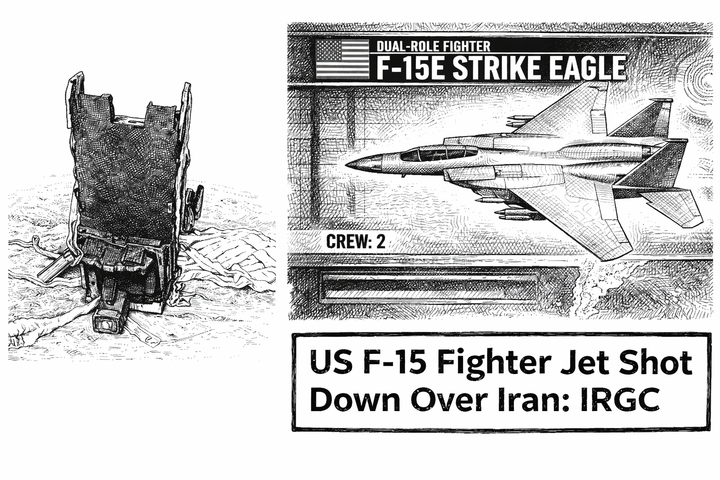
The search for the missing weapons systems officer from the downed F-15E Strike Eagle — declared DUSTWUN ("Duty Status, Whereabouts Unknown") — entered its second full day on April 5, with the US military conducting one of the most dangerous combat search-and-rescue operations in decades deep inside hostile Iranian territory.
The sequence of events: Iran shot down the F-15E Strike Eagle over southwestern Iran on April 3. The pilot was successfully rescued by two US Black Hawk helicopters that flew into Iran under fire — both helicopters were struck by Iranian projectiles; some crew members were wounded, but the aircraft landed safely. A separate US A-10 Thunderbolt II "Warthog" deployed to support the rescue was also struck by Iranian fire, its single pilot ejecting safely into Kuwaiti airspace, where he was recovered. The weapons systems officer — the rear-seat crew member — remains missing.
Iranian state television has run continuous appeals for civilians to locate the airman, with the IRGC and local officials offering rewards. Iranian state media reported a bounty of approximately $60,000. An Iranian state TV anchor urged residents to "shoot them if you see them," referring to videos circulating of US aircraft. The IRGC denied reports that the second crew member had been captured, but Iranian authorities also denied that any search had been successful in locating the airman.
Bryan Stern, a US special forces veteran and founder of Grey Bull Rescue (a high-risk rescue nonprofit), told MS NOW: "The life expectancy of a downed pilot behind enemy lines decreases exponentially every few hours." Stern said Iran is "incentivized" to keep the airman alive because he represents leverage in negotiations. Trump, asked about the situation in a brief phone interview, said only "we hope that's not going to happen" when asked what the US would do if the airman was captured or harmed. He did not elaborate — an unusual restraint for a president who has been voluble about every other dimension of the conflict.
The NYT and Telegraph reported that this is the first confirmed loss of a US manned fighter aircraft to enemy fire in over 20 years — the last being an A-10 shot down in 2003 during the invasion of Iraq.
🇮🇳 How This Impacts India
The missing airman's fate is now the highest-stakes single variable in the Iran war's short-term trajectory. If the airman is captured and Iran produces him publicly, US domestic pressure for escalation — including the April 6 energy infrastructure strikes — will become near-irresistible. If he is found dead, the same dynamic applies. If he is rescued, it gives Trump a symbolic victory that could create a brief window for de-escalation. India's unique diplomatic position — on Iran's "friendly nations" list, with functional embassy relationships in Tehran, and with channels through the Pakistan-mediated ceasefire process — gives New Delhi a rare opportunity to play a quiet but decisive role. India should be using every back-channel available to signal to Tehran that the humane treatment and return of the missing airman is in Iran's own long-term interest: it prevents the escalation to power plant strikes that would further devastate the global economy that Iran needs to recover in any post-war scenario.
📎 References: NYT | Telegraph | NBC News | MS NOW
Story #6: Iran Repairs Missile Bunkers Within Hours — The Intelligence Assessment That Upends the War's Narrative
The Full Picture
A New York Times investigation based on classified US intelligence reports, subsequently confirmed and expanded by The Telegraph and multiple Israeli and regional outlets, has revealed the single most damaging finding yet for the White House's war narrative: Iran is digging out its bombed underground missile bunkers and launch silos within hours of being struck, restoring them to operational status and firing again — while the US and Israel count them as destroyed.
US intelligence agencies found that "the underground bunkers, caves or silos can appear at first to be damaged; in reality, Iran has been able to quickly dig out the launchers and fire them again." Iranian crews deploy bulldozers and excavators to clear rubble and extract buried mobile launch vehicles, often within the same operational shift. Iran is also deploying a significant number of decoys — deliberately constructed fake launch sites built to consume expensive US precision munitions. The result: US intelligence cannot determine with confidence how many of the 12,300+ "targets struck" were actual launchers versus decoy sites built to degrade US munitions stockpiles.
Compounding the problem: Iran is launching approximately 15-30 ballistic missiles and 50-100 one-way attack drones per day — but this rate reflects strategic conservation, not depleted capability. US officials told the NYT that Iran is "deliberately conserving its remaining launchers by keeping more of them in bunkers and caves, preserving capacity to maintain pressure if the war drags on or to threaten the region after it ends."
The gap between the White House claim — "attacks down 90%, navy wiped out, two-thirds of production damaged" — and the classified intelligence picture is now structural. A Western official told the NYT that Iran is firing 15-30 ballistic missiles and 50-100 drones daily. One intelligence source told CNN: "They are still very much poised to wreak absolute havoc throughout the entire region."
🇮🇳 How This Impacts India
Iran's demonstrated ability to repair and restore missile launch capability within hours has a specific long-term implication for India's strategic calculus that no one in New Delhi appears to have publicly discussed. Post-war Iran will retain a functioning ballistic missile force — smaller than pre-war but now battle-hardened, tactically sophisticated, and protected by a doctrine that US air power has been unable to crack. Future threats to Iran — from Israel or the US — will be significantly less credible as deterrents. This means post-war Iran will negotiate from a position of greater confidence than pre-war Iran ever had. India's strategic analysts and planners must model this new Iran: an Iran that has survived the most intense air campaign since the Gulf War, retained leverage over Hormuz, developed a battle-tested mosaic defense doctrine, and rebuilt its post-war reconstruction economy, partly through Hormuz toll revenue. India's relationships with Iran must be calibrated for its new strategic posture, not the pre-war status quo.
📎 References: Telegraph | Times of Israel | WION | Türkiye Today
Story #7: The Riyadh Embassy — Iran Destroyed the CIA Station and Saudi Arabia Hid It
The Full Picture
A Wall Street Journal investigation published April 4 revealed one of the most significant operational security breaches of the entire war: two Iranian Shahed-pattern drones struck the US Embassy compound in Riyadh, Saudi Arabia on March 3, penetrating the most fortified diplomatic enclave in the Gulf, destroying three floors of the embassy's secure wing including the CIA station, and triggering a fire that burned for 12 hours — all of which was actively concealed by Saudi authorities and downplayed by US officials.
One official noted: "If it had occurred during working hours, it could have been a mass-casualty event." A second drone that evening was believed to have been targeting the residence of the highest-ranking US diplomat, located just a few hundred feet from the main compound.
Bernard Hudson, a former CIA counterterrorism chief with extensive Persian Gulf experience, told the WSJ: "There's been a complete blackout on the actual amount of damage done to these places. That feeds suspicions that a lot more damage may have actually happened." He added: "It was able to produce an indigenously made weapon, fire it across hundreds of miles and put it into the embassy of their top opponent, which means they could have hit anything they wanted in the city."
The attack shattered the assumption that Riyadh's Diplomatic Quarter — ringed by Patriot air-defense batteries — was effectively protected from Iranian drone penetration. Two Shahed-type drones with a unit cost of approximately $20,000-$50,000 each penetrated one of the world's most expensive air-defense perimeters, destroyed a CIA station, and triggered a diplomatic cover-up between Washington and Riyadh.
🇮🇳 How This Impacts India
India maintains a large, active diplomatic network across the Gulf — embassies and consulates in Riyadh, Abu Dhabi, Dubai, Doha, Kuwait, Muscat, and Manama. These missions serve as the primary point of contact for approximately 9 million Indian workers across the Gulf, including roughly 2.5 million in Saudi Arabia alone. The revelation that two cheap drones penetrated the most heavily defended compound in Riyadh, destroyed a CIA station, and triggered a 12-hour fire should immediately prompt India's MEA to conduct a security audit of every Indian diplomatic mission in the Gulf. Hardened shelters, enhanced perimeter detection, emergency evacuation protocols, and communications redundancy for a drone-warfare environment are not optional upgrades at this point — they are urgent operational necessities. India should also formally activate its consular emergency framework to ensure that Indian workers across the Gulf know evacuation procedures, have updated registration, and have clear points of contact in the event of rapid deterioration.
📎 References: WSJ | The Week India | Middle East Monitor
Story #8: Russia Evacuates Bushehr — The Nuclear Plant the World Cannot Afford to Lose
The Full Picture
On April 4, Russia's Rosatom evacuated 198 more workers from Iran's Bushehr nuclear power plant — its largest single evacuation — minutes after a US-Israeli projectile struck near the facility, killing an Iranian security guard and damaging a support building. It was the fourth time the area around Bushehr had been struck in 36 days of war.
Rosatom chief Alexei Likhachev confirmed: "As planned, we began the main phase of the evacuation today. About 20 minutes after that ill-fated strike, buses set off from Bushehr station towards the Iranian-Armenian border — 198 people, to be precise — this is the largest evacuation." He added that developments near the plant were "unfolding in line with the worst-case scenario." Russia had approximately 700 personnel at Bushehr at the start of the war, with two additional reactor units under construction. Those construction projects are now suspended. Approximately 100 Russian staff remain at the plant — Likhachev described these as "volunteers" keeping basic functions operational.
The IAEA confirmed in a post on X that one physical protection staff member was killed and a building on site was affected by shockwaves and projectile fragments. The plant itself has not been directly hit, but the Atomic Energy Organization of Iran reported that the surrounding area has now been struck four times. Rosatom's chief told TASS that he had personally briefed President Putin on the situation. Russia's foreign ministry condemned the strike as "evil" and called for an immediate halt to attacks near nuclear facilities.
Bushehr holds 72 metric tonnes of nuclear fuel and 210 metric tonnes of spent nuclear fuel. It is Iran's only operational nuclear power plant, providing 1,000 megawatts to the Iranian grid. Any radiological incident — from a direct strike on a reactor or spent fuel storage — would represent one of the most serious nuclear safety events in history, with consequences that cannot be contained by any party to the conflict.
🇮🇳 How This Impacts India
Bushehr sits on the Persian Gulf coast, approximately 1,200 kilometers from Mumbai. Prevailing wind patterns in April and May in the northern Indian Ocean carry from the northwest — meaning a radiological release from Bushehr in the current season could, depending on release altitude and quantity, have a traceable impact on western India and Pakistan. India's nuclear emergency response framework has been designed primarily for domestic incidents. The Department of Atomic Energy, the Atomic Energy Regulatory Board, and the National Disaster Management Authority must immediately activate monitoring protocols for radiological indicators in the Arabian Sea and western India airspace. India should also engage the IAEA directly to ensure real-time data sharing on the status of Bushehr and to prepare draft public communications that can be activated rapidly if radiological indicators are detected. This is not alarmism — it is basic sovereign responsibility for a nuclear state with downwind exposure to an active war near a nuclear plant.
📎 References: Reuters | Khaleej Times | Moscow Times
Story #9: US Intelligence — Hormuz Won't Open, and Iran Is Now More Powerful Than Before
The Full Picture
Reuters published a landmark intelligence assessment on April 3 — confirmed and expanded by multiple outlets on April 4-5 — that formally articulates the strategic paradox Ali Vaez named so precisely in our Quote of the Day: US intelligence agencies have concluded that Iran is unlikely to open the Strait of Hormuz any time soon, because the strait is Iran's most powerful lever over the United States and the global economy, and Tehran has no rational reason to voluntarily relinquish it.
Three sources familiar with the intelligence reports told Reuters that Iran "understands its ability to drive world energy markets through its chokehold on the strait is much more potent than even a nuclear weapon." The assessment found that Tehran could continue throttling the strait to keep energy prices elevated, squeezing Trump's domestic political position — US gas prices now at $4.09/gallon, Trump's approval rating at first-term lows — as a means of forcing a favorable exit deal.
The finding also confirms what strategic analysts have feared since the war began: "The war, intended to eradicate Iran's military strength, may actually increase its regional sway by showing Tehran's ability to threaten the key waterway." In other words, the war's primary strategic effect may have been to reveal and consolidate a form of Iranian power that no bomb can eliminate — physical geography and cheap drones.
Former CIA Director Bill Burns said in a Foreign Affairs podcast that Iran will use the strait to extract "long-term deterrence and security guarantees" and "some direct material benefits" — meaning passage fees — in any peace deal. "That," he said, "sets up a really difficult negotiation right now." Ali Vaez added the final, devastating observation: "All it takes to disrupt traffic and deter vessels from passing through is one or two drones."
One or two drones. That is the cost of holding the world's most important oil artery. The US Navy costs $200+ billion a year to maintain. Iran has demonstrated that $100,000 in cheap drones can effectively neutralize that investment.
🇮🇳 How This Impacts India
This intelligence assessment requires India to fundamentally recalibrate its energy security strategy permanently — not as a crisis response, but as a structural redesign. The Hormuz Strait, through which India imports approximately 65% of its crude oil, can no longer be treated as a reliable free transit route. Iran has demonstrated it can close it at will, sustain that closure for months, and extract permanent management rights as the price of reopening. India must therefore: first, accelerate all alternative infrastructure — the India-Middle East-Europe Economic Corridor, the INSTC through Iran and Russia, and domestic refinery capacity for non-Gulf crude sources; second, rapidly diversify crude imports toward West Africa, Russia, and the Americas; third, leverage its Chabahar port relationship to negotiate a permanent "friendly nation" corridor through the IRGC monitoring framework; and fourth, build strategic petroleum reserves sufficient for at least 90 days of consumption rather than the current 30-40 days. The post-Hormuz era of Indian energy planning begins today.
📎 References: Reuters/Al-Monitor | Manila Times | Foreign Policy/Vaez & Pape
Story #10: India in "Mission Mode" — The Fertilizer Race Against the Kharif Clock
The Full Picture
The Economic Times confirmed on April 4-5 that India has activated what senior government officials are calling "mission mode" — an emergency procurement and supply diversification protocol — to secure fertilizer supplies ahead of the June kharif planting season, as the sustained Hormuz closure has created the most acute fertilizer supply crisis India has faced since the Russia-Ukraine war of 2022.
India is simultaneously pursuing seven diversification tracks: direct government-to-government procurement talks with Russia, Indonesia, Malaysia, Vietnam, Algeria, and Egypt for urea and DAP (di-ammonium phosphate); extraordinary diplomatic outreach to China — asking Beijing to release urea cargoes from its export quota system and ease restrictions; accelerated import tenders with compressed timelines; gas allocation priority orders under the Natural Gas (Supply Regulation) Order 2026, which prioritise fertiliser plants at 70% of their six-month average gas consumption; emergency activation of government-held strategic stockpiles; coordination with IFFCO, NFL, and Rashtriya Chemicals and Fertilizers on domestic production optimisation; and maritime insurance backstop negotiations to keep Indian-flagged fertiliser vessels moving through alternative routes.
The scale of the challenge: India consumes approximately 35-36 million tonnes of urea annually, producing 28-29 million tonnes domestically. The 7-million-tonne annual import gap — normally filled from Qatar, Saudi Arabia, and Oman — is entirely disrupted. The Bloomberg terminal on April 2 showed India was in talks with major producers and exporters of nitrogen-based and phosphatic fertilizers for direct procurement. Urea prices have risen from roughly $420/tonne pre-war to over $597/tonne. India's fertilizer subsidy bill — budgeted at ₹1.71 lakh crore — is now projected to significantly exceed that figure.
The CSIS analysis (published April 2) found that if oil prices remain above $100/barrel through June 2026 — currently well above that at $112 — the WFP estimates global acute hunger could increase by 45 million people. India accounts for a significant share of that exposure, with the burden concentrated among smallholder farmers who cannot absorb the price shock.
The most critical deadline: kharif sowing begins with the onset of the southwest monsoon in June. DAP is applied at sowing for root establishment — it has no direct substitute. If supplies are not secured, tendered, shipped, and distributed to state governments by late May, some portion of India's kharif crop will be planted on deficient soil nutrition, with yield consequences that will flow directly into food prices by October and November — the pre-election period.
🇮🇳 How This Impacts India
India's "mission mode" fertilizer response is necessary but insufficient unless paired with structural decisions that reduce the severity of the next crisis. Three specific recommendations that go beyond emergency procurement. First, India should immediately leverage its Chabahar diplomatic relationship with Iran to negotiate an explicit "friendly nation" fertilizer corridor — guaranteeing Indian-flagged vessels carrying urea and DAP safe passage through the IRGC's Hormuz monitoring framework, without toll charges, in exchange for India's support for Iranian post-war reconstruction financing through multilateral channels. Second, India should accelerate its coal gasification fertilizer program — India has massive coal reserves and commercial coal-to-urea technology exists at scale; a 5-million-tonne domestic coal-based urea capacity would make India largely import-independent for its most critical fertilizer. Third, the fertilizer subsidy system must be restructured to create strategic procurement reserves — a "fertilizer SPR" equivalent — funded and managed the same way India's Strategic Petroleum Reserve is, giving the government 60-90 days of buffer to manage import shocks without rationing.
📎 References: Economic Times | Bloomberg | Policy Circle | CSIS
The Dispatch: Editor's Synthesis
Day 36. Thirty-six days of bombing Iran, and the outcome is exactly as the quote of the day predicts: the US tried to prevent Iran from building a weapon of mass destruction and gave it a weapon of mass disruption instead. Hormuz will not open on Washington's timetable. Not all the missiles can be found.
The bunkers regenerate withi`n hours. The CIA station is in rubble. The missing airman is still behind enemy lines. The Bushehr nuclear plant has been struck four times. And Chinese AI firms are selling the US military's movements to anyone who will pay.
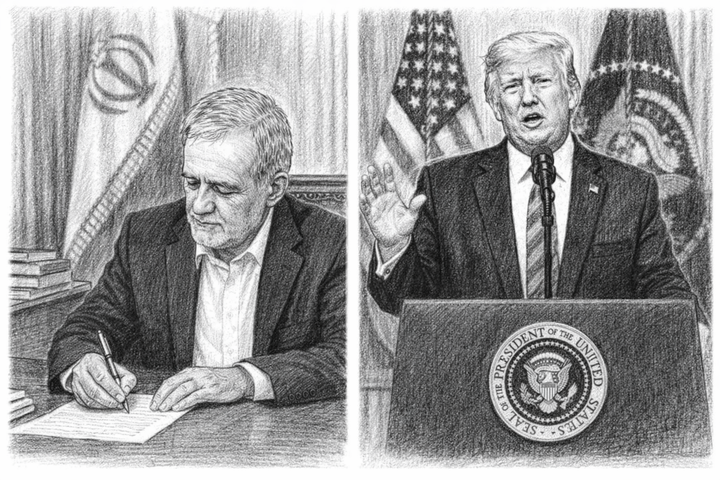
On the other side of the ledger: Iran's economy is under severe strain. Pezeshkian is reportedly clashing with the IRGC over how the war is being conducted. The new Supreme Leader, Mojtaba Khamenei, has made no public appearances. The IRGC's command-and-control has been degraded. Pakistan, Turkey, Egypt, and Saudi Arabia are all pressing for talks. The 40-nation UK-led Hormuz coalition is meeting. The April 6 energy infrastructure deadline is 24 hours away.
The next 48 hours will determine whether this war pivots toward an exit ramp or a new, more dangerous phase. India cannot be a spectator to that pivot.
Every lever India has — the Tehran embassy, Chabahar port, the Pakistan channel, the UK coalition seat, ceasefire advocacy — must be actively deployed in the next 48 hours. There is no neutral position available in the world's most important energy crisis since the 1970s. Standing still is a choice, and it is a costly one.
Comments ()