
The Daily Geopolitics Brief # 12
"Open the F——n' Strait or you'll be living in Hell." Iran said hell right back. Meanwhile India resumed buying Iranian oil, 8 lakh homes switched to piped gas, and a colonel was pulled from a mountain crevice. Day 37

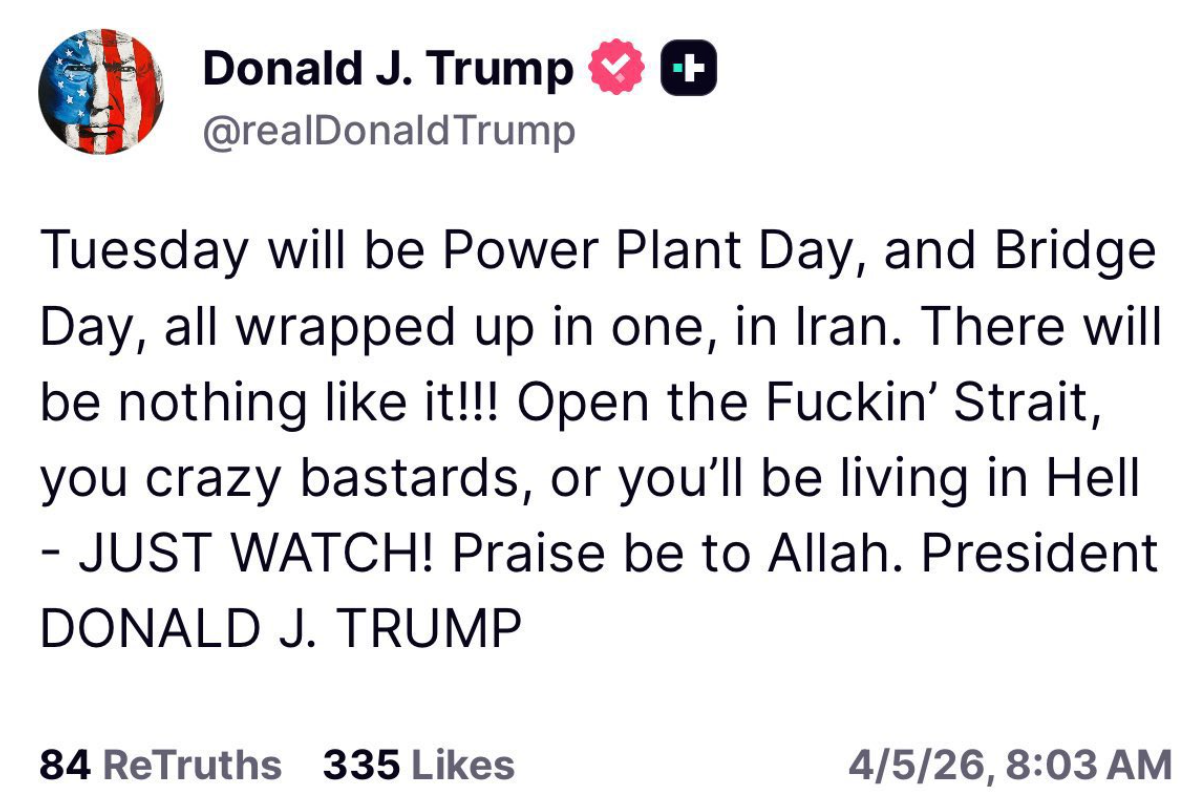
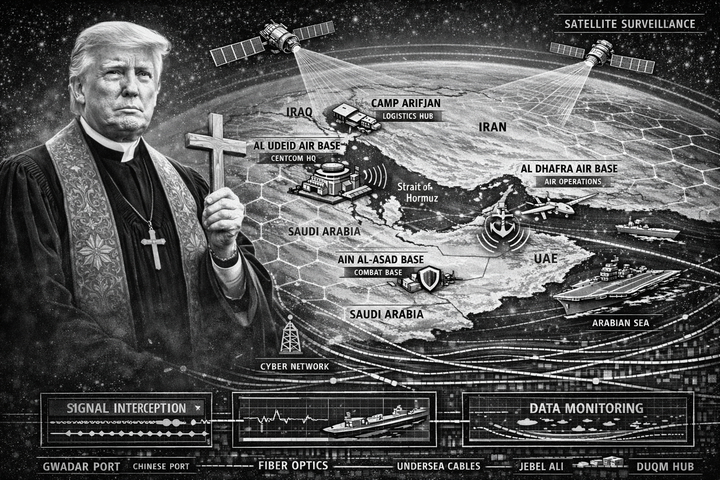
"Tuesday will be Power Plant Day, and Bridge Day, all wrapped up in one, in Iran. There will be nothing like it!!! Open the Fuckin' Strait, you crazy bastards, or you'll be living in Hell - JUST WATCH! Praise be to Allah." — President Donald J. Trump, Truth Social, Easter Sunday, April 5, 2026
"Your reckless moves are dragging the United States into a living HELL for every single family, and our whole region is going to burn because you insist on following Netanyahu's commands." — Mohammad Baqer Qalibaf, Speaker of Iran's Parliament, responding to Trump on X, April 5, 2026
What This Signals
Two leaders. Two visions of hell. Both are absolutely certain that the other side will be living in it.
Trump's Easter Sunday post is a document for the ages — a sitting president of the United States, the world's most powerful office, deploying profanity, ethnic mockery ("Praise be to Allah"), and infrastructure-destruction threats on the holiest day of the Christian calendar, seconds after announcing one of the most heroic combat search-and-rescue missions in US history. The rescued colonel was still being airlifted out of Iranian territory. The ink on his Truth Social post had not dried before he was threatening to bomb power plants.
Qalibaf's response is the mirror image: a parliamentary speaker invoking "living HELL" while explicitly naming Netanyahu as the puppeteer of American policy. His framing — that Trump is a subordinate acting "on Netanyahu's commands" — is one of the most effective pieces of anti-American diplomatic messaging in the war, because it simultaneously emasculates Trump, elevates Netanyahu as the real villain, and resonates with every left-leaning Western audience, every Global South audience, and every Arab and Muslim audience simultaneously.
Taken together, this pair of quotes signals that the war has entered its most viscerally personal and least strategically rational phase.
When heads of state hurl profanity and personal insults at each other in public, the conditions for rational, negotiated de-escalation are at their most fragile. Neither side can now be seen to flinch first without a domestic political cost they may be unwilling to bear.
And yet, somewhere between these two infernal proclamations, India's Ministry of Petroleum was quietly confirming Iranian crude oil purchases. And in Muscat, Oman's deputy foreign minister was sitting down with Iran's counterpart to discuss the smooth passage of vessels through the Strait. And in Istanbul, Zelenskyy was warning AP that the war in Iran could doom Ukraine's defense.
Story #1: The War at Day 37 — Israel Strikes, Iran Fires, and the World Holds Its Breath
The Full Picture
The Times of Israel's April 5 liveblog captured the full picture of a war that refused to pause for Easter Sunday. As the day began, Israeli forces were executing what sources described to NPR as an accelerated targeting program — focused specifically on destroying Iran's arms manufacturing and missile production infrastructure at maximum intensity before any ceasefire could terminate the military opportunity. Israel confirmed conducting "extensive strikes in Isfahan targeting infrastructure." Prime Minister Netanyahu confirmed Israeli strikes had destroyed a petrochemical plant generating revenue used to fund Iran's military.
On the ground across the region, Iran's retaliatory campaign intensified simultaneously. In Kuwait, Iranian drones struck two power generation and water desalination plants overnight, causing "serious material damage" and taking two electricity-generating units offline, according to Kuwait's Ministry of Electricity. The Kuwait Petroleum Corporation (KPC) confirmed that several facilities at the Kuwait National Petroleum Company and Petrochemical Industries Company were targeted, igniting fires at the Shuwaikh Oil Sector Complex. In the UAE, Borouge — Abu Dhabi's flagship polyolefin producer, among the world's largest makers of industrial plastics — took debris hits from intercepted Iranian missiles, starting three fires and forcing immediate suspension of operations. Abu Dhabi confirmed emergency teams brought the fires under control; Bahrain separately reported a drone attack on a storage facility.
At sea, three Omani supertankers and one LNG carrier were observed transiting the Strait of Hormuz on a southern corridor — close to the Omani coast, outside Iran's approved "toll route" through Larak Island — in what appeared to be a navigational test of the Oman-Iran Hormuz protocol under negotiation. In Rome, Pope Leo XIV — delivering his first Easter Urbi et Orbi from St. Peter's Square — implored world leaders: "Let those who have weapons lay them down. Let those who have the power to unleash wars choose peace."
And in the mountains near Isfahan, a deeply wounded US Air Force colonel was being extracted by Delta Force and SEAL Team Six from a crevice 7,000 feet above sea level where he had been hiding for 36 hours. Trump's midnight Truth Social post: "WE GOT HIM!"
Here is a counter-narrative also being floated about this rescue mission.
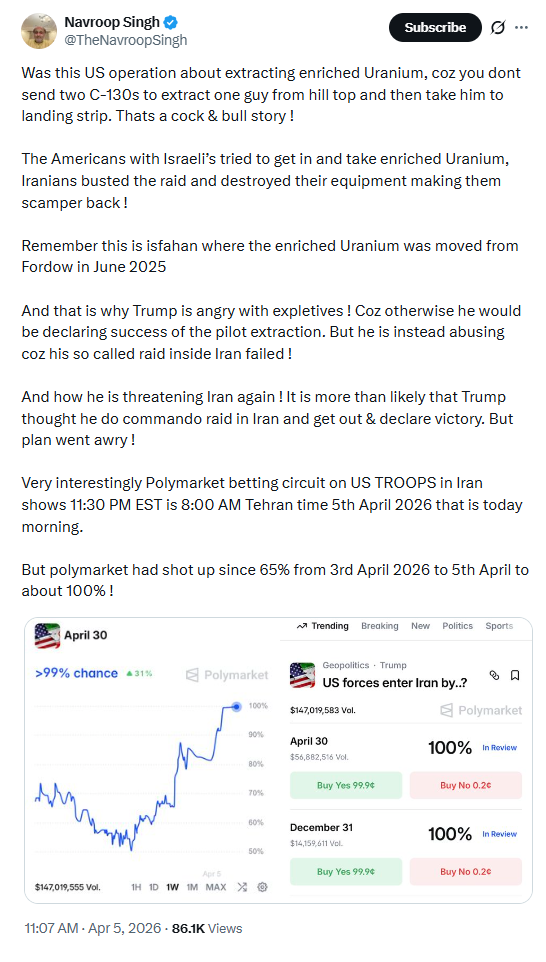
If this rescue mission was indeed the failed uranium capture mission or it is coming, the fact is that if its coming it won't be an easy one.
 Dan Sabbagh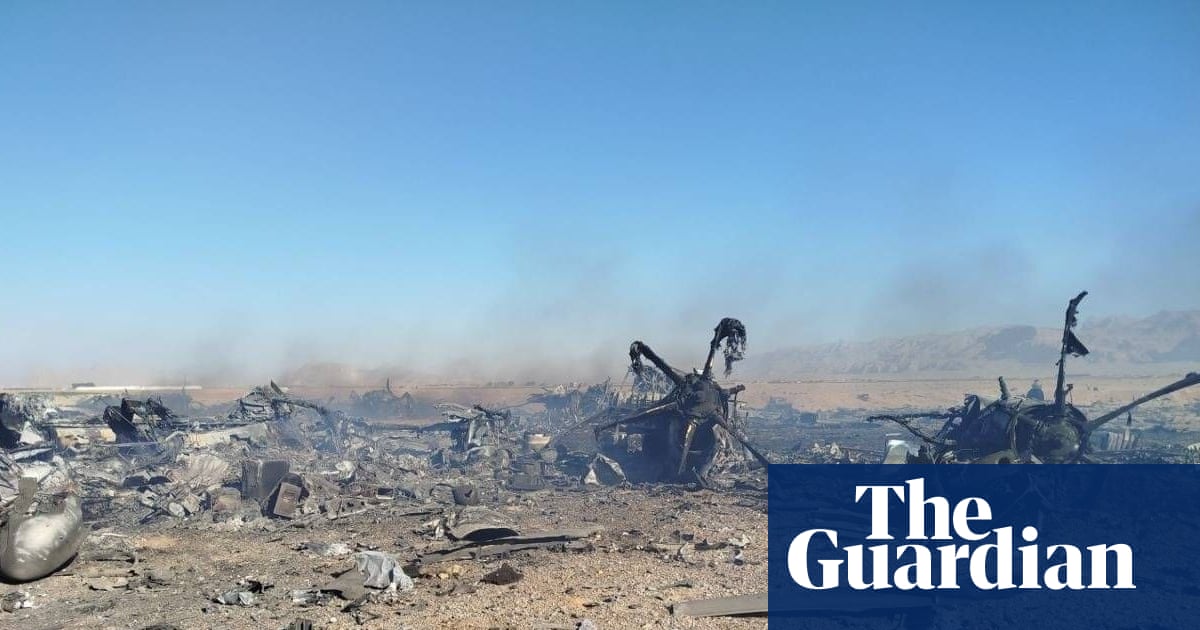
🇮🇳 How This Impacts India
The double crisis — Iranian strikes on Kuwait and UAE industrial infrastructure simultaneously with the Trump "Power Plant Day" deadline — creates an immediate triage challenge for India's MEA. The roughly 3.4 million Indians in the UAE and 1 million in Kuwait are in industrial zones that have now been struck by Iranian drones. India's emergency consular capacity must be instantly deployed at the Kuwait Petroleum and Borouge industrial clusters, specifically, not just in the main embassy districts. Every Indian worker whose factory or plant has been suspended by these attacks is now in employment and legal limbo. India's labor welfare framework must be activated for this scenario within 24 hours, not the usual weeks.
📎 References: Times of Israel Liveblog Apr 5 | Al Jazeera | Al Bawaba | CNN Live
Story #2: Inside Bahrain — A Dead Man, a Crackdown, and the War That Sunnis and Shia Cannot Fight Together
The Full Picture
AP's investigation, published April 3 and running through the April 5 cycle, revealed a dimension of the Iran war that has received almost no coverage in Western media: Bahrain, the island kingdom that hosts the US Navy's Fifth Fleet and is physically on the front lines of Iranian missile and drone attacks, is simultaneously conducting a brutal internal security crackdown that human rights groups describe as the most severe since the Arab Spring of 2011.
At the center of the story is Mohamed al-Mousawi — a 32-year-old Shiite Muslim who had previously been imprisoned and was, according to his family, saving money to start a small business. He was detained by Bahrain's National Security Agency (NSA) last month as the kingdom came under Iranian missile attack. He vanished for days. His family was eventually called to retrieve his body from a military hospital. AP reviewed images of al-Mousawi's body, confirmed by five witnesses who saw it in person: it bore slash marks and bruising, including on the soles of his feet. The death certificate said he died of a heart attack. His family said he had no preexisting conditions.
His death has become a flashpoint in a country that is fundamentally split along sectarian lines: a Sunni Al Khalifa monarchy ruling a Shiite majority population, with Iran just 200 kilometers across the water. Since the war began, Bahraini authorities have arrested dozens of people for filming Iranian strikes and demonstrating — even peacefully. A 21-year-old named Hussein Fatiil was arrested within minutes of filming himself waving a poster of Khamenei at a protest outside the US Embassy. He was charged with five offenses, including misusing social media and treason. His father told AP: "Now he might be charged with the most severe punishment. All I want is for my son to have a normal life."
Bahrain's Interior Ministry said its security measures are "a direct and proportionate response" to Iranian attacks. Rights groups describe it as a systematic revival of the 2011 crackdown playbook — disappearances, torture, and a blanket suppression of any expression of Shia solidarity with Iran.
🇮🇳 How This Impacts India
Bahrain hosts approximately 350,000 Indian workers — one of the highest per-capita concentrations of Indians in the Gulf. The sectarian crackdown in Bahrain is creating a specific vulnerability: Indian workers who are Shia Muslims (a significant proportion, particularly from Kerala) face heightened risk if Bahraini security forces expand their profiling to include religious community as a proxy for Iranian sympathy. India's MEA must engage the Bahraini government at the highest level to secure explicit assurances that Indian nationals will not be caught in the sectarian sweep, and must ensure that any Indian detained in Bahrain receives immediate consular access — something that was denied to al-Mousawi's family until it was too late.
📎 References: AP/WTOP | ABC News
Story #3: Zelenskyy's Warning — The Iran War Is Killing Ukraine's Air Defense, One Patriot at a Time
The Full Picture
In an exclusive AP interview in Istanbul on April 4-5, Ukrainian President Volodymyr Zelenskyy delivered one of the most strategically significant warnings of the broader crisis: the Iran war is consuming Patriot air defense interceptors at a rate that will, within weeks, leave Ukraine dangerously exposed to Russian ballistic missiles.
"Ukraine has never had this many missiles to repel attacks," Zelenskyy told AP, quoting his own earlier figure of 800 Patriot guided missiles consumed in just three days of Iranian attacks across the Gulf in the first week of the war. The production rate of Patriot interceptors globally is under 900 per year. Three days of Iran war consumed nearly a full year's global production. Ukraine, which depends on Patriots as its primary shield against Russian ballistic missiles targeting its cities and power grid, was never given enough in the first place — and now the war has made a global shortage worse.
"We have to recognize that we are not the priority for today," Zelenskyy said. "That's why I am afraid a long Iran war will give us less support." He added pointedly that Russia draws direct economic benefits from the Mideast war — surging oil prices driven by the Hormuz closure are boosting the Kremlin's oil revenues and strengthening Moscow's capacity to sustain its Ukraine campaign. The Iran war, in other words, is simultaneously draining Ukrainian defense resources and filling Russian war coffers.
Zelenskyy offered a creative response: Ukraine has proposed to share its singular expertise in countering Iranian-made Shahed drones with Gulf Arab states in exchange for anti-ballistic missiles. He visited Gulf states in late March to promote new defense cooperation agreements. Ukraine's experience in maritime corridor security in the Black Sea was also offered as a model for Hormuz reopening strategies.
🇮🇳 How This Impacts India
Zelenskyy's warning has a direct India dimension that has gone almost entirely unremarked. India operates one of the most advanced air defense networks in Asia — including indigenous Akash systems, Russian S-400 batteries, and Israeli Barak-8 systems. The global Patriot interceptor shortage is already distorting the air defense market, with lead times extending dramatically. India's planned procurement of additional SHORAD (Short Range Air Defense) systems — particularly for the northern borders where Chinese UAV incursions have been documented — faces heightened competition for production capacity from Gulf customers and Ukraine simultaneously. India's DRDO must use this window to accelerate production of domestic air-defense interceptors under the Akash Next Generation program and the new Pralay ballistic missile defense layer. Strategic dependence on imported interceptors in a world where every major theatre is consuming them simultaneously is a vulnerability India cannot afford.
📎 References: AP/Euronews | ABC News | Al Jazeera
Story #4: "Power Plant Day" — Trump's Deadline, Iran's Response, and the Next 24 Hours
The Full Picture
The Hindustan Times liveblog captured the cascading developments of April 5-6 as Trump's profanity-laced Easter Sunday ultimatum hardened the confrontation to its sharpest point since the war began. The deadline: 8 pm Eastern Time, Tuesday, April 7. The threat: simultaneous strikes on Iranian power plants and bridges. The context: Trump's fourth consecutive Hormuz deadline in six weeks, each of which was previously extended after claiming "talks are going very well."
Iran's response was delivered on multiple channels simultaneously. Iran's joint military command warned: "The gates of hell will be opened upon you if Iran's infrastructure continues to come under attack." Parliament Speaker Qalibaf posted his mirror-image "living HELL" threat. And Iran's IRGC intensified drone and missile strikes on Kuwait and UAE infrastructure — signaling that it intended to demonstrate its retaliatory capacity, not reduce it, ahead of the deadline.
Behind the bombast, there are signs of negotiation. The Axios report confirmed that the US and Iran are exploring a ceasefire-for-Hormuz framework through intermediaries. JD Vance communicated through back-channels that the US is open to a ceasefire if its core conditions are met. Pakistan, Egypt, and Turkey are all active as intermediaries. Oman held deputy FM-level talks with Iran on Hormuz transit on April 5. Trump told Fox News there was a "good chance" of a deal by Monday.
The structural problem remains: Iran's conditions for reopening the Hormuz Strait include international recognition of its sovereignty over the strait and war-damage compensation, demands that require weeks of negotiation. Trump's condition is that the strait opens immediately, as a precondition for any ceasefire. These are not positions that close in 48 hours.
🇮🇳 How This Impacts India
If Trump executes on "Power Plant Day" on April 7, Brent crude — currently at $112 — could spike above $130 within 48 hours. Every Indian petrochemical, fertilizer, and plastics plant that depends on natural gas faces another cost shock on top of an already severe one. India's rupee would come under renewed depreciation pressure. Every kharif farmer who needs urea by June faces a higher price. India's response is not to wait and react — it is to be in simultaneous conversation with Washington, Tehran, and Muscat in the 48 hours before the deadline. India's Chabahar relationship with Iran, its "friendly nation" status for Hormuz passage, and its significance as the world's third-largest energy importer give it standing in all three capitals. This is not the moment for studied neutrality — it is the moment for quiet, purposeful diplomatic intervention.
📎 References: Hindustan Times Liveblog | Fox News | Axios
Story #5: The Satellite Mirror Threat — When Billionaires Try to Turn Night Into Day
The Full Picture
The Guardian's science investigation published April 5 raised alarms about two separate proposals currently under review by the US Federal Communications Commission (FCC) that scientists say could permanently alter the night sky — and with it, human health, wildlife ecosystems, and astronomical research worldwide.
The first is from Reflect Orbital, a California startup that plans to deploy a constellation of up to 50,000 large Mylar mirrors in low Earth orbit — each capable of redirecting sunlight to Earth during nighttime hours. Its first test satellite, Earendil-1 — an 18m × 18m mirror — is scheduled to launch as early as April 2026. Astronomers calculate that each mirror could be as bright as a full Moon when reflecting directly overhead; with 50,000 deployed, the mirrors would outnumber all stars visible to the naked eye by more than a factor of five. The Royal Astronomical Society found that Reflect Orbital's plans, at full deployment, would make the entire night sky three to four times brighter than it is in its natural state.
The second proposal is even more striking: SpaceX has applied to the FCC for permission to launch up to 1 million satellites, which it describes as "orbital AI data centers." There are currently approximately 14,500 active satellites in low Earth orbit. Approving this proposal would increase that number by nearly seventy times.
Scientists across multiple disciplines are alarmed. Astronomers warn that once a mirror is above the horizon, the sky will be too bright for the vast majority of astronomical research. Biologists warn that artificial light at night is already documented to disrupt bird migration, insect populations, coral reef spawning cycles, turtle nesting, and predator-prey relationships across hundreds of species. Sleep medicine specialists at Northwestern University warn that the proposed satellites could amplify existing light pollution to the point of disrupting human circadian rhythms at a global scale — with documented links to insomnia, depression, metabolic disorders, and elevated cancer risk. The FCC, under Trump's deregulation agenda, has moved toward a "licensing assembly line" that grants approvals quickly without systematic environmental review for space-based operations.
🇮🇳 How This Impacts India
India has more dark-sky territory than almost any country of comparable economic development — a legacy of its rural population distribution. That dark sky is a commons of enormous scientific and cultural value: it is what makes institutions like ARIES in Nainital, the Vainu Bappu Observatory in Tamil Nadu, and the proposed Thirty Meter Telescope site in Ladakh viable. If the FCC approves either the Reflect Orbital or SpaceX orbital data center proposals without an environmental review, India's observational astronomy program — and the dark skies enjoyed by hundreds of millions of rural Indians — will be permanently and irreversibly damaged. India's Department of Space and the Ministry of External Affairs must formally file amicus-level comments with the FCC, join the International Astronomical Union's advocacy coalition against unregulated satellite proliferation, and build a multilateral coalition — with the EU, Japan, and Australia — to push for mandatory international dark-sky impact assessments as a precondition for any large satellite constellation approval.
📎 References: The Guardian | Astrobites | DarkSky International | Northwestern NowMeter
Story #6: China's Space Solar Plant — Clean Energy Cover for a Space Weapons Program
The Full Picture
The South China Morning Post reported April 5 on a senior Chinese scientist's peer-reviewed paper that dropped a quietly extraordinary revelation: China's "Zhuri" space-based solar power programme — officially billed as a clean energy project — has been redesigned to also support what its lead architect, Prof. Duan Baoyan of Xidian University, explicitly described as "communication, navigation, reconnaissance, interference and remote control" functions.
The paper, published in Scientia Sinica Informationis, notes that the system requires "extremely narrow, precisely steerable microwave beams to deliver energy from space to the ground over long distances." Duan acknowledged that these capabilities — while designed to improve wireless power transmission efficiency — could "in principle enable targeted signal transmission, including potential applications such as jamming or securing military communications." In plain language: China's space solar power plant is being designed as a dual-use orbital platform capable of electronic warfare.
This is not a hypothetical. China's Zhuri program already operates the world's only full-system ground verification facility for space-based solar power, built at Xidian University in Xi'an — a 75-meter tower that has successfully tested light-to-electricity conversion, microwave conversion, and beam-pointing technology. The SCMP report comes alongside a separate finding that Chinese AI firms are already using the same civil-military integration framework to sell US military movement intelligence gathered from public satellites. Critics note that a gigawatt-level microwave beam is, by definition, a high-energy directed-energy weapon: if a beam strays by even a fraction of a degree, it could damage passing satellites or trigger electromagnetic disruptions in an already congested low Earth orbit.
🇮🇳 How This Impacts India
China's space-based solar power program, if it develops the military applications Duan describes, represents a qualitatively new strategic threat to India. Precisely steerable microwave beams capable of jamming communications — operated from geostationary orbit, which cannot be intercepted by ground-based air defense systems — could in principle disrupt Indian military communications in the LAC zone, India's satellite navigation signals, or India's missile guidance systems during a conflict. India's ISRO and DRDO must urgently assess the electronic warfare implications of China's Zhuri program and begin developing electronic countermeasures and hardened communication protocols that can function under directed-energy jamming from orbital altitudes. India's own space-based solar power research — currently nascent — should be explicitly framed as a strategic dual-use program with national security applications, not merely an energy diversification initiative.
📎 References: SCMP | Sri Lanka Guardian | Interesting Engineeringprogram
Story #7: India's PNG Revolution — 8 Lakh New Connections in a Month, and the LPG Crisis Has a Silver Lining
The Full Picture
The Times of India reported April 5-6 on one of the most significant and under-reported developments in India's domestic energy response to the Iran war: the government has activated an unprecedented piped natural gas (PNG) expansion drive that has added approximately 8 lakh new PNG connections across the country in the space of a single month — driven directly by the LPG supply disruption caused by the Hormuz closure.
The Ministry of Petroleum and Natural Gas confirmed cumulative figures: over 3.33 lakh new PNG connections in the most recent one-month count, with an additional 2.7 lakh approved and in installation. Andhra Pradesh alone has set a target of 10 lakh new connections in six months. Delhi targeted 4 lakh additional connections in the city, with IGL tasked to scale monthly connection rates from 10,000 to 25,000. National PNG Drive 2.0 has been extended to June 30, 2026.
The policy mechanism is clever: the government is offering states an additional 10% commercial LPG allocation incentive if they meet PNG expansion targets — effectively using the LPG scarcity as a forcing function to accelerate the structural transition away from cylinder-based cooking fuel. More than 55,000 PNG connections were gasified in just five days in early April. Domestic LPG booking intervals have been extended from 21 to 25 days in urban areas and 45 days in rural areas to manage demand. Over 4.3 lakh small 5kg "festival" LPG cylinders were sold since March 23 for emergency use. All refineries are running at high capacity, and crude inventories are described as adequate.
India's petroleum ministry stated publicly: "India's crude oil requirements remain fully secured for the coming months." This was accompanied by the confirmation of Iranian crude imports — signaling a whole-of-government approach to supply security.
🇮🇳 How This Impacts India
This is the most underreported good-news story from India in the war. The PNG expansion drive is not just a crisis response — it is a structural energy security upgrade of genuine long-term value. Every household converted from LPG cylinders to piped natural gas reduces India's dependence on imported LPG (approximately 60% of which has historically transited through Hormuz), improves cooking fuel reliability, lowers household energy costs, and eases the fiscal pressure of LPG subsidies. The war in Iran is forcing India to accelerate an energy transition it needed to make anyway. The government's target of 50 lakh PNG connections by the end of 2026-27 — if maintained even post-war — would represent one of the fastest peacetime expansions of energy infrastructure in Indian history. The crisis has created political will for what peacetime failed to generate. India must lock in this momentum with permanent incentive structures, not allow it to dissipate when oil prices fall.
📎 References: Times of India | The Tribune/ANI | Deccan Chronicle
Story #8: Ceasefire Clock — Oman, Iran, and the Architecture of a Post-War Hormuz
The Full Picture
The Times of India Middle East war liveblog on April 5 tracked the most significant diplomatic development of the weekend alongside the rescue and the ultimatum: Iran and Oman held formal deputy foreign minister-level talks on April 5, at the specific request of both parties, to discuss "ensuring smooth passage through the Strait of Hormuz under the current circumstances."
The Omani Foreign Ministry confirmed: "Experts from both sides put forward a number of visions and proposals." No further details were released. But the context — tracked across multiple outlets including The National, Al Jazeera, and CNBC — makes the stakes clear. Iran has been drafting a bilateral "Hormuz monitoring protocol" with Oman that, once signed, would create a joint Iran-Oman governance framework for all vessel transit through the strait. Iran's five-point peace proposal to the US explicitly includes "international recognition of Iranian sovereignty over the Strait of Hormuz" as a ceasefire condition.
The protocol, if formalized before any ceasefire, makes that recognition a diplomatic fact rather than a negotiating position. It establishes Iran-Oman as the governing authority of the world's most important energy chokepoint — a status that would be extraordinarily difficult to reverse in any post-war settlement, regardless of what a ceasefire agreement says. As Lloyd's List tracking showed on April 5, Omani supertankers were already testing the southern corridor — practicing the transit routes that will operate under any future governance framework.
Iran has already allowed Indian, Pakistani, Chinese, Malaysian, and French-flagged vessels to transit. The protocol will formalize these access rights into something resembling a permanent toll-booth regime.
🇮🇳 How This Impacts India
India's status as a "friendly nation" for Hormuz passage must be converted from an informal accommodation into a formal, enforceable right within the Iran-Oman protocol framework before it is signed. Once the protocol is formalized, it will establish a governance precedent that the post-war diplomatic settlement must accommodate — and India's passage rights, if not embedded in the protocol, will need to be renegotiated in that settlement at much higher diplomatic cost. India's MEA must immediately deploy a senior envoy to Muscat to monitor the Iran-Oman talks and lobby for explicit Indian passage rights in whatever protocol text emerges. This is a once-in-a-generation opportunity to formalize India's strategic position in the Gulf's most critical waterway — and the window is measured in days, not weeks.
📎 References: Times of India liveblog | The National | Al Jazeera
Story #9: "WE GOT HIM!" — The Colonel Rescued From the Mountains of Iran
The Full Picture
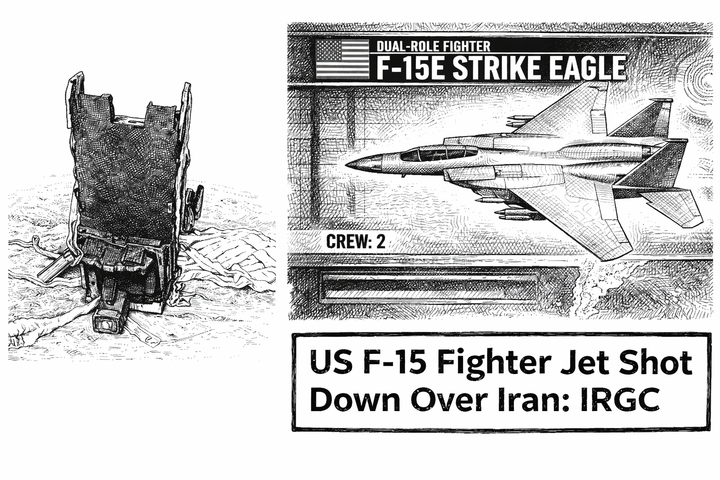
In the early hours of Easter Sunday, Trump's Truth Social post confirmed what a combined force of Delta Force, SEAL Team Six, CIA operatives, and 160th SOAR Night Stalker helicopter pilots had just accomplished: the rescue of an Air Force colonel — the weapons systems officer of the downed F-15E Strike Eagle — from a crevice 7,000 feet above sea level in the mountains of Iran's Isfahan province, after 36 hours of evasion.
RT and BBC both reported on the rescue, with notable differences in framing. BBC provided the operational narrative: the colonel hid alone, armed with a pistol, a beacon, and a communication device; the CIA ran a deception operation to spread false reports inside Iran that he had already been found; Delta Force and SEAL Team Six were inserted via MC-130J Combat King aircraft at a remote abandoned airstrip near Isfahan; the airman was located and extracted in a multi-hour operation that involved dozens of aircraft, some providing close air support to suppress Iranian pursuit forces. Two MC-130Js malfunctioned and were destroyed by US forces on Iranian soil to prevent sensitive equipment capture. Iran's state media broadcast footage of the wreckage.
RT's version emphasized Iranian claims that the IRGC had destroyed two C-130 aircraft and two Black Hawk helicopters during the operation — figures that US officials did not deny entirely, though they characterized the aircraft as having been destroyed by US forces as a precaution, not shot down by Iran. Trump: "Over the past several hours, the United States Military pulled off one of the most daring Search and Rescue Operations in U.S. History. He sustained injuries, but he will be just fine."
🇮🇳 How This Impacts India
The rescue has immediate implications for the next 48 hours. With the missing colonel recovered, the political pressure on Trump to show restraint has been removed. The rescue is a domestic victory — it validates his decision to go to war and gives him the confidence to execute on the "Power Plant Day" threat without looking reckless. India's strategic window for de-escalation has narrowed significantly. Before the rescue, there was an argument that bombing power plants while an American was behind enemy lines would be unconscionable. That argument is gone. India's most urgent diplomatic task — engaging both Tehran and Washington before April 7's 8pm deadline — must now be framed not around humanitarianism but around economic consequences: every escalation costs India an additional $2 billion per week in current account deterioration.
📎 References: RT | BBC | CNN | Time
Story #10: Jeffrey Sachs — Only Modi, Xi, and Putin Can Stop This War. Here's Why He's Right (and Wrong).
The Full Picture
Professor Jeffrey Sachs, the Columbia University economist and director of the Center for Sustainable Development, made explosive remarks on the New Order podcast (NewOrder_TV, April 5 2026) that have gone viral across the Global South, drawing over 3 million views within 24 hours:
"Trump has a kind of mental instability called the dark triad personality. He is a narcissist. He is an extreme Machiavellian, which means don't trust him for one moment. He is a psychopath, meaning he kills people. Not my business, not my concern. But people think that it is getting worse, that there's an added frontotemporal dementia that could be part of this mix..."
"I regard what Israel and the United States have done as a flagrant, reckless, utterly illegal, hugely dangerous war of aggression for no reason... A better term that I heard a few days ago: a war of whim."
"Netanyahu speaks about the 10 plagues that he has put on Iran. Now, mind you, the ten plagues were, in the Hebrew Bible, plagues that God put on. Now, Netanyahu is playing God, vis-à-vis Iran, and he lists the 10 plagues. This is a kind of madness."
"This has to be stopped, and it has to be stopped by grown-ups. And there are only three grown-ups in the world right now that are in a position to stop this, and they should stop it together, and that is Prime Minister Modi, President Xi Jinping, and President Vladimir Putin."
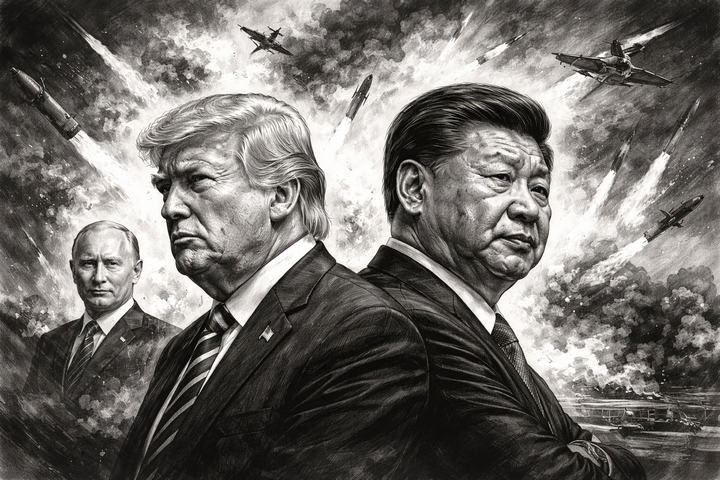
Sachs's argument — that the leaders of India, China, and Russia are the only actors with both the economic leverage and the political independence from Washington to force a de-escalation — is both flattering to India and dangerously incomplete. Here is why it is partly right: Modi, Xi, and Putin collectively represent markets that Iran cannot afford to lose, energy imports that sustain the global economy, and diplomatic standing with both Washington and Tehran that no single Western power possesses. If all three coordinated a joint statement demanding a ceasefire and the reopening of Hormuz, the combined weight would be unprecedented. Here is why it is incomplete: Putin has a clear interest in keeping oil prices above $100 (it funds his war in Ukraine). He will not press for an enthusiastic Hormuz opening. Xi has his own Taiwan calculus — the Iran war is a live PLA laboratory. And India's constitutional and strategic culture of non-alignment makes a trilateral "superpower intervention" with Russia and China extremely difficult to execute domestically. Sachs is right that India has more leverage than it is using. He is wrong that Moscow will be a willing partner in restoring order.
🇮🇳 How This Impacts India
Sachs's viral call-out of Modi by name as one of three people who can stop the war is not merely flattering rhetoric — it is a strategic opportunity. It creates global public expectations of Indian leadership that give the Indian government political cover to take a more assertive ceasefire posture. When Sachs — a credible, mainstream Western academic — says Modi is a grown-up who must act, it is harder for Washington to frame an Indian ceasefire push as anti-American agitation. India should use this moment to announce a formal high-level diplomatic mission — led by the Foreign Minister or a special envoy at NSA level — tasked with shuttling between Washington, Tehran, Muscat, and Riyadh to build a ceasefire framework. Not because Sachs asked. But because the window is closing, and the economic cost of inaction is ₹15,000 crore per week and rising.
📎 References: Jeffrey Sachs / New Order TV
The Dispatch: Editor's Synthesis
Day 37 began with a colonel being pulled from an Iranian mountainside and ended with Trump threatening to bomb power plants. In between: Kuwait's power grid went dark, Abu Dhabi's polyethylene plant caught fire, an American president said "Praise be to Allah" in a profanity-laced threat, an Iranian parliament speaker called for America to burn, a first American pope asked the world to lay down its weapons, Jeffrey Sachs called Modi one of three grown-ups who can stop a psychopath, India quietly resumed buying Iranian oil for the first time in seven years, 8 lakh Indian households switched to piped gas in a month, Oman and Iran held talks on the future of the world's most important shipping lane, China revealed its space solar plant is also a microwave weapon, and scientists warned that a startup might turn night into day with 50,000 space mirrors.
The Iran war is no longer just a conflict. It is a civilizational stress test reshaping energy markets, arms supply chains, diplomatic alignments, space policy, domestic politics, and the lives of millions of ordinary people who never voted for any of it.
For India, Day 37 has one message: your leverage is real, your window is narrow, and the cost of inaction is the most expensive thing on your balance sheet. The next 48 hours before "Power Plant Day" are the most consequential India has faced since the war began. It is time to act like the grown-up the world needs India to be.
Comments ()