
The Daily Geopolitics Brief # 16
Day 41: Iran caps Hormuz at 15 vessels daily under IRGC supervision. Trump orders Netanyahu to calm down — he doesn't. Russia mocks America's "crushing defeat." NATO fractures. Britain breaks with Washington on Lebanon. Islamabad talks begin.
"There will be no return to the pre-war status quo. Fewer than 15 ships per day are permitted to transit the Strait of Hormuz. This movement is strictly contingent upon Iran's approval and the enforcement of a specific protocol. If the termination of the war is not codified into a UN Security Council resolution based on our stipulated terms, we are fully prepared to resume combat against the US and the Zionist regime — just as we have over the past 40 days, and with even greater intensity." — Senior Iranian official, TASS, April 9, 2026 — ahead of the Islamabad talks
What This Signals
Strip away the diplomatic language, and this quote is a contract offer written in the language of ultimatum. Iran is telling the world — in the clearest terms it has used since the ceasefire — exactly what it has and has not agreed to.
- The 15-ship-per-day cap.
- The IRGC approval requirement.
- The UN Security Council resolution demands. The explicit threat to resume combat "with even greater intensity."
- And the phrase that should be written in capitals on the wall of every diplomatic office from South Block to the State Department: "There will be no return to the pre-war status quo."
This is not a negotiating posture. It is Iran's statement of what it believes it has already won.
Before a single delegation arrives in Islamabad. Before Vance shakes any Iranian official's hand. Before one word of a permanent settlement is discussed.
What it signals about the Islamabad talks, which begin today: Iran is not arriving to negotiate from scratch.
It is arriving to formalize what it believes it has already extracted — IRGC control of Hormuz, the right to enrichment, regional proxy freedom, sanctions relief, and a UN-codified end to the war.
The US is arriving believing it has "met and exceeded all Military objectives" and that Iran will accept limits on enrichment in exchange for economic relief. These are not two parties approaching a deal.
For India, the signal is stark and actionable: the 15-vessel-per-day Hormuz cap, if formalized as the post-war operating norm, would transform every energy import calculation India has made over the past decade.
If Hormuz is a managed chokepoint with a daily traffic quota enforced by the IRGC, then India's energy security requires a fundamental restructuring — not a 14-day ceasefire rethink, but a decade-long strategic reorientation toward overland corridors, INSTC diversification, and accelerated domestic production that no amount of back-channel diplomacy with Washington will substitute for.
Story #1: Trump Tells Netanyahu to "Calm Down" — And Netanyahu Opens Lebanon Talks While Bombing It
The Full Picture
In a pivotal sequence of events on April 9, the Trump administration made its most direct intervention yet into Israel's Lebanon campaign: White House envoy Steve Witkoff called Netanyahu and told him to "calm down" the strikes in Lebanon and open negotiations with the Lebanese government.
Netanyahu's response was characteristic: he announced that Israel would begin "direct negotiations with Lebanon as soon as possible," focused on disarming Hezbollah and establishing "peaceful relations." He simultaneously made clear there would be "no ceasefire in Lebanon."
Negotiations, in Netanyahu's formulation, would be held "under fire." The Israeli ambassador to the US, Yechiel Leiter, would lead Israel's delegation; the US State Department announced it would host the talks in Washington next week. Lebanon's government — which had declared a national day of mourning for the 254 killed on April 8, the deadliest day of the Lebanon war — had not yet formally agreed to negotiate and had not appointed its own delegation head as of publication.
Iran's new Supreme Leader, Mojtaba Khamenei, issued a statement declaring that Iran had "won the war," demanded full compensation for damages, and signaled Hormuz would enter a "new phase" of Iranian management. He added that Iran did not seek war but would not relinquish its rights, and described the "entire Resistance Front as one unified whole" — a direct warning that any renewed attacks on Iran will be treated as attacks on the entire Axis of Resistance, including Hezbollah, the Houthis, and Iraqi militias. Iran's parliament speaker, Ghalibaf, said the conditions for the Islamabad talks had already been violated and deemed further negotiations "unreasonable" — though Iran ultimately confirmed it would attend.
🇮🇳 How This Impacts India
The "negotiations under fire" formula Netanyahu has invented for Lebanon is a direct warning to India about the durability of any framework with Islamabad. A country that can simultaneously bomb Lebanon into mourning and claim to be pursuing peace talks is a country that has demonstrated it does not regard diplomatic processes as binding constraints on military conduct.
India's 85,000 nationals in Lebanon remain at direct risk from Israeli strikes that have not paused. India's MEA must issue an emergency evacuation advisory for all Indian nationals in Lebanon, effective immediately, and the Indian embassy in Beirut must activate its emergency consular team at full capacity. India cannot afford to lose citizens in a war it has been at pains not to participate in.
📎 References: Daily Mail | Axios | CNN | NPR | Economic Times,
Story #2: Iran's Hormuz Red Lines — 15 Ships a Day, IRGC Approval, or War Resumes
The Full Picture
TASS's exclusive interview with a senior Iranian official, published April 9 ahead of the Islamabad talks, is the most comprehensive public statement of Iran's actual ceasefire terms to date — and it is radically different from what the White House has been telling markets, allies, and the American public.
The key terms, stated explicitly: no more than 15 vessels per day may transit Hormuz under the ceasefire; each transit requires IRGC approval and compliance with a specific protocol; Iran's frozen assets must be unfrozen within the two-week ceasefire window as an "executive guarantee"; the end of the war must be formalised in a UN Security Council resolution drafted on Iran's terms; the US cannot increase its troop presence during the two weeks; Iran maintains its right to enrichment as agreed in the exchanged text; and if these conditions are not met, Iran will "resume combat with even greater intensity."
The 15-ship cap is the most commercially consequential detail. Pre-war, approximately 130-160 vessels transited Hormuz daily. Iran's ceasefire cap is 15 — roughly a 90% reduction from normal traffic. At that throughput, global oil markets cannot normalize. The EIA's own forecast assumes Hormuz traffic "gradually resumes" — a forecast that is structurally incompatible with a 15-vessel daily cap enforced by the IRGC. Markets had initially priced in a full Hormuz reopening on the ceasefire announcement. That pricing was wrong. Brent, which fell to ~$94 on news of the ceasefire, began recovering as the IRGC published mine-avoidance maps and the 15-vessel reality became clear.
The UN Security Council resolution demand is equally seismic. Russia and China vetoed the previous Hormuz resolution. Getting an UNSC resolution that codifies Iran's terms — including Hormuz fee rights, sanctions relief, and non-aggression guarantees — would require US concurrence, which in turn would require Trump to formally agree that Iran has rights over an international waterway that the IMO has stated cannot legally be tolled.
This is not a negotiating position. It is a structural impossibility within the current international legal framework — unless the US is willing to tear up UNCLOS, which the Islamabad talks will quickly reveal.
🇮🇳 How This Impacts India
The 15-vessel-per-day cap, with IRGC approval, is the single most important number for India's energy security planning to emerge from this entire war.
India imports roughly 90% of its crude oil, of which approximately 60% historically transited through Hormuz. At 15 vessels per day — and assuming India's "friendly nation" status gives it proportional access — India may be able to move 2-3 crude tankers daily through the strait, compared to the pre-war norm of 25-30.
That is a structural energy-supply gap that cannot be addressed through Chabahar negotiations or Hormuz fee exemptions alone. India's energy establishment must commission an emergency 90-day supply-security assessment, model the impact of a permanent 15-vessel-per-day cap, and fast-track diversification of supply through alternative routes — including the Red Sea (once Houthi activity subsides), Cape of Good Hope routing for larger tankers, and exploration of the Arctic route for LNG.
📎 References: TASS | RT | Times of India
Story #3: Russia Mocks Trump's "Crushing Defeat" — What Moscow's Gloating Reveals
The Full Picture
Russia's Foreign Ministry spokeswoman Maria Zakharova did not hold back in her assessment of Trump's ceasefire announcement. Speaking on Sputnik Radio, she said: "All the statements that were made about being more aggressive, being more offensive, writing more on social media, and 'victory' is just around the corner. Once again, this position has suffered a crushing defeat. So has the approach of such a one-track, aggressive, unprovoked attack."
Zakharova's mockery carried specific weight because Russia had, from the outset, called for a ceasefire and a negotiated settlement — and had co-vetoed the Bahrain-sponsored UN Security Council resolution to reopen Hormuz by force, arguing it would have given the US and Israel "carte blanche for continued aggression."
Russia and China's joint veto of that resolution — exercised just 24 hours before the US-Iran ceasefire was announced — was strategically significant: it removed one of the US's potential tools for claiming UN legitimacy for continued military pressure on Iran.
Former Russian President Dmitry Medvedev, deputy chair of Russia's Security Council, struck a similar tone: the ceasefire showed "common sense has prevailed" but warned there would be "no cheap oil" going forward.
Russia's position throughout the war has been analytically consistent: it called the US-Israeli attack "unprovoked aggression," consistently advocated for a political-diplomatic solution, and positioned itself as Iran's strategic guarantor. Russian oil exports had, in the interim, benefited significantly from the Gulf supply disruption — elevated oil prices pumping additional revenue into Russia's war chest in Ukraine, even as US sanctions pressured Moscow.
This narrative has gained significant traction in the Global South.
🇮🇳 How This Impacts India
Russia's gloating matters to India on two levels.
- First, strategic positioning: India's own approach to the Iran war — non-aligned, critical of civilian casualties, calling for diplomacy while maintaining relationships with all sides — mirrors the diplomatic posture Russia is now claiming credit for. This creates an opportunity for India and Russia to develop a shared framework for post-war Gulf governance that serves neither Washington's nor Tehran's maximalist interests, while advancing both countries' energy security.
- Second, the Russia-Iran-China axis that has consolidated during this war — cemented by the joint UNSC veto, China's military assistance to Iran's missile program, Russia's drone component supplies to Tehran — is now a permanent structural feature of the post-war Middle East.
India's triangular relationship with Russia (defense partner), China (strategic competitor), and Iran (energy source and Chabahar host) requires a comprehensive strategic review.
📎 References: Express UK | Newsweek | Al Jazeera
Story #4: Trump Goes Full Scorched Earth — "NUT JOBS!" He Calls Tucker, Megyn, Candace, and Jones
The Full Picture
In a remarkable Truth Social post published April 9, President Trump turned the full force of his rhetorical arsenal on the four most prominent conservative media critics of his Iran war: Tucker Carlson, Megyn Kelly, Candace Owens, and Alex Jones — all of whom have either called for the 25th Amendment, openly opposed the war, or accused Trump of going insane.
Trump's post declared: "I know why Tucker Carlson, Megyn Kelly, Candace Owens, and Alex Jones have all been fighting me for years, especially by the fact that they think it is wonderful for Iran, the Number One State Sponsor of Terror, to have a Nuclear Weapon — Because they have one thing in common, Low IQs." He called them "NUT JOBS, TROUBLEMAKERS" who would "say anything necessary for some free and cheap publicity," and dismissed them as "losers" who had been "thrown off Television." He labeled MTG — Marjorie Taylor Greene — "Marjorie 'Traitor' Brown."
The New York Times had reported earlier in the week that Tucker Carlson had been personally advising Trump not to go to war with Iran in recent weeks, and was eventually ignored. Alex Jones had asked on his show: "How do we 25th Amendment his ass?" — crossing a threshold from MAGA loyalist to open removal advocate. Carlson had not finished college, Trump noted; Jones had "lost his entire fortune" over Sandy Hook; Kelly had asked, "the now famous 'Only Rosie O'Donnell' question."
The post arrives as the ceasefire's durability remains uncertain, the Islamabad talks begin today, and Trump's domestic political position — facing 25th Amendment demands, Democratic impeachment motions, and now open revolt from his own media ecosystem — is at its most precarious since taking office.
🇮🇳 How This Impacts India
A president who spends time composing thousand-word personal attacks on Tucker Carlson while negotiations to end a war begin in Islamabad is a president whose attention management is visibly failing under the strain of simultaneous crises. For India's diplomatic planning, this is a data point, not an analysis.
The data point: Trump is unlikely to be deeply engaged in the granular details of what the US delegation agrees to in Islamabad. Vance will be the operating principal.
India's bilateral diplomacy ahead of Islamabad must therefore target Vance's office specifically — not the White House communications team, not Karoline Leavitt, not the State Department's public messaging.
Vance has been the most consistent back-channel architect of the Iran negotiation. He is the decision-maker India needs to reach a decision on Chabahar, Hormuz passage rights, and the sanctions framework.
📎 References: Mediaite
Story #5: Gulf Quiet, Lebanon Still Burning — The Uneven Ceasefire in Numbers
The Full Picture
The Times of India's April 9-10 liveblog captured the ceasefire's uneven geography on Day 2: Gulf states reported no new Iranian strikes, the Strait of Hormuz saw limited IRGC-approved traffic (the NJ Earth product tanker's crossing was confirmed as the first post-ceasefire Hormuz transit), and oil futures climbed back toward $100 as markets processed the reality of the 15-vessel daily cap. Meanwhile, Lebanon continued to burn: Israeli strikes on Thursday killed additional civilians, including three journalists, with Israel targeting Hezbollah's secretary's close aide Ali Yusuf Harshi. Hezbollah resumed rocket fire into northern Israel on Thursday, citing ceasefire violations.
Lebanon's government declared a national day of mourning on April 9.
The Lebanese PM filed an urgent complaint with the UN Security Council, calling the Israeli attacks "a blatant violation of international and humanitarian law." The Lebanese cabinet announced a plan to demilitarise Beirut and deploy police in areas previously held by Hezbollah — a significant concession from a government that had previously been unable or unwilling to confront Hezbollah publicly.
Iran's IRGC published a mine-avoidance map for Hormuz, listing "designated routes" for shipping — a document that simultaneously confirmed mines are deployed in the standard shipping lane and formalized the IRGC's role as Hormuz traffic controller.
US oil futures rose back above $100 during Thursday trading, retreating from the ceasefire-announcement low of ~$94. Analysts cited the 15-vessel cap, continued uncertainty over Lebanon, and the absence of any confirmed large-scale tanker convoy through Hormuz as reasons the ceasefire had not yet translated into meaningful energy market normalization.
European gas futures, which had plunged 20% on news of the ceasefire, also partially recovered.
🇮🇳 How This Impacts India
India's Petroleum Ministry and Finance Ministry must immediately revise their energy cost assumptions. Brent recovering to ~$100 after a ceasefire that markets initially priced at ~$90 tells a clear story: the structural factors that drove oil above $115 have not been resolved by a ceasefire that leaves Hormuz under 15-vessel-per-day IRGC management. India's Q1 FY2027 current account deficit projection, which was beginning to improve on ceasefire-day oil price assumptions, must now be recalibrated.
At $100 Brent, India's annual crude import bill is approximately $15-18 billion higher than the pre-war baseline. That will be a structural drain on India's foreign exchange reserves, requiring a policy response, not optimism.
📎 References: Times of India liveblog | RT liveblog
Story #6: Britain Condemns Israel, US Splits With Europe — The Atlantic Alliance's Lebanon Fracture
The Full Picture
Britain's stance on Israel's Lebanon bombardment represents the sharpest UK-US policy divergence since the war began.
UK Foreign Secretary Yvette Cooper told Times Radio that Israel's pounding of Lebanon was "deeply damaging" and that the ceasefire must be extended to cover Lebanon.
"We want to see Lebanon included in the ceasefire," Cooper said. "That escalation that we saw from Israel yesterday was deeply damaging, and we want to see an end to hostilities."
The Telegraph's reporting captured the specific intra-UK government tension: Defense Secretary John Healey had just spent the day at Downing Street announcing the successful deterrence of Russian submarines in the North Atlantic — positioning Britain as America's indispensable partner against Russia — while simultaneously the Foreign Secretary was publicly contradicting the US position on Lebanon.
France was more forceful still. President Macron condemned Israel's strikes as "indiscriminate" and said they were "a direct threat to the sustainability of the ceasefire."
French Foreign Minister Barrot demanded Lebanon be included, described the strikes as killing "more than 250 people in 10 minutes," and insisted France "firmly condemns these massive strikes." Spain announced it would reopen its embassy in Tehran. Italy summoned the Israeli ambassador. EU High Representative Kaja Kallas wrote: "Israeli strikes killed hundreds last night, making it hard to argue that such heavy-handed actions fall within self-defense." Germany's Chancellor Merz said the severity of Israel's Lebanon war "could cause the peace process as a whole to fail."
The US, by contrast, continued to insist Lebanon was not part of the ceasefire.
Vance said: "If Iran withdraws from negotiations over Lebanon, which has nothing to do with them, and which the United States never once said was part of the ceasefire, that would be dumb, but that's their choice." This directly contradicted Pakistan's ceasefire announcement, which explicitly stated that it covered Lebanon.
🇮🇳 How This Impacts India
Europe's unanimous condemnation of Israel's Lebanon strikes — while the US defends them — represents a historic fracture in the Western consensus that India has long navigated carefully. India now has an opportunity, and arguably a responsibility, to make its own position clear in terms that resonate with both audiences. India can criticize attacks on civilian infrastructure and call for Lebanon's inclusion in the ceasefire without endorsing Iran's position on enrichment or sanctions — in exactly the same way Britain and France have done.
Doing so would strengthen India's credibility as an independent actor, bring it into alignment with the European consensus India relies on for trade and technology partnerships, and cost it nothing diplomatically with Washington, which is itself beginning to pressure Netanyahu to "calm down." India's Ministry of External Affairs should issue a statement within 24 hours calling for Lebanon's inclusion in the ceasefire framework and condemning civilian casualties — calibrated carefully to neither endorse nor condemn the broader US-Israeli campaign.
📎 References: The Telegraph | Jerusalem Post | Al Jazeera | CNN
Story #7: Putin Used the Iran War to Map Britain's Undersea Cables — The GUGI Operation Exposed
The Full Picture
UK Defense Secretary John Healey delivered a statement from Downing Street on April 9 that was simultaneously a counterintelligence revelation, a deterrence signal, and a pointed accusation: Russia had used the distraction of the Iran war to conduct a covert operation targeting Britain's critical undersea communications infrastructure in the North Atlantic.
The operation, which lasted more than a month, involved a Russian Akula-class nuclear-powered attack submarine — used as a "likely decoy" — and two specialist submarines from GUGI, Russia's Main Directorate for Deep-Sea Research. GUGI submarines are "designed to survey underwater infrastructure during peacetime and sabotage it in conflict," Healey told reporters. The UK Royal Navy, Norwegian forces, and unnamed allies tracked all three vessels throughout the operation. "We left them in no doubt that they were being monitored, that their movements were not covert, as President Putin planned, and that their attempted secret operation had been exposed," Healey said. "Those GUGI submarines have now left UK waters and headed back north."
Healey explicitly framed the timing: "Putin would want us to be distracted by the Middle East," he said, but "Russia is the main threat to the UK and its allies. We will not take our eyes off Putin."
The UK announced an additional £100 million for P8 submarine hunter aircraft and the "Atlantic Bastion" program — combining autonomous technologies with frigates to create a British-built hybrid naval force. The Russia-Iran connection was highlighted: "Tehran has backed Moscow in its all-out war in Ukraine, providing it with its Shahed drones," now manufactured in Russia under the designation Geran. Britain noted a 30% increase in Russian incursions "threatening UK waters" over the past year.
🇮🇳 How This Impacts India
The GUGI operation targeting undersea cables while the world watched the Iran war is the most direct strategic lesson of 2026 for India: every global crisis is simultaneously a cover operation for ot, while the world watched the Iran war, is the most direct strategic lesson of 2026 for India: every global crisis is simultaneously a cover operation for other actors to advance their interests in domains the crisis has distracted fromer actors to advance their interests in domains the crisis has distracted.
While India has been focused on Iran, China's 40-day airspace closure, Russia's North Atlantic cable-mapping operation, and China's alleged supercomputer data sale all proceeded in the shadow of the Gulf conflict.
India's National Security Council must explicitly assess what is happening along India's undersea cable networks — particularly those connecting India to Southeast Asia, the Middle East, and Europe — during this period of distraction. TRAI and CERT-In should be directed to conduct an emergency audit of the integrity of undersea cables within 72 hours.
📎 References: Daily Mail | UK Government | Euronews | Moscow Times
Story #8: "NATO WASN'T THERE" — Trump Bashes Alliance After Rutte Meeting, Revives Greenland Threat
The Full Picture
Trump's meeting with NATO Secretary General Mark Rutte on April 8-9 did not produce the rapprochement that Rutte had hoped for. The White House framed the meeting as a potential discussion of withdrawal before it began. Leavitt said NATO members had "turned their backs on the American people."
Trump emerged from two hours of private talks with Rutte and immediately posted on Truth Social: "NATO WASN'T THERE WHEN WE NEEDED THEM, AND THEY WON'T BE THERE IF WE NEED THEM AGAIN. REMEMBER GREENLAND, THAT BIG, POORLY RUN, PIECE OF ICE!!!"
Rutte, in his CNN appearance after the meeting, described the discussion as "very frank, very open" between "two good friends." He acknowledged that Trump was "clearly disappointed with many NATO allies" but argued that European nations had contributed through "basing, logistics, overflights," and that this support had enabled the US to conduct Operation Epic Fury. He also said NATO was "willing to contribute to a potential mission in the Strait of Hormuz" if requested.
The US separately demanded that NATO allies submit "specific plans within a few days" on how they would ensure the safety of Hormuz navigation, according to Bloomberg.
Politico's reporting confirmed that the meeting "did not seem to help mitigate the US president's hostility towards NATO allies."
The Wall Street Journal's concurrent report — that Trump was considering moving US troops out of France, Germany, Spain, and Belgium and into more supportive countries — represents the most concrete step yet toward a redrawing of the transatlantic military map. The plan would stop short of a formal NATO withdrawal (which requires Congressional approval under a 2023 law co-sponsored by Rubio) but would functionally hollow out the alliance's European deterrence posture. Russia, watching from Moscow, would regard every US troop withdrawn from Eastern European NATO members as a strategic gain.
🇮🇳 How This Impacts India
A NATO weakened by internal US-European fracture, and a US prepared to redeploy troops toward "supportive" allies, creates a specific diplomatic opening for India that must be handled with exceptional care. The countries in line to receive enhanced US troop presence — Hungary, potentially Gulf states — are not natural partners for India's values-based multilateralism.
But the countries facing US troop withdrawal — France, Germany — are. India's relationship with Europe (the Quad-adjacent partnerships with France and Germany, the trade negotiations with the EU) is built precisely on the assumption that these countries remain within a coherent transatlantic security architecture. If that architecture fragments, India needs independent security relationships with France and Germany that don't depend on NATO as the institutional glue. The India-France Horizon 2047 strategic partnership and the India-Germany strategic dialogue should be urgently elevated.
📎 References: Politico | Al Jazeera | Bloomberg | France24
Story #9: What Is Quantum Communication? — And Why It Matters More Than Any Weapon in the Iran War
The Full Picture
Today, India's National Quantum Mission achieved a 1,000-km secure communication milestone.
India has successfully demonstrated a 1,000-km secure quantum communication network, which is one of the longest in the world. This achievement comes less than two years after the mission's launch in October 2024, far outpacing the original timeline to reach 2,000 km in eight years.
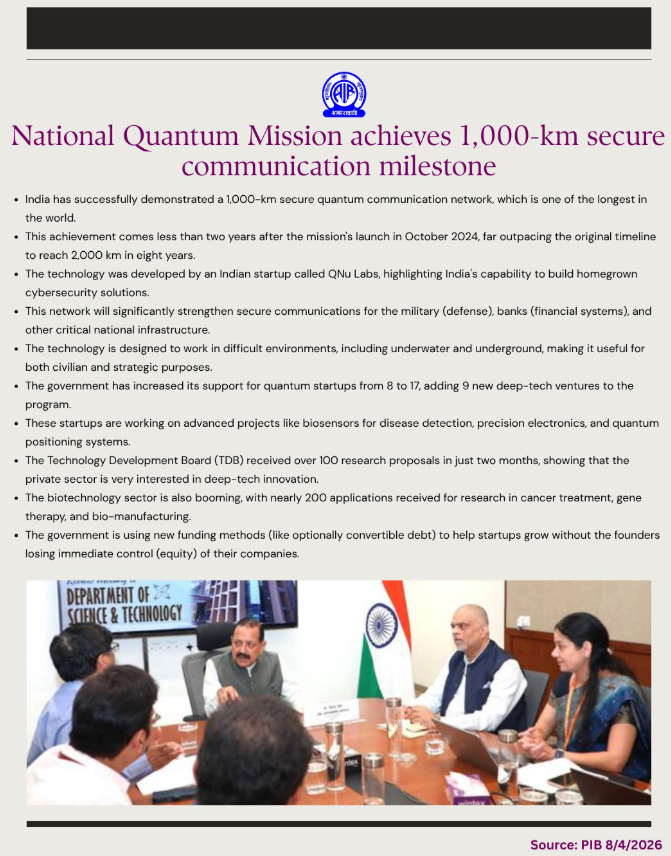
In the shadow of the Iran war's daily carnage, a quieter but potentially more consequential transformation is underway in the architecture of global power: the race to build quantum communication networks — communications systems whose security is guaranteed not by mathematics, but by the laws of physics themselves.
Understanding this race and India's position in it is essential reading for anyone thinking about the next 20 years of geopolitics.
 Desh Kapoor
What quantum communication is: Conventional encryption — the kind protecting your bank account, your WhatsApp messages, and every classified communication between governments — relies on mathematical complexity. Powerful enough computers can, in theory, break it. Quantum communication relies on the quantum-mechanical principle that any attempt to observe or intercept a quantum signal physically disturbs it, thereby revealing the eavesdropper's presence. Quantum Key Distribution (QKD) uses this principle to create encryption keys that are mathematically provable as unbreakable — because nature itself alerts the communicating parties to any interception attempt.
Why it is super-critical: The emergence of quantum computers — machines exploiting quantum superposition to perform calculations exponentially faster than classical computers — means that most current encryption will be breakable within 10-15 years. Every piece of encrypted data that adversaries intercept and store today will become readable once quantum computers reach sufficient scale. Intelligence agencies call this "harvest now, decrypt later." Quantum communication is the only solution that cannot be defeated by quantum computers, because its security is not mathematical — it is physical.
Where China leads: China has built the world's most advanced quantum communication infrastructure by an enormous margin. Its Beijing-Shanghai backbone stretches 2,000 kilometres connecting government agencies, banks, and military clients. Its carrier-grade network covers 12,000+ kilometers of fiber, 145 nodes across 80 cities in 17 provinces. The Micius satellite, launched in 2016, demonstrated quantum-encrypted intercontinental video calls between Beijing and Vienna. A second satellite, Jinan-1, launched in 2022, generates quantum keys at 2-3x Micius's speed. China aims to complete a global quantum satellite constellation and launch a quantum communication service for BRICS nations by 2027. In January 2026, Chinese researchers demonstrated Device-Independent QKD over 100 kilometers of fiber — a 3,000-fold improvement in range achieved in a single breakthrough.
The military dimension: China's PLA is among the major clients of its quantum communication network. The GUGI operation targeting Britain's undersea cables (covered in Story 7) would be far more effective — and perhaps unnecessary — if Russia had quantum-secured communications that British intelligence could not intercept, even if the cables themselves remained intact. The Iran war has demonstrated that conventional communications between principals — the IRGC's 95th wave continuing through the ceasefire, the Farsi-English divergence in Iran's 10-point plan, the gap between what negotiators agreed and what field commanders executed — are vulnerable precisely because communications are interceptable and manipulable. Quantum-secured command-and-control would eliminate this vulnerability for any military that achieved it.
India's position: India's National Quantum Mission, launched in 2023 with ₹6,003 crore over 8 years, has demonstrated QKD over 300 meters and recently achieved a 1,000-kilometer quantum communication network using indigenous technology from Ahmedabad startup QNu Labs — one of the longest globally at its announcement. ISRO's roadmap includes a quantum communication satellite for satellite-based QKD over 2,000 kilometers, though a launch date has not been confirmed. India's NQM targets are ambitious, but the execution gap with China — which has a decade head start, three operational quantum satellites, and tens of thousands of network kilometers — remains enormous.
🇮🇳 How This Impacts India
Three urgent dimensions.
- First, defense: India's nuclear command and control communications, its LAC operational communications with China, and its classified strategic intelligence channels are all potentially vulnerable to Chinese "harvest now, decrypt later" operations. DRDO and the National Security Council must treat quantum-secured communications for India's most critical channels as a five-year emergency program — not an eight-year mission target.
- Second, the BRICS dimension: China's explicit goal of a quantum-secured BRICS communications network by 2027 is both an opportunity and a threat. If India participates, it gains access to quantum-secured channels with China, Russia, and other BRICS partners — but on Chinese infrastructure, with Chinese satellite keys, potentially visible to Chinese intelligence. If India does not participate, it risks being excluded from what becomes the dominant secure communications architecture of the Global South.
- Third, industrial: India's QNu Labs achieving a 1,000-kilometer quantum network is a genuine breakthrough. The NQM's startup support ecosystem — 17 supported ventures — is beginning to produce indigenous quantum technology. India must now make the National Quantum Mission a national security priority, not merely a science funding program, and accelerate its quantum satellite timeline from "planned" to "2026 launch target."
📎 References: Quantum Insider | OpenGov Asia | Scientific American | ORF | The Print
Story #10: Trump-Rutte: NATO's "Frank" Meeting and What It Actually Decided
The Full Picture
Politico's April 9 analysis of the Trump-Rutte meeting at the White House is the most authoritative account of what was — and wasn't — agreed. The short version: Trump held back from the most dramatic action (a formal withdrawal), but the meeting appears to have resolved nothing and hardened Trump's position rather than softening it.
Before the meeting, Leavitt said NATO members had "turned their backs on the American people" and explicitly confirmed Trump would discuss US withdrawal. The Wall Street Journal simultaneously published its report on US plans to redeploy troops out of France, Germany, Spain, and Belgium. Rutte arrived having already told reporters that he understood Trump's "disappointment" — effectively validating the president's framing before the meeting began.
After the meeting, Trump went all-caps on Truth Social: "NATO WASN'T THERE WHEN WE NEEDED THEM, AND THEY WON'T BE THERE IF WE NEED THEM AGAIN." The Greenland threat was revived: "REMEMBER GREENLAND, THAT BIG, POORLY RUN, PIECE OF ICE!!!" Rutte, in damage control mode on CNN, called Trump "clearly disappointed" while insisting the meeting was between "two good friends." He confirmed that NATO was "willing to contribute" to a Hormuz mission and that he had pushed back on Trump's characterization that NATO had "failed." Crucially, Rutte would not confirm or deny whether Trump had threatened withdrawal.
Politico's assessment: the meeting did not "help mitigate the US president's hostility towards NATO allies." The troop-redeployment plan remains under discussion. The demand that NATO allies submit Hormuz mission plans "within a few days" represents an ongoing coercive pressure campaign rather than a settled dispute. Europe — already spending record amounts on defense, already reeling from the Iran war's energy disruption, already facing Trump's anger over refusing to join the war — is now being asked to contribute to post-war Hormuz security on a timeline it has not agreed to and under a framework it had no part in designing.
🇮🇳 How This Impacts India
Politico's analysis of the NATO meeting is the lens through which India should interpret every conversation it has with Washington about security partnerships in the coming months. A White House that frames partnerships as binary tests — "you were with us or against us in Iran" — will apply the same framework to every future engagement. India, which has practiced strategic autonomy for decades, is in a structurally different position from NATO allies, who have treaty obligations and base agreements that created leverage points for US coercion. India has no Article 5, no forward US bases on Indian soil, and no formal obligation to join US military operations. This is India's greatest diplomatic asset right now: the ability to be a consequential partner without being a coerceable ally. India should explicitly communicate to Washington that its value lies precisely in its independence — that an India coerced into choosing sides becomes just another client state, whereas an India respected as an autonomous partner can facilitate negotiations, provide intelligence, and advance outcomes that US military power alone cannot achieve. India's strategic autonomy is not a problem for the US-India relationship. It is the relationship's most valuable feature.
📎 References: Politico | Al Jazeera | Bloomberg | Newsweek
The Dispatch: Editor's Synthesis
The Islamabad talks begin today. Let us be precise about what they are and what they are not.
They are not a peace conference. There is no agreed text. The two sides disagree on whether the ceasefire covers Lebanon. Iran's IRGC is running a 15-vessel-daily chokehold on Hormuz that contradicts what Trump told markets. The Farsi version of Iran's 10-point plan includes uranium enrichment rights that the English version omits — and that the White House has called a "red line." Netanyahu is conducting negotiations "under fire" with a Lebanon that he is still bombing. Russia vetoed the Hormuz resolution and is now publicly celebrating Trump's "crushing defeat." Chinese GUGI submarines were mapping British undersea cables while the world watched Beirut burn. Trump is writing thousand-word Truth Social attacks on Tucker Carlson.
The Islamabad talks are a 14-day diplomatic intermission in a war whose structural drivers — Iranian determination to institutionalize Hormuz control, Israeli determination to eliminate Hezbollah, US determination to deny Iran the nuclear weapon it doesn't have, and everyone's determination to claim victory — remain entirely unresolved.
What they could produce, if managed correctly, is a face-saving framework that keeps the guns quiet long enough for the real negotiations to move to less public channels. That is valuable. Intermissions matter. Markets breathe. Tankers move. Iranian engineers who haven't slept in 40 days get a rest.
But intermissions end.
For India, today's synthesis has four parts — and none of them involve sending a delegation to Islamabad.
One: India's Chabahar waiver expires in 16 days (April 26). This is not an Islamabad issue. It is a bilateral US Treasury issue. India's Ambassador to Washington must have a formal meeting with OFAC within 48 hours.
Two: The 15-vessel Hormuz cap is real. India's energy establishment must model a world where this cap persists for 12-24 months. The planning assumptions for Q1 FY2027, the fertilizer budget, and the current account deficit must all be revised today.
Three: Britain's public break with the US on Lebanon gives India diplomatic cover to issue its own statement condemning civilian casualties and calling for Lebanon's inclusion in the ceasefire framework. It costs India nothing. It gains India credibility in Europe, the Arab world, and across the Global South — all of which matter for India's non-permanent UNSC seat aspiration and its G20 presidency legacy.
Four: The quantum communication race is not a science fiction story. It is a national security emergency that the NQM's 8-year timeline does not adequately reflect. India must treat its QKD satellite program as a 2026 launch priority — not a 2027 aspiration — given China's demonstrated capability, the GUGI undersea cable threat, and the "harvest now, decrypt later" vulnerability to which India's most sensitive communications are currently exposed.
The Islamabad talks begin today in Pakistan. India's real work begins today in New Delhi, Washington, and the servers of QNu Labs in Bengaluru.
Comments ()