
The Daily Geopolitics Brief # 19
Trump blockades Hormuz. Oil jumps 8%. Orbán falls in Hungary's biggest upset in decades. Iran's nuclear breakout time: unchanged at 6 days. Erdogan threatens to invade Israel. China's Taiwan bribe. The ceasefire is over in everything but name. Day 44.
"Effective immediately, the United States Navy, the Finest in the World, will begin the process of BLOCKADING any and all Ships trying to enter, or leave, the Strait of Hormuz. Any Iranian who fires at us, or at peaceful vessels, will be BLOWN TO HELL!" — President Donald Trump, Truth Social, April 12, 2026 — hours after the Islamabad talks collapsed
What This Signals
Two words in that post do more work than all 21 hours of the Islamabad negotiations combined: "Effective immediately." Not "we are considering." Not "we will begin consultations." Effective immediately.
Trump has just blockaded the world's most important waterway — a chokepoint through which 20% of global seaborne oil has historically passed — in response to the failure of peace talks.
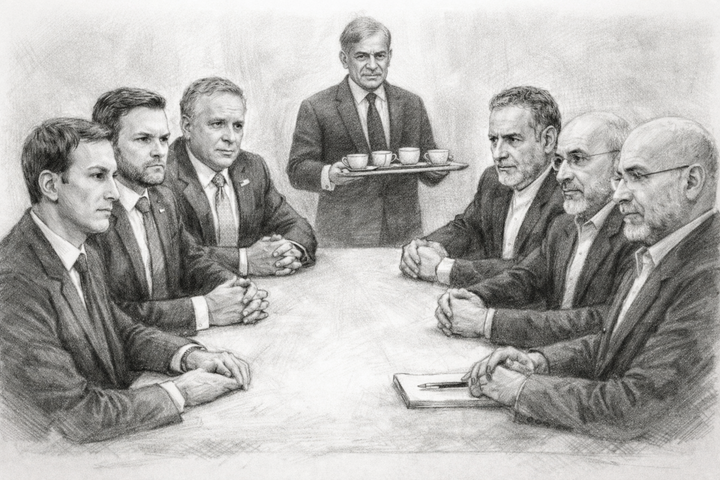
He sent his vice president to conduct them while simultaneously watching UFC in Miami. The blockade is, as CENTCOM clarified within hours, technically limited: it applies only to vessels entering or departing Iranian ports, not all ships. Non-Iranian traffic may pass freely. But the strategic signal is unlimited. The US is now in active competition with the IRGC for control of the Strait of Hormuz — both simultaneously claiming authority over the same waterway, in overlapping jurisdictions, with loaded warships on both sides.
Iran's response came in the form of a map. Speaker Ghalibaf posted a photograph of a Washington DC gas station showing prices above $4 per gallon with the message: "Enjoy the current price of gasoline. With what is being called a 'blockade,' you will soon miss $4 to $5 gasoline."
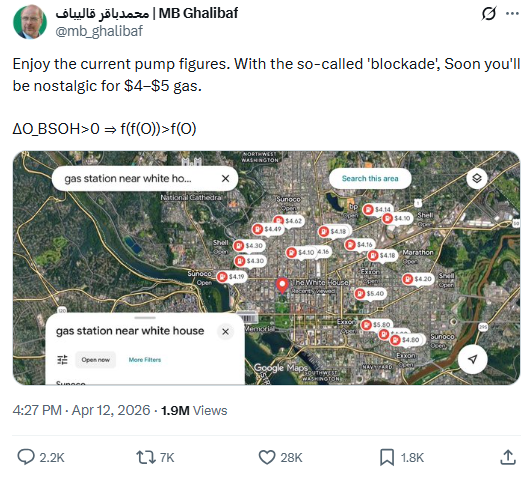
This is not bluster. This is Iran's theory of the conflict stated plainly: its leverage is not military — it is economic. Every barrel blocked, every percentage point of inflation added to the American CPI, every European summer flight canceled, every Asian refinery that runs dry is a data point in Iran's argument that the US has more to lose from prolonged Hormuz closure than Iran does. In this light, the 21-hour Islamabad negotiation was not a failure.
The failure was the war itself, which produced a stalemate that now requires the United States to blockade a waterway it does not control in order to pressure a country that has already survived 44 days of the most intensive American bombing since Vietnam.
For India, the blockade announcement requires clear-eyed assessment, not panic. The blockade applies to Iranian port traffic, so that India's tankers, if they are not bound for Iranian ports, may still, in theory, navigate.
India's tanker operators must receive immediate official guidance. India's government must simultaneously activate its alternative supply chains at full emergency speed.
Story #1: Trump's Hormuz Blockade — What "Effective Immediately" Actually Means
The Full Picture
Trump's Truth Social post landed at approximately 10 AM New York time on Sunday, April 12, within hours of Vance's press conference in Islamabad confirming the talks had failed without a deal. The post's full text is worth reading precisely for what it reveals about the gap between declaration and capacity.
So the question is what does US would "seek and interdict every vessel in International Waters that has paid a toll to Iran,"really imply?
Do you understand the situation?
Pay Iran → risk U.S. seizure
Don’t pay → risk Iranian harassment/mines
Avoid → massive delays + cost spikes
He said any Iranian who fires at US forces or peaceful vessels would be "BLOWN TO HELL." Within minutes, oil prices spiked. Brent crude jumped 7.8% toward $103 a barrel. European gas futures spiked up to 18%. US crude was up 8% toward $104.
This is a complete lockjam in Hormuz.
Here is a very incisive, albeit incomplete, analysis from Fareed Zakaria:
CENTCOM then issued a clarifying statement that substantially narrowed the declaration's scope: the blockade "will not impede freedom of navigation" for vessels transiting to or from non-Iranian ports. Ships not going to or from Iran may pass freely. This is a significant limitation — it means the blockade targets Iranian oil exports specifically, not global shipping generally. US forces would begin implementation at 10 AM New York time Monday, CENTCOM said. The US Justice Department separately announced that it would "vigorously prosecute anyone who buys or sells sanctioned Iranian oil."
Iran's Ghalibaf posted his gas-station price map within the same hour. Iran's IRGC issued a statement warning that any military vessel approaching the strait would be "dealt with harshly and decisively." The UK government publicly distanced itself from the blockade, confirming it would not participate and that it "continues to support freedom of navigation." Columbia University's Center on Global Energy Policy warned that even with CENTCOM's narrowing, the blockade would keep roughly 7 million barrels per day of Iranian crude and Gulf product off the market — adding to an already-existing shortage of 4-5 million bpd that strategic reserve releases have been bridging.
Analyst Karen Young: "It could be a long time from now before oil prices go down, even after the war ends."
The Wall Street Journal simultaneously reported that Trump was considering resumption of limited military strikes on Iran in an attempt to break the peace-talk stalemate — a pressure option that remains live even as the blockade commences.
🇮🇳 How This Impacts India
India's tanker operators need official government guidance within 24 hours. The blockade's CENTCOM clarification means Indian tankers not bound for Iranian ports may theoretically transit — but "theoretically" is not an operational instruction when both the IRGC and the US Navy are claiming authority over the same corridor, and mines of uncertain location remain in the shipping lanes. India's Directorate General of Shipping must issue a formal advisory by the end of the day on April 13 specifying: whether Indian-flagged vessels may transit under the current conditions; what the protocol is for vessels receiving conflicting instructions from IRGC and US naval forces; and whether the Government of India is seeking US naval escort for specific high-priority crude tanker transits. In parallel, India's emergency supply chain activation must move at maximum speed. Russian Arctic crude, US Gulf Coast crude, Venezuelan crude (where Indian refiners have already been increasing purchases), and Australian LNG must all be fast-tracked to fill the gap. This is not future planning. It is this week's task.
📎 References: MSN/CNBC | CBS News | Bloomberg | Al Jazeera | Arab News | Daily Mail
Story #2: Erdogan Threatens to "Invade" Israel — The Turkey-Israel Confrontation Goes Kinetic in Language
The Full Picture
The Erdogan-Netanyahu exchange escalated dramatically on April 12, moving from judicial theatre to explicit military threat. After Turkey filed criminal indictments against Netanyahu and 35 Israeli officials seeking up to 4,596 years in prison over the 2025 Gaza flotilla interception — and after Netanyahu, Katz, and Ben-Gvir responded with insults ranging from "F*ck you" to "paper tiger" — Turkish President Erdogan escalated to a different register entirely.
Speaking at the International Asia-Political Parties Conference in Istanbul, Erdogan accused Israel of "atrocities against Palestine and Lebanon" and threatened military action against the Jewish state, "similar to its past interventions in Karabakh and Libya."
The Karabakh reference is not incidental: Turkey deployed military force, advisers, and Syrian mercenaries to help Azerbaijan retake Nagorno-Karabakh from Armenia.
The Libya reference is equally precise: Turkey sent troops and drones to back the Tripoli government against Khalifa Haftar's forces in 2019-20. Erdogan's message was not rhetorical. He was citing specific precedents for Turkish military intervention in conflicts in which Turkey had decided that its interests or political positioning warranted action.
Turkish officials also warned that if Netanyahu fails to derail diplomatic efforts, he "risks being tried in his own country and is likely to be sentenced to imprisonment" — a reference to the ICC warrant and Netanyahu's ongoing corruption trial in Israel.
Israeli Heritage Minister Amichai Eliyahu posted an AI-generated image of Erdogan kneeling before Netanyahu at the Temple Mount and called for the closure of Turkey's diplomatic missions in Israel. Israel's Foreign Ministry has so far declined to formally expel Turkish diplomats, but multiple Israeli lawmakers have called for it. Turkey has an estimated $7 billion in trade with Israel annually and is a NATO member, making a formal military confrontation legally and practically complex. But the language has moved from heated to threatening in ways that require careful monitoring.
🇮🇳 How This Impacts India
As we have consistently noted in these pages, Turkey is not India's diplomatic partner — it is a structural adversary. Ankara supports Pakistan in international forums, raises the Kashmir issue at the UN, and has been implicated in networks funding destabilization in India's neighborhood. The deepening of Greece-India defense ties and India's arming of Armenia are India's calibrated responses to Turkey's alignment with the Pakistan axis.
The Turkey-Israel confrontation should be read by India purely analytically, not as an opportunity. What it reveals: Turkey is now openly threatening military action against a US ally while remaining in NATO. This is the most severe internal NATO contradiction since the war began — one that weakens the alliance's coherence further and confirms that the post-war Middle East will not feature a unified Western security posture. For India, a fractured Western security architecture is the permanent condition within which it must build its own strategic partnerships — with Israel (defense cooperation), Greece (strategic convergence), France (technology and naval) — without any dependence on NATO as an institutional guarantor.
📎 References: Mirror UK | Jerusalem Post | GB News | Haaretz
Story #3: The Panicked Race for Barrels — Physical Oil Markets Are in Freefall Before the Blockade Even Starts
The Full Picture
While futures markets showed oil at approximately $95-96 a barrel in the days before the Islamabad talks failed — reflecting diplomatic optimism — Bloomberg's reporting on the physical oil market told a radically different story. Traders and refiners across Asia and Europe have been in a "panicked race for barrels" that predates the announcement of the blockade and will now accelerate dramatically.
In the North Sea — the world's most important physical crude benchmark market — traders submitted 40 bids for cargoes last week. Only four were met by offers. "There is simply a shortage of crude," said Neil Crosby of Sparta Commodities. "Physical Brent is a mess and has now risen too far. At this rate even European refiners will have to lower utilization, perhaps as early as next month."
Dated Brent — the physical delivery benchmark — hit a record $144 a barrel before the ceasefire was announced, surpassing its 2008 highs, even as futures remained far below their record levels. The gap between physical and futures prices is the market's signal that paper-market optimism and physical supply reality have completely decoupled.
Asian refiners have moved entirely beyond traditional sources. Japanese refiners have led a charge to buy US crude, booking smaller-than-typical ships to use the Panama Canal for speed.
Indian refiners have been ramping up Venezuelan crude purchases — in the first week of April, tankers loaded almost 6 million barrels for India, double the volumes from the same week in March.
Traders at Asian refineries told Bloomberg they were "no longer focused on price, and were simply seeking to secure barrels wherever they could to ensure energy security." The final cargoes from the Gulf that transited Hormuz before the blockade are now arriving at their destinations. ADNOC's Sultan al Jaber: "This is where the paper traded markets are meeting physical reality, and the 40-day gap in global energy flows is truly exposed."
BCA Research's Marko Papic estimated that through April 19, the world would have lost 4.5-5 million bpd of oil from the conflict — roughly 5% of global supply. But that number would "double by mid-April, becoming the largest loss of crude supply" in modern history, as strategic reserve releases run out and no fresh Hormuz supply replaces them. The blockade announcement on April 12 adds an Iranian oil ban on top of this already catastrophic physical shortage.
🇮🇳 How This Impacts India
India's Bloomberg data point — 6 million barrels of Venezuelan crude loaded in the first week of April, double the March figure — confirms that India's diversification instincts are correct and are already being implemented at the operator level. This is good news. It means India's refiners are acting rationally without waiting for government instruction.
What the government must now do is formalize and accelerate what the market has already started: fast-track the diplomatic channels needed to guarantee Venezuelan crude supply (which requires careful navigation of US sanctions that still technically apply to Venezuela, and which India has been managing through intermediaries); confirm Russian Arctic crude routing through the Cape of Good Hope and INSTC; and ensure that India's strategic petroleum reserves — currently at levels sufficient for approximately 9-10 days of consumption — are replenished to a 30-day buffer as a matter of immediate national security priority. The physical oil crisis is real. India's response is partially already underway. The government must now fully own it.
📎 References: Bloomberg / Yahoo Finance | Bloomberg Oil Advances on Blockade | CNBC Iran war oil shock
Story #4: Iran Reacts to the Failed Talks — "Inches Away From an MOU"
The Full Picture
Iran's post-Islamabad messaging has been carefully calibrated to simultaneously claim moral victory in the failure and keep a door open for the next round. Foreign Minister Araghchi posted on X that the US and Iran were "inches away from a memorandum of understanding" when the talks broke down, accusing the US side of "maximalism, shifting goalposts, and blockade."
Iran's government statement confirmed that "negotiations will continue despite some remaining differences" and that "technical experts from both sides will exchange documents."
The "inches away" formulation is important. It contradicts Vance's framing that the Iranians had simply "chosen not to accept our terms." According to Araghchi, there was a near-agreement — potentially on economic elements such as the release of frozen assets and the sanctions architecture — before the US side escalated its nuclear demands to a permanent, irrevocable renunciation.
This aligns with the user-supplied brief's analysis: Vance's demand moved the goalposts from "stop your enrichment" to "never pursue a nuclear weapon" — a categorical shift that Iran's delegation, having arrived with a 10-point framework built on very different assumptions, had no authority to accept.
Arab News' reporting on the aftermath confirmed that Pakistan's foreign minister Ishaq Dar was "surprised that talks broke down" — a diplomatic signal that Pakistan's own intelligence on the talks' trajectory had suggested more progress than Vance's press conference conveyed. Iran's Tasnim news agency listed Iran's four non-negotiable conditions that remained unmet: full sovereignty over the Strait of Hormuz, complete war reparations, unconditional release of blocked assets, and a durable ceasefire across the region, including Lebanon. None of these were agreed.
The ceasefire's status after the blockade announcement is now genuinely unclear. Iran has not formally declared the ceasefire void. The US has not officially ended it. But a US naval blockade of Iranian ports is operationally incompatible with a ceasefire framework that was premised on Hormuz reopening. The ceasefire is, in effect, suspended pending events.
🇮🇳 How This Impacts India
The "inches away from an MOU" formulation is the most important data point for India's diplomatic assessment of what comes next. If Araghchi is accurate — and his track record in this war for accuracy is stronger than the White House's — then there exists a negotiating framework that came close to success and could be revived if the nuclear maximalism is walked back. India, as a country that has consistently maintained it does not support permanent nuclear renunciation demands that violate the NPT framework (India's own position under the NPT as a non-signatory nuclear power is complex), should convey to Washington quietly and clearly: the "permanent renunciation" demand is structurally different from all previous US negotiating frameworks, is not supported by the NPT, and is unlikely to produce an agreement. A more achievable US-Iran nuclear framework — along the lines of the 2015 JCPOA model with stronger verification — is both more likely to succeed and more compatible with global non-proliferation architecture. India should not say this publicly. It should say it privately to Rubio's team before his May visit.
📎 References: Arab News | NBC News | Al Jazeera rather than
Story #5: Russia and China React to Blockade — Two Vetoes and a Condemnation Waiting to Happen
The Full Picture
Arab News' reporting on the international reaction to the blockade confirms the contours of the emerging post-Islamabad diplomatic landscape. Russia and China, who jointly vetoed the Bahrain-sponsored UN Security Council resolution to reopen Hormuz in early April — on the grounds it would have given the US "carte blanche for continued aggression" — now face a UNSC moment of a different kind: the US has announced a naval blockade of a critical international waterway, which Russia's position has been that such action would be illegal under UNCLOS.
Russia's foreign ministry called for "immediate restraint" from all parties, expressing concern that "forces may be attempting to obstruct progress toward peace." The language is measured, but the implication is clear: Moscow regards the US blockade as an escalation rather than a de-escalation tool. China's reaction was even more pointed. China purchases roughly 90% of Iran's oil exports — and every Iranian barrel blocked by the US embargo is one China doesn't receive from its primary source of cheap oil. China's state media immediately framed the blockade as "economic coercion against China and other peaceful nations."
Beijing is simultaneously preparing — according to US intelligence — to ship MANPAD missiles to Iran. The combination of Chinese arms supply and US blockade of Iranian oil exports creates a confrontation dynamic between the world's two largest economies that no one in the Islamabad Hotel was prepared for.
The UK's public distancing from the blockade — "we continue to support freedom of navigation and the opening of the Strait of Hormuz" — is the most significant Western allied response.
It confirms that even America's closest military partner does not regard the blockade as either legal under UNCLOS or strategically sound as a pressure tool. The UK has instead proposed bringing together "a wide coalition with France and others" to ensure passage through the strait — a diplomatically neutral, UNCLOS-consistent approach that contrasts sharply with the US military blockade.
🇮🇳 How This Impacts India
India's position on the blockade must be established before the 48 hours are out. India cannot support the blockade — doing so would endorse a US claim of authority over an international waterway that violates UNCLOS and would antagonize Russia, China, Iran, and every other major oil importer simultaneously. India cannot condemn the blockade — doing so would directly challenge the US military action, its largest defense partner has just announced, at a moment when Rubio is preparing a May visit. India's correct formulation is the UK's: India "supports freedom of navigation and the opening of the Strait of Hormuz" and calls for "a multilateral framework ensuring safe and unimpeded passage through international waterways in accordance with UNCLOS." This language supports the outcome (opening Hormuz) without endorsing the method (a unilateral US military blockade). It is legally defensible, diplomatically coherent, and strategically autonomous. MEA must issue this statement within 24 hours.
📎 References: Arab News | CBS News | CNN
Story #6: The Netanyahu Phone Call That Changed the Islamabad Talks — An Israeli "Op" Against JD Vance?
The Full Picture
Times of India's reporting on the Netanyahu-Vance dynamic during the Islamabad negotiations reveals a layer of internal US-Israel tension that significantly complicates the simple "Iran refused" narrative.
Multiple sources — Axios, the Times of Israel, and Channel 12 — report that Netanyahu and Vance spoke during or around the Islamabad negotiations to "discuss the components of a possible deal."
A senior US official told Axios: "If the Iranians can't strike a deal with Vance, they don't get a deal. He's the best they're gonna get."
An administration official pushed back on the narrative that Vance was eager to make a deal: "It's an Israeli op against JD." US sources said Israeli counterparts consider Vance "insufficiently hawkish" — and that they were working to undermine him in the talks. Vance, an Iraq war veteran who was among the most skeptical voices within the Trump administration before the war, had "fallen in line" publicly but reportedly continued to probe Iran's vulnerabilities during the 21 hours of negotiations.
The specific Netanyahu phone call to Vance during the negotiations — which the Times of Israel confirms was focused on "the components of a possible deal" — is widely understood to have put pressure on the nuclear renunciation demand, potentially shifting the US position from achievable to maximalist.
Iran's "inches away from an MOU" claim aligns with a scenario where the nuclear demand was escalated during the talks themselves, rather than being a consistent US position from the start.
🇮🇳 How This Impacts India
The "it's an Israeli op against JD" framing from within the Trump administration is a data point that India's foreign policy establishment must absorb carefully.
It confirms something that India has long assessed: Israeli strategic interests and US strategic interests in the Iran war are not identical.
Israel wants permanent degradation of Iranian nuclear and proxy capabilities and has no interest in a diplomatic settlement that leaves Iran sovereign, enrichment-capable, and reconstructing.
The US — specifically Vance's team — is more interested in the nuclear constraint than in the collapse of the Iranian regime. India's diplomatic approach to the US must engage Vance's framework, not Netanyahu's. The Rubio visit in May is the right venue to establish this distinction explicitly: India supports Iran's permanent non-weaponization commitments through a verifiable framework, but does not support regime change or the permanent denial of civilian nuclear rights. This positioning serves both India's NPT-adjacent interests and its role as an honest broker.
📎 References: Times of India | Times of Israel | Axios
Story #7: Trump Threatens China With 50% Tariffs Over Iran Arms — The May Summit Now at Risk
The Full Picture
Trump's April 11 warning to China — "If China does that, China's gonna have big problems" — followed by his formal Truth Social post threatening 50% tariffs on any country supplying weapons to Iran — has placed the planned May Beijing summit between Trump and Xi Jinping under visible stress. The WSJ reported that advisers told Trump that enforcing the tariff threat against China would be legally complicated, given the Supreme Court's February ruling striking down his use of IEEPA to confer broad tariff authority. But the political signal was sent regardless.
As The Times of India's reporting captured, the China-MANPAD intelligence arrives at the most delicate possible moment in US-China relations: Trump is scheduled to visit Beijing in May for a summit that was itself pushed back from March because of the war in Iran. Xi had just met KMT leader Cheng Li-wun in a move designed to demonstrate cross-strait political progress that Trump might trade against arms-sales concessions. If the MANPAD intelligence is confirmed — or even if it remains credibly asserted — Trump arrives in Beijing having already threatened 50% tariffs and a war crimes inquiry against the country he's supposedly visiting to build a constructive relationship with.
Iran's position in all of this is, paradoxically, strengthened. Every US escalation — the blockade, the China tariff threat, the consideration of resumed strikes — increases the cost to the US of a prolonged conflict. Iran's theory of the war has always been that it can impose economic and geopolitical costs that eventually exceed the US political tolerance for the campaign. Each escalation confirms that theory.
🇮🇳 How This Impacts India
The China-50% tariff threat has a direct India dimension. If the US formally imposes secondary sanctions or tariffs on countries supplying weapons to Iran — and China is the primary target — the question immediately arises whether India's own defense relationships with Iran (primarily through Chabahar, which involves some dual-use infrastructure) could be drawn into the sanctions net. India has carefully managed Chabahar as a humanitarian and civilian corridor to avoid precisely this risk. But the escalating US sanctions architecture — which now threatens 50% tariffs on weapons suppliers — requires India to ensure its Chabahar documentation is impeccably civilian in character and that the OFAC waiver renewal (now 13 days away, on April 26) is processed as a matter of urgent priority. The sanctions climate is tightening. India's compliance posture must tighten in proportion.
📎 References: Times of India | CNN | Newsweek
Story #8: China Offers Taiwan a 10-Point Economic Package — The Pre-Trump-Summit Carrot
The Full Picture
The day after Xi met KMT leader Cheng Li-wun, China's Taiwan Affairs Office unveiled a 10-point economic incentive package for Taiwan — timed with precision to the Islamabad talks, the Hormuz blockade announcement, and the approaching Trump-Xi May summit.
The package includes fast-tracking resumption of regular direct flights across the Taiwan Strait, facilitating access for Taiwanese food products to the Chinese market, and — most specifically — sharing energy and water supply with Matsu and Kinmen, the Taiwanese-governed islands geographically closest to the mainland, with a proposal to even build a bridge connecting them.
Taiwan's ruling Democratic Progressive Party was openly hostile. Presidential spokesperson Karen Kuo said, "Any exchanges should not be subject to political preconditions, nor should they be used as tools for political maneuvering or deals by specific parties."
The Mainland Affairs Council noted that "similar measures had been repeatedly rolled out and suspended by China in the past." The KMT's Cheng herself said only that things "must be done one by one" — a response that accepted neither the package's substance nor Beijing's framing.
RT's analysis is correct that Beijing's underlying goal is to establish — before Trump arrives in May — a visible narrative of cross-strait economic integration that Xi can cite as evidence that Taiwan's future lies in peaceful reunification, not in US military support. The bridge proposal to Matsu and Kinmen is particularly revealing: these islands, which Taiwan controls, sit just kilometers from the mainland. A bridge would make them permanently accessible from China in ways that would fundamentally alter Taiwan's defensive posture. The DPP has categorically rejected any such infrastructure.
🇮🇳 How This Impacts India
China's Taiwan economic package is the strategic frame within which Xi arrives at the May Trump summit. His message to Trump will be: we are pursuing peaceful cross-strait integration; what we need from you is a reduction in arms sales and military support for Taiwan that undermines this process. Trump's leverage in Beijing — if he chooses to use it — is precisely the China-MANPAD intelligence and the 50% tariff threat. The question is whether Trump will trade Taiwan security guarantees for Chinese pressure on Iran. India's direct concern: any US-China deal that reduces the American military presence or commitment in the Indo-Pacific without India's knowledge or consultation would directly affect the strategic balance on which India's own security planning is based. The Quad FM meeting in May — which India is hosting with Rubio, Australia, and Japan — must put this question precisely on the agenda: what happens to US Indo-Pacific commitments if Trump makes concessions to China at the Beijing summit?
📎 References: RT | NPR — Xi-KMT meeting
Story #9: Orbán Falls — Magyar Wins Hungary by Supermajority in the Biggest European Political Upset of the Decade
The Full Picture
In a result that stunned even those who had predicted a Tisza victory, Peter Magyar's center-right Tisza party won Hungary's April 12 parliamentary election by a supermajority landslide: 53.6% of the vote to Fidesz's 37.8%, translating to 138 seats out of 199 — well above the 133 needed to amend Hungary's constitution. Turnout was nearly 80% — a post-Communist record.
Viktor Orbán, who had ruled Hungary since 2010 and survived three consecutive election victories through a combination of electoral system manipulation, media control, and state resource deployment, conceded on the phone to Magyar before the final count was in. "The election result is painful for us, but clear," Orbán told supporters. "I congratulated the victorious party."
JD Vance had visited Budapest just five days earlier to endorse Orbán at a rally, attacking EU "bureaucrats" and suggesting Orbán's model of higher-education control should be applied in the US.
Trump had promised to bring "economic might" to Hungary if Fidesz won. The Vance endorsement appears, based on the results, to have had zero positive effect and may have slightly backfired — associating Orbán with the Iran war's economic costs at a moment when Hungarian living costs were a primary voter concern. Magyar's victory speech to tens of thousands on the Danube: "Tonight, truth prevailed over lies." European Commission President von der Leyen: "Hungary has chosen Europe. A country reclaims its European path. The Union grows stronger." Poland's PM Tusk: "Back together!"
The strategic consequences: Orbán's €90 billion veto on the EU loan to Ukraine has now been lifted. Hungary's €20 billion in frozen EU funds will likely be unblocked. Hungary's formal alignment with Russia within EU institutions — which led to revelations that a top Orbán government official was sharing confidential EU deliberations with Moscow — ends. Trump and Putin both lose their primary EU ally at the same time.
🇮🇳 How This Impacts India
Magyar's victory has two specific implications for India. First, the EU-India trade agreement: Orbán's obstructionism within the European Council was one of the factors complicating EU institutional coherence on external trade negotiations. A more pro-European Hungarian government removes one veto point. India should move quickly — within the first 60 days of Magyar's government formation — to signal renewed engagement on the stalled EU-India free trade agreement and the Critical Minerals Partnership. Second, the Russia back-channel loss: Orbán served India as an implicit back-channel to Moscow within the EU — a relationship India had not explicitly cultivated but which existed structurally. With Orbán gone, India loses a European interlocutor with direct access to Putin who operated outside Brussels' institutional framework. India should now invest in the Austria-India relationship as a partial substitute — Austria has historically maintained pragmatic ties with Russia and is geographically and economically positioned to serve a similar function.
📎 References: CNN — Orbán concedes | Al Jazeera — Magyar wins | CBS News | PBSProgram
Story #10: Iran's Nuclear Program Survived — The Expert Consensus That Reframes the Entire War
The Full Picture
The Daily Mail's deep-dive, drawing on multiple arms control experts and intelligence assessments, delivers the most uncomfortable conclusion of the war for Washington and Jerusalem: Iran's nuclear program has survived the US-Israeli bombing campaign in a condition that makes the Islamabad nuclear demand — permanent, irrevocable renunciation — not just politically unacceptable to Tehran but potentially strategically moot.
The expert consensus, drawn from NPR's interview with Ali Vaez of the International Crisis Group, the Arms Control Association's technical assessment, the IAEA director-general's statement, and CNN's analysis: Iran entered the war with 440 kilograms of uranium enriched to 60% purity — enough, if further enriched, for approximately 10 nuclear weapons. Pre-war breakout time: six days. Post-war breakout time: the same six days. The reason: Iran's most advanced centrifuges and its enriched uranium stockpile were located in hidden underground clandestine facilities that US bunker-busters could not reach. The IAEA confirmed it cannot account for the full stockpile and cannot resume inspections. The Arms Control Association noted that even where surface facilities were destroyed, the centrifuge-manufacturing capacity survived, along with "thousands of scientists and the know-how."
Vaez told NPR directly: "From the air, there is nothing left really to bomb. The US can't eliminate all of Iran's nuclear scientific core and know-how. Without boots on the ground — either to retrieve that stockpile or to eliminate Iran's nuclear scientists — there is really no way that this could end." The IAEA's Rafael Grossi said he believed "some part of Iran's nuclear program will remain, even after the heavy damage done by US and Israeli military strikes." CNN's analysis added the political dimension: Khamenei's death has removed the nuclear fatwa he issued. Elite and public opinion in Iran has "shifted dramatically" toward a nuclear weapon. "The nuclear fatwa is dead," Trita Parsi of the Quincy Institute told CNN.
The logical conclusion: the US went to war partly to prevent Iran from getting a nuclear weapon. The war may have made Iran's acquisition of a nuclear weapon more likely, not less. And the Islamabad nuclear demand — permanent renunciation — is being asked of a country whose breakout time has not changed, whose stockpile location cannot be verified, and whose political consensus on nuclear weaponization has hardened.
🇮🇳 How This Impacts India
This story is the one that matters most to India's National Security Council and Department of Atomic Energy, yet it receives the least public attention. If Iran's nuclear breakout time remains at six days — unchanged by the most intensive American bombing campaign in decades — India must update all its regional nuclear threat assessments. The conventional wisdom in South Block that Iran's nuclear program had been "substantially degraded" by US operations must be explicitly challenged. Second, the regional proliferation cascade: Saudi Crown Prince Mohammed bin Salman said in 2018 that Saudi Arabia would pursue nuclear weapons if Iran obtained them. If Iran's nuclear capability is intact and its political consensus has hardened toward weaponization, Saudi Arabia's nuclear ambitions must be factored into India's strategic calculations for the Gulf relationship — including the food security partnerships, LNG agreements, and diaspora welfare dimensions that India has been building during this war. A nuclear Middle East is a fundamentally different strategic environment from the one India has been planning within.
📎 References: Daily Mail | NPR — Vaez interview | Arms Control Association | CNN nuclear analysis | IAEA/NPR
The Dispatch: Editor's Synthesis
Day 44. The world woke up this morning to three simultaneous realities that have never coexisted before:
A US naval blockade of the world's most important oil waterway. A Turkish president threatening to invade a US ally. A Hungarian prime minister who won by supermajority, defeating Trump's endorsed candidate, with JD Vance having campaigned for the loser five days earlier. And, underlying all of it, an expert consensus that Iran's nuclear breakout time is unchanged after 44 days of bombing.
This is not a world in which a ceasefire solves anything. The Islamabad talks failed not because of bad faith or poor negotiation — though both were present — but because the two sides are not actually negotiating over the same object. The US wants Iran to permanently renounce nuclear weapons.
Iran's scientists have already proven they can build, in facilities the US cannot reach from the air. Iran wants to be recognized as having survived a war it did not start and to be compensated for the survival. These are not positions that meet in a Serena Hotel over 21 hours.
The blockade is Trump's escalation tool. It will raise oil prices. It will hurt European consumers. It will hurt Iranian oil revenues. It will create exactly the confrontation with China that the May Beijing summit was supposed to prevent. It is a pressure tactic that is simultaneously too blunt for its diplomatic objective and too limited for its military objective. CENTCOM's clarification — that it targets only Iranian port traffic — confirms it is designed to squeeze Iranian oil revenues without triggering a full naval war. Whether Iran reads it that way is the question on which $100-plus oil depends.
For India, today's synthesis is short and clear.
The Chabahar waiver expires in 13 days. OFAC must be called today — not through a press statement, not through the Ministry of External Affairs' public channels, but through India's Ambassador to the United States, making a direct appointment with the Office of Foreign Assets Control and walking in with a written request for extension by April 20.
India's MEA must issue a statement within 24 hours on the blockade, using the UK formulation: support freedom of navigation, call for a multilateral UNCLOS-consistent framework, without endorsing either the US blockade or the IRGC toll regime.
India's tanker operators need official guidance within 24 hours on Hormuz transit protocols, given the dual US-IRGC authority claim.
India's National Security Council must commission an updated nuclear threat assessment for the region, incorporating the Arms Control Association's finding that Iran's breakout time is unchanged.
And the EU-India trade agreement engagement with Hungary's incoming Magyar government should begin within 60 days of government formation — this is the constructive European dividend of last night's result that India should capture quickly.
The blockade is the headline.
Comments ()