
The Daily Geopolitics Brief # 4
Oil at $104. Fertilizers up 50%. 9M Indians in the Gulf. Both shipping chokepoints under threat. The Iran war is India's crisis too.
Quote of the Day
🔍 What This Signals
This is not merely a quote about oil. It is an announcement of a new geopolitical reality. For the first time since the 1970s oil crisis, a single nation is holding the global economy by the throat — not through a distant embargo, but by physically controlling the world's most critical energy bottleneck. What al-Jaber said at the Middle East Institute in Washington captures the stakes perfectly: this is no longer a regional conflict. Every nation that buys oil, grows food, or manufactures goods has been pulled into the theatre of this war, willingly or not. For India — which imports over 80% of its crude, sources the majority from the Gulf, and relies on Middle Eastern fertilizers for its agriculture — this is not background noise. It is a five-alarm emergency requiring urgent strategic attention.
Story #1: Iran's "Tehran Toll Booth" — The Strait of Hormuz Gets a Price Tag
The Full Picture
Something remarkable — and deeply alarming — is happening in the Strait of Hormuz. Iran is not simply choking the world's most important oil artery; it is now turning it into a revenue stream.
According to shipping intelligence firm Lloyd's List Intelligence, Iran's IRGC has imposed a de facto "toll booth" regime in the Strait of Hormuz. Ships must now divert from the traditional two-lane shipping channel to a northern route around Larak Island, placing them squarely in Iranian territorial waters and closer to the Iranian coastline.
Entities that want their vessels to safely pass through must submit their details to what Lloyd's List Intelligence calls "approved intermediaries" of the Revolutionary Guard — including cargo manifests, owner identities, destination ports, and complete crew lists. Approved vessels receive a passage code and are escorted by an IRGC vessel. Oil is prioritized, and vessels are subject to what the firm describes as "geopolitical vetting." At least two vessels have paid a direct toll, with payment settled in yuan — China's currency.
Iran's parliament is now actively working on a bill to formalize this arrangement. Lawmaker Mohammadreza Rezaei Kouchi said "parliament is pursuing a plan to formally codify Iran's sovereignty, control and oversight over the Strait of Hormuz, while also creating a source of revenue through the collection of fees."
The "Tehran Toll Booth" is growing steadily, with at least 20 ships transiting the corridor as of March 23, accounting for anywhere between 10% and 20% of all strait traffic since the start of the war.
Only about 150 vessels, including tankers and container ships, have transited the strait since March 1 — a collapse from the pre-war average of roughly 130 ships per day.
Maritime law is unambiguous: Article 19 of the UN's Law of the Sea Treaty requires countries to allow "innocent passage" of peaceful, law-abiding vessels in their territorial waters. As maritime historian Sal Mercogliano put it, "There's no provision in international law anywhere to set up a toll booth and shake down shipping." The Gulf Cooperation Council has called it a direct violation of international law.
But in a world where Western hegemony is being targeted by China-aligned Iran, this arrangement is precisely the point: bypass the dollar, demonstrate sovereignty, and monetize the crisis.
🇮🇳 How This Impacts India
India is on the "friendly nation" list that Iran has circulated for safe passage through the strait — a double-edged sword. On one hand, Indian-flagged vessels or those carrying Indian cargo may be able to transit with fewer disruptions. On the other hand, any payment to the IRGC could expose Indian companies to secondary US sanctions. India's crude imports from the Gulf — particularly from Saudi Arabia, UAE, Kuwait, and Iraq — have been severely impacted by the 90% drop in strait traffic. Brent crude at over $104 per barrel translates directly to higher inflation, a widening current account deficit, and fuel subsidy pressures on the Indian government. The formalization of Hormuz as an Iranian toll booth would permanently restructure global shipping economics, forcing Indian refiners to either negotiate directly with the IRGC or pay a significant geopolitical premium.
📎 References: AP via Times Free Press | FDD Analysis | Iran International
Story #2: Houthis on the Trigger — Is the Red Sea About to Explode Again?
The Full Picture
The world's second-most-critical maritime chokepoint — the Bab el-Mandeb Strait — is now also at risk, as Yemen's Houthi movement signals it is ready to enter the Iran war.
Yemen's Iran-aligned Houthi movement, whose attacks on the Red Sea caused international shipping and trade chaos during the Gaza war, stands ready to strike the key waterway again in solidarity with Tehran, one Houthi leader told Reuters — a move that would deepen a global oil and economic crisis brought on by the Middle East war.
If the Houthis open a new front, one obvious target would be the Bab al-Mandab Strait off the coast of Yemen — a key shipping chokepoint and narrow passageway that controls sea traffic towards the Suez Canal, after Iran has already effectively shut the Strait of Hormuz.
A Houthi leader, speaking anonymously, said: "We stand fully militarily ready with all options. As for other details having to do with determining zero hour, they are left to leadership." The Houthis ceased their attacks following a US-brokered ceasefire between Israel and Hamas in October 2025 — and have not yet formally entered the current fray.
Iran's new supreme leader, Ayatollah Mojtaba Khamenei, signaled in his first written public statement that Iran may open "new fronts in the conflict" — which analysts interpret as a signal to the Houthis to get involved soon.
The Soufan Center's analysis makes clear that a Houthi entry would support Iran by further depleting Israeli and US air defense supplies, and offensive munitions — potentially enabling a higher percentage of Tehran's remaining missiles to reach their targets. The Houthis are arguably the least damaged member of Iran's "Axis of Resistance," controlling most of central and northern Yemen including Sanaa.
A fresh Houthi intervention would close both the Hormuz and Suez shipping arteries simultaneously — a scenario with no modern precedent.
🇮🇳 How This Impacts India
India's trade with Europe, Africa, and the Americas flows through the Red Sea and the Suez Canal. During the Gaza-era Houthi attacks in 2024, Indian exporters of textiles, chemicals, and manufactured goods paid a severe price in rerouting costs and delayed deliveries. A renewed Houthi campaign would hit India on both ends: higher import bills for crude and commodities on the one side, and disrupted export corridors on the other. India's JNPT (Mumbai) and other western coast ports would face sustained congestion as shipping diversions pile up. The compounding effect of Hormuz and Bab el-Mandeb both being under threat would make India's eastern coast ports — Vizag, Chennai, Ennore — strategically more relevant for Indo-Pacific trade.
📎 References: Reuters via BOE Report | The Soufan Center | Al-Monitor
Story #3: Iran Threatens Global Tourist Sites — The War Goes Everywhere
The Full Picture
Nearly four weeks into the US-Israeli war on Iran, Tehran has escalated its rhetoric to an unprecedented level: threatening recreational and tourist sites around the world.
Iran threatened to expand its retaliatory attacks to include recreational and tourist sites worldwide, as the US announced it was sending more warships and Marines to the region. Iran's top military spokesman, Gen. Abolfazl Shekarchi, warned that "parks, recreational areas and tourist destinations" worldwide won't be safe for the country's enemies.
The threat renewed concerns that Iran may revert to using militant attacks beyond the Middle East as a pressure tactic. US and Israeli leaders have said that weeks of strikes have decimated Iran's military, killing its supreme leader, the head of its Supreme National Security Council, and numerous top-ranking commanders.
Iran also issued a broader warning to hospitality operators across the Middle East, claiming that hotels and other civilian facilities used to house US military personnel could be considered "legitimate defensive targets." Iran's semi-official Fars News Agency said locations used by US personnel are "not limited" to Bahrain and the UAE, and that alternative accommodation sites for foreign forces in Syria, Lebanon, and Djibouti have also been identified.
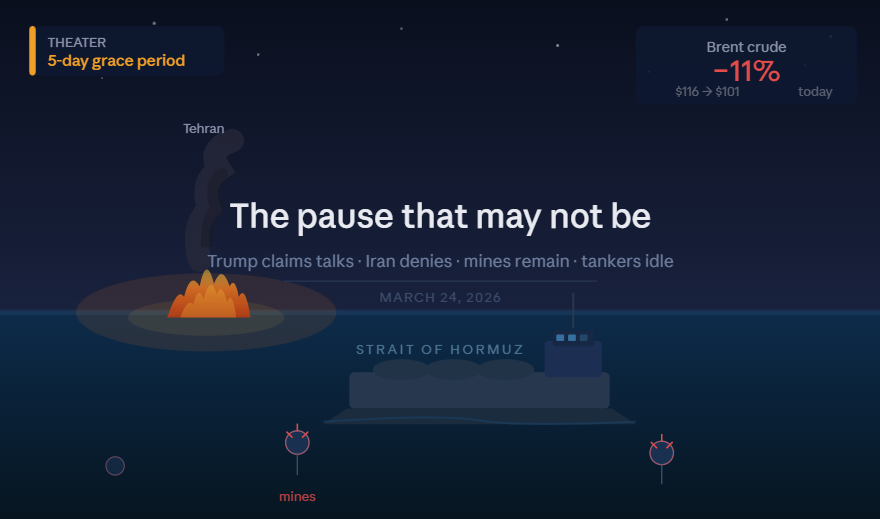
President Trump, meanwhile, paused strikes on Iranian energy plants until April 6, 2026, posting on Truth Social: "Talks are ongoing and, despite erroneous statements to the contrary by the Fake News Media, they are going very well." Iran denied requesting the pause and called US proposals "one-sided and unfair."
🇮🇳 How This Impacts India
Iran's threats have direct implications for Indian citizens working in the Gulf — over 9 million in the UAE, Saudi Arabia, Kuwait, Qatar, Bahrain, and Oman — and for Indian tourism operators reliant on Middle Eastern routes and stopover traffic. The threats extend Iran's coercive strategy far beyond the Gulf, potentially affecting Indian airlines flying over the region and Indian employees at hotel chains hosting Western military liaisons. India's security agencies will also need to assess the threat environment for potential proxy attacks on Israeli or American interests on Indian soil — a scenario that has precedent from the 2012 attempted attack on the Israeli Embassy in Delhi.
📎 References: PBS Newshour | Fortune | NPR
Story #4: Trump Weighs 10,000 More Troops — The War Is Widening, Not Winding Down
The Full Picture
Despite a rhetorical "winding down" narrative from President Trump, the Pentagon's actions tell a very different story.
The Pentagon is looking at sending up to 10,000 additional ground troops to the Middle East to give President Trump more military options even as he weighs peace talks with Tehran, the Wall Street Journal reported, citing Department of Defense officials with knowledge of the planning.
The force, which would likely include infantry and armored vehicles, would be added to the roughly 5,000 Marines and the thousands of paratroopers from the 82nd Airborne Division already ordered to the region. The news comes as reports suggest that Trump is also considering invading Iran's Kharg Island in the Persian Gulf — an oil hub that processes about 90% of Iran's crude exports.
The earlier five-day deadline for resumption of US attacks on Iranian energy infrastructure has now been extended to ten days, until April 6. Trump posted on Truth Social: "Talks are ongoing and going very well." Shortly after, Iran denied it had requested a pause on energy-site strikes.
The contradiction is telling: the US is simultaneously pursuing diplomacy, extending military deadlines, sending more troops, and weighing the seizure of Iranian islands. This is the classic dual-track coercive diplomacy — but at a scale that risks catastrophic miscalculation. The US has offered shifting rationales for the war — from fomenting regime change to eliminating Iran's nuclear program. There have been no public signs of any such uprising, and no end in sight to the war.
🇮🇳 How This Impacts India
A prolonged US military presence in the Gulf is both reassuring and destabilizing for India. On one hand, US naval dominance protects the sea lanes India depends on. On the other hand, a ground war in Iran or a seizure of Kharg Island would trigger the most severe oil supply shock in modern history — far beyond anything 1973 or 1979 produced. India's strategic oil reserves, equivalent to roughly 9–10 days of consumption in government-held facilities, would provide minimal buffer. New Delhi would need to rapidly accelerate discussions with Russia, Kazakhstan, and the US itself on alternative crude supply arrangements. India's "strategic autonomy" positioning would also be severely tested as it navigates between its traditional ties with Iran (including the Chabahar port agreement) and its deepening partnership with the US.
📎 References: Reuters/US News | Times of Israel | Mediaite
Story #5: Japan Fires Its Largest-Ever Oil Reserve Release — A 254-Day Buffer Gets Tested
The Full Picture
On March 26, Japan took the unprecedented step of beginning its largest-ever release of oil from national government reserves — a vivid illustration of just how severe the global supply shock has become.
Japan started its largest-ever release of oil from its national reserves on Thursday as part of a global effort to stabilize supply and counter the economic effects of war in the Middle East. It is the second-ever such release by Japan, and the second-largest contribution among the 32 nations involved in the coordinated intervention. At 10:59 a.m. on Thursday, the Japan Organization for Metals and Energy Security commenced the release of about 400,000 kiloliters (2.5 million barrels) of oil from the Kikuma National Petroleum Stockpiling Base in Imabari, Ehime Prefecture.
Japan will release a total of around 80 million barrels, including privately held reserves. The total planned contribution represents around 45 days' worth of supply.
The release — 15 days' worth of domestic demand from mandatory private reserves and one month from national reserves — was the seventh ever conducted in the nation. The private reserve release is being carried out by lowering the required stockpile amount from 70 days to 55 days, initially for one month.
Japan sources about 95 percent of its oil imports from the Middle East, of which some 70 percent passes through the Strait of Hormuz. Japan is facing what a Chinese expert described as triple, overlapping crises: extreme dependence on oil imports, the ongoing conflict, and long-standing structural economic problems.
The IEA's 32 member countries agreed to release a record 400 million barrels of oil from their strategic emergency reserves — the largest stock draw in the agency's history, far exceeding the 182 million barrels released after Russia's Ukraine invasion in 2022.
🇮🇳 How This Impacts India
India is watching Japan's playbook carefully — and urgently. Unlike Japan, India's strategic petroleum reserve capacity is far more limited. India holds approximately 39 million barrels of government-controlled strategic reserves across three underground facilities (Visakhapatnam, Mangaluru, and Padur) — equivalent to roughly 9–10 days of consumption. With Brent crude above $104 per barrel (up 40%+ since the war began), India's import bill is running at crisis-level premiums. India needs to urgently consider expanding its SPR capacity, accelerating crude diversification towards Africa and the Americas, and deepening its energy diplomacy with Russia — even as it navigates Western sanctions pressures. The IEA release provides a global buffer, but India's limited SPR means domestic fuel price inflation is difficult to contain for long.
📎 References: Japan Times | Al Jazeera | Bloomberg
Story #6: Russia's Fertilizer Windfall — Moscow Profits as the World Faces Food Crisis
The Full Picture
While the world's eyes are on oil, a slower and arguably more dangerous crisis is building in global food supply — and Russia is perfectly positioned to exploit it.
Russia stands to reap gains from surging global fertilizer prices amid the US-Israeli war with Iran. The conflict has tightened global supplies of key crop nutrients by damaging Gulf energy infrastructure and choking off shipping through the Strait of Hormuz. Urea, the most widely traded fertilizer, has risen by roughly 50% since the Iran war began. Middle East granular urea prices surged to $604–$710 per ton from $435–$490 before the crisis, and around $400 at the start of the year.
Analysts working in the sector observed FOB granular urea in Egypt — a bellwether of nitrogen fertilizers — jump to around $700 per metric ton, up from $400–$490 before the war began. According to Oxford Economics' Alpine Macro, urea and ammonia prices have surged by around 50% and 20% respectively since the war began.
About a third of all fertilizer shipped globally passes through the Strait of Hormuz. The UN Food and Agriculture Organization's chief economist warned: "The loss of Gulf exports creates an immediate global shortfall with no quick substitutes." He identified South Asia — specifically India, Bangladesh, Pakistan and Sri Lanka — as among the most immediately impacted regions. "The preparation for fertilizers and other inputs needs to begin already. There is a little bit of nervousness about what if the war continues for too long."
According to projections by analysts, nitrogen fertilizer prices could roughly double from 2024 levels, while phosphate prices might increase by approximately 50%. Asian nations are highly dependent on Middle Eastern supply, receiving 35% of urea, 53% of sulphur, and 64% of ammonia exports from the region.
Russia has also temporarily suspended exports of ammonium nitrate from March 21 to April 21, further tightening global supply of crop nutrients already strained by the Iran war. This allows Moscow to potentially sell remaining stocks at peak prices while creating artificial scarcity.
🇮🇳 How This Impacts India
This is perhaps the most undercovered dimension of the Iran war for India. India is the world's second-largest consumer of fertilizers and imports significant quantities of urea, DAP (di-ammonium phosphate), and potash. A 50% surge in urea prices directly impacts the cost of growing wheat, rice, and sugarcane — staple crops for over a billion people. With India's kharif planting season beginning in June-July, disruptions to fertilizer supply and pricing in the March-May window create a real risk to agricultural yields in 2026. The government's fertilizer subsidy bill, already strained, will balloon further. India should urgently stockpile fertilizers, explore bilateral supply deals with Russia (navigating sanction concerns carefully), and accelerate domestic production of nitrogenous fertilizers using gas from domestic sources.
📎 References: The Moscow Times | NPR | CNBC
Story #7: Zelenskyy's Bombshell — US Will Only Guarantee Ukraine's Security If It Surrenders Donbas
The Full Picture
In a stunning disclosure, Ukrainian President Volodymyr Zelenskyy revealed that Washington has attached a territorial concession to any security guarantee offer — Ukraine must withdraw from all of Donbas.
Ukrainian President Zelenskyy said the US is conditioning post-war security guarantees on Kyiv ceding the Russian-occupied Donbas, as Washington pushes for a swift end to the war. Zelenskyy warned such terms would weaken Ukraine's defences and embolden Moscow.
"The Americans are prepared to finalise these guarantees at a high level once Ukraine is ready to withdraw from Donbas," Zelenskyy said, describing a proposal he warned could undermine both Ukraine's defenses and broader European security.
Zelenskyy warned that abandoning Donbas would hand Russia heavily fortified Ukrainian defensive lines — known as the "Fortress Belt" — weakening Kyiv's position and potentially enabling future aggression. "I would very much like the American side to understand that the eastern part of our country is part of our security guarantees," he said.
Zelenskyy explicitly attributed Trump's posture to the Iran conflict: "The Middle East definitely has an impact on President Trump. President Trump, unfortunately, in my opinion, still chooses a strategy of putting more pressure on the Ukrainian side." He also warned: "Russia is counting on the fact that the United States will not have the strength or patience to bring this to an end."
A fourth round of trilateral US-Russia-Ukraine talks due this month was postponed due to the Iran conflict. The White House denied Zelenskyy's characterization, but did not rebut the specific Donbas condition.
🇮🇳 How This Impacts India
India has long maintained a careful "strategic autonomy" position on Ukraine, abstaining from UN votes condemning Russia while continuing to buy discounted Russian crude. The Donbas revelation has several implications for New Delhi. First, if a forced settlement legitimizes Russian territorial conquest, it signals to other powers — including China — that aggression can succeed when great powers lose interest. This has direct implications for India's security environment in the Indo-Pacific. Second, India's growing defense relationship with Ukraine — particularly in drone technology and maintenance of legacy Soviet systems — may need recalibration. Third, if Russia locks in Donbas, it frees up more military bandwidth to assist China or Iran, compounding India's strategic exposure. India should closely monitor the peace terms and ensure its voice — as a major democracy and UN Security Council aspirant — is heard in shaping any settlement.
📎 References: France 24 | Fox News | Euromaidan Press
Story #8: IDF Chief Raises "10 Red Flags" — Israel's Military Is Running on Empty
The Full Picture
In a dramatic security cabinet meeting, Israel's own military chief delivered a stark warning: the IDF is heading toward structural collapse — even as it fights on multiple fronts.
IDF Chief of Staff Lt. Gen. Eyal Zamir reportedly warned the "IDF is going to collapse in on itself" during a security cabinet meeting this week.
"I am raising 10 red flags in front of you," Zamir told ministers. "Right now, the IDF needs a conscription law, a reserve duty law, and a law to extend mandatory service. Before long, the IDF will not be ready for its routine missions and the reserve system will not last."
The military is currently engaged in operations in Lebanon, Gaza, Syria, Iran and the West Bank simultaneously — a five-front war that is stretching every element of Israeli force structure. Military officials confirmed a growing strain and a significant manpower shortage of thousands of troops. Officials said neither the prime minister nor any ministers responded during the meeting.
The military has informed lawmakers that it is short of around 12,000 troops amid ongoing operational demands. The issue is compounded by political debates over military service exemptions — approximately 80,000 ultra-Orthodox men aged between 18 and 24 are currently eligible for service but have not enlisted.
Former Prime Minister Naftali Bennett put it bluntly: "The IDF is 20,000 soldiers short. There are 100,000 young Haredim of military age in good health today, and if they only recruited a fifth of them, there would be no problem. But the government puts politics above everything."
Under current law, mandatory service is set to be reduced to 30 months in January 2027 unless legislation is changed — potentially worsening the shortage at the worst possible time.
🇮🇳 How This Impacts India
Israel is one of India's most important defense partners, supplying critical weapons systems including the Barak-8 air defense missile (co-developed with India's DRDO), ELM radar systems, Heron drones, and Spyder missile batteries. An IDF under extreme operational and manpower strain will have reduced capacity to service, upgrade, or supply these systems. India's military must plan for potential disruptions in spare parts, upgrades, and technology transfer timelines. More broadly, an IDF that is stretched thin is a more unpredictable actor — one that may take more drastic actions to compensate for reduced conventional capacity. India's defense planners should accelerate indigenization of Israeli-origin platforms and diversify air defense sourcing.
📎 References: Jerusalem Post | Times of Israel | Ynet News
Story #9: The Bab el-Mandeb Factor — The World's Second Chokepoint Is Now in Play
The Full Picture
As the Strait of Hormuz crisis deepens, global attention is turning to a second critical waterway that could soon be weaponized: the Bab el-Mandeb Strait.
The Bab el-Mandeb — Arabic for "Gate of Grief" — is a 20-mile-wide passage between Yemen and Djibouti connecting the Red Sea to the Gulf of Aden and ultimately the Suez Canal. It controls sea traffic towards the Suez Canal, and its effective closure would sever the Europe-Asia trade corridor entirely — the busiest commercial shipping lane on earth.
Unlike the Strait of Hormuz, which is primarily an oil and gas artery, Bab el-Mandeb carries the bulk of global container shipping — electronics, textiles, machinery, pharmaceuticals, and food. When Houthis attacked Red Sea shipping during the Gaza war in 2024, global freight costs surged by 300–400%, forcing container ships to divert around the Cape of Good Hope — adding 10–14 days and $1–2 million per voyage.
Should the Houthis join the Iran war, their most likely course of action would be to revive attacks on oil tankers and other commercial vessels transiting the Red Sea. Doing so would materially add to Tehran's efforts to exert a stranglehold on the global economy. The Houthis attacked more than 100 vessels during the 18 months following October 7, 2023, including oil tankers transiting the Red Sea, forcing over 60% of commercial shipping to divert to alternate routes.
🇮🇳 How This Impacts India
India's western coast ports — JNPT, Mundra, Kandla — handle a vast share of the country's trade with Europe, Africa, and the Americas. During the 2024 Houthi crisis, Indian exporters of gems, textiles, pharmaceuticals, and engineering goods absorbed severe disruption costs. A renewed closure of Bab el-Mandeb would particularly hurt India's $50+ billion pharmaceutical export industry, which relies on just-in-time supply chains to Europe. It would also raise the cost of importing European capital goods, luxury items, and certain defense components. India's strategic importance as a transit hub between East and West, and the Indian Ocean as an alternative routing corridor, would be significantly elevated. India must accelerate talks with Djibouti, Oman, and East African nations to secure alternative port and logistics infrastructure.
📎 References: Economic Times | Reuters | Soufan Center
Story #10: The Global Food Crisis Clock Is Ticking
The Full Picture
As the world focuses on oil, the Iran war's most devastating long-term impact may be on something far more fundamental: food.
About a third of all fertilizer shipped globally passes through the Strait of Hormuz. Shipping traffic has been reduced to a trickle because of the US-Israeli war with Iran, and the prices of goods like oil, natural gas, and fertilizer are now soaring.
The UN's UNCTAD has reported that traffic in the strait has fallen from around 130 ships a day before the crisis to single digits in early March — a decline of more than 95%. It is now the spring planting season, when countries and farmers typically purchase fertilizers for the next harvest. If they are unable to secure enough supply — or if prices are too high — crop yields could decline.
The near-total halt of tanker traffic in the Strait of Hormuz has caused a significant disruption in the global supply of sulfur, with Gulf countries accounting for roughly 45% of the global commodity. The crisis has also constrained the supply of helium, crucial for semiconductor manufacturing. The UN World Food Programme and various analysts warn that these disruptions are driving long-term increases in global food prices, threatening food security for the world's most vulnerable populations.
Sarah Marlow, global head of fertilizer pricing at Argus, explained: "Almost 50% of all globally traded sulfur comes from that region. For urea, it's around a third of all globally traded urea. It's very significant — and more significant in some ways than the impact of Ukraine because it is affecting multiple producers." Analysts warn that supply constraints coinciding with the Northern Hemisphere's spring planting season could lead to decreased usage, lowering yields for staple crops such as wheat, rice, and maize.
The 2026 Iran war has been characterized by the IEA as the "greatest global energy and food security challenge in history." The economic impact echoes the 1970s energy crisis through acute supply shortages, currency volatility, inflation and heightened risks of stagflation and recession.
🇮🇳 How This Impacts India
India is simultaneously a victim and a potential beneficiary of the global food crisis. As a major rice and wheat exporter (when domestic supplies permit), India may find elevated global food prices increasing demand for its exports. However, the more immediate risk is domestic: India's agricultural sector is critically dependent on imported urea and phosphate fertilizers. Higher fertilizer prices will push up the cost of food production, risking both inflation and reduced agricultural output. India's National Food Security Act — which covers approximately 800 million people — depends on affordable agricultural production. The government faces a difficult choice: absorb higher fertilizer subsidy costs (already projected to exceed ₹2 lakh crore this year) or allow prices to pass through to farmers, raising food inflation. India must treat fertilizer security with the same strategic urgency as energy security.
📎 References: UN News/UNCTAD | CNBC | NPR Food Supply Report | Wikipedia: Economic Impact of 2026 Iran War
🧭 The Bigger Picture: A World Being Rewired in Real Time
What emerges from today's stories is not a collection of isolated crises — it is a single, interlocking system shock. The Iran war, now in its fourth week, is doing what no conventional war has done in living memory: simultaneously disrupting the world's two most critical energy shipping chokepoints, collapsing fertilizer supply during peak planting season, rewriting the terms of every major geopolitical negotiation from Ukraine to the South China Sea, and forcing nations to reach deep into their strategic reserves with no clear timeline for relief.
For India, the stakes could not be higher.
The next four to six weeks will be decisive.
Comments ()