
The Daily Geopolitics Brief # 8
Trump addresses the nation on Operation Epic Fury. Iran claims ceasefire, then denies it. Four humans launch to the Moon. Poland refuses US Patriot missiles. China's engineers teach Iran to shoot down F-35s.
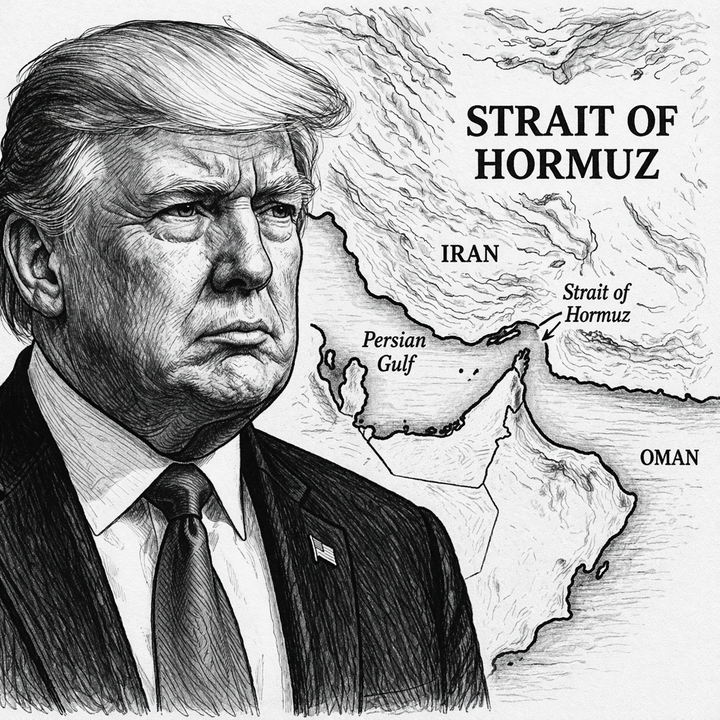
"Iran's New Regime President, much less Radicalized and far more intelligent than his predecessors, has just asked the United States of America for a CEASEFIRE! We will consider when Hormuz Strait is open, free, and clear. Until then, we are blasting Iran into oblivion or, as they say, back to the Stone Ages!!!" — President Donald J. Trump, Truth Social, April 1, 2026
What This Signals
On a single extraordinary Wednesday, three events collided that would normally each dominate a news cycle on their own: a US President addressed the nation about a war he is simultaneously winning and struggling to end; Iran's President wrote a public letter to the American people asking whether their country has become a proxy for Israel; and for the first time in 54 years, human beings left Earth's orbit and pointed themselves at the Moon. April 1, 2026 is the kind of day that historians annotate in bold.
Trump's Truth Social post — claiming Iran had "asked for a ceasefire" — is simultaneously a victory lap, a negotiating position, and a reframing of a murky diplomatic reality. Iran denies making any formal ceasefire request. What actually happened is that President Pezeshkian told a European official on Tuesday that Iran had "the necessary will" to end the war with conditions. Trump translated this into a dramatic announcement hours before his primetime speech. The gap between those two statements is where wars continue to be fought.
The real signal: both sides want an exit. Neither wants to be seen as the one who blinked. The Strait of Hormuz — still largely closed, still the hinge of the global economy — remains the test that will determine whether this is a real ceasefire or just another deadline extension. The next two weeks will define whether April 1, 2026 was the day the war began to end, or just another day of the world holding its breath.
Story #1: Trump Addresses the Nation on "Operation Epic Fury" — Victory Lap Meets Unresolved Reality
The Full Picture
Speaking from the White House Cross Hall in his first primetime address since the war began, President Trump delivered a nearly 20-minute speech that was equal parts victory lap, warning, and plea for patience.
Trump opened by congratulating NASA on the Artemis II launch — a moment he used to frame the evening's broader theme of American greatness. He then declared that Operation Epic Fury was "nearing completion," boasting that "never in the history of warfare has an enemy suffered such clear and devastating large-scale losses in a matter of weeks."
He catalogued the war's achievements: Iran's navy "annihilated," its ballistic missile program "obliterated," its terrorist proxy networks severed, and its nuclear ambitions set back for years. "We are in this military operation, so powerful, so brilliant, against one of the most powerful countries for 32 days, and the country has been eviscerated," he said.
He argued the original nuclear sites struck last June had been rebuilt at a new location — justifying the current campaign.
Yet Trump simultaneously vowed the US would hit Iran "extremely hard over the next two to three weeks" before concluding operations. On the Strait of Hormuz — still largely closed — he asserted: "when this conflict is over, the strait will open up naturally, it'll just open up naturally."
To address soaring gas prices, Trump compared the 32-day war favorably to World War I, World War II, Korea, Vietnam and Iraq — all of which lasted years. He also referenced Iran's ceasefire request and announced "discussions are ongoing."
The speech added little new operational clarity. Oil prices jumped almost 4% as markets read the address as a signal that the war would not end quickly.
He further declared that Operation Epic Fury — the US-Israeli military campaign against Iran — was "meeting or exceeding all benchmarks" and would conclude within two to three weeks, framing the war as a decisive strategic success.
The address came after the White House announced hours earlier that Iran's president had "requested a ceasefire" — a claim Tehran's Foreign Ministry flatly denied as "false and baseless."
The day became a theatre of competing narratives: Trump touting victory; Iran launching its largest missile salvo on Israel since the war's first days; and Chinese and Pakistani mediators tabling a joint peace proposal.
The White House outlined Operation Epic Fury's stated objectives from day one: obliterate Iran's ballistic missile arsenal and production capability; annihilate its navy; sever its support for terrorist proxies; and ensure Iran never acquires a nuclear weapon. CENTCOM reported over 11,000 targets struck, more than 155 Iranian vessels damaged or destroyed, and 13,000 combat sorties flown.
But the credibility problem persists. Trump told Reuters the same day that he "doesn't care" about Iran's enriched uranium stockpiles buried deep underground — arguably the original casus belli for preventing Iran from ever obtaining a nuclear weapon. On the Hormuz front, he said: "The Strait of Hormuz will automatically reopen after US exit." Analysts immediately questioned how leaving a theatre without securing its primary objective constitutes success.
Chinese analysts, cited by the South China Morning Post, noted that Trump is likely reframing the war's objectives to justify a swift exit: originally nuclear disarmament and regime change, now repositioned as "degrading Iran's conventional military to the point where it cannot threaten US interests for years." This narrower target can plausibly be declared achieved — and it provides Trump with the off-ramp he needs before April 6, when the next energy infrastructure strike deadline expires.
The war continues: On the same evening, Iran fired what Israel's military described as "the most significant missile strike since the war's first days" — 10 ballistic missiles targeting central Israel. The UAE's air defenses intercepted five ballistic missiles and 35 drones. Kuwait's international airport was struck by a drone strike. A Qatar Energy tanker was hit by missiles. More than 6,000 US sailors are sailing toward the region aboard the USS George H.W. Bush carrier strike group.
🇮🇳 How This Impacts India
Trump's address is the clearest signal yet that the US is preparing an exit from Operation Epic Fury within weeks — possibly before Hormuz is fully reopened. For India, this is both an opportunity and a danger. The opportunity: India's back-channel diplomacy with both Washington and Tehran becomes more valuable than ever in a ceasefire mediation context — India is uniquely positioned to play honest broker. The danger: a US military exit without a structured Hormuz resolution would leave a vacuum that Iran could exploit to permanently institutionalize its "toll booth" regime. India must use the next two weeks to push aggressively for a Hormuz settlement that includes guaranteed passage for "friendly nations" — of which India is one — without the IRGC compliance burden that exposes Indian companies to secondary sanctions.
📎 References: CBS News | Stars and Stripes | CNBC Live | SCMP | Axios
Story #2: Iran's President Writes to the American People — "Is This Truly America First?"
The Full Picture
In an extraordinary act of asymmetric public diplomacy timed to land hours before Trump's primetime address, Iranian President Masoud Pezeshkian published an open letter directly to the American people — bypassing government-to-government channels and appealing over the heads of the Trump administration.
In an open letter posted in English on his own X account and shared by state broadcaster PressTV, Pezeshkian urged Americans to look beyond "a flood of distortions and manufactured narratives" and ask a simple question: "Exactly which of the American people's interests are truly being served by this war?"
To the people of the United States of America pic.twitter.com/3uAL4FZgY7
— Masoud Pezeshkian (@drpezeshkian) April 1, 2026
"Is 'America First' truly among the priorities of the US government today?" Pezeshkian asked. He argued that Iran had twice been attacked while its negotiators were engaged in nuclear talks — once in June 2025 and again on February 28, 2026 — and that destroying pharmaceutical factories, cancer treatment centres, and industrial infrastructure constitutes war crimes that "carry consequences that extend far beyond Iran's borders."
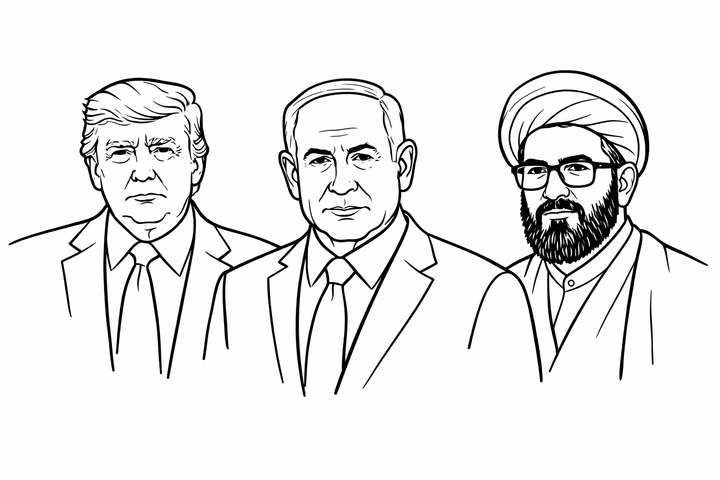
Pezeshkian's most pointed line was a direct challenge to Trump's stated rationale: "Is it not evident that Israel now aims to fight Iran to the last American soldier and the last American taxpayer dollar — shifting the burden of its delusions onto Iran, the region, and the United States itself in pursuit of illegitimate interests?" He explicitly accused Washington of acting "as a proxy for Israel, influenced and manipulated by that regime."
The letter is strategically sophisticated. It is addressed not to Trump — who has shown he cannot be persuaded — but to the American public, 64% of whom, according to recent polls, oppose the Iran military operation. It invokes "America First" — Trump's own brand language — to argue that the war contradicts it. It frames Iran as a victim of Israeli manipulation of American power. It simultaneously signals a willingness to negotiate ("Iran possesses the necessary will to end this conflict, provided essential conditions are met") while issuing a warning that Iran endures and its enemies do not.
US gas prices crossed $4 per gallon on national average for the first time since 2022 on the same day, providing visible domestic evidence that "America First" may not be well-served by the war.
🇮🇳 How This Impacts India
Pezeshkian's letter matters to India on multiple levels. First, the "America as proxy for Israel" framing — however contested — resonates deeply across the Global South and particularly in countries like India that have large Muslim populations and historic relationships with both Iran and Arab states. New Delhi must navigate this carefully: publicly siding with either framing risks damaging strategic relationships.
Third, Pezeshkian's reference to the war as generating "resentment that will endure for years" is a warning India should take seriously: the post-war Middle East will be shaped by this bitterness, affecting Indian workers, traders, and investors in the region for a generation.
📎 References: Al Jazeera | Military.com | CNN Live | CBS News Live
Story #3: "Spying on America's Nuclear Triad" — Intelligence Gaps at the Worst Possible Time
The Full Picture
As the US fights its most demanding conventional air campaign since Gulf War II, a disturbing counterintelligence story has emerged from the background: America's nuclear triad — the ICBMs, submarine-launched ballistic missiles, and strategic bombers that underpin its nuclear deterrence — may have been penetrated by foreign intelligence.
Reporting by DNYUZ and The New York Times revealed that US counterintelligence officials have been investigating whether foreign agents have gained access to sensitive information about America's nuclear command and control infrastructure, specifically targeting all three legs of the nuclear triad. The investigation is described as among the most serious counterintelligence probes in recent years, with particular concern about foreign nationals — believed to include personnel linked to China and Russia — who had access to classified programs.
The timing is acutely sensitive. The United States is currently operating at maximum conventional military tempo in the Middle East, with carrier strike groups, bomber sorties, and special operations forces deployed at scale. A degraded or compromised understanding of US nuclear command procedures, launch authority chains, or strategic submarine positioning at this moment creates windows of vulnerability that adversaries could potentially exploit.
The investigation is described as ongoing and partial details have been withheld for national security reasons. But the pattern is consistent with what intelligence analysts have described as a systematic "long game" by both China and Russia to map American strategic capabilities during periods of conventional conflict when attention and resources are diverted.
The story also connects to a separate SCMP investigation showing Chinese civilian engineers were publishing viral social media tutorials on how to defeat the F-35 — content subtitled in Persian and directly relevant to Iran's air defense challenge. The F-35 tutorial posted on March 14 went viral with tens of millions of views; five days later, Iran claimed it had struck a US F-35 and forced an emergency landing. This is not state-sponsored espionage in the traditional sense — it is distributed, civilian, open-source technical intelligence that is harder to counter because it operates in the grey zone between public knowledge and operational military advantage.
🇮🇳 How This Impacts India
India operates several platforms that interface with US military systems and intelligence architectures, including the P-8I maritime patrol aircraft, C-17 Globemaster transports, and Apache helicopters. India is also a signatory of key military information-sharing agreements with the US including BECA (Basic Exchange and Cooperation Agreement) and LEMOA (Logistics Exchange Memorandum of Agreement). Any compromise of US strategic intelligence infrastructure could have second-order effects on the quality and security of intelligence India receives under these agreements. India's own intelligence community — RAW and the Defense Intelligence Agency — should treat this as a signal to audit the security of their own joint information-sharing protocols with Washington. The Chinese civilian "volunteer intelligence" phenomenon on social media is also directly relevant to India: Chinese netizens have published similar technical content about Indian military platforms, which India's military and cybersecurity agencies must monitor.
📎 References: DNYUZ/NYT | SCMP — Chinese F-35 Tutorial
Story #4: Artemis II Lifts Off — Humanity Returns to the Moon for the First Time Since 1972
The Full Picture
On the same evening that Trump addressed the nation about a Middle East war, four human beings left Earth's orbit and pointed themselves at the Moon — the first time any person has done so in 54 years.
NASA's Artemis II mission launched from Kennedy Space Center at 6:35 PM ET on April 1, 2026, carrying Commander Reid Wiseman, Pilot Victor Glover, Mission Specialist Christina Koch, and Canadian Space Agency Mission Specialist Jeremy Hansen on a 10-day journey around the Moon and back to Earth.
The mission is not a lunar landing — it is a critical test flight for NASA's Orion spacecraft and Space Launch System (SLS) rocket, both of which are being validated for deep space operations for the first time with humans aboard. The crew will spend their first 24 hours in Earth orbit, then fire the trans-lunar injection (TLI) burn to leave Earth's gravity and coast toward the Moon over four days. They will execute a free-return trajectory around the far side of the Moon — getting a closer view of the lunar surface than any humans have seen since Gene Cernan in 1972 — before heading back to Earth for splashdown in the Pacific on April 10.
The mission will set multiple records: it will send humans farther from Earth than ever before — approximately 252,799 miles, eclipsing Apollo 13's record by over 4,000 miles. Victor Glover will become the first person of color to travel beyond low Earth orbit. Christina Koch will be the first woman to do so. Jeremy Hansen will be the first non-US citizen.
In a bittersweet twist, the launch occurred on the same day Iran threatened to strike Apple, Google, Microsoft and Nvidia. Humanity's capacity for both its highest aspirations and its most destructive impulses was on full, simultaneous display on April 1, 2026.
🇮🇳 How This Impacts India
Artemis II has direct and significant implications for India's space programe. India's ISRO has been in discussions with NASA about potential collaboration on the Artemis program, and India's Gaganyaan human spaceflight program — currently targeting its first crewed mission — will eventually need to demonstrate interoperability with international space platforms. A successful Artemis II validates the technology architecture that future international lunar missions, including potential Indian participation in the Gateway lunar space station, will build upon. More broadly, Artemis II demonstrates that the space economy — currently estimated at $400+ billion and growing at 8% annually — is entering a fundamentally new phase of human deep-space activity. India's decision in early 2026 to cancel participation in Lunar Gateway should be revisited in light of this new strategic reality.
📎 References: NASA Official Blog | CNN Artemis | NBC News | Wikipedia — Artemis II
Story #5: Trump Overhauls Steel and Aluminum Tariffs — A New Trade Architecture Takes Shape
The Full Picture
Amid the noise of the Iran war, a consequential restructuring of US trade policy is quietly being rolled out: the Trump administration is preparing to overhaul its broad steel and aluminum tariff regime, replacing uniform rates with a tiered system that distinguishes between commodity inputs and finished products.
The US will maintain 50% tariffs on a large number of derivative products in which the duty will be calculated by the value of the actual imported good, according to multiple people familiar with the matter who spoke on condition of anonymity. Many other products will be tariffed at a lower 25% rate, while some products will fall below that duty level.
The shift is broadly supportive for US domestic steel and aluminum producers but negative for importers and manufacturers reliant on foreign inputs. By raising effective costs on finished goods, the move could add to inflationary pressure at the margin and complicate global supply chains, particularly for autos, machinery and construction-linked sectors.
The overhaul comes as US personal bankruptcy rates hit multi-year highs — with 41.7% of filers citing tariffs as a contributing factor — and as the Iran war adds a second major inflationary shock to the US economy through surging energy prices. Critics argue the tiered tariff system, while intellectually more coherent than flat rates, risks compounding cost pressures on American manufacturers who are already absorbing record fuel costs and supply chain disruptions.
The announcement also comes after the Supreme Court struck down Trump's broader IEEPA tariff authority in February 2026, forcing the administration to rely on Section 232 national security justifications for its remaining tariff arsenal. The tiered steel and aluminum system is one of the first major post-court-ruling trade policy moves.
🇮🇳 How This Impacts India
India is one of the top exporters of steel and aluminum products to the United States, with exports worth over $3 billion annually in metal categories. The tiered system is a mixed signal for Indian exporters: commodity-grade steel and aluminum will face punishing 50% duties, which could effectively shut Indian producers out of the US market in raw metal categories. However, for more sophisticated finished and semi-finished products — where Indian manufacturers have been moving up the value chain — the 25% tier may be more manageable. India's Ministry of Commerce should urgently conduct product-by-product analysis of which Indian exports fall into which tier, and negotiate exemptions or carve-outs through the US-India trade framework. The more important medium-term opportunity: as US tariffs push manufacturing costs higher domestically, India's "China +1" positioning becomes more attractive for labour-intensive metal fabrication and downstream manufacturing.
📎 References: Bloomberg | InvestingLive
Story #6: Iran's Pezeshkian Asks: "Has America Become Israel's Proxy?" — The War of Narratives Intensifies
The Full Picture
Iran's simultaneous diplomatic and military offensive on April 1 reveals a sophisticated strategic doctrine: fight with missiles and drones while simultaneously appealing to global public opinion — and specifically to the American public — to delegitimize the war before Trump's primetime address.
Pezeshkian's letter, as covered in Stories 2 and 6 together, represents Iran's most direct effort to separate the US public from its government's war policy. But the letter also raised a deeper geopolitical question that will outlast the immediate conflict: to what extent has the United States gone to war primarily to serve Israeli strategic interests, rather than its own?
This is not merely Iranian propaganda — it is a question being asked by a growing number of American foreign policy analysts, NATO allies, and even some members of the US Congress. The war began on February 28 in a joint US-Israeli operation. Israel lobbied intensely for US involvement. Israel has consistently rejected any ceasefire terms that don't include the permanent elimination of Iran's military capacity. Gulf states are now reportedly pressuring Trump to continue — even as Trump himself signals he wants to exit.
The diplomatic battlefield: China and Pakistan submitted a joint peace initiative on Tuesday. The UK's Keir Starmer announced 35 nations have signed a statement on restoring Hormuz maritime security. Pakistan is hosting Turkish, Egyptian, and Saudi foreign ministers for talks. India, conspicuously, has not been publicly prominent in the mediation architecture — despite being the country arguably most economically impacted by the war.
🇮🇳 How This Impacts India
The "proxy war" framing, however contested, has real consequences for how the post-war Middle East will perceive India's relationships. India has close defense ties with Israel (including the Barak-8 missile system, Heron drones, and Spyder air defense). India also has deep historical, economic, and civilisational ties with Iran, including the Chabahar port agreement and energy imports. If the war is ultimately framed globally as a US-Israeli war on Iran, India's association with both parties will need to be managed carefully. India should be more visibly present in the ceasefire mediation architecture — alongside China, Pakistan, Turkey, and the Gulf states — both to protect its economic interests and to demonstrate the kind of "strategic autonomy" it has long claimed as a foreign policy principle.
📎 References: Al Jazeera — Pezeshkian Letter | Times of India | CBS News
Story #7: Poland Refuses to Lend Patriot Systems — NATO's Eastern Flank Stands Firm, Alliance Fractures Deepen
The Full Picture
Poland delivered one of the clearest European refusals of the Iran war this week, rejecting a US request to lend two of its Patriot air defense missile batteries — along with PAC-3 MSE missiles — for use in protecting US bases in the Middle East.
Polish Defense Minister Wladyslaw Kosiniak-Kamysz wrote on X: "Our Patriot batteries and their armament are used to protect Polish airspace and NATO's eastern flank. Nothing is changing in this regard, and we are not planning to relocate them anywhere. Our allies fully understand how important our mission here is. Poland's security is an absolute priority."
The Polish newspaper Rzeczpospolita had first reported the US request. Seven US service members have been killed and nearly 350 wounded in Iranian strikes since the conflict began. Iranian missiles and drones have damaged or destroyed several expensive US radars and the E-3 Sentry AWACS at Prince Sultan Air Base in Saudi Arabia.
Poland's refusal carries particular weight for several reasons. Poland is one of NATO's most Atlanticist members — fiercely pro-US in the context of Russia's war on Ukraine, having spent more than 4% of GDP on defense. If even Poland is saying no, the depth of European resistance to this war's demands is profound. Poland's position is also strategically logical: with Russia conducting an emboldened spring offensive in Ukraine, relocating air defence assets from NATO's eastern flank to the Gulf would be reckless from a European security standpoint.
Trump, in his pre-speech remarks on April 1, explicitly said he would raise NATO allies' failures at the prime-time address, and reportedly threatened to "review everything related to NATO, including support for European efforts in Ukraine" — a statement that could dramatically shift the calculus for Poland's own security.
🇮🇳 How This Impacts India
Poland's refusal and the broader NATO fragmentation over the Iran war has direct implications for India's own defence relationships. India is in discussions to acquire several NATO-standard platforms, including Patriot-equivalent air defence capabilities. The demonstrated political fragility of NATO's collective response to a major US military campaign raises questions about whether NATO-standard systems come with the alliance support infrastructure that makes them worth their premium price. India's decades-long strategic choice to diversify its defence suppliers — maintaining Russian, Israeli, French, and US systems — has been validated by this crisis. The India-Russia S-400 transaction, controversial with Washington, now looks far more prudent as a hedge against the kind of conditions the US can impose on its allies during its own military campaigns.
📎 References: RT News | War Zone
Story #8: Minerals for Aid — US Offers Africa Health Funding in Exchange for Critical Resources
The Full Picture
A disturbing new pattern of US bilateral diplomacy toward Africa has been exposed this week: Washington is reportedly conditioning health aid on access to African nations' minerals, health data, and critical resources — a transactional approach that critics are calling "biomedical imperialism."
In late 2025, the US approached Zimbabwe, promising more than $300 million in funding in exchange for sensitive health data — negotiations that Harare described as "lopsided" and pulled out of. About the same time, the US publicly announced $1 billion in funding for Zambia pending talks. But Lusaka, too, called out "problematic" clauses in the US proposal that sought access to the country's critical minerals — copper, cobalt, and lithium — in exchange for health aid. A US diplomatic memo described Washington's strategy as willing to "publicly take support away from Zambia on a massive scale" if it didn't sign.
Zambia relies on PEPFAR (the US flagship HIV program) for more than 80% of its HIV funding, which provides free treatment for 1.3 million people, roughly 6% of the population. Losing this funding could be catastrophic for millions of vulnerable people.
Since President Trump's administration cut global health aid and dismantled USAID in January 2025, Boston University's Impact counter revealed the aid shocks have led to 518,428 child and 263,915 adult deaths from manageable diseases like HIV and tuberculosis. Close to 10 million new cases of malaria were also reported.
The deals being proposed include demands for: government-to-government mineral access agreements; 10-year one-way health data sharing; and co-financing arrangements where African nations must take on 30–40% of their own health spending. Countries like Nigeria and Kenya have reportedly signed versions of these agreements, though the exact terms remain secret.
🇮🇳 How This Impacts India
India is both a major exporter to Africa — with deep trade, cultural, and diplomatic ties across the continent — and a nation with its own critical mineral assets that Washington has been eyeing. The US approach of linking health and humanitarian assistance to mineral access is a precedent India must watch carefully. India has signed several agreements with the US on critical minerals, including through the Minerals Security Partnership (MSP). India must ensure that these bilateral frameworks do not evolve into similar conditionality arrangements that compromise India's sovereign resource control. More positively: as African nations push back against US conditionality, India's offer of "South-South" partnerships — pharmaceutical exports, technical assistance, and trade without political strings — becomes more competitive and diplomatically valuable. India's pharmaceutical sector, which supplies 25% of the world's generic medicines, has a significant opportunity to position itself as a more equitable healthcare partner to Africa than Washington is currently demonstrating.
📎 References: Al Jazeera
Story #9: Chinese Engineers Help Iran Fight the F-35 — The "Volunteer Intelligence" Phenomenon
The Full Picture
A striking and largely unreported dimension of the US-Iran war is emerging from Chinese social media: technically skilled Chinese civilians are voluntarily posting detailed military tutorials on how to defeat US weapons systems — subtitled in Persian, directed at Iran — without any state direction or payment.
On March 14, a detailed tutorial on targeting and destroying America's F-35 stealth fighter appeared on Chinese social media posted by the account "Laohu Talks World" and subtitled in Persian. The video meticulously explained how Iran could use its low-cost systems to target and destroy the advanced stealth fighter. It drew tens of millions of views. Five days after the post, on March 19, Iran claimed it had struck a US F-35 and forced it to make an emergency landing.
Across Chinese social media, many people with backgrounds in STEM have created and shared content aimed at helping Iran's war effort. Some appear to possess expert knowledge of military equipment. This is not state-sponsored espionage — it is a grassroots, distributed, open-source military advisory that operates in the grey zone between public speech and operational intelligence.
The phenomenon reveals something profound about the nature of modern conflict: in an age of global social media and open-source technical knowledge, military advantage is no longer the exclusive preserve of state actors. Chinese public opinion — shaped by decades of anti-American education and genuine sympathy for Iran as a fellow target of US "hegemony" — is generating a form of distributed auxiliary military support that no sanctions or diplomatic protest can easily shut down.
This is a preview of what future conflicts will look like: not just states fighting states, but populations of technically educated civilians around the world voluntarily contributing expertise to the side they sympathize with.
🇮🇳 How This Impacts India
This story is directly relevant to India's military security in multiple dimensions. First, Indian platforms — including the Tejas fighter, DRDO's air defense systems, and Indian Navy vessels — are studied by Chinese civilian analysts with as much or more scrutiny than the F-35. Indian military planners must assume that technical vulnerabilities in Indian systems have been documented, shared, and potentially provided to adversaries. Second, the "volunteer intelligence" model is one that could be employed against India during a future conflict — particularly given the active communities of Chinese and Pakistani social media users who already analyse Indian military news obsessively. Third, India's own STEM talent pool is one of the world's largest. India should think about whether there are constructive, legal, and strategically sound ways to harness its civilian technical community for national security purposes — including open-source intelligence gathering, adversary capability monitoring, and defensive cyber research.
📎 References: South China Morning Post
Story #10: US Begins Secret Talks for New Military Bases in Greenland — The Arctic Opens as a New Front
The Full Picture
While the world watches the Middle East, a quieter but potentially transformative strategic repositioning is occurring in the Arctic. The Pentagon has entered talks with Denmark to gain access to three additional military bases in Greenland — a move that would represent the first major US military expansion on the island in decades.
The New York Times first reported that the Pentagon is negotiating access to facilities at Narsarsuaq and Kangerlussuaq in western Greenland — areas where the US previously maintained Cold War-era bases — plus a third unspecified site. General Gregory Guillot, head of the US Northern Command, was cited as wanting to expand access "due to the growing strategic importance of the Arctic."
The proposed facilities would include an airbase, a deep-water port, and a logistics hub. The US already has broad legal powers under the 1951 Defense of Greenland agreement and can, technically, expand its presence without a new agreement — though doing so without Danish consent would cause a severe diplomatic crisis.
The context is critical: this is not unconnected to Trump's earlier threats to annex Greenland, which he described as "imperative for national and world security." Having pulled back from overt annexation after the Greenland Crisis of January 2026, Washington appears to be pursuing a more pragmatic military-access strategy. The Iran war — which has consumed US attention and exposed the limits of US alliance management — makes the Arctic strategy even more important: as the Strait of Hormuz shows the vulnerability of relying on others for chokepoint security, the Arctic's new shipping lanes and resource access represent the next theatre of US strategic competition with Russia and China.
Several Greenlanders said publicly they opposed the idea. Denmark has deployed troops to Greenland in recent months and is insisting on its sovereignty over the island's future.
🇮🇳 How This Impacts India
The Arctic is increasingly relevant to India's strategic calculus. India holds Observer status in the Arctic Council and has an Arctic Policy published in 2022 that identifies the region as a priority for scientific research, energy resources, and shipping routes. The opening of Arctic shipping lanes could dramatically shorten trade routes between India and Europe — potentially reducing voyage times by 10-15 days compared to the Suez Canal route. As the Iran war demonstrates the fragility of Gulf-based energy and shipping, Arctic routes gain strategic importance as alternatives. India should actively engage in Arctic governance discussions, expand its presence at the Svalbard research station, and open a diplomatic back-channel with Greenland's autonomous government — which is increasingly seeking international partnerships beyond the Denmark-US axis.
📎 References: The Telegraph / NYT via RealClearDefense | Newsmax | New York Times
🧭 The Dispatch: Editor's Synthesis
April 2, 2026 will be remembered as the day the world experienced whiplash at a planetary scale. Four humans pointed themselves at the Moon. A US president claimed victory in a war that was simultaneously launching its most intense strike wave. Iran's elected president addressed the American people directly in English. A NATO member told Washington it could not have its air defense missiles. Chinese civilians wrote viral tutorials on shooting down US fighter jets. And somewhere in the background, America's nuclear triad may have been compromised by foreign intelligence.
For India, the synthesis is this: the architecture of the world order — the alliances, the trade rules, the energy systems, the security arrangements — is being rewritten in real time, without India at the table where the key decisions are being made. India's greatest strategic risk in 2026 is not any single threat from any single direction. It is the risk of being a high-impact bystander to a world that is transforming around it. The next two weeks are a window. India needs to act.
Comments ()