
The Daily Geopolitics Brief # 9
Iran hit Oracle. Trump bombed a bridge. Hegseth fired the Army chief. Macron was mocked. And the real war? It's being fought in a Chinese refinery over the tungsten inside every US missile. Day 33. The Dispatch breaks it down
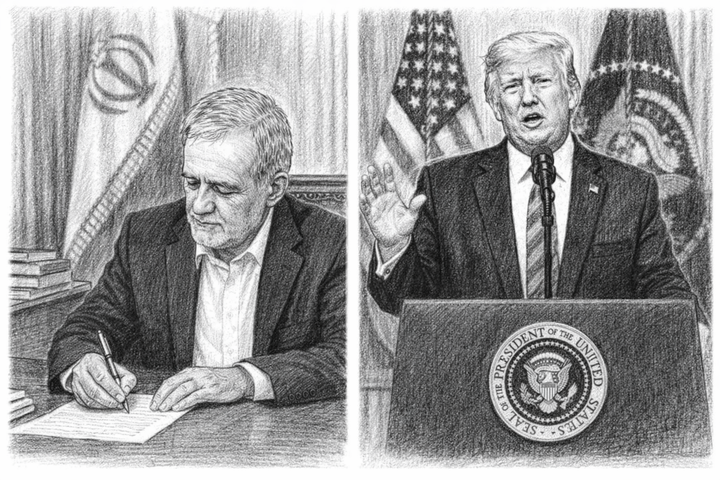
"Stone Age? At a time when you were still in caves searching for fire, we were inscribing human rights on the Cyrus Cylinder. We endured the storm of Alexander and the Mongol invasions and remained; because Iran is not just a country, it is a civilization." — Iran Embassy South Africa (@IraninSA), April 2, 2026 — 1.9 million views
🔍 What This Signals — And Why It Is Deeply Complicated
This post, which went viral with 1.9 million views, is one of the most rhetorically effective responses to emerge from the war. It stops Trump's "Stone Age" taunt dead in its tracks with a civilizational counter-punch: the Cyrus Cylinder, inscribed circa 539 BCE, is widely regarded as one of humanity's earliest declarations of human rights. Persia was educating the world while Rome was still a hilltop village. The tweet lands.
Zoroastrianism — Iran's ancient, original belief system, a religion of fire, truth, and cosmic dualism that predates Abrahamic faiths — was the spiritual foundation of the Achaemenid civilization that produced Cyrus. That civilization was not conquered by America. It was conquered by Islam, arriving via Arab armies in the 7th century CE, an invasion that effectively ended the Zoroastrian world. The Islamic Republic of Iran today — an explicitly theocratic state governed by Shia jurisprudence, where apostasy is punishable by death and Zoroastrian minorities face persistent discrimination — is the inheritor of that conquest, not of Cyrus. When the IRGC and its embassies invoke the Cyrus Cylinder, they are wrapping themselves in the heritage of a civilization their own ideological ancestors helped destroy.
And yet — the counter-counter-irony must also be named: the United States, whose president is threatening to return Iran to the "Stone Age," was itself built through the systematic destruction of the Native American civilizational complex — hundreds of distinct nations, languages, cosmologies, and agricultural traditions, many far older than the United States itself, dismantled by conquest, forced removal, and cultural erasure. The descendants of those civilizations remain, by many metrics, the most marginalized people in America today.
The Cyrus Cylinder tweet is brilliant propaganda. It is also, structurally, a lie. And Trump's "Stone Age" threat is militaristic barbarism. It is also, historically, what American power has often done.
Story #1: Iran Strikes Oracle, Amazon and US Bases — The War Goes Digital
The Full Picture
Iran's Islamic Revolutionary Guard Corps dramatically escalated its digital warfare campaign on April 2, following through on its April 1 deadline by striking Oracle's data center in Dubai and Amazon's cloud computing center in Bahrain — as well as targeting US fighter jets at Jordan's Al Azraq airbase and a US diplomatic facility near Baghdad Airport.
According to the Jerusalem Post, the IRGC attacked Oracle's Dubai data center on Thursday, with Iranian state media confirming the strike. Earlier the same day, the IRGC attacked Amazon's Bahrain cloud computing center "in retaliation for attacks on Iran," as reported by the Iranian Students' News Agency. Bahrain's Interior Ministry confirmed civil defense teams were extinguishing a fire at a company facility following what authorities described as an Iranian attack.
Separately, Iranian drones targeted US fighter jets at Jordan's Al Azraq airbase — a major US logistics hub for the region. A drone also crashed inside Iraq's Trebil border crossing with Jordan, damaging customs clearance offices. Two drones targeted a US diplomatic facility near Baghdad Airport. Iran's Fars News Agency listed several bridges across Kuwait, Saudi Arabia, Abu Dhabi, and Jordan as potential military targets.
This is a genuine doctrinal shift in how Iran is fighting: from purely military targets to corporate and digital infrastructure. The IRGC's April 1 threat named 18 US companies including Apple, Google, Microsoft, Meta, Nvidia, Oracle, Tesla, HP, Intel, IBM, Cisco, Palantir, JPMorgan, and the UAE's G42 as "legitimate targets." The strikes on Amazon and Oracle are the first concrete follow-through. AWS had already suffered disruptions earlier in the war. The targeting of JP Morgan and other financial institutions could, if executed, constitute a form of economic warfare without precedent.
🇮🇳 How This Impacts India
India's largest technology services companies — TCS, Infosys, Wipro, HCL, and Tech Mahindra — operate extensive delivery networks supporting Oracle, Amazon, Microsoft, and Google operations globally. If IRGC strikes cause sustained disruptions to these cloud platforms, India's IT sector — which generates over $250 billion in annual exports — faces cascading client-side disruptions. Indian companies are deeply embedded in Gulf technology infrastructure: data centers, enterprise platforms, and managed services. The IRGC's explicit inclusion of companies like Oracle (with which India has major government contracts, including for cloud infrastructure) and Palantir (whose AI capabilities have implications for Indian defense procurement discussions) means Indian government IT procurement decisions may now need to account for conflict-zone exposure risk.
📎 References: Jerusalem Post | CNBC Iran War Live | Iran International Live
Story #2: US Bombs Iran's Biggest Bridge — "Stone Age" Threat Becomes Reality
The Full Picture
Hours after Trump told the nation the US would bring Iran "back to the Stone Ages," the US military did something it had not done in the 33 days of war: it struck major civilian infrastructure.
The B1 bridge in Karaj — described as one of the tallest bridges in the Middle East, connecting the city to Tehran — was struck twice in the early hours of April 2. Trump posted a video of the explosion on Truth Social, writing: "The biggest bridge in Iran comes tumbling down, never to be used again — Much more to follow! IT IS TIME FOR IRAN TO MAKE A DEAL BEFORE IT IS TOO LATE."
A US defense official said the bridge was struck because it was "a planned military supply route for sustaining Iran's ballistic missile and attack drone force." Iranian state media reported eight people killed and 95 wounded.
Iran's Foreign Minister Araghchi responded: "Striking civilian structures, including unfinished bridges, will not compel Iranians to surrender. It only conveys the defeat and moral collapse of an enemy in disarray. Every bridge and building will be built back stronger. What will never recover: damage to America's standing."
More bridges are reportedly being targeted, with the Pentagon identifying a list of road and infrastructure links across Iran that it intends to strike as part of the "final weeks" campaign. This marks a decisive shift from strictly military targets toward dual-use civilian infrastructure — a move that legal experts say raises serious international humanitarian law concerns. Over 100 international law scholars published a letter on April 2 condemning the war as "a clear violation of the United Nations Charter."
Iran hit back the same day: US crude oil recorded its biggest single-day gain since 2020 — jumping more than 11% — following Trump's bridge announcement and renewed escalation threats.
🇮🇳 How This Impacts India
The escalation to civilian infrastructure — bridges, potentially power plants, oil fields, desalination plants — transforms this from a military campaign into an economic war against the Iranian people. Each step in this direction risks triggering responses that further tighten the Hormuz closure or provoke retaliatory strikes on Gulf infrastructure. For India, oil at $103–105/barrel following a single day's escalation news is not sustainable. India's oil import bill was running at roughly $145 billion annually before the war; at current prices, that figure could exceed $200 billion on an annualized basis. India's excise duty cuts on petrol and diesel are providing partial relief but are rapidly depleting fiscal space. India must urgently activate its diplomatic bandwidth — particularly its unique position as a country on Iran's "friendly nations" list — to push for a ceasefire before civilian infrastructure becomes the primary target.
📎 References: Axios | The Hill | Al Jazeera
Story #3: Trump Bombs Bridges, Macron Fights Back — NATO at Its Most Fractured Since Suez
The Full Picture
The transatlantic relationship hit its lowest point in decades this week, as Trump mocked French President Emmanuel Macron's marriage at a private White House lunch, threatened to pull the US out of NATO, called the alliance a "paper tiger," and demanded European nations send warships to the Gulf or stop complaining about fuel prices.
During a private lunch Wednesday, Trump ridiculed Macron by referencing a May 2025 viral video of Brigitte Macron appearing to shove her husband's face. "I call up France, Macron — whose wife treats him extremely badly — still recovering from the right to the jaw," Trump said, before mimicking a French accent to mock Macron's refusal to deploy warships.
The remarks were briefly posted to the White House YouTube channel before being made private.
Macron, on a state visit to South Korea, responded with measured fury: "The words that I was able to hear are neither elegant nor of a high standard. I am not going to answer it — it doesn't deserve an answer." He added: "If you create daily doubt about your commitment, you hollow it out. You have to be serious. When you want to be serious, you don't say the opposite every day of what you said the day before."
Very importantly, even Macron's fiercest political opponents in France united to condemn Trump's comments as grotesque given the gravity of the moment.
The deeper context: Secretary of State Rubio said the US would "reassess" its relationship with NATO after the war. Trump said "NATO won't be there if we ever have the big one."
Eureka Group analysts note this is the most serious challenge to transatlantic solidarity since the 1956 Suez Crisis — when the US forced Britain and France to abandon a military campaign against Egypt, fracturing Western unity. This time, the direction of pressure is reversed: it is Washington demanding European compliance in a war most European capitals consider illegal.
🇮🇳 How This Impacts India
The NATO fracturing is strategically significant for India in two ways.
- First, a weakened transatlantic alliance increases the relative weight of non-Western powers — including India — in global security and economic governance. India's "strategic autonomy" posture becomes more sustainable, not less, in a world where the West is no longer reliably united.
- Second, the personal degradation of European relationships by Trump creates space for India to strengthen its own ties with France, Germany, Spain, and the EU — without being seen as anti-American. India's purchase of 26 Marine Rafale-M aircraft from France and ongoing discussions on the Rafale Mark 2 jet engine program with SAFRAN are examples of relationships that can deepen.
Macron's state visit to South Korea — not the US — signals where European leaders are increasingly looking to build partnerships.
📎 References: Euronews | The Daily Beast | France 24
Story #4: India Plans ₹2–2.5 Lakh Crore Credit Guarantee Scheme — The Government Acts on the War's Economic Fallout
The Full Picture
As the Iran war squeezes Indian exporters, logistics companies, and MSMEs, the Indian government is planning a major new credit guarantee intervention worth ₹2 to ₹2.5 lakh crore (approximately $24–30 billion) to cushion businesses from the West Asia conflict's cascading economic impact, according to the Economic Times.
The scheme builds on existing frameworks including the Mutual Credit Guarantee Scheme for MSMEs (MCGS-MSME) and the RELIEF (Resilience & Logistics Intervention for Export Facilitation) scheme — a ₹497 crore package launched in March to help exporters grappling with extraordinary freight escalation, heightened insurance premiums, and war-related export risks. The government has also launched a ₹20,000 crore Credit Guarantee Scheme for Exporters and modified the MCGS-MSME to reduce machinery cost requirements, extend loan tenures, and include service sector MSMEs in eligibility.
The proposed ₹2–2.5 lakh crore credit guarantee scheme would be a step-change in scale — roughly equivalent to India's entire defense capital expenditure budget for three years. The scheme would cover banks and financial institutions extending credit to businesses facing cash flow stress, export disruption, and input cost inflation driven by the war. India's MSME sector, which employs approximately 110 million people and accounts for 30% of GDP and 45% of total manufacturing output, is particularly exposed to the war's dual impacts of higher input costs (especially fuel, fertilizers, and petrochemicals) and disrupted export channels.
🇮🇳 How This Impacts India
This is the most direct and significant domestic policy response India has mounted to the Iran war's economic fallout. The scheme is a recognition that the war's impact is not temporary or peripheral — it is structural and is compressing the balance sheets of Indian businesses in real time. Several design elements deserve attention. The credit guarantee approach is superior to direct subsidies because it leverages banking system capacity without creating fiscal moral hazard. However, the quantum of ₹2–2.5 lakh crore requires careful calibration — if businesses use the guarantee headroom for working capital rollovers rather than genuine expansion, it could inflate non-performing assets when the war ends and normalcy returns. India's banks, still carrying legacy NPA burdens, need guardrails. The government should pair this scheme with accelerated demand-side measures: route diversification support for exporters, strategic fertilizer stockpiling, and a dedicated West Asia business continuity task force.
📎 References: Economic Times | Business Standard — RELIEF Scheme
Story #5: Iran-Oman Joint Hormuz Protocol — The Post-War Order Takes Shape Without the US
The Full Picture
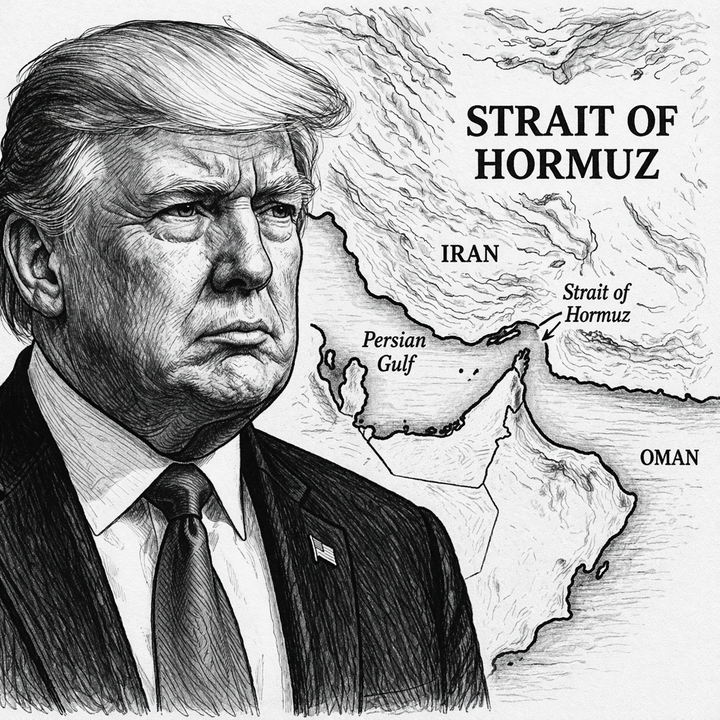
In a development that moved global oil markets and briefly pushed US stocks into positive territory on Thursday, Iran announced it is drafting a formal protocol with Oman to jointly oversee and "monitor" vessel transit through the Strait of Hormuz — effectively moving to institutionalize Iran's control over the world's most critical energy chokepoint as a permanent post-war reality.
Iran's Deputy Foreign Minister Kazem Gharibabadi confirmed the protocol, saying tanker traffic through Hormuz "should be supervised and coordinated" between Iran and Oman, the two coastal states. "Of course, these requirements will not mean restrictions, but rather to facilitate and ensure safe passage and provide better services to ships," he said, while simultaneously confirming that Iran would set tolls for passage. An RT exclusive interview with a senior Iranian security official earlier this week had already made the strategic objective explicit: "The conditions in the Strait of Hormuz will not return to the pre-war status quo."
The Oman angle is significant. Oman has historically served as a diplomatic back-channel between Iran and the West, including during the JCPOA nuclear deal negotiations. Oman is geographically positioned on the other side of the strait from Iran — its cooperation is essential for any viable transit protocol. The Eurasia Group's Iran analyst said that if Iran manages to take permanent control of the Strait of Hormuz, it would be "a colossal win" and "massive strategic win" for Tehran, potentially making Iran more powerful post-war than pre-war.
Iran's parliament also passed a law formalizing the toll regime, with estimates suggesting $100 billion annually in potential revenue once traffic is fully restored — equivalent to Iran's current total oil export earnings.
🇮🇳 How This Impacts India
The Iran-Oman Hormuz protocol is the most consequential single development for India's long-term energy security architecture. India is on Iran's "friendly nations" list — meaning Indian-flagged or Indian-cargo vessels may theoretically transit under the new protocol. But this comes with catches: payment to the IRGC-controlled toll system could trigger US secondary sanctions on Indian companies. Coordination requirements with Tehran mean India's commercial shipping relationships are now partially determined by Iranian state approval. This is a form of energy geopolitical leverage India has not faced since the 1970s oil shock. On the other hand, India's existing Chabahar port deal and its long-standing ties with Tehran give New Delhi unique leverage to negotiate preferential terms — lower tolls, faster approvals, guaranteed LNG access — that other importing nations cannot access. This is a moment for Indian energy diplomacy to be activated, not observed.
📎 References: CNBC | Tasnim News | RT | MS NOW
Story #6: Hegseth Fires the US Army Chief of Staff — Mid-War Military Purge Shocks Washington
The Full Picture
In an act without clear modern precedent, Defense Secretary Pete Hegseth fired US Army Chief of Staff General Randy George on April 2 — asking him to "step down and retire immediately" — along with two other senior Army generals, while thousands of Army paratroopers from the 82nd Airborne Division were actively deploying to the Middle East for combat operations.
Hegseth confirmed the firing through a Pentagon statement: "General Randy A. George will be retiring from his position as the 41st Chief of Staff of the Army effective immediately. The Department of War is grateful for General George's decades of service to our nation." Also fired: General David Hodne, commanding general of the Army's Transformation and Training Command, and Major General William Green, head of the Army Chaplain Corps. Three generals removed in a single day during an active war.
Sources told CBS News that Hegseth wants someone who will "implement President Trump and Hegseth's vision for the Army." George's proximity to former Defence Secretary Lloyd Austin — he served as Austin's senior military assistant before becoming Army chief — had made him a target for months. His replacement as acting Army chief will be General Christopher LaNeve, a former 82nd Airborne commander who previously served as Hegseth's own military aide. The 82nd Airborne — whose elements are currently deploying to the Gulf — was thus previously commanded by the man who will now lead the entire US Army.
As Democrat Rep. Pat Ryan noted: "Hegseth and Trump firing the highest ranking Army officer, in the middle of a war they started, shows you exactly where their priorities are."
The entire Joint Chiefs has been effectively remade.
🇮🇳 How This Impacts India
India's defense relationship with the US Army has been growing significantly — the US-India LEMOA logistics agreement, joint exercises including Yudh Abhyas, and planned co-production agreements depend on institutional continuity in the US Army leadership. When the US Army Chief of Staff changes mid-war, program timelines, co-production negotiations, and exercise calendars all face disruption risk. More fundamentally, the systematic removal of experienced senior military leadership from the US armed forces during an active, complex war raises a question India's defense planners must take seriously: is the US military, as an institution, being weakened precisely when it is being most relied upon? India's defense diversification strategy — maintaining Russian, French, Israeli, and domestic platforms — has never looked more strategically sound.
📎 References: CBS News | Breaking Defense | Reuters | NPR
Story #7: Trump Vows to Keep Bombing — But Is Running Out of Targets
The Full Picture
Behind the triumphalist rhetoric of Trump's prime-time address, a more troubling reality is emerging from military and intelligence sources: the US is running low on high-value military targets inside Iran, has not resolved its core strategic objectives, and is now resorting to infrastructure strikes that raise serious legal and moral questions.
Politico and TIME reported this week that the US military has now struck more than 12,300 targets in Iran. US and Israeli bombs have damaged or destroyed Iran's navy, significant parts of its ballistic missile capability, and much of its military leadership. Yet — crucially — Iran can still fire missiles and drones at Gulf neighbors, Israel, and US bases on a near-daily basis. Roughly 50% of Iran's missile launchers remain intact, and thousands of one-way attack drones remain in its arsenal, according to intelligence assessments cited by Iran International.
The nuclear objective — preventing Iran from building a bomb — is the murkiest of all. Trump admitted in an interview that he "doesn't care" about Iran's enriched uranium stockpiles buried underground. Seizing them would require a ground operation. The US has neither announced one nor credibly prepared for one. "He has killed Iran's top echelons of leaders and blown up a lot of structures, but the basic elements of the regime remain," wrote Slate's Fred Kaplan. Trump is now faced with a choice of three terrible options: escalate with ground troops (deeply unpopular, potentially disastrous), shift to civilian infrastructure (legally fraught, potentially a war crime), or declare victory and exit with the original objectives unmet.
The bridge bombing is the first visible sign that Trump has chosen option two — civilian infrastructure — as the escalation path before exit.
🇮🇳 How This Impacts India
Every day that the US extends the war, the economic cost to India compounds. US crude oil's biggest single-day gain since 2020 came on April 2 — the day Trump announced the bridge bombing and renewed escalation. For India, which imports approximately 4.5 million barrels per day, each $10 rise in oil prices adds approximately $16–17 billion to the annual import bill. The war is now in its fifth week. Oil is at $103–105/barrel. If the escalation cycle — bridge bombing, Iranian retaliation, further US strikes, rising oil — continues for Trump's stated "two to three more weeks," India is looking at sustained $100+ oil through late April at minimum. India's Finance Ministry must begin modelling scenarios for oil at $120 and $130 — and have fiscal response plans ready.
📎 References: Politico | TIME Magazine | Slate
Story #8: The USS Gerald R. Ford — America's Most Advanced Carrier Is Out for a Year
The Full Picture
The USS Gerald R. Ford — the most advanced aircraft carrier in the United States Navy, and the only vessel of its class, costing $13.2 billion to build — is expected to be out of commission for 12 to 14 months following a devastating "laundry fire" that forced it to leave the Middle East theatre in mid-March after a deployment exceeding 260 days.
The ship is currently docked at Split, Croatia, for assessment and repairs. The fire, which began in the ship's main laundry spaces on March 12 as the vessel transited the Red Sea, reportedly burned for approximately 30 hours — longer than the infamous 1967 USS Forrestal carrier fire. More than 600 of the nearly 4,500 sailors aboard lost their bunks, with crew members forced to sleep on tables and floors. Crew laundry was reportedly airlifted to other ships for washing. Iran's military claimed the fire was set deliberately by war-weary crew members — a claim the US denied.
The RT investigation revealed that the Pentagon's own testing office had flagged serious reliability issues with the Ford class even nine years after commissioning — including concerns about radar, jet aircraft launch and recovery systems, lifting mechanisms for aircraft and munitions, and overall ability to sustain operations in combat conditions. The ship was also reportedly 159 bunks short of properly accommodating its crew before the fire.
The Ford's absence from the theatre comes precisely as the US is deploying the USS George H.W. Bush carrier strike group — another carrier — to the region, signalling that the Navy is pushing its remaining assets hard to cover the gap.
🇮🇳 How This Impacts India
The Ford's year-long absence from active service has two implications for India.
- First, it reduces US carrier capacity in the Indian Ocean Region — the body of water India considers its strategic backyard and where US freedom of navigation operations are a key element of the regional balance of power vis-à-vis China. A US Navy stretched thin by the Iran war will have less capacity to maintain presence in the Indo-Pacific. India's own aircraft carrier program — INS Vikrant now operational, INS Vishal on the drawing board — becomes more urgently necessary to fill the regional power-projection gap.
- Second, the Ford's mechanical woes are a cautionary tale for India's own naval procurement: complex, technology-intensive platforms come with reliability risks that are only revealed in sustained operational deployment. India's preference for robust, battle-tested platforms over cutting-edge but untested systems has strategic merit.
📎 References: RT | The War Zone
Story #9: Iran's Drone Strikes on Gulf Infrastructure Escalate Further
The Full Picture
Iran's drone and missile campaign against Gulf infrastructure continued to intensify through April 2, with new strikes targeting oil and energy facilities across the region. The UAE's Ministry of Defense reported its air defenses have now intercepted a cumulative total of 438 ballistic missiles, 19 cruise missiles, and 2,012 drones since the war began — figures that, taken together, reveal the extraordinary scale of Iran's air campaign against the Gulf states.
Saudi Arabia intercept and destroyed drones targeting its Eastern Province. Bahrain reported fires at commercial facilities from Iranian projectiles. Kuwait's international airport was struck by a drone strike, sparking a fire. QatarEnergy's tanker — the Aqua 1 — was struck by missiles off the Qatari coast; no crew injuries were reported, though one projectile remained unexploded in the ship's engine room.
The cumulative effect of 33 days of Iranian strikes on Gulf infrastructure — energy facilities, refineries, airports, ports, and data centers — is beginning to have structural economic consequences beyond oil prices. Gulf aviation is severely disrupted, regional shipping insurance premiums have reached historic highs, and several Gulf economies are running emergency protocols to keep essential services functioning under sustained attack.
Iran's Fars News Agency additionally circulated a list of bridges in Kuwait, Saudi Arabia, Abu Dhabi, and Jordan as potential future military targets — signalling that Iran intends to mirror the US bridge-bombing strategy against Gulf infrastructure supporting American military operations.
🇮🇳 How This Impacts India
The Gulf is India's economic lifeline — 9 million Indian workers, $80+ billion in annual remittances, and the foundation of India's energy import architecture. Sustained Iranian strikes on Gulf airports, ports, and oil infrastructure create cascading risks for each. Disrupted airports affect Indian workers' ability to return home, travel for work, or access emergency consular services. Damaged port infrastructure affects the movement of Indian exports. Strikes on refinery facilities affect the supply of petroleum products that India imports from Gulf refiners (not just crude oil). India's MEA missions across the Gulf must be on emergency footing — and India needs to quietly invest in evacuation logistics, including pre-positioning of Indian Navy and Coast Guard assets in the Arabian Sea, that could support a rapid civilian evacuation if conditions deteriorate further.
📎 References: Express.co.uk | CBS News Live | Iran International
Story #10 The War America Is Losing in a Chinese Refinery — Tungsten, Rare Earths, and the Real Strategic Trap
The Full Picture
Foreign Policy's investigation this week surfaces the most structurally significant dimension of the Iran war that almost no one is discussing in prime time: the missiles, bombs, and guidance systems the US has been firing into Iran for 33 days are consuming materials that China almost entirely controls — and cannot be quickly replenished.
The story begins with tungsten. The silvery-grey metal, known for having the highest melting point of any pure element, is essential for armor-piercing munitions, rocket nozzles, and high-heat military applications — exactly the categories of weaponry being expended in sustained strikes on Iran. Tungsten prices have surged more than 500% since the war began. The United States does not mine tungsten at commercial scale. China controls the vast majority of global tungsten production, processing, and trade. "We're getting a very clear picture that there's just simply not enough tungsten in the supply chain now, and nobody really knows how this shortfall will be made up in the near future," said Pini Althaus of Cove Capital, a US mining investment firm backed by the government to develop tungsten capacity in Kazakhstan.
But tungsten is only the beginning. Rare earth elements underpin the guidance systems of every Tomahawk missile fired, every F-35 deployed, every Predator drone in the sky, every Aegis missile defense system protecting US ships and Gulf bases. China controls over 90% of global refined rare earth output and nearly 90% of permanent magnet production. If Beijing chose to stop the flow, the US defense industry faces a crisis within months — not years.
The strategic bind that Foreign Policy identifies is this: every day Trump continues bombing Iran, the US burns through munitions built with Chinese-sourced materials, tightening its dependence on Beijing precisely as it needs room to maneuver in trade negotiations. China has already imposed severe rare earth export controls — beginning December 2025, companies with any affiliation to foreign militaries were largely denied export licenses. The Trump administration secured a temporary reprieve through May 2025 talks in Switzerland, but that arrangement has been fragile. "If anything, the continued US actions in the Iran war play further into Beijing's leverage over the US," analysts warned FP. The SCMP reported that China's rare earth supplies may literally dictate how long US strikes on Iran continue — with Beijing comfortable in a holding pattern as America burns its "silver bullets."
The processing gap is the most devastating element. Even where the US can mine rare earth ores domestically — in Nevada, Idaho, and California — it lacks the industrial capacity to convert those ores into defense-grade metals and alloys. Metallization and alloying — the chemical process of turning rare earth oxides into high-performance magnets and components — is the real chokehold. CSIS identifies this as "the most difficult capability to rebuild outside China." It requires years of operational history to reach the tolerances demanded by military-grade magnets. The US can dig the rock, but cannot yet make it into the part that guides the missile.
🇮🇳 How This Impacts India
This story is perhaps the most important geopolitical opportunity hiding in plain sight for India. Here is why:
India is one of the world's largest holders of rare earth reserves — estimated at approximately 6.9 million tons, the fifth-largest in the world, with significant deposits of monazite (rich in thorium and rare earths) in states like Kerala, Odisha, Andhra Pradesh, and Tamil Nadu. India also holds the world's fifth-largest tungsten reserves. India has the technical infrastructure — through IREL (India Rare Earths Limited) and the Department of Atomic Energy — to process rare earths, though at nowhere near the scale currently needed.
As the US scrambles to build non-Chinese rare earth and tungsten supply chains, India is positioned to become a critical alternative supplier — if it moves decisively. The US has already approached India under the Minerals Security Partnership (MSP); the India-US Critical Minerals Task Force has been active; and Trump's proposed global minerals trading bloc of 50+ allies is a framework India could leverage aggressively.
The strategic logic for India is clear: rare earth and tungsten exports to the US defense industrial base, processed through Indian facilities (rather than shipped to China for processing), would simultaneously reduce US dependence on China, increase India's geopolitical leverage with Washington, generate high-value manufacturing jobs, and position India as an indispensable partner in the reordering of the global defense supply chain. India's government should treat the rare earth processing sector with the same urgency it is now applying to semiconductor fabrication. The window created by the Iran war — and by the US military's sudden, painful awareness of its mineral vulnerability — will not remain open indefinitely.
📎 References: Foreign Policy | OilPrice.com | American Prospect | Phoenix Refining/Critical Minerals | CSIS | SCMP
🧭 The Dispatch: Editor's Synthesis
The Iranian Embassy's tweet about the Cyrus Cylinder is the image that will define this moment in cultural memory. But the deeper truth it surfaces is this: we are watching two states — each with deeply compromised civilizational claims — destroy the physical world while arguing about who represents history better. Trump's America bombs bridges; the Islamic Republic invokes a civilization whose religion it replaced. Both are, in their own ways, performing legitimacy they have not entirely earned.
For India — a civilization with genuine, unbroken continuity from Harappa to Hindustan — the lesson is to watch with clear eyes, engage with steady purpose, and act in its own interest while neither side is paying full attention. The next two to three weeks will be pivotal. The April 6 deadline for energy infrastructure strikes, the Iran-Oman Hormuz protocol, the ceasefire negotiations via Pakistan, and the US domestic pressure from rising gas prices and falling poll numbers are all converging simultaneously.
India's window to shape the outcome is narrow. It must use it.
Comments ()