
The Dragon’s Gambit: Turning America's Iran War Into China's Strategic Asset
Xi Jinping enters the May summit having brokered a ceasefire Trump credited publicly, weaponized Taiwan's opposition for diplomatic cover, and — per US intelligence — quietly arming Iran through cutout channels. This is not three stories. It is one architecture.
initiative and thus commands the action. To attack makes men brave; to defend makes them timorous.” ― Steven Pressfield, The Virtues of War
A disciple once asked his master:
“Master, when two tigers fight in the valley, who wins?”
The master smiled. “Neither. The mountain wins.”
The disciple frowned. “But surely one tiger must fall?”
The master picked up a bowl of water and stirred it gently.
“When the tigers fight, the valley trembles. The rivers shift. The forest changes. The one who watches… and reshapes the valley… wins.”
The disciple was silent.
The master continued:
“Wise power does not rush into battle. It waits. It lets others exhaust themselves. And then—without striking—it changes the ground beneath their feet.”
Far away, two tigers roared. And on the mountain, the wind did not move.
The Taiwan Game
On April 10, 2026, Chinese President Xi Jinping received Taiwan’s opposition leader Cheng Li-wun in the East Hall of the Great Hall of the People — a venue normally reserved for foreign heads of state.
Who is Cheng Li-Wun?
Well, Cheng Li-wun is a 56-year-old Taiwanese politician and lawyer who became Kuomintang (KMT) chair in November 2025. Her biography is one of the more remarkable political transformations in modern Taiwanese history.
KMT is the largest opposition party in Taiwan's Legislative Yuan, often described as part of the Pan-Blue Coalition.
The Kuomintang (KMT) traces its origins to 1894, when Sun Yat-sen founded the Revive China Society in Honolulu, then part of the Republic of Hawaii.
In 1919, he reorganized the movement in Shanghai’s French Concession under the name Kuomintang.
Under Chiang Kai-shek, the KMT launched the Northern Expedition (1926–1928), defeating regional warlords and bringing much of China under a unified government, ending the Beiyang regime. Initially allied with the Chinese Communist Party during the First United Front, Chiang later purged communist elements, triggering a prolonged civil conflict. From 1928 to 1949, the KMT ruled China but faced mounting challenges, including the Second Sino-Japanese War and the ongoing civil war with the CCP.
In December 1949, following defeat, the KMT government retreated to Taiwan, where it continued its political existence.
After completing her law degree, Cheng entered politics with the Democratic Progressive Party (DPP), representing Taipei in the National Assembly from 1996 to 2000 and later taking an active role in its youth wing.
She began as a Taiwanese independence advocate and student activist, representing Taipei in the National Assembly as a DPP member from 1996 to 2000. She described both the KMT and the CCP as “tyranny.”
In 2002, a dispute with party leadership over how it handled sexual harassment allegations involving Twu Shiing-jer led to her suspension, after which she resigned from the DPP.
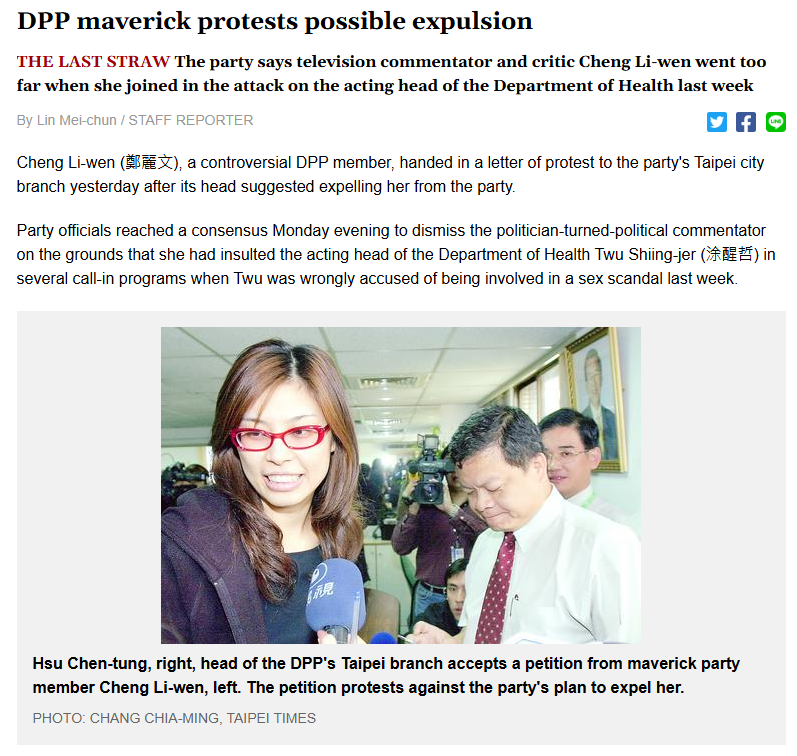
She is now the KMT chair.
Cheng's meeting with Xi in Beijing's Great Hall has long-term consequences for Taiwan.
Cheng publicly opposed “foreign meddling” in cross-strait relations, echoed Xi’s talking points about shared bloodlines, and praised China’s development record while offering no public criticism of Beijing’s military drills around Taiwan.
This obviously did not go well with the main ruling party members back home. They saw it as a surrender.
Chinese Nationalist Party (KMT) Chairwoman Cheng Li-wun’s (鄭麗文) remarks during her meeting with President Xi Jinping (習近平) were shameful and a chilling “letter of surrender,” Democratic Progressive Party (DPP) Legislator Fan Yun (范雲) said on social media today. Both sides of the Strait should plan and build institutionalized and sustainable mechanisms for dialogue and cooperation based on the “1992 consensus” to make peaceful development across the Strait irreversible, Cheng said in Beijing today. Fan asked if the “institution” Cheng was referring to was “one country, two systems,” as the Chinese Communist Party (CCP) views the “1992 consensus” as “one country, two systems.” (Source: "Cheng’s remarks to Xi a ‘shameful surrender’: DPP lawmaker" / Taipei Times)
Let us understand how KMT approaches and influences politics within Taiwan.
KMT-controlled legislature has stalled Taiwan’s $40 billion special defense budget for asymmetric capabilities. The same party whose chairwoman is shaking Xi’s hand today is the party blocking the weapons purchases Washington needs Taiwan to make to sustain the First Island Chain deterrence strategy that underpins US containment of China.
But this must be understood properly. Over the years, there has been a genuine constituency within Taiwan that aligns with the 1992 Consensus framework, cross-strait economic integration, and dialogue-over-deterrence narrative.
The KMT governed Taiwan for decades and built real cross-strait economic architecture.
So, their resistance to the $40 billion defense package is not simply Beijing's hand reaching into Taipei's legislature. It reflects a real ideological disagreement about how Taiwan survives.
The problem is that "internally coherent" and "strategically disastrous" are not mutually exclusive.
The KMT's logic works in a world where Beijing is a rational actor whose threat calibration responds to diplomatic signals.
The evidence from the last decade — military drills escalating regardless of cross-strait political temperature, the Hong Kong crackdown proceeding regardless of "one country two systems" commitments, the Cheng Li-wun meeting being used immediately as summit propaganda — suggests Beijing does not, in fact, reduce military pressure in response to Taiwanese political gestures.
It uses the gesture and maintains the pressure. That is why it's easy to see that the KMT's strategic premise is empirically weak.
There is psychological warfare, alright. But what about the domestic realities?
What the American media (NYT / Bloomberg) identifies as Beijing "spinning" the situation may actually be something more structural.
Is it really a spin if it is partially true?
The fact that a majority of Taiwanese voters, in polling, favor maintaining the status quo over formal independence.
Indeed, a majority of Taiwanese (60%) say Taiwan should maintain the status quo either permanently (34%) or for the time being while deciding on independence or unification based on future circumstances (26%). Twenty-seven percent prefer independence, either as soon as possible (5%) or in the future while maintaining the status quo for now (22%). Finally, 7 percent of Taiwanese prefer to seek unification, either as soon as possible (1%) or in the future while maintaining the status quo for now (6%). (Source: Americans and Taiwanese Favor the Status Quo / Global Affairs)
Also Lai Ching-te's cross-strait approval ratings have collapsed (SCMP), that the $40 billion defense package has genuine domestic critics.
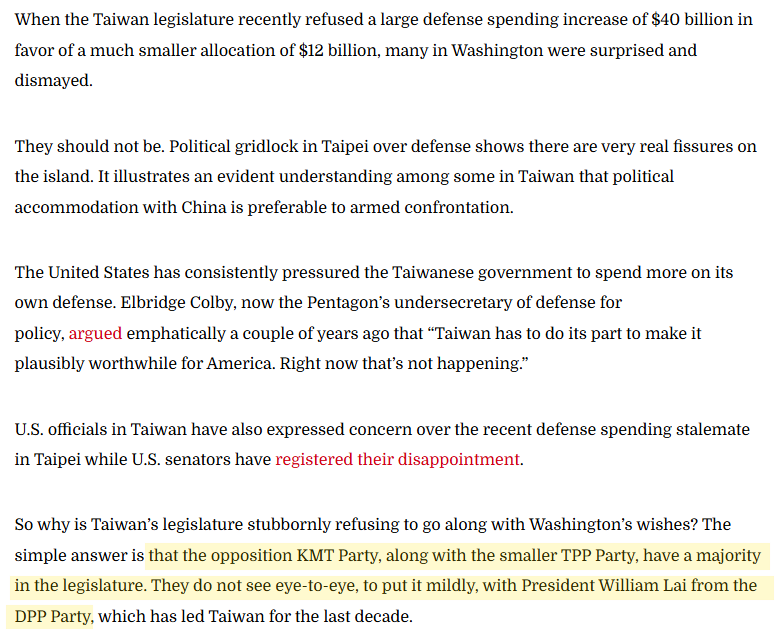
You see, these are real political facts that Beijing is not fabricating.
It is quite possible that Beijing is pushing them behind the scenes, and also selecting and amplifying them. This is what makes the psychological warfare effective.
Dialog over Deterrence: Does it Work?
Given the history of China and Taiwan, it has a factual foundation. Propaganda built on lies is fragile. Propaganda built on real domestic divisions is durable.
What is important to discuss is how the KMT approaches engagement and posturing compared to Beijing, and how the DPP approaches them.
The KMT's "risk reduction through engagement" logic contains an implicit assumption that warrants explicit naming: Taiwan's deterrence posture is the primary driver of Chinese military pressure.
This is the KMT's foundational premise. If Taiwan arms less, China threatens less. If Taiwan arms more, China has a justification to escalate.
If one looks carefully, this was the exact same logic used in European appeasement in the 1930s, and it has the same structural flaw.
It places the moral and causal responsibility for the aggressor's behavior on the potential victim's defensive choices.
The fact that China has been escalating military pressure during periods of both KMT and DPP governance — and that the escalation has tracked Chinese domestic political consolidation under Xi more closely than it has tracked Taiwanese political signals — is the empirical refutation of the KMT premise.
The deeper problem is this: by opposing investment in asymmetric warfare now, the KMT is not reducing the probability of war. It is shifting the cost distribution of the war that may happen anyway, from Beijing, which would face higher casualties attacking a porcupine, toward Taiwan's civilian population, which would bear the consequences of a faster-falling defense.
"Dialog over deterrence" sounds like peace. What it actually does, in a world where the aggressor's behavior is not responsive to the victim's diplomatic signals, is make the victim cheaper to coerce.
Asymmetric warfare capability — the drones, the mobile missiles, the naval mines, the distributed command infrastructure — takes years to procure, deploy, train on, and integrate.
Taiwan is not in a position to delay for two years and then accelerate. The training pipelines, the institutional knowledge, the operational readiness that makes deterrence credible — these require sustained investment over time. Delay now does not mean "we'll spend more later." It means the capability that would have existed in 2028 does not exist in 2028.
This is the real strategic consequence of the KMT's legislative obstruction. Not just slower spending. A capability gap in a specific window that China's military planners can see in their own assessments, narrowing the cost of a 2028-2030 coercive move.
KMT is not a Beijing tool, but it is operating on a strategic premise — that Taiwanese deterrence posture drives Chinese threat behavior — that the evidence does not support. That premise-level error, combined with the irreversibility of capability-delay windows, renders the political motivation essentially irrelevant to the strategic outcome. Whether the KMT is acting in good faith or not, the military consequence is the same: a narrower window for coercive action that becomes cheaper for Beijing with every budget cycle that stalls.
Washington's frustration is not about Taiwan's politics. It is about the mathematics of deterrence credibility within a specific time window, and what happens when political processes eat that window from within.
What the Meeting was - and what it was not
Taiwan’s Mainland Affairs Council reacted sharply, warning that Cheng’s rhetoric in Beijing “echoes the political framework of the People’s Republic of China” and risks eroding global support for Taiwan. This is not a routine political attack from a ruling party against an opposition leader. It is a structural warning about a two-level risk.
The external narrative risk: if the leader of Taiwan’s largest opposition party stands in Beijing and calls cross-strait ties an internal Chinese affair to be resolved by “Chinese on both sides,” foreign governments find it harder to justify arms sales and diplomatic upgrades. The argument that “responsible Taiwanese forces themselves oppose foreign defense involvement” — which Beijing will advance in the May summit and beyond — now has a documented human face.
Also given how KMT has stalled defense budgets, dilute asymmetric warfare preparations, and push for “peace frameworks” that hardwire elements of Beijing’s One-China conception into Taiwan’s own statutory landscape, we can see a larger gambit being pushed by Beijing.
In that sense, the Xi-Cheng meeting is akin to a constitutional opening move.
It surely does not change Taiwan’s status overnight. It creates a recognized interlocutor who can later sign on to frameworks and institutions that move Taiwan incrementally into Beijing’s legal orbit.
The Chinese media framing is the tell: Cheng is now “a leader of responsible forces in Taiwan” in Beijing’s official language. That designation matters in the long game.
Will Taiwan Fall by Politics or War? The Hybrid Coercive Path
The question cuts to the core of long-term analysis of Taiwan.
The answer, grounded in current evidence and strategic wargaming, is neither pure politics nor pure war.
What the evidence supports is a hybrid coercive trajectory — one in which the Xi-Cheng meeting, the Trump-Xi summit, and China’s Iran positioning are all early phases.
Why Purely Political Unification Is Unlikely
Several structural factors make Hong Kong-style absorption by agreement improbable. Taiwanese identity has consolidated sharply away from “Chinese” over two decades of democratization. The Hong Kong crackdown under the National Security Law has destroyed trust in “one country, two systems” across Taiwanese society more decisively than any DPP campaign messaging could achieve.
Any KMT government that moves too quickly toward Beijing’s preferred frameworks risks electoral annihilation and internal splits.
And Japan, the United States, and allied partners see Taiwan as a geopolitical hinge point whose status affects the entire Indo-Pacific architecture — they will quietly support deterrence and resilience even if a “peace process” is nominally underway.
Political instruments alone will not deliver the finality Beijing requires for its stated objectives.
Why Full-Scale Invasion Is a Last Resort
Recent wargaming and think-tank analysis, including US war games and Taiwanese defense planning, converges on a stark assessment of a full cross-strait invasion.
An amphibious assault would likely yield enormous PLA casualties, major platform losses, and a high probability of stalemate or failure if Taiwan fully implements its “hellscape” asymmetric defense concept: mass drones, naval mines, mobile missile launchers dispersed across the island, and anti-ship capabilities that turn every Taiwan Strait crossing into a killing ground for surface vessels.
 Daisy Johnston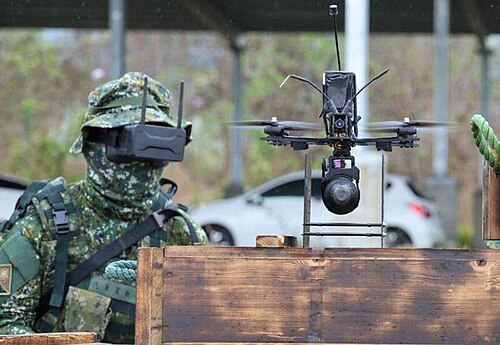
The economic fallout — Western sanctions, disrupted shipping lanes, capital flight from China — could push the Chinese economy into a systemic crisis, threatening the CCP's domestic legitimacy at precisely the moment when Xi would need national unity.
This is why US and Taiwanese planners emphasize converting Taiwan into a porcupine state. And this is why the KMT’s role in slowing these investments is so consequential to Beijing’s calculus.
The Likely Sequence: The Hybrid Campaign
A more realistic trajectory over the next decade is a sequenced hybrid campaign that moves through six phases, with war as the backstop rather than the opening move.
- Political Pre-Conditioning. Deepen KMT–CCP ties through revived forums, think-tank dialogues, and party-to-party exchange mechanisms frozen since 2016. The Xi–Cheng meeting is Phase 1 of this. Use it to prepare the ground for peace frameworks, crisis hotlines, and joint committees that implicitly accept One-China conceptual language.
- Deterrence Erosion. Leverage the KMT’s legislative power to slow or dilute asymmetric defense programs — the large UAV purchases, mobile missile systems, and mining capabilities that underpin the hellscape strategy. Encourage domestic narratives that over-emphasize economic integration and downplay military risk, reducing public willingness to fund expensive deterrence.
- Gray-Zone and Legal Warfare. Intensify ADIZ incursions, cyber operations, lawfare through fishing bans and customs harassment — calibrated to raise pressure but stay below the threshold of outright armed conflict. Expand economic carrots for KMT-governed localities and business elites, building a pro-accommodation coalition inside Taiwan’s own political economy.
- Crisis and Limited Coercion. At a chosen political trigger — a constitutional move by the DPP, a high-profile US visit, a formal independence declaration — escalate to blockade or quarantine operations around Taiwan’s ports, or possible seizure of outlying islands like Kinmen or Matsu. The narrative: ‘targeted policing’ against separatists, not war against Taiwan as a whole.
- Settlement Under Pressure. Under blockade-induced economic pain and information warfare fatigue, Beijing and a “peace faction” inside Taiwan push for a political settlement: codified no-independence commitments, limits on US and Japanese military presence, creation of cross-strait joint authorities that effectively bind Taiwan into China’s constitutional space without formal annexation.
- War as Backstop. If Taiwan endures the pressure and external support holds, Beijing faces a choice: accept a frozen conflict or escalate toward broader kinetic operations with all their attendant domestic and international risks. War becomes a backstop, not the primary instrument.
In this architecture, the Xi-Cheng meeting is the political opening gambit that makes phases 1 through 3 more feasible.
The Trump-Xi summit is the venue where Xi seeks to blunt external support before harder moves begin.
The Iran war is simultaneously a distraction and a leverage mechanism: it ties Trump’s hands on escalation with China even as Beijing deepens its enabling role in a US-opposed theater.
And the MANPAD intelligence is the thread that connects the Iran front to the Taiwan front to the summit calculus, revealing the underlying logic of the entire architecture.
The Other Two Stories
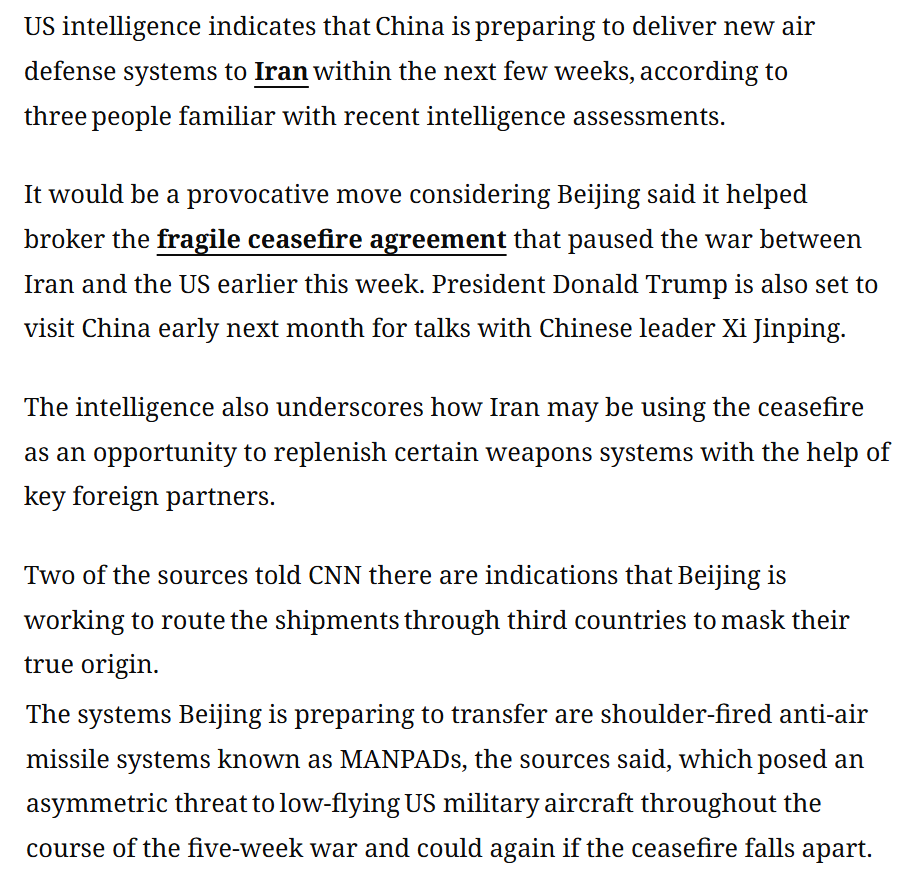
In the same week that Cheng Li-wun met Xi Jinping, US intelligence reported that Beijing was preparing to ship shoulder-fired anti-air MANPADs to Iran through third-party channels.
Also, the Trump-Xi summit, originally scheduled for March 31, has been rescheduled to May 14-15, with Beijing serenely announcing the two sides “remain in communication.”
President Donald Trump will travel to Beijing for a rescheduled summit with Chinese President Xi Jinping on May 14 and 15, the White House announced on Wednesday. Trump had been scheduled to travel to China later this month but previously announced he was delaying the trip so he could be in Washington to help steward the U.S. and Israeli war against Iran. The Republican president had announced a rescheduled trip even though the war in Iran continues and the U.S. is pressing Tehran to accept a ceasefire proposal. (Source: PBS)
One Strategy, Not Three Stories
One may want to treat these stories (Cheng-Xi meet, Chinese-Iran nexus expose, and delayed US-China meet) as three separate news cycles.
That temptation must be resisted.
What the week of April 6-12, 2026, revealed is not three stories. It is one strategy with three fronts, each module reinforcing the others with a coherence that is not accidental.
- Use the Iran war to showcase Beijing as an indispensable energy mediator while quietly enabling Iran’s military resilience through dual-use flows, sanctioned technology transfers, and — according to US intelligence — preparations to ship weapons systems through cutout countries.
- Use the Trump–Xi summit to lock in an extended economic truce, secure American concessions or deliberate ambiguity on Taiwan, and extract protection for Chinese firms doing business with Iran from post-war secondary sanctions.
- Use the Xi–Cheng meeting to deepen United Front leverage inside Taiwan’s political architecture, weaken the island’s deterrence posture from within its own legislature, and reframe the Taiwan question as an “internal constitutional dispute among Chinese” rather than a geopolitical fault line requiring external defense.
The common denominator across all three fronts is a single principle that Beijing has refined since 2022: exploit crises you did not start to gradually reshape the strategic environment without firing a shot — until the battlefield is already tilted in your favor.
The Diplomatic Pose: Peacemaker Under Fire
The Iran war began on February 28, 2026, when Israel and the United States launched coordinated strikes on Iranian military and government sites, assassinating Supreme Leader Khamenei during what Tehran believed were ongoing negotiations. China’s initial response was formulaic but calibrated: condemnation of the strikes as violations of international law, calls for ceasefire and restraint, and alignment with Russia in blocking or diluting UN Security Council resolutions that would have legitimized the US military campaign.
What changed in early April was the perception that Beijing had helped midwife the ceasefire. US and Pakistani officials briefed that China quietly leaned on Tehran through a web of intermediaries — Pakistan, Turkey, Egypt — to accept a two-week truce brokered out of Islamabad.
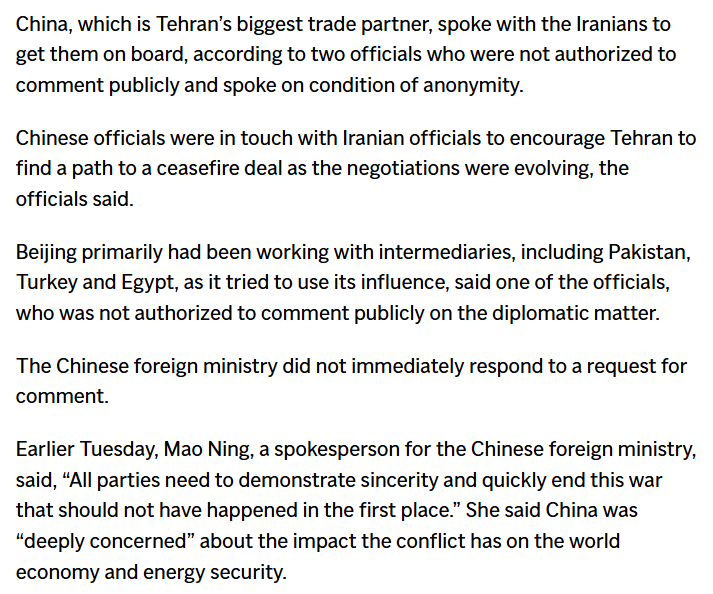
President Trump publicly said he “heard yes” when asked by AFP whether China had helped secure the ceasefire, implicitly crediting Beijing as a responsible stakeholder.
U.S. President Donald Trump told AFP on Tuesday that he believes China got Iran to negotiate a ceasefire in the war against Israel and the United States.The Chinese foreign ministry said on Wednesday that it welcomed the ceasefire, adding that China had made its own efforts towards realising lasting peace in the Middle East. "China has consistently advocated for an immediate ceasefire and cessation of hostilities, as well as the resolution of disputes through political and diplomatic channels," ministry spokesperson Mao Ning said.She did not detail what China's efforts were when asked at a regular news briefing. (Source: Trump says he believes China got Iran to negotiate, AFP reports / Reuters)
Three diplomats familiar with China’s behind-the-scenes efforts confirmed that Beijing “used its leverage to urge the Iranians back to the negotiating table.”
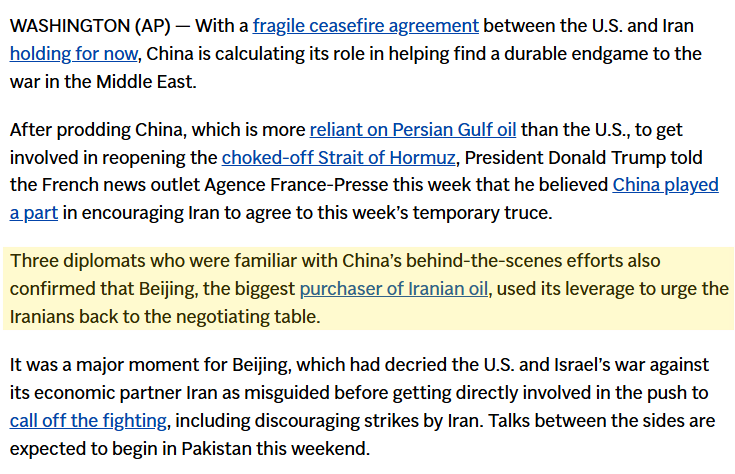
Beijing’s response to this credit was itself revealing. Chinese state media, initially eager to burnish the peacemaker image, then partly walked it back.
Some commentators have warned that Western commentary was overstating China’s decisive role.
This is a calibrated move: Beijing wants the credit without being saddled with responsibility if the truce collapses. It wants to be thanked without being accountable. It is the perfect diplomatic positioning — visible enough to matter, ambiguous enough to escape blame.
Analytically, Beijing has achieved three things simultaneously.
- It is visibly opposed to the war, helpful for its image in the Global South, and with domestic audiences wary of American military aggression.
- It is quietly indispensable — Washington cannot discuss the ceasefire without acknowledging Chinese influence on Tehran.
- And it has avoided overt military commitment while still shaping battlefield equilibria through dual-use flows, enabling technologies, and commercial relationships that preserve Iran’s capacity to absorb punishment.
The Shadow Track: Material Enabler of Iran’s Resilience
Behind the diplomatic facade, intelligence and open-source evidence point to a Chinese role in the Iran conflict that is considerably more active than Beijing acknowledges. This shadow track has multiple layers.
We have seen the reports that Beijing is preparing to transfer shoulder-fired anti-air missile systems known as MANPADs to Iran
The systems represent an asymmetric threat to low-flying US military aircraft — the same aircraft that conducted five weeks of strikes degrading Iran’s air defenses. Beijing denied the report categorically.
Trump’s public response: “If China does that, China is gonna have big problems, OK?”
The May summit remained scheduled.
We have shared in our articles about sanctioned Iranian vessels from Chinese ports carrying sodium perchlorate — a key solid rocket fuel precursor.
In early March 2026, two ships owned by an Iranian company that the US identifies as a ballistic missile program supplier departed a Chinese chemical-storage port. Chinese firms with PLA ties have been linked to geospatial intelligence support and chipmaking components — including SMIC-related exports and imagery services marketed into the region — that improve Iranian missile accuracy and reliability.
Also, Chinese-Iranian arms relationship predating the conflict: including HQ-16B surface-to-air systems, anti-ship missiles, kamikaze drones, and radar systems.
Beijing is careful not to cross the line into overt alliance. No formal basing, no publicly acknowledged arms shipments, no explicit military guarantees. But enough support that Iran’s missile and drone ecosystem can regenerate and adapt under sanctions. The line between “commercial relationship” and “enablement” is deliberately blurred because that ambiguity is itself a strategic asset.
What Does China's Support Mean?
This sequence of events reveals to every serious analytical actor what Washington’s public rhetoric systematically obscures: the US-China relationship, despite its visible tensions and high-volume rhetoric, has not reached the threshold at which economic interdependency gives way to strategic confrontation.
China calculated that it could arm Iran without fracturing the Trump-Xi summit. Based on current evidence, that calculation appears correct. And it was not a reckless bet. It was a calibrated read of the American political economy.
The US-China trade truce, with its November 2026 expiration cluster for rare-earth suspensions and tariff pauses, creates a powerful structural incentive for Washington to avoid any confrontation that could blow up the summit or trigger the Chinese reinstatement of export controls. China controls materials essential to US semiconductor manufacturing and defense supply chains. That control cannot be dissolved in months.
Trump’s transactional worldview makes him particularly susceptible to exactly this leverage structure — the threat of near-term economic costs outweighs the strategic cost of tolerating Chinese gray-zone weapons flows.
Structural Interests: Oil, Sanctions Arbitrage, and the Post-War Dividend
Why does Beijing walk this tightrope? The structural interests are substantial and interconnected.
Energy security is primary. China buys around 80-90% of Iran’s oil exports, typically at a deep sanctions discount.
A prolonged closure of the Strait of Hormuz — through which approximately 20% of global crude normally flows — would hit Chinese refiners and downstream industries already operating under pressure from slow growth and the property sector's debt overhang.
Premier Li Qiang’s 4.5-5% growth target for 2026, the lowest since 1991, reflects this pressure. China has real economic skin in ceasefire stability — which is precisely why its quiet pressure on Tehran carried weight.
 China Briefing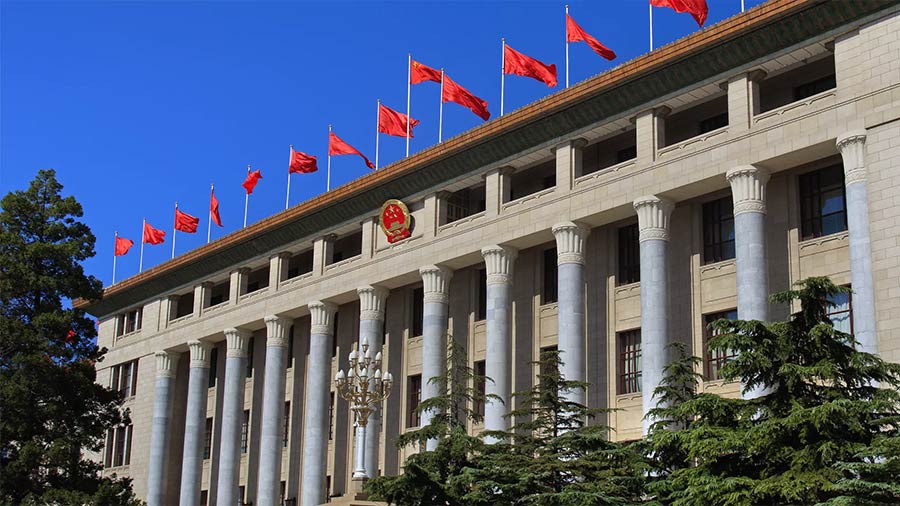
Sanctions arbitrage is secondary but strategically significant.
The war in Iran allows Beijing to expand its role as the world’s dominant sanctions arbitrageur — the same blueprint it used after Russia’s 2022 invasion of Ukraine: buy distressed hydrocarbons, pay with constrained currencies, and feed them into its own industrial base.
The Bruegel analysis argues that China is relatively insulated from an Iran war in the short term but still faces meaningful economic risks. It has buffers against energy shocks, yet prolonged disruption—especially in oil flows or the Strait of Hormuz—could hurt trade, raise costs, and weaken external demand for Chinese exports.
Guntram B. Wolff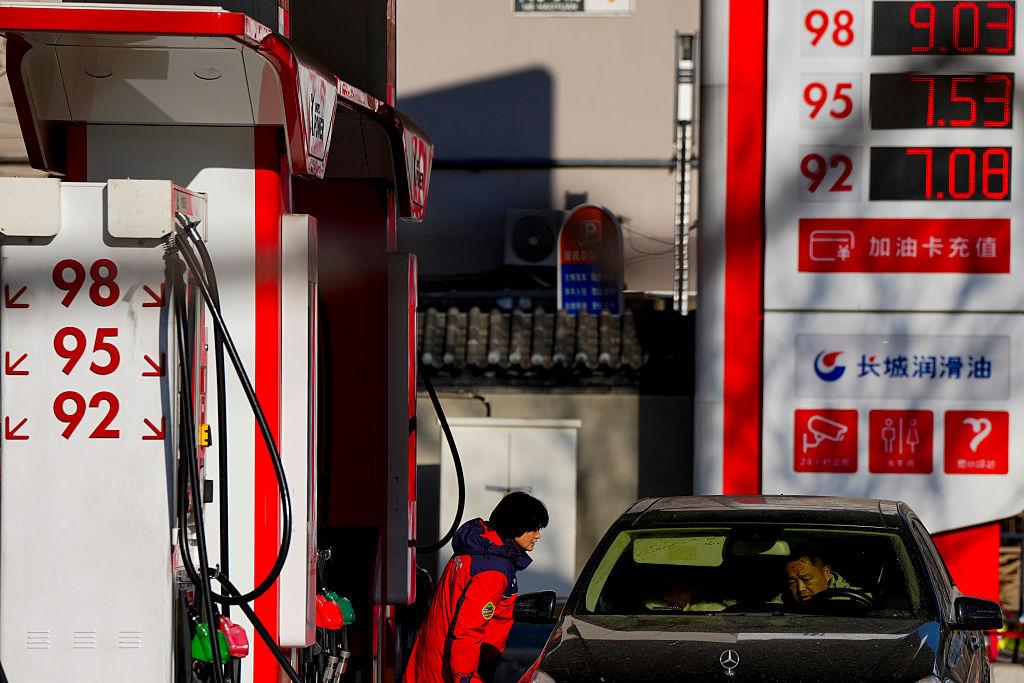
The conflict may also strain China’s global partnerships while offering limited strategic opportunities amid its rivalry with the U.S.
It acknowledges that China will become more, not less, central to Iran’s economic survival, the longer the conflict endures. Every month of continued war deepens Tehran’s structural dependency on Beijing, giving China leverage in the post-war order that it did not have before February 28.
Post-conflict reconstruction is the third and longest-horizon interest. As in Syria and Iraq, whoever finances reconstruction will enjoy decades of strategic leverage.
China is already Iran’s largest trading partner and signatory to the 25-year Comprehensive Cooperation Plan signed in 2021. It is positioned as the go-to provider of infrastructure, telecoms, and industrial plant once guns fall silent. Iranian reconstruction will likely run into the hundreds of billions of dollars. China will be at the center of it.
Finally, geopolitical signaling. By not joining Western sanctions yet not fully arming Iran, China signals a distinct posture to every capital watching: “We are neither with Washington nor in a formal axis with Tehran and Moscow. We are the third pole you must court.”
This message resonates particularly strongly in the Global South, where Beijing has been systematically building the institutional architecture — through BRICS expansion, the SCO, and bilateral cooperation agreements — for a post-Western economic order.
The Summit Context: From Busan to Beijing
The Beijing summit of May 14-15, 2026, was originally planned for March 31 but was delayed when Trump announced he needed to remain in Washington during the Iran war. The postponement itself was analytically instructive.
Beijing, which had never officially confirmed the original dates, responded with practiced calm: “The US and China remain in communication.” China showed no visible frustration.
Analysts at NBC News noted this was consistent with a Chinese reading that delay actually worked to Beijing’s advantage: more time to observe American overextension in the Middle East, more time to prepare deliverables, and more time to let Trump’s “total and complete victory” claim in Iran become a political commitment he needed to protect.
The context for May sits atop the October 2025 Busan APEC trade truce.
Spencer Kimball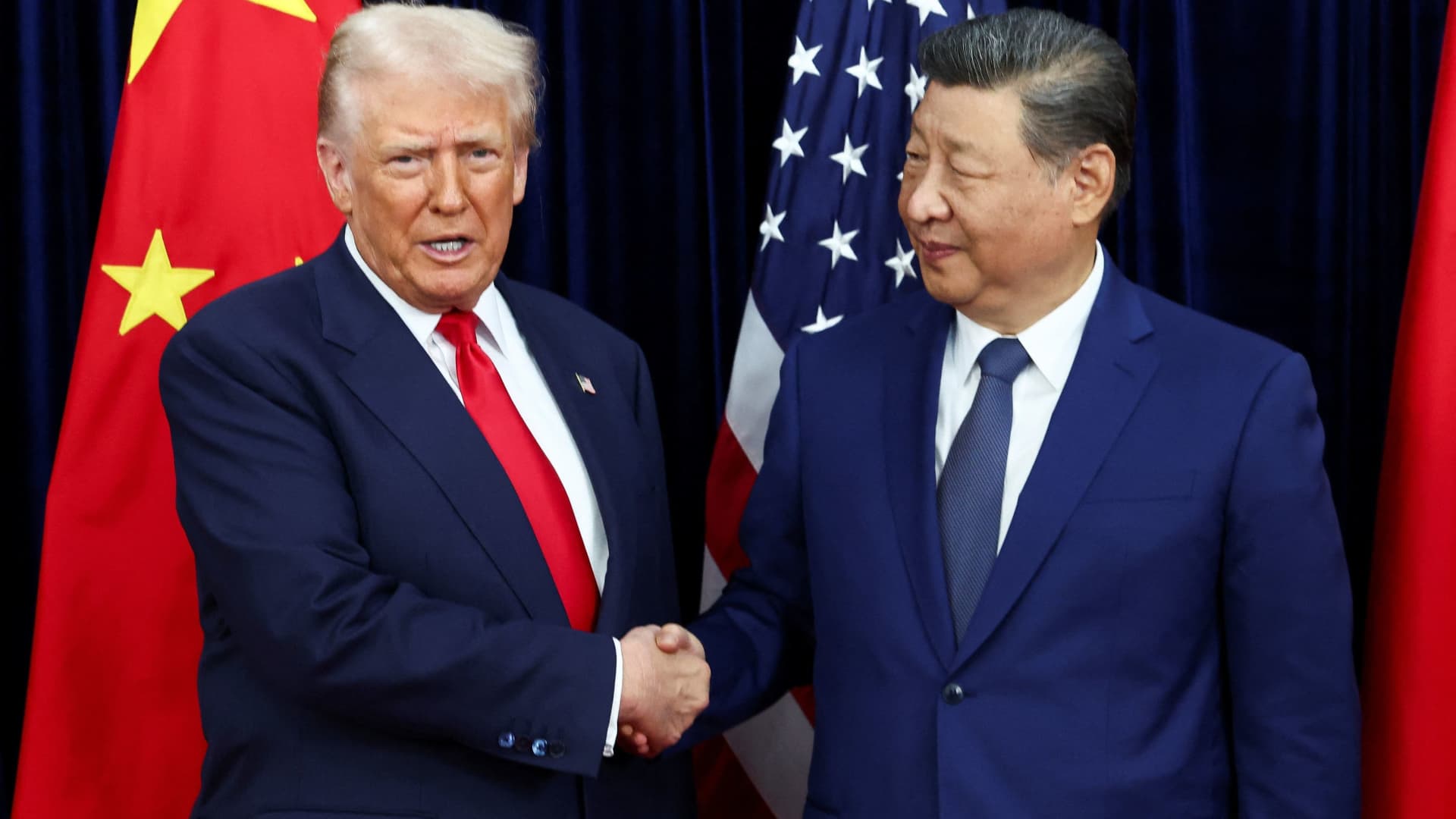
Under that agreement, the US reduced some tariffs while China suspended parts of its rare-earth export controls for one year, paused new tariff rounds and port fees, and agreed to standard — not general — export licensing for gallium, germanium, antimony, and graphite. The White House fact sheet after Busan claimed China had agreed to “de facto removal of controls” on these materials. China’s MOFCOM notices confirmed only the narrower one-year suspension. The gap between the two readouts was significant and documented — and it will happen again in May.
These suspension deadlines cluster around late November 2026, giving Beijing timed leverage of precise design: if the May summit fails to deliver on Beijing’s core asks, China can simply let the clock run out and re-tighten controls, hitting US semiconductors and defense supply chains at a moment of its choosing. This is not incidental. It is the architecture.
Xi’s Ask List and the Leverage Stack
From open diplomatic signaling, Chinese foreign ministry readouts, and expert reconstruction, Beijing’s ask list for May is relatively clear. It operates across four domains.
- On trade and technology: extend or deepen the tariff pause and package it as a “Phase 2” deal; keep rare-earth controls in a suspended but reversible mode, preserving the leverage without triggering immediate supply chain crises; avoid new US export controls on advanced chips and manufacturing tools beyond what is already in place; and maintain current frameworks for rare earth licensing without escalation.
- On Iran and sanctions: obtain assurances that Chinese firms doing business with Iran in energy, infrastructure, and dual-use goods will not face secondary US sanctions as part of a post-war settlement. This is what Beijing has explicitly sought, according to diplomats familiar with Chinese deliberations on the war. Keep any discussion of MANPAD transfers and dual-use technology flows in private channels, away from summit theatrics where they could embarrass both sides.
- On Taiwan: extract wording that both sides “oppose unilateral changes to the status quo” and support “peaceful resolution by the Chinese people across the Strait.” Press Trump to at least slow or re-sequence major arms packages to Taiwan, under the argument that “responsible Taiwanese forces” — meaning the KMT, freshly validated by the Xi-Cheng meeting — are engaging in dialogue and oppose foreign militarization of the dispute. This argument is now documented: Cheng herself, standing in Beijing, called US involvement “foreign meddling.”
- On optics and legitimacy: stage a summit that looks like parity — joint statements, reciprocal visits, carefully choreographed media — to project the image of a G2 relationship that Washington cannot afford to rupture.
Trump enters the May summit with his own set of clear incentives and binding constraints.
He needs headline wins for domestic audiences — trade relief, soybean purchases, a “historic understanding” — without delving into technical detail that would require sustained follow-through.
He needs to avoid a market shock from renewed tariff escalation or rare-earth supply disruptions. And he needs to minimize military entanglement over Taiwan while the US is still absorbing the political and fiscal costs of the Iran operation.
These constraints make Trump precisely the interlocutor that Beijing has learned to navigate most effectively. His transactional worldview, his preference for the headline over the fine print, and his demonstrated willingness to claim victory on the basis of photo opportunities rather than verified implementation details are known quantities in Beijing. Chinese negotiators have studied them carefully since 2017.
Language that seems harmless domestically in Washington can be weaponized internationally by Beijing as a diplomatic wedge — especially when combined with the new KMT channel Xi has just validated through the Cheng Li-wun meeting.
The divergent readout problem is structural and will recur. After the Busan summit, US fact sheets and Chinese MOFA readouts diverged significantly — particularly on what “general licenses” for rare earths actually meant versus what MOFCOM actually committed to. After May, the same pattern will almost certainly repeat.
Consider the probable scenario: Trump signs a statement referencing “peace and stability in the Taiwan Strait,” “non-escalation,” and “respect for each side’s core concerns.”
US officials insist this changes nothing about the Taiwan Relations Act and arms sales. Beijing’s readout emphasizes that the US has “reaffirmed commitment to the One-China principle” and “opposes Taiwan independence in all forms.” Two readouts. One summit. Permanent diplomatic record.
Watch for any May summit language around Taiwan to be analyzed with forensic precision. If Trump does not explicitly reaffirm US obligations under the Taiwan Relations Act and the Six Assurances, Xi will interpret the absence as a concession and publicize it accordingly.
The Connecting Logic Across All Three Fronts
The MANPAD intelligence is the thread that makes the entire architecture visible.
Let us evaluate.
- On Iran: China can enable Iranian military resilience through dual-use flows and weapons transfers without fracturing the summit — because Washington needs the summit more than it needs to punish the transfers.
- On Taiwan: China can deepen the United Front through the Cheng Li-wun channel and push for vague summit language that Beijing interprets as undermining US arms sales — because Trump will prioritize the economic deal over Taiwan doctrine.
- On trade: China can maintain the rare-earth leverage architecture and let the clock run toward November 2026 expirations — because US manufacturers and defense contractors are structurally dependent on materials they cannot yet source elsewhere.
The common denominators are leverage through interdependence, dual-track diplomacy paired with shadow enablement, ambiguity maintained as an asset, and time-horizon asymmetry.
Xi is playing a decade-long game. Trump’s horizon is electoral and transactional.
This asymmetry is what allows China to extract structural advantages from crises it did not initiate.
The Structure of the Relationship as of April 2026
The October 2025 Busan summit produced what Brookings analysts called “less a deal, more an uneasy truce.” The tariff pause and rare-earth suspension cluster around November 2026. China’s April 2025 export controls on seven rare earths, including gallium and germanium — critical for defense and semiconductors — remained in force regardless of the Busan headlines. The White House fact sheet claimed “de facto removal of controls.”
China’s MOFCOM notices confirmed only a one-year suspension of the additional measures announced in October. The divergent readout problem was established from day one of the truce.
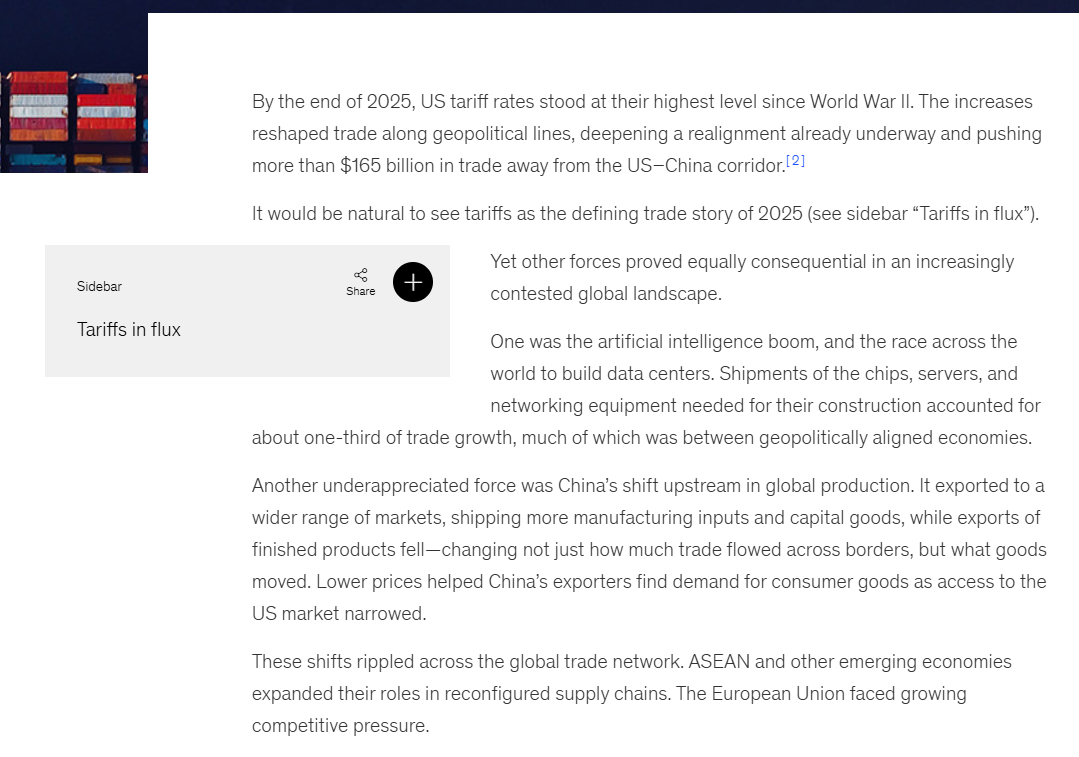
The McKinsey Global Institute’s March 2026 trade analysis confirmed that tariff shifts had pushed more than $165 billion in trade away from the US-China corridor, but that structural dependencies remained deep and that AI-related trade grew nearly 40% in 2025 while energy resources contracted.
The US-China bilateral relationship remains the largest goods trade relationship on the planet. Both economies carry embedded dependencies that neither can quickly dissolve. This is not a bilateral relationship approaching rupture.
It is a bilateral relationship managing competition within a framework of deep economic integration — exactly the condition that enables China’s leverage strategy.
China’s Four-Vector Leverage Matrix
China’s leverage over the United States as of April 2026 operates through four simultaneous vectors, and the synergies between them constitute the structural difference from prior periods of US-China tension.
Rare earths and critical minerals remain the foundational vector. China accounts for nearly 99% of global primary gallium production. The US sources 100% of its gallium from overseas, with approximately 95% from China. These numbers have not materially changed despite years of declared diversification efforts. Building alternative supply chains at scale remains years away.
With November 2026 deadlines approaching, China is in a structural countdown that puts pressure on Washington to avoid any escalation.
China accounts for nearly 99 per cent of global primary production of gallium, according to a report by the mining firm Cerro de Pasco Resources. The US sources 100 per cent of its gallium from overseas, with about 95 per cent of those imports coming from China, according to Minerals Make Life, a project run by the US National Mining Association. America’s reliance on China for critical minerals became a strategic vulnerability amid the US-China trade war, with Beijing placing controls or even outright bans on exports of several strategic materials as tensions rose. Those curbs led a slew of major Western firms to face shortages of crucial inputs, such as rare earth magnets, last year. (Source: China’s gallium grip looms over Trump’s Beijing visit as critical deadline nears / SCMP)
Iranian ceasefire credit is the second vector. Trump publicly credited China with the ceasefire. Any US pressure on Beijing over weapons transfers to Iran now carries the awkward subtext of punishing the actor you just credited with ending the war. Xi has embedded himself into the ceasefire credit structure in a way that makes confrontation politically costly for Trump domestically.
Political manipulation in Taiwan is the third vector. The Cheng Li-wun meeting hands Xi a documented talking point for the May summit: “responsible Taiwanese political forces” support cross-strait dialogue and oppose “foreign meddling.” Watch for this framing in any May summit discussion about US arms sales to Taiwan.
Economic summit leverage is the fourth vector. Trump is seeking a broader trade deal to claim as a domestic economic victory. Xi controls whether that deal happens. The implicit offer is: accept our framing on Taiwan’s status, soft-pedal the Iran weapons flows, extend the trade truce — and we will give you a photo op and a deal to announce before the November 2026 US midterm cycle.
India’s Strategic Reading: What the Architecture Demands
The full picture assembled in this analysis yields a set of strategic implications of particular importance to India, which sits at the intersection of the US-China competition, the China-Pakistan axis, the Iranian oil relationship, and contested borders with Beijing, which are managed through a framework of calibrated deterrence.
The first and most important implication is that US-China strategic competition is real but bounded — and MANPAD intelligence is the clearest single indicator of where the boundary lies. The US has not reached the threshold at which it will sacrifice its economic relationship with China to contest Beijing’s gray-zone activities, even when those activities include arming a belligerent that killed American soldiers.
This is not a weakness in the classical sense.
It is a constraint that is structural, economic, and political.
But constraint is constraint.
India must price it into every calculation that assumes the US and China are engaged in zero-sum strategic competition across all domains. They are not.
The second implication concerns Pakistan. Pakistan served as the mediator for the Iran ceasefire, with Prime Minister Sharif publicly inviting both the US and Iranian delegations to the Islamabad talks.
Beijing likely encouraged and enabled this role — it aligned with China’s interest in having ceasefire mediation conducted through a non-Western intermediary that happens to be China’s principal strategic partner in South Asia, while burnishing Islamabad’s regional relevance.
The Iran ceasefire process has elevated Pakistan’s diplomatic profile in ways that have secondary effects on the India-Pakistan equation, particularly as Washington’s attention is absorbed by the Iranian settlement and the Beijing summit.
The third implication is about the nature of strategic autonomy. India has been criticized in Washington for buying Russian oil, abstaining on UN votes related to the Ukraine and Iran conflicts, and maintaining economic relationships with Iran. The MANPAD intelligence demonstrates that the world’s superpower is itself maintaining a summit relationship with a state that its own intelligence community has concluded is preparing to arm a belligerent that killed American soldiers.
India’s strategic autonomy is not a departure from international norms. It is the norm. The difference is that India is honest about its positioning while Washington obscures its own constraints behind rhetorical escalation.
The fourth implication concerns the long game in Beijing. China’s strategy across Iran, Taiwan, and the summit is patient, structural, and multi-vector. It is built on the same principle that has governed Chinese statecraft since Deng: hide your strength, bide your time, and let adversaries exhaust themselves in crises you did not start. India’s border dispute with China, its semiconductor ambitions, and its positioning as an alternative manufacturing hub to China all exist within this framework. Beijing will apply the same leverage-through-interdependence logic to India that it applies to the United States. The difference is that India has less economic interdependency with China — and has been reducing it — which is precisely the right strategic direction.
The Essence of the Dragon’s Gambit
Six weeks ago, China was a bystander to a war it did not want between its economic partner and its strategic competitor.
Today, Xi Jinping enters a major summit having brokered a ceasefire that Trump publicly credited, having held a legitimacy-conferring meeting with Taiwan’s opposition leader in the venue reserved for heads of state, holding rare-earth export control deadlines as structural leverage over US semiconductor and defense supply chains, and — according to US intelligence — quietly preparing to resupply Iran with MANPADs through third-party channels while publicly claiming the mantle of responsible peacemaker.
This is what a patient, structurally sophisticated power looks like when it operates simultaneously across multiple domains, each move reinforcing the others.
The ceasefire credit gives Xi protection against public confrontation over weapons transfers. The Cheng meeting gives Xi a Taiwan prop for the summit. The rare-earth deadlines give Xi economic leverage in the trade discussions.
And Trump’s transactional worldview — which values the headline over the fine print, and the deal’s announcement over its implementation — is the American cognitive style that Beijing has learned to navigate most effectively across two administrations.
The May 14-15 summit will not resolve any of these tensions.
It will produce a communiqué with divergent readouts, extend the trade truce, and generate Trump’s characteristic superlative assessment.
The underlying structural competition will continue beneath the surface — in export control architectures being built in both capitals, in semiconductor supply chains being reshuffled across Southeast Asia, in rare earth processing facilities under construction in the US and its allies, and in weapons components flowing through third-party networks to Iranian forces in a post-ceasefire environment.
The central question for analysts and policymakers is the one that this analysis has been building toward throughout:
That is the essence of the dragon’s gambit. It is being executed simultaneously across Iran, Beijing, and Taipei.
It is not a future threat. It is the present architecture of Chinese statecraft in 2026. And it demands that every strategic actor in the Indo-Pacific — especially India — read the architecture for what it is, rather than for what Washington’s public rhetoric says it is.
Comments ()