
The Global Power Fracture: Beijing Purges, Delhi Maneuvers, Europe Retreats
Major powers are no longer coordinating, they’re insulating. China purges, India hedges, Europe retreats on sanctions, and the U.S. loses deniability space in Asia. Global alignment still exists—but trust has already collapsed.

The Four Keepers of the Threshold
A young monk once found four hooded figures standing before an ancient gate.
Each guarded a different symbol — earth, fire, water, and ice.
“Why do you stand apart?” the monk asked them.
“Why not enter together?”
The first keeper replied,
“When storms gather, cracks appear from within before they come from without. I seal the fractures.”
The second said,
“When a flame burns too bright, it blinds the one who carries it. I dim the light so it lasts.”
The third whispered,
“Rivers change their course long before the mountain notices. I follow the shift, not the stone.”
The fourth breathed,
“To survive the winter, warmth must be hidden — not shown.”
The monk watched as they turned their backs — not on each other, but on the world behind them. They were not united, yet not divided; not allies, yet not enemies. Each held their element close, protecting it from the others — and from the sky above.
He finally understood.
The gate did not separate friend from foe.
It separated those who prepare from those who wait.
Lesson:
When the world senses approaching rupture, wisdom does not march in formation — it retreats into insulation. The unspoken alignment is not partnership but self-preservation.
SUPPORT DRISHTIKONE
In an increasingly complex and shifting world, thoughtful analysis is rare and essential. At Drishtikone, we dedicate hundreds of dollars and hours each month to producing deep, independent insights on geopolitics, culture, and global trends. Our work is rigorous, fearless, and free from advertising and external influence, sustained solely by the support of readers like you. For over two decades, Drishtikone has remained a one-person labor of commitment: no staff, no corporate funding — just a deep belief in the importance of perspective, truth, and analysis. If our work helps you better understand the forces shaping our world, we invite you to support it with your contribution by subscribing to the paid version or a one-time gift. Your support directly fuels independent thinking. To contribute, choose the USD equivalent amount you are comfortable with in your own currency. You can head to the Contribute page and use Stripe or PayPal to make a contribution.
The Off-On Sanctions
In October 2025, the U.S. Department of the Treasury imposed sweeping sanctions on Russia’s two largest oil producers, Rosneft and Lukoil, cutting off their U.S. assets and barring Americans from doing business with them.
U.S. President Donald Trump on Wednesday imposed Ukraine-related sanctions on Russia for the first time in his second term, targeting oil companies Lukoil and Rosneft as his frustration grows with Russian President Vladimir Putin over the war. The U.S. Treasury Department said it was prepared to take further action as it called on Moscow to agree immediately to a ceasefire in Russia's war in Ukraine, which began in February 2022. (Source: US hits top Russian oil companies Rosneft and Lukoil with sanctions / Reuters)
At the same time, the European Union adopted its 19th package of sanctions targeting Russia’s energy exports, including a phased ban on LNG imports and new restrictions on China-linked refineries and shadow-fleet tankers used to evade sanctions.
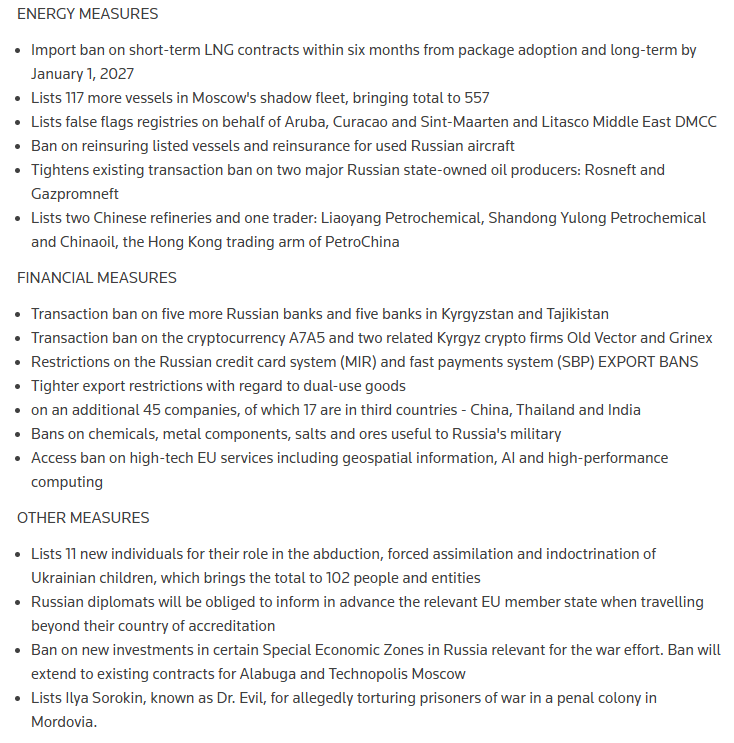
The objective, presumably, is to choke off Moscow’s war financing by slashing its revenues from oil and gas. But effectiveness depends heavily on global buyers such as India and China complying, and on the enforcement of secondary sanctions
Germany, meanwhile, is actively seeking US sanctions exemptions for Rosneft’s German arm. Ditto for the British.
Why are they seeking carve-outs? Let's look at Germany first:
- Rosneft owns significant stakes in German refineries (most notably the Schwedt refinery, which feeds Berlin/Brandenburg).
- If Rosneft’s stake is fully sanctioned without a carve-out, Berlin faces fuel shortages and price shocks.
- Simply “replacing Rosneft” is not legally or financially easy — compensation & arbitration issues under EU law.
- Germany needs Russian-origin crude quietly, even if politically it has to condemn Moscow.
The UK is no better either.
- The UK indirectly relies on Russian energy routed through third countries (India, the UAE, and Turkey).
- Britain wants energy flexibility without admitting reliance, hence exemptions for “utility-critical” flows.
- London cannot allow refinery and petrochemical markets to spike again before elections.
What Germany is Really Asking For — and Why
Berlin is lobbying Washington for a sanctions exemption for the former Rosneft subsidiaries that still hold significant stakes in the PCK Schwedt, MiRo, and Bayernoil refineries. Though technically Russian-owned, these entities, as per the German narrative, are under German state trusteeship and legally insulated from Moscow’s influence.
Germany argues that treating them as “active Rosneft assets” rather than “ring-fenced German infrastructure” is a category error that damages European energy security without weakening Russia.
Smart, eh?!
The most sensitive case appears to be PCK Schwedt, which supplies the Berlin-Brandenburg region. If the U.S. continues to treat the refinery as a sanctioned entity, banks, insurers, and trading houses could withdraw, triggering disruptions in capital flow, maintenance investment, and crude procurement. Politically, that risk translates into fuel instability in the German capital — a scenario Berlin cannot allow in an already fragile economy.
Germany also points to precedent: the UK has already provided a similar carve-out for these same Rosneft-linked German units. Berlin is effectively asking for “sanctions parity”.
Obviously, if London can balance punishment with continuity, Washington should not enforce a harder line at Europe’s expense.
The UK’s Quiet Two-Track Strategy
Britain sanctions Rosneft, Lukoil, and the “shadow fleet” on paper — while simultaneously authorizing narrow technical exemptions that protect refinery-linked flows into Europe.
This approach manages optical toughness for domestic politics, while preserving pragmatic continuity for supply chains.
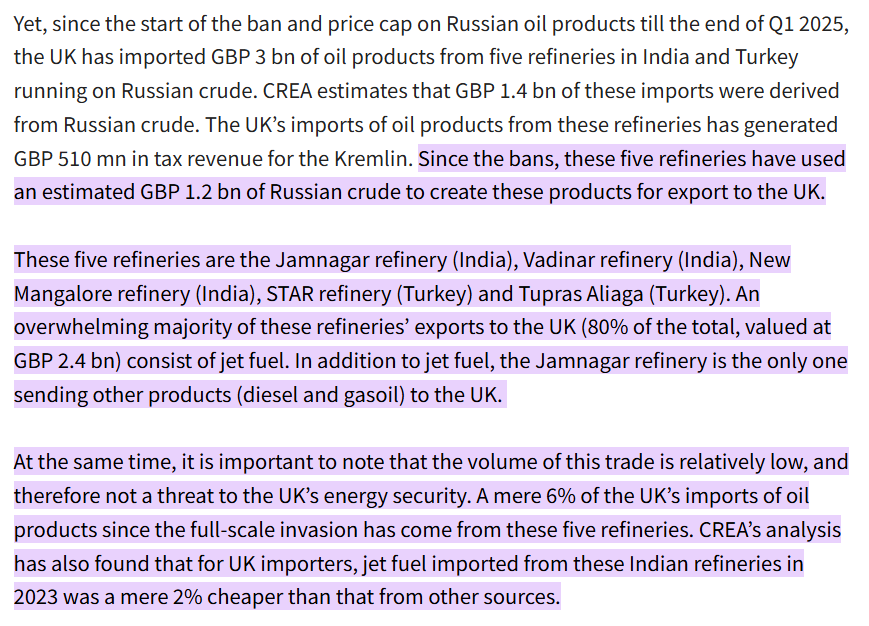
Independent data confirms that the UK continues to import fuel refined from Russian crude via India, Turkey, and China — a loophole London is not eager to close for itself.
Why the EU is Now Moving to Seal the Loophole
Beginning January 21, 2026, a new EU rule will require proof-of-origin certification for refined fuels, explicitly targeting India-Turkey-China routing. This is Europe trying to prevent future “laundering” without admitting present dependence.
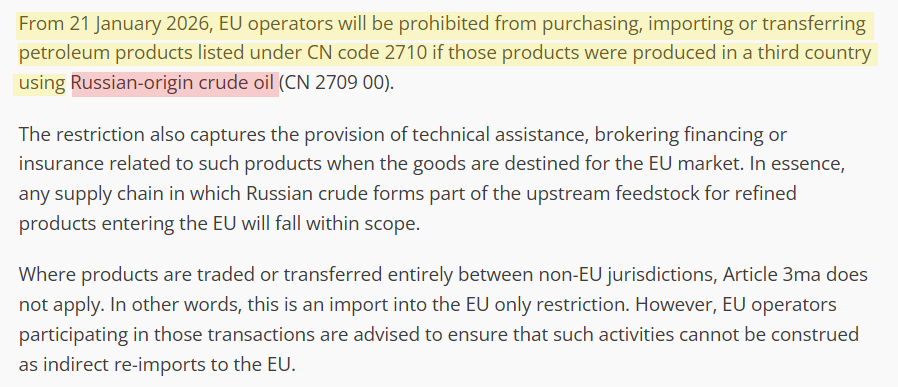
The politics of sanctions coherence are now catching up with energy reality — and Germany is trying to renegotiate the cost of loyalty.
Where Does This Leave India?
The latest U.S. sanctions package targeting Rosneft and Lukoil does not directly hit Indian refiners.
Still, it complicates the ecosystem they rely on — especially financing, tanker insurance, and dollar-clearing for cargoes linked even indirectly to designated subsidiaries.
Indian refiners are already modelling contingency procurement: U.S. crude, West African grades, and some Latin American blends could replace volumes if risk premia rise — but at a substantially higher landed cost. The economic logic of discounted Russian barrels remains intact, but the friction around accessing them is now higher.
At the same time, European demand for Indian refined fuels is not hypothetical — it is structural. Diesel and jet fuel flows from India kept EU markets liquid after the Russian distillate embargo. Many traders are now front-loading purchases ahead of the 2026 EU rule requiring proof of non-Russian origin. In other words, Europe wants the benefit of Indian refining but without the political optics of “importing Russian oil through India.” CREA’s tracking of shadow fleet movements shows European exposure continues quietly, underscoring how sanctions cohesion is already fragmenting behind the scenes.
The Geopolitical Signal
The bigger message is about hierarchy. Germany and the UK can openly lobby for carve-outs in the name of “energy security.”
Yet, India is pushed to justify its trade under a transparency burden not imposed on Western allies. Washington’s enforcement is not symmetrical — it is tiered. Energy security for Berlin is a strategic priority; energy efficiency for Delhi is treated as negotiable.
The Indo-Russian Urea Plant
Despite the pressure — or maybe because of it —and the games being played around it, India is now embarking on another venture—the Urea plant in Russia.
RCF, NFL and Indian Potash Ltd sign NDAs with Russian firms; proposed 2-million-tonne unit to reduce price volatility and import dependence. India is preparing to set up its first urea manufacturing facility in Russia to secure long-term fertiliser supplies and reduce exposure to global price shocks, people familiar with the discussions told Economic Times. The proposed project, backed by Rashtriya Chemicals and Fertilisers (RCF), National Fertilisers Ltd (NFL) and Indian Potash Ltd (IPL), aims to tap Russia’s abundant reserves of natural gas and ammonia, key raw materials that India lacks. Officials said the venture could be announced during Russian President Vladimir Putin’s visit to India in December, marking a major new chapter in India–Russia economic cooperation. (Source: "India plans first urea plant in Russia to secure fertiliser supply; details likely during Putin’s December visit" / Money Control)
Why is this important?
Before we go further, here are some details on India's relationship to urea.
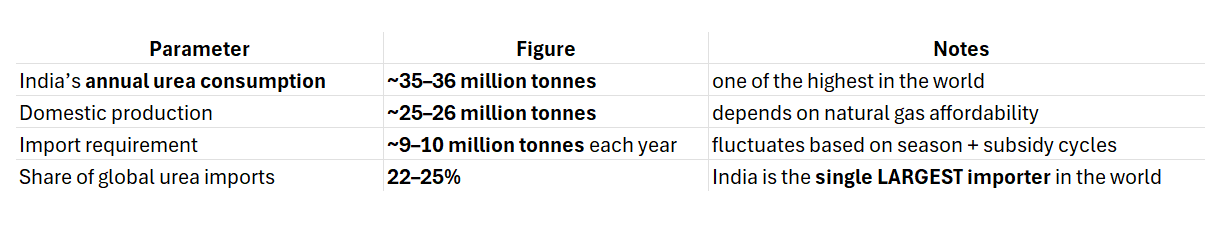
So India depends on foreign suppliers for ~30% of total demand
Most of these imports come from:
- Oman/UAE/Qatar (gas-linked supply)
- China (when it does not curb exports)
- Tiny share from Russia/others (until now)
And now, some data on Russia's urea and hydrocarbon capabilities.
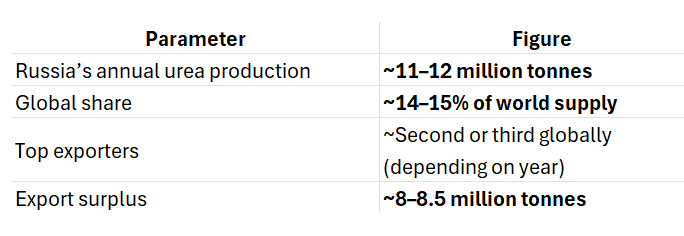
Russia’s traditional export markets included Brazil, Europe, Africa, and Turkey. After the US-EU sanctions architecture cut Moscow off from its largest premium market — Europe — the Kremlin now needs new, long-term, politically stable buyers who can absorb volumes consistently rather than sporadically.
In other words: sanctions didn’t just redirect oil flows — they forced Russia to go shopping for reliable partners.
India’s decision to build a urea plant inside Russia is not a commercial venture — it is a supply-security hedge.
And rather than being at the mercy of Middle Eastern LNG pricing, India can tap into Russia’s cheaper gas feedstock, which is the real cost driver for urea. More importantly, this creates structural insulation from US-led sanctions pressure: when production is hosted in the partner’s territory, external chokepoints cannot easily weaponize access.
It is a long-term strategic play. See it is as a fertilizer equivalent of energy sovereignty.
A single urea plant in Russia has the capacity to cover nearly one-fourth of India’s total fertilizer import requirement. If a second facility is added later — which is already being discussed at a strategic level — India could eliminate its dependence on Gulf producers and Chinese supply routes altogether.
The financial architecture is just as crucial as the fertilizer: payment in rupee–ruble bypasses the petrodollar system and creates a sanctions-resilient settlement corridor. Once production is inside Russia and denominated in a currency other than the dollar, U.S. pressure tools lose effective leverage.
For decades, this dependence acted as a quiet external lever over Indian agriculture policy. By embedding production at source and moving settlement off the dollar grid, India has effectively removed that lever from U.S. hands. This is not procurement — it is strategic insulation.
You see, 70%+ of Lok Sabha seats are from agrarian belts. If fertilizer prices spike, the farmer's anger, protests, and even aggression is not far off. That will lead to national-level political instability.
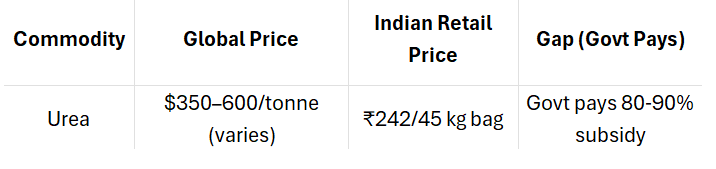
Remember, Urea pricing in India is almost entirely subsidy-driven.
It is one of the most heavily subsidised inputs in the economy, which means the government (not the market) effectively sets the floor for farmer affordability.
Even small supply shocks translate into massive fiscal exposure for the state. This is why securing low-cost upstream production is not just an agricultural issue but a budgetary and political one. The Indian government pays a whopping 80-90% subsidy for urea (Link: Economic Times)!
Most of India’s imported urea currently moves through supply chains that sit inside the U.S.-controlled security and financial perimeter.
A large share of India’s urea imports comes from Oman, Qatar, and the UAE. All three operate under U.S.-backed maritime and security umbrellas, meaning their export posture is never fully independent — it is calibrated to American geopolitical objectives.
The U.S. does not need to sanction India directly to apply pressure.
It can simply weaponize shipping insurance, banking compliance, and logistics permissions — tools that look “commercial,” not coercive. This is the same sanctions-by-stealth template used against Iranian oil, Venezuelan crude, and later Russian banking channels.
Look at the complete picture.
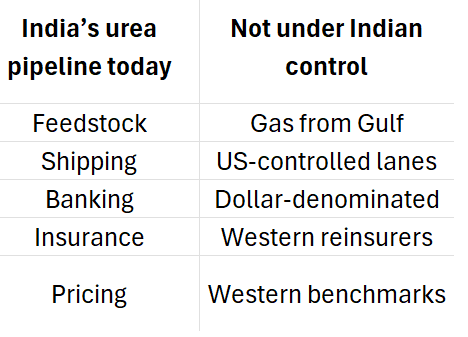
By hosting urea production inside Russia, India moves part of its agricultural lifeline outside this coercive perimeter. The question is not whether the U.S. would cut India off — it is whether India should continue to leave such a central lever of food security in someone else’s hands.
This is why upstream localization in Russia is a sovereignty hedge, not a trade convenience.
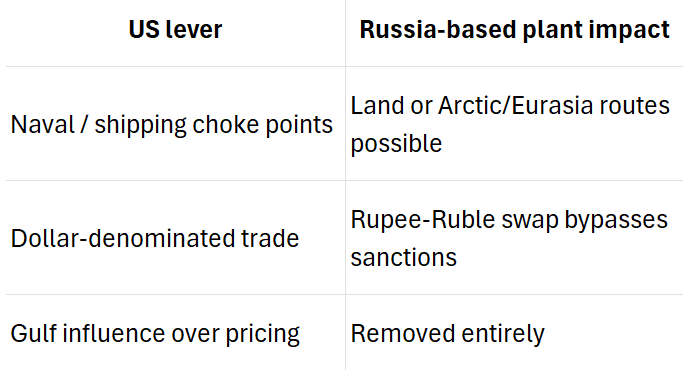
See the difference?
The objective isn’t blockade, but coercive timing: create distress precisely when the state is most vulnerable, then extract concessions quietly.
This is how the U.S. "negotiates" with sovereign countries. Not through overt warfare, but by weaponizing supply-chain timing against electoral and social stability.
Consider it as "soft power with hard edges".
Remember:
Controlling urea = controlling the Indian farmer
Controlling the Indian farmer = controlling the Indian election cycle
Controlling Indian elections = controlling Indian foreign policy
India’s Playbook: From Defence to Leverage
At the recent 'Berlin Global Dialogue 2025,' Piyush Goyal openly challenged the UK trade minister over sanctions targeting Indian refiners like Nayara Energy for purchasing discounted Russian oil, while exempting Western allies like Germany and the UK.
The message was clear - India will no longer take it lying down.
So, what can India do going forward to best use the global maneuvers and actions?
- Parity Language, Not Exception Language
India should not ask for “leniency” but for parity: if London can shield German-linked refineries, India can secure safe harbors for non-designated payments, insurance, and trade structures. - Origin Certification Infrastructure
Post-2026, Europe will pay a premium for verifiable “non-Russian derived” barrels. India can turn compliance into pricing power. - Strategic Diversification
Supplement (not replace) Russian supply with U.S./WAF/LatAm liftings to reduce chokepoints in shipping and insurance. - Quiet Leverage
A calibrated message: European fuel stability has been imported security from India. That gives negotiating weight.
India is not merely a buyer, you see, it is now a geopolitical stabilizer in the global refining matrix. And that can be priced diplomatically.
The hierarchy
The Ukraine war has become less about the battlefield and more about the hierarchy inside the Western alliance.
At the top sits the United States as the strategic hegemon.
Below it are “privileged allies” like Germany and the United Kingdom, who are allowed informal exceptions, flexibility on rules, and quiet carve-outs when sanctions hurt their own industries.
And then there are the so-called “swing states” such as India. They are expected to align, but never invited to co-design policy or strategy.
This reveals the real fracture line: not the US versus Russia, but the US versus its own allies and partners over who absorbs the economic cost of sustaining the confrontation.
India is being squeezed precisely because it has used this disruption to its own advantage — by refining discounted crude and selling into global markets, it turned sanctions into leverage rather than liability. The cracks in sanctions cohesion are now visible and widening.
Meanwhile, explosions have occurred at refineries linked to Russia in Hungary and Romania.
Explosions shook a Hungarian and a Romanian oil refinery on Monday, 20 October. Investigations are underway in both cases, and many circumstances remain unknown. The first explosion hit the Petrotel-Lukoil refinery in Ploieşti, Romania, at about 11.30am local time on Monday. Media reports say the blast occurred in the industrial sewerage system, with the hatch of a sewerage well being ejected during maintenance work. At the time, the refinery platform was undergoing a major shutdown for repairs. The Petrotel-Lukoil plant is one of Romania’s largest oil-processing facilities and is owned by the Russian company Lukoil. The second, similar incident occurred on Monday evening at MOL’s refinery in Százhalombatta, Hungary. Officials said the fire was contained by Tuesday morning, but operations were still suspended and investigations were continuing; the primary cause of the explosion remained unknown at the time of writing. The Százhalombatta refinery is a key node in both the Hungarian and Central European fuel networks, processing crude delivered via the Druzhba pipeline from Russia. Oil refined at Százhalombatta supplies mainly domestic markets but also, in significant quantities, Slovakia. (Source: "Explosions at Oil Refineries in Hungary, Romania Spark Sabotage SuspicionsExplosions" / Hungarian Conservative)
Bangladesh: The New Hotbed of Global Intelligence Operations
First, let us start with the CIA operation one horribly wrong.
Terrence Arvelle Jackson, the Command Inspector General for the US Army’s elite 1st Special Forces Command (Airborne), was found dead in Room 808 of the Westin Hotel in Dhaka, Bangladesh, on August 31, 2025.
Official reports from Bangladeshi authorities and preliminary statements pointed to death by natural causes, with no signs of foul play observed in CCTV footage or initial medical assessment.
However, the handling of the case raised immediate suspicions within intelligence circles across South Asia and beyond: the body was handed over to the US Embassy without an autopsy, and embassy officials quickly removed his belongings (including electronic devices, maps, and suitcases) from the scene.
Jackson was ostensibly in Bangladesh “on a business trip,” but this cover story unraveled as new details emerged about his activities and rank.
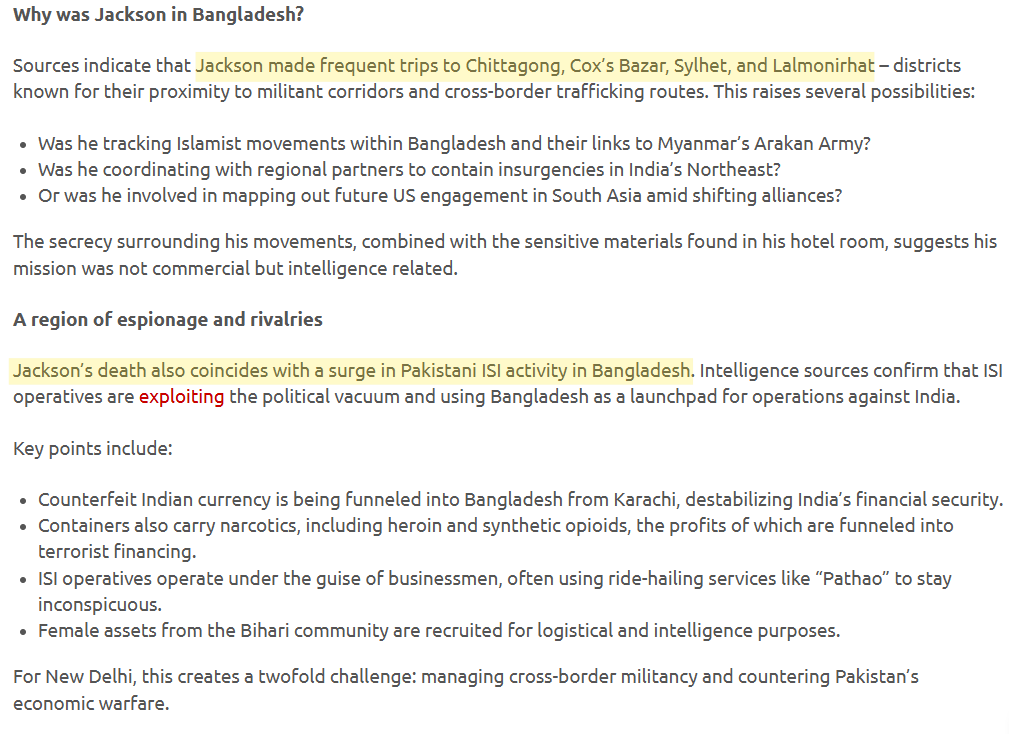
Multiple reports indicate that he was engaged in covert liaison tasks—pressuring the interim Bangladeshi government, run by factions loyal to Muhammad Yunus, into mortgaging strategic assets such as St. Martin’s Island to the US under the guise of “diplomatic coordination”.
Simultaneously, some public analysts suggest that Jackson was reportedly involved in a plot targeting Indian Prime Minister Narendra Modi during the Shanghai Cooperation Organization (SCO) summit, with rumors suggesting an assassination attempt was being prepped.
Intelligence tip-offs from friendly foreign agencies (including China’s MSS and India’s R&AW) alerted regional power centers about Jackson’s presence and intentions.
Jackson’s death coincided with increasing strategic cooperation between China, Russia, and India at the SCO, especially as President Trump ramped up tariff pressure on Asia.
Chinese President Xi Jinping was deep into a purge of several PLA generals suspected of being influenced by the CIA and pushing for conflict with India—an operation understood by insiders as clearing out foreign-influenced danger to regime survival rather than mere dictatorial paranoia.
In a parallel episode, Russian President Vladimir Putin took extraordinary security measures with Modi during the summit, reportedly holding secret meetings and avoiding interpreters, which some speculate was to warn Modi about an uncovered assassination plot. We discussed that in our earlier newsletter.
 Desh Kapoor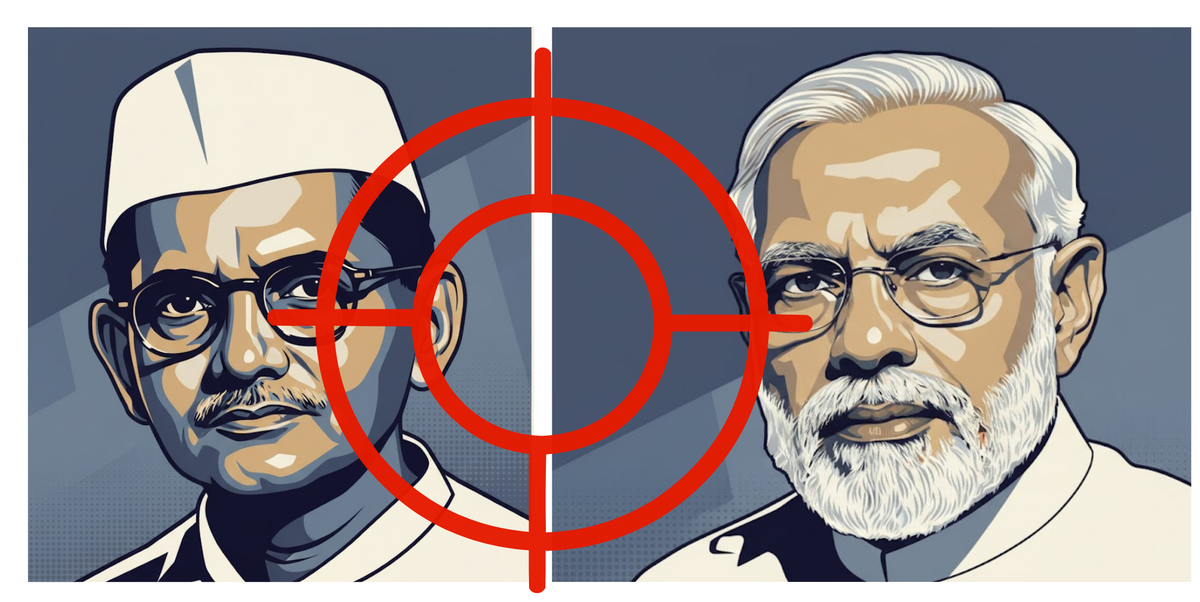
The Garment Fires
Bangladesh has been rocked by some major fires recently.
On Oct. 14, 2025, a major fire at a garment factory and chemical warehouse in Mirpur occurred (link). There is little information about the exact unit where the fire occurred, but that area is critical to the overall fabric manufacturing in Bangladesh.
Some of these plants operate at a very large scale; for example, individual facilities in the district are known to process up to 1.5 million yards of fabric per month, feeding directly into major apparel supply chains. Given this level of production concentration, even a single shutdown can create meaningful disruption.
The damaged factory may not be the largest in Bangladesh, but in a cluster where throughput is so tightly linked to export timelines, a stoppage can still trigger knock-on delays, reduced capacity, and supply-chain ripple effects during a peak shipping window.
And then, on October 18th, another inferno broke out at Dhaka airport's cargo import section.
Garment exporters in Bangladesh are bracing for losses of up to USD 1 billion following a massive fire that tore through the cargo complex at Dhaka's Hazrat Shahjalal International Airport, just as the industry enters its busiest export season, Al Jazeera reported. The blaze, which erupted on Saturday in the airport's cargo import section, destroyed large volumes of imported raw materials, finished garments, and vital product samples. (Source: Bangladesh Apparel Sector Faces $1 Billion Blow After Airport Cargo Fire / NDTV)
The Dhaka airport cargo fire is not merely an industrial accident — it hits Bangladesh at the most sensitive phase of its export cycle, right before the Western holiday season when garment shipments peak. This means the impact is two-fold: Bangladesh’s economy takes a direct blow, and US retail supply chains also feel disruption, especially for fast-turnaround apparel and sample-based fashion.
The timing is highly consequential. Bangladesh has become an active theatre of intelligence contestation, with US special operations presence, Chinese countermoves, and growing Indian surveillance of the corridor.
A $1B logistics shock creates dependency, and dependency invites leverage. Whoever steps in with financing, cargo rerouting, military “protection,” or emergency supply-chain guarantees gains influence not just over Dhaka but also over India’s eastern flank and access to the Bay of Bengal.
Economic distress is now a strategic tool—and Bangladesh is becoming an externally imposed pressure point, not a neutral geography.
Here is some more information on the activities in Bangladesh.
Now, let us move to the ongoing purge of top military generals in China.
The Chinese Purge
China is undergoing the most sweeping military purge since the Cultural Revolution — not in its lower ranks, but at the very apex of its war-fighting architecture.
The entire leadership of the PLA Rocket Force, along with senior figures in space, cyber, and naval commands, has been abruptly removed.
Officially, this is “anti-corruption,” but the scale, timing, and targeted branches point to something far more serious: fears of foreign penetration inside China’s nuclear and strategic weapons chain of command.
Xi Jinping is acting not like a leader cleaning graft — but like one responding to a counterintelligence breach.
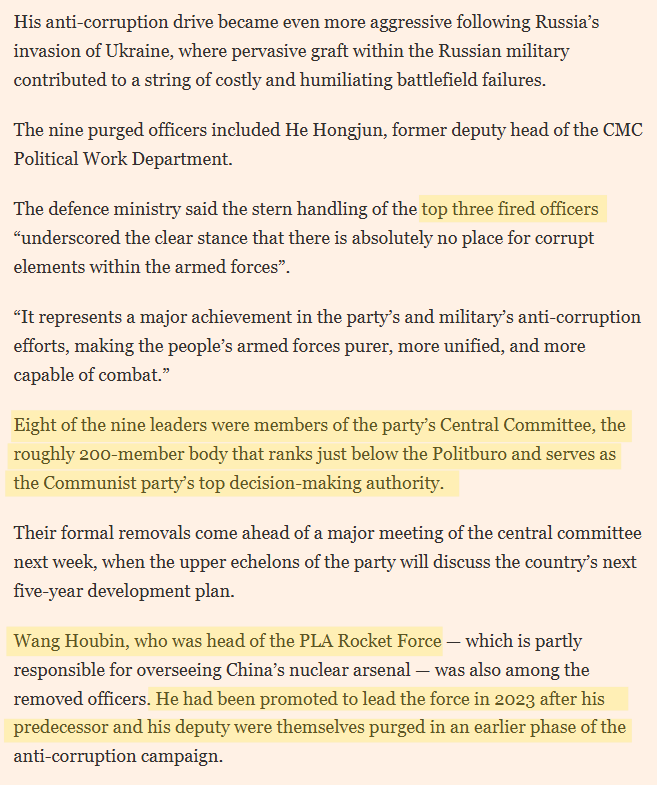
Who were those nine generals? Here is the list (courtesy Sinoinsider):
- He Weidong, member of the Politburo and vice chairman of the CMC.
- Miao Hua, former CMC member and director of the CMC Political Work Department.
- He Hongjun, former executive deputy director of the CMC Political Work Department.
- Wang Xiubin, former executive deputy director of the CMC Joint Operations Command Center.
- Lin Xiangyang, former commander of the Eastern Theater Command.
- Qin Shutong, former political commissar of the PLA Ground Force.
- Yuan Huazhi, former political commissar of the PLA Navy.
- Wang Houbin, former commander of the PLA Rocket Force.
- Wang Chunning, former commander of the People’s Armed Police.
We have compiled a list of officials purged from the Chinese military over the last few years. Well, the actual list could be much longer.
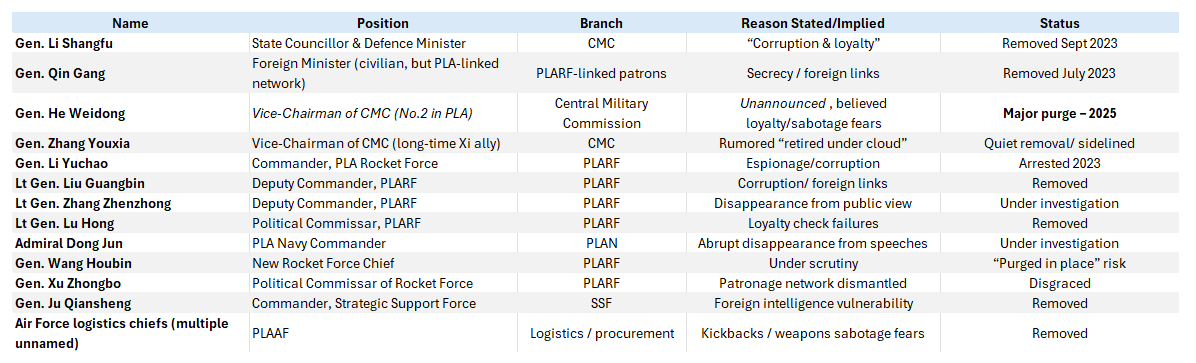
The language the PLA uses in its communications about the purges is initriguing.
China’s military purge is being framed by the Party not as a matter of financial misconduct, but as a betrayal of ideological loyalty and political obedience.
The official editorial condemned the ousted generals for “collapsing in faith,” undermining Party control over the gun, and damaging the internal political environment of the PLA.
The language is extreme and unusually sweeping, signalling that the Party sees this not as corruption but as a political breach — a threat to the regime’s monopoly over military loyalty.
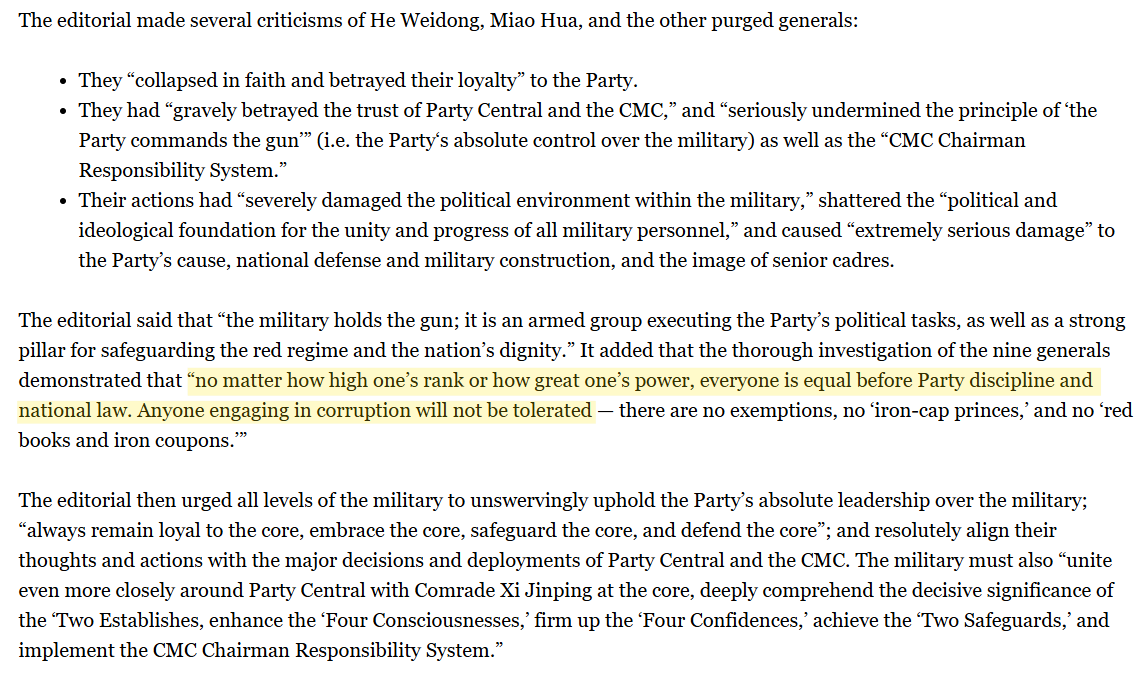
The conclusion is unmistakable: loyalty to Xi has become non-negotiable, and no rank is immune.
Remember here that Xi Jinping’s purge did not merely target officers accused of routine corruption or bribery.
This goes far beyond standard disciplinary action. When the suspicion is covert allegiance or ideological subversion, removing a single officer does not neutralize the threat.
The network around him — deputies, adjutants, procurement officers, communications staff — may also be compromised. This is why Xi did not sack individuals in isolation.
He dismantled entire command clusters to eliminate the possibility of parallel loyalties forming within the PLA’s chain of command.
US vs Not-US wings in the Chinese military?
The language used in these official communications is extremely revealing. The Party is not accusing these generals of bribery or negligence; it is accusing them of political disloyalty and “collapsing in faith.” In CCP vocabulary, that is code for allegiance to an alternative center of power. When the PLA Rocket Force, Strategic Support Force, and Navy commanders are purged simultaneously at this rank level, it suggests more than internal discipline — it suggests a battle over China’s strategic alignment, especially in the context of a Taiwan war scenario.
The subtext is that some senior factions may have drifted toward Western influence or US-linked channels over the last decade — through family members, offshore assets, or elite networks. Xi’s purge is therefore not just about tightening control; it may be pre-empting a fracture inside the military between those aligned with his hardline sovereignty doctrine and those who might prefer détente or US leverage as “insurance.”
This is why the campaign frames loyalty not just to the Party, but specifically to Xi Jinping as the core. The purge is both counterintelligence and political consolidation — a signal that any senior node suspected of a US-aligned worldview is being forcefully removed before wartime conditions expose those fractures.
Why is this not just corruption
If this were a routine corruption clean-up, China would have targeted procurement officers, accountants, and logistics handlers, the usual areas where graft occurs.
The pattern indicates Xi is not worried about stolen money. Instead, he is worried about compromised loyalties, covert influence networks, or embedded foreign access channels inside China’s war-fighting core.
Any bookkeeping audits or money movements do not dictate this kind of purge. Such an action could only be a countermeasure against wartime infiltration and sabotage prevention.
Were their families living in the US?
This is not a side detail — it is the core vulnerability that China’s Ministry of State Security (MSS) and the Central Commission for Discipline Inspection (CCDI) are now auditing across the PLA’s upper ranks.
In Chinese political vocabulary, there is a specific term for this: “裸官 (luo guan)” or the “naked official.”
Who is a Luo Guan? It's an official who remains in China holding a sensitive or strategic post, while his wife and children live, study, or hold assets abroad. Such officers are seen as high-risk vectors for external coercion and kompromat.
The purge inside the PLA Rocket Force (PLARF) and the Strategic Support Force (SSF) is therefore not about routine graft. The focus of the investigation is:
- children studying in the US, Canada, UK, or Australia
- spouses holding property or long-stay visas abroad
- assets parked through shell companies in Singapore, Hong Kong, Malta, or the Caribbean
- undeclared second residency obtained through relatives
The Rocket Force was especially vulnerable. During 2008–2016, when China’s “military modernization” coincided with economic opening, many generals sent their children to American universities. This created a long-term intelligence exposure channel: if one’s child is living under US jurisdiction, the leverage is automatic.
This is why Xi did not merely demote or discipline individual officers — he replaced entire command clusters, wiping the slate clean rather than patching over compromised loyalties.
This is a counterintelligence purge masquerading as an anti-corruption drive — a structural security reset.
Why the Rocket Force purge is geopolitically alarming
The PLA Rocket Force (PLARF) is not just another military branch — it is China’s entire nuclear deterrence architecture and the custodian of its hypersonic strike capability. Whoever controls PLARF controls the credibility of China’s second-strike posture.
If even one senior PLARF commander were penetrated by US or allied intelligence, the exposure would be catastrophic. A compromised officer could leak:
- Real-time targeting logic and launch protocols
- Early-warning system signatures
- Fuel-loading and standby schedules
- Movement patterns of mobile missile silos
- Pre-war readiness indicators
With this level of insight, the US would gain the ability to pre-emptively blind, delay, or neutralize China’s nuclear response before missiles ever left the ground.
That means China’s deterrent — the foundation of its geopolitical leverage — could be rendered unusable at the outset of a conflict.
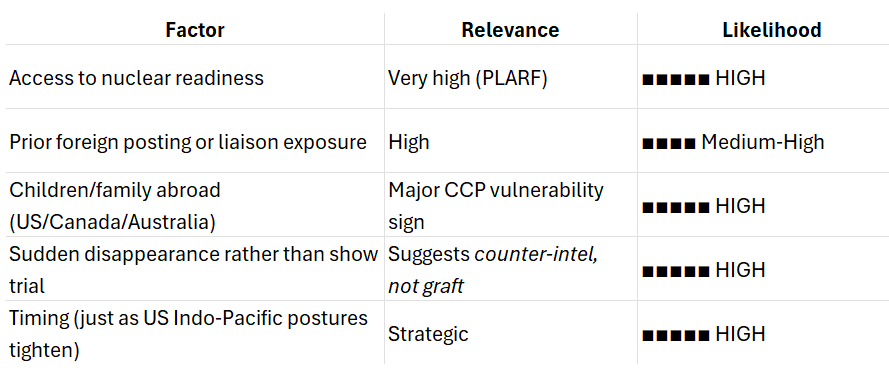
Xi Jinping’s purge must therefore be read as a counterintelligence emergency, not merely an “anti-graft” cleanup. His decision to replace the entire Rocket Force leadership rather than disciplining individuals implies fear of systemic infiltration, potentially linked to “naked officials” whose families lived abroad.
Here is a quick synopsis of the criticality of those purged.
Acts of Insulation
Across capitals, the pattern is becoming clearer: major powers are preparing for a protracted, more fractured geopolitical cycle by insulating themselves from internal shocks and reducing their external exposure.
In Beijing, the ongoing purge of the PLA command structure is not merely anti-corruption theatre. It is risk management before turbulence. With the economy softening, debt risks rising, and the belt of external confrontation tightening, Xi is pre-empting the possibility of institutional drift or factional leakage. The Chinese state is hardening vertically: fewer veto points, tighter command chains, and reduced room for rival networks to act autonomously.
New Delhi, in contrast, is playing for manoeuvring space. India is avoiding needless optics of confrontation even as it bargains harder behind closed doors — whether on energy security, supply-chain realignments, or preferential routing of Russian crude. The priority is not publicity, but insulation: maximum policy flexibility, minimal public entanglement.
Europe’s core states, despite rhetorical alignment with Washington, are now quietly privileging energy stability over sanctions absolutism. The German and UK carve-outs illustrate that “unity” is conditional on domestic energy security. The façade of cohesion remains, but underneath it is a negotiated retreat from pain-maximising sanctions.
For Washington, the strategic environment in Asia has become noisier and less permissive. HUMINT and SOF footprints are encountering hosts who are far more cautious and rivals who are vastly more alert. Bangladesh, which once served as a relatively low-visibility operating environment, is now politically “hot,” surveilled, and contested. The U.S. is not losing capability — it is losing deniability space.
The throughline in all of this is defensive repositioning.
Everyone is building buffers against financial shocks, covert blowback, escalation spirals, or political contagion. Public multilateralism is thinning; private hedging is accelerating. The most sensitive flashpoints are not headline battlefields but pressure nodes: energy chokepoints in Europe, strategic infrastructure corridors in South Asia, and governance cracks inside large-power militaries.
This is the architecture of pre-conflict stabilization: tighten internal command, diversify external dependencies, limit reputational exposure, and prepare for a world where alignment is no longer the same thing as compliance.

Comments ()