
Western Hypocrisy and India's Major Eurasian Ploy: Putin's Visit
Yes, Putin's India visit was about a strong message from India to Europe and the US. But it was far more than that. It will redefine the Eurasian geopolitics for the next 2-300 years.
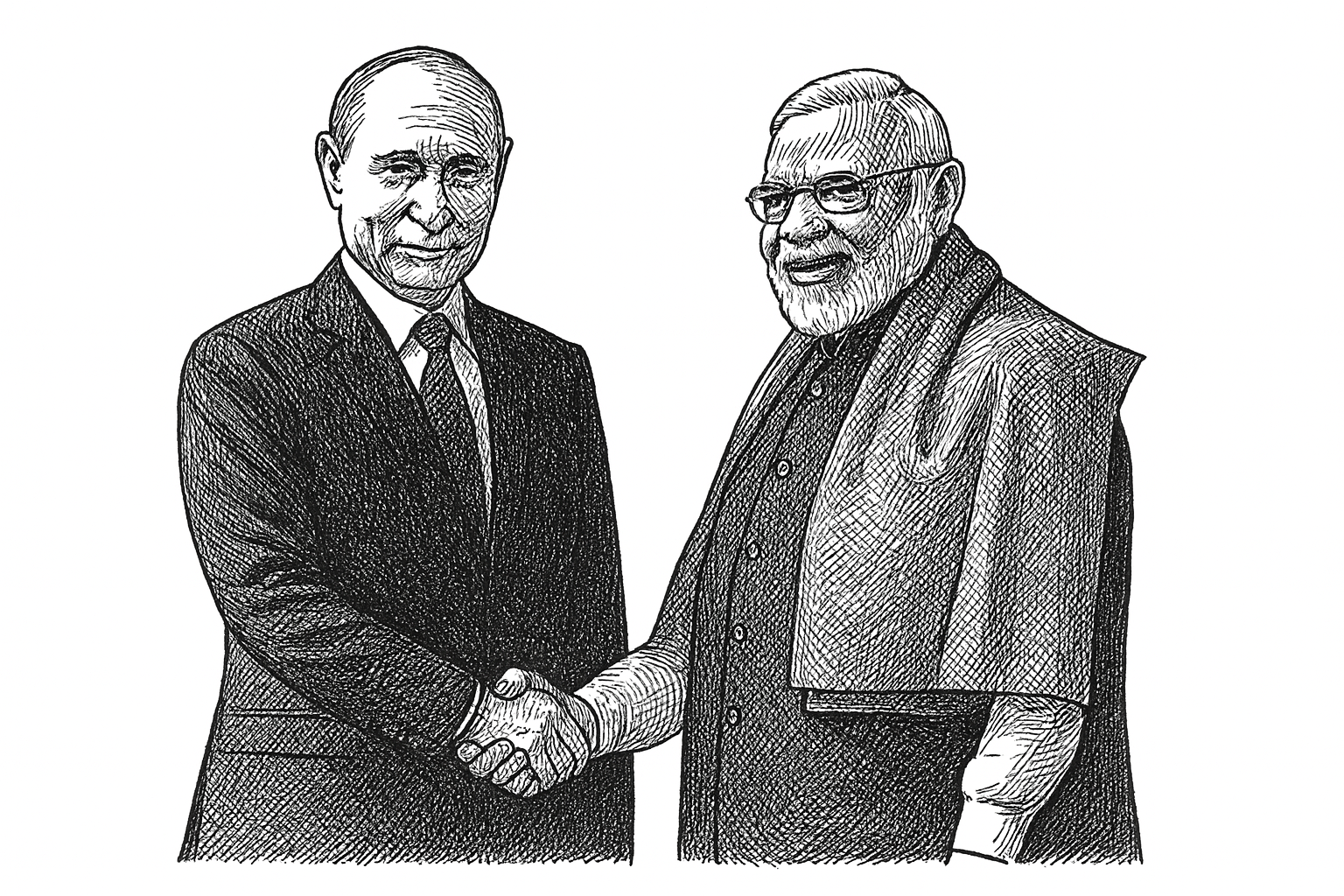
The Monk, The Falcon, and the Five Gatekeepers
A Zen Story of India, Strategic Autonomy, and a Changing Eurasia
High in the mountains of the East stood an ancient monastery.
Travelers said the monastery was older than kingdoms, older than maps, older even than the names men gave themselves.
One winter morning, a young monk named Arya was sweeping the stone courtyard when he heard a loud flutter above. A falcon descended — strong, steady, unmistakably wild. It landed on the monastery’s gate and stared directly at him.
The falcon carried a message tied to its leg.
The Five Gatekeepers
Before Arya could untie it, five gatekeepers appeared on the ridge — armored, loud, and proud. They wore helmets shaped like crowns, and each held a scroll listing rules they themselves never followed.
The first gatekeeper shouted:
“Monk! You may open the falcon’s message only after we approve it.”
The second added:
“We alone decide how birds should fly. If you speak to other falcons, you undermine world peace!”
The third raised his scepter:
“And if you refuse, we shall write letters calling you irresponsible. We shall gather our scribes in every bazaar to shame you.”
The fourth gatekeeper leaned in and whispered:
“Listen to us, obey us…
and we will praise you as a ‘pillar of stability.’
The fifth simply smiled:
“We will guide your choices, for your own good.”
Arya bowed once — not out of fear, but out of politeness.
Then he said nothing.
The falcon waited.
The Message of the Falcon
Ignoring the gatekeepers, Arya gently unrolled the note tied to the falcon’s leg. It said:
“Walk your path. Let the world adjust.”
It was signed by the Northern King, a traveler from a distant frost-bitten land who never forgot his old friendships.
The gatekeepers exploded:
“How dare you read that!
Do you not know we disapprove of this king?
Do you not see we have written entire chronicles condemning him?
Do you not understand that your friendship with him embarrasses us?”
Arya looked at them calmly.
“You condemn him today,” he said.
“Yesterday you traded with him.
Tomorrow, when wind shifts, you may trade again.”
The gatekeepers were offended.
3. The Empty Teacup
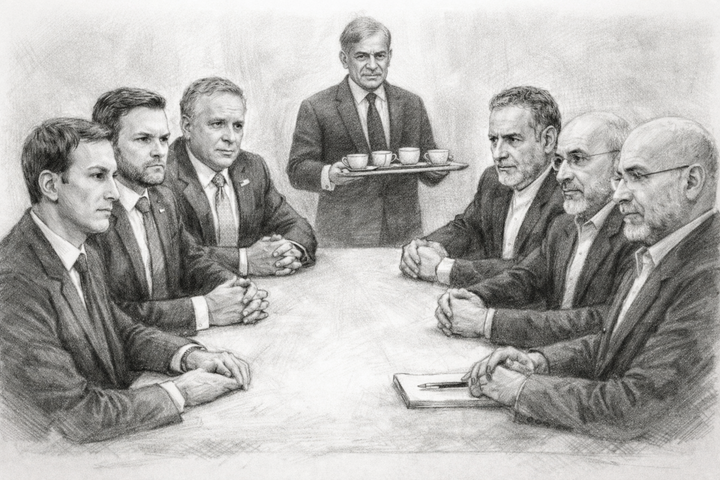
The monastery’s abbot, Master Shaant, stepped forward. He invited the five gatekeepers inside for tea.
They followed, triumphantly, believing they had won.
Master Shaant poured tea into their cups.
But he kept pouring…
and pouring…
until the tea spilled over.
“Stop!” the gatekeepers cried. “The cup is full! You’re overflowing it!”
Master Shaant nodded gently.
“Like your minds,” he said.
“Too full for new truth.”
He pointed to Arya:
“The monk has chosen to read the falcon’s message.
You call it defiance.
I call it clarity.”
The Seven Roads of the Valley
Master Shaant drew a map of the surrounding valleys.
- One road led east — narrow, noisy, crowded with merchants who offered praise in exchange for obedience.
- One road led north — wide and old, full of memory and trust built over centuries.
- One road led west — paved with clever words but riddled with past betrayals.
- One road led south — full of storms but rich with possibility.
- Three other roads circled the mountains — unclaimed, untamed, waiting for those with courage.
Arya spoke quietly:
“You insist we must choose only one road.
But why?
Why can we not walk many roads, carrying our lantern of autonomy?”
The falcon screeched in agreement.
The Gatekeepers Lose Their Balance
Unable to accept this, the gatekeepers sneered:
“If you walk your own path, you will disrupt the order we built!”
Arya replied:
“The order you built serves you first.
And others only when convenient.”
The ground beneath the gatekeepers trembled. Not from anger, but from reality catching up with illusion.
For far below, new caravans were moving through the valleys:
- Caravans from Central kingdoms, aligning with monastery's new corridors.
- Traders from Western kingdoms, opening routes bypassing old empires.
- Kings from East kingdoms, seeking balance instead of lectures.
- Scribes from West kingdoms, speaking of multipolar dawns.
And somewhere across the forests, the Northern King — the falcon’s master — was meeting Arya’s people, forging new bridges of energy, economy, currency, and security.
The world was shifting.
The gatekeepers felt it — and feared it.
The Abbot’s Final Lesson
Master Shaant addressed the gatekeepers one last time:
“When you were strong, you ordered the world.
When you weakened, you moralized the world.
And now, when others rise, you shame the world.”
He placed the empty teacups before them.
“But this monk’s path… this ancient land’s choice…
is not shaped by your praise or pressure.”
He pointed toward the horizon where the falcon circled high above.
“The mountain does not bow. The wind adjusts to it.”
The Transformation
The five gatekeepers left the monastery shouting warnings into the valley.
But the valley had changed.
- New alliances were sprouting like spring grass.
- Old roads were being rebuilt.
- Kingdom’s center of gravity was shifting.
Arya tied a reply to the falcon’s leg:
“We walk our own path.
May your kingdom walk its own.
Balance is strength.”
The falcon soared.
The gatekeepers faded.
The mountain remained.
Moral for Geopolitics
When a rising power chooses autonomy, old powers mistake it for rebellion. But autonomy is not rebellion. It is reality awakening. And once reality awakens, the world rearranges around it.
SUPPORT DRISHTIKONE
In an increasingly complex and shifting world, thoughtful analysis is rare and essential. At Drishtikone, we dedicate hundreds of dollars and hours each month to producing deep, independent insights on geopolitics, culture, and global trends. Our work is rigorous, fearless, and free from advertising and external influence, sustained solely by the support of readers like you. For over two decades, Drishtikone has remained a one-person labor of commitment: no staff, no corporate funding — just a deep belief in the importance of perspective, truth, and analysis. If our work helps you better understand the forces shaping our world, we invite you to support it with your contribution by subscribing to the paid version or a one-time gift. Your support directly fuels independent thinking. To contribute, choose the USD equivalent amount you are comfortable with in your own currency. You can head to the Contribute page and use Stripe or PayPal to make a contribution.
The Heartburn and the Diplomatic "Attack" on India
Before the visit, three European diplomats launched their first attack on India for even hosting Russian President Putin. A clear interference and diplomatic aggression on India.
The Times of India op-ed by the German, French and UK envoys was not just a view on Ukraine. It is also a diplomatic act aimed at India – and by the standards these same governments apply at home, it walks very close to the line of sovereign interference.
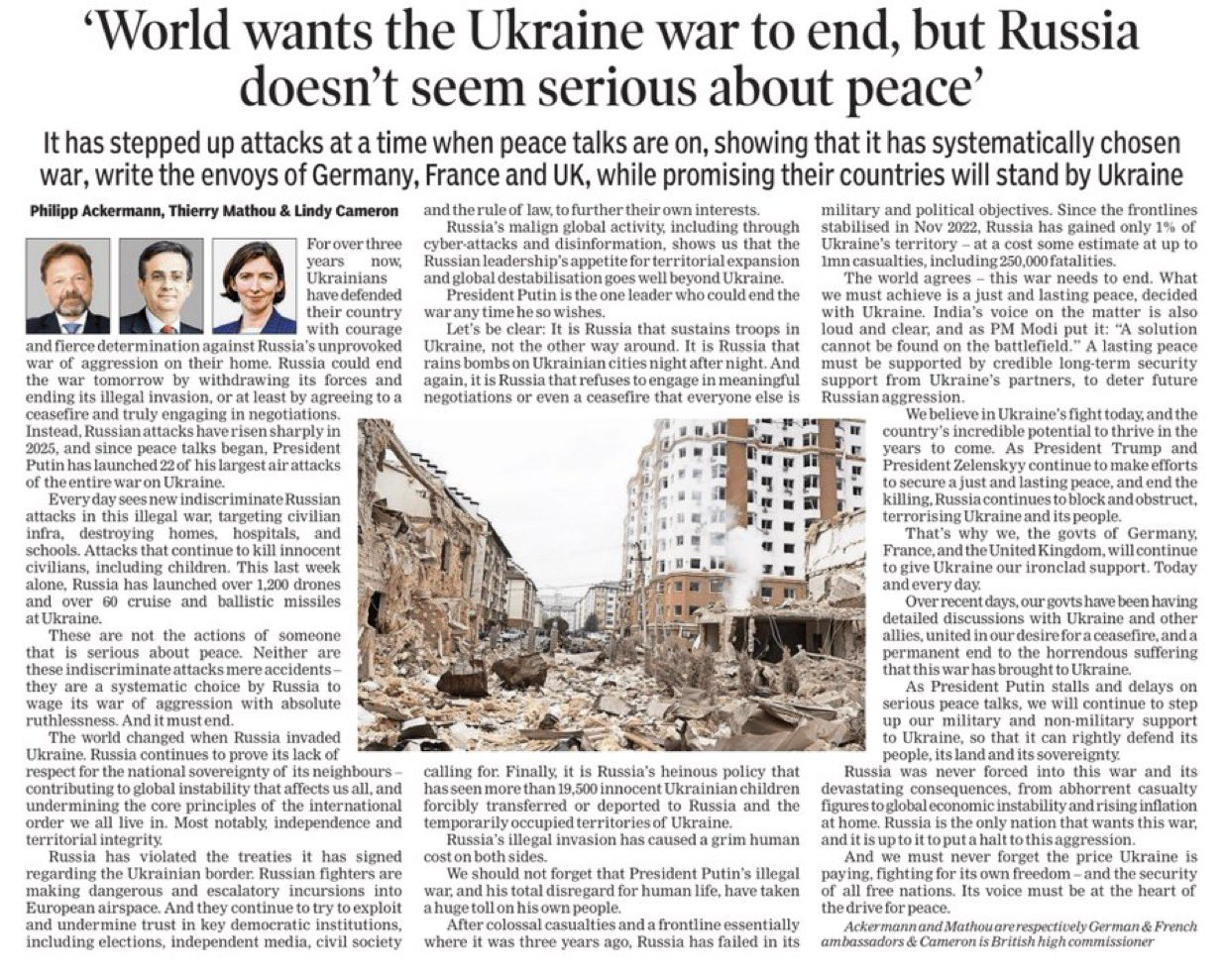
The basic rulebook here is the Vienna Convention on Diplomatic Relations (1961), which all three countries – and India – are party to. Article 41 says plainly: Persons enjoying diplomatic privileges “have a duty not to interfere in the internal affairs of the receiving State.”

Modern practice accepts public diplomacy – ambassadors give interviews, tweet, write op-eds. But there’s still a line:
- You can explain your own government’s policy.
- You are not supposed to campaign to reshape the domestic political consensus of the host country against its long-standing strategic partnerships.
The ToI op-ed does exactly that:
- It implicitly questions the morality and legitimacy of India’s close ties with Russia, right on the eve of Putin’s state visit.
- It frames the issue in moral absolutes – Russia as a systematic aggressor, the West as guardians of law and order – and implicitly invites Indian elites and public to “choose the right side”.
- The timing and tone clearly make it more than an informational piece; it is a pressure tactic to align Indian policy and public opinion with NATO’s narrative during a sensitive diplomatic moment.
Now flip the scenario.
Imagine: The Indian ambassador in London, a week before a high-profile British leader’s trip to, say, Israel, publishes an op-ed in The Times titled:
“World wants the Gaza war to end, but Britain doesn’t seem serious about peace”
Then proceeds to:
- List British arms supplies,
- Call UK operations “illegal” or “indiscriminate”,
- Imply that the British government is blocking peace,
- And subtly hint that countries maintaining close defense ties with the UK should rethink their moral position.
Do we seriously believe this would be treated as “friendly debate”? Most likely reactions from London, Berlin or Paris would be:
- Summoning the Indian envoy to the Foreign Office to express “strong displeasure”.
- Leaks to the media about “unacceptable interference in internal affairs” and “attempts to influence domestic political debate”.
- Demands, on op-ed pages and from MPs, that diplomats “respect the norms of diplomacy”.
Which is precisely why many Indian diplomats and observers view the ToI article as:
- A violation of the spirit (if not the strict letter) of Article 41 – open campaigning in India’s public sphere against one of India’s key partners.
- A diplomatic slight to India’s strategic autonomy – essentially implying that India’s relationship with Russia is morally deficient and must be “corrected” through Western narrative pressure.
- Instrumental use of Indian media: ToI, by running it in its New Delhi edition at this exact moment, effectively becomes a vehicle of NATO public diplomacy targeted against India’s own foreign-policy posture, not just against Russia.
The naiveté of these diplomats is quite remarkable. They had the gumption to "advise" Modi to tell Putin to stop the war because "he is your friend." Not sure if one should laugh at their childish ways or dismiss it with the absolute derision that it deserves?
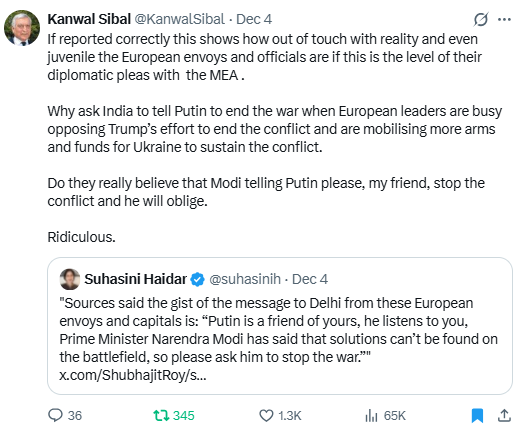
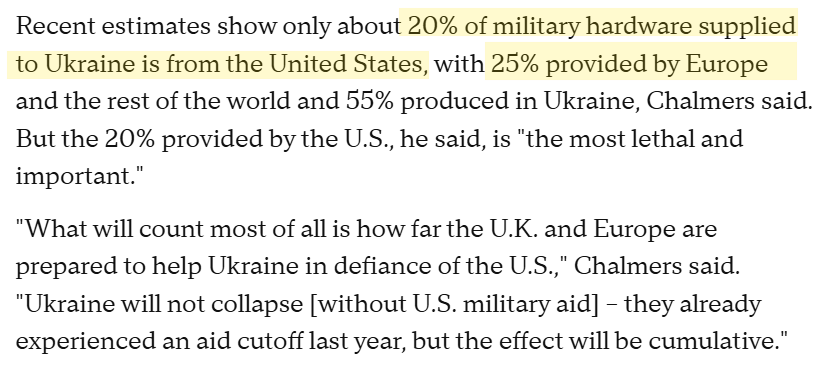
This is when Europe is a major supplier of arms to Ukraine.
India obviously did not take the conduct of the European diplomats too lightly and slammed them. Officials it 'very unusual' and 'not acceptable diplomatic practice.'
Germans did not stop at their juvenile acts of bashing India and its guest. They doubled down on their undiplomatic aggression.
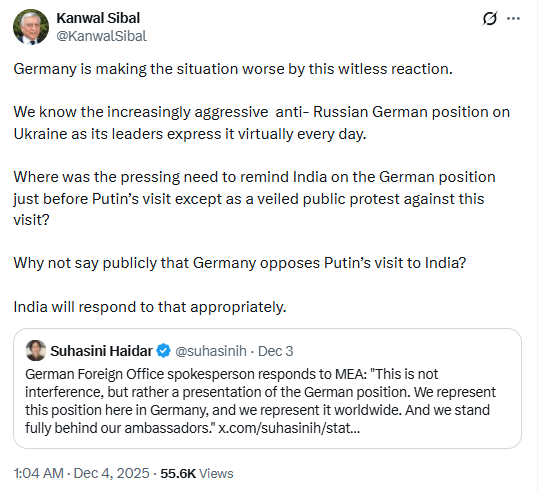
Now let us look at the reality of the fake story and complete myth of unilateral Russian aggression being propagated by the European and American elite and media.
The Reality of the Ukraine Story
First and foremost, as far as unilateral and illegal aggression on another country is concerned, very few can match the record of United States and the European countries.
- 1999: NATO bombed Yugoslavia for 78 days without UN Security Council authorisation (bridges, power, TV)
- 2003: Iraq invasion lacked clear UNSC authorization; later said by UN chief to be illegal
- 2011: Libya intervention morphed from civilian protection into regime change
The pattern here is unmistakable -
Here are some facts:
Setting Ukraine up
George Soros began shaping his involvement in Ukraine remarkably early—well before the country even became independent. In 1990, he established the Renaissance Foundation in Ukraine, a precursor to what later became part of the Open Society Foundations (OSF). His early presence laid the groundwork for long-term political, legal, and economic interference in Ukraine.
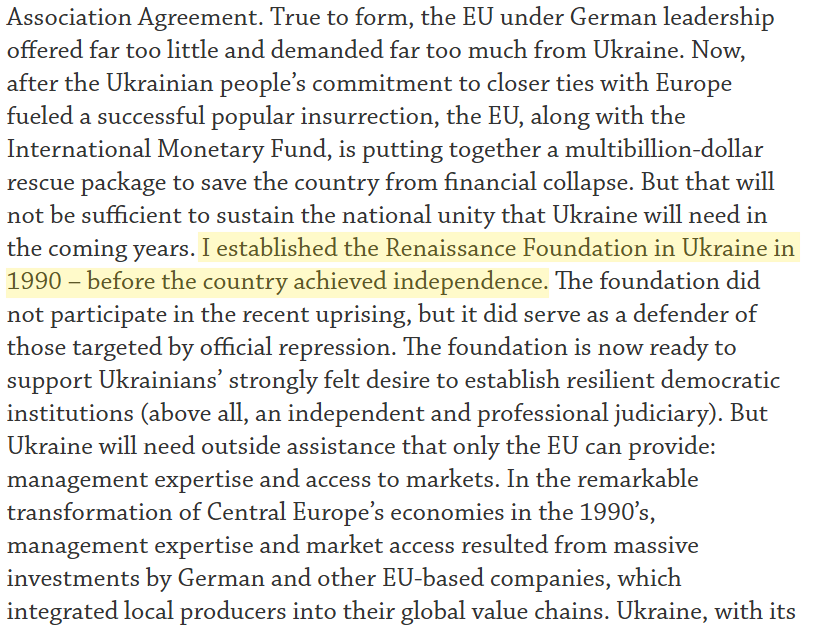
The eyes were set. The target was locked.
In the document titled “Breakfast with US Ambassador Geoffrey Pyatt”, the minutes of a pivotal March 31, 2014 meeting reveal an extraordinary dynamic: American diplomats effectively treating George Soros and his Open Society network as partners—and in some areas, architects—of U.S. policy in post-Maidan Ukraine.
Around the table sat key U.S. officials—Ambassador Geoffrey Pyatt, Economic Counsellor David Meale, and USAID Ukraine’s Deff Barton—alongside senior operatives from Soros’s Open Society Foundations and its Ukrainian arm, the International Renaissance Foundation (IRF). Rather than Soros merely being briefed, the minutes show him advising, shaping, and validating strategic decisions normally reserved for state actors.
Ambassador Pyatt openly pressed for a coordinated information campaign to undermine Putin and frame the new Ukrainian government in the most favorable light internationally. Instead of U.S. officials directing civil-society partners, it was Soros who quickly endorsed, refined, and aligned with the ambassador’s geopolitical narrative—effectively stepping into a policy-shaping role. His foundations were treated not as NGOs but as an auxiliary decision-making arm of American diplomacy.
Please peruse the document for more detail.
Was it really charity or full-fledged interference?
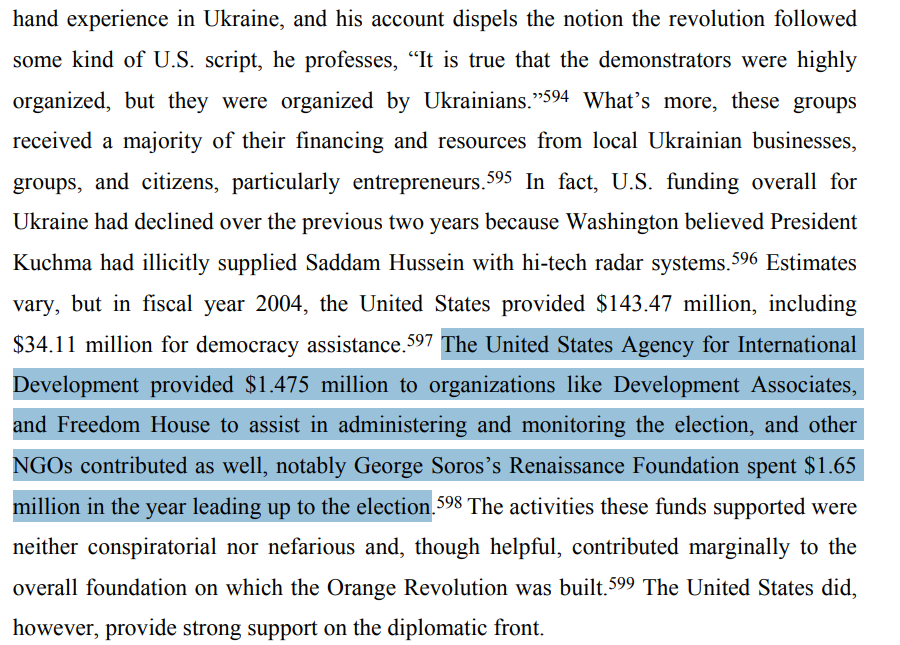
In the Naval Postgraduate School’s report, “Russian Political Warfare: Origin, Evolution and Application,” the extent of George Soros’s funding networks and operational involvement is laid out with striking clarity.
The report explicitly names George Soros and several of his affiliated organizations—Freedom House, Development Associates, and the Renaissance Foundation—as significant actors in Ukraine’s political landscape. Yet, despite detailing their extensive involvement and funding networks, the authors express no concern or warning. Instead, they treat these organizations as routine instruments within the broader ecosystem of Western-backed political engagement, offering no indication that their influence might warrant deeper scrutiny or raise questions about external steering of domestic political processes.
Often, anything related to George Soros is dismissed as a conspiracy theory. Well, we have written in detail about Soros and his character.
 Desh Kapoor
The Pyatt meeting document makes one conclusion difficult to ignore: the United States, operating not only through official diplomatic channels but also through powerful non-state actors such as George Soros and his network of organizations, was deeply involved in reshaping Ukraine’s post-Maidan political trajectory.
The coordination between U.S. diplomats and Soros-linked institutions reveals an effort to influence Ukraine’s internal direction in ways that strategically weakened Russia’s position.
Rather than purely supporting democratic reform, this alignment functioned as a broader geopolitical project aimed at countering and constraining Russian influence in its immediate neighborhood.
The Democracy-Death Dance by Soros, USAID, NED, CIA and Western Establishments
Since we have discussed about how USAID and Soros collaborated together on Ukraine in order to hoist a compliant government and bureaucracy such that it could be used as a launching pad against Russia, let us discuss this topic in more detail.
Let us understand how it all started.
Soviet era Democracy Promotion as a Tool for Subversion
US President Ronald Reagan’s 1982 Westminster Address—delivered before the British Parliament on June 8, 1982—became the foundational doctrine for Washington’s modern strategy of democracy promotion as an instrument of geopolitical influence. In this speech, Reagan argued that the West needed to “foster the infrastructure of democracy” globally as an ideological counterweight to Soviet-led communism. He explicitly framed democracy promotion not as a passive value, but as a strategic tool of U.S. foreign policy, declaring that the world was entering a period in which the “march of freedom and democracy will leave Marxism–Leninism on the ash heap of history.”
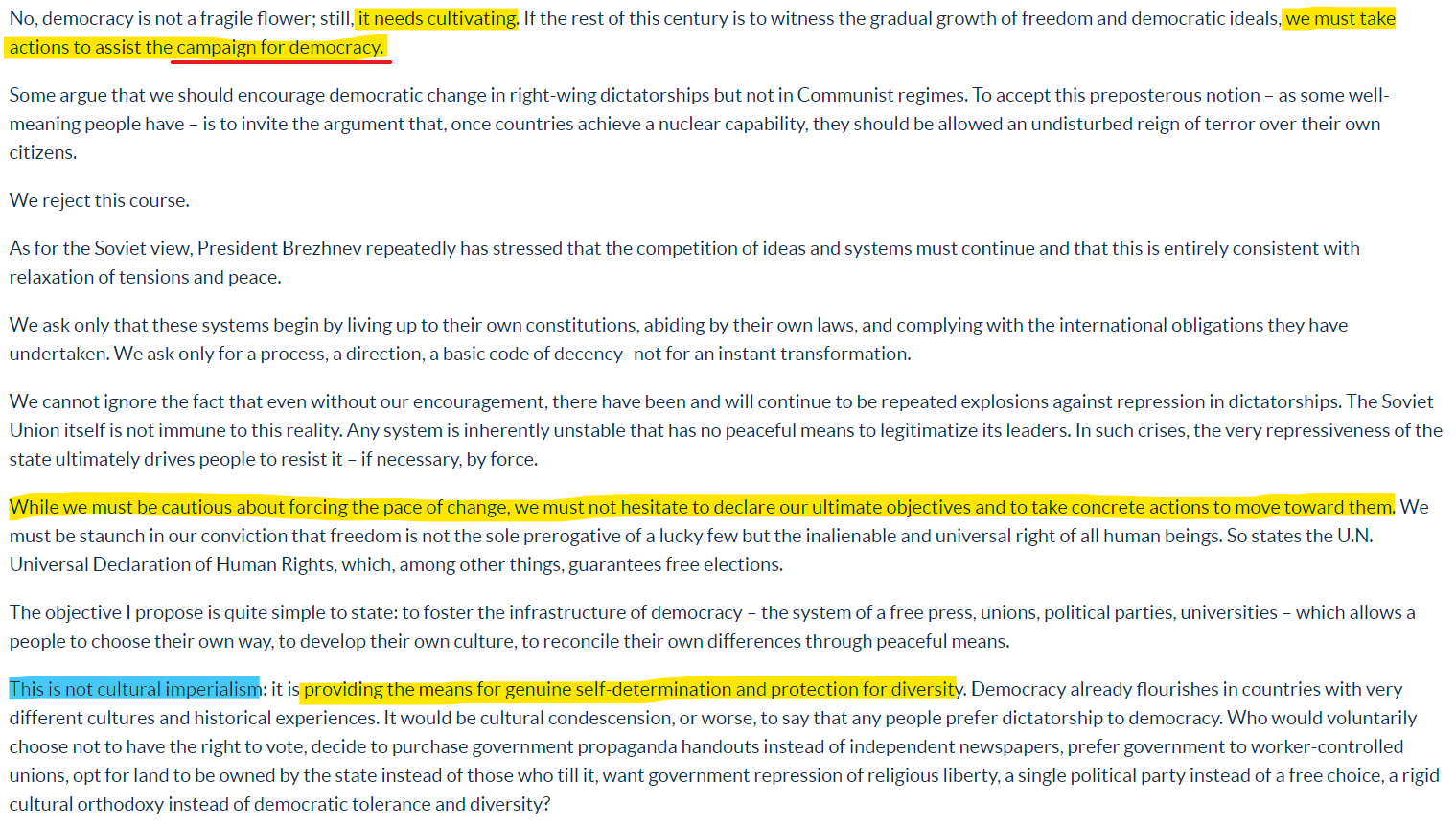
What is less commonly acknowledged is that Reagan and the architects of this doctrine were self-aware about the imperial implications of such a program. In the same address, Reagan admitted that America could be accused of practicing “cultural imperialism” by actively shaping political values overseas. Reagan’s exact words were:
“We must be cautious of accusations of cultural imperialism… Yet we must speak out for those who are seeking freedom.”
This internal tension—recognizing the imperial nature of U.S. ideological outreach while justifying it as a moral imperative—became a defining feature of American democracy-building projects.
The Westminster speech laid the blueprint for the creation of the National Endowment for Democracy (NED) in 1983, along with four core institutes: NDI, IRI, CIPE, and the Solidarity Center. As Allen Weinstein, one of NED’s co-founders, famously acknowledged:
“Forty years ago, President Ronald Reagan challenged the free world to ‘foster the infrastructure of democracy.’ He argued that support for freedom in other countries was not cultural imperialism, and that it was in fact cultural condescension to believe people anywhere prefer dictatorship to democracy. With the Westminster speech, he inspired the creation of the National Endowment for Democracy (NED) and its four core institutes, including IRI, one year later. (Source: IRI Statement on 40th Anniversary of Westminster Speech / International Republican Institute)
Behind the veneer of the altruism of "Democracy Promotion" was the need to hide the subversive activities of the CIA and give them a legitimate facade.
NED was the means for achieving that.
Scholars such as Herman & Chomsky (Manufacturing Consent, 1988) and William Robinson (Promoting Polyarchy, 1996) have described this model as a shift from covert Cold War political warfare to overt, institutionalized democracy engineering, still imperial in function but more publicly legitimized.
Thus, from its inception, Reagan’s democracy-promotion framework carried an embedded duality: it was marketed as moral liberation while functioning as a systematic instrument of U.S. influence and political penetration, especially in states aligned with or vulnerable to Soviet power.
Far from being an accidental evolution, democracy promotion was conceived at Westminster as a deliberate, strategic alternative to CIA covert action—overt, institutionalized, ideologically assertive, and, as even Reagan hinted, inherently imperial in its cultural reach.
From its inception, the National Endowment for Democracy (NED) was never intended to function as a standalone instrument. Rather, it was conceived as part of a broader ecosystem of U.S.-aligned political operatives, NGOs, philanthropies, and civil-society engineering networks designed to shape political outcomes abroad. Among the most influential parallel actors in this ecosystem was George Soros and the organizations he would later group under the Open Society Foundations (OSF).
Declassified U.S. government documents, congressional testimonies, and scholarly research show repeated intersections between NED’s agenda and Soros-funded initiatives. In many regions—Central and Eastern Europe, the Balkans, Central Asia, South Africa, Myanmar, and later Ukraine - NED and OSF worked toward closely aligned political objectives, often supporting the same movements, activists, NGOs, journalists, and opposition networks.
It is rather interesting that Soros’s Open Society networks emerged in the same period, performing similarly political functions using private philanthropy and NGO influence rather than state funding.
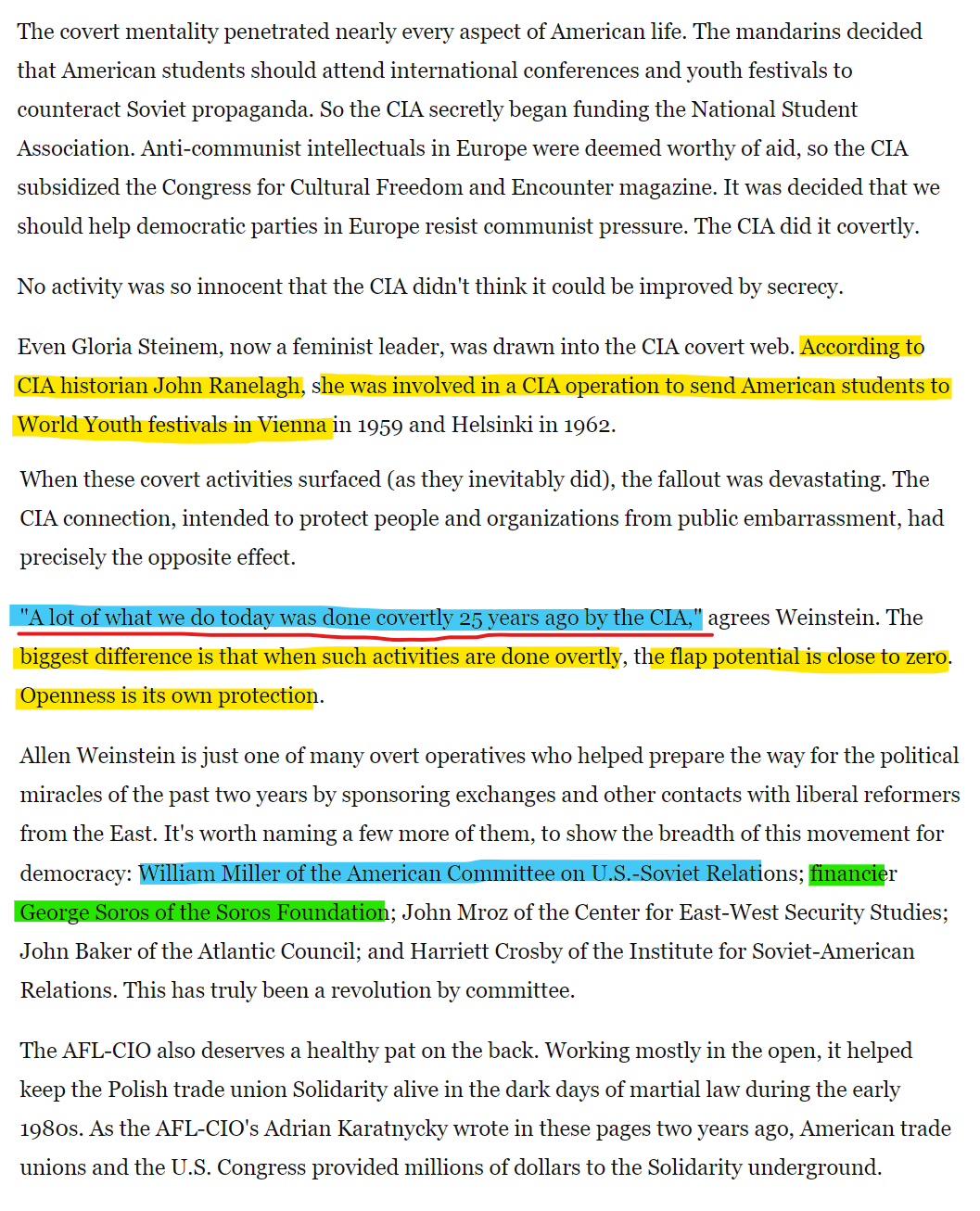
Soros' contribution to the Color Revolutions is remarkable. This article in Los Angles Times shares his "contributions".
 David Holley
Let me share some of the portions of the article that will share the extent and the depth of the work that Soros did in the ex-Soviet states.
Here you go.
In the five post-Soviet “stans” of Central Asia – Kazakhstan, Kyrgyzstan, Tajikistan, Turkmenistan and Uzbekistan – Soros’ Open Society Institute has focused on public health, legal and judicial reform, and education, spending about $20 million in 2003. In some of these countries, Soros also supports independent media and efforts to encourage fair elections. [Georgia] And across the Caspian Sea, in the former Soviet state of Georgia, he played an important role in creating the conditions for a bloodless revolt that overthrew a long-serving president. During November parliamentary elections in Georgia, Soros supported exit polling that indicated an opposition party placed first, contrary to official results. The poll played a critical role in triggering mass protests over alleged vote-counting fraud. That led to the ouster of former President Eduard A. Shevardnadze and the election in January of President Mikheil Saakashvili, who led what has become known as the “Rose Revolution.” “I’m delighted by what happened in Georgia, and I take great pride in having contributed to it,” Soros said in the telephone interview. The developments in Georgia are believed to have played a key role in President Islam Karimov’s decision this spring to expel the Open Society Institute from Uzbekistan. In power since 1990, Karimov saw a possibility that the uprising against Shevardnadze could echo in his country. // [Kazakhstan] In Kazakhstan, the Soros Foundation runs the Kazakhstan Revenue Watch project to monitor the revenues the country receives from its large oil and gas exports. A project statement describes its aim as trying to ensure that revenues “are used to the benefit of the public – for example, to eliminate poverty, reform education, increase the quality of public health-care services, and to solve other social problems.” // [Turkmenistan] The Soros network does not have a branch in Turkmenistan, but it does support some groups and individuals there. The country is led by President Saparmurad A. Niyazov, who runs an isolated state focused on a cult of personality. Turkmenistan requires registration of nongovernmental organizations and closely monitors their grant activities, but because the Soros network doesn’t have an office in the country, it cannot be so firmly controlled, said Erika Dailey, the Hungarian-based director of the Open Society Institute’s Turkmenistan project. “It’s been sort of the unseen donor,” she said. “It’s more difficult for the authorities to track what we do.” (Source: Soros Invests in His Democratic Passion - Los Angeles Times / references to the countries have been added by us)
While NED was created as a publicly funded instrument of U.S. foreign policy, George Soros operated as a private ideological counterpart, often advancing the same geopolitical objectives through grantmaking, civil-society infrastructure, media influence, and activist networks.
Their mutually reinforcing roles—one state-backed, the other privately financed—formed the backbone of what scholars now describe as the modern democracy-promotion complex, a soft-power architecture that has shaped political transitions across the world for more than four decades.
Let us discuss more about that now.
So, we know that the National Endowment for Democracy (NED) is an American covert intelligence operative agency that uses "Democracy Promotion" as a tool for subversion. But it is not alone.
Other Western organizations in the West have similar goals and modus operandi. For example the Westminster Foundation for Democracy (WFD).
The Westminster Foundation for Democracy (WFD) also ostensibly "promotes democratic practices and institutions in developing democracies".
Collaborating with partner organizations enhances the institutions of democracy, primarily focusing on political parties, parliaments, and civil society institutions.
The Westminster Foundation for Democracy (WFD) has been a close partner of the National Endowment for Democracy (NED) since 1992, when it was founded.
And so it’s a great pleasure for me to address this forum of the Westminster Foundation for Democracy and the Henry Jackson Society. The Westminster Foundation has been the NED’s partner in the United Kingdom since it was founded in 1992 and we organized a forum where its representatives were able to explain the new organization to a Washington audience. (Source: A FORWARD STRATEGY FOR DEMOCRACY PROMOTION IN 2008 AND BEYOND: REGAINING THE MOMENTUM, THE HOUSE OF COMMONS)
The pretext of "reforming the civil society" has proliferated numerous organizations, groups, and initiatives within the West. Actions, which are calibrated to subvert the governments that the Western intelligence agencies do not approve of. All the grants, money, and awards are geared towards that goal.
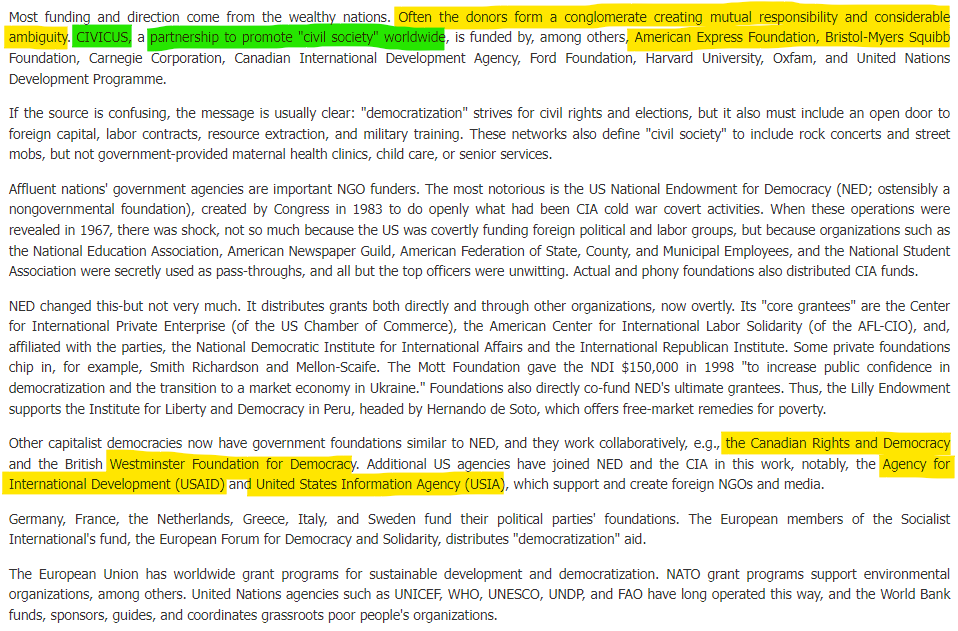
The Western establishments have been pouring money into the NGO sector.
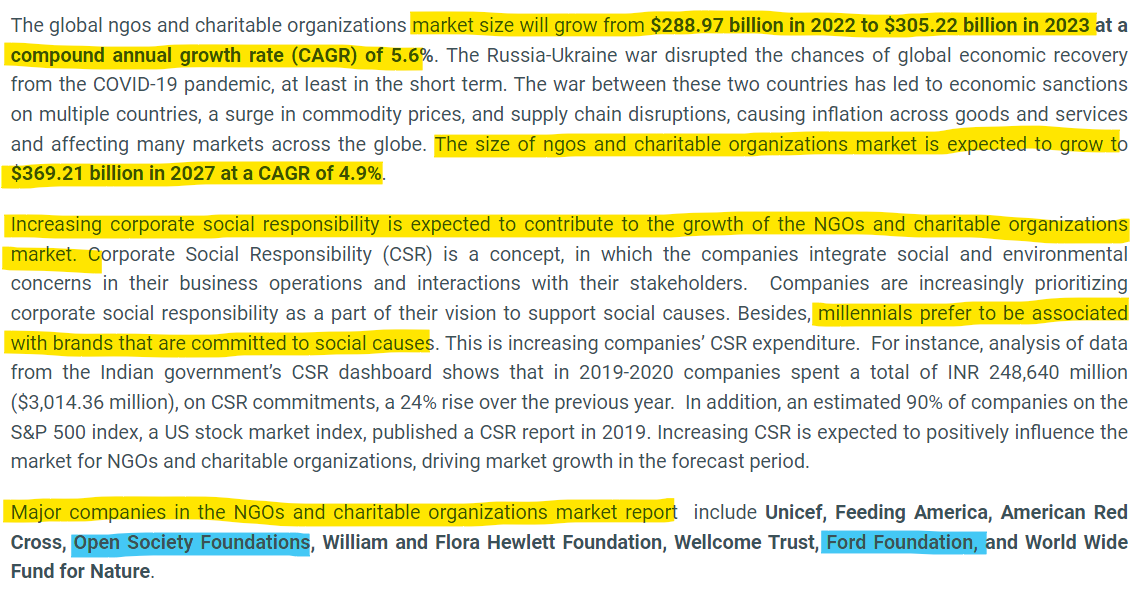
And not just one-time funds, recurring and growing amounts of money. The NGO Sector funding is $305 Billion this year from the major large donors. This amount will keep increasing at a healthy rate of close to 5% every year irrespective of the state of the global economy.
This video will bring together many sources of information that conclusively back the work we have shared above.
Now to a more detailed video.
This video is from the Shawn Ryan show and is worth watching.
You may also want to check this X Post and its video out.
MrBeast And The USAID Truman Show pic.twitter.com/L7v6aX2JIh
— Mike Benz (@MikeBenzCyber) November 30, 2025
The evidence and the background information on how US and the European countries using the state-funded and backed organizations and non-state actors backed by them have been subverting the countries that they wished would work as per their "music sheet". The biggest targets of this large operation were the ex-Soviet states which essentially made Russia's subversion their ultimate goal.
Step by Step Chronology of how Ukraine unfolded
We will now evaluate the steps that led to the Ukraine war along with the stated positions, the triggers, the legal responsibility, if the parties broke any agreement or understanding, Escalation Driver and interpretation or consequence.
So what are the key takeaways?
NATO Expansion Was Legal but Politically Dishonest: Yes, NATO possessed the legal right to expand. However, expanding after giving verbal assurances to Soviet leadership that it would not move “one inch eastward” represented a political breach, even if not a legal one. In international security norms, such verbal commitments carry significant weight because they shape expectations, trust, and strategic calculations.
Modern diplomacy treats verbal assurances as politically binding, and breaking them can destabilize relationships—even without violating formal treaty law.
This is why George Kennan, US veteran diplomat and the architect of the U.S. Cold War "containment" policy, called NATO expansion - "a fateful error".
In late 1996, the impression was allowed, or caused, to become prevalent that it had been somehow and somewhere decided to expand NATO up to Russia's borders. This despite the fact that no formal decision can be made before the alliance's next summit meeting, in June. The timing of this revelation – coinciding with the Presidential election and the pursuant changes in responsible personalities in Washington – did not make it easy for the outsider to know how or where to insert a modest word of comment. Nor did the assurance given to the public that the decision, however preliminary, was irrevocable encourage outside opinion. But something of the highest importance is at stake here. And perhaps it is not too late to advance a view that, I believe, is not only mine alone but is shared by a number of others with extensive and in most instances more recent experience in Russian matters. The view, bluntly stated, is that expanding NATO would be the most fateful error of American policy in the entire post-cold-war era. (Source: "A Fateful Error" / New York Times)
Betrayal and deception - that started with throwing the diplomatic norms and agreements out of the window because well... they could was the first step. Deception as a ploy remained in currency going forward as well.
The Minsk Agreements Were a Deception
The Minsk Agreements arose after Kyiv launched its “Anti-Terrorist Operation” in April 2014 to suppress the Donbas uprising following the post-Maidan government change.
With civilian casualties mounting and Ukrainian forces suffering defeats at Ilovaisk (2014) and later Debaltseve (2015), Germany, France, Russia, and Ukraine, under the Normandy Format, negotiated Minsk I (September 2014) and Minsk II (February 2015). Publicly, these accords promised ceasefire, autonomy for Donbas, and constitutional reform.
Years later, the key architects, however, admitted Minsk was never intended as a peace deal. Angela Merkel told Die Zeit (7 Dec 2022) that Minsk was designed “to give Ukraine time” to build military strength. François Hollande confirmed this to Le Monde (28 Dec 2022), and Petro Poroshenko said in a June 2022 interview that Minsk helped Ukraine “create powerful armed forces.” These statements revealed Minsk as a deliberate strategic deception—an interim shield for rearmament rather than a roadmap to peace.
This is the Angela Merkel interview where she let her mind out:
 Tina Hildebrandt
Poroshenko, president of Ukraine from 2014 to 2019, reiterated what Merkel and Hollande had shared earlier.
Critics of the Minsk agreement say Poroshenko signed it in 2015 because a gun was pointed at Ukraine’s head, as Kyiv’s forces faced total military defeat from an enemy that was receiving covert support from the Kremlin. “From my point of view, the Minsk agreements were born dead,” said Volodymyr Ariev, an MP from Poroshenko’s party. “The conditions were always impossible to implement. We understood it clearly at the time, but we signed it to buy time for Ukraine: to have time to restore our government, our army, intelligence and security system.” (Source: "Can Ukraine and Russia be persuaded to abide by Minsk accords?" / The Guardian)
It is quite clear that the Western leaders never intended the Minsk Agreements to be a real peace settlement, but rather a geopolitical tactic to buy time for Ukraine’s militarization against Russia. Angela Merkel’s December 2022 admission to Die Zeit is central: “The Minsk Agreement was an attempt to give Ukraine time… to become stronger.” François Hollande confirmed the same, stating that Minsk “was a diplomatic attempt to freeze the conflict… while Ukraine strengthened its army.”
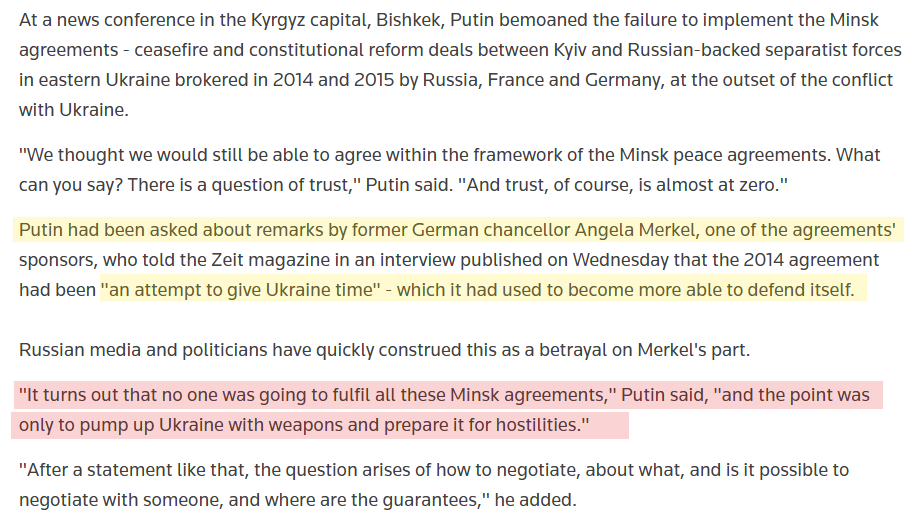
From Russia’s perspective, this amounted to betrayal. Vladimir Putin remarked in 2022: “It has turned out that no one was going to implement the agreements.” As the Reuters noted, Putin viewed these revelations as “completely unexpected and disappointing,” reinforcing Moscow’s belief that the West used diplomacy as a façade.
What is even more egregious that the betrayal of Russia by the Europeans is what they were setting the stage for.
Unleashing the Nazis
While the European leaders were feigning to work for peace, they were actually setting up a Neo-Nazi regime in Ukraine to facilitate massacres of the ethnic Russians.
After the illegal ousting of President Viktor Yanukovych in February 2014 - orchestrated by USAID, NED, and Soros organizations- the new Kyiv regime, infused with ultranationalist and neo-Nazi elements, launched the "Anti-Terrorist Operation" (ATO) against the Donbas.
Within a year of the first Minsk accord, Ukrainian neo-Nazi battalions, such as the Azov Regiment, had taken over the armed forces of Ukraine.
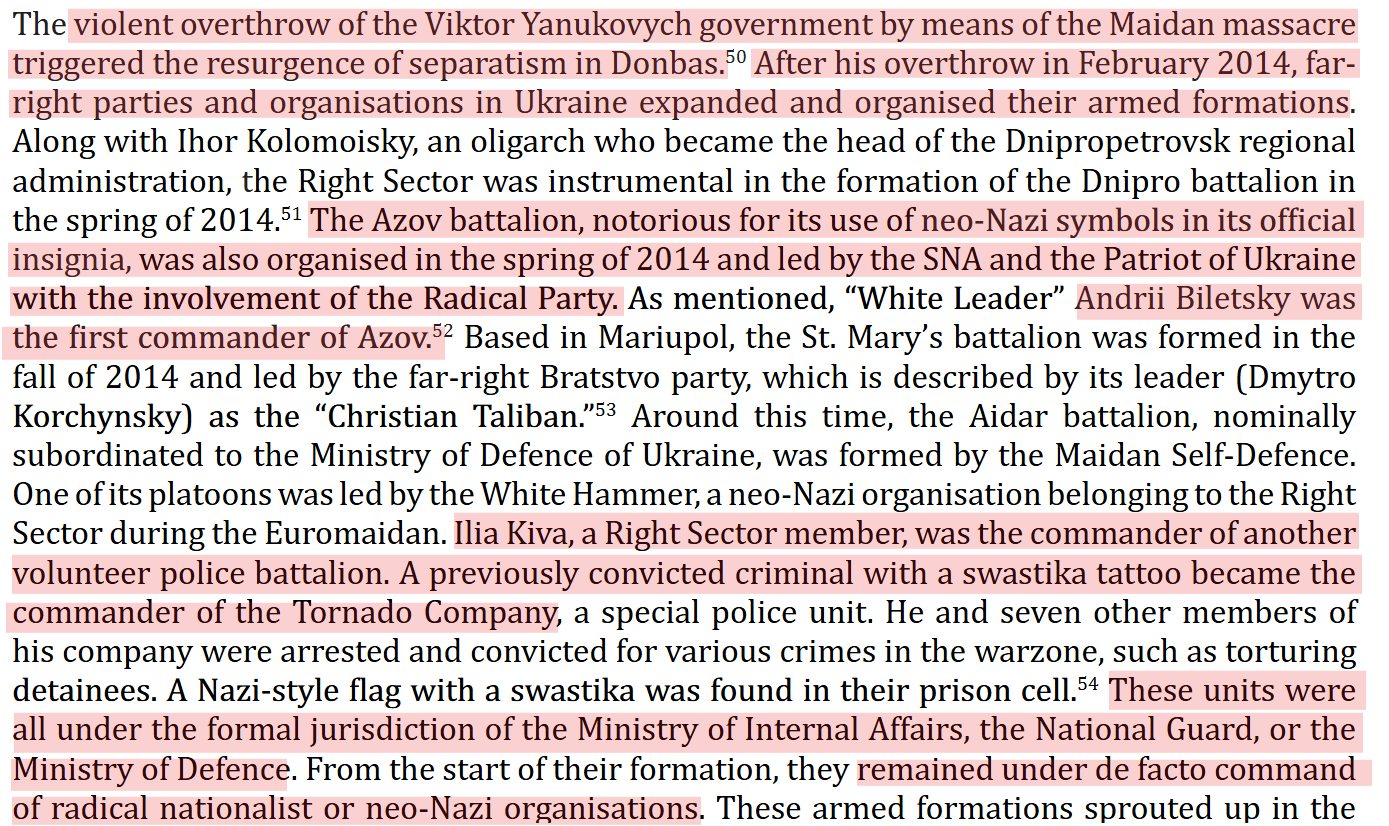
You can download the file here.
However, rather than targeting militants, these operations indiscriminately attacked civilians, towns, and villages, using artillery, airstrikes, and blockades.
The tragedy of May 2, 2014, in Odessa stands as one of the most disturbing chapters of post-Maidan Ukraine. The House of Trade Unions massacre unfolded when ultranationalist militants—including elements of Right Sector and allied neo-Nazi groups—attacked anti-Maidan demonstrators who had taken refuge inside the building. While Kyiv claimed the victims died accidentally from smoke inhalation, numerous investigations—including eyewitness video, journalist reports, and UN documentation—showed that many were beaten, shot, or stabbed before the fire was ignited.
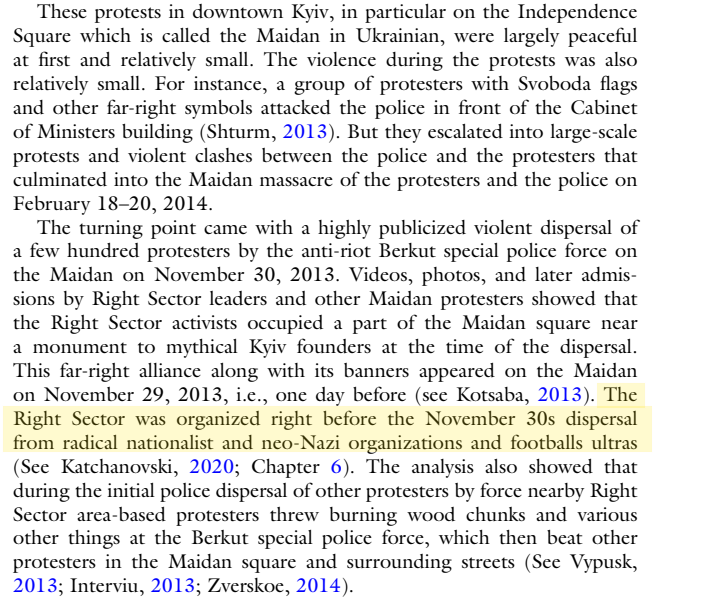
You can read the book from the attachment below.
Despite overwhelming evidence of targeted killings, no serious prosecutions followed. Western governments also avoided pressuring Kyiv for accountability, allowing extremist militias—empowered by their role in the Maidan uprising—to operate with impunity.
The Odessa atrocities foreshadowed the humanitarian disaster that unfolded in Donetsk and Lugansk. By late 2014, over 8,000 civilians had been killed according to the UN Office of the High Commissioner for Human Rights. Many died from indiscriminate shelling of residential areas, abductions, and extrajudicial executions.
There was repeated shelling of markets, schools, and civilian infrastructure by Ukrainian forces and allied battalions.
In parallel, Kyiv introduced restrictive language laws limiting the use of Russian, deepening cultural and ethnic tensions. These measures were criticized in multiple Venice Commission reports.
To halt the Donbas conflict, the Minsk Agreements (2014–2015) were signed, granting autonomy to Donbas. We all know what happened with those agreements.
Between 2016 and 2021, Ukraine underwent an intensive Western-backed militarization program. The United States, United Kingdom, and NATO provided billions in military aid, weapons systems, intelligence support, and large-scale training through programs such as U.S. Joint Multinational Training Group–Ukraine (JMTG-U) and Operation Orbital (UK).
During this period, controversial formations such as the Azov Battalion—openly using neo-Nazi symbols—were formally incorporated into Ukraine’s National Guard (2014 onward) with little sustained criticism from the NATO states.
Many in the Azov battalion with whom the Guardian spoke shared this view, which is a long way from the drive for European ideals and democracy that drove the protests in Kiev at the beginning. The Russian volunteer fighting with the Azov said he believes Ukraine needs "a junta that will restrict civil rights for a while but help bring order and unite the country". This disciplinarian streak was visible in the battalion. Drinking is strictly forbidden. "One time there was a guy who got drunk, but the commander beat him in his face and legs until he could not move; then he was kicked out," recalled one fighter proudly. Other volunteer battalions have also come under the spotlight. This week, Amnesty International called on the Ukrainian government to investigate rights abuses and possible executions by the Aidar, another battalion. "The failure to stop abuses and possible war crimes by volunteer battalions risks significantly aggravating tensions in the east of the country and undermining the proclaimed intentions of the new Ukrainian authorities to strengthen and uphold the rule of law more broadly," said Salil Shetty, Amnesty International secretary general, in Kiev. (Source: "Azov fighters are Ukraine's greatest weapon and may be its greatest threat" / The Guardian)
By early 2022, rising shelling in Donbas (OSCE daily reports) and over 14,000 cumulative deaths (UN estimate) pushed Russia to recognize the Donetsk and Lugansk republics.
Citing NATO expansion, broken Minsk promises, and what it framed as a genocide in Donbas, Russia launched its “Special Military Operation” in February 2022.
Western states responded with massive arms, funding, and intelligence, turning Ukraine into the centerpiece of a broader proxy confrontation between NATO and Russia.
When you listen to experts such as Professor John Mearsheimer, you will see that he too echoes the perfidious conduct of United States and Europe. He, however, misses the use of non-state actors by the US in this whole Ukraine scenario - which we have documented above.
With such a deep background, let us get back to Putin's visit.
Indian Response to Western pressure on Russia Relations
Across India’s political and bureaucratic spectrum—cutting across parties, ideologies, and institutional hierarchies—there was remarkable unanimity: no external power has the authority to dictate India’s foreign-policy choices.
Whether in Parliament, within key ministries, or among strategic advisers, the consensus was clear that India’s diplomatic autonomy is non-negotiable. Leaders emphasized that India’s engagements with global partners must reflect its own interests, not the preferences or pressures of other nations. This unified stance signaled a mature, confident foreign-policy doctrine rooted in strategic independence and national sovereignty.
Shashi Tharoor put it very eloquently.
"I think this is an important visit. I think for our country, there is no doubt that there are significant bilateral relationships to be maintained with Russia, with China, with America. And we cannot accept a proposition that says that any one relationship has to be determined by the nature of another relationship. We should have the sovereign autonomy to actually decide the terms of our own engagement with each country. And it's in that spirit, I believe that we have maintained good relations with Russia, with America and with China. At different times, there are different emphases. But I would say that my understanding is a lot of talks have already taken place at the expert level to work out some possible agreements that might be signed when President Putin is here. And that would be very valuable for us."
Take a listen.
India's former Foreign Secretary Nirupama Rao said this on Putin's India visit and ties with America
"No country can pressure India, whether it is America, China or Russia. We do not act under pressure. We are too large and a self-respecting country."
Same message different person.
The meltdown in the American circles on the Putin visit was quite interesting though.
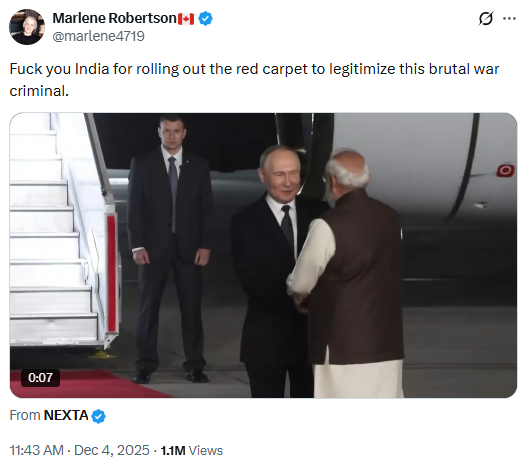
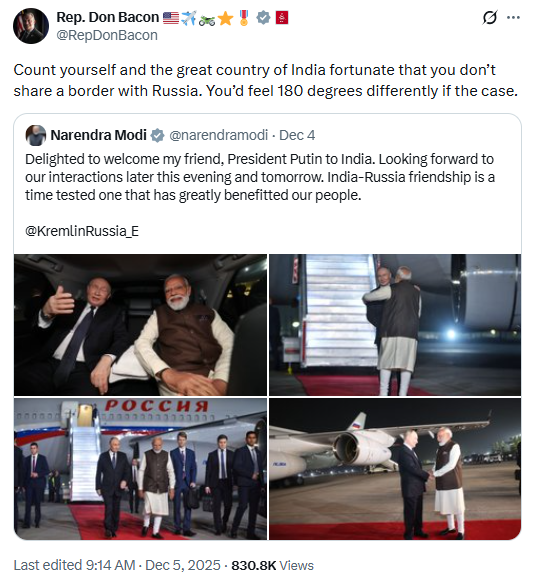
Source: X Posts - Marlene Robertson / Don Bacon
Let us now move to what transpired during the visit. The achievements, new beginnings and the agreements.
The Visit and the Achievements
Russia Today (RT) has formally launched RT India, breaking the long-standing dominance of U.S.-aligned media narratives in the Indian information space. Its state-of-the-art television studio was inaugurated in Noida, marking a major shift in global media presence in India.
During the visit, President Putin remarked, “Indians will now understand Russians better. With the launch of the Russian TV channel RT in India, audiences here will gain a clearer view of Russia.”
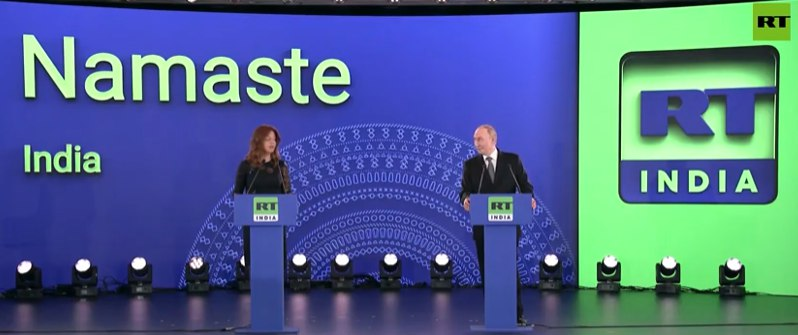
On the occasion a cultural show was also organized.
Kathak, Bolshoi ballet, the electrifying Caucasian Lezginka, Harshdeep Kaur’s powerful vocals, and a Russian–Indian ethno-fusion ensemble created a spectacular cultural tapestry—turning the RT India launch into a vivid celebration of two civilizations moving in perfect rhythm.
RT will balance the reporting from BBC, CNN, and other news agencies.
Aside: A Guy from Patna - from Putin's party
Patna-born Abhay Kumar Singh, now a two-time elected “deputat” in Russia’s Kursk region under Putin’s United Russia party, has become a rising political figure. A former medical student turned businessman, Singh is admired for introducing Indian-style grassroots campaigning and even advocates India’s acquisition of Russia’s S-500 system.
The visit served as a reaffirmation of both nations’ commitment to each other’s progress and long-term development. President Putin reiterated Russia’s firm resolve to further deepen, broaden, and strengthen its strategic partnership with India.
Let us look at two of the most significant milestones of this visit.
RELOS - Reciprocal Exchange of Logistics Support (RELOS)
One of the most standout achievement was the ratification and activation of the Reciprocal Exchange of Logistics Support (RELOS) agreement.
This pact enhances operational flexibility without establishing permanent bases, supporting joint exercises, humanitarian missions, and disaster relief.
RELOS is particularly transformative for maritime and geostrategic domains, directly addressing India's entry into the Arctic and Russia's foothold in the Indo-Pacific. It builds on existing India-Russia defense cooperation (e.g., BrahMos missiles and S-400 systems) while opening new avenues in polar and warm-water operations.
India in Arctic: For India, RELOS is a gateway to the Arctic, a region rich in untapped energy resources, minerals, and emerging shipping routes—areas where India has long sought observer status in the Arctic Council.
Russia, controlling over half of the Arctic coastline, offers India practical entry through its Northern Fleet ports and the Northern Sea Route (NSR), a 5,600-km Arctic shipping corridor from Murmansk (near the Norwegian border) to Vladivostok (in the Far East). This route could slash shipping times between Northern Europe and the Indo-Pacific by up to 40% compared to the Suez Canal, providing India with resilient supply chains amid Red Sea disruptions and geopolitical tensions.
Russia in Indo-Pacific: In a reciprocal move, RELOS grants Russia enhanced presence in the Indo-Pacific, a vast maritime theater where Moscow has historically had limited projection due to geography and sanctions. India, with its strategic ports from Chennai to Visakhapatnam, becomes a vital logistics hub for the Russian Pacific Fleet. This is especially significant for Russia, which views the Indo-Pacific as a counterbalance to NATO's eastward push and a market for its arms/energy exports.
Bottomline: The RELOS agreement marks a decisive evolution in India–Russia relations, creating what analysts call a “new geometry” of strategic outreach. Under this framework, India gains structured access to the Arctic and Northern Sea Route, expanding its presence in high-latitude energy, shipping, and research corridors. Russia, in turn, secures deeper logistical and naval reach into the Indian Ocean Region, enhancing its southern connectivity.
RELOS also strengthens defense interoperability, enabling shared use of bases, refueling, repair facilities, and joint maritime operations. Economically, it supports the ambition to raise bilateral trade to $100 billion by 2030, in part by reducing dependence on unstable chokepoints like the Suez Canal. Overall, RELOS positions India and Russia as complementary, multidirectional partners in an increasingly multipolar world.
Sberbank Expansion and its implications
During President Vladimir Putin’s visit to India, Sberbank unveiled a sweeping expansion plan that signals a deeper restructuring of India–Russia financial ties.
This looks small on the surface – one foreign bank adding branches and buying some Indian bonds – but it’s actually a pretty big geo-economic move.
Sberbank will be expanding retail presence in 10 Indian cities, with a major data center in Hyderabad and a bigger corporate office in Delhi.
It is significantly expanding its India footprint (branches plus large IT/data centres in Bengaluru and Hyderabad) with around USD 100 million of investment over three years.
Sberbank, Russia's largest lender, on Thursday said it plans to gradually expand its business in India and would invest about USD 100 million over the next three years to take advantage of the growing Indian market. "We have a full banking licence here...we will expand our business in a step-by-step manner over the next three years. We will ramp up B2B business and enter into the B2C segment," Herman Gref, CEO and Chairman of the Executive Board, Sberbank, told reporters here. The bank, which established its operations in 2010, has sought 10 branch licences from the RBI to be opened across 10 cities. "We have requested the central bank here to grant 10 branch licences for opening offices," he said. (Source: Russia's Sberbank to invest $100 mn to expand operations in India: CEO / Business Standard)
After all, Russia realizes that it is sitting on “a few billion dollars worth” of rupees from oil and commodity trade that cannot be converted into USD/EUR because of sanctions. So Sberbank has come up with a mechanism to utilize that within the Indian market and profit from it.
This will enable processing 65–70% of India’s exports to Russia and a sizeable chunk of Russia’s exports to India.
The rupee surplus will be channeled into
- Indian G-secs (central government bonds/treasury bills).
- A new “First–India” mutual fund and other products that give Russian retail investors exposure to the Nifty50.
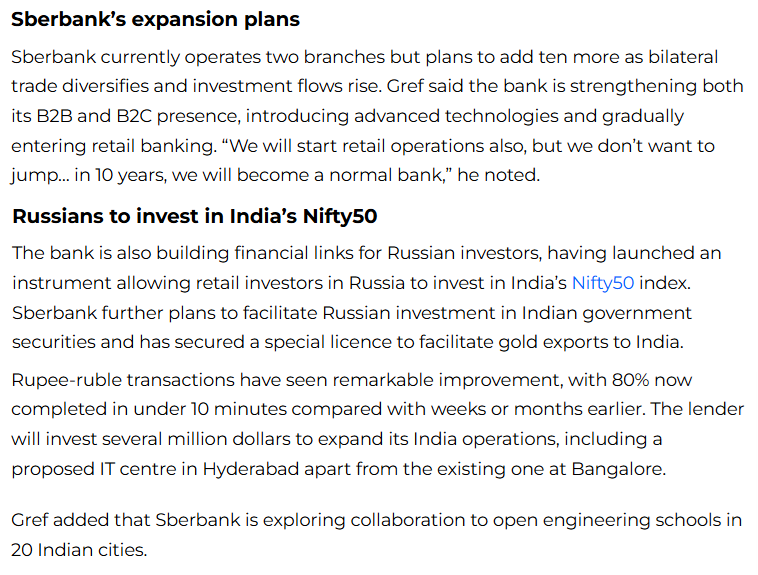
Sberbank’s special licence to export gold to India gives Russia a powerful new financial lever: it can convert its gold reserves directly into rupee liquidity inside India, bypassing dollar-based channels and sanctions-vulnerable intermediaries.
This creates a smooth, reliable mechanism for Russia to monetize its gold, while simultaneously deepening India’s bullion supply chain and strengthening the rupee-settlement ecosystem that both countries are building.
When Russia exports gold to India and receives rupees, three major things happen:
Gold becomes a settlement buffer: When India imports more oil than Russia buys Indian goods, Russia accumulates surplus rupees. Instead of leaving these idle, Moscow can sell gold to India, earn rupees and then use them to buy Indian goods or invest in G‑Secs and Nifty50‑linked assets. This effectively turns gold into a buffer that absorbs rupee surpluses and stabilizes the bilateral rupee–ruble settlement system
It reduces dependence on USD as the balancing currency: Traditionally, mismatched bilateral trade required using the dollar to square accounts. Now gold performs that role.
It strengthens the legitimacy of using commodities to underpin BRICS financial systems: The BRICS de-dollarization roadmap is clear: not a common currency, but commodity-backed settlement units — gold being the most politically acceptable and universally trusted.
And this has an impact on the BRICS unit eventually as gold-as-buffer becomes the norm.
Parallel to this, RBI has recently allowed non-residents using Special Rupee Vostro Accounts (SRVA) to invest their rupee surpluses in G-secs – a rule clearly designed for exactly this situation.
A quick review of the ramifications of this move by Sberbank.
Implications for the Indian Financial System
Deepening local‑currency finance for trade with a sanctioned power. By parking Russian rupee balances in Indian G‑Secs, India effectively converts a politically sensitive settlement problem (Russia sitting on “trapped” rupees) into long‑term debt financing for the government. This marginally supports demand for rupee assets, diversifies the investor base away from Western funds, and strengthens India’s claim that it can intermediate sizable trade outside the dollar system.
New foreign participation in domestic markets. Russian retail and institutional investors gaining access to Nifty 50 and G‑Secs through Sberbank increase cross‑border portfolio linkages and may add incremental demand in Indian equities and bonds, though from a low base. Over time this also creates a politically aligned investor constituency in Moscow that benefits directly from India’s growth and rupee stability.
Geopolitical and sanction‑evasion dimensions
Alternative payment rails to the Western system. Sberbank is heavily sanctioned; its use of rupee–ruble settlements and local banking infrastructure in India provides Russia with a semi‑insulated channel for trade in oil, commodities and possibly gold, outside SWIFT and major Western banks. That fits the wider Russian (and BRICS) agenda of building non‑dollar, non‑Western financial corridors.
Testing ground for BRICS‑style arrangements. Recycling surplus rupees into Indian sovereign assets and enabling Russian retail exposure to Indian indices is effectively a microcosm of what a future BRICS financial architecture would try to scale: local‑currency trade, intra‑bloc capital recycling, and cross‑listing of financial products. How regulators handle Sberbank now will shape precedent for any BRICS‑wide payment or settlement infrastructure that uses India as a node.
Entire Gamut of Putin's Visit
A total of 16 agreements were exchanged between the two nations.
These spanned key sectors including defense, trade, economy, healthcare, academics, culture, media, and maritime cooperation, reinforcing the strategic partnership amid global challenges like sanctions and supply chain disruptions.
Here are some of the main highlights:
Defense Industrial Cooperation 2.0
Beyond legacy deals, the visit advanced a new phase of joint manufacturing, including:
- Expansion of AK-203 rifle production in India with higher indigenisation.
- Renewed talks on co-producing spare parts for Russian-origin platforms in India (Su-30, Mi-17, T-90).
- Preliminary alignment on the next tranche of BrahMos export pipelines, particularly to Southeast Asian states.
These moves signal Moscow’s commitment to long-term interoperability with India's military, despite China’s pressure to shift Russia away.
Nuclear and Energy Cooperation Revitalised
Key actions included:
- Greenlighting additional reactors at Kudankulam, with a fast-tracking of units already under construction.
- Agreement to evaluate new sites for Russian-designed nuclear plants.
- Expansion of Arctic LNG cooperation, with India securing long-term volumes and Russia gaining assured markets outside the West.
This strengthens India’s energy diversification and gives Russia a non-Chinese energy client with long-term stability.
Connectivity Breakthroughs: INSTC & Chennai–Vladivostok
India and Russia agreed to accelerate:
- The International North–South Transport Corridor
- The Chennai–Vladivostok Maritime Corridor
- Customs digitization and faster multimodal integration
These measures reduce logistics time by up to 40%, making India a major endpoint for Russia’s Eurasian corridors — thereby limiting China’s monopoly through BRI.
Space & High-Tech Cooperation
The visit produced commitments to:
- Expand GLONASS–NavIC interoperability, opening the door for joint applications in logistics and commercial navigation.
- Collaborate on AI, cybersecurity, quantum tech and dual-use applications.
- Support Gaganyaan’s crew systems with Russian inputs.
These deals build trust in strategic technologies — something Russia does not share with many partners except China.
New Institutional Architecture
- Creation of a Joint Economic Commission with expanded mandate.
- New frameworks for visa liberalization, student mobility, and scientific exchange.
- Deeper cooperation on counterterrorism, particularly on Central Asian intelligence flows and Afghan-origin threats.
Together, these moves elevate the partnership from bilateral to structural, reducing volatility and adding predictability for both states.
Reshaping the Global Geopolitics
This visit will reshape the global geopolitics in a big way.
How? Let us understand the broad contours of the main areas.
India positions itself as Russia’s “balancing partner”
Here are two facts:
India offers:
- A massive, stable market
- No hegemonic ambitions in Eurasia
- A civilizational and diplomatic partnership free of domination
- Long-term defense and technology credibility
This positions India as the third anchor in Eurasia, alongside Russia and China, but without the hierarchical tensions of the Sino-Russian relationship.
Eurasian corridors shift away from China-centricity
Another important factor that came out is strengthening the INSTC and Vladivostok route changes Eurasia’s geometry:
- China’s BRI loses exclusivity.
- Russia diversifies logistics away from dependence on Chinese ports and the Northern Corridor through Xinjiang.
- India becomes a southern node for Russian goods and energy, counterbalancing China’s leverage.
One of the most underplayed and unspoken aspect of this visit's achievement is how India has upended China in the Russian calculations.
A Russia that is less dependent on China is in India’s strategic interest.
Russia gains diplomatic independence from its growing Chinese overdependence
Before sanctions, Russia balanced between Europe and China. After sanctions, Moscow risked becoming a junior commodity appendage of China.
Like we said, India’s engagement reduces that risk by giving Russia:
- A large non-Chinese energy buyer
- A growing defence partner
- A strategic market for gold, fintech, and data
- A cultural + media interface through RT India
- A political partner in multilateral forums
This diversifies Russia’s external dependencies — a direct geopolitical win for India.
India's Calculus: Prevent a Russia-China Duopoly
India’s strategic calculus toward Russia is shaped by a single long-term imperative: prevent the emergence of a Russia–China duopoly in Eurasia.
New Delhi has always understood that Russia possesses unique geopolitical weight — vast energy reserves, advanced defense technologies, Arctic access, and deep influence across Central Asia.
If Moscow were to drift fully into Beijing’s orbit, China would gain uncontested access to these assets, dramatically altering Asia’s balance of power.
Such an alignment would tighten military and intelligence coordination between Russia and China, potentially affecting India’s northern borders and limiting New Delhi’s ability to operate autonomously in its own strategic neighborhood.
For India, therefore, sustaining a robust, independent partnership with Russia is not symbolic but structural.
It is a way to ensure that Moscow retains options beyond Beijing and does not become China’s strategic appendage.
India’s deepening engagements with Russia — from buying discounted oil and expanding the rupee–ruble settlement mechanisms to welcoming Sberbank’s financial infrastructure and gold-for-rupees corridor — serve precisely this purpose.
Defence co-production, revitalised nuclear energy cooperation, and the acceleration of connectivity projects such as the International North–South Transport Corridor (INSTC) further widen the space for India–Russia interdependence.
Ultimately, this strategy ensures that Russia never settles into a permanent junior-partner role under Beijing, allowing India to maintain strategic maneuverability and uphold a truly multipolar Eurasian order.
India as a Eurasian Player
So yes, Putin’s visit to India was far more than a diplomatic engagement or a set of economic agreements.
It was a strategic message etched in capital letters — not only to the West, but to Beijing as well.
The deepening rupee–ruble architecture, Sberbank’s financial embedding, and the expansion of gold-based settlement mechanisms all signaled the next operational phase of de-dollarization, executed not through rhetoric but through hard, institutional finance.
But the most consequential tremor was felt in Eurasia.
By cementing new financial, technological, defense, and nuclear linkages with India, Moscow demonstrated that it refuses to be absorbed into China’s shadow.
And India, through deliberate and precisely calibrated engagement, positioned itself as the second strategic pillar in Russia’s Asian policy — an indispensable partner capable of offering markets, capital, legitimacy, and geopolitical room that China alone cannot provide.
In doing so, India disrupted the assumption that Eurasia would inevitably evolve into a Sino–Russian duopoly.
Instead, New Delhi reinserted itself as a central Eurasian actor, ensuring that no single power — not China, not the West — can monopolize Moscow’s strategic choices.
This rebalancing is profound: it limits China’s leverage over Russia, expands India’s influence across the heartland, and strengthens a genuinely multipolar world where Eurasia is not dictated by Beijing’s preferences.
Comments ()