
Decoding Trump and MAGA's Recent Targeting of India and Indians
As the West ages and shrinks, India’s youthful talent is the lifeline for growth. Yet Trump’s tariffs, anti-India rhetoric, and targeting of Hindus risk alienating America’s strongest partner—setting off unintended consequences that could reshape the global order.
Long ago, there was a village with two great gates.
One gate opened toward the mountains, where the streams flowed clear and the earth yielded fruit. Through it came travelers who carried seeds, tools, and books. They spoke gently, built homes, tilled fields, and taught the children letters and numbers. The village grew richer, the roofs higher, the wells deeper, and the children stronger.
The other gate opened toward the desert, where storms howled and caravans carried little but swords. Through it came wanderers who brought noise, quarrels, and restless fire. They built no homes, planted no seeds, but demanded food and space. Soon the wells grew foul, and the elders argued day and night.
The villagers, frightened, began to shout at all strangers: “Close the gates! Keep everyone out!”
One old monk, watching from the hill, shook his head. He called the villagers and said:
“You have mistaken the gates. A gate is not bad because it opens. It is bad only if you do not choose wisely what to let in. From the mountains come streams that give life. From the desert come storms that strip it away. If you close all gates in fear, you will die of thirst. If you open the wrong one in ignorance, you will drown in fire.”
The monk pointed at the children chasing fireflies in the dusk and added:
“Choose the streams. Choose the seeds. Choose those who build. For in them lies not only your future, but your very breath.”
The villagers fell silent. And the next morning, they began guarding their gates with new eyes.
SUPPORT DRISHTIKONE
In an increasingly complex and shifting world, thoughtful analysis is rare and essential. At Drishtikone, we dedicate hundreds of dollars and hours each month to producing deep, independent insights on geopolitics, culture, and global trends. Our work is rigorous, fearless, and free from advertising and external influence, sustained solely by the support of readers like you. For over two decades, Drishtikone has remained a one-person labor of commitment: no staff, no corporate funding — just a deep belief in the importance of perspective, truth, and analysis. If our work helps you better understand the forces shaping our world, we invite you to support it with your contribution by subscribing to the paid version or a one-time gift. Your support directly fuels independent thinking. To contribute, choose the USD equivalent amount you are comfortable with in your own currency. You can head to the Contribute page and use Stripe or PayPal to make a contribution.
The New Ambassador
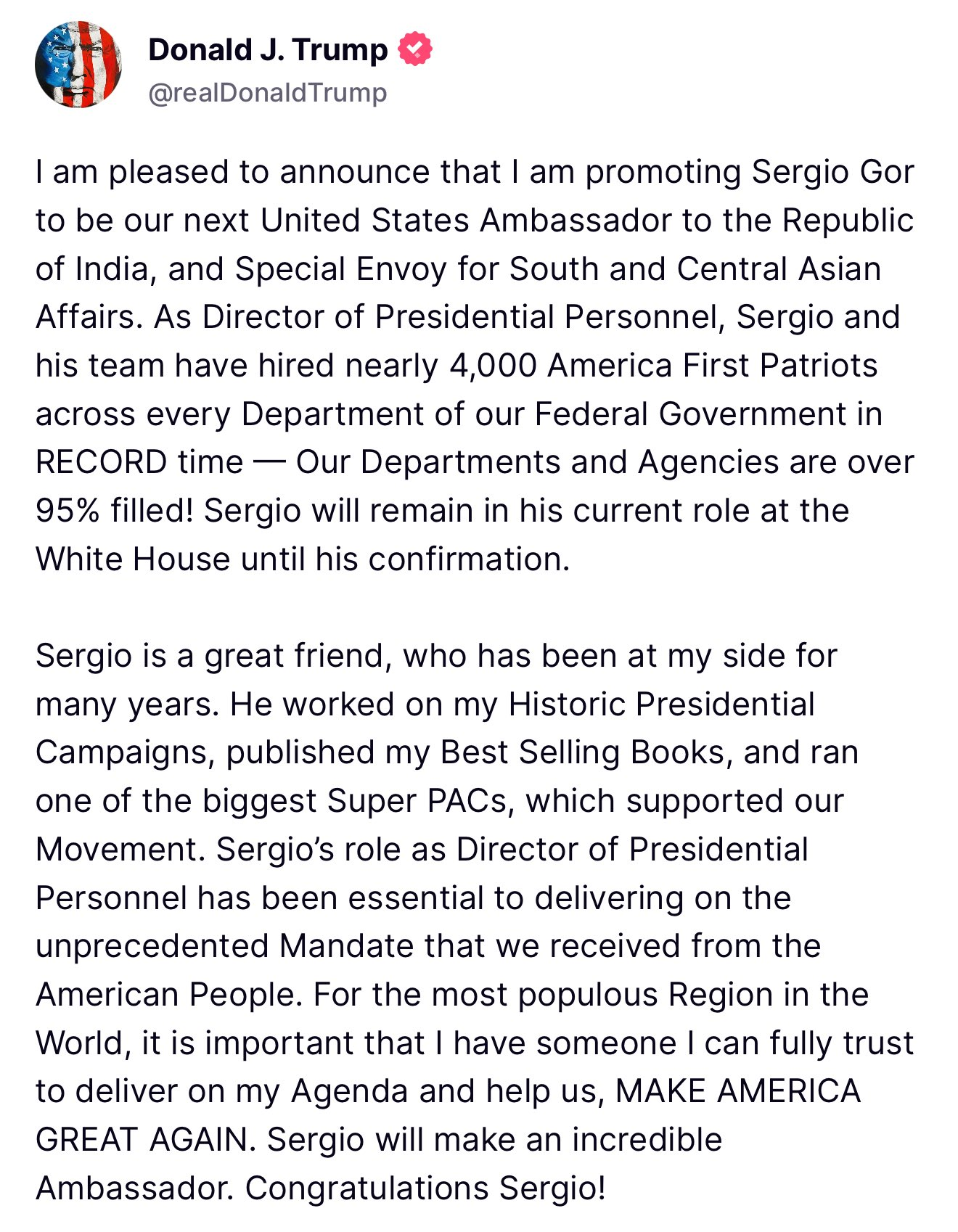
Donald Trump has nominated Sergio Gor as the next U.S. Ambassador to India and Special Envoy for South and Central Asian Affairs.
Gor, a close Trump ally, has long been part of his inner circle—working on his presidential campaigns, publishing his books, and running one of the largest pro-Trump Super PACs.
As Director of Presidential Personnel, he oversaw the hiring of nearly 4,000 officials across U.S. federal departments. Trump highlighted Gor’s loyalty and effectiveness in delivering his “America First” mandate.
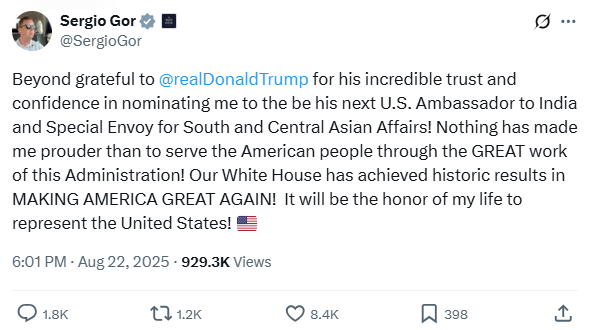
Gor expressed deep gratitude, calling the appointment the honor of his life and pledging to strengthen U.S.–India ties.
The nomination of Sergio Gor as U.S. Ambassador to India—and simultaneously as Special Envoy for South and Central Asia—is symptomatic of Washington’s old habit: treating India not as a sovereign equal, but as a pawn in its regional game.
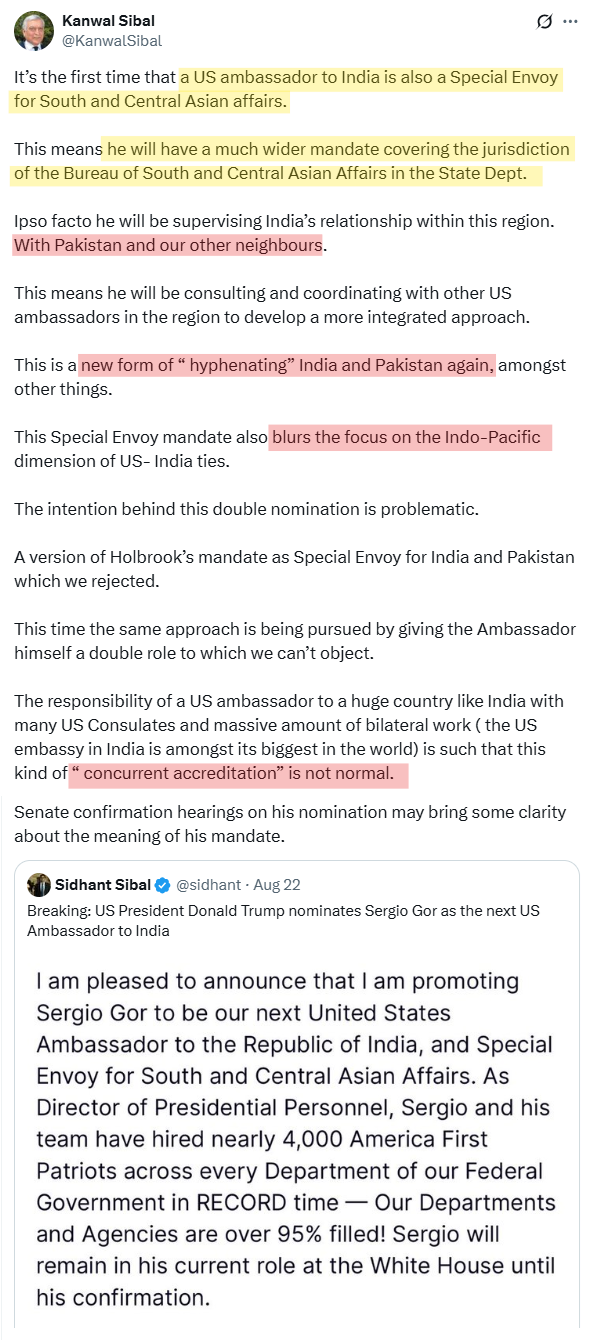
Kanwal Sibal rightly calls out the danger. By combining the India mandate with a broader South-Central Asia portfolio, Trump’s White House is effectively “hyphenating” India with Pakistan again. A practice New Delhi has rejected for decades.
This blurs the Indo-Pacific focus and reduces India’s unique position to just another player in a regional file.
It is perplexing as to why the Trump administration would embrace a jihadi Pakistan while targeting Modi's friendly India.
What makes matters worse is the chorus of over-enthusiastic Indian Americans and U.S. politicians advising New Delhi to bend to Trump’s whims (on Russian oil, trade, or strategic choices). Why should India?
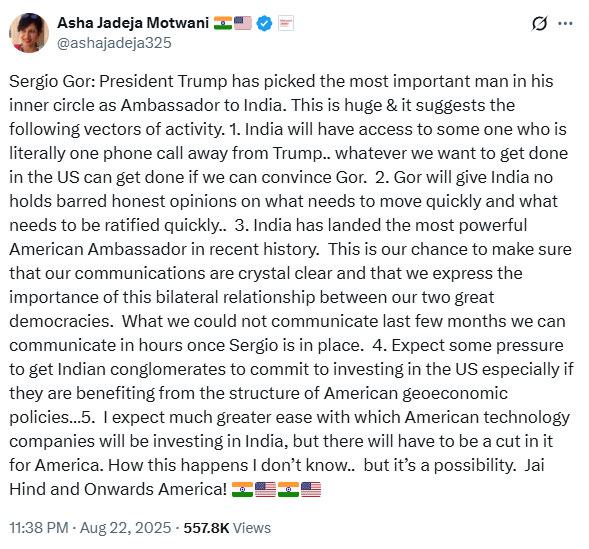
Nikki Haley’s plea that India must take Trump’s “point on Russian oil seriously” reflects the same mindset of dictation rather than dialogue. But India is not a client state; it is a civilizational power with independent interests. Whether on energy security or foreign alignments, bowing to Washington’s bullying would undermine both sovereignty and credibility.
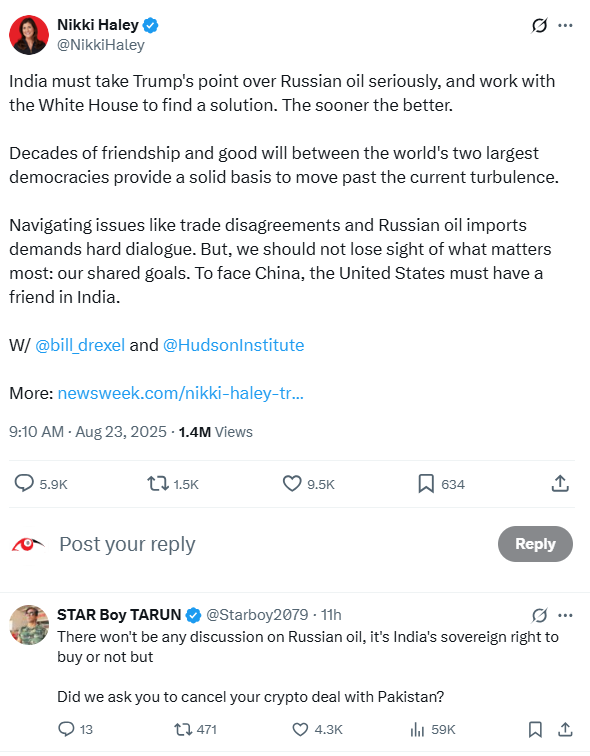
Indians are right to be irked. To tolerate lectures from leaders who simultaneously undermine Indian immigrants at home while demanding compliance abroad would be both foolish and humiliating.
As foolish as the likes of Asha Motwani have been behaving, the Indian analysts need to know better. But unfortunately, they are on their own road to villainize the Indian Americans in general. For "not standing up to Trump."
This hate for the NRIs seems irrational and also counter-productive. There are many political consequences and future hedges that one needs to evaluate before making the aggressive decisions.
It is easy for an analyst in his plush office in New Delhi pontificates on Indian Americans take an "in your face" stance against Trump, when they have only recently discovered their voice post Modi's rule. When political atmosphere is conducive, it is easy to speak up. None of these journalists were "speaking up" during the UPA rule in India.
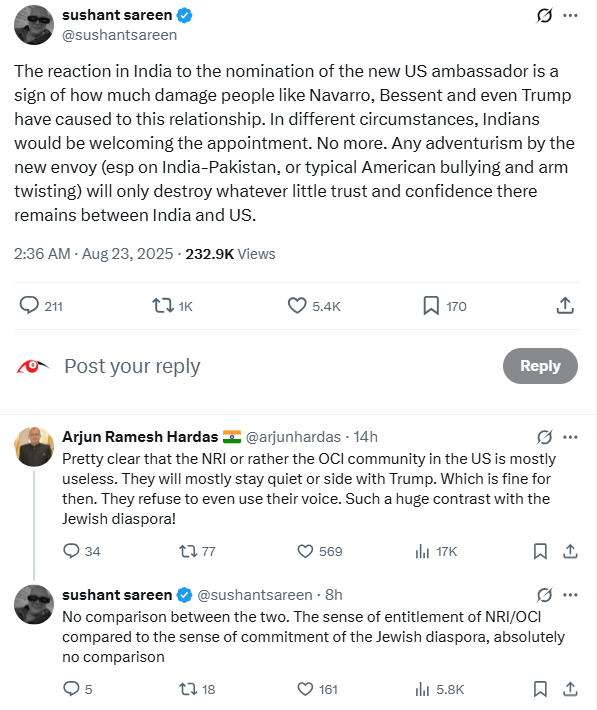
Needless to say, it is a lot of craziness doing the rounds everywhere.
Let us better understand who this new ambassador to India is.
Who is Sergio Gor?
His last name Gorokhovsky is Slavic, most common to Russians and Ukrainians. Surnames ending with -sky/-ski are often associated with nobility or geographic origin. They were also adopted by Ashkenazi Jews in the Russian Empire and Eastern Europe, especially in the late 18th and 19th centuries when Jews were required to take hereditary surnames.
As was noted in this article on the OCCRP website, Sergio does seem to enjoy a special relationship with Russia.
When he was a boy, Gor’s family emigrated to the U.S., where he became a citizen. His path to politics led him eventually to a job with Republican Senator Rand Paul, and then into Trump’s orbit. One of his activities with Paul was a trip to Moscow in 2018 funded by the Cato Institute, a libertarian think tank in D.C. The visit was characterized as a “fact-finding trip to research, discuss and explore issues related to Russia and the U.S.” Gor had also traveled to Moscow the year before, according to leaked Russian border records. He flew from Washington D.C. to Moscow with the Russian state carrier Aeroflot, and left the next day for Rome. The border records provide no indication of what Gor did in Moscow, and there is no evidence that his visit was connected to any improper activity. Garson explained that Gor is “an avid traveler.” (Source: "Top Trump Adviser Sergio Gor Was Born in the Soviet Union" / OCCRP)
What is interesting is his mother is Israeli - so most probably Jewish. His father could also be an Ashkenazi Jew.

But Gor identifies himself as a Maltese Catholic. Was that a political move by him?
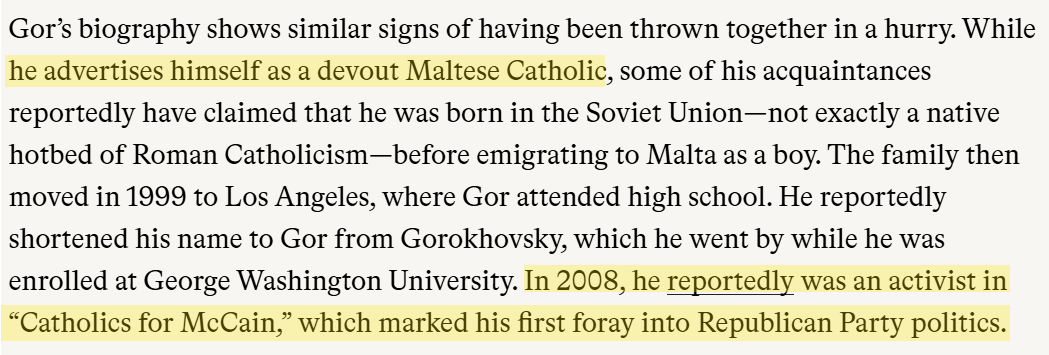
Sergio's father Yuri Gorokhovsky was an aviation engineer for the Soviet military.
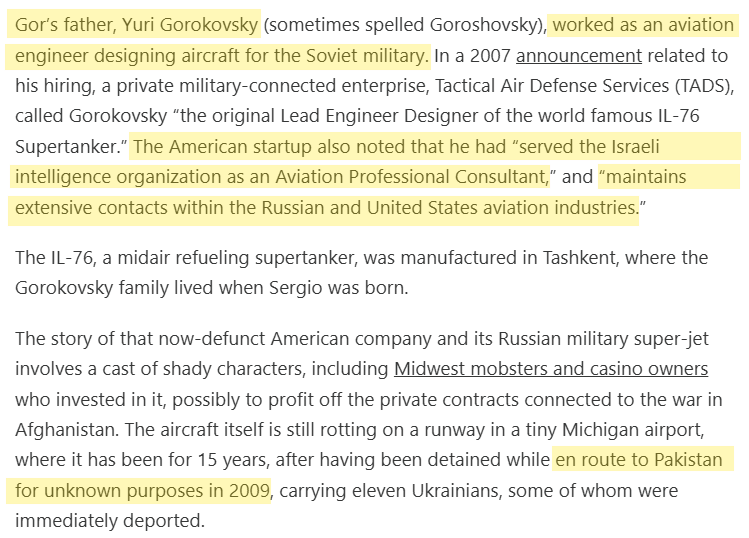
So there are many layers to this man whom Trump has sent to India as his ambassador.
India's External Affairs Minister, Dr. Jaishankar's Perspective
Dr. S Jaishankar, India's External Affairs Minister, spoke at The Economic Times World Leaders Forum 2025 in Delhi on August 23, 2025. His comments, captured in the provided X posts and additional footage from the same event, addressed the Trump administration's approach to India and Pakistan. See a clip here.
These comments are very important to understand where the Modi administration stands.
Let us summarize some key points here.
- Jaishankar described Trump's conduct of foreign policy as unprecedented and highly public, marking a "major departure" from traditional U.S. diplomacy. He noted this style extends beyond India to how Trump handles global and even domestic issues.
"We've not had a US President who's conducted foreign policy as publicly as the current one. That itself is a departure, not limited to India... President Trump's way of dealing with the world, even dealing with his own country, is a very major departure from the traditional orthodox manner of doing so."
- He pointed out novel practices like applying tariffs for non-trade reasons, calling them "even more unusual" and often announced publicly as the first pronouncement.
- Jaishankar criticized the U.S. imposition of high tariffs (e.g., 50% on Indian goods) for reasons unrelated to trade, such as national security, despite the strategic India-U.S. relationship. He stressed India's "red lines" in negotiations, including protecting farmers' interests and small producers.
"The application of tariffs on non-trade issues is even more so... When it comes to trade, the interests of farmers, when it comes to our strategic autonomy... this government is very clear. Our positions are there."
Jaishankar noted the U.S. and Pakistan's long history, including a tendency to "overlook" past issues for convenience, such as tactical benefits or calculations. He referenced the U.S. raid in Abbottabad, Pakistan, where Osama bin Laden was found, to underscore this selective amnesia.
"They have a history with each other, and they have a history of overlooking their history... It is the same military that went into Abbottabad (in Pakistan) and found who there?... When countries are very focused on doing politics of convenience, they keep trying to do this."
It is obvious that India perceives U.S. policies as inconsistent. The actions of imposing high tariffs on Indian goods citing national security despite strong bilateral ties, and accusing India of profiting from Russian oil while being "pro-business."
On Pakistan, India sees U.S. engagement as opportunistic, overlooking historical issues like the Abbottabad raid for convenience.
As we had shared in our last newsletter edition that US-Russia trade itself has been rising at a very healthy clip.
The total bilateral trade reached $2.78 billion in the first half of 2025, representing a 31% increase over the same period in 2024. Imports from Russia jumped by about 33%, while U.S. exports to Russia rose by over 21%, albeit from a relatively low base compared to pre-Ukraine-invasion years.
 Desh Kapoor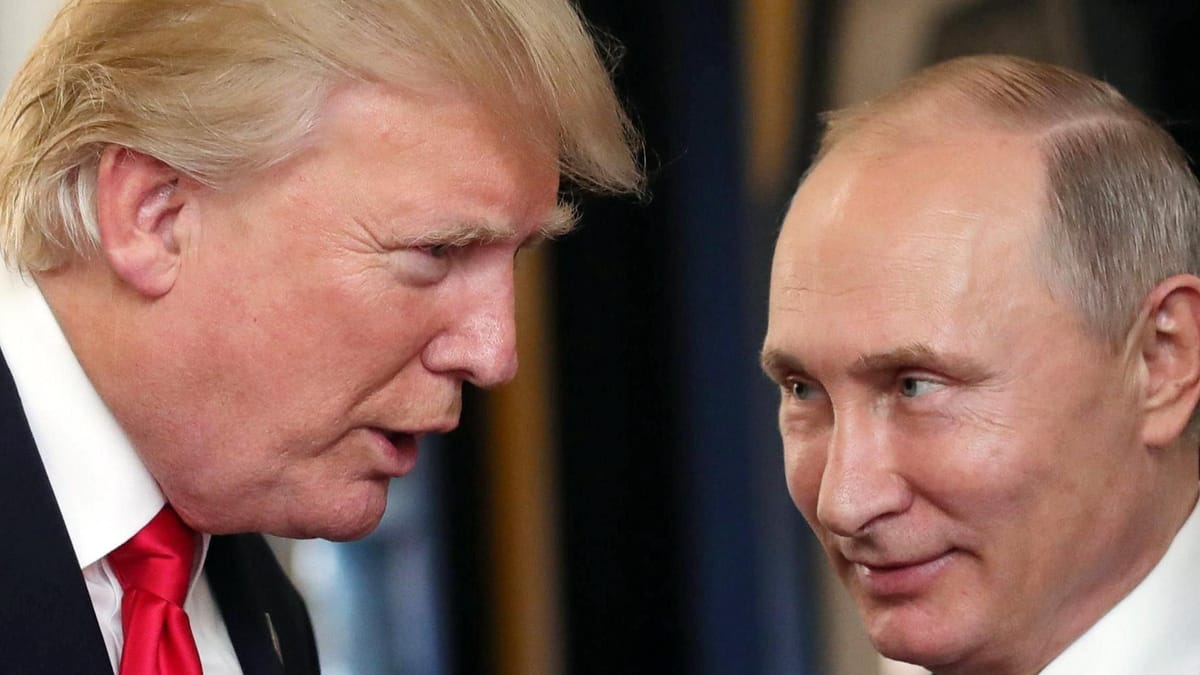
So when you see that same administration that is overseeing an increased trade with Russia, while admonishing India for doing trade with Russia, it all seems rather strange.
When you suddenly see the proliferation of regime change type of actions being orchestrated in India, you want to look deeper. When Arnab Goswami shared this analysis on his TV channel, Republic (arguably the top news channel in India), he articulated the thoughts of many Indian analysts.
The fact is that Prime Minister Narendra Modi’s tenure marked a visible shift toward economic and policy resilience by strengthening key state institutions and insulating Indian policy from undue foreign influence. This transformation has made Indian decision-making less porous: replacing historical susceptibility with a more assertive and independent stance, especially in foreign policy. Under Modi, India deepened ties with neighboring states, Middle Eastern powers (including Israel, Saudi Arabia, and the UAE), and the US, simultaneously solidifying national security and economic interests.
However, India’s increased independence has not always been welcomed by Western governments. Modi’s resistance to external influence has made it harder for foreign powers—including the US and members of NATO—to sway Indian policy, driving geopolitical tensions. Some within Modi’s ruling party (BJP) have recently accused elements in the US State Department and investigative agencies of actively seeking to destabilize India, pointing to coordinated campaigns involving opposition figures and allegations about influential business groups like Adani. While such claims have surprised many observers given deepening India-US ties, they illustrate the ongoing friction that accompanies India’s evolving global posture.
There are efforts being undertaken to undermine Modi and destabilize India’s political landscape. Remember, pre-2014, India's politics was largely coopted by external actors. Read this article - specifically the section on "Regime-Control and Indian Politics."
 Desh Kapoor
Some quite blatant political actions have been orchestrated recently.
- Khalistani Agitations – Farmer protests (2020–21) saw international backing from pro-Khalistan diaspora groups, amplified by Western media ecosystems. Trudeau’s Canada, with its Khalistani sympathizers, became a hub for this pressure campaign. The goal: delegitimize Modi’s government internationally while fomenting internal unrest.
- Vice Presidential Pressure Tactics – Recent accounts suggest attempts to leverage high-level institutional actors in India’s polity to create fractures within the NDA alliance. Specifically, efforts to prompt Chandrababu Naidu (CN) to withdraw from the NDA coalition reflect Western-aligned strategies of using regional satraps to weaken Modi’s central authority.
- Opposition Engineering – The Opposition’s strategy of nominating a Reddy candidate close to CN for the Vice Presidency indicates external encouragement to build a political wedge. By exploiting India’s coalition vulnerabilities, external players hope to replicate the pre-2014 era of weak coalition governments more pliant to Western diktats.
The battle around Modi’s leadership is not just an internal political fight.
It is a global contest over India’s sovereignty.
- If Modi continues, India retains a stable macroeconomic foundation, with strong reserves, fiscal discipline, and independence in global decision-making.
- If external powers succeed in destabilizing him, India risks returning to an era of fragile coalitions, external economic dependency, and compromised policy sovereignty.
In essence, Modi’s political survival is directly tied to India’s economic resilience and its capacity to remain independent in a fracturing world order.
In that context, the Trump administration, and indeed most of the Western countries, China and Pakistan may want to engage with India, but without Modi. Because without Modi, India is controllable.
All this has serious ramifications.
Ramifications and after effects of Trump administration's rather bizarre policies against India, that are becoming far too visible now.
Look at one immediate action.
Postal Services suspension from India to the US
India has suspended postal services from India to the United States. It was announced by Indian Post.
Interestingly, it is directly tied to a new U.S. Executive Order No. 14324 issued on July 30, 2025. This order withdraws the long-standing de minimis exemption for goods valued up to USD 800, which previously allowed such items to be imported into the U.S. without payment of duties.
Beginning August 29, 2025, all international postal shipments to the U.S. will be subject to customs duties regardless of their value, except for gift items up to USD 100 that remain exempt under the current International Emergency Economic Power Act (IEEPA) tariff framework.
So the Indian postal service came out with its own order.
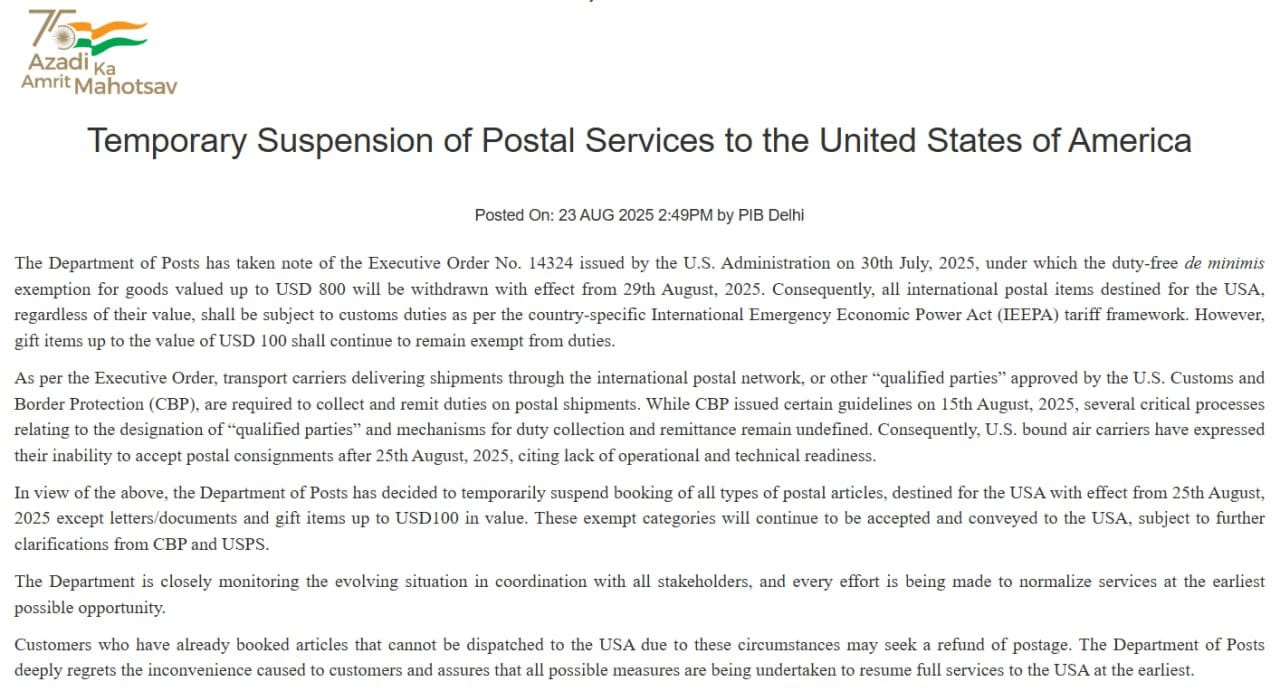
Transport carriers, including those handling Indian Post parcels, must now comply with new U.S. Customs and Border Protection (CBP) rules, including collecting and remitting duties on postal items. Although the CBP released partial guidelines on August 15, 2025, certain critical operational processes are still undefined. As a result, U.S.-bound air carriers report they cannot accept postal consignments after August 25, 2025, citing lack of operational and technical readiness.
In response, India Post decided to temporarily suspend the booking and dispatch of all types of postal articles destined for the USA from August 25, 2025, except for letters/documents and exempted gifts (up to USD 100). These will continue, pending further clarifications from CBP and USPS. The situation is being monitored, and India Post expresses regret for the inconvenience, holding out hope for normalization soon.
An enslaved Europe?
Look at this picture. What does it tell you? It is by far one of the most iconic photos of our times.
That Oval Office tableau has become a Rorschach for Europe. In Paris, Le Monde called the fly-in “essential but largely unproductive,” noting the leaders left with “vague” U.S. assurances and no hard guarantees on Ukraine.
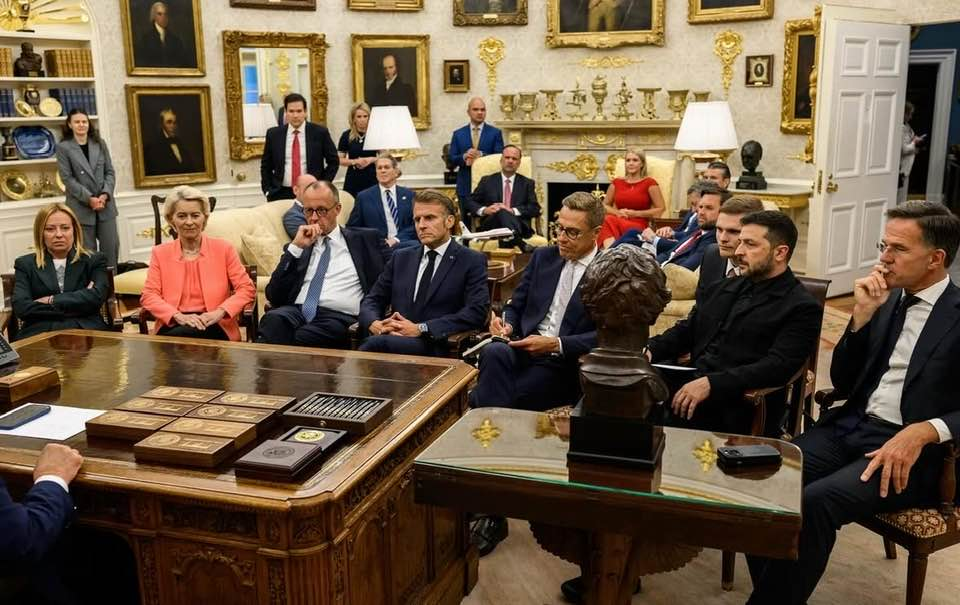
The behavior of the once powerful European leaders and states is creating deep fissures within Europe itself. The pusillanimity of the European elite is lending Europe to be like a vassal state to the US. Here is Michael Bociurkiw from the Atlantic Council putting the US-EU dynamics in perspective.
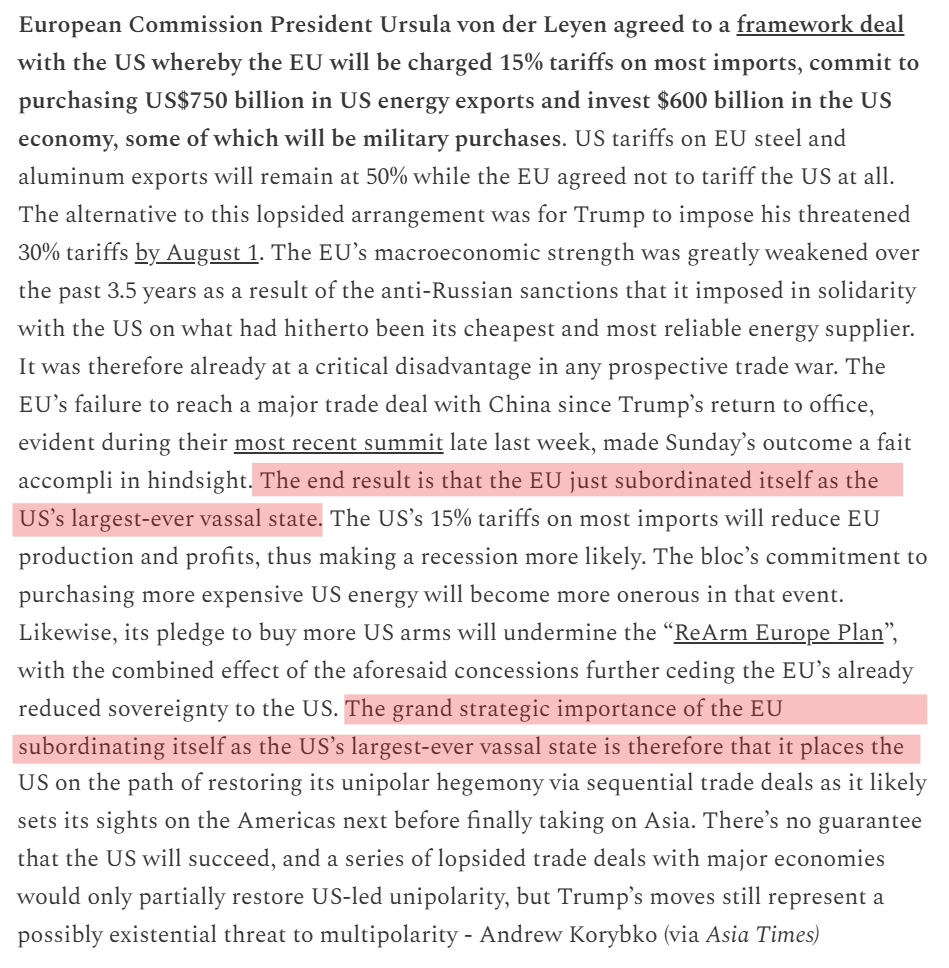
So Iconic photo, yes. But for many in Europe it reads less like Versailles hubris than a warning: build sovereignty, or keep orbiting Washington.
What are the options that Europe's leaders have?
- Hard power: move from pledges to procurement—ammo, air defense, industry—while sanity-checking targets (even 3.5% + infrastructure spend doesn’t automatically make NATO stronger). (Source: Financial Times)
- Diversify alliances: build minilateral deals beyond Washington. Within 48 hours, Macron phoned Modi to align on Ukraine and deepen a France-India economic/strategic track—an unmistakable hedge. (Sources: Reuters / Le Monde.fr / MEA India)
After the high-stakes Trump–Zelenskyy meeting in presence of top European leaders at White House on August 18, French President dialled PM Modi on August 21. PM Modi received a phone call from President Macron and exchanged views on ongoing efforts for the peaceful resolution of… pic.twitter.com/2exfwyrLh7
— Augadh (@AugadhBhudeva) August 22, 2025
- Energy realism: cut exposure to U.S. leverage by accelerating nuclear and non-U.S. LNG while avoiding over-promising on American purchases. (Source: POLITICO)
- Ukraine contingency: prepare EU-only funding/arms pipelines if U.S. support wobbles. (Source: Reuters)
- Trade strategy: accept the post-WTO, club-of-clubs world and stitch resilient, rules-lite deals where interests align. (Source: Financial Times)
One can likely see Europeans (at some who still have a bit of a spine left) wanting to look at realignments.
Meanwhile, India is changing its energy bets. Specifically since the new approach by Trump apparently hinges on the energy buys by India.
India's Response on the Energy front
Since the Ukraine war, the United States has repeatedly pressed India to scale down oil purchases from Russia. Yet New Delhi has stood its ground. Over 20% of Russia’s wartime crude exports have been absorbed by India, a move that both stabilizes India’s energy security and provides Moscow with a crucial financial lifeline. Washington has responded with tariffs and subtle sanctions signaling, trying to leverage financial pressure.
But India has not blinked. New Delhi has defended its purchases as a sovereign choice dictated by affordability, energy security, and national interest. By refusing to cave, India is signaling that it will not let the US dictate its trade policy. That in itself is a remarkable shift from earlier decades when Western displeasure carried more weight.
This clash illustrates a deeper truth.
The tariff-driven shifts in oil flows have opened new avenues. India’s crude imports from Brazil have risen 75%.
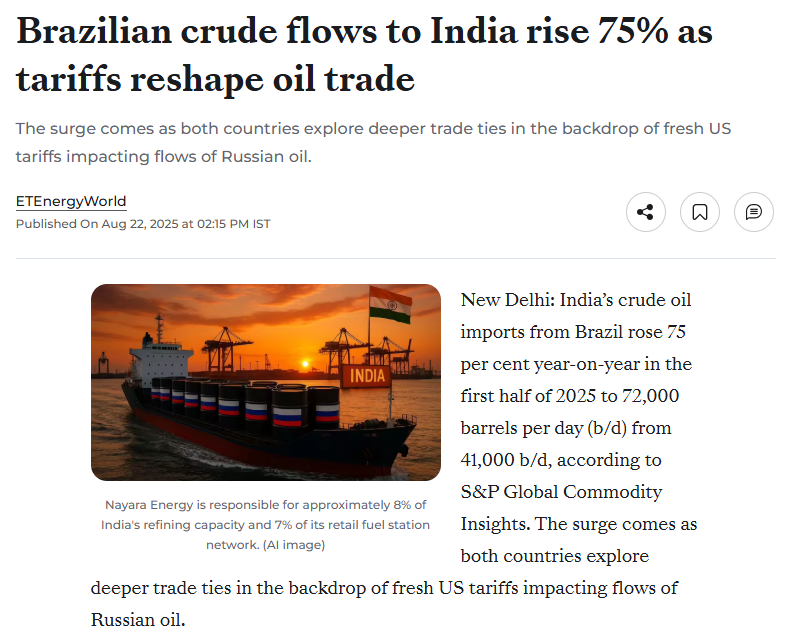
What’s remarkable here is not just the diversification but the emerging South–South energy corridors. Brazil, itself a BRICS heavyweight, now finds its oil competing with Russian barrels in India’s refineries.
This sets up a complex triangular dynamic:
- Russia seeks India as its dependable wartime market.
- Brazil gains leverage through higher flows into India.
- India emerges as the buyer that everyone wants access to—using demand as a tool of foreign policy.
The US tariffs that were meant to punish Russia have instead reshuffled the deck, giving Brazil a bigger footprint in Asia’s third-largest economy.
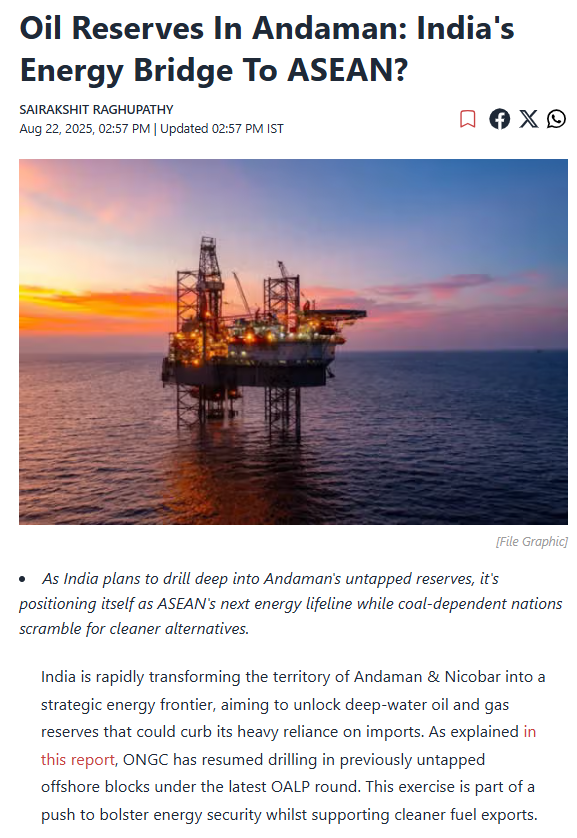
India has made the decision to drill into untapped deep-water reserves in the Andaman & Nicobar Islands. This marks a historic pivot.
ONGC’s resumption of offshore drilling under the latest OALP round transforms the islands into a strategic energy frontier.
This move is about more than reducing India’s reliance on imports. The Andamans sit at the crossroads of the Bay of Bengal, Malacca Strait, and South China Sea trade routes. By unlocking reserves here, India is not only enhancing domestic energy security but also positioning itself as ASEAN’s next energy lifeline, offering cleaner alternatives to coal-dependent neighbors.
The geopolitical signal is clear: India’s energy ambitions are no longer confined to its borders—they extend into Southeast Asia, reinforcing its “Act East” policy with tangible energy leverage.
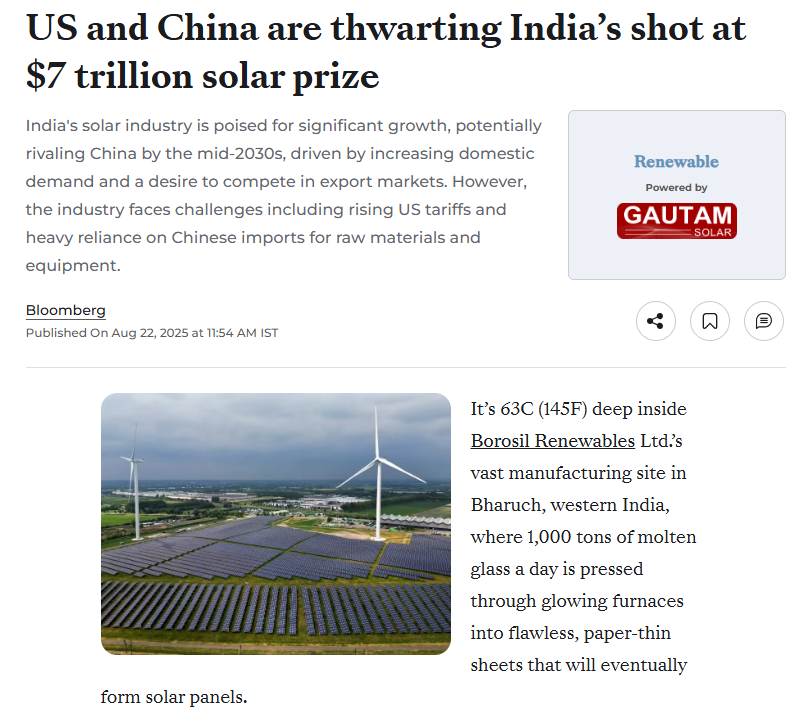
Energy is not just about oil. In H1 2025, India attracted $11.8 billion in clean energy inflows, with solar projects taking 77% of that capital. On the surface, this shows investor confidence in India’s green transition. But the story runs deeper.
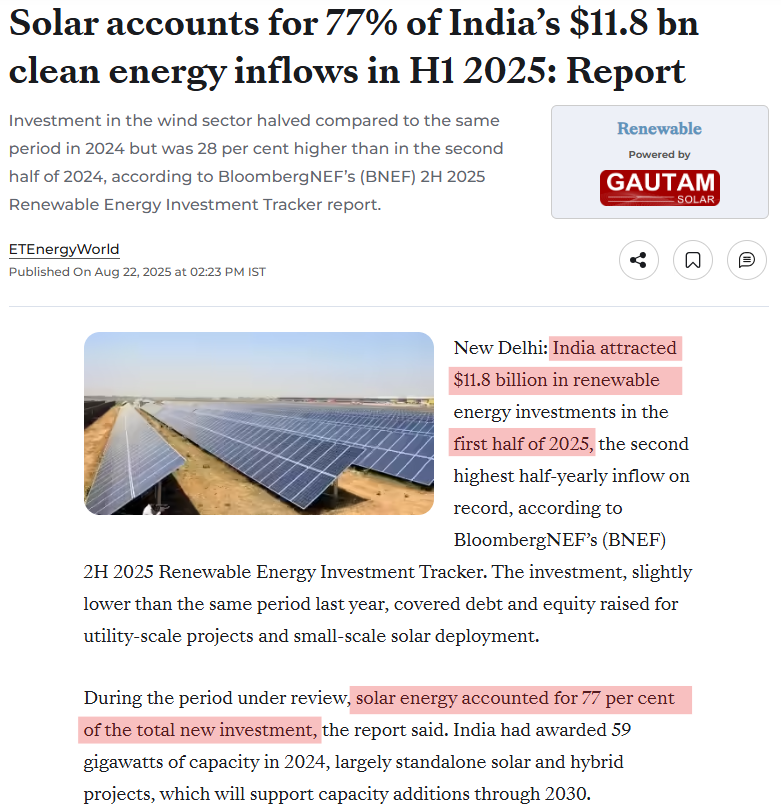
Both the US and China are actively working to thwart India’s bid for the “$7 trillion solar prize”. China dominates module supply chains, while the US exerts pressure through tariffs, financing, and IP control. For India, the clean energy race is as much about strategic autonomy as the crude oil market.
Thus, India is playing a double game: locking in hydrocarbons from Russia and Brazil while simultaneously racing to build an indigenous solar empire that neither Washington nor Beijing can corner.
The Russia–India relationship is no longer defined solely by defense imports. Oil has become the new cement. Moscow needs markets; New Delhi needs affordable crude. This convergence ensures that despite Western pressure, Russia and India will continue strengthening ties.
India’s long-term play is to leverage Russian oil discounts while quietly negotiating technology access and Arctic energy cooperation. In effect, Moscow is being reoriented as India’s “strategic resource buffer” against Western coercion.
Brazil’s surging crude flows to India aren’t just trade statistics—they are political statements. Both countries are central to BRICS and share an interest in rewriting the rules of global trade away from dollar dominance. By tightening energy ties, India and Brazil could extend their cooperation into food security, agri-tech, and even rare earths.
The symbolism is powerful: Latin America’s largest economy and Asia’s rising giant aligning outside the shadow of Washington.
The next decade will see the following shifts:
- Multipolar Energy Trade
- No single bloc will dominate. India’s crude mix—Russia, Brazil, Middle East—will exemplify a diversified, sovereignty-first model.
- Fragmented Western Leverage
- US sanctions will have diminishing bite as India, China, and Brazil deepen inter-trade channels.
- Energy as Diplomacy
- Oil and solar are no longer commodities but tools of strategy. India’s choices will define whether the Global South retains autonomy or slides into new dependencies.
- BRICS as an Economic Counter-Bloc
- With India’s assertiveness, BRICS could evolve from a talking shop into a genuine pillar of global governance.
The India–US clash over Russian oil, Brazil’s rising crude flows, and the solar power tug-of-war with the US and China are not isolated events. Together, they signify the end of unipolar energy politics.
India is crafting a new doctrine: energy sovereignty as the foundation of geopolitical autonomy. In doing so, it is not only reshaping its bilateral ties with Russia, Brazil, and the US but also repositioning BRICS as a force that could reorder the 21st-century global architecture.
The world is entering a phase where oil barrels, solar panels, and supply chains matter as much as aircraft carriers and missiles. And in this battlefield, India stands not as a follower, but as a shaper of destiny.
MAGA and Trump administration - India and Indians as Targets
What we are witnessing is not mere policy confusion.
We are seeing the naked face of racism dressed in nationalist slogans.
Trump’s erratic targeting of the Modi administration in India has been mirrored by the MAGA crowd’s hostility toward Indians and Hindus in the United States.
The same hands that claim to defend “American greatness” now clamor to eject not just legal H-1B workers, but also Green Card holders and even naturalized citizens. As much as everyone would like to call it as an action about jobs or security, it is not.
It is about color, culture, and resentment.
The irony is staggering. Indians, particularly Hindus, are among the most law-abiding, educated, and economically productive immigrant groups. They are net contributors to the U.S. economy, stabilizers of suburban communities, and builders of Silicon Valley’s innovation engine. Yet they are being singled out for suspicion and vilification.
In attacking Indians abroad and Hindus at home, this movement reveals its deeper alignment: hostility not just toward a government in New Delhi, but toward a civilizational ethos of pluralism and contribution. To drive away those who build, while embracing policies that court decline, is not only racist—it is socio-economically suicidal. In trying to “save” America, this crowd may well destroy it.
See one report where the racism and resentment clearly came to the fore.
Suicidal Direction
What may seem nationalistic to this MAGA crowd right now is anything but. Let us lay out our detailed argument.
United States (White Population)
Information Source: US Census, World Population Review, Brookings
The White population of the United States has been in absolute decline for over a decade. In 2023 alone, it fell by 461,612, a 0.2% drop. The median age of Whites is 43, far older than Asians (37) or Hispanics (29). Nearly 22% of Whites are over 65, while only 19.6% are under 18.
By 2045, the U.S. will be a “minority-White” nation. The future growth of the workforce—and the very sustainability of Social Security and Medicare—rests on the shoulders of immigrant populations, among which Indians rank near the top in education, income, and stability.
- Age Structure (2025)
- Projected Changes
- Impacts
Europe
Europe’s population is shrinking faster. Between 2024–2025 alone, Europe lost 685,000 people. Fertility rates average 1.41, far below replacement. By 2050, Europe is projected to lose 2+ million people annually.
The median age is already 42.8, and the native White Christian population is collapsing.
Let us look at the two major countries within Europe in some detail.
Germany: Information Sources: Population Pyramid (Germany), Worldometers - Germany Demographics
- 2025 Age Pyramid
- Trend
- Impacts
- Pensions and elder care dominate spending, workers are in short supply.
- Ongoing debate on immigration targets and labor market reforms; dependency ratio (60%) threatens tax base.
France: Information sources: France Demographics, Demographics of France/Wikipedia, and Population Pyramid (France)
- 2025 Age Pyramid
- Trend
- Policy Effects
Asia
Two Asian economic giants are seeing their populations decrease as well. Japan lost 908,000 people in 2024, with nearly 30% of its population above 65. China, too, has begun its decline, shedding 1.39 million people in 2024 alone. These civilizations are now demographically crippled.
Japan: Information Sources: Population Pyramid/Japan, Worldometers - Japan Demographics, Wikipedia/Demographics of Japan
- 2025 Age Pyramid
- Trend
- Impacts
- Huge pressure on social infrastructure, labor shortages, GDP slowdown.
- Policies: Promoting robotics, incentivizing workforce participation (women, seniors), minor immigration reforms (still very restrictive), new efforts for higher birth rates.
China: Information Sources: Population Pyramid/China, Worldometer - China Demographics, Countrymeters - China
- 2025 Age Pyramid
- Trend
- Impacts:
- End of one/two-child policy, now pro-natalist incentives—including cash, easier registration, housing.
- Pension and healthcare reform; opening research and technology to offset dependency issues.
- Urbanization slows rural aging but heightens city pressures.
Age Trends: The world is witnessing an interesting phenomenon occurring. One set of countries are seeing their populations collapse, while another set of countries are seeing their populations expanding. In the coming 25 years, the impact of these demographic shifts will be substantial.
- Contracting/Top-Heavy (US Whites, Germany, France, Japan, China): Wide top, narrow base: reflects aging, low births, high old-age dependency.
- Expanding/Bottom-Heavy (Africa and South Asia): Wide base, narrow top, reflective of high fertility, huge share of youth, low elderly dependency.
As the demographics change, the future looks very different from today.
Immigration as the Solution
If the local populations are collapsing, the immigration factor will kick in. In a big way!
The total number of international migrants worldwide probably will increase during the next decades as economic factors continue to attract migrants to wealthier countries while poor conditions and crisis spur people to leave their home countries. The exact trajectory of the expected increase in the number of international migrants is likely to depend on how these push and pull factors come together, as well as other countervailing forces. Most migrants are likely to continue to leave their homes voluntarily to pursue socioeconomic opportunities. In 2019, about two-thirds of the world’s migrants were voluntary workers, and only 11 percent were refugees fleeing conflict or instability. (Future of Migration / Office of DNI, US)
This one chart from the report by US-DNI puts everything in context.
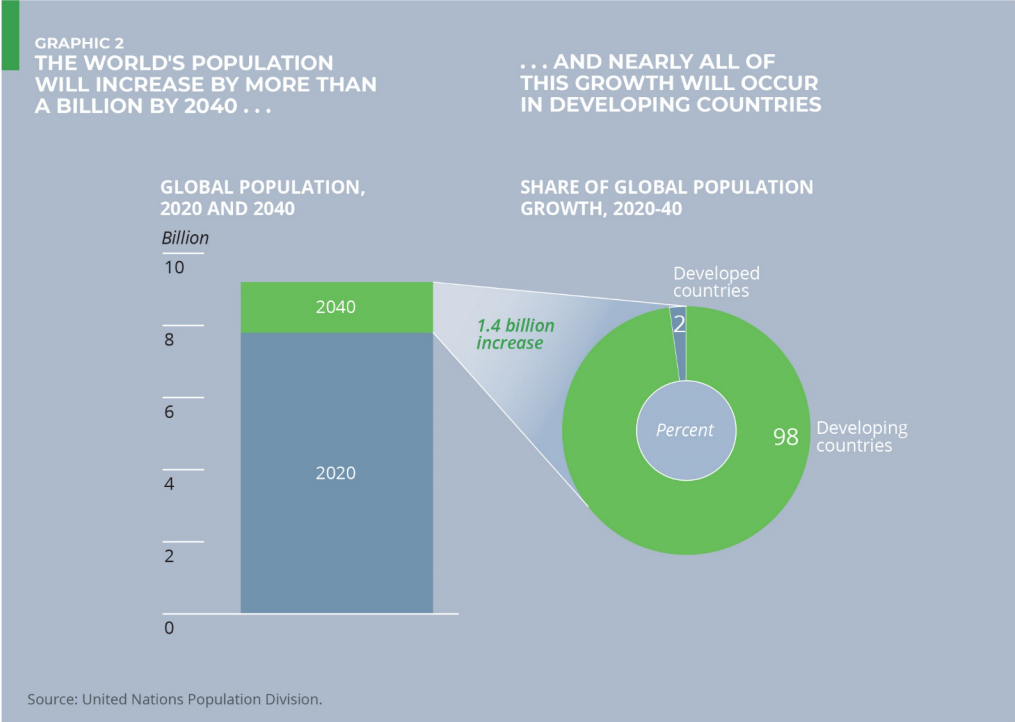
The world is undergoing a demographic split with profound consequences. On one side are contracting, top-heavy societies—US Whites, Germany, France, Japan, China—whose age pyramids are wide at the top and narrow at the base. Fertility is low, populations are shrinking, and old-age dependency is rising. These nations face labor shortages, declining tax bases, and unsustainable welfare systems. Without an infusion of youth, their economic and geopolitical influence will wither.
On the other side are expanding, bottom-heavy regions—Africa and South Asia—with wide bases of young populations. Here lies both risk and opportunity. If unemployed, this youth bulge can lead to unrest; but if productively absorbed into aging societies, it can create the very workforce, innovation, and consumer base needed to sustain growth.
Among these regions, India stands apart. With a median age of just 25.4, it has the largest pool of youthful, educated, and English-speaking talent.
Let us summarize the demographic trends around the world in a table.

The insight one gets are fascinating. Now, let us look at something more granular - the impact of the source of migrants.
Here are a few facts:
In many Western countries, authorities and analysts have linked some increases in violent crime and terrorism concerns to poorly integrated migrant populations, particularly young males from conflict-torn Islamist countries.
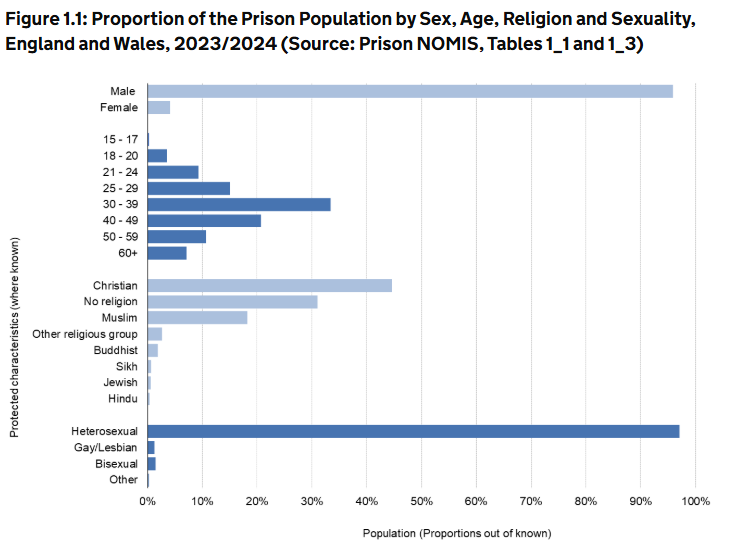
- According to the HMPPS Offender Equalities Report 2023/24, Muslims accounted for 18.2% of the prison population (15,909 prisoners), while Muslims are ~6.5% of the general population. This indicates overrepresentation
- France: Although the state does not publish official religious data, multiple studies (e.g. IFOP, Washington Post citing French prison chaplaincy estimates) suggest 60–70% of the prison population are Muslims, compared to ~8–10% of the national population.
- Germany: Around 49% of prisoners are foreign nationals, with many from Turkey, North Africa, and the Middle East. Religious breakdown is not officially recorded, but academic studies note a heavy presence of Muslim-background inmates.
- Sweden: Research has found that people with foreign backgrounds are significantly overrepresented in violent crime statistics, with large shares from Muslim-majority countries.
- In the UK, Indians (many Hindu) are one of the most successful immigrant groups socio-economically. They have higher-than-average education, income, and lower incarceration rates.
- Hindus in the UK and US represent less than 2% of the population, and there is no evidence of overrepresentation in prisons. In fact, Indian-origin people are among the least likely to be imprisoned compared to Pakistani/Bangladeshi groups (UK Ministry of Justice ethnicity stats).
- In the U.S., Hindus (mostly Indian) have median household incomes above $140,000 and negligible representation in jails compared to their population share.
These facts share a pattern:
- Immigration from Pakistan and other Islamist-majority countries in Europe and the UK has coincided with higher representation in prisons and some rise in violent crime, often linked to integration challenges and socio-economic disadvantage.
- By contrast, Hindu and Indian migrants are socio-economically high-performing, with very low crime and incarceration rates, and contribute disproportionately to the economy.
Thus, when aging Western nations consider migration as a solution to demographic decline, the source of migration matters: some groups enhance democratic and social fabrics, while others introduce long-term strains.
For the U.S., Europe, Japan, and even China, the path forward is unambiguous:
- Without migration, collapse is certain.
- With the right migration (Indian/Hindu youth dividend), renewal is possible.
Thus, migration is not a choice but a civilizational imperative.
And, most importantly, the source of that migration will determine whether aging societies experience revival or rupture. Critically, whether the current social structures that benefit democracy and freedoms can indeed remain intact or become a replica of the Islamist and authoritarian societies?
Impact of Indian H1B Immigrants
To properly understand the impact, let us first lay down the basic statistics. These will guide us to objectively understand what the H1Bs from India really contribute.
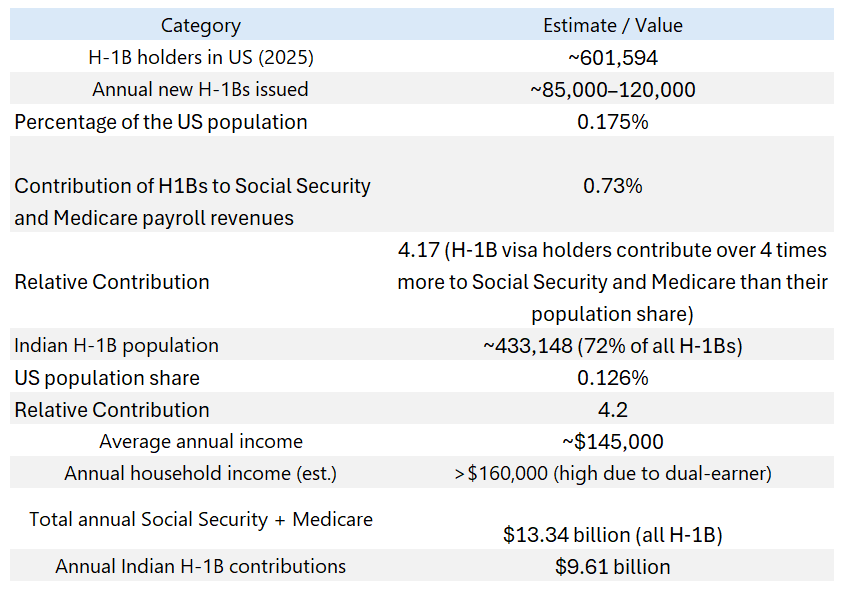
The average annual salary of an H-1B worker hovers around $145,000, substantially above the U.S. median household income (~$74,000).
With dual-earner households common, the average Indian H-1B family easily crosses $160,000/year in household income.
These incomes translate into massive fiscal contributions:
- Social Security & Medicare: H-1B holders contribute $13.34 billion annually, with Indian H-1Bs alone paying $9.61 billion.
- Housing Market: Collectively, H-1Bs spend $26 billion annually on housing, while Indians dominate suburban new housing markets in hubs like Dallas, Atlanta, New Jersey, and the Bay Area.
- Consumer Spending: H-1Bs inject $27.5 billion annually into consumption, powering retail, education, and local services
The most significant aspect of the Indians in general and the immigrants in particular is the home ownership.
Local economic impacts include new school enrollments, rising property values, new business formation, and infrastructure demand.
Indian Presence in New Homeownership
- Foreign buyers overall: Purchased 78,100 homes in April 2024–March 2025, accounting for 2.5% of all U.S. home sales ($56 billion).
- Indian buyers: Indians accounted for 6% of all foreign buyers in this period (about 4,686 homes, $2.2 billion spent).
- Recent patterns: Indian Americans, especially H-1B holders, are heavily represented among new suburban developments, often exceeding this national average in key markets (Houston, Bay Area, Atlanta, Dallas suburbs, NJ, etc.).
Suburban Share Estimate
- While national data show Indians at 6% of foreign buyers, anecdotal and Realtor surveys report Indians make up 20-40% of new home buyers in many active suburban developments in major cities. In some tech corridor suburbs, figures may be even higher, often rivaling non-Hispanic whites in newly built subdivisions.
- Example: Frisco, TX, Plainsboro, NJ, parts of North Atlanta, Bay Area.
Market Impact ("Suburban Scenario")
- If we take 30% share for Indian Americans in new suburban home purchases in top metros (conservative but realistic for this sector), and assume that 40% of all new homes are in major metro suburbs:
- Estimated Indian share of new suburban homes = 12% of all new homes nationally (0.3 × 0.4).
- This balloons their impact on housing investment far above their overall population share (just 0.125%) and vastly increases the local economic multiplier (grocery, retail, schools, construction, services).
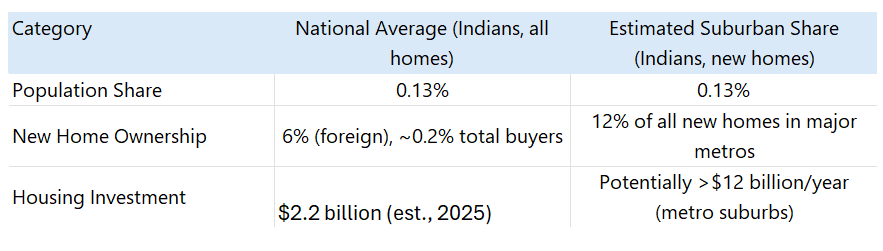
Factoring in their dominant presence in new suburban housing, Indian buyers are extraordinarily overrepresented relative to their population in driving U.S. suburban housing investment, new development, and associated local economic vitality. If Indian H-1Bs and their families were removed, the impact would be far greater at a local level than national statistics alone indicate, leading to notable declines in new home demand, property values, local services, and economic growth in many U.S. metro regions.
Every H-1B job is estimated to create 7.5 additional U.S. jobs through multiplier effects. Indians disproportionately occupy critical roles in STEM, healthcare, and finance. They are overrepresented among startup founders, CEOs of Fortune 500 companies (Google, Microsoft, Adobe, IBM, etc.), and leaders of America’s technology revolution.
If H-1Bs were drastically cut, America would lose over $100 billion in GDP annually. The loss would not be in abstract numbers but in slower product cycles, weaker R&D, and diminished global competitiveness.
Racist Attacks on Hindus and Indians and their Myopia
The Trump administration had promised to take on the illegal immigration process. Instead, it has been working to attack the legal immigrants. People who followed the law and became rightful permanent residents, hold H1B working visas, or even naturalized citizens.
- Student Visa Suspension: From May 27 to June 18, 2025, the Trump administration temporarily suspended new student visa appointments during the peak admissions season. Although visa processing resumed in late June, applicants now face heightened scrutiny, especially regarding social media and political views.
Quite simply, Trump’s hostility toward foreign students has made American higher education a riskier proposition for them.
- Heavier Vetting: Executive Orders in January and May 2025 have broadened the grounds for visa revocation and increased scrutiny of non-citizens—even reviewing personal social media accounts for expressions deemed critical of US foreign policy or pro-Palestinian sentiment.
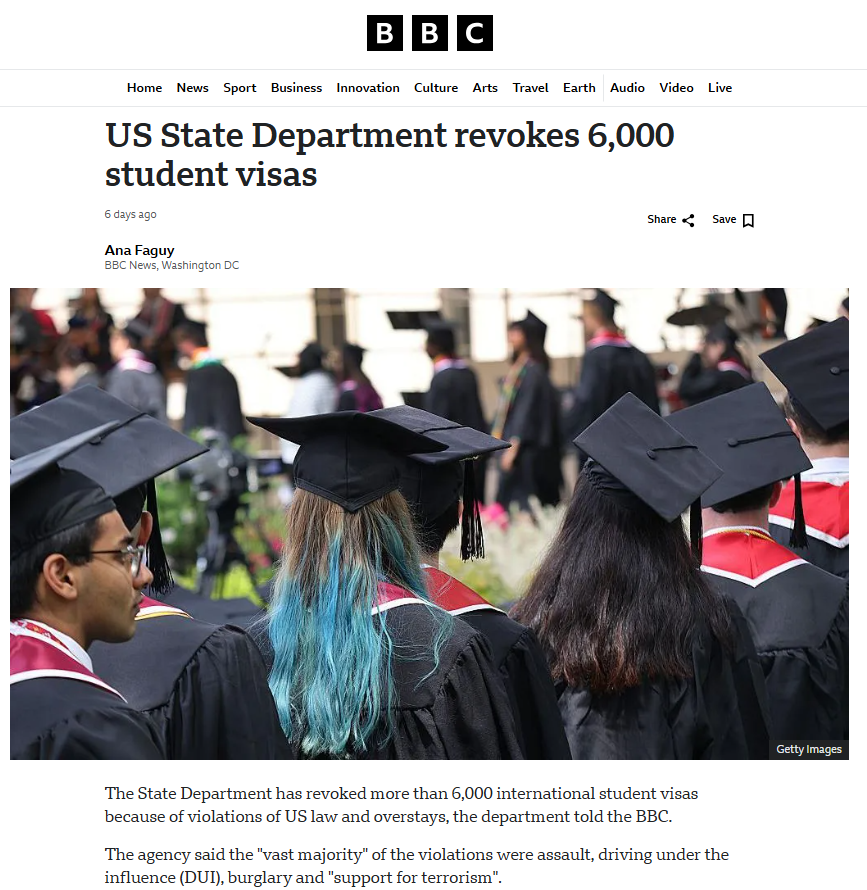
- Revocations: Over 6,000 student visas were revoked in 2025, mostly for alleged links to terrorism, visa overstays, and legal violations. Some revocations were later reversed following court orders, but many students faced denied entry, missed semesters, and uncertainty about re-enrollment.
- Country-Specific Bans: In late May 2025, Trump signed proclamations restricting entry for students from 19 countries (including Afghanistan, Iran, Yemen, Cuba, Laos, Venezuela, and Haiti). There is an explicit directive blocking new F1 student visas for Chinese nationals—this policy currently remains in effect.
- Restriction/Elimination of Legal Pathways: Policy “blueprints” call for winding down work visa programs (H1-B, H2-A, H2-B), slashing refugee admissions, halting family-based immigration (“chain migration”), and actively seeking to “eliminate or significantly reduce” student visas from countries labeled as “hostile”. (Source: Project 2025)
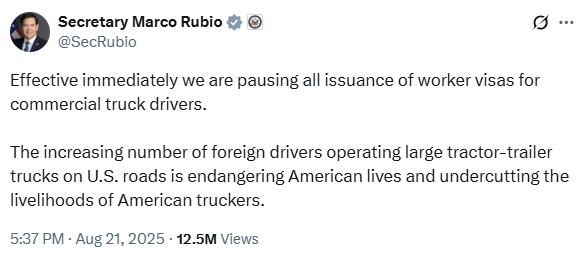
The extent of reactionary policy stands can be easily seen from this post on X by Marco Rubio.
All this happened because of an extremely bad judgment and action by an Indian driver who made a U-turn which he should not have and it resulted in a very sad accident that killed an entire family.
🇺🇸 #America
— Indian Invasion (@IndianInvasionN) August 18, 2025
Another illegal Indian migrant truck driver has caused a major accident
Indians are more dangerous than drunk drivers on the road, they should never be allowed to drive an 18 wheelerpic.twitter.com/ouJGoYB9hL
What happened there should have never happened. But to fashion a policy for all the immigrant drivers when there is a shortage of drivers in the US is rather short sighted.
And then when you listen to the ideologues like Steve Bannon rant against the H1Bs, foreign students etc you know that the MAGA crowd has started on a track that will hurt America in future far more that these myopic commentators can imagine.
BANNON: Globalists and big tech push H1B visas, now adding spouses as a path to green cards. We don’t need them, foreign students, or worker visas right now. Foreign students should leave after graduation. Nations should keep their best and brightest. pic.twitter.com/ipLDWbihB3
— Steve Bannon WarRoom🇺🇸 (@WarRoom_Steve) August 16, 2025
When one looks at the factual reality of the future about to unfold in the coming decades, one can see the utter folly of what the MAGA crowd is trying to do.
1. Economic Self-Sabotage: Efforts to restrict H-1B visas, especially for Indian professionals, are fundamentally misguided from an economic perspective. Indian H-1B holders are disproportionately employed in critical fields such as technology, engineering, medicine, and academia. Far from “taking jobs,” each Indian worker typically spurs job creation for Americans—by launching start-ups, filling essential skill gaps, and driving innovation across sectors. Empirical studies show that regions with higher shares of skilled Indian immigrants see greater wage growth and job expansion among native-born workers. Cutting Indian H-1Bs won’t save American jobs; it will stifle entrepreneurial activity and shrink overall employment opportunities for Americans, particularly in high-tech and STEM industries where domestic talent is often lacking.
2. Fiscal Consequences and Entitlement Risks: America’s aging demographic is rapidly straining entitlement programs like Social Security and Medicare. With the White population’s median age climbing and native birth rates falling, the fiscal health of these social safety nets hinges increasingly on contributions from working-age immigrants. Indian H-1B professionals alone inject over $9.6 billion annually into Social Security and Medicare through payroll taxes. This is not a trivial amount—it is vital to the solvency of these programs. Reducing Indian H-1B numbers risks accelerating insolvency and even collapse of benefits on which tens of millions of American retirees depend. Far from “protecting” American workers, such policies may deprive the elderly of their most basic financial lifelines.
3. Civilizational Myopia and Values Alignment: While Islam is projected to be the world’s fastest-growing religion (73% growth by 2050), Hinduism stands out as a non-proselytizing, stabilizing force with deep roots in democracy, pluralism, and social harmony. American Hindus are among the country’s most educated, law-abiding, and politically moderate communities, aligning closely with core democratic values. Yet, policy rhetoric and nativist backlash risk alienating this model minority, instead of harnessing their stabilizing influence and commitment to American civic life. Ignoring the unique contributions of Hindu Americans during a time of global religious transformation is an error in civilizational vision—potentially undermining social cohesion and pluralism in the U.S.
4. Geopolitical Undermining: India, now the world’s most populous country, is one of the United States’ most important strategic partners and a pivotal counterweight to China’s global ambitions. Policies that alienate Indian immigrants in America risk sending negative signals to New Delhi, eroding the trust and cooperation crucial to the U.S.-India alliance. In the context of intensifying U.S.–China rivalry, weakening domestic and diplomatic ties with India undermines American geopolitical interests, tech competitiveness, and regional stability. Alienating Indians at home is not just domestic short-sightedness—it is a strategic blunder with reverberations for global security and the future balance of power.
The future of global geopolitics will be decisively shaped by demographic realities. On one side stand the aging, contracting populations of the U.S., Europe, Japan, and China, weighed down by old-age dependency and shrinking workforces. On the other side lie the youthful, expanding populations of Africa and South Asia.
In this context, the natural partners for sustaining growth and stability should be educated, democratic, and pluralistic communities such as Indians and Hindus, who bring both demographic strength and alignment with democratic values.
Yet nationalist and racist tendencies in parts of the West are driving a contradictory approach. Policies increasingly target Indians and other high-contributing immigrant groups, while tolerating or even courting militant, less-integrated communities. This not only undermines social cohesion but also erodes economic competitiveness, as it marginalizes the very groups that power technology, innovation, and fiscal sustainability.
Overlaying this demographic contradiction are economic frictions.
Tariffs and punitive measures against India, combined with broader anti-immigrant sentiment, risk producing “unintended consequences.”
Alienating one of the world’s fastest-growing economies and most critical youth bases may snowball into reduced cooperation, weakened alliances, and accelerated shifts toward alternative global alignments.

Comments ()