
Dissecting Art of Living’s Campaign Against Sadhguru
Over recent years, a pattern of slander and character assassination against Sadhguru has emerged from the top ranks of Art of Living. Ignored until now, this has escalated into a coordinated, well-funded campaign. It demands scrutiny. This piece confronts it directly.

“Those who act in distortion and delusion do not turn toward Me.
Bewildered, fallen from discernment, their understanding seized by Māyā, they take refuge in an asuric orientation of being.” (Bhagawad Gita 7.15)
When religious diversity is used for targeting certain institutions and beings, and have geopolitical underpinnings then they need to be addressed dispassionately.
Today's newsletter, outside the regular cadence, is for that.
The Inexplicable Slander and the Why?!
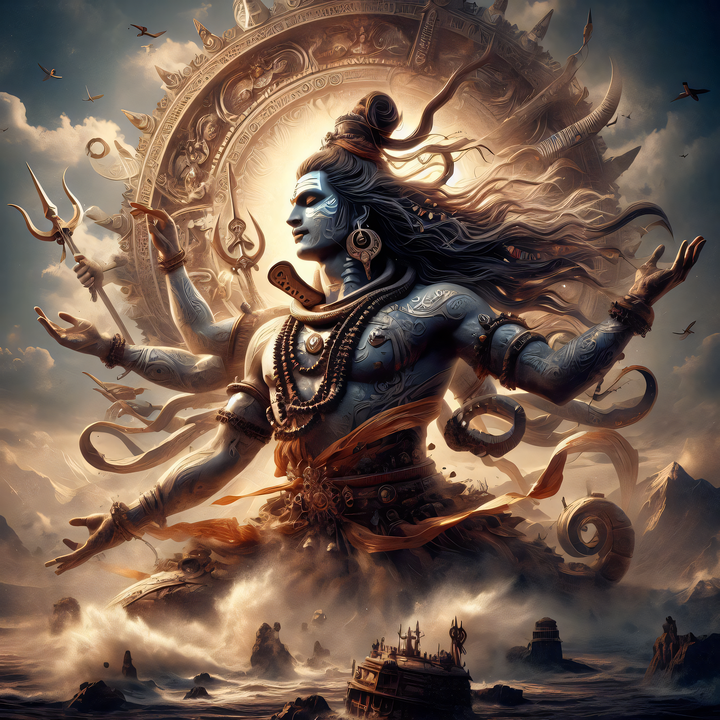
In February 2017, India’s Prime Minister Narendra Modi unveiled the "Adiyogi statue - the glorious face of Shiva," as PM Modi called it. PM Modi was sharing the Adiyogi murti with the world at the Isha Yoga Center.
It was a civilizational moment marking the reclaiming of Shiva as the source of yogic science, as even the Prime Minister alluded.
However, a few months later, an Art of Living teacher, Dinesh Ghodke, chose to trivialize it as a mockery of Dharma.
He obviously disagreed with the very idea of Shiva as Adiyogi, and that difference of opinion could have been handled with scholarship based on philosophical underpinnings. But he chose mockery.
Publicly, casually, he demeaned the very concept of Adiyogi by comparing it to his shoes. Reducing a sacred archetype, revered across millennia of Shaiva and yogic tradition, to a trivial object meant to provoke laughter.
Hindus have been subjected to ridicule and desecration, and quite often it comes in the garb of trivializing humor. A smile with viciousness in hiding. We know that it is erasure by ridicule. Turning a civilizational symbol into a punchline is not a critique. It should never be allowed to be one.
Before Sadhguru was to conduct the Ecstasy of Enlightenment program in Toronto, an offering for which thousands had rearranged their lives, their schedules, and their inner readiness, an ugly spectacle was set in motion.
A senior Art of Living teacher, Julia, who is ostensibly close to Sri Sri Ravi Shankar, initiated an open campaign to sabotage the program.
Again, not through honest theological disagreement. Not through principled critique. Not through transparent evidence and due process. But through insinuation, recycled narratives, and the oldest weapon in reputational warfare: character assassination dressed up as “concern.”
Let us be very clear about what this all means.
When a spiritual institution, or those who hold authority within it, steps into the arena of slander and mockery, it is not merely indulging in “competition.” It is, in essence, spiritual and religious subversion by stealth.
It is an ethical collapse.
Because, you see, spirituality is not a brand war; it is a vow. A vow of seeking. Seeking the Truth of this existence. Not your Truth or my Truth, but the Truth.
And when that vow is traded for innuendo, the damage is obviously done to the target. But it also demeans the sanctity of the entire spiritual space.
In our tradition, an Aghori is as far apart from Meera as any hue of seeker would be. Yet, Aghori does not need to endorse or like Meera, nor would she do that to an Aghori. Their quest leads them to the same destination even when the paths are aeons apart. The vow is to the path of seeking. Not its topology.
In this exercise today, we will examine the details: specific statements, specific actions, and specific allegations made not only by senior teachers but also echoed, amplified, or implied by the leadership of the organization itself.
We will do so calmly, carefully, and with full respect for truth as the highest form of devotion.
But before we descend into particulars, we must confront the question that matters more than any single claim:
Why?
Why would a teacher representing a “spiritual organization” spend his or her time publicly attempting to derail a representation of Shiva or an inner program attended by thousands?
A statue that now defines Shiva globally. A program whose participants were not going to a rally, a marketplace, or a political theatre - but to a space of seeking, discipline, and transformation. Why did that become a theater of vilification?
The way these people acted openly, they very likely believed it was worth the cost.
The way others within the organization supported it, they too believed it was worth aligning their names with such subversive tactics.
That alone tells you something. There is a perceived stake here that is bigger than casual disagreement.
So the honest question for every Hindu, every spiritual seeker, and every person who values the dignity of spiritual life is not merely, “Are the allegations true?” The deeper question that we ought to ask ourselves is:
And even more pointedly:
And please let’s not insult our own intelligence with lazy answers.
“Jealousy” is too small a word for the kind of deliberate, sustained, reputational aggression we are describing.
Jealousy can sting. It can gossip. It can sulk in private. But it does not usually drive senior figures, who claim spiritual authority, to risk their moral credibility in public, to spend social capital, to organize petitions, and to circulate insinuations against another spiritual leader with global reverence among ordinary devotees and accomplished professionals and leaders.
That kind of action suggests a more potent trigger.
A strategic trigger. An institutional trigger. A psychological trigger. A control trigger.
And this is why we must be disciplined as we proceed.
Yes, we will assess each allegation dispassionately and objectively, one by one. We will test them against evidence, patterns, motive, and method. We will expose what is shallow, what is manufactured, what is malicious, and what is designed to poison perception rather than illuminate truth.
But through every point, hold on to one steady question—the question that makes the whole structure either stand or collapse:
Why would they do it? Why, after all?
Let us take this inquiry where it must go. Beyond personalities, beyond anecdotes, and beyond tactical allegations. All the way into motive, scale, and moral gravity.
If the impulse to do this was so powerful that an institution was willing to place its leadership credibility, spiritual authority, and reputational capital on the line to attack another spiritual leader, then this was not casual, impulsive, or incidental.
No one risks everything for nothing.
Institutions, especially those that claim to operate in the inner domain of consciousness, do not mobilize themselves “for the heck of it.”
Such acts require deliberation. They require justification. They require a perceived necessity so strong that ordinary ethical restraints are overridden.
Let us dispense with weak explanations.
This is not just about reputational gain alone. There is no certainty of victory in public slander.
Specifically, when the person being targeted commands deep reverence among millions and quiet respect among scientists, leaders, and achievers worldwide.
So what would compel someone to proceed anyway?
More disturbingly, why proceed at this precise historical moment?
Times, when it is now openly documented that coordinated networks are spending millions to manufacture deepfakes, seed false narratives through dubious media portals, and target India, Hindu civilization, and its spiritual symbols?
When a senior cybersecurity expert like Amit Dubey publicly states that such weaponized misinformation ecosystems exist and are active spending millions falsely and deviously targeting Sadhguru, another question becomes unavoidable:
Why would a spiritual institution choose to stand in the same corner as those actors?
- Why would it borrow their methods?
- Why would it amplify their material?
- Why would it lend spiritual legitimacy to the very machinery that degrades truth, corrodes dharma, and profits from deception?
This is by no means a neutral choice. Nor can it be attributed to an innocent overlap.
So we are confronted with two irreducible “Whys”, neither of which can be dismissed:
- First: Why initiate an attack when there was no provocation, no injury, no transgression from the other side? No encroachment. No theft. No ethical violation. No personal harm. Nothing that would warrant even private grievance, let alone public annihilation.
- Second, and more grave: Why align, even tacitly, with forces that are demonstrably hostile to India, hostile to Hindu civilization, hostile to spiritual autonomy, and hostile to the very idea of indigenous Gurus who refuse to be filtered through Western approval systems?
After all, these are not mere rhetorical flourishes. They are relentless moral interrogations. Why?
And that is the heart of the matter.
We are not asking for emotion. We are not asking for loyalty. We are demanding an explanation.
- What force is strong enough to make people abandon restraint?
- What fear is deep enough to justify a comprehensive moral collapse?
- What strategic objective is valuable enough to risk spiritual credibility itself?
Until these questions are answered honestly, no amount of allegations, however loudly repeated, will ever substitute for truth.
And, in the end, truth has a way of outlasting campaigns.
Always.
Who is Shiva?
In a series of public videos, Sri Sri Ravi Shankar has dismissed the idea that Shiva is the originator of Yoga (referred to in Hindu tradition as Adiyogi, Mahāyogi, or Yogeśvara), calling such assertions “rubbish” and “nonsense.”
He then goes on to say:
In the video below, the discussion begins with Sadhguru explaining a well-established Shaiva and yogic understanding: that Shiva is revered as the primordial yogi, the first to embody and transmit the science of yoga.
This view is not a modern invention but finds resonance across Hindu textual traditions, including titles such as Mahāyogi and Yogeśvara found in the Mahabharata and later Purāṇic and Āgamic literature.
Sri Sri’s response, however, does not engage these sources or the philosophical framework within which such terms operate.
Instead, it rejects the entire premise outright, without textual examination, historical analysis, or metaphysical clarification. The dismissal is categorical rather than reasoned, substituting rhetorical negation for doctrinal engagement.
This contrast is significant. One position draws upon a long and internally consistent Shaiva–yogic lineage that understands Shiva as both the ontological source of yoga and its supreme exemplar. The other rejects that lineage without addressing its scriptural foundations, effectively severing the discussion from the civilizational and philosophical context in which the idea of Adiyogi arises.
The profundity of Dharma, or the spiritual tradition that Indian Sages worked upon, was that it could be approached in several different ways. The same divine forces and energies were viewed in as many hues as there were devotees.
One Devotee would call out Krishna as Gopal, another as Thakur, some as Damodaran, some as Hari, some as Jagannath, or Madhusudan, or Shyam, or Vasudev.
The divine qualities of the being known as Krishna were perceived by different people in their own ways.
For millions of women devotees, Krishna was the most loving son, for many women, he was their love, for many others yet, he was their friend.
Shiva's devotion has been no different. Whether he was the Mahāyogī, Yogīśvara, Yogendra, Umapati (Uma's husband), Shankara of the Mahabharat, or Rudra or Shiva of numerous scriptures, he was approached by everyone in their own way. Adi Shankara had many names of Shiva, including Dakṣiṇāmūrti, the origin of Yoga.
Are those wrong? No!
There is no contradiction between the first yogi in a manifestational precedence way and being Anādi (beginningless) in an eternal sense from an ontological perspective. We will discuss this further in the context of Krishna later.
Shiva's Murtis ("idols") other than Lingams
The claim that Shiva was never worshipped in form but only as a linga reflects a shallow and historically incomplete understanding of the deep evolution of Shaivism.
Archaeology, textual tradition, and temple art together disprove this reductionist view.
Shiva has been represented in multiple anthropomorphic, symbolic, and cosmic forms. Each of those being a metaphysical doorway into the mystery of existence.
We will evaluate Sri Sri's statements thread by thread as we go through many millennia of Shiva Murtis - some very large ones that have been consecrated not just in India but also in the "India Major" region that had included Nepal and Mauritius.
The Proto-Rudra of the Indus Valley
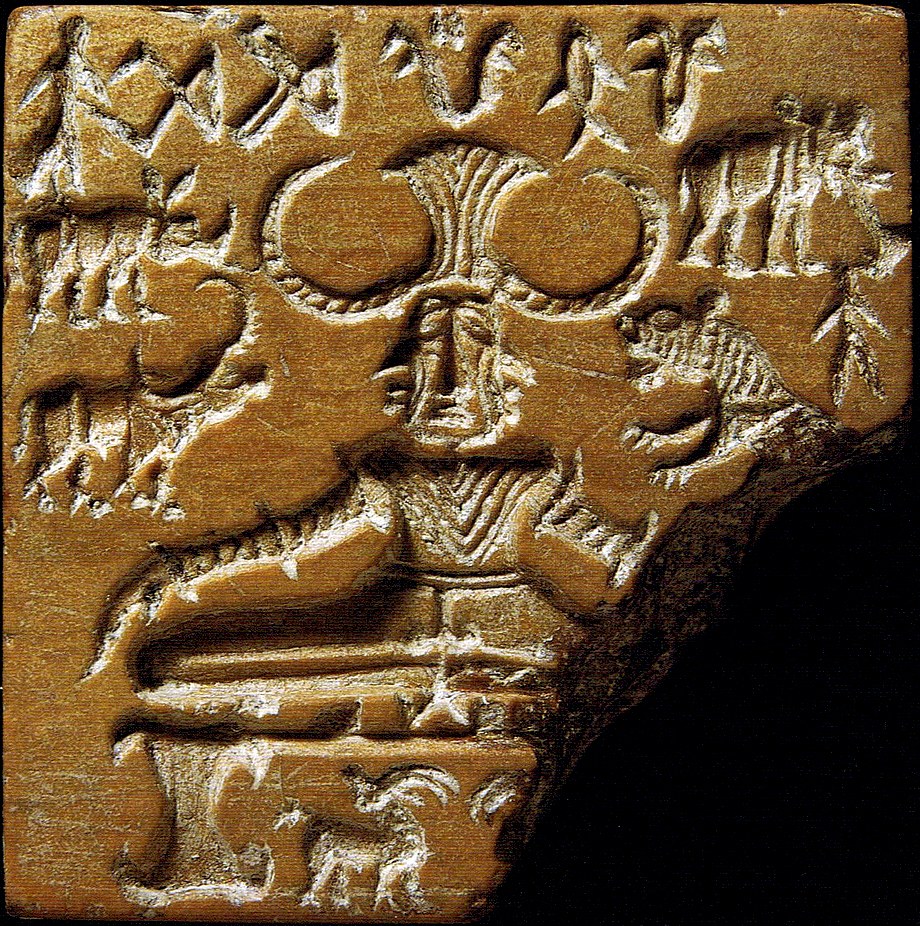
The earliest known archeological representation of Shiva appears on the Pashupati Seal from Mohenjo-daro (ca. 2500 BCE).
It depicts a seated yogic figure with a horned headdress, surrounded by animals—a motif resonant with Shiva’s later form of Pashupati (“Lord of all living beings”).
Scholars such as Sir John Marshall, Asko Parpola, and Dr. Stella Kramrisch have identified this figure as Proto-Rudra, representing the yogic and ascetic archetype that, in their view, precedes Vedic Shaivism.
This form captures all philosophical elements that later crystallize in the Mahadeva:
- Yogic posture (Mulabandhasana) reflecting meditative transcendence.
- Horned crown symbolizing connection with nature's vitality.
- Multiplicity of faces suggesting omniscient consciousness.
Thus, the roots of Shiva worship reach far beyond the later lingam form. In fact, they originate in a physical representation of Shiva, while they emerge from India’s most ancient civilizational memory.
In the Rigveda, Rudra is the fierce yet healing form and has been addressed with reverence and fear.
Over successive centuries, this Rudra evolves into Shiva, the auspicious one (Śaiva, “that which makes whole”). The Shvetashvatara Upanishad explicitly identifies Rudra-Shiva with the Supreme Consciousness that animates creation. He is referred to as Shiva and Rudra at different places.
In Chapter 3, verses 1 and 2, Rudra is clearly defined as transcendent.
1. The one who casts his net, who rules over all the beings with His supreme powers, who rules all the worlds also with His supreme powers, who arises as one and happens to make things possible remaining as one, he who knows Him thus becomes immortal.
2. Rudra indeed is that one, without a second, who rules all these worlds with his supreme powers, who stands in front of all creatures, who protects the worlds He creates, also withdraws them in the end.
Within the Dharmic itihaasa - Mahabharata and Ramayana - Shiva’s forms diversify:
,Ardhanarishvara (the union of male and female principles), Dakshinamurti (the teacher of eternal knowledge), and Bhikshatana (the mendicant).
Each icon encodes a philosophical truth — about the unity of opposites, the transmission of wisdom, and freedom from social convention.
The Cosmic Dance: Nataraja — Form as Conscious Energy
The Nataraja icon, emerging powerfully under the Pallavas and perfected by the Cholas (6th–10th century CE), stands among humanity’s most sophisticated visual metaphors.
Here, Shiva is both dancer and stillness — performing the Ananda Tandava that sustains cosmic rhythm.
Classical Tamil texts such as Tevaram and Tiruvacakam envision this form as the ecstatic harmony between destruction and creation.
This icon has radiated globally: sculptures appear in Ellora, Chidambaram, Angkor Wat, and Bali, symbolizing the universality of the Shiva principle as dynamic consciousness.
Devotion Cast in Stone: Contemporary Manifestations
As for the size of the Shiva murtis and statues, there are many, and some are much larger than Isha's Adiyogi. All of them have their own significance, form factor, and speciality.
From the Murudeshwara Temple in Karnataka — with its 123‑foot Shiva rising from the Lakshwadweep coast — to Nathdwara’s Vishwas Swaroopam (112 m, the world’s tallest Shiva statue), the divine form continues to inspire awe.
Nepal’s Pumdikot statue and Mauritius’ Mangal Mahadev echo this continuity across geographies. The table below shares more details.
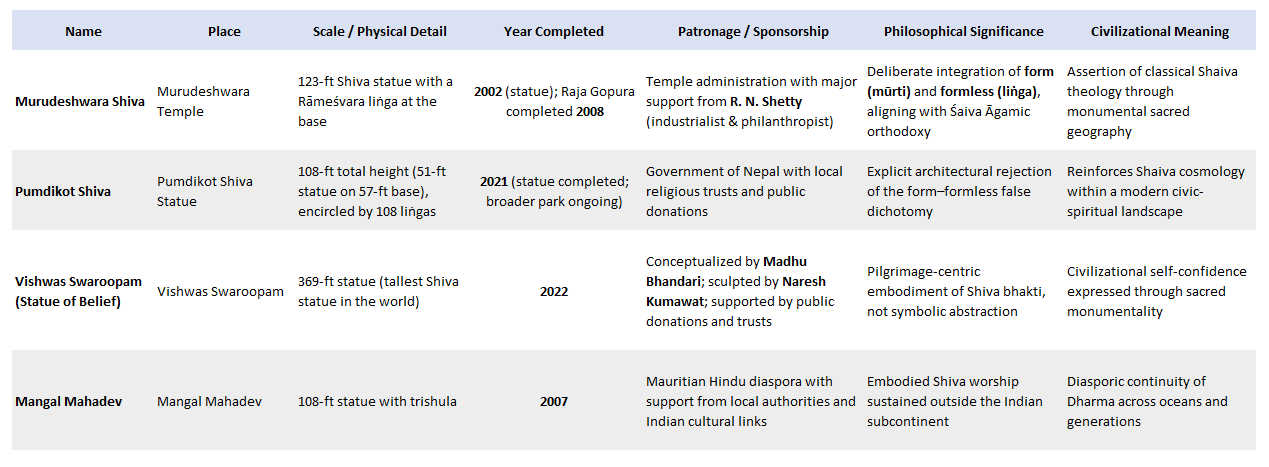
Here are the three largest statues, along with the ancient ones from the Brihadeshwara temple.
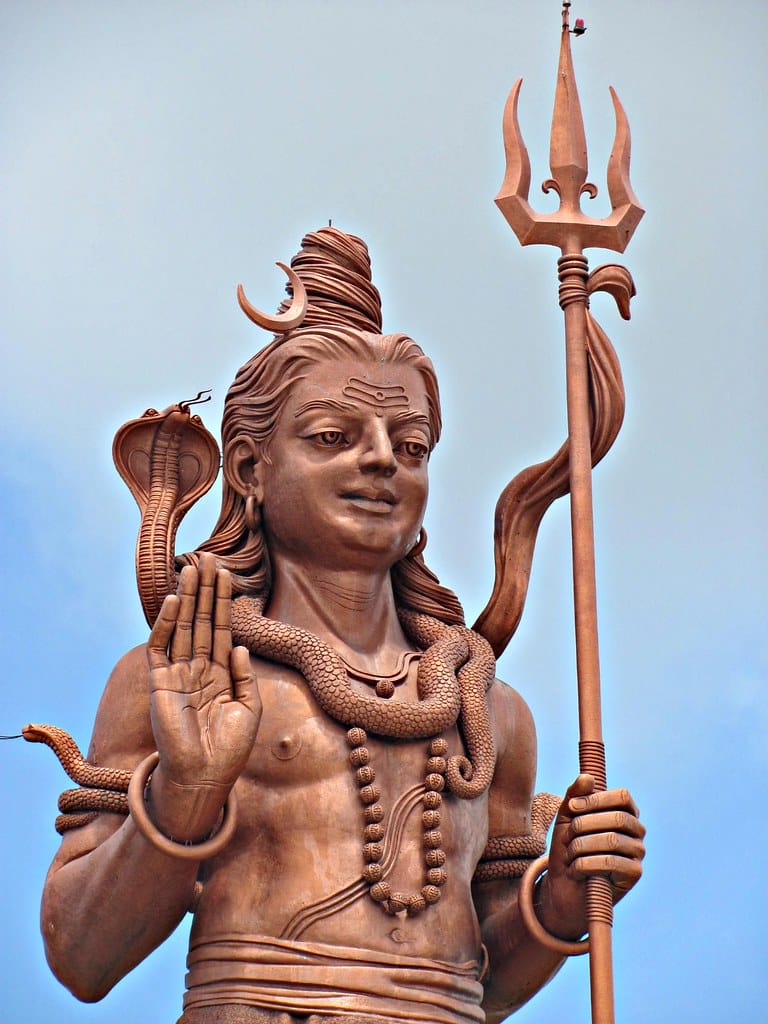
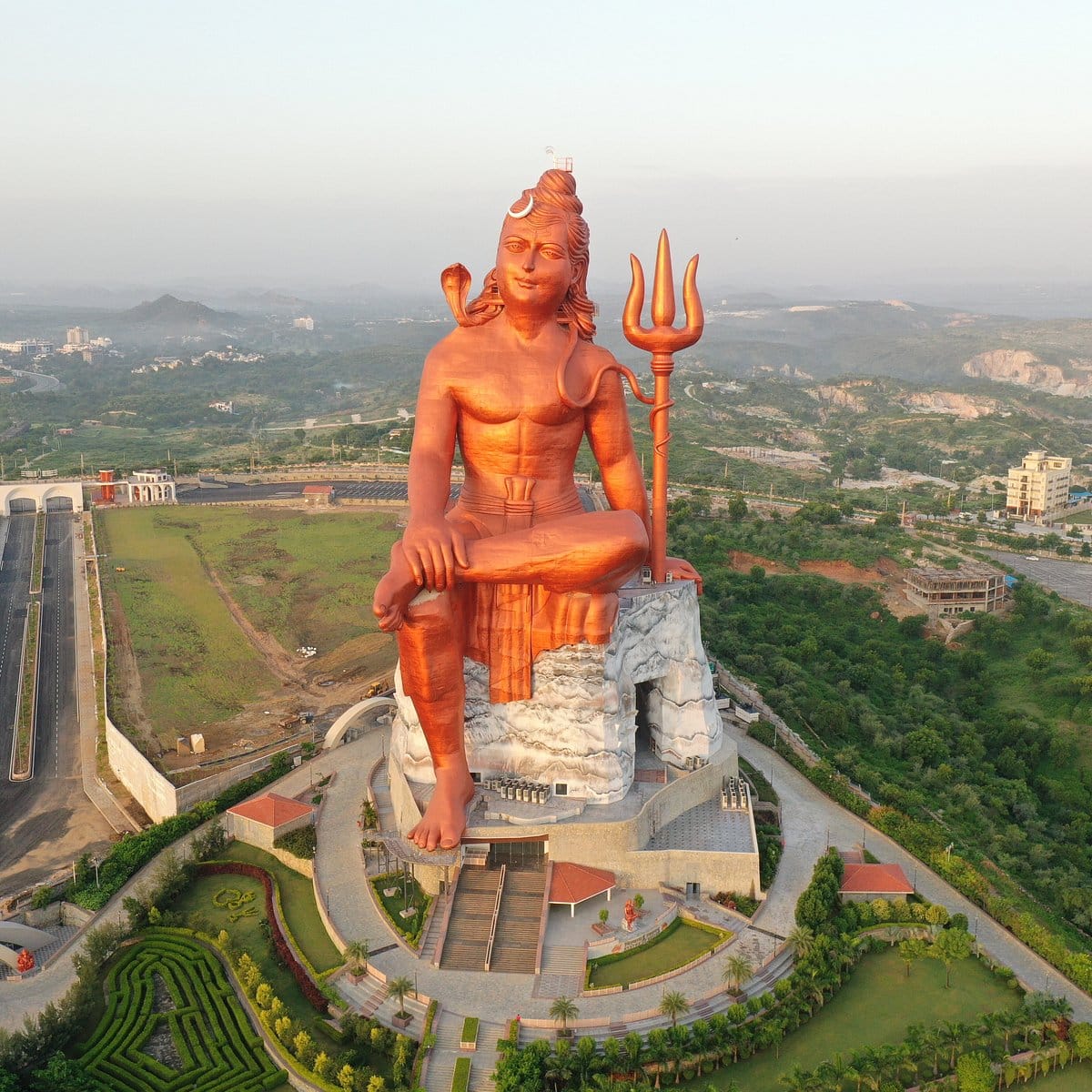
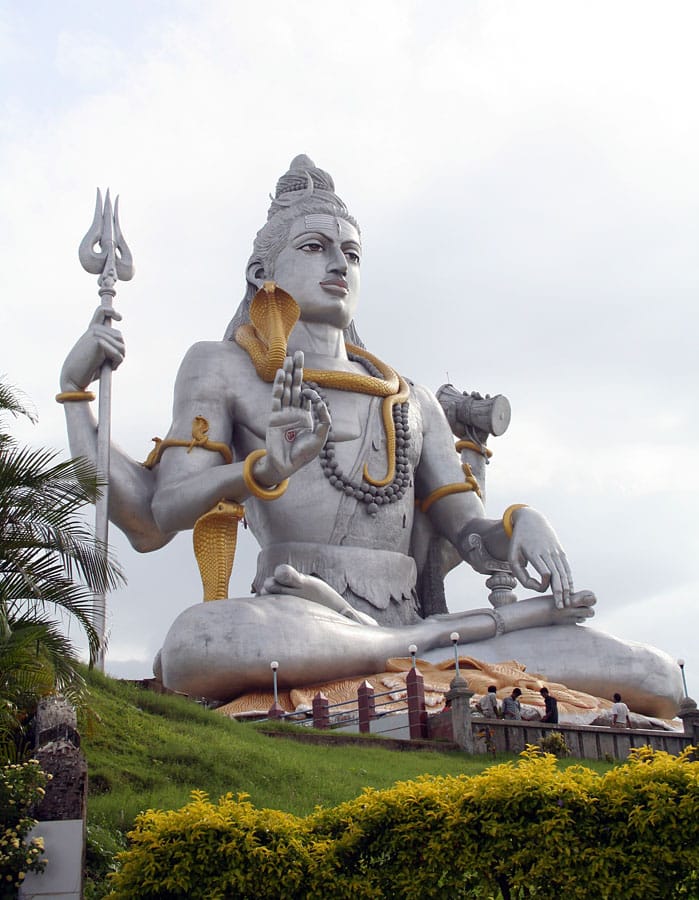
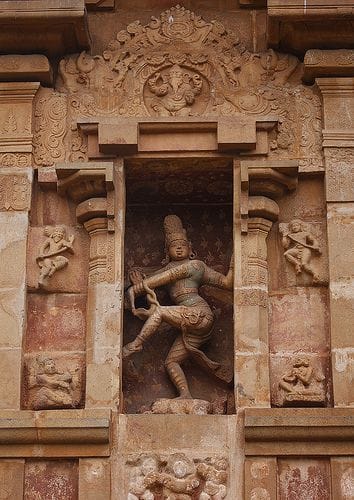
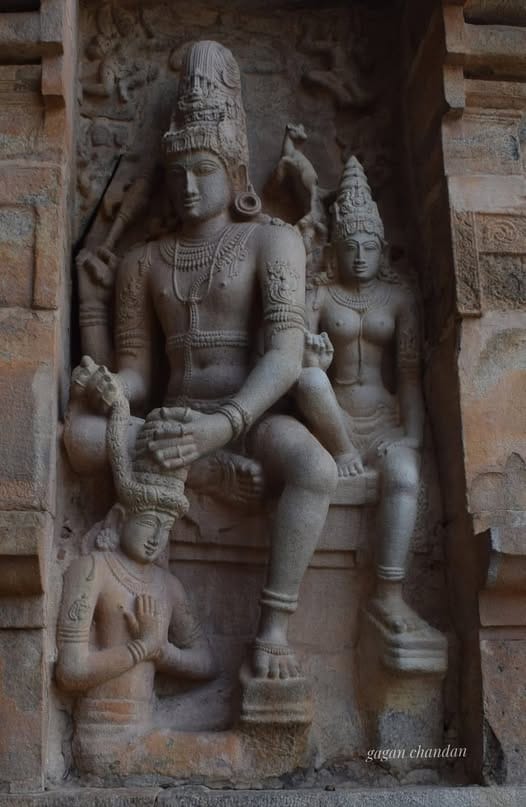
1. 108 feet Ganga Talao (Grand Bassin) Shiva Statue, known as Mangal Mahadev 2. 369 feet Vishwas Swaroopam (also known as Statue of Belief) in Nathdwara, Rajasthan; 3. 123-feet Sri Shiva at Murudeshwara Temple 4. Shiva as Nataraja on the wall of Brihadeshwara Temple, and 5. Shiva garlanding a devotee carved in Brihadeshwara temple.
So what do you see?
These monumental forms are not expressions of "small people making large idols". they are civilizational affirmations of transcendence, crafted by cultures that see divinity not as an abstract ideal but a living presence in stone, metal, and air.
They symbolize bhakti as architecture, where devotion gives shape to metaphysics.
Shambhavi Mahamudra: The Rant, the Gatekeepers and the Scientific Facts
In light of all the dismissive rants by Sri Sri regarding "Shambhavi Mudra," let us evaluate the classical Dharmic scriptures.
The Gheranda Samhita stands as one of the most authoritative and systematic treatises on Haṭha Yoga in the Hindu tradition. Structured as a dialogue between Sage Gheraṇḍa and his disciple King Caṇḍakāpāli, the text outlines a complete yogic path consisting of seven limbs, designed to carry a serious aspirant from bodily purification to the highest states of samādhi and ātma-jñāna.
Unlike other haṭha yoga manuals, the Gheraṇḍa Samhitā presents a deliberately integrated system that unifies the discipline of the body with mastery of consciousness.
Gheraṇḍa’s sevenfold path uniquely incorporates tattva-dhāraṇā (concentration on the elemental principles) and seamlessly bridges haṭha yoga and tantra.
The text thus presents yoga not as fragmented techniques, but as a coherent spiritual technology.
Within this framework, Śāmbhavī Mudrā holds an exceptional importance.
Gheraṇḍa then makes a declaration of profound theological consequence. He states that one who truly knows Śāmbhavī becomes like Ādinātha (Shiva himself explicitly invoking the term Adi-Nātha, the primordial Lord).
Such a practitioner is said to be Nārāyaṇa, Brahmā the Creator, and fully established in the highest realization.
The text goes further: Maheśvara himself is quoted as affirming—without doubt—that one who knows Śāmbhavī is Brahmā (or the Creator himself).
This assertion is not metaphorical ornamentation; it presupposes Shiva as a conscious speaking authority, affirming realization through embodiment, not abstraction.
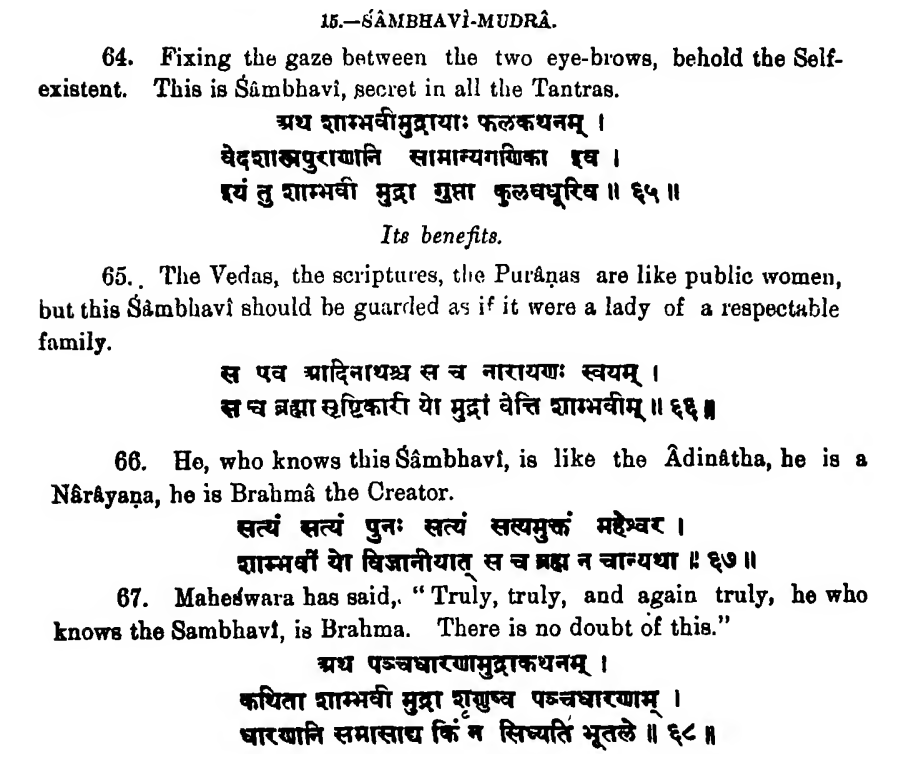
Significantly, the Gheraṇḍa Samhitā also expounds Śakti-cālana Kriyā in great detail.
It is a practice central to the awakening and ascent of kuṇḍalinī śakti that is shared by Sadhguru. This kriyā, reserved for advanced practitioners, is presented as a transformative process that accelerates spiritual realization.
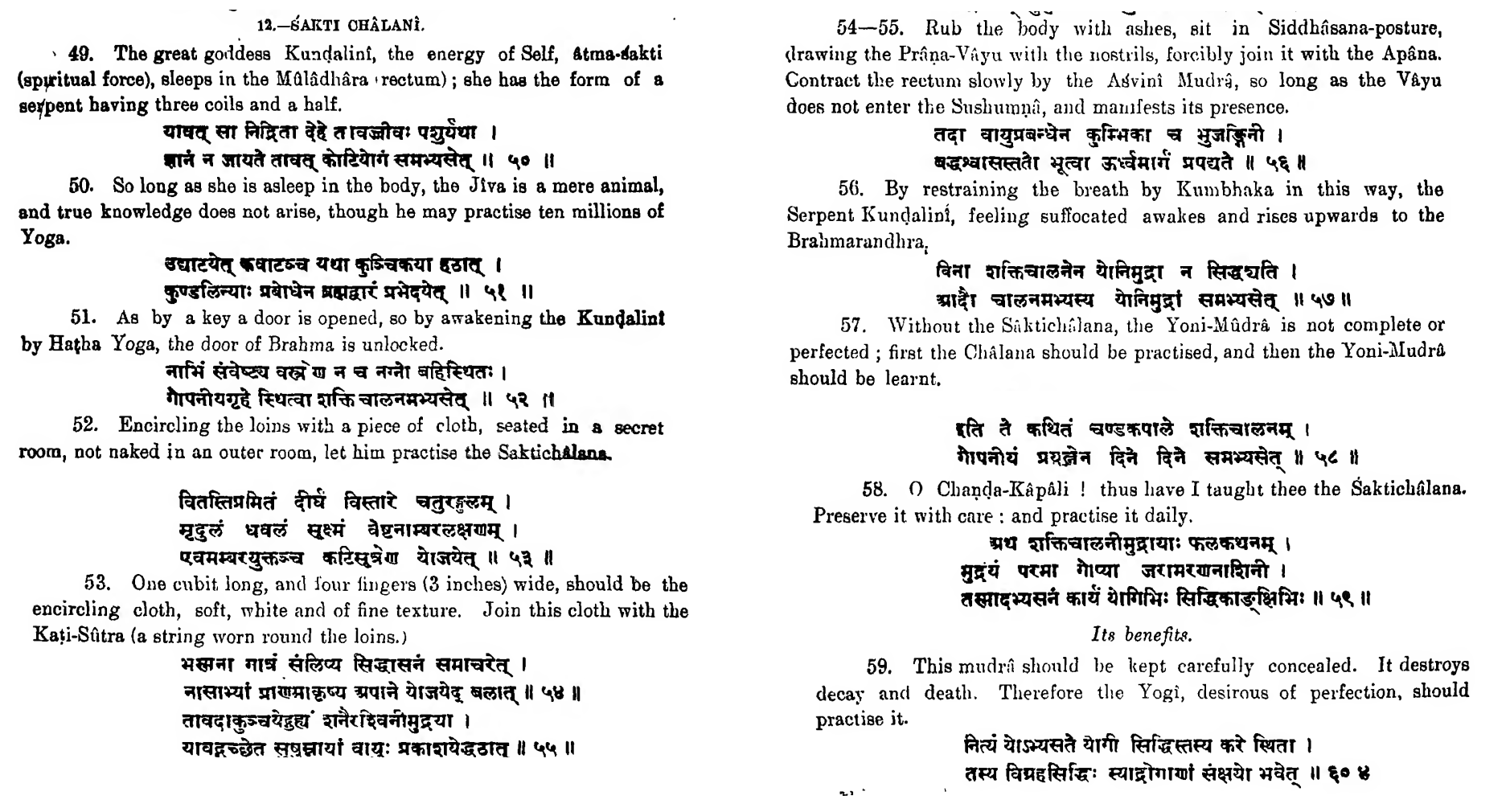
Taken together, the Gheraṇḍa Samhitā decisively refutes the notion that Shiva is merely an abstract principle or symbolic energy. It affirms, with scriptural precision, that realization culminates in identity; the yogin becomes that which he worships.
To know Śāmbhavī is not to petition Shiva, but to become Ādinātha, just as the highest aim of yoga has always declared.
You can also download the scripture from here:
Scientific Evidence related to Shambhavi Mahamudra
It is from this textual and experiential foundation that we now turn to modern scientific studies on advanced meditators who have practiced Śāmbhavī, examining how contemporary research intersects with an ancient and rigorously preserved yogic science.
At the outset, let us state clearly that scientific measurements should not be viewed as a commentary on the efficacy of the ancient yogic techniques or otherwise. They serve as an instrument to showcase the fundamental scientific underpinnings to the agnostics and the atheists.
Check for yourself.
An instructive contrast emerges when one examines how major contemporary yogic practices are represented on Wikipedia. On the page dedicated to Sadhguru (Wikipedia's Sadhguru page), there is no substantive mention of Śāmbhavī Mahāmudrā as his principal or most widely transmitted yogic offering. This omission is striking, given that Śāmbhavī Mahāmudrā has been taught to millions worldwide, is foundational to Isha’s yogic programs, and has been the subject of multiple peer-reviewed scientific studies examining its effects on mental health, stress regulation, and cognitive well-being.
By contrast, the Wikipedia page of Sri Sri Ravi Shankar (link to the page) includes detailed coverage of Sudarshan Kriyā, explicitly highlighting it as a signature practice, with references to both organizational materials and academic studies. The asymmetry is not merely editorial; it reveals a pattern in how prominence and legitimacy are selectively assigned.
This discrepancy illustrates what may be described as gatekeeping bias within Wikipedia’s editorial ecosystem. The platform’s reliance on a narrow and often ideologically filtered definition of “acceptable sources” allows certain practices to be foregrounded while others—despite comparable or even stronger scientific and scriptural grounding—remain marginal or invisible. The issue is not the absence of evidence, but the selective validation of evidence.
Importantly, Śāmbhavī Mahāmudrā is not only supported by modern scientific inquiry; it is also anchored in classical yogic literature, including authoritative Haṭha and Tantric texts that discuss Śāmbhavī Mudrā as a transformative and highly guarded practice, transmitted through strict guru–śiṣya lineage. Its omission, therefore, cannot be explained by lack of relevance, impact, or documentation.
What this reveals is not a neutral encyclopedic judgment but the operation of editorial filters shaped by institutional familiarity, narrative preference, and ideological comfort. Wikipedia’s open-edit model does not negate gatekeeping; it often relocates it—away from transparent scholarly debate and into informal yet powerful editorial consensus.
The larger concern, then, is not about any single individual or organization, but about how living Dharmic practices are curated, framed, or erased in influential public knowledge platforms.
When scientific studies and scriptural continuity are insufficient to secure fair representation, the problem lies not with the tradition but with the epistemic standards being applied to it.
We should assess this peer-reviewed, NIH-indexed, methodologically sound study published on PubMed Central (NIH / NLM) related to Shambhavi Mahamudra and related practices authored by credentialed researchers.
This is an unambiguous evaluation of a meditational practice as opposed to a rant by Sri Sri, sans any evidence.
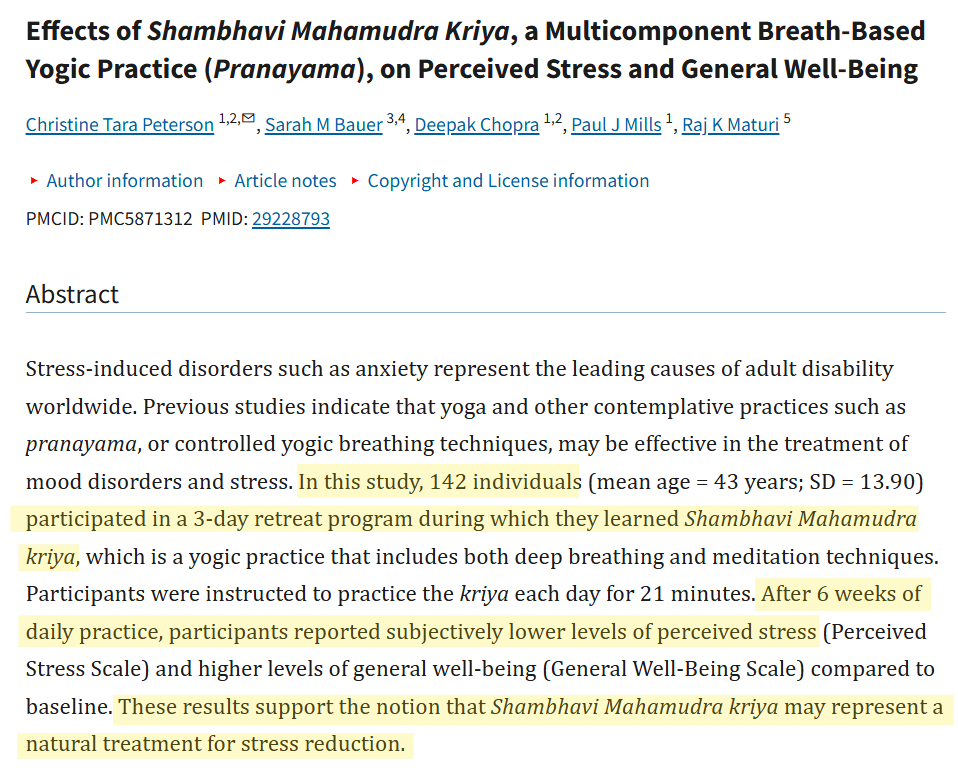
Further, let us look at another peer-reviewed study.
This is another peer-reviewed and serious scientific study that measures the impact of meditation offerings during the Samyama program at Isha.
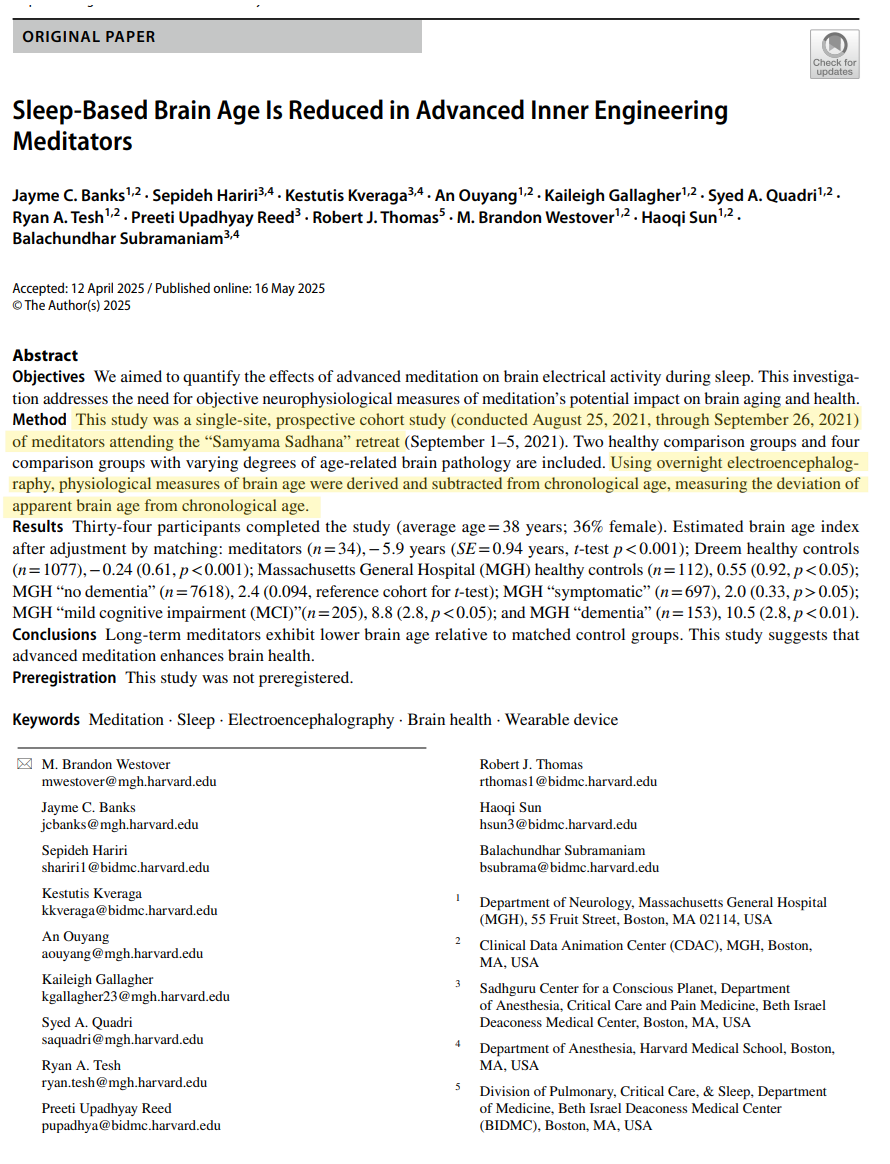
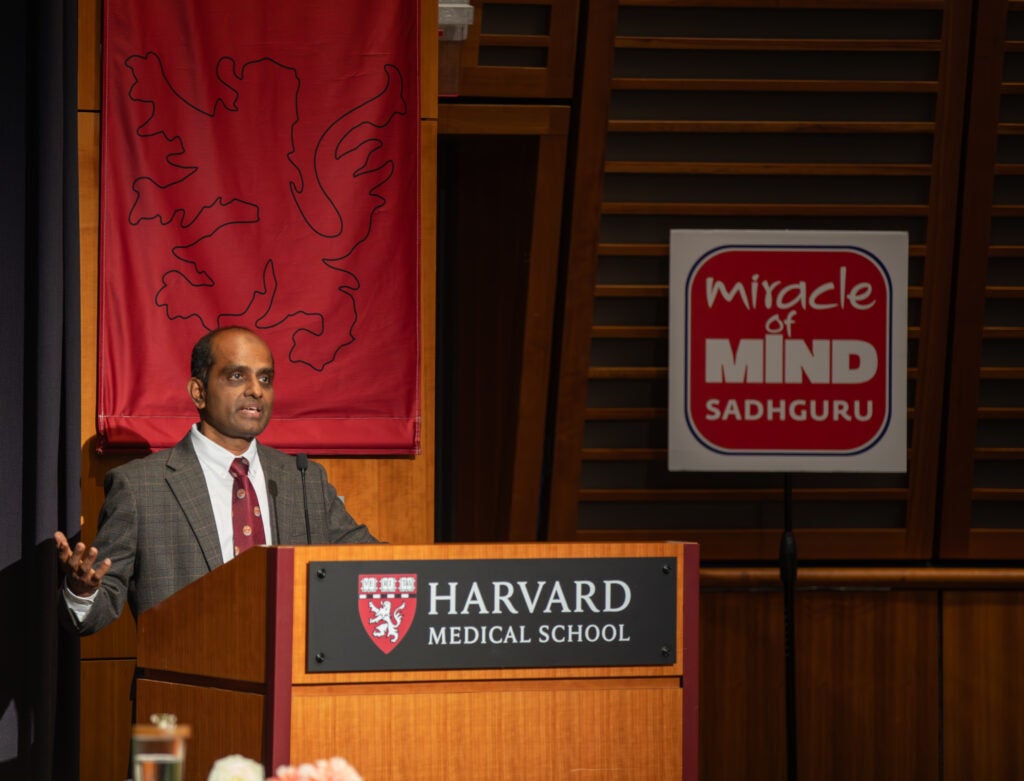
You can read more about that study and the Sadhguru Center for a Conscious Planet below.

We need to be clear about one thing in this instance - Wikipedia editors are not evaluating science. If they did, then research on Shambhavi Mahamudra and Samyama would have been presented credibly. It wasn't even mentioned!
Why? Because they are evaluating narrative risk based on what they present to readers at large.
The premise seems very clear:
Maintaining such a level of gatekeeping bias doesn't come easy. It takes a lot of effort and involves “primary study” dismissal, “notability” hedging, “undue weight” arguments, and endless talk-page delay.
What is put forth as "editorial judgment" is anything but. It is an ideological prior roadblock.
The Ring Finger and Its Significance
In another instance, Sri Sri emphasizes the importance of the ring finger and its role in grounding life energies within the body. The use of metal rings is treated especially disdainfully by him.
Take a listen.
Let us look at the Dharmic evidence now.
In the philosophical architectures of Shaiva, Shākta, and Kaula traditions, the Mulādhāra Chakra is not merely the starting point of spiritual ascent but the ontological anchor of embodiment.
It functions as the critical nexus where Cit-Shakti (dynamic consciousness) voluntarily accepts the limitations of Māyā (matter/illusion), thereby facilitating the soul’s engagement with the phenomenal world.
Analytically, the Mulādhāra operates on three primary dimensions:
- The Junction of Involution: It is the seal of the Brahma Granthi (the knot of creation), representing the precise locus where consciousness condenses into jaḍa (inert matter). It is the stabilizing friction that allows the infinite to inhabit the finite.
- The Pneumatic Regulator: It serves as the seat of Apāna Vāyu (the downward-moving breath). In the physiology of Hatha Yoga, the Mulādhāra governs the equilibrium between Prāṇa (generative force) and Apāna (eliminative/degenerative force), thereby regulating the biological parameters of birth, homeostasis, and eventual death.
- The Somatic Tether: In the advanced stages of dissolution (laya), when higher karmic accumulations have been incinerated by jñāna (gnosis), the Mulādhāra acts as the final tether. It maintains the jīva’s (soul's) connection to the sthūla śarīra (gross body), preventing immediate discarnation.
The Tirumantiram, the seminal text of Tamil Shaiva Siddhānta authored by Tirumūlar, posits that the physical vessel is not an obstacle to be discarded but a requisite instrument for stabilizing gnosis.
Tirumūlar warns against a premature ascent that neglects the somatic foundation.
Regarding the necessity of anchoring the breath and consciousness at the base to preserve the body, Tirumūlar writes:
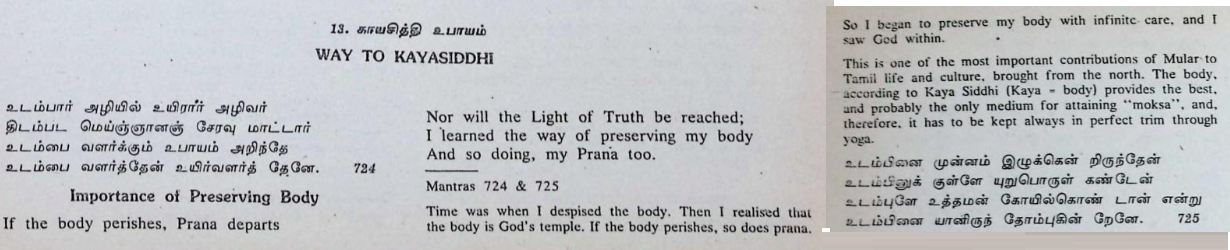
"If the body perishes, the Prana departs; If Prana departs, the Light of Truth cannot be attained. Knowing the means to preserve the body, I preserved the body and thereby preserved the Soul." — Tirumantiram, Tantra 3, Verse 724
Furthermore, in the section related to Pratihara, the Sage discusses the awakening of the Kuṇḍalinī fire at the base.
Tirumūlar emphasizes that the "sleeping serpent" must be mastered at its source to effect a transformation of the physical elements, rather than merely escaping them.
The implication is that without the stability of the root (the "Kindling"), the alchemical process of immortality (kāyasiddhi) cannot occur.
The Siddhāntic View: Karmic Mechanics and Jīvanmukti
Shaiva Siddhānta provides a rigorous taxonomy of the bonds (pāśa) that tether the soul to the body.
The necessity of the Mulādhāra is best understood through the distinction between types of karma:
- Āṇava Malam: The primordial impurity of "mineness" or individuated ego. This is the root ignorance that creates the sense of separation from Shiva.
- Prārabdha Karma: The specific portion of past karma allocated for fruition in the current lifespan.
While the ascent of consciousness may dissolve Sañcita Karma (accumulated karma) and loosen the grip of Āṇava, the Prārabdha Karma remains active until the body completes its destined trajectory.
The Mulādhāra acts as the repository for the momentum of Prārabdha.
If the Yogi completely severs ties with the root chakra before the Prārabdha is exhausted, the physical body drops (videhamukti).
However, for the state of Jīvanmukti (liberation while living), which is the ideal of the Siddha tradition, the consciousness must retain a "functional grounding" in the Mulādhāra.
This grounding prevents the premature dissipation of the body, allowing the Siddha to remain in the world as a vehicle of Grace (Arul), demonstrating that the highest non-dual realization includes, rather than excludes, the physical plane.
Varma Kalai: The Tamil Art of Vital Points
Varma Kalai (Tamil: வர்மக்கலை, "Art of Vital Points") represents a sophisticated synthesis of Tamil martial arts (Adimurai) and traditional traumatology (Vaidhiya Murai).
Emanating from the Siddha lineage of Southern India, it posits the existence of specific bio-energetic nodes (varmam) on the human body where physiological functionality, nervous integrity, and pranic flow intersect. We will examine the discipline’s dual application as a combative system and a healing modality, while critically assessing its foundational role in Siddha medicine and Kalaripayattu.
Its origin and transmission
The term derives from the Tamil varmam (vital point) and kalai (art/discipline). Cognate with the Sanskrit Marma, the concept refers to vulnerable junctions where ligaments, vessels, bones, and nerves converge.
In the scriptures of Tamil Shaivism, the lineage is traced to a divine transmission: Lord Shiva expounded the knowledge to his son Murugan, who, disguised as an elder, transmitted 108 vital points to the Sage Agastya. Agastya, the patriarch of Tamil grammar and medicine, is credited with systematizing this oral tradition into textual form, disseminating it through the Siddhar lineage.
The 108 Nodes
While Ayurvedic texts (such as the Sushruta Samhita) classify 107 marma points, the Varma Kalai tradition of Siddha medicine explicitly identifies 108 varmams. These are categorized not merely by anatomical location but by the lethal potential and the force required to activate them:
- Padu Varmam (12 Major Points): These are critical junctions associated with major organ systems and the central nervous system. Trauma to these points can be fatal or cause immediate incapacitation.
- Thodu Varmam (96 Minor Points): These are activated by touch or specific finger pressure (thodu means touch). They are often used in therapeutic manipulation to release blocks in pranic flow.
The Shandilyopanishad and Vashishtha Samhita corroborate the spiritual dimension of these points, citing focus on 18 specific marmas as a supreme form of Pratyahara (withdrawal of senses), linking somatic geography to yogic praxis.
The Dual Modality: Harm and Healing
Varma Kalai operates on a continuum of force. The same point used to disable an opponent is used to resuscitate a patient.
- Adimurai / Varma Adi (The Martial Application): This serves as the combative "pressure-point striking" system. Unlike external styles that rely on brute force, Varma Adi targets the neuro-electric system. Strikes are precision-guided to disrupt the opponent's equilibrium, cause paralysis, or induce shock.
- Vaidhiya Murai (The Medical Application): This constitutes the traumatology and physiotherapy wing of Siddha medicine. It treats ailments such as spondylitis, nervous disorders, and paralysis by manipulating varmam points to restore the flow of prana.
Kalaripayattu is broadly divided into Northern (Vadakkan) and Southern (Thekkan) styles. Southern Kalari (often called Adi Murai or Thekkan) is nearly synonymous with Varma Kalai. Zarrilli (1992) notes that in the Southern tradition, the empty-hand techniques (Adithada) are merely preparatory drills for the application of Varma Adi.
Varma Kalai serves as the interstitial tissue connecting the combative arts of Tamil Nadu/Kerala with the therapeutic arts of the Siddha tradition. It effectively blurs the line between the warrior and the healer, positing that one cannot truly know how to destroy the body without understanding how to repair it, and vice versa.
The Anāmikā Constraint: Spiritual Anchor in the Siddha Tradition
In the Siddha and Shaiva anthropologies, the body is not merely biological but an alchemical vessel (kāya) constituted by the interplay of the five elements (Pañca Bhūtas). The ring finger, or Anāmikā, serves as the somatic interface for the Earth Element (Prithvi Tattva).
The theological premise for wearing a metal ring—specifically copper (tāmra)—on this digit rests on the necessity of "weighting" the consciousness. When the Kuṇḍalinī ascends or when karma is metabolized, the soul achieves a high "escape velocity." Without a corresponding gravitational anchor, the vital force (Prāṇa) may decouple from the gross body (Sthūla Śarīra), leading to Videhamukti (disembodied liberation).
For the Siddha who seeks Jīvanmukti (liberation while physically extant), this decoupling is premature. The ring finger acts as the control rod, and the copper ring functions as the dielectric seal, preventing the "short-circuiting" of the finite into the infinite.
Scriptural and Textual Grounding
The doctrinal basis for body stabilization is most potently articulated in the Tirumantiram of Tirumūlar and the Varma Cūttiram literature.
1. The Imperative of Body Preservation
We have already discussed this earlier that Tirumūlar argues that the body is the requisite theater for divine stabilization.
This "means to preserve" (Upāya) includes the use of Yantras, Mantras, and Aushadha (medicine/metals) to lock the soul into the frame.
2. The Ring Finger in Varma Sāstra
In the text Varma Kāṇṇāḍi (The Mirror of Varma), the flow of Vāsi (vital breath) is mapped across the digits. The ring finger is identified as the conduit for the Prithvi (Earth) and a regulator of the Apāna Vāyu (the downward grounding wind).
“In the Anāmikā resides the Earth, steady and cool, Binding the Vāsi to the Mulādhāra seat. Pressing it seals the gate of the heart, Preventing the bird of life from flying too soon.” — Paraphrased from oral glosses on Varma Oḍivu Murivu Sāra Sūttiram
3. The Copper Connection (Tāmra)
The Siddha alchemical text Bogar 7000 discusses the properties of copper (Tāmra). Copper is classified as a conduit that harmonizes the Pitta (fire/heat) and Kapha (earth/structure) doshas. By placing a conductive band around the Prithvi finger, the yogi creates a "closed loop," recycling the ascending energy back into the somatic field.
The Bio-Mechanics of the Ring Finger Varmam
In Varma Kalai, the ring finger is not inert. It interacts with the Ullangai Varmam (Palm Center) and connects to the Hridaya Nadi (Heart Channel).
- The Mechanism: The nerve ending at the tip of the ring finger connects via the ulnar nerve pathway towards the heart region.
- The Lock: When a Yogi is in deep Samādhi, the system cools down, and the heart rate drops. If the energy surges toward the Sahasrāra (Crown) without a tether, the heart may stop (clinical death during meditation).
- The Ring's Role: The tight copper ring applies constant, subtle acupressure to the base of the phalanx. This signal (a mild pain/pressure stimulus) keeps the autonomic nervous system "engaged" with the physical reality. It is a biological "ping" ensuring the server (body) stays online.
So, the ring finger and the use of metals, specifically copper, create a bandha - or closed loop of energies - that keeps ascending Kundalini energies back into the somatic field, lest it exits the body and the yogi is no longer capable of using the body for further sadhana.
Sabotaging Programs
Let us look at the evidence.
Sadhguru had planned a program to help seekers experience higher states of consciousness. Many did.
Sadly, the Art of Living teachers ran an elaborate campaign to stop Sadhguru's program in Toronto.
Julia Arbuckle, a top Art of Living Teacher, started a petition on Change.org to peddle false narratives in the garb of "alleged sexual abuses" - a classic sexual slander and character assassination mechanism - to stop the Ecstasy of Enlightenment program in Toronto.
Check the pictures below.
Julia Arbuckle is the organizer of the petition to cancel Sadhguru’s event. And then we have her clear, public affiliation as a senior figure within Art of Living Toronto (pictured with the founder, Sri Sri Ravi Shankar).
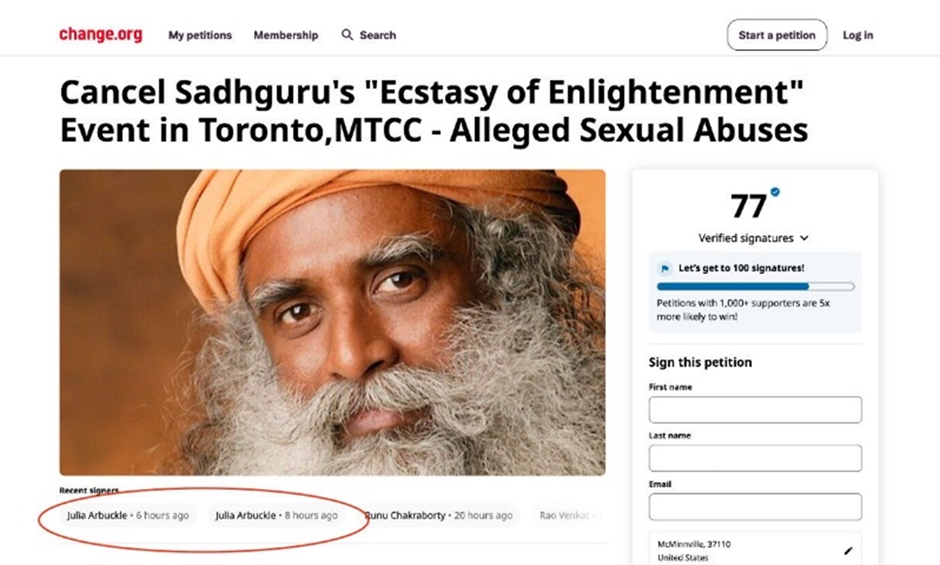
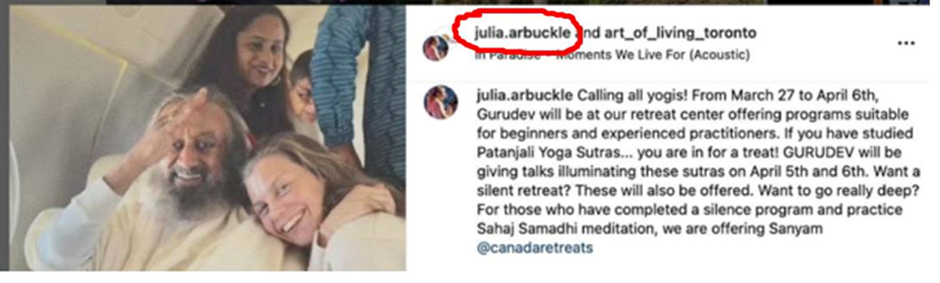
A perusal of the list of supporters for this petition shows that they are all Art of Living teachers or office bearers. Below are a few of them. They are all Art of Living teachers and volunteers. One can do a general Google search to confirm that.

Quite simply, the link dissolves the defense that this petition or such attacks are the work of "rogue individuals."
When high-ranking teachers or regional leads engage in public takedowns of another spiritual leader (perhaps "rivals" in their perspective, even when Isha or Sadhguru may not look at it their way), it signals, at a minimum, institutional tolerance, and at worst, institutional directive, specifically, when Julia and others have not been reprimanded for these actions.
In the corporate world, this would be akin to a VP of Marketing at Pepsi publicly petitioning to ban Coke for esoteric ethics violations based on fake news by some tabloids.
It is a direct, hostile engagement.
The sabotage game from Art of Living, however, goes deeper.
Adiyogi and Adidas: How Art of Living's hate targets Hindu Traditions
When Prime Minister Narendra Modi went to inaugurate, Dinesh Ghodke, a senior Art of Living teacher, shared this message on X:
"Shiv is timeless, infinite. To say he lived on Kailash 15000 yrs ago (Adiyogi, in that sense) is childish. But Adi-das exists 😊"
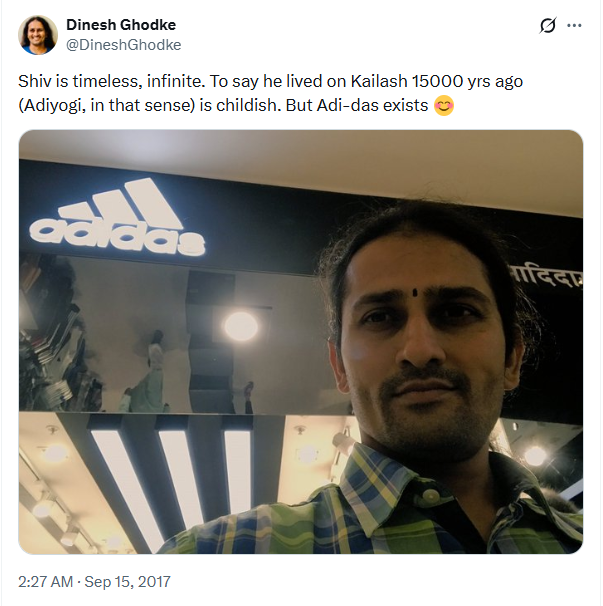
He was suggesting that to say Adiyogi Shiva, the first yogi lived on Kailash is "childish" and that Adiyogi was inferior to his shoes from Adidas.
That was not a one-off.
Recently, he posted again on his urge to demean Adiyogi by reducing him to a shoe brand and calling him delusional.
"Shiva is anaadi, ananta. He is mahaakaal, beyond time - so putting Him in a timeline however many thousand years ago is unscientific at least & illusory at most. Adiyogi is a delusion, Adidas is reality. I should know, I own a pair myself :-)"
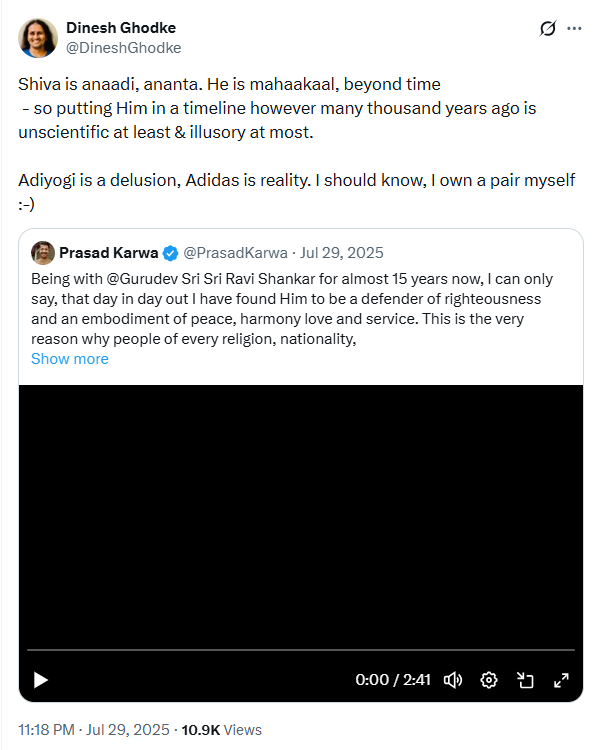
Let us analyze this.
What Ghodke is actually doing (and why it’s dishonest)
Dinesh Ghodke’s recent commentary cannot be dismissed as mere "playful banter."
It represents a calculated, bipartisan assault on Shaiva heritage:
- First, the weaponization of a pseudo-scientific veneer to delegitimize core theology, and
- Second, the immediate trivialization of the deity through consumerist ridicule.
This combination is not accidental; it is a classic mechanism of religious demeaning designed to operate under the guise of plausible deniability.
1. The Metaphysical Strawman: Denying the Civilizational Genius Ghodke’s argument—that because Śiva is anādi–ananta (without beginning or end) and Mahākāla (beyond time), the concept of Adiyogi is therefore a delusion—relies on a fundamental theological illiteracy.
He attacks a strawman, pretending that Hindu metaphysics is incapable of holding the timeless and the manifest in unison.
Shiva as Mahākāla and Shiva as Adiyogi are not contradictions. One is ontology; the other is pedagogy, the first yogi as the archetypal source of yogic knowledge.
The Krishna who spoke on the battlefield and actively participated in the Mahābhārata was the manifest form—historical, relational, and present in time.
Yet the same Krishna simultaneously revealed Himself as the Viśvarūpa, the boundless, timeless cosmic reality that contains all beings, all moments, and all worlds.
Here are the verses that clear the naive and false dichotomy being introduced within the Dharmic understanding of divinity.
Bhagavad Gītā 4.6: Though I am unborn, imperishable, and the Lord of all beings, I manifest Myself through My own yogic power.
अजोऽपि सन्नव्ययात्मा भूतानामीश्वरोऽपि सन् ।
प्रकृतिं स्वामधिष्ठाय सम्भवाम्यात्ममायया ॥
What does it mean: Krishna is aja (unborn) and avyaya (unchanging), yet He manifests. Timelessness does not negate manifestation.
Bhagavad Gītā 9.4–5: All beings exist in Me, yet I am not limited by them. This is My divine mystery.
मया ततमिदं सर्वं जगदव्यक्तमूर्तिना ।
मत्स्थानि सर्वभूतानि न चाहं तेष्ववस्थितः ॥
न च मत्स्थानि भूतानि पश्य मे योगमैश्वरम् ।
भूतभृन्न च भूतस्थो ममात्मा भूतभावनः ॥
What does it mean: Krishna contains all, yet is not contained by any single form or moment.
Bhagavad Gītā 11.32 (Viśvarūpa): I am Time itself—the great destroyer of worlds.
कालोऽस्मि लोकक्षयकृत् प्रवृद्धो
What does this mean: Here Krishna identifies Himself as Mahākāla, timeless Time itself—while still standing before Arjuna as a person.
The Gītā makes no attempt to separate these dimensions. The unborn becomes present without ceasing to be eternal. The infinite enters form without being reduced by it. In Krishna, the historical and the timeless are not competing explanations; they are a single reality understood at different depths.
These two dimensions were not in conflict. They were not competing claims. They were one and the same reality, perceived through different lenses. What appears as form is not separate from the formless; what moves in time is not cut off from the eternal. The Gītā does not ask us to choose between history and transcendence—it teaches us to understand their profound unity.
The Being who Walked: Was He Shiva?
There could be another question. How do we know that the being who walked this planet was indeed Shiva?
Is the Being who is said to inhabit Kailash Shiva or not?
What if all that we have in our tradition about Kailash and Shiva-Parvati is "nonsense" (to borrow from Sri Sri's characterisation)?
Indeed.
It is a diversion, long employed by those insufficiently grounded in India’s metaphysical and devotional traditions.
The Yoga Vāsiṣṭha addresses this issue with exceptional clarity. Sage Vāsiṣṭha had shared with Śrī Rāma that God and Guru are not as critical for the seeker as his own Purusharth or self-effort.
When Sage Vāsiṣṭha tells Śrī Rāma that Prahlāda attained enlightenment by the grace of Viṣṇu, Rāma immediately questions the apparent contradiction: if liberation is achieved through self-effort, why invoke divine grace at all?
Vāsiṣṭha’s reply is decisive. What Prahlāda attained was indeed through self-effort alone. The reference to “Viṣṇu’s grace” is not ontological dependence but semantic shorthand.
Viṣṇu is the Self, and the Self is Viṣṇu.
Through sustained self-inquiry and devotion, Prahlāda dissolved all duality. At that level of realization, Prahlāda was Viṣṇu, and Viṣṇu was Prahlāda. The distinction existed only in language.
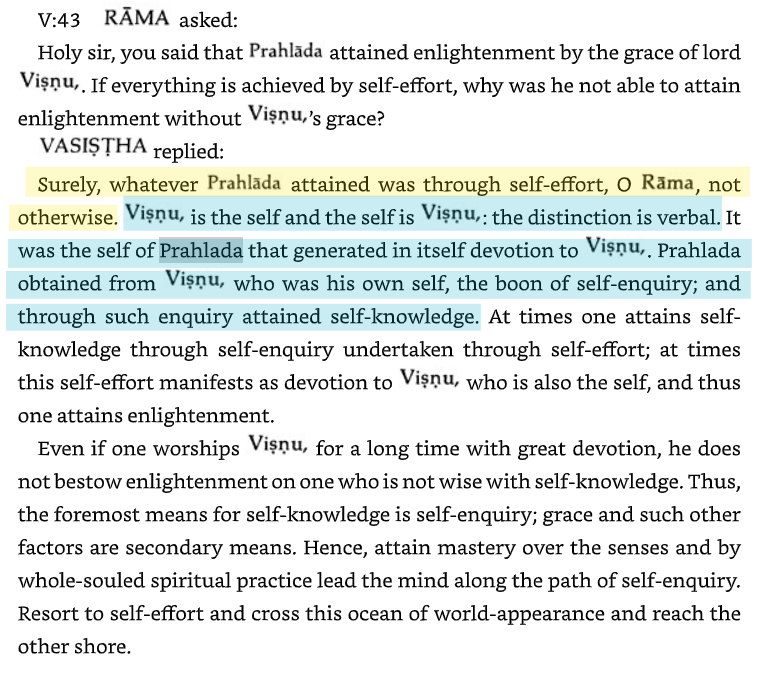
Prahlāda himself makes this explicit when he declares that one who is not Viṣṇu derives no benefit from worshipping Viṣṇu. This is not arrogance; it is Advaitic precision.
The word for devotion in Hinduism is called upāsanā—upa (near) + āsana (to sit or abide).
True devotion is not supplication from a distance; it is the progressive obliteration of separation, until the devotee abides in the very being of that which is worshipped.
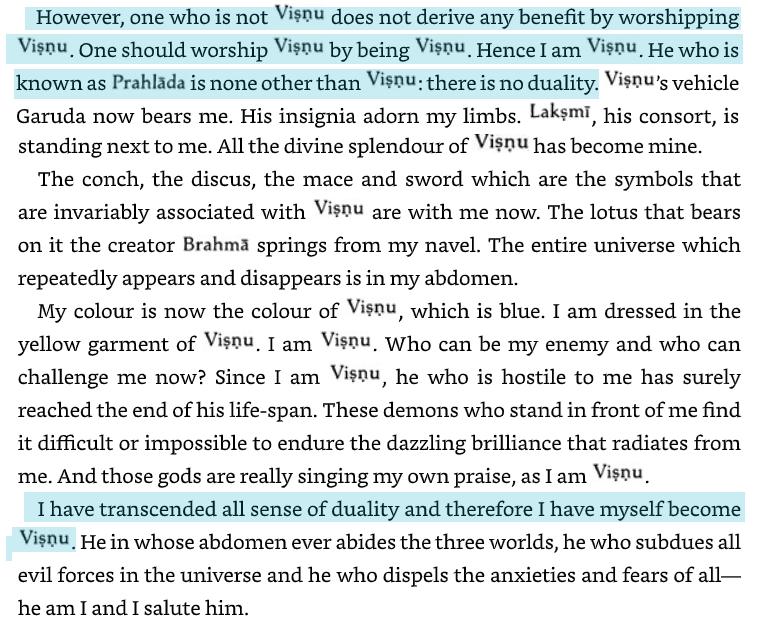
This principle is not confined to Viṣṇu-bhakti. It is universal across Sanātana Dharma.
Just as Prahlāda became Viṣṇu, countless devotees have dissolved themselves into Krishna, Rāma, or Shiva. There was no duality left between Mīrā and Krishna; the distinction survived only for onlookers.
This is the unique strength of Dharma: the door to the highest realization is never closed. One may become that which one worships when duality is obliterated.
This openness stands in contrast to many later traditions (religious or philosophical) that permanently separate the seeker from the Absolute. Sanātana Dharma does not.
Neither does Buddhism in its own framework.
Jainism and Sikhism, in different ways, also retain echoes of this trajectory.
But in the Upaniṣads, the Bhagavad Gītā, the Yoga Vāsiṣṭha, and the Aṣṭāvakra Saṃhitā, the path is unmistakable: from duality to non-duality, from worship to non-identity.
The Yoga Vāsiṣṭha reinforces this again through another narrative - that of a mendicant who, through sustained yogic realization, becomes Rudra.
Not metaphorically, not symbolically, but by dissolving the false boundary between himself and Shiva.
This is the fundamental property of devotion itself.
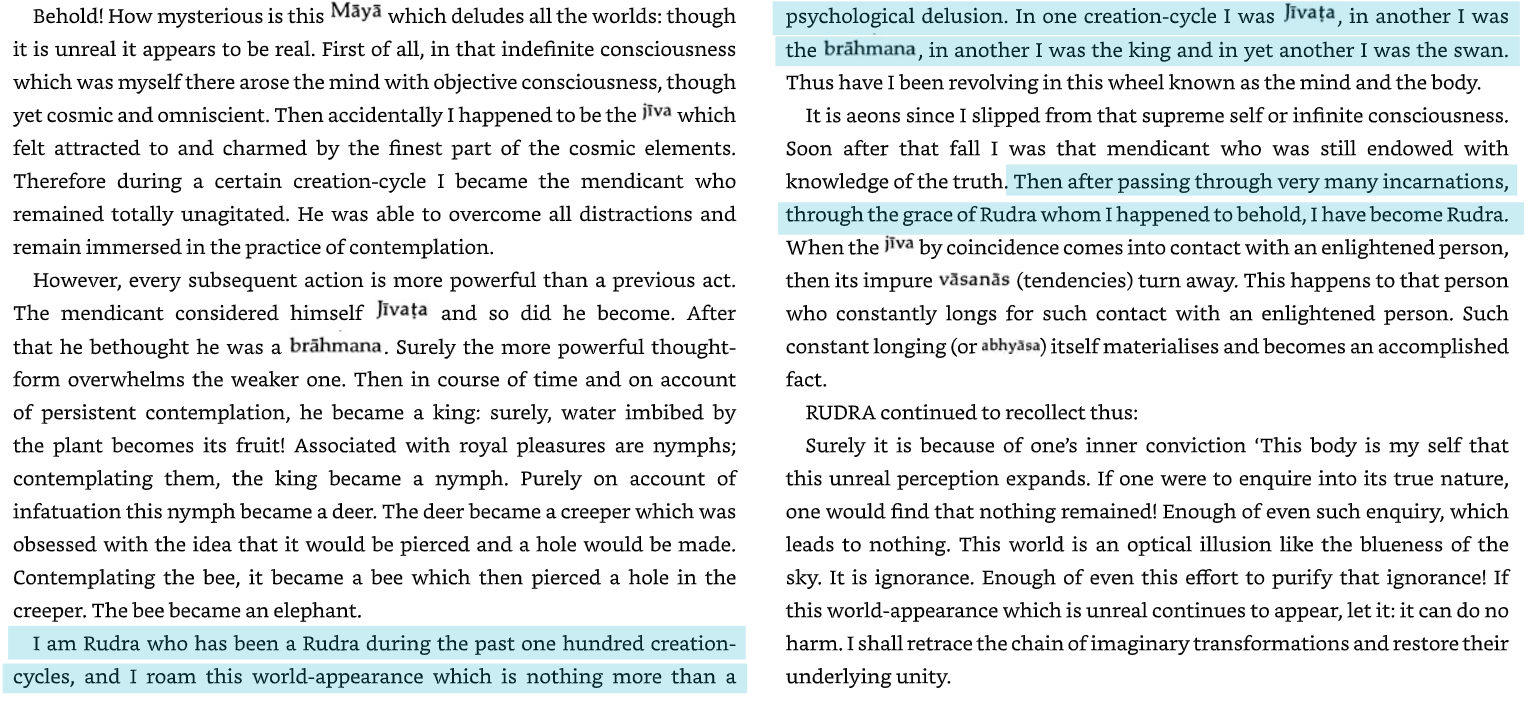
Therefore, the claim that a body cannot embody the timeless is not merely incorrect—it is foreign to Dharma.
In the Dharmic vision, the timeless does not negate embodiment; it transfigures it.
So for any self-proclaimed spiritual Guru in the Hindu tradition to even bring up the question that Art of Living leadership - from Sri Sri to its senior teachers are bringing - is an exposition of complete Dharmic ignorance. A study of Bhagwad Gita or Yoga Vasistha could have dispelled such dark clouds from their minds.
Nirguna and Saguna
The brilliance of the Dharmic tradition lies precisely in its refusal to reduce the Divine to a sterile abstraction. We explicitly recognize the Nirguṇa (the Absolute beyond attributes) alongside the Saguṇa (the approachable Manifest). The human being requires a doorway to the Infinite, and that doorway is not a "childish contradiction"—it is the structural necessity of spiritual life.
- The Both/And Reality: Just as the Liṅga serves as a tangible sign of the formless, a pillar of light with neither top nor bottom yet centered in worship, the perceptive understanding of Adiyogi allows the Infinite to become intelligible without becoming small. Moreover, just as Krishna transmitted the Yogic knowledge as the Bhagwad Gita, Shiva did so with the Saptarishis and his wife Parvati.
- Sacred Geography: The Śiva Purāṇa does not position Kailāsa as a trivial geographic claim to be fact-checked against a modern timeline; it establishes it as a "sacred grammar"—a locus where transcendence is lived as presence. To mock this is to mock the very mechanism by which the Divine engages with the human.
2. The Category Error - Contempt Masquerading as Rationality: Ghodke commits a grave category error by invoking "science" to adjudicate symbolic and metaphysical truth.
Science evaluates empirical claims and forensic evidence; it does not arbitrate the ontological status of a deity.
When Shaiva traditions speak of Śiva as Mahākāla, they are making an ontological statement: Time exists within Him; He does not exist within time. To leap from "Śiva is beyond time" to "therefore the narrative of the First Yogi is a lie" is not scientific rigor by any stretch.
It is simply intellectual contempt dressed in the costume of rationality.
3. Desecration-by-Humor - The "Adidas" Tactic: Please see clearly, and you will immediately notice that the quip "Adiyogi is delusion, Adidas is reality" is not a mere critique.
It is worse - an act of desecration.
It is a deliberate rhetorical strategy designed to:
- Drag a sacred archetype into the realm of commodity fetishism.
- Signal to a secularized audience that Hindu devotion is intellectually embarrassing or "cringe."
- Provoke the faithful while retaining the cowardly defense of, "Relax, it was just a joke."
4. The Textual Reality - Adiyogi is Canonical, Not Marketing: The assertion that the "First Yogi" is a modern fabrication is historically and textually perverse as well!
The template of Śiva transmitting the technology of liberation is the spine of the tradition:
- Tantric Transmission: The Vijñāna Bhairava Tantra - विज्ञान भैरव तंत्र (also called Śiva-jñāna-upaniṣad by Abhinavagupta) is explicitly structured as a dialogue in which Śiva instructs Devī in 112 methods of realization. (Check link for an English translation of the scripture)
- The Primal Teacher: As Dakṣiṇāmūrti, Śiva is the archetype of the Adi-Guru, depicted in iconography instructing the ancient Rishis through silence and transmission.
- The Householder: The Śiva Purāṇa maintains a sustained narrative world where the Absolute interacts with Pārvatī, Gaṇeśa, and the Gaṇas. This insists that the Highest Reality is not in contradiction to life or relationship. (Check link for an English translation of the scripture)
When one reduces the cosmic grandeur of Mahākāla, who is beyond time yet present as the Teacher, to a shoe brand, they are not engaging in skepticism.
They are, instead, engaging in targeted cultural vandalism.
Hindu tradition has never been trapped in the immature binary of "either timeless or manifest."
We hold both.
Presenting this argument as "science" is an ideological polemic performed for attention.
We now come to discuss what Art of Living leadership brass is actively and actually doing - Reputational Warfare.
Reputational Warfare: Tool to Target Greek Temples to Adiyogi
In The Darkening Age, Catherine Nixey documents (Nixey, Catherine. The Darkening Age. Bloomsbury, 2017, pp. 118–152.) how early Christian polemic systematically weaponized sexual allegations to delegitimize pagan religions and philosophical traditions.
Pagan priests, philosophers, and rituals were repeatedly depicted as sexually licentious, morally depraved, and corruptors of youth, often without evidence and through formulaic accusations recycled across texts. A pattern pushed by Western powers and communists alike.
Through constant repetition, such allegations hardened into accepted “facts,” enabling the destruction of temples, the suppression of philosophical schools, and the exclusion of pagan traditions from public legitimacy.
Sexual slander thus operated as a powerful civilizational weapon, allowing Christians to bypass debate and justify cultural eradication under the guise of moral purification.
Sexual slander as a tool to bring down the Greek civilization has been well documented. It was used to legitimize attacks on spiritual and academic schools, temples, and traditional rituals, undermining their public legitimacy.
This is a scourge that Hindus are dealing with on an active basis from a biased and leftist media.
Delegitimizing Hinduism
In a unique study, researchers from Maharaja Sayajirao University of Baroda, Gujarat, investigated how digital news media reported on Hindus and Hinduism using four political occurrences in 2019 as case studies.
Deracination and de-Hinduisation: Hindu festivals like Diwali, Holi, Rakshabandhan, Makar Sankranti, Karwa Chauth, etc, are mocked and criticised. This coverage can be considered as attempts at deracination of Hindus from their heritage, culture, and civilisation, ie, de-Hinduisation. Hindu festivals are politicised, whereas the same is not found in the reportage on festivals of other faiths. Diwali is linked to weight gain. It is also linked to air pollution and poor quality of air, especially in the National Capital Region. Many news narratives, thus, either discourage Hindus from celebrating their festivals or induce a sense of guilt in them if they choose to follow their traditions. As part of the 'social justice’ frame, Hindu festivals are seen as opportunities to promote ideas about environmental awareness, gender equality, fairness, and pluralism. Value judgements are routinely passed on Hindu festivities, and sermons are given to the community on how they should go about celebrating their festivals. For examples, see here, here, here, and here. Also, celebration of Hindu festivals such as Durga Puja, Ganesh Utsav and Dahi Handi is framed as land grabbing and encroachment, and a threat to religious minorities. (Source: "How Left Media Uses Questionable Frames To Float Misleading Narratives About Hindus" / Swarajyamag)
Science and Methodology of Character Assassination
We will now go into a detailed assessment of established mechanisms of Character Assassination.
To get the context of what we will discuss now, it is essential to check this video, which uses misrepresentation of facts (including about the fake cases being filed in the US funded by "dubious and questionable sources" - which I am sure are being traced), innuendo, slander, and character assassination.
As per a paper by Sergei Samoilenko, Eric Shiraev, Jennifer Keohane, and Martijn Icks seven powerful methods are used for Character Assassination.
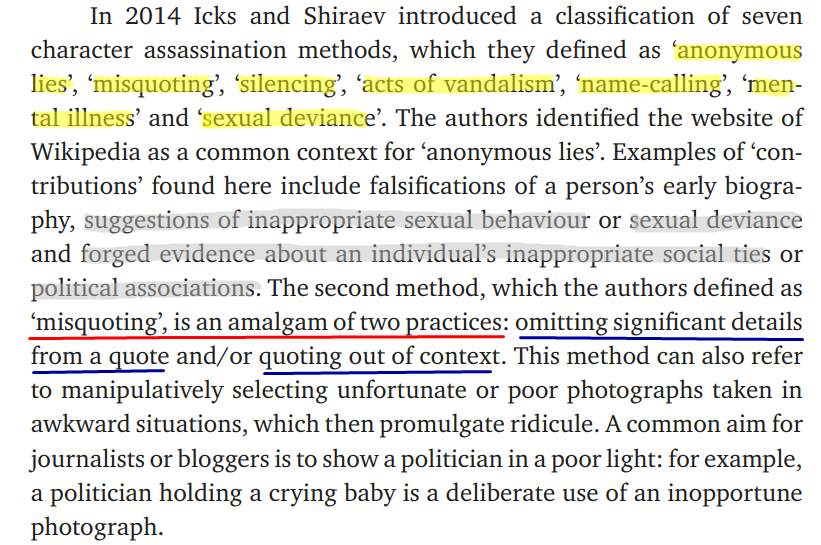
A quick understanding of each of them.
- Anonymous lies: Deliberately false claims spread without identifiable authorship, making accountability impossible and forcing targets to disprove vague, source-less allegations repeatedly.
- Misquoting: Selective quotation or removal of context to distort meaning, making truthful statements appear immoral, extreme, foolish, or self-incriminating.
- Silencing: Erasing or ignoring an individual’s ideas, achievements, or existence to remove legitimacy and exclude them from collective memory or discourse.
- Vandalism: Symbolic or physical destruction of representations—texts, images, monuments, records—to signal disgrace and delegitimize the individual publicly.
- Name-calling: Application of stigmatizing labels or ridicule to reduce a person to a caricature, bypassing substantive evaluation of ideas or actions.
- Mental illness accusations: Portraying a target as psychologically unstable to invalidate their reasoning, credibility, and agency without addressing their arguments.
- Sexual deviance accusations: Alleging immoral or deviant sexual behavior to trigger disgust, moral panic, and lasting stigma regardless of evidence or refutation.
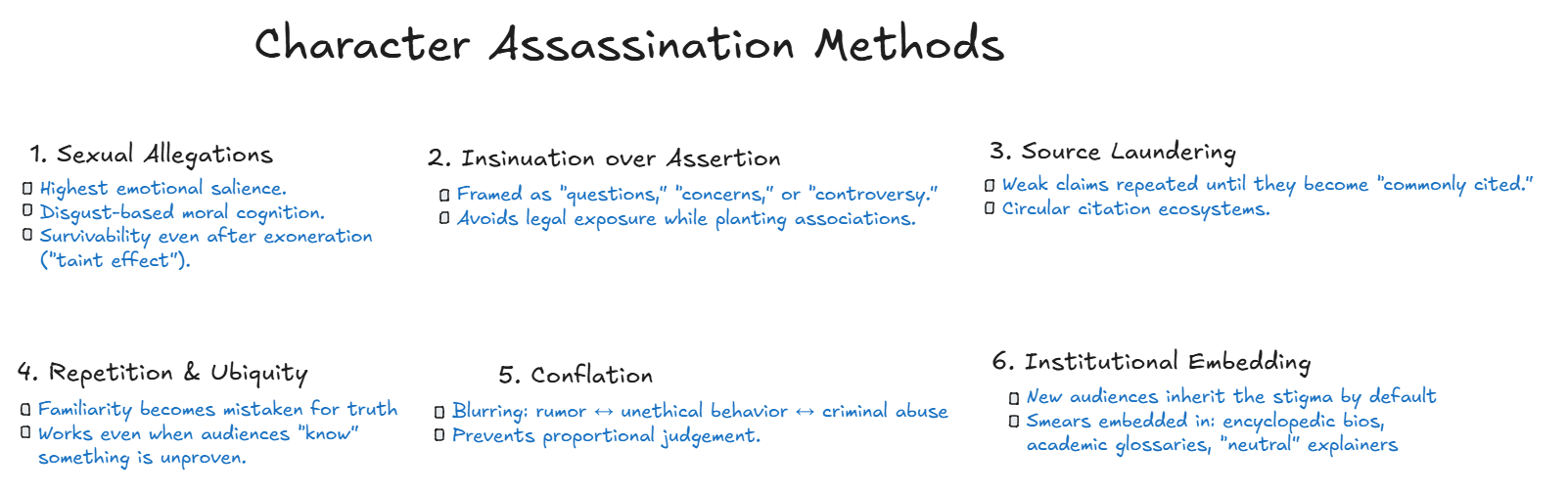
When one reviews the broader literature on how these games are run, one finds six powerful ways to carry out character assassination.
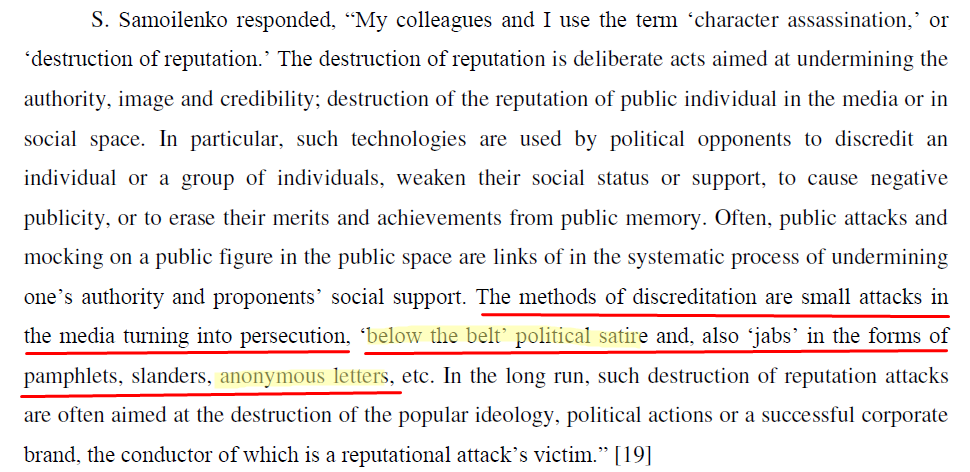
A doctoral thesis (see the extract below) examines character assassination as a deliberate tool in international politics, focusing on U.S.–Russia relations over nearly a quarter-century.
It conceptualizes character attacks, classifies their methods (from rumors and falsifications to sexual deviance allegations), and traces American and Russian traditions of denigration in domestic and foreign policy.
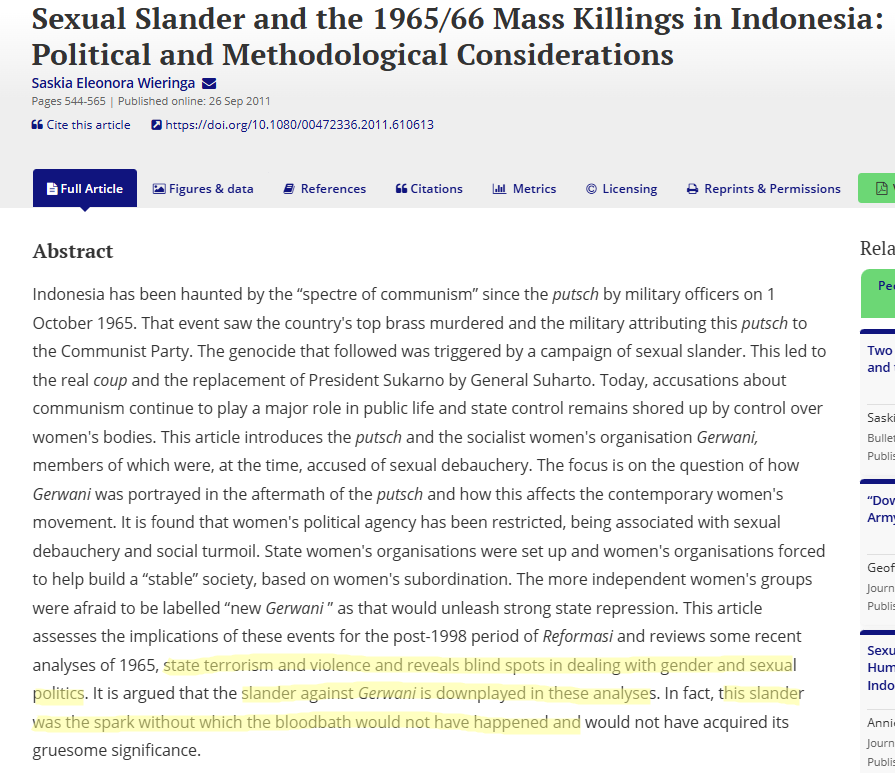
During the 1965-1966 mass killings in Indonesia, the military-led anti-communist propaganda campaign heavily relied on sexual slander against the socialist women's organization Gerwani. Members were falsely accused of sexual debauchery and mutilating army generals, which served as a pretext for the subsequent genocide and the establishment of an authoritarian regime that suppressed women's political agency.
What Nixey documents historically is the early, religious prototype of what Icks & Shiraev later formalize theoretically and the modern powers have used to attack each other.
The bottom line in this entire story is that sexual allegations, fake yet repeated, short-circuit rational evaluation and legitimize exclusion.
The Darkening Age is fundamentally a work of historical narrative, while the framework developed by Icks & Shiraev belongs to classical communication and political-psychology theory.
Over the centuries, this weapon has followed a consistent logic.
When senior teachers associated with the Art of Living Foundation, particularly those close to Sri Sri Ravishankar, deploy innuendo to employ sexual slander against Sadhguru and actively circulate it, they are participating in a mode of warfare that is neither new nor benign. It mirrors a strategy long perfected in Western ideological and leftist ecosystems, where reputational annihilation precedes cultural or institutional capture.
Are these actors merely imitating techniques historically used against Dharma and Hindu civilizational figures, or has there been a deeper internalization of adversarial frameworks that were initially designed to dismantle precisely the traditions they now claim to represent?
Either answer is troubling. And neither can be dismissed as a coincidence.
One would urge us all to again come back to the same question we posed earlier: Why?
Why indeed?
Oceans Don't Obliterate
In all this, we need to ponder and remind ourselves that Karma does not involve a 'punishment mechanism.'
You see, Oceans do not kill. Those who fight the waves drown.
Those who understand them ride walls of water a hundred feet high.
The ocean remains the same.
Fire did not kill indiscriminately.
It consumed Holika, yet could not scorch Prahlad.
Why?
Holika relied on a loophole. A borrowed immunity.
Prahlad stood aligned with the five elements themselves.
Nature does not punish. It only exposes alignment. Or the lack of it.


Comments ()