
Iran Holds All the Cards
Trump wants an off-ramp. Iran has no reason to offer one. And Israel keeps slamming every exit shut. Inside the most dangerous strategic contradiction in modern American foreign policy.
Mearsheimer and Diesen
In a remarkable discussion, American political scientist and international relations scholar Professor John Mearsheimer discusses the US/Israel-Iran War with Glenn Diesen (Norwegian political scientist, political commentator, and politician currently serving as a professor at the Department of Business, History and Social Sciences, University of South-Eastern Norway).
They both touch on many areas, and John Mearsheimer brings in insights from across them to paint a disturbing yet coherent picture of where the war is headed and the options available to the different players.
We will use their discussion as the basis and factor in the information we know to look at where the war is today and where it is headed.
The Board as It Stands
John Mearsheimer makes a bold argument that Iran holds most of the cards in a protracted war. He makes his case to that point by drawing on the current situation and military history.
Well, that argument may seem correct, but it is, nevertheless, incomplete. It accurately describes the tactical and operational chess position.
What it does not fully map is the broader board: the wild cards sitting off to the side, the pieces that haven't moved yet, and the endgame scenarios that emerge when multiple simultaneous crises interact rather than unfold in sequence.
This analysis attempts to do that.
The war that began on February 28, 2026, is not simply a U.S.-Iran conflict. It is the kinetic manifestation of a decades-long structural transformation: the collapse of unipolarity, the formation of a loose but functional counter-hegemonic bloc, and the terminal overextension of American strategic ambition in a region it no longer has the will, resources, or coherence to dominate. The Iran war is, in this sense, not the cause of what comes next. It is the accelerant.
Part I: The Axes — Clarity and Fog as Strategy
The False Clarity of "Sides"
In earlier multipolar conflicts — World War II being the paradigmatic case — the axes were legible.
The current conflict deliberately resists that clarity, and the resistance is not accidental. It is strategic.
On one side: the United States and Israel, whose interests overlap substantially but are not identical and are in certain crucial respects directly contradictory.
The U.S. wants an off-ramp. Israel wants no such thing. Israel's strategic objective — articulated consistently by its security establishment for over thirty years — is the permanent elimination of Iranian strategic capacity: nuclear, ballistic, and regional.
Not regime change in the American sense of installing a friendly government. Destruction. The fragmentation of Iran into weakened successor states is incapable of projecting power. This is not American policy. But American military power is being used to pursue it.
On the other side: Iran, with Russia and China providing what might be called "strategic oxygen" — sanctions relief, diplomatic cover, weapons components, economic lifelines — without formally entering the conflict.
This fog — the deliberate blurring of who is really fighting whom — is Russia and China's greatest strategic asset.
It prevents the United States from escalating to the level where the real adversaries would have to show themselves. It keeps the war contained to a theater where Iran has overwhelming advantages. And it allows Beijing and Moscow to watch American power bleed out while maintaining plausible deniability and continuing normal economic relations with much of the world.
The GCC: The Pivoting Bystander
The Gulf Cooperation Council states — Saudi Arabia, UAE, Qatar, Kuwait, Bahrain, Oman — occupy the most precarious position on this board.
They are nominally aligned with the United States through decades of security guarantees, base agreements, and arms sales.
And yet.
Iran can destroy Saudi Arabia as a functioning society. This is not hyperbole. Saudi Arabia has approximately 2.4% of the world's renewable freshwater resources per capita — effectively none. The entire country depends on desalination plants for drinking water. Its oil infrastructure is concentrated, above ground, and precisely mapped. Its financial system is entirely dependent on hydrocarbon revenues.
If Iran chose to systematically destroy Saudi desalination infrastructure and oil processing facilities — as it demonstrated the capacity to do in the Abqaiq attack of 2019 — the Kingdom would face civilizational collapse within weeks, not months.
 Tim Lister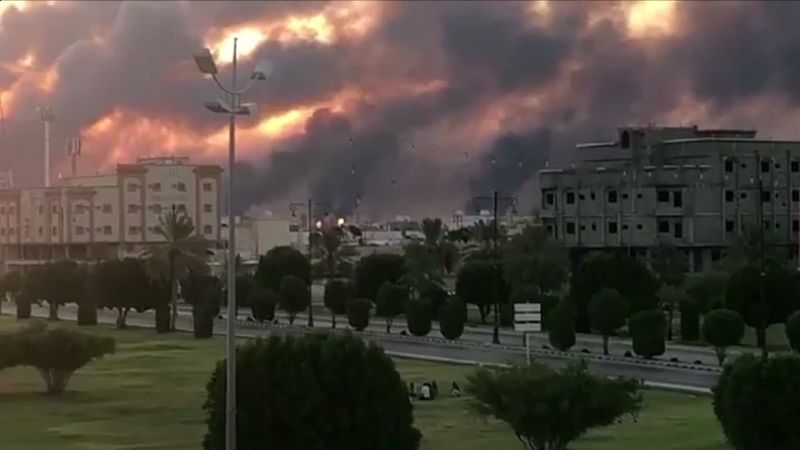
There is no American air defense system capable of intercepting the volume of drones and cruise missiles Iran can now deploy simultaneously.
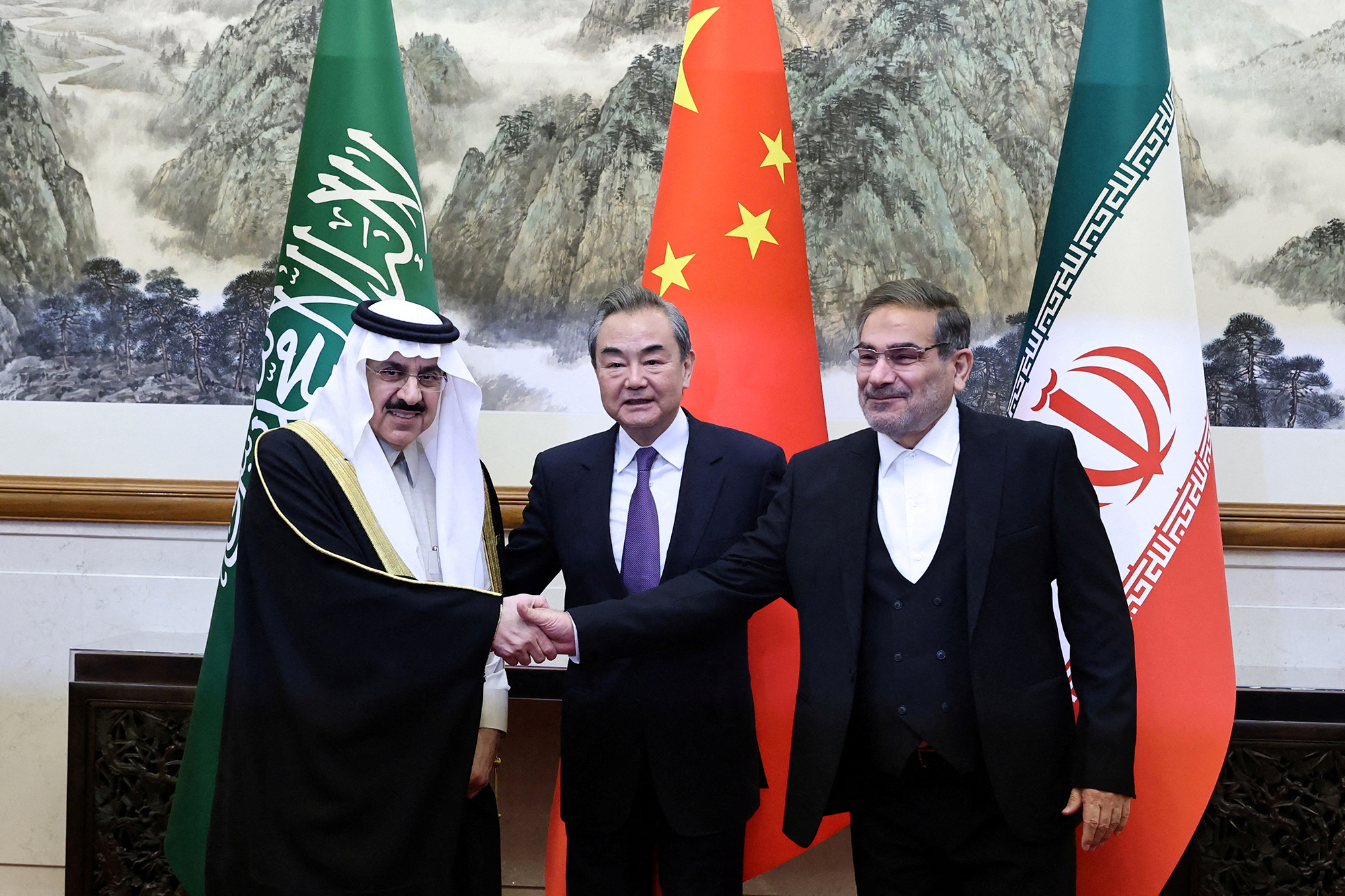
The GCC leadership understands this. They understood it before February 28, 2026. China's brokering of the Saudi-Iran normalization agreement in 2023 was not a diplomatic curiosity — it was the GCC's first public acknowledgment that their security calculus had fundamentally changed. The message was: we cannot rely solely on American protection, and we cannot afford permanent enmity with a neighbor that can destroy us.

The war has obliterated that fragile equilibrium.
The physical and economic destruction of Qatar as a livable environment would cause the foreign labor force to flee within days, leaving an uninhabitable desert with a tiny native population and no functioning economy. This is not a distant theoretical scenario — it is Iran's baseline deterrent.
China already wants this. Russia already wants this. The Shanghai Cooperation Organization has been preparing this institutional architecture for years. The Abraham Accords, America's last significant regional diplomatic achievement, will be a historical footnote.
Part II: The Wild Cards — Nuclear, Korean, and the Weapons Architecture of Shared Apocalypse
Wild Card One: The Nuclear Threshold
The most dangerous assumption in the current Western discourse is that nuclear use is unthinkable.
It is not unthinkable. In fact, the trajectory, the speed at which the players are moving, the direction, and the players in the midst lend themselves to only one possibility - that a nuclear option being exercised from one or both sides (a certainty if one side uses it in frustration) is an absolute certainty!
It has been thought of, planned for, and, in certain scenarios, modeled as rational by both parties.
The Iranian nuclear calculus is not simply about building a bomb for deterrence. It has evolved into something more urgent: the recognition that conventional deterrence has failed. Iran has been subjected to two surprise military strikes in the span of months. Its air defenses, while improved, are not impenetrable. Its leadership has seen what happened to states that gave up their nuclear ambitions — Libya, Iraq, Syria.
The lesson from Gaddafi's fate alone was burned into Iranian strategic culture. The nuclear program is not primarily about prestige or regional dominance.
It is about survival insurance for a leadership that has now experienced firsthand what the United States and Israel do to states they decide must be destroyed.
If Iran concludes — and there is reason to believe elements of its leadership already have concluded — that the current war trajectory ends in either regime annihilation or permanent strategic emasculation, the calculus around nuclear use changes.
Not against the United States directly. That remains suicidal.
But against Israel, which lacks the second-strike capability of a major nuclear power and whose population density makes it uniquely vulnerable to even a small number of warheads, the calculus is grimmer.
Iran does not need to destroy Israel with a first strike. It needs only to demonstrate the credible capacity to do so, or to use a single weapon in a way that makes the continued prosecution of the war politically impossible for any Israeli government.
The American nuclear calculus is different but equally dangerous. The scenario Mearsheimer references — the desperate actor rolling the dice — is precisely where low-yield tactical nuclear use enters American planning.
If conventional options have failed, if the economic damage from Hormuz closure is cascading, if American prestige is collapsing publicly and irreversibly, and if a small tactical nuclear strike against Iranian military infrastructure could theoretically "reset" the board — that option exists in American war planning.
It has always existed. What has changed is the gradient of desperation. The more desperate the actor, the lower the threshold.
What nuclear use would do to the broader situation is not resolve it — it would detonate it. A single nuclear detonation anywhere in the Persian Gulf theater would:
- Trigger automatic radiation contamination of water and food supplies across a region that imports most of its food and desalinates most of its water
- Cause the immediate evacuation of all remaining foreign nationals from GCC states, collapsing their labor-dependent economies overnight
- Destroy the global insurance and shipping markets for the Persian Gulf and Red Sea for years — no tanker, no insurer, no flag state would permit transit
- Drive oil prices to levels that would trigger simultaneous recessions in every major economy
- Force China to make an explicit choice about its relationship with Iran and the United States — a choice Beijing has carefully avoided making
- Activate every nuclear-armed state's alert posture simultaneously
- Almost certainly end the NPT as a functioning international norm
Wild Card Two: North Korea as Second Line of Defense
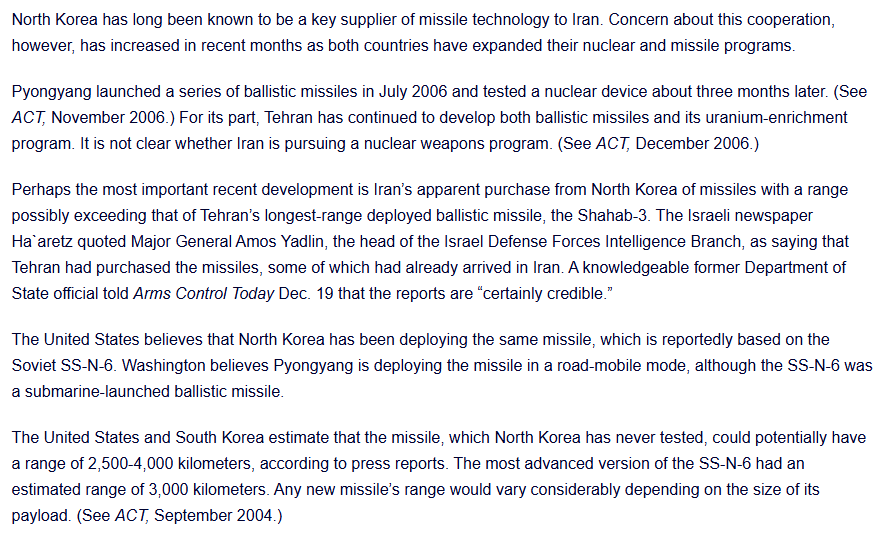
The Iran-North Korea weapons relationship is one of the most consequential and least publicly discussed strategic partnerships of the past two decades. It is not a simple arms transfer relationship. It is an integrated weapons development architecture — what might be described as the outsourcing of apocalyptic capability.
The two programs have been described by weapons analysts as effectively a single distributed research and development enterprise, with tests conducted in one country informing design decisions in the other.
The Hwasong series of North Korean ICBMs and the Iranian Shahab and Sejjil missile families share design lineage that is not coincidental.
The solid-fuel technology that makes Iran's current missile arsenal so operationally flexible — capable of launch with minimal preparation time, resistant to preemptive strikes — owes a direct debt to North Korean engineering. Recent intelligence assessments have suggested that North Korean technicians have been present at Iranian missile test facilities, and that the knowledge transfer has increasingly run in both directions, with Iranian drone technology influencing North Korean UAV development programs.
In the context of the current war, North Korea's role as a "second line of defense" for the Russia-China-Iran axis has several dimensions:
Direct weapons supply: North Korea has already demonstrated its willingness to supply artillery shells and ballistic missiles to Russia for use in Ukraine. The same pipeline, running through Russian territory, can supply Iran. Spare parts, guidance components, additional missile stockpiles — all can flow through this channel in ways that are difficult for American sanctions to interdict.
Strategic distraction: North Korea retains the capacity to conduct provocative missile tests, nuclear tests, or even limited military actions against South Korea or Japan at moments of maximum American strategic distraction. If the United States is deeply committed to the Persian Gulf, a North Korean provocation in the Pacific forces an impossible allocation decision. The American military cannot be at full combat readiness in two separate theaters simultaneously while also sustaining the economic costs of the Iran war. North Korea, at direction or encouragement from Beijing, can apply this pressure at will.
The nuclear escalation ladder: This is the most dangerous dimension. If Iran faces imminent regime-ending destruction and has not yet completed a deployable nuclear weapon of its own, the North Korean nuclear arsenal becomes relevant in a way it has never been before. The scenario — theoretical but not fantastical — involves North Korea offering Iran a "nuclear umbrella" or, in the most extreme case, the transfer of a weapon.
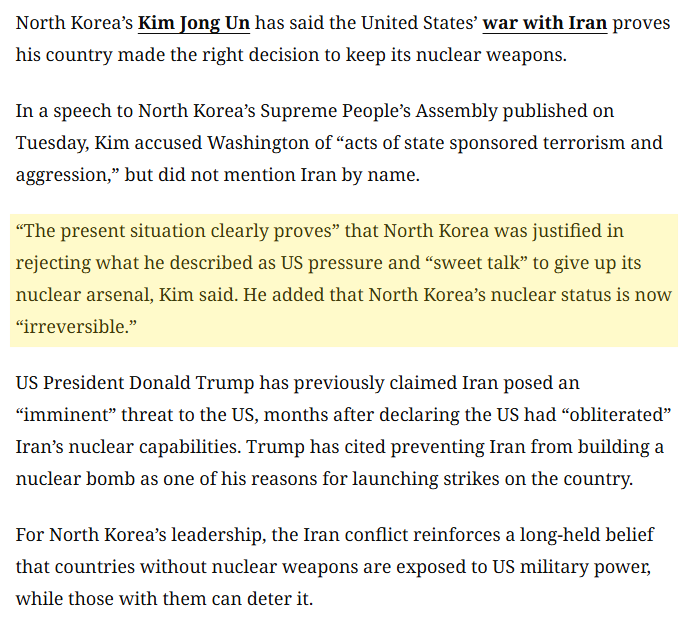
The lesson every mid-sized state draws from this is simple and brutal: Libya gave up its weapons program, and Gaddafi was killed. Iraq had no WMDs and was invaded anyway. Iran was negotiating and got bombed. North Korea has nuclear weapons and holds summits.
Kim Jong Un used a speech to North Korea's Supreme People's Assembly to argue that the current situation "clearly proves" North Korea was right to reject what he called U.S. pressure and "sweet talk" to give up its arsenal, declaring its nuclear status "irreversible."
Kim Jong Un is already using the Iran war to justify North Korea's expansion of its nuclear plans.
This would be the single most destabilizing event in the history of nuclear proliferation. It would make any American or Israeli military action against Iran a potential nuclear exchange. It would force China to either endorse or publicly repudiate the act, either choice carrying catastrophic consequences. And it would permanently end the fiction that the global non-proliferation regime has any remaining force.
Let us just say it like it is.
Beijing maintains plausible deniability over Pyongyang's actions while retaining sufficient influence to either encourage or restrain them.
In a scenario where the United States is losing badly in the Persian Gulf, China can deploy the North Korean card to ensure that American attention and resources are spread impossibly thin.
It costs China nothing. It costs the United States enormously.
Wild Card Three: The Red Sea and the Houthis' Chess Piece
Mearsheimer correctly identifies the Houthis as a force multiplier for Iranian strategy, but the full significance of the Red Sea chess piece deserves elaboration.
Iran has spent the better part of a decade not simply arming the Houthis but constructing a durable, indigenous weapons manufacturing capability inside Yemen.
The significance of this is often underappreciated. Early Houthi missiles were Iranian imports. Current Houthi weapons — the Toophan anti-ship missiles, the Qasef drones, the Badr ballistic missiles — are substantially manufactured locally, using Iranian designs and components that arrive in small, difficult-to-interdict shipments rather than in large cargo loads that can be blocked at sea.
This means that the Houthis' weapons capacity cannot be degraded simply by blockading Yemen. The architecture is already inside the country. The manufacturing capability is distributed and underground. American airstrikes can destroy specific launch sites and storage facilities, but the production capacity reconstitutes faster than it can be destroyed — a dynamic identical to the broader drone war dynamic that Mearsheimer describes, where cheap Iranian drones exhaust expensive American interceptors at a 1:200 cost ratio.
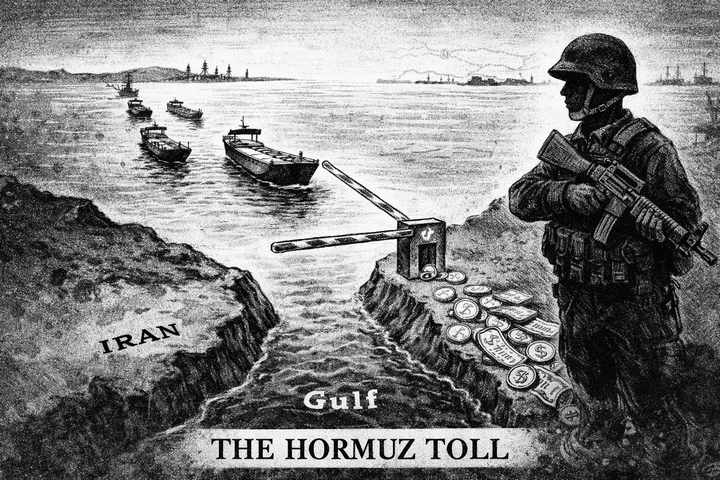
Approximately 20% of the world's oil and gas transits the Strait of Hormuz. Approximately 12% of global trade, including significant volumes of European energy imports, transits the Red Sea through the Bab-el-Mandeb Strait.
If both are simultaneously closed or effectively rendered too dangerous for commercial shipping, the economic impact is not additive — it is multiplicative.
European energy security, already strained by the disruption of Russian gas supplies following the Ukraine war, would face simultaneous supply shocks from both its eastern and southern corridors.
The fertilizer shipments that Mearsheimer references — potash, ammonia, urea — that move through these straits are not a minor footnote. They are the input material for approximately 40-50% of the world's food supply. A sustained closure of both straits for six months would begin to produce food insecurity in the Global South within weeks and famine conditions in the most vulnerable countries within months.
Part III: The Terminal Scenarios
Scenario A: The Negotiated Humiliation (Best Case and Least Likely)
In this scenario, Trump's economic advisors — recognizing the Titanic-iceberg dynamic (shared by Mearsheimer) — override the Israel lobby, the Fox News commentariat, and Trump's own pride within the next 30-60 days. The United States accepts Iranian terms at 60-70%: no nuclear enrichment above a low threshold (5%), reduction but not elimination of ballistic missile program, drawing down but not eliminating Iranian regional partnerships, and — crucially — a face-saving formula around American military presence in the Gulf that allows Trump to claim withdrawal as strategic repositioning rather than defeat.
Iran does not get everything. The United States does not lose everything. Israel is furious. The GCC is uncertain. The global economy avoids the cliff.
This is the best-case scenario. It is also probably the least likely.
For the reasons that Mearsheimer identifies:
- There is no bargaining space,
- Iran has no incentive to close the deal quickly, and
- Trump's domestic political constraints make accepting Iranian terms publicly devastating.
Scenario B: The Slow Bleed (Most Likely Near-Term)
In this scenario, which appears to be where events are currently heading, neither side achieves a decisive outcome.
The war continues for months. Hormuz remains effectively closed to 80-90% of normal traffic. The Red Sea operates at 40-50% of normal volume due to Houthi interdiction. Global oil prices remain elevated. American treasury yields stay in the danger zone.
In this scenario, Israel conducts additional strikes on Iranian nuclear infrastructure, killing the diplomatic track repeatedly every time it shows signs of life. The GCC begins quiet but increasingly open security dialogues with China. Saudi Arabia does not renew its petrodollar arrangement when it comes up for renegotiation. North Korea conducts a ballistic missile test over Japan to signal to the United States that it is paying attention.
President Trump's leverage is thinning out, though.
In the recent Conservative PAC convention, the portends would be devastating for the MAGA movement.
 Jack Hobbs
It is obvious that CPAC, the conservative movement's ideological heartland, is showing quiet fractures. Hundreds of empty seats and a sleeping audience member signal erosion of enthusiasm at the base level. More telling: when chairman Matt Schlapp casually asked the crowd about impeachment hearings, they erupted in cheers — forcing him into an embarrassed retreat. This wasn't a protest crowd; these were MAGA conference attendees by choice.
The most likely driver is the Iran conflict. Trump's base is instinctively anti-interventionist, and an active war contradicts his core "no foreign wars" promise. Leadership's panicked suppression of the impeachment cheer reveals they know the fissure exists. Empty seats plus accidental cheers for impeachment — the enthusiasm layer is going soft, and that's precisely what threatens the Republican electoral model.
If Trump cannot stop the war until November, he may not be able to survive the midterms when the Democrats start his impeachment proceedings.
Scenario C: The Triple Destruction (The Scenario Nobody Will Discuss)
This is the scenario your framing correctly identifies as possible and that demands direct engagement precisely because its possibility is being systematically denied in Western policy circles.
The sequence would unfold approximately as follows:
Phase 1: Israeli nuclear desperation. As Iran's missile campaign degrades Israeli air defense stockpiles and begins to inflict serious infrastructure damage on Israeli territory — power stations, ports, desalination facilities (Israel too is heavily dependent on desalinated water), airport infrastructure — the Israeli government faces a decision that no Israeli government ever expected to actually face: the existential question.
If conventional defense is failing and American support is constrained by the broader strategic situation, Israel's Samson Option — the use of nuclear weapons as a last resort — moves from doctrine to operational consideration. Israel has never confirmed its nuclear arsenal but is widely believed to possess 80-400 warheads. Their use against Iranian cities or military concentrations would kill millions. It would also produce radioactive fallout across a region that shares air, water, and food systems.
Phase 2: Iranian retaliation and GCC destruction. An Israeli nuclear strike would remove all remaining constraints on Iranian action. Iran would deploy everything: ballistic missiles against Israeli cities (whether or not they have nuclear capability at this point), full drone and cruise missile campaigns against all GCC infrastructure, activation of the Houthis' Red Sea blockade at maximum intensity, and mining of the Strait of Hormuz.
Phase 3: Iranian leadership continuity through dispersal. This is the element your framing identifies that is almost never discussed. Iranian leadership — the Revolutionary Guard command, the supreme leadership structure, the technical cadres who possess weapons knowledge — does not need to survive on Iranian soil. Russia and China have the capacity and the interest to provide sanctuary. The Revolutionary Guard's most valuable asset is not territory or population. It is knowledge: weapons design, intelligence networks, organizational capacity. All of this is portable. Iranian leadership can disperse to Russia and China, preserve its most critical human capital, and continue to function as a state-in-exile while Iranian territory absorbs the consequences.
This is not unprecedented. The Taliban governed Afghanistan from Pakistan for years.
Various governments-in-exile have functioned throughout history. The difference is that Iran's dispersed leadership would carry with it the North Korean weapons architecture, the relationship with Hezbollah (which has its own diaspora), and access to Russian and Chinese patronage that makes it a continuing strategic actor even without sovereign territory.
Phase 4: Israel's terminal vulnerability. An Israel that has used nuclear weapons, in a world where the United States has failed to protect it from an existential Iranian campaign, in a region where every Arab government has now experienced devastating Iranian retaliation for American/Israeli actions, has no remaining political architecture for survival. The Abraham Accords are dust. American domestic support — already eroding — collapses. The two-state framework is permanently dead. A Jewish state on that territory, without Arab normalization and without American military protection (now militarily and economically incapable of providing it), has no path forward. This is the scenario that Netanyahu's three decades of strategy have paradoxically made more rather than less likely.
Phase 5: The European and American economic consequences. With both straits closed, the GCC destroyed, Iran in ruins, but its leadership dispersed and continuing to operate, and Israel in terminal crisis, the global economic impact arrives not as a shock but as a sustained systemic failure. European energy supply is catastrophically disrupted. Food prices spike globally, producing famine conditions in the Global South and severe austerity in Europe and the United States.
American Treasury yields reach levels that make debt servicing impossible without monetization. The dollar's reserve currency status — already under pressure from the petrodollar's collapse — faces a structural challenge it cannot survive intact.
Phase 6: Ukraine. Throughout all of this, Russia has been patient in Ukraine. It has not needed to rush. American attention, resources, and political will have been consumed entirely by the Persian Gulf. European rearmament, while rhetorically committed, has not yet produced the capabilities it promises.
Ukrainian military manpower is exhausted. In the spring or summer of 2026 or 2027 — the timing is flexible because Russia is playing a long game — Russia advances decisively on the remaining Ukrainian defensive lines. By the time European governments are in a position to respond, Ukrainian resistance has collapsed in the eastern and southern oblasts.
Russia does not necessarily take Kyiv. It doesn't need to. It takes a territorial position that makes Ukraine non-viable as a NATO candidate and signs an armistice that makes the 2015 Minsk framework look generous by comparison.
Part IV: Why the Contradiction at the Heart of the American Axis Is Fatal
The Mearsheimer-Diesen framework correctly identifies the internal contradiction: the United States wants an off-ramp, and Israel refuses to allow one. But the deeper structural problem is more fundamental.
American grand strategy — as articulated even in Trump's own National Security Strategy of December 2025 — was premised on disengaging from the Middle East to focus on the Indo-Pacific. The logic was clear: China is the real strategic competitor; Russia must be stabilized, or at least contained, in Europe; the Middle East is a resource trap that has consumed American power without producing commensurate strategic returns for thirty years.
Israel's grand strategy is the exact inverse. Israel needs the United States to be permanently committed to the Middle East. It needs Iranian power destroyed, not managed. It needs American military presence as a permanent backstop against the demographic and geographic realities that make Israel's long-term security precarious without external support.
The tragedy — and Mearsheimer gestures at this without fully stating it — is that Israeli objectives in this war are not even achievable. Iran cannot be fragmented from the air. Nuclear facilities can be damaged but not permanently destroyed without ground occupation.
Regional Iranian influence — through Hezbollah, through the Houthis, through Iraqi militias — is a network of relationships and ideas that no number of airstrikes can eliminate.
Israel's strategy, even if fully executed with unlimited American support, produces not a secure Israel but a destroyed Iran sitting in radioactive ruins with its human capital diaspora continuing to operate against Israeli interests from Russian and Chinese territory indefinitely.
The contradiction in the American axis is not just political. It is civilizational. It is the contradiction between a declining hegemon that knows it must retrench and a dependent client that cannot allow retrenchment without facing its own existential reckoning. The client is steering the hegemon into a war the hegemon cannot win, for objectives the client cannot achieve, at costs that may destroy both.
Part V: The Question of Russia, Ukraine, and the Endgame of Global Order
Let us look at the question that is now staring at us: would Russia have taken Ukraine by then?
Russia does not need to occupy all of Ukraine. It needs to occupy enough territory to render the remaining Ukraine non-viable as a Western strategic asset, and it needs to do so in a manner that breaks the political will of European governments to continue resisting the Russian fait accompli.
The deeper strategic shift, however, goes beyond Ukraine. What Russia achieves is not simply territorial — it is the demonstration that the American security guarantee is not credible in both theaters simultaneously.
If the United States cannot protect Israel from Iranian missile attack, cannot keep the Strait of Hormuz open, cannot prevent the GCC from pivoting to China, and cannot prevent Russia from consolidating in Ukraine, then the American alliance system in both Europe and Asia faces a structural credibility crisis.
Taiwan watches. South Korea watches. Japan watches. Saudi Arabia watches. Each of them runs the same calculation: what is the American guarantee actually worth? Each of them updates their answer downward.
Conclusion: The Board's Probable Endgame
The most likely outcome of the current trajectory — absent a dramatic American policy reversal in the next 30-60 days — is not the clean Triple Destruction scenario but something worse in certain respects: a prolonged, multi-year catastrophe that produces most of the destruction of that scenario but without the clarity of resolution that would allow rebuilding to begin.
The GCC states will not be destroyed overnight. They will be slowly strangled — oil revenues collapsing as global demand falls in recession, water infrastructure degraded by sporadic Iranian strikes, foreign labor departing as risk rises, sovereign wealth funds drawn down to maintain services. The process takes years, not weeks. But the direction is irreversible once it begins.
Israel will not be destroyed in a day. It will face a sustained war of attrition that its small size and limited strategic depth make ultimately unwinnable — not militarily, perhaps, but demographically and psychologically. The emigration of skilled Israelis that has already begun accelerates. Investment collapses. The political radicalization required to maintain the war effort makes governance impossible.
Iran will not be destroyed cleanly. Its territory will be devastated, its population will suffer enormously, and its economy will be in ruins. But its leadership structure, its weapons knowledge, and its regional networks will survive — because Iran has built precisely the kind of distributed, resilient strategic architecture that is resistant to decapitation.
The United States will not collapse. But it will emerge from this period as a diminished power with a degraded economy, a discredited alliance system, a domestic political crisis stemming from the gap between the promised victory and the experienced reality, and a strategic position in the world's most energy-critical region that has been permanently downgraded.
And Russia, patient throughout, will hold what it has taken in Ukraine and wait for the world to adjust to the new map.
Comments ()