
Operation Epic Fury and Freeing Iran's Soul
US and Israel have taken out Iran's Islamist regime and Iran started its own attacks against the Arab states. Where will this go?
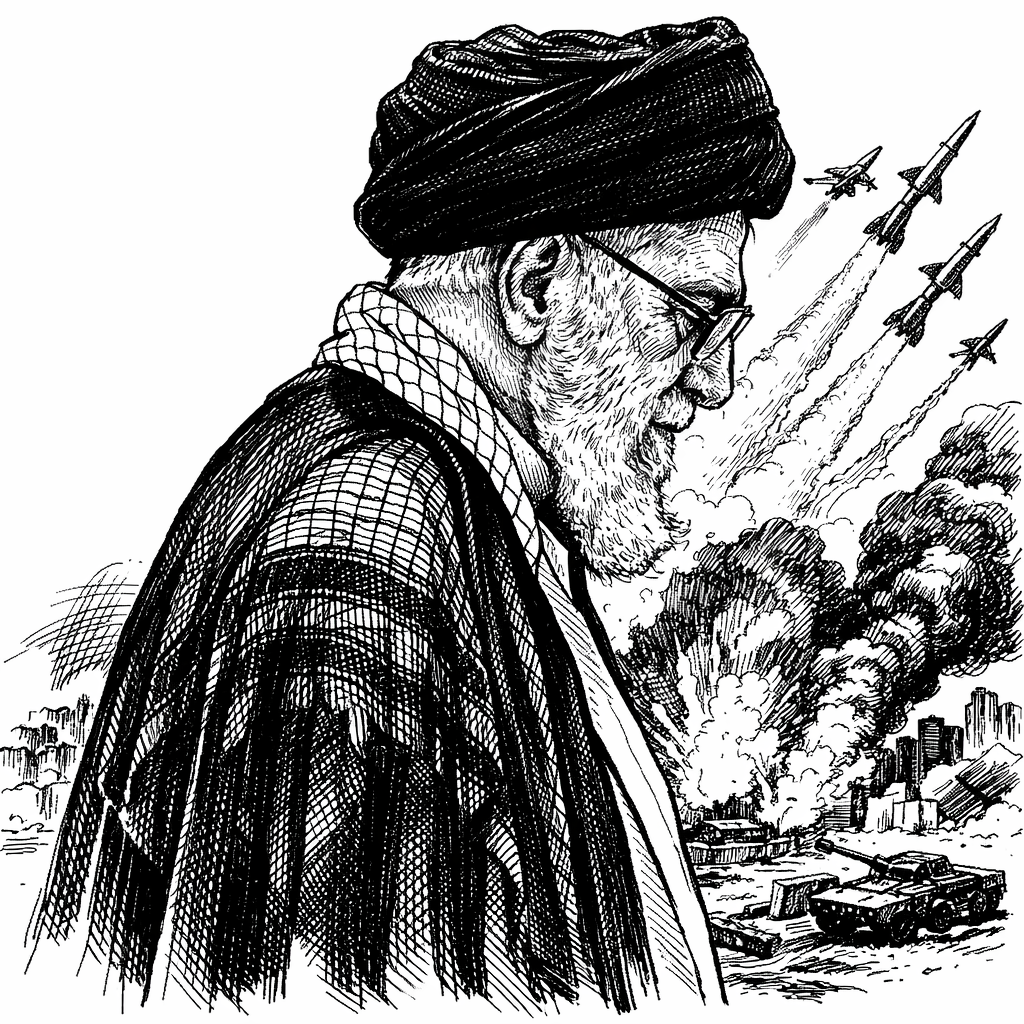
The Battle of Trust
A monastery once stood on the edge of a great desert, where caravans crossed and empires argued. The monks lived quietly, tending dates, drawing water, and offering shelter to anyone who arrived before dusk.
One spring, a warlord sent word: “I will punish the raiders who hide beyond the dunes.” His messengers spoke of justice, of order, of the need to strike quickly. The villages nodded. The caravans carried the story onward. And the desert, as always, listened.
The abbot called his youngest monk and said, “Go to the watchtower tonight. Tell me what you see.”
The monk returned at midnight. “Master, the desert is calm.”
The next day, the abbot sent him again. At noon.
The monk came back shaken. “Master… today the sky split open in daylight. Not the outposts. Not the wells. Not the camels. The strike fell on the tent where the chiefs gathered. The sand itself seemed to remember.”
The abbot nodded. “A blow to the stone can be repaired. A blow to trust cannot.”
That evening, the raiders did not attack the warlord’s camp. They struck the roads instead—at the caravanserais, the marketplaces, the ports where merchants believed they were safe. A traveler arrived at the monastery with ash in his hair and said, “Even the far cities are burning. Even the resorts by the sea. Even the places that sold the illusion of distance.”
The abbot poured him water. “When leaders lose their sanctuary, they make everyone else lose theirs too.”
In the days that followed, people argued about dates and deadlines. Some watched the diplomats in distant halls. Some watched ships on the horizon. Some watched their markets.
But the abbot watched something else: the moment a man stopped trusting the man beside him.
“Master,” the young monk asked, “where will this go?”
The abbot picked up a lamp and held it close. Its flame danced, steady and small.
“It will go where all wars go,” he said. “First, to the skies. Then to the streets. Then to the mind.”
He placed the lamp down gently.
“And in the end,” he said, “the battle is not for territory. It is for the story people believe when fear arrives.”
SUPPORT DRISHTIKONE
In an increasingly complex and shifting world, thoughtful analysis is rare and essential. At Drishtikone, we dedicate hundreds of dollars and hours each month to producing deep, independent insights on geopolitics, culture, and global trends. Our work is rigorous, fearless, and free from advertising and external influence, sustained solely by the support of readers like you. For over two decades, Drishtikone has remained a one-person labor of commitment: no staff, no corporate funding — just a deep belief in the importance of perspective, truth, and analysis. If our work helps you better understand the forces shaping our world, we invite you to support it with your contribution by subscribing to the paid version or a one-time gift. Your support directly fuels independent thinking. To contribute, choose the USD equivalent amount you are comfortable with in your own currency. You can head to the Contribute page and use Stripe or PayPal to make a contribution.
The Attack!
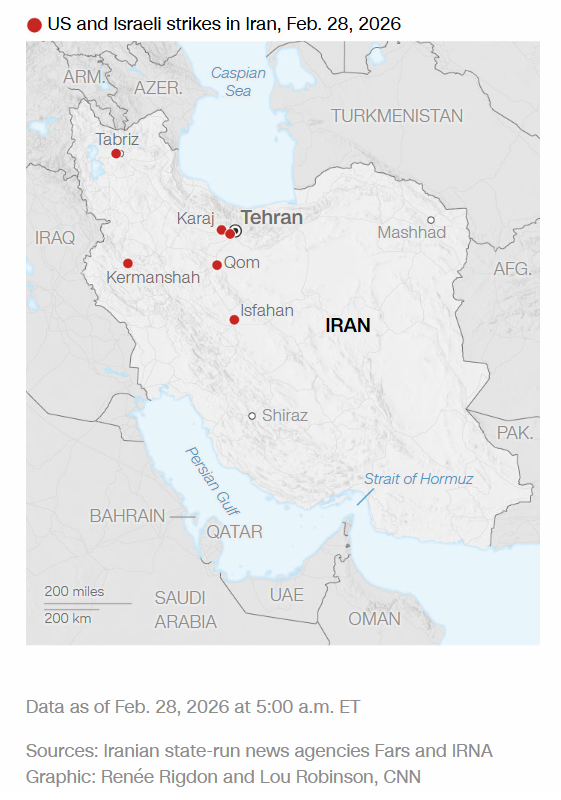
Israel and the United States carried out coordinated precision strikes on February 28, 2026, at approximately 11:40 a.m. local time in Tehran, targeting the highest levels of Iran’s political leadership. The operation reportedly focused on a high-level meeting attended by Supreme Leader Ali Khamenei, President Masoud Pezeshkian, and senior security officials. Rather than striking military infrastructure or proxy assets, the mission aimed directly at decision-makers, marking a deliberate and escalatory shift in strategy.
The daylight attack followed months of intelligence gathering, surveillance, and behavioral tracking, enabling planners to act on real-time leadership movements. Compounds associated with Khamenei and senior security figures were reportedly damaged or directly hit. However, there has been no definitive confirmation regarding casualties, leaving uncertainty over whether key leaders were killed, wounded, or narrowly escaped.
Circulating video and eyewitness clips show explosions and destruction in **Iran’s capital following a major joint United States Armed Forces and Israel strike on Tehran, part of a large-scale campaign against Iranian targets after the killing of Supreme Leader Ayatollah Ali Khamenei. Smoke and fire engulfed streets, with vehicles burned, rubble scattered, and craters visible in the urban landscape, illustrating the intensity of the assault and the depth of penetration into hardened areas of the city. Local footage shows widespread structural damage and emergency responders amid the aftermath, underlining the severity of the attack and the significant escalation in the conflict.
Inside Iran, the psychological impact appears profound. The absence of clarity has fueled speculation, mistrust, and heightened paranoia within the ruling elite. Operationally, the shift from previous night-time infrastructure strikes to a bold daylight decapitation attempt signaled a new threshold. The message was unmistakable: Israel demonstrated the capability to penetrate Iran’s security architecture and track senior leadership in real time, challenging Tehran’s core assumptions about internal security and strategic immunity.
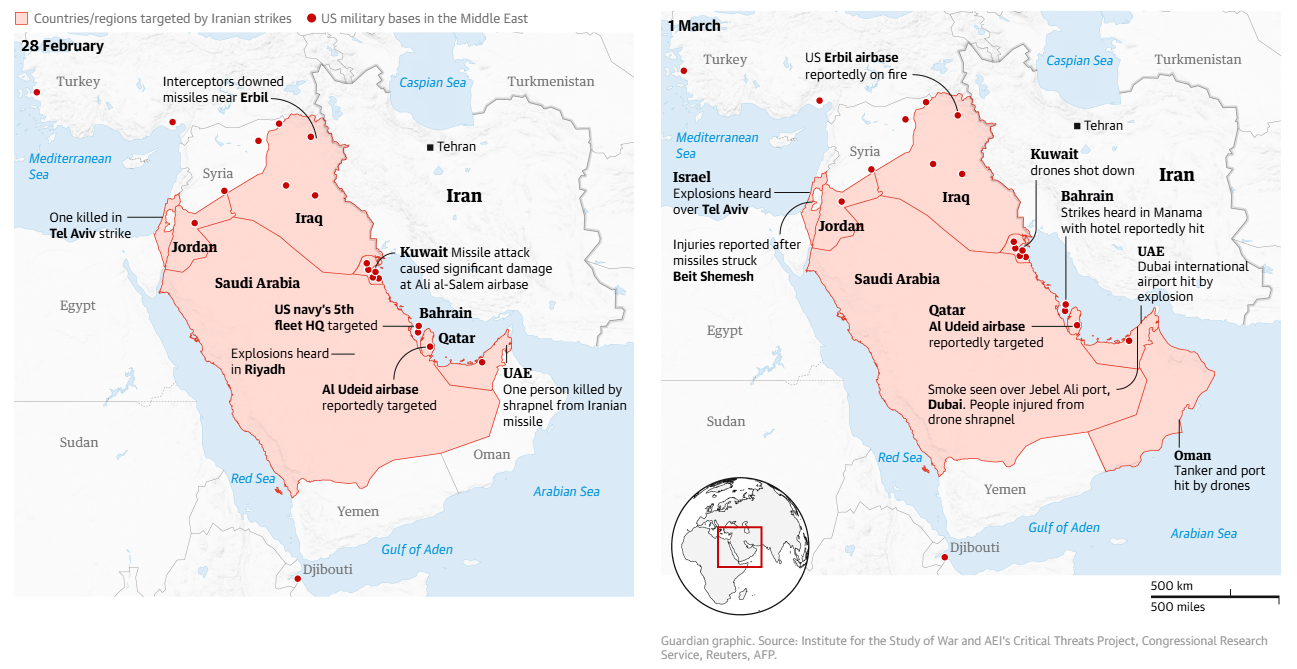
Late Feb 28 / Early Mar 1, 2026: After joint U.S.–Israeli strikes on Iranian territory, Tehran began its counter-attacks within hours, launching waves of ballistic missiles and drones toward multiple targets across the Middle East.
Iran’s retaliation was directed at U.S. military assets and regions hosting U.S. forces across several Arab states:
- Bahrain: Missiles struck near the U.S. Fifth Fleet service center, with sirens activated and explosions reported.
- Qatar: Missiles and drones targeted areas including near Al Udeid Air Base (a major U.S. logistics hub), prompting interceptions and airport disruptions.
- United Arab Emirates: Intercepted Iranian missiles and debris caused damage in Abu Dhabi and Dubai, including at airports, hotels, and port facilities — resulting in injuries and infrastructure impact.
- Kuwait: Intercepts and debris fell around Ali al-Salem Air Base and other sites.
- Jordan: Missile interceptions over the country were reported.
- Saudi Arabia: Riyadh reported inbound threats and condemned the attacks; missiles crossed or targeted airspace near bases hosting U.S. assets.
Other Gulf states’ capital cities saw explosions, air defense activations, and debris impacts in urban areas — a rare event in typically secure Gulf environments.
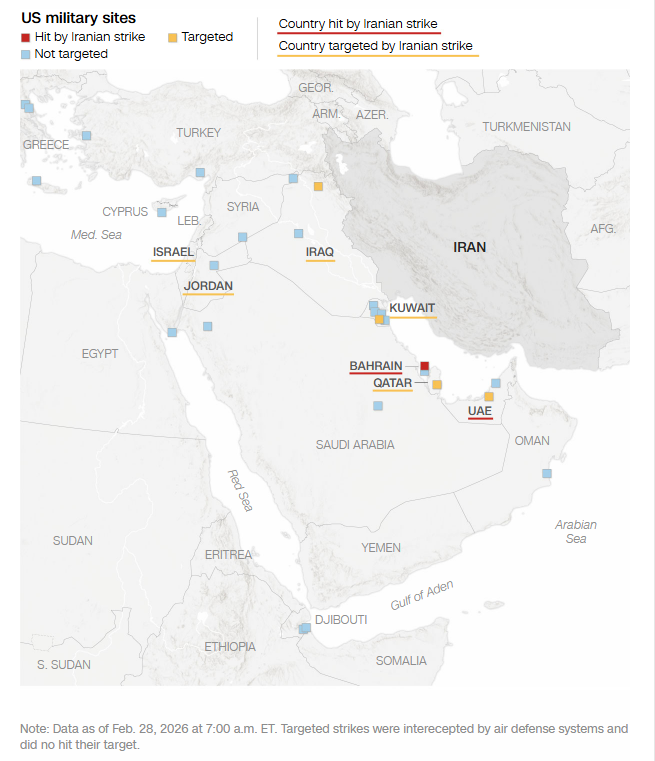
Iran used a mix of ballistic missiles and armed drones launched toward U.S. and allied positions. Most offensive missiles and drones were intercepted by Gulf air defenses (Patriot, THAAD, NASAMS, etc.), minimizing direct hits on bases but causing civilian infrastructure damage from falling debris.
Iran’s retaliation after the Feb 28 U.S.–Israeli strikes was broad and multi-directional, aimed at U.S. military sites across Gulf countries and provoking regional alarm. While air defenses limited military damage and casualties, the strikes had significant political, security, and economic reverberations, highlighting how a localized conflict can rapidly expand into a wider regional crisis.
The Critical Variable in the Timeline
The most important factor in the strike calculus may not have been the deadline, Geneva talks, or carrier movements.
It was Narendra Modi.
February 25: Take a look at what was going on that day.
- Prime Minister Modi lands in Tel Aviv for a two-day state visit.
- Meetings were scheduled with Benjamin Netanyahu.
- Address to the Knesset at 4:30 PM.
- Visit to Yad Vashem.
- The 48-hour diplomatic deadline expires the same day.
Launching a strike on Iran while the leader of 1.4 billion people was physically in Israel would carry enormous security and diplomatic risk. Escalation could trigger retaliatory missile fire during a high-profile state visit. Any such event would derail the very alliance architecture Netanyahu has publicly promoted.
February 26: The visit by Modi came to an end and Geneva talks began.
- Modi departed Israeli airspace.
- Geneva talks resumed the same day.
If diplomacy failed in Geneva, the breakdown would become documented and internationally visible. The “off-ramp” would have been formally offered and refused. The diplomatic predicate for force would be clearer.
February 27–March 1: Operational preparation and authorization window.
March 2: Purim — a date some analysts speculate carries symbolic weight in Israeli political culture. That created a compressed seven-day arc:
- The deadline expired while Modi was present.
- The diplomatic channel was formally tested.
- Strike window opened only after departure.
India’s advisory urging citizens to leave Iran immediately added another layer to the timing assessment.
Markets may have been watching the deadline, but the strategists were likely watching the departure. In geopolitical crises, symbolism, sequencing, and legitimacy often matter as much as firepower.
Khamenei is Dead
Iranian state media and multiple international outlets later confirmed that Supreme Leader Ayatollah Ali Khamenei was killed in the attack, marking an unprecedented blow to the Islamic Republic. Iran’s government announced a 40-day national mourning period following the confirmation of his death early on March 1, 2026.
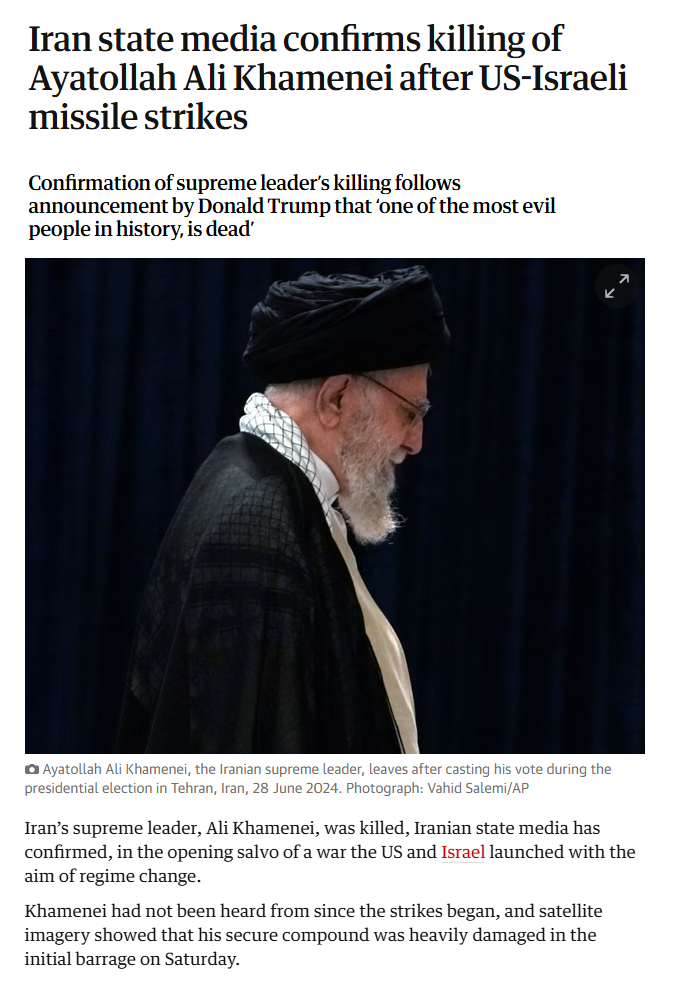
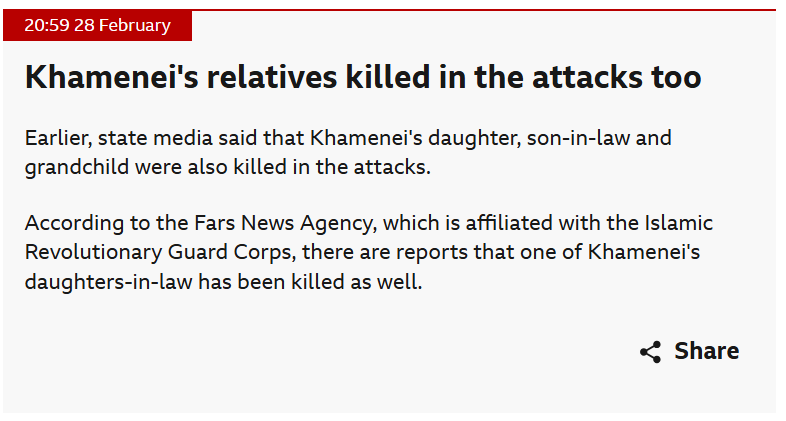
State reports also indicated that several senior Iranian officials died alongside him, including Khamenei’s daughter, son-in-law, grandchild, and daughter-in-law, all killed in the strike on his compound.
The joint operation—part of a campaign codenamed Operation Epic Fury—was aimed at dismantling Iran’s senior leadership and security architecture.
U.S. and Israeli officials, including President Trump and Prime Minister Netanyahu, publicly acknowledged Khamenei’s death, framing it as a decisive moment in confronting Tehran’s regime and its regional influence. Iranian authorities have confirmed the succession process is underway, with interim leaders taking control amid heightened tensions.
U.S. and Israeli officials, including President Trump and Prime Minister Netanyahu, publicly acknowledged Khamenei’s death, framing it as a decisive moment in confronting Tehran’s regime and its regional influence. Iranian authorities have confirmed the succession process is underway, with interim leaders taking control amid heightened tensions
Continuing Attacks
Following the first wave of Iranian retaliation with missiles at US and Israeli targets in Iran, Tehran launched additional cruise missile and drone strikes across the Gulf region.
Explosions and emergency responses were reported on both days, marking the conflict’s spread beyond military sites to urban and civilian infrastructure.
For most of the day Saturday, tourists and residents relaxed on Dubai’s glitzy Palm Jumeirah, tanning on the man-made beaches and throwing birthday parties for their children—even as the U.S. and Israel struck targets in Iran and inbound Iranian missiles were being intercepted over the Persian Gulf. But just after dusk, the mood began to change. A loud explosion shook apartment buildings, and a thick column of smoke churned from an impact site near fancy hotels along the Palm’s trunk. People ran screaming down the beach as interceptors engaged missiles along Dubai’s cosmopolitan coast and the smell of gun smoke hung in the air. (Source: Glitzy Dubai Gets a Taste of Middle East War / WSJ)
Since the first day's attacks, Iran has continued with the attacks since then.
United Arab Emirates
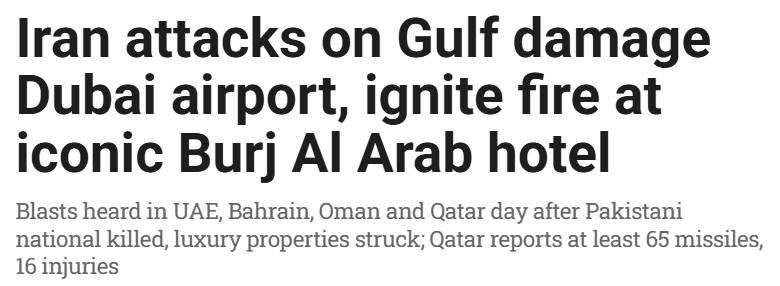
- Dubai – Palm Jumeirah / Fairmont The Palm: Iranian drones/missiles hit Dubai’s luxury tourist district, igniting a fire at the Fairmont hotel, injuring at least four people, and prompting evacuations.
- Burj Al Arab: Drone debris caused a fire at the iconic sail-shaped luxury hotel.
- Dubai & Abu Dhabi Airports: Passenger terminals saw damage, flight disruptions, and injuries, with Dubai International and Abu Dhabi’s Zayed International both affected.
Bahrain
- Explosions near urban districts and ongoing drone strikes prompted firefighting and rescue operations.
Qatar
- Doha also experienced blasts and smoke visible in parts of the city on multiple occasions.
Oman
- Near the Duqm commercial port, drones hit the area and injured workers, while other debris landed close to fuel facilities.
Iran employed a mix of missiles and armed drones in waves, targeting both military bases and, increasingly, civilian infrastructure and symbolic urban centers. Gulf states’ air defense systems intercepted the majority, but intercepting the debris still caused fires and casualties.
Iran’s retaliation has moved from hitting U.S. bases to hitting civilian commercial and symbolic targets—including luxury hotels and airports in Dubai and beyond—signifying a major escalation in the conflict’s geographic and political footprint.
The Intelligence behind the US-Israeli hits
A New York Times article (by Julian E. Barnes, Ronen Bergman, Eric Schmitt, Tyler Pager) shares the coordination between US and Israel and the inputs from the CIA that helped pinpoint the attack with such precision.
The C.I.A. had been tracking Ayatollah Khamenei for months, gaining more confidence about his locations and his patterns, according to people familiar with the operation. Then the agency learned that a meeting of top Iranian officials would take place on Saturday morning at a leadership compound in the heart of Tehran. Most critically, the C.I.A. learned that the supreme leader would be at the site. The United States and Israel decided to adjust the timing of their attack, in part to take advantage of the new intelligence, according to officials with knowledge of the decisions. The information provided a window of opportunity for the two countries to achieve a critical and early victory: the elimination of top Iranian officials and the killing of Ayatollah Khamenei. The remarkably swift removal of Iran’s supreme leader reflected the close coordination and intelligence sharing between the United States and Israel in the run-up to the attack, and the deep intelligence the countries had developed on Iranian leadership, especially in the wake of last year’s 12-day war. The operation also showed the failure of Iran’s leaders to take adequate precautions to avoid exposing themselves at a time where both Israel and the U.S. sent clear signals that they were preparing for war. The C.I.A. passed its intelligence, which offered “high fidelity” on Ayatollah Khamenei’s position, to Israel, according to people briefed on the intelligence. (Source: The C.I.A. Helped Pinpoint a Gathering of Iranian Leaders. Then Israel Struck / New York Times)
If the reporting is accurate, this kind of strike would have required an exceptionally layered intelligence architecture — not a single breakthrough, but a fusion of multiple streams refined over months.
First, pattern-of-life surveillance. Tracking a figure like Ali Khamenei would likely involve persistent overhead ISR (intelligence, surveillance, reconnaissance) from satellites, high-altitude drones, and possibly stealth platforms collecting signals and imagery. Repeated observation establishes behavioral rhythms — meeting cadence, security rotations, vehicle usage, and communication windows. Once patterns stabilize, deviations become predictive markers.
Second, SIGINT (signals intelligence). Intercepting encrypted communications, geolocating devices, and mapping internal Iranian command networks would be central. “High fidelity” location data implies either a compromised communications infrastructure or access to metadata that revealed proximity to known secure compounds.
Third, and arguably most decisive: HUMINT (human intelligence). History shows that decapitation strikes rarely succeed on technical means alone. The U.S.–Israel operation against Osama bin Laden relied heavily on courier tracking and informants. Israel’s operations against Hezbollah leadership and past Mossad penetrations of Iranian nuclear facilities similarly depended on insiders. For the CIA to know not just the location but the timing of a leadership meeting suggests sources close to the regime — possibly within administrative, clerical, security, or IRGC logistical layers.
Iran’s Revolutionary Guard Corps (IRGC) has factions. Power struggles, ideological fractures, financial corruption, and generational divides can create openings for recruitment. Financial inducements, ideological disillusionment, coercion, or blackmail are classic recruitment pathways. Post–“12-day war,” intensified cyber penetration of Iranian networks could also have exposed vulnerabilities leading to asset flips.
To fully grasp the deep penetration that Israel is capable of, one needs to check this clip. Here, Iran's former president Ahmadinejad shares a shocking fact: “Iran's Secret Service had established a unit to target Mossad agents within Iran. However, the head of this unit turned out to be a Mossad operative himself, along with 20 other agents.”
So, the coordinated U.S.–Israeli timing adjustment in the current attaxck underscores deep intelligence integration — shared targeting cells, synchronized surveillance feeds, and rapid decision cycles.
If true, the broader implication is not only external penetration but internal erosion of regime cohesion. Precision strikes at this level usually reflect not just technological dominance, but compromised trust at the top.
When Women Stood Up Against Religious Evil
The Woman–Life–Freedom uprising belonged to a specific phase of struggle, but it transformed Iran’s political culture and set the stage for how Iranians are reacting to today’s attacks on Ali Khamenei and the regime.
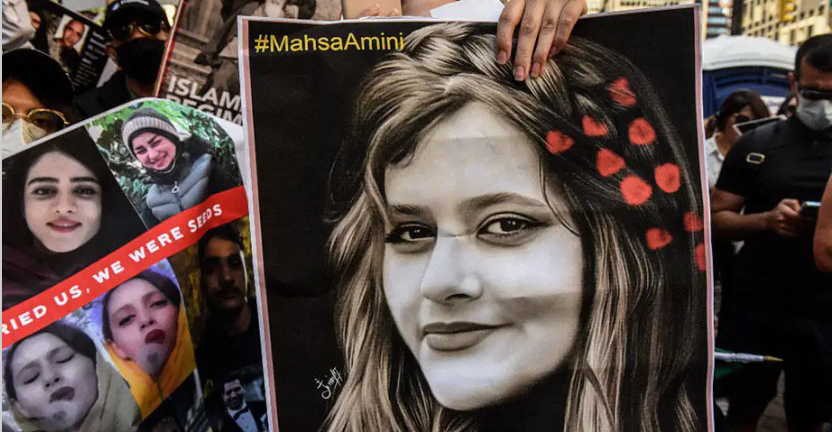
Her death in custody, which resulted from suspected beatings, triggered widespread, months-long protests against the Iranian government.
Women and schoolgirls led demonstrations, removed and burned hijabs, and chanted “Zan, Zendegi, Azadi” (Women, Life, Freedom) as protests spread nationwide and were brutally crushed. Hundreds were killed, including young women such as Mahsa Amini, Nika Shakarami (16), Sarina Esmailzadeh (16), Hadis Najafi (20), Asra Panahi, Aylar Haghi (23), and many others whose faces became icons of defiance.

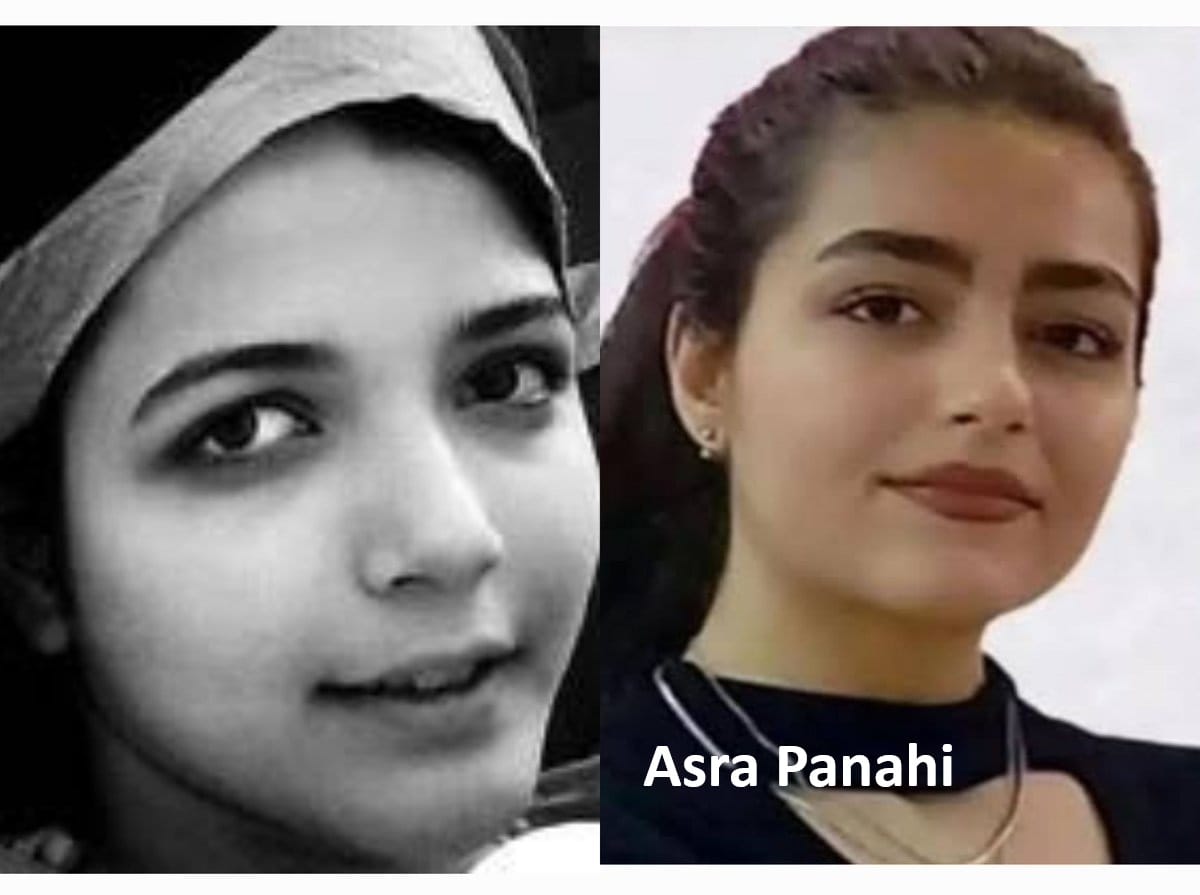

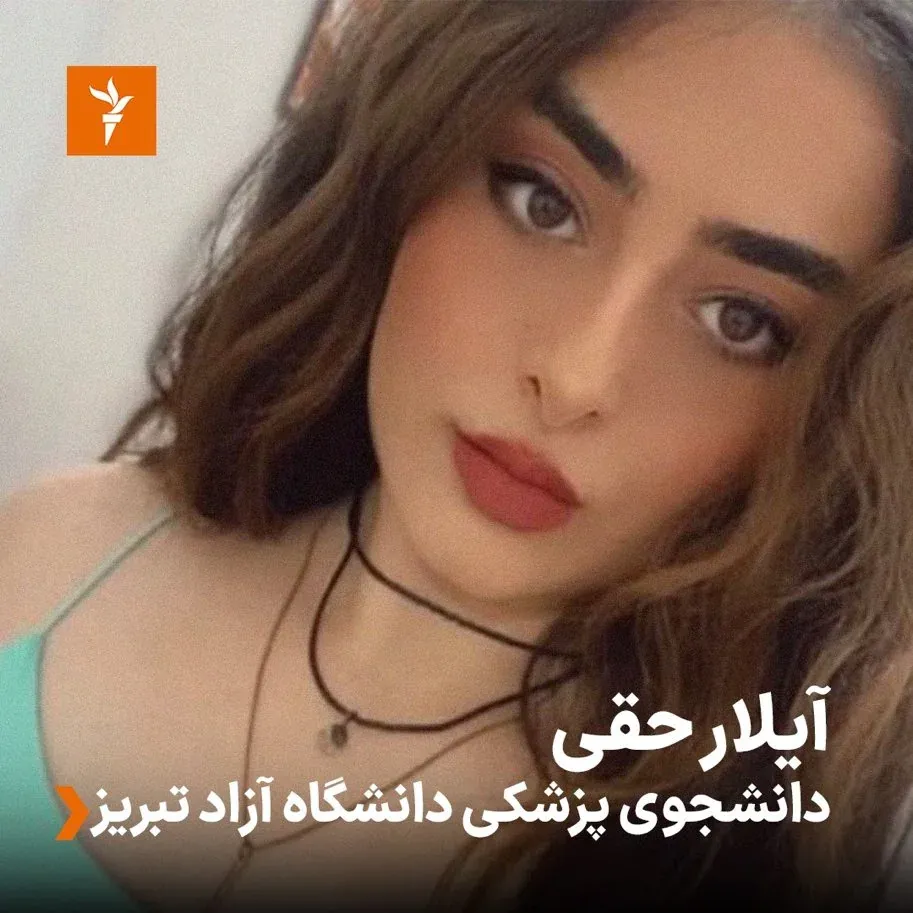

That movement has since been pushed off the streets by repression, executions, and fear, but it never really ended; it shifted into a quieter, simmering refusal to obey the state’s hijab rules and a deep, unhealed anger at Khamenei personally as the man ultimately responsible. This is why, after the recent strikes that targeted and then killed Khamenei and senior figures of the Islamic Republic, videos have shown many Iranians and much of the diaspora responding not with mourning but with open celebration, fireworks, honking car convoys, dancing, and messages describing him as the killer of their children and dreams.
In parallel, a striking new symbol has appeared: women calmly using a flame from burning portraits of Khamenei to light their cigarettes, sometimes unveiled, sometimes posting the clips from exile or semi-clandestinely from inside Iran.
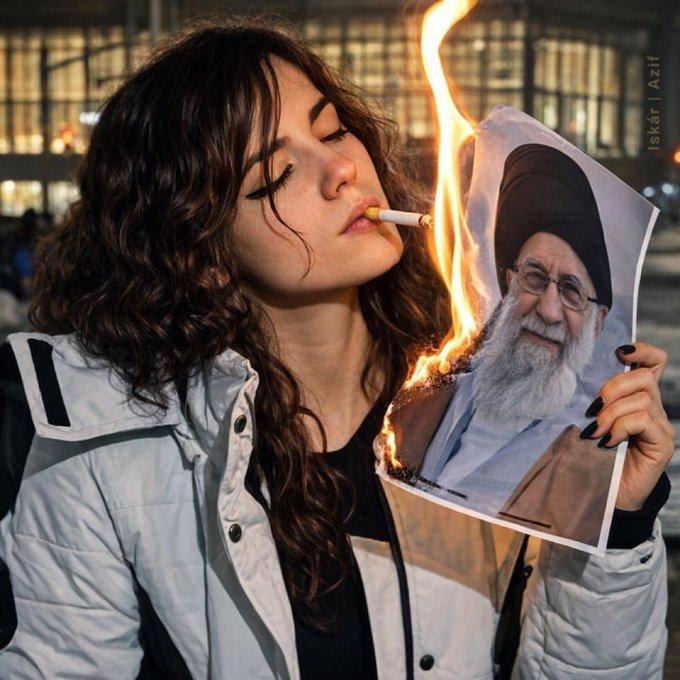
The act is layered humiliation: they turn the Supreme Leader’s sanctified image into a disposable lighter and combine it with female smoking, long stigmatized in the Islamic Republic, to reject both religious‑political authority and patriarchal social control in a single gesture.
Seen in sequence, the 2022–23 anti‑hijab uprising, the years of ongoing resistance, and the jubilant reactions to the attacks on Khamenei are parts of the same story: a society that has already broken its psychological fear barrier and increasingly treats the once‑untouchable Leader not as God’s representative, but as a hated, mortal tyrant whose fall is cause for celebration.
Iran is NOT its Islamist Regime
It is critical to separate Iran from the Iranian Islamist regime that has ruled it since 1979. A nation is not the same as the ideology imposed upon it. The current clerical establishment has jailed, tortured, executed, and brutalized thousands of Iranians who resisted enforced religious conformity — whether through rejecting compulsory hijab, questioning clerical authority, or demanding political freedoms. That repression is the product of a governing system, not the essence of the Iranian people.
Over the past 25 years in North America — across both the United States and Canada — my interactions with Iranian expatriates have revealed something striking. Again and again, conversations drifted toward heritage. Toward Persia. Toward Zoroastrianism. Many would insist, almost defensively, that they were not “Arab Muslims,” but Persians whose ancestors were conquered and Islamized centuries ago. Whether historically simplified or not, the emotional resonance was unmistakable: a longing for a civilizational identity older than the Islamic Republic.
During the anti-hijab protests two years ago, I spoke with an Iranian woman about what might happen if the clerical regime collapsed. I suggested that perhaps 40 percent of Iranians might reconnect with Zoroastrian roots. She reacted immediately: “No.” Surprised, I asked if she believed the number would be lower. She replied firmly, “It will be 90 percent of us.”
That exchange captures something deeper than statistics. Iran — or Persia — is a civilizational state whose history stretches back millennia before Islam. It produced imperial systems, philosophical traditions, artistic movements, and administrative sophistication long before many modern polities were conceived. Yet that identity is often overshadowed by the image of the Islamic Republic.
There is an undercurrent — inside Iran and across its diaspora — that sees the current regime not as the culmination of Iranian history, but as a rupture from it. Whether or not one agrees with the geopolitical framing, it is essential to remember: Iran is not synonymous with its Islamist rulers. A people’s civilizational memory does not disappear simply because a regime claims to speak in their name.
The Rescue Mission
Max Amini has emerged as one of the most prominent stand-up comedians of his generation, with a rise that has been nothing short of remarkable. An Iranian by heritage, Amini has built a global audience not only through humor, but through candid reflections on identity, exile, and the harsh realities facing ordinary Iranians under the Islamist regime.
In recent exchanges, he has spoken openly about the repression, brutality, and systemic abuses inflicted on everyday citizens — from the crushing of dissent to the enforcement of restrictive social codes. His tone often blends satire with pain, reflecting the experience of a diaspora deeply connected to events unfolding back home.
When discussing the recent U.S.–Israeli strike aimed at eliminating Supreme Leader Ali Khamenei, Amini referred to it as a “rescue mission.” The phrase resonated strongly with many in the Iranian diaspora and beyond. For those who view the regime as having hijacked the nation’s future, such language captures a sense of relief and vindication rather than loss.
Amini’s remarks echo a broader undercurrent among segments of the Iranian public and expatriate community who distinguish between the Iranian people and the ruling establishment. In giving voice to that sentiment, he articulates emotions that many feel but few express publicly.
The Celebrations
That is why you are seeing Iranians across continents celebrating. For many, this moment feels less like geopolitics and more like deliverance. From neighborhoods inside Tehran and Shiraz to diaspora communities in Berlin, London, Los Angeles, Toronto, and Vancouver, expressions of relief and defiance have filled social media feeds and public spaces alike. The slogans in the air are not about war — they are about release.
To outside observers, the reaction may seem surprising. But for those who have lived under, fled from, or closely watched decades of repression, the response is emotional and deeply personal. Families separated by imprisonment.
Women were punished for resisting compulsory codes. Young protesters jailed or worse. The memory of those realities shapes how this moment is being interpreted.
What you’re hearing is the sound of a nation roaring in celebration at the death of Khamenei, the man who murdered thousands of Iran’s children. pic.twitter.com/jUOina6C3z
— ثنا ابراهیمی | Sana Ebrahimi (@__Injaneb96) February 28, 2026
At the same time, Iranians are not naive. They understand that power vacuums are dangerous. They know regional actors will calculate their interests. They know that foreign assistance is never purely altruistic, and that geopolitical support often carries long-term costs. History has taught them that external involvement can reshape a nation in ways both intended and unintended.
Yet for many, the alternatives available to them have been painfully limited. Between sustained internal repression and uncertain external consequences, some see change — however complex — as the only path forward. Celebration, then, is not a declaration that the road ahead is easy. It is an expression that stagnation under the previous order felt far worse.
A civilizational society has its back against the wall. It is fighting nevertheless with its own blood.
Setting up the Islamic Axis Framing
Meanwhile, Iran's President Pezeshkian has framed this as a "declaration of war against Muslims."
Iran's President Masoud Pezeshkian said Sunday that the killing of supreme leader Ayatollah Ali Khamenei in US and Israeli strikes was a "declaration of war against Muslims". "The assassination of the highest political authority of the Islamic Republic of Iran and a prominent leader of Shiism worldwide... is perceived as an open declaration of war against Muslims, and particularly against Shiites, everywhere in the world," Pezeshkian said in a statement carried by state TV. Meanwhile, Hamas mourned Khamenei after his death in what it described as a "heinous" US-Israeli attack. "We in Hamas mourn the passing of Ayatollah Ali Khamenei. He provided all forms of political, diplomatic and military support to our people, our cause, and our resistance," the Palestinian Islamist movement said in a statement. "The US and the fascist occupation government bear full responsibility for this blatant aggression and heinous crime against the sovereignty of the Islamic Republic of Iran, as well as for its serious repercussions on the security and stability of the region." (Source: "US-Israel Attacks Iran LIVE Updates: "Khamenei Killing Declaration Of War Against Muslims": Iran President" / NDTV)
If this statement reflects Tehran’s official line, it marks a strategic escalation of narrative framing, not just rhetoric.
The implication: escalation may now move beyond calibrated military exchanges into broader ideological mobilization. Once conflicts are framed in civilizational terms, de-escalation becomes harder and retaliation becomes harder to control.If this statement reflects Tehran’s official line, it marks a strategic escalation of narrative framing, not just rhetoric.
Masoud Pezeshkian characterizing the killing of Ali Khamenei as a “declaration of war against Muslims” is highly consequential for three reasons.
- First, it shifts the frame from a state-to-state military conflict (Iran vs US/Israel) to a civilizational-religious confrontation. That widens the emotional and mobilization base beyond Iran’s borders. By specifically emphasizing Shiism, Tehran is signaling to Shia populations in Iraq, Lebanon, Bahrain, Pakistan and beyond that this is not merely geopolitical—it is existential.
- Second, the endorsement from Hamas reinforces the “Axis of Resistance” alignment. Iran is attempting to consolidate its proxy and partner network under a unified grievance narrative. This increases the risk of multi-theater retaliation—from Lebanon to Iraq to potentially maritime domains.
- Third, this rhetoric pressures Sunni-majority Arab states. If the conflict is framed as “war on Muslims,” Gulf governments aligned with Washington face domestic optics challenges, even if strategically opposed to Iran.
The implication: escalation may now move beyond calibrated military exchanges into broader ideological mobilization. Once conflicts are framed in civilizational terms, de-escalation becomes harder and retaliation becomes harder to control.
Are Arab Regimes Muslim Enough?
And that is precisely why Iran’s attacks on Arab states are so consequential.
Yes, these countries host U.S. military bases. Facilities that have supported operations across the region, including against Iran.
But by striking or targeting territories such as Bahrain, United Arab Emirates, Saudi Arabia, Jordan, Qatar, and Kuwait, Tehran is doing something more than retaliation. It is reframing the regional map.
This aligns with President Masoud Pezeshkian’s framing that the conflict is not merely Iran vs Israel, but an assault on the Islamic world itself. By broadening the definition of the battlefield, Tehran shifts pressure onto Arab leaderships who must now defend both their sovereignty and their religious legitimacy.
But this strategy is risky.
Instead of igniting regional solidarity, it could expose Iran’s isolation. Gulf governments can counterframe this as reckless destabilization of Muslim states by Iran itself. In doing so, they invert the narrative: not Islam under attack—but state order under siege.
The region now faces a contest not just of missiles, but of legitimacy.
And that battle may prove more decisive.
Why Not Pakistan?
It is striking that Iran has launched missiles and drones toward multiple Arab states hosting U.S. assets, yet has not moved against Pakistan — even though Tehran and Islamabad exchanged airstrikes as recently as January 2024. Not just that, there were reports in the Iranian media about how Pakistani Army Chief Asif Munir may have facilitated the assassination of Iran’s military chief, General Mohammad Hossein Baqeri.
Reports from Iranian media have raised serious questions about the role of Pakistan's top military officer, Field Marshal Asim Munir, in the recent killing of Iran’s military chief, General Mohammad Hossein Baqeri. Baqeri was killed in an Israeli airstrike on June 13, just days after he reportedly met Munir in late May. Munir reportedly met General Baqeri in Tehran on May 31, less than two weeks before the attack. What seemed like a routine military interaction has now become the centre of a controversy involving espionage, GPS tracking, and a possible backdoor deal with the United States. (Source: GPS Watch, Secret Meeting: Did Pakistan Army Chief Asim Munir Help Israel Track Iranian General? / Republic World)
At first glance, this appears inconsistent. But the strategic environments are very different.
In much of the Arab Gulf, Iran has historically targeted:
- U.S. and Israeli military infrastructure,
- States openly aligned with Washington and hosting U.S. bases,
- Theaters where Iran maintains dense proxy networks and long experience calibrating escalation.
Pakistan presents a fundamentally different risk profile.
Nuclear escalation risk: Pakistan is a declared nuclear weapons state. Any sustained Iranian missile or drone campaign on Pakistani soil carries a non-trivial risk of rapid vertical escalation. Unlike Gulf exchanges, the deterrence threshold is far less predictable.
Precedent of calibration: The January 2024 episode was carefully limited. Both sides struck non-state militant targets, avoided direct state-to-state confrontation, and quickly de-escalated. The message was clear: limited punishment may be tolerated; open war is not.
Fragile borderlands: Iran’s Sistan–Baluchestan and Pakistan’s Balochistan are insurgency-prone regions. A wider conflict would almost certainly trigger reciprocal support for separatist or militant proxies, threatening territorial integrity on both sides.
Proxy asymmetry: To Iran’s west, it possesses layered influence networks — in Iraq, Syria, Lebanon, and Yemen — giving it multiple escalation rungs. Eastward toward Pakistan, that ladder largely does not exist. State-to-state confrontation becomes the immediate step.
Resource prioritization: Under pressure from U.S.–Israeli operations, Tehran must conserve air defenses, missile inventories, and political bandwidth. Opening an eastern front would dilute focus.
In short, Iran’s restraint toward Pakistan is not ideological favoritism. It reflects steep escalation risks and limited control options compared with the Gulf theater.
Religious Loyalty Over Humanity
The killing of Ali Khamenei has triggered protests among some Shia groups in India. That reaction is significant. Not simply because of the event itself, but because of what it represents.
Residents of Alipur village in Gauribidanur taluk of Chikkaballapur district in Karnataka are gripped by anxiety and grief after members of the Shia Muslim community called for a protest march and three days of mourning, condemning the death of Iranian Supreme Leader Ayatollah Ali Khamenei. The protest is being organised under the leadership of the Anjuman e Jafaria Committee. Located around 70 kilometres from Bengaluru, Alipur has a population of nearly 25,000, of whom an estimated 90% are Shia Muslims. (Source: Protest march, mourning in Karnataka’s Alipur over death of Iran’s Supreme Leader Ayatollah Ali Khamenei / The Hindu)
Khamenei led a regime accused by international watchdogs of suppressing dissent, imprisoning opponents, and overseeing violent crackdowns over decades. For many observers, he symbolized authoritarian control rather than moral authority. Yet for parts of the global Shia community, he also represented religious leadership and resistance politics. That dual perception explains the protests—but it does not neutralize their implications.
When demonstrations in India center on the fate of a foreign leader tied to an external conflict involving Iran, Israel, and the United States, it risks importing geopolitics into a fragile domestic space. India’s stability depends on separating internal civic life from external sectarian struggles. Allowing West Asian power contests to become rallying points within Indian streets creates space for polarization, counter-mobilization, and political exploitation.
The responsibility of religious and political leadership is to ensure that international crises do not become internal fault lines within India.
The Curious Case of Christian Amanpour
Born in London in 1958 to an English mother and Iranian father, Christiane Amanpour spent much of her childhood in Tehran, moving between Britain and Iran and inhabiting both cultures from an early age. Her father, Mohammad Taghi Amanpour, was a senior executive at Iran Air, placing the family firmly within Iran’s prosperous, cosmopolitan professional elite under the Shah. Biographical accounts describe the Amanpours as politically connected and affluent, enjoying the security and comforts that came with alignment with the monarchy in pre‑revolutionary Iran.
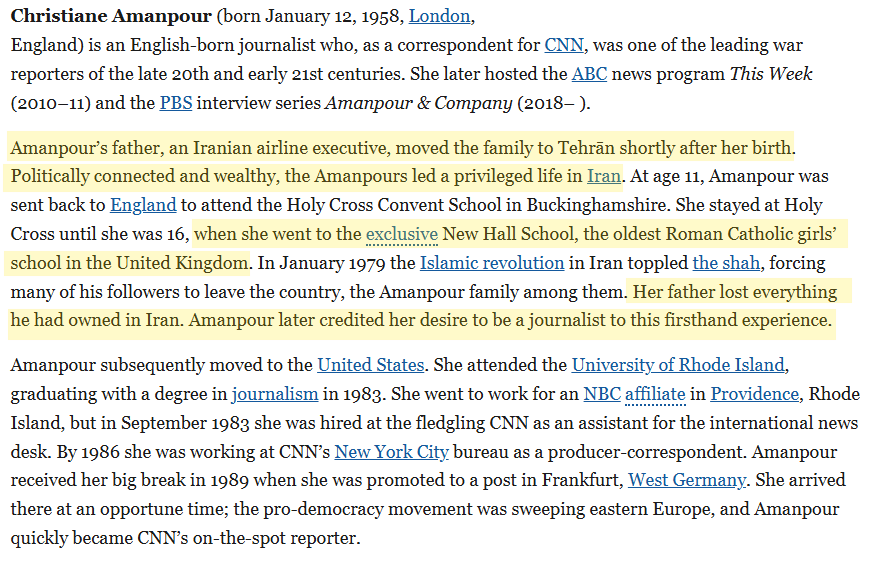
Iranian diaspora sources go further, portraying the family as part of a wealthier stratum from Fars Province with aristocratic connections to the Pahlavi court. In this telling, her uncle Nasrollah Amanpour married into the Jahanbani family: General Amanollah Jahanbani was a prominent officer under Reza Shah, and his sons included General Nader Jahanbani, a famed air force commander executed after the 1979 revolution, and Khosrow Jahanbani, who married Princess Shahnaz Pahlavi, the Shah’s eldest daughter. This network placed Amanpour’s extended family in the orbit of both high military circles and the royal household.
During the late 1990s and early 2000s, opposition and diaspora commentators alleged that the Khatami‑era “outreach” to exiled elites included offers to restore confiscated assets to some Pahlavi‑era families in exchange for cooperation or muted criticism.
According to an Iranian Substack essay and Farsi‑language social‑media clips, this was part of a broader pattern in which returnees sometimes signed loyalty undertakings or aligned with regime‑friendly narratives, and Amanpour allegedly leveraged her access and “personal and family networks” to regain property.
However, these remain uncorroborated opposition claims; mainstream biographies and Amanpour herself have never publicly confirmed any such deal.
After the revolution, the Amanpour family’s funds and possessions inside Iran were confiscated by the Khomeini regime. Later, during the presidency of Mohammad Khatami (1997–2005), the regime began what many exiled Iranians describe as a coordinated “outreach” effort**— encouraging members of the diaspora who had lost property to return and reclaim assets. Some who did so later reported being required to sign “loyalty oaths” to the regime, while others described pressure to align themselves with diaspora organizations promoting Tehran-friendly policies. Christiane Amanpour was among those who regained property, a matter she herself documented in her 2000 CNN program Revolutionary Journey. For critics, this raises questions about potential conflicts of interest — or, at minimum, about the appearance of them. (Source: Pretender to Journalistic Integrity: The Case of Christiane Amanpour / Iran So Far Away - Substack)
Since the late 1990s, Christiane Amanpour has emerged as one of the Western journalists with the most regular access to senior figures in the Islamic Republic, interviewing presidents Mohammad Khatami and Mahmoud Ahmadinejad, as well as Foreign Minister Mohammad Javad Zarif and other top diplomats. Dissident critics argue that the timing of this access overlaps suspiciously with alleged efforts by the regime to restore confiscated assets to select exiles, including her family, as part of a broader Khatami‑era outreach.
In their view, her 2005 trip to interview Akbar Hashemi Rafsanjani exemplifies this overlap, with a Reddit post explicitly tying the visit to a supposed deal over her father’s properties. These critics claim her continued entry into Iran and “soft” tone toward regime figures suggest an accommodation, and contrast this with her sharply critical treatment of opposition figure Reza Pahlavi, which sparked angry confrontations at the Munich Security Conference. They frame this as a serious conflict of interest: if she benefited materially from the regime, they argue, she cannot report ethically on it. However, these remain opposition narratives; mainstream Western biographies and Amanpour herself have not confirmed any property deal or financial tie to Tehran.
Watch this video, which summarizes everything really well.
New Phase in Global Conflict
“Operation Epic Fury,” synchronized with Israel’s campaign against Iran, marks a structural inflection in the global system rather than a spike in the long Israel–Iran shadow war. It is morphing into a multi-theater stress test of a fragmented world order, with several active wars and crises interlocking and hardening emerging blocs.
At the regional level, the Middle East is shifting from deterrence managed through proxies and deniability to direct state-on-state confrontation. Once U.S. assets are openly fused with Israeli targeting cycles, escalation ladders shorten and miscalculation risk rises. Iran will double down on asymmetric tools—missile salvos, drone swarms, cyber disruption, and pressure on maritime choke points—expanding the battlespace into the Gulf, Levant, and Red Sea rather than keeping it Israel–Iran centric.
For Gulf monarchies, strategic ambiguity is compressing. States that tried to hedge between Washington and Tehran while hosting U.S. bases are being forced into de facto operational alignment. That accelerates the emergence of an integrated air-defense and maritime surveillance web linking Israel, key Gulf states, and Western militaries—an architecture designed around Iran as the primary threat but with China and Russia in the background as strategic variables.
Globally, energy becomes a hard power instrument. Even partial disruption—insurance spikes, tanker diversions, attacks on infrastructure, threats around Hormuz—lands on an already stressed macro system shaped by the Ukraine war, Red Sea shipping attacks, and post-pandemic inflation. Europe’s dependence on stable hydrocarbon flows after decoupling from Russian gas makes it far more vulnerable to Middle Eastern volatility, deepening its reliance on U.S. security guarantees while pushing Brussels rhetorically toward “strategic autonomy” it cannot yet operationalize.
For Washington, this creates a bandwidth and sustainability dilemma. Ukraine remains a high-burn, artillery- and missile-intensive conflict. The Western Pacific demands a persistent deterrent presence vis-à-vis China over Taiwan and the first island chain. Add chronic instability arcs—Afghanistan–Pakistan, the Sahel, the Horn of Africa—and every new Middle Eastern escalation cannibalizes ISR, naval tonnage, munitions stockpiles, and political capital. The real risk is not a clean defeat but cumulative strategic exhaustion.
These dynamics open maneuver space for other powers. Russia benefits from any further diversion of U.S. attention and matériel away from Ukraine, while sanctions-battered Moscow can ride higher energy prices and deepen arms and energy ties with Iran. China’s priority is energy security and trade route stability, but a distracted and overextended United States also serves Beijing’s long game: it can posture as an economic stabilizer and mediator while quietly testing U.S. alliance cohesion in Asia. The EU, despite talk of autonomy, remains structurally hitched to U.S. security and NATO logistics, but its war fatigue and economic pressures may translate into a softer posture on escalation and sanctions.
India sits in a uniquely complex position. It needs affordable energy from the Gulf and Iran, defense ties with Russia, deepening strategic convergence with the U.S. in the Indo-Pacific, and growing economic links with Europe and the Arab world. A prolonged Israel–Iran–U.S. confrontation that elevates oil prices, militarizes sea lanes, and tightens Western secondary sanctions on Russia and Iran constrains New Delhi’s room for strategic hedging. At the same time, an overstretched U.S. seeking reliable partners in the Indo-Pacific and global South enhances India’s bargaining leverage on technology transfers, co-production, and its role in supply-chain reconfiguration.
When you overlay this war on Ukraine, ongoing instability in Africa, and the simmering U.S.–China contest, what emerges is not a single World War–style alignment but clustered camps:
- U.S.–EU–Japan plus Israel and a subset of Gulf and Asian partners coalescing into a security–technology axis.
- A Russia–China core providing diplomatic cover, energy deals, and arms to sanctioned or revisionist states.
- An Iran-led resistance ecosystem spanning militias, political movements, and states loosely bound by anti-U.S./anti-Israel narratives.
- Arab states and India are practicing fluid multi-alignment, arbitrating between blocs while protecting their economic modernization agendas.
In the next phase, we are likely to see “escalation management through controlled violence”: calibrated strikes, cyber shots, and proxy flare-ups calibrated to signal resolve without tipping into full regional conflagration.
The system is not yet at world-war integration, but great-power and middle-power stress is now concurrent and mutually reinforcing. The danger is that one more shock, whether in Taiwan, the Korean Peninsula, or a European escalation, could snap the already thinning margin for error in this emerging blocified order.
Comments ()