Profits & Paradoxes: The Two-Faced Geopolitics of Trump
Trump’s tariffs, private deals, and warm ties with rivals both challenge the entrenched ‘Deep State’ and enrich him and friends while reshaping alliances, stirring chaos and profit. A deep, hard-hitting look at power, paranoia, and paradox in geopolitics.
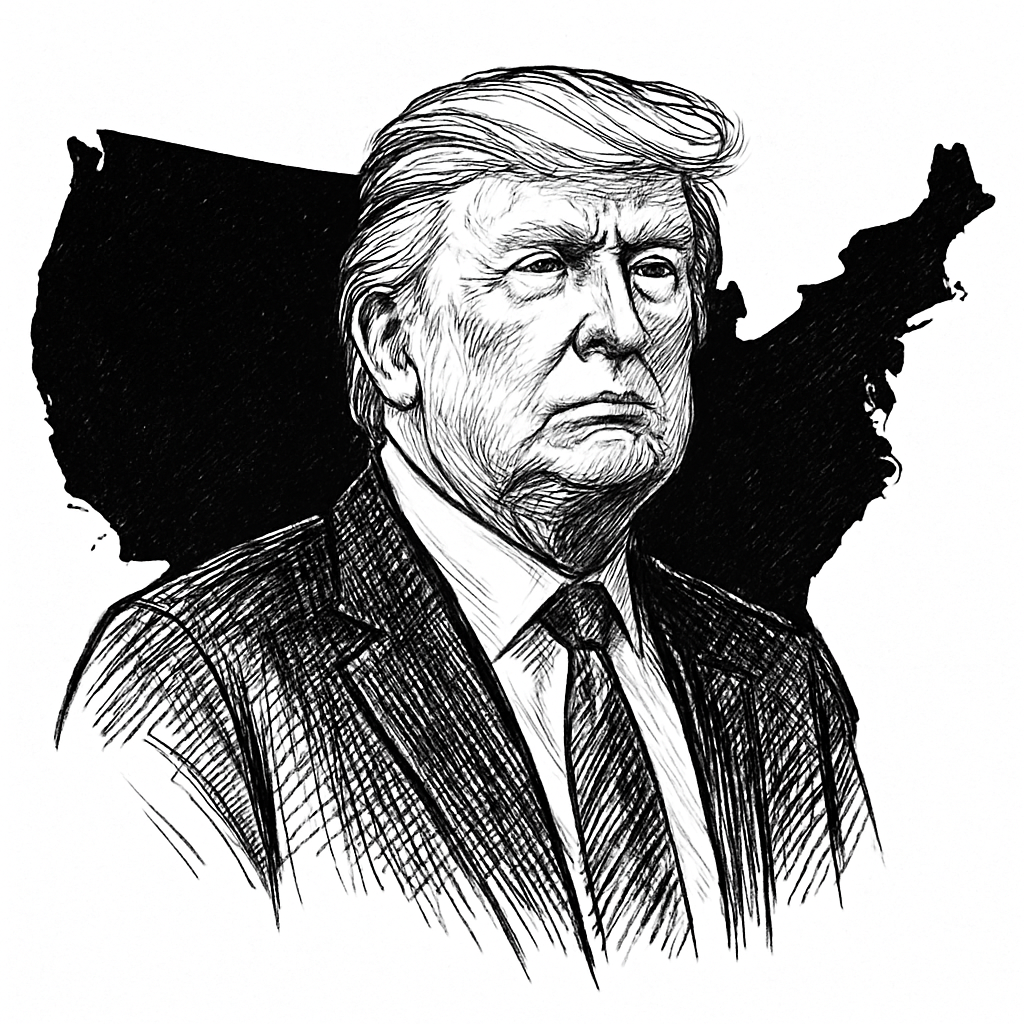
The Crazy Profiteering Gardner
On a green hill above the wide river, three old monks sat beneath the pine and watched the world move like a slow tide.
Downriver the city had long tended its bridges. Merchants threaded ropes of trade across them; children learned the routes by heart. For generations the river fed the stalls and the stalls fed the city.
Across the water, the neighbors beat their drums. Their riders said the world was dangerous, that iron must be sharpened and banners raised. The city grew anxious, and its leaders argued over which debts to pay and which men to arm.
On the city side lived a gardener known to some as Tiānlóng. He was blunt with his hands and quick with a plan. One morning he walked among the ropes and vines. Where others wove new knots, he raised his axe.
“Why cut?” the merchants cried. “The ropes keep our lights burning.”
The gardener set his jaw. “We are tethered to strangers,” he said. “When storms come, I will not let our house drift with their mast.”
So he cut many vines. He planted iron and seed. He cleared a long strip for a smith who promised work and a new mill near the river. He built a high fence on one side of the market and a toll-board on the other. Some stalls closed. Some merchants left to other towns. Some grew rich selling to the gardener’s new customers.
The drums across the river grew louder. The city’s leaders pointed at the cleared ground and shouted betrayal. “He has weakened us,” they said. “He has cut the ropes that kept the city safe.”
Others whispered, “He has made us less dependent.” They liked the mill and the smith’s wage. They liked the gardener’s deals and the coin that came with them.
The three monks drank tea. The youngest asked, “Is the gardener cruel or brave?”
The eldest tapped his cup. “He is a gardener who likes profit,” he said. “He plants not only food but also a path for his own cart. That does not make him a saint. It does not make him a fool either.”
The middle monk added, “When drums call for war, clearing a field is courageous for some and catastrophic for others. A gardener who clears for the common good will feed his neighbors when the storm comes. A gardener who clears to sell timber and charge passage will prosper whether the bridges stand or burn.”
Time passed. Traders who remained, bought from the mill. Some neighbors sent envoys with trade offers. Others sharpened spears and watched the water’s surface for sails.
Stories spread: the gardener who cut ropes in wartime. Some called him a savior; others, a profiteer. The monks only taught one careful lesson to their students:
“Learn to read the clearing,” they said. “See what grows there and who carries the baskets. Noble ends may come from self-interest, and ruin may wear the mask of virtue. Do not be quick to bless the hand that plants, nor quick to curse the hand that profits. Measure the future by who shares the harvest when the nights are cold.”
And when the storms finally came, those who had planted with others had food to trade and hands to help. Those who had only drums and sharp words had long, thin nights. The gardener counted his coins and walked among the rows. The monks kept their tea warm and their eyes open.
Thanks for Sekar ji for his generous contribution!
SUPPORT DRISHTIKONE
In an increasingly complex and shifting world, thoughtful analysis is rare and essential. At Drishtikone, we dedicate hundreds of dollars and hours each month to producing deep, independent insights on geopolitics, culture, and global trends. Our work is rigorous, fearless, and free from advertising and external influence, sustained solely by the support of readers like you. For over two decades, Drishtikone has remained a one-person labor of commitment: no staff, no corporate funding — just a deep belief in the importance of perspective, truth, and analysis. If our work helps you better understand the forces shaping our world, we invite you to support it with your contribution by subscribing to the paid version or a one-time gift. Your support directly fuels independent thinking. To contribute, choose the USD equivalent amount you are comfortable with in your own currency. You can head to the Contribute page and use Stripe or PayPal to make a contribution.
The Aviation Cyberattack
A major cyberattack struck global aviation systems around September 20, 2025, causing chaos at airports across Europe and North America. The disruption originated late on September 19 in the US, first with a major air traffic outage stalling flights coast to coast, including in Dallas. This quickly rippled to Canada, delaying flights in Toronto, Montreal, and Vancouver.
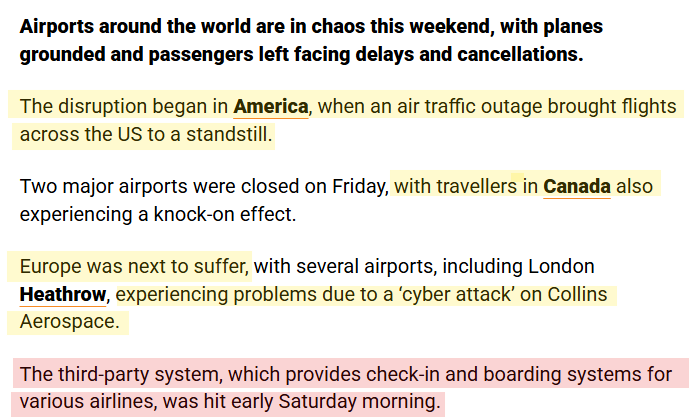
By early September 20, the attack hit Europe, impacting check-in and boarding systems at major airports—most notably London Heathrow, Brussels, and Berlin.
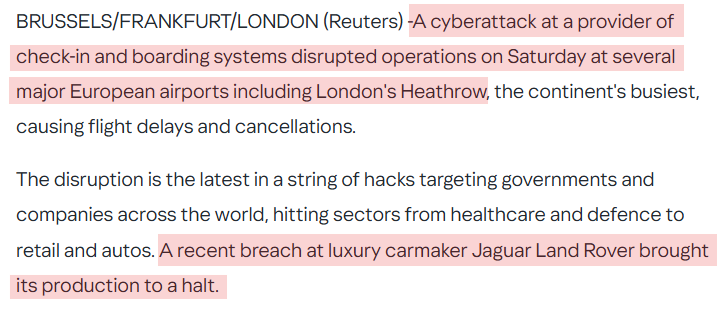
The culprit was a cyber-attack on Collins Aerospace’s MUSE software, a vital third-party platform used for electronic check-in and baggage handling. This led to widespread delays, flight cancellations, and forced airports to fall back on manual processes, causing huge queues and stranding thousands of passengers.
Hundreds of flights have been delayed and cancelled at Heathrow after a cyber attack targeting a service provider for check-in and boarding systems. has hit European airports. The attack has rendered automated systems inoperable, allowing only manual check-in and boarding procedures, according to Brussels Airport. London Heathrow and Berlin airport also said the attack was disrupting their flights, with passengers advised to confirm their travel with airlines before heading to the airport on Saturday. More than 500 flights were disrupted on Saturday, according to FlightRadar. Heathrow said that Collins Aerospace, which provides check-in and boarding systems for multiple airlines globally, is “experiencing a technical issue which may cause delays for departing passengers”. (Source: "Hundreds of Heathrow flights delayed after cyber attack hits European airports" / The Independent)
No group has officially claimed responsibility, and officials have not named a perpetrator—though ransomware is widely suspected, and attention has loosely turned to Russian or other state-backed hackers given recent escalations in hybrid attacks on European infrastructure. As of the latest reports, full resolution was still pending, with manual operations in place and investigations ongoing, highlighting deep vulnerabilities in aviation’s digital backbone.
Cybersecurity attacks in aviation have surged by 600% from 2024 to 2025, creating immense risks for airports, airlines, and aviation supply chains. Nearly 40% of airports now place cybersecurity as their top IT investment, and 80% see it among their highest spending priorities, acknowledging the sector’s vulnerability to sophisticated cyber threats.
These attacks can disrupt flight schedules, compromise navigation systems, and leak sensitive passenger or operational data. A successful breach could paralyze airport operations, halt air traffic, and endanger passenger safety.
Cybersecurity is emerging as a top IT investment priority for airports, with nearly 40 per cent of all airports ranking it as their top priority, according to Sita's 2024 Air Transport Insights. Sita is an IT provider for the air transport industry. Around 80 per cent of airports include cyber security in their top three areas of spend for the next 12 months, it said. "This emphasis underscores airports’ commitment to safeguarding their systems and data against evolving and sophisticated threats, fraud, and risks," Sita said. The aviation sector recorded a 600 per cent increase in cyber-attacks from 2024 to 2025, according to a June report by French aerospace company Thales. "Behind any physical turbulence in the skies, a silent cyber war is being waged on the aviation sector," the report said. "From airlines and airports to navigation systems and suppliers, every link in the chain is vulnerable to attack." (Source: "Heathrow and European airport flight delays after cyber attack" / The National)
In the scenario of a serious armed conflict in Europe, such cyberattacks could be weaponized to cripple critical aviation infrastructure, delay military or humanitarian flights, and hamper civilian evacuations.
Widespread disruptions would undermine logistical support for allied operations, erode public confidence, and have cascading effects on global commerce and emergency response.
The interconnected nature of aviation means an attack on one country could ripple across Europe, intensifying the overall chaos.
In our earlier newsletter we have discussed how Europe is feverishly preparing for a large war. In fact France is preparing its hospital system to prepare for huge war casualties by March 2026! So it is important that one views this event from that standpoint.
 Desh Kapoor
Some would say the cyberattack was a 'false flag' for the European elite to establish Russian aggression, but there is no reason to be so cynical. It may well have been the job of a lone hacker or an esoteric group.
Now let us address the elephant in the room - the H1B visa policy.
The New H1B Policy and the Exorbitant Fee
On September 19th, US commerce secretary Howard Lutnick proudly announced that "$100K a year, for H1B visas" was being imposed. Listen here. President Trump nodded in agreement.
But in the evening of September 20th, comes a clarification from the White House.
The White House clarification says three things: the $100,000 charge is not annual, it’s a one-time petition fee, it applies only to new H-1B visas (not renewals or current holders), and it won’t be charged for re-entry to existing H-1Bs. It also starts with the next lottery cycle.
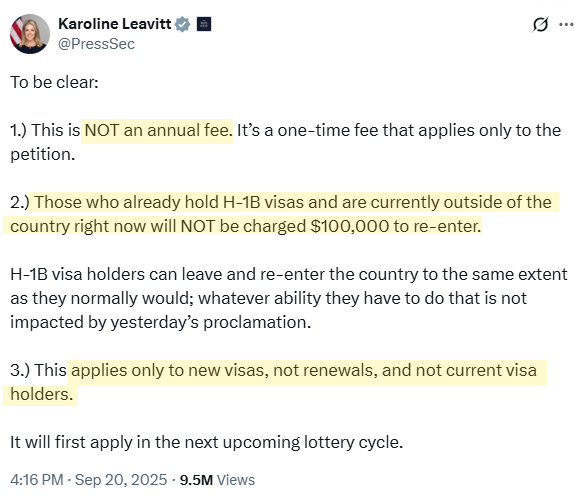
Here is the "fact sheet."
 The White House
So, did Lutnick just blabber way above his pay grade?
One doesn't know whether the Trump administration did a U-turn or if Lutnick spoke out of turn.
A story of a permanent resident who has tumor but was detained by the ICE for simply using a payphone without paying years ago!
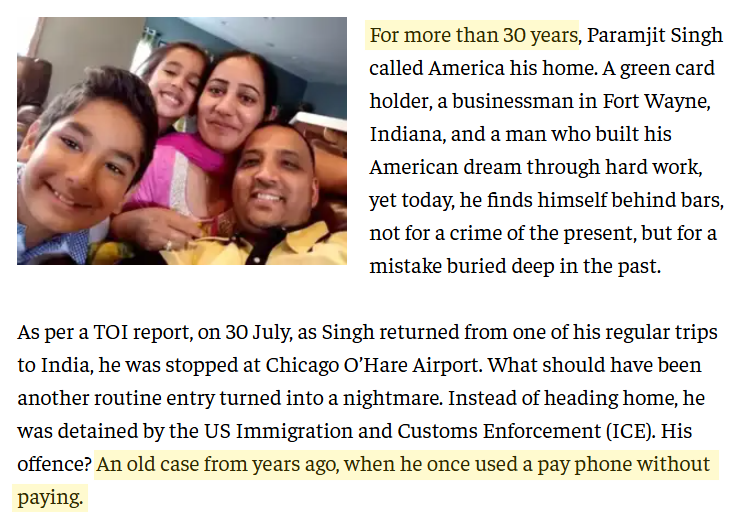
Coming from a generation that was one generation away from our grandparents pushed out of their homes in what is now Pakistan, one doesn't know whether hitching one's lives as Indians in the US is a smart move going forward anymore?
Here are some concrete pointers.
1. Don’t panic or overcorrect. For most current H-1Bs, the rational path is stabilize U.S. status, widen options, diversify assets across USD/INR, and upgrade skills.
2. Build a 12–18-month runway (cash + committed income). Have 6–12 months USD emergency fund (HYSAs or short T-bills). Don’t trap all liquidity in INR if income remains USD.
3. Set triggers: loss of I-140 portability, repeated project visa frictions, stalled promotions, or family priorities (kids’ schooling). When a trigger hits, execute your prepped move (cap-exempt job; Canada PR; India offer).
4. Work on downsizing. Be flexible in terms of housing - rent vs buy.
H1B Increased Fee Impact
Yes, the administration has clarified the situation a bit. It obviously doesn't make it as damning as it was earlier but it still is quite impactful for the future of American industry and the world in general.
Let us first look at how it will impact the industry.
- Demand shock for new hires. Many SMEs and startups will exit the H-1B channel; only deep-pocketed firms (Big Tech, elite consultancies, FAANG-scale) can absorb ~$100k upfront. Expect almost no new filings.
- Workforce reconfiguration. Substitution toward L-1 (intra-company), O-1 (extraordinary ability), nearshoring (Canada/Mexico), and accelerated offshoring. Universities and nonprofits (cap-exempt) may seem like a swing factor but the foreign students would find it hard to justify the investment in an American education without the option to work in US to pay off the high debt. US Universities will suffer.
- Wages/productivity. Marginal upward pressure on starting wages for new domestic hires, but possible productivity drag if roles move offshore or are left unfilled. Large firms keep output; smaller firms lose velocity.
How will it impact the US macro-economic scenario?
- Near-term GDP: Minimal immediate hit (existing H-1Bs unchanged).
- Medium-term growth: Slower innovation diffusion if startup hiring of specialized skills (AI/semis/biotech) stalls; more capex abroad (labs and dev centers in Toronto, Vancouver, Guadalajara).
- Prices & competitiveness: Some cost pass-through in software-intensive goods/services; potential erosion of the U.S. edge in frontier tech if the early-career global talent stream thins.
Now, let us look at the geopolitical impact.
- U.S.–India tech corridor: New inflow slows, but diaspora already in the U.S. remains intact. Indian IT firms likely expand India-based delivery and nearshore nodes, reinforcing India’s role in global services while trimming on-shore U.S. presence.
- Bilateral politics: Less acute than under an “annual fee for everyone” (as understood earlier) scenario, but expect Delhi to press for carve-outs/alternatives (L-1 facilitation, quicker green-card lines) in broader negotiations.
- Global competition: Canada/UK/Germany will poach talent with friendlier schemes, marginally shifting the innovation map. Japan is already offering a Permanent Residence
Japan, for instance, is ready to offer Permanent Residence for a paltry INR 4800!
 Lifestyle Desk
So, there are options for folks who want to move to societies outside India.
We will discuss more about the "dismantling the deep state" angle in a bit. For that, we will have first address another area - the European war clamor.
Europe's Existential Gamble
There is a lot of talk of how Ukraine war is an "unprovoked Russian aggression". But is it so?
Let us look at the NATO moves, Russian countermoves, and the Western (specifically European) narrative for those situations. We have mapped this out chronologically.
Western move: NATO expands into Central Europe despite verbal assurances to Gorbachev.
Russian response: Too weak to react militarily; voices repeated diplomatic objections.
European narrative: “Democratic enlargement” and “security integration,” not provocation.
----------------------------------------------------------------
2000s – NATO Pushes Further East
Western move: NATO admits Baltics and promises membership to Ukraine & Georgia. Color Revolutions supported by Western NGOs.
Russian response: 2008 Georgia war, red-line warnings.
European narrative: Russia is “aggressive” and neighbors need protection.
----------------------------------------------------------------
2010s – Ukraine as Flashpoint
Western move: U.S. and EU back Maidan uprising; IMF and NGO networks activated. Minsk Accords signed but treated as delay tactic.
Russian response: Annexes Crimea; backs Donbas separatists.
----------------------------------------------------------------
2020s – Open Confrontation
Western move: NATO exercises near Russia; U.S. arms Ukraine; EU sanctions escalate.
Russian response: 2022 invasion of Ukraine framed as defensive against NATO encirclement.
European narrative: “Unprovoked aggression” — fear of Russia becomes the legitimizing story.
----------------------------------------------------------------
Present (2025)
Western move: Europe signals willingness for prolonged confrontation, military build-ups, and talk of escalation.
Russian response: Nuclear posture reminders; deepening ties with China/Iran.
European narrative: “Defend Europe from existential threat,” even as escalation risks catastrophic self-destruction.
You will see an interesting pattern.
Western (NATO) moves steadily advanced into Russia’s strategic space. Russian responses were reactive, escalating only when red lines were crossed. Europe reframed each step as “defensive” or “fear of Russia,” even when the sequence shows provocation first.
So, if we roll the clock back to the 1990s, the European “fear of Russia” narrative is harder to sustain because:
1. Post-Soviet weakness and Western encroachment: After the USSR collapsed, Russia was internally shattered — economically, militarily, and politically. During the 1990s, it posed little direct threat to Europe. Yet instead of consolidating a neutral buffer, the West expanded NATO step by step, despite verbal assurances given to Gorbachev that NATO would not move “one inch eastward.” From Moscow’s perspective, this looked like encirclement.
2. Color revolutions and NGO networks: Figures like George Pyatt and organizations linked to Soros played highly visible roles in Ukraine and other post-Soviet states. Western funding and political support for “civil society” initiatives blurred into political engineering. Russia interpreted these not as democratic flowering, but as Western-backed regime change. The 2014 Maidan uprising became the tipping point.
3. Minsk Accords as delay tactic: The Minsk agreements were promoted as a path to peace, but admissions from European leaders (Merkel, Hollande, Poroshenko) later suggested they were meant to “buy time” to arm and prepare Ukraine. To Moscow, that confirmed duplicity rather than dialogue.
4. NATO as provocation: By pushing NATO infrastructure and promises of membership right up to Ukraine’s border, the West crossed Russia’s red line. If we invert the scenario: imagine Russia stationing missiles and advisors in Mexico or Cuba under the banner of a “defensive alliance.” Washington would never tolerate it — the Cuban Missile Crisis proved that. So an analogy with London (or Washington) is apt: Western capitals would have reacted with fury for something that they did with Russia.
That is why the whole “fear of Russia” claim in Europe has as much to do with political narrative as with hard security.
The actual trajectory since the 1990s shows Europe and the U.S. deliberately testing and pressing Russia’s tolerance, not the other way around. In that light, the constant claim of “historic trauma” that Europeans parade works more as a legitimizing story for escalation today than as an accurate reflection of the 1990s reality.
The question we should all ask is:
Now, when you look around and discuss this question, the answers one gets include fragments of some or all of these elements.
Federalization of Europe: A sustained external threat is the fastest path to deeper EU integration—especially in defense (joint procurement, EU-level command, common debt). The EU’s Strategic Compass lays the doctrinal groundwork; budgets are already rising toward/above 2% of GDP.
Rearming Industrial Policy: Rearmament doubles as an EU-wide industrial policy: munitions, air defense, C4ISR, shipyards. Germany’s Zeitenwende and multi-hundred-billion proposals illustrate how defense spend becomes an engine for tech and manufacturing revival.
Conjuring a Financial warfare scenario: Confrontation normalizes using frozen sovereign assets/“excess profits” to finance war and reconstruction—powerful leverage in a finance-centric order. The EU has begun moving from talk to instruments. But it is facetious at best given their systemic dependence on Russian Oil and Gas, specifically for winters, and lack of economic heft to make sanctions do anything to Russia. In fact, Russia has grown more under sanctions than Europe has by using them!
Military Industrial Takeover: NATO/EU bureaucracies and defense firms gain budgets, stature, and stickiness from sustained confrontation. Once mobilized, these coalitions are hard to unwind; spending data show rapid, path-dependent growth.
Irrational Overconfidence in Escalation Control: Leaders may believe nuclear thresholds won’t be crossed and that Russia, attrited by the Ukraine war, can be deterred with limited risk. This seems to be an assumption visible in ongoing kinetic and economic tit-for-tat.
Committed Jingoism and Reputation Sunk Cost: After maximalist narratives about “existential” stakes, reversing course is domestically costly. Credibility traps push policymakers to double-down even as risks rise—hence continued force build-ups and sanctions innovation.
The fact, however is - these arguments naively assume that the conflict will be a controlled one. That may not be true.
We are dealing with a combination of Russia, North Korea and China versus NATO/Europe.
Let us be honest - both inherently unstable (in decision-making capabilities) groups.
If at all the former may be more responsible - given the irrational European moves - than the latter has proven to be.
And this may be even more profound a realization because of these factors:
- Centralized coherence vs. coalition drift. Moscow/Beijing have fewer veto players and a survival-first doctrine; NATO/EU has many principals and actors, each with domestic games. So, there are more chances and avenues for missteps in NATO's or EU's case.
- Theory of victory. Russia’s “escalate-to-de-escalate” (whether or not doctrinally formal) presumes limited use to force talks; Europe’s consensus politics can’t pre-commit credibly to off-ramps.
- Resource realism. Russia/China price war’s costs differently (manpower tolerance, industrial basing), making brinkmanship more calibrated than Europe’s rhetoric implies.
So, from where we see, Europe is sleepwalking toward the cliff.
Here are five signals that could push this realization harder if true.
- First, negotiation itself is delegitimized—diplomats, mediators, or journalists who argue for talks are stigmatized, investigated, or legally constrained, shrinking the political space for de-escalation.
- Second, defense spending becomes irreversible: multi-year munitions lines, permanent basing, joint borrowing and procurement are locked in without matching crisis hotlines or pre-agreed pause mechanisms.
- Third, cyber operations nudge too close to nuclear command, control, and communications (NC3), probing early-warning networks where misreads can lead to hair-trigger responses.
- Fourth, anti-satellite activity—tests, jamming, dazzling, or dual-use “experiments”—normalizes space warfare and blinds verification channels.
- Finally, alliance rhetoric eliminates exit options: maximalist victory frames, public red lines, and vows to “never negotiate” harden commitments that leaders cannot later unwind. When these trends converge, miscalculation risk jumps from tail to baseline; policy inertia does the rest. Add secrecy, shortened decision cycles, and degraded hotlines, and volatility spikes—dangerously so.
But you will find Europe tripping on each of these signals. For example, see how the Center for European Policy Analysis (CEPA) article which proudly announces this. (Source)
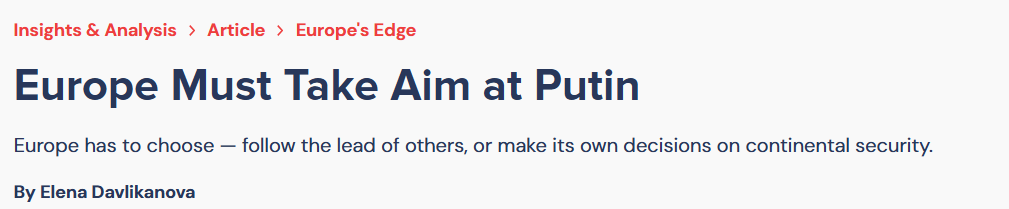
The unrelenting clamor for an existential conflict against Russia within the NATO and European circles is mind-boggling as it is damning.
What should have happened?
Setting of guardrails for security. Here are some.
- Establish standing hotlines—political, military, and space—supported by rehearsed playbooks, escalation checklists, and delegated authorities for immediate crisis communication, deconfliction protocols.
- Codify pre-notification and no-go rules for exercises, cyber operations touching NC3, and space assets; synchronize calendars, inspectors, and verification mechanisms.
- Negotiate interim understandings: nuclear no-first-use pledges and NC3-immunity carveouts, even if temporary or confidential, to prevent panic-driven misinterpretation during crises.
- Publicly delineate geography-specific red lines—Crimea, Kaliningrad, Suwałki—paired with reciprocal restraint measures and sanctions pauses automatically triggered by verified compliance milestones.
- Pre-build ceasefire architecture: monitoring missions, prisoner and asset escrow, phased sanctions relief, humanitarian corridors, and dispute-resolution timetables ready for activation.
- Create parliamentary shielding: cross-party resolutions, sunset clauses, and oversight committees so de-escalation choices aren’t framed as betrayal or capitulation domestically.
Try sharing any of these sane tactical ways to create off-ramps and Europeans will delegitimize you as a "fascist."
Strangely, despite all the rhetoric of higher tariffs and extra 25% penalties for trading with Russia against India, the United States Vice President (and one presumes, President Trump, as well) recognizes the corner that Europeans are painting themselves into.
Watch this clip where I have combined two JD Vance videos.
(The highlighted part is what JD Vance says in the first video)
This second video is about directly targeting Soros' Open Society and the Ford Foundation, both of which are at the forefront of subversion activities in other countries. India has seen its share of their subversion.
Here is the video:
The predicament that we have discussed above regarding Europe and its sleepwalk to an existential war pushes people to think of alternative explanations.
The Deep State Moves in NATO/EU?
The unexplainable dilemma pushes people to think out of the box, if you will. Here is Susan Kokinda. She is is a Washington Representative for the Lyndon LaRouche PAC. She discusses, albeit in almost "over-the-top" conspiratorial style, about how the UK's Imperial family and UK's MI-6 (along with other European entities and royal families) may still be trying to dictate a lot in the US.
A lot of what she says needs to be taken with a grain of salt. Yet her insistence of Trump taking on the Imperial family of UK betrays the underlying issues in the overall landscape of the Global Elites - the "Deep State," if you will.
We had written one edition to explain the depth and breadth of this Deep State.
 Desh Kapoor
Based on several readings and evidence - some conspiratorial - we had laid out a map of the so-called "Deep State". We have since updated that illustration as shown below.
Please remember that this is a starting heuristic.
The five tiers — Global Elite, Think Tanks/Secret Forums, International Organizations, National Actors, and Local Influencers — show how ideas, funds, and policies cascade from transnational hubs into domestic politics and society.
This framework illustrates a causal chain: strategic agenda setting at the top, translation into actionable plans, execution through international and national mechanisms, and, finally, legitimation at the grassroots level.
By following this flow, one can trace how abstract global strategies transform into everyday political realities. It captures both the vertical diffusion of influence and the layered interplay between power, narrative, and acceptance across scales.
So use it in that sense.
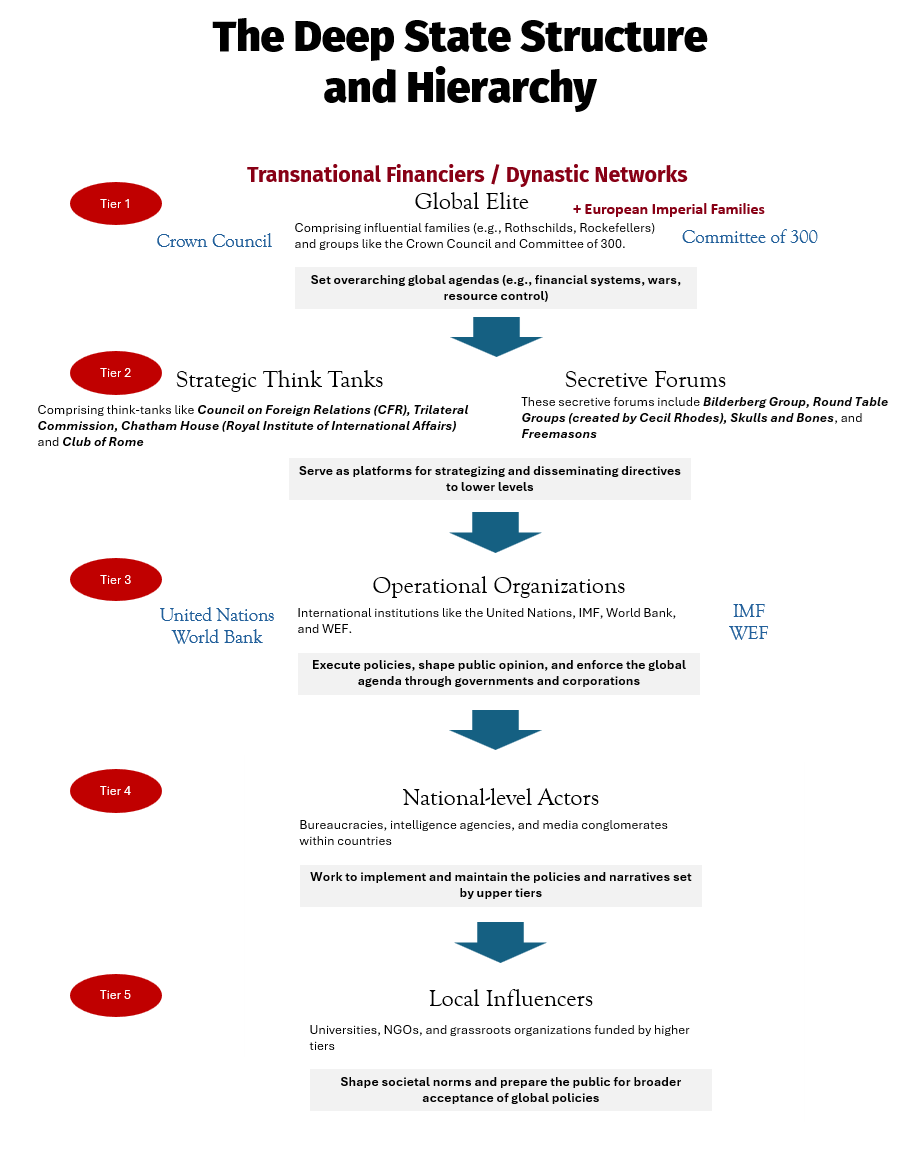
Here are some caveats to keep in mind when thinking about the Deep State tiers.
Porosity and two-way flows. Influence is not simply a one-way cascade from the global elite downward. National governments, corporations, and electoral politics often push back and shape the agendas of elites and think tanks. While our diagram shows a primary flow from top to bottom, the reality is bidirectional. Flows that move upward—grassroots pressure, national policy shifts, corporate lobbying—are less powerful but still significant in shaping outcomes.
Not a single unified will. The top tiers should not be seen as a monolithic force. They are coalitions of financial dynasties, sovereign wealth managers, legacy families, and global corporations. These actors do not always agree, instead forming shifting alliances around issues such as energy, finance, or defense. Their primacy, however, remains largely intact despite internal rivalries.
Hybrid actors. Many powerful entities blur the line between private and state. Sovereign wealth funds, state-linked banks, multinational corporations, military-industrial firms, and large NGOs operate across tiers, reinforcing the system’s complexity and resisting simple categorization.
Conspiracy framing risk. Labels like “Crown Council” or “Committee of 300” risk sliding into conspiratorial rhetoric, given their use in fringe literature. A more grounded description is to speak of “transnational financiers” or “dynastic networks,” which captures their influence without sensationalism.
Geography and factionalism. The global elite is not a single bloc. Elites in London, Brussels, or New York differ in interests and methods from those in Beijing, Riyadh, or Mumbai. Geography, history, and ideology shape how these networks interact, compete, and overlap. The tiers bleed across borders, creating a web of factional interests rather than a single centralized structure.
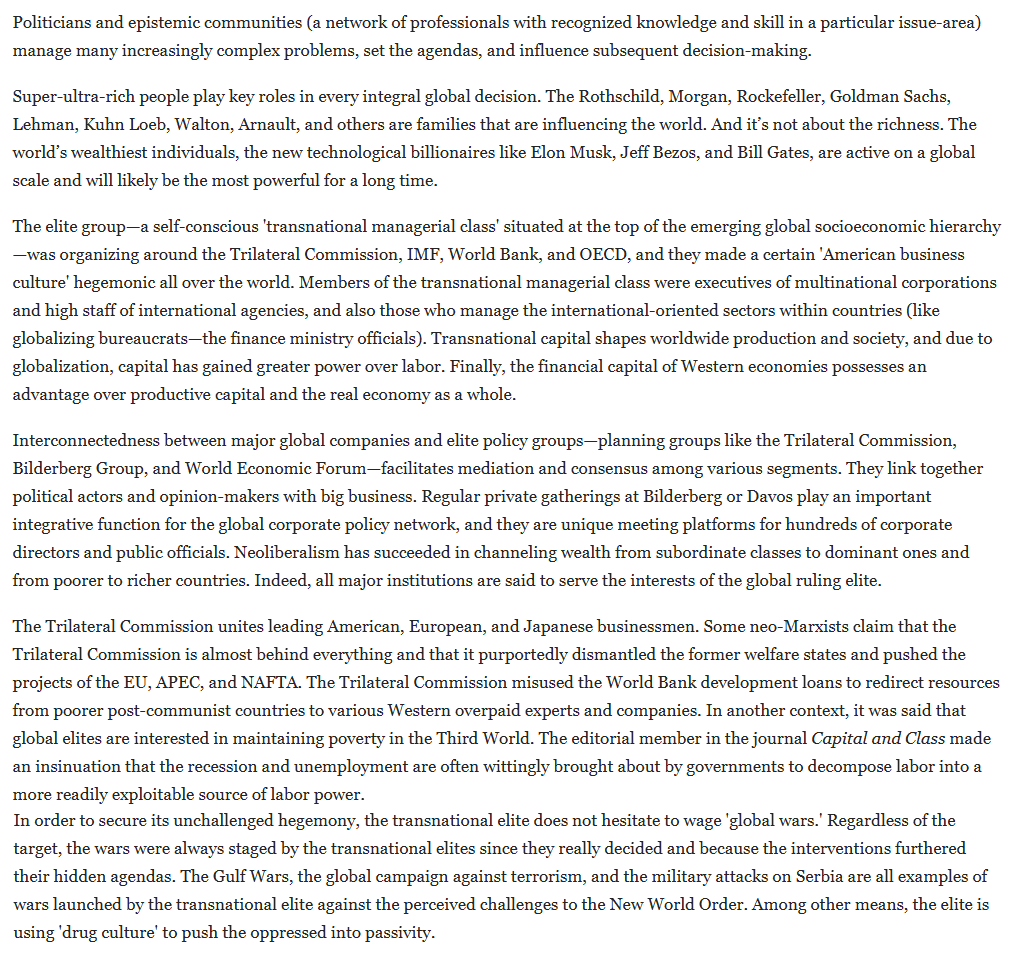
This article also shares a similar landscape of how the "Global Elite" landscape works.
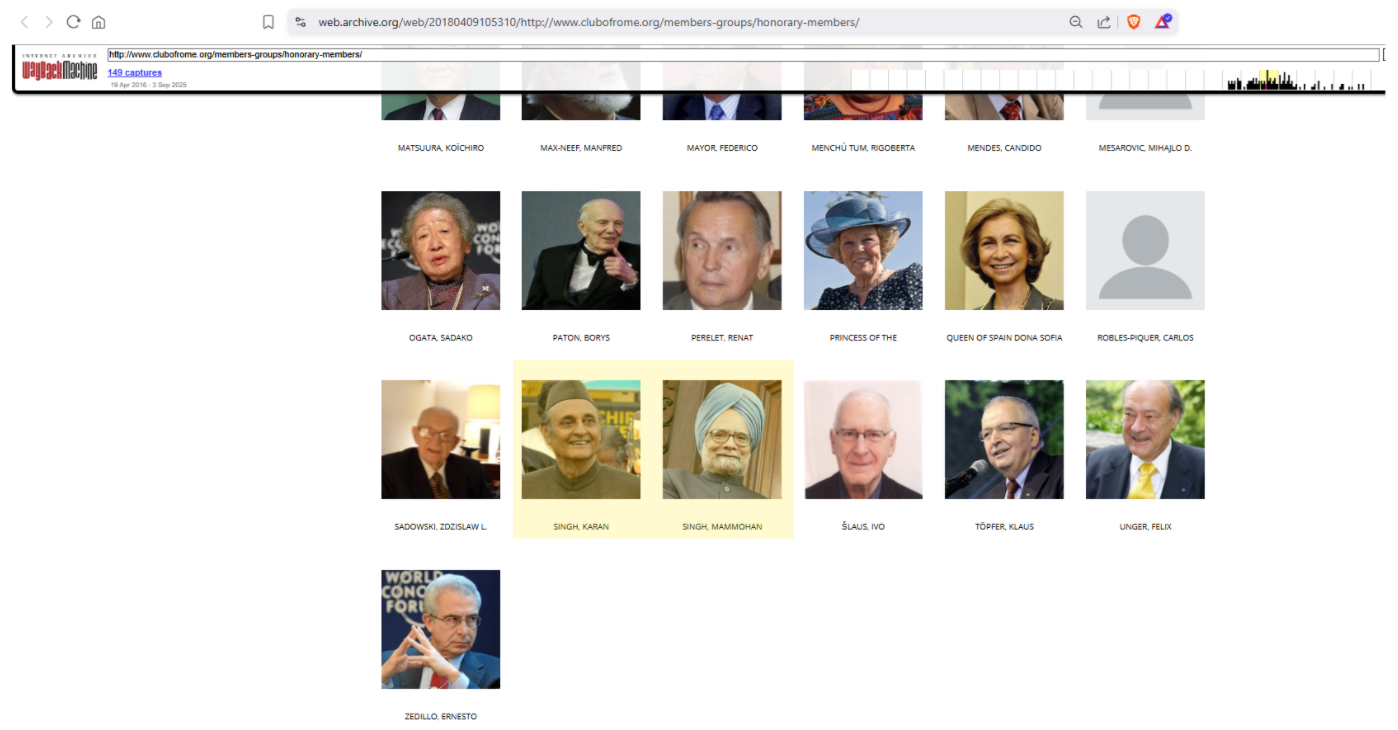
From the Indian standpoint, as a matter of interest, one can see who the two honorary members of the Club of Rome have been. (PS: We thank our friend Bharath for sharing the link with us.)
It doesn't need a rocket scientist to figure out that Trump-style measures — big tariffs, steep H-1B fees and hawkish trade policy — are very clearly directed towards dismantling of the policy scaffolding (regulatory harmonization, visa mobility, tariff discipline) that made high-volume cross-border capital and labor flows predictable.
So are we witnessing an internecine battle within the larger "Deep State" fold?
While the entrenched Deep State actors, specifically the top tier clamor for an all-out (in most probability a nuclear) war, the current US administration is dismantling everything that has sustained the current players in the Deep State.
Remember, that history and theory show that wars and systemic shocks create moments of structural change: winners rewrite institutions, losers see assets redistributed, and new governance architectures emerge after large conflicts. Scholars who study the political economy of war and post-war orders note exactly this dynamic: structural ruptures create windows for institutional redesign.
So is what Trump doing good or bad?
Decoding Trump
Donald Trump’s geopolitical conduct is defined by persistent contradictions.
He rhetorically attacks the entrenched “Deep State” and globalist institutions — using tariffs, immigration shocks (H-1B fees) and protectionist industrial policy to dismantle aspects of the post-Cold War order — yet simultaneously pursues transactional deals that can enrich his political allies and reshape markets in ways critics call self-serving.
He cultivates warmer relations with power centers often seen as adversaries of the Western establishment (Russia, China, and Pakistan) while also embracing hawkish posture when it advances his bargaining leverage; this produces the appearance of both detente and escalation depending on audience and timing.
Domestically he uses populist, sometimes nativist rhetoric that amplifies xenophobia and targets immigrant communities (including Indian tech workers), even as he publicly courts leaders such as India’s prime minister to secure geopolitical or commercial wins.
Allegations around initiatives like “Operation 37” or the Pakistani crypto deal which are destabilizing for India, underscore the way his moves can simultaneously undercut allied security narratives and open new spheres for influence.
 Desh Kapoor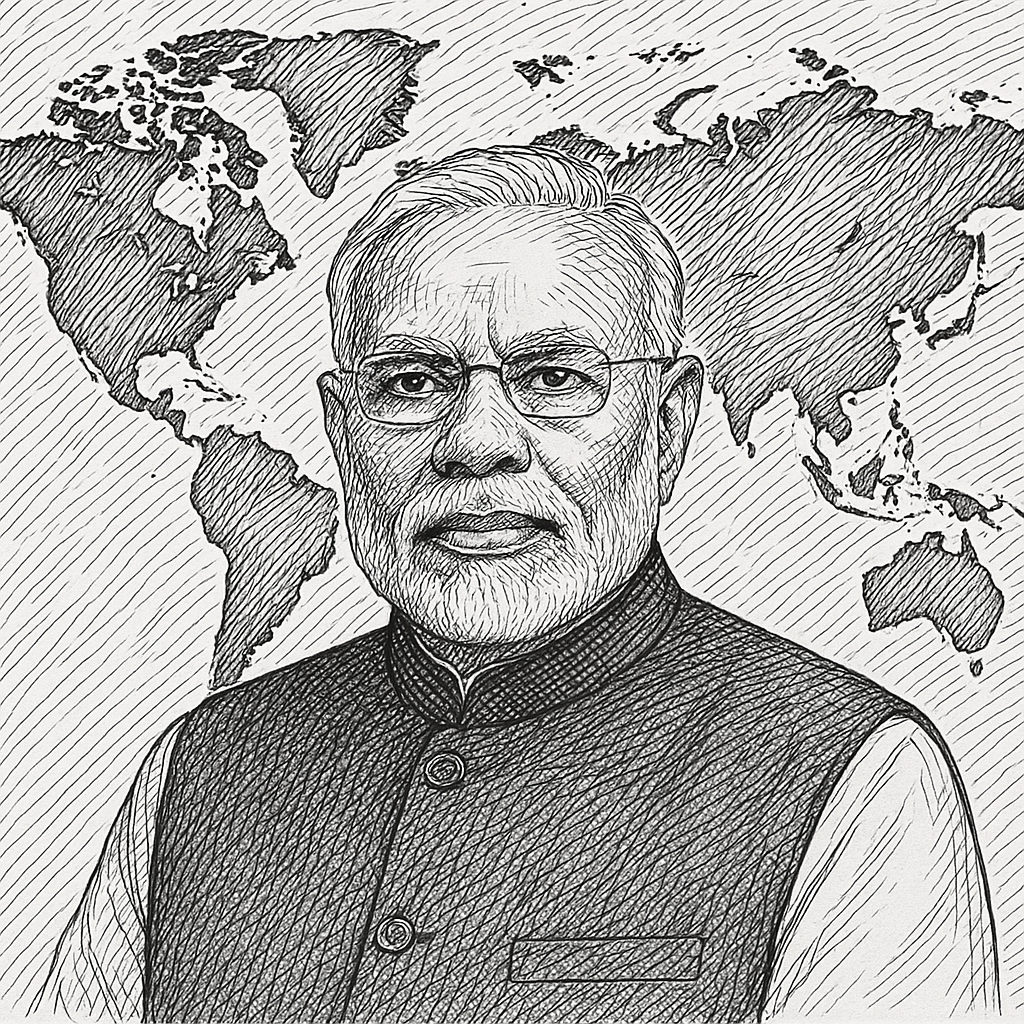
At the same time, Trump’s disruption forces entrenched institutions to adapt, sometimes pushing them toward greater assertiveness and coalition-building.
The net result is strategic muddle: policies that erode multilateral rules yet reinforce select power networks; anti-establishment rhetoric that coexists with rent-seeking behavior; and foreign alignments that oscillate between confrontation and accommodation, producing both realignment and renewed institutional resistance.
Comments ()