
The Daily Geopolitics Brief # 14
"A whole civilization will die tonight." Twelve hours later: ceasefire. Pakistan accidentally posted the White House's script. Jubail burned. China locked its airspace. Germany rearmed. The war paused — but nothing is resolved. Day 39.
"A whole civilization will die tonight, never to be brought back again. I don't want that to happen, but it probably will. However, now that we have complete and total regime change, where different, smarter, and less radicalized minds prevail, maybe something revolutionarily wonderful can happen." — President Donald J. Trump, Truth Social post, 6:30am EST, April 7, 2026 — approximately 13 hours before he announced a ceasefire
What This Signals
Read that quote again. Slowly. The President of the United States — the holder of the world's largest nuclear arsenal, the commander of the military that has conducted over 10,000 combat flights and struck over 13,000 targets in 38 days — announced at 6:30 in the morning that an entire civilization of 90 million people would probably die that night.
By 6:30 in the evening — 12 hours later — the same man announced a ceasefire.
What happened in those 12 hours was not a military breakthrough. There was no dramatic Iranian capitulation. Iran did not "cry uncle." The IRGC did not surrender. The Strait of Hormuz did not spontaneously open. What happened was that a scripted request — drafted by the White House, handed to Pakistan's Prime Minister, accidentally posted with the header "Draft — Pakistan's PM Message on X" still intact, then reposted without the header — gave Trump the political cover he needed to walk back the most extreme threat any American president has made since Hiroshima.
The quote signals three things simultaneously. First: the rhetoric of existential threat has become so routinized in this war that even "a whole civilization will die tonight" could be issued, ignored, and reversed within 12 hours without triggering a constitutional crisis. Second: the gap between what Trump says publicly and what his administration is doing privately has never been wider — even as he was posting this genocidal language, JD Vance was in Budapest conducting overnight ceasefire negotiations through back-channels. Third: the world's threat-detection systems — markets, allies, the UN Security Council, military planners in every capital — have begun discounting Trump's language entirely, which creates its own danger: the day he means it, no one will believe him.
For India, the quote signals the end of the war's loudest chapter and the beginning of its most consequential: the 14-day negotiating window in which every outcome that matters — Hormuz governance, sanctions architecture, Chabahar, fertilizer supply, energy pricing — will be decided in rooms that India must be in.
Story #1: The Ceasefire That Nobody Saw Coming — And Everybody Saw Coming
The Full Picture
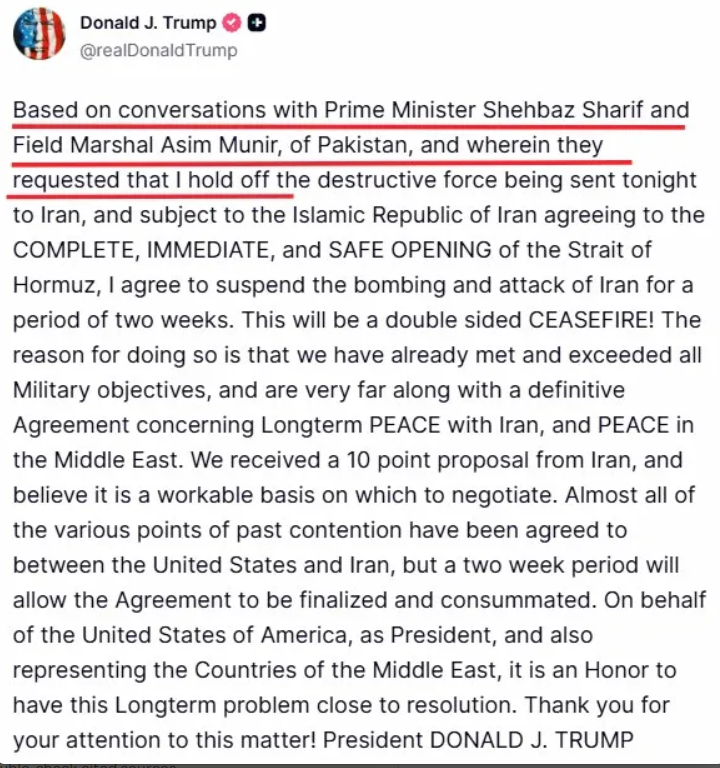
At approximately 6:15 pm EST on Tuesday, April 7, 2026 — roughly 105 minutes before Trump's own 8 pm deadline — Trump posted on Truth Social, announcing a "double-sided CEASEFIRE." The post read: "Based on conversations with Prime Minister Shehbaz Sharif and Field Marshal Asim Munir, of Pakistan, and wherein they requested that I hold off the destructive force being sent tonight to Iran, and subject to the Islamic Republic of Iran agreeing to the COMPLETE, IMMEDIATE, and SAFE OPENING of the Strait of Hormuz, I agree to suspend the bombing and attack of Iran for a period of two weeks."
The post was extraordinary in its claims. Trump declared the US had "already met and exceeded all Military objectives" — a formulation that had not been used in any previous official communication. He said Iran's 10-point proposal was "a workable basis on which to negotiate" — despite having called it "not good enough" less than 24 hours earlier. He said "almost all of the various points of past contention have been agreed to," which US and Iranian officials had described as false just hours before, with one senior official calling the gaps "very big."
Iranian Foreign Minister Abbas Araghchi confirmed acceptance on behalf of Iran's Supreme National Security Council, framing it as a victory for Pakistani diplomacy: "In response to the brotherly request of PM Sharif in his tweet, and considering the request by the U.S. for negotiations based on its 15-point proposal as well as announcement by POTUS about acceptance of the general framework of Iran's 10-point proposal as a basis for negotiations, I hereby declare: If attacks against Iran are halted, our Powerful Armed Forces will cease their defensive operations. For a period of two weeks, safe passage through the Strait of Hormuz will be possible via coordination with Iran's Armed Forces."
Notice what Araghchi said: passage through Hormuz will be possible "via coordination with Iran's Armed Forces." Not free passage. Not unconditional opening. Coordinated passage — meaning the IRGC toll-booth regime remains structurally in place, suspended for 14 days as a gesture of goodwill while negotiations proceed in Islamabad on April 10. Markets reacted instantly: S&P 500 futures rose more than 1%, oil futures dropped approximately 6% on the news, and Brent fell from above $115 to around $108 within minutes of the announcement.
Pakistan's PM Sharif announced the ceasefire would apply across the region, including Lebanon, and invited both delegations to Islamabad on April 10 for formal negotiations. A US Defense official confirmed offensive operations in Iran had ceased. Israel also agreed to the ceasefire, a senior White House official told CNN, though Israel had not officially confirmed as of publication. In an illustration of the ceasefire's fragility, Iran fired a missile at Israel within minutes of the announcement, before the ceasefire formally took effect.
🇮🇳 How This Impacts India
The ceasefire is the most significant event for India's energy security since the war began 38 days ago. The immediate commercial implications: a 6% fall in Brent crude saves India approximately $350-400 million per week in import costs at current consumption levels. But the structural implications are more important than the price movement. Iran's Foreign Minister did not say Hormuz is open — he said it is accessible "via coordination with Iran's Armed Forces." That coordination mechanism is the Hormuz tollbooth framework that India must now formally engage with. India's EAM S. Jaishankar must immediately place calls to both Araghchi and the US State Department to ensure India's "friendly nation" passage status — already informally confirmed — is formally documented in whatever Islamabad talks framework emerges. India cannot allow a fortnight of negotiations to produce a Hormuz governance architecture that India had no role in shaping.
📎 References: New York Times | Axios | Foreign Policy | NBC News | Arab News
Story #2: "A Whole Civilization Will Die Tonight" — When a President Threatened Genocide and Then Called a Ceasefire
The Full Picture
The 12 hours between Trump's morning Truth Social post and the ceasefire announcement constitute one of the most extraordinary sequences in the history of American presidential rhetoric — and deserve to be documented in full.
At 6:30 am EST on April 7, Trump posted on Truth Social: "A whole civilization will die tonight, never to be brought back again. I don't want that to happen, but it probably will." UN Human Rights Chief Volker Türk responded that threats to annihilate a civilization were "sickening" and that carrying them out would constitute "the most serious international crimes." The ICRC's president said threats against civilian infrastructure were "incompatible with the law." British journalist Owen Jones wrote that Trump appeared to be "threatening to use nuclear weapons against Iran." The White House communications team, in an email exchange with CQ Roll Call, declined to rule out the use of nuclear weapons when directly asked.
Democratic response was swift and unprecedented in its unity. House Minority Leader Hakeem Jeffries issued a joint statement with House Democratic leadership: "Donald Trump is completely unhinged. His statement, threatening to eradicate an entire civilization, shocks the conscience and requires a decisive congressional response. The House must come back into session immediately and vote to end this reckless war of choice in the Middle East before Donald Trump plunges our country into World War III." Senator Chuck Schumer co-authored a joint statement with Senate Democratic ranking members on all key committees: "We speak today with one voice and one purpose: to condemn President Trump's threat to extinguish an entire civilization." Republican Senator Ron Johnson told CNN he was "hoping and praying" the post was "just bluster."
Iran's response: Iranian citizens formed human chains around power plants and bridges nationwide. State media broadcast footage of hundreds of flag-waving people gathered around the Kazerun combined-cycle power plant in Fars province. Iranian President Masoud Pezeshkian said approximately 14 million Iranians had answered the government's call for war volunteers. IRGC General Ebrahim Zolfaqari warned: "If attacks on non-civilian targets are repeated, our retaliatory response will be carried out far more forcefully and on a much wider scale." Iran also renewed its threat to ask Houthi allies to close the Bab el-Mandeb waterway — a second major oil chokepoint — if the US escalated further.
Raw Story's Alexander Willis documented the global panic the post ignited. Progressive commentator Krystal Ball: "Genuinely one of the most proudly evil men of all time. The military needs to revolt." Mehdi Hasan: "The ravings of a homicidal maniac and sociopath." Liberal influencer Brian Krassenstein with one million followers: "This is literally a genocide." Then, 12 hours later, Trump announced the ceasefire.
🇮🇳 How This Impacts India
The "whole civilization will die" post — and the fact that it preceded a ceasefire by just 12 hours — has a specific lesson for India's threat-assessment apparatus. India's intelligence and foreign policy planning must now build in a systematic "Trump discount" when calibrating responses to US rhetoric. The gap between Trump's public statements and US policy intent has been demonstrated to be potentially as large as "annihilation of a civilization" versus "ceasefire within 12 hours." India must not allow its own policy responses — whether on sanctions compliance, Chabahar negotiations, or Hormuz passage — to be driven by Trump's public statements rather than by the actual back-channel signals its own diplomats are receiving. The post also confirms that Trump's nuclear ambiguity — leaving open the question of nuclear use when directly asked by journalists — is a deliberate negotiating tool. India, as a nuclear-armed state, must formally discuss this posture with its own NSC and ensure India's own nuclear doctrine statements are robust enough to signal that any conflict involving nuclear threats will change India's regional posture entirely.
📎 References: Raw Story | The Mirror | CNN | The Guardian | Time
Story #3: Mullin's Airport Gambit — How DHS Just Threatened to Ground International Travel at Every Blue City in America
The Full Picture
Newly installed DHS Secretary Markwayne Mullin — who replaced the fired Kristi Noem — used his first major media interview to float one of the most operationally disruptive domestic policy proposals of the Trump second term: withdrawing US Customs and Border Protection officers from international airports in sanctuary cities.
Speaking on Fox News with Bret Baier, Mullin said, "I believe sanctuary cities are not lawful. I don't think they're able to do that. And so we're going to take a hard look at this. One area we may take a hard look at is that some of these cities have international airports. If they're a sanctuary city, should they really be processing customs into their city? Seriously, if they're a sanctuary city and they're receiving international flights, and we're asking them to partner with us at the airport, but once they walk out of the airport, they're not going to enforce immigration policy, maybe we need to have a really hard look at that." When Baier confirmed, "So you're saying big cities that are sanctuary cities that have a big airport, they might lose their customs?" Mullin replied: "I'm saying we are going to have to start prioritizing things at some point."
The practical implications are staggering. Without CBP and customs officers, airports cannot process international arrivals. International flights cannot effectively land. The airports at risk — in Los Angeles, New York, San Francisco, Chicago, Boston, Seattle, Denver, Philadelphia, Portland, and Minneapolis — collectively handle tens of millions of international passengers annually. Los Angeles International Airport alone processes approximately 6.3 million international passengers per month. San Francisco International sees approximately 4.5 million per month. The 2026 FIFA World Cup, scheduled to begin in June 2026 across multiple US cities, would be directly disrupted if any of the host cities — New York, Los Angeles, San Francisco, Boston — lost international customs capability.
Legal experts immediately noted a 2025 federal injunction in San Francisco that blocked the administration from retaliating against sanctuary cities by withholding federal services. Aaron Reichlin-Melnick, senior fellow at the American Immigration Council: "Markwayne Mullin floats that his first major move as DHS Secretary might be to massively disrupt international air travel into and out of the United States by pulling customs officers out of cities like New York and Los Angeles, a move that would have international ramifications." California Governor Gavin Newsom responded: "If you thought the economy was bad with Trump's war driving prices at the pump up… just wait until international travel is halted at some of the busiest airports in the world."
The context: DHS has been in a funding shutdown for nearly two months, with TSA agents calling out en masse over missed paychecks, causing long airport wait times nationwide. Mullin is arriving in a department already under severe operational strain.
🇮🇳 How This Impacts India
This story has a more direct impact on India than it appears. India's diaspora — approximately 4.2 million Indian-Americans, the largest and highest-earning immigrant community in the US — is concentrated precisely in the sanctuary cities at risk: the San Francisco Bay Area, New York metro, Los Angeles, Chicago, and Seattle collectively account for the majority of Indian-American residential and commercial presence. Any disruption to international customs processing at SFO, JFK, LAX, O'Hare, or Sea-Tac would directly affect Indian nationals travelling for business, tourism, family visits, and the H-1B visa holders who are the backbone of the US tech industry. India's Consulate General offices in San Francisco, New York, and Chicago should immediately begin contingency planning for disrupted international travel at their host cities, and the MEA should formally communicate to the State Department that any disruption to international air travel infrastructure affecting Indian nationals will be treated as a bilateral issue requiring immediate attention.
📎 References: The Times | Newsweek | KTVU Fox 2 | Daily Beast
Story #4: China's Silent 40-Day Airspace Lockdown — The Shadow War Nobody Is Watching
The Full Picture
While the world's attention has been consumed by the Iran war, China has quietly sealed off a section of its offshore airspace larger than Taiwan itself — for 40 consecutive days, without explanation, without announced exercises, and without the usual NOTAM justifications that accompany military drills.
The restrictions, first reported by the Wall Street Journal and confirmed by US Federal Aviation Administration data, cover five separate zones extending approximately 340 miles from the Yellow Sea near South Korea southward to the East China Sea near Shanghai. The zones are designated "SFC-UNL" — from the surface to unlimited altitude — meaning they cover the full vertical spectrum of military aviation. The restrictions began on March 27 and run until May 6. Normal Chinese military exercises last three to four days. The previous longest NOTAM-type restriction China had issued in this area lasted three days.
Ray Powell, director of Stanford University's SeaLight project, which tracks Chinese maritime activity: "What makes this especially notable is the combination of SFC-UNL with an extraordinary 40-day duration — and no announced exercise. That implies not a one-time exercise but a position of operational preparedness that has to be maintained over time, and apparently, one that China does not feel the need to defend." Christopher Sharman, director of the US Naval War College's China Maritime Studies Institute: the restricted airspace could "provide an opportunity to practice the kinds of air combat maneuvers that would be required" in a Taiwan conflict scenario.
A senior Taiwanese security official told the WSJ the closure is "clearly aimed at Japan," as China attempts to deter US military access through Japanese and South Korean bases — the "tip of the spear" any American response to a Taiwan conflict would rely on. The timing is not coincidental: all three US carrier groups that would normally be positioned in the Pacific are currently in the Gulf for the war with Iran. The Pacific's US military footprint is at its thinnest in decades. A Taiwanese opposition KMT leader is visiting China this week — the first such visit by a KMT chairman in more than a decade. Trump's own visit to China is reportedly being planned for the following month.
🇮🇳 How This Impacts India
The 40-day China airspace closure, timed to coincide with the maximum US military distraction in the Gulf, is one of the most significant signals of strategic intent this year — and India is the country in the Indo-Pacific most directly affected by its implications. If China uses the Iran war window to rehearse and consolidate its operational posture for a Taiwan invasion, the security architecture of the entire Indo-Pacific shifts. India shares a 3,488km border with China, has ongoing territorial disputes at multiple points along the LAC, and has been slowly strengthening its alignment with the US, Japan, and Australia through the Quad. A China that has used the Iran war period to significantly advance its military operational readiness for Taiwan is a China that will be more assertive — not less — on its India border once the Iran ceasefire attention fades. India's defense establishment must formally raise this in Quad consultations immediately, and India's eastern naval command and air force should be placed on heightened readiness monitoring through May 6.
📎 References: The Telegraph | The Sun | Defence Security Asia | Taiwan News
Story #5: Jubail in Flames — Iran Hits Saudi Arabia's Industrial Crown Jewel
The Full Picture
In the most economically significant single strike of the entire war, Iran's Islamic Revolutionary Guard Corps on April 7 targeted Jubail Industrial City — the heart of Saudi Arabia's downstream petrochemical sector — with medium-range ballistic missiles and suicide drones, in direct retaliation for the previous night's Israeli strike on Iran's Asaluyeh petrochemical plants connected to the South Pars gas field.
Reuters confirmed the attack, with video footage verified by its reporters showing smoke and flames rising from Jubail. The IRGC stated it had "effectively targeted" the Sadara complex — a $20 billion joint venture between Saudi Aramco and US chemical giant Dow — and ExxonMobil facilities in Jubail, as well as a petrochemical facility in nearby Juaymah. The IRGC explicitly framed the attack as "in response to the enemy's crimes in the aggression against (Iran's) Asaluyeh petrochemical plants."
Jubail's strategic importance cannot be overstated. The city is home to SABIC — Saudi Arabia's largest non-oil company — and hosts joint ventures with virtually every major Western petrochemical corporation: SATORP (Aramco-TotalEnergies), SASREF (Aramco Jubail Refinery), the Sadara complex (Aramco-Dow), ExxonMobil, and dozens of others. Jubail alone accounts for approximately 7% of global petrochemical production. It is where a significant proportion of global urea, ammonia, ethylene, and propylene are manufactured. Saudi Arabia's Ministry of Defense confirmed the interception of seven ballistic missiles but acknowledged that damage assessment was ongoing.
A senior Pakistani official told Reuters that the Jubail strikes "threatened to derail the talks," and that a Saudi retaliation could draw Pakistan into the conflict under its defense pact with Riyadh. The strikes came as Pakistan was simultaneously conducting the ceasefire negotiations — creating an extraordinary scene where the same country was trying to stop the war through diplomacy while Iran was striking its defense ally's industrial infrastructure. Physical oil prices hit a record near $150 a barrel on spot markets when news of the Jubail attack broke, before falling sharply following the subsequent ceasefire announcement.
🇮🇳 How This Impacts India
Jubail is where the global fertilizer crisis gets worse or better — and on April 7, it got worse. SAFCO, SABIC's fertilizer subsidiary, operates some of the world's largest ammonia and urea production facilities in Jubail. Urea prices had already risen from $420 to $597 per tonne since the war began. Any sustained production disruption at Jubail will push prices higher still. India's fertilizer season for kharif (summer) crops begins imminently, and India's fertilizer import bill has already exceeded the annual budget. The Petroleum and Chemicals Ministry must immediately assess whether any of India's contracted Saudi fertilizer supply was sourced from Jubail facilities, and whether alternate procurement from Oman, Qatar (assuming Hormuz reopens), Indonesia, and Canada can be fast-tracked. Every week of delay in alternate procurement translates directly into higher input costs for Indian farmers.
📎 References: Reuters | Al-Monitor | Arab News | Times of Israel
Story #6: Democrats, MAGA, and the Pope — The Unholy Alliance Calling for Trump's Removal
The Full Picture
In an alignment that would have been unimaginable 12 months ago, Trump's "whole civilization will die tonight" post triggered simultaneous calls for his removal from the Democratic Party's House leadership, MAGA's most prominent former congresswoman, conservative Republican senators, and Pope Leo XIV.
The Democratic response was the most unified and explicit since Trump's second inauguration. House Minority Leader Hakeem Jeffries called Trump "completely unhinged" and demanded Congress reconvene for an emergency vote to end the war. Senate Minority Leader Chuck Schumer led a joint statement from Democratic ranking members on every key Senate committee — Foreign Relations, Armed Services, Intelligence, and Finance — condemning "the threat to extinguish an entire civilization." Democratic Representative Mark Pocan of Wisconsin called for the immediate invocation of the 25th Amendment. Representative Melanie Stansbury explicitly said it was "time to invoke the 25th" — naming individual Republican colleagues by implication, noting they needed to join the effort for the constitutional process to work.
From within the Republican coalition: Marjorie Taylor Greene — who left Congress in January after her public falling-out with Trump — posted: "He has gone insane. Everyone in his administration who claims to be a Christian needs to fall on their knees and beg forgiveness from God." Republican Senator Ron Johnson: "I'm hoping and praying it's just bluster. We are not at war with the Iranian people." From the White House's own communications staff: when a social media account suggested Vance's remark in Budapest "implies Trump might use nuclear weapons," the White House communications team called the interpretation "absolutely buffoonish" — but the press office did not answer questions about whether nuclear weapons were ruled out.
Pope Leo XIV, speaking at Castel Gandolfo, called Trump's threat to destroy Iranian civilization "truly unacceptable" and said attacks on civilian infrastructure violate international law. The Pope specifically described the Iran conflict as "an unjust war, which is continuing to escalate and which is not resolving anything." The Guardian's reporting on Democrats and the 25th Amendment noted this was the first time Democratic leadership had made the 25th Amendment a mainstream public demand rather than a fringe suggestion.
🇮🇳 How This Impacts India
The domestic US political implosion around the Iran war has a direct bearing on the Islamabad negotiations; India must engage. A US president facing the 25th Amendment demand from Democrats, evangelical desertion from MAGA, and Republican senators praying his threats are "just bluster" is a president whose domestic political position depends on the ceasefire being seen as a genuine victory. That makes him desperate for the Islamabad talks to produce something he can call a deal. India should read that desperation as a diplomatic opportunity: the more Trump needs the two-week ceasefire to produce visible outcomes, the more leverage India has in attaching its own conditions — a permanent Chabahar waiver, a formalized Hormuz passage rate for Indian vessels, a bilateral energy framework — to its participation in the broader regional settlement process that India could help facilitate.
📎 References: The Guardian | Arab News | NBC News | CBS News
Story #7: Hormuz: "Via Coordination With Iran's Armed Forces" — What the Ceasefire Actually Opened
The Full Picture
The BBC's reporting on the ceasefire made a distinction that most headlines missed: the Strait of Hormuz did not "reopen" on April 7. It became accessible for 14 days through coordination with Iran's armed forces, subject to technical limitations.
Araghchi's statement was precise and carefully lawyered: "For a period of two weeks, safe passage through the Strait of Hormuz will be possible via coordination with Iran's Armed Forces and with due consideration of technical limitations." Three phrases deserve forensic attention. "Via coordination with Iran's Armed Forces" — meaning the IRGC retains operational control of access. Passage is permitted, not guaranteed; it requires active Iranian approval. "Due consideration of technical limitations" — leaving Iran the ability to deny passage to specific vessels on technical grounds. "For a period of two weeks" — with no commitment to what happens after April 21.
Trump's Truth Social post said "COMPLETE, IMMEDIATE, and SAFE OPENING" — language of unconditional access. Iran's FM said "coordination with Iran's Armed Forces" — language of managed access. These are not the same thing. The gap between them is the central issue at the Islamabad talks. What the ceasefire actually produced is not a free Hormuz but a supervised Hormuz — exactly the toll-booth governance framework Iran has been seeking since the war began. The IRGC's "friendly nation" passage list — China, India, Russia, Pakistan, and select others — remains structurally in place. The fee mechanism is suspended but not abolished. The two-week window is a negotiating period, not a resolution.
US oil futures dropped approximately 6% on the ceasefire announcement, with Brent settling around $108 from its intraday high above $115. The EIA had forecast gas prices peaking at $4.30/gallon this month — that forecast will be revised downward if the ceasefire holds, but only partially, as Hormuz traffic will take weeks to normalize and Gulf production shut-ins will not immediately reverse.
🇮🇳 How This Impacts India
India's relationship with the new Hormuz is the single most important commercial and strategic question of the next 14 days. As a "friendly nation" on Iran's passage list, India is in a structurally advantageous position — but that advantage is informal and verbal, not contractual. Before the Islamabad talks conclude, India needs to secure three things in writing: a formal confirmation of India's "friendly nation" status from the IRGC's Hormuz management authority; a specific exemption from or preferential rate on whatever transit fee regime emerges from the negotiations; and a commitment that Indian-flagged vessels and vessels carrying Indian energy cargoes will not be subject to arbitrary "technical limitations" holds. India's shipping ministry, petroleum ministry, and MEA must coordinate a joint position paper on these three demands within 48 hours and transmit it through India's Iran back-channel before the Islamabad talks begin on April 10.
📎 References: BBC | Axios | NPR | Foreign Policy
Story #8: Germany's War Economy — €127 Billion in the Red, €39 Billion for Defense, and a Rearmed Europe That India Must Reckon With
The Full Picture
Germany's Federal Statistical Office published its 2025 fiscal data on April 7, revealing numbers that mark a structural break in European economic and military history. Germany ran a budget deficit of €127.3 billion in 2025 — the highest since 2022, a full €22.9 billion wider than the previous year. The federal government accounted for €85.4 billion of that shortfall. Military spending reached €39 billion, a year-on-year increase of over 23%, making Germany's defense expenditure — for the first time in the post-war era — a primary driver of the expansion of the structural deficit.
Chancellor Friedrich Merz has pledged to transform the Bundeswehr into the "strongest conventional army in Europe," with defense expenditure projected to exceed €500 billion cumulatively by 2029. Germany's Armored Brigade 45 is being deployed to Lithuania. The 1,200-page OPLAN DEU operational plan is being finalized for potential warfighting against Russia. Germany's central bank has warned the deficit could reach 4.8% of GDP by 2028 — the highest since German reunification in 1990. Germany's economy has suffered two years of recession (2023-2024) and near-stagnation in 2025, meaning this military buildup is occurring against a backdrop of economic weakness, financed entirely through debt.
Russia's Foreign Ministry Spokeswoman Maria Zakharova warned: "The last time the German political elite set out to make their country 'the main military power in Europe,' it ended in tragedy for all of humanity." The RT article reporting the German figures noted that this rearmament trajectory — funded through borrowing against a contracting economy — represents the most significant European militarisation since the Second World War.
🇮🇳 How This Impacts India
A rearming Germany has four direct implications for India. First, defense trade: Germany is already among India's top five defense equipment suppliers (including submarines, howitzers, and optical systems). Bundeswehr spending of €500 billion through 2029 will generate surplus capacity in German defense manufacturing that India can access — potentially on better terms than under its current agreements. India's defense ministry should initiate a formal framework for a German defense-industrial partnership within this fiscal year. Second, economic spillover: a German economy running 4.8% of GDP deficits while in near-stagnation will be a drag on eurozone growth, which will affect India's export competitiveness in Europe. Third, geopolitical realignment: a militarised Germany that can no longer depend on US extended deterrence through NATO — Trump called NATO a "paper tiger" at his April 6 press conference — will be far more receptive to building non-US security partnerships. India should propose an India-Germany-France trilateral strategic dialogue before year-end. Fourth, the Russia dimension: German rearmament explicitly targeting Russia creates pressure on India's Russia arms-supply relationship, which will increasingly be subject to German-led European sanctions.
📎 References: RT | Reuters | Bundesbank
Story #9: The Self-Directed Ceasefire — Pakistan Posted the White House's Script by Mistake
The Full Picture
The most extraordinary piece of documentary evidence to emerge from 38 days of war was not a satellite image of a destroyed facility, not a leaked intelligence assessment, not a classified cable. It was a Twitter edit history.
Shehbaz Sharif's April 7 post on X — the post that Trump credited as the basis for suspending military operations against Iran — went through two public versions. Version 1, the draft, began: "Draft - Pakistan's PM Message on X." Version 2, the published version, deleted that header. The substantive text was identical across both versions.
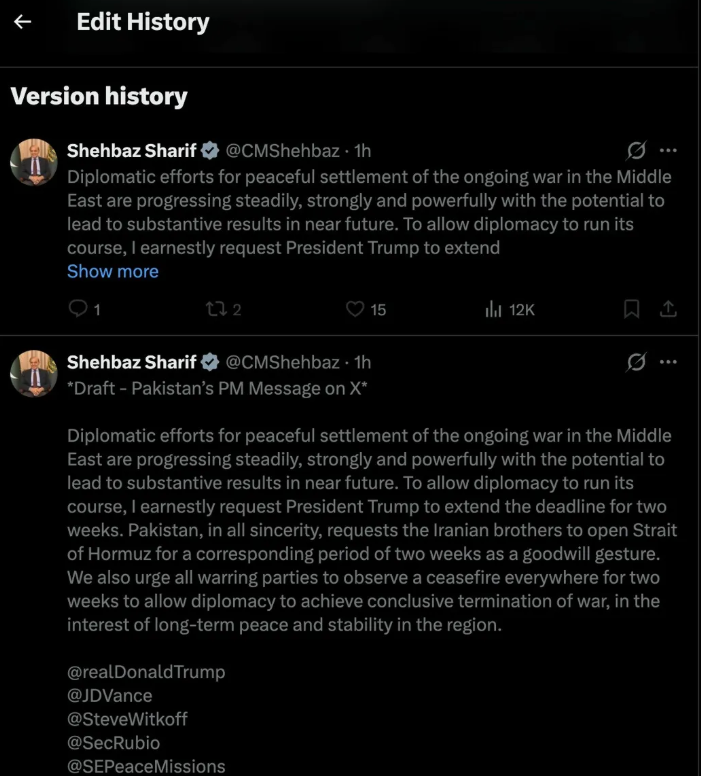
The phrase "Pakistan's PM" is the forensic tell. No Pakistani government official, no member of Sharif's staff, no diplomat in Islamabad's foreign service would refer to their own head of government as "Pakistan's PM" in an internal working document. That is the language of an external party writing instructions for someone else to perform. It is the label on a script. The White House — or Steve Witkoff's office, or the State Department's Pakistan desk — drafted "Pakistan's PM Message on X," transmitted it to Islamabad, and Sharif's office posted it verbatim, accidentally including the stage direction.
Then Trump posted on Truth Social: "Based on conversations with Prime Minister Shehbaz Sharif and Field Marshal Asim Munir, of Pakistan, and wherein they requested that I hold off the destructive force being sent tonight to Iran..." The "request" that Trump was "responding to" was a script his own team had written and handed to Islamabad to post.
The architecture of the self-directed ceasefire is now fully visible. Trump could not execute his power plant threat — MAGA was fracturing, Democrats were invoking the 25th Amendment, Gulf allies were privately warning that Iranian retaliation would turn Gulf cities dark, and oil was at $115. He could not simply withdraw his deadline without looking weak. So his team wrote a "request" for Pakistan's PM to make, packaged it as a diplomatic initiative, and Trump responded to his own prompt as a magnanimous concession to Pakistani mediation. Iran received face-saving language — "the general framework of Iran's 10-point proposal as a basis for negotiations" — and confirmed the ceasefire as a response to Pakistan's "brotherly request." Araghchi's statement was itself carefully framed as a concession to Pakistan, not to America.
Pakistan, for its role, receives historic diplomatic capital — the credit for ending (or pausing) a war that has reshaped global energy markets. Islamabad gets to host the April 10 talks. Asim Munir is named alongside a sitting PM in a US presidential ceasefire announcement — an elevation of Pakistan's Army Chief to co-equal diplomatic status with the civilian government, which is itself significant. Pakistan was the vehicle, not the driver. But the vehicle gets the photograph on the front page.
🇮🇳 How This Impacts India
This story is the most important one India's foreign policy establishment needs to internalize — not because of what happened in Pakistan, but because of what it reveals about how this ceasefire was manufactured and what that means for what comes next. The Islamabad talks on April 10 will be shaped by the same dynamics that produced the ceasefire: domestic political pressure on Trump, Iranian maximalism dressed as flexibility, and Pakistan as the venue for performances of agreements pre-negotiated elsewhere. India was not in the room where the script was written. India must be in the room where the final agreement is drafted. India has the diplomatic assets, the Iran relationships, the US credibility, and the regional stake to insist on a seat at the table — not as a spectator to Pakistani statesmanship, but as a co-architect of the post-war Gulf order. The Islamabad talks are in two days. India has 48 hours to decide whether to signal that it expects to be consulted, or to accept the role of an audience while Pakistan and the US negotiate a Hormuz regime that will govern India's energy imports for decades.
📎 References: Axios | Jerusalem Post | CNBC | NPR
Story #10: Iran's 10 Points vs. Trump's 15 Points — What the Islamabad Talks Must Resolve
The Full Picture
Trump has now publicly acknowledged Iran's 10-point counter-proposal as "a workable basis on which to negotiate." That phrase — previously unthinkable from an administration that called the same proposal "not good enough" hours earlier — is the diplomatic foundation on which the Islamabad talks will be built. What does the gap between the two frameworks look like?
Iran's 10 points: (1) Permanent security guarantee that Iran will not be attacked again; (2) Permanent end to the war, not a ceasefire; (3) End to Israeli strikes in Lebanon; (4) Lifting of all US sanctions on Iran; (5) End to all regional fighting against Iranian allies; (6) In return, Iran opens Hormuz; (7) Iran imposes a $2 million per ship transit fee; (8) Iran splits fees with Oman; (9) Iran provides rules for safe passage; (10) Iran uses fees for reconstruction instead of formal reparations. The US 15-point framework, as summarised by Steve Witkoff, included an immediate ceasefire, nuclear verification mechanisms, reopening of the Hormuz, with no toll regime, and no automatic sanctions relief.
The gaps that remain are structural and enormous: Iran demands a permanent end to the war and security guarantees — the US has offered only a 45-day ceasefire. Iran demands full sanctions lifting — the US has not agreed. Iran insists on institutionalizing Hormuz transit fees — the US framework said free passage. Iran wants Israeli strikes on Lebanon to stop — Netanyahu has explicitly warned Trump against any ceasefire that constrains Israel's Lebanon operations. Iran wants recognition of sovereignty over Hormuz — the US regards that as a violation of international law. What Iran has given, as a concession, is the fee-for-reconstruction framing of Point 10 — which converts the politically toxic word "reparations" into a commercially viable "infrastructure revenue stream." That reframing is the single biggest concession Iran made, and it is the one that gives the Islamabad talks the best chance of producing something durable.
The Islamabad talks will be led on the US side by Vice President JD Vance, who has been the principal architect of the back channel throughout. Iran's delegation has not been named. Pakistan will host. Egypt and Turkey, the other mediating parties, will likely have observer status.
🇮🇳 How This Impacts India
The $2 million per ship Hormuz transit fee — Point 7 of Iran's framework, which Trump has now acknowledged as a "workable basis" — is the number India must negotiate before Islamabad produces a final framework. At current Indian energy import volumes transiting Hormuz (approximately 3,000 vessel transits per year), a $2 million fee represents an additional $6 billion annually in energy import costs — equivalent to roughly 0.15% of India's GDP — added directly to the cost of energy that Indian industry and consumers pay. India's "friendly nation" status on the IRGC passage list suggests India may be in line for a preferential rate — but that preference is currently informal. India must formalize it, in writing, as part of any Hormuz governance framework that emerges from Islamabad. India also has a specific interest in Points 4 (sanctions lifting) and 10 (reconstruction fees): if US sanctions on Iran are partially lifted as part of a peace agreement, India's Chabahar operations — currently running under a conditional 19-day sanctions waiver — could be placed on a durable footing without requiring constant OFAC negotiation. And if Iran is using Hormuz fees for reconstruction, India's construction and infrastructure firms — some of the world's most competitive — should be positioning themselves for reconstruction contracts in a post-war Iran.
📎 References: New York Times | Axios | Washington Times | Xinhua
The Dispatch: Editor's Synthesis
Here is what April 7, 2026 will be remembered as: the day the world's most powerful man threatened to end a civilisation, and then announced a ceasefire, and the gap between those two events was 12 hours and a accidentally-uncovered stage direction that read "Draft — Pakistan's PM Message on X."
Strip away the rhetoric. Strip away the MAGA meltdown, the papal condemnation, the 25th Amendment demands, the oil spike to $150 on spot markets and the 6% crash on ceasefire news. Strip away the Jubail fires and the human chains around Iranian power plants. Strip away the China airspace mystery, the German deficit, and the Mullin airport gambit. What remains is a structural fact that now governs the next 14 days:
Iran did not open Hormuz unconditionally. It opened it "via coordination with Iran's Armed Forces." The IRGC toll booth is suspended, not abolished. The "friendly nation" passage list is dormant, not deleted.
The $2 million transit fee framework is acknowledged as "a workable basis" by the US President, which means it is alive in the negotiation, even if not yet agreed upon.
Every structural element of the post-war Hormuz order that Iran wanted to institutionalize is still in the room at Islamabad.
The American domestic political crisis — MAGA in revolt, Democrats demanding the 25th, Republican senators praying his threats are bluster, gas at $4.30 and headed higher — has been given a fortnight's reprieve.
What the world got: 14 days to negotiate the governance of 20% of global oil and gas supply, the architecture of US-Iran relations for the next decade, the post-war future of Lebanon, the status of every Iranian proxy force from Yemen to Iraq, and the question of whether Iran gets to keep the nuclear leverage it has been building since February 28.
For India, today produced three specific action items that cannot wait:
One: Jaishankar must call Araghchi before April 10 to formalize India's Hormuz passage rights in writing. Not as a favor. As a contractual entitlement of a "friendly nation" that has maintained an Iran relationship under maximum US pressure.
Two: India's negotiating team must transmit a formal position paper on the Chabahar sanctions waiver — which expires in 19 days, on April 26 — to OFAC and the State Department before the Islamabad talks begin. The 14-day ceasefire window is the best possible moment to convert a conditional waiver into a permanent carve-out.
Three: India must determine whether it sends an observer to the Islamabad talks — not as a supplicant asking for inclusion, but as a regional power asserting that the Gulf order being negotiated in those rooms will not be finalized without the input of the country that is the Gulf's largest energy customer and the Indo-Pacific's indispensable swing state.
The curtain was up. The intermission has begun. India has 48 hours before the next act starts in Islamabad — and the playwright, this time, should not be Washington.
Comments ()