
The Daily Geopolitics Brief # 5
Week 4 of the Iran War: nuclear sites struck, U.S. troops wounded in Saudi Arabia, oil at $99, NATO fractures, and the Strait of Hormuz hangs in the balance.
The Daily Dispatch
Iran Retaliates Against Saudi Airbase,
Wounding 10 U.S. Troops
Israel's military confirmed it had struck nuclear infrastructure it described as key to Iran's enrichment cycle. Iran's Atomic Energy Organization said neither facility was operational and there was no contamination risk — but Tehran's response was swift. Iranian FM Abbas Araghchi declared Iran would "exact a HEAVY price for Israeli crimes," and the IRGC warned workers at U.S.- and Israel-linked industrial sites across the Gulf to evacuate immediately.
The strike on Prince Sultan Air Base left at least two service members with serious shrapnel wounds and several refueling tankers damaged. Meanwhile, Iranian cluster munitions hit eleven sites across the Tel Aviv metropolitan area late Friday, killing a 52-year-old security guard. Israel's defense minister vowed attacks on Iran would "intensify and expand." As the war enters its second month, the total death toll across the region has surpassed 3,000, with over 1,900 killed in Iran and more than 1,100 in Lebanon.
Secretary of State Marco Rubio privately told G7 foreign ministers in France that the war against Iran will continue for another two to four weeks — the first time a senior U.S. official extended the timeline beyond the original four-to-six week estimate. Rubio publicly told reporters the U.S. was "on or ahead of schedule" and expected to conclude operations "in a matter of weeks, not months." He stressed the U.S. aims to destroy Iran's ability to manufacture missiles and drones, and called on G7 allies to help police the Strait of Hormuz after the conflict ends. G7 ministers issued a joint statement demanding an "immediate cessation of attacks against civilians" and the restoration of "safe, toll-free freedom of navigation" in the strait — but stopped short of committing resources to the military effort.
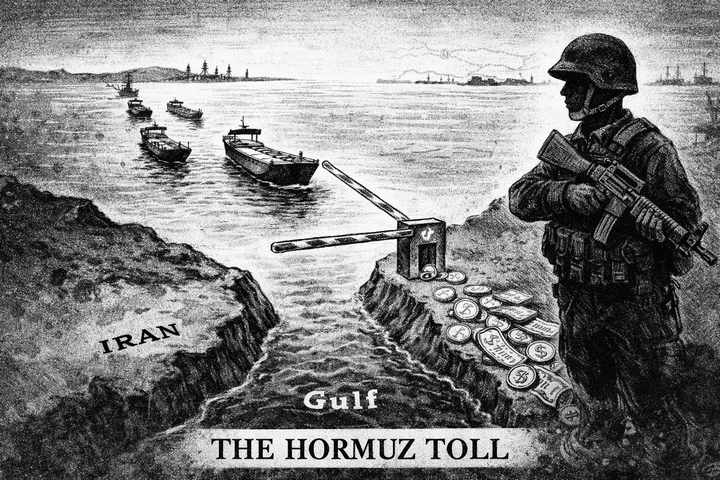
U.S. crude closed at its highest level since July 2022, up 5.46% to $99.64 per barrel, and international Brent gained 4.22% to settle at $112.57. The surge came after two Chinese COSCO vessels attempting to transit the Strait of Hormuz were turned back by Iran — the first major container-carrier attempt since the war began. Iranian state media reported parliament is pursuing legislation to formally codify fees for shipping through the strait. An estimated 17.8 million barrels per day of oil flow have been disrupted, with close to 500 million barrels of total liquids lost since the war started. The OECD raised its 2026 global inflation forecast to 4%, citing the Hormuz closure as the primary driver.
Speaking at the Future Investment Initiative forum in Miami Beach, President Trump said the United States does not "have to be there for NATO," citing European allies' refusal to provide material support to the U.S. in the Iran war. European leaders were not consulted before the February 28th strikes and many have publicly opposed the offensive campaign. Trump framed the comment as a direct rebuke: "We would have always been there for them, but now, based on their actions, I guess we don't have to be, do we?" The remarks once again raised questions about U.S. commitment to Article 5 — the mutual defense clause at the core of the alliance — and come as Washington has grown increasingly irritated with allies who support defensive operations but refuse to join offensive military action.
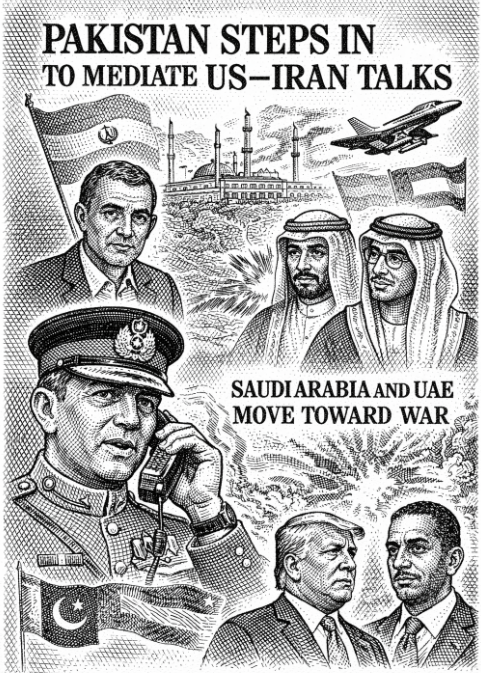
In a moment that garnered laughter at the Saudi-backed FII summit, Trump referred to the Strait of Hormuz as the "Strait of Trump," then feigned an apology before adding: "There's no accidents with me. Not too many." The quip carried real diplomatic weight — Trump has previously floated a proposal for joint control of the strait with Iran, and the New York Post reported Friday he is actively considering renaming it or designating it the "Strait of America." Iran's blockade has reduced traffic through the waterway by 90%, and Trump has given Tehran until April 6 to reopen it or face strikes on its power plants — a deadline he extended by 10 days from a previous ultimatum, citing ongoing talks that Tehran publicly denies constitute negotiations.
Kremlin spokesman Dmitry Peskov warned that strikes on nuclear facilities were "potentially extremely dangerous" and "fraught with possibly irreparable consequences," saying Russia had "conveyed relevant signals" to Washington. Russia previously condemned the bombing of nuclear installations under IAEA safeguards as "unacceptable" and warned the attacks risked a "humanitarian, economic and possibly radiological catastrophe." Moscow has been largely powerless to assist its Iranian partner militarily, constrained by its war in Ukraine and a cautious balancing act with Gulf Arab states. A Washington Post investigation earlier this month revealed Russia has been providing Iran with targeting intelligence on U.S. warships and aircraft — a charge Moscow has not confirmed.
The Iranian-linked hacking group Handala published hundreds of emails, personal photographs, and documents allegedly stolen from FBI Director Kash Patel's personal Gmail account — calling it retaliation for the FBI's seizure of Handala's domains the previous week. The FBI confirmed the breach, calling the information "historical in nature" and involving "no government information," while offering a $10 million reward for leads on Handala operatives. Cybersecurity researchers noted Iran likely held the files — dating primarily from 2011–2022 — in reserve for strategic deployment. Handala had previously claimed credit for a destructive attack against U.S. medical device giant Stryker in retaliation for a U.S.-Israeli strike on an Iranian elementary school that killed more than 170 children.
While energy markets dominate headlines, the Strait of Hormuz blockade is quietly devastating global agriculture. The strait carries nearly a third of the world's fertilizer trade, and prolonged disruption threatens planting cycles and food prices worldwide. Iran agreed Friday to allow humanitarian and agricultural shipments through — a concession to U.N. Secretary-General Guterres' newly formed task force — but the arrangement's durability is uncertain. Iran's parliament is simultaneously drafting legislation to formalize fees for all commercial shipping. The OECD warned Thursday that halted fertilizer shipments and spiking energy prices risk compounding global food insecurity, particularly across South and Southeast Asia where dependence on Persian Gulf-sourced inputs is highest.
Elon Musk participated in a 40-minute phone call Tuesday between President Trump and Indian Prime Minister Narendra Modi focused on the Iran war and the Strait of Hormuz crisis, the New York Times reported Friday, citing two U.S. officials. The White House and Musk offered no explanation for his presence — an unprecedented role for a private citizen in head-of-state diplomacy during an active conflict. Modi publicly framed the call as focused on de-escalation, saying India supports "open, secure and accessible" passage through the strait. Analysts noted Musk's business interests intersect directly with the crisis: Middle Eastern sovereign wealth funds are invested in his companies, SpaceX is weighing an IPO sensitive to global market stability, and he has long sought commercial expansion in India.
Speaking at a Saudi sovereign wealth fund event in Miami, Trump revived his push for Israeli–Saudi normalization, declaring "it's now time" following military gains against Iran. "We've now taken them out, and they are out bigly. We got to get into the Abraham Accords," he said. The remarks came as Trump also extended by 10 days his deadline for Iran to reopen the Strait of Hormuz, citing diplomatic progress. Significant obstacles remain: Saudi Arabia insists on a credible path to Palestinian statehood before normalization, and the status of the occupied West Bank — where settler violence has escalated dramatically — remains deeply contentious. Secretary Rubio said the U.S. is "concerned" about West Bank settler violence but suggested Israel would take action.
"We are on or ahead of schedule in that operation, and expect to conclude it at the appropriate time here — a matter of weeks, not months."
"Iran will exact HEAVY price for Israeli crimes. Israel has hit civilian nuclear sites, steel factories, and a power plant. The equation will no longer be 'an eye for an eye.'"
"Ensuring that the Strait of Hormuz remains open, secure and accessible is essential for the whole world. India supports de-escalation and restoration of peace at the earliest."
"Strikes on nuclear facilities are potentially extremely dangerous and fraught with possibly irreparable consequences. Russia has conveyed relevant signals to the United States."
"They want to make it permanent. That's unacceptable. The whole world should be outraged. There is no provision in international law to set up a toll booth and shake down shipping."
"We would have always been there for them. But now, based on their actions, I guess we don't have to be, do we? They weren't there for us."
Comments ()