The Valley of Three Peaks
In a vast valley where trade winds carried caravans and whispers across continents, three great peaks watched one another from afar.
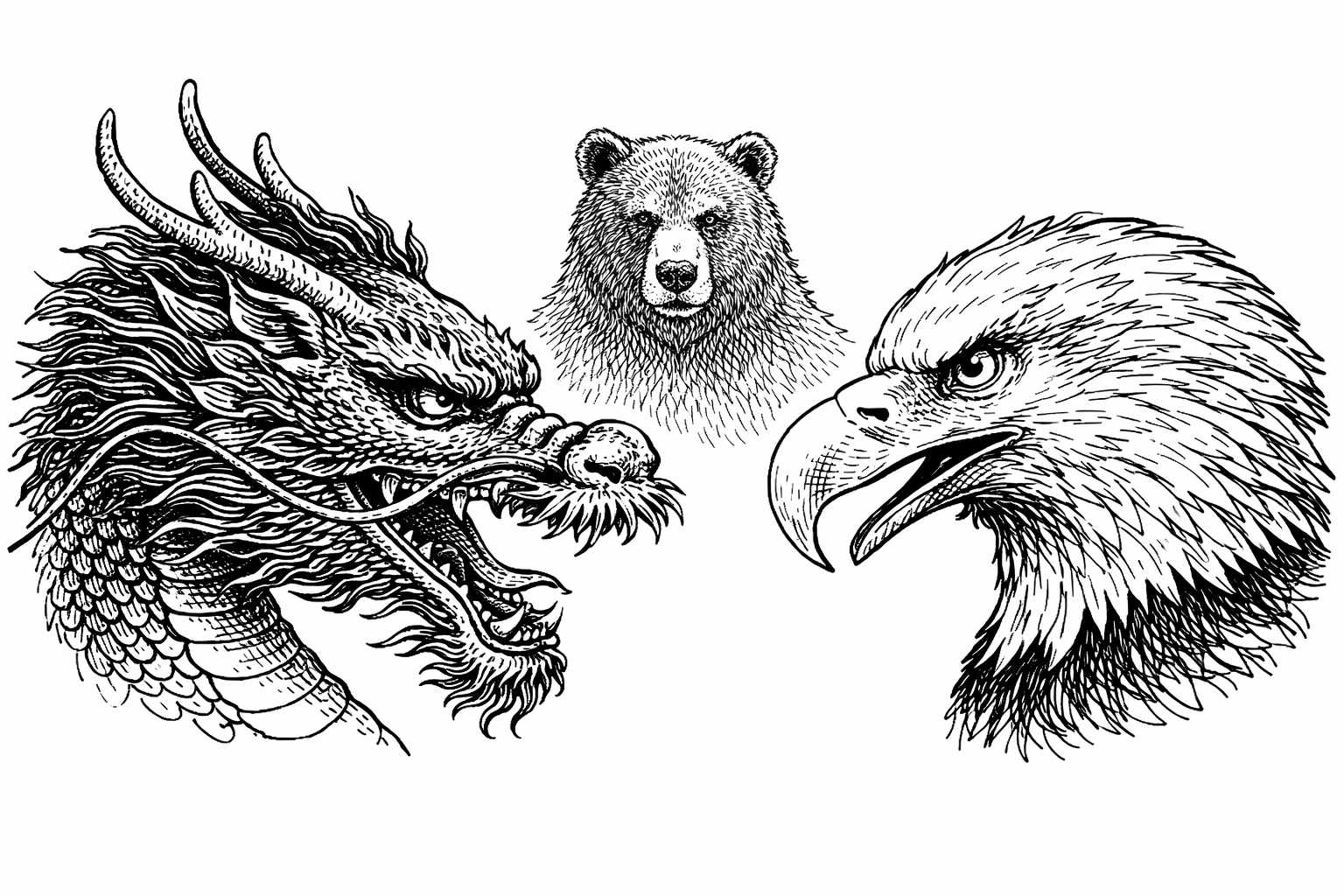
The first was Eagle Peak. Its slopes were alive with merchants, scholars, and inventors. Rivers of trade flowed down its valleys, and ships from distant lands gathered at its ports. For many years Eagle Peak stood taller than the others, confident in its strength and admired for the prosperity around it.
To the east stood Dragon Peak. For a long time, it had been wrapped in mist. Travelers spoke of ancient civilizations that once flourished there, but in recent centuries, its villages had struggled through turmoil and hardship. Dragon Peak was quiet, but beneath its clouds lay vast plains and countless people waiting for renewal.
To the north rose Bear Peak. Broad and imposing, it had long cast a shadow across the valley. Its winds were cold and powerful, and for generations, many believed Bear Peak would one day dominate the entire landscape.
For years Eagle Peak and Bear Peak watched each other warily across the valley. Their winds clashed, their storms collided, and each tried to prevent the other from expanding its reach.
Dragon Peak observed silently.
The Opening
One day, Eagle Peak noticed that Dragon Peak and Bear Peak had begun to quarrel.
The ground between them trembled with arguments over doctrine and direction. Their storms no longer moved together.
Eagle Peak saw an opportunity.
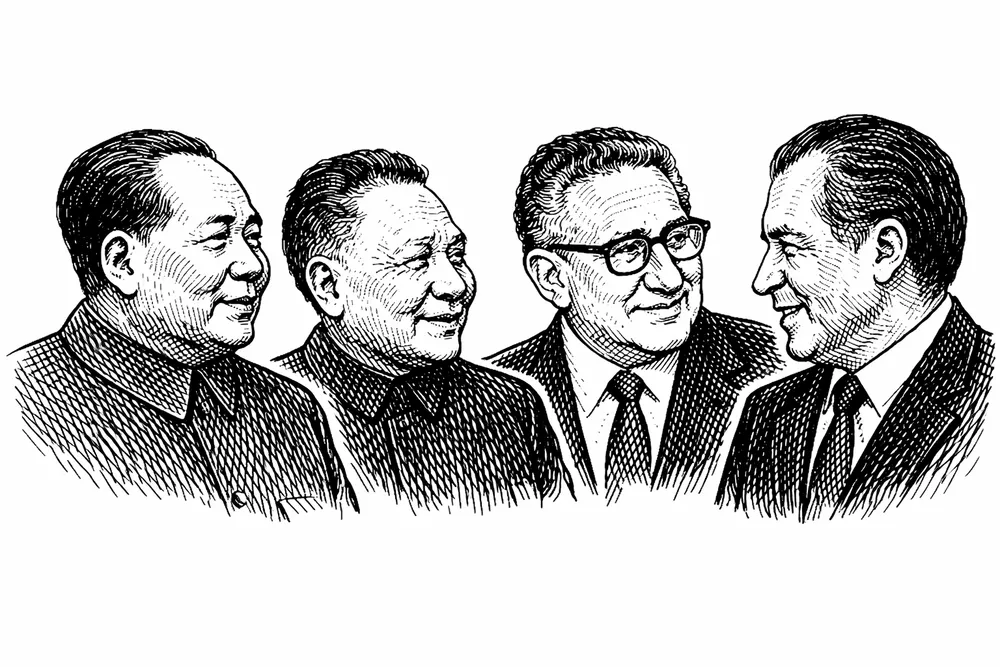
So it sent a careful traveler across the narrow mountain paths to Dragon Peak. The traveler spoke not of friendship but of balance.
“The northern winds grow too strong,” he said. “Perhaps we should speak.”
Dragon Peak listened quietly. After a long silence it replied:
“The wind from the north troubles us as well.”
A narrow path opened between the two peaks.
Caravans soon began to move through the valley.
The Years of Learning
At first, the exchange was small.
Merchants from Eagle Peak brought tools, machines, and knowledge. In return, Dragon Peak offered labor, patience, and discipline.
Factories began to appear in Dragon’s valleys.
Roads connected its villages.
Ships began leaving its ports carrying goods to every corner of the world.
The markets of Eagle Peak were filled with objects made on Dragon Peak—clothing, tools, electronics, toys.
Eagle Peak believed the exchange would transform Dragon Peak.
“If Dragon grows prosperous,” it thought, “it will become more like us.”
Dragon Peak thought differently.
“If we learn from Eagle,” it said quietly to itself, “we will grow strong.”
Meanwhile, Bear Peak weakened. A great fracture appeared across its slopes, and many of its surrounding ridges broke away.
For a time, Eagle Peak stood alone as the tallest peak in the valley.
The Quiet Rise
But Dragon Peak continued to change.
Year after year its cities expanded. Its workshops multiplied. Its engineers mastered new crafts.
Its merchants grew confident.
Soon travelers noticed something remarkable.
The goods flowing from Dragon Peak began shaping the entire valley. Supply routes converged there. Ports grew larger. Industrial towns emerged like forests after rain.
Eagle Peak began to notice the change.
“What was once quiet has become powerful,” it said.
Dragon Peak answered calmly:
“We simply walked the road that was opened.”
The Bear Returns
Far to the north, Bear Peak slowly gathered strength again.
Though no longer as dominant as before, it remained formidable. Its forests still held vast resources, and its winds still carried great force.
Bear Peak began speaking with Dragon Peak more frequently.
They shared concerns about the valley’s balance.
They also understood that Eagle Peak still commanded immense influence.
Their conversations were careful but steady.
The Valley Divides
As years passed, the caravans flowing through the valley began to shift.
Eagle Peak started guarding certain paths—especially those carrying the most advanced tools and machines.
Dragon Peak responded by building new workshops and inventing its own technologies.
Gradually, two different networks of trade emerged.
One centered around Eagle Peak.
The other around Dragon Peak.
Smaller hills and distant lands found themselves choosing which paths to follow.
At times Bear Peak stirred the winds in distant plains, drawing Eagle Peak’s attention away from Dragon Peak’s eastern waters.
The balance of the valley became more complex.
The Monk on the Hill
High above the valley lived an old monk who watched the three peaks for many years.
One evening a young traveler climbed the hill and asked:
“Master, which peak will dominate the valley?”
The monk poured tea and gazed at the distant mountains.
Then he said quietly:
“Long ago Eagle Peak opened the path to Dragon Peak to balance Bear Peak.”
“Dragon Peak walked that path patiently and learned the ways of the valley.”
“Bear Peak, though wounded, never vanished.”
The traveler asked again:
“So who will prevail?”
The monk smiled.
“In a valley of great peaks, victory rarely belongs to one alone.”
“More often, the mountains move slowly until a new balance emerges.”
He pointed toward the horizon where Eagle, Dragon, and Bear stood beneath the evening sky.
“The valley is still shifting,” he said.
“And the story is not yet finished.”
World Today: An Echo from the Past
The wars unfolding around us today carry a strange echo from history.
In Ukraine, the West has poured enormous financial, military, and intelligence resources into a prolonged confrontation with Russia. In the Middle East, the crisis involving Iran has exposed the limits of military deterrence in an era where missiles, drones, and proxy warfare blur the line between conventional and asymmetric conflict.
In both theaters, a common theme is emerging: the global order built after the Cold War is under stress.
But beneath these crises lies a deeper, older question. One that stretches back more than half a century.
How did we get here?