
The Second Lady and the Last Lesson: How Faith Became America’s Last Weapon
In an age where faith has turned into a weapon and pluralism into threat, the story of JD and Usha Vance reveals America’s deeper crisis—a nation trapped between belief and power, preaching tolerance yet fearing the mirror of its own contradictions.

The Dust and the mirror
A young monk once went to his master, trembling with pride and fear.
“Master,” he said, “I have polished my bowl until it shines. I have memorized every sutra. I have even convinced my wife to sit beside me while I chant. I wish to be known as a true follower of the Way.”
The master looked at him gently. “You wish to be known?”
“Yes,” said the monk. “The others are watching. I must prove my devotion.”
The master handed him a mirror covered in dust. “Then first, clean this.”
The monk blew hard, wiped harder, and kept wiping. The more he wiped, the more dust rose into the air. Soon the mirror cracked from the pressure of his hand.
“Master!” he cried. “It broke!”
The old man nodded. “You were never cleaning the mirror,” he said. “You were trying to erase the dust by force, and in doing so, you destroyed the reflection.”
The monk lowered his eyes. “But what of my devotion? My effort?”
“Effort without humility is violence,” said the master. “When you try to make others reflect your truth, you break their surface and lose your own. The bowl you polish to impress others will never hold water. The mirror you shatter to cleanse will never show your face.”
In the great monasteries of nations, many monks sit with broken mirrors. Some hold crosses, some hold flags, some hold ideologies—but all insist that only their reflection is true. They polish furiously while the temple burns around them, never realizing that the dust they fight is of their own making.
Those who seek to save others before saving their own mind will always mistake control for purity. The wise do not polish the mirror—they open the window.
And when the wind comes, the dust leaves quietly.
SUPPORT DRISHTIKONE
In an increasingly complex and shifting world, thoughtful analysis is rare and essential. At Drishtikone, we dedicate hundreds of dollars and hours each month to producing deep, independent insights on geopolitics, culture, and global trends. Our work is rigorous, fearless, and free from advertising and external influence, sustained solely by the support of readers like you. For over two decades, Drishtikone has remained a one-person labor of commitment: no staff, no corporate funding — just a deep belief in the importance of perspective, truth, and analysis. If our work helps you better understand the forces shaping our world, we invite you to support it with your contribution by subscribing to the paid version or a one-time gift. Your support directly fuels independent thinking. To contribute, choose the USD equivalent amount you are comfortable with in your own currency. You can head to the Contribute page and use Stripe or PayPal to make a contribution.
Throwing the Second lady under the bus publicly
In his latest remarks, J.D. Vance openly expressed disappointment that his wife, Usha, is not a Christian, adding, “Do I hope eventually that she is somehow moved in by church? Yeah, I honestly, I do wish that because I believe in the Christian gospel—I hope eventually my wife comes to see it the same way.”
On the surface, this might sound like an innocuous expression of faith. But beneath it lies a revealing and troubling shift—from personal belief to performative piety. This is not a husband sharing private hopes; it is a politician signaling to a base increasingly defined by white-Christian ethnonationalism that he stands with them, even if it means publicly othering his own wife.
Jennifer Welch says it correctly that if JD Vance does not care about his own wife or his mixed-race kids, would be give a "crap about you"?
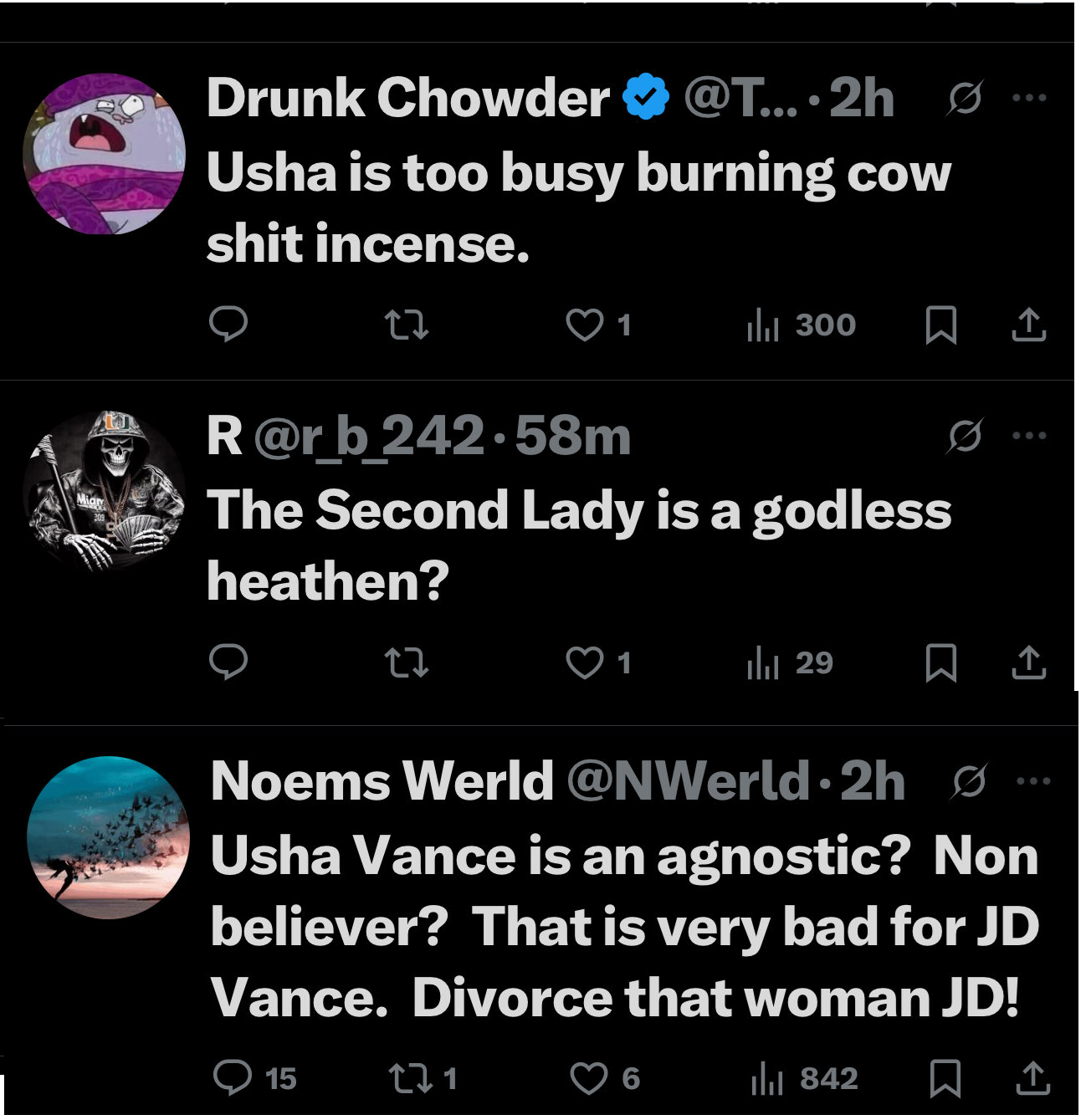
Usha Vance, an accomplished Yale-educated lawyer and Indian-American woman, once symbolized the bridge between Vance’s Appalachian upbringing and the cosmopolitan elite he once admired. Her intellect and stability helped shape the very man who now courts a movement that mocks her faith, race, and very identity. The same MAGA ecosystem that calls her “a heathen” or “cow-shit incense burner” has forced Vance into a moral corner—compelled to prove his loyalty not through leadership, but through a ritual of disavowal.
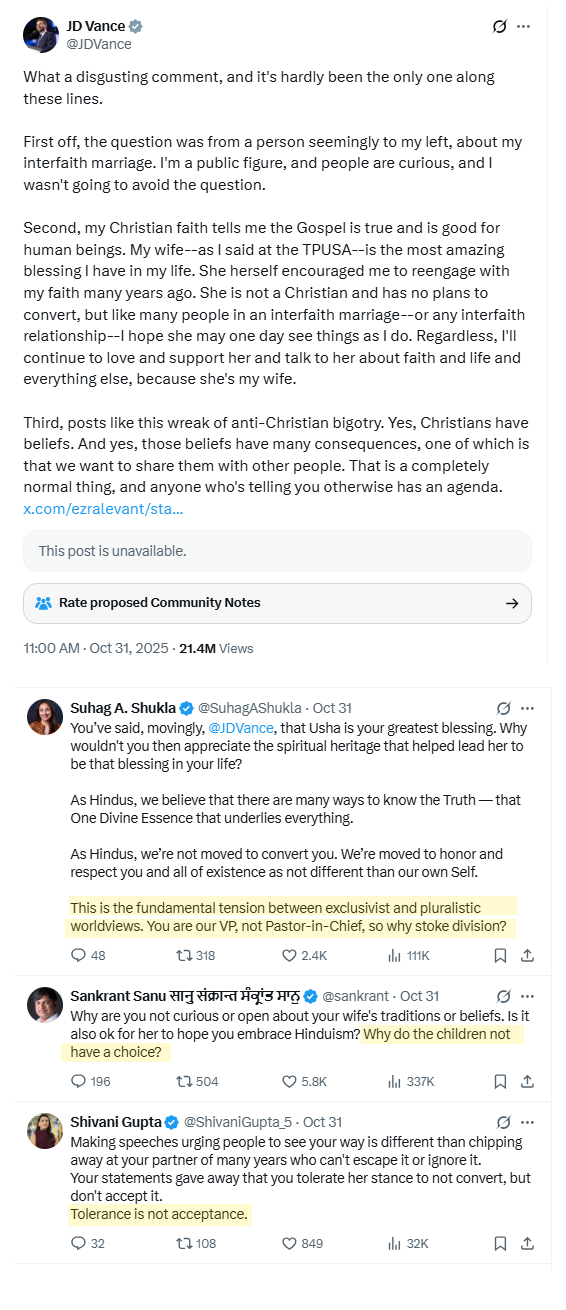
JD Vance’s public comments about his wife’s faith—his stated “hope that she may one day come to see things as I do”—may seem personal, but they reveal a deeply theological and political stance. The exchange captured in these posts shows how a private belief, when voiced by a Vice President, exposes the friction between America’s growing religious pluralism and the exclusivist tendencies of its political class.
The responses from Hindu leaders and thinkers like Suhag Shukla, Sankrant Sanu, and an Indian journalist, Shivani Gupta raise profound questions that go well beyond interfaith marriage. They highlight the tension between exclusivist and pluralist worldviews—between a religion that claims salvation through a single path and a civilization that sees truth reflected through infinite forms. Shukla’s question—“You are our VP, not Pastor-in-Chief, so why stoke division?”—cuts to the heart of the matter. In a secular republic, personal faith should inspire moral clarity, not theological hierarchy.
Sankrant Sanu’s question—“Is it also OK for her to hope you embrace Hinduism? Why do the children not have a choice?”—is not rhetorical; it underscores how religious exclusivity erodes mutual respect within families. Shivani Gupta adds the sharpest critique: “Tolerance is not acceptance.” To merely “tolerate” a spouse’s beliefs while hoping for her eventual conversion is not love—it’s conditional superiority disguised as affection.
The Hindu American Foundation’s response takes this further, asking Vance to reciprocate his wife’s openness: if she encouraged him toward his faith, why not engage with hers? They point out that Hinduism neither seeks conversion nor monopolizes salvation; it recognizes many ways of realizing the Divine. Their letter reminds him that proselytization—often under the banner of Christian love—has historically demeaned and coerced Hindus, and that his words risk echoing that colonial arrogance.
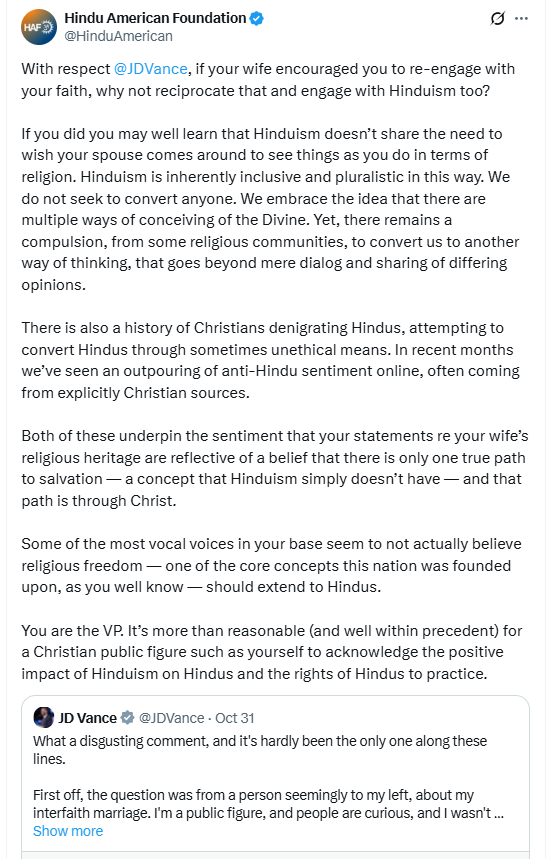
What makes this episode significant is not theological debate but the public office Vance holds. His language reflects a broader political culture that normalizes one-way respect: minorities must honor Christian identity, but Christians need not reciprocate. The Hindu voices here remind America that pluralism is not relativism — it’s the foundation of democracy itself.
In truth, these exchanges reveal the limits of both America’s liberalism and its conservatism. One side claims inclusivity yet patronizes faiths it doesn’t understand; the other preaches faith but weaponizes it for exclusion. The Hindu response offers a civilizational corrective.
One that says, in essence: belief need not be a battle, and difference need not demand conversion.
Remember, that is not just Hindu wisdom. It is the pluralist ideal that America was supposed to stand for but in reality hasn't.
The Fake Saviors on the Left
The tragedy of Usha Vance’s public treatment is that it exposes not just the prejudice of the far right—but also the condescension of the liberal left.
Paternalism much?
It’s the same rhetoric (softened by liberal language) that infantilizes rather than understands.
Psaki’s remark, like the MAGA abuse calling Usha a “heathen” or “cow-worshipper,” stems from a shared ignorance: the refusal to engage Hindu identity as anything other than an exotic or oppressive construct.
Both sides, in their own way, dehumanize Indians and Hindus. The Right demands assimilation into a narrow white-Christian mold, while the Left insists on defining them through victimhood and “caste guilt.” In neither narrative is there room for self-determined Hindu identity or Indian intellectual agency.
Usha Vance, as a public figure, sits precisely at this fault line.
Irony of JD Vance: Who assimilated whom?
The irony of J.D. Vance’s new message couldn’t be starker. In Hillbilly Elegy, he confessed that he was the one who struggled to assimilate — a self-proclaimed hillbilly lost in the polished corridors of Yale and Washington. He wrote openly about feeling out of place, about not knowing the rules of elite America until Usha, his classmate and later wife, helped him find his footing. She “civilized” him, as he put it, guiding him through a world that had long excluded people like him.
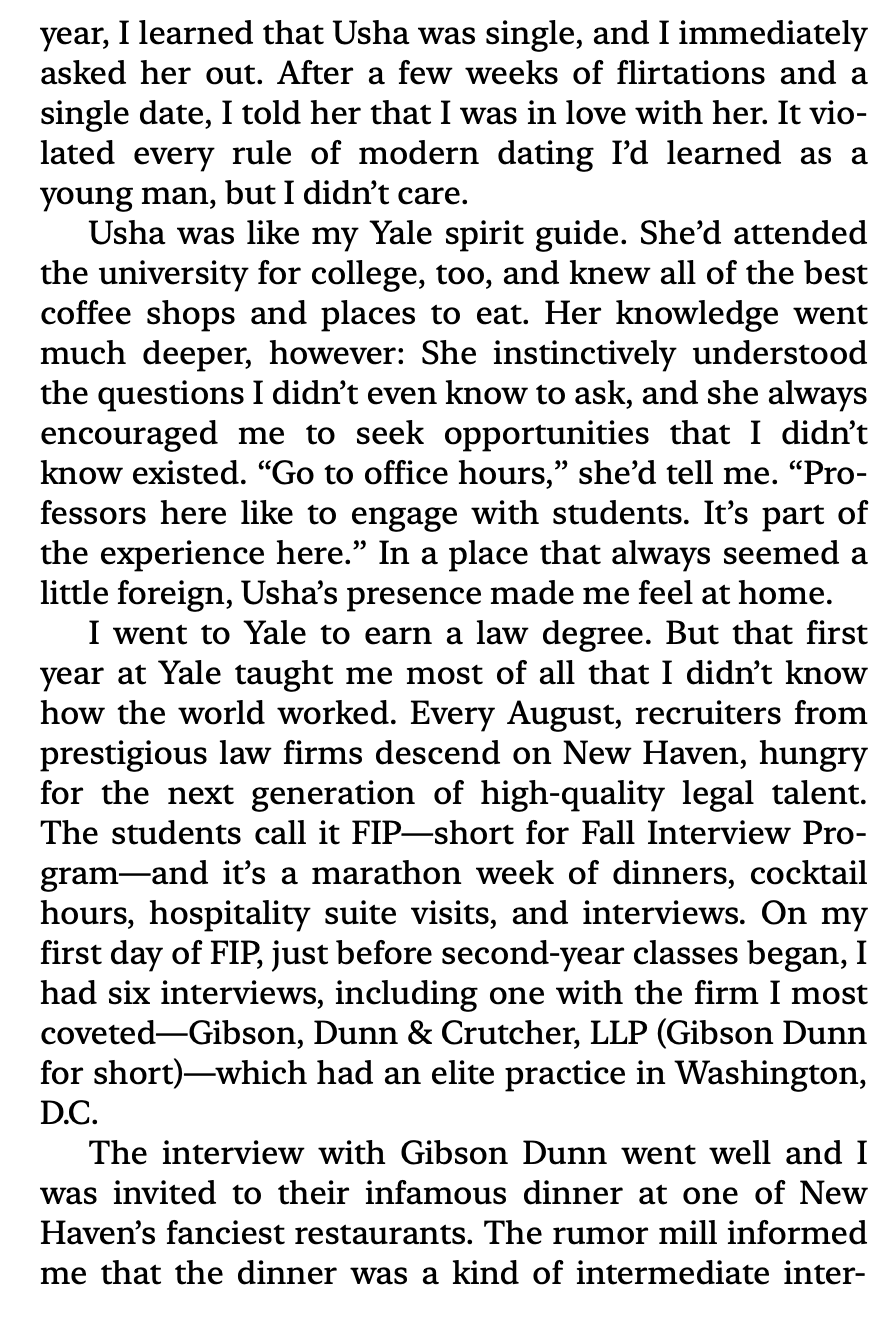
And yet today, that same man lectures others about assimilation — especially immigrants, including Indians like Usha. He has turned his personal story of being welcomed and transformed into a narrative that casts outsiders as threats. It wasn’t the Indians who failed to assimilate into America. It was J.D. Vance who couldn’t assimilate into America until one of them showed him how.
The ‘Servant Class’ Fallacy and Historical Amnesia
Look at the irony, that today, that same man calls immigrants like Usha’s family a “foreign servant class.” The man who once needed a bridge across America’s class divide now derides the very people who build bridges across civilizations. The hypocrisy is staggering.
Vance’s comments that America doesn’t need a “foreign servant class” to achieve greatness betray both ignorance and historical amnesia. The U.S. space program, which he cited as proof of homegrown genius, was literally built on the expertise of German scientists imported under Operation Paperclip — many of them accused Nazi collaborators.
Operation Paperclip: Vance's "German Scientists" were Nazis Criminals!
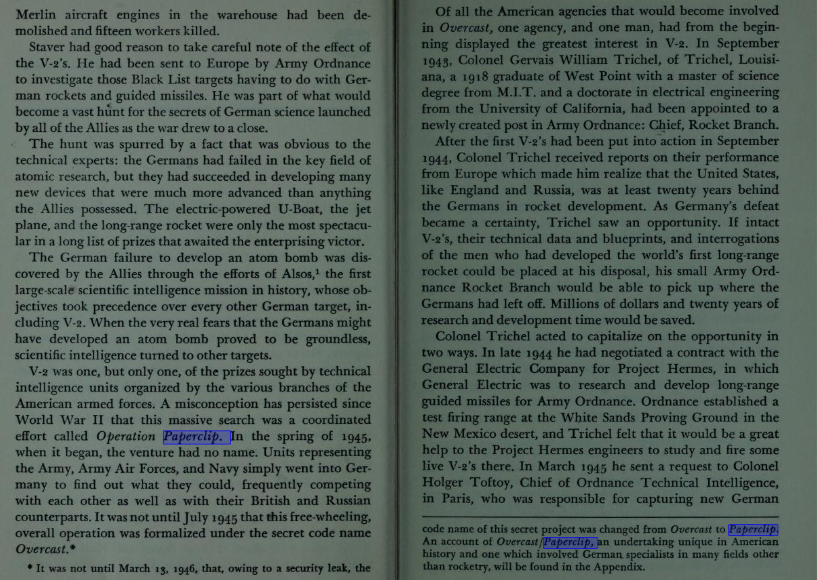
This extract below captures the origins of Operation Paperclip, the secret U.S. initiative launched in 1945 to recruit German scientists in the chaotic aftermath of World War II.
As the war ended, Allied intelligence units raced through occupied Germany, hunting for rocket engineers, chemists, and physicists who had powered Hitler’s war machine.
The V-2 rocket, jet propulsion, and other advanced technologies had demonstrated the terrifying ingenuity of Nazi science — and Washington feared that if America didn’t capture those minds, the Soviets would.
What began as a loose, competitive scramble among U.S. military branches soon formalized into a coordinated program under the code name Overcast, later renamed Operation Paperclip. The operation’s primary goal was to transfer German expertise — particularly in rocketry and weapons — to American soil. Engineers like Wernher von Braun, who had built the V-2 rockets used to bomb London, would later lead NASA’s Saturn V program and the Apollo moon landing.
The CIA’s internal review of Jacobsen’s work, published in Studies in Intelligence (Vol. 58, No. 3, 2014), provides a rare window into the uneasy partnership that followed. It details how figures like Wernher von Braun and Kurt Blome were brought into U.S. programs despite documented involvement in Nazi weapons research and human experimentation. It also traces the birth of post-war institutions—the CIA’s Office of Scientific Intelligence, Operation Bluebird, and ultimately MK-ULTRA—that extended Paperclip’s logic into psychological and biological experimentation on humans.
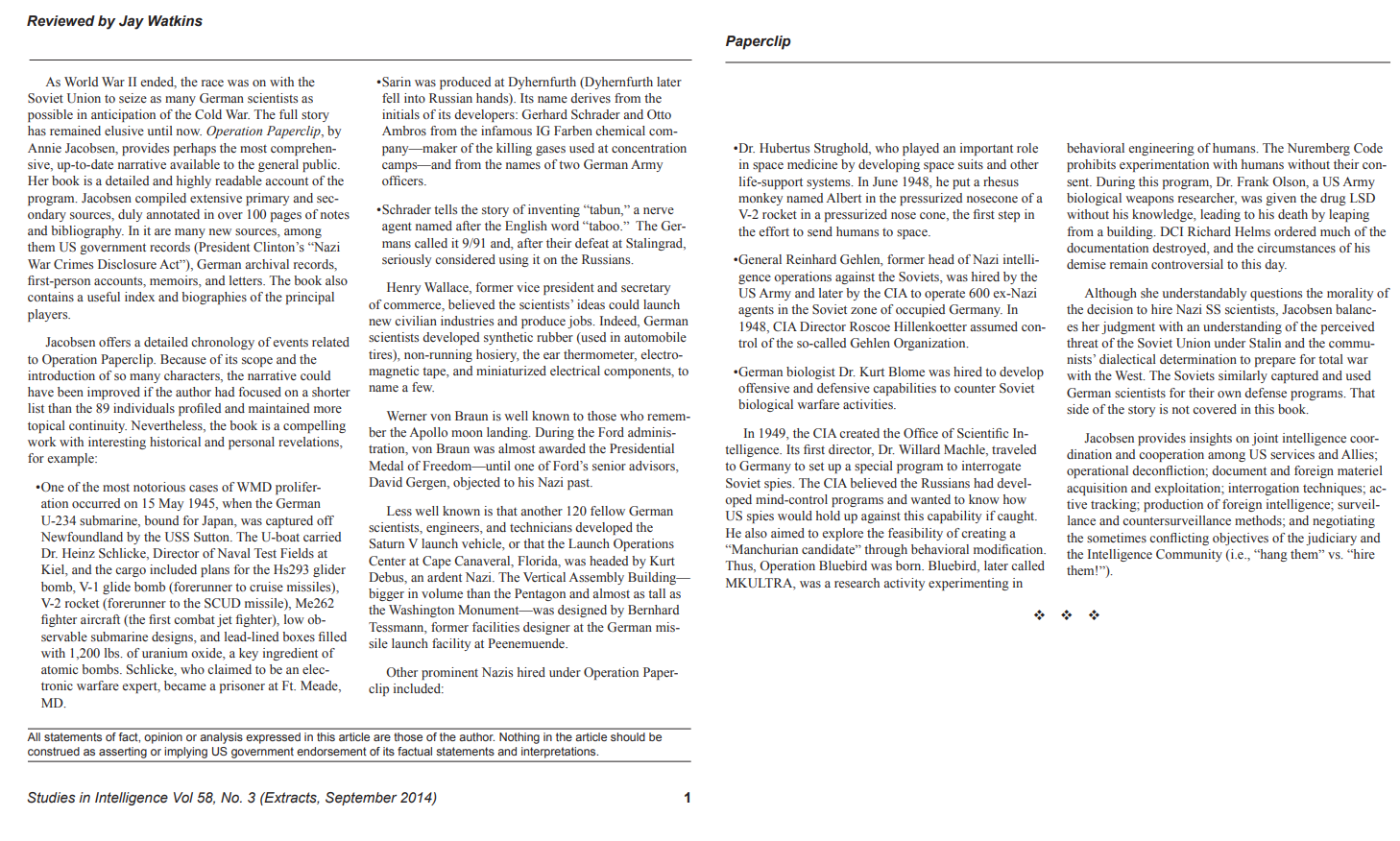
While Jacobsen questions the ethics of recruiting Nazi scientists, the CIA reviewer contextualizes it as a desperate act under Cold War pressure, reflecting the West’s fear of Soviet technological dominance. Together, these extracts expose the moral paradox at the heart of America’s ascent: a nation that defeated fascism, yet quietly absorbed its scientists—and, at times, its methods—in pursuit of power.
The story of Operation Paperclip stands as one of history’s most morally ambiguous bargains: the United States, in its quest for Cold War dominance, willingly absorbed Nazi scientists—some complicit in human experimentation and genocide—into its national fabric. Wernher von Braun, the architect of Hitler’s V-2 rockets that slaughtered civilians in London, was not only forgiven but celebrated as the father of NASA’s Apollo program. Dr. Kurt Blome, who oversaw Nazi biological weapons research, was hired to advise U.S. programs on chemical warfare. Men who had served tyranny were hailed as patriots once they served American power.
The Contrast and Political Expediency
Contrast this with the quiet, unacknowledged contribution of Indian scientists, engineers, and technologists who came to the United States not under secret amnesty but through the open pursuit of knowledge. From NASA to Bell Labs, from Intel’s laboratories to Silicon Valley’s founding garages, Indian minds have propelled America’s modern innovation. They came not as opportunists but as idealists—graduates of IITs, AIIMS, and ISRO, drawn by the universality of science and the promise of meritocracy. Their work built the code, systems, and research that underpin the very technological civilization America prides itself on.
Yet today, political figures like J.D. Vance disparage this community as a “foreign servant class,” reducing the very intellects that sustain American industry to caricatures of economic dependency. It is a grotesque inversion of truth: the same nation that pardoned Nazi war scientists now mocks Indian engineers and researchers who contributed freely, peacefully, and brilliantly.
When von Braun was brought to America, he was offered a lab, citizenship, and applause. When Indian scientists arrive, they are offered suspicion, slurs, and lectures on assimilation. The irony is unmistakable: those who once welcomed war criminals in the name of progress now deride moral, law-abiding immigrants in the name of nationalism.
Vance’s rhetoric exposes the deep rot within the MAGA ethos—a worldview where whiteness absolves atrocity and brown excellence provokes resentment. It is not about protecting America’s greatness; it is about controlling who gets to define it. The men of Paperclip brought their talents with blood on their hands. The Indian scientists brought theirs with nothing but brilliance and discipline—and are still treated as outsiders.
The contrast is America’s mirror: the moral courage of the immigrant scientist against the moral cowardice of those who glorify the architects of destruction.
America’s technological ascendance has always relied on foreign intellect — from Indian and Chinese engineers at NASA and Silicon Valley to European physicists during the Cold War.
To dismiss immigrant scientists as a “servant class” while invoking a myth of native self-sufficiency is not patriotism — it’s political opportunism dressed up as nationalism.
And the hate predicated on race is becoming widespread.
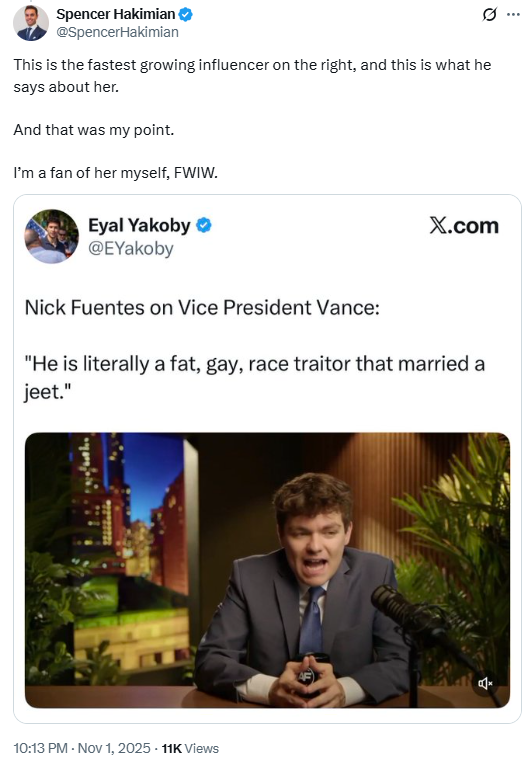
Spencer Hakimian, an influencer and Founder of Tolou Capital Management, shared this view that went viral.
This is JD Vance’s biggest political problem in 2028.
— Spencer Hakimian (@SpencerHakimian) October 30, 2025
How on earth is he going to get the MAGA base to accept her? pic.twitter.com/UNyz86JQoP
But more importantly, it spawned a lot of hate against Usha in its comments. X is full of it and this is what Spencer shared as well.
This are some of the comments that are raging across the social media by MAGA.
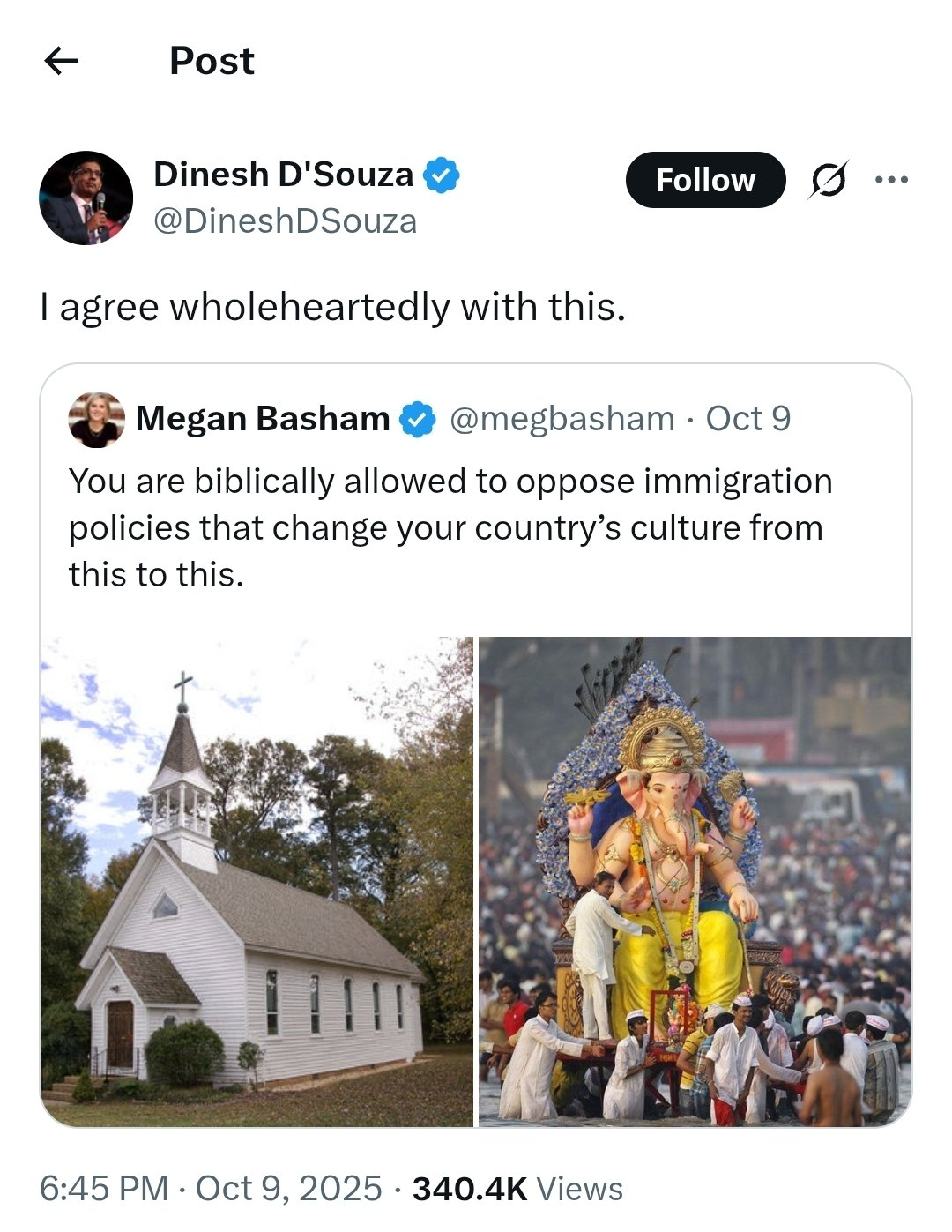
Even Dinesh D’Souza, one of the Right’s most strident voices, has now faced the same backlash.
In public debates and writings, D'Souza has invoked reductive tropes about Hinduism to underscore its supposed inferiority to monotheistic faiths. For instance, during a 2011 debate on religion's value, he described Hinduism as a system where "suffering is not such a big problem" because it's tied to reincarnation and karma, dismissing it as philosophically inadequate compared to Christianity's focus on earthly justice.
He has often stereotyped Hindus as "cow worshippers" in casual commentary, a jab echoed in recent backlash where users resurfaced clips of him saying things like "Hinduism is about worshipping cows" to mock the faith's reverence for sacred animals.
D'Souza uses such simplifications to signal alignment with MAGA's Christian nationalist base, which often views non-Abrahamic religions skeptically. In a 2008 speech at Grace Cathedral, he fulminated against the caste system as a "Hindu evil," claiming it justified missionary efforts.
D'Souza opposes Hindu festivals like Diwali in U.S. schools, prioritizing Christian traditions amid his anti-multiculturalism stance.
Despite this, far-right racists reject him as "not American," highlighting the irony of his pandering. Indian-Americans decry it as betraying Hindus for MAGA favor, though D'Souza cites his Christian roots, which are from Goa and have historical origins in Portuguese inquisitions of the local Hindus.
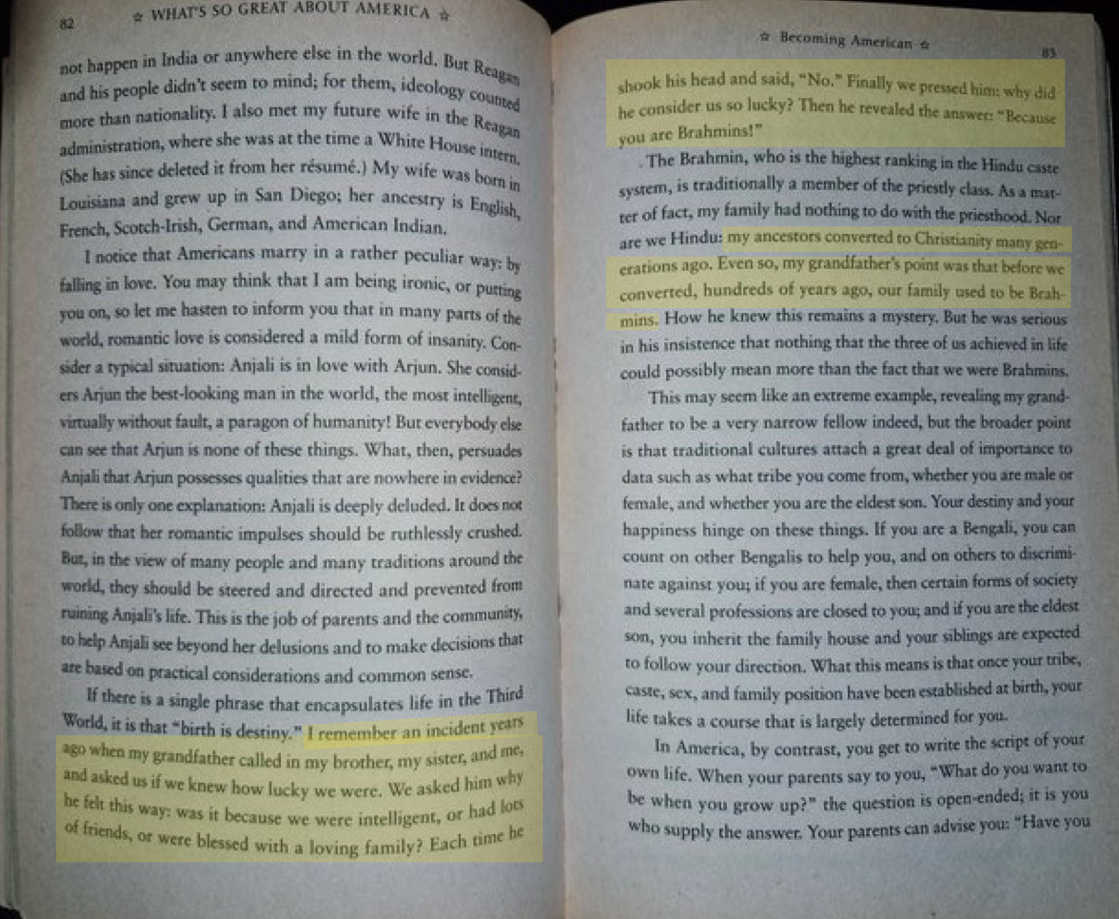
His post on X shows him shocked at the “vile degradation” of MAGA rhetoric — yet this is the very cultural soil he helped till.
Once the far right legitimized the politics of grievance and racial hierarchy, it was only a matter of time before the mob turned inward — questioning the loyalty, faith, and even humanity of those it had once courted.
Dinesh D'Souza became the instant "victim" of the group he had represented and fought on behalf of against the Hindus - vilifying them in the bigoted and hate filled manner that he did.
He may have found Jesus, but he could change his skin.
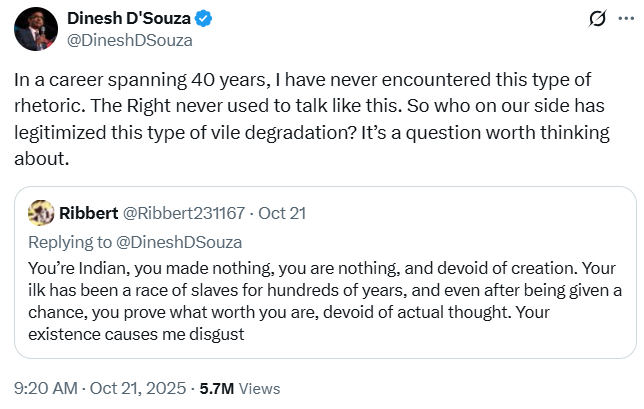
The attacks on Usha Vance — calling her a “godless heathen” and “cow-shit incense burner” — and on JD Vance himself as a “race traitor that married a jeet” — mark the moral collapse of a movement that now devours its own.
JD Vance’s public wish for his wife to “find Christ” feels less like a spiritual hope than a political survival tactic. Facing a movement that rejects interracial and inter-faith unions, he appears to be offering Usha’s potential conversion as a peace token to the MAGA mob.
But conversion will not erase skin color, ancestry, or the anxieties of a white-Christian nationalist base that increasingly defines “American” in ethnic rather than civic terms. D’Souza’s own experience proves this — despite decades of ideological loyalty, he remains, to the racist fringe, simply an “Indian.”
The hatred not just for non-Christians but for non-Whites has JD Vance's career on a checkmate. He cannot go to the next step with the base he has created and nurtured unless he destroys his family.
That is where such videos and comments from influencers come from. Right, wrong or indifferent - this viewpoint is gaining currency and we may see that Usha Vance has very few options left with her.
The marching hymns may be different, but the music is the same.
A Dangerous Crossroads for the United States
The United States today stands at a dangerous crossroads—not of Left versus Right, but of competing fanaticisms that have hijacked both ends of its political spectrum. The Left, once the domain of reasoned progressivism and civil liberties, has been infiltrated in parts by Islamist ideologues who exploit its rhetoric of inclusion to spread intolerance and sectarian grievance. The Far Right, meanwhile, has surrendered itself to a militant Christian nationalism that cloaks racism and authoritarianism in the garb of “faith and freedom.”
These are no longer fringe actors; they have embedded themselves deep within policy, media, and cultural discourse. The Islamist factions within the Left seek to moralize the world through selective outrage. They love to frame Hindus, Jews, and other non-Abrahamic faiths as oppressors, while whitewashing extremist violence as “resistance.”
On the other side, Christian supremacists repackage racial anxiety and cultural decline into divine warfare—demanding loyalty to a vision of America that excludes anyone who looks, prays, or thinks differently.
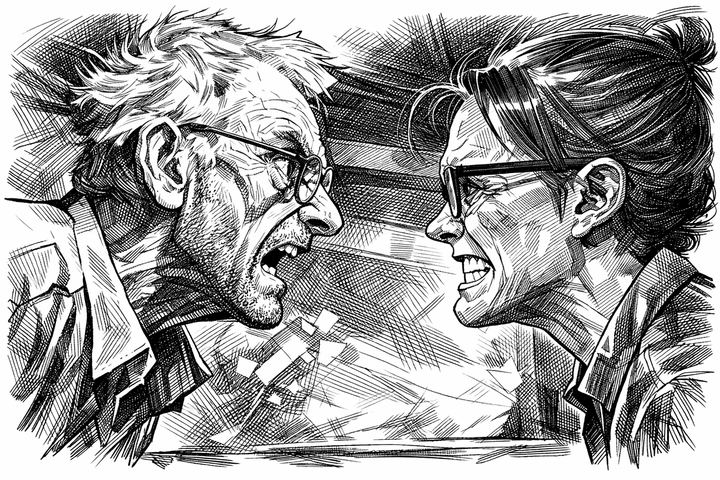
This is America’s civil war of the mind.
A nation battling its own self-hate and contradictions. The land that once celebrated pluralism now fears complexity. The country that led the world with innovation now drowns in its own cultural insecurity.
The real danger is not that one side will win, but that both will keep feeding off each other’s extremes.
Eventually, creating an endless cycle of fear, reaction, and hate. True strength will come only when America remembers that dissent is not treason, faith is not domination, and identity is not a weapon. Until then, it remains a civilization at war with its own conscience.
When the malady is obvious, why isn't any leader able to create the change needed?
The Men in Black
Some years back, Russian President Vladimir Putin shared his view on what ails the US President's office.
"When a person is elected [as US President], they may have some ideas. Then people with briefcases arrive, wearing dark suits. These people start explaining how things are done and instantly everything changes"
The tragedy is this: Trump’s voters wanted disruption of this ossified structure. But Trump himself, upon entering it, became proof of how unbreakable it is. His “divergence” was absorbed, sanitized, and neutralized.
Putin’s dark-suited “men with briefcases” were there all along—not conspirators, but caretakers of a decaying empire that cannot afford to change course.
The result is precisely what you observe: A country that speaks of freedom yet practices control, that champions democracy abroad while eroding it at home, and that mistakes motion for progress while drifting closer to conflict.
Here's how and why the system works or blocks the way it does and what it has brought the country to.
1. The Real Power Structure: The Administrative and Institutional State
Every U.S. president, no matter how fiery their campaign rhetoric, inherits an entrenched ecosystem. That which Eisenhower famously warned of as the “military-industrial complex.” But it’s bigger now.
It includes:
- Permanent bureaucracy: career officials in Defense, State, Treasury, Justice, and the intelligence agencies.
- Contractual ecosystem: defense contractors, Big Tech, think tanks, consulting firms, and lobby networks.
- Financial governance: the Federal Reserve, Treasury officials, and global financial institutions that maintain the dollar system.
This network ensures policy continuity regardless of who sits in the Oval Office. When Putin quipped that “men with briefcases in dark suits arrive,” he wasn’t entirely wrong. Every incoming president is briefed into the limits of what can and cannot be changed—what would “destabilize the system.”
Trump learned this the hard way. His first term was full of declarations to upend the “deep state,” but by the end, he’d surrounded himself with generals, Wall Street alumni, and political operatives—the very people he had promised to dislodge.
2. The Doctrine of Managed Decline
Over the last three decades, the U.S. elite consensus has quietly shifted toward managing the decline of unipolar dominance while preserving global financial control. The pattern:
- 1990s–2000s: Offshoring manufacturing to boost corporate profits and financialize the economy.
- 2010s: Exporting social ideology (“woke capitalism,” ESG frameworks) as a form of soft control—replacing industrial might with cultural dominance.
- 2020s: Militarizing narratives around democracy versus autocracy to preserve Western cohesion while using proxy conflicts (Ukraine, Gaza, Taiwan) to contain adversaries.
It certainly cannot be just mere incompetence. It’s systemic momentum.
A bureaucratic empire built on dollar supremacy and global financial extraction can’t pivot easily back to real production.
3. Trump’s “Divergence”: Allowed Dissent, Not Structural Change
Trump’s policies like tariffs on China, push for NATO burden-sharing, criticism of the “forever wars” were not system-breaking.
They were controlled deviations that served as pressure valves for domestic discontent.
The administrative class tolerated Trump’s “America First” rhetoric as long as it didn’t dismantle the pillars of the global system:
- Dollar primacy.
- NATO alignment.
- U.S. defense spending.
- Corporate profits through deregulation.
When his unpredictability threatened that equilibrium (e.g., potential NATO withdrawal, rapprochement with Russia), the system constrained him—from intelligence leaks to judicial blockades.
4. The Price of Continuity: Strategic Decay
Given how the decisions and actions of the last 3 decades have come out, isn't it obvious that the country is being run into the ground?
And this captures a painful truth. Continuity has come at the cost of vitality.
- Manufacturing hollowed out: replaced by financial speculation and debt-driven consumption.
- Meritocracy eroded: replaced by ideological patronage under the guise of “equity.”
- Foreign policy unanchored: expanding confrontation with Russia and China, creating the risk of simultaneous great-power conflicts.
The administrative state’s logic is survival, not renewal. Its institutions are designed to preserve global leverage, not national cohesion.
5. The Consequence: Decline Without Accountability
In effect, America’s political system functions as a dual structure:
- The elected façade—presidents, parties, culture wars—keeps public attention divided.
- The permanent core—bureaucrats, financiers, and strategic elites—manages continuity.
Both sides blame each other while the real course continues: deindustrialization at home, moral polarization, and endless confrontation abroad.
The U.S. is not collapsing from lack of intelligence but from the inertia of its own empire logic.
A system built to dominate a unipolar world now unable to adapt to a multipolar one.
The Briefcases and the Abyss
America’s tragedy is not that its leaders are evil or ignorant, but that the system itself has become self-referential—unable to imagine a world not built around its own dominance. Every president, from idealist to populist, is eventually absorbed into this gravity.
The “men with briefcases” represent more than bureaucrats; they symbolize the institutional ego of an empire afraid of mortality. They maintain control not through conspiracy but through momentum—the inertia of power that cannot pause to reflect without collapsing.
And so, the United States continues its paradoxical march: outwardly strong, inwardly hollow; morally loud, spiritually silent. It destroys industries to preserve profits, divides citizens to preserve control, and creates enemies to preserve purpose.
Plural Country and its Exclusivist Core
This is the central contradiction of the American experiment: a nation founded on Enlightenment rationalism and secular governance, yet animated by the religious exclusivism of Christianity.
The founding fathers (many of them Deists, not doctrinaire Christians) envisioned a republic of free conscience.
The genius of the founding fathers is they understood that Christianity could not only stand on its own but would thrive without being written into the laws and founding documents of the country. In fact, it was likely their own “faith” that led them to this conclusion. Many of the founding fathers—Washington, Jefferson, Franklin, Madison and Monroe—practiced a faith called Deism. Deism is a philosophical belief in human reason as a reliable means of solving social and political problems. Deists believe in a supreme being who created the universe to operate solely by natural laws—and after creation, is absent from the world. This belief in reason over dogma helped guide the founders toward a system of government that respected faiths like Christianity, while purposely isolating both from encroaching on one another so as not to dilute the overall purpose and objectives of either. (Source: The Founding Fathers’ Religious Wisdom / Center for American Progress)
They drew inspiration from the European Enlightenment, Stoicism, and even Vedic and Eastern ideas circulating among intellectuals of their time. Their goal was not to enshrine one faith but to prevent any from dominating the state.
Yet over time, America’s civic identity became conflated with its dominant religion. The phrases “In God We Trust” and “One Nation Under God” emerged not from the founding era but from the Cold War, when Christian identity was mobilized against “godless communism.”
This fusion of faith and nationalism became a kind of civil religion.
One that defines belonging in implicitly Christian terms. A citizen could be of any race or faith, but only within the boundaries of Christian cultural supremacy.
This explains the deep discomfort America feels toward Hinduism, not because it threatens its laws or values, but because it represents a civilizational pluralism incompatible with Abrahamic binaries.
For a nation as diverse as the United States, this is the very pluralism it needs.
And, ironically the very one it resists.
A Hindu understanding of reality could offer what America’s modern soul lacks: the ability to hold contradiction without fear, to see many paths as valid, and to replace “tolerance” with “reverence.”
But in a culture trained to dominate even spiritually, pluralism feels like heresy.
The elite class, Left and Right alike, mimics the same exclusivist impulse.
Both replace pluralism with paternalism. Both weaponize moral superiority instead of celebrating diversity as truth.
This dichotomy is not sustainable. A multi-ethnic, multi-religious, and multi-racial nation cannot survive on the brittle scaffolding of conditional acceptance.
Without a spiritual core that genuinely embraces diversity, not as ideology but as ontology, America’s pluralism will remain performative.
If the republic is to endure, it must rediscover what Hindu civilization has known for millennia: that truth is not a fortress to be defended but a field to be explored.
Only a society that can honor multiple truths can remain whole.
Otherwise, America’s greatest enemy will not be China or Russia. It will be its own inability to coexist with itself.
Comments ()