
The War is Coming: Europe Prepares For a War of Its Own Making
Even at the peak of the Cold War, the lines of communications between the West and USSR were open. How could hatred for one man fuel the march to a war that could annihilate the continent. Why has dialog been thrown off the table? Trying to make sense.

A young monk once came to his master, trembling.
“Master, I have seen the enemy sharpening his sword. Surely he prepares to strike me down. I too must sharpen mine, and quickly.”
The master asked, “Did he raise the sword toward you?”
“No, but he sharpened it.”
“Did he step into your courtyard?”
“No, but I saw him across the valley.”
The master smiled and took the monk to a still pond.
“Strike the water with your fist,” he commanded.
The monk did so, and ripples spread across the pond.
“Now look. Is it calm?”
“No, Master. The more I strike, the more it trembles.”
The master said, “So it is with your heart. By striking at the reflection, you create the storm you fear. The sword across the valley is his. The war in the water is yours.”
The monk bowed in silence, for he understood: sometimes the enemy outside is weaker than the war we summon within.
SUPPORT DRISHTIKONE
In an increasingly complex and shifting world, thoughtful analysis is rare and essential. At Drishtikone, we dedicate hundreds of dollars and hours each month to producing deep, independent insights on geopolitics, culture, and global trends. Our work is rigorous, fearless, and free from advertising and external influence, sustained solely by the support of readers like you. For over two decades, Drishtikone has remained a one-person labor of commitment: no staff, no corporate funding — just a deep belief in the importance of perspective, truth, and analysis. If our work helps you better understand the forces shaping our world, we invite you to support it with your contribution by subscribing to the paid version or a one-time gift. Your support directly fuels independent thinking. To contribute, choose the USD equivalent amount you are comfortable with in your own currency. You can head to the Contribute page and use Stripe or PayPal to make a contribution.
The Forgotten Guy in the Center
On August 18th, in what will go down as a historic meeting, European leaders met US President Donald Trump.
There was British prime minister Sir Keir Starmer, French president Emmanual Macron, German Chancellor Freidrich Merz, Italian prime minister Giorgia Meloni, European Commission President Ursula von der Leyen, NATO Secretary-General Mark Rutte, Ukrainian president Volodymyr Zelensky and one more guy.
The person we have marked out.
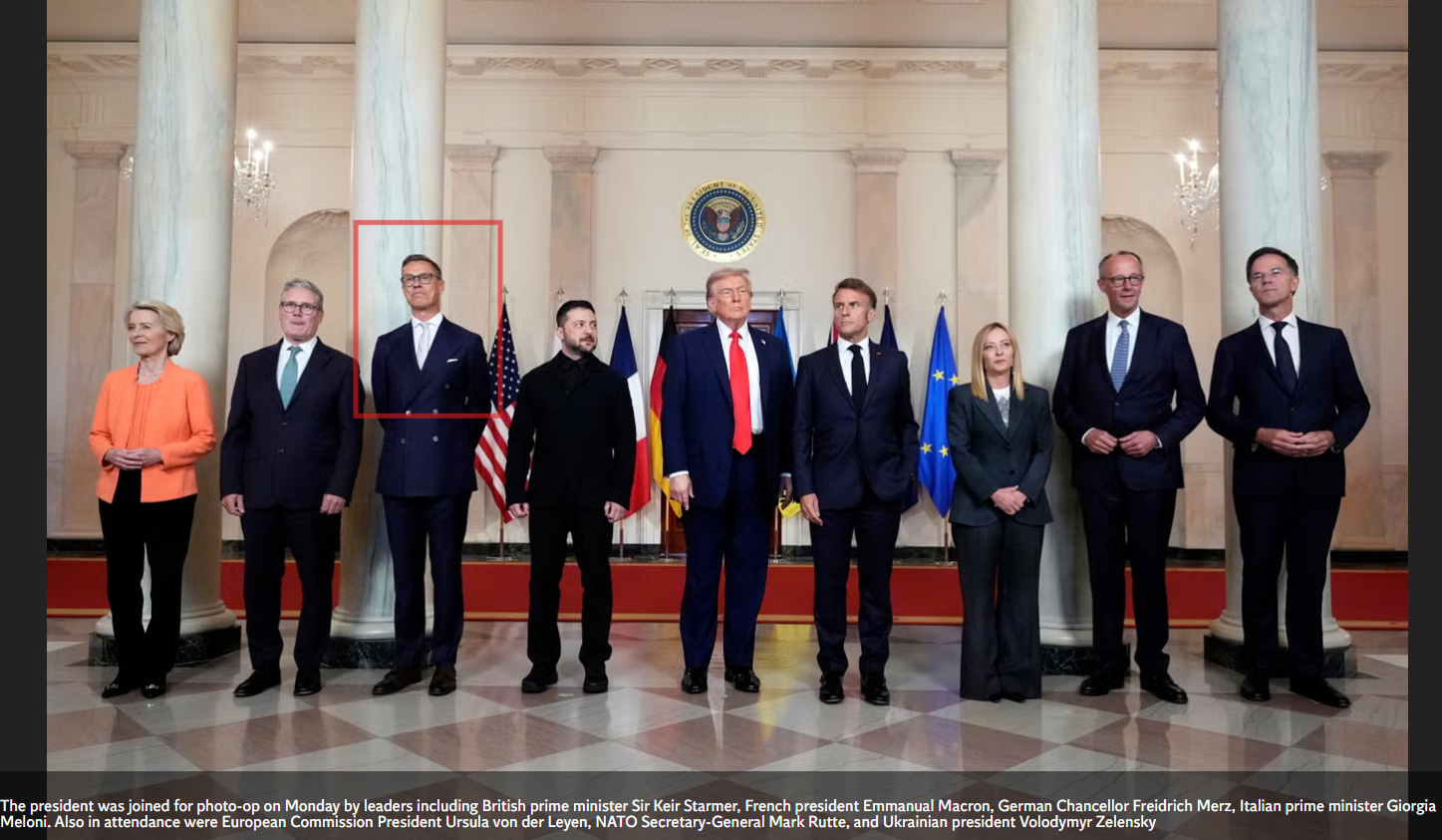
He's not even mentioned in the picture credits by the newspaper site here.
Here he is right in the center of the star cast in front of President Trump.
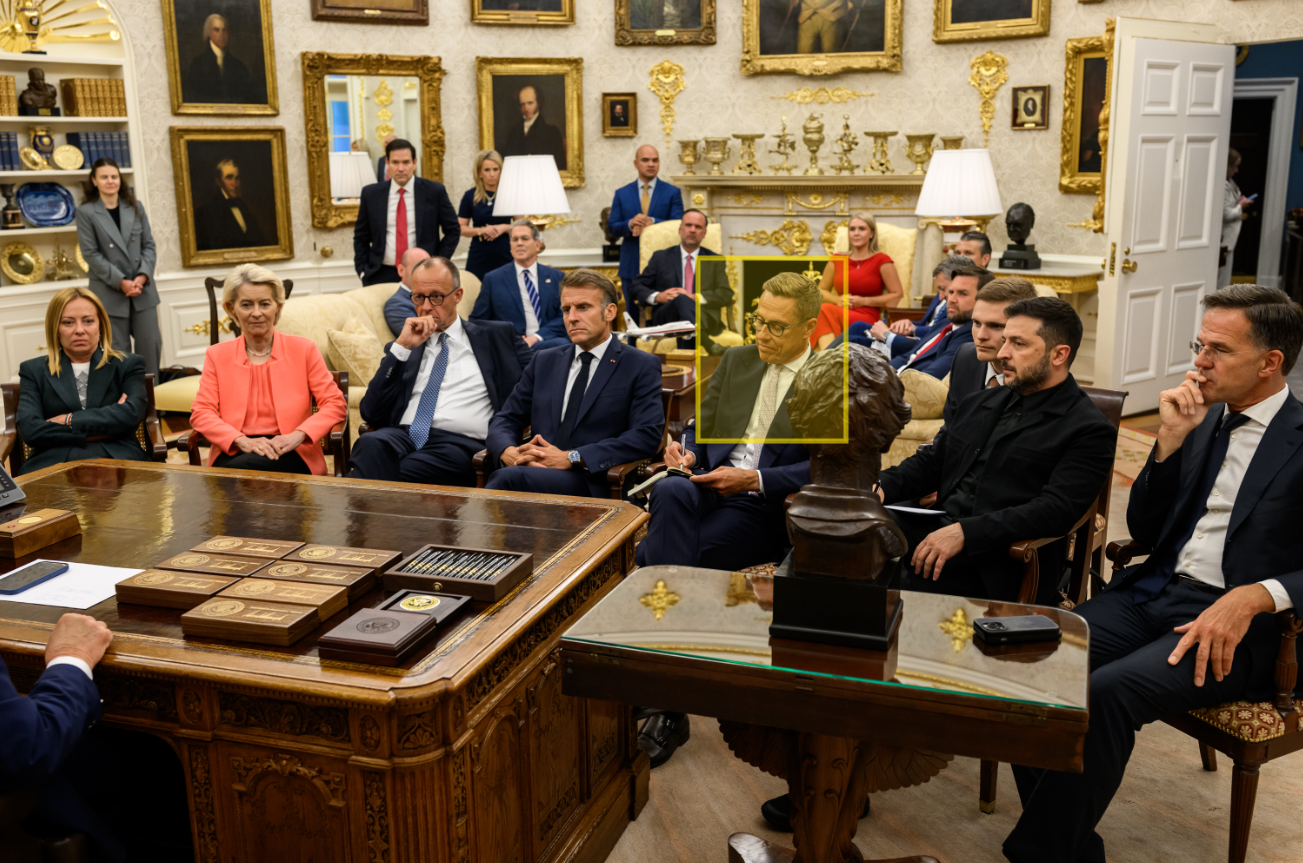
Who is he?
Interestingly, US President Trump did not even recognize him. Not once but twice!
Curious huh?!
Well, he is Finnish president Alexander Stubb.
Tuomas Malinen, Associate Professor of Economics at the University of Helsinki and CEO of GNS Economics - the guy in the video above has an interesting story of why Stubb was there in the Oval office.
Malinen calls Stubb - The New Zelensky. Curiously, he names King Charles as the leader of the global conspiracy to create war (one of the leaders of the "Deep State"?)!
Basically Malinen, a professor at the University of Helsinki, believes that Stubb is stoking the war against Russia.
From the recent records, Stubb seems to be very active in the higher circles.
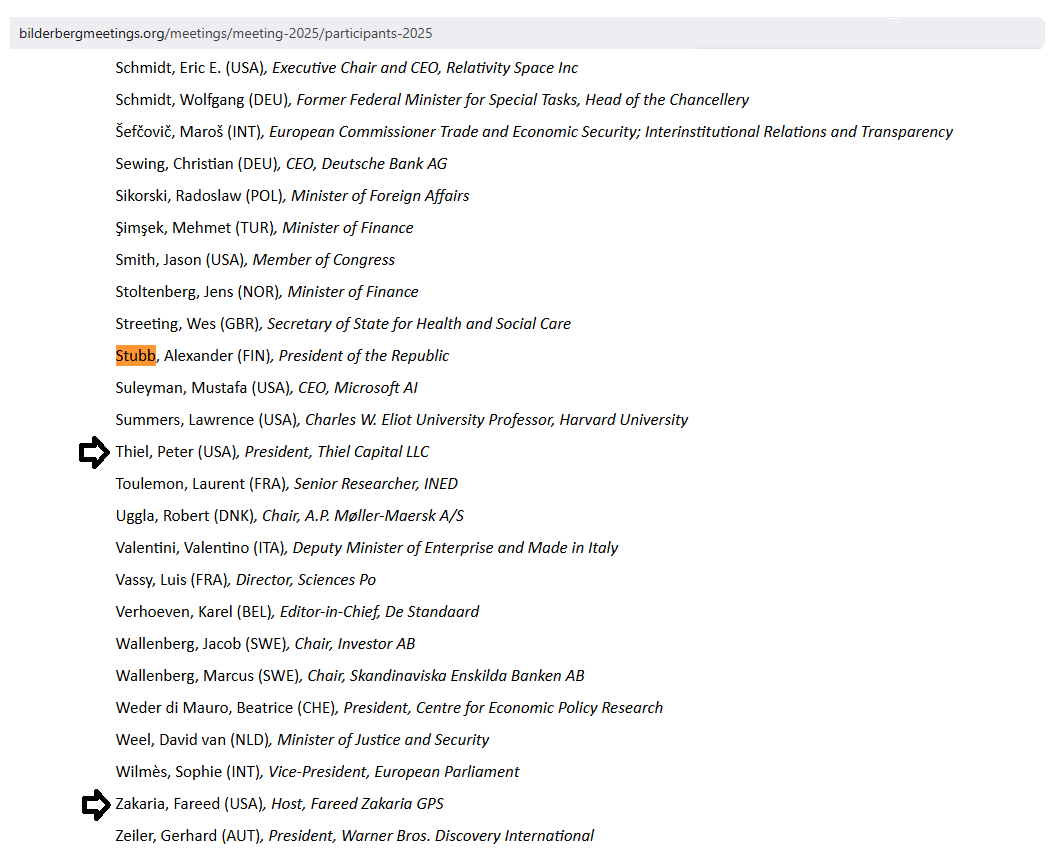
For example, he attended the 2025 Bilderberg Meeting. Find out why it is important in this story we did earlier.
 Desh Kapoor
This year, the top four topics were:
- Transatlantic Relationship
- Ukraine
- US Economy
- Europe
(PS: also check out some other participants. Well, there was another interesting guy - Satya Nadella in the mix as well.)
So what's really going on here?
Why Finland?
Finland is quite small when it comes to its GDP with respect to the rest of the European countries.
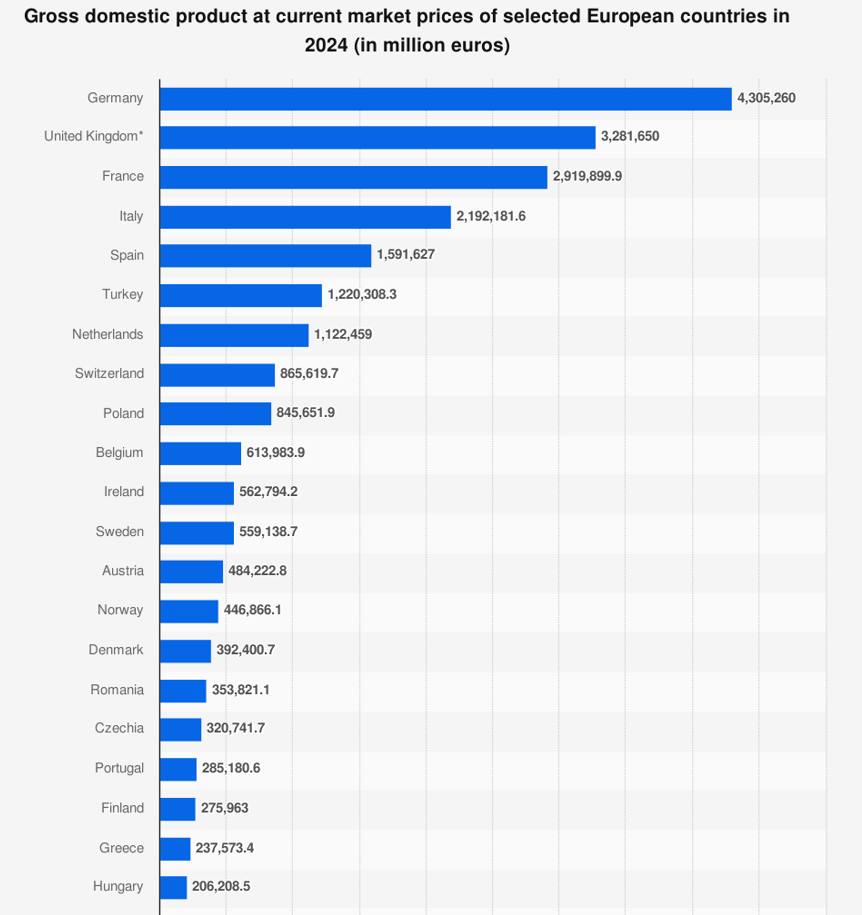
Why is the leader of a small European country (in terms of population and GDP) sitting along with the top European leaders discussing the future with Trump?
That too bang in the center of the gang?
The answer lies on the map.
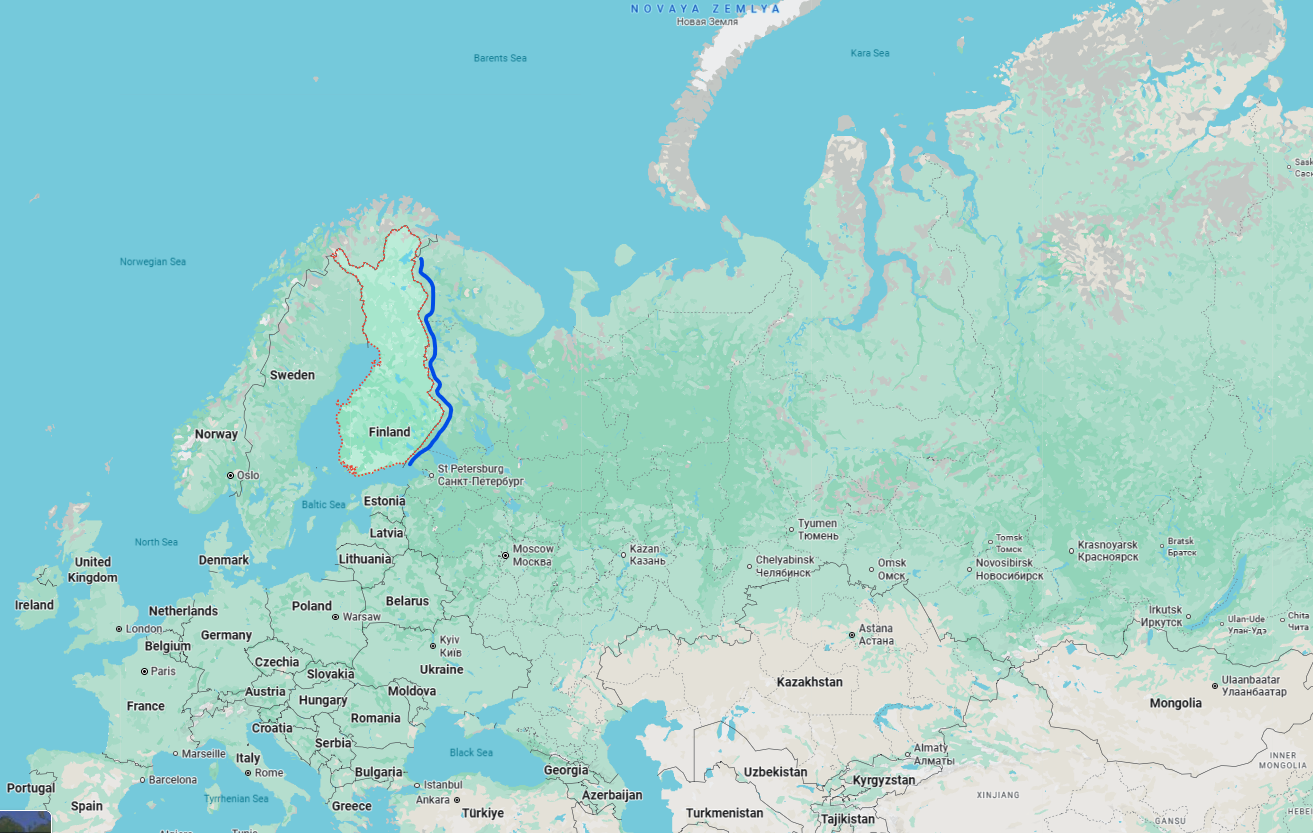
The border between Finland and Russia is approximately 1,340 kilometers (833 miles) long. It is the longest border between Russia and any European Union member state and was established through treaties, with significant changes made after the Winter War and World War II.
That is what earned Finnish President Stubb that seat at Trump's table.
To better understand the Finnish-Russian situation, watch this excellent video that provides great background information although it strays into fear-mongering against Russia - as is the norm these days.
Let us understand what is being presented in the video.
Russia’s military build-up near Finland highlights a rapidly escalating security dilemma. Satellite imagery reveals new bases, accommodation for 2,000 troops, and expanded facilities within 60 km of the Finnish border. These moves fit into Moscow’s strategy to reinforce the Murmansk Peninsula, home to its Northern Fleet and nuclear forces. From Russia’s perspective, NATO enlargement has erased its buffer: Finland’s accession in 2023 doubled NATO’s shared border with Russia by over 1,300 km, turning Finland from neutral ground into a frontline state.
For Finland, the threat of invasion is historic. After losing territory and Arctic access in World War II, Finland remained neutral under Soviet pressure but heavily militarized its border. The Soviet collapse allowed Helsinki to integrate with Europe, but distrust persisted. Today, Finland fields one of the strongest conscription systems globally, with 900,000 reservists.
That is 16% of its population.
Defense spending, historically steady around 1.6% of GDP, will rise to 5% by 2032.
The Ukraine war ended Finland’s neutrality, pushing it into NATO. Moscow has since labeled Finland a “front line threat,” deployed tactical missiles, and allegedly orchestrated migrant flows from Syria and Somalia to destabilize Finland through hybrid warfare. In response, Finland closed all land crossings, began building a border fence, and is considering anti-personnel mines. These measures hurt border towns reliant on trade but reflect urgent security concerns.
Both sides now accuse each other of escalation. For Finland, it’s about survival and deterrence; for Russia, regaining a lost buffer. The border has become one of Europe’s most volatile fault lines.
Satellite imagery has revealed that Russia is significantly increasing its military presence along the Finnish border, drawing parallels to the buildup seen at Russian bases ahead of Putin's invasion of Ukraine. Analysts report that Moscow is constructing new troop housing, developing infrastructure for aircraft deployment, and renovating older military facilities at strategic bases—clear indications that it is strengthening its capabilities in this critical border area.
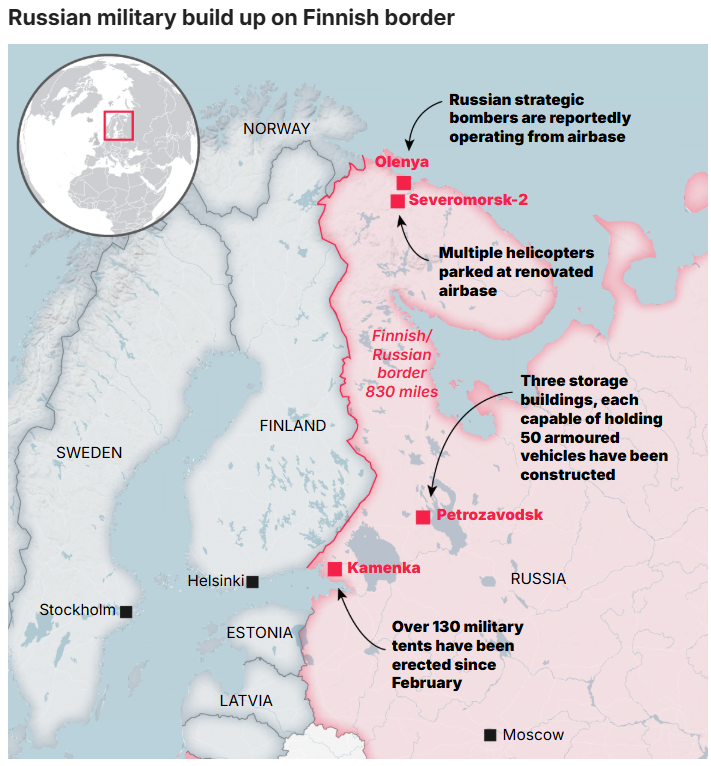
Finland’s April 4, 2023 entry into NATO stretched the bloc’s border with Russia by 800+ miles and drew a fierce response from Moscow, which cautioned that nuclear use wouldn’t be ruled out. Russia has since raced to build up facilities along its northwest border - specifically the four areas of Kamenka, Petrozavodsk, Severomorsk-2, and Olenya.
Finland, Norway, and Sweden are gateways to the Arctic.
Arctic is the emerging battleground where Russia holds geographic dominance and vast resources. By militarizing Finland, NATO builds redundancy into its Arctic encirclement plan.
The idea is to force Russia to defend both Ukraine and the High North, overstretching its forces.
The Arctic is not about ideology; it’s about hydrocarbons, shipping routes, and control of the “last frontier.”
The focus of the neocons or the Western leadership is across Europe though.
And, the entire Europe seems to be preparing the coming war.
Yes an imminent war as soon as in the next one year.
French prepare for War - Casualties could be higher than 50,000!
Let's first discuss about France. It has been at the forefront of the European war preparation along with Germany.
President Macron has pledged a substantial boost in France’s defense budget, aiming to double spending by 2027 compared to 2017. The military budget is set to reach €64 billion in 2027, with additional targeted increases of €3.5 billion in 2026 and €3 billion in 2027. Macron’s July 2025 address outlined accelerated investments in ammunition, drones, missile defense, electronic warfare, space, and reserve forces. He emphasized that every sector of society, including business and private industry, must help fund expanded defense capabilities.
The budgetary trajectory laid out in the LPM set military spending at €53.7 billion in 2026 and €56.9 billion in 2027. With the additional funds announced by Macron, France’s defence budget would total €64 billion in 2027 (instead of 2030), effectively doubling the spending levels of 2017 when he took office. Macron also announced a subsequent update to the LPM to be unveiled in fall 2025. President Macron evoked the need for additional funds to fill in weak spots that could include munitions stocks, drones, precision and saturation weapons, and spatial capabilities while reinforcing surface-to-air defence, electronic warfare, and the reserve forces. It would be expected that the accelerated rise in defence spending would also allow for accelerated equipment deliveries, advancing them to 2027 from 2030 for example. While leaving his prime minister the task of finding the money, Macron insisted it come from ‘increased activity and production’. He made a plea for ‘each and every person to take his or her share of the burden’: taxpayers; but also banks, private investors and businesses able to finance defence technologies and industry. (Source: "What to Make of Macron’s Recent Defence Spending Commitments?" / The Royal United Services Institute for Defence and Security Studies (RUSI))
The 2025 National Strategic Review, released after Macron’s speech, identifies high-intensity conflict near the EU borders as a tangible risk. The government stresses the need for enhanced supplies, munitions, and a quicker ramp-up in defense industry production.
Macron recently hosted a major summit on European defense and postwar security guarantees for Ukraine, leading a coalition that pledged ongoing support, including the possibility of troop deployments and military presence as a deterrent after the conflict ends.
 Illia Novikov, Samuel Petrequin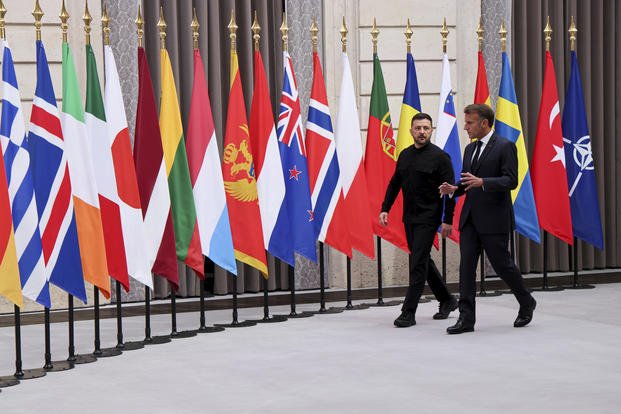
And now comes the news of a document leak where the government is asking the French hospitals to prepare for an armed conflict.
French hospitals have been told to prepare a potential armed conflict in Europe by next year, local media reported. In a letter sent to regional health agencies, revealed by Le Canard Enchaîné , the Ministry of Health asked hospitals to prepare for a “major (military) engagement” by March 2026. The newspaper warned that between 10,000 and 50,000 men could be expected in hospitals over a period of 10 to 180 days. (Source: "French hospitals told to prepare for war in Europe by next year in leaked Government letter" / Yahoo News)
Watch this news item as well.
The directive, dated July 18, 2025, instructs regional health agencies to ready hospitals for a scenario involving a high-intensity conflict in Europe, including large-scale medical support for both French and NATO personnel.
French hospitals are directed to prepare for the treatment of between 10,000 and 50,000 wounded service members (including foreign/NATO soldiers) over periods ranging from 10 to 180 days. The system should be able to handle surges of up to 250 patients per day during peak periods.
Plans include the establishment of medical transit centers near major transport hubs (airports, ports, train stations) to sort and stabilize casualties for further treatment or repatriation.
This initiative is part of a larger strategic review and “foresight” effort, including the distribution of a 20-page survival manual to French households. The manual is designed to help citizens prepare for “imminent threats”—not only military conflict, but also natural disasters, health emergencies, and other crises.
So what does the government have to say about this?
Well, the French health ministry frames this as prudent contingency planning (not a definitive announcement of war), with lessons learned from the COVID-19 pandemic and ongoing concerns about NATO-Russia tensions informing the timeline and scenario assumptions. Officials stress that “anticipation of such crises is part of national responsibility”.
Sure!
So, are the French the only ones preparing for an imminent war in the coming months?
Heck no.
Germany is Building Bunkers
Germany is leading the charge, while other NATO countries are preparing as well.
Last year however, its plans in Ukraine were leaked.
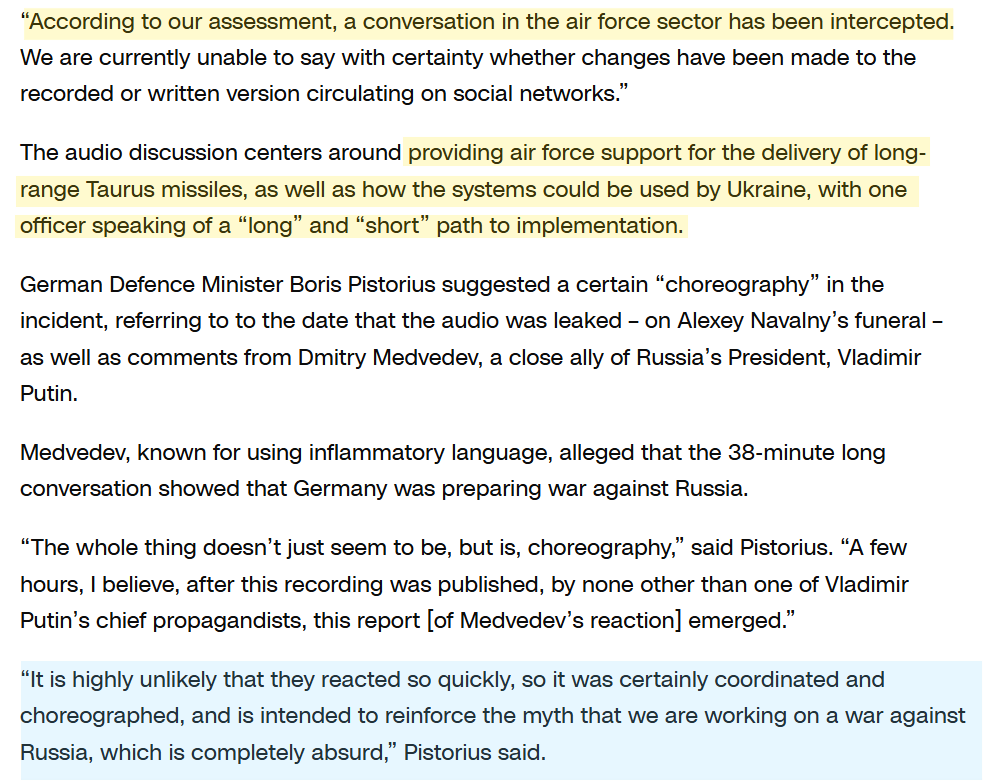
A Bundeswehr strategy paper had suggested earlier this year that Russia is preparing for a war against NATO. One wonders how much of this is reality and how much of it is to prepare the ground within the German population to ready its mind for a war.
The German military deems Russia an "existential risk" to the country and Europe, according to a Spiegel news magazine report that cites a new Bundeswehr strategy paper. The confidential document warns that the Kremlin is aligning both its industrial and leadership structures "specifically to meet the requirements for a large-scale conflict against NATO by the end of this decade." Russia is verifiably preparing for a conflict with NATO, particularly by strengthening forces in western Russia "at the borders with NATO," the report cites the strategy paper as saying. As early as next year, Russia could have around 1.5 million soldiers on active duty, according to the paper.Germany can only counter this threat "with a consistent development of military and society-wide capabilities," the document concludes. (Source: "German military deems Russia 'existential risk' to nation and Europe, Spiegel reports" / Reuters)
Germany is increasing its military spend at an alarming rate.
The alliance's total annual defense spending now stands at $1.5 trillion, with Europe contributing a third of that. While Russia dismisses these actions as "fear-mongering," frontline NATO states are taking decisive steps.
Poland, bordering Russia and Belarus, plans to allocate 5% of its GDP to defense by 2026 and aims to build a 500,000-strong army.
Poland also shares a 500-mile border with Russia and Kremlin ally Belarus, and it is not only building up defenses there. This year, Polish Prime Minister Donald Tusk called on all Polish men to begin military training, announcing to parliament in March that by the end of this year, the aim is for every adult male in the country to be trained in the event of war. Hundreds of miles north of the capital, along Poland's border with Russia, bulldozers clear farmland for a land mine field while crews place neat rows of concrete anti-tank structures called hedgehogs that look like massive gray Lego pieces. On a work break, Polish Lt. Iwona Misiarz gives a tour of the country's newly fortified border with the Russian exclave of Kaliningrad. She peers into a deep ditch filled with water and, beyond that, gazes upon rows of anti-tank barriers — hedgehogs — that follow the curved border for as far as the eye can see. On the other side of the ditch, beyond a razor-wire fence, is dense birch forest: Russia. (Source: "Poland Prepares for War" /NPR)
Poland plans to train every adult male for potential war and is building minefields and anti-tank barriers along its borders with Russia and Belarus. A 40-page civilian “Safety Guide” is being prepared for each Polish household, with advice on coping in war or disaster (finding water, air raids, bomb shelters).
Poland’s Prime Minister Donald Tusk has said that NATO’s Europe commander, General Alexus Grynkewich, confirmed to him during a meeting on Friday that “Russia will be ready to confront Europe, and therefore us, as early as 2027”. “There is no reason for us to scare each other, but we must be truly vigilant and focused,” stated Tusk in a video posted on X, warning that “Poland must be ready”. Tusk’s warning comes after a similar comment he made last week. While announcing a long-awaited government reshuffle, the prime minister cited American reports pointing to “a direct threat from Russia [that] could materialise as early as 2027”. (Source: "Russia will be ready to confront us in 2027,” warns Polish PM after meeting with NATO commander" / Notes from Poland)
Ordinary citizens are joining military training programs, and the government is modernizing its arsenal and drone usage. Mass military training for adult men has commenced, and Poland is investing in border fortifications and has withdrawn from the landmine ban treaty - only to lay landmines along the border with Kaliningrad, which is Russia as well. (See Poland's border with the Russian territory Kalinigrad in blue notations in the map below).
Recent reports suggest Russia has stationed dual-capable (nuclear/conventional) Iskander missiles in Kaliningrad. This allows Moscow to threaten European capitals within minutes, bypassing longer-range strategic missile warning systems.
Militarily speaking, Russia could try to cut off the Baltic states (Estonia, Latvia, Lithuania) from the rest of NATO by seizing this gap. (See the red notations in the map below).
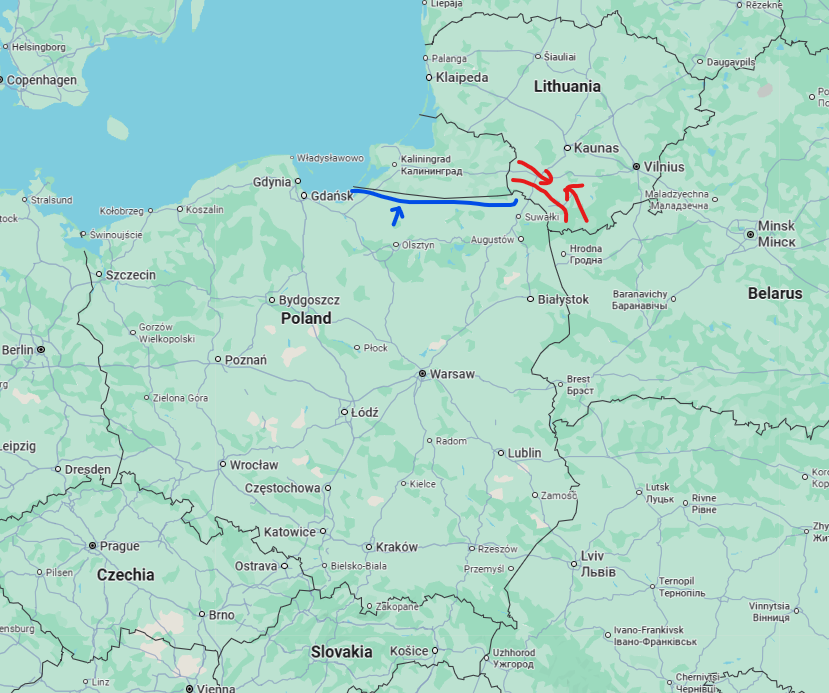
Kaliningrad is like a "dagger in the side" for NATO while it provides Russia a rare ice-free port in the Baltic and direct access to Central Europe.
Defeating Germany was Russia's biggest contribution to a world free of the Nazis. Which is precisely what Putin wants to remind the West which keeps patting its back on "taking out" Hitler. They didn't. It was Russia.
Let's look at other European countries as well in terms of their preparation for the war against Russia.
The Baltic Countries (Latvia, Lithuania, Estonia)
These countries are massively increasing defense spending (5% of GDP, the highest in NATO), reinforcing borders, and physically fortifying against potential Russian aggression, such as building anti-tank obstacles and bunkers. Latvia alone is stockpiling thousands of “dragon’s teeth” anti-tank obstacles and related fortifications.
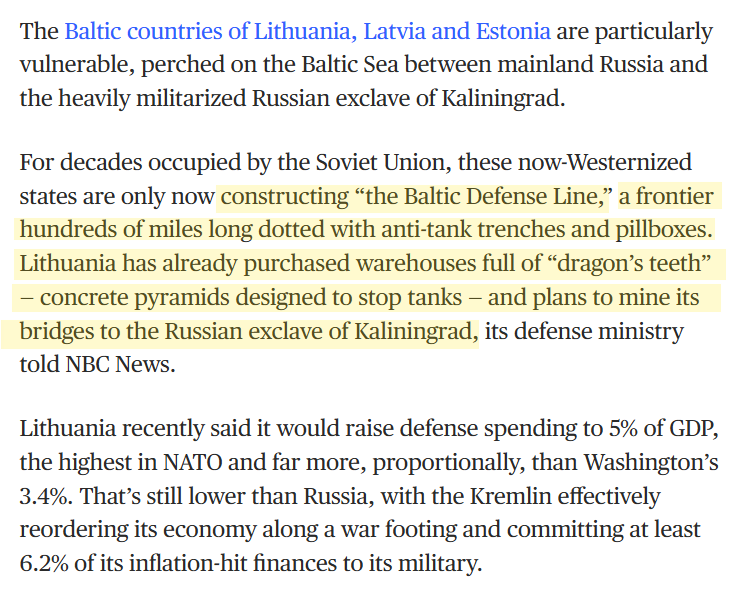
The region is running frequent military drills—including with NATO and U.S. forces—focused on rapid response to conventional and hybrid threats, such as drone incursions and sabotage.
Let's look at the Nordic countries as well.
Sweden, Norway and Denmark
To understand how the Nordic countries behave, we many need to understand their history vis-a-vis Russia, Germany and NATO a bit.
[We have taken the basic information from this very well articulated comment on Reddit and then we fact-checked it via the information on the net.]
When Nazi Germany and the Soviet Union divided Eastern Europe under the Molotov–Ribbentrop Pact (1939), Finland fell into the Soviet sphere.
In November 1939, the USSR invaded, launching the Winter War. Against overwhelming odds, Finland resisted fiercely but was forced in March 1940 to cede about 11% of its territory, including Karelia. Around 12,000 Swedish volunteers fought alongside Finns, though Sweden itself remained officially neutral.
In April 1940, Germany occupied Denmark and Norway, leaving neutral Sweden wedged precariously between the Third Reich and the Soviet Union. When Hitler invaded the USSR in June 1941, Finland entered the Continuation War as a co-belligerent with Germany, aiming to reclaim lost lands. Finland, however, pursued limited war aims and avoided deeper entanglement with Nazi ideology. Sweden, surrounded by German-controlled territory, continued strict neutrality, balancing economic concessions to Germany with quiet sympathy for its Nordic neighbors.
After WWII, the Soviet Union imposed harsher terms on Finland: additional territorial losses (Petsamo, Porkkala), heavy reparations, and the 1948 Treaty of Friendship, Cooperation, and Mutual Assistance, which bound Finland to Soviet security interests. This arrangement became known as “Finlandization”—Finland retained sovereignty and democracy but avoided policies that might provoke Moscow. Stalin accepted this outcome, partly impressed by Finland’s wartime resistance, but primarily because a neutralized Finland served Soviet strategic needs better than outright annexation.
Thus, both Finland and Sweden’s neutrality stemmed less from formal agreements than from pragmatic survival strategies in the shadow of great powers.
For Finland, it meant independence under Soviet pressure; for Sweden, it meant staying out of alliances to preserve security and regional balance.
Norway and Denmark are NATO members, having joined as founding members in 1949. Sweden, however, is a more recent addition, becoming NATO's 32nd member on March 7, 2024. Finland had joined in April 2023.
Sweden
After joining NATO in March 2024, Sweden is ramping up defense spending—from roughly 1% of GDP in 2017 to a projected 3.5% by 2030
Sweden reinstated universal conscription (men and women) and plans to train up to 10,000 conscripts annually by 2030. Active personnel are expected to reach 115,000 by 2030 and 130,000 by 2035.
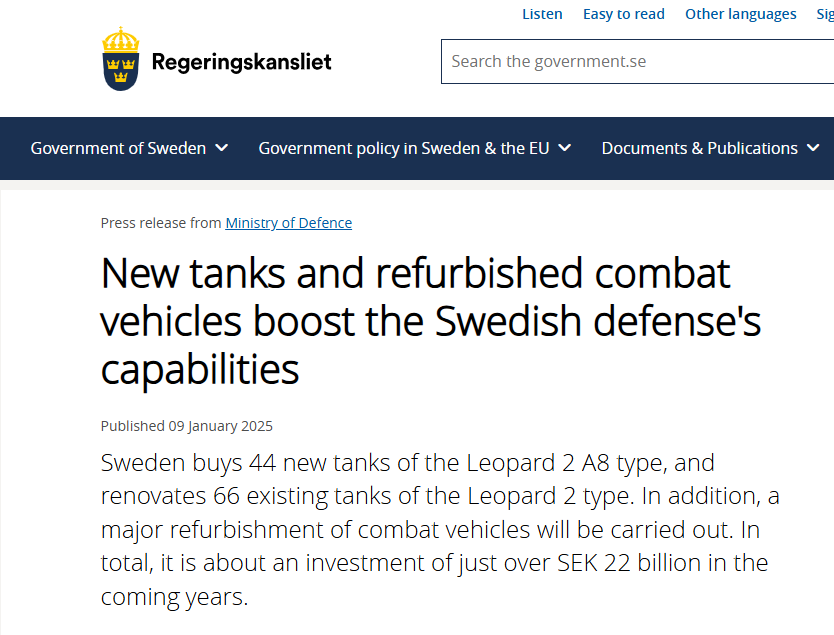
Sweden has acquired 44 new Leopard 2A8 tanks and modernizing 66 older Leopard 2s, aiming for a fleet of 154 modern tanks. CV90 infantry fighting vehicles are also being upgraded, and artillery is being bolstered with Archer systems.
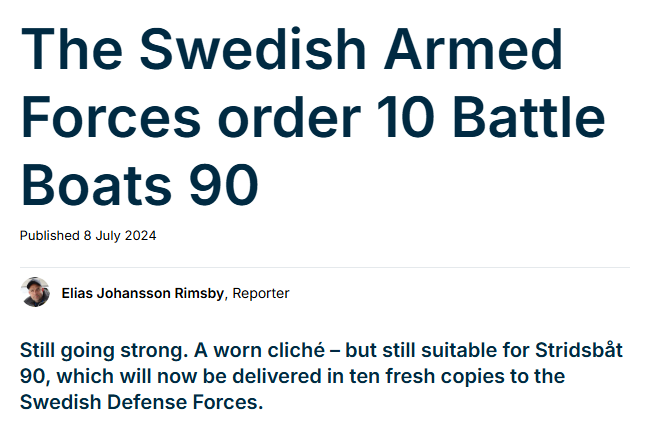
They have also ordered new ships to replace older vessels and boost its fleet of Stridsbåt 90 combat boats; upgrading Visby-class corvettes and planning larger Luleå-class corvettes
Also, just as France and other European countries are doing, Swedish government is also distributing booklets on how to prepare when war comes.
Distribution of the updated “If War Comes” pamphlet to millions of households, offering practical advice for crisis preparedness (including coping with propaganda, emergency supplies, and basic medical procedures) is going on.
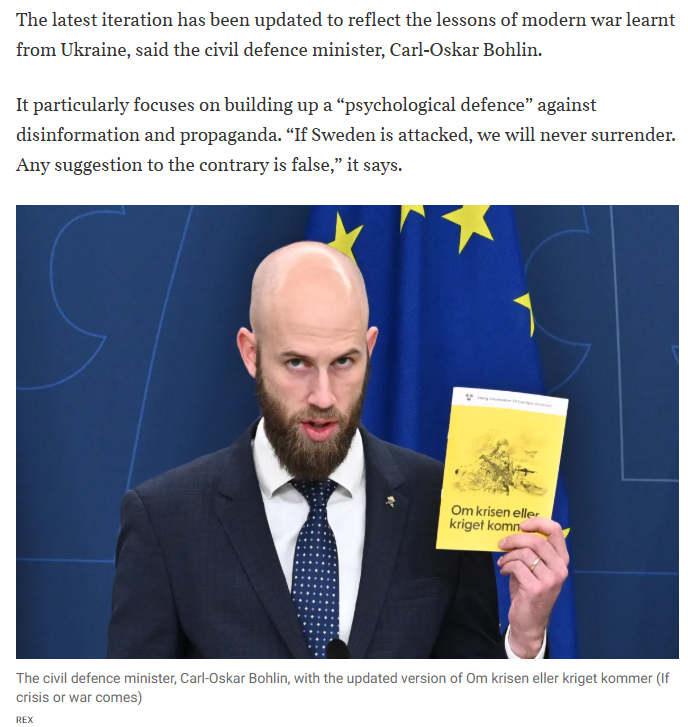
Now, let's check on Denmark.
Denmark
Denmark is raising defense expenditure to 3% of GDP within two years, redirecting 50 billion DKK (approx. £5.5 billion) toward military capabilities.
Danish Prime Minister Mette Frederiksen's desperate race to arm Denmark can be easily gauged from her message to her armed forces - What counts is speed of acquisition!
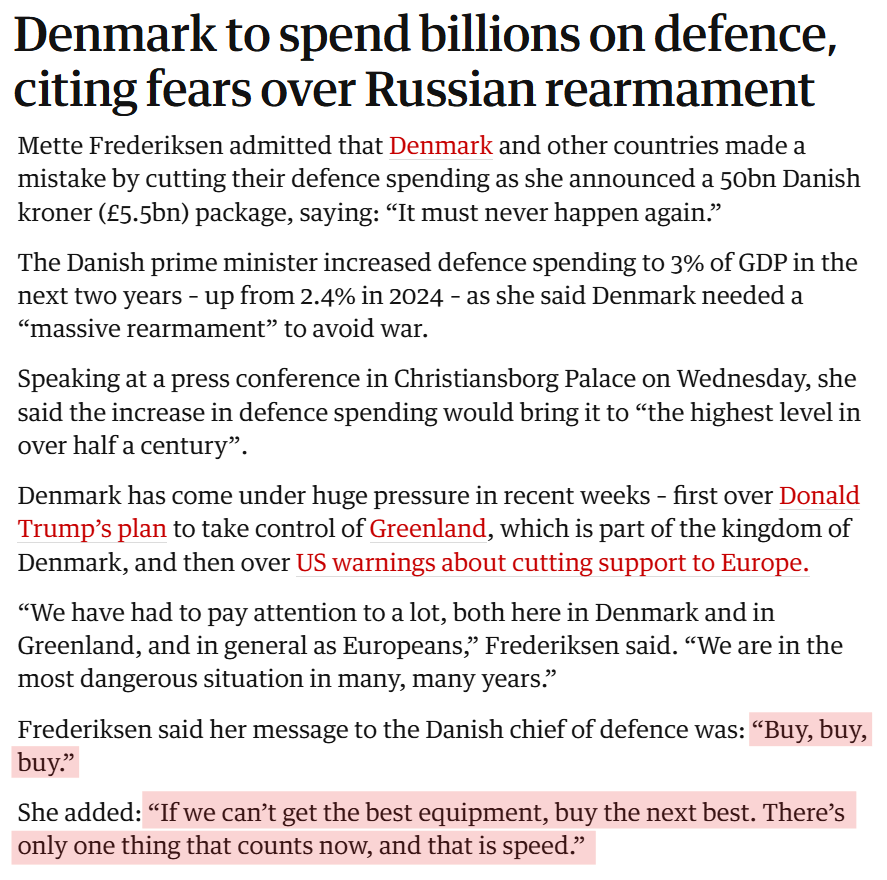
As of June 2025, all Danish women (turning 18 onward) will enter the national draft lottery. This will be expanding the number of service members from 4,700 to 6,500 by 2033, with longer service durations (from 4 to 11 months). (Source: Denmark Female conscription / AP News)
Denmark is acquiring drones and specialized marine vessels (four mine-laying or environmental ships plus 21 additional vessels) to protect critical subsea infrastructure and strengthen naval capabilities in the Arctic and Baltic.
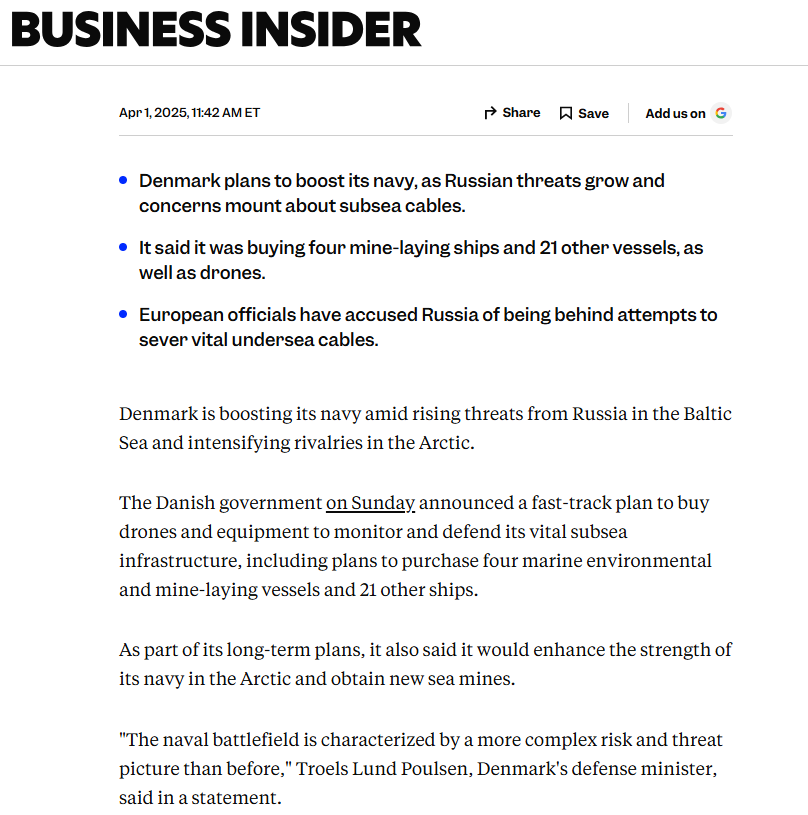
Working with Norway to enhance cooperation on Arctic surveillance, joint training, and shared use of platforms like Leopard 2 tanks, F-35s, and SEAHAWK helicopters. Both also contribute to training Ukrainian F-16 pilots.
Denmark has also joined the EU’s Permanent Structured Cooperation (PESCO) following the 2022 referendum, becoming fully involved in EU defense integration.
Norway
Before we look at Norway's preparation here is something to remember about Norway.
Norway has signed a landmark $13.5 billion deal to procure British Type-26 City-class frigates. It's largest-ever defense investment.
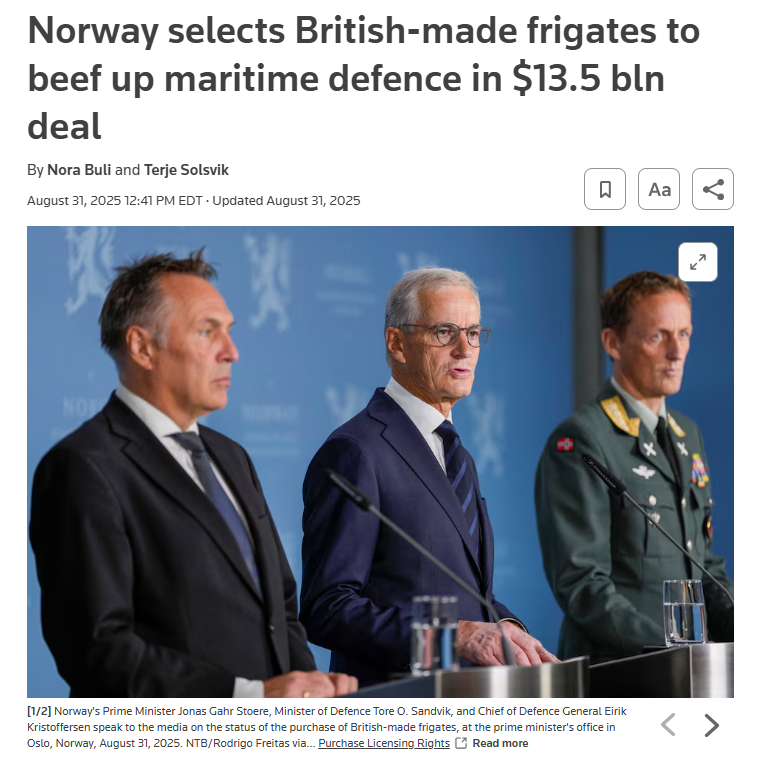
This supports anti-submarine warfare in the North Atlantic, especially regarding Russian submarines from the Kola Peninsula.
Meanwhile, Norway has more than doubled its defense spending within just over a year—mirroring regional trends in response to rising threats.
Norway has more than doubled its spending on defense in a little more than a year. Denmark has implemented mandatory conscription for women. And Sweden, the newest NATO member, also has indicated it will quicken its rearmament pace. All three Nordic countries have the same impetus: a resurgent Russia. “We must do more to secure our country and contribute to joint security with our NATO allies,” Norwegian Prime Minister Jonas Gahr Støre said shortly before the June 2025 NATO summit, according to the Barents Observer, a Norwegian newspaper. “The world has become more dangerous and unpredictable, and Europe must take a bigger responsibility for its own security.” Norway plans to meet NATO’s new requirement of 3.5% of gross domestic product (GDP) spent on defense while spending 1.5% on related infrastructure, a formula agreed to by most NATO members at the summit. In March 2024, Støre announced a defense spending increase to 2% of GDP. At the time, the influx of money for defense was seen as a historic push to rearm after Russia invaded Ukraine in 2022. A series of sabotage incidents at Norwegian air bases and radar installations, and provocatory behavior by Russia in the demilitarized and treaty-protected Svalbard Peninsula have elevated the Norwegian pulse on Russian aggression. “The threats from Russia are significant and enduring,” Norwegian Defence Minister Tore O. Sandvik told the Observer. (Source: The Watch)
Europe's War - A Slide to Self-Destruction?
Despite the tearing hurry that EU's leadership is in to arm itself, analysts in Europe now believe it may not be "fast enough."
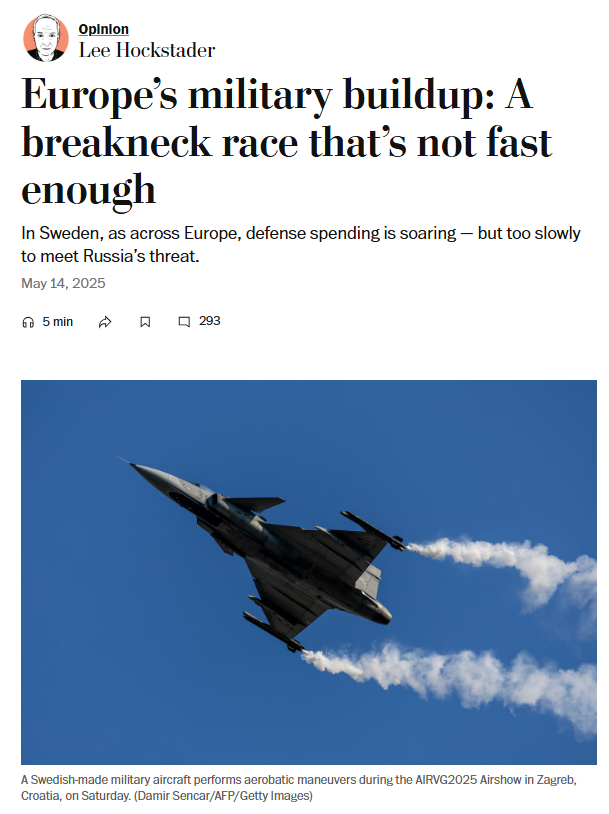
Not "fast enough" for what?
So, is Putin in a hurry or is Europe in a hurry?
Is Europe's Military Diversity its Curse?
Europe’s joint military front is limited by its lack of interoperability and absence of a centralized command structure.
Key vulnerabilities when compared to the U.S. approach.
Unlike the U.S., which relies on streamlined and standardized weapon systems, European armed forces operate a much more fragmented arsenal (178 weapon types compared to the U.S.’s 30, and 20 fighter aircraft types vs. six for the U.S.), making coordinated action complex and inefficient.
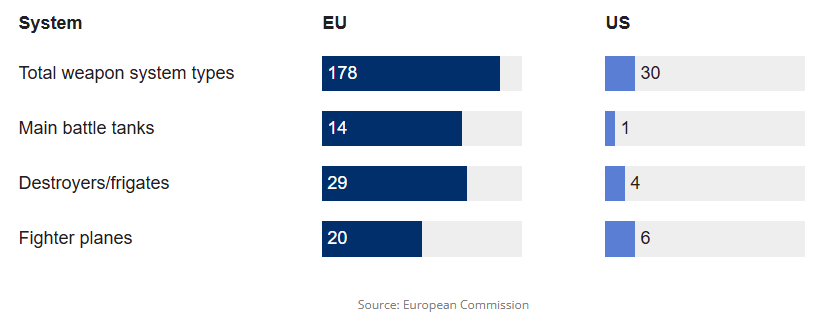
European militaries currently use 19 to 20 different main battle tank models and as many tactical combat aircraft, reflecting persistent industrial and procurement competition among EU countries.
This fragmentation stems from defense industries that remain nationally organized and serve domestic interests rather than focusing on pan-European priorities, stalling moves toward a unified arsenal or standardized procurement.
As a result, costly duplication and inefficiency pervade capability development, while Europe lags in ready-for-deployment weapon stocks, as seen during the war in Ukraine.
Something in our entire discussion and analysis seems completely off and extremely ominous. War is coming. A big war.
But why exactly? That isn't clear yet.
Europe’s Rush to War: A Self-Fulfilling Prophecy?
The Nordic countries, alongside the rest of Europe, are rearming at a pace unseen since the Cold War. Budgets are soaring, conscription is expanding, and civil populations are being prepared psychologically for conflict. The justification: Russia is preparing to strike.
Yet Moscow, in its own narrative, repeatedly insists it seeks security guarantees rather than outright conquest, stressing that if NATO halts its expansion and “antics” on Russia’s borders - Ukraine, ex-Soviet spaces, and now the Nordics - it too will stop.
This contradiction exposes a troubling dynamic. Europe appears locked in a feedback loop where military preparation, distrust, and political rhetoric reinforce each other.
War thus becomes a self-fulfilling prophecy.
With every new battalion mobilized in Sweden or frigate purchased by Norway, Moscow feels encircled. In turn, Russia’s missile deployments in Kaliningrad or its buildup in the Arctic are interpreted as aggressive intent by Europeans. What is absent is even the pretense of dialogue. Negotiation has been foreclosed not by accident, but by design.
On one level, deterrence through strength has its logic: Europe’s vulnerability without U.S. protection is glaring, as studies show the need for 300,000 extra troops and hundreds of billions in new spending. Yet deterrence without diplomacy risks hardening into provocation.
The question must be asked: is Europe bringing devastation upon itself out of a cultivated hatred for Russia?
The language of European leaders increasingly reduces Russia to an existential “other,” incompatible with peaceful coexistence.
This civilizational framing leaves no room for compromise.
The cost of such intransigence is staggering. Russia is not a weak adversary.
Its missile arsenal includes the RS-28 Sarmat (NATO designation: “Satan II”), capable of carrying multiple nuclear warheads across continents, to the Kinzhal hypersonic missiles and the Avangard glide vehicle.
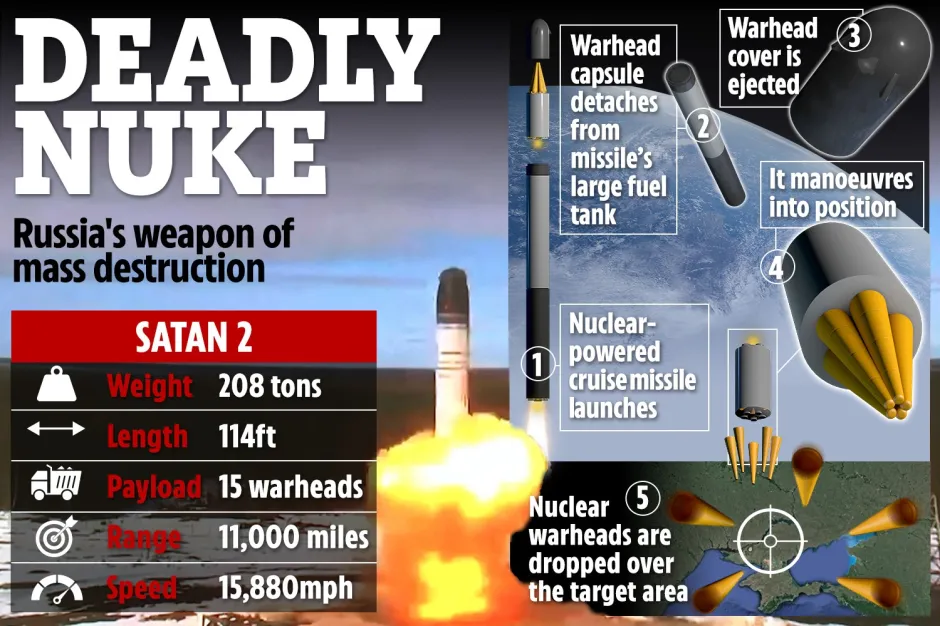
These range of weaponry pretty much renders much of Europe indefensible in the event of escalation.
Even the Oreshnik and Iskander systems deployed in Kaliningrad can reach European capitals within minutes. Europe knows this. Yet it arms and escalates, seemingly resigned to the possibility of nuclear catastrophe.
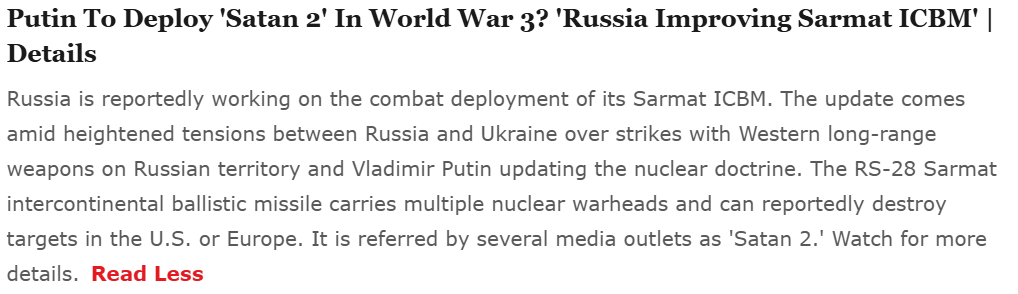
Quite simply - the consequences could be unimaginably devastating.
Europeans are certainly not as holy and moral as they portray themselves. We know they aren't given their stances and their actions in the past and current crisis.
So why? Why bring about untold devastation on the planet instead of simply talking to someone you consider your adversary?
Part of the answer lies in political psychology.
During the Cold War, the world balanced on a nuclear knife’s edge, yet survival instincts ensured dialogue. Washington and Moscow, despite fierce rivalry, built channels of communication:
- the Kennedy–Khrushchev hotline after the Cuban Missile Crisis,
- the Helsinki Accords,
- SALT and START treaties.
The principle was clear: deterrence only works if both sides are constantly talking, testing intentions, and avoiding miscalculation.
Today, that principle has been abandoned.
Europe and the United States have embraced deterrence without dialogue, an arrangement that is inherently unstable.
NATO floods weapons into Ukraine, militarizes the Baltics and Nordics, and frames Russia as an irredeemable enemy.
Moscow responds with hypersonic deployments, nuclear posturing, and closer ties with China and Iran.
This is irrationality at its peak.
To face a nuclear-armed adversary who is capable of obliterating Europe in minutes, with no avenue for conversation is reckless to the point of madness.
The West once understood that silence between nuclear powers is the real trigger for Armageddon.
Today, it seems determined to relearn that lesson the hardest way possible.
Hatred and fear combine with U.S. strategic interests to create an atmosphere where diplomacy is politically impossible. Europe thus marches forward.
Not necessarily toward victory, but toward the abyss, carried by its own narrative.
Nota Bene - Modi and the SCO Summit
There have been reports and discussions around how the foreign powers - specifically the West related - are working hard to remove Modi from the top position.
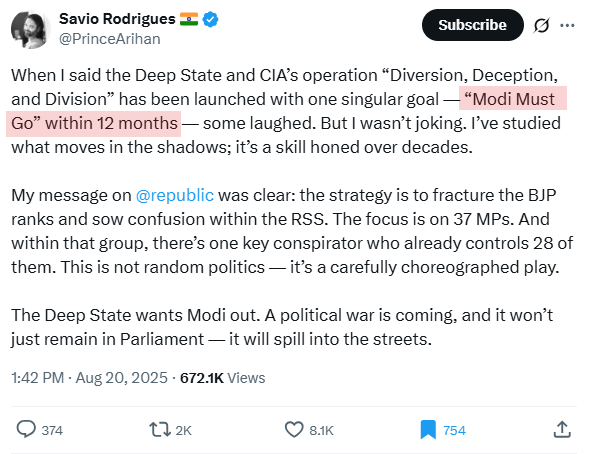
And when PM Modi made a remark which was seen as a joke, some wondered at the odd sense of humor of a man who is usually quite serious in these matters.
He said that he returned from the visit to Japan and China the night before, and the audience started clapping. He remarked - "Was the applause for the fact that I went there or that I returned from there?"
Was there more to that remark than we are not aware of?
Is the targeting of Modi personally because the powers in Europe and the US want to create a pliable India before the "big war" starts?
When Prime Minister Modi greeted Vladimir Putin and Xi Jinping warmly at the Shanghai Cooperation Organization summit, it was not just routine diplomacy. It was a calculated signal at a moment of shifting alignments. For months, Rahul Gandhi and elements within the Pakistani establishment have been edging closer to Washington, aligning with U.S. narratives that often seek to undermine India’s sovereign strategic autonomy. Beijing, which has watched the United States weaponize allies and proxies in Europe and Asia, is acutely sensitive to such moves.
We can see that in how Sharif was handled by Xi Jinping.
In fact, Pakistan's lack financial stability and impact on the CPEC (Belt and Road initiative) was called out at his face in a humiliating manner.
So you see, the optics of Modi’s SCO engagement serve a deeper purpose.
By projecting bonhomie with both Moscow and Beijing, Modi positions himself as the only Indian leader capable of keeping open a stable channel with the Eurasian axis. For China, which views the West as increasingly mercurial and untrustworthy, this matters enormously.
It creates a perception that Modi, despite recent frictions, is indispensable if India is to remain a credible partner in balancing Western pressure.
This has unintended but important consequences.
Should the U.S. establishment continue to pursue strategies aimed at destabilizing Modi’s leadership, Beijing and Moscow will have their own incentives to ensure he remains in power.
Any alternative Indian leadership—Rahul Gandhi or regional coalitions—already appears too compromised or co-opted by Western agencies. From Beijing’s perspective, such figures cannot be relied upon in the emerging great power contest.
Comments ()