
MAGA’s Civil War: How the Right’s Israel Split Is Rewiring Conservatism Globally
There is a MAGA civil was raging. Clash over what United States really ought to be. As it evolves, US is changing its role in the global scenario. We are examining the scenario.

Meaning of Home
In an old republic by the western ocean, there stood a mountain called Fox Peak.
For many years, all roads of the Right passed through that mountain. At its summit lived the Keepers of the Lamps—men in pressed robes who spoke in polished sentences and believed that order was kept by gates, alliances, and carefully trimmed words. They taught that beyond the sea stood a small citadel of great importance, and that to defend it was to defend civilization itself. They taught that the empire must remain strong, that markets must remain open, and that distant wars, though regrettable, were sometimes the price of keeping chaos at bay.
The people below listened because there were few other voices. The mountain had the loudest drums.
But in time, the river changed course.
Far from Fox Peak, in caves, garages, barns, and dimly lit rooms, new fires were lit. Men with uncombed hair and long questions began speaking into little bronze circles. Their voices traveled not by tower or cable, but by invisible wind. They did not speak for seven minutes. They spoke for three hours. They did not shave every argument into neat squares. They let them grow wild.
Hunters, truckers, coders, soldiers, tradesmen, restless sons, and disappointed fathers gathered around these new fires. They listened while old wars were reopened and old certainties placed on the table like bones.
“Why,” asked one voice from a cave, “must the empire bleed for every border but its own?”
“Why,” asked another from a barn, “must every alliance be sacred even when the people who pay for it can no longer afford bread?”
“Why,” asked a third from a dark room with a red light, “are some questions forbidden unless asked by approved men in approved buildings?”
The listeners did not always agree. But they kept listening.
Soon, the mountain was no longer alone.
The elders of Fox Peak looked down and saw, with unease, that the caves had grown into a valley, and the valley into a marketplace. There, merchants of outrage, prophets of grievance, jesters, sages, warriors, and cranks all sold their wares. Some sold truth. Some sold poison. Most sold both in the same bowl.
At the center of the marketplace stood three gates.
At the First Gate stood the Guardians. They still wore clean robes. They spoke of law, constitution, institution, civilization. They said, “The house is cracked, but it is still our house. Repair it, do not burn it.” They defended the distant citadel with fierce devotion and drew hard red lines around bigotry, madness, and open hatred. They believed a nation without discipline becomes a mob, and a movement without limits becomes a swamp.
At the Second Gate stood the Fire-Talkers. They wore no uniform. They distrusted think tanks, polished donors, and professional patriots. They said, “The house has been rented out to strangers. Why speak of curtains when the roof leaks and the pantry is empty?” They questioned wars, alliances, blank checks, and holy cows. They invited forbidden guests to speak, saying, “A dangerous thought does not become less dangerous when hidden. Bring it into the light.” Their crowds were larger, louder, angrier.
At the Third Gate, half in shadow, stood the Hollow Men. They spoke of blood, replacement, betrayal, and enemies behind every curtain. They hated not just the house, but many of those living in it. They mistook rot for truth because both smelled strong. Even the Fire-Talkers kept them at arm’s length, though some of their smoke drifted into the marketplace all the same.
One autumn, a dispute broke out over whether a poison-bearing wanderer should be allowed to speak near the marketplace well.
The Guardians cried, “To give poison a cup is to poison the well.”
The Fire-Talkers answered, “To forbid the cup is to make the poison sacred.”
The Hollow Men smiled, for every quarrel among their betters widened the crack through which they might enter.
Then another quarrel came, this time over the distant citadel beyond the sea.
For forty years, no one on Fox Peak had dared ask whether the old vow should be examined. The vow had become incense. One did not analyze incense. One breathed it.
But the young listeners in the valley had grown up not under the old sky of balanced wars. They had lived under the dust of new wars and witnessed graves of its victims. The debt they were forced to take on and high prices of everything in life due to that. The endless theater of distant urgencies.
They had seen images, not paragraphs. Flames, not white papers. Bleeding children, not strategic memos. Through the invisible wind of the new fires, suffering arrived before context and feeling before doctrine.
So one of them asked the unforgivable question:
“Does this sacrifice serve the republic, or only the memory of what the republic once thought itself to be?”
At once, the marketplace split into thunder.
The Guardians heard in the question the first footstep of hatred. They saw a straight road from doubting policy to despising a people. They unsheathed moral swords and declared the lines must hold.
The Fire-Talkers heard in the same question the first breath of honesty. They said the old priesthood was using sacred words to silence earthly scrutiny. They grew sharper, more mocking, less patient.
And the Hollow Men, watching from the dark, whispered, “Yes, yes—keep confusing criticism with hatred and hatred with criticism. Confusion is our bridge.”
Meanwhile, in the palace by the river, there sat a ruler with a talent for mirrors.
When he first rose, he denounced the old wars and mocked the Keepers of the Lamps. “No more forever roads,” he had said. “No more paying for everyone’s roof while ours collapses.” The tired and the angry loved him for it.
But once enthroned, he did not simply put down the sword. He changed the way he held it.
He no longer spoke of saving the world. He spoke of deals.
He no longer said the empire had a duty. He said it had a price.
He no longer preached universal ideals. He weighed territories, straits, minerals, routes, migrations, tariffs, ports.
He told allies, “Pay.”
He told rivals, “Yield.”
He told the people, “This is peace through strength.”
Yet more than once, when he claimed to leave the old road, he returned by another path. He scorned liberal empire in speech, but practiced imperial bargaining in deed. He rejected the old hymnbook, yet still summoned troops, threats, and strikes when it suited him. He said, “I hate the forever wars,” while opening new doors to shorter wars that threatened to become long ones.
A monk watching from a ruined monastery laughed softly and said, “The tiger has changed masks, but not claws.”
Then came a scroll from the palace—thick, solemn, stamped with the seal of the republic.
The scroll said:
- The nation-state is the final unit.
- Borders are sacred.
- Trade is strategy.
- Migration is siege.
- Alliances are contracts.
- Institutions beyond the nation are to be distrusted.
- The hemisphere is ours to order.
- Other civilizations are to be dealt with as they are, not remade.
Many in the valley called the scroll a restoration. Others called it a confession. A few called it by a quieter name: Hard Sovereignty.
The monk called it this: “A fortress teaching itself to speak like a civilization and a civilization teaching itself to think like a fortress.”
Fox Peak approved some of the scroll and feared the rest. The Fire-Talkers cheered its contempt for old global sermons, yet mocked its contradictions when the ruler who praised restraint marched with sudden force. The Hollow Men were delighted that words like civilization, erasure, and replacement had entered respectable weather.
Then, from the far side of the world, another quarrel arrived—this time over an ancient land of many gods and memories, wounded long by invaders, lectures, and foreign misunderstandings.
A woman from the western marketplace, sharp-tongued and reckless, traveled there. Some hoped the land would tame her; others hoped she would embarrass herself. Instead, the gathering became a stage upon which every tribe projected its hunger. The liberal host performed outrage. The guest performed defiance. The nationalists raised suspicion.
The old civilizational thinkers attempted alchemy: perhaps a critic could be turned by contact. Yet underneath all their voices lay a deeper confusion — who among them truly loved that ancient land, and who merely wished to use it in their own war against enemies elsewhere?
After the event, a young student asked the monk, “Master, who is winning?”
The monk picked up three stones.
He placed the first stone on the table and said, “This is the Mountain. It has money, memory, buildings, donors, legal offices, and doors to power.”
He placed the second stone down and said, “This is the Fire. It has energy, grievance, youth, virality, mood, and the ear of the disenchanted.”
He placed the third stone down and said, “This is the Shadow. It has no kingdom, but it thrives wherever men stop distinguishing wound from wisdom.”
Then he swept all three stones into a bowl of water.
The student frowned. “What does this mean?”
The monk said, “You are asking the wrong question.”
He pointed to the bowl.
The stones were no longer visible. Only ripples remained.
“Power,” said the monk, “is no longer where men think. It has left the summit but has not yet settled in the valley. The mountain still owns the roads. The fire owns the weather. The shadow owns every unattended corner. And the palace sits beside the river, learning to drink from all three.”
The student was silent for a long time.
At last he asked, “Then is the movement collapsing?”
The monk shook his head.
“When a snake sheds its skin,” he said, “the old skin calls it death.”
The student bowed. “And what of the republic?”
The monk looked west, where the sun was falling behind the ocean.
“The republic,” he said, “has entered the age when every tribe speaks of saving the house while secretly arguing over who will inherit the keys.”
“Will they destroy it?”
The monk smiled sadly.
“Perhaps. But first, they will rename every room.”
Then he added, after a pause:
“Remember this. A civilization does not fall only when enemies batter its gates. It also falls when its storytellers forget whether they are chroniclers, merchants, or priests. And when its people, weary of lies, begin to prefer any voice that bleeds.”
The wind moved through the pines.
Far below, Fox Peak still glowed.
In the valley, the fires still burned. In the shadows, patient faces still waited.
And over all of it, unseen but everywhere, the invisible wind carried voices without end.
The student listened.
For the first time, he understood that the war was not only over policy, or party, or one distant citadel, or one ruler with many masks.
It was over the meaning of home.
And when the meaning of home is unsettled, every messenger becomes a general, every microphone becomes a sword, and every argument begins to sound like prophecy.
New American Conservative Landscape and Its Internecine Battles
There is a perceptible shift happening within the conservative narrative landscape that is already impacting the global geopolitical scenario is a profound manner.
The contemporary conservative media ecosystem in the United States has undergone a structural transformation, with podcasters, social media influencers, and alternative digital outlets emerging as central actors in shaping political narratives and policy discourse.
For decades, the conservative narrative was closely guarded by a strict oligopoly of legacy institutions: traditional Washington think tanks, centralized television networks like Fox News, and established, rigidly formatted talk radio syndicates. These gatekeepers enforced a relatively uniform orthodoxy that tightly bound free-market capitalism with neoconservative foreign policy, ensuring that dissenting isolationist voices were marginalized as fringe elements.
Today, that centralized control has been utterly annihilated by the "Podcast Revolution." Independent broadcasters and digital platforms hosted by figures such as Joe Rogan, Lex Fridman, Tucker Carlson, and Steve Bannon now attract highly dedicated audiences that dwarf the viewership of traditional cable news networks.
This decentralized, heterodox ecosystem thrives on anti-establishment sentiment, intentionally blurring traditional left-right political boundaries while overwhelmingly promoting a hyper-masculine, anti-interventionist, and highly skeptical populist worldview.
Because podcasting relies on long-form, unscripted conversation—often stretching to three hours or more—it allows for the exploration of deep, systemic critiques that legacy media soundbites simply cannot accommodate.
Hosts like Rogan and Carlson frequently feature guests who fundamentally question the foundational premises of the American empire, challenging the necessity of the military-industrial complex, critiquing the intelligence community's involvement in domestic censorship, and denouncing the "forever wars" of the 21st century.
The result is a massive, deeply engaged, and overwhelmingly male audience that views federal institutions, overseas entanglements, and traditional foreign policy experts with extreme suspicion.
A review of hundreds of hours of podcasts and television shows, thousands of social-media posts, and interviews with dozens of political insiders reveals an increasingly symbiotic relationship between the Trump administration and the new conservative media class.
Right-wing influencers and conservative media personalities, often working in lockstep with Trump officials, have become a potent force in a widening campaign of retribution against perceived enemies of the Trump administration. Empowered by ownership and technology shifts in the media and bolstered by financial incentives, these figures help discredit Trump’s rivals and amplify his administration’s talking points and false claims, blurring boundaries between official messaging and private-sector news and opinion. This account is based on a review of more than 300 hours of podcasts and TV shows, thousands of social media posts and interviews with 48 people – including influencers, elected officials, political strategists and media owners — and an examination of court filings. (Source: In Trump’s second term, MAGA-aligned influencers and conservative media reshape America's information landscape / Telegraph India via Reuters)
Unlike earlier eras when conservative media largely functioned as commentators or critics of political power, many influencers today operate as active participants in political messaging and agenda-setting.
For example, during episodes in which National Guard troops were deployed to American cities, pro-Trump influencers widely amplified government portrayals of Democratic-led urban areas as descending into chaos, despite official crime statistics indicating declining violence in many cities.
This dynamic reflects what analysts describe as a direct feedback loop between political authority and the influencer ecosystem.
The White House has actively cultivated this relationship, inviting right-wing media personalities to policy discussions and granting them unprecedented access to senior officials. Figures such as Tucker Carlson, Ben Shapiro, Steve Bannon, and others have helped construct a decentralized but highly influential conservative media network spanning podcasts, streaming platforms, and social media.
As University of Oregon researcher Whitney Phillips observes, there now exists a “direct line between MAGA media and the halls of power,” allowing digital personalities to shape political messaging while simultaneously reinforcing the administration’s narrative that mainstream news organizations represent a hostile liberal elite.
Technological and institutional changes have accelerated this shift. Elon Musk’s transformation of X (formerly Twitter) and Meta’s rollback of content moderation policies have significantly expanded the reach of pro-Trump accounts, while media ownership changes, from Jeff Bezos’ restructuring of editorial policy to new leadership at major outlets, have altered the broader information environment.
At the same time, podcast audiences have surged, with pro-Trump programs dominating the top political podcast rankings.
The result is a media ecosystem characterized by strong ideological alignment with Trump and remarkable loyalty among leading influencers, even amid policy controversies.
Analyses of influencer commentary following political disputes—such as debates over the Epstein investigation—show that criticism is often redirected toward administration officials rather than the president himself.
Taken together, these developments illustrate the emergence of a hybrid political-media coalition in which digital influencers, podcast hosts, and sympathetic media owners function not merely as observers but as integral participants in shaping the narrative architecture of modern American conservatism.
The Fight
In the last few months, however, the commentators within the conservative space have been having raging internecine battles.
This was underscored by this article on Mediaite.
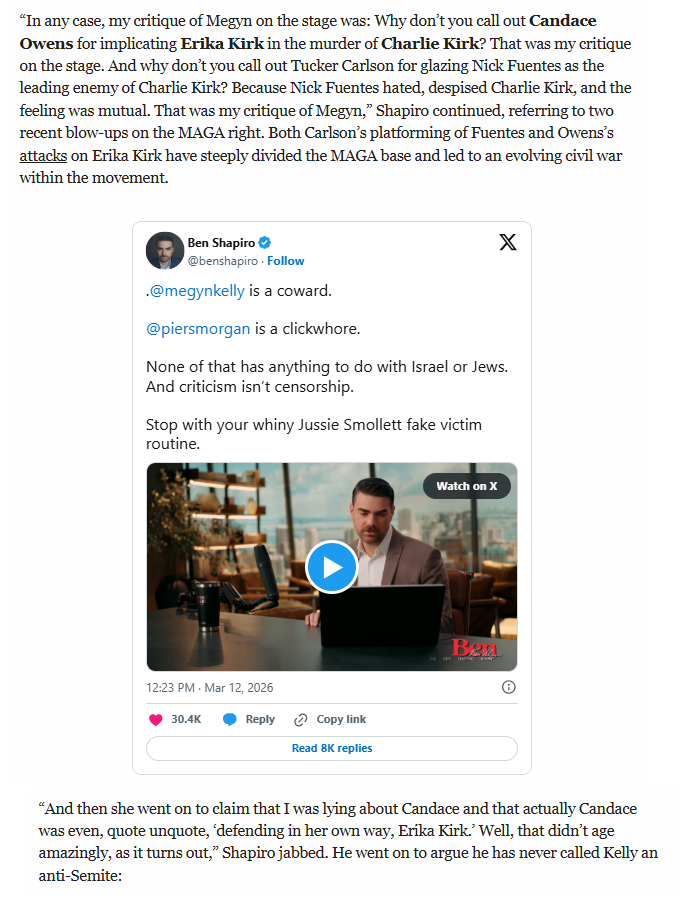
So if one closely looks at the different factions emerging, it is clear that there are three clear, distinct ones:
A. Institutional / Traditional Conservative Right: This camp represents the legacy, institution-minded conservative movement that wants to preserve the system rather than blow it up.
Their worldview is defined by several core instincts:
- Strongly pro-Israel, with an emphasis on Israel as a democratic ally and a frontline state in a civilizational struggle.
- Firmly anti-antisemitism, regularly drawing red lines against overtly antisemitic or neo-Nazi figures and calling them out as illegitimate.
- Supportive of U.S. institutions—courts, the Constitution, the military, elections—believing the system is flawed but fundamentally worth defending and reforming, not overthrowing.
- Socially conservative and combative against the left, but ultimately incrementalist; they want cultural and political pushback, not revolutionary upheaval.
In their own self-understanding, they are the camp of “responsible conservatism”: pro-law, pro-order, pro-constitution, and eager to distinguish themselves from both the radical left and the truly extremist right.
B. Populist / Post-Fox MAGA Media: This faction is more insurgent, more anti-elite, and more in tune with grassroots anger than with think-tank orthodoxy. It includes personalities such as Tucker Carlson, Megyn Kelly, and Candace Owens, whose audiences are less interested in preserving institutions and more interested in punishing the establishment.
Their worldview looks like this:
- Deeply anti-establishment: hostile not only to the liberal left but also to the old Republican “uniparty” they see as corrupt, globalist, and disconnected from ordinary Americans.
- Critical of foreign wars and skeptical of interventionism, especially after Iraq and Afghanistan; they question the military-industrial complex and the bipartisan foreign-policy consensus.
- More skeptical of traditional pro-Israel orthodoxy—not necessarily anti-Israel, but more willing to question aid, strategy, and U.S. entanglement than the institutional right.
- Comfortable platforming controversial or fringe voices, including figures with extremist histories, in the name of “open debate” or attacking political correctness.
They speak directly to the populist base—people who feel betrayed by legacy media, legacy Republicans, and legacy institutions.
C. Fringe / Dissident Right: Beyond both the institutional conservatives and the populist MAGA media lies the dissident or fringe right, a space that is explicitly radical and often openly bigoted.
Figures like Nick Fuentes operate here, positioning themselves not as reformers of conservatism but as its total replacement.
This group:
- Pushes extreme ethno-nationalist and explicitly exclusionary ideas, often framed around white identity and “civilizational” struggle.
- Is frequently openly antisemitic and Holocaust-denying, attacking not just liberal institutions, but also conservative Jews and mainstream pro-Israel voices.
- Rejects U.S. institutions as irredeemably corrupt, “globalist,” or controlled by enemies; they are not trying to conserve the system but to overturn or outflank it.
- Is publicly disavowed or kept at arm’s length by most mainstream conservatives, including many in both the institutional right and the populist MAGA world, even when there is occasional overlap in audience or online ecosystems.
Where the institutional right wants to protect the system and the populist right wants to punish the establishment, the dissident right ultimately wants something closer to regime and cultural replacement. This makes it radioactive, even to many hardline conservatives.
The Controversies
Three recent controversies have converged into a larger struggle over the future of the American right.
- The first centers on Nick Fuentes being given a platform. Ben Shapiro and others in the institutional right argue that offering him airtime effectively legitimizes antisemitism and brings explicitly bigoted ideas closer to the conservative mainstream. By contrast, figures in the populist and post-Fox ecosystem, including Tucker Carlson and his allies, frame the issue as one of open debate and free speech, insisting that even deeply controversial voices should not be censored but confronted in public.
- The second controversy involves Candace Owens and her very public split with the Daily Wire. What might have looked like a personal or contractual dispute quickly evolved into a proxy fight over tone, loyalty, and ideological boundaries on the right. Her break with Shapiro’s outlet did not create the divide, but it dramatically widened existing tensions between institutional conservatives and the more insurgent, populist media sphere that thrives on attacking “the establishment”—including conservative institutions themselves.
- The third fault line runs through debates over Israel and, more broadly, foreign policy. A growing segment of MAGA-aligned voices is questioning longstanding assumptions about America’s role in foreign wars and the depth of the U.S.–Israel relationship. They are more skeptical of interventionism, more critical of foreign aid, and more willing to challenge pro-Israel orthodoxy from the right. Shapiro and his camp view this trend as dangerous, seeing it as a gateway to both isolationism and the normalization of antisemitic narratives.
Taken together, these three controversies are not isolated skirmishes; they are different fronts in a single argument about what the American right will become in the post-Trump, post-Fox era.
Is MAGA imploding?
Is the MAGA movement imploding? Not really. What we are watching instead is internal churn—a struggle to define the soul of conservatism, particularly MAGA, in a rapidly shifting world.
To make sense of this, we need to step back and look at where the real ideological split lies.
What is conservatism now?: At the core is a dispute over the meaning of conservatism itself.
- In the Shapiro-style view, conservatism means defending traditional values anchored in strong, enduring institutions—constitutional order, established media platforms, and a rules-based political process.
- In the Carlson-style view, conservatism has morphed into populist nationalism: a revolt against elites, the permanent establishment, and the “uniparty,” with greater emphasis on representing the aggrieved base than on preserving institutional norms.
What should America’s foreign policy be?: The right is also divided over America’s role in the world.
- One camp still leans toward interventionism, viewing U.S. power as a force for shaping global outcomes.
- Another, the America First realists, wants a harder-edged, interest-driven approach: fewer foreign entanglements, greater skepticism toward war, and a sharp critique of globalism.
These tensions have sharpened in the wake of the Ukraine war, ongoing conflicts involving Israel, and a broader collapse of trust in global institutions and internationalist projects.
Who defines the movement?: Finally, there is a power struggle over who gets to speak for the right.
- The old model centered on think tanks, legacy conservative institutions, and the Fox News orbit.
- The new model is driven by independent podcasts, X and YouTube personalities, and decentralized online communities.
As influence shifts from institutions to individual creators, public feuds and factional battles are almost inevitable—because what’s really at stake is not just ideas, but authority over the conservative audience itself.
What’s happening on the American right is less an implosion than a reordering of power inside a crowded conservative media and political ecosystem. Three big shifts are underway at once: the old Fox-dominated era is loosening; podcast and influencer conservatism is surging; and long-settled foreign-policy assumptions are being reopened. That is evolution, not collapse.
The movement is not falling apart; it is redefining itself. The central fault line now runs between institutional conservatism—anchored in outlets like The Daily Wire, legacy think tanks, and parts of Fox—and populist nationalist conservatism, driven by post-Fox personalities on X, podcasts, and YouTube.
The Shapiro–Kelly–Carlson clashes are best understood as a battle for narrative control and audience loyalty, not as the end of MAGA.
Who is Winning?
Let us understand this then - can we see the new emerging winners as the churn grows? Are there clear winners emerging who can define the coming years and elections?
Well, as it stands, one can say there are competing centers of gravity, not a single clear winner.
- Institutional players like Fox and The Daily Wire still command huge audiences, big ad dollars, and deep ties to donors and campaigns, which gives them real leverage in shaping GOP messaging and candidate pipelines.
- Populist media figures such as Carlson-aligned and Kelly-style podcasters have outsized cultural influence among activists and younger, online-first conservatives, helping set the mood and litmus tests of the grassroots.
- The more fringe dissident right has influence at the margins of the base conversation, but its toxicity makes it unlikely to control the broader electoral direction, even as its talking points occasionally bleed into mainstream debates.
In electoral terms, whoever can bridge institutional infrastructure (money, data, turnout operations) with populist energy (online audiences, cultural momentum) will be best positioned to define the right’s agenda in 2028 and beyond. No single media faction has achieved that synthesis yet—which is precisely why the current struggle is so intense.
For your purposes, do you want this framed more as a neutral analytical brief or as a pointed argumentative section in a larger essay?
American Conservatism and the Global Change
For forty years, the American right treated Israel not as a debate, but as a given. From Reagan through Trump’s first term, Republican foreign policy ran on muscle memory: Israel was “our closest ally in the Middle East,” support was automatic, and anyone questioning that was suspect or fringe.
Evangelical theology sacralized this alignment, seeing Israel as central to Biblical prophecy.
Since roughly 2021, a new populist right has begun to ask an unforgivable question in old conservative circles: “Are these foreign commitments serving America first, or not?” Tucker Carlson, Candace Owens, and a wider constellation of post-Fox voices have taken that question from the margins to the center of the conversation. Their case is blunt: foreign wars bleed American resources, alliances should be transactional, and no country—including Israel—should get a blank check. This isn’t inherently anti-Israel, but it absolutely is anti-automatic.
The reason this debate exploded now is simple: the global order cracked, and the bill for twenty years of “permanent war” finally arrived. The Ukraine conflict turned what used to be a niche objection into a mass sentiment: why is Washington writing endless checks for other people’s borders while America’s own is a joke? Traditional conservatives doubled down on the old script—contain Russia, defend democracy, keep faith with allies. Populists said: we’ve heard this sales pitch before, and it ended in Iraq and Afghanistan. Then Israel’s latest wars forced the same question in a far more emotionally charged theater.
To millions, it suddenly looked like a pattern: Washington as a global security contractor for every cause except its own citizens.
Layered on top of this is the collapse of centralized gatekeeping.
For decades, Fox News, major think tanks, and party donors could set the boundaries of “respectable” debate. Now, podcasts, X, YouTube, and independent creators have shattered that monopoly. Arguments that would once be killed in a green room now play out in real time, at scale, in front of millions. The right’s foreign policy is no longer negotiated in closed-door seminars; it is fought out in live streams, viral clips, and algorithm-driven outrage. That chaos is not an accident—it’s the new structure.
This is why Ben Shapiro is swinging so hard. For his faction, the erosion of automatic support for Israel is not just a policy disagreement; it’s a red alert.
In their view, populist rhetoric creates a giant opening for people who don’t just oppose specific wars, but openly hate Jews and want to smuggle that hatred back into the mainstream. From that perspective, compromise is impossible. Any softening becomes complicity.
Hence the scorched-earth tone: not just criticism, but moral excommunication.
Populists, in turn, are done being guilt-tripped into silence.
They argue (in a way, correctly) that opposing specific wars or questioning aid packages is not the same thing as hating Jews.
The fact is that what is being done through the war could have been accomplished through deft diplomatic work and covert operations.
These commentators see the “antisemitism” label being thrown around as a blunt weapon to shut down legitimate scrutiny of policy, just as charges of “racism” were often used to suffocate immigration or crime debates.
This is why Megyn Kelly, Carlson, and others have escalated: for them, this is not just about Israel, it’s about whether the old guard can still police what may and may not be said on the right. Either foreign policy is open to full, brutal critique—or it isn’t.
Trump, characteristically, has tried to eat from both plates. He wrapped himself in the strongest pro-Israel record of any recent president (Jerusalem, the Golan, the Abraham Accords) while preaching “America First” and attacking endless wars.
His personal popularity allowed him to hold the coalition together by sheer force of personality. But that balancing act doesn’t scale. Commentators and influencers don’t have his gravitational pull, so the underlying contradiction he papered over is now ripping out into the open.
Strip away the personalities, and the question is stark:
That same fault line is now visible across the global right:
- Civilizational conservatives see Israel as a frontline outpost of “our side” in a broader clash with Islamism and illiberal ideologies. For them, standing with Israel is part of defending the West itself.
- Sovereigntist nationalists accept Israel as an ally but refuse automatic alignment. Their priority is domestic stability, economic survival, and avoiding foreign quagmires.
Europe filters this through migration and Islamist radicalism.
India sees a parallel with its own fight against jihadist movements while balancing ties with the Gulf.
Latin America’s new right splits between Milei-style civilizational alignment and inward-focused nationalists who barely care about the Middle East.
Underneath all this is a deeper historic turn: the post–Cold War, U.S.-managed order is dissolving, and the right must decide what replaces it.
There are three broad futures:
- a civilizational alliance politics that binds “the West” (and its allies like India and Israel) into a strategic bloc,
- a hard sovereigntist politics that treats all alliances as expendable, or
- a cynical multipolar game where everyone cuts deals with everyone.
The fight over Israel is not a side argument. It’s the stress test for what the right really believes about power, identity, and who “we” are. And there’s no technocratic way out: one side will eventually have to lose.
How is this debate shaping the larger public opinion today? Let us check.
Changing Public Opinion?
Public support in the United States for Israel’s military operations in Gaza has experienced a notable erosion. According to recent Gallup data, American approval has declined by ten percentage points since the previous measurement in September, falling to 32 percent—the lowest level recorded since Gallup first began tracking public sentiment on the issue in November 2023. Conversely, disapproval has risen to 60 percent, signaling a widening gap between proponents and critics of the campaign.
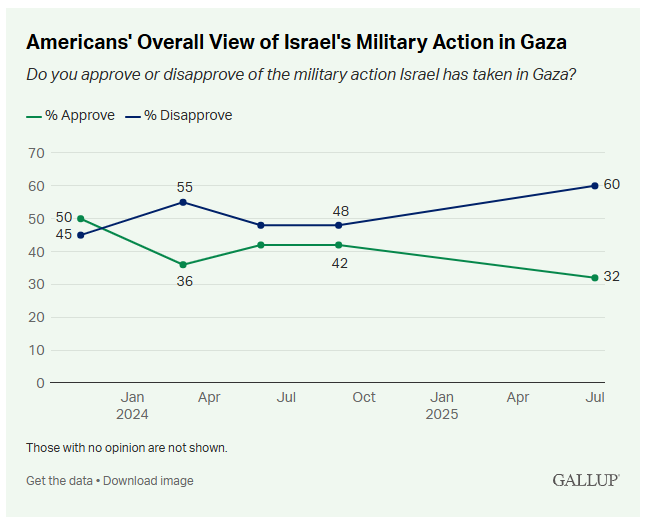
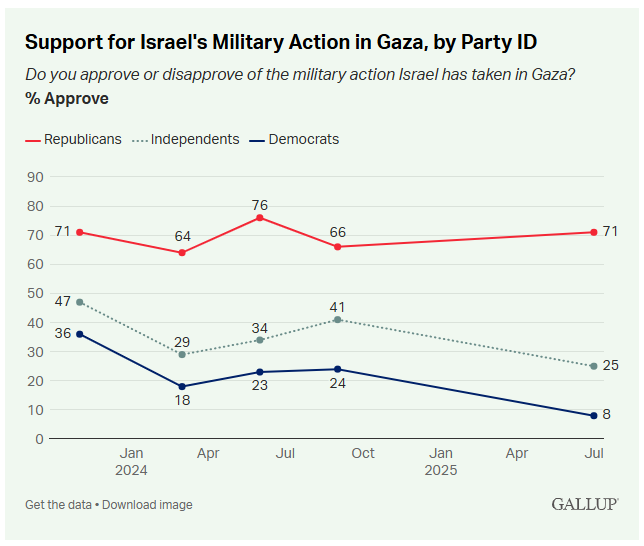
The shift in opinion is driven primarily by substantial changes among Democrats and political independents, both of which recorded 16-point declines in approval.
While independents continue to exhibit somewhat higher levels of support than Democrats, their approval has dropped to 25 percent, marking their lowest level since the conflict began.
Among Democrats, support has fallen even more sharply, reaching just 8 percent, underscoring the profound skepticism toward Israel’s military conduct within that constituency.
Republican attitudes, however, have moved in the opposite direction. Seventy-one percent of Republicans now approve of Israel’s military actions, an increase from 66 percent in September, reinforcing the growing partisan divide in American public opinion. The data, therefore, reflects not only declining overall approval but also the deepening polarization of U.S. political attitudes toward the Gaza conflict.
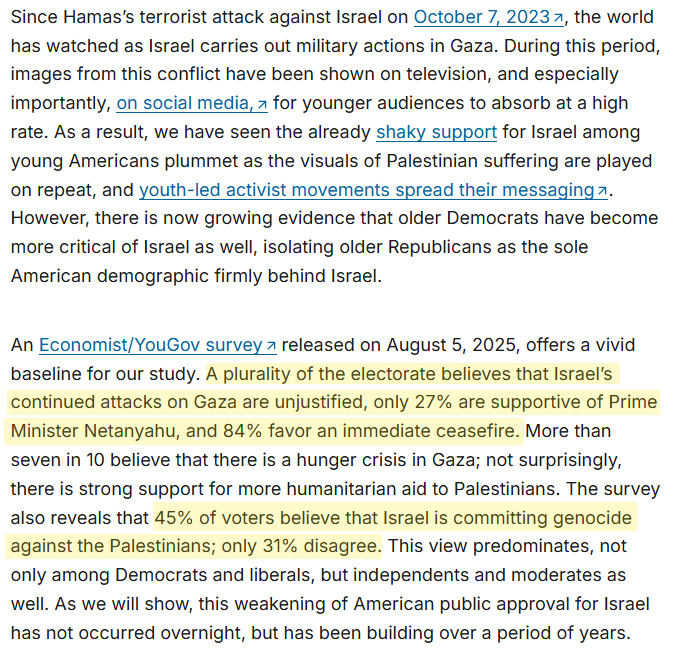
Findings from a YouGov survey conducted with The Economist indicate a significant erosion of public support for Israel’s ongoing military operations in Gaza. A plurality of voters reportedly view Israel’s continued attacks as unjustified, only a minority expresses support for Benjamin Netanyahu, and a large majority favors an immediate ceasefire.
Nearly half of the respondents believe Israel is committing genocide against Palestinians—an accusation strongly disputed by Israel and its supporters but increasingly visible in global political discourse.
This shift appears to be driven partly by the information environment of the digital age, particularly social media platforms where images and narratives from the conflict circulate rapidly and continuously. Younger Americans, in particular, are consuming these images and organizing activism around them, amplifying pro-Palestinian messaging and humanitarian concerns.
For decades, support for Israel in the United States rested on a relatively stable bipartisan coalition:
- Republicans (strongly pro-Israel)
- Democrats (generally supportive but more conditional)
The poll above suggests that this structure is changing.
Younger Democrats and many independents are becoming increasingly critical of Israeli policy, while older Republicans remain the strongest supporters. This leaves Israel politically anchored primarily in one ideological camp, which has not historically been the case.
There are other polls and studies on how the views and opinions within the US are changing as well.
 John B. Judis,
 Laura Silver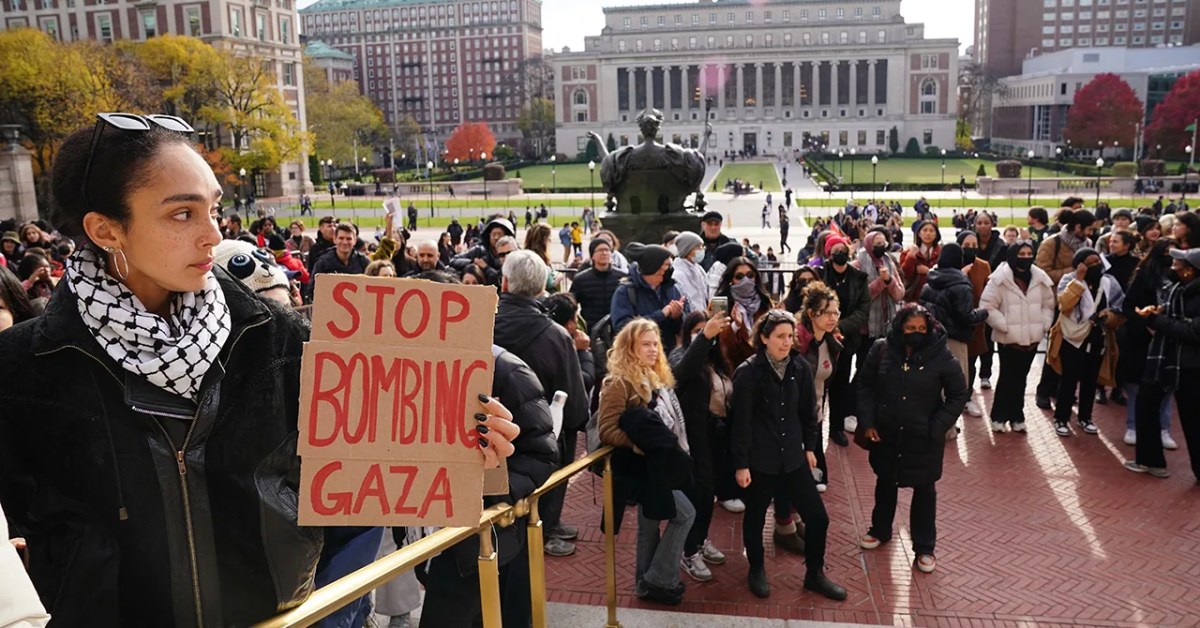
The data from various surveys compiled throughout late 2025 and early 2026 reveals a staggering, unprecedented generational divide within the conservative movement.
Older Republicans (aged 50 and above), whose foundational political worldview was shaped by the stark moral binaries of the Cold War and the absolute necessity of defeating the Soviet Union, remain staunchly hawkish, fiercely pro-Israel, and highly supportive of preemptive military intervention against regimes like Iran.
However, younger Republicans (aged 18 to 34), whose formative political experiences include the disastrous outcomes of the Iraq and Afghanistan wars, the 2008 global financial crisis, and rampant domestic inflation, view all foreign entanglements through a lens of deep, unyielding cynicism.
This massive divergence is unequivocally visible across multiple specific polling metrics gathered during the height of the 2025-2026 Middle East crises:
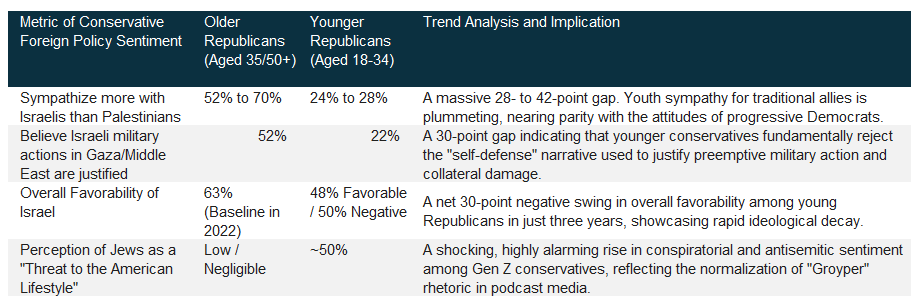
This data indicates that the traditional Republican consensus on foreign policy is mathematically unsustainable. As the older cohort naturally ages out of the electorate over the next decade, the populist, non-interventionist, and increasingly anti-Israel wing of the party will achieve absolute demographic dominance, permanently altering the trajectory of American statecraft.
The "Donroe" Doctrine
Donald Trump first captured the presidency by championing an “America First” agenda and sharply criticizing the neoconservative foreign policy that had defined the Republican Party during the George W. Bush years. On the 2016 campaign trail, Trump repeatedly condemned the Iraq War and the broader interventionist mindset that had drawn the United States into prolonged conflicts in Iraq and Afghanistan.
Yet the trajectory of his foreign policy has evolved in striking ways. Following the dramatic removal of Venezuelan leader Nicolás Maduro and escalating confrontations with countries such as Iran and Colombia, Trump has pushed the United States toward a new form of interventionism. Observers have begun describing this approach as the “Donroe Doctrine,” a modern reinterpretation of the historic Monroe Doctrine that emphasizes American dominance and strategic primacy in the Western Hemisphere.
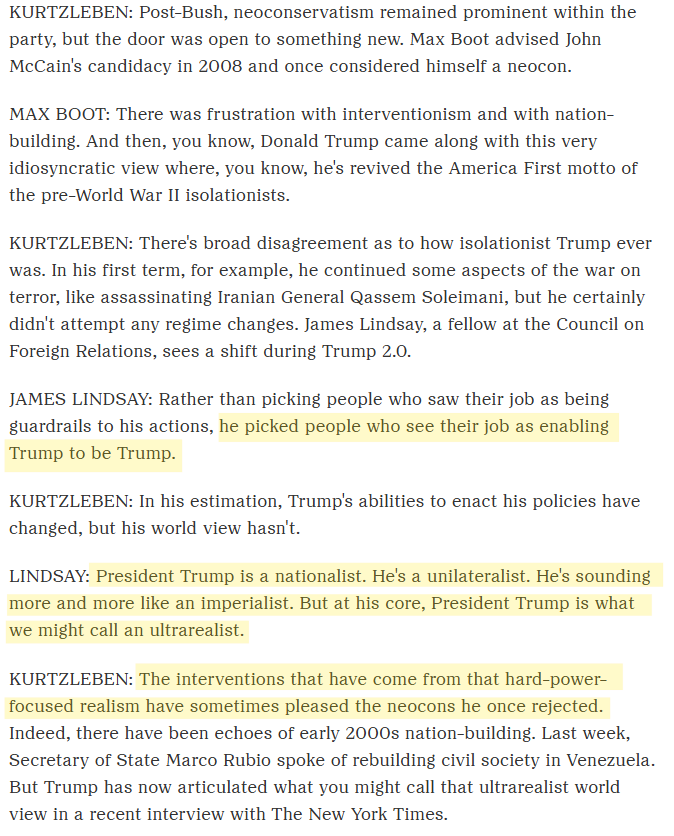
The NPR conversation (with host Danielle Kurtzleben and foreign-policy analyst James Lindsay) revolves around a central puzzle in American politics: Is Donald Trump an isolationist, a nationalist, or something else entirely?
Some important points that the discussion brings forth are:
- After the George W. Bush era, neoconservatism dominated Republican foreign policy—characterized by interventionism, democracy promotion, and nation-building. Figures like Max Boot advised Republican leaders such as John McCain and represented this worldview.
- Trump emerged in response to this model. His rhetoric revived the “America First” tradition, historically associated with pre–World War II isolationism. Many voters who were frustrated by endless wars in Iraq and Afghanistan embraced his promise to end nation-building and reduce global policing.
- Analysts in the discussion argue that Trump’s record complicates the label of isolationist. For example, he continued aspects of the War on Terror and ordered the assassination of Iranian General Qassem Soleimani. He avoided large regime-change wars but still used targeted military power.
- According to Lindsay, Trump’s second term reflects a shift in personnel and power structure. Instead of advisers acting as “guardrails,” Trump selected people who enable his instincts and worldview.
Lindsay characterizes Trump’s worldview as nationalist, unilateralist, and “ultrarealist.” In this view:
- Alliances matter only if they serve American power.
- International institutions are secondary to direct leverage.
- Power politics—not ideology—drives decisions.
So the NPR discussion concludes that Trump has not abandoned intervention entirely; instead, he has redefined it through a nationalist lens.
Trump's New Path: From Global Policeman to Imperial Bargainer
Donald Trump’s political genius lay less in exercising power than in redefining the terms of America’s foreign-policy debate. Instead of merely tweaking existing doctrines, he upended decades of bipartisan consensus and reconstructed the vocabulary of global leadership.
His transformation of U.S. strategy, from liberal internationalism to what might be called imperial bargaining, has profoundly reshaped the ideological landscape of American politics.
Phase 1: Killing the Neocon Dream: From 9/11 through the Obama years, Washington’s elites spoke one language abroad: neoconservatism. American primacy was to be protected through a blend of democracy promotion, military intervention, global alliances, and an unshakeable belief that the U.S. was the indispensable nation.
Trump torched that gospel. On the campaign trail, he called out the Iraq War as a disaster, mocked NATO allies as freeloaders, and blasted globalism for exporting American jobs. His message hit voters where they lived—after two decades of endless wars and industrial hollowing, “America First” wasn’t isolationism. It was common sense.
He became the first Republican in a generation to say out loud what voters already felt: that the United States had been played for a sucker under the banner of global leadership.
Phase 2: The Rise of “America First Realism”: Once in power, Trump didn’t abandon the assertion of U.S. strength; he flipped its purpose. Gone was the moral packaging of “making the world safe for democracy.” In its place came a blunt new equation: American power should serve American advantage, period.
Allies were told to pay more for their own defense. Trade partners faced tariff threats. Multilateral deals—from climate accords to trade pacts—were shredded. Washington no longer pretended that global leadership was a burden generously carried for humanity’s sake. Under Trump, leadership meant using every tool—economic, military, or diplomatic—as an instrument of national self-interest.
It looked like retrenchment, but it was really a strategic repositioning. Trump wasn’t retreating from the world; he was renegotiating America’s relationship with it.
Phase 3: Coercion in Plain Sight: For all the talk of restraint, Trump governed through power projection wrapped in showmanship. Whether it was the strike that killed Iranian general Qassem Soleimani, sanctions that crushed Venezuela’s economy, or his surreal proposal to buy Greenland from Denmark, the pattern was the same: turn U.S. influence into leverage.
He bluffed Canada on trade, berated NATO partners, and weaponized tariffs like precision bombs. This wasn’t humanitarianism or even traditional diplomacy—it was pure transactional bargaining.
It would act like a superpower that knew exactly what it was doing.
The Trump Synthesis: Power Without Apologies
The genius of Trumpism is that it fuses two contradictory streams of American conservatism.
From the neoconservatives, he kept the conviction that the United States should dominate. From the America First nationalists, he borrowed the demand for sovereignty and disengagement from costly adventures.
The blend produced a hybrid worldview: fight fewer wars, but flex more muscle.
Instead of promoting democracy, Trump sold power as negotiation.
Instead of rule-making, he offered rule-bending. One message for his base: we’re done with nation-building. Another for the world: don’t mistake restraint for weakness.
Why It Worked: Politically, Trump’s foreign policy was a masterstroke. He resolved a long-running civil war inside the GOP by giving each faction a piece of what it wanted. The neocons got toughness. The realists got pragmatism. The nationalists got defiance.
At home, he channeled America’s war fatigue. After Iraq and Afghanistan, voters were eager to hear that the elites who sold those debacles had been wrong. Trump turned anti-interventionism into a populist rallying cry—without ever surrendering the language of strength.
Geopolitically, his instincts matched the moment. The illusion of a unipolar world was collapsing as China rose, Russia reasserted itself, and alliances frayed. Trump didn’t mourn the decline of American hegemony; he monetized it. In his view, a multipolar world wasn’t a problem—it was a marketplace.
The Contradiction at the Core: Still, Trump’s “America First realism” was always haunted by contradiction. He spoke the language of restraint but acted through constant escalation. Was it a clever form of pragmatic realism, Nixonian in its cunning? Or a return to naked imperial bargaining stripped of idealism? Skeptics saw a third option: theatrical nationalism designed mostly for domestic consumption, where each dramatic move abroad—be it a strike, a tariff, or a snub—reinforced the story of Trump as defender of sovereignty against global elites.
The MAGA Doctrine’s Next Chapter: Whatever label one prefers, Trump’s reframing has permanently shifted the Republican Party’s center of gravity. Future MAGA-aligned leaders will likely embrace economic protectionism, skepticism toward alliances, and selective dominance over liberal internationalism.
Globally, this points toward a world drifting back to power blocs and hard bargains. The U.S. leverages resources, China expands influence, Russia fortifies its sphere, and Europe hides behind regulatory strength. It’s neo-mercantilism in motion.
The End of the Liberal Consensus: Trump didn’t make America isolationist; he made it unapologetically self-interested. By gutting the moral language of liberal internationalism, he unveiled a blunter truth about power: nations act for advantage, not ideals. Whether this realism becomes a durable strategy or devolves into cynical nationalism depends on what comes next.
What’s undeniable is that the age of global guardianship is over. America is no longer the world’s policeman—it’s the world’s bargainer, cutting deals from a position of strength and letting everyone else adjust.
And this brings us to how the churn within the conservative idea-space is now leading to a complete shift in the American global strategy. No better document to get a sense of that than the 2025 National Security Strategy.
Doctrinal Shift: The 2025 National Security Strategy
To comprehensively understand the current ideological fracture, one must examine the doctrinal framework established by the Trump administration's National Security Strategy (NSS), published and disseminated in December 2025.
The document represents a total, unapologetic repudiation of the post-Cold War globalist approach, transitioning the United States away from the paradigm of "liberal hegemony" and replacing it with a dual doctrine defined as "Civilizational Realism" and "Hard Sovereignty".
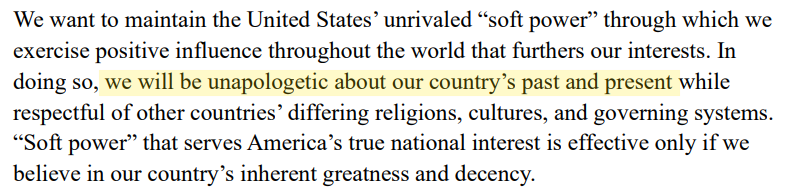
Under the doctrine of "Hard Sovereignty," the 2025 NSS explicitly rejects the notion that the United States should continue to serve as the primary underwriter of global security, effectively dismantling the idea of internationalism managed through supranational institutions.
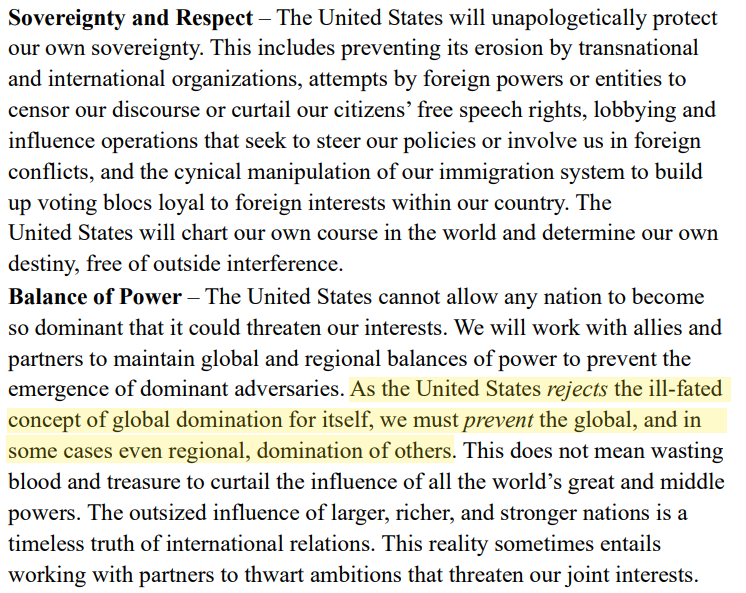
The strategy treats the nation-state as the sole legitimate political unit, elevating trade protectionism, universal tariffs, and stringent immigration control from domestic policy debates to core strategic elements of national defense.This doctrinal shift fundamentally alters the American relationship with its traditional allies, particularly in Europe.
The NSS demands that NATO allies increase their defense spending to an unprecedented 5 percent of their Gross Domestic Product (GDP)—more than double the previous 2 percent target—threatening to revoke Article 5 mutual defense protections for nations that fail to meet this massive burden-sharing threshold.
The document asserts a "Trump Corollary to the Monroe Doctrine," signaling a hard, exclusionary pivot toward the Western Hemisphere. This corollary aims to restore absolute American hegemony in the Americas, actively pushing out Chinese and Russian infrastructure investments in Latin America while treating the region not merely as an area for diplomatic engagement, but as a heavily militarized buffer zone against narcotics trafficking and irregular migration.
The second pillar, "Civilizational Realism," frames the United States not as an expanding liberal empire seeking to spread democratic norms, but as a "sovereign fortress" under siege from both external geopolitical rivals and internal cultural subversion.
This perspective is profoundly and aggressively transactional. It officially terminates the era of human rights conditionality and nation-building, opting instead to accept authoritarian partners—particularly in the Gulf States and across Africa—"as they are," provided they align strictly with American energy dominance and security interests.
Africa, for instance, is marginalized in the document, viewed almost exclusively as a battleground for competition over critical mineral resources with China, rather than as a continent requiring social or political development.
Most alarmingly for traditional transatlantic relations, the strategy openly echoes the rhetoric of European nationalist and nativist movements. The NSS warns against the "stark prospect of civilizational erasure" in Europe, attributing this existential threat to mass migration, the regulatory overreach of entities like the European Union, and the suppression of far-right political speech.
Analysts have noted that the administration's use of the term "civilizational erasure" closely mirrors the "Great Replacement" theory frequently utilized by nativist elements, signaling an ideological alignment with right-wing populist parties rather than traditional European centrist governments.
By adopting this posture, the administration has signaled to the world that the era of American "strategic altruism" is dead; security is now a high-priced commodity, alliances are strictly contractual, and every nation must pay its way in a zero-sum global arena.
However, this overarching strategy is inherently contradictory. While the NSS preaches restraint, isolationism, and a withdrawal from the "forever wars" of the Middle East, the administration's actual foreign policy in early 2026 has been characterized by hyper-military interventionism, most notably executing operations in Venezuela and launching a massive war against Iran.
A war that may end up lasting far longer than Trump may have bargained for. It may not be a "forever war" (it could be though!) but it will be long enough to hurt his deft gameplaying of the conservative narratives.
For many, the "strategic dissonance" between the gaping chasm between an explicitly isolationist, America First ideology and highly aggressive, unilateral military actions has created a vacuum of coherent strategic narrative.
It is precisely within this vacuum that the conservative media ecosystem has gone to war with itself, as factions struggle to reconcile the rhetoric of non-interventionism with the reality of preemptive warfare.
The India Fallout
The sharp, often inflammatory tone of some conservative narratives about India and Hindus has been building for years, but it seemed to crystallize around an India Today event last week. Laura Loomer’s participation became the flashpoint. Many nationalist commentators in India immediately attacked India Today for platforming someone who had previously hurled abuses at Indians and Hindus, seeing her invitation as yet another instance of the Indian mainstream media legitimizing hostile Western culture warriors.
Yet there was another layer to the story.
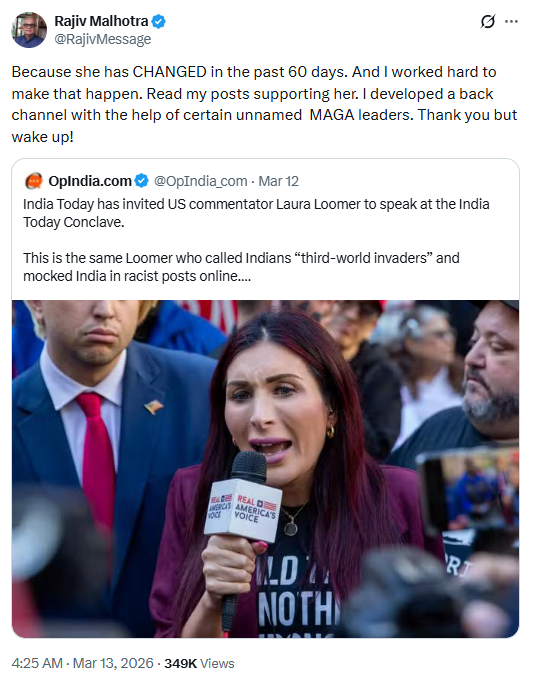
Rajiv Malhotra, a prominent Indic thinker, suggested that he and others in the broader MAGA-aligned ecosystem had been engaging Loomer behind the scenes, trying to shift her stance on India and Hindu civilization. According to this view, her trip to India was not a random provocation but partly the result of that outreach.
A test case of whether a hostile critic could be converted, or at least moderated, through direct exposure and dialogue.
Whatever opportunity there was for recalibration, the event itself quickly devolved into a familiar spectacle. On stage, Rajdeep Sardesai—whose politics often align with ultra-left and Islamist-adjacent narratives—launched into Loomer with theatrical indignation. He rattled off his grievances and effectively shouted her down, less to interrogate her ideas than to perform outrage for a domestic audience. Loomer’s refusal to sanitize jihadism and Islamist violence appeared to be his main trigger. Instead of engaging her specific claims, he wrapped himself in the mantle of “being an Indian” and turned his fire on her from that safe rhetorical position.
Source: India Today / X.com
Laura took to X to respond to Rajdeep's bile, laying out the scenario in her own way in front of Sardesai. She also didn't realize that her question - "Don't you have any sense of national pride and a desire to preserve your country as a majority Hindu?" - had an obvious Rajdeep Sardesai answer: He didn't give two hoots about India or Hindus!
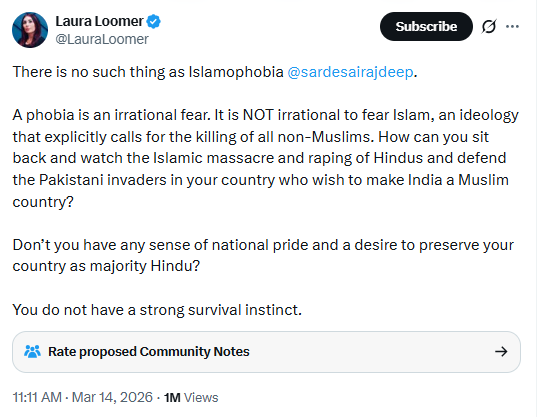
This episode exposed a deeper and more uncomfortable reality: the strange convergence of interests and talking points among ultra-leftists, Islamists, sections of the liberal establishment, and even segments of the Western right and ultra-right.
The left and Islamist blocs often align in narrative warfare against Hindu civilizational assertion; parts of the Western right veer into racialized contempt for Indians while claiming to be anti-Islamist; and Indian nationalists sometimes try to leverage Western “anti-woke” figures who simultaneously carry anti-India baggage.
The result is a tangled battlefield where alliances are tactical, principles are selectively applied, and opportunism is the only consistent ideology.
The Loomer–Sardesai clash was not an isolated media spat; it was a snapshot of a rapidly mutating global narrative war in which India, Hindus, and civilizational questions are becoming a central, contested terrain.

Comments ()