
Trump’s Post-Dollar Gambit: Tariffs, Crypto, and Courting Pakistan’s Terror-backing Generals
When you look at Trump's actions that are debasing the US Dollar and his strange love for Pakistan's terror-orchestrating General Munir while sidelining India, you realize something - all this is for making Trump rich, not MAGA.
A young monk asked the old master, “Can a man profit by turning wind into money?”
The master drew a circle in the dust. “Only if the wind stays in the circle.”
In a far-off bazaar, a Merchant-King unveiled a new coin.
It was not metal.
It was promise—painted on glass and light.
“See,” he said, “my coin moves faster than grain, outruns tax, leaps borders. Trade will follow it like geese.”
To show his strength, he chose a great ox in the village square and shoved it.
“The crowd must see a struggle,” he smiled, “or they won’t notice the toll gate I’m building.”
While the people argued about the shoving, the toll gates quietly clicked into place.
But the road to his market crossed the Scorpion River.
On the far bank stood generals with stingers tucked under silk.
Their boats were swift. Their hands were bloody.
The Merchant-King bowed low. “Guard my caravans,” he said, “and I’ll pay in painted coins.”
The generals nodded. “We know rivers,” they said. “We know prices.”
The old master told the monk, “Hiring fire to protect silk is a lively lesson.”
Soon, pilgrims took the new road.
They paid the toll not in rice, but in echoes of rice.
The Merchant-King skimmed the echoes and grew proud.
“Look,” he said, “how obedient the wind becomes when I give it a ledger.”
One evening the river rose.
The scorpions stung the oarsman to test his skin.
The boat lurched; the lantern fell; oil kissed water.
On the far bank, reeds burned like prayer flags.
The Merchant-King counted his coins of light.
He said, “I only built a bridge. The river was always the river.”
The old master wiped away the circle.
“Teacher,” the monk asked, “who lost?”
“Count the bridges at dawn,” the master said. “If there are fewer, everyone paid.”
“And the painted coin?” the monk pressed.
The master held up an empty bowl.
“When a bowl is full of wind, it looks generous,” he said. “But strike it, and you hear only how hollow it is.”
The monk bowed. “Then what is right action?”
The master pointed to the river.
“If you toss a coin to a scorpion, do you buy a crossing—or teach it to bite for a price?”
He let the question float downstream, where markets and armies both pretend to be water.
SUPPORT DRISHTIKONE
In an increasingly complex and shifting world, thoughtful analysis is rare and essential. At Drishtikone, we dedicate hundreds of dollars and hours each month to producing deep, independent insights on geopolitics, culture, and global trends. Our work is rigorous, fearless, and free from advertising and external influence, sustained solely by the support of readers like you. For over two decades, Drishtikone has remained a one-person labor of commitment: no staff, no corporate funding — just a deep belief in the importance of perspective, truth, and analysis. If our work helps you better understand the forces shaping our world, we invite you to support it with your contribution by subscribing to the paid version or a one-time gift. Your support directly fuels independent thinking. To contribute, choose the USD equivalent amount you are comfortable with in your own currency. You can head to the Contribute page and use Stripe or PayPal to make a contribution.
Terror-orchestrating feted by US Military and Government
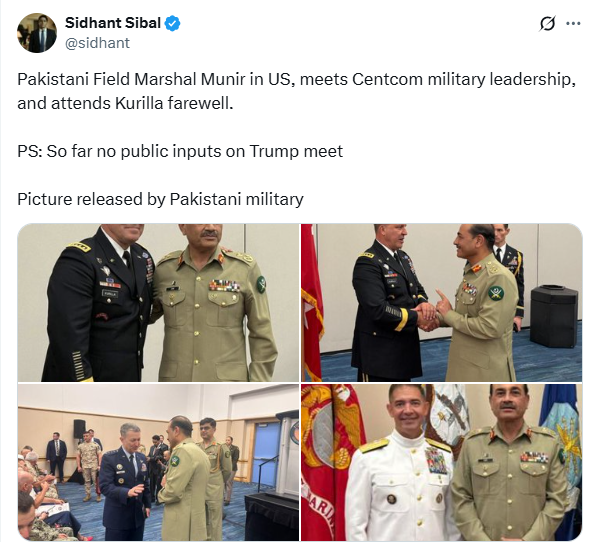
Asim Munir, Pakistan's "Field Marshall" is in the US. He's on a whirlwind tour and is being courted by the United States military as well.
Munir attended the retirement ceremony of outgoing US CENTCOM Commander General Michael E. Kurilla in Tampa, Florida, as well as the change of command ceremony marking Admiral Brad Cooper’s assumption of command.
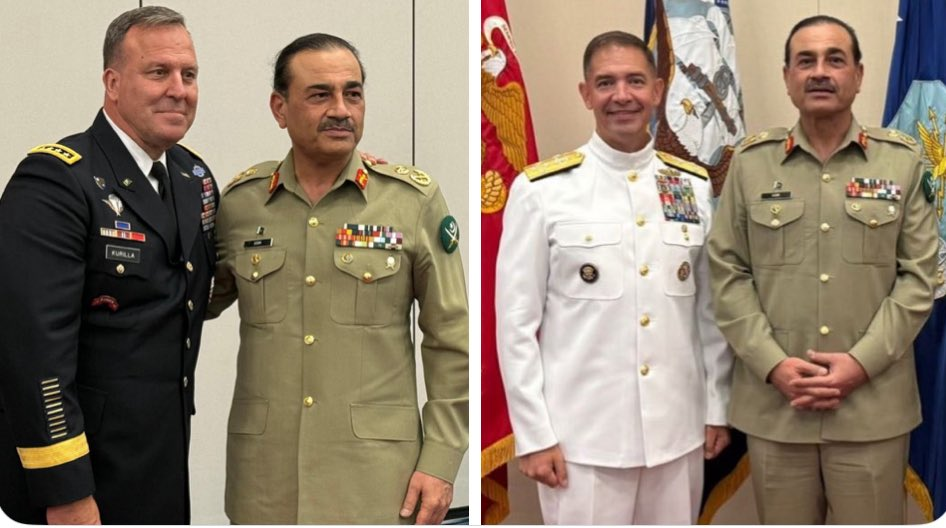
The transition from Gen. Michael Kurilla to Adm. Brad Cooper marks a new chapter in U.S. military strategy, one in which Pakistan's role is being fashioned as being increasingly close and critical to counterterrorism efforts, Gulf security, and managing the complex spillovers from Afghanistan and Iran.
Given what Pakistan has been up to, this kind of "image makeover" by the United States seems like a fantasy tale for only the most naive or the retarded.
CENTCOM's official readouts and media coverage of the event leave no room for ambiguity. The presence of Pakistan's Army Chief at such a critical juncture is not merely a courtesy; it is a strategic statement.
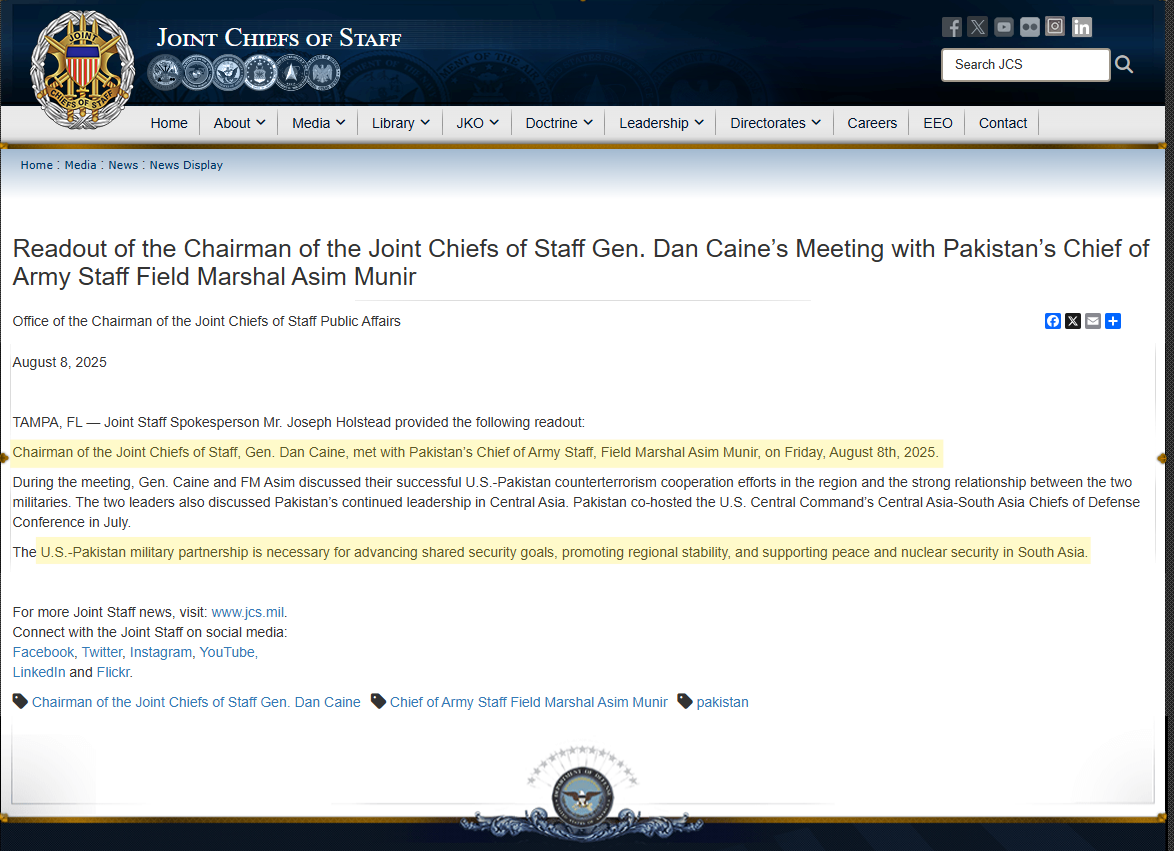
Munir also met with the Chairman of the US Joint Chiefs of Staff, General Dan Caine. A meeting that further strengthens Pakistan's claim to legitimacy despite its recent terror credentials.
This is what Munir did with the Americans. Later, he used the American soil to threaten a nuke strike on India saying "we are a nuclear nation, if we think we are going down, we’ll take half the world down with us."
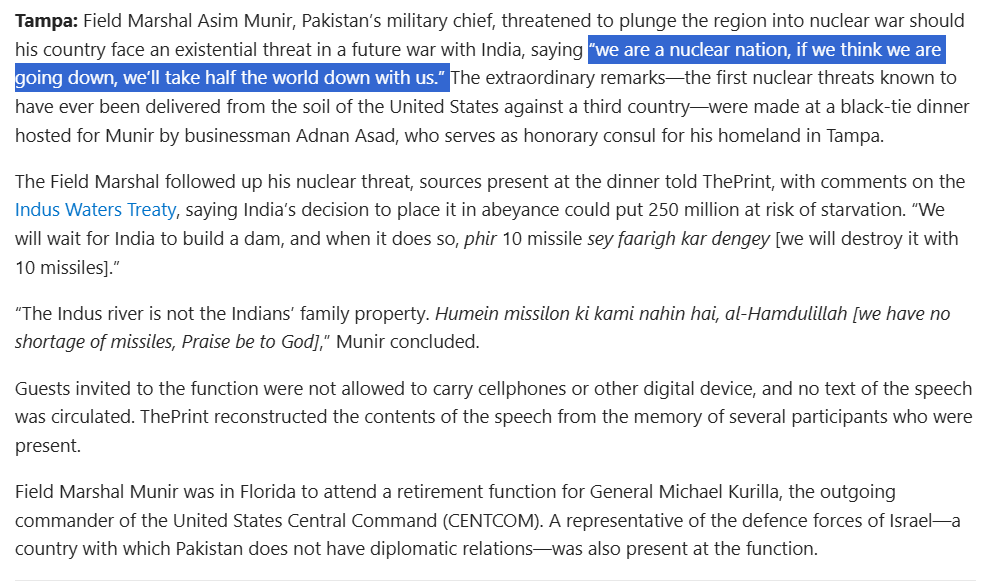
Interesting situation indeed.
Chronology for the Modi-Trump dynamics
The Modi-Trump relationship from the last Trump term was defined by Howdy Modi event in Texas. Things have taken a sharp turn during the second Trump term. It seemed to start off with jibes by President Trump on tariff related issues and soon it morphed into deeper backing of Pakistan, because of which the relationship went on a downward spiral. A call in June where the door for India backing Trump's Nobel prize ambitions were shut by some straight talk by Modi, ostensibly angered Trump.
Post that, it has been a downhill.
Let us arrange all the events, actions and occurrences in neat chronological order for us to understand what happened when.
January–March 2025: Setup & talks begin
- Feb (context): As Trump rolled out broad tariff threats on multiple partners, India was initially spared but warned that “high tariffs are coming,” setting the stage for talks. (Source: www.ndtv.com)
- Mar–Jul: Five rounds of India–US trade negotiations tried to cap or limit tariffs (agriculture/GM crops, dairy access, standards, and Russia-oil issues were friction points). India Today and Reuters both track five rounds running through mid-July. (Source: India Today / Reuters)
April–May: Pahalgam attack → Operation Sindoor → Trump claims credit
- Apr 22: Pahalgam terror attack kills 26 civilians in J&K. (Source: The Times of India)
- May 7–8: India launches Operation Sindoor—precision strikes on terror infrastructure in Pakistan/PoK; India says no Pakistani military/civilian sites were targeted. (MEA brief; mapping & reportage). (Sources: Consulate General of India, Istanbul / Al Jazeera)
- May 10 onward: Trump publicly claims he “stopped” the India-Pakistan fighting (crediting his diplomacy/trade dangled to both sides). India disputes this account; fact-checks call the evidence scant. (Sources: www.ndtv.com / PolitiFact)
June: The 35-minute call & India “sets the record straight”
- Jun 17–18: A 35-minute Trump–Modi call: India’s Foreign Secretary’s readout notes discussion of Operation Sindoor; Indian reporting says Modi pushed back on US mediation claims. Follow-ups (Newsweek/Financial Express) describe the call as tense and a turning point. (Sources: MEA India / Newsweek / The Financial Express)
July: Talks collapse; tariffs land; Pakistan courtship
- Mid-July: Round 5 in Washington fails to break the deadlock; India signals it won’t bargain away farm protections. (Source: Reuters)
- Jul 30–31: Instead of a deal, Trump imposes a 25% tariff on Indian goods (country-specific “reciprocal tariff” action). White House legal action posts on Jul 31. (Sources: India Today / The White House)
- Jul 30–Aug 1: In parallel, Trump announces a new US–Pakistan trade arrangement framed around oil reserves/energy, minerals, IT and crypto, signalling warmer commercial ties with India’s regional rival. (Reuters, Fox Business, PoliticoPro). (Sources: Reuters / Fox Business / Politico Pro)
August: From 25% → 50%; “dead economy” jab; India’s defiant reply
- Aug 6: Trump adds another 25% on India (explicitly tying it to India’s continued purchases of Russian oil), lifting total duties to ~50% pending effect in ~3 weeks. (NDTV live tracker; Reuters; Supply Chain Dive). (Sources: www.ndtv.com / Reuters / Supply Chain Dive)
- Aug 7: Trump calls India a “dead economy.” Indian media, RBI officials and analysts rebut with growth data. (Sources: www.ndtv.com / The Economic Times
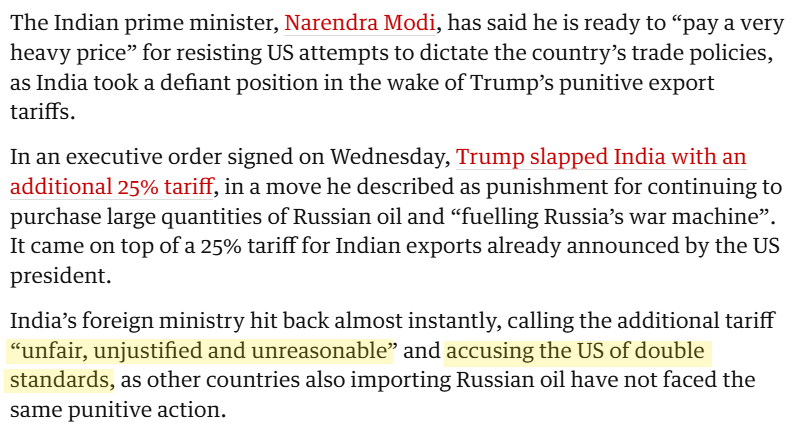
- Aug 7: Modi’s response: India will “pay a heavy price” if needed but “will never compromise” on sovereign interests—especially farmers/domestic industry. (Guardian; Reuters; Newsweek/Yahoo). (Sources: The Guardian / Reuters / Newsweek / Yahoo Finance)
- Aug 8–9: The US doubles down that Trump “was directly involved” in India-Pakistan peace; Indian side continues to dispute US mediation claims. (Sources: www.ndtv.com / Hindustan Times)
Now let us analyze what this entire sequence of events show.
Security crisis → narrative clash: After Operation Sindoor, Trump’s public credit-claim clashed with India’s line that the operation and subsequent de-escalation were Indian decisions—not US-brokered. India's distrust in the United Nations and other Western countries' objectivity has established the firm bi-partisan understanding that India-Pakistan issues are bilateral and no 3rd party intervention will be tolerated. It was further formalized in the Shimla Agreement post -1971 war. Trump was "tone-deaf" to the historical context and the extent of political fallout for Modi had he not been forceful on this front. The 35-minute call (Jun 17–18) hardened positions for Trump as well as for Modi.
Trade talks soured fast: Despite five negotiation rounds (Mar–Jul), talks broke by July 30–31, replaced by tariffs. Trump came out with his pronouncements of very high tariffs even when the negotiations were going on
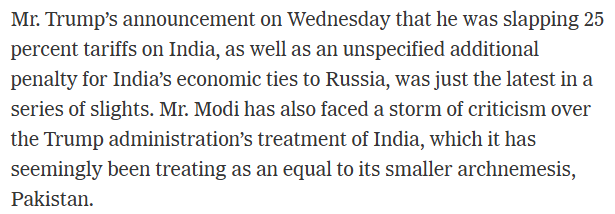
Tariffs + Pakistan tilt: The tariff move coincided with a fresh US–Pakistan trade opening (energy/minerals/crypto), widely read in India as Washington courting Islamabad while turning the screws on New Delhi. Pakistan is the stick that US uses against India. It started way back when Pakistan came into existence and US got a B-2 Bomber base and later backing Pakistan during the 1971 war to handing over the nuke plants and designs to Pakistan as well as funding and supporting Pakistani terror network. So, to reward someone like Asim Munir, an anti-Hindu Islamist bigot who planned the Pahalgam terror attack, is to side with forces that target Indian citizens directly. It took the whole situation far beyond just tariffs.
Escalatory rhetoric, defiant response: If all that wasn't enough, Trump started humiliating India in general. Something that could only be met with complete defiance. Trump’s “dead economy” line and the 50% tariff ceiling met a publicly defiant Modi stance prioritizing sovereignty and farm protections over concessions.
The Modi government's response to the 50% tariff was hard-hitting and called out the double standards in Trumps response.
Is all this making America strong?
Tariffs and Dollar
Trump's actions almost seem like bringing the US dollar down. The actions are remarkably uncanny in their import.
Economists told Newsweek this could advance Trump's goal of promoting American goods in foreign markets and strengthening exports, but warn that a weakened dollar comes with significant downsides, including the jeopardization of its status as the world's reserve currency. The U.S. Dollar Index—which tracks its value relative to a basket of major foreign currencies—has declined by more than 10 percent over the past six months. This marks the steepest first-half slump, and the worst beginning for a presidential term, since its creation in 1973. Achieving this milestone comes amid a period of flux for the U.S. economy. On Friday, Trump signed the One Big Beautiful Bill Act, which had been narrowly passed by the Republican-controlled House of Representatives the day before. The sweeping budget reconciliation package contains new spending measures and an extension of Trump's 2017 tax cuts, which, together, budget watchdogs believe could inflate the nation's already-sizable national deficit. (Source: The Dollar Is Sinking: Here's Why / Newsweek)
And, what makes Trump's actions even more telling is that a real estate mogul and opportunist businessman like Steve Witkoff is leading his global geopolitical negotiations. Witkoff, his son and his firm led the negotiations with Pakistan. And with EU and now with Russia as well.
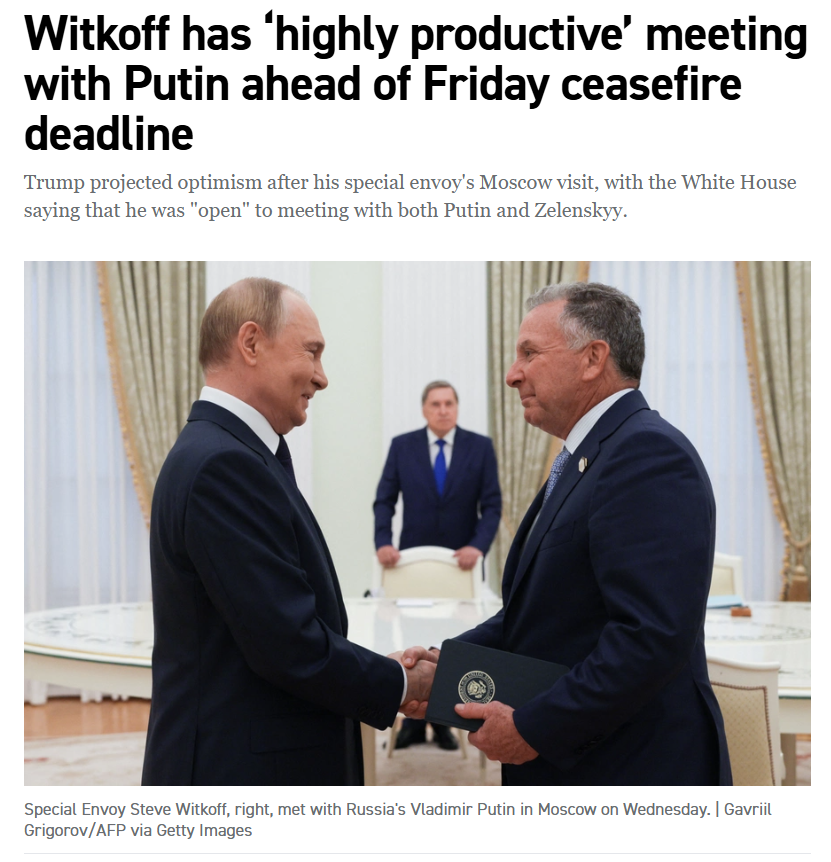
Who is Witkoff and his World Liberty Financial (WLF).
Witkoff owned WLF recently wrote a "Gold Paper' with Trump as its logo. What does this paper imply?
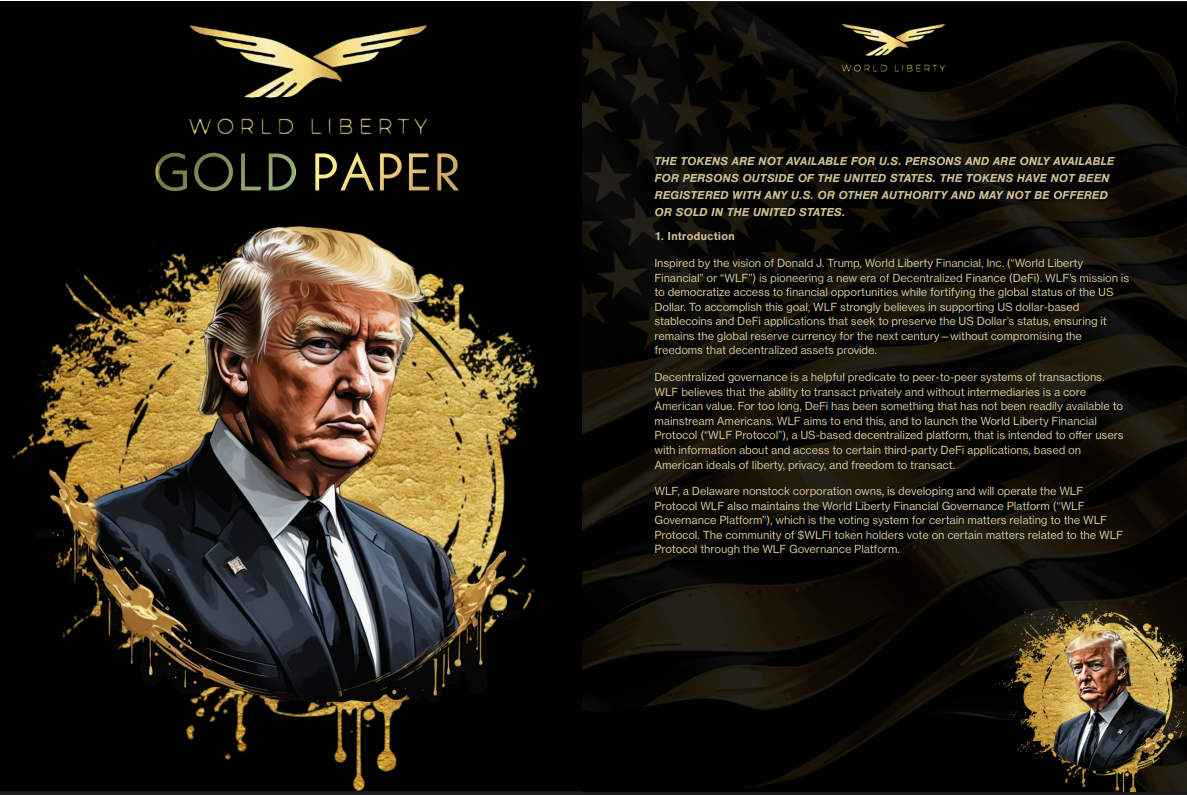
Here are the key takeaways from this "Gold Paper".
Stated mission vs. practical design: WLF frames itself as pro-USD DeFi—promoting USD-stablecoins to “fortify” the dollar and resist CBDCs—while delivering a branded gateway that onboards Web2 users via the Trump name.
Governance in name, control in fact: $WLFI is a non-equity, governance-only, non-transferable token with a 5% per-wallet voting cap; proposals are screened by the company and executed by a Gnosis multisig controlled at WLF’s discretion (and can be centralized during “security” events).
Economics & beneficiaries: After a $30M reserve, 75% of net protocol revenues flow to DT Marks DEFI LLC (Trump-affiliated) and 25% to Axiom/affiliates (with a share to WC Digital Fi). DT Marks also receives 22.5B $WLFI; Axiom 7.5B $WLFI. This heavily aligns incentives to private “rails.”
Reg posture: Tokens are not registered, unavailable to U.S. persons (except Reg D accredited buyers), and positioned as not securities; KYC/sanctions screening applies.
Remember what we have been discussing. This is how what the Gold Paper by WLF strengthens those arguments.
- Private rails capturing value: The explicit revenue rights to DT Marks/Axiom, plus non-equity governance tokens, mirror the thesis that policy theater + DeFi plumbing = private cash-flow capture rather than dispersed community ownership.
- Stablecoins as a pro-USD instrument (not de-dollarization): The paper casts USD-stablecoins as reinforcing dollar dominance (via Treasury-backed reserves, liquidity) and as a non-CBDC path—exactly the “digital extension of dollar hegemony” lens we discussed.
- Brand-led mass onboarding: Using the Trump brand as the on-ramp from Web2 to Web3 fits the “politics as distribution” model—policy rhetoric upfront, infrastructure and fee capture behind the curtain.
- Centralized switch hidden inside ‘decentralized’ wrapper: Proposal screening, multisig execution, and emergency centralization sit uneasily beside the decentralization pitch—matching the concern that “decentralized governance” often masks administrative control.
So crypto - specifically the stablecoins will be the main instruments for Trump's future plan.
What about Gold?
Trump's tariffs are creating an incentive for some investors to explore or increase their allocation to gold-backed digital instruments as a potentially more convenient way to hold gold, the primary determinant of gold's normalization or wider adoption as a digital instrument depends more broadly on factors like:
- Regulatory clarity: The topsy turvy world of US foreign trade regulatory frameworks for cryptocurrencies, including gold-backed tokens, plays a crucial role in their broader acceptance and normalization.
- Market demand and adoption: there is continued investor and institutional interest in gold as a safe-haven asset. This goes along with the growing adoption of digital assets in general. All this will influence the normalization of gold-backed digital instruments.
- Security and transparency: The integrity of the gold backing, including transparent auditing processes and secure storage, is critical for building trust in these digital instruments.
Then there was this whole issue of tariffs on Gold.
Gold prices surged on Thursday after a letter from the U.S. Customs Border Protection Agency was published, suggesting that levies would be imposed on one-kilo and 100-ounce gold bars because of the “reciprocal tariffs” that Trump announced earlier this year. The letter, dated July31, was in response to a request sent by a U.S. firm that wanted clarification on the tariff classification for gold bars from Switzerland. Numerous media organizations picked up the story on Friday after it was first reported Thursday by the Financial Times. The news surprised gold investors, and gold futures rose to an all-time high on Friday morning, before cooling down a bit in the afternoon. Speculation about the reason for the tariff was rife. Some industry insiders said that the latest move reflected the Trump administration’s playbook of placing a tariff on anything he wanted to control. Others said that the move could be linked to Trump trying to pressure Switzerland into a deal. (Source: Trump put a tariff on gold — or did he? / Yahoo Finance)
Irrespective of whether Trump took back the tariffs on gold or not. The fact is that gold has now entered the equation.
So let us understand this - By imposing steep tariffs on gold, Trump boosts its price and re-centers it in global trade conversations. This, in turn, normalizes gold-backed digital instruments—a space WLF is positioned to dominate.
There is another thing that needs to be understood - he slapped steep duties on imported gold bars – something no prior president had attempted. Markets reacted instantly as gold prices surged, a predictable outcome given gold’s status as borderless money and a safe haven when trust in the dollar falters.
Trump himself stood to profit from this shift. During his 2024 campaign and presidency, Trump openly embraced cryptocurrency – accepting Bitcoin donations and even floating the idea of a U.S. Bitcoin reserve as “freedom money”. After winning, he went further, launching a meme token ($TRUMP) that instantly ballooned his family fortune. Soon after, a larger venture emerged: World Liberty Financial (WLF), a decentralized finance empire controlled by Trump-linked entities. WLF issues a stablecoin called USD1, which quickly became a top-10 global stablecoin by volume.
The Trump family and inner circle reportedly hold a 60% stake in WLF, meaning any boost to WLF’s adoption directly enriches Trump’s clan. (Source: Is Trump family's Pakistan crypto deal behind his Indo-Pak mediation itch? / India Today)
US Economy and USD1 Stablecoin
The genius – or perfidy – of Trump’s strategy is that WLF’s success is inversely tied to the U.S. dollar’s. WLF’s USD1 stablecoin would become a cash machine only if adopted in dollar-starved markets like Pakistan, Argentina, or Nigeria.
In other words, if the dollar stumbles, Trump’s coin soars. Every disruptive tariff that undermines confidence in the dollar isn’t a bug; it’s a feature.
Tariff wars disrupt trade and nudge countries to seek neutral, non-dollar payment systems, from Bitcoin to stablecoins and gold-backed tokens. As one analysis put it, with each tariff hit “crypto’s case as a practical trade currency gets stronger,” paving the way for WLF to capture that new market.
Through these maneuvers – tariff brinkmanship, gold manipulation, crypto evangelism – Trump is effectively positioning his private enterprise as a beneficiary of de-dollarization.
It’s disruptive economic statecraft not to advance U.S. national power, but to build a private empire.
If successful, this would mark the first time a U.S. president actively pushed the world away from the dollar’s embrace – a realignment even BRICS nations have only dreamed of.
Trump didn’t need to outright replace the dollar; he just needed to engineer conditions where “gold & crypto look safer than the greenback”.
Deep State and Speculative Shift
There is often a discussion around the deep state backing global subversion. we have looked at it deeply in an earlier newsletter.
 Desh Kapoor
We laid out the entire structure in Five Tiers.
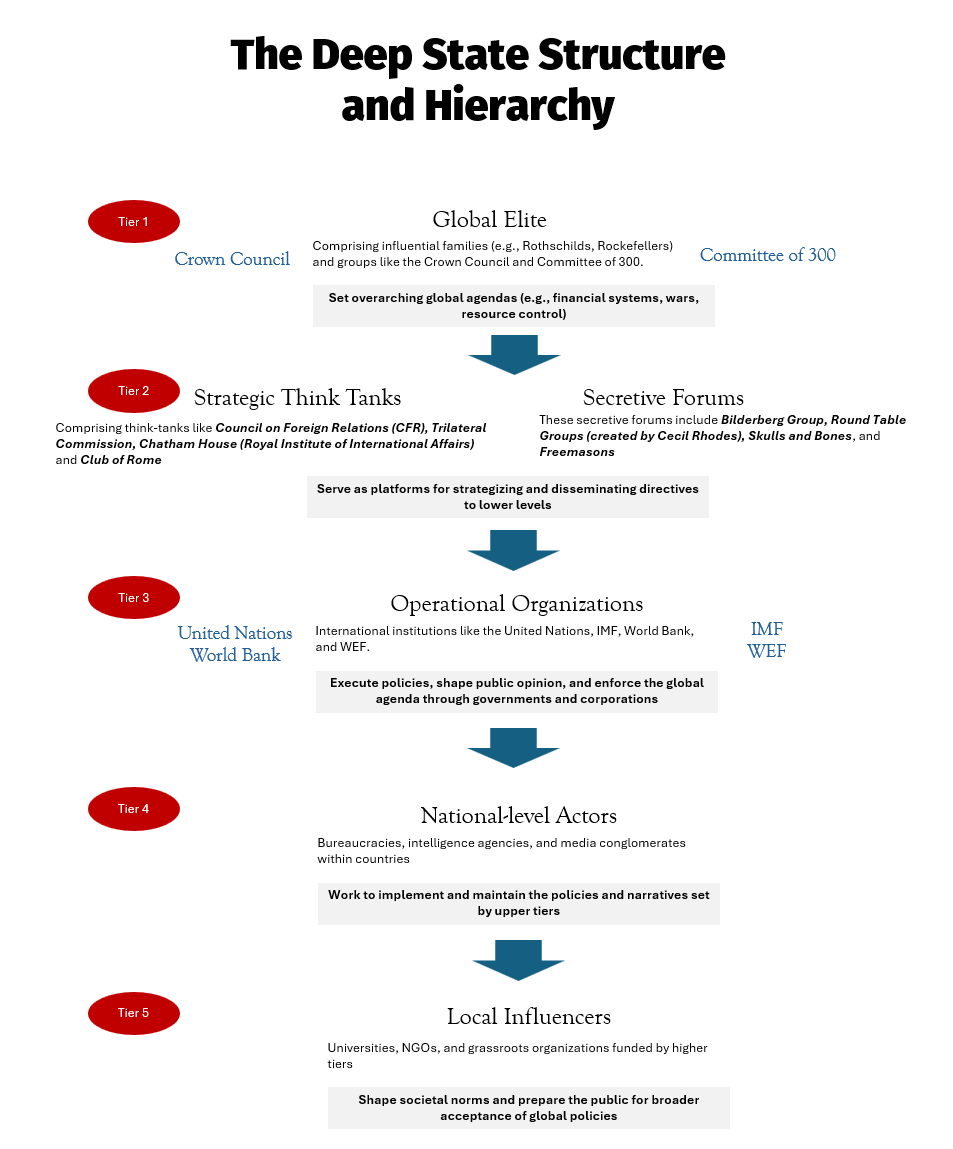
The “deep state”, therefore, isn’t a single dark room; it’s a shifting syndicate.
At one level sit the old guard—Treasury veterans, Bretton Woods traditionalists, IMF-adjacent mandarins—who view disorder as an existential threat to the dollar system that underwrites U.S. power.
And then there could be challengers who could be opportunists but equally "loyal" to the overall "deep state world order". This could include speculative capital, boutique funds, commodity traders, and private dealmakers who see volatility not as risk but as freedom from Washington’s rule book. They don’t want to burn the cathedral down; they want to toll its bells. For a fee.
Viewed through that lens, Trump’s recent playbook reads less like statecraft and more like a private strategy executed with public instruments.
- Step one: manufacture trade and monetary shocks that fracture the presumption of dollar permanence.
- Step two: push alternative rails—gold-settled trades, crypto-denominated instruments, tokenized “assets”—from fringe to normal, so the market treats them as legitimate hedges rather than heresy.
- Step three: position one’s own financial pipes to skim the spread as nervous capital migrates. You don’t have to replace the dollar; you just have to monetize the exit lanes.
If you carefully see, India functions as the perfect foil in this drama: a large, visible counterpart that lends ideological cover.
Frame the disruption as “tough love” toward a rising power. Throw in tariffs, lectures on oil, performative spats, so the policy looks principled, not pecuniary.
The press argues about sovereignty and growth; meanwhile, the "rails" are being laid.
The shock for boardrooms is not merely higher tariffs. It’s the possibility that an American president is effectively shorting dollar supremacy in broad daylight.
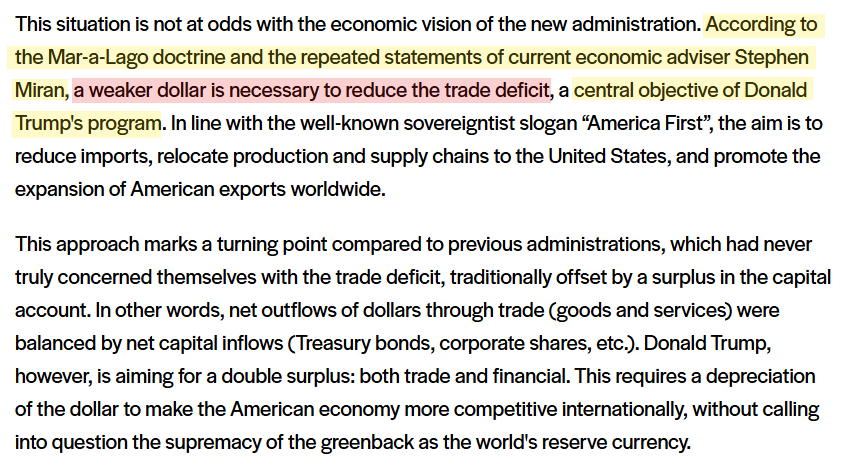
Meanwhile, he is carefully picking his winners in energy, mining, payments, and digital custody.
Some sectors will be pre-briefed and positioned. Others will learn in real time that they’re collateral. The old guard will call it reckless. The syndicate will call it optionality. Either way, the center that held the post–Cold War consensus is being tested.
Was India a Prop for Trump's Crypto Goals?
Given the facts, we will hypothesize a path that this whole Trump's game against Modi is going.
Although, it’s a stretch to say the White House wants a USD crash.
There is real evidence of
- (a) deep Trump/Witkoff exposure to a dollar-pegged stablecoin (USD1),
- (b) aggressive tariffs, including on India; and
- (c) unusual Pakistan engagement.
Whether all this adds up to a deliberate “short-the-dollar/long-WLF” master plan is unproven, but the incentives and behaviors do rhyme with that speculation.
So, let's get started with our scenario building:
To catalyze this post-dollar shift, Trump chose an unlikely primary target: India.
Despite India being a nominal U.S. partner and nowhere near the top of U.S. trade deficits, Trump went “irrationally berserk” with protectionist measures against New Delhi. He imposed punitive tariffs up to 50% on Indian goods under the pretext of penalizing India’s oil trade with Russia (Source: Hindustan Times).
(Never mind that China, EU countries, or Turkey import as much or more Russian oil – India was singled out.)
By hammering India with tariffs, Trump created a vivid example for the world. He knew India wouldn’t simply cave; instead, New Delhi would look for ways to bypass the dollar in trade (as it already had begun doing for Russian oil).
Indeed, India’s government responded by exploring rupee settlements and strengthening its BRICS partnerships rather than bowing to Washington’s pressure.
This was precisely what Trump wanted. Global media began asking, “What are the alternatives to the dollar?”, amplifying India’s push for de-dollarized trade. Inevitably, crypto entered that debate.
And once crypto is normalized as a trade currency, WLF – with Trump’s brand and influence – is poised to reap the windfall without even needing overt lobbying.
Far from a misguided trade tiff, the Indo-U.S. tariff war appears to be strategic theater. Trump’s endgame isn’t to win a better deal from India; it’s to use India’s resistance as a showcase that the dollar-based system is negotiable, even dispensable.
This is not “America First” at all. It’s Trump first.
Weakening the dollar would indeed hurt American power, but Trump’s private wealth would skyrocket.
The victims of this scheme include the very U.S. economy Trump claimed to defend.
The beneficiaries? Trump’s crypto holdings and those foreign partners willing to help legitimize them.
Trump has even tilted U.S. tariff policy in ways that favor Pakistan – a country he once lambasted but now sees as crucial to his plans.
In a dramatic revision of tariffs on August 1, 2025, Trump slashed tariffs on Pakistan from 29% down to 19%, even as he maintained a punitive 25% rate on India (Source: Trump's Revised Tariffs: India Remains At 25%, Pak's Rate Slashed / NDTV).
Officially, Pakistan earned a reward for cooperation, while India was punished for aligning with Russia.
In reality, Trump was courting Islamabad’s goodwill at New Delhi’s expense – a signal that Washington’s economic embrace can be guided by Trump’s personal strategic interests rather than traditional alliances. India, a democracy of 1.4 billion, found itself treated worse than a military-backed regime that harbored America’s adversaries. As has been the case with the United States' policy for last 70 years! Democracy backers? Sure!
Those who are uninitiated into the context of India's concerns regarding terrorism, let us go into the details the Pahalgam attack and its investigations.
The Pahalgam Attack: Pakistan State's Terror Attack
The simmering effects of Trump’s strategy became stark on April 22, 2025, when terror struck Indian Kashmir. Five gunmen armed with military-grade M4 carbines and AK-47s opened fire on a group of tourists in the picturesque Baisaran Valley near Pahalgam (Source: Pak Army Chief's "Jugular Vein" Speech Viral Again After J&K Terror Strike / NDTV).
It was a massacre: 26 civilians were slaughtered in cold blood – all Hindu pilgrims from various parts of India, along with one Nepali.
Eyewitness video showed bodies strewn across the meadow, families in shock and horror. This was the worst terrorist attack on Indian civilians since the 2008 Mumbai carnage, and it instantly ratcheted up the already high tensions between India and Pakistan
Indian authorities identified the perpetrators as Pakistan-backed jihadist terrorists – specifically operatives of Lashkar-e-Taiba’s front group “The Resistance Front,” which even claimed responsibility initially.
Within days, forensic and intelligence leads traced the plot to Pakistan’s security apparatus: digital footprints, safe houses, and handlers linked back to Pakistan’s ISI spy agency and army proxies.
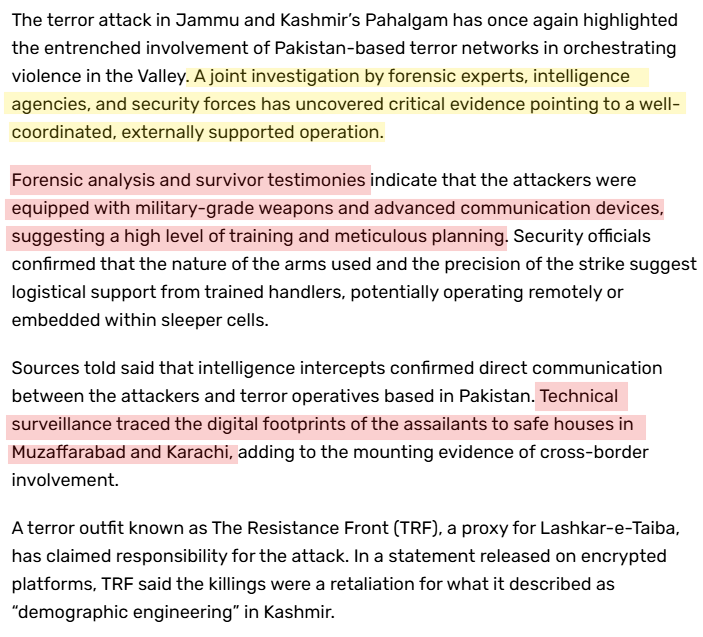
Perhaps most chilling, one of the key militants, Hashim Moosa, turned out to be a former Pakistani Special Forces commando (SSG) who had later joined Lashkar-e-Taiba. In other words, a highly trained ex-soldier of Pakistan had carried out the massacre of unarmed Indian tourists – a fact that underscored the role of Pakistan’s military in abetting terror.
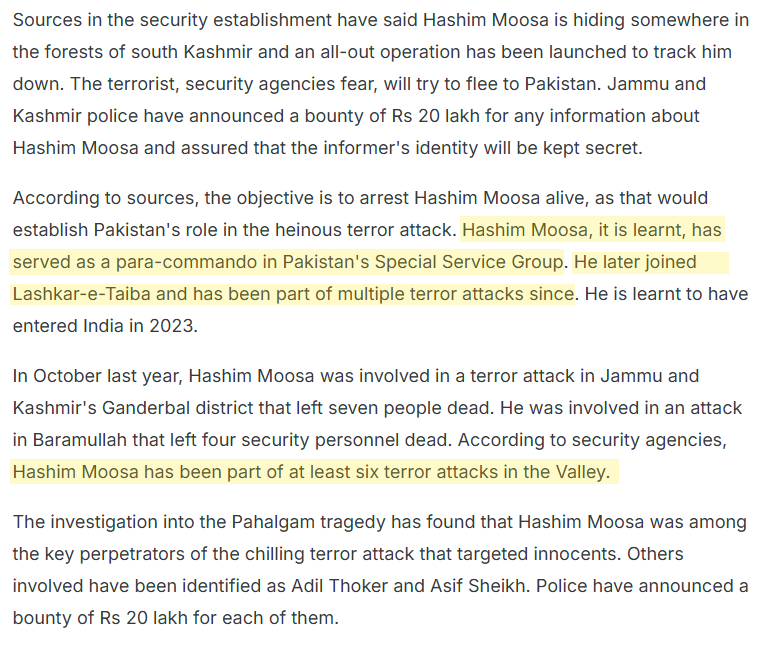
According to government officials, the three Lashkar-e-Taiba terrorists (Suleman (alias Faizal Jatt), Hamza Afghani, and Zibran) maintained contact with associates and facilitators in Pakistan using ultra-high-frequency wireless sets.
These radios require a dedicated frequency and clear line-of-sight, with an effective range of roughly 20–25 kilometers (12–16 miles). The trio infiltrated India in 2023.
Newly infiltrated LeT cadres aligned with Suleman and began executing attacks across the Kashmir Valley.
Suleman personally took part in the October 20, 2024 assault on a construction site in Gagangir, Ganderbal (central Kashmir), which left seven civilians dead. In Parliament, Home Minister Amit Shah stated that the Intelligence Bureau and local security forces tracked the group for more than two months using multiple surveillance methods.
Through this effort, Indian agencies mapped the infiltration routes, movement patterns, and command hierarchy underlying the Pahalgam attack.
Investigators identified Sajid Saifullah Jatt—LeT’s South Kashmir chief of operations based in Lahore—as the primary handler directing the cell. The picture that emerges is of a cross-border, radio-coordinated network with compartmentalized leadership and a clear escalation in 2024.
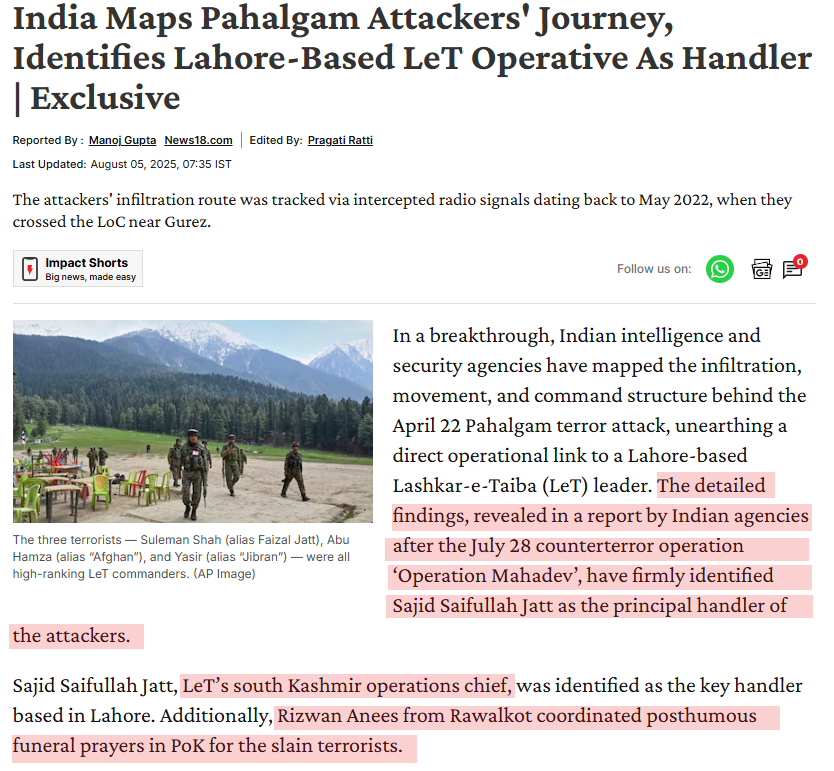
So all these attackers were Pakistani nationals and ex-militants sheltered by Pakistan for years. The Pahalgam attack was not a random act of “militancy” – it was terrorism, plain and simple, rooted in Pakistan’s long-running proxy war in Kashmir.
Compounding the outrage was the context: just one week prior, Pakistan’s Army Chief, General Asim Munir, had made a highly provocative, bigoted speech effectively justifying a jihadist stance on Kashmir.
On April 16 in Islamabad, addressing an Overseas Pakistanis Convention, Gen. Munir described Kashmir as Pakistan’s “jugular vein” – vowing “it was our jugular vein, it will be our jugular vein” and pledging never to abandon the Kashmiri cause.
This rhetoric echoed the most hardline Pakistani narratives. But Munir went even further, veering into openly anti-Hindu invective. He reminded his audience that Pakistan’s founders believed “we were different from the Hindus in every aspect of life”, boasting that Pakistanis belong to a “superior ideology and culture.”
He lauded the two-nation theory – the ideological justification for Partition – saying it was based on Muslims’ civilizational differences from Hindus.
The implication was unmistakable: the fight over Kashmir was cast not just in nationalist terms, but as an Islam vs. Hinduism battle, an existential and religious struggle. Such hateful rhetoric from a sitting army chief – effectively branding Hindus as inferior and invoking jihadist imagery – poured fuel on an already volatile situation.
India’s reaction to the massacre was furious and swift.
Blaming Pakistan squarely, Prime Minister Narendra Modi vowed the terrorists “will not be spared”. Within a fortnight, India’s military struck back with “Operation Sindoor” – a series of cross-border air and missile strikes on May 7 targeting terror camps deep in Pakistan (including in Pakistan’s Punjab province). Pakistan retaliated with unsuccessful artillery and drone attacks that met the might of India's air defense system.
For a brief spell in early May the two nuclear-armed rivals teetered on the edge of a broader conflict. By mid-May, over two dozen targets had been hit and both sides were partially mobilized.
The world braced for the worst – a potential India-Pakistan war erupting in the Himalayas.
Crypto Diplomacy Amid Crisis: The WLF–Pakistan Deal
This is the moment where Trump’s personal stakes and geopolitical maneuvering dramatically converged. With South Asia on the brink, Trump eagerly inserted himself as a would-be peacemaker – but not out of sheer goodwill. Observers noted that Trump’s zeal to mediate coincided with a suspiciously timed deal involving his family’s crypto interests. In fact, just four days after the Pahalgam attack – even as India and Pakistan traded fire – a Trump-affiliated venture quietly inked a partnership in Islamabad. On April 26, 2025, Pakistan’s newly formed Pakistan Crypto Council (PCC) signed a deal with World Liberty Financial (WLF), the Trump-linked crypto company. The signing ceremony in Islamabad was attended by top Pakistani officials, including the information minister and the head of the PCC, alongside WLF executives flown in from the U.S.
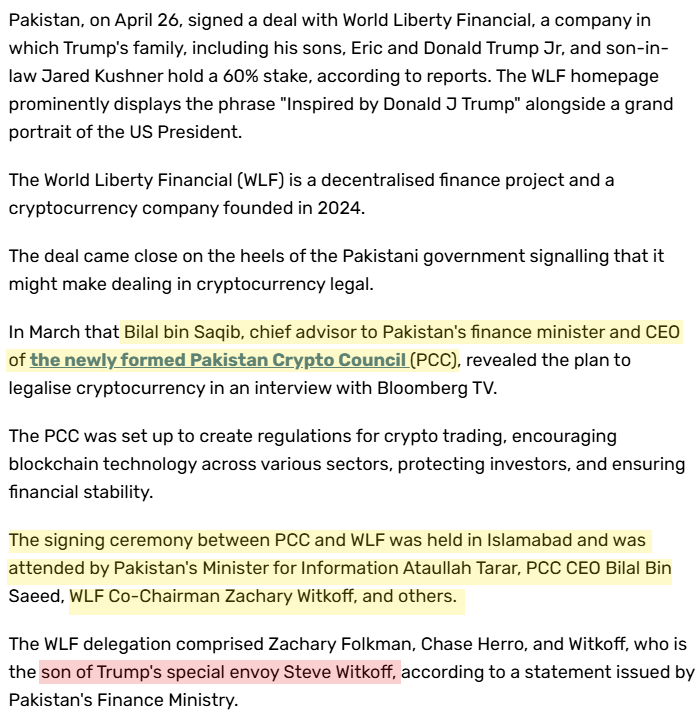
WLF’s delegation even met with Prime Minister Shahbaz Sharif and Gen. Asim Munir himself to formalize the cooperation.
The agreement’s details were telling. Pakistan’s government, which only weeks earlier had hinted at legalizing cryptocurrency trading, welcomed WLF’s help to build out its digital asset infrastructure.
The WLF-PCC cooperation aimed to explore tokenizing real-world assets (like real estate and commodities) and to advise on blockchain payment rails and stablecoin use for Pakistan’s economy. Implicitly, this opened the door for WLF’s USD1 stablecoin to become a sanctioned medium of exchange in Pakistan’s dollar-starved markets.
Pakistan has long struggled with dollar shortages and IMF bailouts; embracing a Trump-branded stablecoin or crypto network could offer a backdoor to liquidity – and give Trump leverage. Indeed, countries like Pakistan are exactly the “dollar-starved” arenas WLF targeted for growth.
The timing of the April 26 deal was, to say the least, highly coincidental. As one Indian publication dryly noted, “a deal was signed by a Trump family-backed venture… days after the Pahalgam attack”, raising questions whether Trump’s sudden urge to mediate the India-Pak conflict was “triggered by the deal”.
Sure enough, Trump moved with uncharacteristic swiftness to defuse the Indo-Pak standoff. By mid-May, both India and Pakistan agreed to a ceasefire after discreet outreach.
Trump then wasted no time claiming credit.
Trump's Gambit: Using Tragedy for Profit
In June, as the crisis ebbed, Trump publicly boasted that he helped broker peace and even “saved Pakistan from India’s wrath” behind the scenes. In private, according to insiders, Trump leveraged the situation to push Pakistan’s generals on deeper crypto adoption: essentially a quid pro quo where the U.S. would restrain India in exchange for Pakistan embracing WLF’s financial platform.
If true, this is an astonishing exchange – U.S. diplomatic intervention traded for crypto market access.
It aligns with reports that Trump “bet on Asim Munir” and got the WLF deal done by promising to shield Pakistan during its moment of vulnerability.
The broader implication is that Trump has intertwined U.S. foreign policy with his personal financial ventures to an unprecedented degree. Consider the incentives now in play: Trump profits if Pakistan and other countries move away from the dollar, so his administration actually benefits from instability in the dollar-centric order.
Tariffs that push countries to seek alternatives, crises that let him step in and encourage crypto – these are not aberrations, but part of the plan.
As one analysis succinctly observed, “Every tariff, every peace deal, every disruption is a nudge toward a post-dollar economy that enriches Trump.” The Pahalgam episode showcased this vividly.
Trump positioned himself as peacemaker, likely angling for a Nobel Prize image boost, while quietly securing a foothold for his crypto empire in Pakistan.
Munir was back in the United States – this time to attend ceremonies at U.S. Central Command (CENTCOM) in Tampa, including the retirement/farewell of General Michael Kurilla. The return visit underscored how rapidly Washington-Islamabad military ties have warmed. American generals and officials have showered Munir with accolades. General Kurilla, speaking to Congress in June, went so far as to call Pakistan a “phenomenal partner” in counterterrorism, citing cooperation in hunting ISIS militants.
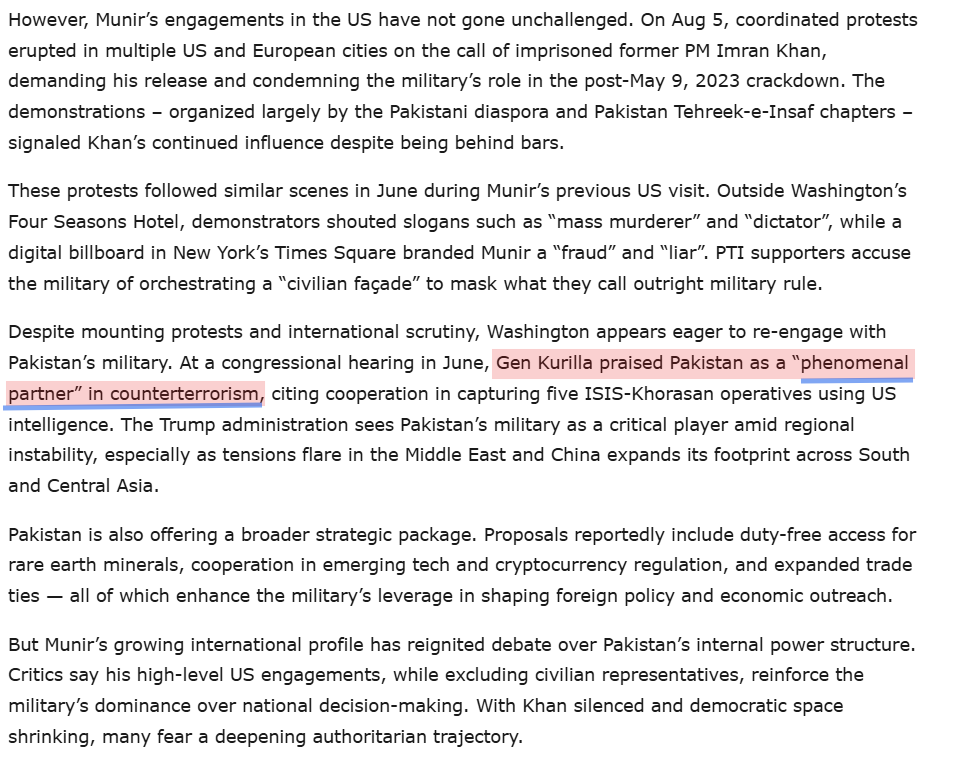
It was a jaw-dropping characterization, given Pakistan’s notorious record of sheltering the Taliban and hosting a rogues’ gallery of terror groups. Yet the U.S. security establishment under Trump seemed keen to rebuild an alliance with Rawalpindi. The Pentagon’s logic (as articulated by Kurilla) is that with regional instability rising – from Middle East flare-ups to China’s expansion – Pakistan’s military is a “critical player” the U.S. must have on side.
In plainer terms, Trump’s Washington has decided that embracing Pakistan’s junta is worth sidelining democratic India, in pursuit of short-term tactical gains and Trump’s own agenda.
From India’s vantage point, this turn of events is nothing short of a strategic snub. New Delhi spent the past two decades deepening defense and diplomatic ties with Washington, positioning itself as a like-minded democracy in a region of autocracies.
Yet here was the American president feting the chief of the very army that India holds responsible for cross-border terrorism against it. To Indians, Trump’s cozy lunch with Munir – coming so soon after the slaughter of Indian citizens in Kashmir – felt like a betrayal.
It signaled that Washington would not let terrorism (at least not against India) get in the way of its geopolitical realignment. Indian External Affairs Minister S. Jaishankar pointedly stated that “terrorism is terrorism” and one cannot whitewash killers as partners, a thinly veiled critique of U.S. eagerness to forgive Pakistan.
Indian diplomats also bristled at Trump’s insinuation that he mediated their conflict; India has long rejected third-party intervention in Kashmir. By sidelining those sensitivities, Trump dented U.S. credibility with the Indian public and elite. If the U.S. could so readily pivot to Pakistan’s side when it suited Trump’s interests, how reliable was Washington’s support really?
The fallout of Trump’s economic and geopolitical realignment strategy is only beginning to be felt, but the implications are profound.
- First, Trump’s actions may ironically accelerate the very multipolar financial order that America has long resisted. By weaponizing tariffs and sanctions for personal ends, and by openly promoting alternatives to the dollar, Trump is doing more to undermine the dollar’s dominance than America’s rivals ever accomplished. De-dollarization efforts by BRICS nations, Gulf petro-states, and others have been underway for years, but nothing lends them credibility like the U.S. president himself pushing gold and crypto as trade currencies. Through his gold tariffs and crypto normalization, Trump has given cover to countries that wish to conduct commerce outside the dollar system.
- Second, India is likely to deepen its pursuit of strategic autonomy and multipolar partnerships as trust in the U.S. erodes. Prime Minister Modi appears to have read the writing on the wall. Faced with Trump’s tariff assaults and the U.S. tilt toward Pakistan, New Delhi has reinforced its engagement with other powers. In recent months Modi has visibly cozied up to Russia, China, and other BRICS members, coordinating on trade arrangements that bypass the dollar. India joined discussions on alternative payment systems and even increased its gold purchases and rupee-ruble trade with Russia, signaling that it won’t be caught helpless if U.S. sanctions or tariffs strike again.
In effect, India is hedging its bets. It will not leave the U.S. camp entirely – India still values ties with Washington for balancing China – but it is asserting that it has options. India’s firm stand against Trump’s tariffs (“unfair and unjustified” in New Delhi’s words) and its refusal to bow on oil imports have won it quiet applause in the Global South.
The message: India will not be a pawn in someone else’s great game, be it about NATO, oil, or crypto. In the long run, a more independently assertive India could be a net positive for a multipolar world order – but it also means the U.S. has lost substantial influence in the Indian subcontinent that it may struggle to regain.
- Third, U.S. credibility in Asia – and beyond – has taken a hit. Allies and partners are watching how Washington has handled the India-Pakistan episode. Many see a troubling pattern of transactionalism.
For countries like Japan, Australia, or European allies, such behavior undermines the idea of a values-based alliance system. In Southeast Asia, nations hedging between the U.S. and China could conclude that Washington under Trump is unpredictable and driven by a president’s whim (or worse, his wallet) rather than consistent principles. This weakens America’s hand in the Indo-Pacific at a time when China is eager to portray the U.S. as an unreliable partner. As one Indian observer put it, Trump’s cozying to Pakistan’s generals “is a slap in the face to democracy” – it tells the world the U.S. will cut deals with strongmen when convenient.
- Finally, the convergence of Trump’s personal interests with U.S. foreign policy sets a dangerous precedent. It raises questions about governance and ethics within the United States. Congressional critics like Senator Elizabeth Warren have already lambasted the WLF venture – calling it “corruption” and warning senators not to ignore Trump’s conflicts of interest. If a U.S. president can run an “alternative financial empire” from the Oval Office and tilt American policy to enrich that empire, the long-term damage to U.S. institutions and credibility is incalculable. America’s soft power has long relied on a perception (not always accurate) that it upholds rule-based order and anti-corruption norms. Trump’s blending of official power with family business (whether through WLF or other deals) shatters that image. It suggests an America for sale, with foreign powers invited to strike bargains that benefit the First Family in exchange for policy favors. For the many countries that have looked up to the U.S. as a beacon, this is deeply disillusioning.
We are witnessing a remarkable realignment.
A U.S. president’s gambit to profit from de-dollarization is nudging traditional allies into new coalitions and giving adversaries an opening to promote non-dollar systems.
- Pakistan’s military, long a destabilizing force, finds itself courted and empowered, while India – the world’s largest democracy – is kept at arm’s length by Washington.
- BRICS and other emerging blocs are seizing the moment to advance a post-Western economic order, one ironically midwifed by an American leader.
This is a geopolitical moment heavy with consequence. The dollar’s throne is being shaken from within; U.S. alliances are being reordered by private greed; and norms of statecraft are being upended by one man’s “art of the deal.”
Where does this go?
In the short term, Trump may celebrate these disruptions as personal victories – political showmanship at home and lucrative deals abroad.
But the long-term costs to American leadership and global stability are mounting. Undermining the dollar for profit is playing with fire at the foundations of the international system.
Sidelining allies to embrace a terror-tainted regime might win momentary gains, but it seeds mistrust among democracies. As India and others forge their own path and previously fringe ideas like trading in gold or crypto gain mainstream traction, the U.S. risks waking up to a new world where its leverage is greatly diminished. In this new order, Donald Trump might indeed be richer – but America as a whole would be poorer, less influential, and more isolated.

Comments ()