"The most important thing we can do is to de-escalate the conflict and get the Strait of Hormuz open — and that's why I'm co-hosting the summit on Friday, in order to make progress on both those fronts." — UK Prime Minister Keir Starmer, speaking in the House of Commons, April 15, 2026
What This Signals
Starmer is doing three things in one sentence. He is distancing Britain from the US blockade (Britain explicitly declined to join it). He is positioning London as a co-host of the Hormuz navigation summit with France. And he is framing the entire crisis through the lens his domestic audience cares most about: energy prices.
The Friday summit Starmer references is a multilateral gathering aimed at "restoring freedom of navigation" — the precise formulation that both France and the UK have been advancing as an alternative to the US unilateral blockade. It is a UNCLOS-consistent, coalition-based approach that neither endorses the IRGC toll regime nor the US naval interdiction of Iranian ports. Britain is leading the middle ground that everyone says they want, but no one has yet institutionalized.
For India, this quote is the open door. Starmer is assembling exactly the coalition India has been positioned to join since the blockade went live. The Friday Hormuz navigation summit is India's moment to formally request observer status — or better yet, co-sponsorship. India's strategic autonomy, its maritime interests, its adherence to UNCLOS, and its credibility with both the US and Iran make it the ideal addition to a France-UK-led Hormuz governance framework. If India is not at this table, it will be shaped by it. The choice is India's.
Story #1: Basel III Fragments — Why US, Europe, and India Are Now Playing by Different Rules
The Full Picture
The Economic Times' commentary on Basel III fragmentation arrives as the most consequential regulatory divergence since the 2008 crisis was stitched together under a unified framework. On March 19, 2026, US regulators — the Fed, FDIC, and OCC — unveiled a revised Basel III Endgame proposal, substantially recalibrated from the 2023 version that would have raised large-bank capital requirements by 16-19%. The new US proposal seeks a "capital-neutral" outcome, removes the "dual stack" framework, and allows greater internal modeling flexibility — a significant concession to industry lobbying and a clean break from the Basel Committee's intent.
The EU, meanwhile, has implemented CRR3/CRD6, the legislative transposition of Basel III finalisation, with the FRTB (Fundamental Review of the Trading Book) postponed for the second time — now pushed to January 1, 2027, explicitly because of the US and UK delays and the need to preserve "a level playing field for EU banks' trading activities." The UK's Prudential Regulation Authority separately delayed the implementation of Basel 3.1 to January 2027. Canada's OSFI indefinitely delayed Basel III capital floor increases, citing "tariff-induced economic uncertainty."
The result, as Bloomberg's analysis documents, is that global Basel III implementation has become a patchwork in which each major jurisdiction is calibrating capital requirements to its own competitiveness and political pressures — exactly the fragmentation the Basel Committee was designed to prevent. US banks will face lower capital requirements than EU peers. EU banks are lobbying for further softening. And the emerging market question — what India and other large developing economies do — has become the pivot point of global regulatory competitiveness.
India's RBI has taken a more conservative approach than the US's new direction. India has been phasing in Basel III elements since 2015 and has maintained liquidity coverage ratios tighter than required, partly reflecting lessons from domestic bank stress. But India's public sector banks — which still carry significant NPL legacies — face a competitive challenge if US banks emerge from the Endgame recalibration with materially lower capital costs, enabling them to price credit more aggressively in international markets where Indian banks compete for corporate lending.
🇮🇳 How This Impacts India
India's RBI and Ministry of Finance must treat Basel III fragmentation as a strategic regulatory opportunity rather than merely a compliance calendar item. The new US proposal's comment period runs to June 18, 2026 — India should formally engage the process, as the world's fifth-largest economy and a significant participant in global capital markets. More importantly, RBI's next-cycle capital guidelines must explicitly address the competitive implications of US deregulation: if American banks emerge from the Endgame with significantly lower capital costs, India's public sector banks will be at a structural disadvantage in corporate lending markets. The government should consider whether this is the moment to accelerate India's own credit market development — through deeper corporate bond markets, development finance instruments, and infrastructure debt structures that don't depend on bank balance sheet capacity — reducing the transmission of US regulatory arbitrage into India's credit landscape.
📎 References: Economic Times | Bloomberg Basel III Endgame | Atlantic Council | Conference Board
Story #2: Global Debt to Hit Post-WWII Levels by 2029 — IMF's Fiscal Monitor Delivers a Warning That Outlasts the War
The Full Picture
The IMF's April 2026 Fiscal Monitor — released alongside the World Economic Outlook at the Spring Meetings in Washington — delivers a warning that transcends the immediate Iran war crisis: global public debt is on track to breach 100% of world GDP by 2029, a level not seen since the aftermath of World War II. The IMF's newly appointed Fiscal Affairs Director, Rodrigo Valdés, noted directly that the Iran war is "contributing to negative fiscal outcomes" through higher commodity prices, rising global interest rates, a stronger US dollar, and energy price spikes — all of which "exacerbate macroeconomic pressures in emerging market and developing economies."
The current trajectory: global public debt stands at approximately 94% of world GDP. Interest payments now absorb roughly 3% of global GDP. In low-income developing economies, interest payments consume around 15% of government revenue — squeezing health, infrastructure, and social spending. The fiscal cushion that existed a decade ago has effectively been eroded to near zero. The US runs deficits of 7-8% of GDP, with debt projected to reach 142% of GDP by 2031. China's debt approaches 127% of GDP as it supports domestic demand. Europe is loosening fiscal rules to accommodate defense spending booms. The IMF warns risks are "tilted firmly to the downside."
The bright spots in the IMF assessment are specific and instructive: India, alongside Mexico and Turkey, recorded an improvement in its fiscal position in the recent reporting period, supported by "restraint in primary spending." India's debt trajectory is expected to stabilize or decline over time, aided by strong nominal GDP growth and fiscal consolidation. But the IMF immediately notes India's debt-to-GDP ratio remains elevated above 84%, and that "higher energy prices, tighter global liquidity, and volatile capital flows" could complicate fiscal management if geopolitical tensions persist.
The IMF's structural warning is the one that most policymakers will ignore: the global fiscal buffer has been depleted by COVID, then Russia-Ukraine, then the Iran war. Each shock was managed by borrowing. The next shock — whether a financial crisis, a pandemic, or a Taiwan crisis — will arrive with far less fiscal room to respond. The IMF urges the gradual elimination of fuel subsidies and the broadening of tax bases. Neither is politically popular. Both are fiscally necessary.
🇮🇳 How This Impacts India
India's relative fiscal position — a bright spot in the IMF's Fiscal Monitor — is a genuine strategic asset that deserves to be deployed, not squandered. India's fiscal credibility has been built through years of difficult consolidation. It should not be wasted on poorly targeted fuel subsidies (the IMF specifically warns against these) or electoral spending that undermines the trajectory. More constructively, India's fiscal credibility creates space for differentiated borrowing in global capital markets. As the US debt trajectory approaches 142% of GDP and European defense spending booms create new fiscal strains, India's relative fiscal discipline will increasingly be recognized by international investors as a quality premium. India's sovereign bond inclusion in the JP Morgan EM Bond Index (already underway) and its potential inclusion in other global indices is directly supported by fiscal credibility. Every percentage point of primary surplus India maintains above IMF projections is a basis point of lower borrowing costs across the entire economy.
📎 References: Economic Times | BusinessToday | WAFA/IMF | IMF World Economic Outlook
Story #3: India Doubles Russian Oil Imports to €5.8 Billion — The Strategic Autonomy Dividend
The Full Picture
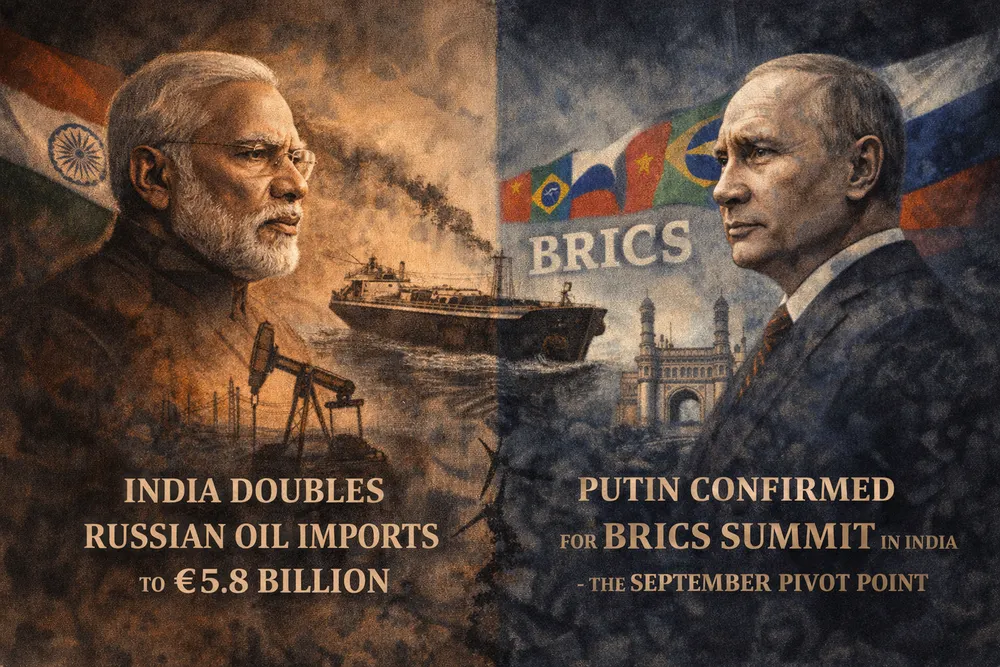
The Center for Research on Energy and Clean Air (CREA) data, reported by the Financial Express and multiple Indian outlets, confirms the scale of India's strategic energy diversification in action: India was the second-highest buyer of Russian fossil fuels in March 2026, importing a total of €5.8 billion of Russian hydrocarbons. Crude oil products constituted 91% of purchases at €5.3 billion — a more-than-tripling from February's €1.4 billion in crude purchases. Volumes doubled month-on-month, with state-owned refineries leading the surge (a 148% month-on-month increase in state refinery purchases) after Mangalore and Visakhapatnam refineries resumed Russian imports following a pause since November 2025.
The context that makes these numbers striking: in February, India was the third-largest buyer of Russian oil, behind China and Turkey. In March, India overtook Turkey to become second, behind only China. India's share of Russia's crude exports in March was 38%, compared with China's 51%. Russia's own TASS reported that India's oil imports from Russia reached 1.98 million barrels per day in March — the highest since June 2023. The CREA report also documents a secondary flow: India's Jamnagar refinery (Reliance Industries) contributed to a stream of oil products from Russian-crude-fed refineries flowing to the EU, Australia, and the US, with 25% of Jamnagar's feedstock from Russia in March. The US's own imports in this category came partly from Jamnagar.
Russia's revenues from India jumped 52% in the period, per CREA data compiled in the Financial Express. India's state refiners, which had paused Russian imports under diplomatic pressure in late 2025, resumed imports at scale once the disruption in Iran made Russian crude the most economical available alternative. The Russian barrels are "more available in the spot market," CREA noted, "which serves as the primary source of imports for state-owned refineries."
🇮🇳 How This Impacts India
These numbers reveal something important that India's critics — and India's own public communications team — consistently underplay: India is not merely surviving the Iran war energy crisis, it is navigating it with considerable sophistication. Doubling Russian crude purchases at a moment when every other major importer is scrambling for alternative barrels is a function of India having maintained the diplomatic and commercial relationships with Russia that make this possible. Strategic autonomy is not a slogan — it is this: buying the cheapest available barrel from the most willing supplier, while simultaneously diversifying into Venezuelan crude, US Gulf Coast oil, and West African supply. India's energy mix in April 2026 is arguably more diversified, not less, than it was before the war. The CREA data also raises a question India must manage carefully: if Indian refineries are processing Russian crude and selling products to the EU, Australia, and the US, India becomes a node in a Russia sanctions circumvention network — which is exactly the framing US officials will use to pressure India if the political climate shifts. India must ensure its legal compliance documentation across the Jamnagar and other refinery export chains is impeccable.
📎 References: Financial Express | Kashmir Reader / CREA report | Arunachal Times
Story #4: Putin Confirmed for BRICS Summit in India — The September Pivot Point
The Full Picture
Kremlin spokesperson Dmitry Peskov confirmed to TASS on Wednesday that President Vladimir Putin will "definitely" attend the BRICS Summit in New Delhi, expected September 12-13, 2026. This will be Putin's second visit to India in less than a year, following his December 2025 appearance for the 23rd India-Russia Annual Summit. India is hosting the BRICS Chairship for the fourth time (having previously held it in 2012, 2016, and 2021). The summit's theme — "Building for Resilience, Innovation, Cooperation and Sustainability" — signals India's intention to use the BRICS platform to address exactly the economic disruptions the Iran war has created: supply chain resilience, digital public infrastructure, energy transitions, and reforms to global institutional governance.
The confirmation of Putin is diplomatically significant on multiple levels.
- First, it confirms that despite the Russia-Ukraine war's ongoing toll on Russia's international standing in Western forums, Moscow's relationship with India remains sufficiently robust for Putin to make a second high-profile visit in less than a year.
- Second, it places Putin on Indian soil at a moment when the post-Iran war geopolitical architecture is being negotiated — the BRICS summit will occur approximately five months after the Iran ceasefire, at a point when the war's outcome will be clearer and when the post-war energy and financial order will be taking shape.
- Third, the summit will include all BRICS members — China, Russia, Brazil, South Africa, and India — as well as the expanded membership, including Saudi Arabia, the UAE, Egypt, Ethiopia, Iran, and Argentina, creating a rare gathering of the Hormuz-affected world in one room on Indian soil.
🇮🇳 How This Impacts India
The confirmation of Putin's BRICS participation is the most consequential diplomatic calendar development of 2026 for India's strategic positioning. India will host, in September, a summit that will include Russia (under sanctions, seeking rehabilitation), Saudi Arabia and the UAE (America's Gulf allies, seeking energy security guarantees), and Iran (the active combatant in the just-concluded war), simultaneously. This is the most unusual diplomatic gathering in the post-Cold War era — and India is chairing it. The preparation for this summit must begin now, not in August. India's BRICS Sherpa must develop a summit agenda that converts the war's disruptions into a concrete institutional output: a BRICS Energy Security Framework that addresses Hormuz-alternative routing, strategic reserve coordination, and LNG spot market transparency. India should also use the September summit to formally propose the multilateral IMO Hormuz navigation framework — inviting all BRICS members (who collectively account for the majority of Hormuz oil flows) to co-sponsor it. This is the institutional vehicle India has been building toward through this entire crisis.
📎 References: Economic Times | Republic World | Deccan Herald
Story #5: Iran War Day 47 — Second Talks Now "Very Likely" in Islamabad, IRGC Threatens to Expand Conflict
The Full Picture
The diplomatic track of the Iran war and the military threat track ran in parallel on April 15-16, producing the war's most cognitively dissonant news cycle yet. On the diplomatic side, Trump told Fox News the war is "very close to over" and predicted "amazing" developments in the next two days. White House press secretary Leavitt confirmed any US delegation would "very likely" return to Islamabad. The ceasefire, set to expire April 21, has not been formally extended — but a White House official told CNN the possibility of extension is "still on the table." Treasury Secretary Bessent confirmed the US is now "willing to apply secondary sanctions" to countries buying Iranian oil — a new enforcement ratchet that tightens even as talks approach. The S&P 500 and Nasdaq hit fresh record highs, erasing all losses from the Iran war, as markets priced in an imminent deal.
On the military threat side: IRGC commander Major General Ali Abdollahi issued the most expansive threat to date — warning that if the US blockade continues, Iran will "not allow any exports or imports to continue in the area of the Persian Gulf, the Sea of Oman and the Red Sea." The Sea of Oman and Red Sea extensions of this threat are significant escalations beyond Hormuz. Combined with Iran's parliament speaker Ghalibaf making a rare call to UAE Vice President Mansour bin Zayed to discuss "de-escalation," Iran is simultaneously threatening military expansion and engaging in Gulf diplomacy — a dual-track that suggests Tehran is also trying to find its own off-ramp while maintaining domestic credibility.
The nuclear gap remained: Iran rejected the US 20-year enrichment freeze. The sticking points from Islamabad remain: Lebanon's inclusion in the ceasefire, governance of the Strait of Hormuz, nuclear timelines, and the release of frozen assets. Pakistan's PM Sharif is personally shuttling between capitals.
🇮🇳 How This Impacts India
India's Chabahar waiver expired April 26 (11 days away as of today). India's Ambassador to Washington must have called OFAC before this newsletter reaches readers. If the call has not been made, it must be made today. This is not bureaucratic scheduling — it is the difference between India retaining its Chabahar operational capacity and losing it at the worst possible moment in the war's diplomatic arc. Additionally, Bessent's announcement of secondary sanctions on Iranian oil buyers is a direct threat to India's Russian crude supply chain if US officials decide to apply the "Iranian oil" label broadly to Jamnagar refinery products that contain Russian crude. India's Ministry of Finance and MEA must jointly assess this risk and prepare a legal brief for Treasury.
📎 References: Times of India liveblog | CNN live | CBS | Al Jazeera — IRGC threat
Story #6: Russia Publishes European Drone Factory Target List — Medvedev: "Legitimate Targets"
The Full Picture
Russia's Defense Ministry on April 15 published a public list of military production facilities across Europe involved in manufacturing drones and drone components for Ukraine. The list identifies facilities in the UK, Germany, Denmark, the Netherlands, Latvia, Lithuania, the Czech Republic, Finland, and Poland. Additional sites outside Europe — Turkey, Israel, Spain, Italy (at least four sites), and Germany — were named for drone component production. Former Russian President Dmitry Medvedev, now Deputy Chair of Russia's Security Council, immediately posted on X that the list should be treated as a register of "potential targets for the Russian armed forces." He added, "When strikes become a reality depends on what comes next. Sleep well, European partners."
The Russian Defense Ministry framed the publication as a warning: Kyiv's Western backers are seeking to "sharply ramp up" production of long-range UAVs, a move that "deliberately leads to sharp escalation of the military-political situation throughout Europe" and risks turning host countries into "Ukraine's strategic rear area." The ministry described the operations as targeting "terrorist attack scenarios against Russia using supposedly Ukrainian UAVs manufactured in Europe." The publication is unprecedented — never before in the Russia-Ukraine war has Moscow formally named European industrial facilities as potential strike targets while the facilities' host countries are NATO members.
The context: Ukraine has been launching hundreds of fixed-wing drones daily into Russian territory, targeting civilian infrastructure and military sites. Russia has responded with its own long-range strike campaign. The drone production network is distributed across NATO member states specifically to reduce its vulnerability to Russian strikes — but Moscow is now signaling it considers those states' territory as part of the conflict zone.
🇮🇳 How This Impacts India
The Russian target list has a specific India angle that requires attention: Israel is named as a drone component supplier to Ukraine (multiple sites). Given that Israel is simultaneously an Indian defense partner, a US ally, and now named as a Russian military target in the Ukraine context, India must explicitly segment its defense cooperation with Israel: Israeli drone technology sourced for India's military and defense programs must be carefully documented as non-Ukraine-related. Any suggestion that India is facilitating the supply chain of Israel's Ukraine-related exports would create an extraordinarily complex diplomatic situation with Moscow — at precisely the moment when Putin is confirmed for a September BRICS visit.
India's Ministry of Defense must issue internal guidance to all defense procurement channels that any purchases of Israeli-origin drones or components include explicit end-use certificates confirming non-Ukraine-related applications.
📎 References: RT — drone list | RT — Medvedev targets
Story #7: Lebanon-Israel Talks in Washington — The First Direct Engagement Since 1993
The Full Picture
Arab News' reporting on the Israel-Lebanon Washington talks — confirmed across Al Jazeera, NPR, and the State Department — documents a diplomatic moment that is historically significant regardless of its immediate outcome. Israeli and Lebanese ambassadors held direct talks at the State Department on April 14, the first direct bilateral engagement between the two countries since 1993. Secretary of State Marco Rubio framed the meeting: "This is a process, not an event."
The gap between the parties remains substantial. Israel wants Hezbollah disarmed and will not agree to a ceasefire in Lebanon as part of any deal; Lebanon wants an immediate ceasefire and humanitarian relief for the 1.1 million displaced and 2,124 killed. Hezbollah's Secretary-General Naim Qassem called the talks "futile" and urged Lebanon's government to withdraw, calling them a "free concession" to Israel. Despite this, both ambassadors described the meeting as "constructive." Israeli Ambassador Leiter said the next talks would be "in a few weeks in Washington." Israel is reportedly planning a long-term occupation of a security zone in southern Lebanon up to the Litani River — approximately 30km from the border.
The broader strategic logic: the Lebanon-Israel track is the third front of this war, alongside Iran-US nuclear diplomacy and the Hormuz blockade. If Rubio can produce even a temporary Lebanon ceasefire framework, it removes one of Iran's core objections to a peace agreement and reduces the IRGC's most immediate domestic political constraint. Lebanon's inclusion was one of Iran's stated red lines in Islamabad. Progress on this track — even incremental — makes the nuclear track more navigable.
🇮🇳 How This Impacts India
India has UNIFIL peacekeepers in southern Lebanon. Italy's Meloni suspended its Israel defense agreement partly because of a shot fired at an Italian UNIFIL convoy — an incident that directly raises questions about the safety of all UNIFIL contingents, including India's. The Ministry of Defense must assess the current rules of engagement for Indian UNIFIL troops, the evacuation protocol if Israeli ground operations approach UNIFIL positions, and whether the Israeli-Lebanese talks in Washington sufficiently change the operational environment to allow Indian forces to hold their current positions safely. This is not hypothetical: if Israel is planning a "security zone to the Litani River," UNIFIL positions south of the Litani are in the potential zone of operations. India's UNIFIL commander should be in direct communication with the Ministry of Defense and the Ministry of External Affairs on this question this week.
📎 References: Arab News | Arab News Saudi | Al Jazeera | NPR
Story #8: Iran's Hardliners Say "Impossible" to Accept Even One US Clause — The Internal Battle for Tehran's Position
The Full Picture
Arab News' reporting on Iran's internal political dynamics confirms the structural constraint that has shaped every moment of the Islamabad negotiation and will shape every moment of the second round: Iran's hardliners — concentrated in the IRGC, the parliament's security commission, and state media — are actively opposing any deal that concedes ground on uranium enrichment, Strait of Hormuz governance, or Hezbollah's status in Lebanon.
The specific quote from Esmail Kowsari, a member of parliament's national security commission and former senior IRGC commander: it would be "impossible" for the government to accept "even one clause" of the 15 points the Trump administration presented as conditions for peace. This is not a negotiating position. This is a veto. Kowsari added: "We know the Americans are not trustworthy and will not remain committed to agreements" — a direct reference to Trump's 2018 JCPOA withdrawal.
The contrast with Iran's moderate reformist voices is striking. Former President Mohammad Khatami — sidelined for years — released a statement urging the IRGC to "transform achievements in the field of battle to a lasting peace that would allow Iran to develop." And President Masoud Pezeshkian has said Tehran will continue dialogue within "the framework of international law" while blaming Washington for "excessive demands." The current Supreme Leader, Mojtaba Khamenei (Ali Khamenei's son, elevated after his father's assassination), has not spoken publicly on the negotiations — a silence that is itself a signal of uncertain authority over both the IRGC hardliners and the reformist moderates.
The key data point: Ghalibaf — the IRGC-aligned parliament speaker who led the Islamabad delegation and whose return to Tehran was described as necessary to "get approval for any deal" — held a rare phone call with UAE VP Mansour bin Zayed on April 15 to discuss "de-escalation." This call suggests Ghalibaf may be the conduit between the IRGC's military posture and the diplomatic track — and that he is engaging directly with Gulf actors as the second round of talks approaches.
🇮🇳 How This Impacts India
Iran's internal division between hardliners (who effectively run the IRGC and state media) and pragmatists (Pezeshkian's government) mirrors India's experience negotiating with Iran: the Foreign Ministry often says one thing, while the IRGC does another. India's diplomatic engagement with Tehran must be conducted at multiple levels simultaneously — the Foreign Ministry level (Araghchi, who is available and cooperative), the IRGC level (Ghalibaf, who controls Hormuz policy and was in the room in Islamabad), and the presidential level (Pezeshkian, who has the political legitimacy but not the operational authority). India's Ambassador to Tehran must have a direct line to all three. The Chabahar waiver's "friendly nation" passage status for India must be formalized not just through OFAC but through a direct Ghalibaf acknowledgment — because it is the IRGC, not the Foreign Ministry, that actually controls who passes through the strait.
📎 References: Arab News | Al Jazeera — IRGC threat | CBS live
Story #9: Trump Hints "Something Amazing" as Macron Calls Both Trump and Pezeshkian — The Diplomatic Surge
The Full Picture
Arab News' reporting on April 15-16, combined with CNN's live coverage, confirms that the diplomatic surge around a second round in Islamabad has produced the widest coalition of active mediators since the war began. France's Emmanuel Macron personally called both Trump and Iranian President Pezeshkian on April 14-15, "urged the resumption of negotiations suspended in Islamabad," and said he "deemed it essential for the ceasefire to include Lebanon and for the Strait of Hormuz to be reopened unconditionally." Macron's X post confirmed France and the UK are working together on a Hormuz navigation coalition — aligning exactly with the UNCLOS-consistent multilateral framework that India has been positioned to propose.
Trump's signals remain characteristically impulsive and oscillating: he told the New York Post talks "could be happening over the next two days," then told Fox Business News the war is "very close to over," then told ABC's Jonathan Karl he isn't "thinking about extending the ceasefire" because it "won't be necessary." All three statements were made within a 24-hour window. Markets interpreted the totality as optimistic. The S&P 500 hit a record high. Oil fell below $100. Both signals — the stock record and the oil price — are the market's version of a deal announcement.
Pakistan's PM Sharif has personally begun shuttle diplomacy, visiting Tehran and other capitals. Chinese FM Wang Yi has called Pakistani FM Dar to "preserve the extremely fragile ceasefire." UN Secretary-General Guterres called the talks "urgently needed." The architecture of a second round is assembled. What is missing is the specific bridging formula on nuclear enrichment duration that allows both sides to claim they have not conceded.
🇮🇳 How This Impacts India
Macron's active involvement — calling both leaders, proposing a Hormuz navigation coalition with the UK — creates a specific opening for India. France and the UK are both moving toward the multilateral navigation framework India has been positioning for. If India reaches out to Macron and Starmer in the next 48 hours and explicitly offers to co-sponsor a multilateral IMO Hormuz framework with France and the UK, India converts its passive neutrality into active multilateral leadership at the precise moment when the architecture of post-war Hormuz governance is being designed. This is a 48-hour window. It will not remain open indefinitely.
📎 References: Arab News | CBS live | CNN live
Story #10: China Doubles AI Computing Without US Chips — And Quantum Outperforms a $100M Supercomputer for <1% of the Cost
The Full Picture
Two SCMP stories from the same week paint a picture of China's technology trajectory that should be read in New Delhi as a national security document, not a science page curiosity.
The first: SCMP reported that China's AI computing infrastructure has approximately doubled in scale over a two-month period, without US chips. The vehicle is Huawei's Ascend series processors, combined with SMIC's 7nm fabrication. TrendForce projects that domestic chips will account for 50% of China's AI chip market in 2026. DeepSeek's forthcoming V4 model — expected in late April — is reported to run on Huawei hardware, with Alibaba, ByteDance, and Tencent placing bulk orders for Huawei hardware in preparation. If V4 performs at competitive levels on Huawei silicon, it will confirm that US export controls have served as a driver of Chinese semiconductor independence rather than a bottleneck. "If they have successfully trained V4 entirely on Huawei silicon, it signals a material shift in the geopolitical tech landscape," Counterpoint Research analyst Wei Sun told AFP. The key outstanding question is training compute vs. inference compute: running a model on Huawei chips has already been demonstrated; training frontier models at scale on domestic silicon remains the challenge.
The second: SCMP reported that Chinese researchers from the University of Science and Technology of China and Hong Kong's CUHK have demonstrated a nine-qubit quantum system that matched or exceeded the performance of a classical reservoir network with 10,000 nodes in multi-step weather prediction tasks — at less than 1% of the cost of a standard AI weather prediction center ($100M+).
The system is built on nine interacting quantum spins. The implications for the economics of AI infrastructure are potentially transformative: if compact quantum systems can deliver competitive performance in specific high-value tasks — weather prediction, financial modeling, drug discovery — at 1% of the cost, the economic logic that is driving the $1-3 trillion global AI data center buildout requires reassessment.
🇮🇳 How This Impacts India
These two stories together define the single most important strategic technology challenge facing India in 2026: the widening gap between China's AI infrastructure build-out (no longer dependent on the US, doubling every two months) and India's National Quantum Mission (approved in 2023, still largely at the planning stage). India has been treating the National Quantum Mission as a science program.
After reading this week's China news, it must be treated as a national security emergency. China's quantum-AI intersection — demonstrated in real-world tasks at 1% of the cost of classical computing — is directly relevant to India's defense AI program, its signals intelligence architecture, and its financial market infrastructure.
India's quantum computing investment must be doubled in the next Union Budget, with specific target deliverables (a functional 50-qubit system operational by 2027 and a quantum-AI integration lab embedded in DRDO) that are publicly tracked. The 48-hour window India has to lead on Hormuz is matched by a 24-month window India has to close the quantum-AI gap with China. After that, the gap becomes structural.
📎 References: SCMP — AI computing doubles | SCMP — quantum AI real-world task | DeepSeek V4 / Huawei | TechXplore
The Dispatch: Editor's Synthesis
Day 47. The ceasefire expires in five days. A second round of talks is being assembled in Islamabad. Markets have already priced the deal. China is running its AI infrastructure without US chips. Russia is publishing European factory target lists. Global debt is heading for levels not seen since the aftermath of World War II. And Putin is coming to New Delhi in September.
The Dispatch has spent 47 days chronicling a crisis. Today's edition is about something larger: the world being built in the crisis's shadow. The five structural shifts that will outlast the Iran war are all visible in today's stories.
The first is financial fragmentation. Basel III is no longer a single standard. US, European, and emerging market banks will operate under different capital rules. The 2008 consensus — that global banks need a common capital floor — is dissolving. India must treat this not as a compliance problem but as a strategic opportunity.
The second is fiscal exhaustion. Global debt is at post-WWII levels by 2029. The next crisis — whatever it is — arrives in a world that has spent its fiscal buffers. India's relative fiscal discipline is therefore not just responsible governance. It is strategic capital.
The third is energy diversification becoming structural. India is now the world's second-largest buyer of Russian oil. This is not a temporary crisis response — it is a new structural feature of the global energy order. India must manage its compliance exposure carefully but should not apologise for the economic rationality of its energy choices.
The fourth is the post-war order being negotiated right now. The Lebanon-Israel talks in Washington, Macron calling both Trump and Pezeshkian, Pakistan's Sharif shuttling between capitals, Ghalibaf calling UAE's VP — these are the conversations that will determine the post-war Middle East's governance architecture. India needs to be in these conversations, not watching from outside.
The fifth is the AI-quantum convergence that China is winning. The National Quantum Mission is India's single most underinvested national security program. China is doubling its AI infrastructure every two months without US chips and demonstrating quantum systems that outperform $100M supercomputers at 1% of the cost. India has a 24-month window to close this gap. After that, it becomes structural.
The ceasefire expires in five days. The BRICS summit is in five months. The world is being rebuilt.