The Keeper of the Bowl
A traveler arrived in a mountain village carrying nothing but an empty bowl and a look of great sorrow.
"I have come," she told the village elder, "because I heard your people suffer."
The elder looked at her empty bowl. "You have brought nothing."
"I have brought witness," she said. "And witness, properly displayed, brings everything."
Within a season, gold arrived from distant cities. Merchants, nobles, even kings sent coins after seeing the traveler's accounts of the village's suffering. She built a house at the edge of the village and brought the sick and the dying inside.
The villagers were grateful. They told their children: the traveler came with nothing and built a house for our suffering ones.
A young monk passing through the valley stopped to observe. He spent three days watching the house. On the fourth day he came to the village elder.
"The suffering ones inside," he said carefully, "are they improving?"
The elder hesitated. "They are... maintained."
"I watched a man yesterday ask the attendant for a second bowl of rice. He was refused. Not because there was no rice. I saw the rice."
The elder said nothing.
"I watched another man in considerable pain. The attendants have medicine. I saw the cabinet. It remained locked." The monk paused. "I asked one of the attendants why. She said that suffering was the proper condition of the dying. That it was an offering. That it refined the soul."
"She has brought much gold to this valley," the elder said quietly.
"Yes," said the monk. "Where does it go?"
The elder looked uncomfortable. "To the central house. In the great city far from here."
"And from there?"
"We do not know. We have never been told. When we asked, the answer was that such matters were administered from elsewhere. From a very great distance."
The monk sat down on a stone.
"Let me tell you what I have seen in other valleys," he said. "In the southern forests, a similar traveler came with a similar bowl. Within a decade, the young men of that valley knew more of her distant homeland's language than their own. The old songs were called darkness. The old names were replaced. And when a king of that valley attempted to ask where the gold went, ambassadors arrived from her homeland calling him a persecutor of the compassionate."
The elder stared at him.
"In the eastern hills," the monk continued, "another such house was built. The attendants learned the tribal boundaries, the water sources, the locations of minerals in the mountain. They sent letters home. Years later, merchants from that same distant homeland arrived knowing exactly where to dig."
"You are saying she is not what she appears."
"I am saying," the monk said carefully, "that the bowl has two functions. The first function, which everyone sees, is to collect suffering. The second function, which few examine, is that collected suffering generates gold, and gold generates influence, and influence generates information, and information generates power, and power generates more gold. The suffering ones in the house are not the purpose of the bowl. They are the mechanism of the bowl."
The elder was quiet for a long time.
"But some of them would have died in the road."
"Yes," said the monk. "That part is true. And that true part is load-bearing. It holds up everything else. Remove the genuine suffering and the bowl loses its power to collect. The suffering must be real. It needs only to remain suffering. It must not be resolved."
The elder looked toward the house at the edge of the village.
"What do I do?"
"Ask where the gold goes," the monk said. "That is the only question. Not whether she weeps when she carries the dying. She may weep genuinely. Not whether some of the sick receive some care. Some do. The question is: one hundred coins arrive in the name of your dying. How many reach your dying? And where do the others travel? And who receives them? And what do they do with them?"
"She will say I am ungrateful. The ambassadors will say I am cruel."
"Yes," said the monk. "They will call the question persecution. They will send important men to stand at your gate and speak of your cruelty to the distant lands where the gold went. The more important the men they send, the more important your question was."
The elder straightened slowly.
"And if I ask and they do not answer?"
The monk picked up his walking staff.
"Then you have your answer," he said, and continued up the mountain.
The elder stood for a while watching the white walls of the house at the edge of the village, where the attendants moved quietly behind small windows, and the cabinet of medicine remained locked, and the gold continued its long journey to somewhere no one in the valley had ever been permitted to see.
He went inside and began to write the letters that would need to be written.
Diplomacy?
The framing of the Marco Rubio visit to New Delhi as diplomacy deserves immediate interrogation. Diplomacy between equals is characterized by mutual accommodation, reciprocal agenda-setting, and calibrated give-and-take across domains. What the Rubio visit has hitherto represented is like a structured demand delivery, with each stop carefully choreographed to signal leverage points rather than build goodwill.
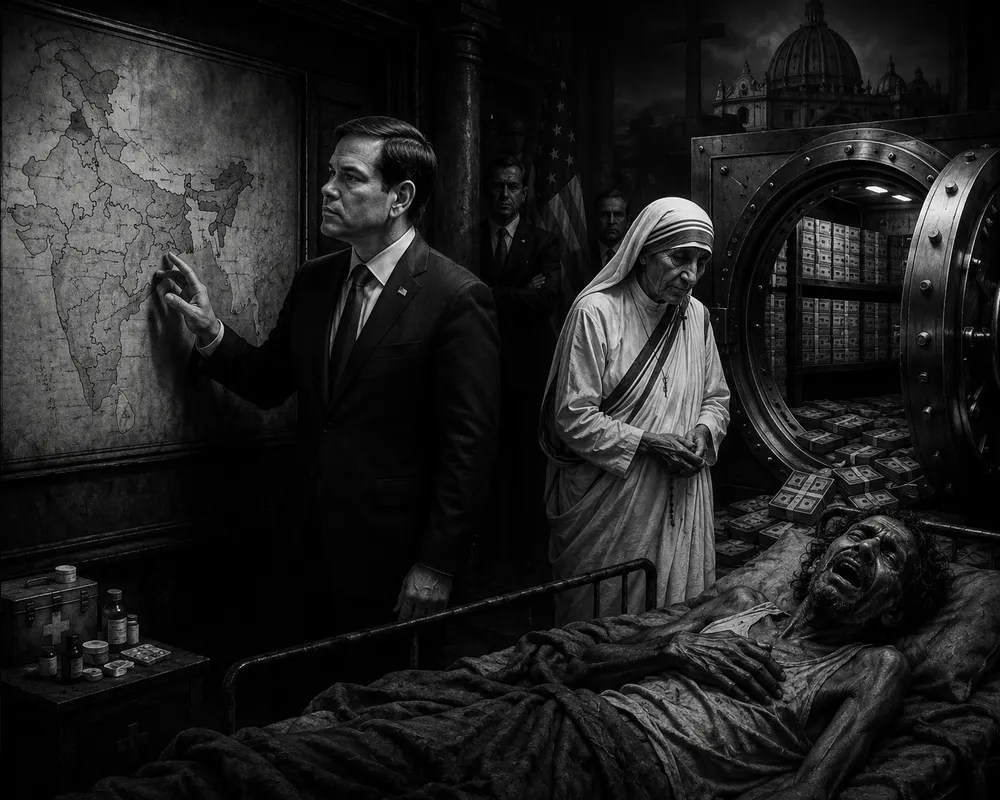
The opening stop at the Missionaries of Charity in Kolkata was the opening.
A devout Catholic Secretary of State begins his India visit not in New Delhi with strategic interlocutors, but in Kolkata with a faith-based institution whose FCRA license renewal has been under political contestation.
This action looks like a territorial marker.
The message is precise: Washington has a stake in what happens to this organization, and by extension to the entire ecosystem of foreign-funded religious institutions operating in India.
What makes this particularly sharp is the sequencing reported prior to the visit: nuns from the Missionaries of Charity reportedly met with the vanquished fascist leader of the past, Mamata Banerjee, the day before Rubio arrived. Mamata and her politics of anti-India subversion lost credibility and power in the recent elections.
 Desh Kapoor
The meeting with the nuns, followed immediately by Rubio's visit, creates an architecture where the federal government in New Delhi is flanked.
The signal to Modi is layered: Washington can work around you if needed, and the Church has allies inside India's political opposition who are prepared to receive that support.
Before Rubio set foot on the Indian soil, he was handed a 'shopping list' by Congressman Chris Smith. Related to India's FCRA changes and its impact on Christian organizations.
The FCRA Battlefield and Chris Smith's Intervention
The broader context of Congressman Chris Smith's public intervention completes the picture of coordinated pressure. Smith, who chairs the House Global Human Rights Subcommittee, published an op-ed explicitly calling on Rubio to push New Delhi to withdraw proposed FCRA amendments, framing this as a religious freedom and human rights issue. His argument deserves careful examination because it illuminates the strategic logic of the pressure campaign.
 Rep. Chris Smith
Smith argued that the proposed amendments would allow the Indian government to seize or nationalize the properties and assets of faith-based NGOs, including churches, charities, hospitals, schools, and dioceses, if their FCRA licenses lapsed or were not renewed, even for minor accounting or technical errors. He invoked the 2021 Missionaries of Charity FCRA renewal crisis as the template for what he claimed could become routine state predation against Christian institutions. He warned against India evolving into what his coverage described as a "Hindu cultural civilization" under BJP governance, and cast FCRA enforcement as the primary instrument of that evolution.
This framing is analytically dishonest but politically sophisticated.
FCRA is not an anti-Christian instrument. It is a sovereignty instrument, enacted to prevent the use of foreign funding to distort India's political, electoral, and social landscape. Every major democracy maintains equivalent frameworks.
The United States has FARA. The European Union has foreign agent registration regimes.
The Missionaries of Charity’s FCRA registration was denied renewal by India’s Ministry of Home Affairs on 25 December 2021, resulting in its lapse on 31 December 2021; it was restored in early January 2022 after a brief interruption. (Source: NDTV)
The Missionaries of Charity situation in 2021 is instructive precisely because it illustrates how these instruments actually work. The organization's account was frozen over a compliance violation. This is standard regulatory procedure under FCRA. The incident became a global controversy not because the regulation was unjust but because the institution in question carries the moral branding of Mother Teresa, which makes it nearly impossible to subject it to the same scrutiny that would apply to any other foreign-funded organization.
Smith's invocation of the 2021 episode is a deliberate conflation of regulatory compliance with religious persecution.
This becomes important because Khalistani supporter and backer Gunisha Kaur has been appointed to the United States Commission on International Religious Freedom (USCIRF). She will serve as one of the 9 Commissioners of USCIRF for 2 years.
The Church as a Sophisticated Institutional Actor
What the Rubio visit and Smith's intervention clarify is that the Catholic Church and allied Christian institutions operating in India are not simply charitable organizations. They constitute a sophisticated network with their own strategic interests, their own political relationships both inside and outside India, and their own capacity to mobilize diplomatic pressure at the highest levels of the US government.
The Missionaries of Charity is part of this architecture. Whatever its facade of humanitarian work may be, the institutional structure of Catholic education and charity in India has historically functioned as a conversion pipeline.
This is not a polemical characterization. The entire logic of Catholic mission work, globally and in India, is evangelization.
Education, healthcare, and charitable service are delivery mechanisms for that mission. The institutional sophistication lies in the ability to maintain the charitable branding while pursuing the evangelical objective, and to mobilize state-level diplomatic pressure when regulatory frameworks threaten the funding streams that make this possible.
The personal connection many Indians have with these institutions, with schools run by affiliated congregations, and with charitable donations, was part of everyday life, reflecting how deeply embedded this network is in Indian civil society.
That embeddedness is itself a strategic asset, because it makes critical examination of the institutional logic emotionally difficult for those who carry personal associations.
Now, let us discuss the work and character of the Missionaries of Charity and the lady who was called Mother Teresa.
Tell Jesus to Stop Kissing Me!
When the conquest of souls - a self-serving and facetious understanding of the word as it may be - is your goal, then you are no longer required to answer to your own soul for the crimes you commit out of your fanaticism.
The lady called "Mother Teresa" had a Human Rights problem.
A sick and suffering man was dying and screaming from pain while the lady Teresa, who had picked him off the street, was "attending" to him, another "poor dying destitute" that would bring her the millions. She promised him, "You are suffering, that means Jesus is kissing you."
The suffering man, money bank advertisement that he was for her, shouted in agony, "Then tell your Jesus to stop kissing me."
The editor of the prestigious medical journal The Lancet, Robin Fox, had documented the extreme medical and criminal negligence committed by the band of Teresa nuns.
In 1994, Robin Fox, editor of the prestigious medical journal Lancet, in a commentary on the catastrophic conditions prevailing in Mother Teresa's homes, shocked the professional world by saying that any systematic operation was foreign to the running of the homes in India: TB patients were not isolated, and syringes were washed in lukewarm water before being used again. Even patients in unbearable pain were refused strong painkillers, not because the order did not have them, but on principle. "The most beautiful gift for a person is that he can participate in the suffering of Christ," said Mother Teresa. Once she had tried to comfort a screaming sufferer, "You are suffering, that means Jesus is kissing you." The sufferer screamed back, furious, "Then tell your Jesus to stop kissing me." (Source: Mother Teresa: Where Are Her Millions? / The Freethinker)
If you look at it closely, this anecdote is really a policy statement in human form. The suffering actually is the point of this infrastructure of charity! Not a failure of resources or logistics.
Pain was being administered as theology, to people who had not consented to that theology, by an institution that was simultaneously collecting hundreds of millions of dollars in the name of alleviating exactly that suffering.
The fact is that lady Teresa was not running a "home for the poor and destitute" - she was running a money-making enterprise, quite like how the Slumdog Millionaire showed of the poor used in begging cartels.
The only difference between lady Teresa and the owner of one of the begging cartels is that she was given Sainthood.
The suffering was for others. Moneyed care was for her. When sick, she did not seek refuge in her own home, and the practices that defined the cult of pain her theology pushed her towards. She would instead check into expensive clinics in California.
This returns us to the medieval corruption of the church, which sold indulgences to the rich while preaching hellfire and continence to the poor. MT was not a friend of the poor. She was a friend of poverty. She said that suffering was a gift from God. She spent her life opposing the only known cure for poverty, which is the empowerment of women and the emancipation of them from a livestock version of compulsory reproduction. And she was a friend to the worst of the rich, taking misappropriated money from the atrocious Duvalier family in Haiti (whose rule she praised in return) and from Charles Keating of the Lincoln Savings and Loan. Where did that money, and all the other donations, go? The primitive hospice in Calcutta was as run down when she died as it always had been—she preferred California clinics when she got sick herself—and her order always refused to publish any audit. But we have her own claim that she opened 500 convents in more than a hundred countries, all bearing the name of her own order. Excuse me, but this is modesty and humility? (Source: "Mommie Dearest" / Slate)
Teresa was therefore an emblem of how a pain‑centric theology can sanctify not only suffering but also the maintenance of environments in which the poor continue to suffer visibly, thereby serving as perpetual symbols for fundraising and the drama of redemptive pain.
Her practices have been called “horrifically negligent,” “morally repugnant,” and even a “systematic human rights violation.” Which objectively checks out to be correct.
Gonzalez went home and started a Facebook campaign called Stop Missionaries of Charity, demanding professional medical care and full public disclosure of donations. He called it Responsible Charity because the original was not.
It is the kind of work that inspired Hemley Gonzalez, who lived on the other side of the world in Miami, United States. A migrant from Cuba, Gonzalez had grown up in a poor neighborhood and was inspired after reading a biography of Mother Teresa. "I wanted to come to India and serve in Kalighat (the place where Nirmal Hriday is situated)," he recounts over the phone. Gonzales, who runs a real estate business in Miami, reached Kolkata in December 2008 and stayed for two months. "I was shocked to see the negligence. Needles were washed in cold water and reused and expired medicines were given to the inmates. There were people who had chance to live if given proper care," says Hemley. He narrates incidents of an untrained volunteer wrongly feeding a paralyzed inmate, who choked to his death; and another where an infected toe of an inmate was cut without anesthesia. "I have decided to go back to Kolkata to start a charity that will be called 'Responsible Charity.' Each donation will be made public and professional medical help will be given," says Hemley, who now runs a campaign on Facebook called 'Stop Missionaries of Charity,' and has over 2,000 members. (Source: "Pointing Fingers At Mother Teresa's Heirs" / Forbes)
Fourteen years separate Fox's Lancet commentary from Gonzalez's eyewitness account. The conditions had not changed. This is not an institution that failed to improve. It is an institution for which improvement was structurally irrelevant, because the suffering was the inventory and marketing strategy, not the problem to be solved.
The warnings of Teresa's sick operations have been numerous.
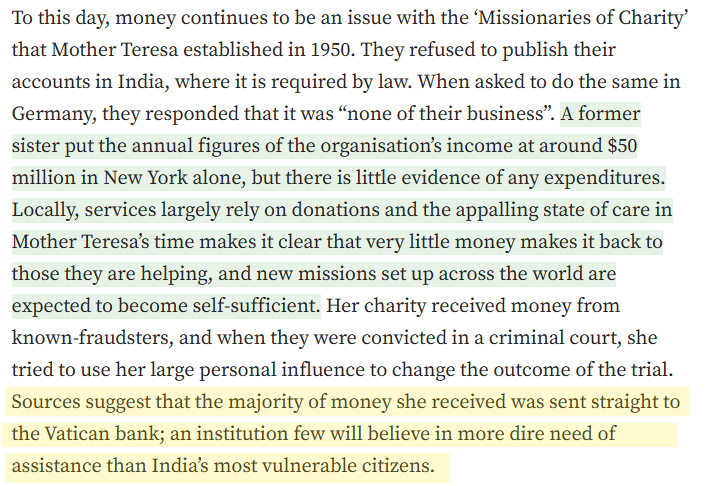
The bottom-line is that she headed an operation that eulogized the cult of pain theology.
Whiter Millions
Kitty Wenham's account briefly points to this. So, let us dive deeper into this.
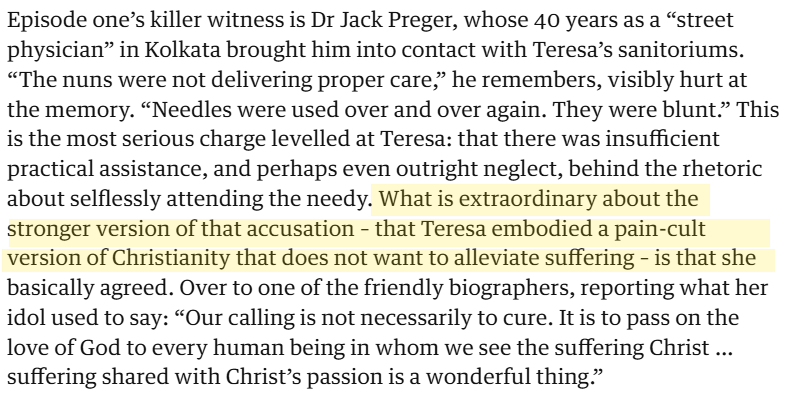
England is one of the few jurisdictions where MoC was required to submit even minimal financial disclosure.
When the head of the England operation, Sister Teresina, was asked where the remaining ninety-three percent went, her answer was: "Sorry, we can't tell you that."
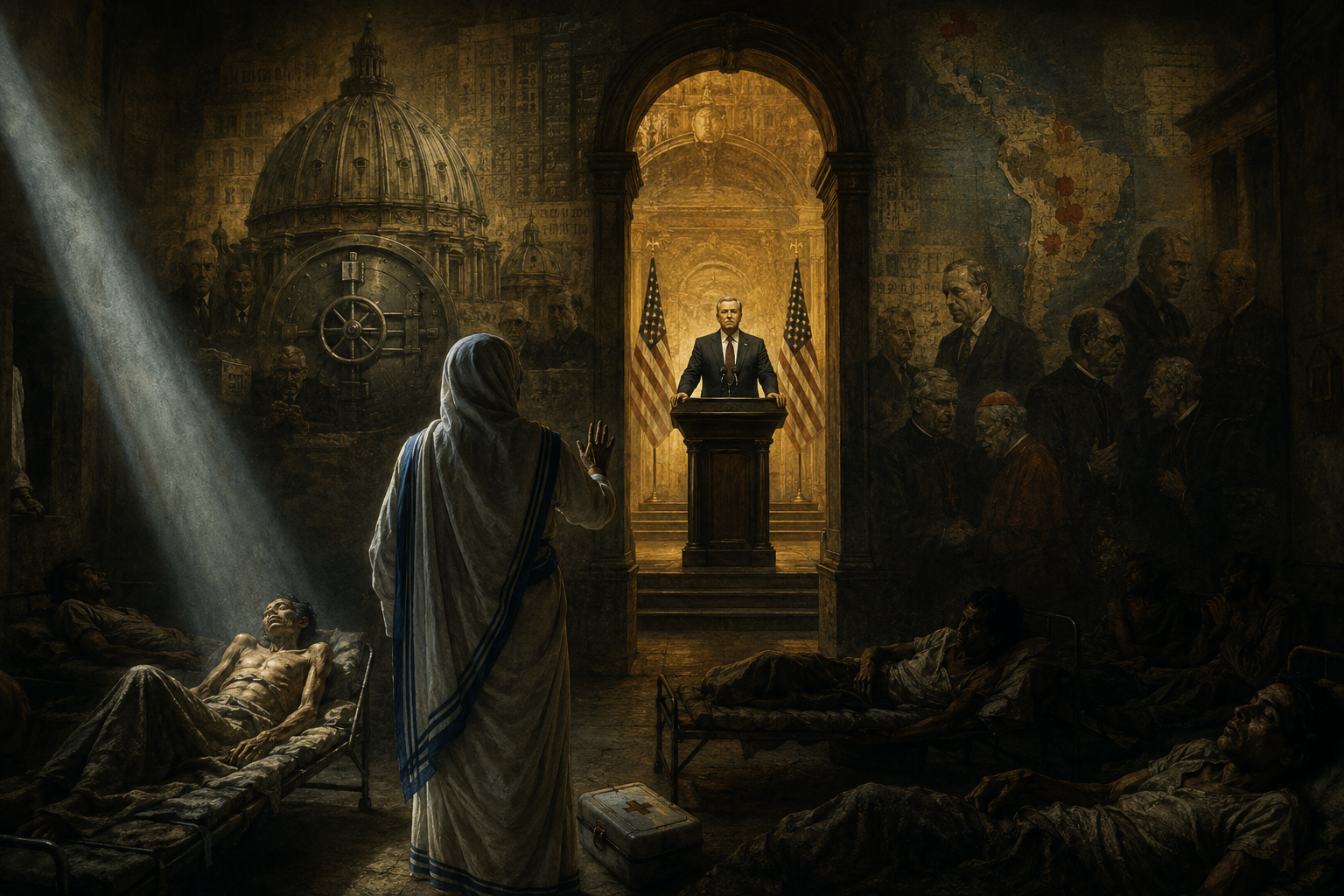
England is one of the few countries where the sisters allow the authorities at least a quick glance at their accounts. Here the order took in DM5.3 million in 1991. And expenses (including charitable expenses)? — around DM360,000 or less than 7%. Whatever happened to the rest of the money? Sister Teresina, the head for England, defensively states, “Sorry we can’t tell you that.” Every year, according to the returns filed with the British authorities, a portion of the fortune is sent to accounts of the order in other countries. How much to which countries is not declared. One of the recipients is however, always Rome. The fortune of this famous charitable organistaion is controlled from Rome, — from an account at the Vatican bank. And what happens with monies at the Vatican Bank is so secret that even God is not allowed to know about it. One thing is sure however — Mother’s outlets in poor countries do not benefit from largesse of the rich countries. The official biographer of Mother Teresa, Kathryn Spink, writes, “As soon as the sisters became established in a certain country, Mother normally withdrew all financial support.” Branches in very needy countries therefore only receive start-up assistance. Most of the money remains in the Vatican Bank. (Source: Mother Teresa: Where Are Her Millions? / The Freethinker)
What the returns did show is that money was regularly transferred to accounts in other countries. How much. To which countries. Not declared. One destination was always Rome. The operation was controlled from there, through an account at the Vatican Bank.
Italian investigative journalist Gianluigi Nuzzi, in his book Original Sin, found Teresa's Vatican Bank accounts through accounting slips from secret deposits in dollars and Italian lire. What he found there clarified the scale of the operation.
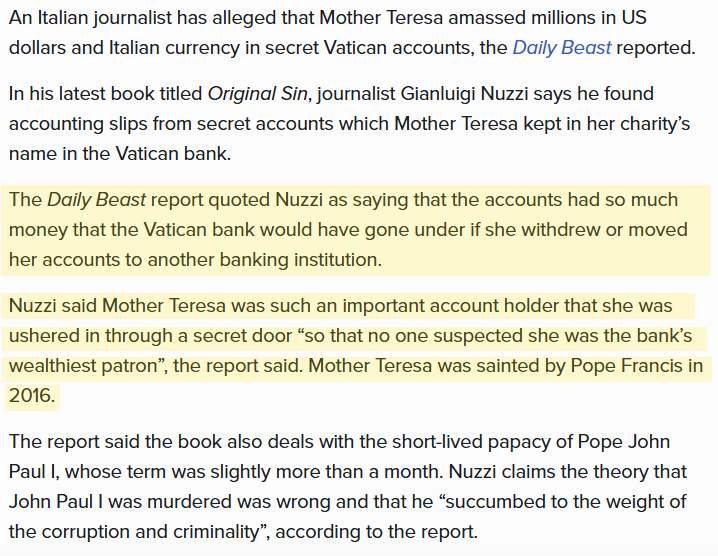
The official biographer of Teresa, Kathryn Spink, provided a detail that explains how the distribution logic worked.
As soon as MoC sisters established themselves in a country, Teresa withdrew all financial support to that branch. Local branches received startup assistance and nothing more after that. The money raised in wealthy countries in the name of the poor in poor countries did not reach those poor countries. It remained in the Vatican Bank.
Read those three facts together.
- Dying patients denied painkillers as a theological principle.
- Less than seven percent of income reaching the people that income was raised to serve.
- Billions accumulating in a Vatican Bank account, controlled from Rome, never disclosed, never returned to the suffering that generated them.
Does this look like a charity that may have fallen short? Heck no! This is a structure in which the suffering was harvested and the proceeds were extracted. Just like the Slumdog Millionaire's begging cartel.
Evangelicals as Intelligence Operatives
God's work in the Christian world was more about power than about some divinity. God and his son were just convenient mascots. They still are.
So it is quite in keeping that those who work in the path of the god, would also proliferate power for the mighty.
Evangelicals have a history of helping the intelligence agencies create subversions in other societies.
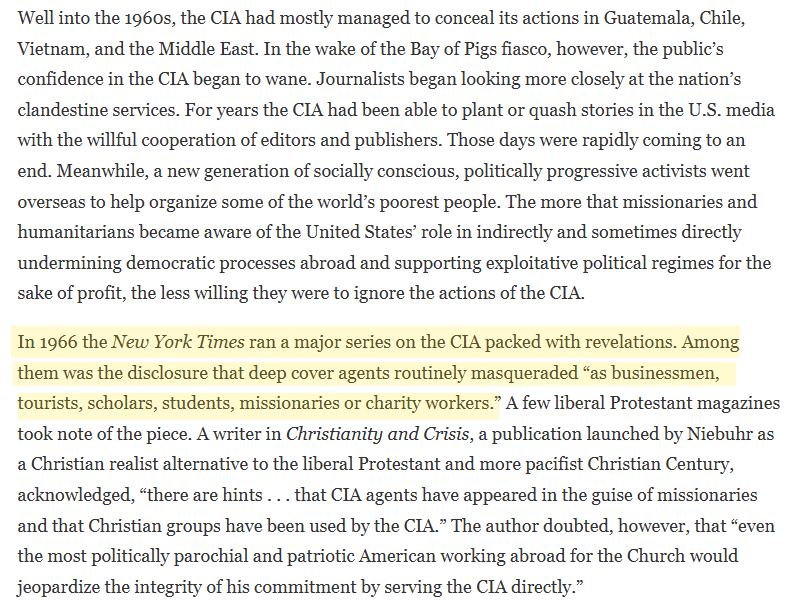
There is a sentence that appeared in a letter from CIA Director William Colby to Senator Mark Hatfield of Oregon, written after the Church Committee hearings of the 1970s had exposed the agency's penetration of American religious institutions. Hatfield, himself an evangelical Baptist, had written to express concern about the CIA's use of missionaries in covert operations. Colby's response was direct.
He had no intention of stopping.
Upon learning that the CIA had been using American religious activists for covert operations, Senator Mark Hatfield of Oregon, an outspoken evangelical and Baptist, wrote Director William Colby to express his concerns. Colby, however, had no intention of restricting the agency’s use of missionaries. In many countries clergy, both indigenous and American, he explained, “play a significant role and can be of assistance to the United States through CIA with no reflection upon their integrity nor their mission.” He blamed the controversy on “sensational publicity” rather than the facts on the ground. (Source: God’s Spooks: Religion, Spying, and the Cold War / Church Life Journal)
That sentence is the foundation of everything that follows. It is not a conspiracy theory.
It is a CIA director's written statement to a US senator, on the record, after the Church Committee had already documented the scale of the operation.
The question of whether the CIA has used Christian missionaries as instruments of American geopolitical power is now well-documented and closed.
It is documented from the agency's own communications, from declassified State Department cables, from USAID contracts, from congressional testimony, from multiple investigative books whose authors spent years in archives across three continents, and from the decisions of sovereign governments across Latin America and Asia who expelled these organizations from their territories because they had independent evidence of what they were doing.
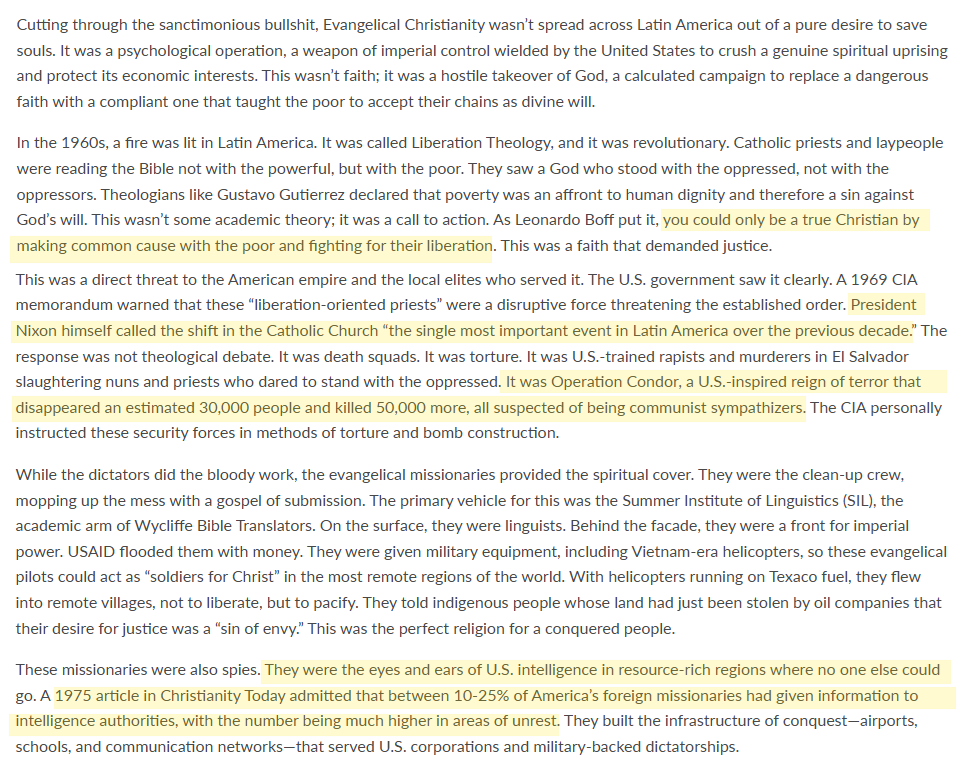
The question worth asking is not whether this happened. The question is how it worked, what it accomplished, and what it means when the United States Secretary of State opens his India visit at the doorstep of one of these institutions in Kolkata.
The Operational Logic: Why Missionaries Make Perfect Spies
OSS officers, the organizational predecessors of the CIA, realized during the Second World War that missionaries made some of the best clandestine operatives. Missionaries have excellent language skills, they understand cultural sensibilities, they know how to disappear into foreign cultures, and they are masters at effecting change abroad.
By the end of the war, American missionaries were gathering intelligence, keeping tabs on Axis agents, drafting plans to infiltrate enemy territory, partnering with insurgent groups, recruiting foreign hitmen, and hatching assassination plots.
In civics classes across the country, students are taught that a metaphoric wall separates church and state. However, the church-state connection is far more complicated, according to NEH Public Scholar Matthew Avery Sutton. “During the 1940s,” he writes, “American leaders came to understand in deeper and more explicit ways how central religion was to crafting successful foreign policy.” They hatched numerous plans to use spirituality as a political tool, but one in particular stuck: hiring missionaries to “serve God and country” as spies. Sutton’s book, Double Crossed: the Missionaries who Spied for the United States during the Second World War, examines this “holy” espionage throughout WWII, presenting a fledgling U.S. intelligence agency, its religious assets, and their unusually close alliance. (Source: The Hidden World of Holy Spies: A Q&A with NEH Public Scholar Matthew Avery Sutton / National Endowment for Humanities)
This is not a peripheral or accidental discovery. It is the foundational operational insight that shaped American intelligence doctrine for the next eighty years. The missionary arrives in a country with a cover story that is legally protected, morally unimpeachable in Western public discourse, institutionally backed by powerful domestic constituencies, and structurally designed for deep community penetration. A missionary does not visit a country. A missionary lives in it, learns its languages at the granular dialect level, maps its social hierarchies, identifies its internal tensions, builds trusting relationships with local populations over years and decades, and moves freely through regions that would be inaccessible to a typical foreign agent.
This combination of access, cover, and institutional network is operationally invaluable. It is also, from the perspective of the host country, a profound security vulnerability that is systematically disguised as humanitarian service.
William "Wild Bill" Donovan, head of the Office of Strategic Services, hired numerous missionaries to conduct espionage throughout the Second World War. When the OSS morphed into the CIA after the war, the networks and the doctrine came with it.
The Summer Institute of Linguistics: Mapping the Amazon for Rockefeller
The most extensively documented case of the missionary-intelligence partnership is the Summer Institute of Linguistics, the academic arm of Wycliffe Bible Translators, and its operations across Latin America from the 1940s through the 1970s.
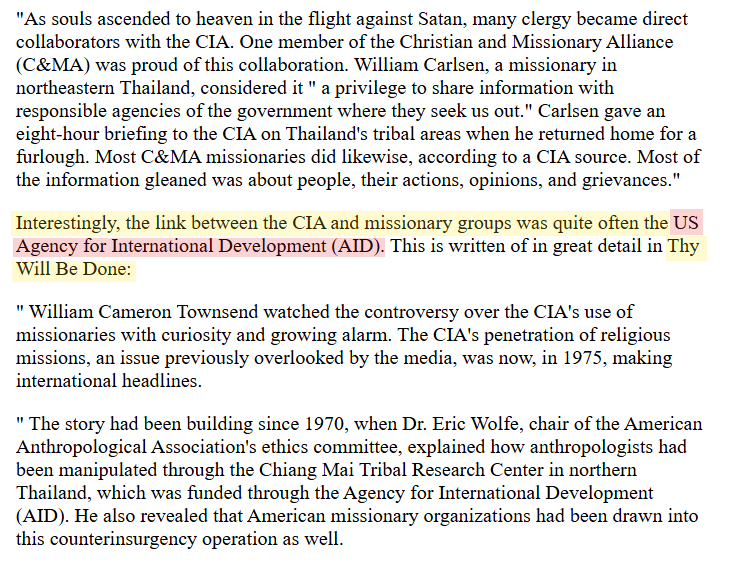
Thy Will Be Done, by Gerard Colby and Charlotte Dennett, exposes the entanglement of US missionary movements, Cold War geopolitics, and corporate expansion into the Amazon through the Rockefeller dynasty's covert operations. Nelson Rockefeller's appointments as Coordinator of Inter-American Affairs and later Assistant Secretary of State for Latin American Affairs positioned him to fuse religious missions with intelligence operations.
His coordination with fundamentalist missionary groups, including Wycliffe Bible Translators and the Summer Institute of Linguistics, integrated Christian evangelism into a US-engineered system of territorial and ideological control.
These missionaries, deployed under the guise of translating Bibles, mapped indigenous populations, identified tribal resistances, and facilitated access for corporate and military entities seeking land and resources.
 Charlotte Dennett
The operational elegance of this arrangement cannot be overstated. Wycliffe Bible Translators needed to go where the untranslated languages were, which meant the Amazon basin, the interior of Papua New Guinea, the highland tribal regions of Southeast Asia.
In the 1970s, several Latin American countries including Colombia, Mexico, Panama and Peru held SIL responsible for advancing the interests of American intelligence agencies, and Brazil expelled SIL's missionaries from the country for acting as cover for geologists searching for mineral deposits in the Amazon basin. This was not Brazilian paranoia.
It was Brazilian intelligence assessment of a documented operational pattern, independently verified by multiple sovereign governments across the same region.


The 1942 internal directive from SIL founder William Cameron Townsend to his Mexico City office makes the intelligence relationship explicit even in those early years.
Following discussions in Washington with "some men who are interested in furthering good will between our countries," Townsend specifically requested SIL's Mexico City office to solicit reports from "any of our workers who may have observed efforts on the part of anyone to make the Indians think that Americans are not their friends."
This is surveillance doctrine, written by a missionary organization leader, directed at his own field operatives, framed as goodwill, and positioned against any indigenous organizing that questioned American interests.
The Bible translator as informant network was operational from the beginning.
India: The Operation Moves East
The Latin American template was not limited to Latin America.
With the collapse of the Soviet Union in 1991, efforts to evangelize Latin America were mostly abandoned, and the weaponized evangelicals were now used to justify war in the Middle East, especially against Iran. The strategic target shifted. The operational doctrine did not.
India's northeast, with its tribal populations, its geographic distance from the Hindu cultural heartland, its borders with China, Myanmar, and Bangladesh, and its history of insurgency, presented a strategically significant operational theater.
The missionary penetration of this region was not organic. It followed the same pattern documented in Latin America: access through humanitarian and religious services, deep community penetration, intelligence gathering, and the slow replacement of indigenous cultural frameworks with a Christian identity that created loyalty structures external to the Indian state.
Indian intelligence agencies flagged that several missionaries in India were being used by Western powers for intelligence gathering and pushing an anti-India agenda.
In recent months, conversion operations were busted in Uttar Pradesh, Madhya Pradesh, Maharashtra, Odisha, and Meghalaya, revealing networks involving foreign nationals on tourist and business visas.
Investigations found that these operatives were targeting vulnerable populations, particularly tribals, by offering free healthcare and education. Officials said these groups were spreading false, anti-India narratives through vulnerable recruits, who were later used to further infiltrate communities.
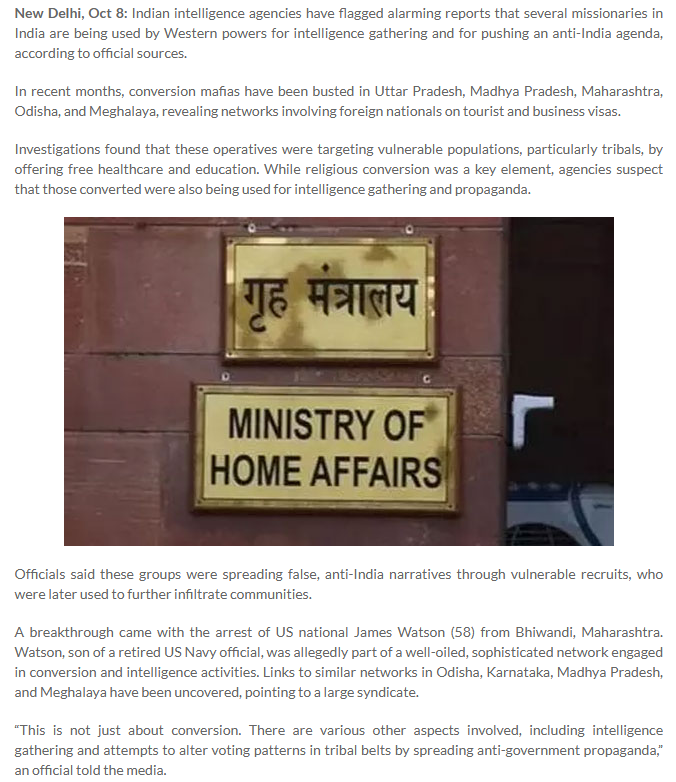
More details about the modus operandi came following the arrest of US national James Watson, 58, from Bhiwandi in Maharashtra. Watson is the son of a retired US Navy official. The institutional connection to the American military-intelligence establishment was embedded in the family biography of the arrested operative. This is not coincidence. It is pattern.
 IANS
IANS
Earlier, the focus of this operation was largely in the tribal areas and northeastern states. However, it has started to expand and is now found in many more states, including Tamil Nadu. The newer, more sophisticated methods now involve intelligence gathering, attempts to destabilize governments, and influence over voting patterns in tribal belts.
The Regulatory Response and the American Reaction
India's FCRA framework is the regulatory architecture designed to make this operation visible. It requires foreign-funded organizations to disclose their funding sources, demonstrate the application of funds to declared purposes, and maintain licenses through compliance with basic financial transparency requirements. It asks, at minimum, what the British government asked MoC in 1991: where is the money going?
The American legislative and executive response to India's FCRA enforcement is now documented: a senior congressman chairs a subcommittee hearing framing FCRA as religious persecution, publishes an op-ed demanding the Secretary of State intervene, and that Secretary of State opens his India visit at the Kolkata home of the specific institution whose financial opacity FCRA would pierce.
The doctrine is consistent. The target has changed. The method is identical.
What This Means
The CIA-evangelical partnership is not a historical footnote.
It is a living operational framework that has moved through Latin America, Southeast Asia, Africa, and the Middle East, adapting its methods to each theater while maintaining its core logic: missionary access provides intelligence cover, evangelical doctrine produces politically pacified populations, USAID and foreign funding channels provide deniable financial infrastructure, and the religious freedom framing provides diplomatic protection when host governments attempt to regulate what is happening inside their borders.
India is not Guatemala. It is not Brazil.
It has a civilizational depth, an institutional complexity, and a democratic accountability structure that makes the operation more difficult and its exposure more consequential.
But the operational template being applied is the same one documented in Colby's letter, in the SIL expulsions, in the Contra funding network, in the declassified State Department cables, and in the ongoing arrests of foreign nationals conducting intelligence operations under missionary cover across multiple Indian states.
Rubio's Kolkata visit was not a devotional gesture. It was a territorial signal, delivered in the language of faith, backed by the full weight of American diplomatic and legislative pressure, designed to protect an operational infrastructure that India's sovereignty and its citizens' security require it to regulate.
The Oil Lever and the Green Card Weapon
The Rubio visit should not be viewed in isolation.
It coincided with a new US communique on Green Card adjustment of status that carries significant implications for Indian H1B holders. The timing can not be coincidental.
The dual pressure is structured to create a bidirectional squeeze: on the economic aspirations of India's middle and professional class through immigration leverage, and on India's macroeconomic stability through energy pricing.
On energy, the United States has maintained a deliberate policy of using its influence over the Strait of Hormuz situation to keep global oil supply constrained. Russian refineries operate under sanctions, reducing global refining capacity. Venezuelan crude reaches global markets primarily through US-controlled channels that impose a premium.
The result, is manufactured scarcity designed to make American crude the price-setter of last resort.
India's vulnerability here is real. Oil is not a discretionary import. It runs the economy. The pressure to buy American or Venezuelan oil routed through American channels at premium prices is an extraction mechanism.
And the FCRA and immigration levers are the behavioral conditioning tools that surround it: cooperate or face compounding costs across multiple domains simultaneously.
The H1B and Green Card pressure operates through a different but equally real channel. Hundreds of thousands of Indians embedded in the American technology, medical, and financial sectors represent a remittance and human capital link that is deeply important to Indian families and to India's political economy. Washington understands that threatening this link creates domestic political pressure on Modi from communities that would normally support his government.
India's Strategic Options
The question is not whether this is pressure. The question is what India can do about it and over what time horizon.
On oil, India's position is stronger than the short-term optics suggest. India is not alone in facing the consequences of the Hormuz-related supply squeeze. China, Japan, South Korea, and Southeast Asian economies face the same structural constraints.
A coordinated lobbying effort through these countries directed at the US Congress, timed ahead of the November 2026 congressional elections, when incumbent members in energy-importing states face electoral accountability, creates leverage that individual bilateral approaches do not.
India has rarely pursued this kind of multilateral economic lobbying systematically. This may be the moment to build that coalition.
Russian oil remains accessible and priced favorably, but the sanctions risk is real.
The calculation changes if the US attempts to intercept Russian cargo on the high seas, which would likely trigger Russian provision of advanced weapons systems to Iran, including hypersonic missiles.
That outcome is too destabilizing for Washington to seriously pursue, which creates a gray zone that India has historically navigated with more skill than it is currently deploying.
On the FCRA question, India's constitutional and legal frameworks are its strongest ground. FCRA applies equally to all foreign-funded organizations regardless of religious affiliation. Hindu religious organizations, environmental groups, and political NGOs face identical compliance requirements.
This is regulatory sovereignty and not religious discrimination.
India should refuse to accept the framing that Smith and Rubio are attempting to impose, and should make that refusal explicit at the diplomatic level rather than managing it quietly through bureaucratic delay.
On the immigration lever, India holds a countervailing card that it has been reluctant to use.
The presence of Indian talent in American technology and healthcare is not a gift from Washington to New Delhi. It is a structural dependency that American institutions have built because Indian talent is economical, highly skilled, and largely non-unionized. Threatening that supply chain, even implicitly, through regulatory friction, retaliatory visa policies, or by actively encouraging Indian professionals to consider alternatives in Europe, Canada, or the Gulf, creates costs that American corporations would translate quickly into congressional pressure on the administration.
The most counterintuitive option is the one that Indian PM Modi has recently shared - India communicating to its own citizens, without explicit attribution, that the country is navigating a pressure environment equivalent in severity to a war footing. This is an accurate reading of the situation. Not some disinformation.
The effect of such a signal, allowed to amplify through Indian media and civil society without government fingerprints, is to consolidate domestic political support for strategic autonomy while simultaneously signaling to Washington that the Indian public is being mobilized in a way that limits Modi's room to accommodate American demands.
Democratic governments are constrained by their publics.
A mobilized Indian public that understands it is under economic siege is itself a diplomatic instrument.
The Deeper Structural Read
What the Rubio visit ultimately reveals is a Washington establishment that has not fundamentally updated its model of India from the Cold War paradigm, in which India was a pressure target rather than a genuine peer.
The toolkit being deployed, religious freedom framing, human rights NGO pressure, immigration leverage, energy pricing coercion, is the same toolkit that was applied to Indonesia, the Philippines, and Brazil in earlier decades.
India is a larger and more complex target, but the logic is identical.
What Washington appears not to have fully absorbed is that India's strategic autonomy doctrine is not a negotiating position. It is a settled civilizational and political conclusion drawn from two centuries of colonial and post-colonial experience.
India has navigated the Non-Aligned Movement, the Soviet collapse, the American unipolar moment, and the emergence of Chinese power as a structural challenge.
It has done this while maintaining democratic governance, managing extraordinary internal complexity, and building an economy that is now the fourth largest in the world.
This is not a record that suggests India will capitulate to a checklist delivered by a Secretary of State whose opening gambit was a visit to a Catholic mission.
Rubio came with a list. India should return it unsigned, and should have a counter-list ready.