When results came in on 4 May 2026, and the BJP swept to power in West Bengal with 207 seats, ending 15 years of Trinamool Congress rule, most analysts and commentators focused almost entirely on the political story.
A story that comprises Mamata's downfall, Modi's expansion, identity politics, and the Matua vote.
What they all missed and hardly gave any attention to was the deeper question:
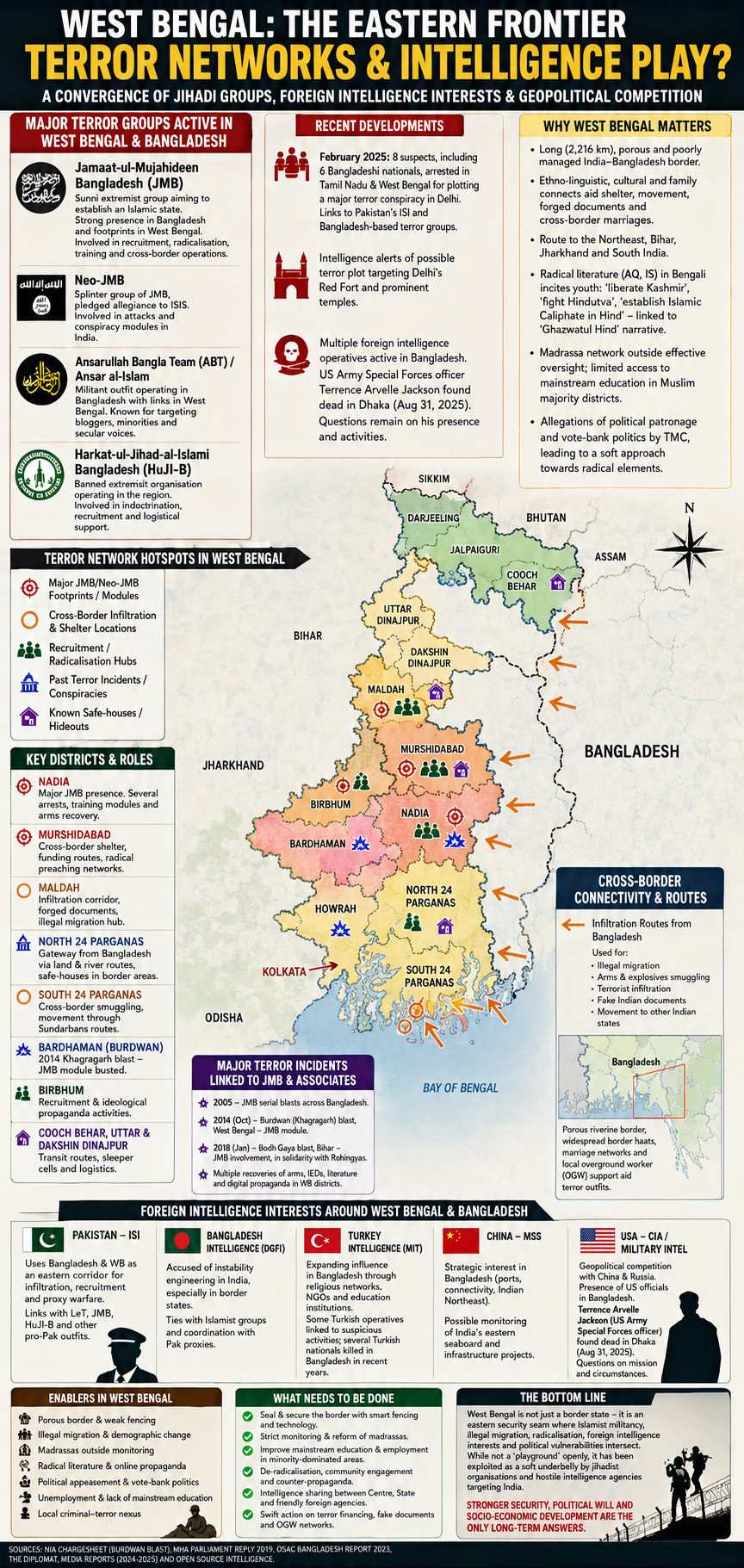
The insights, assembled from NIA case records, intelligence agency warnings, military deployments, arrested terror operatives, and the documented activities of foreign intelligence services, reveal something that transcends normal politics.
The 2026 West Bengal election was the culmination of a covert war.
One involving Pakistan's ISI, Chinese strategic planners, the American intelligence apparatus, and a ruling state party that had, knowingly and structurally, served as a shield for the networks that those agencies needed to run their project of balkanization within perhaps India's most vulnerable geography.
This is the story of that war.
The Map! - Geography as Destiny
To understand why West Bengal became a target for multiple converging hostile operations, one has to start with geography sans any ideology.
You see, the state sits at one of the most strategically exposed junctions in Asia.
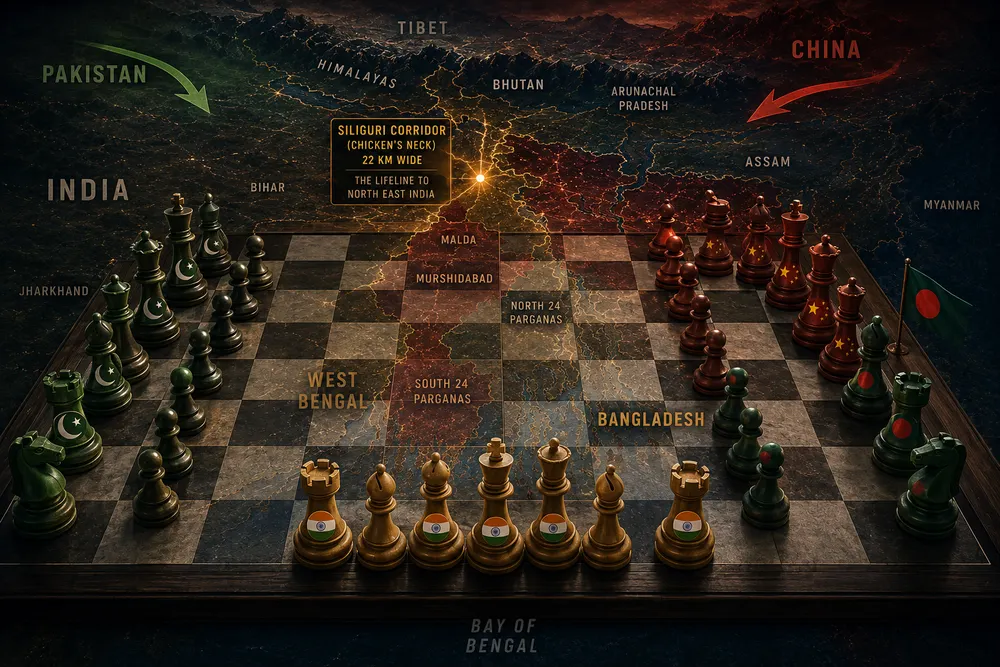
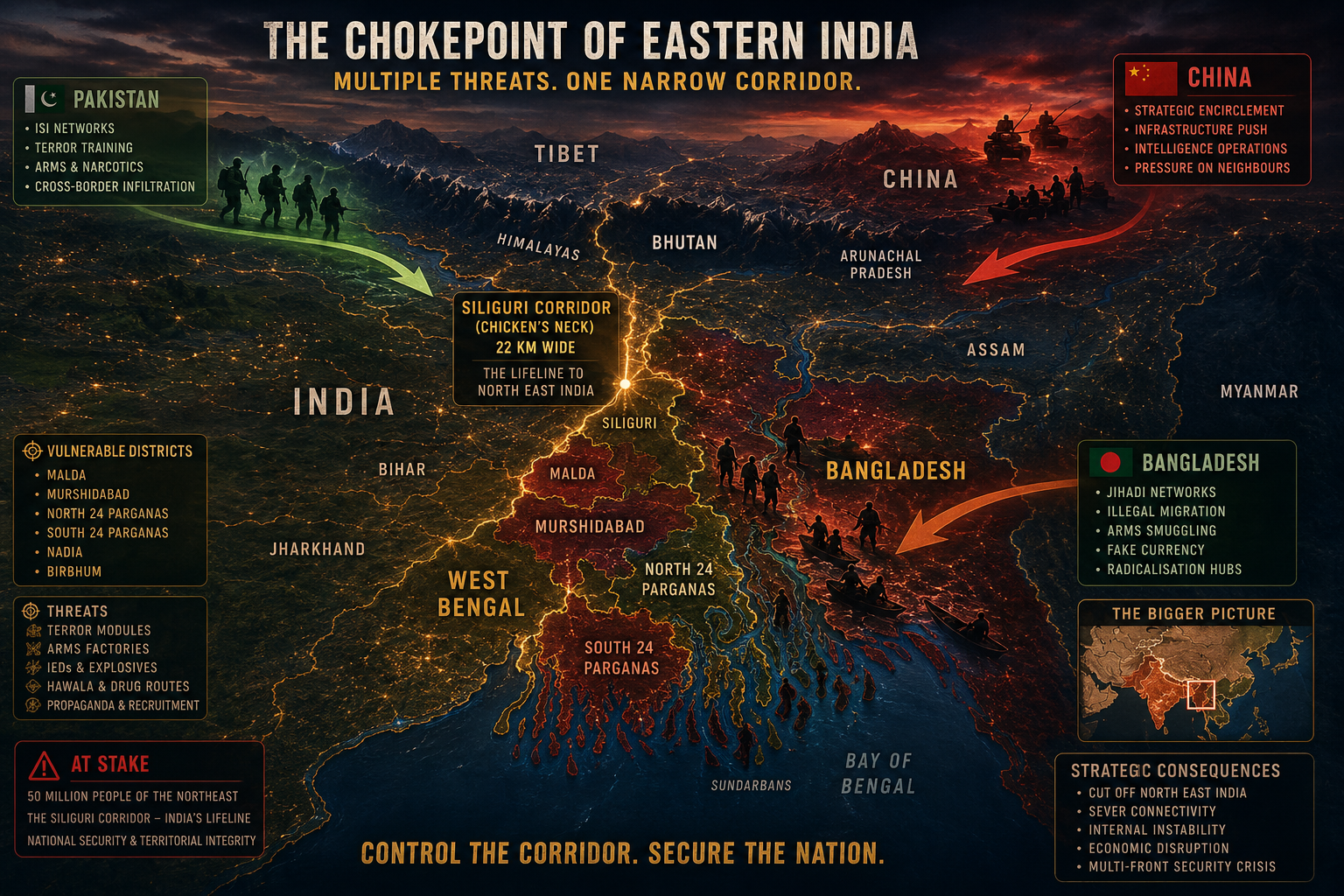
In the north, the Siliguri Corridor, a 22 kilometers wide and nicknamed the "Chicken's Neck", is the only land connection between India's mainland and its eight northeastern states.
A part of India that is home to approximately 50 million people and sharing borders with China, Myanmar, and Bangladesh.
Imagine this - a Chinese military advance of just 130 kilometers could cut off Bhutan, West Bengal, and India's northeastern states from the rest of the country entirely.
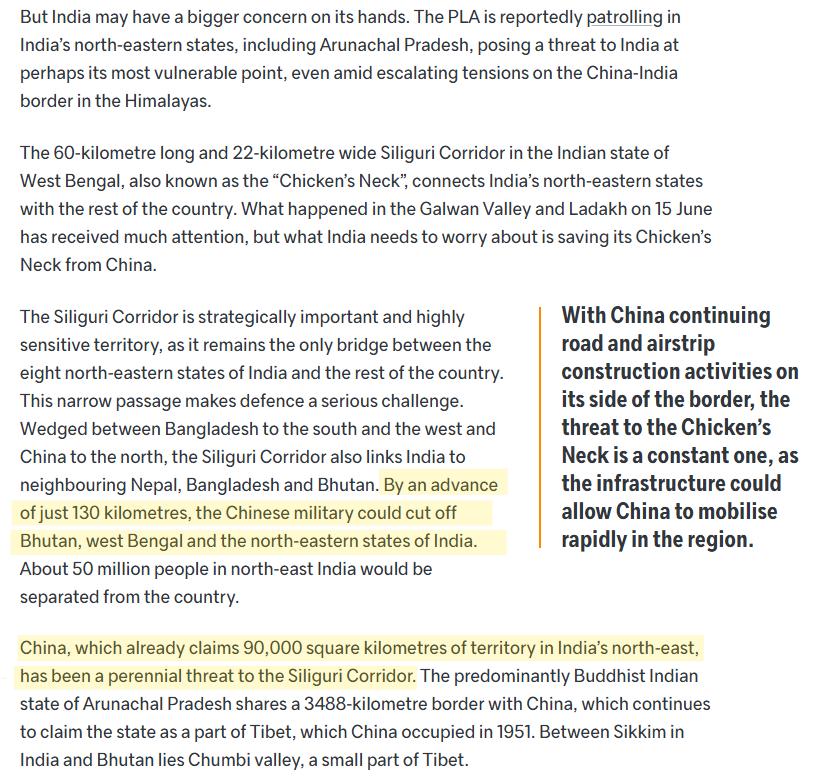
In the east, over 2,200 kilometers of riverine, forested, and demographically complex border separate West Bengal from Bangladesh.
In the south, the Bay of Bengal opens into one of the most contested maritime spaces on earth, where American, Chinese, and Indian strategic interests collide.
In the last few years, the Bay of Bengal has emerged from historical obscurity to become the "epicenter of the Indo-Pacific concept," where East and South Asian strategic interests collide. For the US, it is an arena for "maintaining the free and open international order".
For China, it is essential to secure energy independence and build alternative trade corridors.
The region's future will be shaped by how effectively these competing visions are "negotiated" (through various tools of statecraft and spycraft) with the interests of local littoral states like India, Bangladesh, Myanmar, and Sri Lanka.
Now look at the districts. Malda and Murshidabad.
Both Muslim-majority, both sharing long borders with Bangladesh, both deeply penetrated by illegal immigration networks — sit immediately south of the Chicken's Neck.
South 24 Parganas, which includes the Sundarbans delta, forms a porous southern maritime border that the BSF has long identified as a transit corridor for ISI-linked networks. North 24 Parganas, adjacent to Dhaka via the Petrapole-Benapole land crossing, is the highest-volume people-and-goods corridor on the entire India-Bangladesh border.
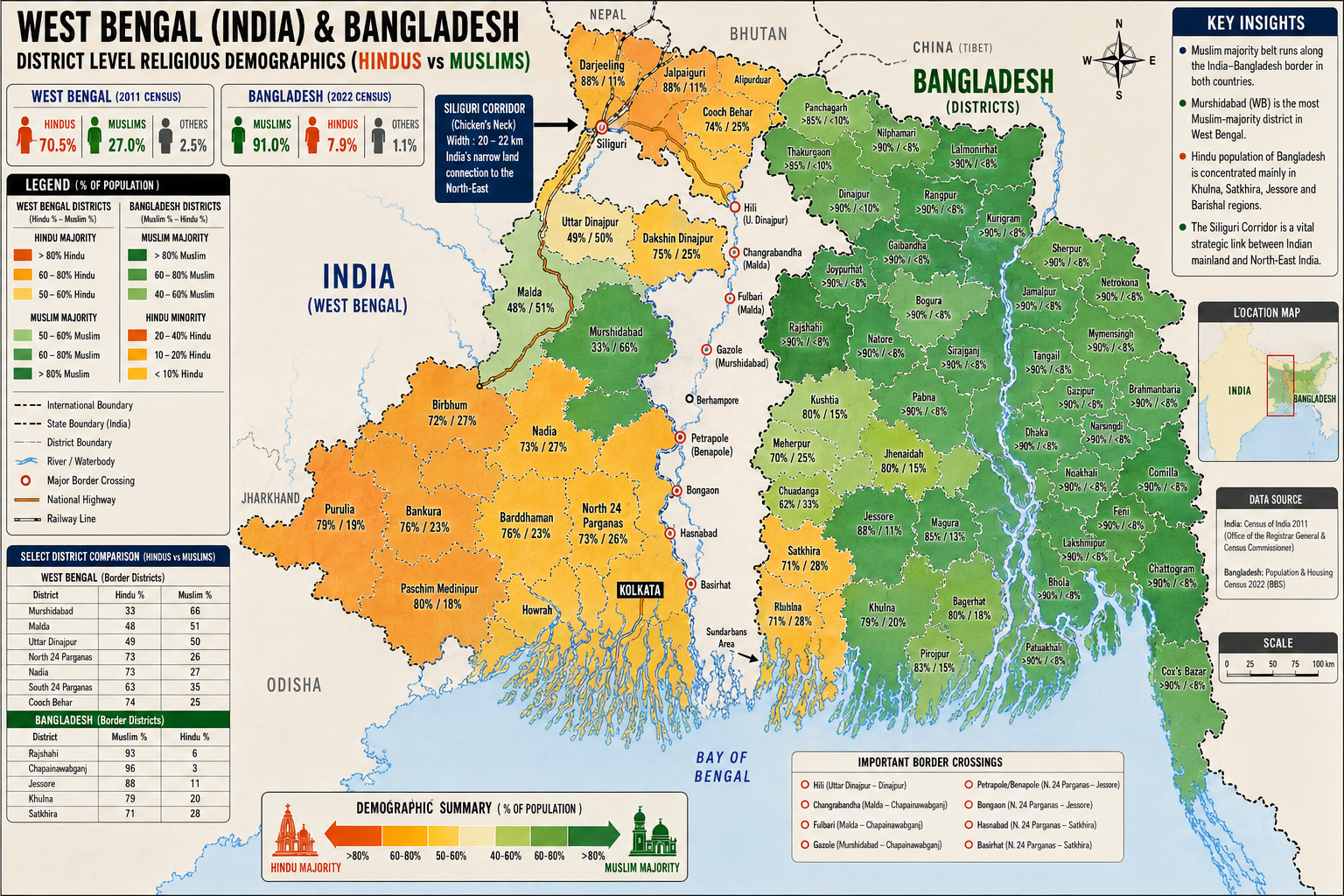
Remember this geography.
We will see how these are precisely the districts where arms factories were discovered, where JMB networks were mapped, where ISI infiltration routes terminate, and where TMC consistently claimed its strongest "strongholds."
The convergence of these facts is the first and most important finding of any honest security analysis.
The Arms Industry that Pakistan Exported
The most concrete, documented evidence of what West Bengal was being prepared for, beyond infiltration and recruitment, is the systematic establishment of a domestic arms manufacturing infrastructure in the border districts.
Pakistan's ISI, it emerges, was not merely smuggling arms into India. It was transferring the capacity to make them.
In Kaliachak's Debipur village, a raid by the NIA and local police uncovered an illegal arms factory producing 9mm and 7mm firearms.
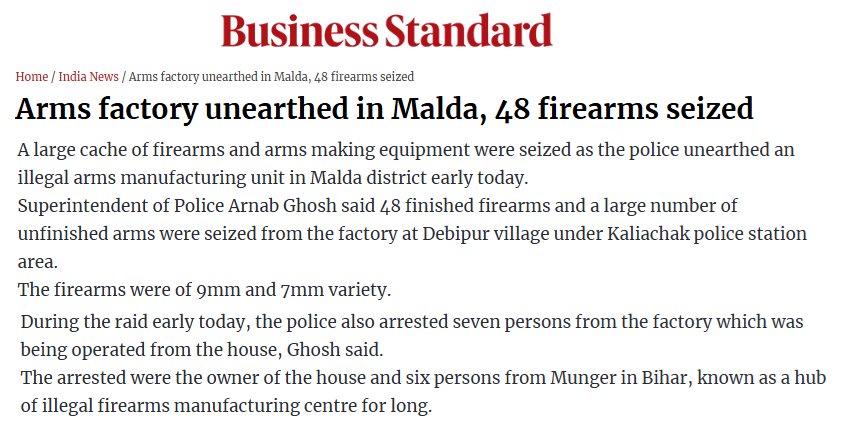
We need to remember that this was not an isolated discovery.
The pattern of similar factory busts across a decade tells a consistent, chilling story:
In Kaliachak, the hub of illegal activity just 10 km from the porous India-Bangladesh border, illegal arms manufacturing units were busted repeatedly — hidden behind a laddoo shop in one instance, behind a grill workshop in another.
In June 2018, 11 were arrested in Malda, with 9 from Munger. In January 2018, an illegal arms unit was busted in North 24 Parganas. In May 2017, a huge arms cache was recovered in South 24 Parganas with two more Munger-linked individuals.
In 2016, Metiabruz in Kolkata was used to smuggle made-in-China INSAS and AK-series rifles. In 2014, Khagragarh saw the discovery of 16 sophisticated chemicals, with NSA Ajit Doval himself rushing to the spot.
 Anindya Banerjee
Arms smuggling runs in both directions — not only from Munger into Bengal, but from these factories across the border into Bangladesh.
Chapainawabganj, which shares 155 km of border with India's Malda and Murshidabad districts, has over a dozen professional arms smugglers, and finding small firearms or bullets in the bordering areas is described by insiders as "no big deal."
Coded language is used — cows for 9mm pistols, unborn calves for 7.62mm — as orders are placed across the border using Indian SIM cards.
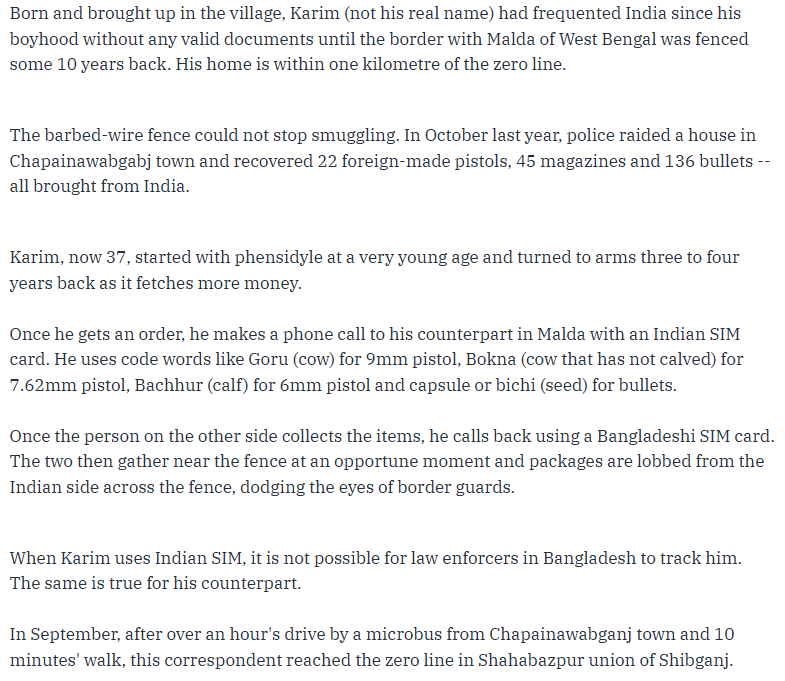
The Munger connection is critical and requires explanation.
Munger in Bihar has historically been India's most notorious hub for illegal firearms manufacture.
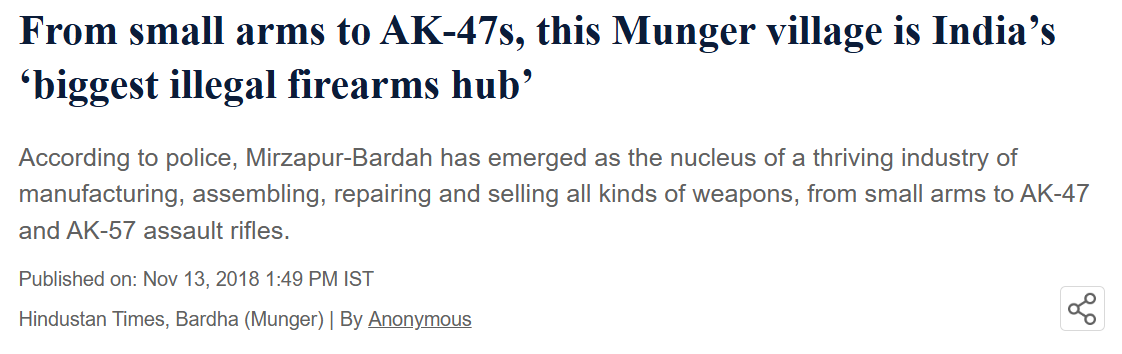
The repeated appearance of Munger-trained operatives in West Bengal's border districts means that someone was not just buying weapons.
NIA officials established that these bomb factories operate throughout the year, not only during elections.
When there are no elections, they supply crude bombs to gangs and terror groups alike. Illegal immigrants from Bangladesh and Myanmar are hired at 70 to 100 rupees a day to manufacture these devices.
The Burdwan case was an eye-opener: over 1,000 bombs were found, and these factories had managed to operate for several years without any interference from law enforcement.
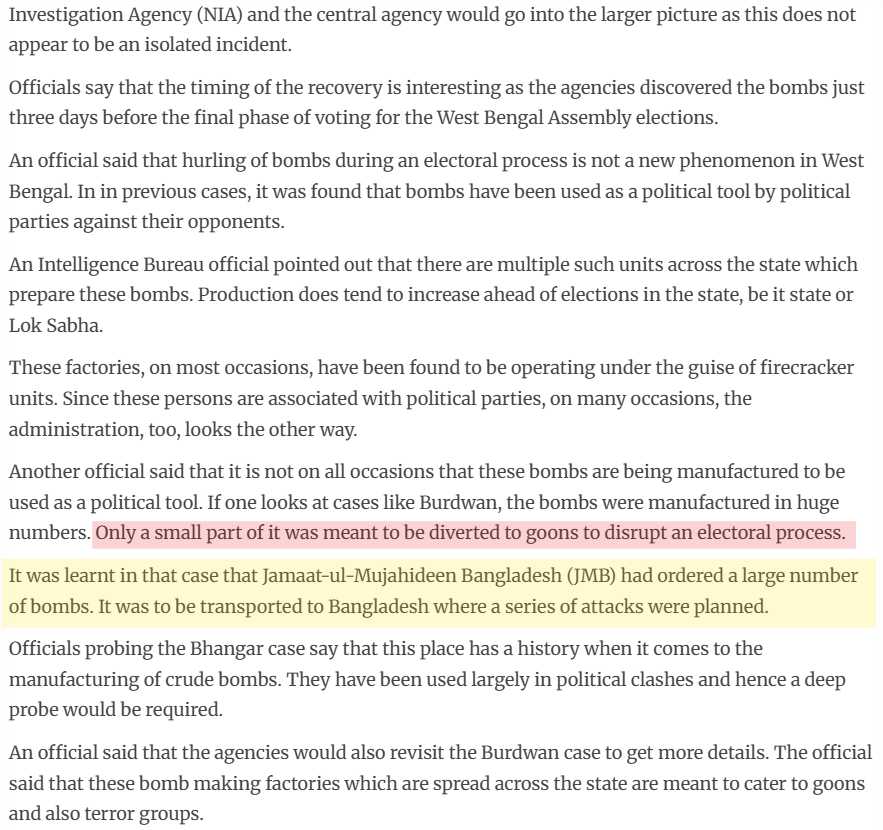
It is quite clear that the operating space for these factories has not been accidental. It was enabled by a state administration that, for 15 years, treated every central agency intervention in the border districts as a political threat to its vote-bank arithmetic. So much so that it was willing to balkanize India itself!
Kaliachak: Capital of the Parallel State
No single location captures the convergence of all these threats more precisely than Kaliachak in Malda district. It deserves treatment as a case study in what happens when a state government systematically refuses to enforce India's sovereignty over its own territory.
Kaliachak and surrounding areas had long been under scrutiny for illegal activities, including fake currency circulation, drug trafficking, and illegal poppy cultivation. The Malda region, especially areas near the international border with Bangladesh, had become known for these operations, with smuggling, fake currency, and narcotics production running in parallel.
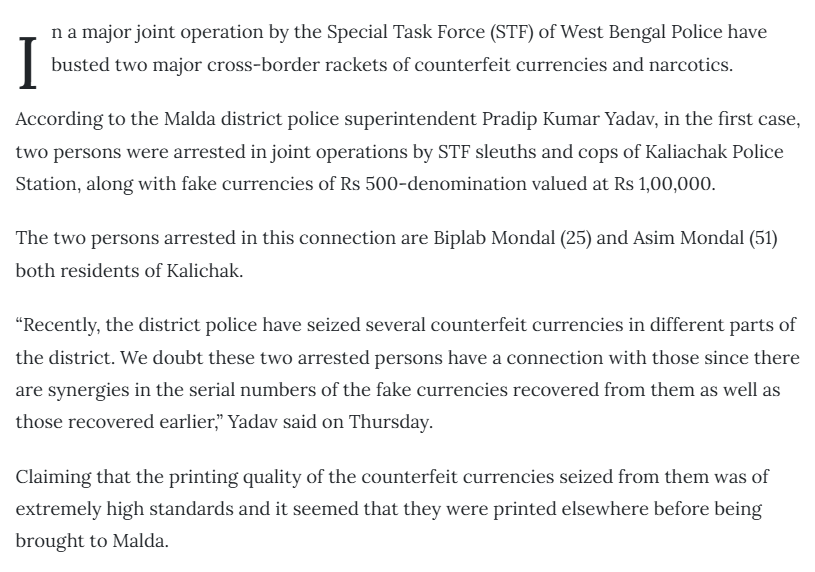
Also read - Fake Indian currency notes, narcotics seized from two persons by the Malda police (The Telegraph) | Malda Police seize drugs worth around Rs 1 crore (Millennium Post)
Kaliachak's population composition is itself a product of years of unchecked demographic transformation.
The total population of Kaliachak is 3,92,517, of which the Hindu population is only 41,456, while the Muslim population is 3,50,475 — 90 percent of the total.
Most significantly, even the pockets where Hindus are still present, such as Kaliachak-Baliadanga, were specifically targeted during violence, suggesting coordinated intimidation rather than spontaneous unrest.
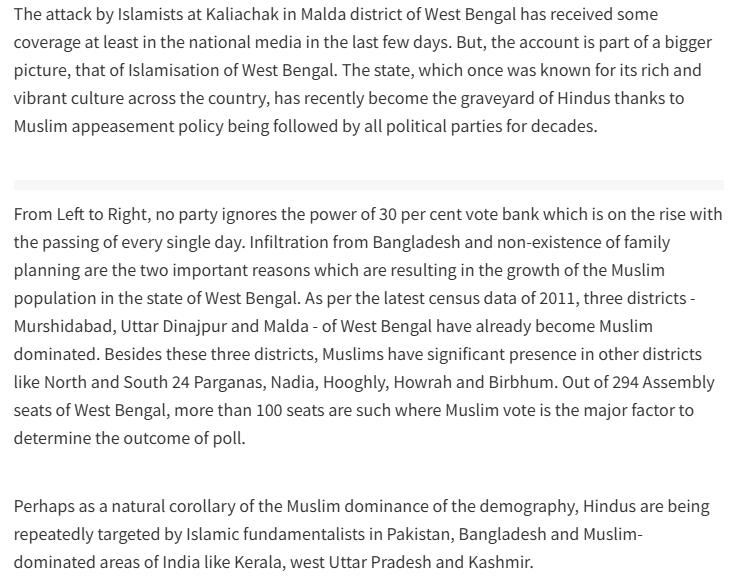
The 2016 Kaliachak riots crystallized the nature of the problem.
A Muslim mob of more than one lakh people attacked the police station of Kaliachak, vandalizing it along with the block development office and public property, injuring 30 policemen. BSF vehicles were torched, an NBSTC bus was set ablaze on National Highway 34, and train services were disrupted.
Attackers shouted slogans including "Islam Zindabad," "Nara-e-Takbeer," and "Hang Kamlesh Tiwari." Hindu temples were attacked at Baliadanga, and around 25 houses and shops owned by Hindus were vandalized.
The state government's response, or rather non-response, was the most revealing element.
The BJP's Malda general secretary directly stated that "Trinamool is colluding with the same people who burnt down the station. They are roaming free and free to influence the election." (Source: Scroll.in)
This was not a wild allegation. The TMC's chief minister came to address a rally at Kaliachak's local Karbala ground after the riots, choosing to engage with the perpetrators' community as an electoral constituency rather than holding the rioters accountable.
The 2016 riots' underlying criminal nexus made this political complicity even more dangerous. Police had recently destroyed 1,500 acres of poppy fields in the area the previous week, and it is suspected that the poppy mafia, operators with cross-border connections deeply embedded in the local economy, were involved in orchestrating the clash during the protest, using religious mobilization to create cover for destroying evidence and signaling their capacity for violence to law enforcement.
 Divya Bharti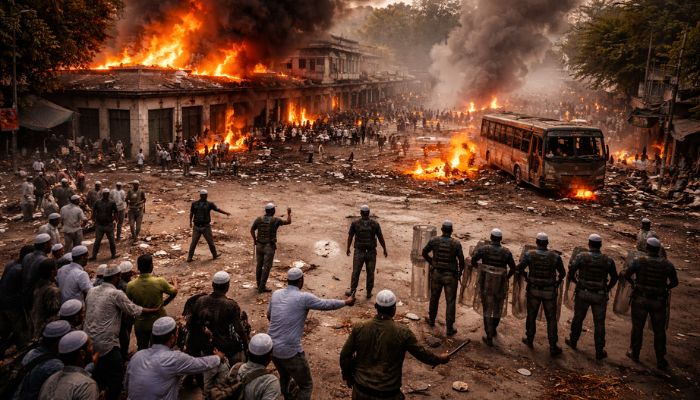
The pattern was then exported.
Just 40 km from Kaliachak, in Pakur district of Jharkhand, a mob during Bakrid chanted "Pakistan Zindabad" while attacking police, with mosque announcers explicitly calling for repeating the Kaliachak incident.
Thousands from Bengal were reported marching toward Maheshpur. Police were forced to fire 250 rounds. Kaliachak had become not just a local incident but a template.
A model for how to use religious mobilization, criminal networks, and demographic concentration to challenge state authority in the border region.
The ISI-Bangladesh-JMB Triangle and Its Bengali Roots
Understanding the ISI's operational strategy in West Bengal requires recognizing that Jamaat-ul-Mujahideen Bangladesh did not simply penetrate West Bengal from outside. It grew roots there, using the cultural, linguistic, and social continuity of the Bengal-Bangladesh ethno-linguistic space as cover.
JMB's cross-border marriages created shelter networks in West Bengal, allowing operatives to establish their legitimacy as local residents.
JMB ran a recruitment and fund-raising drive for months across seven madrasas in Murshidabad, Malda, and Nadia districts, seeking to build a cadre of at least 150 young men. Before the Burdwan blast was discovered, nearly 50 improvised explosive devices had already been dispatched — to Dhaka and Assam — with the ISI, operating out of the Pakistan Embassy in Dhaka, providing material and financial support.
 Saikat Datta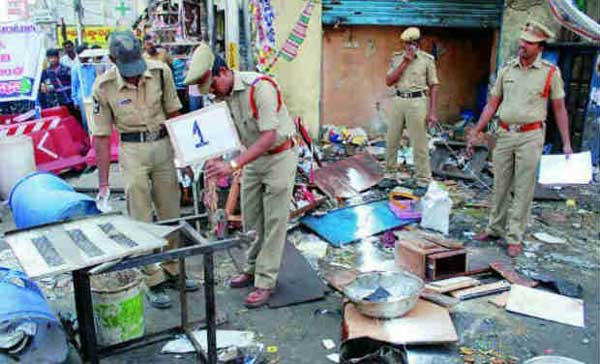
The geography of JMB's West Bengal networks maps almost perfectly onto TMC's "stronghold" districts.
Murshidabad, which the TMC swept in 2021, winning 20 of 22 seats, was also the primary madrasa recruitment ground for JMB.
Malda, where Kaliachak's arms factories were operating, was where TMC claimed to be building a 22-of-22 sweep in 2026. North and South 24 Parganas (both TMC citadels) were the districts where bombs were recovered just before polling day, where crude bomb factories operated year-round, and where infiltration routes from Bangladesh terminated.
This geographic overlap is not metaphorical. It describes a political economy in which TMC's electoral dominance in border districts was sustained by the same networks comprising illegal immigrants, arms manufacturers, smugglers, and madrasa-connected recruiters that ISI was using for its India-facing operations.
TMC's administration was accused of helping create fake IDs, including Aadhaar cards for illegal immigrants, stalling border fencing along the India-Bangladesh border, and resisting every attempt by central agencies to conduct meaningful security operations in these districts. Illegal immigrants given fake documents became voters. Voters became TMC's numerical dominance. TMC's dominance became protection for the networks. The protection enabled more infiltration. It was a closed loop — a political machine running on the fuel of India's own security compromise.
 Organiser Bureau
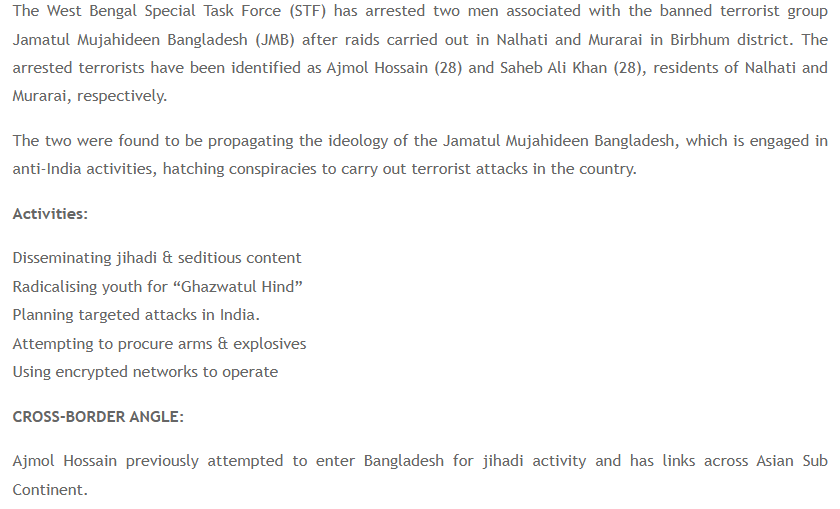
As recently as May 2025, West Bengal's STF arrested JMB operatives in Birbhum district who were found radicalizing youth for "Ghazwatul Hind," planning targeted attacks in India, attempting to procure arms and explosives, and using encrypted networks.
Birbhum, another district with a strong TMC electoral history, was simultaneously a JMB recruitment and operational zone.
The Pakistani Military's Strategic Probe
In January 2025, there were reports of Pakistan's intelligence officers in Bangladesh's Rangpur area.
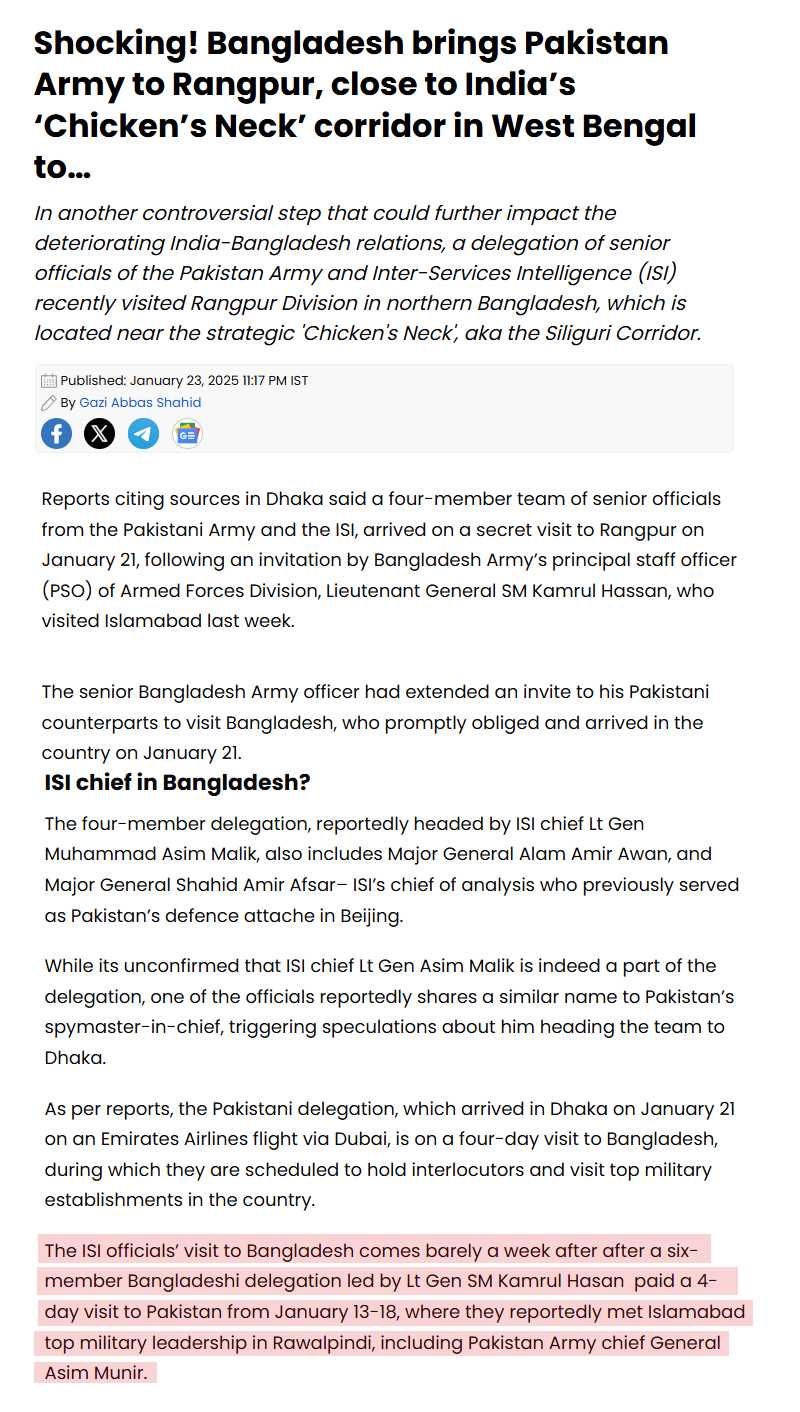
The January 2025 movement of Pakistani ISI officers to Bangladesh's Rangpur division, mere 130 kilometers from the Siliguri Corridor, must be read against everything described above. This was not a routine military visit. It was a strategic probe by a military establishment that had spent years building operational networks in West Bengal and Bangladesh, and was now assessing its positions relative to India's most critical vulnerability.
The ISI officials' visit came barely a week after a six-member Bangladeshi delegation led by Lt Gen SM Kamrul Hasan paid a four-day visit to Pakistan, where they reportedly met Pakistan Army Chief General Asim Munir in Rawalpindi, along with the ISI Chief Lt Gen Asim Malik and the Chairman of the Joint Chiefs of Staff.
The sequence of visits by the Bangladeshi Army leadership to Rawalpindi and the Pakistani ISI to Rangpur suggests pre-planning and coordination at the highest levels.
Rangpur's location immediately adjacent to the Siliguri Corridor means that ISI personnel conducting a "secret visit" there were, effectively, conducting intelligence reconnaissance of India's most sensitive strategic chokepoint from inside friendly territory.
No other interpretation is militarily credible.
India's response was proportionate to the threat. Three new military garrisons were rapidly established along the Indo-Bangladesh border — at Bamuni in Assam, at Kishanganj in Bihar, and at Chopra in West Bengal — significantly enhancing troop mobility, surveillance, and rapid-response capability across the vulnerable southern arc of the Siliguri Corridor. A multi-agency review was convened in Siliguri under the Intelligence Bureau's Subsidiary Multi-Agency Center, attended by the BSF, SSB, ITBP, state police, the Army, and the Railway Protection Force. Advanced air defense systems, including the S-400 Triumf, the Indo-Israeli MRSAM, and the indigenous Akash missile platform, were deployed.
The Federal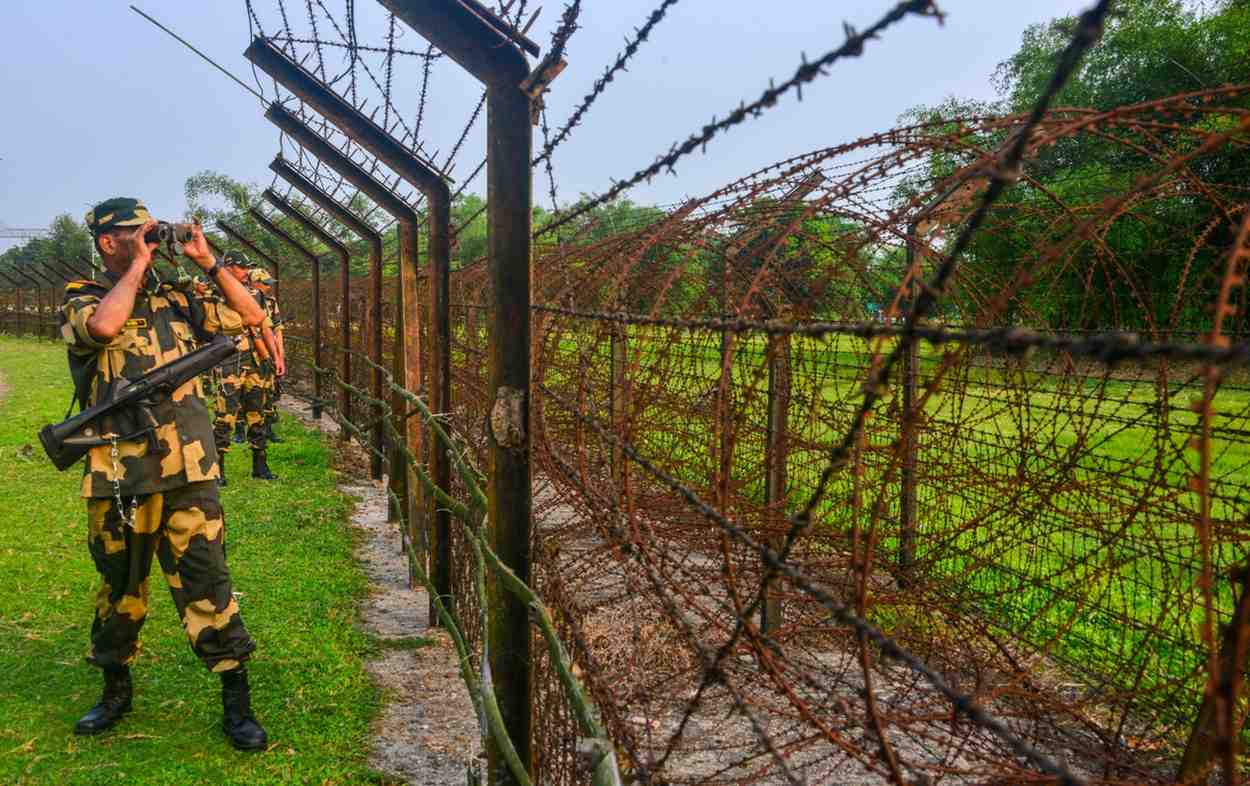
You build a layered missile defense over a corridor when you believe a multi-axis military threat is forming. India did exactly that.
China's Encirclement from the South
China's approach to West Bengal's strategic environment operates on a slower timeline and through quieter instruments than Pakistan's.
The strategic logic, however, is identical: securing positions that enable control or severance of India's connection to its northeast.
A planned airstrip in northwestern Bangladesh, near the border with West Bengal's Jalpaiguri and Cooch Behar districts, has caused grave strategic unease in New Delhi. Negotiations for the airfield are believed to have taken place during Bangladesh's representative Muhammad Yunus's diplomatic trip to China.
Posing ostensibly as a civilian project, its proximity to Indian soil makes it a strategic tinderbox, with defense analysts warning of its potential dual-use capacity for military and reconnaissance operations.
 Natraj Shetty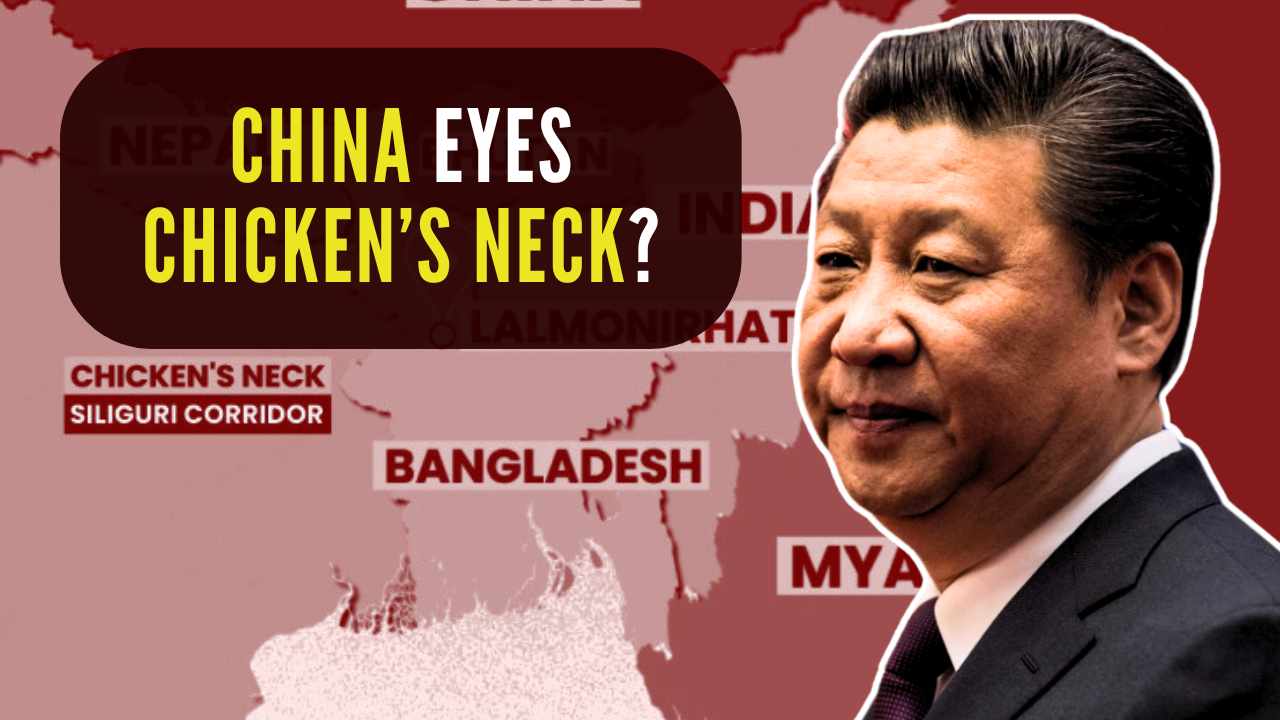
The concern over the Lalmonirhat airfield specifically is grounded in sound military logic: it offers potential intelligence visibility and surveillance reach into India's Eastern Air Command, which houses some of the Indian Air Force's most sensitive assets.
The concern over China’s involvement in redeveloping the Lalmonirhat airfield in Bangladesh—barely a breath away from India’s border—is not a consequence of paranoia but of sound military logic. Lalmonirhat secures a vantage point offering potential intelligence visibility and surveillance reach into India’s Eastern Air Command, which houses some of the Indian Air Force’s most advanced assets, including frontline fighters, missile systems and integrated air-defence grids. A dual-use facility so close to such critical infrastructure is a clear strategic signal. Beijing understands the strategic leverage of the northeast, and it is positioning itself around it. (Source: "Siliguri Corridor: Can India defend its 'Chicken's Neck' against China?" / The Week)
China's strategy has been incremental: a few roads here, villages there, airfields in Tibet, and now perhaps infrastructure close to the Siliguri Corridor.
These cannot be dismissed as discrete motions.
They are linked steps in a strategy to keep India diplomatically cornered and geographically exposed. The "String of Pearls" from Gwadar to Hambantota to Kyaukpyu may now extend to a new outpost in Bangladesh
Whether this was conscious or structural is almost beside the point — the effect was identical.
The American Dimension — St Martin's Island and the "Zo State" Project
The presence of US Special Forces Command Inspector General Terrence Jackson in Dhaka on August 31, 2025, dying under circumstances that prevented a Bangladeshi autopsy, announced to those who were watching that the Bay of Bengal had become a zone of intense American covert engagement.
Jackson's role at 1st Special Forces Command (Airborne), a unit capable of rapidly deploying high-level headquarters for sustained unconventional campaigns in foreign theaters, made his presence in Dhaka impossible to explain away as routine.
His body was handed over to the US Embassy without an autopsy, his belongings removed by embassy officials.
This episode connects to a larger strategic project that Sheikh Hasina described before her ouster.
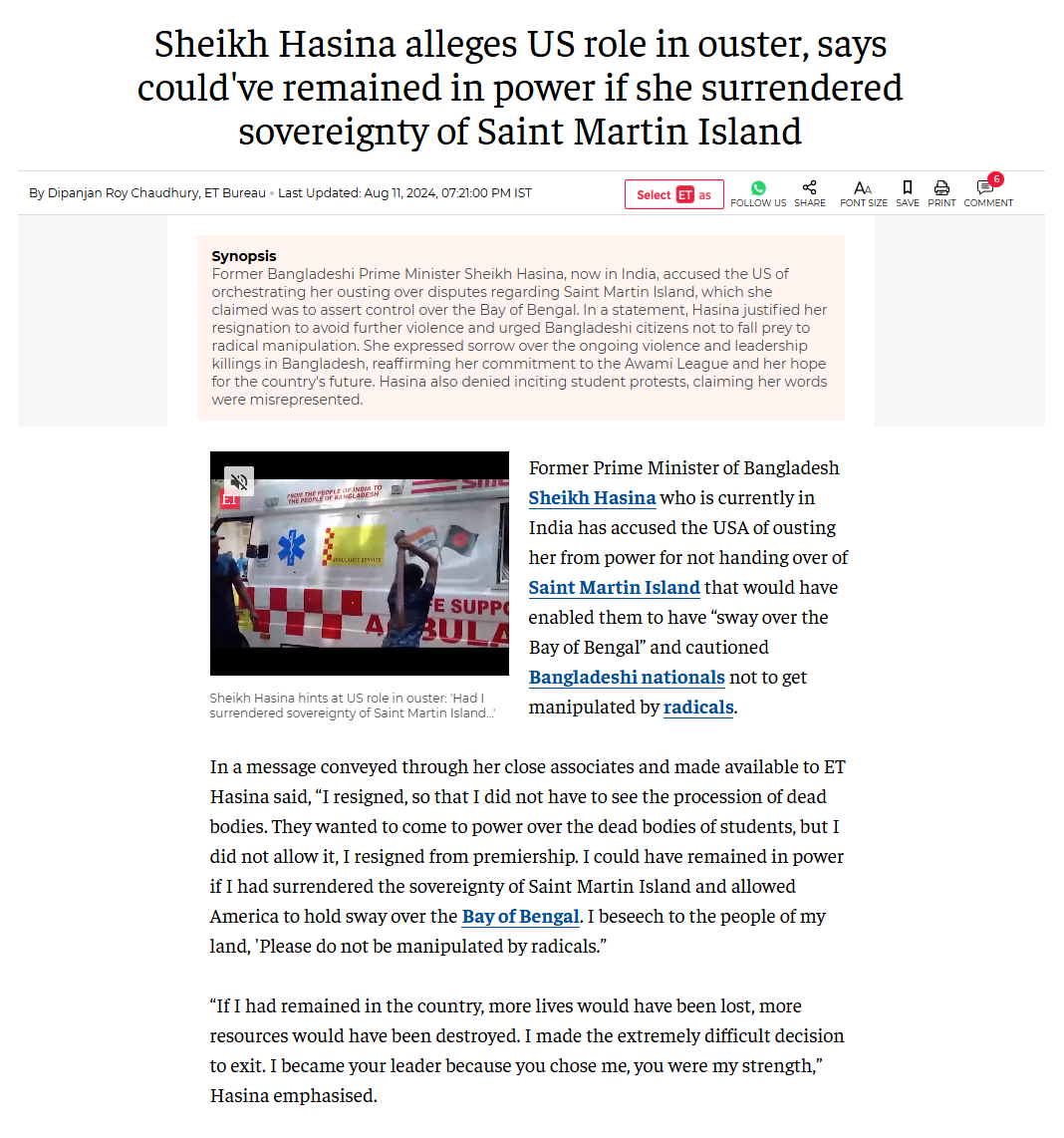
Indian and Bangladeshi intelligence agency sources describe a US long-term project of encouraging the formation of a Christian state comprising contiguous areas of Myanmar, Bangladesh, and India, inhabited by the "Zo" people (Kuki-Chin-Mizo communities), modeled on East Timor.
What Hasina described as the proposed Christian state would, according to Awami League leaders, also include parts of Northeast India, including Kuki-inhabited areas of Manipur and Mizoram.
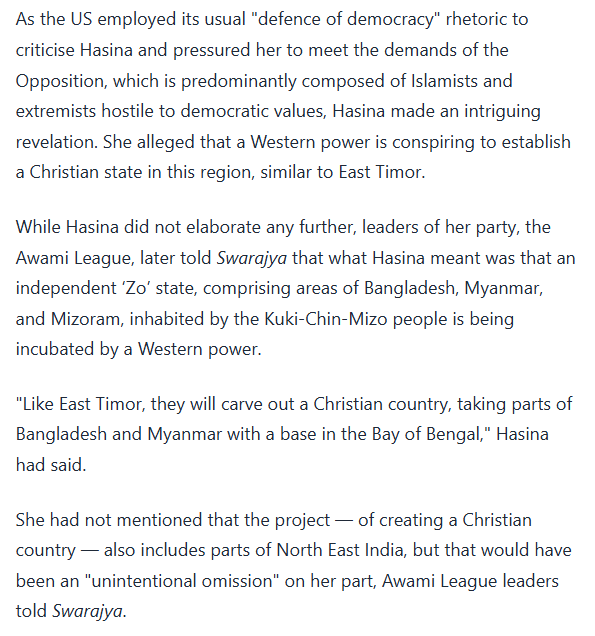
For West Bengal, the implications of a partial "Zo state" realization would be severe. Such a state, carved from parts of Myanmar's Chin State, Bangladesh's Chittagong Hill Tracts, and India's northeast, would sever the geographic logic of the subcontinent and create a foreign-aligned entity immediately adjacent to the Chicken's Neck. West Bengal's northern districts would be left exposed in a way that no amount of military deployment could fully compensate for.
Bhaskar J. Mahanta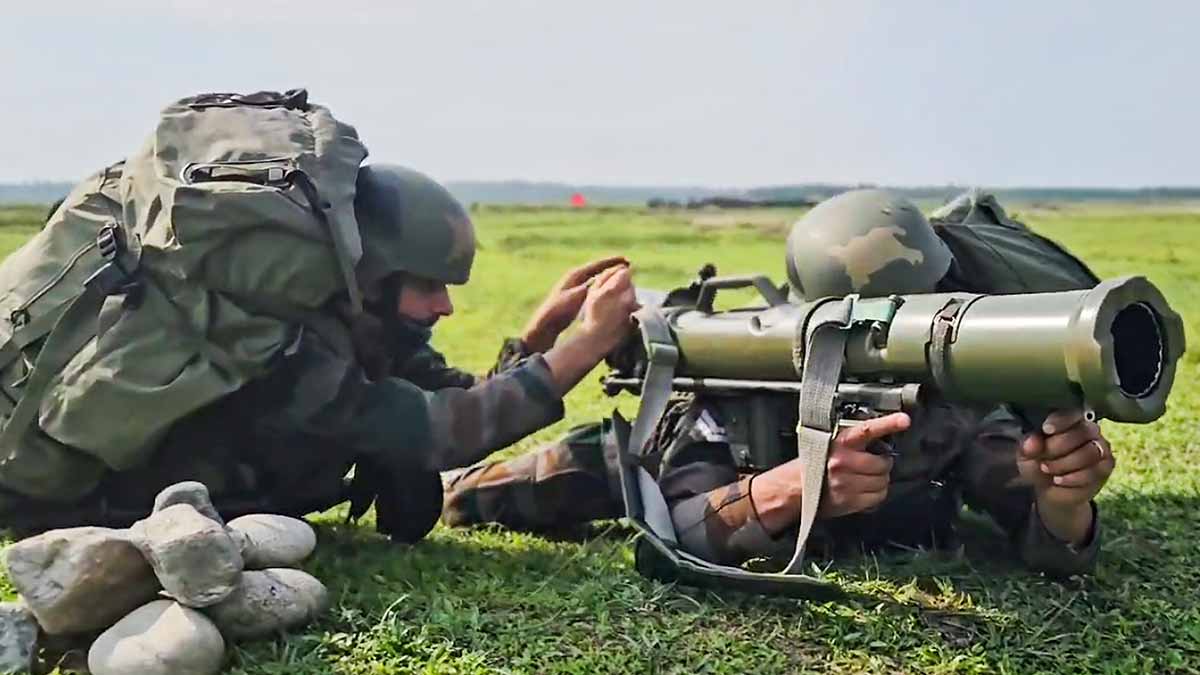
The TMC as a Structural Shield
The case against TMC in the national security context is not that Mamata Banerjee was an agent of Pakistani or Chinese intelligence. The case is structurally more damning: her government created and maintained a political environment in which hostile intelligence networks could operate with reduced risk of enforcement.
There were several mechanisms:
Fake documentation. TMC's administration was accused in multiple reports of helping create fake IDs, including Aadhaar cards, for illegal immigrants — transforming security threats into electoral assets.
Stalling border fencing. The TMC government consistently opposed and obstructed the erection of border fencing along the India-Bangladesh border — fencing that would have constrained the infiltration routes used by both illegal immigrants and JMB operatives.
Blocking central agency cooperation. Bangladesh had asked India to extradite a terrorist identified as Shahdat Hossain, operating out of a madrasa in Murshidabad. The West Bengal government simply refused to cooperate. R&AW chief KC Verma sought home minister Chidambaram's help in the matter — but despite repeated efforts, the Union government failed to get the man Bangladesh had asked for. The same madrasas were later identified as active JMB recruitment grounds.
Electoral arithmetic over security arithmetic. In Murshidabad, TMC won 20 of 22 assembly seats in 2021 and targeted 22 of 22 in 2026. Murshidabad is simultaneously the district with the deepest JMB recruitment networks, the most active illegal immigration corridors, and the districts from which most bomb-related incidents were reported during election cycles. The electoral math and the security map were the same map.
Treating security enforcement as communal polarisation. Every NIA raid, every arrest of JMB operatives, every BSF border hardening was characterized by TMC as anti-Muslim communal politics. This framing made security enforcement politically costly and created additional disincentives for state cooperation with central agencies.
The cumulative effect of these choices was that the ISI, JMB, and associated networks had, within West Bengal's ruling party, a de facto political insurance policy against the sustained law-enforcement pressure that broke JMB in Bangladesh.
The Maneuvers Before the Election
The most revealing sequence of events in the entire Bangladesh-West Bengal security story of 2026 did not happen during the West Bengal election campaign.
It happened in the weeks immediately before, and it followed a logic that only makes sense when viewed as an intelligence operation unfolding in real time.
The Diplomatic Reset as Intelligence Intervention
On April 7, 2026, less than three weeks before West Bengal's first phase of voting, Bangladesh Foreign Minister Khalilur Rahman arrived in New Delhi for his first high-level bilateral visit to India in more than a year.
That same evening, NSA Ajit Doval hosted Rahman for a dinner meeting in New Delhi, marking the first senior-level engagement with India by the newly formed Bangladesh Nationalist Party government. Various aspects of India-Bangladesh relations figured in the talks, with a focus on charting new momentum, according to those familiar with the proceedings.
Rahman’s visit featured a packed schedule of high-level engagements with India’s top leadership. Following his arrival in New Delhi, National Security Adviser Ajit Doval hosted Rahman for a dinner meeting on April 7, marking the beginning of official interactions. Rahman met External Affairs Minister S Jaishankar on Wednesday (April 8, 2026) for formal talks, as the latter hosted a lunch at Hyderabad House for his Bangladeshi counterpart. (Source: Research News Analysis)
On the surface, this was diplomatic thaw — the ending of 18 months of frozen bilateral ties. But the timing and the sequencing of what followed reveal that this was not merely a courtesy dinner. It was a strategic inflection point, and Doval's participation as NSA rather than as a diplomatic formality signals clearly that the agenda extended beyond trade and energy.
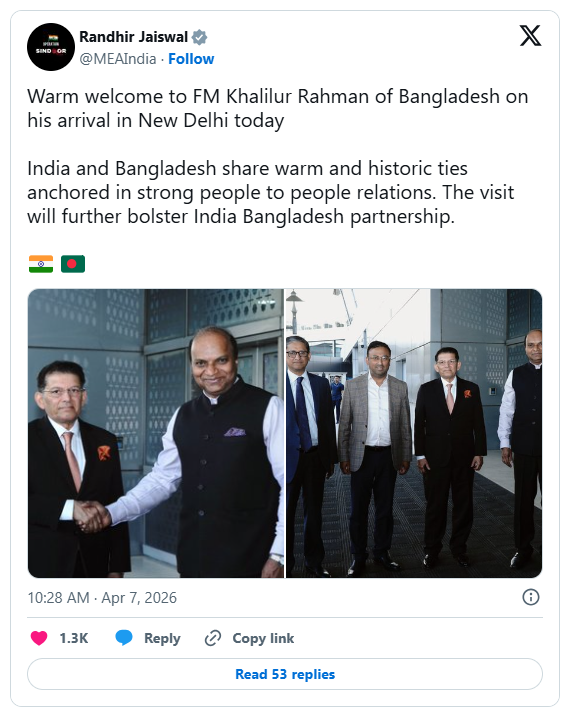
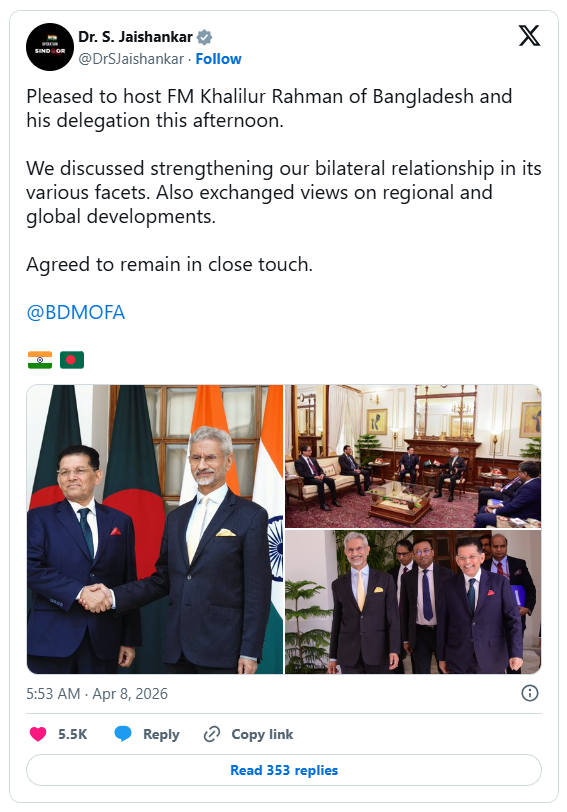
Source: Dr Jaishankar / Randhir Jaiswal
During the meetings, Jaishankar told Rahman that Indian visas for Bangladeshi citizens, especially medical and business visas, would be eased. Rahman thanked India's Petroleum Minister for the diesel supply and requested an increase in fertilizer. The Bangladeshi side also reiterated its request to extradite former PM Sheikh Hasina. These were the publicly disclosed items. The undisclosed items, as subsequent events revealed, were considerably more consequential. (Source: Business Standard)
The Purge That Followed
On April 20, 2026 — thirteen days after the Doval dinner — Bangladesh's Air Force intelligence wing launched raids across multiple bases. What they found was not a minor disciplinary infraction. It was the anatomy of a structured foreign intelligence operation embedded inside one of Bangladesh's most sensitive military institutions.
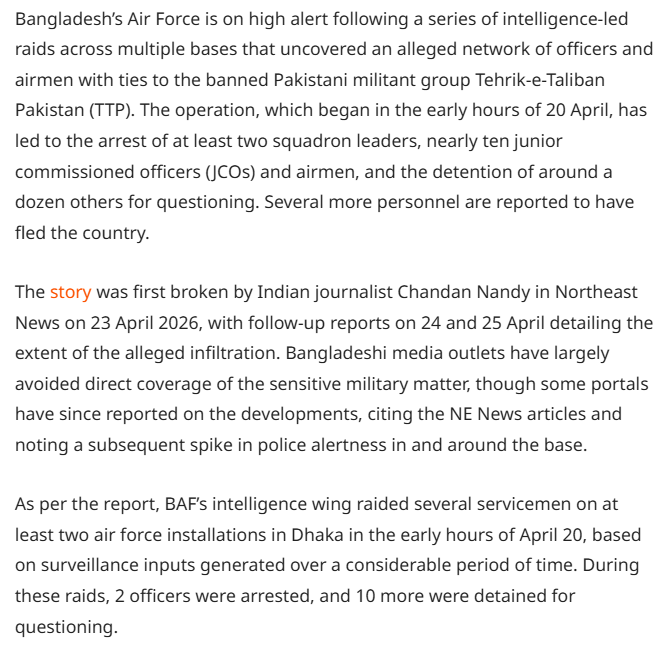
The investigation was triggered when a Bangladesh Air Force Warrant Officer posted at the Zahurul Haque Airbase near Chittagong went absent without leave for approximately two months. Pakistani authorities traced him to a TTP hideout in Pakistan's northwest region and detained him.
Under interrogation, he reportedly divulged critical information regarding TTP recruitment efforts targeting BAF personnel, as well as alleged links involving other officers. The disclosures prompted Pakistani officials to alert Bangladeshi authorities, triggering a sweeping internal investigation.
Also Read: B’desh Air Force under scanner as TTP recruitment trail emerges (News Arena India)
Here are the takeaways of the Opindia article cited above.
- Reports claim that Bangladesh Air Force (BAF) intelligence uncovered a suspected network linked to Tehrik-i-Taliban Pakistan (TTP) operating inside parts of the Air Force.
- The investigation reportedly began after a Bangladesh Air Force warrant officer went AWOL and was later allegedly located in Pakistan’s Khyber Pakhtunkhwa region at a suspected TTP hideout.
- Following interrogation, Pakistani authorities reportedly shared intelligence with Bangladesh regarding possible TTP recruitment efforts targeting BAF personnel.
- Bangladesh Air Force intelligence then conducted raids across three major installations:Zahurul Haque Air Base (Chittagong)A.K. Khandakar Base (Dhaka/Kurmitola)Matiur Rahman Base (Jessore)
- Reports state:2 squadron leaders/officers were arrestedAround 10 junior personnel and airmen were detainedAdditional personnel fled the country after the network became exposed.
- Some of the absconding personnel were allegedly linked to destinations including Turkey, Pakistan, Portugal, and New Zealand.
- Investigators reportedly identified an imam associated with the Zahurul Haque Air Base mosque as a suspected ideological recruiter for TTP-linked radicalization efforts.
- Bangladeshi authorities reportedly feared attempts to establish extremist training infrastructure around Cox’s Bazar/Ukhia.
Since that action, over twenty people were detained — two commissioned officers, several warrant officers, airmen, and, critically, an imam who ran the mosque inside the base itself.
At least six others had already left the country, their destinations including Turkey, Pakistan, New Zealand, and Portugal. That kind of dispersal is not panic. It is a network operating according to a plan.
Anshuman Dutta
The investigation expanded across multiple installations — the A K Khandakar Airbase in Dhaka and the Matiur Rahman Airbase in Jessore were also raided. At least two Squadron Leaders, nearly ten Junior Commissioned Officers and airmen, and around a dozen others were detained for questioning.
Bangladesh Air Force headquarters shied away from even acknowledging the raids and consequent arrests, detentions, and escapes. BAF JCOs were instructed to seize the mobile phones of all Leading Aircraftmen and subordinate ranks before depositing them with the Defence Branch Headquarters.
The TTP-as-Scapegoat Thesis
The official framing that the Tehrik-e-Taliban Pakistan, a group currently fighting its own war for survival against the Pakistani army and simultaneously engaged in a broader conflict along the Afghanistan-Pakistan border, had the operational capacity and strategic interest to infiltrate Bangladesh's Air Force does not seem credible on its face.
Security analysts who tracked Bangladesh through the post-Hasina window describe it as the most permissive environment for Pakistan-linked Islamist actors that Bangladesh has seen in its post-independence history.
Jamaat-e-Islami became a major political force. Pakistan's ISI Director General visited Dhaka — a first in the modern bilateral relationship. The Bangladeshi naval vessel BNS Samudra Joy participated in a Pakistani naval exercise. Talks around acquiring JF-17 Thunder jets entered serious territory.
The TTP — an organization currently under existential military pressure in Pakistan's northwest — does not conduct sophisticated, multi-year infiltration operations inside foreign military institutions without institutional backing. Pakistan's ISI, by contrast, does exactly this. The ISI's pattern of using ideological proxy labels — "TTP-linked," "Jamaat-linked," "JMB-linked" — to provide operational deniability for its own penetration operations is well established across South Asia.
The mosque at the Chittagong airbase, as the nerve center of the recruitment operation, is an ISI signature, not a TTP one. The TTP recruits for battlefield operations in Waziristan. The ISI recruits for intelligence penetration of adversary military infrastructure. The goals of embedding operatives in an air force — access to aircraft schedules, radar coverage, base security protocols, communications systems — serve ISI's India-facing intelligence needs, not TTP's Afghanistan-Pakistan war needs.
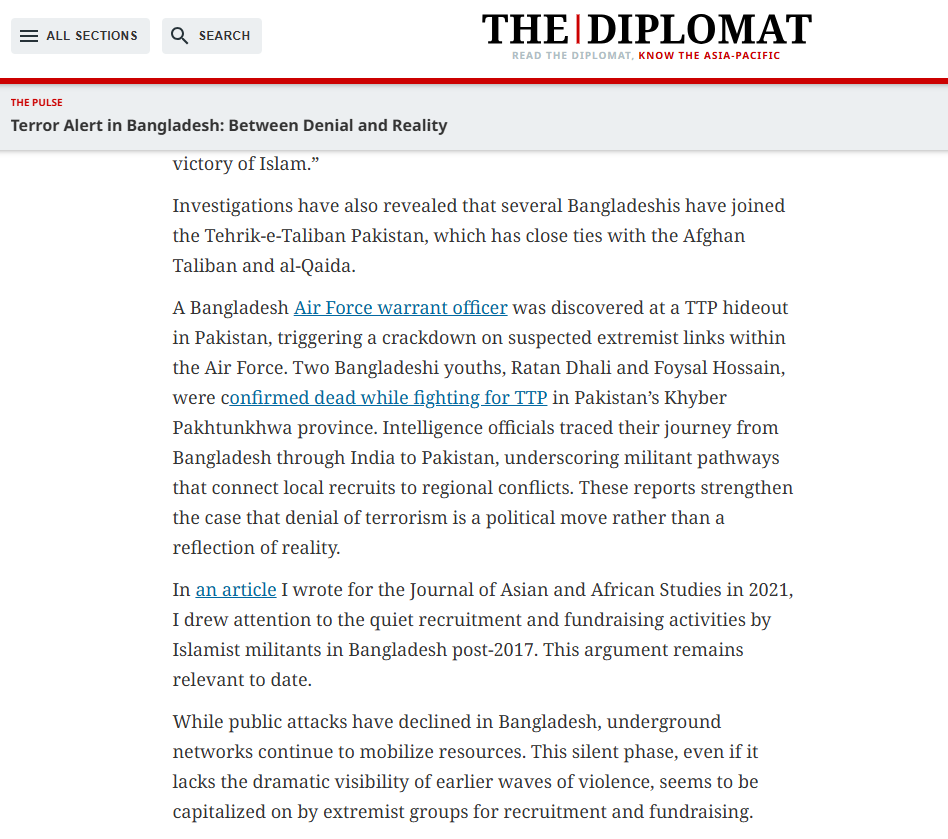
Two Bangladeshi youths confirmed dead while fighting for TTP in Pakistan's Khyber Pakhtunkhwa province — their journey traced from Bangladesh through India to Pakistan — indicate well-established militant pathways connecting Bangladeshi recruits to Pakistani conflict zones. But the Air Force operation is categorically different from battlefield recruitment. It is the architecture of a military intelligence penetration, and the entity with both the motive and the capability for that operation in Bangladesh is the ISI, with TTP serving as the accountable label.
Matthew VanDyke, the Ukrainian Mercenaries, and the European Gun That Killed Suvendu Adhikari's PA
On March 13, 2026 — just six weeks before West Bengal went to the polls — India's National Investigation Agency conducted a coordinated operation across three airports simultaneously. The most significant arrest happened at Kolkata's Netaji Subhas Chandra Bose International Airport.
The NIA arrested seven foreign nationals, including an American citizen: Matthew Aaron VanDyke was apprehended at Kolkata, while three Ukrainian nationals were arrested at Lucknow and three more at Delhi. The group faced charges under the Unlawful Activities (Prevention) Act — India's premier anti-terror legislation — related to international terrorism and illegal border crossings. VanDyke was arrested in Kolkata, specifically, the gateway city to West Bengal's border districts and the most logistically connected hub to both Bangladesh and the Northeast.
Who is Matthew VanDyke? The public record is detailed and illuminating. He is a 46-year-old American from Baltimore, educated at Georgetown University's Walsh School of Foreign Service with a master's in Security Studies focused on the Middle East. He participated in the Iraq War and Libya's civil war, and is the founder of Sons of Liberty International (SOLI), a Washington, DC-based consulting firm that says it provides free security consulting and training services to vulnerable populations to enable them to defend themselves against terrorist and insurgent groups. The company also operated in Ukraine between 2022 and 2023, providing training and advice to Ukraine's military on the use of non-lethal equipment.
The résumé reads, to any trained analyst, as a near-perfect profile for a CIA asset operating under humanitarian cover. Georgetown's Walsh School, a master's in security studies, fighting in three conflict zones, founding a "non-profit" that somehow funds sustained operations in Libya, Syria, Iraq, Ukraine, Venezuela, and now Myanmar, while his personal brand involves global media exposure and documentary filmmaking — this is the classic deniable operator model, what intelligence tradecraft calls "non-official cover with blowback insulation."
The Week described VanDyke as a "Georgetown University-educated security contractor with a resume that describes him as a CIA black-ops recruit," and noted that his arrest uncovered what security agencies called the first visible layer of a deep network of threats operating across the porous Indo-Myanmar border.
The Operation: How They Entered, What They Did
The group entered India on valid tourist visas at various intervals — a total of 14 Ukrainian nationals had entered India on tourist visas before the arrests. They then converged on India's northeastern states before illegally accessing Mizoram without the required Restricted Area Permit and crossing into Myanmar.
According to the FIR filed by the NIA in a Delhi court, the suspects established contact with Ethnic Armed Organisations (EAOs) and various insurgent groups banned in India, providing combat training, giving them weapons, and helping in drone operations. The NIA alleged the group was involved in illegally importing huge consignments of drones from Europe to Myanmar via India for use by these ethnic armed groups. Crucially, the agency added that these groups also supported Indian insurgent groups by supplying weapons and training them in terrorist activities.
The drone expertise these men brought was not theoretical. The very tactics seen in September 2024 attacks — drones dropping over 40 bombs on Meitei villages like Koutruk and Kadangband in Imphal West, killing civilians — mirror the expertise these foreigners allegedly specialised in. That drone bombing attack killed a 31-year-old woman and severely wounded her minor daughter, with at least nine others sustaining shrapnel wounds. Manipur Police called it an "unprecedented attack." VanDyke and his Ukrainians arrived after that attack. The inference is that they were not initiating drone warfare in the region — they were professionalising it.
A drone attack on Myitkina airport by Kachin rebels that severely damaged an ATR 72 aircraft of Myanmar National Airways pointed to the growing prowess of rebel groups in Myanmar in the use of combat drones — the kind of operational capability that Ukrainian veterans, with the best hands-on combat drone experience in the world from the Russia-Ukraine war, were uniquely positioned to transfer.
VanDyke did not merely film or advise in Myanmar; NIA investigators allege he built a deniable pipeline that funnels modern warfare know-how straight into India's internal fault lines. By 2025, he was openly boasting on social media of running covert operations with Venezuelan rebels since 2019, including missions later publicized as "Operation Aurora." In early 2026, he simply pivoted theatres — from Caracas to Myanmar's civil war.
Russia Breaks the Network
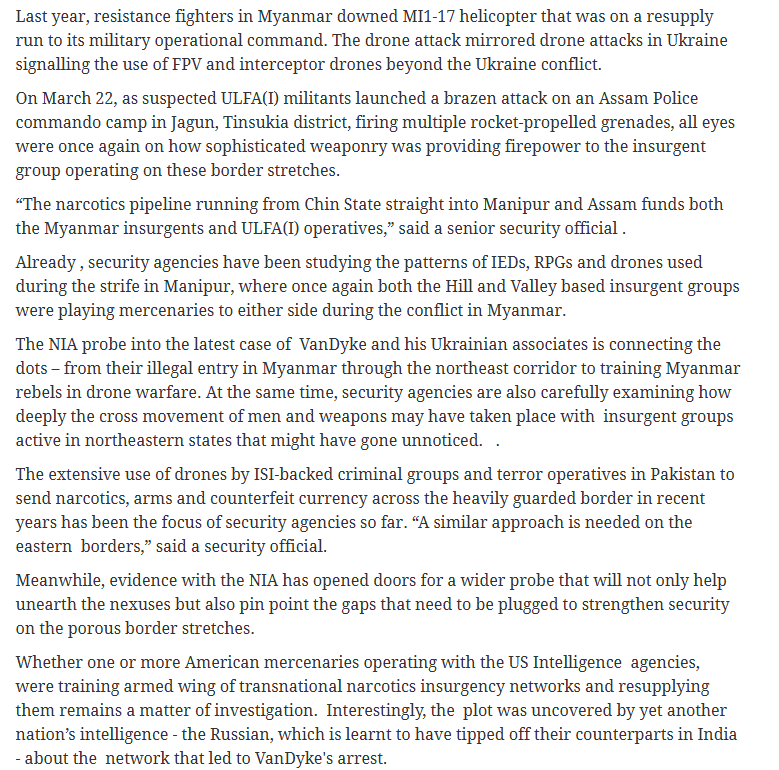
The arrest arose from a geopolitical irony that reveals the multidimensional nature of the contest over India's northeast. According to a Hindustan Times report, quoting unnamed sources, Russian authorities shared intelligence with India on the suspects' activities.
NIA officials confirmed to Germany's international broadcaster DW that Russian authorities may have shared intelligence on the foreign nationals' movements.
The Russian motivation was transparent. From Moscow's vantage point, exposing the presence of Ukrainian drone experts in the India-Myanmar borderland reaffirmed the Russian view that Kyiv was contributing to the destabilization of unstable regions across the world. Russia's Ministry of Foreign Affairs spokesperson Maria Zakharova accused Ukraine of trying to conceal the incident and to keep its citizens' questionable activities, which were clearly designed to destabilize the situation in the region, under wraps.
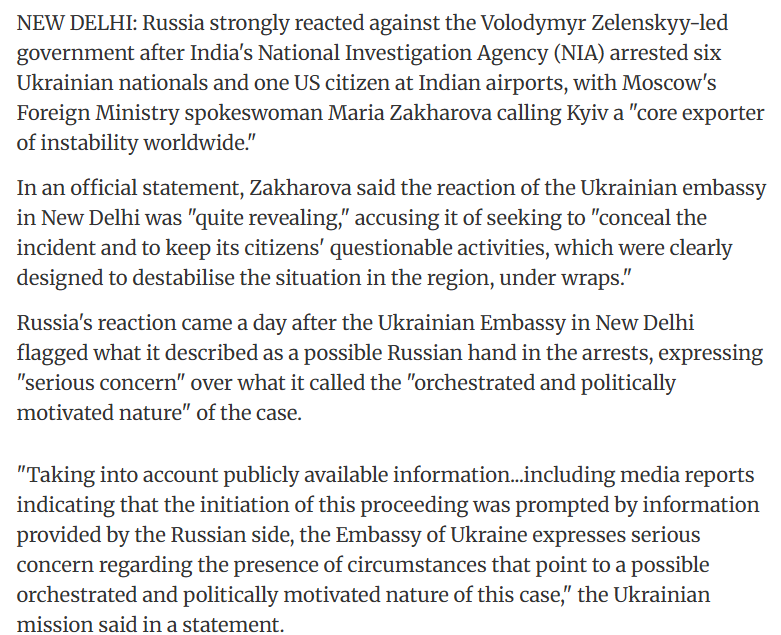
Russia had its own interests — but those interests aligned, at least temporarily, with India's. The tip was acted upon. The NIA tracked VanDyke and his team for at least three months before the March 13 arrests. That the primary arrest was made at Kolkata rather than in the northeast is itself significant: VanDyke was intercepted at India's eastern hub city, the logistical nerve centre for everything that moves between Bengal, Bangladesh, and the Northeast corridor.
The "Christian Nation" Project Materializes as an NIA Case
The VanDyke operation cannot be separated from the "Zo state" and "Christian nation" project discussed earlier, because the NIA's own court submissions connect them directly.
VanDyke is accused of supplying Kuki militants in Manipur with military-grade equipment, including drones and bulletproof vests. A review of VanDyke's posts on X shows a strong expression of his Christian beliefs.
He described US President Donald Trump as a "bad Christian" and claimed Christian voters had been misled by MAGA.
MPost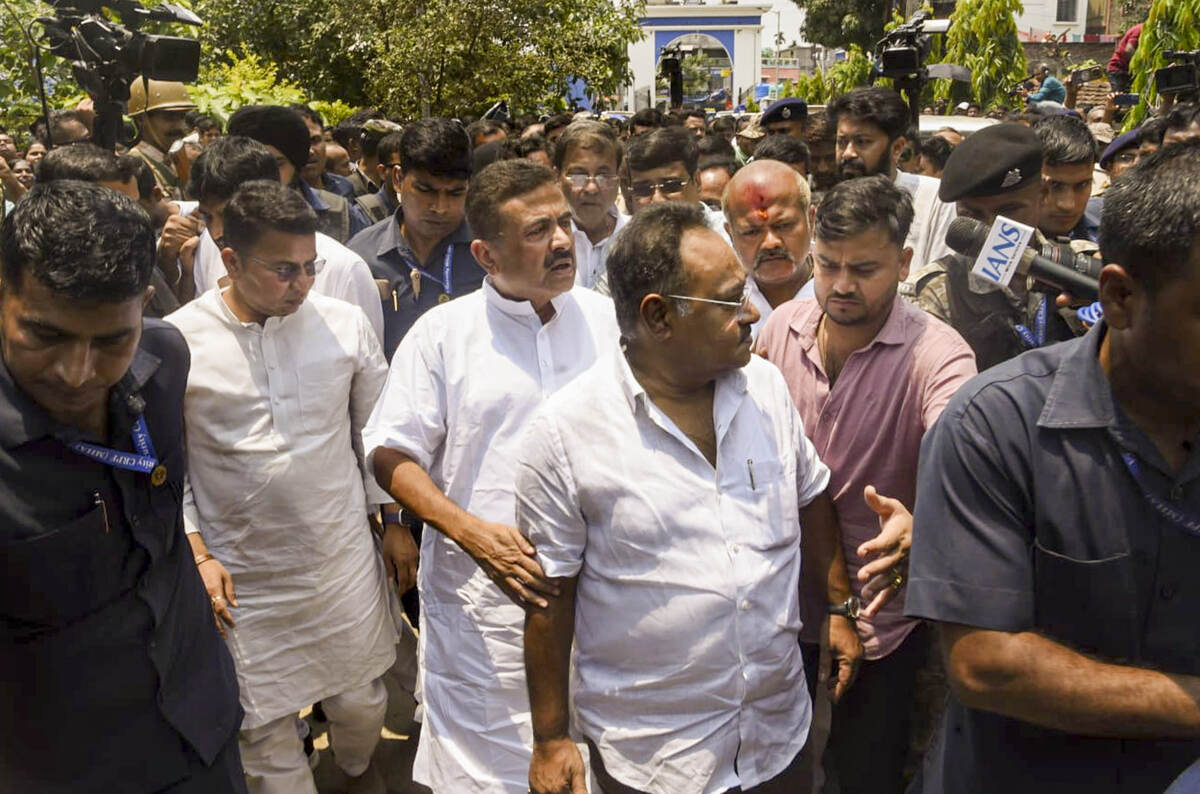
Retired Colonel RSN Singh, a former RAW officer, described Manipur as a theatre in a broader proxy war where religion plays a pivotal role, and alleged that Christian militant elements, possibly supported by US Baptist networks and the CIA, were capitalizing on shared ethnic and faith ties between Myanmar's Chin, Naga, and Karen communities and Northeast India's Kuki and Naga groups. VanDyke's arrest was not merely the interception of a mercenary. It was the first concrete, documentable NIA case that placed the "Christian nation" project's operational infrastructure — drones, European weapons, battlefield training — physically inside Indian territory, transiting through Kolkata.
The Glock 43X and the Question That Cannot Be Dismissed
Two days after the BJP's historic victory in the West Bengal Assembly elections, Suvendu Adhikari's personal assistant, Chandranath Rath, was shot dead in Madhyamgram, North 24 Parganas.
Rath was shot at close range by three unidentified assailants who fled immediately. His Scorpio SUV had been tailed from Doltala at 3 PM, with CCTV footage showing a white car tracking his movements. The attack, police sources said, bore the hallmarks of a contract killing — the area had been reconnoitered in advance, the vehicle movement closely monitored, and the large number of shots fired suggested the assailants wanted to ensure his death.
Sources said the attackers used a Glock 43X pistol, a compact Austrian-made firearm, during the shooting.
A Glock 43X is not a weapon purchased at a local Malda arms factory. It is not a pipe gun made by Munger artisans in Kaliachak.
It is a precision, Austrian-manufactured compact pistol — a professional-grade firearm of the kind used by police forces, military units, and contract killers with access to premium European arms supply chains.
Its presence in Madhyamgram, North 24 Parganas, on a post-election targeted assassination of a senior BJP leader's closest aide, two months after VanDyke was arrested at Kolkata while running a network that the NIA described as importing large consignments of weapons and equipment from Europe through Indian territory, raises a question that investigators cannot responsibly ignore:
How did a European-manufactured firearm reach Madhyamgram, and through which supply chain?
The Federal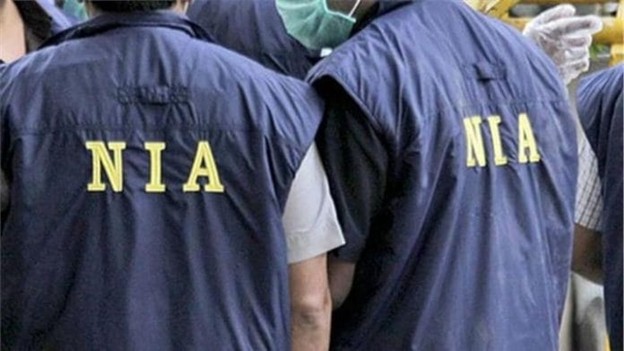
The documented facts are these: VanDyke's network was importing "large consignments of drones from Europe to Myanmar via India." The NIA explicitly stated the network also supplied weapons and hardware to groups that in turn supported banned Indian insurgent groups. The route ran through India's northeastern corridor — and the primary intercept point for the network's coordinator was Kolkata. The same Kolkata from which multiple districts of West Bengal, including North 24 Parganas, are accessible within hours.
To state clearly what cannot yet be proven but also cannot be responsibly dismissed: the VanDyke-Ukrainian network represented a documented European weapons pipeline running through Kolkata and the northeast. A Glock 43X — Austrian, professional, traceable to European manufacture — was used in a targeted post-election assassination of a senior BJP leader's aide in North 24 Parganas. The geographical, chronological, and operational overlap demands full forensic investigation into whether the weapon's supply chain connects to the VanDyke network, to Ukrainian-origin arms flows, or to other European smuggling routes now under NIA investigation.
Rajya Sabha MP Rahul Sinha alleged there was a conspiracy to kill Suvendu Adhikari himself and demanded strict action. (Source: ANI News)
Police teams left for Siliguri to investigate the vehicle trail. The investigation pointing toward Siliguri — the city at the gateway to the Chicken's Neck, the same area where ISI officers had conducted their January 2025 reconnaissance — is itself a signal about the geographic networks that supplied both the intelligence for the killing and potentially the weapon used to carry it out.
The Full Picture: Three Weapons Systems, One Theatre
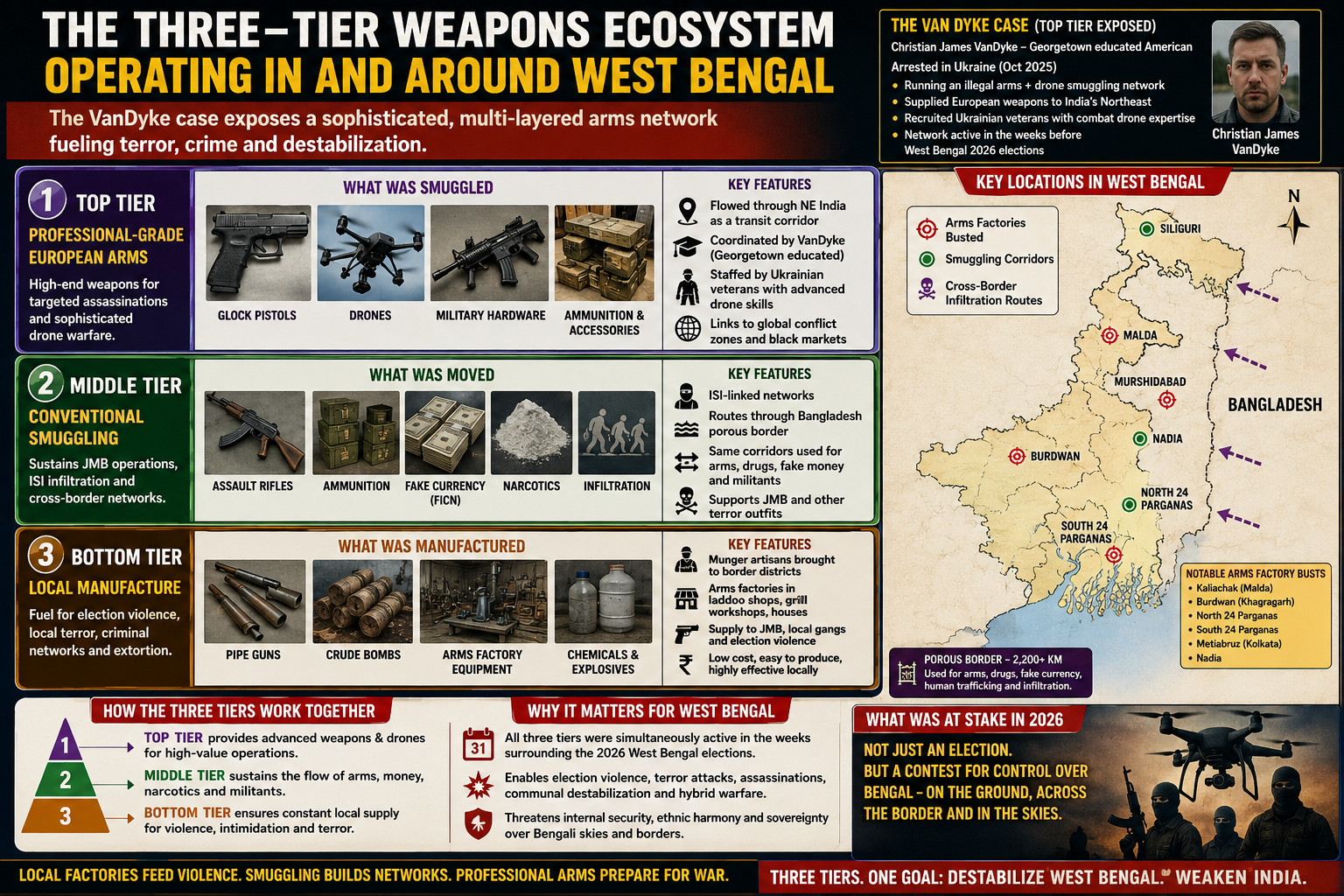
The VanDyke case, read alongside the domestic arms factory networks documented in Kaliachak and Burdwan, reveals a three-tier weapons ecosystem operating in and around West Bengal:
The bottom tier is local manufacture — Munger artisans brought to border districts, making pipe guns and crude bombs in laddoo shops and grill workshops for JMB, local criminal networks, and election violence.
The middle tier is conventional smuggling — ISI-linked networks moving weapons through Bangladesh's porous border, the same routes used for fake currency, narcotics, and infiltration.
The top tier is professional-grade European arms — Glocks, drones, military hardware — flowing through a network that used India's northeast as a transit corridor, was coordinated by a Georgetown-educated American with deep conflict-zone credentials, and was staffed by Ukrainian veterans with the most current combat drone experience in the world.
Each tier serves a different purpose.
- Local manufacturers supply election violence and low-level terror.
- Conventional smuggling sustains JMB's operational capacity and ISI's infiltration networks.
- Professional European hardware enables targeted assassinations and the kind of sophisticated drone warfare that can change the military balance in an ethnic conflict zone — or, in the wrong hands, over Bengali skies.
That all three tiers were simultaneously active in the weeks surrounding West Bengal's 2026 election is the most precise available measure of what was actually at stake, and who was actually playing.
The Intelligence Signal Chain: Reading the Sequence
The chronology, when assembled, tells a story that is more than coincidental:
February 2026: Jamaat-e-Islami wins 68 seats in Bangladesh's parliamentary election, with its highest tally in 25 years, concentrated specifically in border constituencies adjacent to West Bengal — Rangpur, Gaibandha, Satkhira, and districts that mirror exactly the infiltration corridors and JMB recruitment zones identified in Indian intelligence assessments. Jamaat ran a campaign directly targeting anti-India sentiment, capitalizing on Muslim resentment regarding India's stringent anti-infiltration stand and instances of violence along the border. Indian analysts assessed that this would embolden extremists in border areas.
April 7, 2026: Ajit Doval meets Bangladesh's Foreign Minister Khalilur Rahman for dinner in New Delhi — the first such engagement since the Hasina ouster. Whatever was communicated across that dinner table about ISI infiltration of Bangladeshi institutions, militant networks, and the security situation in the run-up to West Bengal's election, it was significant enough for the government of Bangladesh to act within two weeks.
April 20, 2026: Bangladesh Air Force intelligence raids its own bases. The operation is described as intelligence-led, broad-based, and sudden. The arrests span multiple installations. Personnel flee to four countries. The scale of the operation suggests either that the intelligence on the penetration had been accumulating for some time, or that a specific intelligence input — potentially shared during the Doval-Rahman engagement — catalyzed a decision to act.
April 23-29, 2026: West Bengal votes in two phases, with the NIA deployed across six districts, 79 crude bombs already recovered in Bhangar, and border crossings locked down.
The convergence of these events within a single three-week window is not coincidental. It reflects the activation of an intelligence coordination mechanism between India and the newly installed Bangladesh government — a mechanism that Doval's dinner was designed to initiate or accelerate.
Jamaat on the Border: The Electoral Map as a Security Map
The image from the Bangladesh election results is perhaps the single most visually striking piece of evidence in this entire security picture. Jamaat secured most of its seats primarily in areas bordering India — Rangpur, Khulna's Satkhira district, where it won all four seats, Gaibandha, Joypurhat, and constituencies connected to West Bengal's districts of Jalpaiguri, Malda, Murshidabad, Nadia, and 24 Parganas. In these border areas, where Hindus constitute 11% or more, Muslim voters appear to have united behind the extremist Jamaat in a pattern that Indian analysts described as anti-Hindu voting.
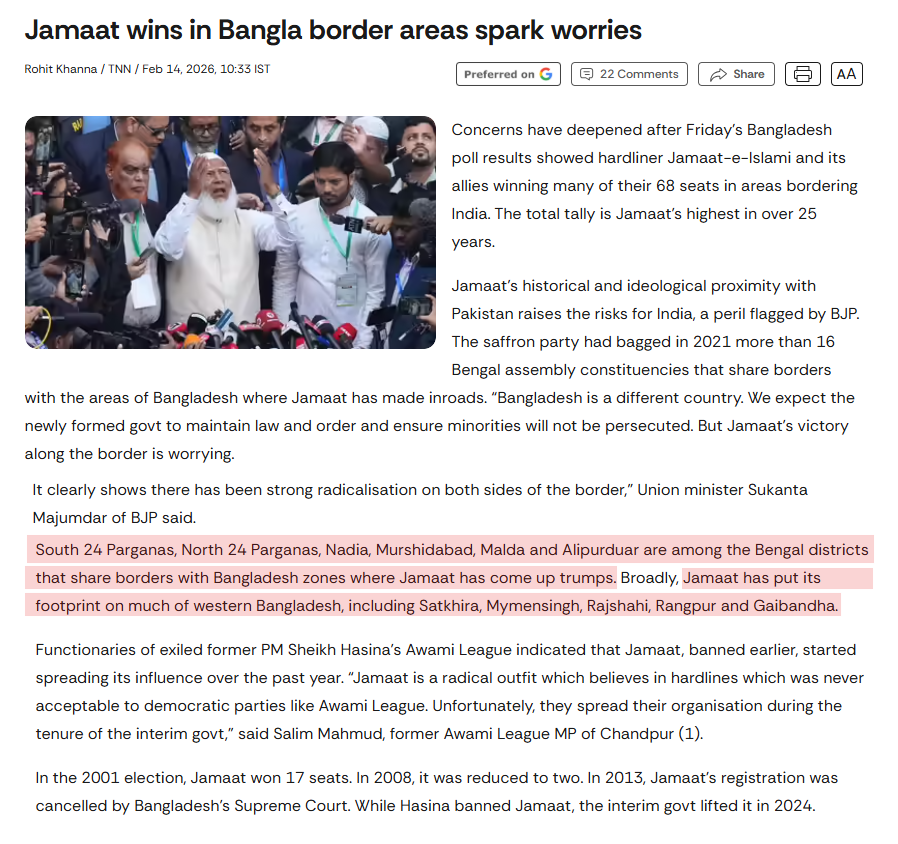
The implications for West Bengal are direct. Jamaat's electoral map on the Bangladeshi side of the border maps almost perfectly onto JMB's recruitment and infiltration map on the Indian side.
The BJP had warned that Jamaat's victory along the border shows strong radicalization on both sides of the border.
As Union Minister Sukanta Majumdar stated, "Bangladesh is a different country. We expect the newly formed government to maintain law and order and ensure minorities will not be persecuted. But Jamaat's victory along the border is worrying. It clearly shows there has been strong radicalization on both sides of the border."
This statement is significant not for its political framing but for what it implies about the operational intelligence picture.
What the Sequence Means
Read together, the Doval dinner, the Bangladesh Air Force purge, and the Jamaat border election results constitute a three-part intelligence signal chain that describes the current state of the contest:
The Doval-Rahman meeting represents India successfully establishing a first channel of security coordination with a Bangladesh government that, despite containing Jamaat as an ally, recognised that ISI penetration of its own military was a threat to Bangladeshi sovereignty as much as to Indian security. The new BNP government, whatever its Islamist coalition partners, has an institutional interest in not being the government under whose watch a Pakistani-penetrated Air Force potentially provided targeting data or operational access for an attack on India.
The Bangladesh Air Force purge represents the most concrete evidence yet that ISI (operating through TTP as a deniable label) had successfully embedded operatives inside Bangladesh's military infrastructure. The three airbases that were implicated: Chittagong's Zahurul Haque, Dhaka's AK Khandakar, and Jessore's Matiur Rahman, cover Bangladesh's primary strategic air approaches.
Operatives inside these bases would have access to precisely the kind of intelligence on radar gaps, flight patterns, and base security that would be valuable in planning operations against India's Eastern Air Command.
The Jamaat border election results represent the political consolidation of the same geography that ISI uses for infiltration operations. An elected Jamaat parliamentarian in Satkhira or Rangpur is not merely a political representative. He is the legitimate face of networks that have, for decades, served as ISI's ground-level infrastructure in Bangladesh's border districts.
That the BJP won — and that it won most decisively in the border districts that had been identified as the most infiltrated and most strategically exposed — may be the most consequential security outcome of the 2026 Indian electoral cycle.
The Election Itself as a Security Event
When the 2026 election actually arrived, the security dimension was visible in every metric.
Just three days before the final phase of voting, 79 crude bombs were recovered at Bhangar in South 24 Parganas.
On April 26, police recovered at least 79 crude bombs from the house of a person, allegedly a Trinamool Congress (TMC) worker, at Bhangar in South 24 Parganas district of West Bengal. The explosives were seized during a search operation at the house of Rafikul Islam, conducted on the basis of specific intelligence inputs, he said. Later, on a directive by the Union Home Ministry, the National Investigation Agency (NIA) registered a case to probe the recovery of 79 crude bombs in the state. In pursuance of the MHA's order, the anti-terror agency on Sunday registered a case, which was originally filed at Uttar Kashi police station, Bhangar division, Kolkata on Saturday, and took up the investigation, an NIA spokesperson said in a late-night statement. "The case pertains to the recovery of 79 crude bombs and other incriminating materials by Kolkata police, which were being stored at a spot, thereby endangering human life and property," the spokesperson said. (Source: IndiaTV)
The NIA determined this was not an isolated incident and took over the investigation. The NIA deployed multiple teams across Purba Bardhaman, South 24 Parganas, Hooghly, Nadia, Howrah, and Kolkata ahead of the second phase of polling.
Over 8,000 polling booths were declared "super sensitive." 2,321 companies of central forces were deployed, with 273 companies in Kolkata alone. Drones fitted with cameras monitored the entire polling process. Authorities imposed temporary restrictions on cross-border movement through the Petrapole land port in North 24 Parganas along the India-Bangladesh border, applying to both people and vehicles entering or leaving Indian territory.
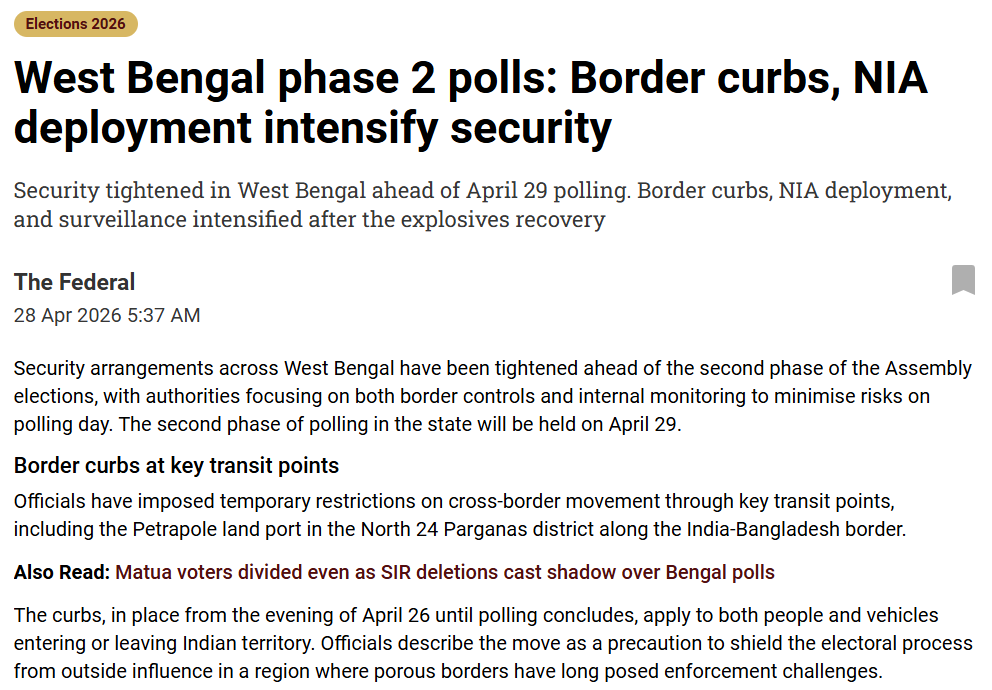
This scale of security deployment — central paramilitary forces, NIA, border lockdowns, drone surveillance — is not deployed for a normal state election.
The post-result violence confirmed what the security assessment had anticipated. Within hours of the BJP's sweeping victory, clashes erupted across Kolkata, Howrah, Birbhum, Murshidabad, North 24 Parganas, South 24 Parganas, and other districts.
In North 24 Parganas, police officers and central force personnel were shot at during patrols amid clashes. A CPI(M) worker in Murshidabad was hit by gunfire. A BJP worker was killed in New Town.
And now, Suvendhu Adhikari, the BJP leader who defeated Mamata Banerjee by over 15000 votes, has been shot dead.
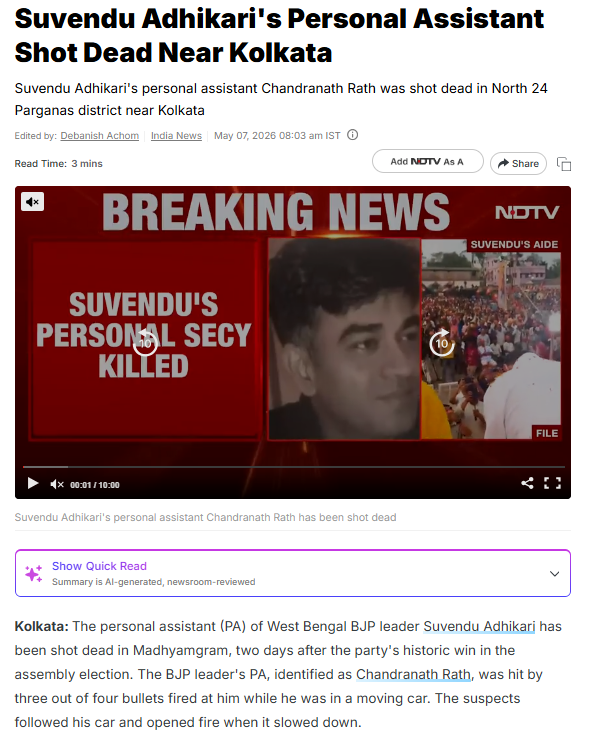
The networks that had been sheltered, armed, and politically protected for fifteen years did not dissolve on counting day. They merely changed their tactical objective from preventing a BJP victory to destabilizing its aftermath.
What Was Actually Won and Lost
The BJP's victory in West Bengal 2026 was, on one level, a historic political realignment.
The Siliguri Corridor is now flanked by newly established Indian military garrisons and covered by layered missile defense.
The ISI-JMB networks in Murshidabad and Malda, repeatedly raided and arrested, no longer enjoy state-level political protection. The border districts that served as arms manufacturing hubs will face, for the first time in 15 years, a state government with electoral incentives to cooperate with, rather than obstruct, central security agencies.
China's planned airstrip near the Chicken's Neck remains a concern. The American strategic project in the Bay of Bengal continues. Pakistan's ISI, post-Operation Sindoor, is regrouping. Bangladesh's new government has deep structural ties to Islamist networks.
But the elimination of the protective political layer — the state government that shielded the networks that fed these operations — is a genuine strategic shift.
West Bengal 2026 was not just an election. It was India's most important internal security battle of the decade, fought at the ballot box because that was the arena in which the decisive confrontation was possible.
They were all aimed at the same objective: keeping West Bengal unstable, penetrable, and partitioned from the Indian state's sovereign authority over its own territory.
For now, that project has failed. But it has not been abandoned. It has simply had its most important political asset removed.