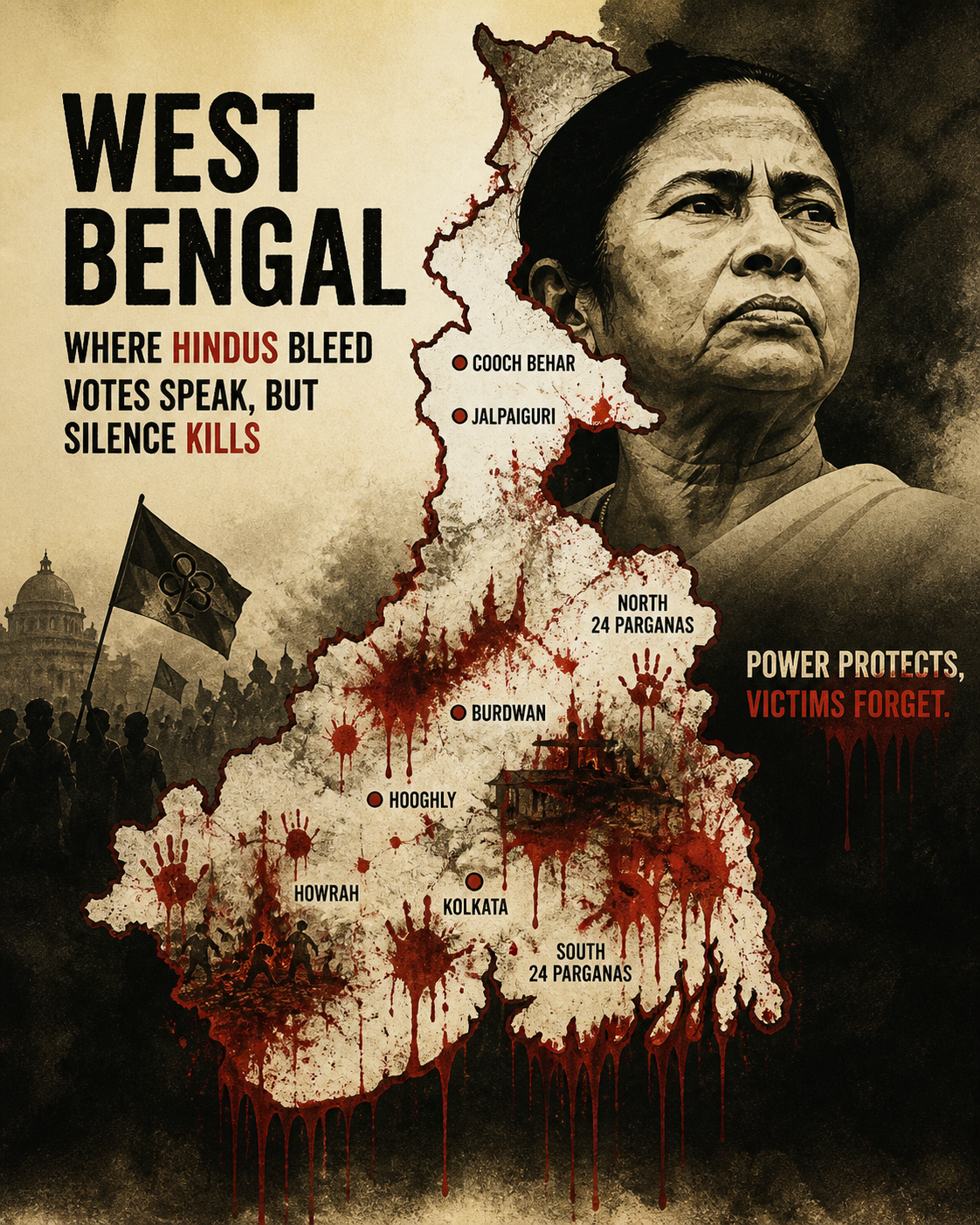
Why this was not an Election
There is a standard template through which elections are analyzed: party programs, charismatic candidates, economic grievances, coalition arithmetic, vote-share mathematics. Apply that template to the 2026 West Bengal assembly elections and you will understand almost nothing about what actually happened.
What happened in West Bengal on April 23 and April 29, 2026 was a civilizational referendum, a national security test, and a moral reckoning compressed into voting booths guarded by central paramilitary forces.
For the first time in decades, Bengal actually voted. Democratically. Without fear.
And they used that protection to deliver a verdict so thunderous, so unambiguous, so far beyond what even optimistic projections had suggested, that it can only be read as the accumulated testimony of a people who had been silenced for a very long time.
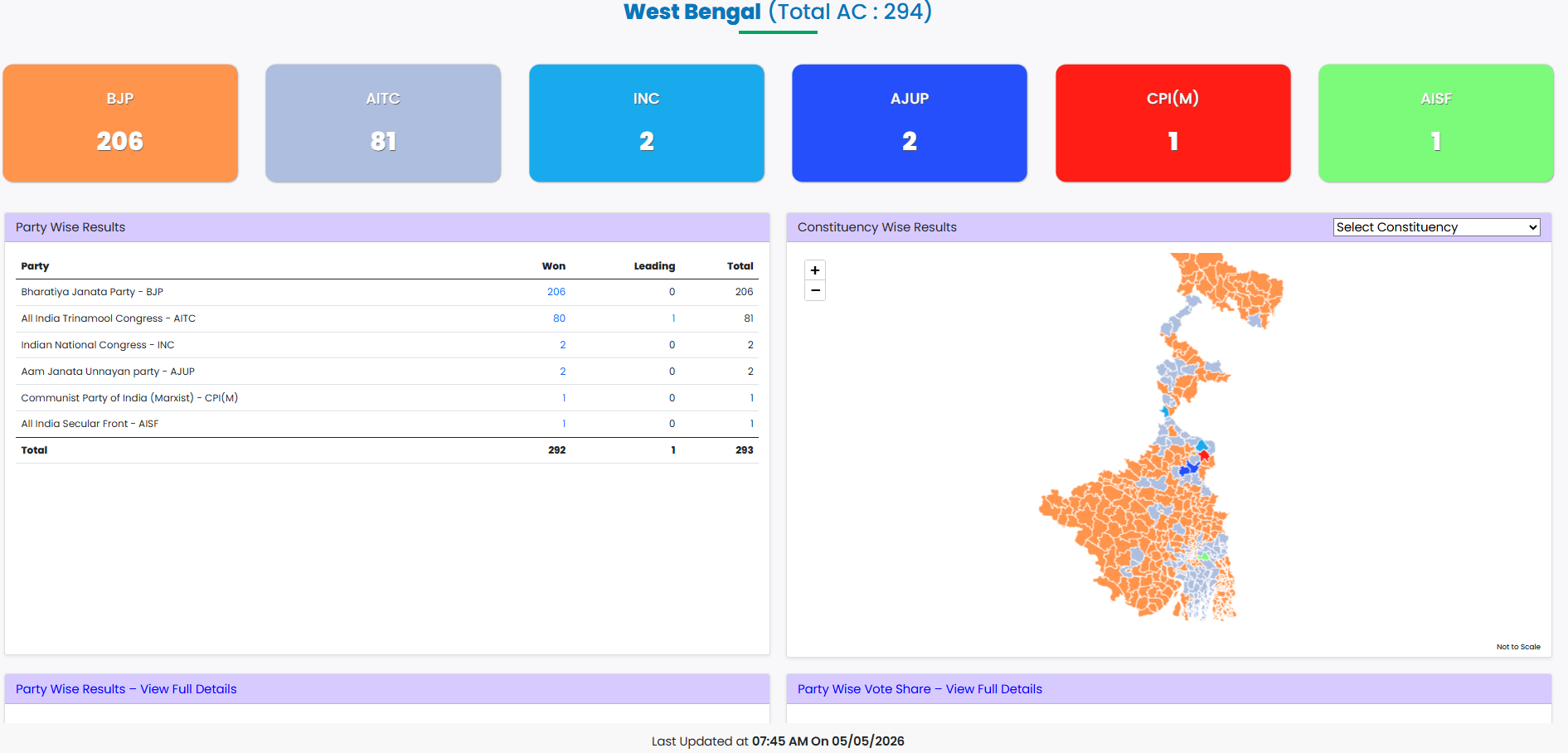
The BJP's over-200-seat mandate did not emerge from a normal political contest. It emerged from a population that had spent fifteen years under a regime of political murder, sexual terror, judicial intimidation, press suppression, systematic demographic engineering, and deliberate complicity with a national security threat that had been building, brick by brick, on Bengal's eastern border.
It emerged from people who had watched their neighbors hang from trees. From families who had fled their homes and could not return for over a year. From women who had been told their bodies were the political property of the ruling party's enforcers.
From Hindus who had watched their temples burn in Murshidabad while a TMC councilor reportedly walked through the ashes to mark which homes remained.
I: The Architecture of a Terror State
Any honest accounting of the TMC regime in West Bengal must begin with the bodies. The specific, named, documented cases of human beings murdered for their political beliefs.
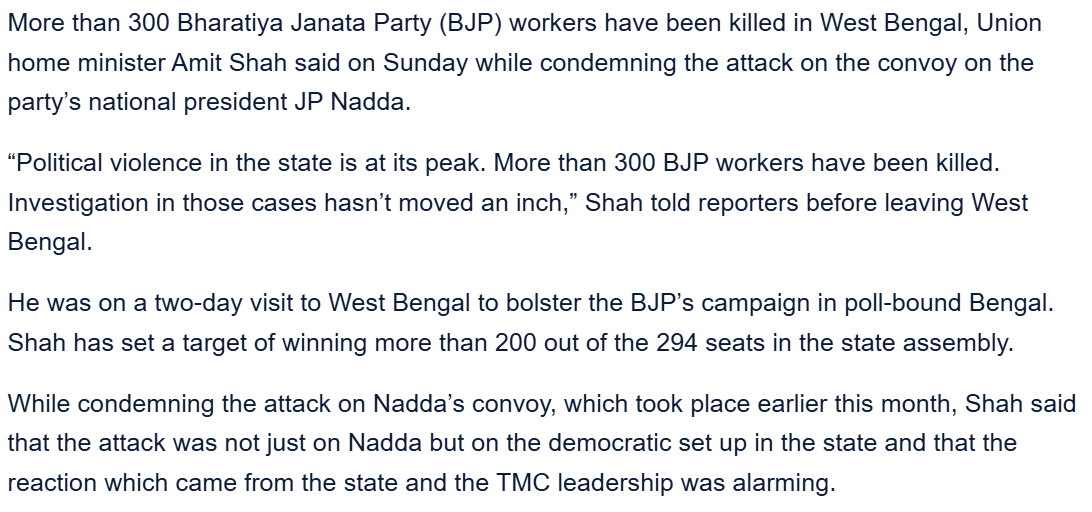
By December 2020, before the 2021 elections had even concluded, Union Home Minister Amit Shah stated in front of the journalists that more than 300 BJP members had been killed due to political violence in West Bengal, and that "investigation in those cases hadn't moved an inch."
The impunity was intentional. It was the message. When the state refuses to investigate the murders of political opponents, it is communicating to every potential victim and every potential perpetrator alike that certain lives are unprotected.
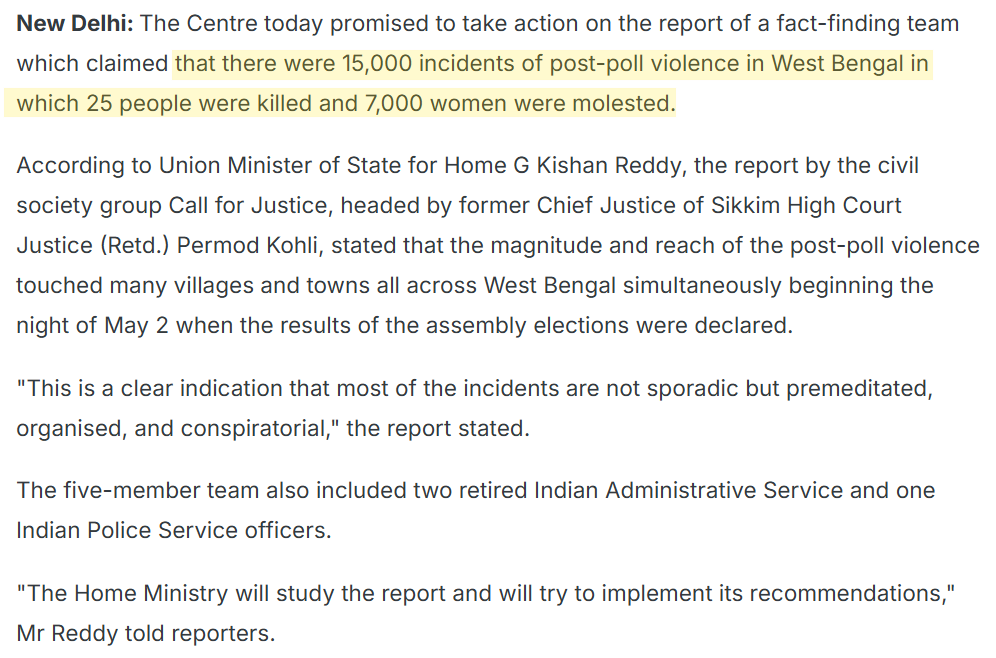
After the 2021 assembly results were announced, the carnage became undeniable even to those who had been doing their best not to look. At least 24 BJP workers were documented as killed in the immediate post-poll period. The CBI investigated 52 cases of murder or unnatural death arising from the post-poll violence. These were real people with names.
BJP worker Avijit Sarkar from Behala in Kolkata was stoned to death. BJP workers Manoj Mandal and Chaitanya Mandal were hanged from a tree in Uttar Lakshmipur, Malda, tied together with a rope, their bodies displayed like a public announcement to their entire community. BJP worker Arup Ruidas was killed and hanged from a tree in Bankura. BJP activist Trilochan Mahato was found hanging from a tree in Balarampur, Purulia, with a note left nearby explaining that he had been "punished for working for the BJP."
BJP worker Mintu Burman was beaten to death in Cooch Behar. Chandan Roy and Haradhon Ray were murdered in Cooch Behar and Dinhata. BJP karyakarta Momik Moitra was killed in Sitalkuchi. A 22-year-old BJP youth wing leader, Shuvro Jyoti Ghosh, was found hanging from a bamboo structure in Alipurduar.
 Aditi
Aditi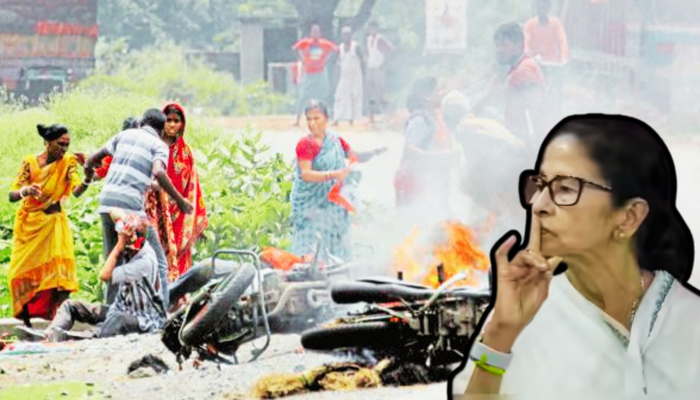
The method of hanging from trees deserves particular scrutiny. Display was the point.
Within 36 hours of the 2021 results, at least 14 political killings were documented across the state. BJP candidate Kashinath Biswas's residence was set ablaze.
Location: Beleghata #BJP candidate Kashinath Biswas’s residence was set ablaze earlier today. He said it was #TMC supporters behind the attack. pic.twitter.com/2BuUUwnNDA
— Sreyashi Dey (@SreyashiDey) May 2, 2021
Houses of BJP workers in multiple districts were ransacked and torched. The BJP's Arambagh office was burned while vote counting was still ongoing. BJP offices in Nandigram, Asansol, and across the state were vandalized and destroyed.
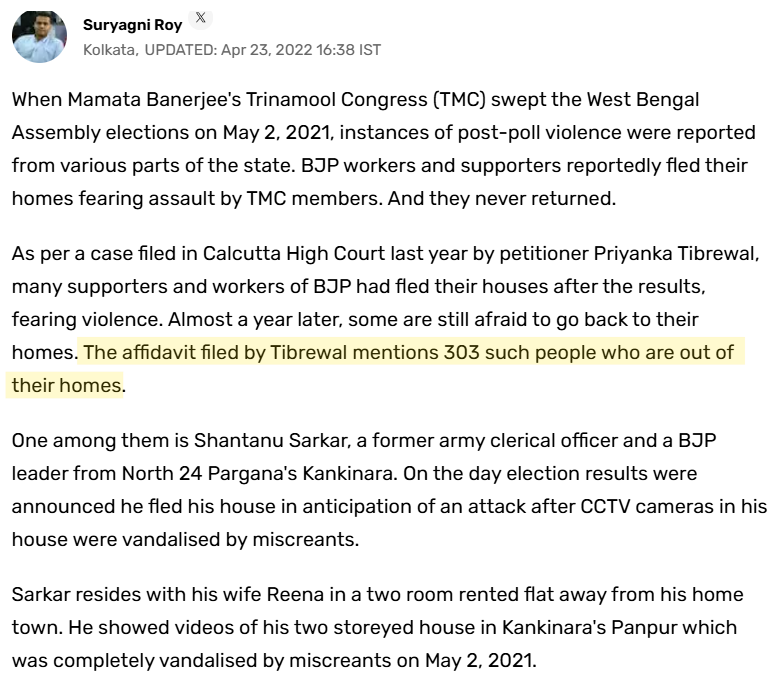
As of April 2022, at least 303 BJP workers and local leaders who had fled Bengal in 2021 were still unable to return to their homes. They were waiting for the state government to provide assurances of safety before moving back. The BJP leadership of East Burdwan submitted lists to police demanding the return of their displaced workers. Three hundred and three families in internal exile within their own country after a democratic election, waiting for the government that had driven them out to grant them permission to come home.
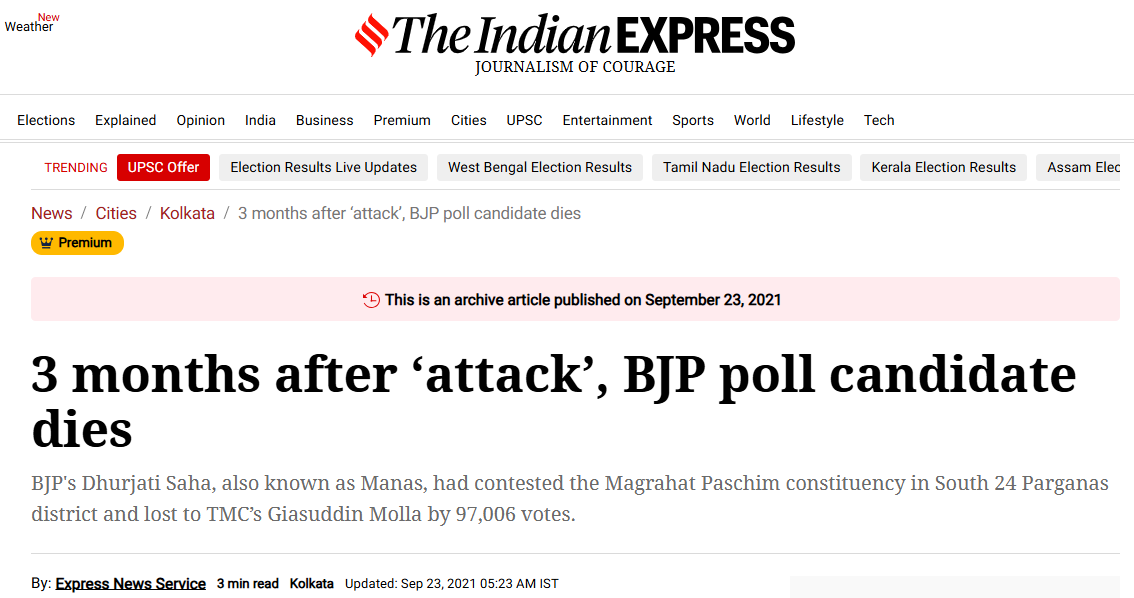
In September 2021, BJP candidate Manas Dhurjati Saha from Magrahat Paschim, who had allegedly been beaten by TMC workers and sustained serious head trauma, died in hospital.
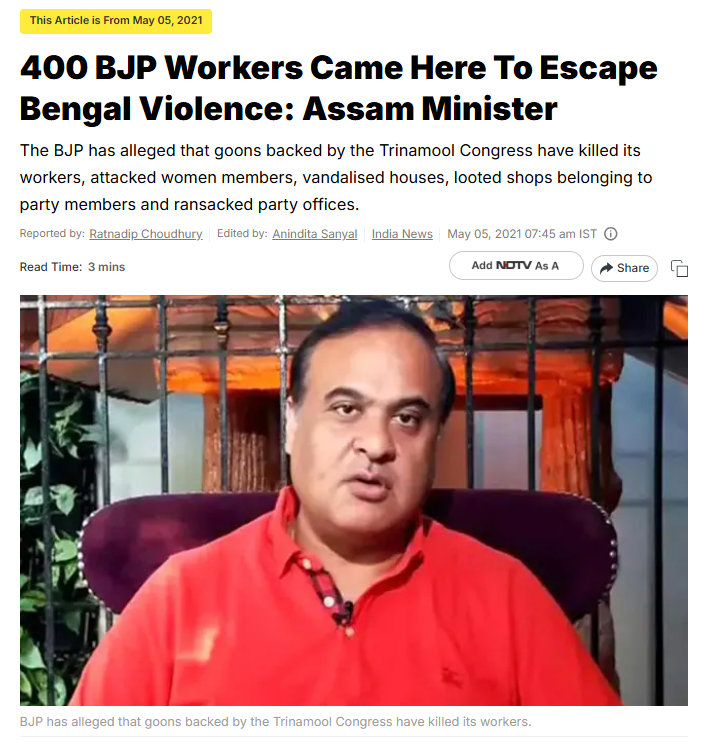
Assam Chief Minister Himanta Biswa Sarma confirmed that hundreds of families of BJP workers had crossed the West Bengal-Assam border to seek shelter. He called it "the ugly dance of democracy."
The Rape Weapon
Among the most methodically deployed instruments of TMC political terror was the systematic use of sexual violence and its threat as a tool of political submission.
It was doctrinal in nature. A crime deliberately unleashed.
During the 2026 election campaign, multiple voters in Falta came on camera to journalists and reported the identical threat: if you do not vote for TMC, the women of your household will be raped. The precise consistency of this formulation across different voters, different locations, and different reporters establishes it as a communicated instruction that flowed through the TMC apparatus.
Someone decided this was the message. Someone delivered it to enough people that multiple independent reporters confirmed it from multiple independent sources.
After the 2021 elections, BJP workers were reportedly told that if they wanted to return home at night, they should send the women of their households to the homes of TMC goons. A 60-year-old woman was raped by TMC workers because her family had voted against the party. The case reached the Supreme Court. Two BJP workers were reportedly gang-raped in the immediate post-poll period.
 Debayan Roy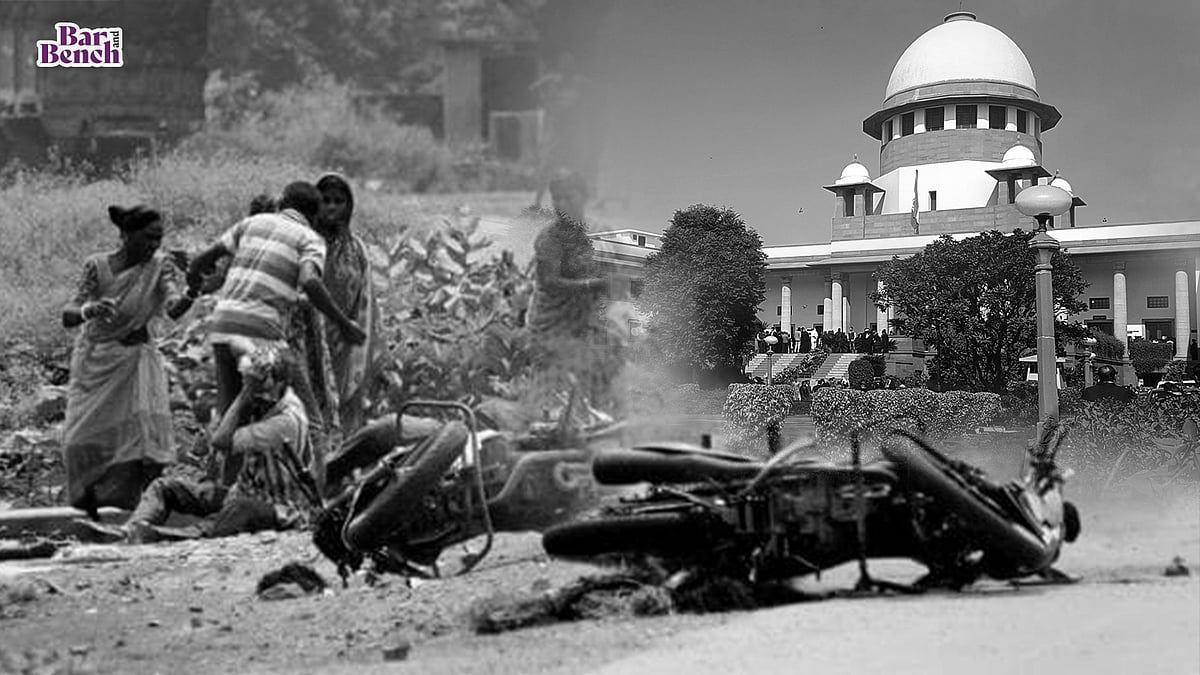
What was Mamata Banerjee's response to post-poll violence?
She accused central ministers of "inciting violence" in West Bengal and claimed the BJP-led central government was unable to come to terms with its electoral loss. In a press conference on May 10, 2021, Banerjee asserted, "There has been no genocide. We saw only one genocide that took place in Cooch Behar's Sitalkuchi on the polling day". (Source: Indian Express)
The architecture of this terror was surgical.
This calculation is the logic of every regime that has weaponized sexual violence against civilian populations, from the Rwandan genocide to the ethnic cleansing campaigns of the Balkans. You do not need to rape every woman in a community to terrorize every man in it. You need to rape enough women, threaten enough families, and ensure enough impunity that every man performs the calculation and concludes that compliance is the only rational option.
That this logic was applied in a democracy, by a political party claiming to govern through popular mandate, represents a particular kind of moral obscenity.
It hollows out the legitimacy of every vote the TMC ever claimed to receive.
If a significant portion of your electorate voted for you under the credible belief that their family members would be sexually assaulted if they did not, that is a protection racket wearing the costume of an election.
Sandeshkhali: Religious Feudalism in the Twenty-First Century
The events in Sandeshkhali's cluster of villages in North 24 Parganas represent one of the most extensively documented cases of organized feudal sexual predation in contemporary India.
Groups of twenty to thirty men would arrive on motorcycles, survey the available women, select those they wanted, and take them for nights at a stretch. They would not release the women until they were, in the victims' own words, "fully satisfied." When a husband attempted to assert his right to his own wife and said she could not be taken, the response was direct: "She is not yours. She is ours." The husband was beaten for the offense of having objected.
The women were neighbors of the men who took them. They lived in adjacent houses. Their children attended the same schools.
The predation was conducted openly, casually, as a matter of course, because everyone involved understood that the state offered no recourse. When victims attempted to file police complaints, they were told to go back and negotiate with the TMC leader.
When the Enforcement Directorate arrived in early January 2024 to raid Shahjahan's house, his supporters physically attacked the team.
Shahjahan then went on the run. He remained a fugitive for weeks while the state government, whose constitutional duty was to assist the investigation, demonstrated consistent inaction.
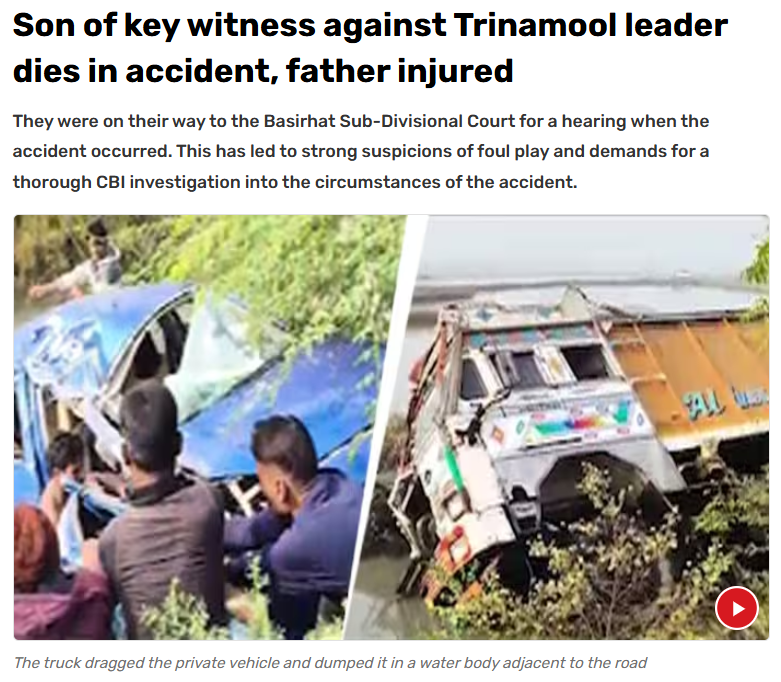
When a key witness finally gathered the courage to testify against him and began traveling to court, the witness suffered an "accident" en route.
The pattern is textbook organized crime nested inside a captured state: when the legal system cannot be prevented from functioning entirely, the witnesses who feed it are eliminated or intimidated before they can testify.
Fourteen months after the initial uprising, women in Sandeshkhali continued to live under the shadow of Shahjahan's network. The structures that had enabled the abuse remained fundamentally intact. The arrest of a single leader does not dismantle the network, the patronage relationships, the complicit police, or the culture of impunity. What is required is the dismantling of an entire governance architecture, which requires precisely the kind of political change that the 2026 election represented.
The Malda Judicial Hostage: When Courts Became Targets
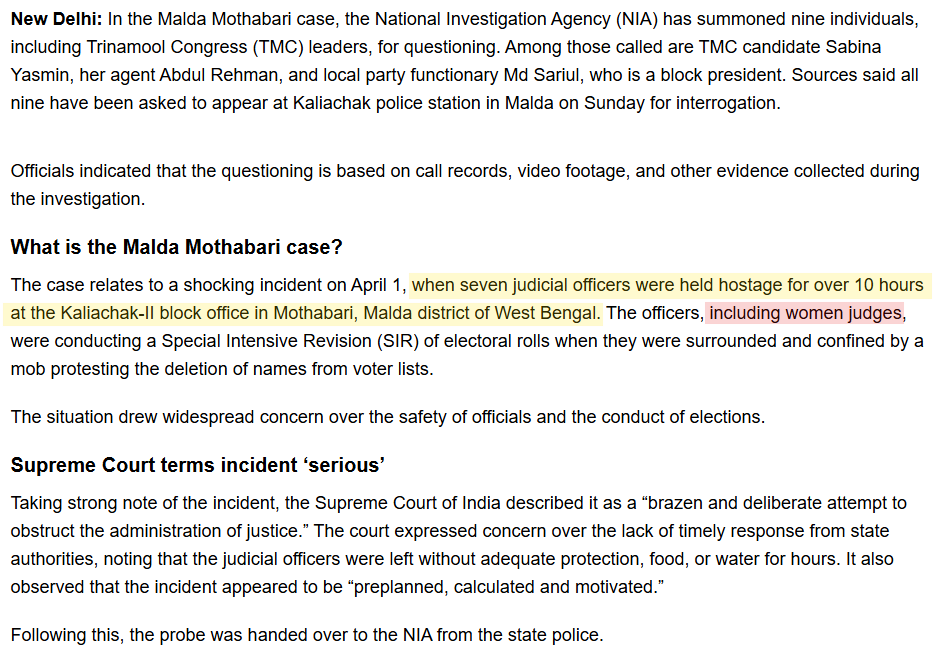
Among the most constitutionally alarming episodes in the months preceding the 2026 elections was the hostage-taking of judicial officers in Malda in early April, just weeks before polling day. Seven judicial officers, including three women, were conducting a Special Intensive Revision of electoral rolls at the Kaliachak-II block office in Mothabari when a mob surrounded and confined them for over ten hours.
The purpose of the voter roll revision was to identify and remove fraudulent entries, including names of infiltrators who had been registered as voters through the TMC's systematic facilitation of illegal immigration.
The Supreme Court took immediate and severe notice. Chief Justice Surya Kant described the incident as "highly premeditated" and called the conduct of the Chief Secretary, Home Secretary, DGP, and local SP "deeply disappointing." The NIA was directed to investigate. Nine individuals, including TMC candidates and party functionaries, were subsequently summoned for questioning. The main accused, Mofakkerul Islam, had bail denied repeatedly with judicial custody extended through mid-May.
West Bengal BJP president Samik Bhattacharya stated publicly that the incident was "orchestrated by TMC" and that the main arrested person had been spotted on stage with the Chief Minister. He described the event as a direct attack on the judiciary and said that TMC was "defying the federal structure."
Consider what this event represented, stripped of its political framing. A mob surrounded government offices and held judicial officers, including women, hostage for over ten hours to prevent them from performing the constitutional function of verifying voter eligibility.
The state police, which constitutionally exists to protect government functionaries performing their duties, did not intervene effectively. The Supreme Court had to intervene from Delhi to secure the safety of judges performing their official duties in their own state.
When a state government is either unable or unwilling to prevent a mob from holding judges hostage for ten hours, you are witnessing a governance void. The space that should be occupied by the state's legitimate authority is occupied instead by the TMC's parallel power structure.
II: The Suppression of Truth
No totalitarian system sustains itself without controlling the flow of information about what it is doing. The TMC regime understood this and applied it with systematic thoroughness over fifteen years.
Reporters Without Borders documented waves of attacks on journalists covering elections in West Bengal, with TMC activists among the alleged perpetrators. Freelance reporter Biplab Mondal of the Times of India was attacked by TMC members in Kolkata after he refused to delete photographs he had taken near nomination filing offices.
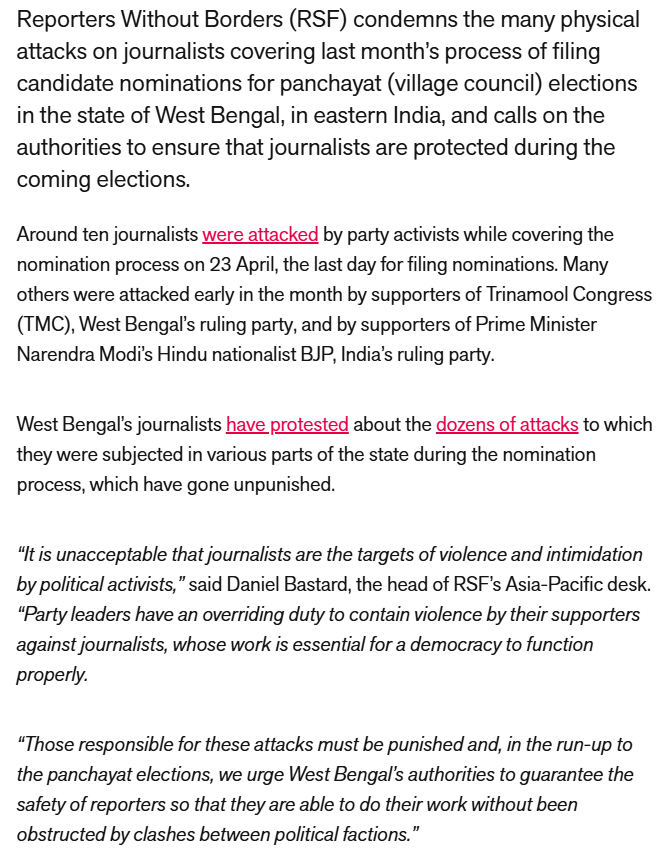
He was beaten, threatened, and stripped of his clothes.
ETV Bharat reporter Manas Chattopadhyay had his phone seized by force and was beaten over the head in the same location. The police, present during these events, told Chattopadhyay to leave rather than arresting his attackers.
In January 2026, journalist Soma Maity of Zee 24 Ghanta was grabbed by two men while reporting from Beldanga in Murshidabad. They pulled her hair, restrained her legs, tore at her clothes, and allowed others to touch her body. Her cameraman was hospitalized with head injuries. The following day, ABP Ananda reporter Parthapratim Ghosh and photojournalist Ujjwal Ghosh were assaulted covering roadblocks nearby.
On January 16, Soma Maity, a journalist with broadcaster Zee 24 Ghanta, and her cameraman were attacked by a mob while reporting from the town of Beldanga in Murshidabad district. The next day, a reporter with news channel ABP Ananda, Parthapratim Ghosh, and photojournalist…
— CPJ Asia (@CPJAsia) January 20, 2026
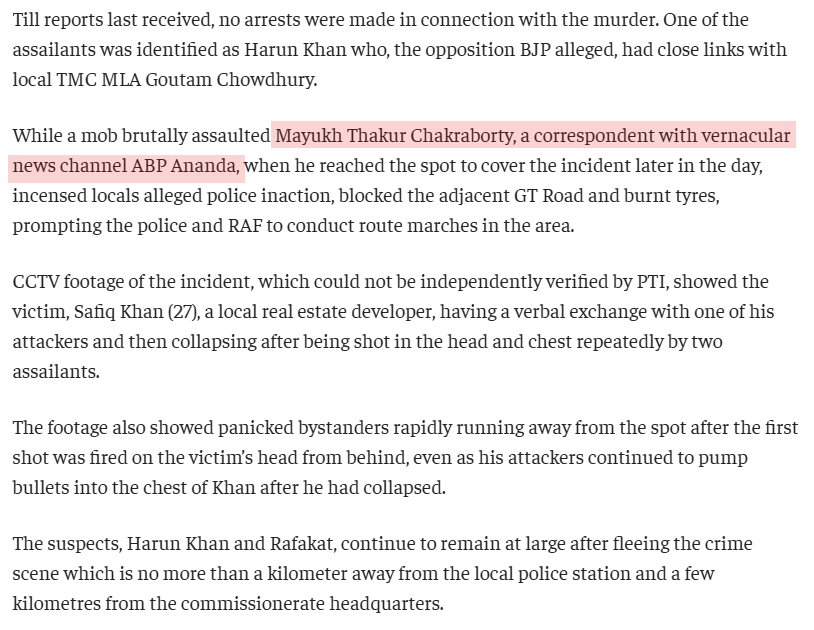
In February 2026, ABP Ananda correspondent Mayukh Thakur Chakraborty was assaulted on camera in Howrah city after he questioned a local TMC lawmaker about alleged links to a murder suspect. The assault was captured on video. A journalist was beaten in front of cameras for asking an elected representative an uncomfortable question about criminal associations.
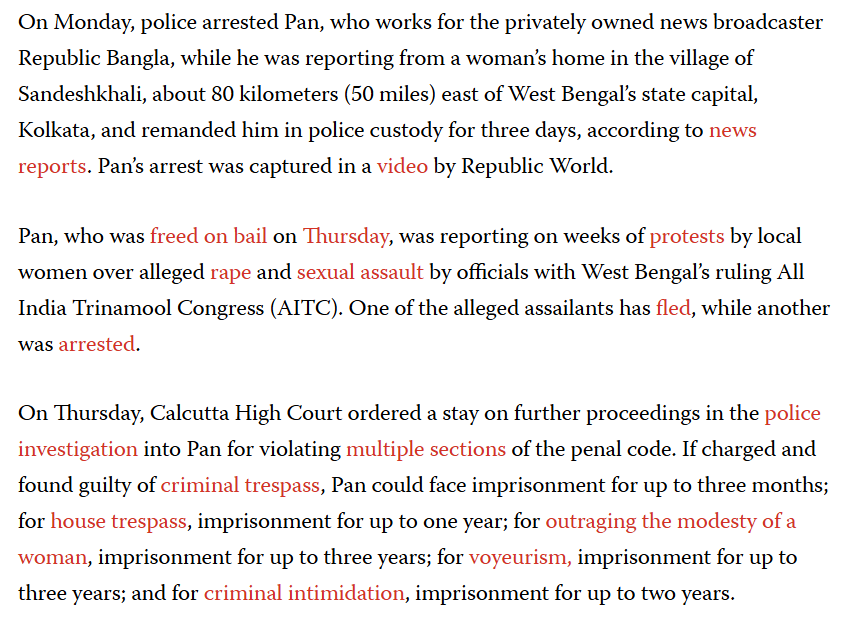
In 2024, journalist Santu Pan of Republic Bangla was arrested live on air while reporting on protests related to alleged abuse by TMC officials. He subsequently quit journalism altogether.
All this has been noted and documented.
That last response deserves attention for its moral logic. When a journalist is beaten while performing constitutionally protected work, the appropriate response from a Chief Minister is to investigate and prosecute the perpetrators. To instead advise journalists to stay away from volatile crowds transfers the moral responsibility for the attack onto the victim and communicates to every future attacker that the state will not hold them accountable.
It is victim-blaming elevated into governance philosophy.
Local reporters operated under a regime of terror more severe than national media could document, precisely because national reporters could leave after filing stories while local journalists lived permanently inside the system they were trying to cover. Local reporters who filed uncomfortable stories lost their jobs. Those who persisted had cases registered against them. Some were jailed. The consequence was a systematic self-censorship that blinded local audiences to the scale of what was being done to them.
The psephologist who publicly stated that he lacked the courage to send his survey teams into certain West Bengal constituencies, because his researchers would be jailed for asking people how they intended to vote, is perhaps the most damning single testimony about the state of democratic functioning in Bengal.
When the act of asking a citizen how they plan to vote is considered dangerous enough to forgo, you are operating in a territory where democratic forms exist as a facade over a system of coercive control.
Prominent Voices Silenced and Targeted
Journalist Nupur Sharma's experience illustrates how the TMC terror machinery extended beyond the physical terrain of Bengal into the professional and personal lives of critics across the country. Sharma, her 70-year-old father, her husband, and her daughter were all subjected to threats and harassment as a direct consequence of her critical coverage of the TMC government.
The deliberate targeting of a journalist's elderly parent and minor child is an act of psychological warfare, designed to communicate that there is no safe perimeter around the journalist, no category of person connected to them who will be left alone, no level of threat that will not be deployed. It converts the journalist's every professional act into a calculation about their family's safety.
The RG Kar case provides another case study in the silencing of accountability. Advocate Vrinda Grover, who had taken up representation of the family of the rape and murder victim, withdrew from all courts under circumstances that pointed directly to the pressure campaign being mounted against anyone who pursued the case aggressively. The victim's parents were explicitly threatened that their dead daughter could still be "hurt" if they did not withdraw their demand for justice. A threat against a dead person makes complete sense from the perspective of a terror system.
YouTubers who produced content demanding accountability for the RG Kar case were raided. Citizens exercising the most basic form of democratic expression, asking publicly on their own platform what happened to a murdered woman and why the people responsible for institutional failures were not being held accountable, found police at their doors.
III: Murshidabad and the Pattern of Engineered Demographic Violence
The violence in Murshidabad in April 2025 requires the most careful analysis because it sits at the intersection of TMC's political architecture and the broader national security reality that makes the Bengal situation uniquely dangerous.
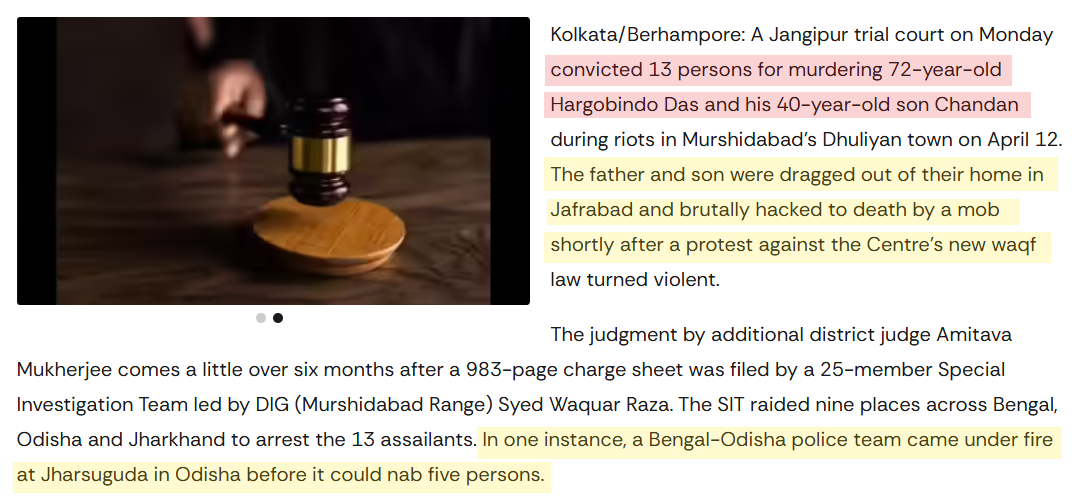
On April 12, 2025, following Friday prayers on April 11, violence erupted across Murshidabad district. A frenzied mob of over one hundred people dragged Hargobind Das and his son Chandan Das from their home in Jafarabad and hacked them to death. Their home was vandalized.
In the neighboring villages of Betbona, Ranipur, and Digri, Hindu localities were simultaneously attacked, with houses set ablaze and looted.
Over 400 Hindus, including women and children, were displaced and fled to neighboring Malda district by boat. The attacks were geometrically precise in their targeting: Hindu homes and shops were destroyed while adjacent Muslim properties were left intact.
The Calcutta High Court appointed a three-member fact-finding committee. Its findings demolished the state government's "outsiders did it" narrative.
The committee found that the main assault on April 11 was led by Mehboob Alam, a local TMC councillor.
The TMC MLA had visited the area on Friday, observed which Hindu homes remained unburned, and left. Those homes were attacked Saturday. One of the Hindu men whose testimony was documented was himself a TMC member. His party affiliation provided no protection. The attackers came for Hindus specifically, and being a TMC voter did not change what you were.
#MurshidabadViolence
— TIMES NOW (@TimesNow) May 21, 2025
The fact-finding committee did not give any report about the outsiders who came to W.B...: @Badalofficial71
Law and order is the responsibility of the state: @gopalkagarwal tells @Swatij14 pic.twitter.com/T5ejp1Vaa3
Victims testified that the West Bengal Police did not answer calls at 4 PM on either Friday or Saturday when locals called to report attacks and request assistance. The police, who are constitutionally obligated to protect life and property, were, at the precise moment when lives and property were being destroyed, unreachable by the people whose lives and property were being destroyed.
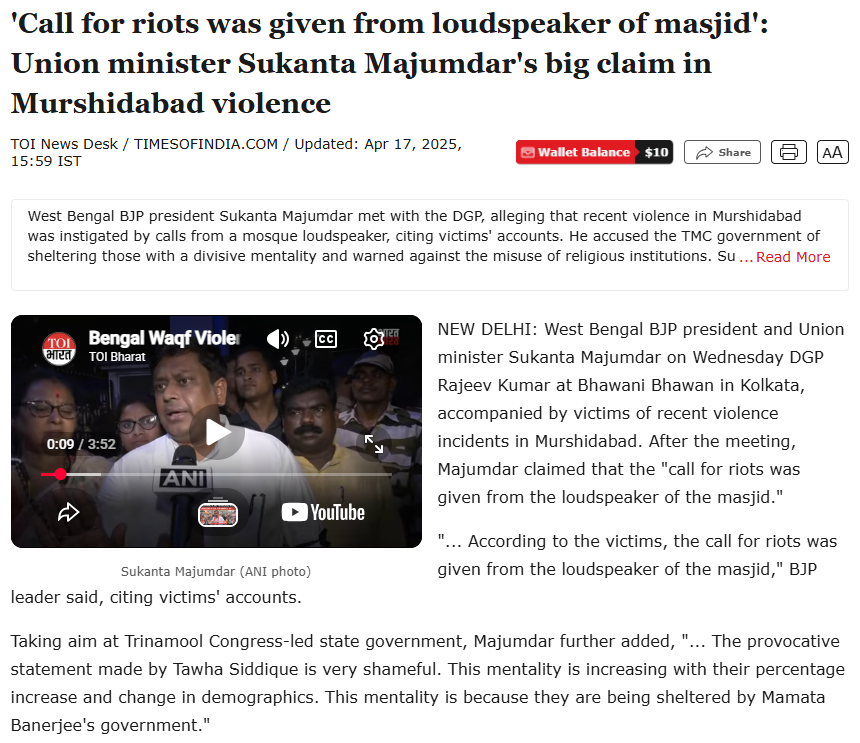
A Hindu man who escaped described hearing an announcement from a mosque microphone directing worshippers to come out with weapons after Fajr prayers on Saturday morning. The violence was scheduled. It was organized. It was coordinated across multiple villages simultaneously. It was preceded by target designation and followed by police non-response.
The pattern matches what historians call pogrom dynamics: a communal majority's organized assault against a minority, with state complicity expressed through inaction rather than direct participation.
This is the pattern of every major episode of communal violence in the subcontinent over the past century.
IV: The National Security Dimension
The violence against Hindus in West Bengal does not exist in geopolitical isolation. It exists within a broader theater of civilizational pressure being exerted on the Hindu population of the Bengal delta from both banks of the border simultaneously.
Following the ouster of Prime Minister Sheikh Hasina in August 2024 and the installation of an interim government under Nobel laureate Muhammad Yunus, Bangladesh has experienced a sustained and documented campaign of anti-Hindu violence with no precedent in the post-Liberation War period.
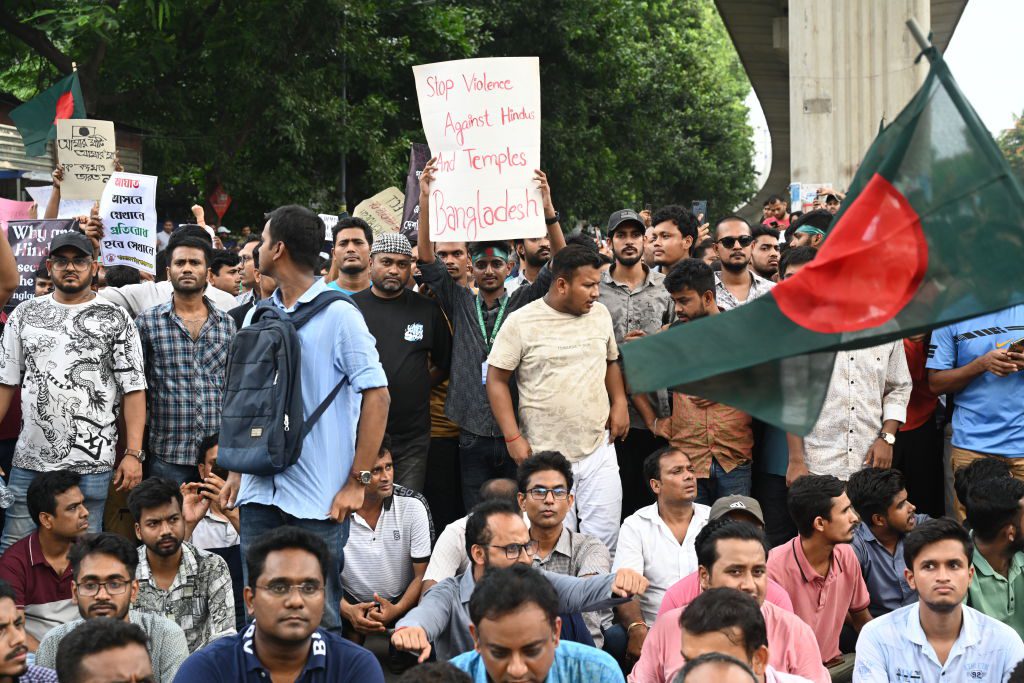
The Bangladesh Hindu Buddhist Christian Unity Council documented over 2,010 incidents of violence against minorities between August 4 and September 20, 2024, alone. By mid-2025, the total had climbed to over 2,244 incidents since the transition.
There are varying figures on violence against religious minorities, particularly post August 2024. Ain o Salish Kendra reported a total of 926 violations against religious minorities and indigenous groups between January and December 2024, and 27 violations against religious minorities and indigenous groups between January and February 2025. However, the Bangladesh Buddhist Hindu Christian Unity Council reported 2184 incidents of violence against religious minorities between 4 August 2024 and 31 December 2024 and 92 incidents in violence between January and February 2025. The difference in reported figures is due to some cases being characterised as sectarian rather than politically motivated violence or violence rooted in economic or personal reasons. The report of 2,200 cases of violence against Hindus in 2024 was highly contested and described as misleading and exaggerated by Bangladeshi authorities and independent human rights organisations. Violations against religious minorities tend to increase during political turmoil, however, this is not always due to religious intolerance and the number of violations has decreased in 2025 (Source: UK Government)
The attacks included murders, gang rapes, home burnings, temple desecrations, forced resignations of Hindu professionals, and systematic destruction of Hindu cultural artifacts. Hindu women in certain regions stopped wearing bangles and bindis to avoid harassment.
PTI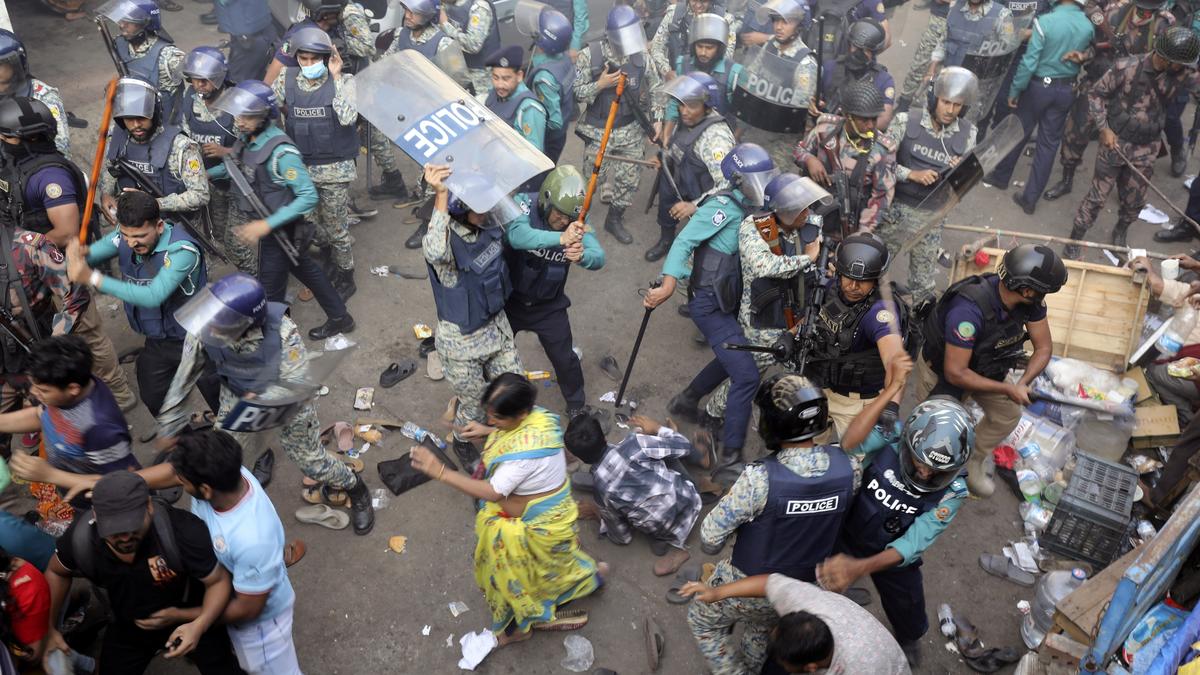
Major Hindu festivals were scaled back or canceled because of safety concerns. The ISKCON spiritual leader in Bangladesh, Chinmoy Krishna Das, was arrested in November 2024 on charges widely seen as pretextual and remained in detention through 2025 without bail, despite the arrest being condemned by international bodies, including the United States Commission on International Religious Freedom. Islamist groups demanded that ISKCON be banned from Bangladesh entirely.
The United States Commission on International Religious Freedom, in a July 2025 factsheet, concluded that "religious freedom conditions in Bangladesh declined significantly" and documented a pervasive "sense of fear" within the Hindu community.
Amnesty International reported that "religious minorities and Indigenous Peoples faced violence" with mob attacks continuing to "destroy the lives of minority communities." The first quarter of 2025 alone saw 92 documented incidents, including 11 murders, 3 rapes, and 25 attacks on temples.
In May 2025, an entire Hindu village in Abhaynagar, Jashore, was attacked by an Islamist mob. Eighteen homes were looted, vandalized, and set on fire. Administrative assistance was delayed by four hours. In July 2025, thousands of Islamists looted and burned 15 to 20 Hindu homes in Gangachara, Rangpur, triggered by a Facebook post allegedly made from a fake account using a Hindu student's name.
This is the ground-level reality on the eastern side of the boundary that separates West Bengal from Bangladesh. It is a reality of systematic demographic pressure, the slow erasure of Hindu presence in Bangladesh through organized violence, economic deprivation, and the weaponization of blasphemy charges.
The Hindu population of Bangladesh was approximately 28 percent at partition in 1947. By 2024, it had fallen to below 8 percent. The documented outcome of generation-long organized violence, written in the demography of a people.
The ISI-Pakistan Axis and the Eastern Threat
The strategic implications of this demographic reality become acute when considered alongside Pakistan's ISI-orchestrated strategy for India's eastern flank. Multiple intelligence assessments and investigative reports documented in late 2025 indicated that Pakistan's military establishment, under Army Chief Asim Munir, was actively exploiting the post-Hasina power vacuum in Bangladesh to establish influence networks targeting India's eastern border.
Reports from intelligence agencies across India, Nepal, and Bangladesh tracked conversations inside Pakistan's militant networks referring explicitly to "a new phase of operations in the east." West Bengal was specifically identified as a focus area. Pakistan's ISI was reportedly forming a National Armed Reserve of over 8,000 radicalized Bangladeshi youth under the command of Jamaat-e-Islami leadership, with the explicit aim of turning Bangladesh into a compliant theater for anti-India operations.
Pakistan Army Chief Asim Munir, identified by a former Pakistani army major as the architect of the Pahalgam terror attack of April 2025 that killed 26 Hindu tourists based on religious identity screening, had publicly stated that Pakistan's expanding military capabilities could "dismantle India's misconceived immunity" over its geographic warspace. He warned of retaliation "far beyond India's imagination." Intelligence assessments indicated that post-Operation Sindoor, Munir was desperate to re-establish ISI proxy operations and was exploring multiple eastern vectors.
The critical link to West Bengal is demographic and political. Of the 4,096 kilometers of the India-Bangladesh border, over 2,216 kilometers run through West Bengal. The TMC government's documented policy of facilitating, enabling, and politically exploiting illegal infiltration from Bangladesh created in West Bengal an operational environment uniquely suited to the ISI's eastern strategy.
The 2021 voter roll manipulation was far from abstract. Fraudulent voter registrations for infiltrators represent the creation of a documented cover identity, a path to Aadhaar cards, to ration cards, to all the infrastructure of Indian citizenship that enables permanent deep-cover presence inside India.
The TMC's resistance to NRC, its active opposition to voter roll cleansing, its deployment of mob violence to prevent judicial officers from reviewing voter lists, these were national security policies, and they served interests aligned with everything Pakistan's ISI was trying to accomplish from the east.
West Bengal as a Launching Pad
The geography of India's strategic vulnerability is stark. West Bengal is the narrow waist through which the Siliguri Corridor, the so-called Chicken's Neck, connects the Indian mainland to the Northeast. The corridor is approximately 22 kilometers wide at its narrowest point. If hostile forces could establish a destabilized, sympathetic, or simply ungoverned West Bengal as a base of operations, they would have created the conditions for a strategic encirclement of India's entire northeastern region.
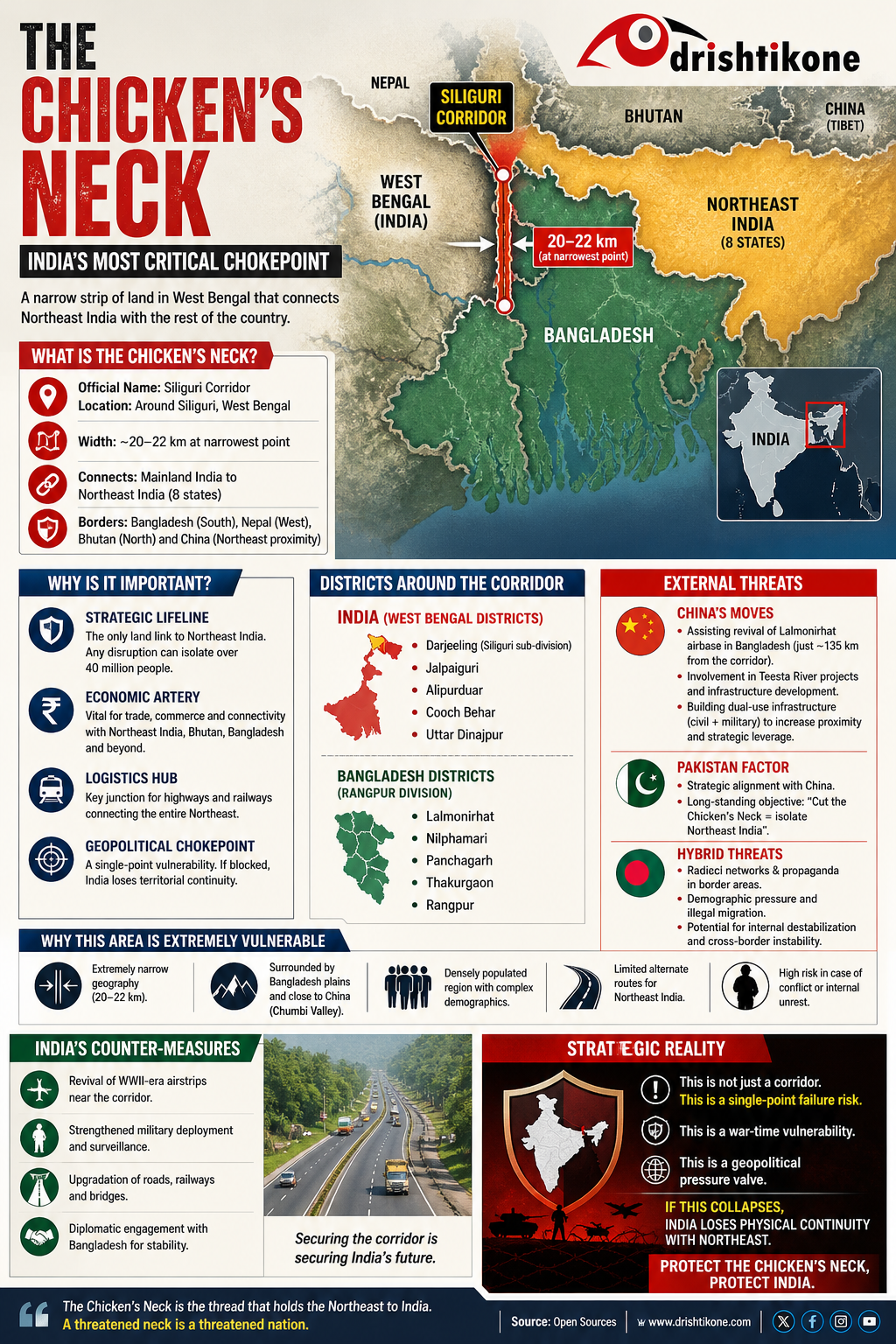
This is the operational logic of every serious strategic assessment of India's eastern vulnerability. The Northeast, comprising eight states with their own complex ethnic, religious, and political dynamics, is connected to the rest of India through a geographic bottleneck that any conventional military planner would identify as the most efficient point of pressure. The Chinese military presence in the north, the ISI-Bangladesh nexus in the east, and an unstable West Bengal in the middle would represent a three-dimensional threat envelope that India's strategic planners regard with serious concern.
The TMC government, which for fifteen years maintained power through political terror, appeasement politics that systematically favored the infiltrator-augmented Muslim voter base over the indigenous Hindu population, and active interference with every mechanism designed to verify who was legitimately present in the state, was a national security liability of the first order.
The Bengal election was, therefore, a battle for the integrity of India's eastern strategic flank. A fourth TMC term would have meant four more years of voter roll fraud, four more years of infiltration facilitation, four more years of police subordinated to syndicate politics rather than national security, and four more years of a state government that had demonstrated its willingness to hold judges hostage to prevent electoral roll verification. Given the pace at which the ISI was working to establish the eastern theater, four years was an eternity.
V: The Nazi, Stalinist, and Genocidal Parallels
Critics of comparative political analysis always argue that invoking historical atrocities diminishes those atrocities by comparison with lesser evils. This argument, however sincerely held, has the practical effect of ensuring that the early stages of serious political terror are never named as such until they have escalated to the point where the comparison becomes undeniable to everyone. By that point, naming the comparison serves no preventive purpose.
The value of historical comparison lies in identifying structural and operational similarities at a stage where recognition can still prompt protective action.
The TMC's governing methodology in West Bengal shares operational characteristics with several historical regimes whose records place them among the most condemned political systems of the modern era. The comparison is one of method, intent, and structural logic.
The SA and the Logic of Paramilitarism. The Nazi Sturmabteilung operated as a party-linked paramilitary force that made political opposition physically dangerous without requiring direct state involvement. The SA's genius as a political instrument was that it allowed the Nazi party to claim democratic legitimacy while simultaneously ensuring that democratic competition was accompanied by the constant threat of violence for those who chose the wrong side. TMC's goon apparatus operated on precisely this model: nominally separate from the state, actually integrated with it through the overlapping personnel and interests of party cadres and local police, providing coercive enforcement of political loyalty while the state maintained plausible deniability. The pattern of post-election violence, where known TMC supporters committed documented murders and the state police's investigations "didn't move an inch," is the SA model applied to a 21st-century democracy.
The Stalinist Witness Elimination Protocol. The Soviet NKVD's practice of ensuring that witnesses to inconvenient events suffered accidents, were prosecuted on false charges, or simply disappeared before they could testify in inconvenient forums is the precise operational model for what happened to the Sandeshkhali witness injured en route to court, the advocate who withdrew from the RG Kar case under pressure, and the journalists who were jailed for reporting on TMC abuses. The state does not need to confess to intimidating witnesses. It needs only to create an environment in which witnessing has reliably dangerous consequences, and the witnesses will make the rational calculation themselves.
The Balkan Ethnic Cleansing Methodology. The organized violence against Hindus in Murshidabad in April 2025, as read through the Calcutta High Court fact-finding committee's findings, carries the structural signature of organized ethnic violence. A local political leader, TMC councilor Mehboob Alam, led the assault. The MLA toured the remaining unburned homes and departed; those homes were burned the following day. Police did not respond to calls from the targeted community. Hindu properties were systematically destroyed while adjacent Muslim properties were untouched. Target designation, organized assault, and planned non-response of state protection: this is the operational template of every major ethnic cleansing campaign documented in the 20th century.
The Feudal Sexual Tribute System. Sandeshkhali's system of organized sexual predation against Hindu women, maintained for over twelve years with full police complicity, finds its parallels in the documented practices of warlord-controlled territories in failed states: the explicit claim by armed men that the women of a civilian population are their sexual property, backed by monopoly violence and enabled by captured state institutions. The statement "she is not yours, she is ours" is the formal assertion of territorial dominion over human bodies. It is the logic of conquest, the claim that the victor's rights extend to the bodies of the defeated community's women. This logic operated in a district of democratic India, with the full knowledge and protection of the state government, and it operated for twelve years.
The Blasphemy Weapon and Minoritization. The systematic use of blasphemy accusations against Hindus in Bengal's border districts, mirroring the identical mechanism being deployed against Hindus in Bangladesh, constitutes a coordinated strategy for producing communal fear and demographic pressure. When a community knows that any dispute, any business rivalry, any personal conflict can be escalated by the stronger party into a blasphemy accusation that will bring a mob to their door and receive no police protection, they make the rational survival calculation: leave. This is the operating mechanism of minoritization, the slow, grinding transformation of a majority population into a besieged minority through accumulated individual calculations that living somewhere else is safer.
The Nazi Germany Parallel for Hindu Voters
There is one comparison that deserves the most specific elaboration because it is the most exact: the situation of Hindu voters and BJP workers in West Bengal under TMC governance most closely resembles the situation of Jewish communities in Nazi-controlled territories before the implementation of the Final Solution, and of political opponents in Germany in the years between 1933 and 1938. The parallel lies in the structure of targeted persecution, the complicity of state institutions, the atmosphere of normalized impunity, and the psychological condition of a community being told, through escalating demonstrations of violence, that the state does not consider them fully entitled to its protection.
Jewish communities in Nazi Germany did not, in the early years, face systematic extermination. They faced the gradual withdrawal of legal protection, the normalization of violence against them without prosecution of perpetrators, the economic exclusion through boycotts and property destruction, the social humiliation through public degradation, and the systematic communication that they were a lesser category of person for whom normal rights did not apply. This is precisely the experience of Hindu BJP supporters and RSS workers in TMC's Bengal. The withdrawal of legal protection: investigations that "didn't move an inch." The normalization of violence without prosecution: over 300 murders before 2021 with no accountability. The economic exclusion: BJP workers forced to flee, unable to return, their properties destroyed. The public humiliation: Ratna Debnath spat upon while campaigning, and BJP candidates were surrounded by goons on voting day. The systematic communication that they are a lesser category of person: the voter who was told to send his wife to TMC goons as the price of coming home at night.
Stalin's Soviet Union and the Informant State
The TMC's use of the police apparatus as an instrument of political persecution rather than law enforcement echoes the Soviet model in which the distinction between the party and the state had been so thoroughly erased that the security apparatus served the party's political needs rather than the law's requirements. Police who arrested journalists for reporting on TMC abuses. Police who watched the journalist beatings without intervening. Police who told harassment victims to leave the scene rather than removing their harassers. Police who did not answer phones during communal attacks. Police who were reinstated by Mamata Banerjee within days of taking oath for her third term, immediately after the Election Commission had transferred them for their conduct during the election period.
The Soviet security apparatus's most destructive legacy was its conversion of the citizen's relationship with the state from one of protection into one of threat. When the police serve the ruling party rather than the law, every citizen lives in the knowledge that what the state owes them is exposure, not protection. Every grievance they file can be used against them. Every complaint creates a paper trail that can be weaponized. Every contact with state institutions is potentially dangerous. This produces the deeper subjection of persons who have internalized that the state is hostile and that the only safety is invisibility.
This is what the Sandeshkhali women were describing when they said the police told them to negotiate with the TMC leader. That instruction reflects the systematic conversion of the police function from protection to party service.
VI: The Global Framework of Democratic Values and How Bengal Measured
The International Rule of Law Standard
The Venice Commission of the Council of Europe, the organization responsible for providing constitutional assistance to the world's emerging democracies, defines the rule of law as requiring that the law applies equally to all, that legal certainty exists, that arbitrary exercise of power is prevented, that access to justice is guaranteed, that human rights are protected, and that the state does not act in ways that abuse its power. By every one of these criteria, the TMC government in West Bengal during its fifteen-year tenure operated something other than a rule-of-law state. The law applied differentially based on political affiliation. Legal certainty was inverted: certainty was available to TMC perpetrators that they would not be prosecuted, and certainty was equally available to their victims that prosecution would not follow their complaints. Access to justice was weaponized against those who sought it.
Were West Bengal evaluated as a standalone jurisdiction by the methodologies used by these ratin agencies, their rating during the TMC years would fall into the "Partly Free" category at best, and in the border districts where the most severe violations occurred, the "Not Free" designation would be more accurate.
The International Covenant on Civil and Political Rights, to which India is a signatory, explicitly protects the right to life, the right to be free from torture and cruel treatment, the right to liberty and security of person, the right to freedom of expression, the right to freedom of assembly, and the right to take part in public affairs through genuine periodic elections. The TMC government's conduct constituted violations of virtually every one of these protected rights, against its own citizens, within the territory of a democratic republic.
The Falta Test and Democratic Integrity
In the 2026 election, the Election Commission ordered a repoll in Falta constituency after finding that BJP symbol buttons on EVMs had been physically interfered with using ink, making the BJP option difficult to identify. This was crude, physical tampering with voting machines during an election supervised by the constitutional authority responsible for free and fair polls. The Election Commission also warned that repolling for the entire constituency might be required if further issues were found.
This is the electoral environment in which the people of Bengal voted. The intimidation and threats documented across this analysis. The "TMC goons on motorbikes" that the father of the RG Kar victim described following them to polling booths. The actual physical tampering with the machines through which votes are cast. The attempt to make it literally impossible to vote for the opposition. That the BJP still won nearly 200 seats under these conditions, with all of this weight against it, is the measure of how complete the rejection was.
VII: The Reckoning of May 4th and The Hindu Patience!
The Extraordinary Discipline of Democratic Restraint
Here is what the Hindu population of West Bengal did not do between 2011 and 2026: they did not take up arms.
This restraint deserves recognition as one of the most remarkable acts of civilizational faith in the democratic process in modern Indian history.
A people who had been told by their government's enforcers that their wives could be raped as a political instrument, who had watched their neighbors hang from trees with notes explaining their punishment, who had spent over a year unable to return to their own homes, continued to believe that the ballot box rather than the bullet was the appropriate instrument of political change.
This is a conscious, collective, culturally grounded choice to vest faith in institutions that had repeatedly failed them, because the alternative was to become the thing they were fighting against. The Hindu civilization's foundational ethical premise, expressed across millennia of philosophical tradition in the Vedic and Dharmic literature, is that the means and the end cannot be separated; a victory achieved through evil methods produces a different form of evil. The people of Bengal, most of them unable to articulate this in philosophical terms but carrying it as a cultural inheritance, waited.
They waited through 2011, when the Left Front was defeated. They waited through 2016, when the TMC was returned with a stronger mandate. They waited through 2021, when the election was held amid organized violence, and the TMC again retained power. They waited through years of court cases that moved slowly or not at all, through NHRC reports that documented atrocities and led to limited consequences, through central government interventions that helped but did not transform the fundamental power dynamic.
And then, in 2026, when the Election Commission finally deployed sufficient central forces to protect every booth, when the courts had dismantled sufficient voter-roll fraud to partially cleanse the electoral lists, when the BJP had built sufficient organizational presence to field candidates across all 294 constituencies, they voted.
With 91 to 93 percent turnout in two phases. The highest turnout in the state's democratic history. They voted with the completeness of a people who had been waiting a long time for this moment and were not going to miss it.
Ratna Debnath: The Personal Made Political
The story of Ratna Debnath is the moral distillation of everything that happened in Bengal and of what the vote meant. Her daughter, a postgraduate trainee doctor known publicly as Abhaya, was raped and murdered inside a government medical college. The crime produced nationwide protests. The investigation was obstructed. The institutional officials responsible for covering up the crime were found by CBI investigation to have been taking instructions from political actors. The family's advocate withdrew under pressure. The family was explicitly threatened that their dead daughter could still be harmed.
The mood in and around Kolkata shifted decisively in favour of BJP once Ratna Debnath was declared the candidate from Panihati.
— Sensei Kraken Zero (@YearOfTheKraken) May 4, 2026
Have been telling people (friends on X will be able to confirm this) that her candidacy has had an insane effect on 40+ women voters.
It seems I… pic.twitter.com/IRKj0xRuhs
Ratna Debnath ran for election from Panihati on a BJP ticket, in a seat the TMC had held uninterrupted since 2011. During her campaign, TMC workers greeted her with "Go Back" slogans.
On polling day, TMC goons on motorcycles surrounded her and her husband, used abusive language, accused her of "doing business in her daughter's name," and told her they would "see her on May 4." The police, when she complained, asked her to leave the scene rather than removing the TMC workers. Black ink was found on the BJP symbol button at a Sodepur booth.
She won. By over 56,000 votes. In a seat that had been a TMC fortress for fifteen years.
That result is the precise answer of a democratic people to everything documented in this analysis. To the murders and the hangings. To the women of Sandeshkhali. To the judicial officers held hostage. To the journalists beaten on camera. To the three hundred families who could not go home. To the voters in Falta who were threatened with rape. To the advocate who withdrew. To the parents who were told their dead daughter could still be hurt.
The National Security Victory
Beyond the moral and democratic dimensions, the May 4 result represents a significant national security achievement. A fourth TMC term would have meant continued facilitation of illegal immigration from Bangladesh, continued obstruction of voter roll verification, continued conversion of the state police into a partisan instrument, and continued maintenance of West Bengal as a zone where ISI-aligned elements could operate with relative impunity under the protection of a government that needed their demographic support to remain in power.
The BJP government that will now administer West Bengal has both the mandate and the obligation to purge the voter rolls of fraudulent registrations, secure the Bangladesh border with the cooperation of state police rather than against their obstruction, investigate and prosecute the cases of political murder and sexual violence that accumulated under fifteen years of TMC governance, restore the state police to constitutional functioning, and collaborate with central intelligence and security agencies rather than obstructing them.
None of this will be easy. Fifteen years of institutional capture leave deep structural legacies. The networks of patronage, the habits of complicity, the embedded culture of impunity, these are not dissolved by an election result. They require sustained institutional effort over the years. The first precondition for addressing them is the removal of the political protection that sustained them, and that precondition has now been met.
What the Trees Say Now
There are trees in Bengal from which BJP workers were hanged. The workers are dead. The trees remain. The communities around those trees watched, and remember, and voted.
There are villages in Sandeshkhali where women hid their grief for twelve years because the police told them to negotiate with the men who had violated them. Those women voted.
There are families in Murshidabad whose homes are ruins, whose cattle were burned, whose neighbors watched from doorways while they fled to boats in the dark. The survivors of those families voted.
There is a woman in Panihati whose daughter was raped and murdered in a place that should have been safe, whose advocate was driven out, whose family was threatened even in their mourning, who ran for office and was spat on and threatened and surrounded by goons on voting day. She voted. And then she won by 56,000 votes.
There is a young man who sat in his home and livestreamed himself weeping on Facebook, telling the world that TMC goons were outside his door waiting to kill him. We do not know if he survived to vote. We know that others like him did.
There are 303 families who spent over a year unable to go home. Many of them, presumably, went home eventually. Some of them, presumably, voted.
The global standard of democratic integrity, expressed through the frameworks of the Venice Commission, the International Covenant on Civil and Political Rights, and the Universal Declaration of Human Rights, requires that citizens be able to participate in political life free from intimidation, that their votes express genuine preferences rather than survival calculations, that their state's institutions protect them rather than victimize them, and that the law apply to them equally regardless of their political beliefs or religious identity.
Under each of these standards, the people of West Bengal were denied democratic governance for 15 years. They received something in its place: a system of coercive control that used the forms of democracy, the elections, the candidates, the vote counts, as instruments of legitimation for a power maintained through murder, rape, judicial intimidation, press suppression, demographic manipulation, and national security compromise.
They stood in lines. They cast their votes. They waited for the count.
And when the count came, it was over 200 seats out of 294.
A mandate so overwhelming that it cannot be explained by any calculation that does not account for all of the above.
They said it. In the only language a democracy provides.
The trees are still standing. But the people who stood under them have spoken.