The River
A cartographer spent thirty years mapping a great river. He knew every bend, every sandbar, every tributary by name. His maps were celebrated. Kings paid for copies.
One monsoon season, the river flooded and carved a new channel, abandoning its old course entirely. The cartographer stood at the dry riverbed, maps in hand, and declared the flooding a lie. His measurements were precise. His records were unimpeachable. The river, he insisted, still flowed where his maps said it flowed.
His apprentice walked upstream to where the water had gone. She returned muddy, alive with discovery.
"The river has found a better path," she said.
"The river," said the cartographer, "has made an error."
He died defending the accuracy of maps describing land that hadn't felt water in a decade.
The apprentice kept no maps. Each morning she would sit at the riverbank in silence before beginning her work, watching the current without naming it, asking nothing of it, bringing no prior conclusion to its movement. Slowly she learned to read the river the way the river read itself: without argument, without nostalgia for yesterday's channel, without the exhausting labor of making reality agree with records.
Her charts were never celebrated by kings. They were too honest for that, too alive, correcting themselves at the margins with each new season.
But she always knew where the water was.
The cartographer always knew where the water had been.
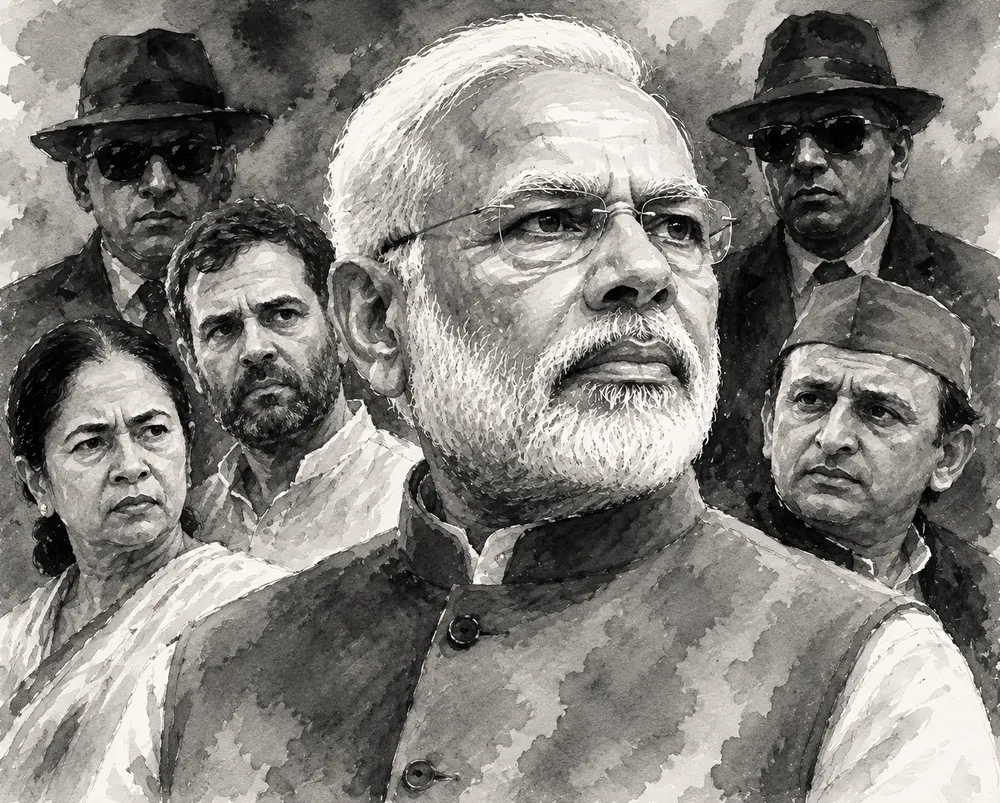
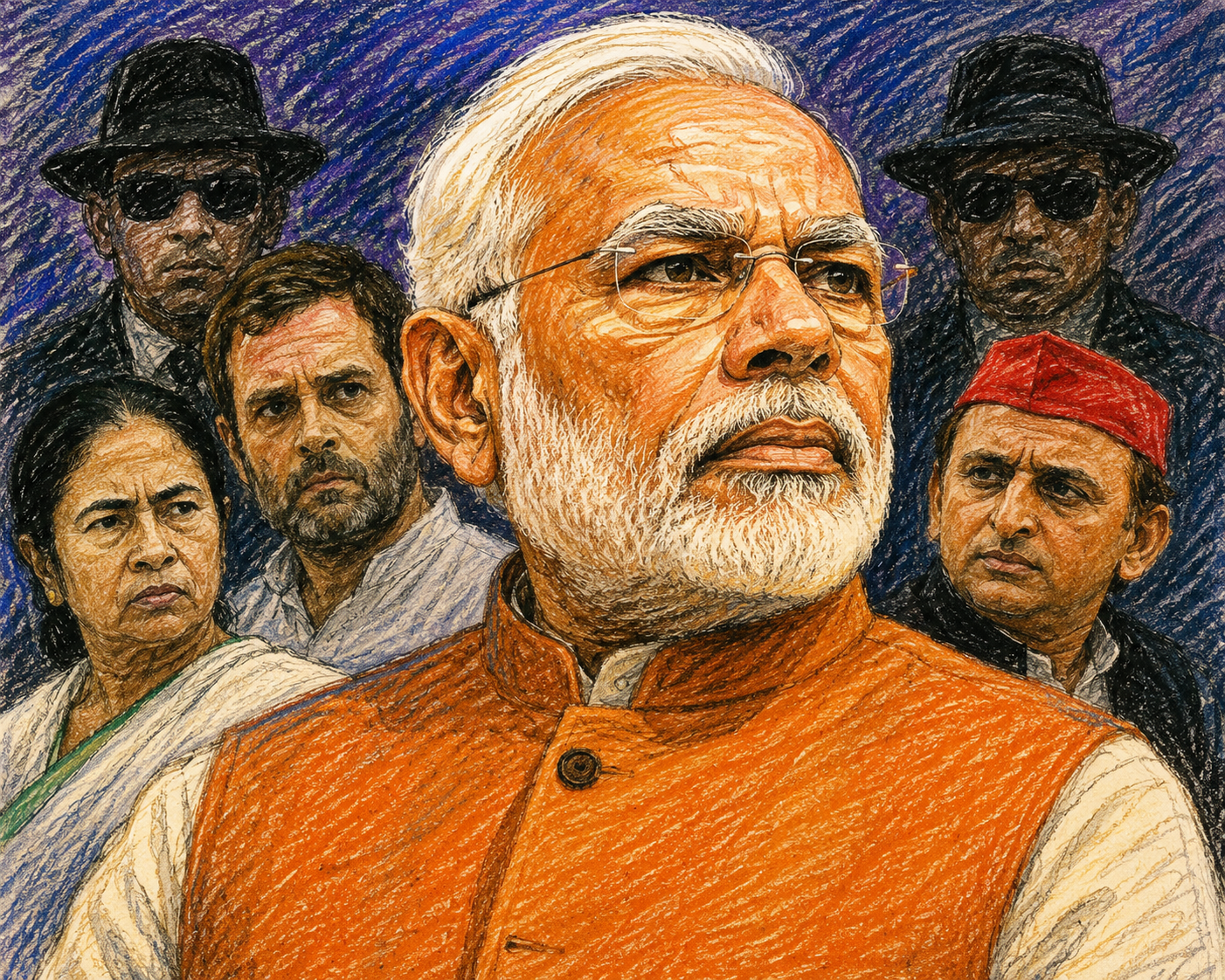
Who is Narendra Modi?
Narendra Modi personifies the story of Bharat. An India that lives regardless of the difficulties and pain.
And, to understand Narendra Modi, you must first understand what it means to be a Hindu in modern India.
No, not theoretically. In a lived, bruised, gaslighted, survival sense rather than the abstract philosophical one, though that matters enormously too.
You must understand what it means to be the majority in your own ancient land and yet be treated as though your civilizational identity is an embarrassment that must be diluted, bracketed, and managed, the way an inconvenient relative is handled at a polished dinner party.
You must understand what it means to have your women violated as a strategy of conquest and domination across centuries, and then to be told that even naming this history incites communal violence. You must understand the exhaustion of the Hindu who has been required, generation after generation, to prove his tolerance while others demonstrate their supremacy.
Narendra Modi emerged from that soil.
From a tea stall. From the RSS shakha. From the roads of Gujarat. From years of anonymity as a pracharak, building something no one could see. From that soil.
And that is why no electoral arithmetic, no coalition mathematics, no psephological framework adequately explains him.
You see, he is a civilizational response wearing the clothes of a politician.
The Bengal Miracle: Winning Without a Face
On May 4, 2026, something happened that political analysts had declared structurally impossible for decades. The Bharatiya Janata Party swept West Bengal's 294-seat assembly, winning 207 seats. Its previous best in the state had been 77 seats in 2021.
Mamata Banerjee's Trinamool Congress, which had ruled since 2011 and positioned itself as the bulwark against Hindu majoritarianism, collapsed to 87 seats.
The outcome strengthened Modi's political position midway through his third term. The BJP has never governed West Bengal before.
Mamata Banerjee has held power in this state since 2011.
That fact alone warrants pause. Bengal is the land of Ram Mohan Roy and Vivekananda, of Tagore and Netaji, of the Jana Sangh's very ideological founding. It is the state where the communist left ruled unbroken for 34 years. It has over 27 percent Muslim population, which analysts had long argued made a BJP majority mathematically improbable.
The ruling machinery under Mamata Banerjee had become synonymous with a muscular street-level political control. The TMC booth apparatus was a form of territorial governance, a parallel state that made voting for the opposition a physical act of courage.
And yet.
Modi told supporters at BJP headquarters: "A new chapter has been added to Bengal's destiny."
One needs to remember that the victory came without a chief ministerial face being projected in advance.
There was no local leader of Mamata's charisma or stature being offered as an alternative.
There was Modi. Just Modi.
The name, the face, the brand, the energy, and behind it a civilizational argument that cut beneath caste calculations and coalition arithmetic and reached something more elemental in the Bengali Hindu voter.
This is not the first time this pattern has played out.
Bihar. Uttar Pradesh. Assam.
In state after state, the BJP has discovered that when Modi makes a campaign personal, when he frames it in terms of what India is becoming versus what it was condemned to remain, the arithmetic of opposition coalitions dissolves.
Caste voters split. Communities that were supposed to be monolithic fractured. The "inevitable" did not happen.
Why? Because Modi speaks to people, not to categories. He sees India where others see votes.
The Epistemological Failure of Modi's Opponents: Fighting the Wrong Election
There is a particular kind of intellectual blindness that afflicts India's commentariat.
It is so consistent, so patterned, so repeated across election after election that it can no longer be attributed to error.
It has become a structural feature of how a certain class of analyst, journalist, and opposition politician processes Indian political reality.
The post-results conversation between Barkha Dutt and Neerja Choudhary is an almost clinical illustration of this condition. Both are experienced journalists. Both have covered Indian politics for decades. And sometimes, in a shameless way, even tried to "shape" it in contravention of electoral results.
And yet, even in the moment of acknowledging an outcome they did not predict, they cannot bring themselves to name what actually happened.
Neerja Choudhary had called it a 50/50 election. It was 200-plus to 87. That is a category error, a fundamental misreading of what kind of election was being fought, far beyond any polling error.
The reason for the misreading is entirely predictable: they were analyzing a normal election, you see.
Mamata Banerjee was running a normal election. The analysts were applying normal frameworks, welfare calculus, caste arithmetic, Muslim consolidation, anti-incumbency coefficients, voter roll deletions, to what was at its core not a normal election at all.
Modi, however, was fighting a civilizational referendum.
His opponents were fighting a political contest.
It loses, moreover, without understanding why it lost, which is the more significant outcome.
Listen to what the conversation offers as explanation for why people voted against Mamata: anti-incumbency, aspirational voters wanting more than welfare, urban-rural gaps, the TMC's goon culture, Muslim vote fragmentation.
Yes, these are all real. These are all true. Yet, they are utterly insufficient to explain the scale of what happened.
What cannot be said in the commentariat's framework, because saying it would require a vocabulary that this class has spent careers dismissing as dangerous, is the following.
When the conversation gestures at "a latent dormant anti-Muslim feeling in sections because of the past history, partition of Bengal," it names the most consequential political reality of the Bengal election in the most carefully minimizing possible language.
What they dare not state (because of their ideological dishonesty), and what was actually the truth, was that Bengali Hindus were responding to a rational, evidence-based, lived-experience conclusion that their safety, their women's safety, and their civilizational continuity were under active threat. Mamata Banerjee had chosen, deliberately and consistently, not to protect them.
This is the operational record. When the Sandeshkhali victims came forward, women describing sexual violence, land grab, and organized intimidation by TMC-linked strongmen, the Chief Minister's government did not investigate. It arrested the women who complained.
When Murshidabad saw violence around Waqf amendment protests, the state police response was asymmetric by any fair assessment. When Bangladesh's Hindus were being attacked, Mamata's government offered condemnation calibrated not to offend her voting coalition.
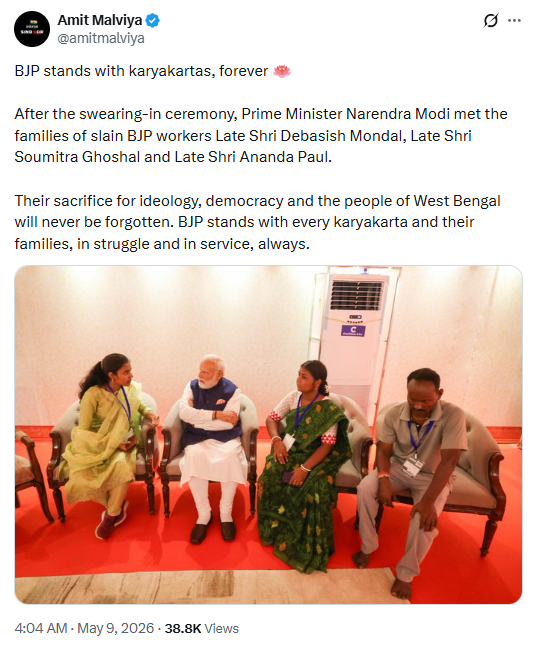
Bengali Hindu women voted for the BJP because they knew, from their own neighborhoods, from their relatives' experiences, from what they had watched happen to women like them, that the state was not protecting them. The state was, in some cases, actively enabling what was being done to them.
The displays of Hinduness that erupted across Bengal on results day were striking. The open declarations of identity.
The chanting in public spaces that would previously have required careful negotiation with the local TMC apparatus. The sheer visible joy of people who had learned to keep their heads down.
These were the expression of a people coming up for air after a long submersion.
Society bouncing back from several decades, in some respects over a century, of systematic Hindu subjugation in Bengal, with fifteen years of TMC misrule as the final and most immediate weight.
The partitioned soul of a civilization, reasserting itself.
The irony is that the standard commentariat framework cannot hold this.
It has categories for political parties, welfare schemes, vote shares, coalition arithmetic.
It has no category for civilizational suffocation and its release. It is exactly what they worked hard to erase over these decades. Because that category is absent, the analysts cannot see what was actually being voted on.
This epistemological failure of Modi's opponents is perhaps the most consistently underexamined feature of the Modi era.
They consistently misread the elections they lose, draw the wrong conclusions, and then misread the next one too. They fight the election they understand while Modi fights the election that is actually happening.
In Bihar, they ran caste arithmetic.
Modi ran delivery-plus-dignity and won.
In UP 2017, they were certain that the pain of demonetization would translate into punitive votes. Modi ran Yogi plus development plus Hindu identity and won.
In Bengal 2021, they were close. The TMC's booth management and political violence were real. But they drew the wrong conclusion: that they needed to become more culturally Bengali, more careful about explicit Hindu symbols.
What actually needed to happen, and what Amit Shah understood with cold strategic clarity, was that the Hindu consolidation needed to deepen, the anti-incumbency needed to ferment for four more years, and the specific atrocities of the TMC period needed to accumulate to the point where they became undeniable even to cautious voters in rural booths.
Neerja's observation that "Bengal has done more than any other state to still voices of dissatisfaction against Modi within the base" is more insightful than it first appears.
Every time Modi's adversaries go all out, throw everything at him, and lose spectacularly, as Mamata did, they lose far more than that individual contest.
They lose the ability to sustain the anti-Modi meta-narrative that their entire political project depends upon.
They have spent years building the story that Modi's support is mile-wide and inch-deep, that his victories are manufactured, that the real India, secular, pluralist, caste-complex India, would assert itself when pushed.
And yet, in a bizarre way, every comprehensive defeat makes that story harder to maintain.
Mamata had positioned herself as the last major fortress of non-BJP India. She was the leader who would unite the opposition. She was the proof that Modi could be beaten by someone willing to fight without apology on a platform of explicit Muslim protection and Hindu skepticism. She went all in.
Result: She lost her even own seat.
And, her party collapsed from a majority to 87.
And with her collapse came the effective end of a coherent national opposition architecture.
This is the pattern. Rahul Gandhi's NYAY yatra. The INDIA alliance. The Hindenburg attack. The SIR narrative in Bengal. Each was constructed as the definitive challenge that would finally reveal Modi's vulnerability. Each failed, and each failure was epistemological as much as political, revealing the intellectual bankruptcy of the challenger rather than any weakness of the target.
Modi wins elections in ways that educate his opponents about exactly the wrong lessons.
Because they cannot name the real source of his strength, the civilizational reconnection, the dignity delivery, the patient strategic depth, they keep misidentifying it as something they can counter: better welfare messaging, tighter coalitions, identity politics more aggressively played.
The RSS-BJP machinery, 88,000 booths, five-person teams per booth, painstaking organizational detail, is real and important.
It is the delivery mechanism, not the message.
What fills the booths, what moves the workers, what makes a woman from West Bengal travel two days back from Delhi to vote, is belief.
His opponents have been unable to generate that quality of belief in their own workers and voters.
They are fighting for power. Modi's people believe they are fighting for India.
In that asymmetry of belief lies the complete explanation for every election result that leaves the commentariat reaching for frameworks that will not fit.
The Politics of Dignity
Almost all Western and elite-Indian analyses of Modi interpret his success as the product of manipulation: Hindu nationalism deployed as a wedge, welfare schemes purchased as votes, media managed, institutions captured, opponents intimidated.
The analysis as satisfyig as it seems, completely misses the substrate.
For the Indian poor, which is to say for the vast majority of Indians, dignity has historically been the rarest commodity.
The village-level poor Hindu has lived for decades in a system where his vote was solicited every five years and his existence ignored for the four-and-a-half years in between. He received schemes designed to make him dependent rather than capable, schemes that announced his poverty as a permanent condition to be managed rather than a problem to be solved.
What Modi delivered was different in kind.
The gas cylinder under the Ujjwala scheme was the removal of a daily humiliation: the gathering of firewood, the smoke-blackened lungs, the back bent over an open flame. It was a declaration that this woman, in this village, in this obscure district, deserves what urban households have always taken for granted.
The pucca house under PM Awas Yojana put an end to monsoon anxiety. The possibility of sleeping without fear of the roof collapsing.
The Jan Dhan account was the first time the Indian poor were formally included in the financial architecture of their own country, treated as participants rather than subjects.
The Swachh Bharat toilet, for women in rural India, was the end of the terror of open defecation: the daily vulnerability, the harassment, the indignity performed in the dark.
Each of these interventions, taken individually, can be analyzed as a welfare scheme.
Taken together, they represent a philosophical statement: the Indian poor are citizens to be served, full stop. And they felt the difference.
Modi delivered to constituencies that no one in Delhi's power circles had bothered to think about precisely. Targeted, tangible, named, tracked deliveries. And because he had spent years, as Chief Minister of Gujarat and then as Prime Minister, building implementation systems rather than merely announcing intentions, the delivery rate on these schemes was historically unprecedented.
Whatever the spin of the opposition spinmasters, the fact is that the poor know the difference between a promise of a pipe and a pipe laid to their house.
The Mountain He Climbed: From 2002 to Operation Sindoor
To appreciate who Modi is, you must understand the scale of what he has faced.
The 2002 Gujarat riots were, by every serious legal examination and judicial investigation, a catastrophic communal breakdown that the state struggled to contain following the Godhra train massacre in which 59 Hindu pilgrims, many of them women and children, were burned alive.
The SIT appointed by the Supreme Court of India, after exhaustive investigation, found no evidence that Modi ordered, abetted, or failed to act in the way his accusers alleged. He was given a clean chit by an independent Special Investigation Team whose work was scrutinized by the Supreme Court itself.
This finding was buried and ignored because it was inconvenient to a narrative that had become foundational to the anti-Modi political project.
The narrative required the riots to be Modi's personal guilt, and so the legal exoneration was treated as suspect while the accusation was treated as settled fact.
An entire industry - of NGOs, of "independent" institutions, of foreign-funded advocacy networks, of sympathetic media outlets - was constructed around the presumption of his guilt.
He bore it. He built regardless. And, he governed.
Gujarat became a model of economic development: the Vibrant Gujarat summits, the industrial corridors, the infrastructure.
When the Supreme Court's SIT gave its final verdict, the apparatus that had built careers on his guilt had no graceful way out. Several of the most prominent accusers found themselves in legal jeopardy for fabricating evidence.
Then came 2014.
His opponents, having failed to stop him in Gujarat, attempted to stop him nationally with the same playbook amplified. The secular-liberal consensus declared that his election would trigger mass pogroms, that minorities would flee, that India's constitutional fabric would be torn. None of it happened. What happened instead was economic growth, infrastructure development at a pace India had never seen, and a reassertion of Indian civilizational confidence in international forums.
Then 2016: Demonetization.
The move was unprecedented in scale and the disruption was real. Every financial economist and opposition politician declared it an unmitigated disaster. The BJP won Uttar Pradesh in 2017, the largest state in India, the most complex, with a thumping majority.
The people had a different verdict than the economists.
 Desh Kapoor
Then came COVID. The challenge was unlike anything faced by any Indian government in independent history. A virus of unknown behavior, a healthcare system stretched to its limits, a billion-plus population across geography ranging from dense urban centers to the most remote rural districts. The early lockdown was severe and caused genuine suffering, particularly for migrant workers. The critics were relentless.
Desh Kapoor
But India, with COWIN, with the vaccination drive, with the production and delivery infrastructure built almost from scratch, ran one of the largest vaccination programs in human history. India manufactured and donated vaccines to nations across the world at a time when wealthier nations were hoarding theirs. The post-COVID economic recovery was V-shaped and faster than most predicted.
Then came Hindenburg: a short-selling report targeting the Adani Group, timed with surgical precision to destabilize India's capital markets and by extension the economic credibility of the Modi government. The report was weaponized by the opposition.
Desh Kapoor
Joint parliamentary committees were demanded. The Supreme Court took cognizance. For months, the dominant narrative was that Indian markets were built on fraud. The Adani Group has since substantially recovered, the allegations largely unvalidated by regulatory proceedings.
Operation Zeppelin later exposed what had been done by the highest-ranking members of the Congress party.
Then came Operation Sindoor: India's military response to the Pahalgam attack, which killed 26 Hindu tourists in Kashmir in one of the most gruesome targeted sectarian massacres in the valley in years. India's military response was precise, surgical, and for the first time, it did not stop at the Line of Control. Strikes were conducted on Pakistani territory, where the infrastructure of terrorism was housed.
The signal was sent. The world watched. Unlike the confused, apologetic, escalation-afraid Indian responses of the past, this one held its ground through diplomatic pressure and maintained its position.
His adversaries, from local jihadi networks to Chinese strategic planners, from Western institutional pressure to foreign-funded domestic civil society organizations filing petitions at the direction of foreign governments, all run the same playbook: create a crisis, amplify the crisis, wait for collapse.
What they have not been able to model is a leader who metabolizes pressure rather than collapsing under it.
Who waits. Who collects information. Who gives adversaries enough rope, lets them go all out, lets them expose themselves completely, and then, when they are maximally extended, acts with a precision that dismantles them comprehensively.
This is strategic patience operating at a timescale that confounds the quarterly-cycle thinking of his opposition.
The Rishi in the Politician
There is a specific quality in how Modi approaches difficulty that does not fit the standard Western framework for political leadership.
Western political science offers categories: the charismatic leader, the transactional leader, the ideological leader.
Modi fits partially in each but fully in none, and this is a signal that the wrong tradition is being applied.
The more fitting framework comes from the tradition he himself emerges from: the karmayogi of the Bhagavad Gita.
The one who acts without attachment to personal outcome. Who performs his duty without ego investment in whether he is celebrated or destroyed for it. Who measures success by consequence rather than applause.
Watch how Modi behaves under attack.
He spent his formative years as a pracharak, a full-time RSS worker who had given up personal life, family formation, private comfort, and financial accumulation. He slept where he could sleep. He ate what was available. He built organizational capacity in obscure districts and unremarkable towns. For years, decades, he was nobody outside his immediate organizational world.
This is the biography of service seeking its form, not ambition seeking power.
When he became Chief Minister of Gujarat, initially appointed rather than elected to the post, he immediately faced the 2002 crisis. A politician driven by self-preservation would have found ways to avoid accountability through the crisis. He called for early elections, put himself before the voter, and won. He trusted the people to adjudicate what the establishment wanted to condemn him for.
That is a peculiar kind of courage: the courage that comes from having already surrendered personal interest.
Ramakrishna Paramahamsa used to say that the sannyasi who has truly renounced carries a special power, the power of tyaga, of renunciation, that the householder cannot access. The renounced person has genuinely freed himself from the ego-calculations that limit everyone else. He can see more clearly because he wants less personally.
Modi has not taken the orange robes. But in his functioning, he exhibits the characteristics that the tradition describes: the capacity to act without personal ego investment in outcome, the willingness to absorb hostility without emotional destabilization, and the patience that comes from not needing vindication within a single news cycle.
His opponents have been destabilized by their own egos.
Rahul Gandhi's campaign strategy is driven by the need to be personally vindicated after years of being dismissed as a lightweight. Mamata Banerjee's Bengal strategy was driven by her personal identity as the undisputed sovereign of a domain. Arvind Kejriwal's entire political brand was built on a moral superiority claim that his personal behavior repeatedly undermined.
Modi has no such vulnerability.
Bengal's Founding Debt: Shyama Prasad Mukherjee and the Living Witness
On May 9, 2026, at Brigade Parade Ground in Kolkata, Suvendu Adhikari was sworn in as West Bengal's first-ever BJP Chief Minister. The ceremony marked the completion of a political journey that began 75 years ago with a terrible injustice and a brave defiance.
On that stage, before the ceremony began, Prime Minister Narendra Modi walked toward an old man. He did not approach him as a Prime Minister approaches a subject. He approached him as a student approaches a guru, as a son approaches a father, as the present bows before the witness of a past it could not have reached without sacrifice.
He bent. He touched the feet of Makhanlal Sarkar.
To understand why this gesture carried the weight it did, you must understand who Makhanlal Sarkar is and what his life contained.
He is one of the earliest grassroots figures associated with the nationalist movement in post-Independence India. In 1952, Sarkar was arrested in Kashmir while accompanying Syama Prasad Mukherjee during the movement to hoist the Tricolour there: an Indian citizen, arrested in his own country, for carrying his own country's flag.
Syama Prasad Mukherjee. The name deserves far more recognition than it receives in the sanitized history textbooks of Nehruvian India.
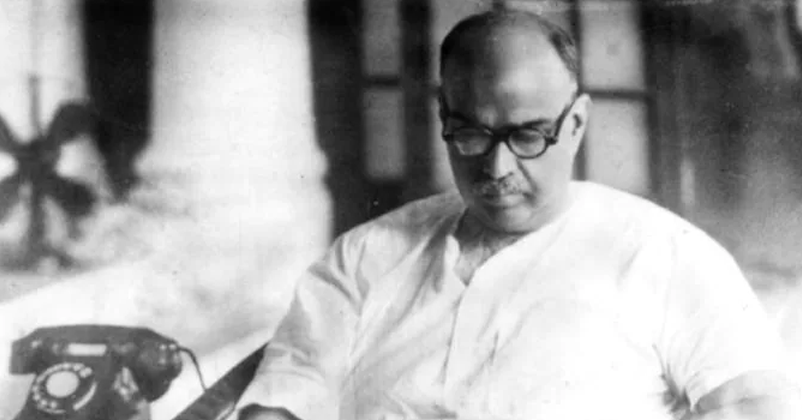
He was a brilliant Bengali intellectual, scholar, educator, politician of rare integrity, former minister in Nehru's own cabinet who resigned on principle over the Liaquat-Nehru Pact, which he believed compromised the interests of Hindus in East Pakistan. He founded the Bharatiya Jana Sangh in 1951, the direct ideological ancestor of today's BJP. He was from Bengal, by birth and by civilizational soul.
Kashmir in 1952 required a permit from the Sheikh Abdullah government simply to enter. An Indian citizen needed a permit to enter an Indian state. This was the mechanism by which what was nominally an accession to India was being functionally administered as a separate jurisdiction, with Sheikh Abdullah's government acting as a sovereign power rather than a state government. Mukherjee found this constitutionally intolerable, democratically offensive, and nationally dangerous. He launched a civil disobedience movement: enter Kashmir without a permit, assert the right of every Indian citizen to move freely within their own country.
He was arrested at the Kashmir border. He was detained. He died in detention in June 1953, under circumstances that his family and supporters have always found suspicious. The official explanation of a heart attack never fully satisfied those who knew the 52-year-old was in reasonable health before his detention.
The Indian Express article lays bare a striking pattern of political evasion after the death of Syama Prasad Mookerjee in detention in Kashmir in 1953.
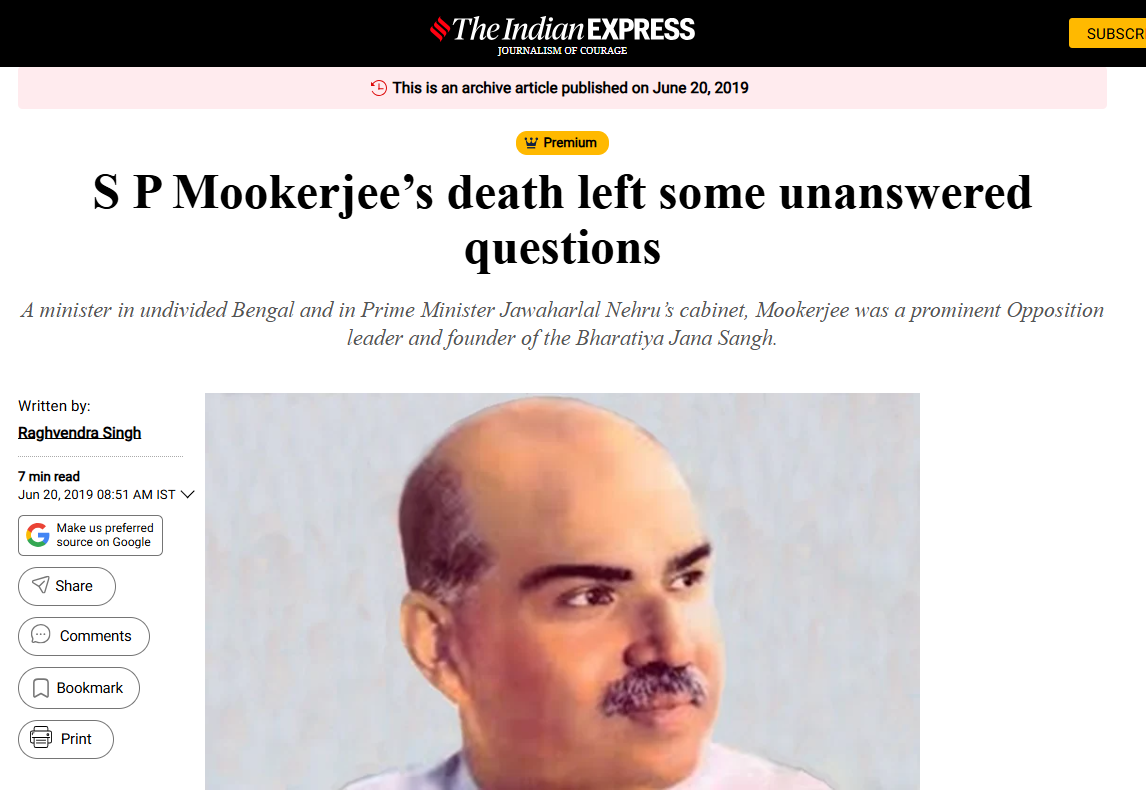
As we said, Mookerjee died under circumstances that were never independently investigated. His mother, Jogmaya Devi, directly questioned Jawaharlal Nehru about his indifference and failure to intervene.
Although public outrage was intense and the West Bengal Assembly demanded a Supreme Court-led inquiry, the Congress government diluted the resolution and deferred responsibility to the very Jammu and Kashmir administration accused of negligence. The Government of India repeatedly claimed the matter was solely for J&K to handle, knowing no meaningful inquiry would occur.
The result was a profound institutional failure, leaving one of independent India’s most controversial custodial deaths unresolved.
Makhanlal Sarkar was with him on that journey. A young man from Siliguri, fired by nationalist conviction, who went to Kashmir alongside his leader to do something as simple and as profound as carrying the national flag into his own country. He was arrested. He saw what happened. He lived with the knowledge of what happened.
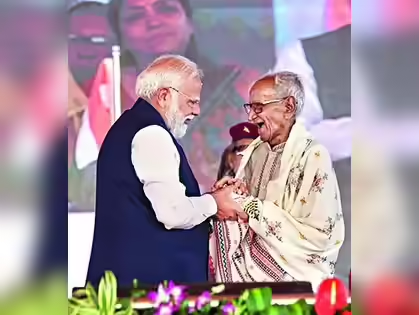
Bengal BJP chief Samik Bhattacharya recalled at the ceremony: "Mookerjee was killed in a mysterious way in a Kashmir jail. Sarkar, who was part of his last journey, has graced us with his presence today." He added that Sarkar was brought before a judge for singing a nationalist song and refused to apologize. "The judge wanted to listen to the song, so he sang it again in the court. The judge then asked the police to get Sarkar a first-class ticket back home and give him Rs 100 for his journey."
Sarkar was arrested for singing a nationalist song. He refused to apologize.
 Asian News International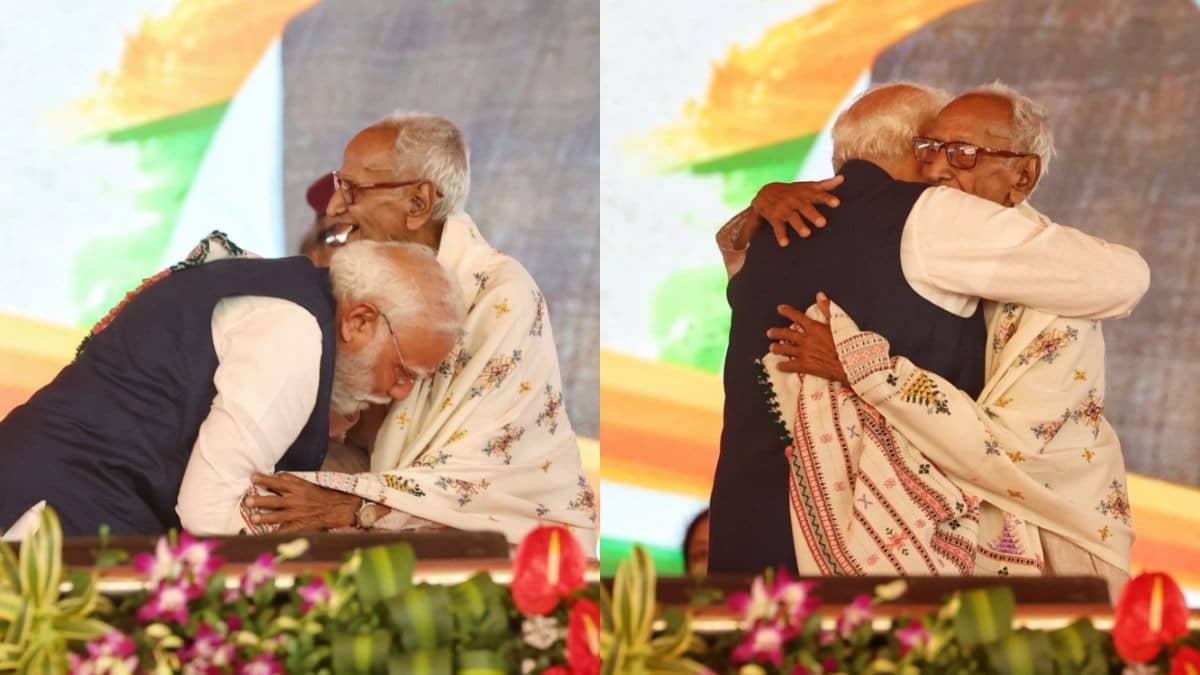
He sang it again in court. The judge, moved by the impossible purity of the act, gave him a dismissal and a railway ticket home. The man this happened to was alive on that stage in Kolkata, 74 years later, watching the state that his party had never governed swear in its first Chief Minister.
After the formation of the BJP in 1980, he became the organisational coordinator across West Dinajpur, Jalpaiguri, and Darjeeling districts, enrolling nearly 10,000 members within a year: an impressive feat during the party's early years in the region. From 1981 onward, he served continuously for seven years as district president, an exceptional tenure at a time when party leaders rarely held the same organisational post for more than two years.
Building a party in West Bengal in the 1980s was a calling performed at personal risk, not a career opportunity. The Left Front was at its peak. The machinery of CPI(M) was comprehensive and occasionally violent. Being a visible BJP organizer in those districts was not a path to comfort. Sarkar did it for seven continuous years, enrolling members village by village, district by district, in a state where the party had no electoral footprint.
He built something invisible. Planted seeds in ground that would not yield for four decades.
And then Modi came to Bengal in 2026, after 75 years of the party's founding in this very state, after Mukherjee's death, after decades of irrelevance, after the slow grinding buildup, and won. When he won, before receiving any garland, before giving any speech, before doing anything that would appear in any political calculation, he bent and touched the feet of the old man who had been there at the beginning.
Sarkar's son Maniklal said: "I was teary-eyed on seeing the respect my father got. The Prime Minister and the BJP did not forget about my father. Even my father felt extremely happy."
For Modi to perform this gesture before a man who was arrested trying to hoist India's flag in India's own territory, before a man who sang a nationalist song in court rather than apologize for it, before a man who had spent the better part of 74 years building what just reached its fulfillment, this was the acknowledgement that civilizational projects take longer than individual lifetimes, that the people who plant seeds rarely harvest, that India owes its dignity to its invisible soldiers as much as its visible heroes.
Modi, more than any leader in post-Independence India, has the instinct to name these invisible soldiers. He reads out names in Mann Ki Baat of ordinary people who did extraordinary things: the farmer who irrigated an impossible field, the nurse who walked miles to reach a remote village, the young man who cleaned a river. He treats governance as a conversation with people who are already doing the work, not as the province of credential-holding elites who occasionally condescend to serve the masses.
Consider the full arc of what that stage in Kolkata contained. Here was a man who in 1952 traveled to Kashmir with Syama Prasad Mukherjee to assert something so elementary it should not have required assertion: that an Indian citizen can enter his own country without a permit. He was arrested for this. His leader died for this. He came home, built the party in obscure North Bengal districts for decades, and then spent his remaining years watching Bengal be governed by the Left for 34 years and then by Mamata for 15. The BJP never governing, never in power, always marginal in the state where its founder was born.
And then, at 98 years old, having witnessed Mukherjee's cause finally vindicated in Kashmir under Article 370's abrogation, and now watching the BJP's first government sworn into office in the state that gave birth to the nationalist movement, the Prime Minister of India walked across a stage in front of the entire nation and bent to touch his feet.
Sarkar had not been a Chief Minister. Not a Union Minister. Not a visible public figure. He was the kind of man that history usually erases: the grassroots organizer, the envelope stuffer, the midnight meeting-caller, the person who kept the faith when keeping the faith brought no reward. That Modi knew who he was, that he knew the specific history of 1952 and the tricolour movement and the Kashmir arrest, that he chose to publicly honor this man on the day of Bengal's first BJP government, this speaks to a quality that has no adequate English-language political science term.
In Sanskrit, it would be pitru-rna: the debt to the ancestral. The acknowledgement that you stand on the shoulders of those who came before, that their sacrifice made your achievement possible, that the appropriate response to victory is reverence for the chain rather than celebration of self.
Modi carries this quality into governance in ways both visible and invisible. It is why he wins without a local face in Bengal, because the face the voters are seeing is a civilizational argument's face. And it is why, even in moments of maximum political triumph, he bends.
What He Means to the Hindu
For the Hindu who has lived through the post-Independence decades, Modi represents something that is difficult to articulate without sounding immodest, because Indian culture, the Dharmic culture as distinct from its political deformations, does not naturally speak in the language of grievance and demand.
Let us name what has changed.
This was a systematic structural disadvantage imposed on the majority in the name of protecting minorities.
Modi, without fanfare and often without explicit naming, has been working to correct this asymmetry.
The Waqf Amendment Act. The temple corridor projects delivered with consistency. The Ram Mandir: the construction of the temple was its formal dimension, but the deeper meaning was the symbolic end of an occupation that had lasted five centuries. When Modi entered the Ram Mandir for its consecration, he was closing an account that had been open since Babur's armies destroyed what was there before.
The distinction matters. Modi has been careful, often excruciatingly so in ways that frustrate his more passionate supporters, not to allow Hindu civilizational restoration to tip into the register of retaliation.
He does not endorse mob violence.
He navigates the immensely difficult territory between a legitimate Hindu assertion and an illegitimate communal aggression with a precision that his critics refuse to acknowledge and his admirers sometimes wish he would abandon.
This carefulness is wisdom. India is too vast, too plural, too internally diverse for majoritarian absolutism. What he is doing is more subtle and more durable: restoring the conditions under which Hindus can live out their tradition with confidence rather than in apology, while building state capacity and infrastructure that benefit all Indians, regardless of religion.
Welfare delivery involves no religious targeting.
The Ujjwala gas cylinder went to Muslim households in UP. The Jan Dhan account was opened for every Indian without a bank account. The pucca houses were not allocated by religion. The COVID vaccine was administered to all.
This is the paradox that Modi's critics cannot accommodate: the man they frame as a Hindu nationalist delivers universally to all Indians. The universalism does not fit their template. And so they ignore it, or explain it away as political calculation, unwilling to consider that the man actually believes governance is seva, service, and that seva has no caste and no creed.
The Strategic Mind: Patience as Weapon
The security and geopolitical domain reveals something important about the kind of leader Modi is.
India has faced, in the Modi years, adversaries with qualitatively different capabilities and intentions than those of previous decades. China's salami-slicing in Ladakh was a different order of challenge than previous border skirmishes. Pakistan's continued support for terrorism against India, now combined with its escalation through groups responsible for the Pahalgam massacre, required a response that broke India's established pattern of absorption without consequence. The global narrative architecture, Western media, international NGOs, and foreign-funded domestic civil society organizations continued to maintain pressure on India's internal decisions in ways that earlier Indian governments found destabilizing.
Modi's approach in each case has followed the same identifiable pattern: quietly accumulate capability, absorb provocation without reactive escalation, carefully build alliance architecture, and then act with overwhelming precision at the moment of maximum readiness.
The Galwan response, the quiet, disciplined holding of Depsang, the infrastructure buildout in Ladakh, and the disengagement negotiations conducted without public posturing demonstrated strategic patience that many commentators mistook for weakness until it became obvious that India had held what it needed to hold.
Operation Sindoor demonstrated the other side. When the moment is right, India acts without hesitation, without apology, and without stopping at the threshold that its adversaries have relied on India observing. The targeting of terrorist infrastructure deep inside Pakistani territory sent a message that the previous strategic doctrine of restraint was a choice India had made and could unmake. India chose restraint until it chose otherwise.
This is statecraft of a high order.
It requires the kind of ego strength that can absorb being called weak and indecisive by those who do not understand what is being built, because the builder knows the building's architecture even when the spectators see only incomplete walls.
His opponents' charges of cowardice before China were answered by Doklam. Their charges of weakness before Pakistan were answered by Balakot and amplified by Sindoor. The pattern is consistent: he plays a longer game than his critics can conceive, and then delivers outcomes that make their commentary look shallow.
In the international arena, this same patience expresses itself as strategic autonomy. Modi's India has positioned itself, through the Quad, through the Indo-Pacific framework, through the careful maintenance of the Russian relationship during the Ukraine war, through the G20 presidency that delivered the African Union's inclusion, as a nation that refuses to be a junior partner in anyone's alliance system. This is a complete reversal of the posture of UPA-era India, which was perpetually deferential to Western institutional opinion and sought legitimacy from the very structures designed to keep India secondary.
The Loneliness at the Top
There is a quality to Modi's solitude that Indians who follow him closely have noticed.
He has no visible inner circle in the way that other politicians do. He does not appear to have friends in the social sense. He does not relax publicly, does not gossip, and does not cultivate the warmth-seeking relationships that characterize most human beings who hold power.
He meditates. He practices yoga. He keeps to a disciplined schedule that appears, by all accounts, punishing in its demands. He works at hours when most humans are asleep.
This is the biography of someone who has organized his entire existence around a mission, who has, in the terminology of the Gita, surrendered the personal self to the impersonal work.
This is also why his adversaries have never found the lever to break him. Every adversary who has gone all out against him has been operating on the assumption that he must have a personal ego investment somewhere, a vanity, an ambition, a possession he fears losing. They have never found it because it is not there.
When the Hindenburg report dropped, the expected response was panic: capital flight, political embarrassment, parliamentary crisis. Modi absorbed it and governed. When the Pahalgam massacre happened, the expected response, based on decades of Indian strategic restraint, was a diplomatic protest and some cross-border shelling. Modi responded with Operation Sindoor. When Bengal went against all psychological prediction, the expected response from the losing side was a graceful concession. Mamata refused to resign, and her allies continued post-election violence, including the assassination of Suvendu Adhikari's close aide.
What History Will Record
Historians writing about India in the 22nd century will have a choice of frameworks for understanding this era.
- One framework is already written: a Hindu nationalist who polarized India, dismantled its secular institutions, and represented a dangerous turn toward majoritarianism. Thousands of papers, books, and editorial columns have pre-populated its arguments.
- A second framework, the one more adequate to the evidence, describes a leader who emerged from the most excluded circumstances, was shaped by the most demanding of training traditions, faced an unparalleled sustained campaign of destruction, and responded by building: infrastructure, institutions, welfare delivery systems, military capability, diplomatic positioning, civilizational confidence, at a pace and scale that India had not previously achieved.
Historians will note that the post-Partition settlement in India had imposed on the Hindu majority a specific burden: bear the guilt for Partition, subsidize minority institutions while your own temples are run by state bureaucrats, treat your history as myth and your traditions as obstacles to progress, and prove your secularism by erasing your own identity.
Modi said, quietly and consistently: No. That settlement was not equity. It was a specific arrangement that served specific interests. We are going to rebalance it.
They will note that he won West Bengal in 2026 without a local chief ministerial face, relying entirely on his own connection with the voters, and that on the day of the swearing-in, before all the cameras and the political pageantry, he stopped to touch the feet of an old man from Siliguri who had been there at the beginning.
They will note that the old man had been arrested for carrying a flag.
They will note that the flag now flew over a BJP government in Bengal for the first time.
They will note that the Prime Minister of India, at the height of his power, bent before that history.
The Shivajis and Guru Gobind Singhs of their eras fought the Aurangzeb mindset with sword and sacrifice, in conditions of physical battle, in ages when the terms of civilizational survival were simpler if no less brutal.
Modi fights the same battle in the age of institutional capture, narrative warfare, financial weaponization, and lawfare, where the weapons are International Criminal Court petitions and Hindenburg reports and NGO-funded human rights campaigns and editorial boards in New York and London. The sophistication of the attack has increased. The principle being attacked has not changed.
As Guru Gobind Singh built the Khalsa from a decimated community, creating a people who would carry forward an identity under siege, Modi has been engaged in the longer, slower, more difficult work of rebuilding civilizational confidence in a people who had been systematically taught that their confidence was dangerous.
He is working in civilizational time, where the unit of measurement is the generation rather than the electoral cycle, where the relevant precedents are the great defenders of Dharma who faced apparently insurmountable odds and prevailed through a quality of purpose that confusion and compromise could not touch.
In the end, let us return to May 9, 2026.
Brigade Parade Ground, Kolkata. The place where Subhas Chandra Bose once called upon Bengal and India to rise. Where history has been made before and forgotten, and made again.
Suvendu Adhikari took his oath. The first BJP Chief Minister of West Bengal. The culmination of a 75-year journey that began with Shyama Prasad Mukherjee founding the Jana Sangh in 1951, was interrupted by his death in a Kashmir detention cell in 1953, was carried forward by invisible men in obscure districts building something nobody could see, was amplified by the national momentum of 2014 and 2019, stumbled in 2021, and then crested in the wave of 2026.
And standing on that stage, alive, at 98 years old, having been there at the beginning, having been arrested for carrying a flag, having built the organization membership by membership in the cold mountains of North Bengal, is Makhanlal Sarkar.
Modi walks to him. Bends. Touches his feet. Receives his blessing. Wraps a shawl around his shoulders.
In that moment, the circuit of Indian history closes in a particular arc. The man who died in Kashmir in 1953, Mukherjee, is honored by the survival of his companion. The companion who built from nothing is honored by the Prime Minister who inherited the organization and took it to places no one thought possible. The dream that was kept alive by small men doing invisible work in impossible conditions is vindicated.
This is what Modi is to India. He is the convergence point of multiple interrupted journeys: of the Rashtriya Swayamsevak Sangh's patient civilizational project, of the Jana Sangh's founding dream in Bengal, of the Hindu's centuries-long effort to simply exist with dignity in his own land, of the Indian poor's long wait for a state that would finally see them.
He is the one who remembers. Who completes what others began. Who carries the thread from arrest to fulfillment, from defeat to consecration, from the obscure mountains of North Bengal to the stage of history.
He is what India needed when India did not yet know it needed him.