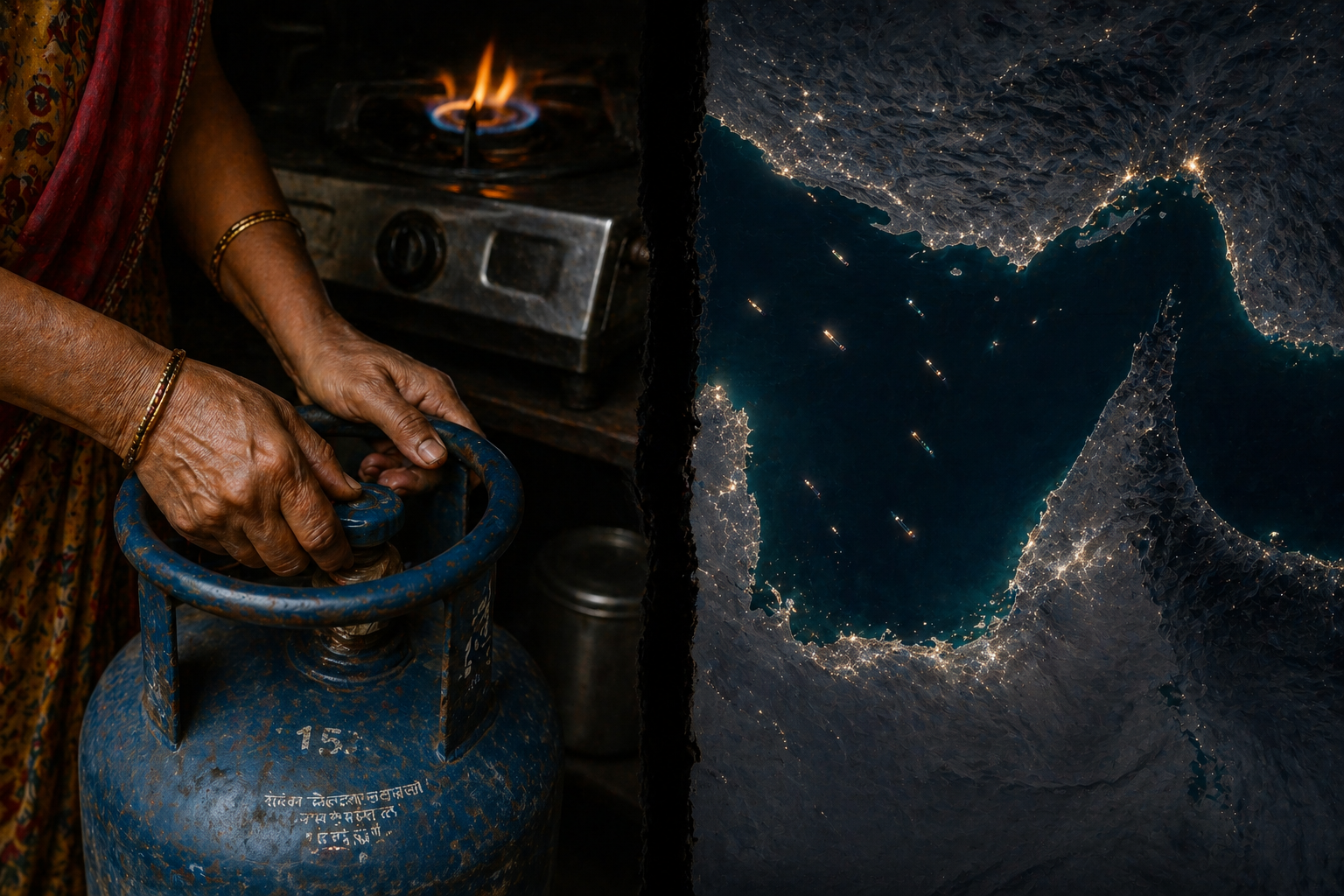
The Cylinder and the Strait
A village on a dry plateau had cooked on wood fires for ten thousand years. The smoke lived in their lungs like an unwelcome tenant.
A new headman arrived. He had seen clean blue cylinders in the city. He made a promise: every hearth would have a clean flame before the next monsoon.
The village elder raised her hand. "Where do the cylinders come from?"
"From merchants across the mountain pass."
"And if the pass closes?"
The headman smiled. The pass had been open for fifty years. "We will deal with that," he said, "when it closes."
The elder nodded slowly. In the way that means: I have heard this before.
The cylinders arrived. Ten, then a hundred, then ten thousand. The smoke cleared. The daughters stopped coughing. The headman's photograph appeared on posters in the market.
Years passed.
Children grew up who had never known wood smoke. And, who had never learned wood fire. The old ways were not set aside gently. They were simply forgotten.
One winter morning, the supply caravan did not arrive. A war, distant and enormous, had closed the pass. No one knew for how long.
The headman called a meeting.
The elder spoke quietly. "Three years ago, a surveyor said we could build a storage cave in the hill. Enough for ninety days. You approved the study. The study was conducted. Nothing was built."
"There were other priorities," said the headman.
"Yes," said the elder. "There were."
That night, a monk sat with the headman by a cold hearth.
"I gave them the flame," said the headman. "Was I wrong?"
The monk said: "The error is not in placing the stone on the scale. The error is in believing that because the scale has not yet tipped, it never will."
The headman stared at the dark hearth.
Outside, the pass remained closed.
The photographs remained on the posters.
India's Gas Crisis
The numbers are striking. Before the conflict, approximately 45 percent of India's crude oil imports and 60 percent of its LPG requirements transited the Strait of Hormuz.
For LPG specifically, liquefied petroleum gas, the propane-butane blend that fuels India's cooking stoves, the dependence was even more extreme: roughly 90 percent of imported LPG moved through that single 33-kilometer chokepoint.
When Iran closed it, the consequences were not theoretical. Within days, 320,000 tonnes of LPG were stranded on 22 vessels anchored outside the Strait, unable to move. Brent crude surged past $126 per barrel. Spot LNG prices jumped more than 113 percent.
The rupee fell to a record low of 95 against the dollar.
The government's crisis response was competent and swift.
An LPG Control Order issued on March 8, 2026, directed all Indian refineries to maximize LPG yields by channeling their C3 and C4 hydrocarbon streams — propane, butane, propylene, butenes — exclusively to Oil Marketing Companies for domestic cooking gas distribution.
Within five days, domestic LPG production had increased by 28 percent.
A Natural Gas Control Order followed on March 9, establishing a national priority sequence for gas allocation: households first, then hospitals and schools, then fertilizer production (critical to the Kharif planting season), then industry.
The Indian Navy activated Operation Sankalp, deploying warships to escort Indian-flagged vessels through the Gulf of Oman.
New procurement was secured from the United States, Norway, Canada, Algeria, and eventually Russia — though Russian LNG came bundled with severe diplomatic complications, as Moscow's LNG exports remain under U.S. sanctions and the Trump administration had claimed (without Indian confirmation) that New Delhi had pledged to stop buying Russian energy. Petroleum Minister Hardeep Singh Puri flew to Doha on April 9 for a two-day diplomatic mission — characterized accurately as a rescue operation rather than a routine bilateral engagement — to negotiate emergency arrangements with QatarEnergy and discuss the conditions for resuming flows once Hormuz reopens.
Was only India hurt by the Hormuz Blockade?
No, the Hormuz closure is a global crisis.
Europe is heading into what analysts describe as a second energy shock comparable to 2022, with gas storage at historically low levels following a harsh winter and Dutch TTF benchmarks nearly doubling.
Japan and South Korea, which Zero Carbon Analytics has assessed as theoretically more vulnerable than India on raw risk scores, are scrambling for replacement barrels.
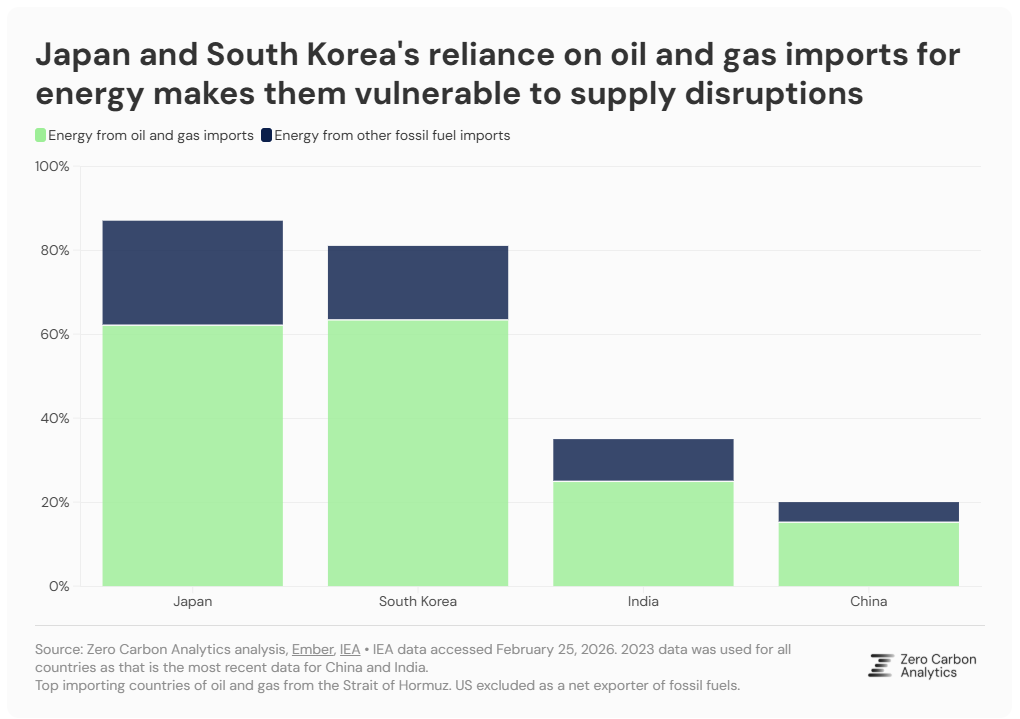
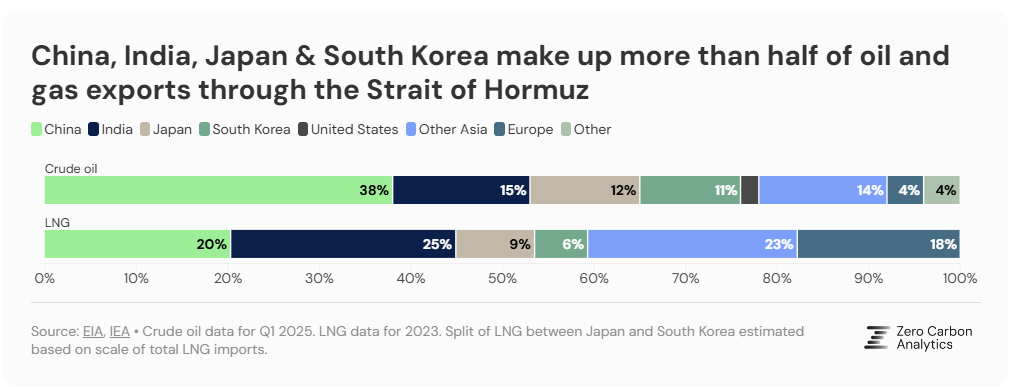
In 2024, the Strait of Hormuz continued to serve as a critical conduit for global energy flows, with Asia emerging as its primary destination. According to estimates from the United States Energy Information Administration, approximately 84 percent of crude oil and 83 percent of liquefied natural gas passing through the Strait was directed toward Asian markets. This concentration reflects the region’s enduring reliance on energy imports from the Middle East.
Within Asia, demand is heavily concentrated among a few major economies. China, India, Japan, and South Korea together accounted for about 75 percent of the oil and 59 percent of the LNG moving through this narrow maritime passage. These countries depend on stable and continuous energy supplies to sustain industrial activity, transportation networks, and economic growth.
The IEA's executive director has called the situation the greatest threat to global energy security in history.
So why does India's crisis feel categorically more acute? The answer lies in four structural distinctions that converged with particular force in early 2026.
A Tale of Different Gases
Before we dive into the geopolitical understanding the Gas that fires kitchens to our industries, let us get a lowdown on what gas or gases are we talking about and why that distinction is critical to our understanding.
So, the "gas" in your cooking cylinder and the "gas" that powers a city are chemically different substances, stored differently, transported differently, and sourced from different places.
This distinction, which sounds like a chemistry textbook footnote, happens to be one of the most consequential facts regarding India's energy vulnerability.
To understand why 330 million Indian households ended up dependent on a shipping lane in the Persian Gulf, you need to understand why these gases are not interchangeable, and what trade-offs each one carries.
Three Gases Walk Into a Kitchen
Think of it this way. Imagine you need water at home.
You could get it three ways: buy bottles from a shop, have a tanker deliver a large drum, or have a pipe connected directly to the city's water supply.
Same substance, water, but radically different supply chains, vulnerabilities, and costs.
The gas world works almost exactly like this.
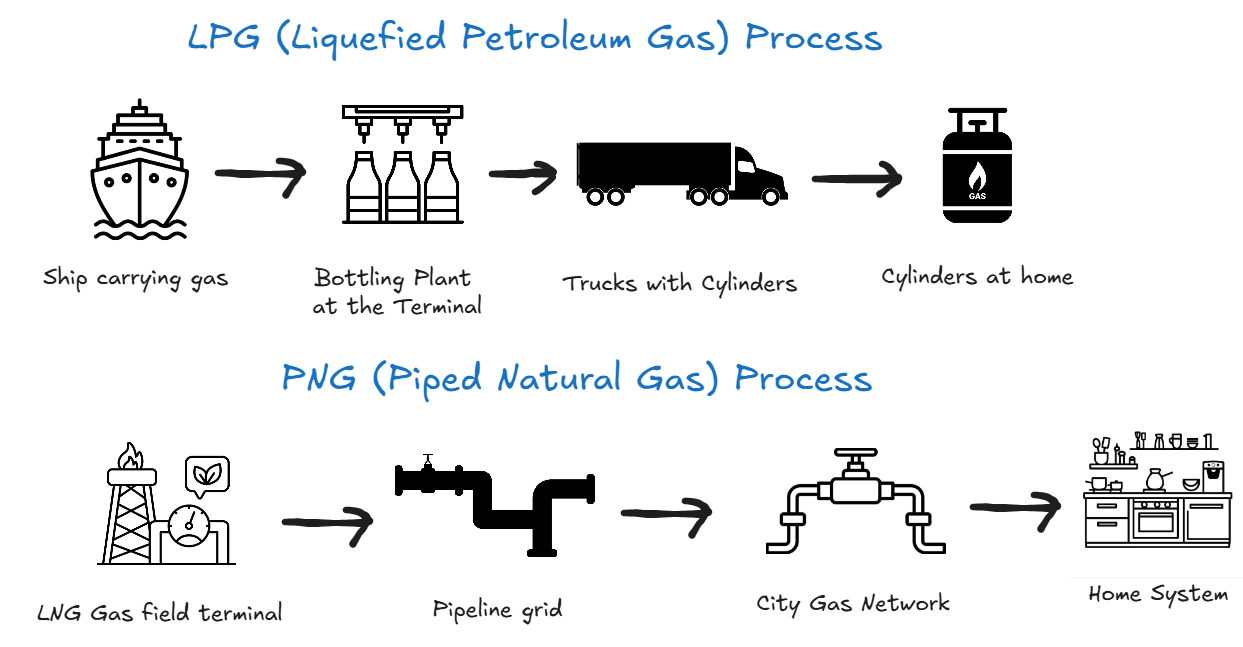
LPG — the bottled water of fuel. Liquefied Petroleum Gas is propane and butane mixed together.
It is then pressurized into liquid form at room temperature — this is why your cooking cylinder feels heavy and cold — loaded into ships, unloaded at Indian ports, sent to bottling plants, put into cylinders, loaded onto trucks, and delivered to your home.
Every step of that chain is a point of failure. There is no network. There is no pipeline. There is no buffer.
If the ship does not arrive, the cylinder does not appear.
This is exactly what happened when Hormuz closed in February 2026: the ship could not leave the Gulf, and the cylinder stopped appearing. The kitchen went cold.
LNG — the water tanker. Liquefied Natural Gas is almost pure methane — the same methane that powers cities, industries, and fertilizer plants.
It arrives at terminals like Dahej in Gujarat or Kochi in Kerala, gets warmed back into gas, and enters the pipeline network.
LNG is therefore not a different fuel — it is the same methane that ultimately powers your city's gas distribution system, just wearing a transport disguise for the ocean crossing.
PNG — the water pipe. Piped Natural Gas is what happens when LNG becomes gas again and enters the city pipeline network. It is the same methane, but now it flows continuously into your home through a pipe, the way water does.
No cylinder. No truck. No bottling plant. No distributor.
The supply is continuous, the price is typically lower, and there is no "last-mile" logistics chain to break.
Here is an illustration of the flow for LPG vs PNG.
After the blockade of the Strait of Hormuz, India is facing one of the biggest cooking gas crises in its history.
In fact, India has directed state-run refiners to ramp up production of low-margin LPG regardless of profitability, while curtailing commercial-sector supplies to about 70% of normal levels to safeguard household demand.
India’s government is leaning on its refineries to survive an acute shortage of cooking gas as the war in Iran drags on, while also scouring the world for additional suppliers and nudging consumers toward alternatives. Still, with cargoes of liquefied petroleum gas trapped in the Persian Gulf, the country has yet to find enough supply to meet pre-crisis demand — exposing a major energy vulnerability, forcing prices up and pushing out some consumers entirely. India has raised local output by over a fifth since strikes on Iran began in February, to about 46,000 tons a day. That will rise to 50,000 tons after Nayara Energy Ltd.’s refinery restarts in May after a period of maintenance, according to the oil ministry. (Source: "India ramps up refinery output to cope with enduring cooking gas crisis" / Business Standard)
Let us understand the geopolitical ramifications of the different gases.
Why the Differences Are Geopolitically Explosive
Now the chemistry becomes foreign policy.
Liquefied Petroleum Gas: LPG's origin as a refinery byproduct means its supply is structurally tied to the oil ecosystem.
There is no LPG pipeline alternative. There is no LPG strategic reserve equivalent to the Strategic Petroleum Reserve. There is no LNG-to-LPG conversion pathway in an emergency. When Hormuz closes, LPG — and therefore 330 million cooking stoves — stops.
Liquefied Natural Gas: LNG is inherently more diverse.
Qatar is India's largest LNG supplier, but Australia, the United States, Russia, and a growing number of African nations also export LNG.
More importantly, LNG terminals have storage tanks — they hold several weeks of supply. And LNG can be rerouted: a cargo booked for Japan can be diverted to India if the price is right and the logistics work. This creates market flexibility that the LPG cylinder chain simply does not have.
Piped Natural Gas: PNG is the most resilient of all, precisely because it is a network rather than a supply chain.
A networked system has multiple entry points, multiple sources, and the ability to reroute flows when one source fails.
But PNG requires massive upfront infrastructure investment — pipelines laid under cities, pressure regulation systems, smart metering, safety networks.
It takes years and tens of billions of rupees to build.
The story of India's Gas vulnerability will not be complete without going into one of India's greatest social achievement - providing cooking gas to hundreds of million households!
How India's Greatest Welfare Achievement Became Its Greatest Energy Vulnerability
There is a photograph that defined the early Modi years. A woman in a saree, rural, middle-aged, standing before a gas stove with a flame she has never had before. Behind her, a blue cylinder. The caption: Ujjwala. Clean fuel. Better life.
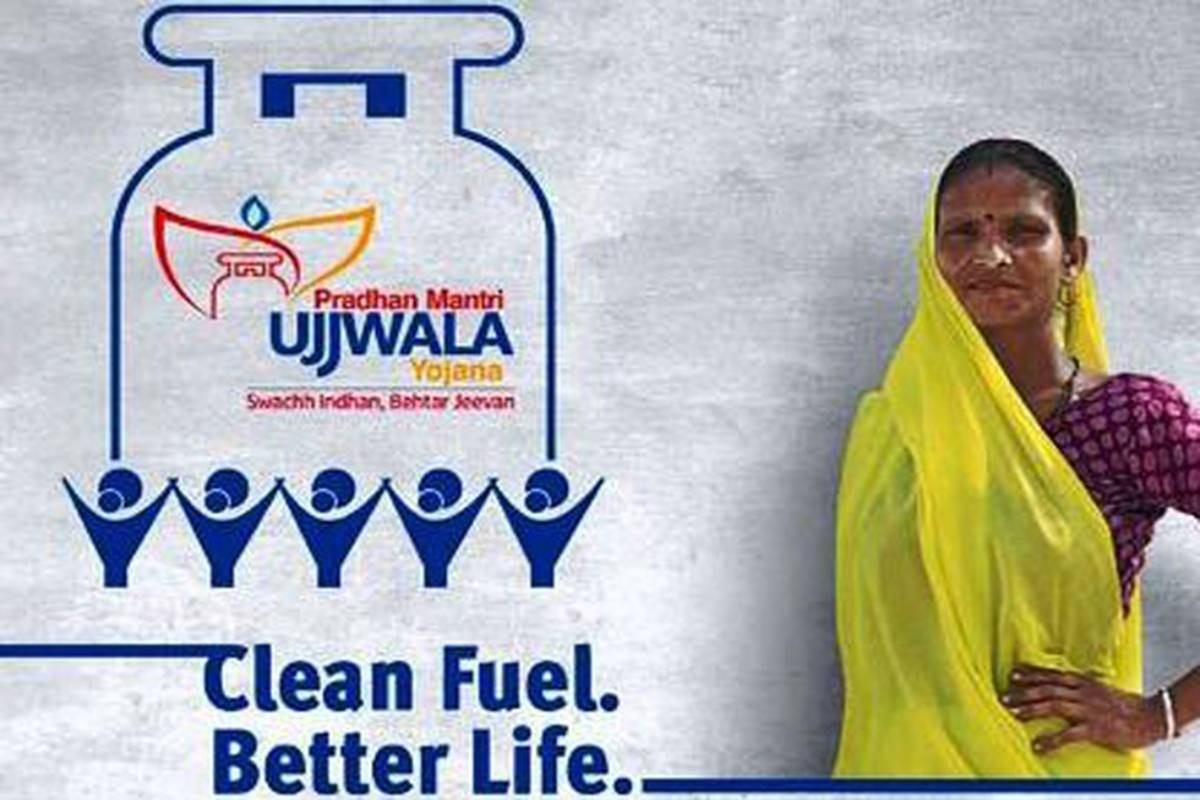
The image was true. The story behind it was more complicated than anyone admitted.
The Problem Ujjwala Was Solving
To understand what the Modi government did, you must first understand what it was responding to.
In 2014, when Modi came to power, roughly 300 million Indian households — predominantly rural, predominantly poor, overwhelmingly female — cooked on chulhas. Wood. Cow dung. Agricultural waste. Open flame in an enclosed kitchen.
The World Health Organization had a name for what this produced: Household Air Pollution.
The numbers were medieval.
Indoor smoke (Indoor Air pollution - IAP) from solid fuel combustion killed an estimated 600,000 Indians annually — more than malaria, tuberculosis, and diarrhoeal diseases combined.
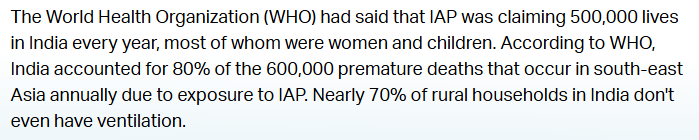
Women, who did the cooking, bore the exposure disproportionately. A woman cooking three meals a day on a wood fire inhaled the equivalent of smoking 400 cigarettes. She did this every day of her life.
The typical cooking fire produces about 400 cigarettes' worth of smoke an hour, and prolonged exposure is associated with respiratory infections, eye damage, heart and lung disease, and lung cancer. In the developing world, health problems from smoke inhalation are a significant cause of death in both children under five and women. (Source: "When Cooking Kills" / Pulitzer Center)
LPG — the blue cylinder — was the solution. Clean-burning propane and butane, contained, controllable, smokeless. Middle-class urban India had been using it for decades. The problem was access and affordability. A cylinder connection required a security deposit, an installation fee, and the ongoing cost of refills — barriers that kept the rural poor on wood smoke.
This was the gap Ujjwala was designed to close. Launched in May 2016, the Pradhan Mantri Ujjwala Yojana had a simple mandate: provide free LPG connections, including stove and regulator, to women in Below Poverty Line households. The government would absorb the upfront cost. The cylinder would arrive.
Enter the Pradhan Mantri Ujjwala Yojana.
The Scale of What Was Accomplished
The execution under the Ujjwala Yojana was, by any objective measure, one of the most impressive welfare delivery operations in Indian administrative history.
The delivery mechanism was the existing oil company distributor network — Indian Oil, Bharat Petroleum, Hindustan Petroleum — extended into rural blocks through aggressive expansion of distribution points.
No new infrastructure was required. No pipeline was laid. No city gas network was built.
The system scaled through the cylinder supply chain that already existed, simply pushed further and further into rural India.

This was the political genius of it.
Speed. Visibility. Zero infrastructure lead time.
A village got its Ujjwala connection not after a decade of pipeline laying but within weeks of administrative enrollment. The photographs came quickly. The political returns were immediate. The health benefits were real and measurable.
What was not visible — what would not become visible for years — was the supply chain architecture that was being scaled simultaneously.
The Architecture of the Vulnerability
Every cylinder that reached a rural kitchen in Uttar Pradesh or Odisha or Rajasthan had traveled the same route.
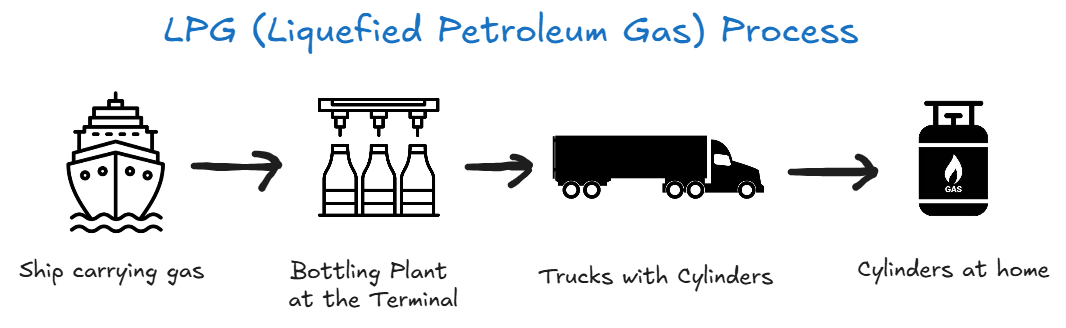
Twelve to sixteen steps. Each one a point of failure. And the entire chain — every cylinder, for every household — passed through a single 33-kilometer strait.
After Ujjwala, it became civilizational in scale.
When you connect 100 million BPL households to a fuel whose supply chain runs entirely through one geographic chokepoint, you have not just created an energy policy. You have created a geopolitical hostage situation — except the hostages are 330 million cooking stoves, and they do not know they are hostages until the strait closes.
India's LPG imports from the Gulf were running at approximately 90% of total imports through Hormuz by 2024.
No other major economy had that level of single-chokepoint concentration for a fuel used at mass domestic scale. Japan, South Korea, and China all had LNG dependencies on Gulf routes — but LNG has diversification options, storage infrastructure, and is not the primary cooking fuel for the majority of their populations.
LPG in India was different.
It was the cooking fuel. For the poorest households. Who had no alternative.
The Trade-Off the Government Made — and Did Not Make
Here is where the analysis must be precise rather than merely critical.
What is not defensible is what did not happen alongside Ujjwala. Three things should have been built in parallel, and were not:
- First, a strategic LPG reserve. The equivalent of the Strategic Petroleum Reserve, but for LPG — underground cavern storage at coastal locations, sufficient for 60 to 90 days of consumption. This would have buffered exactly the kind of supply disruption that Hormuz's closure produced. The cost would have been approximately $2 to 3 billion. For reference, India's fertilizer subsidy bill in 2024-25 was $18 billion annually. The reserve was affordable. It was simply never prioritized.
- Second, aggressive PNG network expansion. The logical transition from cylinder to pipe, gradually reducing cylinder dependency, urban household by urban household, was underway, but at a pace that bore no relation to the scale of the vulnerability being created. As Ujjwala was connecting rural India to cylinders at a rate of 10 million per year, the city gas distribution network that would eventually replace cylinders was expanding at a pace that would take decades to reach meaningful coverage.
- Third, domestic LPG production enhancement. India's own refineries produce LPG as a byproduct of processing. This domestic production was never systematically maximized or treated as a strategic priority. After the Hormuz crisis hit, domestic refinery LPG extraction was ramped up by 28 to 36% — proving the capacity existed. It simply had not been activated because cheap imports made it economically unattractive during normal times.
The government made the Ujjwala choice. It did not make the accompanying choices that would have made that choice strategically sound.
The Political Economy Explanation
There was an obvious gap between what was promised and delivered, and its future availability.
Did this happen due to incompetence?
Well, honestly, this gap is not adequately explained by incompetence.
It can be explained by the incentive structure of democratic governance operating on electoral timescales.
The underground cavern storage system that India needs would have taken three to four years to build and $2 billion to fund. It would have appeared in no campaign speech.
Its absence would go unnoticed in opposition critiques during normal times. It would have been, from a political return standpoint, an invisible investment.
This is the structural problem that afflicts every democracy that governs through electoral cycles shorter than the infrastructure timescales of strategic resilience.
The U.S. ran down its Strategic Petroleum Reserve for the same reason. India never built its LPG reserve for the same reason. The political incentive structure is identical: spend on visible welfare, defer invisible insurance.
Was Ujjwala a Mistake?
From a social standpoint, Ujjwala was one of the greatest achievements since independence.
At the same time, the crisis it helped create was predictable.
So let us clearly call out the mistake the Modi government made.
The Five Structural Amplifiers
Crises do not create vulnerability. They expose the architecture that was already in place. The 2026 shock in the Strait of Hormuz did exactly that for India. What appeared on the surface as a supply disruption was, in reality, the convergence of multiple structural pressures that had been quietly building over time.
These pressures amplified each other, turning a disruption in one narrow waterway into a nationwide stress event.
The result is a system where exposure is not defined by a single point of failure. It is defined by a set of reinforcing conditions that magnify risk under stress. Understanding these structural amplifiers is essential because they explain why the impact was so severe and why incremental fixes will not be enough.
1. Unmatched Hormuz Concentration for LPG: While India sources 53% of its LNG from Qatar and the UAE, its LPG dependency was running at approximately 90% through Hormuz — a level of single-chokepoint concentration no other major economy matched for a fuel used by 330 million households. South Korea sources only 14% of its LNG from Qatar and the UAE. Japan sources just 6%.
2. LPG as a Mass Domestic Consumption Fuel: In Japan, South Korea, Europe, and even China, LPG is primarily an industrial feedstock or minority fuel. In India, it is the primary cooking fuel for the majority of the population. A supply disruption that registers as a cost-management problem in Tokyo becomes a kitchen-table crisis in Maharashtra and Bihar. The political and humanitarian stakes are of an entirely different order.
3. No Strategic Buffer While China Had One: China, despite importing roughly a third of its oil via Hormuz, was relatively well-positioned because of large commercial and strategic stockpiles and sanctioned Iranian barrels held offshore. India had no equivalent LPG strategic reserve — a gap identified in policy discussions as far back as 2015 and still unaddressed in 2026.
4. China Received Preferential Transit Access First: Iran initially allowed only Chinese-flagged vessels to transit the strait, citing Beijing's supportive stance. India only received transit approval on March 26 — weeks later — alongside Russia, Iraq, and Pakistan. Those weeks of delay compounded the physical shortage materially.
5. The Geopolitical Straitjacket: India's response options are more constrained than other major importers. Russia has become the emergency alternative LPG/LNG supplier — but Russian LNG is under US sanctions, and this move risks souring New Delhi's ties with Washington, especially given Trump's claims that Modi had pledged to stop buying Russian energy. Europe, Japan, and South Korea don't face this diplomatic bind while scrambling for alternatives. India is caught between energy necessity and geopolitical optics simultaneously.
The vulnerability score misses the social transmission mechanism that makes India's exposure uniquely dangerous.
India's Unexplored Reserves!
India holds 651.8 MMT of proven crude oil reserves and 1,138.6 BCM of proven natural gas reserves as of January 2025. (Source: PIB) But proven reserves are the floor, not the ceiling.
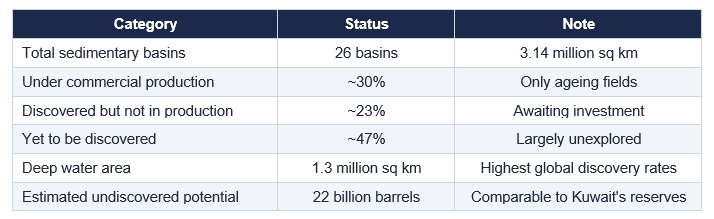
The 22 billion barrel undiscovered potential figure, from S&P Global Commodity Insights, is the most consequential data point. India has been importing nearly 4.9 million barrels of oil per day at $100 per barrel — that is $490 million every single day flowing out of the country — while sitting on a potential resource endowment comparable to Kuwait's entire proven reserve base.
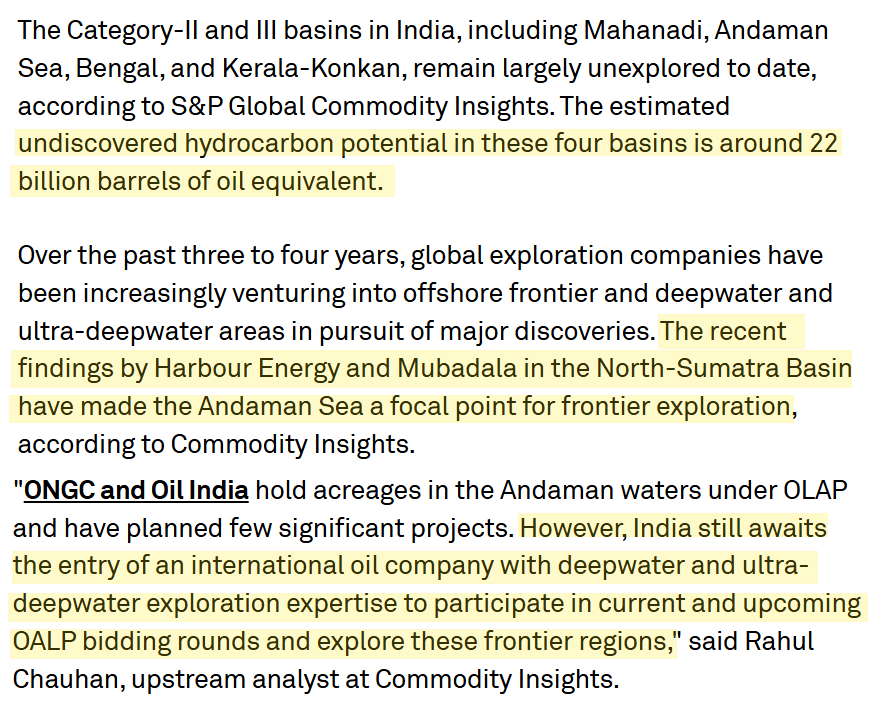
The 22 billion barrel undiscovered potential estimate from S&P Global is basically a strategic indictment.
At current import levels of roughly 4.9 million barrels per day, India is effectively exporting close to half a billion dollars daily to secure energy it may partially possess beneath its own soil and seabed. This asymmetry, comprising high import dependence alongside vast untapped basins, reveals a structural failure in exploration intensity, policy execution, and risk appetite.
The Frontier Basins: Where the Future Is
Andaman-Nicobar Basin
Current estimates suggest approximately 371 million tonnes of oil equivalent. In early 2026, Oil India Limited and ONGC initiated major exploratory drilling. Among the three wells drilled, Vijaypuram-2 confirmed the presence of gas, with 87% methane, at depths ranging from 2,212 to 2,250 meters.
ONGC is working on the ultra-deepwater ANDP-1 well targeting 6,000 meters below the seabed. The Andaman basin has geological similarities with proven petroleum systems in Myanmar and North Sumatra, among the most productive in Asia.
Krishna-Godavari Basin
The KG deepwater block is expected to produce 45,000 barrels of oil per day and contribute around 7% of India's gas output during ramp-up. However, this basin's history is a cautionary tale. The KG-D6 dispute — regulatory conflicts over cost recovery, profit share disputes, and ONGC's allegations of gas migration — effectively killed investor appetite for upstream investment in India for over a decade.
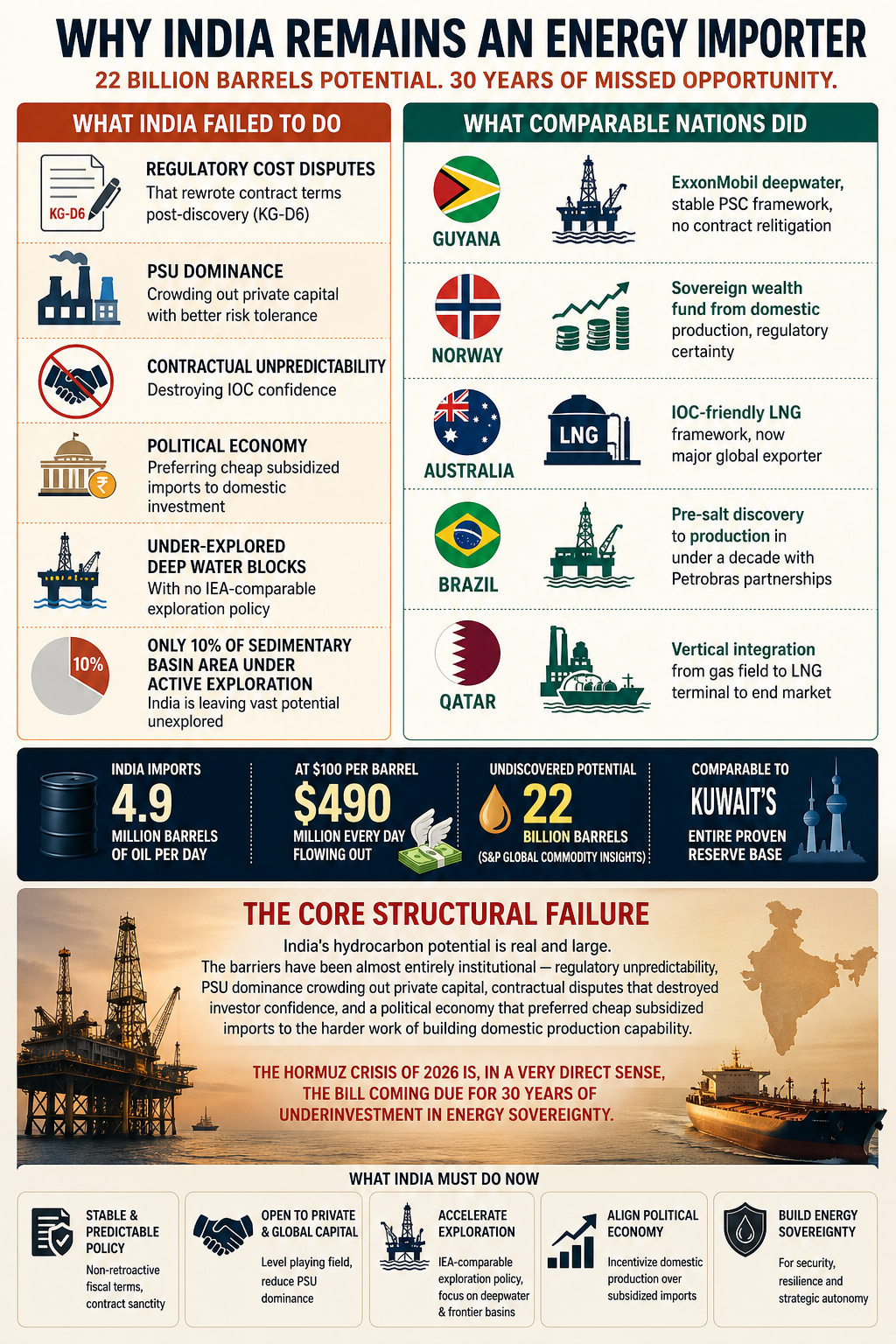
The Modi Government's Strategic Calculation: India's Petroleum Reserve Problem
Just as the United States historically resisted tapping its Strategic Petroleum Reserve (SPR) until a crisis made it politically unavoidable — treating it as a last-resort asset rather than a continuously managed buffer — the Modi government has made an analogous calculation on India's energy reserves. This is not a coincidence. It reflects a shared logic of political economy that both countries have now paid a steep price for.
The US SPR Calculation: The Template
The United States built the SPR after the 1973 Arab oil embargo precisely because it had been caught without a buffer.
But over subsequent decades, the SPR became a political asset more than a strategic one — released during Gulf War I (1991), after Hurricane Katrina (2005), during the 2011 Libya crisis, and dramatically during the 2022 Ukraine war — each release politically motivated, each one reducing the buffer without a systematic rebuild strategy.
The SPR went from 727 million barrels in 2009 to under 350 million barrels by mid-2022 — its lowest level since 1983.
The logic: don't spend the political capital (or financial capital) to maintain the reserve at full capacity when imports are cheap and available. The reserve is for emergencies, and emergencies are, by definition, exceptional.
India's Parallel Logic
The Modi government has followed the same logic, but with an additional dimension: subsidized LPG is simultaneously a welfare program, a political instrument, and a supply chain.
The Ujjwala Yojana scheme — which connected 80 million BPL households to LPG — was a genuine social achievement.
But it created a 330 million-household dependency on a fuel whose supply chain was 90% concentrated at a single chokepoint, with no strategic reserve backstop.
So is the Modi Government's lack of action on the proven oilfields fundamentally different from the US SPR decision framework?
In one respect, it is.
The U.S. SPR calculation was primarily financial and geopolitical in that it was about avoiding the economic and political cost of maintaining a large reserve.
India's calculation adds a deeper structural dimension: the entire domestic production ecosystem had been allowed to atrophy through regulatory dysfunction, so building a reserve was not simply a matter of releasing political will and capital.
The pipeline from domestic gas production to the LPG cylinder was broken at multiple joints simultaneously.
The parallel to the U.S. decision not to tap reserves until the crisis point is apt.
But India's crisis exposed a more severe underlying vulnerability: not just the absence of reserves, but also the absence of domestic production capacity to replenish them.
The U.S. could release 180 million barrels from the SPR in 2022 and eventually rebuild it from domestic shale production. India has no equivalent replenishment mechanism because it never built the upstream production base.
The Reserve Question
As of November 2023, India's underground gas storage program had reached only the feasibility study stage for 3-4 BCM of capacity, at an estimated cost of $1-2 billion and a 3-4-year construction timeline. This study should have been acted on a decade earlier.
Instead, the political incentive structure rewarded distributing the subsidy budget directly to households rather than building the strategic buffer that would have made those households resilient when the supply chain broke.
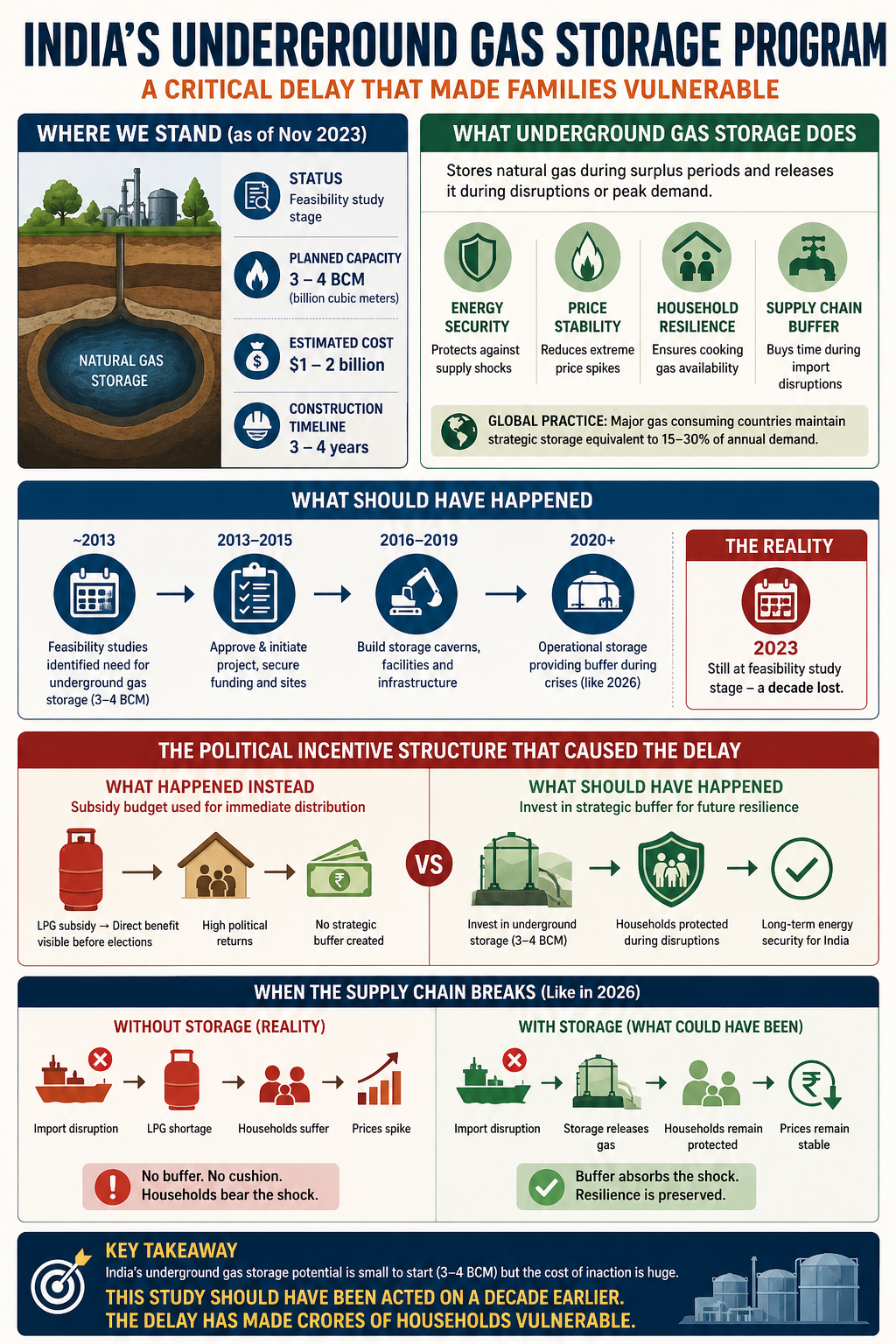
It is not as if India has not built any reserves. It has. But inadequate.
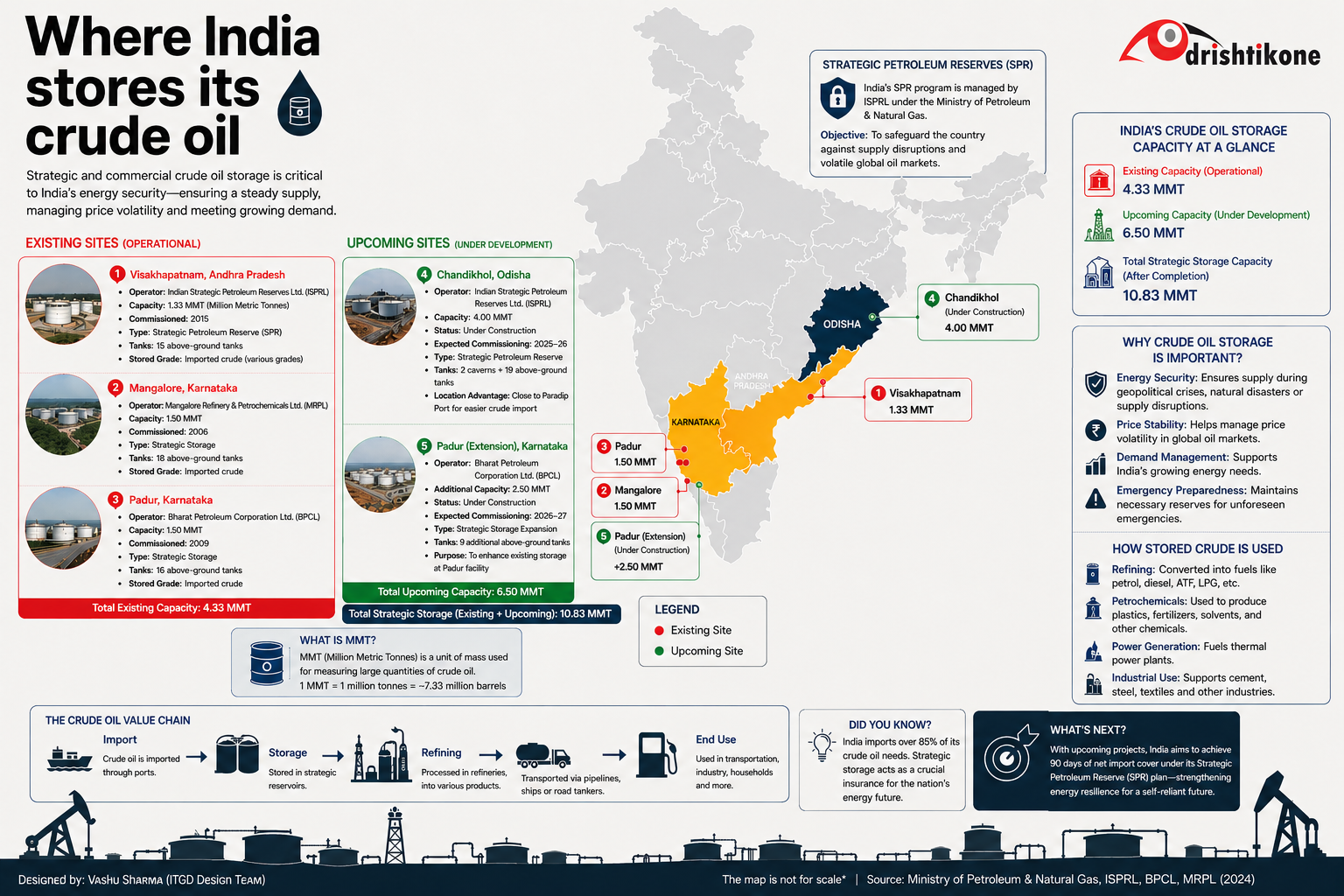
India's Strategic Petroleum Reserve
India is moving to expand its strategic petroleum reserve system with six additional sites, including key locations such as Mangalore and Bikaner. The objective is clear. Raise total reserve cover to ninety days of net imports, aligning with the benchmark followed by members of the International Energy Agency.
At present, India’s dedicated underground reserves are modest in scale. The first phase includes facilities at Visakhapatnam, Mangalore, and Padur, with a combined capacity of 5.33 million metric tonnes. This translates to less than ten days of emergency crude requirements.
When combined with inventories held by state-run refiners, total coverage rises to around seventy-seven days. That figure appears substantial but masks a critical limitation. Much of the refinery stock is operational inventory, not fully insulated for emergency drawdown.
The second phase attempts to close this gap. New capacity is under development at Chandikhol, along with an expansion at Padur. These projects are structured as public-private partnerships to reduce the fiscal burden while attracting global expertise in storage and trading.
The next phase represents a strategic shift. Expanding to inland and diversified locations such as Bikaner reduces coastal concentration risk and improves resilience against maritime disruptions. Underground rock caverns remain the preferred technology due to their security, longevity, and lower evaporation losses.
This buildout is not just about storage volume. It reflects a deeper recognition that energy security requires time buffers. Reserves provide decision space during crises, allowing governments to manage supply shocks without immediate economic disruption. India’s move toward ninety-day coverage signals an overdue transition from reactive procurement to structured energy security planning.
What options does India have for its future doctrine?
The Three-Layer Doctrine
The question we have before us is:
The fact is that India needs a three-layer doctrine that combines elements of both, but with a fundamentally different underlying philosophy than either the pre-crisis approach or the emergency response.
India needs a "Three-Layer Doctrine".
Layer 1: Production Sovereignty (the anti-JIT layer)
Just-in-time works when supply chains are reliable. It catastrophically fails when a single chokepoint breaks.
The first layer of any credible energy doctrine is to reduce the fraction of energy consumption that depends on international supply chains altogether. This means domestic gas production, domestic LPG extraction from refineries, and eventually green hydrogen/ammonia.
Domestic production is the ultimate hedge against JIT failure — because it removes the supply chain dependency rather than managing it.
Layer 2: Strategic Reserves (the buffer layer)
Even with growing domestic production, India will remain a net energy importer for decades.
The buffer layer — strategic petroleum reserves, underground gas storage, strategic LPG cavern storage — converts the JIT supply chain from a zero-tolerance system to one with managed slack.
The target should be 90 days of LPG consumption coverage in strategic storage, matching the IEA oil reserve standard that insulates Japan and South Korea. This is achievable.
The estimated $1-2 billion cost for 3-4 BCM of underground gas storage is less than four days of India's current import bill.
Layer 3: Multi-Vendor Diversification (the resilience layer)
Within the international supply chain, India must structurally prevent any single country, routing, or commodity from exceeding 30% of its import dependency.
This means: multiple LNG supplier contracts (not just Qatar and the UAE), multiple routing options (Cape route capability, Mediterranean pipeline access for select commodities, Central Asian overland corridors), and multiple currency settlement mechanisms (rupee-ruble, rupee-dirham, digital settlement) to avoid exposure to secondary sanctions.
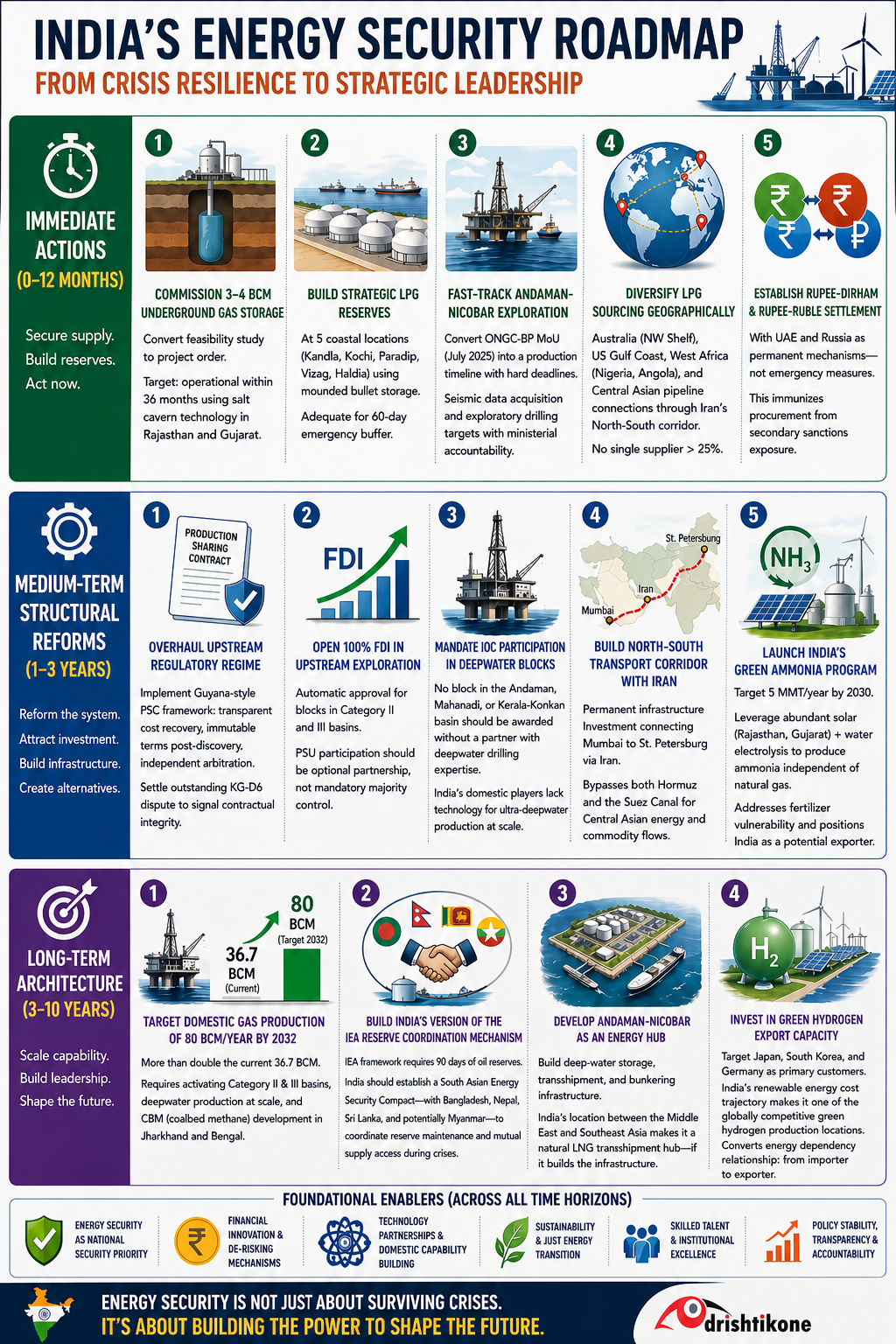
What should India Do Now?
India cannot undo the 2026 crisis. But it can use it the way Germany used the 2022 gas crisis: as the political catalyst to make structural changes that would have been politically impossible in normal times.
Germany went from 55% Russian gas dependency to near-zero in two years. India can execute a comparable transformation in its energy architecture if the political will exists.
Here is the roadmap.
The Geopolitical Repositioning: How India Becomes Strong
Energy sovereignty is not just an economic question. It is the foundation of strategic autonomy.
The energy dependency is the structural constraint that forces the geopolitical bind.
Resolving energy dependency is, therefore, simultaneously a domestic economic project and a foreign-policy liberation.
What about the Russia Move?
India's emergency pivot to Russian LNG during the Hormuz crisis is a symptom of the dependency trap, not a solution to it.
Buying Russian LNG under US sanctions pressure creates exactly the geopolitical straitjacket that domestic production is designed to escape.
Russia benefits; Washington is annoyed; India is exposed to secondary sanctions risk; and the underlying vulnerability is not addressed.
The difference between opportunistic purchasing and dependency purchasing lies in the availability of alternatives.
Build the alternatives; then the Russian relationship becomes a choice and not a necessity.
Lessons from the Hormuz Blockade: Need for a New Strategic Doctrine
A nation that cannot feed and fuel itself without relying on a chokepoint controlled by others has not secured sovereignty. It has secured comfort under conditions set by external powers.
The 2026 crisis around the Strait of Hormuz revealed how fragile those conditions are.
A large share of India’s crude oil and LNG imports move through this narrow corridor. When tensions rose, shipping costs climbed sharply, insurance premiums surged, and deliveries slowed.
The impact spread quickly across the economy through fertilizer shortages, pressure on power generation, and rising costs for households and industry.
The decision before India now is fundamental. It can use this disruption to rebuild its energy system with stronger foundations. That means accelerating domestic production, expanding storage capacity, securing diversified long-term contracts, and investing in alternatives such as green ammonia and hydrogen. It also means building transport corridors and financial settlement systems that reduce exposure to external pressure.
Another path exists. India could rebalance suppliers and shift dependence across partners such as Russia or the United States while keeping the same underlying structure. That approach maintains vulnerability under a different configuration.
Sovereignty in energy rests on control over supply, storage, and routing. The Hormuz crisis has clarified the gap between growth and control. The next set of decisions will determine whether India closes that gap or continues to operate within constraints defined elsewhere.