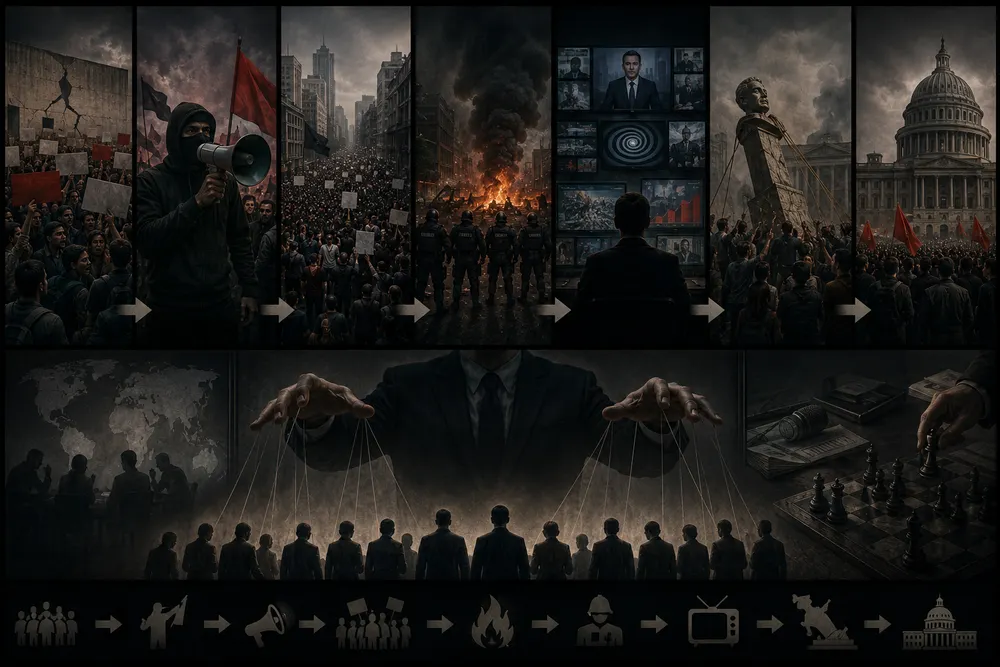
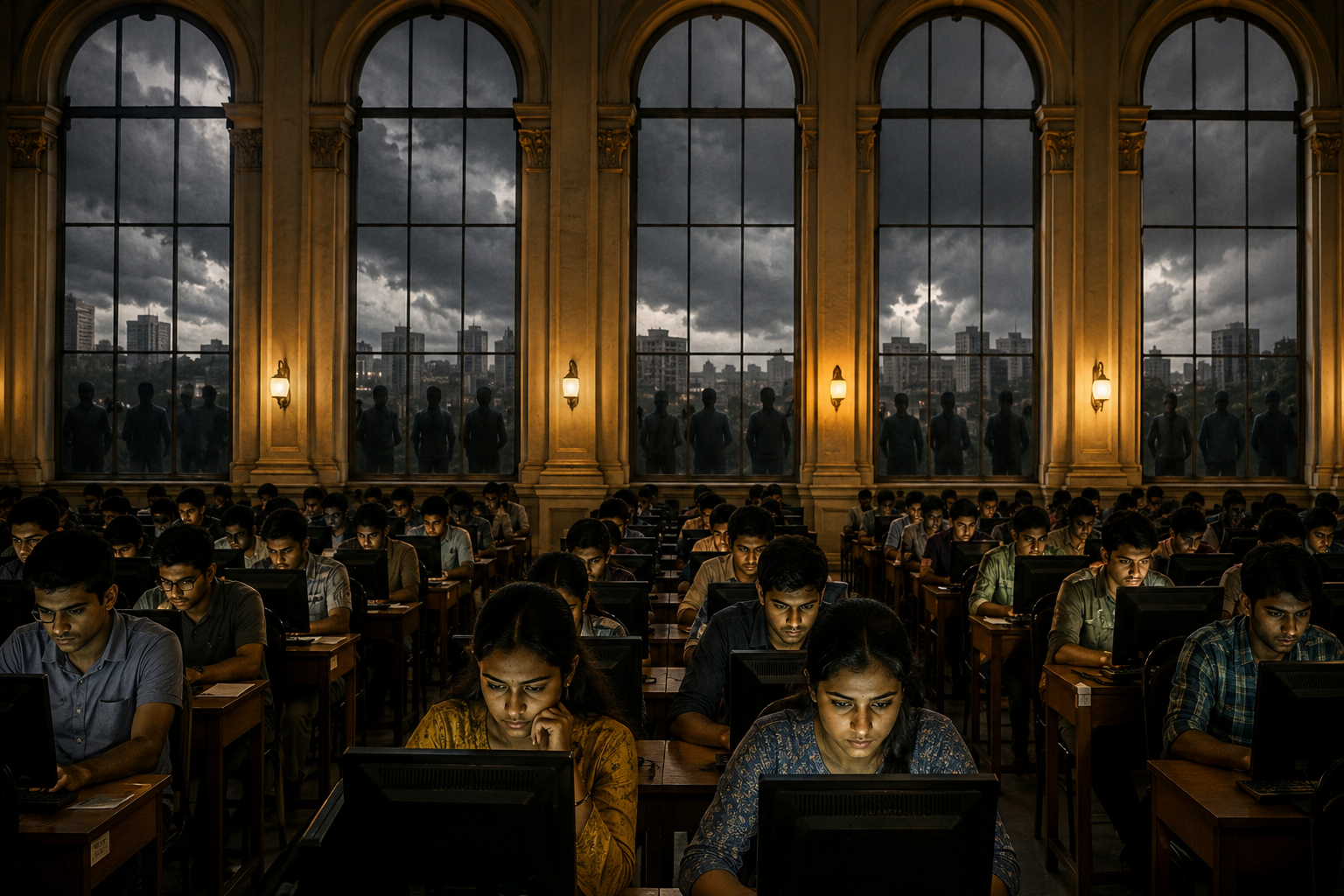
The Fisherman and the Borrowed Storm
A fisherman in a coastal village had a fine boat. One season, a stranger arrived and told the other villagers that the fisherman's boat had a hole in it, that it would sink, that their children were unsafe near it.
The villagers had seen the boat for years. They knew it was sound. But the stranger said it with such certainty, and so many times, that some began to wonder. A few stopped sending their children to fish with him.
The fisherman, confused, pulled his boat ashore and inspected every plank. He found a small crack near the bow. It was real. It needed fixing.
He fixed it and returned to the water.
But the stranger had moved on to the harbor master, then to the merchants, then to the village elder, each time carrying the same message, louder: the boat is dangerous, the fisherman cannot be trusted, the whole village is at risk.
One evening, a young apprentice asked the stranger: "If the boat was truly going to sink, why did you not help fix the crack when it was found?"
The stranger had no answer.
The apprentice understood then that the stranger had never wanted the crack fixed. He had wanted the fisherman's reputation to sink instead. The crack was borrowed. The storm was his own.
The wound was real. The flood was manufactured.
The Chief Justice Remarks
On May 15, CJI Surya Kant was hearing what he would later describe as a frivolous petition — a lawyer filing yet another challenge over senior advocate designations at the Delhi High Court. In dismissing it, the CJI's frustration widened into something larger, and he made remarks calling unemployed youth who turn to journalism, social media, and RTI applications "cockroaches" and "parasites of society."
Chief Justice of India Justice Surya Kant on Friday made sharp remarks in the Supreme Court, saying some unemployed youngsters become “media”, social media users, RTI activists and other activists “like cockroaches” and then begin attacking the system. The remarks came during the hearing of a petition linked to the designation of a lawyer as a Senior Advocate before a bench comprising CJI Surya Kant and Justice Joymalya Bagchi. The court reprimanded the petitioner lawyer for aggressively pursuing the senior advocate designation and questioned his conduct, including the language he allegedly used on Facebook. “The entire world may be eligible to become senior (advocate), but at least you are not entitled,” the bench told the petitioner. A visibly anguished CJI Surya Kant said that if the Delhi High Court granted senior advocate designation to the petitioner, the Supreme Court would set it aside in view of his professional conduct. Referring to the lawyer’s social media conduct, the CJI said, “There are already parasites of society who attack the system and you want to join hands with them?” He further remarked, “There are youngsters like cockroaches, who don't get any employment or have any place in profession. Some of them become media, some of them become social media, RTI activists and other activists and they start attacking everyone.” (Source: "Unemployed youth like cockroaches, parasites: CJI slams those who attack system" / India Today)
The Cockroach Janta Party was founded on May 16, 2026 — the very next day — by Abhijeet Dipke, a political communications strategist who formerly worked with the Aam Aadmi Party. CJP posited itself as an explicit response to the CJI's remarks.
The actual courtroom context: the case involved a petition seeking directions to the Delhi High Court on the process of senior advocate designation. The bench found the plea frivolous and expressed strong disapproval. The CJI told the petitioner: "The entire world may be eligible to become senior advocate, but at least you are not entitled," in view of his professional conduct including language he allegedly used on Facebook.
So the remark was directed at a specific lawyer aggressively gaming social media to pursue a professional title, not at India's youth. The CJI then issued a clarification saying he was specifically criticizing those who had entered the legal profession and media "with the aid of fake and bogus degrees."
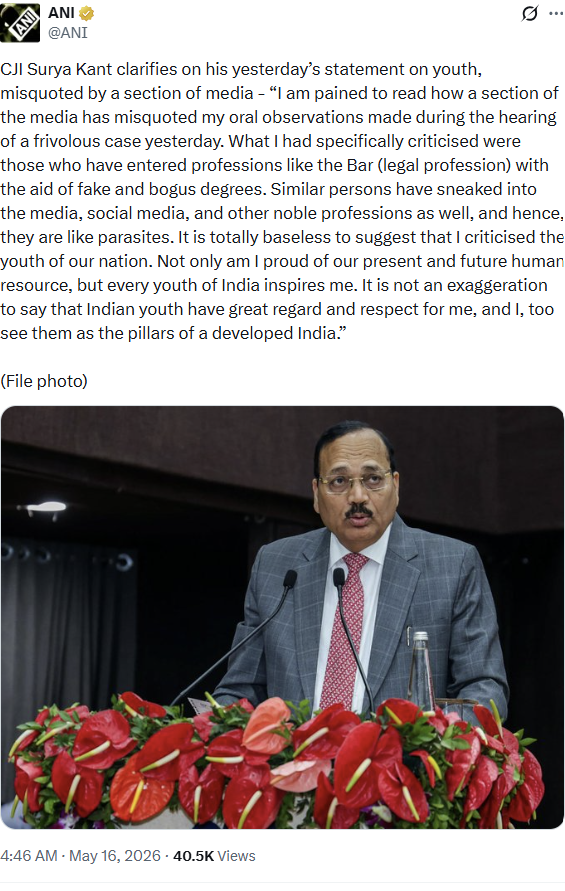
Dipke is a 30-year-old political communications strategist and Boston University student who turned the CJI's remark into India's fastest-growing political movement, reaching 22.5 million Instagram followers in just five days.
So, a remark specifically directed at a lawyer gaming social media to obtain a professional designation, made in the context of a frivolous petition the CJI called out on the spot, was stripped of its entire context and presented as the Chief Justice of India calling all unemployed Indian youth cockroaches. The CJI issued a clarification the very next day saying he had been misquoted, that what he had specifically criticized were those who had entered professions with fake and bogus degrees. That clarification was ignored. The movement had already launched.
And the person who launched it was not a spontaneously outraged student. He was a professional political communications strategist with AAP meme-campaign experience, operating from Boston, who had a movement infrastructure ready to deploy within 24 hours of the remark going viral.
The Spectacular Social Media Heist by CJP
One of the most intriguing controversies surrounding the Cockroach Janta Party (CJP) has not been its demands or leadership, but the extraordinary growth of its social media presence.
Within a matter of days, CJP reportedly accumulated more than 20 million followers across platforms. Such growth immediately sparked questions about who exactly was following the movement and whether the surge reflected genuine grassroots enthusiasm or something else.
According to reports cited by The Economic Times (Source: Cockroach Janta Party has 80% Pak-Bangladesh followers, claim netizens; 94% are Indians, says Abhijeet Dipke), critics and social media users alleged that a substantial portion of the movement's audience originated from countries such as Pakistan, Bangladesh, and Turkey, with some suggesting coordinated bot activity or foreign amplification.

CJP founder Abhijeet Dipke rejected those allegations and claimed that approximately 94% of the audience was based in India, citing platform analytics as evidence.
The precise geographic breakdown remains disputed. What is not disputed, however, is the scale and speed of the growth itself.
For context, established political organizations that have spent decades building cadres, networks, and public recognition do not typically acquire tens of millions of followers in a few days. Reports noted that CJP's social media presence rapidly surpassed the Instagram followings of both the BJP and Congress, despite being a newly created movement.
That fact alone raises legitimate questions. Social media history is filled with examples of inorganic amplification, algorithmic boosts, coordinated promotion networks, and bot-assisted engagement. None of this proves that CJP's audience was fake or foreign. But neither does virality automatically prove authenticity.
The real issue is not whether the number was 94% Indian or 80% foreign. The real issue is whether any political movement can genuinely build an audience larger than that of India's most established political parties within 72 hours without significant external amplification, extraordinary algorithmic promotion, or coordinated digital mobilization.
The June 6th Drama
On June 6th, Dipke, the founder planned to land in Delhi from Boston and then head to the police station to get the permission for CJP protest with just a few hours of lead time as opposed to 7 days as per rules.
Dipke landed, got the permission but the crowd and the "movement" that he and his supporters had hoped for were absent.
Worse, the main officials could not handle the heat. Delhi heat!
Saurav Das was visibly trying to beat the heat. He was seen sipping cold coffee beverage while a servant was fanning him to cool him off. (source: X Post)
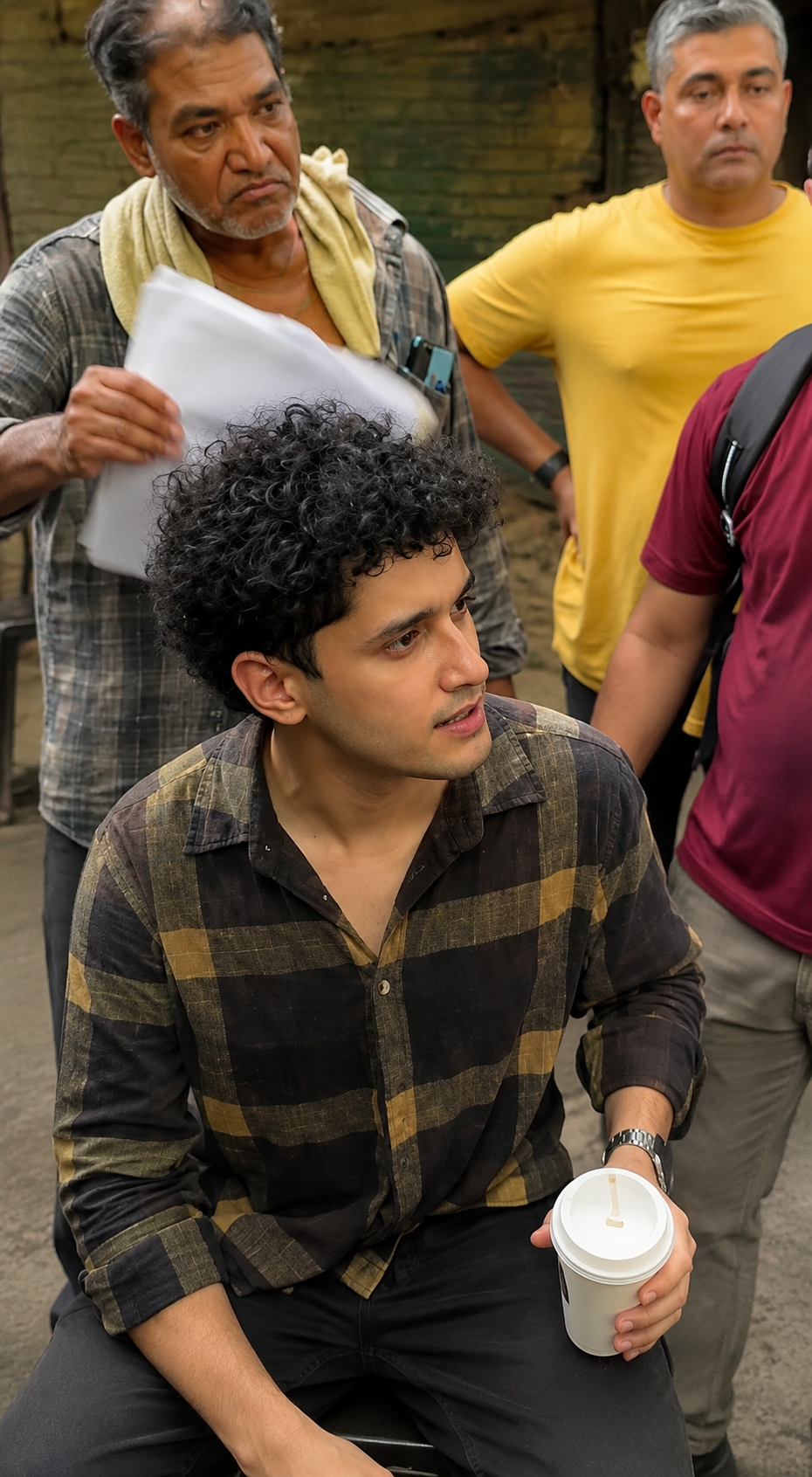
So, while Saurav Das needed someone to fan him with sheets of paper as he sat with a cold beverage in hand, Abhijeet Dipke reportedly did not remain at the site for long after arriving from Boston, soon departing in an air-conditioned vehicle.
There is nothing inherently wrong with seeking comfort. The question is whether the public image being projected matches the reality being lived.
That contrast becomes even more striking when compared to political leaders who routinely endure punishing campaign schedules. Narendra Modi, at 75, continues to undertake multi-city tours, public rallies in extreme weather, international travel, and extended workdays that would challenge people half his age.
One may agree or disagree with Modi's politics. But endurance, discipline, and the ability to sustain a demanding public schedule over decades are qualities that cannot be manufactured through social media optics alone.
The masses are not impressed by slogans. They are impressed by stamina, consistency, and the willingness to endure the same conditions they face every day.
One of the more interesting measures taken by Delhi Police during the protest was not crowd control, but narrative control.
The entire rally was extensively documented through photographs, video recordings, drones, and police photographers positioned across the route. Officers also carried live-streaming body and walking CCTV cameras, creating a comprehensive visual record of events as they unfolded.
The significance of this approach goes beyond law and order. In an era where selective clips, edited videos, and manufactured narratives can dominate social media within minutes, an independently recorded visual archive becomes an important safeguard against misinformation.
Whether one supports or opposes the protest, the existence of multiple official angles and continuous footage makes it far more difficult for any side to selectively present events or spin a misleading version of what transpired.
In many ways, Delhi Police treated the protest not just as a security challenge, but as an information-domain challenge as well.
The Numbers: Facts and Lies
The contrast between the media narrative and the reality on the ground could not have been starker.
Much of India's mainstream media appeared determined to portray the CJP rally as a major political breakthrough. Headlines spoke of a massive turnout, a youth uprising, and the emergence of a new force in Indian politics. Yet even some of the movement's sympathetic observers acknowledged that attendance was far more modest than the hype suggested.
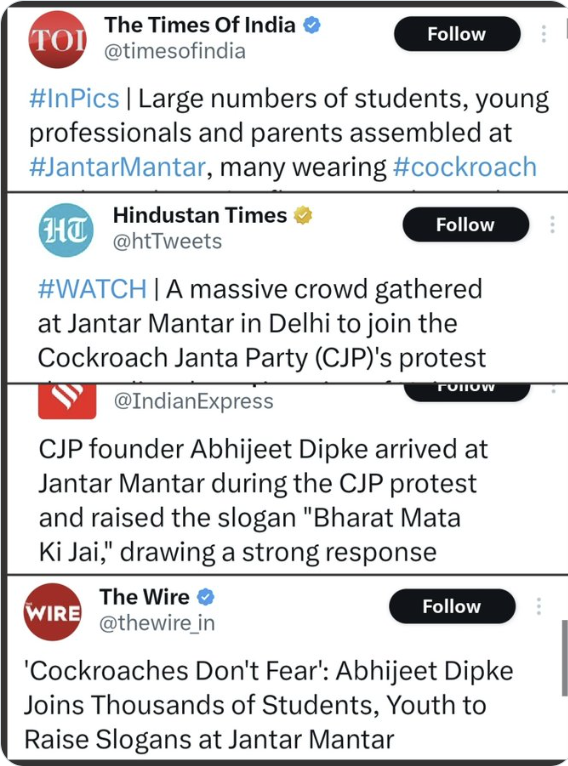
Estimates from even the most ardent critics (haters rather) of the Modi government and supporters of this movement like Arfa Khanum themselves placed the crowd less than 2000 rather than the tens of thousands implied by some coverage.
A significant numbers of those present appeared to consist of journalists, YouTubers, photographers, social media influencers, and security personnel documenting the event. The result was an atmosphere where cameras often seemed to outnumber protesters.
What was even more striking was the enthusiasm shown by sections of the foreign media with respect to the supposed "rise of the new political superstar."
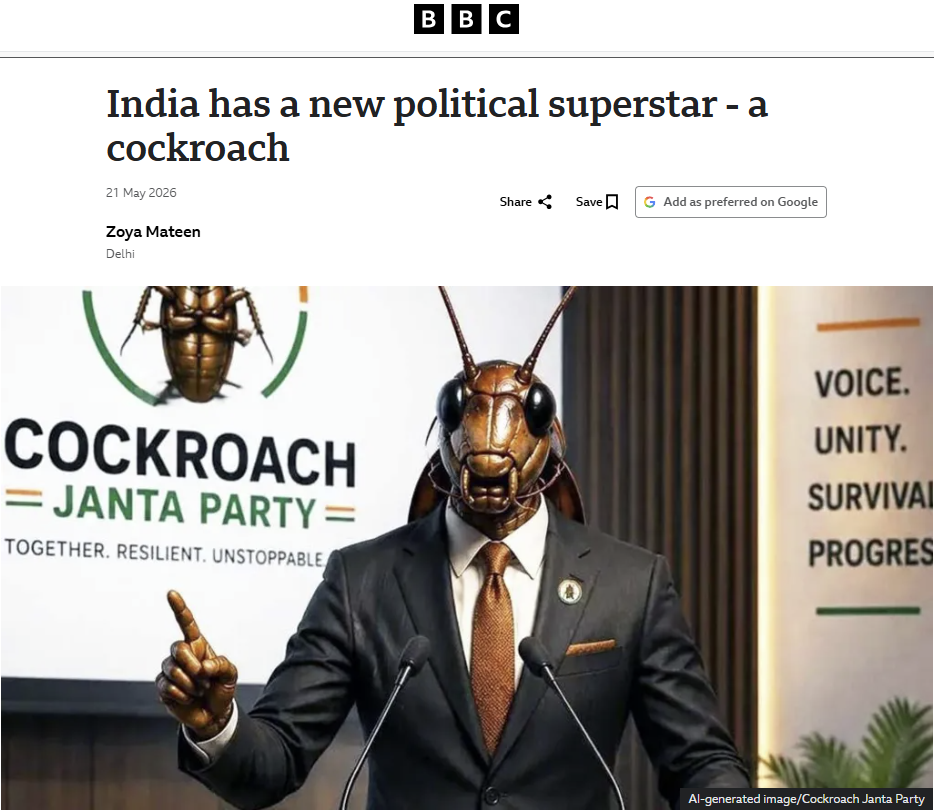
France24, in particular, covered the movement with a level of interest that many observers felt crossed the line from reporting into advocacy. The framing was not merely that of a protest being covered, but of a political project being promoted. There was little effort to present competing perspectives or critically examine the movement's claims, leadership, or objectives.
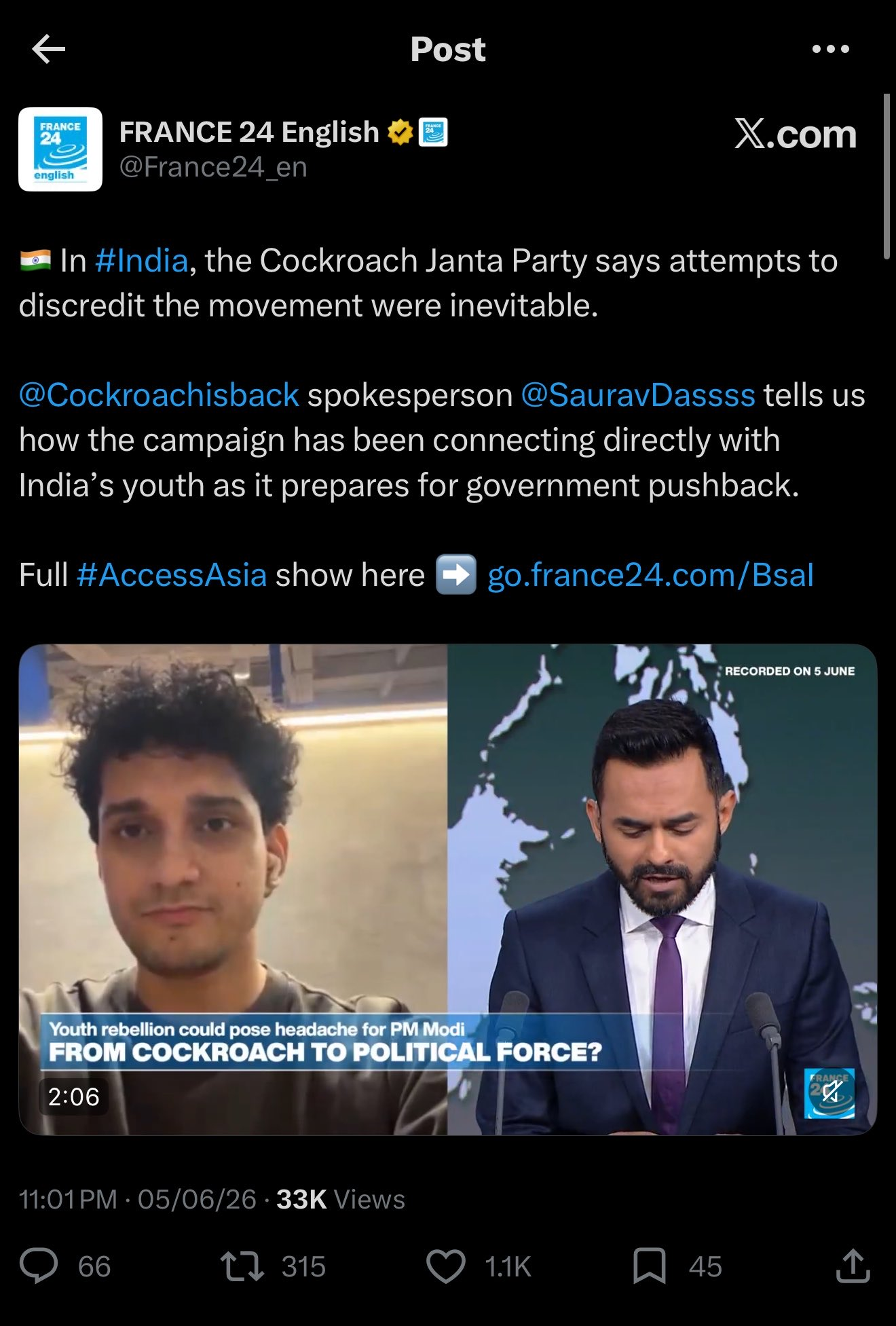
Such coverage naturally raises questions. When international media outlets appear deeply invested in a domestic political movement, skepticism is inevitable. Journalism is expected to inform audiences, not become a participant in the story itself. The closer reporting moves toward activism, the more credibility it risks losing.
Worse, France24's reporter in India Navodita Kumari was personally seen addressing the rally at the venue.
If media ceases to be an observer and becomes a participant in a political movement, the implications are profound regardless of whether one supports or opposes the cause.
At its core, journalism is supposed to perform three functions:
- Inform — report facts.
- Verify — test claims made by all sides.
- Hold power accountable — whoever holds it.
Once media becomes an actor, those functions begin to change.
The Objectives
In political mobilizations, activist media often seeks to:
- Shape narratives rather than report them.
- Create legitimacy for a movement.
- Amplify grievances while minimizing counterarguments.
- Manufacture perceptions of momentum ("everyone is joining").
- Create international pressure on governments.
- Influence elites, courts, bureaucracies, and foreign actors.
This is why analysts often describe modern political conflicts as battles in the information domain before they become battles in the political domain.
The Techniques
Media acting as a participant often exhibits recognizable patterns:
- Reporting allegations as established facts.
- Highlighting one side's emotions while questioning the other's motives.
- Inflating crowd sizes or significance.
- Ignoring internal contradictions within the movement.
- Elevating certain leaders into symbols.
- Reframing narrow grievances into broader systemic indictments.
The objective is not merely to describe reality but to construct a political narrative that influences reality.
How Exams Failed
Before I go further, let me be straight with you about the examination failures. Because this part is important and it needs to be said clearly.
India moved its big national exams to digital platforms. JEE, NEET, CUET, SSC, banking exams — all of it moved online.
That was the right decision.
The old system had paper leaks happening everywhere for decades. Criminal networks were embedded in state exam boards all across the country. That could not be fixed without changing the whole system.
So digitization — going digital — was absolutely the right step for the nation and for the students.
But the people who built the digital system made one big mistake.
They built it to handle millions of students. They did not build it to handle criminals who are specifically trying to break it.
Those are two completely different things.
Let me give you three examples.
NEET 2024. The CBI traced a paper leak to Hazaribagh and Patna. Officials were compromised. Brokers distributed the paper. One hundred and fifty-five students got the questions before the exam even started. Old-style corruption, just adapted to the new system.
During the probe, the CBI alleged that the paper leak had originated from Oasis School in Hazaribagh, Jharkhand, where sealed question papers were allegedly accessed before the examination began. The investigation led to multiple arrests across Bihar, Jharkhand, Gujarat, Rajasthan and Maharashtra. Those arrested reportedly included alleged middlemen, school officials and even MBBS students from AIIMS Patna accused of helping candidates solve leaked papers. The matter eventually reached the Supreme Court, where several petitions sought cancellation of the entire NEET UG 2024 examination and a nationwide re-test. While hearing the case, the Supreme Court observed that the "sanctity" of the examination process had been affected. However, the court declined to order a nationwide re-examination, stating that there was no evidence to prove a systemic leak that had impacted all candidates across the country. (Source: "How NEET UG 2024 Paper Leak Controversy Unfolded" / NDTV)
Bottomline is that this leak was not systemic and had nothing to do with the central government.
JEE Main 2021. This one is the most dangerous. A company called Affinity Education in Noida presented itself as a legitimate education consultancy. It was a front for a criminal gang. Here is what they did — they did not steal the question paper. They did not need to. During the live exam, their people remotely accessed the computers at the exam center while the enrolled candidates sat in front of the screens pretending to work. Solvers sitting somewhere else entirely answered the questions on behalf of the candidates paying for the service. In fact, a Ukrainian hacker was involved in that operation.
Think about that. The paper was safe. The technology was unbroken. But the exam was completely compromised.
That is how sophisticated this has become.
And Common University Entrance Test (CUET) 2026 — TCS admitted their platform crashed for two hours during a live national examination. Two hours. For hundreds of thousands of students whose entire future is riding on that one day.
 ETtech
And, then the latest CBSE On-Screen Marking crisis. Well, it carries a specific kind of importance because it demonstrates precisely how a genuine institutional failure becomes a political weapon within days.
CBSE introduced its On-Screen Marking system, or OSM, at scale for the first time in the 2026 Class 12 examination cycle.
When results were declared on May 13, 2026, the complaints flooded in immediately. Blurred scans that made handwriting illegible. Multi-page answers where only the first page had been evaluated. Missing sheet pages that left answers unscored entirely. Unexpectedly low marks in Physics, Chemistry, and Mathematics that students could not reconcile with their preparation.
What came next is where the story becomes significant beyond its administrative dimensions.
A 17-year-old student from Jharkhand, Sarthak Sidhant, dissatisfied with blurred scans of his own answer sheets, spent days cross-referencing CBSE's official bidding documents on the public procurement portal. He tracked three successive versions of the tender and published his findings under the title "How CBSE Rewrote Rules to Favour Coempt EduTeck." His investigation alleged that eligibility criteria, technical requirements, and security safeguards had been progressively diluted across successive tender rounds in ways that specifically benefited the eventual winning vendor, a Hyderabad-based firm called Coempt Eduteck. (Source: First post)
The Coempt backstory is damaging on its own terms. Coempt was formerly known as Globarena Technologies, the company at the center of the 2019 Telangana Intermediate Examination disaster, where software and evaluation failures triggered widespread outrage and twenty-three students died by suicide. The company rebranded. Sidhant alleged that clauses specifically addressing poor performance history and blacklisting had been removed from later versions of the CBSE tender, despite that history. He identified at least fifteen discrepancies across successive tender rounds and was subsequently called to present his findings before a parliamentary committee.
These failures are real. The students are right to be aggrieved. They put in years of work. Families funded their studies and extra tuitions and made genuine sacrifices. All of it put at risk by a system that was not secured properly.
But here is the question.
Who benefits most from that grievance that has been turned into anger? The students? Or someone else?
Although both CBSE and Coempt have both denied wrongdoing, investigation is continuing by the government.
That gap, between the legitimate student grievance and the political weapon attached to it, is the signature of the doctrine examined in this essay. And its appearance in the CBSE controversy, with the same speed and the same escalation pattern visible in NEET, JEE, and the CJP movement, is not coincidental.
Which makes the presence of external ignition all the more important to identify and name.
TCS Nashik and the Third-Party Problem
In March 2026, something else broke that most people are not connecting to this story.
The TCS Nashik case.
Nine FIRs were filed and seven arrests were made.
The NIA, the ATS, and the Intelligence Bureau all started investigating at the same time. Six women police officers went undercover inside the TCS facility for forty days — forty days! — because nothing inside TCS itself had caught what was going on across four years of operation.
Remember that - Four years.
The people arrested were not small employees. They were team leaders. HR managers. People with real authority inside the company. The allegations document a four-year organized operation — targeting Hindu women employees, grooming them, coercing them, putting religious pressure on them. And the HR system that should have received complaints was being run by people connected to the accused.
So complaints went nowhere.
And then there is this — investigators identified an external handlers based in Malaysia, Pakistan, and other countries. Nida Khan’s laptop and phone revealed that she had Contacts with “136 radical organisations” across multiple countries.
🚨Nida Khan Under Scanner After Alleged Global Extremist Contacts Found on Laptop
— Resonant News🌍 (@Resonant_News) May 13, 2026
Investigators reportedly claim that evidence recovered from Nida Khan’s laptop includes alleged contacts with 136 radical organisations across multiple countries.
⚠️ Sources further allege that… https://t.co/qHw9uiKsRL pic.twitter.com/lG48L9bQve
In fact, she would participate in video calls with Pakistan‑based organizations or individuals who were training her specifically in methods of religious conversion, specifically targeting Hindu employees at the TCS Nashik BPO unit.
Now connect these dots with me.
This same TCS runs most of the top exams in India via its unit - TCS iON.
So, TCS runs JEE. TCS runs NEET. TCS runs CUET. TCS holds biometric records and personal data for tens of millions of young Indians.
 Desh Kapoor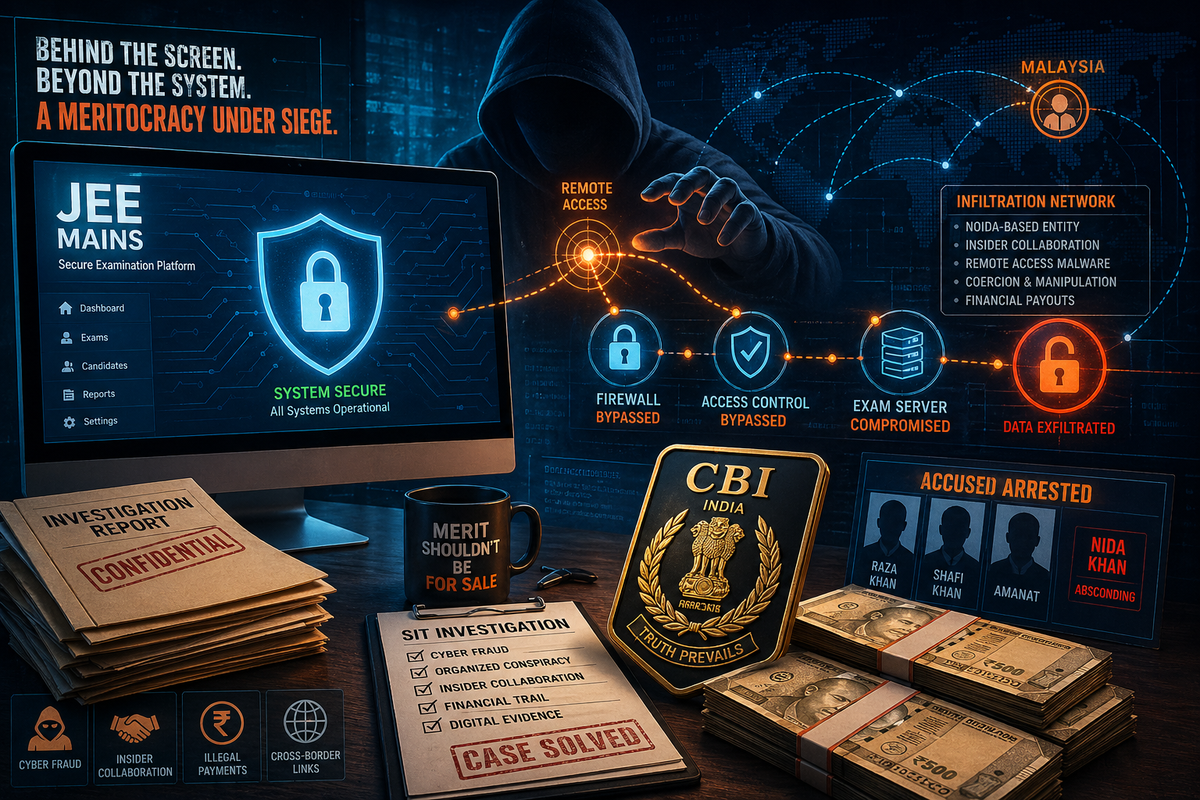
Every student who sat for a major national exam in the last several years — their data is in that system.
A company that could not detect a coordinated criminal operation inside its own walls for four years the question we should ask is what data did those criminals have access to? What was copied?
What was sent out of India to those terror organizations and their handlers in ISI and other intelligence agencies?
That question has not been publicly answered.
And it needs to be, because the Pakistan and Malaysia connection is not random. Malaysia is a known hub for Pakistan-linked networks that target Indian institutions, while Pakistan is the terror sponsoring country.
So let us be clear - This was not just workplace harassment. This was institutional penetration with a foreign coordinator.
And we are supposed to believe the exam failures and the CJP protests happening right now are completely unrelated to all of this.
That is quite hard to believe, isn't it?
Now I want to take you back to 1966. Stay with me — this is where everything connects.
Cloward-Piven Strategy of Subversive and Anarchist Movements
On May 2, 1966, the American magazine The Nation published an article that would quietly reshape how political subversion is practiced across the world for the next six decades. Its title was anodyne: "The Weight of the Poor: A Strategy to End Poverty." Its authors were Richard Andrew Cloward and Frances Fox Piven, both professors at the Columbia University School of Social Work, both longtime members of the Democratic Socialists of America.
The article can be read at the original source. It has never been retracted, amended, or disavowed. Everything Cloward and Piven proposed in it was stated openly.
Their argument began with a specific observation about the American welfare system. Millions of Americans were legally eligible for public assistance but were not enrolled. The reasons were varied: administrative obstruction, social stigma, bureaucratic complexity, and deliberate discouragement by officials who used the rolls as a tool of labor-market management. The system was designed to provide just enough relief to prevent rebellion while maintaining a pool of cheap, desperate labor.
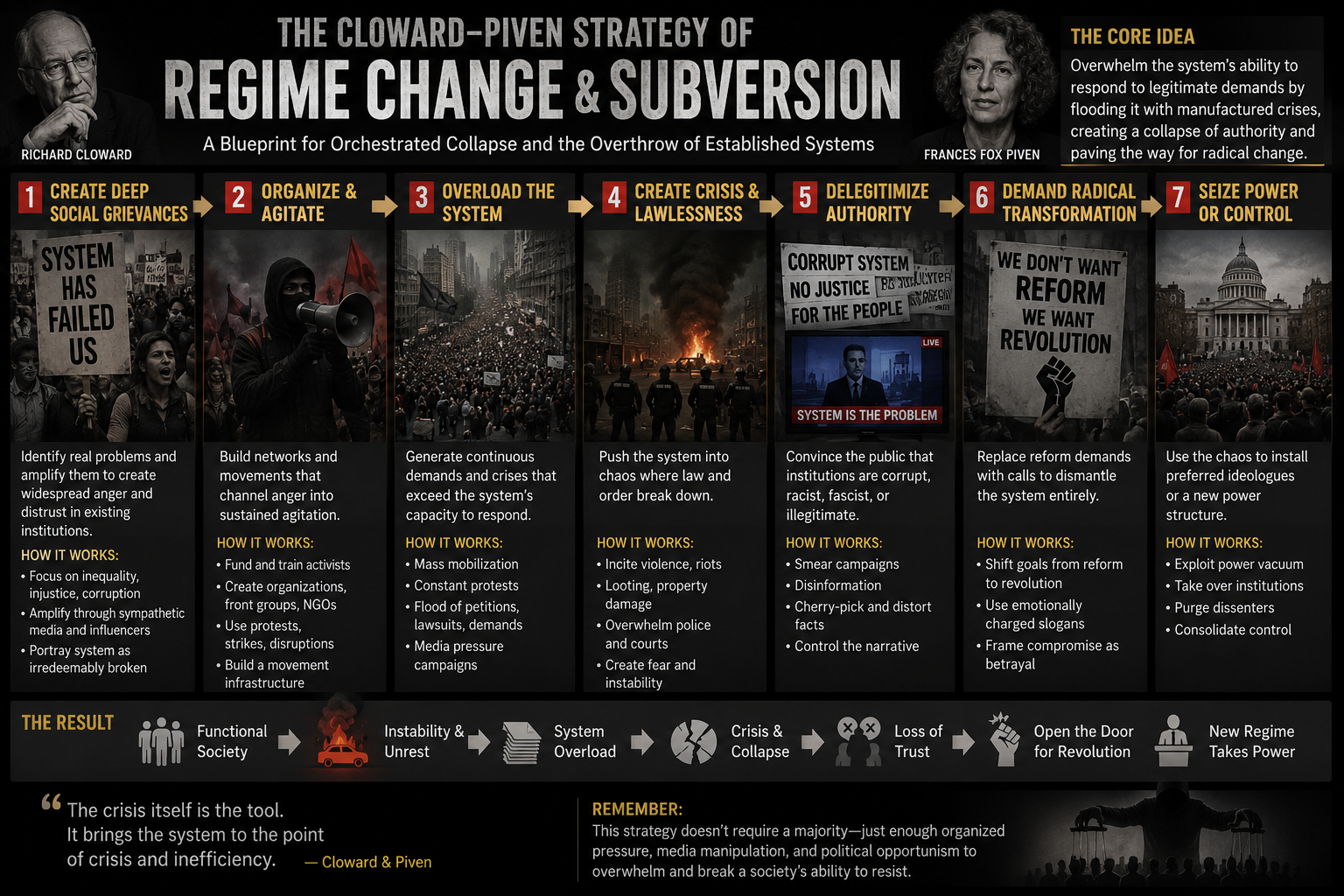
Cloward and Piven's proposal was elegant in its brutality. Rather than petitioning for reform, organizers should mobilize every eligible recipient simultaneously to demand full enrollment. The resulting flood of claims would overwhelm the administrative and fiscal machinery of the welfare state. Cities and states would face budget crises they could not resolve within existing frameworks. The federal government would be forced, under combined pressure of institutional collapse and mass public anger, to replace the patchwork system with something structurally different: a guaranteed national income.
The article called specifically for "cadres of aggressive organizers" to create "a crisis in the system." The word crisis was not metaphorical. Cloward and Piven were explicit that the goal was to make the existing system unmanageable, not to make it work better.
The Nation sold an unprecedented 30,000 reprints of the article within weeks of publication.
In 1966, Piven and Richard Cloward published “The Weight of the Poor” in the Nation magazine. The essay elaborates what has since been dubbed the “Cloward-Piven Strategy”: the mass enrollment of the poor onto welfare rolls. If all who were entitled to government benefits claimed them, they argued, the system would buckle, exposing the magnitude of American poverty and the inadequacy of its safety net. The ensuing political crisis would provide an opening in which to enact broad and lasting anti-poverty policy. Cloward and Piven published the article in the midst of an intense period of grassroots activity among welfare recipients. That same year, anti-poverty groups around the country formed a broad coalition that became the National Welfare Rights Organization, of which Piven was a founding member. The rank-and-file membership of the NWRO grew dramatically through the late-60s, reaching over 20,000 dues paying members and 540 grassroots groups by the end of the decade, and gaining influence over national welfare politics. (Source: The Weight of Movements / Phenomenal World)
Activists across the country described it as the "crisis strategy" — a term Cloward and Piven themselves used. It became the foundational text of a movement.
And yet sometimes things move more quickly. Every once in a while we see outbreaks of mass protest, periods of peak activity when the accepted rules of political affairs seem to be suspended. As one sociologist writes, these are extraordinary moments when ordinary people “rise up in anger and hope, defy the rules that ordinarily govern their lives, and, by doing so, disrupt the workings of the institutions in which they are enmeshed.” The impact of these uprisings can be profound. “The drama of such events, combined with the disorder that results, propels new issues to the center of political debate” and drives forward reforms as panicked “political leaders try to restore order.” These are the words of Frances Fox Piven, the eighty-one-year-old Distinguished Professor of Political Science and Sociology at the CUNY Graduate Center. As co-author, with Richard Cloward, of the classic 1977 treatise Poor People’s Movements, Piven has made landmark contributions to the study of how people who lack both financial resources and influence in conventional politics can nevertheless create momentous revolts. Few scholars have done as much to describe how widespread disruptive action can change history, and few have offered more provocative suggestions about the times when movements—instead of crawling forward with incremental demands—can break into full sprint. In recent years, Occupy Wall Street and the Arab Spring have created renewed interest in such moments of unusual activity. These uprisings have spawned discussion about how activists might provoke and guide other periods of intensive unrest, and also how these mobilizations can complement longer-term organizing. Those coming out of traditions of strategic nonviolence and “civil resistance,” in particular, can find striking parallels between their methods for sparking insurgency and Piven’s theory of disruptive power. (Source: Can Frances Fox Piven’s Theory of Disruptive Power Create the Next Occupy? / Dissent Magazine)
The Mechanism: How Institutional Demolition Works
What made the Cloward-Piven insight durable beyond its specific welfare-system context was the universality of its underlying logic. The authors had identified a structural feature of all complex institutions, not just American welfare bureaucracies.
Every large institution operates within a load-bearing capacity. It is designed to handle a predictable volume of demands under normal conditions. It is not designed to handle simultaneous, coordinated, maximum-volume demands from its entire eligible constituency while under sustained public attack on its legitimacy.
More importantly, every institution depends on the tacit cooperation of its constituents to function. Most eligible welfare recipients did not apply because they accepted the implicit social message that they should not. Most citizens accept institutional authority because they believe the institution is basically legitimate. The moment that legitimacy is publicly, visibly, and persistently questioned, the institution's operating premise collapses. It can no longer rely on tacit cooperation. Every interaction becomes a confrontation. Every failure becomes evidence. Every administrative delay becomes proof of oppression.
Cloward and Piven understood that they did not need to construct a false grievance. The genuine grievances of the genuinely suffering were sufficient raw material. The strategy required only that those grievances be organized toward systemic confrontation rather than incremental resolution.
This is the central insight that makes the doctrine so difficult to fight: it is parasitic on authentic suffering. Its participants are not deceived about their own grievances. They are only, in most cases, unaware of who is managing the direction and escalation of their movement, toward what political destination, and in whose ultimate interest.
The mechanism in its mature, internationally applied form operates through five stages:
Stage One: Grievance Identification. Locate a manufactured or real, widespread, deeply felt injustice. The more legitimate the grievance, the more durable the movement built around it. Manufactured grievances are brittle under scrutiny. Authentic ones are not. Yet, both work to disrupt the systems before they can be called out.
Stage Two: Identity Construction. Build a strong emotional and cultural identity around the grievance. The participants must feel not just wronged but defined by their wrongness. They must feel that their suffering is invisible to power, that they are dismissed, belittled, and erased. This emotional architecture is what produces the level of commitment required for sustained confrontation.
Stage Three: Escalation Architecture. Build organizational infrastructure oriented toward escalation, not resolution. Every offer of partial concession should be rejected as insufficient. Every government response, whether crackdown or compromise, should be framed as evidence of systemic illegitimacy. The goal is not to win a negotiation. The goal is to make governance itself look like the problem.
Stage Four: International Amplification. Engage external voices — foreign media, international NGOs, diaspora networks, sympathetic governments — to frame the domestic crisis as a human rights or democracy emergency. This serves two functions: it adds political cost to the target government beyond what domestic opposition alone can impose, and it creates a legitimizing frame for intervention if and when the political transition comes.
Stage Five: Alternative Positioning. The political alternative must be positioned before the crisis peaks, not after. The beneficiary of the manufactured crisis must be clearly identified in public consciousness as the solution to the crisis before the institution collapses. This is the refinement that experience added to the original Cloward-Piven formulation. The 1975 New York fiscal crisis produced austerity, not guaranteed income, partly because no credible political alternative had been pre-positioned. Later applications corrected this.
From Academic Theory to Operational Doctrine: The Intelligence Dimension
The transition of Cloward-Piven logic from academic proposal to operational statecraft happened through several parallel channels that deserve careful examination.
The Gene Sharp Connection
The most significant institutionalization of this logic in the domain of geopolitical subversion came through Gene Sharp, a political scientist who spent nearly thirty years as a researcher at Harvard University's Center for International Affairs and founded the Albert Einstein Institution in 1983.
Sharp's 1993 book From Dictatorship to Democracy: A Conceptual Framework for Liberation is the operational manual that gives the Cloward-Piven strategic insight its step-by-step tactical form. Published originally for distribution among Burmese dissidents, the book has since been translated into more than 34 languages and distributed across every continent. It has been explicitly credited as the foundational operational document by the leaders of multiple color revolution movements.
Gene Sharp's From Dictatorship to Democracy has been studied by groups including Egypt's April 6 Movement, Serbia's Otpor, Georgia's Kmara, Kyrgyzstan's KelKel, and Belarus' Zubr in their efforts to effect change in their societies. Oleh Kyriyenko, one of the leaders of Ukraine's Orange Revolution, said in 2004: "The bible of Pora has been the book of Gene Sharp, also used by Otpor; it's called 'From Dictatorship to Democracy.'"
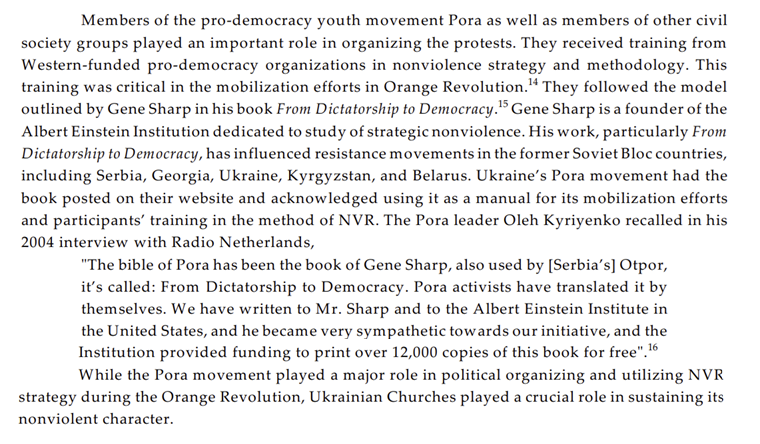
What does this really mean?
identify the genuine grievance the local population has against its political leaders, identify and support those within the country who oppose the current government, infiltrate and strengthen opposition movements, fund them with external resources, organize protests that appear organic and legitimate, embed trained political instigators among ordinary protesters to manage escalation, and use international media to amplify delegitimization of the target government.
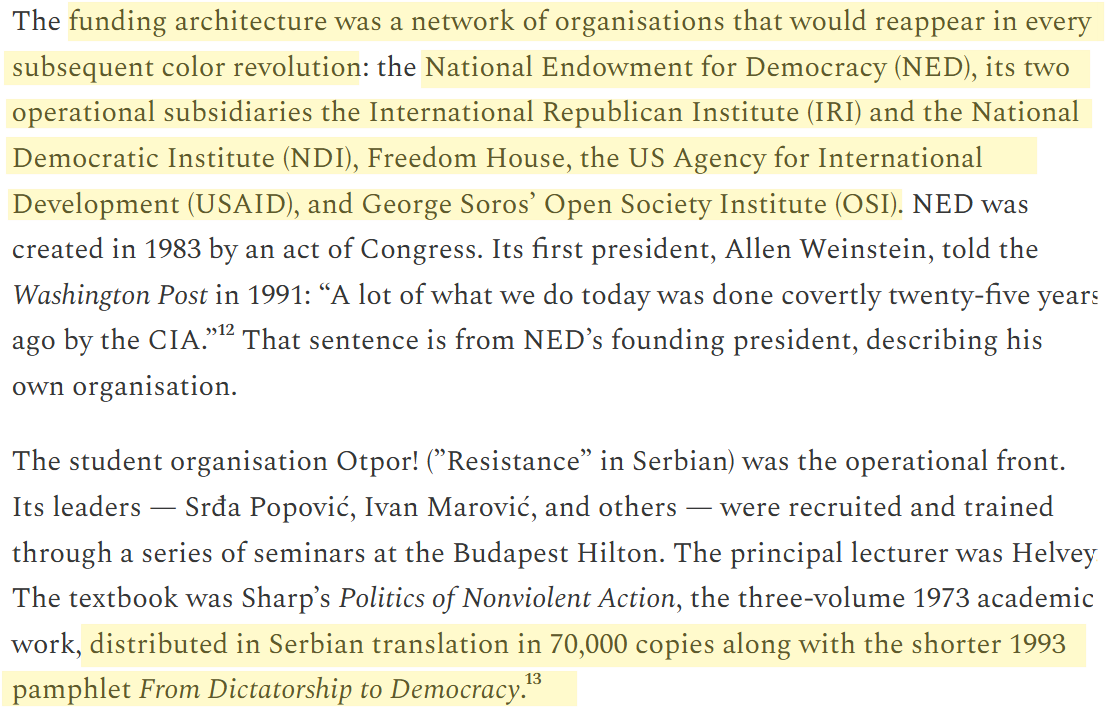
The relationship between Sharp's Albert Einstein Institution and American intelligence and foreign policy infrastructure has been extensively documented, though Sharp himself consistently rejected the CIA label. Freedom House, a US democracy promotion NGO and regular recipient of National Endowment for Democracy funds, paid for the translation, printing and distribution of 5,000 copies of Sharp's pamphlet From Dictatorship to Democracy, which were then disseminated to thousands of activists throughout Serbia before the 2000 revolution that removed Slobodan Milosevic.
The NED: Covert Operations Made Overt
The National Endowment for Democracy, established in 1983, is the institutional vehicle through which the American government operationalized Sharp-style strategic nonviolence as a foreign policy tool.
The NED was created explicitly to do openly what the CIA had been doing covertly. This is not an inference. It is a statement made by the NED's own founder. As early as 1991, NED founder Alan Weinstein put it bluntly in an interview with the Washington Post that a lot of what they were doing was what the CIA had done twenty-five years ago.
 Desh Kapoor
Former CIA officer Philip Agee was even more explicit. In a 1995 television appearance, Agee said: "Nowadays, instead of having just the CIA going around behind the scenes and trying to manipulate the process secretly by inserting money here and instructions there and so forth, they have now a sidekick, which is this National Endowment for Democracy, NED."
The NED's operational record in applying color revolution methodology includes documented interventions across Venezuela, Ukraine, Bolivia, Iran, Algeria, Georgia, Serbia, and Belarus. In Ukraine specifically, the NED served as the tip of the spear for heightened CIA and State Department efforts to foster political revolution, providing a steady stream of grants to myriad Ukrainian political entities and movements that advanced both the Orange Revolution and the Maidan Revolution that paved the way for the current Ukraine-Russia war.
The operational template across all these cases is consistent with the Cloward-Piven architecture: identify genuine domestic grievances, fund and organize the movements built around them, manage escalation toward regime change, and position the preferred political alternative before the crisis peaks.
The Five Signatures of a Cloward-Piven Operation
Decades of documented applications across multiple continents have produced a consistent set of observable signatures that distinguish a Cloward-Piven operation from a genuine organic protest movement. These signatures do not require proof of conspiracy. They are behavioral and structural markers that reflect the operational logic of the doctrine, observable from outside the movement itself.
Signature One: Disproportionate Scaling Speed. Organic protest movements scale with the spread of information and the gradual accumulation of participants who independently encounter the movement and join. This process is inherently rate-limited by geography, social networks, and the time required for genuine deliberation. A Cloward-Piven operation has pre-built infrastructure, pre-designed content, and pre-positioned distribution channels that produce scaling at rates impossible through organic spread alone. When a movement reaches millions of followers in days, with consistent branding, professional content, and uniform messaging, the scaling speed is itself evidence of pre-built infrastructure.
Signature Two: Rapid Demand Escalation Beyond the Original Grievance. Organic movements negotiate. They accept partial concessions as genuine progress. They argue internally about whether a partial win is sufficient. Cloward-Piven operations do not negotiate, because resolution of the grievance would end the crisis, and ending the crisis before the political transition is the one outcome the architects cannot accept. Every partial concession is immediately reframed as insufficient. Demands expand to encompass wider institutional delegitimization. The original grievance becomes a footnote to a larger claim about systemic failure.
Signature Three: External Amplification Coordination. Organic protest movements attract international attention gradually, unevenly, and through the normal channels of journalism and civil society response. Cloward-Piven operations have pre-built international amplification channels that activate in coordination. Multiple high-profile international voices post on the same hashtag on the same day. Foreign government officials make coordinated statements. International media frames the domestic crisis through a pre-supplied narrative. The coordination is visible in the timing and the uniformity of the messaging.
Signature Four: Opposition Political Pre-Alignment. Organic movements are often politically ambiguous in their early stages, attracting supporters across partisan lines. Cloward-Piven operations are aligned from the beginning with specific political actors who have been pre-positioned to benefit from the crisis. Opposition political figures do not merely criticize the government's response to the grievance; they amplify the delegitimization framing and demand political replacement, not policy reform.
Signature Five: Funding Opacity. Organic protest movements are financially fragile. They depend on participant fundraising, volunteer labor, and donated resources. The financial architecture of a Cloward-Piven operation is professional and sustained. Legal support networks, content production operations, social media management, international coordination — all of this requires ongoing financial infrastructure that exceeds what any genuine student or community movement can self-generate. The funding is typically structured to obscure its origins through intermediary NGOs, diaspora networks, and foreign-affiliated foundations.
The CJP: A Textbook Illustration
The Cockroach Janata Party movement merits examination against each of these five signatures, not as an accusation of conspiracy but as an analytical exercise in pattern recognition.
The Origin Narrative: A Manufactured Lie
Before examining the signatures, it is necessary to establish the most important fact about the CJP: its founding grievance was not merely exaggerated. It was fabricated through deliberate misrepresentation.
We have already seen how the CJP movement was carefully orchestrated on the back of manufactured lie about India's Chief Justice Surya Kant's comment. The founding statement positioned the movement as a response to the CJI calling all unemployed youth cockroaches.
That characterization of the CJI's remark was false. The remark was directed at a specific lawyer aggressively gaming social media for a professional title. It was made in the context of a frivolous petition. The clarification was issued within 24 hours. None of this mattered to the founding narrative of the CJP, because the founding narrative was not an honest response to the remark. It was a vehicle for a pre-existing political operation that had been waiting for a usable trigger.
This is the CAA pattern repeated with even less plausible deniability.
The CJI remark was a context-specific critique of fraudulent credential holders in professional settings. It was presented as contempt for all unemployed Indian youth, and the manufactured outrage around that framing produced a movement with 22.5 million Instagram followers in five days.
Three operations. Three manufactured grievances attached to authentic anxieties. Three applications of the same operational logic.
Signature One Check: Scaling Speed: The CJP reached 22.5 million Instagram followers in just five days, growing faster than established political parties with decades of history. The branding was professional from day one. The content was consistent. The escalation from the founding grievance (CJI's remark) to the substantive political agenda (examination failures, government delegitimization) happened within 48 hours of launch. A 30-year-old PR student at Boston University, however talented, does not generate this scaling speed from personal effort and authentic student networks. The infrastructure was built before the trigger appeared.
Signature Two Check: Demand Escalation: The CJP launched on a specific grievance: a judicial remark. Within days it had adopted the examination failure narrative as its central cause. Within weeks it was demanding the Education Minister's resignation. The demand sequence moved from a specific judicial observation, to a systemic examination infrastructure failure, to political accountability framed as regime change. At no point did the movement accept any partial concession as genuine progress toward resolution.
Signature Three Check: External Amplification: The CBSE exam scandal set off student outrage that was covered by Al Jazeera, BBC, and CNN in framing that consistently positioned the crisis as evidence of government failure rather than as an administrative and technical problem requiring specific remediation. The international amplification followed the pre-supply-narrative pattern: the framing was consistent across outlets, centered on regime accountability rather than technical solutions, and arrived faster than organic journalism would produce.
Signature Four Check: Opposition Pre-Alignment: Multiple opposition political figures aligned their public signaling with the CJP escalation framing within days of the movement's launch. They were not merely criticizing the government's handling of examination failures, which would be legitimate political opposition. They were amplifying delegitimization framing and demanding political replacement. The speed and consistency of that alignment, across multiple political actors using identical framing, reflects pre-coordination rather than spontaneous political response.
Signature Five Check: Funding Opacity: The financial architecture sustaining a social media operation at this scale, with this consistency of content production, this breadth of legal and organizational support, and this degree of international amplification, has not been publicly accounted for. Who is funding the CJP operation? This question has not been answered, and the movement's advocates have not volunteered the information.
India has seen this before
India has already been through two versions of this. Not very long ago.
The CAA protest, the Shaheen Bagh operation that went on for One hundred and one days. Women sitting in the road getting free biryani and subversive actors calling for breaking India and its Chicken Neck. Within no time, the pliant foreign media had made it an international story.
And it was all built on one claim — that the Citizenship Amendment Act was going to strip Indian Muslims of their citizenship.
That claim was a lie. Everyone knew it.
Read the Act. Any Indian can read it. It gave persecuted non-Muslim minorities from Pakistan, Afghanistan, and Bangladesh a faster path to Indian citizenship. It gave some people something that had been promised to them for years. It took nothing from anyone. Not one Indian Muslim's citizenship was touched. UN Human Rights law calls it Non-Refoulement. You cannot send refugees from countries back to their home country, where they will be killed.
The anxiety in the Muslim community was manufactured. The lie was repeated by everyone without any contest.
Now we all know that anxieties about identity run deep and do not always need a specific law to feel urgent. But the specific claim — that this law was targeting Muslim citizens of India — was completely false. It was deliberately constructed. And it had organizational infrastructure behind it.
Then there were the so-called Farmers' Protest. The farm laws. For decades, governments — including Congress governments — have said India's agricultural market needs these kinds of reforms. The laws were genuinely useful and had been commented on for decades. And, they were not anti-farmer.
And then the toolkit. The Poetic Justice Foundation — a Khalistani organization founded by Mo Dhaliwal and others — had prepared a sequenced action plan. On February 3rd, 2021, Rihanna tweeted about it. Greta Thunberg tweeted about it. A list of international celebrities posted on the same hashtag on the same day.
 OpIndia Staff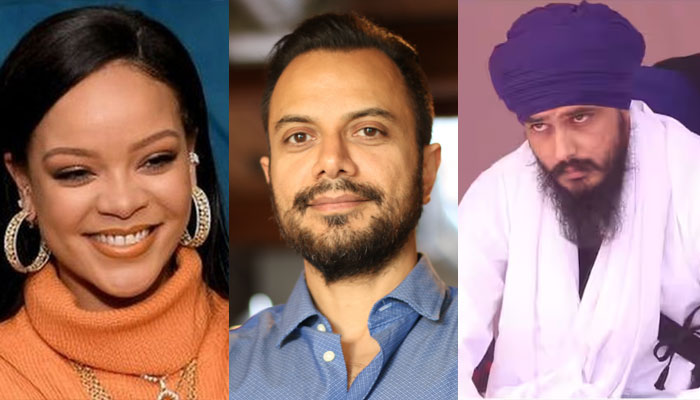
That this happened by accident would be too much of a coincidence. Celebrities like Rihanna do not tweet about some local laws in a country across the globe without adequate funds.
As a result, the farm laws were repealed.
And everyone running this playbook against India learned one thing from that.
Such operations do work sometimes.
So now they are planning a similar operation - using a different pretext.
The CJP Architecture: Reading the Signs
The examination failures are the authentic grievance. Everything else in the CJP movement is the architecture.
The branding arrived fully formed. The social media scaling exceeded organic capacity. The escalation sequence has been consistent: establish a student identity built around institutional betrayal, generate confrontational imagery to produce viral delegitimization content, expand demands progressively from exam reform to wholesale governance failure, and sustain the crisis through the news cycle with steady content production that no actual student network could maintain without external support.
The funding question is primary. No social media campaign at this scale and consistency runs on student pocket money. The organizational backbone, the legal support networks, the sustained content production cycle, and the international amplification infrastructure all require financial architecture. That architecture needs to be traced completely through FCRA scrutiny and its findings made public regardless of what they reveal.
The handler question follows. The strategic direction of the movement's escalation, its framing decisions, its selection of targets, and its timing of confrontational moments does not emerge from spontaneous student deliberation. The Farmers' Protest Toolkit was a moment when handler infrastructure accidentally became visible. The handlers of the current movement are not making that error. But the pattern of their decisions is legible to anyone who knows what to look for.
The opposition alignment question is the most telling. Multiple opposition political actors have aligned their public signaling with the movement's escalation in ways that go beyond normal political opportunism. They are not merely criticizing the government's handling of examination failures, which would be legitimate political opposition.
They are amplifying the delegitimization framing, the governance illegitimacy narrative, and the demand for political rather than administrative accountability. That alignment is not coincidental. It reflects a shared political calculus worth naming precisely: they believe that a governance legitimacy crisis serves their interests better than exam reform would.
That calculation reveals who they have already decided to serve. The interests of the external actors providing the organizational architecture for this movement do not align with those of Indian students. The external actors want a government in New Delhi that they can influence, compromise, or control.
A government that comes to power on the back of a manufactured crisis owes its existence to those who built the apparatus of manufacturing that anarchy. That debt is structural. It is not dischargeable through policy. It is dischargeable only through alignment.
The opposition actors who are amplifying this crisis are either naive about what they are participating in or not. In either case, the consequence of their alignment is the same.
The Convergence: When Institutional Penetration Meets Political Subversion
The full picture, when held together, has a coherence that its individual components do not fully reveal.
TCS Nashik documented that a coordinated operation with a foreign handler could operate inside one of India's most sensitive institutional environments for four years without detection. The compromise reached the HR governance layer, capturing the internal mechanism designed to detect exactly this kind of activity.
The data exposure question: what information was passed through the operational reach of the compromised individuals during those four years, has not been publicly answered.
The examination infrastructure managed by TCS iON is the pipeline through which the next generation of India's professional and administrative class is selected.
The data it holds documents who is rising, where they are coming from, and what their vulnerabilities and pressure points are. That data has strategic value to external actors whose interest is in India's future institutional composition, not just its present political management.
The JEE Main syndicate demonstrated that the examination pipeline can be compromised without breaching central cryptographic security by controlling the endpoint. The same logic applies to institutional influence: you do not need to control the election to influence the outcome. You need to control sufficient nodes in the system that select, advance, and position the people who will eventually govern.
The CJP protest movement is operating against this backdrop. Its demands, when followed to their logical conclusion, would delegitimize the government overseeing both the reform of the examination system and the investigation into TCS Nashik. A change of government achieved through a manufactured crisis would produce precisely the conditions under which the Nashik investigation is deprioritized, the examination of security overhaul is delayed or diluted, and the foreign-linked networks that have been penetrating institutional access points are given operational breathing room.
This convergence is not a conspiracy theory. It is a strategic logic. Each element is independently documented. The connection between them is the consistent alignment of outcomes: every success of the subversion architecture produces conditions more favorable to the external actors who built it.
How Nations Fall: The Lesson No One Wants to Learn
Every nation that has been brought down by a variant of this doctrine believed, until very late in the process, that it could not happen to them.
Egypt had a professional military, a functioning government, and decades of institutional continuity. Its army ultimately recovered the state after the Brotherhood interregnum, but at enormous cost to the social fabric and with permanent damage to the democratic aspiration that had genuinely motivated millions of its citizens.
Libya had oil wealth, functioning governance structures, and a population that was not, by regional standards, particularly impoverished. It has not had a functioning central government since 2011. It is now a transit hub for sub-Saharan migration into Europe and an operational theater for Turkish, Emirati, Russian, and various other foreign military forces. The Libyans who marched for dignity in 2011 did not march for this. They got it anyway.
Bangladesh was stable, economically developing, and governed by a leadership that had managed both Islamist political pressure and Pakistani strategic pressure for fifteen years. The student movement of 2024 began with a legitimate grievance about civil service quotas. It ended with Sheikh Hasina in exile, an interim government with documented connections to Islamist political networks, and a strategic posture toward India that has shifted from cautious partnership to open hostility. The students who took to the streets got a political transition. Pakistan got Bangladesh's strategic orientation.
Nepal has repeatedly experienced externally managed political instability since the 1990s. The Maoist insurgency that destabilized it for a decade had ideological roots in Cloward-Piven adjacent strategic thinking: identify the genuine grievance of marginalized hill communities, build an organizational infrastructure oriented toward systemic confrontation, escalate toward governance crisis, and leverage the crisis for political restructuring that serves interests far beyond those of the Nepalese poor whose suffering provided the movement's moral authority.
India has survived previous applications. The CAA protests dissolved when COVID closed the streets. The Farmers' Protest ended when the farm laws were repealed, a concession that validated the doctrine and withdrew the fuel simultaneously, a tactically understandable decision with long-term strategic costs. India's democratic resilience, its institutional depth, its numerically massive, committed citizenry, and a government with genuine popular legitimacy have provided buffers that less institutionally robust nations lack.
But buffers are not permanent. And the doctrine's practitioners learn from every application. Each cycle produces a more refined understanding of where India's institutional vulnerabilities are, which grievances carry the most explosive political potential, and how the escalation architecture needs to be adapted for the specific conditions of Indian political culture.
The examination crisis is a near-perfect grievance vehicle. It affects hundreds of millions of families. It sits at the intersection of economic aspiration and institutional trust. It involves a corporate entity, TCS, that is already compromised at the institutional level in ways that the broader public does not yet fully understand.
And it generates the specific emotional register, young people cheated out of futures they earned through sacrifice, that makes political moderation seem like complicity.
The Appeal to Youth: You Are the Target, Not the Beneficiary
The students being recruited into the CJP movement deserve to be spoken to directly.
Your grievance, and even your anger, are legitimate. The examination failures that compromised years of your preparation are real. The institutions that were supposed to protect the integrity of your effort failed you, and failed you through a combination of criminal enterprise, administrative negligence, and institutional complacency that demanded exactly the accountability you are seeking. None of that anger is wrong. None of it is being dismissed here.
What is being said here is something different and more important.
The people who have built the organizational infrastructure around your anger are not primarily interested in fixing examinations. If they were, their demands would be specific and technical: mandate zero-trust CBT architecture, eliminate franchise-center administrative access to examination devices, require independent forensic audits after every major examination, impose vendor accountability for both downtime and security failures, and establish an Exam Security Authority with regulatory powers equivalent to a critical infrastructure regulator. These demands would directly address the failures you experienced. They can be won. They would produce immediate, structural, verifiable improvements in the examination system.
Instead, the demands being advanced in your name are political: government delegitimization, leadership accountability framed as regime change, a governance crisis framed as the only resolution to institutional failure.
These demands cannot produce exam reform. They are not designed to. They are designed to produce a political transition. And you will not be the beneficiary of that transition.
Look at Bangladesh. The students who brought down Sheikh Hasina in 2024 genuinely believed they were fighting for a fairer Bangladesh. They got a political transition.
What happened then?
Pakistan captured Bangladesh's strategic orientation. The students got to watch their country's relationship with India collapse, Islamist networks strengthen their institutional presence, and the democratic aspiration that motivated the movement recede from possibility.
Human rights abuses and genocidal actions against the Hindus increased manifold. Killings, rapes and arson against Hindus and other minorities have become rampant.
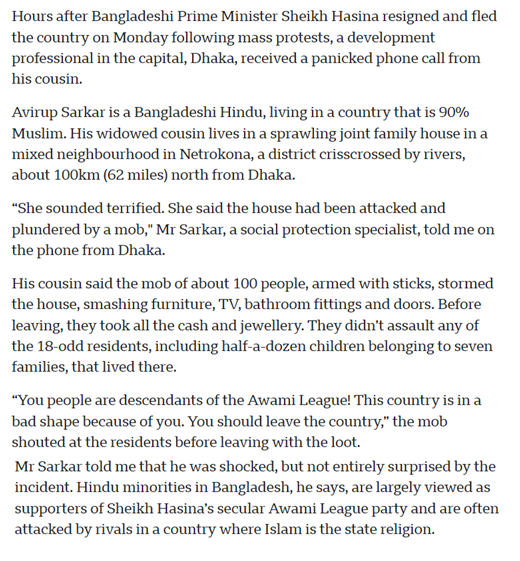
Some of them are now speaking publicly about what they believe went wrong. They are doing so from a Bangladesh that is strategically, institutionally, and economically worse positioned than the one they were trying to fix.
That is what Cloward-Piven produces when it succeeds. Not the world its participants marched for. The world that its architects meticulously designed and executed.
Two Questions and Civil Society Obligation
Civil society in India faces a specific obligation at this moment. That obligation is not comfortable, but it is unambiguous.
The obligation is to hold two things simultaneously.
- The examination failures are real and require urgent, structural, visible remediation.
- And the movement built around those failures has an organizational architecture, a funding structure, a handler layer, and a political beneficiary profile that have nothing to do with examination reform and everything to do with governance replacement on behalf of interests that are hostile to India's civilizational sovereignty.
Holding only the first thing makes civil society complicit in the manufactured crisis, whether or not that complicity is intended. Holding only the second thing destroys the credibility needed to be heard by the students whose legitimate anger is being weaponized against them.
The two questions that every responsible voice in India's public discourse needs to ask loudly and persistently are these.
- Who is paying for this movement? The social media infrastructure, the organizational backbone, the legal support, the content production, the international amplification, none of it is free. Follow the money. Apply FCRA scrutiny. Publish what it reveals. If the funding is clean and domestic, the public record will show that and the movement's organic legitimacy will be confirmed. If the funding has foreign or opaque sources, the public record will show that too, and the students will have the information they need to decide whether they want to continue as the fuel for someone else's political project.
- Who benefits when this government falls? Not the students. The examination infrastructure they need fixed can only be fixed by a government with the institutional authority and political will to impose zero-trust security requirements on a major national corporate champion. A government that comes to power through manufactured crisis owes its existence to the crisis-manufacturing architecture. It will not move against the networks that produced it. It will not impose security requirements on institutions those networks have penetrated. It will not complete the investigation into TCS Nashik or ask the data-access question that investigation has not yet publicly answered.
The students deserve to know this. The civil society voices they trust to speak truth need to tell them.
The REAL Examination
India's examination infrastructure failed its students. That failure must be fixed with urgency, structural depth, and public transparency about what went wrong and what is being changed.
India also faces a different kind of examination. One that does not have a scheduled date or a published syllabus but that will determine, with far greater consequence than any individual admission test, what kind of country India remains for the generation currently being failed by its testing infrastructure.
The Cloward-Piven doctrine has toppled governments in Cairo, Tripoli, Colombo, and Dhaka. It has been adapted for different cultural contexts, refined through six decades of application, enhanced by social media's capacity to scale manufactured consensus at speeds that institutional responses cannot match. It works by making the authentic wound indistinguishable from the political weapon that has been attached to it.
The antidote is not dismissal of the wound. The antidote is clarity about the weapon.
The students who are angry deserve better than to be the fuel for that project.
India's civil society, which exists precisely to make visible what power prefers to keep obscure, has an obligation to give them better.
The answer to that question is the examination that actually matters.