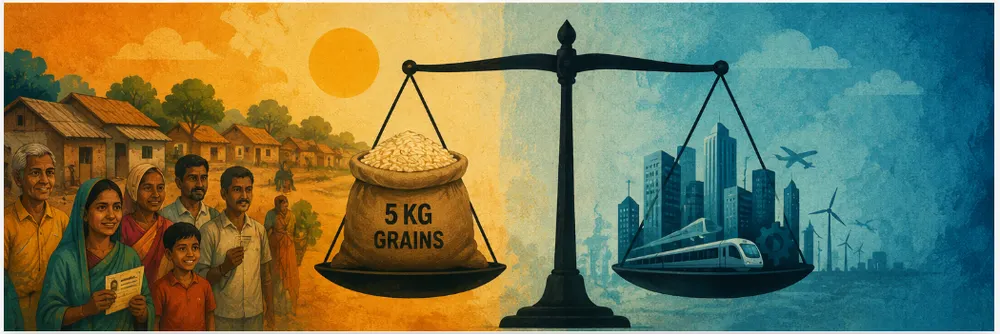
There is a particular species of argument that travels well on social media and dies quickly under scrutiny.
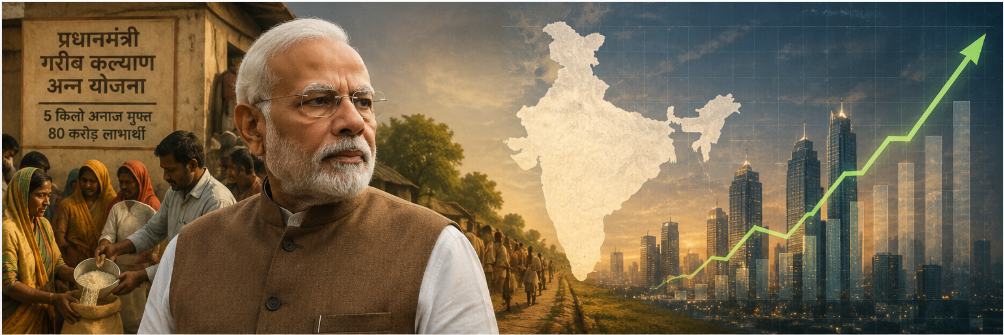
The line about the Modi government "still handing out 5 kg of grain to 80 crore people even though COVID is over" belongs squarely to this species.
It is delivered with a smirk, dressed up as fiscal common sense, and it assumes that the listener knows nothing about how India's food security architecture actually works.
Let us take that jibe apart carefully, because the people who repeat it are relying entirely on the audience not knowing three things:
- where the numbers come from,
- why the policy exists, and
- how India's welfare footprint actually compares to the rest of the world.
Once those three things are on the table, the jibe collapses.
What replaces it is a far more interesting picture:
The critics' arsenal
Before answering the charge, it is worth laying out honestly what the critics actually say, because they rarely say just one thing. The jibe about grain is usually the tip of a larger rhetorical iceberg, and the arguments underneath it fall into a few recognizable clusters.
- The first is the "the emergency is over" argument. COVID was a genuine shock, the reasoning goes, and emergency measures were justified during the pandemic. But the pandemic ended years ago. Why is the government still running what was sold as a temporary relief scheme? If it was temporary, end it. If it is permanent, then it was never really about COVID at all, and the government misled us.
- The second is the "freebie culture" argument, which has become a favored talking point in Indian political commentary. This frames free grain as part of a broader slide into what critics call the "revdi" or freebie economy, where governments buy votes with handouts, erode the incentive to work, and mortgage the country's fiscal future for electoral gain. In this telling, 80 crore people receiving free grain is not welfare. It is dependency engineered for political return.
- The third is the "we are supposed to be growing" argument, and this one deserves special attention because it is the most rhetorically potent. India is celebrated as the fastest growing major economy. It has crossed into the top five economies by absolute GDP. It talks of becoming a developed nation by 2047. So how, the critic asks, can a country making such spectacular progress still need to feed two thirds of its population? Either the progress is a mirage, or the handouts are unnecessary. You cannot have both a booming economy and 80 crore people who cannot buy their own food. The contradiction, they insist, exposes the hollowness of the growth story.
- The fourth is the "India is becoming socialist" argument, which is really an ideological charge rather than an economic one. The claim is that under Modi, despite the pro-market rhetoric and the reform-oriented image, India has quietly built a vast redistributive state. Between free grain, direct cash transfers, subsidized health insurance, free cooking gas connections, and housing schemes, the argument runs, India has drifted away from the liberalizing spirit of 1991 and toward a bloated welfarism that will eventually crush enterprise and productivity.
These four arguments are worth stating plainly because each contains a grain of a real question, and the answer is stronger when it engages the real question rather than the smirk attached to it.
The problem is that all four rest on foundations that turn out to be either wrong or badly incomplete.
Let us take them in the order that builds the strongest case: first the law, then the crisis layer, then the economic logic, and finally the comparative fiscal reality.
Where 80 crore and 5 kg actually come from
The single most important fact that the jibe conceals is this: the figure of roughly 80 crore beneficiaries and the entitlement of 5 kg per person per month were not invented by the Modi government. They are written into a law passed in 2013, a full year before Modi came to power. That law is the National Food Security Act, and understanding it is the whole game.
The NFSA of 2013 legally entitles up to 75 percent of the rural population and 50 percent of the urban population to subsidized food grains through the Targeted Public Distribution System. When you run those percentages against the population, using the Census of 2011, you arrive at roughly 81.35 crore people (Ministry of Consumer Affairs, Food and Public Distribution, PIB). This is not a target the government reaches toward. It is a statutory ceiling, a legal entitlement that the state is obligated to honor. The government's own reply in the Rajya Sabha put the entitlement question to rest in a single line:
"There is no change in the entitlement of foodgrains of beneficiaries under the Act." — Ministry of Consumer Affairs, Food and Public Distribution (PIB, February 2023)
So when every official press release refers to "about 80 crore beneficiaries," it is not quoting some arbitrary politically chosen number. It is quoting the coverage mandated by an Act of Parliament. The 80 crore figure is the NFSA figure. It exists on paper, in law, independent of any government's preferences. In practice, states have identified close to that ceiling, roughly 80.67 crore beneficiaries as of October 2024.
The 5 kg entitlement has the same origin. Under the NFSA, households classified as Priority Households are entitled to 5 kg of grain per person per month at highly subsidized prices, historically 3 rupees for rice, 2 rupees for wheat, and 1 rupee for coarse grains. The poorest of the poor, classified under the Antyodaya Anna Yojana, receive 35 kg of foodgrains per family per month. These entitlement levels are the statutory design of the food security system. They were legislated in 2013.
This matters enormously for the debate, because it reframes the entire question. The critic imagines a government waking up each month and deciding, out of political generosity or vote-buying calculation, to give away grain to 80 crore people. The reality is that the government is discharging a legal obligation created by the previous dispensation and endorsed across the political spectrum. To end the 5 kg for 80 crore, you would have to repeal or gut the National Food Security Act itself. No serious political actor in India, across any party, is proposing to do that, and for good reason, which we will come to.
What PMGKAY actually changed
If the NFSA already provided 5 kg to 80 crore people, then what exactly did the Modi government do? This is where the honest answer is more interesting than either the government's cheerleaders or its critics usually admit.
When COVID struck in early 2020, the government launched the Pradhan Mantri Garib Kalyan Anna Yojana, or PMGKAY. What PMGKAY did during the pandemic was doubling the ration. The scheme provided an additional 5 kg of free foodgrain per person per month, and this was, in the government's own description, over and above the normal quota provided under the NFSA at its subsidized rate. So for the acute pandemic period, a Priority Household member was receiving 10 kg per month, half at the old subsidized NFSA price and half entirely free.
That was the emergency layer, and it was genuinely an emergency layer. It responded to a specific crisis: hundreds of millions of informal-sector workers had lost their incomes overnight when the economy shut down, and the fastest way to prevent mass hunger was to push grain directly into households rather than wait for incomes to recover.
Then, from 2023 onward, the design shifted again. Rather than continuing to give double rations forever, the government consolidated the arrangement. In December 2022, the pandemic scheme was subsumed under the NFSA to provide free ration, and the core NFSA quota itself was made free. In other words, the 5 kg that had previously been sold at a subsidized price now costs the beneficiary nothing. The extra pandemic-era 5 kg was folded back, and what remains is the original NFSA entitlement of 5 kg per person, now at zero price, extended under the PMGKAY banner.
In November 2023, the Union Cabinet extended this arrangement for five more years, from January 2024 through December 2028, for about 81.35 crore beneficiaries at an estimated cost of 11.80 lakh crore rupees (PMIndia; PIB). The government framed it as a permanent food security commitment rather than a rolling emergency:
"PMGKAY: Amongst World's largest Food Security Schemes for 81.35 crore persons." — Prime Minister's Office (PMIndia, November 2023)
This is the crucial point that the "COVID is over" jibe misses entirely. The government did not simply keep the emergency double-ration running indefinitely. It rolled back the emergency top-up and instead converted the permanent, legally mandated NFSA entitlement into a free entitlement. What continues today is not a COVID relief measure that overstayed its welcome. It is the statutory food security floor of the country, with the price component removed. Conflating the two is either an error or a deliberate sleight of hand.
The real question: why feed two-thirds of a growing country?
Now we reach the argument that actually deserves a serious answer rather than a factual correction: how can a country growing this fast still need to guarantee food to two thirds of its people? This is where the critic feels most confident, and where the confidence is least justified.
Start with the arithmetic of scale that India's growth story tends to obscure.
India is a country of more than 1.4 billion people. Being the fifth largest economy by absolute GDP tells you about the total size of the pie. It tells you very little about the size of each person's slice.
On per capita terms, India remains a lower-middle-income country, ranked well outside the top hundred nations. A large economy in aggregate can coexist perfectly comfortably with very low incomes for the median citizen, and India is the textbook case of exactly that coexistence.
The mistake in the critic's reasoning is treating aggregate national growth and individual household security as the same thing.
They are not.
A capitalist economy in a high-growth phase generates enormous wealth, and it generates that wealth unevenly. The gains concentrate first among those who own capital, hold skills that the growth sectors demand, and sit in the geographies where investment lands.
The person at the bottom of the pyramid, the landless agricultural laborer, the informal construction worker, the domestic worker, the street vendor, participates in the growth story last and least. This is not a bug specific to India.
What growth does over time is lift the floor. But the lifting is slow, and it is uneven, and while it happens, there is a vast population living close enough to the margin that a single shock- a failed monsoon, an illness in the family, a lost job, a spike in food prices- can push them from precarious into destitute.
For that population, an assured monthly quantity of grain is the difference between a household that absorbs a shock and a household that goes hungry, pulls children out of school, sells assets, and falls into a poverty trap that takes years to climb out of.
This is why the food guarantee is best understood as insurance rather than charity, and as a floor rather than a ceiling. It does not make anyone prosperous. It ensures that the process of growth, which is genuinely lifting hundreds of millions over time, does not leave the most vulnerable to starve in the interim.
A government can simultaneously preside over the fastest-growing major economy and maintain a food security floor, because the two operate on completely different timescales. Growth compounds over decades. Hunger arrives in a week.
The evidence that this floor works is not theoretical. An International Monetary Fund working paper by Surjit Bhalla, Karan Bhasin, and Arvind Virmani, titled Pandemic, Poverty, and Inequality: Evidence from India, found that extreme poverty, measured as those living below the old benchmark of 1.90 dollars per day in purchasing-power terms, was as low as 0.8 percent in the pre-pandemic year 2019 and stayed there through 2020. The reason it did not spike, when every prediction said it should have, was the food guarantee. The authors are blunt about it:
"Food transfers were instrumental in ensuring that it remained at that low level." — Bhalla, Bhasin and Virmani, IMF Working Paper WP/22/69
Their own summary goes further, noting that the expansion of India's food subsidy program absorbed a major part of the pandemic shock, and that back-to-back low poverty rates suggested India had effectively eliminated extreme poverty in that measure.
This is a documented outcome from an IMF paper, not a government press release. The policy did precisely what a food floor is supposed to do, and it did it at the exact moment the market economy was least able to protect its most exposed participants.
The buffer stock logic that critics never mention
There is a second layer to the economic rationale that almost never appears in the freebie-culture critique, because it requires knowing how India's agricultural economy is actually structured. The food security system is not a standalone expenditure.
It is tightly bound to India's minimum support price and procurement regime, and the two only make sense together.
Every year, the government procures large quantities of wheat and rice from farmers at the Minimum Support Price, through the Food Corporation of India. This procurement exists primarily to protect farmers, guaranteeing them a floor price for their crop so that a good harvest does not collapse into ruinously low prices.
The result is that the FCI accumulates enormous stocks of grain. In many years these stocks run well above the buffer norms that the country actually needs to hold for security purposes.
The food distribution system converts this problem into a solution. By channeling a large share of procured grain into the PDS as free or subsidized rations, the government turns surplus stock that would otherwise degrade into direct nutrition for the poor.
The grain that would have rotted in an FCI godown instead feeds a household.
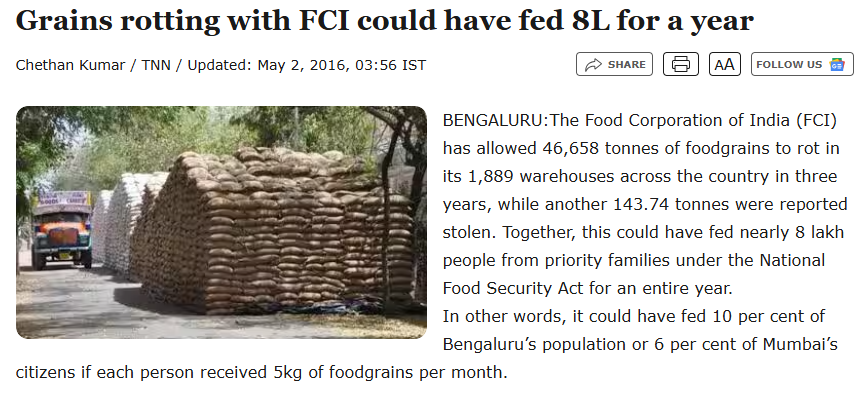
This is why, when critics point at the food subsidy line in the budget and gasp at its size, they are misreading what that number represents.
Because beneficiaries now pay nothing under PMGKAY, almost the entire economic cost- the MSP paid to farmers plus handling plus storage plus freight- shows up as "subsidy."
But a large part of that cost was going to be incurred anyway through procurement and storage. The food scheme reallocates money the system was already spending into actual consumption by the poor, rather than into warehouse losses.
So the honest framing of the policy is that it does three jobs at once. It protects farmers through assured procurement. It manages the resulting buffer stocks productively instead of letting them rot. And it delivers food security to the vulnerable.
The "5 kg to 80 crore" line is as much about the mechanics of MSP and stock management as it is about welfare optics. A critic who understands only the welfare optics is seeing one third of the picture.
The socialism jibe and the actual numbers
This brings us to the final and most ideologically loaded charge: that under Modi, India has become dangerously "socialist," that welfare has ballooned, that the redistributive state has grown fat. This is the charge that most rewards actually looking at the data, because the data says almost the exact opposite of the rhetoric.
Let us define terms cleanly. Public social spending, in the standard international sense, covers pensions, health, unemployment support, family benefits, and social assistance. Compared as a share of GDP, here is roughly where the major economies sit, using the OECD's latest figures.
Check the figures below.
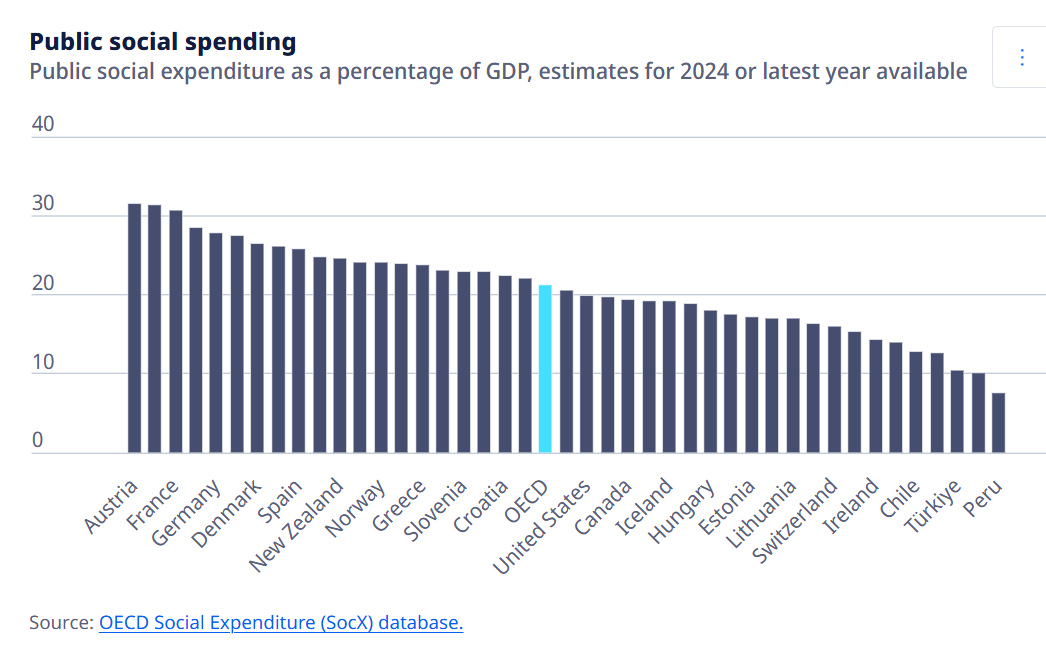
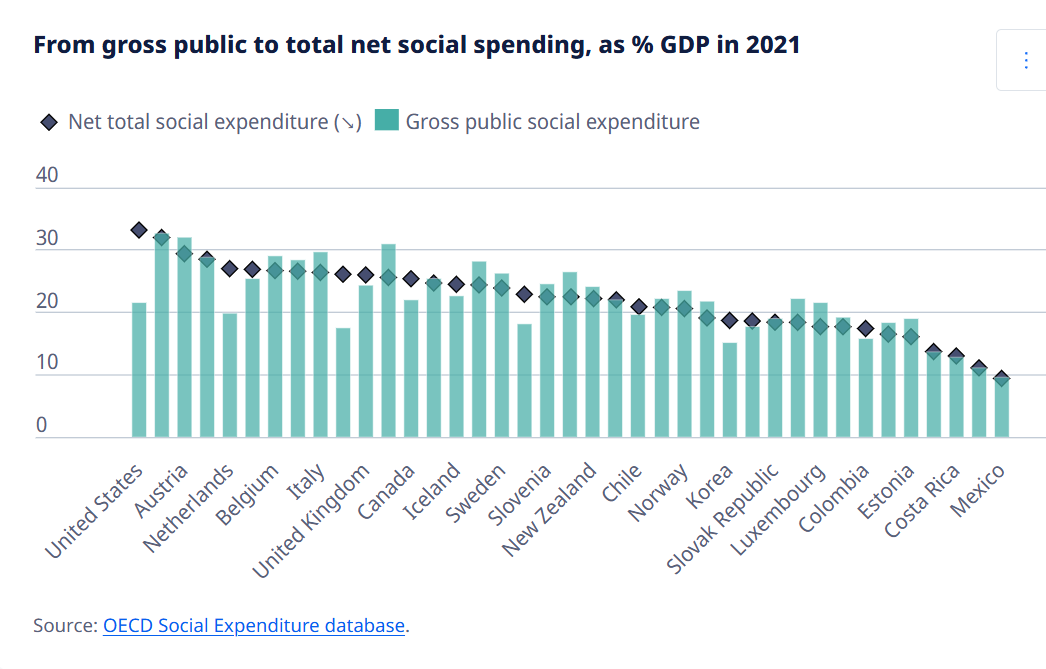
Source: OECD
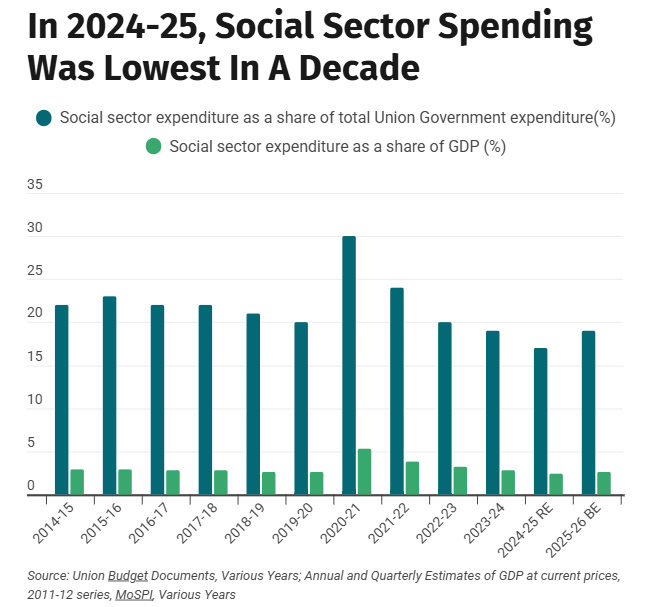
And India? India's combined central and state social sector spending, covering education, health, rural development, welfare, and nutrition, runs at roughly 2.5 to 3.5 percent of GDP in recent years. The central government's own social sector share averaged 2.8 percent of GDP through the pre-COVID Modi years.
Check the figure below.
The OECD's own dashboard frames the benchmark cleanly:
Public social expenditure "is worth about one-fifth of GDP on average across the OECD." — OECD Social Expenditure Dashboard
India, at 2.5 to 3.5 percent, is nowhere near that one-fifth benchmark. It is a fraction of it.
Now consider the same comparison as a share of each government's total budget, which is arguably the more relevant measure of how much a state prioritizes welfare within its own choices. In the big European welfare states, social protection is the single largest budget item, running to roughly half or more of all public spending in France, Germany, and Japan, and around 45 to 50 percent in the United Kingdom. Even the United States devotes around 40 to 45 percent of public spending to social programs once state and local outlays are included. China lands at roughly a quarter to a third of its budget.
India's social sector, by contrast, has ranged from about 19 to 26 percent of total general government expenditure over the past decade. In the financial year 2023-24, 26 percent of total general government expenditure went to the social sector, as per the Economic Survey 2024.
In the financial year 2023-24, 26% of total general government expenditure was spent on the social sector, as per the Economic Survey 2024. While states implement most social sector programmes, the Union government has been responsible for providing key social and public goods and ensuring a minimum standard of investment across states. (Source: Source: Budget 2025: Understanding social sector spending / IDR)
The union government's own share has been considerably lower and falling, as we will see. On both measures, share of GDP and share of budget, India runs one of the leanest social states among major economies on earth. The charge that India has "become socialist" under Modi does not merely lack support in the data. It is contradicted by the data on every axis one can measure.
Is Modi Government Socialist?
Given the visibility of the schemes and their direct targeting of the most vulnerable, another charge is being levied strongly.
The socialism charge implies a trajectory, a drift, a structural expansion of the redistributive state over time. So the fair test is to look at how India's social spending has actually evolved across decades, and whether the Modi years represent a surge.
The most careful decade-long accounting comes from analysts working off the Economic Survey data, synthesized by the Accountability Initiative and reported by IndiaSpend and IDR. Their headline finding is unambiguous:
"The share of social sector spending in total Union government expenditure has stagnated." — IndiaSpend / Accountability Initiative analysis, Budget 2025
The numbers behind that sentence tell the whole story.
As we saw in the IDR chart earlier, during 2014-15 to 2019-20, the union social sector averaged 21 percent of total expenditure and 2.8 percent of GDP. Through the COVID and recovery years from 2019-20 to 2024-25, the expenditure share stayed around 21 percent, while the GDP share averaged 3.3 percent, lifted by PMGKAY, the rural employment guarantee, and health spending.
The one genuine spike came in the pandemic year of 2020-21, when PMGKAY and MGNREGS expansions pushed social sector spending to an all-time high of 30 percent of total expenditure and 5.3 percent of GDP. That was emergency relief: free food, rural employment, health response. And it was rolled back exactly as an emergency measure should be. By 2023-24, the union social sector had fallen back to 19 percent of expenditure and 2.8 percent of GDP, marginally lower than the 2014-15 level.
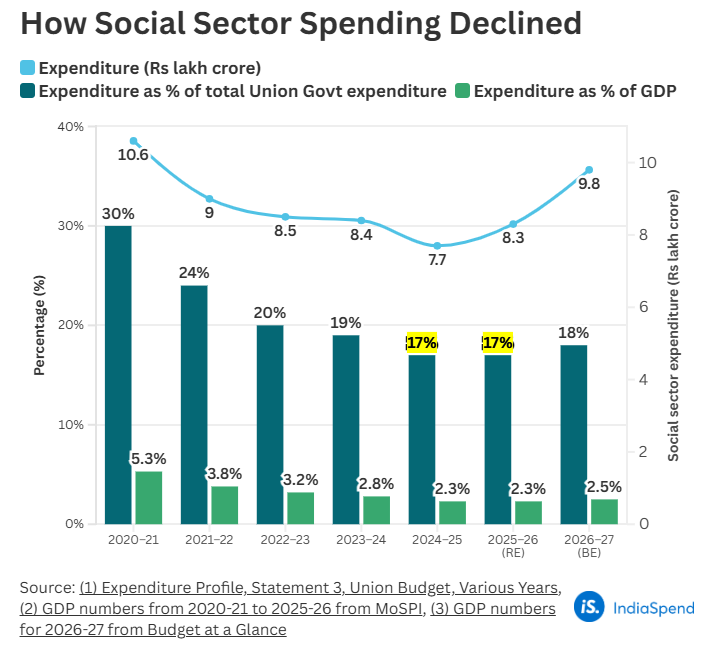
In 2024-25 it reached 17 percent of total expenditure, an all-time low in the decade, and the 2025-26 projection sits around 19 percent.
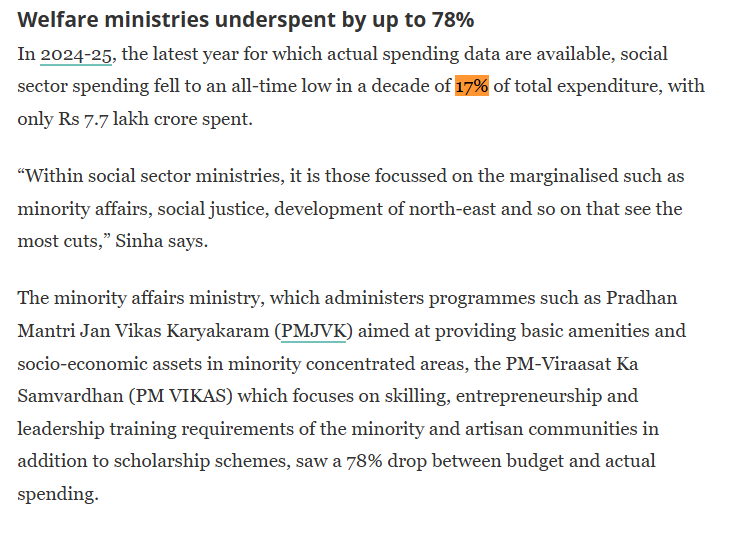
Compare this to the trajectory of the countries the critics implicitly invoke. The OECD records that across the founding member states, public social spending to GDP ratios more than doubled between 1960, at 7.9 percent, and 2000, at 17.9 percent, and reached about 20 percent by 2019. (Source: OECD)
Many of the large welfare states more than doubled their commitment over that span. China's social spending share of GDP doubled or more just since 2000, climbing from 3 to 4 percent to around 9 to 10 percent. These are what genuine social expansions look like in the data.
The honest, data-anchored conclusion is unavoidable. India has not become fiscally more socialist under Modi. The share of national resources devoted to social spending has grown only gradually over the long run, spiked once for a genuine emergency, and under the current government has largely stagnated or drifted slightly downward. The size of the social state, measured in the only way that is not rhetorical, which is money, remains small.
Then why the confusion?
It is worth being fair to the critics on one point, because the confusion has a real source. Something genuinely did change under Modi, and it is easy to mistake that change for a fiscal expansion.
The delivery mechanisms became digital, trackable, and branded. Citizens can now see the welfare state in a way they could not before, when subsidies leaked through opaque channels and much of the money never reached the intended household.
This visibility creates an optical illusion. Because welfare is now delivered directly, named clearly, and communicated aggressively, it feels vast. It feels like a state that has thrown itself into redistribution. But feeling and fiscal reality diverge sharply here. The same period that made welfare visible also saw its share of GDP and of the budget stay flat or fall.
Indeed, the growth rate of social sector spending itself slowed, from an average of 8 percent a year between 2014-15 and 2019-20 to just 4 percent between 2019-20 and 2024-25. What improved was the efficiency and targeting of a small social state, rather than the enlargement of it into a big one. (Source: Isignal)
So the accurate statement is layered.
Better plumbing is being mistaken for a bigger reservoir.
There is one more aspect that is complete missed but is backed by established scholarship in political economics.
Social Spending Rises with National Income
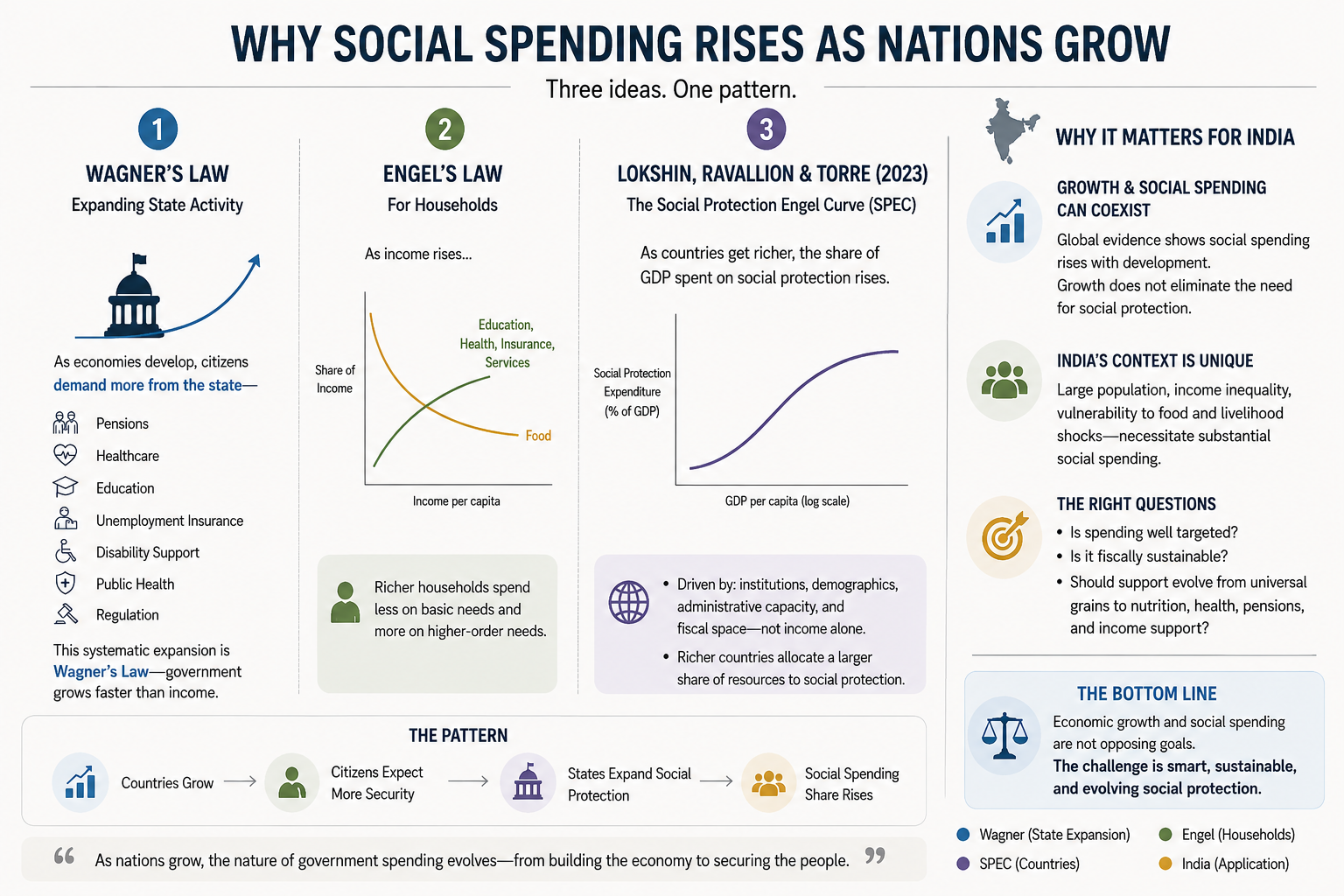
There is a reason the great welfare states of today were once lean administrative states preoccupied with roads, ports, and policing. As economies grow richer, social spending tends to rise, both in absolute terms and as a share of national income, and in mature economies it becomes the single largest thing the government does. This is one of the most durable regularities in public finance, and it rests on more than casual observation.
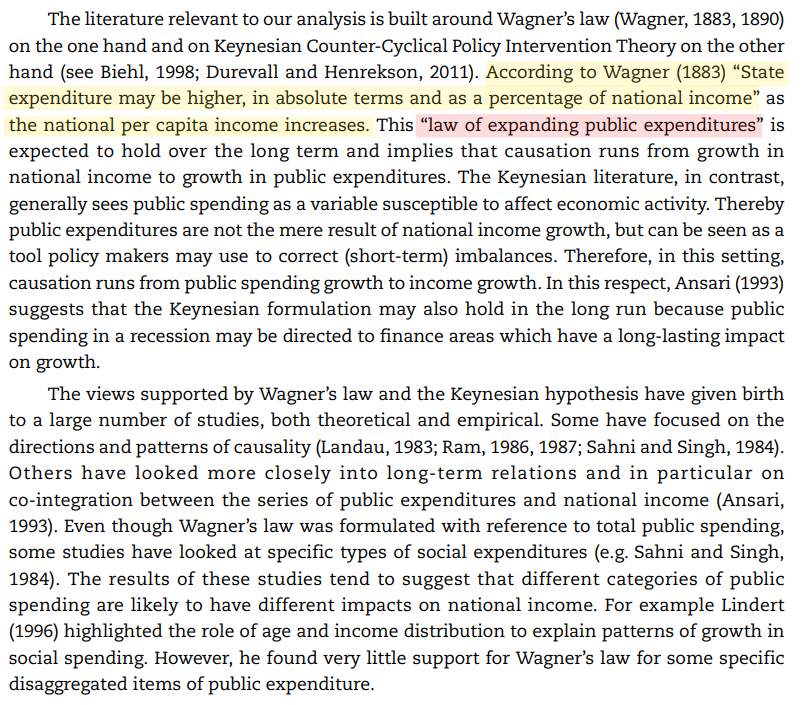
The oldest framework is Wagner's Law. Writing in the late nineteenth century, the German economist Adolph Wagner observed that as societies industrialize, public expenditure grows faster than national income, because citizens begin demanding things markets supply poorly: pensions, healthcare, education, and insurance against unemployment and disability. This systematic expansion of government responsibility is captured by Wagner's Law of Expanding State Activity.
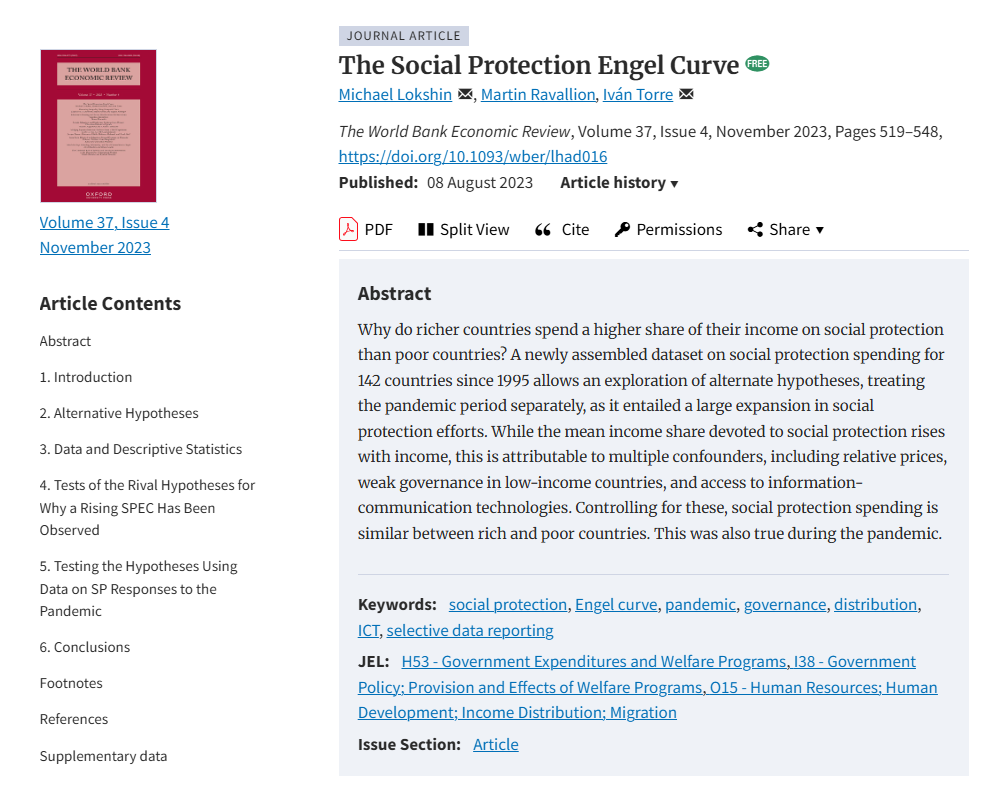
The modern restatement is the Social Protection Engel Curve. Just as richer households spend a smaller fraction of income on food and more on services, richer countries devote a larger share of national income to social protection.
The World Bank study behind this idea, covering 142 countries since 1995, confirms the descriptive pattern, while adding an important caveat: once relative prices, governance quality, and technology access are controlled for, spending looks similar across income levels, which suggests that growth itself, rather than a sudden appetite for welfare, drives the climb.
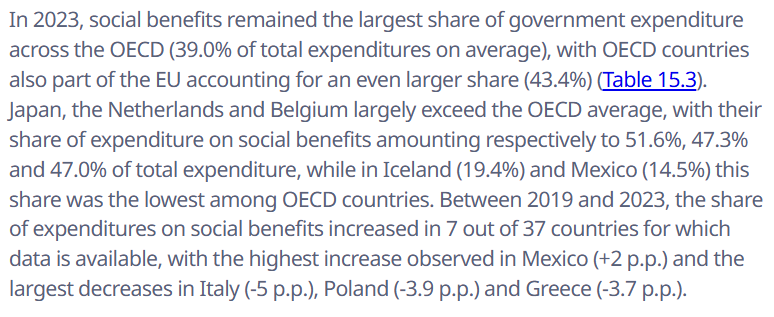
The budget-share evidence is starkest of all. Across the OECD in 2023, social benefits were the largest category of government spending, averaging about 43 percent of total expenditure, and rising to 51.6 percent in Japan, 47.3 percent in the Netherlands, and 47.0 percent in Belgium. Demography reinforces the trend: as fertility falls and populations age, pensions and healthcare consume ever more of the budget as a matter of arithmetic.
The lesson for India is direct. A rich country's welfare state is large because it grew rich, and India's is small because it is still, in per capita terms, a poor one. Growth and social spending are companions along a single curve, not opposites.
The answer, assembled
Return now to the original jibe: why is the government still giving 5 kg of grain to 80 crore people when COVID is over?
Having assembled the full picture, the answer is now obvious but let us articulate it in detail.
- First, the numbers are not a whim. The figure of 80 crore beneficiaries and the entitlement of 5 kg per person come directly from the National Food Security Act of 2013, a law passed before this government took office. This is a statutory obligation, not a discretionary handout. To end it, you would have to repeal India's food security law, which no serious political actor across the spectrum is willing to do.
- Second, what continues today is not the COVID emergency. The pandemic-era measure, the extra free 5 kg on top of the existing ration, was rolled back. What remains is the permanent legal entitlement, the original NFSA quota, with its price removed. The "COVID is over" objection is aimed at a policy that has already ended. The current policy is the country's ordinary food security floor.
- Third, the logic is sound precisely for a fast-growing capitalist economy. Aggregate growth and household security operate on different timescales. Market-led growth lifts the floor slowly and unevenly, and in the interim leaves a vast population one shock away from destitution. A food guarantee is the cheapest, fastest, most direct instrument to ensure that the growth process does not starve its most vulnerable participants along the way. The IMF's own working paper confirms it worked: extreme poverty did not spike during the worst income shock in living memory, because the food floor held.
- Fourth, the scheme is bound to the procurement and buffer stock regime. It converts surplus grain, which the state accumulates anyway to protect farmers and would otherwise pay to store and watch rot, into direct nutrition. The apparent size of the food subsidy line is largely a reallocation of costs the system was already incurring.
- And fifth, the charge that all this has made India socialist is refuted by every available number. India runs one of the leanest social states among major economies, spending a smaller share of both its GDP and its budget on welfare than the United States, China, and every European democracy. Over sixty years it has expanded its social commitment only modestly, while the countries the critics invoke doubled or tripled theirs. What changed under Modi was the visibility and efficiency of a small social state, mistaken by the inattentive for the growth of a large one.
That surplus grain cannot simply be left to rot. And that India's welfare footprint is modest by global standards.
Once those facts are restored, the punchline disappears.
References
National Food Security Act, 2013: coverage and entitlements
- Ministry of Consumer Affairs, Food and Public Distribution, Rajya Sabha reply, Press Information Bureau, February 2023 (75 percent rural and 50 percent urban coverage, about 81.35 crore persons at Census 2011; 5 kg per person per month for Priority Households; 35 kg per family for AAY; free grain under NFSA from January 2023). https://www.pib.gov.in/PressReleaseIframePage.aspx?PRID=1897933
- "Nation Food Security Act provides coverage of 75 pc rural, 50 pc urban population," ThePrint / ANI, February 2023. https://theprint.in/india/nation-food-security-act-provides-coverage-of-75-pc-rural-50-pc-urban-population/1366046/
- National Food Security Act, 2013 overview (statutory backing, roughly two-thirds coverage, ~80.67 crore beneficiaries as of October 2024). https://grokipedia.com/page/National_Food_Security_Act,_2013
PMGKAY: pandemic top-up, consolidation, and five-year extension
- "Free Foodgrains for 81.35 crore beneficiaries for five years: Cabinet Decision," Prime Minister's Office. https://www.pmindia.gov.in/en/news_updates/free-foodgrains-for-81-35-crore-beneficiaries-for-five-years-cabinet-decision/
- Cabinet decision on PMGKAY five-year extension, Press Information Bureau, November 2023 (81.35 crore beneficiaries, ~Rs 11.80 lakh crore over five years from 1 January 2024). https://www.pib.gov.in/PressReleasePage.aspx?PRID=1980689
- "Cabinet extends free foodgrains scheme for 5 years," Business Standard, November 2023 (PMGKAY history: additional 5 kg over NFSA quota during COVID; subsumed under NFSA in December 2022; extension through December 2028). https://www.business-standard.com/economy/news/cabinet-extends-free-foodgrains-scheme-for-5-years-starting-jan-1-2024-123112900801_1.html
Poverty and the food floor
- Surjit Bhalla, Karan Bhasin, and Arvind Virmani, "Pandemic, Poverty, and Inequality: Evidence from India," IMF Working Paper WP/22/69, April 2022 (extreme poverty 0.8 percent in 2019, held there through 2020 by food transfers; food subsidy absorbed a major part of the pandemic shock). Landing page: https://www.imf.org/en/publications/wp/issues/2022/04/05/pandemic-poverty-and-inequality-evidence-from-india-516155 | Full paper (PDF): https://www.imf.org/-/media/files/publications/wp/2022/english/wpiea2022069-print-pdf.pdf
India's social sector spending over the decade
- "Budget 2025: Four Key Trends in Union Govt's Social Sector Expenditure," IndiaSpend / Accountability Initiative, February 2025 (21 percent of expenditure and 2.8 percent of GDP in 2014-15 to 2019-20; 30 percent and 5.3 percent of GDP in 2020-21; growth slowing from 8 to 4 percent a year). https://www.indiaspend.com/budget/budget2025-four-key-trends-in-union-govts-social-sector-expenditure-940524
- "Budget 2025: Understanding social sector spending," India Development Review (IDR). https://idronline.org/article/advocacy-government/budget-2025-understanding-social-sector-spending/
- "Budget 2026: Big schemes, bigger gaps in social spending," IDR, February 2026 (17 percent of total expenditure in 2024-25, a decade low). https://idronline.org/article/advocacy-government/budget-2026-big-schemes-bigger-gaps-in-social-spending/
- "Budget 2025: Four Trends in Social Sector Spending," The Wire (26 percent of total general government expenditure on social sector in FY 2023-24, per Economic Survey 2024). https://m.thewire.in/article/economy/budget-2025-four-trends-social-sector-spending
- "10 Years of Social Sector Spending," Accountability Initiative (PDF). https://accountabilityindia.in/wp-content/uploads/2023/10/10-Years-of-Social-Sector-Spending.pdf
International comparison of social spending
- "Social spending," OECD (public social spending just over 30 percent of GDP in Austria, Finland, and France in 2024; OECD ratios more than doubled from 7.9 percent in 1960 to 17.9 percent in 2000). https://www.oecd.org/en/topics/sub-issues/social-spending.html
- "Social spending: Society at a Glance 2024," OECD (France the biggest social spender at about 30 percent of GDP). https://www.oecd.org/en/publications/society-at-a-glance-2024_918d8db3-en/full-report/social-spending_d72b8d7b.html
- OECD Social Expenditure Dashboard (public social expenditure about one-fifth of GDP on average across the OECD). https://www.oecd.org/en/data/dashboards/social-expenditure-dashboard.html
- "Sizing up Welfare States: How do OECD countries compare?" OECD Statistics blog, February 2023 (long-run expansion and cross-country budget composition). https://oecdstatistics.blog/2023/02/02/sizing-up-welfare-states-how-do-oecd-countries-compare/