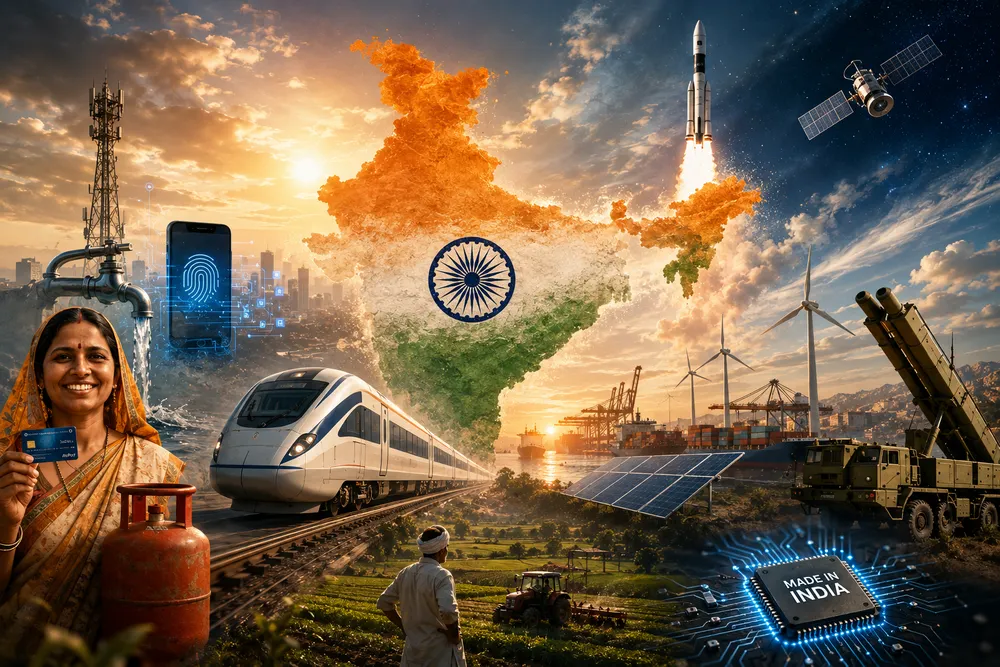
The Twelve Winters
A traveler asked the fort's keeper why he climbed the ramparts each year to speak.
"In the first winters," the keeper said, "the village had no wells, no lamps, no roofs that held the rain. So I spoke of wells and lamps and roofs. The people laughed that a keeper should trouble himself with such small things."
"And then?"
"When the wells were dug, the people no longer thirsted for water. They thirsted for the road beyond the hill. So I spoke of roads, and taught them to want the horizon."
"And then?"
"A village that wants the horizon must learn to walk on its own feet. So I spoke of strength. We forged our own tools. We stopped buying from merchants who smiled while raising their prices."
The traveler looked down at the valley, where storms gathered and distant kingdoms hoarded fire and grain, turning even these into weapons.
"The merchants have closed the roads," the traveler said. "The season of open trade has ended."
"I know," said the keeper. "That is why I no longer speak of wells. A village that can feed itself, light itself, and defend itself owes nothing to the storm. Dependence is the only true poverty."
"Twelve winters for one lesson?"
The keeper smiled. "The lesson was never about wells, or roads, or tools. It was about a village learning that it could stand. First they needed. Then they wanted. Then they could. Now they are."
He turned toward the mountain. "Tomorrow, we climb higher."
Words and Their Meanings: Modi Speeches
For some, words are mere words. Some are spoken to dazzle, some to deceive, and some to share personal biases.
For some people, words measure the internal compass and commitment to what is to come.
In the hands of such people, words are more than instruments of communication; they give vision a shape that people can understand, trust, and carry forward.
For leaders, the right words transform uncertainty into purpose and hardship into a shared test of conviction. But words matter most when they are joined by an unrelenting will to act.
A vision spoken without execution remains an aspiration; a vision pursued in the face of resistance becomes a legacy.
Leaders who endure challenges do not use language merely to inspire applause—they use it to build resolve, clarify priorities, and summon courage. Their words become meaningful because their actions repeatedly prove that they mean them.
For decades after Independence, India was governed largely as a country whose limitations had to be managed.
Poverty had to be alleviated. Shortages had to be distributed. Infrastructure would come eventually. Technology would be imported. Defense equipment would be purchased. The poor would wait for the state to reach them. And India's ambitions would remain calibrated to what a developing country was supposedly entitled to expect.
Narendra Modi changed that grammar in the nation's daily discourse.
His most consequential achievement may not be any single highway, bank account, toilet, missile, digital platform or welfare scheme. It is that he changed the operating ambition of the Indian state.
He began, remarkably, at the bottom.
In 2014, from the Red Fort, Modi spoke not in abstractions but about toilets, bank accounts, sanitation, electricity and manufacturing. The subjects seemed almost mundane. But underneath them was a radical proposition: scale was not an excuse for failure. Scale was India's advantage.
And then came execution.
Hundreds of millions entered the banking system. Welfare moved directly into accounts. Villages were electrified. Toilets, cooking gas, tap water and housing became measurable missions rather than permanent promises. Digital public infrastructure turned a supposedly administratively ungovernable population into one capable of executing transactions at extraordinary scale.
Then the ambition changed.
The conversation moved from toilets to semiconductors. From financial inclusion to digital sovereignty. From importing weapons to exporting them. From roads to integrated logistics. From energy access to energy security. From India's poverty to India's power.
That progression is the real Modi story.
Nehru sought to build the Republic, often disregarding the country's soul. Even when millions were in pain, their lost lives were not the biggest concern. A nation built on borrowed principles and ideas was the main worry.
Indira Gandhi concentrated India's political power. Manmohan Singh later spoke borrowed words from the ramparts as the Prime Minister he never was.
Modi has attempted something different: to convert India's enormous demographic, economic and civilizational scale into national capability.
India must possess the capacity to act.
And perhaps that is the most fundamental change Modi brought to India.
He did not merely ask Indians to imagine a more prosperous country.
He asked India to stop thinking like a country that needed permission to become powerful.
Here is a table with links of texts of all the speeches that Indian PM Modi has made over the last 12 years.
| Year | Independence Day | Official transcript |
|---|---|---|
| 2015 | 69th | Read the speech |
| 2016 | 70th | Read the speech |
| 2017 | 71st | Official Independence Day archive |
| 2018 | 72nd | Official Independence Day archive |
| 2019 | 73rd | Read the speech |
| 2020 | 74th | Official Independence Day archive |
| 2021 | 75th | Official Independence Day archive |
| 2022 | 76th | Read the speech |
| 2023 | 77th | Read the speech |
| 2024 | 78th | Read the speech |
| 2025 | 79th | Read the speech |
| 2026 | 80th | Read the speech |
With this, let us begin to understand PM Modi, his manner of being and his working frameworks, using his speeches. Whether they were a chronicle and even a harbinger of our times.
Please do watch our commentary (and share with your friends and family) on the oft-repeated charge against India under Modi: that Democracy is sliding. Is it really? We look at it in detail.
Why the speech is a document worth reading closely
The Independence Day address from the ramparts of the Red Fort is one of the few fixed instruments in Indian statecraft. It clears no cabinet, faces no interlocutor, and in Modi's case is delivered without a teleprompter to the largest single audience a serving prime minister can command. It is, in effect, an annual state of the nation delivered as personal testament, and its author knows it.
For Narendra Modi, the address has functioned as more than a ritual.
Across thirteen consecutive speeches from 2014 to 2026 it has served as an announcement platform, a preview of intent, a place to reset the timeline of ambition, and increasingly a stage from which to project a theory of national power outward to the world.
Read in sequence, the speeches trace a clear intellectual migration.
The early years are about needs: sanitation, bank accounts, electricity, toilets. The middle years shift to aspirations: a New India, defined milestones, welfare saturation. The later years move to power: self-reliance reframed as strategic autonomy, development reframed as leverage, and finally, in 2026, an explicit declaration that the age of globalization has ended and that sovereign capability is the only durable currency in the international order.
Today we try to examine the progress of Modi's speeches as the country and the society evolved over the years.
The chronology in four phases
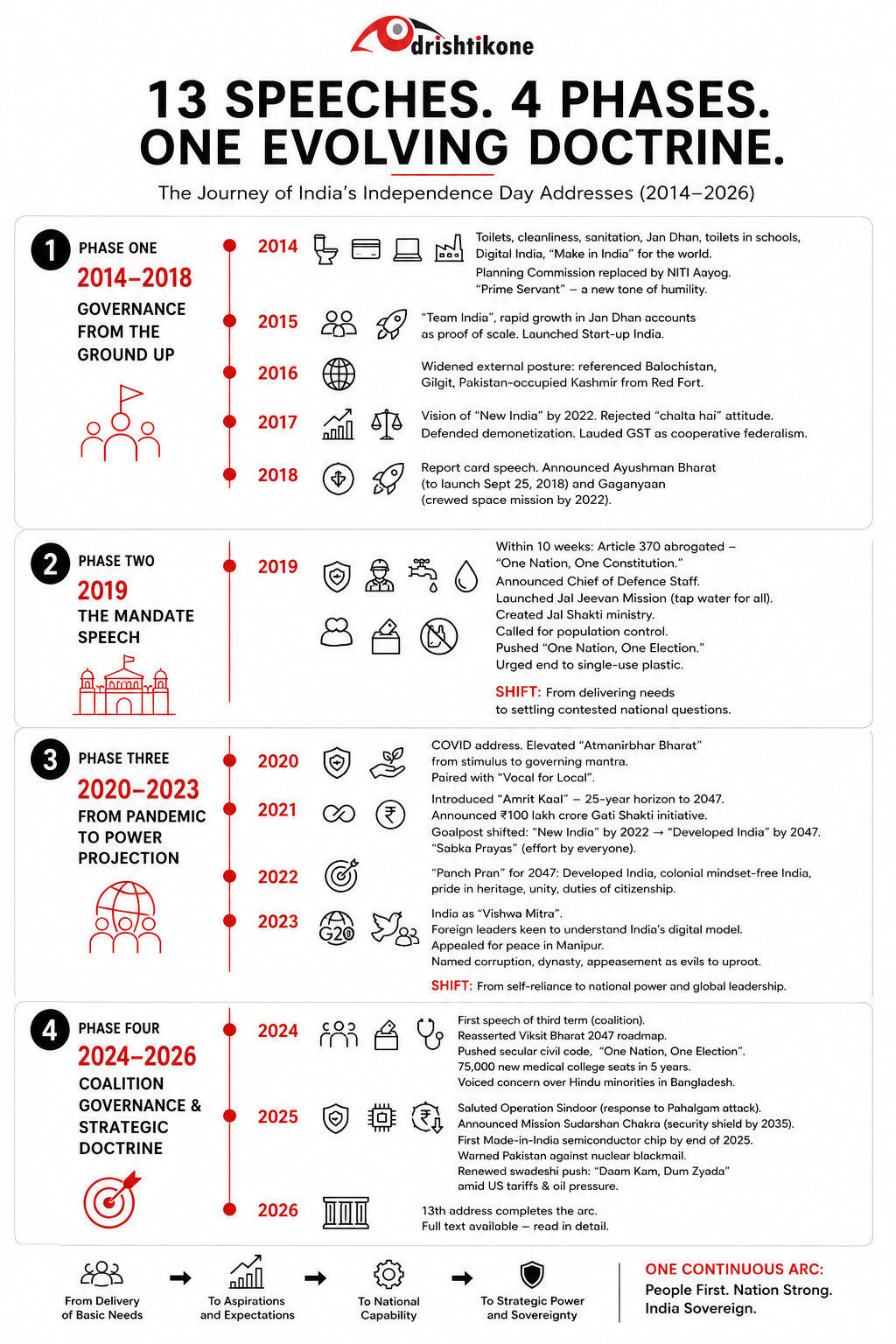
After going through the entire lot, we believe that the thirteen speeches are best grouped into four phases, each defined by a shift in what the address was trying to accomplish.
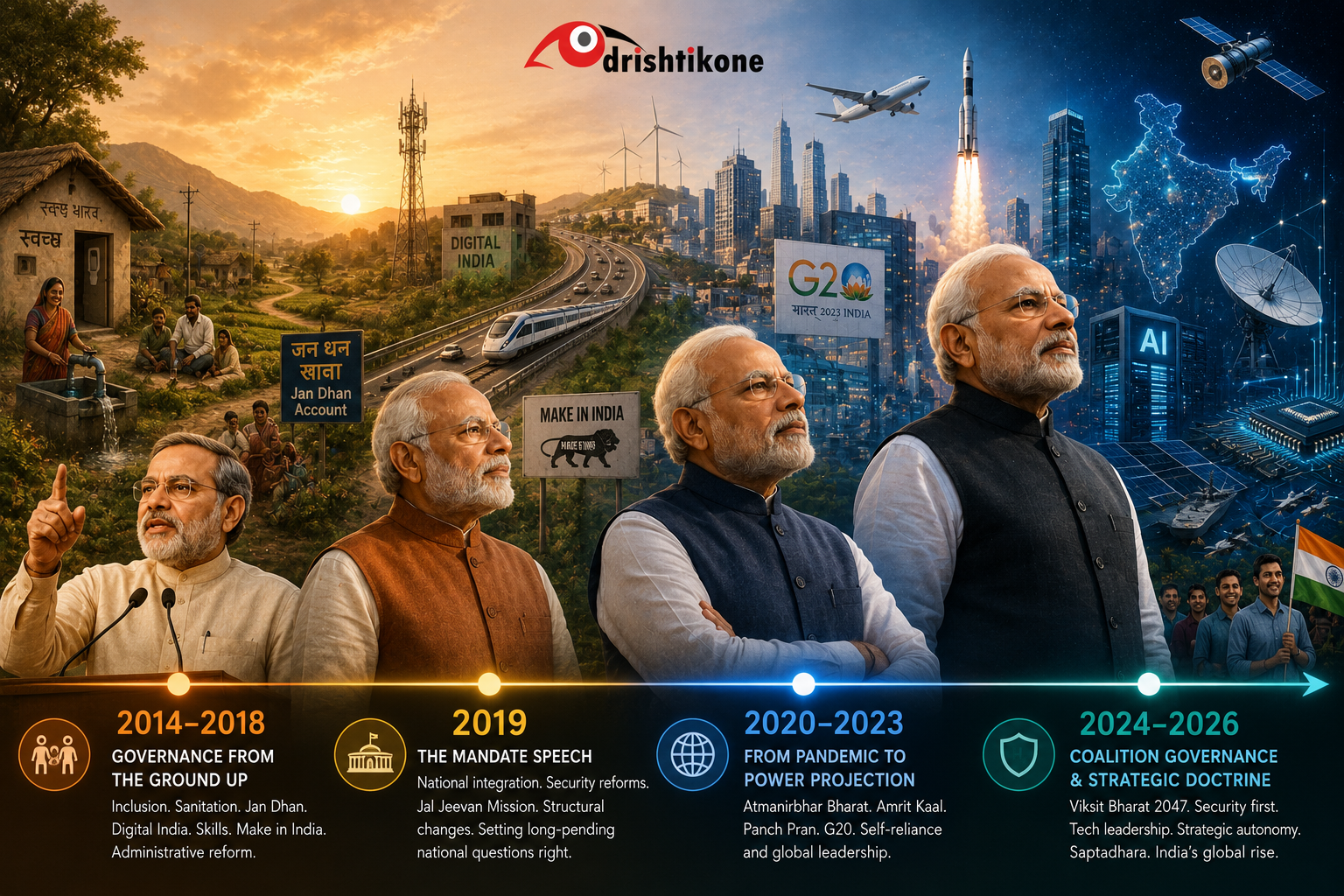
Phase one, 2014 to 2018: governance from the ground up: Modi's first speech in 2014 was striking for how small its declared subjects were. He spoke of toilets, cleanliness, and sanitation, announced the Pradhan Mantri Jan Dhan Yojana for financial inclusion, promised toilets in schools, laid out Digital India, and called on global manufacturers to "Come, Make in India."
He announced that the Planning Commission, a Nehru-era body, would be replaced by NITI Aayog. He described himself that day as the "prime servant" rather than the prime minister, a studied humility that broke from the loftier register of his predecessors. The pitch was governance from the base of the pyramid: inclusion, sanitation, skills, manufacturing, administrative reform.
The 2015 address leaned on "Team India" and pointed to the rapid growth of Jan Dhan accounts as proof that delivery was possible at scale, and it launched Start-up India into public consciousness.
By 2016, in his third address, Modi widened his external posture, referencing Balochistan, Gilgit, and Pakistan-occupied Kashmir from the Red Fort for the first time, weeks before the September 2016 cross-border strikes. The 2017 speech set out to build a "New India" by 2022, framed around a rejection of the "chalta hai" attitude, the resigned acceptance of things as they are, and folded in a defense of demonetization and a presentation of the Goods and Services Tax as a triumph of cooperative federalism.
The 2018 speech, his last before re-election, was crafted as a report card, headlined by Ayushman Bharat, the health insurance scheme he promised to launch on September 25 of that year, and Gaganyaan, a commitment to a crewed space mission by 2022.
Phase two, 2019: the mandate speech: The 2019 address followed a larger electoral mandate, and Modi used it to signal that the second term would resolve long-pending questions. Within ten weeks of returning to power, he noted, the government had abrogated Article 370, which he pitched from the Red Fort as the realization of "One Nation, One Constitution."
He announced the post of Chief of Defense Staff to integrate the three services, a structural reform debated since the Kargil conflict, launched the Jal Jeevan Mission to pipe drinking water to every household, created a Jal Shakti ministry, called for checking a "population explosion," pushed "one nation, one election," and urged an end to single-use plastic.
The register had shifted from delivering needs to settling contested national questions.
Phase three, 2020 to 2023: from pandemic to power projection: This is the phase in which the speeches turned decisively toward self-reliance and national power. The 2020 COVID address, examined in detail below, elevated "Atmanirbhar Bharat" from a stimulus slogan into a governing mantra and paired it with "Vocal for Local."
The 2021 address, delivered as India entered the seventy-fifth year of independence, introduced "Amrit Kaal," a twenty-five-year horizon to 2047, and announced the 100 lakh crore rupee Gati Shakti initiative.
It also quietly moved the goalpost: the "New India" promised for 2022 in the 2017 speech became a "developed India" for 2047, a shift of a full quarter-century that the prime minister did not explain, with "Sabka Prayas," effort by everyone, added as the operative principle.
The 2022 speech gave the framework its most memorable form, the "Panch Pran," five pledges for the road to 2047: a developed India, the shedding of every trace of a colonial mindset, pride in heritage, the strength of unity, and the duties of citizenship.
By 2023, with India hosting the G20, the external frame was explicit. Modi described India as "Vishwa Mitra," a friend to the world, reported that foreign leaders wanted to understand India's digital model, appealed for peace in Manipur, and named corruption, dynasty, and appeasement as the evils to be uprooted.
Phase four, 2024 to 2026: coalition governance and strategic doctrine: The 2024 address was the first of Modi's third term, delivered after an election that returned him at the head of a coalition.
At ninety-eight minutes, it was his longest to that point, and it reasserted the Viksit Bharat 2047 roadmap while pushing for a "secular civil code" in place of what he called a communal one, for "one nation, one election," and for 75,000 additional medical college seats over five years, and it voiced concern over the safety of Hindu minorities amid instability in Bangladesh.
The 2025 address was dominated by security. Modi saluted Operation Sindoor, India's military response to the April 2025 Pahalgam terror attack, presenting it as proof that indigenous weapons let India act without foreign dependence.
He announced Mission Sudarshan Chakra, a national security shield to be built by 2035, declared that India's first Made-in-India semiconductor chip would reach the market by the end of 2025, warned Pakistan against nuclear blackmail, and, against United States tariff pressure and demands that India stop buying Russian oil, renewed a swadeshi push under the slogan "Daam Kam, Dum Zyada," meaning lower price and greater strength.
The 2026 address, the thirteenth, completes the arc, and because its full text is now available, it can be read directly rather than through summary. That reading follows.
Did the speeches preview what he would do?
The record supports a qualified but strong yes. The Independence Day speech under Modi has functioned as a genuine announcement platform, and a striking share of its headline commitments translated into policy or institutional change.
The clearest cases are the ones where the speech named a scheme that then launched on schedule.
The 2025 promise of a Made-in-India semiconductor chip by year-end is claimed to have been delivered in the 2026 speech, where Modi reports that three semiconductor plants are running and production is already being exported.
There is also a category of long-horizon previews that matured slowly. Make in India, introduced in 2014, grew over a decade into the production-linked incentive schemes and the semiconductor push. The self-reliance theme, first sounded in 2014 in the context of national security and Digital India, became the defining doctrine of the 2020s.
The record also requires a distinction between direction, delivery and deadlines. Modi's 2017 vision of a "New India" by 2022 combined specific developmental targets with much larger national aspirations: housing and electricity for every family, doubling farmers' incomes, and an India increasingly free from terrorism, communalism, casteism, corruption and nepotism.
Beginning in 2021, Modi placed India's next stage of transformation within a much longer horizon: Amrit Kaal, the twenty-five years leading to the centenary of Independence in 2047, with Viksit Bharat (a developed India) as its destination.
This was not simply the 2022 program with its deadline shifted by twenty-five years. It represented a considerably broader conception of national transformation, increasingly centered on infrastructure, industrial capacity, technological sovereignty, defense capability, energy security and India's position in the world.
There is nevertheless a legitimate accountability question embedded in this evolution. Modi has repeatedly used ambitious targets and compressed timelines as instruments to mobilize government machinery and raise expectations.
That method can accelerate execution, but it also requires the original benchmarks to remain visible. The appropriate measure of the record is therefore not whether every sweeping aspiration was "completed," nor whether every unfinished ambition can simply be subsumed into 2047.
It is more exacting: What was promised? What was delivered? What materially improved but missed its deadline? What remains unfinished?
On that test, Modi's Independence Day speeches reveal both an unusually strong relationship between declared intent and subsequent government action, particularly for specific programs and institutional reforms, and a recurring tendency to set transformational ambitions whose timelines prove more elastic than the rhetoric announcing them.
The forecasting was reliable at the level of specific schemes and institutions and negotiable at the level of civilizational endpoints. Shekhar Iyer's analysis) framed this candidly: Modi himself quoted statistics across sectors, and then conceded, in Iyer's paraphrase, that India had reached neither its full potential nor the pace it should have.
The 2026 address comes off as a report card that grades itself honestly on pace even as it insists on direction that is indeed critical.
From Delivery to Power: How Modi's Independence Day Doctrine Changed
The most revealing way to read Narendra Modi's Independence Day speeches is not as thirteen separate political addresses, but as a single evolving argument about what India must become.
The vocabulary changes. The targets change. The scale changes. But more importantly, the conception of the Indian state changes.
Modi's first Red Fort speeches were strikingly grounded in problems that seemed almost too ordinary for the ceremonial grandeur of Independence Day: toilets, bank accounts, sanitation, electricity, skills, manufacturing and administrative delivery. By the middle of his tenure, the language had moved toward aspiration—New India, infrastructure, entrepreneurship, national integration and increasingly ambitious deadlines. After COVID-19 came another transformation: Atmanirbhar Bharat, strategic autonomy, domestic manufacturing, supply chain resilience, and technological capability.
By the middle of the 2020s, the vocabulary had expanded again—to semiconductors, artificial intelligence, critical minerals, nuclear power, defense production, space, cyber resilience and sovereign industrial capacity.
That evolution is not merely rhetorical. It describes an increasingly expansive theory of national power.
The underlying proposition appears to be this: political independence is incomplete if a country remains structurally dependent upon others for the technologies, energy, weapons, industrial components, financial infrastructure, or supply chains without which a modern state cannot function.
Seen this way, Modi's Red Fort speeches move through three broad stages:
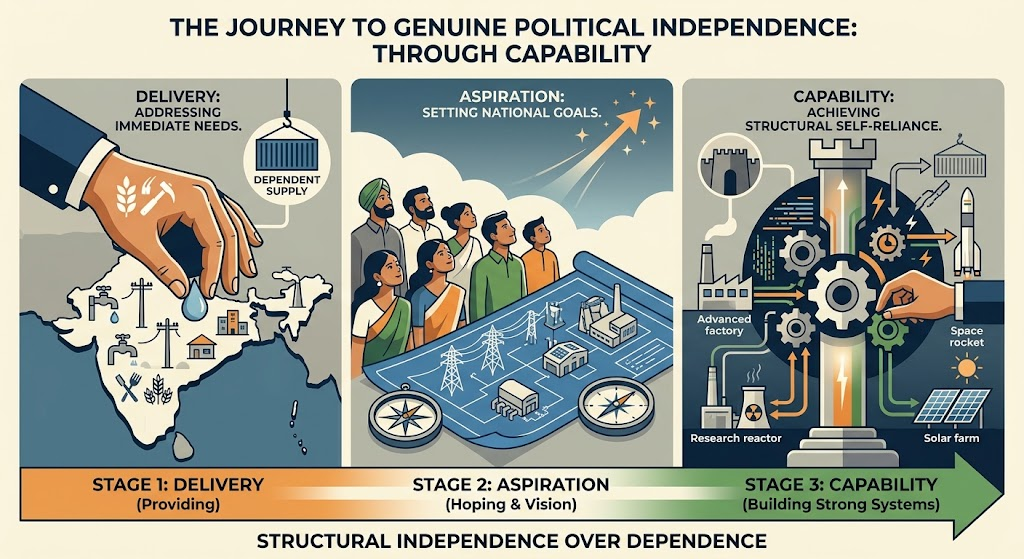
And capability ultimately becomes the foundation of sovereignty.
1. The first revolution was deliberately mundane: make the state work
Modi's 2014 address began unusually close to the ground. Jan Dhan, toilets, Skill India, Digital India and "Come, Make in India" sat alongside administrative reform. The official account of that speech records the announcement of universal banking access, a national skills movement, digital infrastructure and an invitation to manufacturers to produce in India.
This mattered because the initial Modi proposition was not principally ideological. It was administrative:
The subsequent speeches repeatedly returned to measurable delivery. In 2015, Modi reported 17 crore Jan Dhan accounts and emphasized direct transfers and the elimination of intermediaries. By 2016, he was pointing to 21 crore people brought into the Jan Dhan scheme, more than two crore toilets constructed, and 10,000 of the roughly 18,000 targeted unelectrified villages having received electricity.
The political significance went beyond those individual schemes.
For decades, India's enormous population had often been presented as an explanation for administrative failure: India was too large, too poor, too diverse and too institutionally complicated for universal provision to happen quickly. Modi increasingly inverted that argument. Scale became something to organize, digitize and mobilize.
That is why Jan Dhan, Aadhaar-linked delivery, mobile connectivity, and, later, India's digital public infrastructure mattered beyond welfare.
They began creating the administrative architecture through which a continental-scale state could identify, transact with, and deliver benefits directly to hundreds of millions of people.
2. From necessities to expectations: the politics of aspiration
Once the fundamental mechanisms of basic service delivery were secured, anchoring the nation’s political foundation, the entire axis of Prime Minister Modi’s discourse shifted.
It was a bold move from barely surviving to reaching for massive goals.
This movement marked the irrevocable tipping point where developmental politics ruptured its own historical constraints, transitioning from the patronizing metrics of pity to the vibrant dynamics of desire.
Historically, developmental politics was defined by a single, deficit-oriented question: "What does the poor citizen lack?"
This outdated model kept the citizen passive, portraying them as a beneficiary perpetually waiting for governmental salvation to arrive through a spreadsheet of distributed commodities.
Aspirational politics has obliterated that dependency.
It poses a modern, respect-based question: "What does the rising citizen now expect?"
The distinction is not merely rhetorical; it is transformative. The citizen increasingly portrayed in recent years is not a supplicant holding out a hand, but a dynamic, impatient stakeholder demanding a world-class environment in which to compete. This rising Indian is no longer satisfied with mere electricity; they require total digital integration and a seamless financial ecosystem that fosters audacious entrepreneurship. They don’t just hope for a road; they expect high-speed, global-standard connectivity and transportation networks that collapse time and space.
This internal metamorphosis of the Indian persona from stagnant to dynamic was visually captured by the deliberate transition from the pragmatic structure of "Team India" to the visionary vitality of "New India."
The former represented the painstaking work of aligning forces toward a baseline; the latter is the active pursuit of global primacy.
Crucially, this entire vision was powered by an unrelenting cultural purge: a systematic, deliberate assault on the insidious "chalta hai" mentality.
This was more than a change in rhetoric; it was a refusal to accept the paralytic idea that mediocrity was India’s destiny.
It was a declared war on the complacent acceptance that Indian systems were fated to be inevitably slower, dirtier, or less efficient than those elsewhere.
By attacking "chalta hai," the new discourse affirmed that global quality was not a luxury for other nations, but a right for the Indian people.
By 2019, the scope expanded further. Modi's Independence Day address was no longer principally a catalog of welfare initiatives.
Article 370 had just been abrogated; Modi defended "One Nation, One Constitution."
He announced the creation of the Chief of Defense Staff, pushed the Jal Jeevan Mission, and spoke about deeper structural questions of national integration.
Something important had changed.
3. COVID changed the meaning of self-reliance
The decisive intellectual break came in 2020.
COVID exposed a vulnerability that was not uniquely Indian. Governments across the world discovered that the efficiency of globally optimized supply chains could become a strategic liability when borders closed, factories stopped, and countries competed for medicines, protective equipment, electronics, and critical inputs.
Atmanirbhar Bharat emerged from this environment.
It is easy to translate Atmanirbhar simply as "self-reliance" and therefore mistake it for an updated version of older Indian import substitution. That misses the larger idea.
That is closer to the concept of strategic autonomy than it is to autarky.
Indeed, analysts were identifying this continuity surprisingly early.
Brookings noted in 2014 that the Modi government's foreign policy retained India's longstanding desire for diversification and strategic autonomy: maintaining multiple relationships to maximize India's options and reduce the risks posed by dependence on any one power.
 See More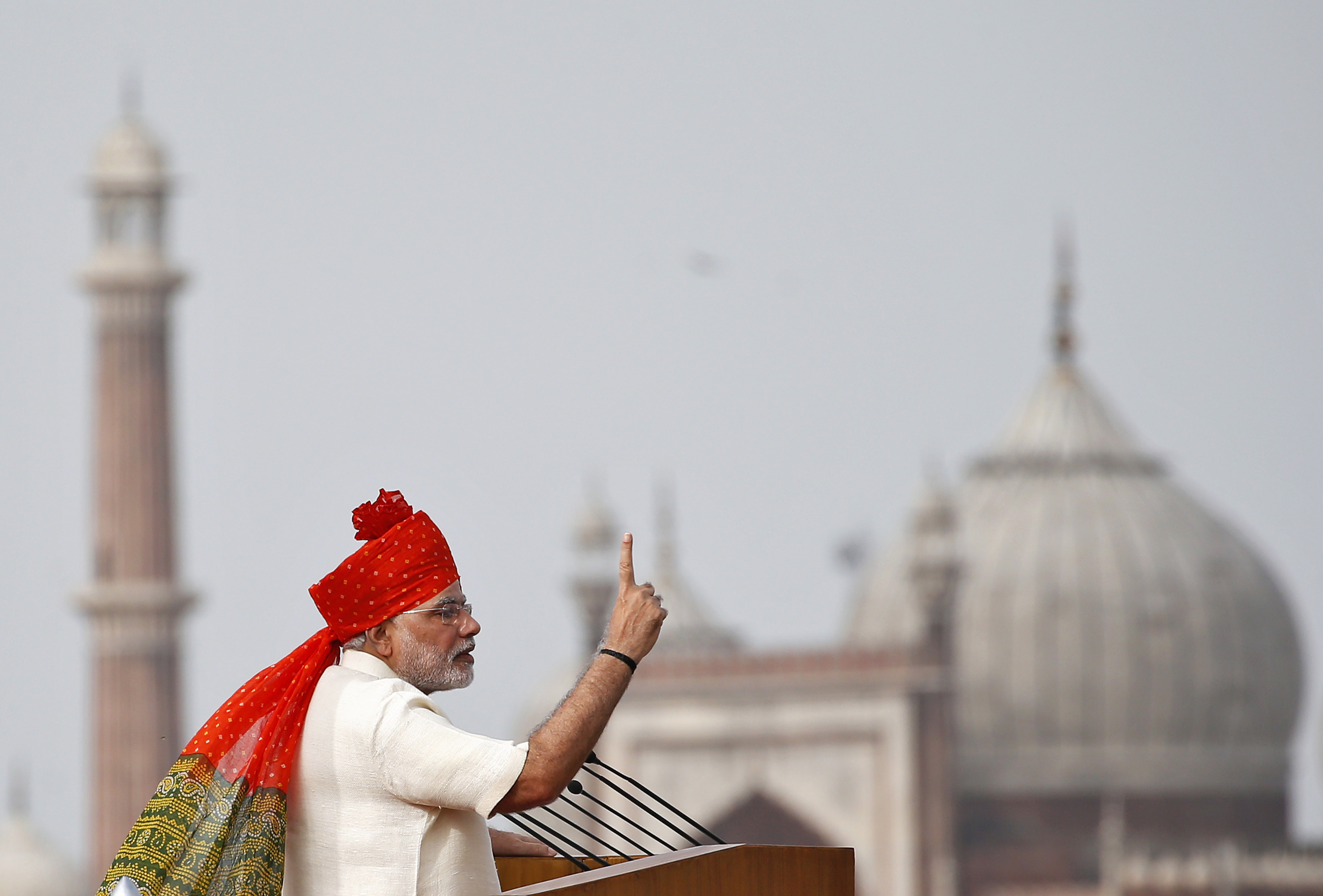
COVID gave that old geopolitical instinct a new industrial dimension.
Strategic autonomy could no longer mean merely refusing to join alliances. It increasingly required the material capability to withstand pressure.
That is a much more demanding definition of sovereignty.
4. Welfare does not disappear; it becomes the foundation beneath strategic capability
This is where the later speeches become qualitatively different.
The early Modi vocabulary was dominated by financial inclusion, sanitation, housing, gas, electricity and welfare saturation. The newer vocabulary increasingly contains the technologies and resources from which twenty-first-century power is constructed:
This is not abandonment of welfare. It is a layering of strategic capacity onto welfare delivery.
The distinction is crucial because the purpose of industrial policy changes. Manufacturing is no longer valuable simply because factories create jobs. Semiconductor fabrication matters because chips are found in telecommunications, automobiles, AI systems, weapons, and virtually every advanced industrial system. Critical minerals matter because the energy transition, electronics, and defense systems depend on them.
Domestic defense production matters because diplomatic freedom becomes constrained when military readiness depends excessively upon foreign suppliers.
Economic policy therefore begins merging with national-security policy.
That is one of the most important transformations visible across the speeches: development and security gradually become parts of the same doctrine.
5. India stops speaking only to itself
A parallel transformation occurs in the audience.
The early Red Fort speeches are overwhelmingly domestic. Modi is speaking to Indian households about what their government will do.
By 2023, India is increasingly speaking about what it represents internationally.
The G20 presidency became an important marker. India convened the Voice of Global South Summit, which brought together 125 countries, and explicitly sought to bring developing-country concerns into G20 deliberations. India's presidency also helped secure permanent African Union membership in the G20, something the government presented as part of its effort to amplify the Global South's representation in international decision-making.
This was the geopolitical counterpart to the domestic shift.
The diplomatic concepts of Vishwa Mitra, meaning "friend of the world," and the ancient civilizational ethos of Vasudhaiva Kutumbakam, "the world is one family," are central to India’s contemporary foreign policy narrative.
These ideas are explicitly linked with India’s renewed focus on Global South diplomacy.
This strategic framing supports a clearly defined geopolitical progression.
6. The civilizational turn is not decorative
The semantic transformation that the Indian nation took is quite significant.
The early vocabulary: Team India, Skill India, Digital India, Make in India, New India; sounds like the language of modern development administration.
Later terminology is qualitatively different:
Amrit Kaal.
Panch Pran.
Viksit Bharat.
Sudarshan Chakra.
Saptadhara.
The change represents more than political branding.
In the 2022 Red Fort address, Modi explicitly linked becoming a developed nation to eliminating the colonial mentality while taking pride in India's roots.
Those became two of the five Panch Pran for the twenty-five years to 2047.
The 2023 address pushed the temporal horizon even further. Modi spoke of decisions made during Amrit Kaal and described a country emerging from a "slave mentality" and recovering its confidence.
This reveals something fundamental about Modi's conception of development.
India is not being asked merely to catch up with advanced Western economies, as defined by a developmental hierarchy created elsewhere.
That is profoundly different psychologically from the language of post-colonial catch-up.
7. And underneath everything runs a progressively harder conception of security
There has also been a security spine throughout the evolution.
What changes is the definition of security itself.
Traditional national security concerns soldiers, borders and weapons.
The emerging doctrine treats chips, energy, minerals, telecommunications, data, manufacturing capacity, supply chains and technology as security assets too.
And this brings the evolution full circle.
In 2014, Modi was asking whether India could provide a poor household with a bank account and electricity in a village.
A decade later, the underlying question had become whether India could ensure that no external power could use technology, energy, finance, weapons or supply chains to dictate India's choices.
At first glance, these questions might seem completely unrelated, touching upon radically different subjects that share no obvious common ground. However, if we look more closely, a profound underlying connection emerges, linking them through a single, powerful concept.
When individuals, systems, or organizations develop the necessary capabilities, skills, or resources, they are no longer passive subjects. Instead, this acquired capacity directly translates into genuine agency, granting the power to make meaningful choices, exert real influence, and take decisive action in the world. Ultimately, they explore the same empowering truth.
A citizen without access to the state has limited agency. A nation without control over critical capabilities has limited strategic agency.
That may be the deepest continuity running through Modi's Independence Day speeches.
The project begins with toilets and bank accounts not because those are small ambitions, but because national power without human capability underneath it is brittle. It then climbs through infrastructure, digitization, and manufacturing toward technology, energy, and defense, because welfare without productive and strategic capability eventually encounters its own limits.
Seen across thirteen Red Fort addresses, therefore, Modi's trajectory is not simply from welfare to nationalism or from development to geopolitics.
It is more coherent than that. It is an attempt to construct power from the individual upward:
And that explains why the language of sovereignty becomes progressively more demanding.
Political independence gives a nation the legal right to make its own decisions.
That is the distance Modi's Red Fort doctrine has traveled—from making the Indian state reach every Indian to trying to make India itself beyond the reach of external coercion.
The 'Generational Crises' Years
Modi's pivotal addresses have been shaped by two distinct crises:
- the global pandemic and a
- persistent combination of natural disasters intersecting with security issues.
The 2020 COVID speech provides the clearest illustration of an emergency fundamentally reshaping both the form and substance of his national message.
In 2020, the traditional ceremony was visibly curtailed.
The schoolchildren, who typically create intricate patterns on the lawns and whom Modi usually breaks protocol to meet, were absent for safety reasons, an absence he noted, remarking that the virus had halted everyone.
The event was scaled down and muted. Yet, conceptually, the substance did the opposite of retreating. Modi seized upon this crisis to elevate "Atmanirbhar Bharat" (Self-Reliant India) into a core national mantra.
He argued the pandemic proved to the world that self-reliance was the only viable path forward, pairing this with the call for "Vocal for Local."
He posed a pointed question about how long India would continue to merely export raw materials and import finished products. The emergency essentially provided the justification for this new doctrine.
Instead of narrowing ambition, the pandemic address expanded it, converting the severe supply-chain vulnerabilities exposed by the crisis into a rationale for deep structural change.
This was the crucial turning point of Modi's work and direction.
So, in 2026, when he talks about the end of globalization, it lends itself as a logical continuation rather than a sudden shift.
Fast forward to 2026, and the speech offers its own retrospective view of that initial emergency and the ones that followed; this retrospective is itself a unique rhetorical move. Modi recalls that over the last dozen years, India navigated a world-shaking pandemic, followed closely by conflicts in Ukraine and West Asia.
He then catalogs the dire predictions he claims accompanied each event:
- that vaccines would not materialize,
- that petrol pumps would run dry, and
- that gas, diesel, and fertilizer would disappear.
His core argument is that the groundwork laid over the prior ten years carried the country through.
Consequently, gas, petrol, and urea remained accessible.
He shares they did the same with di-ammonium phosphate.
In this 2026 address, the emergency functions as a way to evaluate the administration's work and policies.
He acknowledges current difficulties with empathy, noting floods elsewhere in the country and pledging national solidarity with those affected, but then subordinates this to the broader story of strength through self-reliance. This pattern holds throughout his recent addresses: emergencies are viewed not as events that displace the doctrine, but as tests that prove its worth.
The 2026 address itself is rich with detail and deserves a close look. Several key elements pop out. First is the reliance on a statistical scorecard as the rhetorical foundation. The entire speech is constructed around an unusually dense recitation of before-and-after figures, all framed around the theme of "the last twelve years."
Modi asserts that twenty-five crore Indians escaped poverty during this time and that a country once labeled part of the "Fragile Five" transformed into the fastest-growing major economy.
He then shares the multipliers:
- defense production increased roughly 4 times,
- khadi and village-industry output roughly 5 times,
- electronics manufacturing roughly 7 times,
- modern railway coach production 21 times, and
- mobile phone production an astounding 33 times.
- internet users grew 4 times,
- patents granted 4 times, and
- digital transactions 100 times.
He applied this same statistical rigor to welfare distribution,
- sharing that tap-water connections are being issued 15 times faster each year,
- gas connections 6 times faster,
- toilets 4 times faster, and
- homes three times faster.
The goal is to counter the prevailing narrative of economic stagnation with an imposing wall of quantified success.
The intellectual core of the speech lies in the "Shakti Ki Saptadhara," or seven streams of national power.
This is presented as the strategic roadmap for achieving over the next 5-7 years.
These seven streams provide a comprehensive roadmap for India:
- Manufacturing: Making products entirely within India, from design to final sale, with a strict focus on high quality.
- Agriculture: Building direct paths for farmers to export specific foods like spices and fruits, while shifting to chemical-free farming.
- Technology: Leading in areas like AI, quantum computing, and space exploration to become a creator of new tech, including building India’s own 6G network.
- Infrastructure: Creating fast, connected transportation networks across the country and modernizing seaports.
- Defense: Becoming a global supplier of advanced military hardware, such as drones, and strengthening cybersecurity.
- Clean Energy: Focusing on sustainable resources like green hydrogen and using ocean resources responsibly.
- Culture: Spreading Indian culture, including yoga, traditional medicine, and films, to the world while bidding to host major international events.
The framework is intentionally holistic. Its underlying logic is that national power in the modern era is decided across all these interconnected fronts simultaneously, and that advancement in just one sector is insufficient.
The speech’s most potent geopolitical observation looks back to when Modi first championed self-reliance.
He recalls comfortable critics questioning what would happen to globalization. He now answers that the world itself has virtually stopped using the term, that the voices that once promoted it have gone quiet, and that every country has shifted focus toward managing its own national interests.
He identifies the mechanism driving this change: the weaponization of resources.
This is the philosophical core of the address and is more direct than prior formulations. It reframes India’s push for self-reliance not as a defensive posture, but as an alignment with the actual structure of the emerging global order.
He cites concrete examples of India’s response: a National Critical Mineral Mission and a Critical Mineral Corridor announced in the budget, with agreements already signed with several nations; energy security chased through a 100-gigawatt nuclear target by 2047, five new reactors this decade, and newly achieved mastery of fast-breeder technology aiming for nuclear fuel self-sufficiency, made possible by a recent atomic energy law amendment; and the opening of ninety-nine percent of India’s coastline, once a restricted zone, to offshore exploration under the Samudra Manthan initiative with significant funding.
This is the connecting theme: countries are now monetizing and weaponizing everything, to the detriment of the global economy, forcing governments to act in response to this challenging external environment.
Perhaps the most contested part of the speech, and the one the global media quickly highlighted, is the section on "dimaagi Naxals." Modi declares that while armed Naxalism—which he claims took the lives of over three thousand security personnel over four decades—has been largely eradicated, a residue lingers in the form of "dimaagi Naxals," or intellectual and mental Naxals.
He accuses Maoist-minded individuals of having long occupied the halls of power and shaping policy as government advisors. He asserts that although the armed groups are gone, these ideological actors are still seeking opportunities for violence and anarchy and must be identified and isolated.
Understanding the political context surrounding this statement is vital.
This is clearly situated within a season of widespread unrest, citing protests at Jantar Mantar, student agitations, and the NEET examination controversy.
A broader online narrative is being created that suggests the country was in a state of collapse. Clearly a view with an agenda.
One can see, as we have looked at the mechanisms of subversion, that it is at best a coordinated effort by internal and external forces to spread fear and hopelessness even as India moves forward.
In a way, Modi's 2026 Independence Day address is a deliberate attempt to shatter that negative mindset by displaying national confidence.
Modi also deliberately raises the bar for national aspiration.
The Yuva Shakti is presented as both the primary engine and the main beneficiary of a developed India (Viksit Bharat). He catalogs the supportive structures put in place: over two and a half lakh registered startups, a one lakh crore rupee innovation fund, cheap data, Skill India initiatives, an opened space sector, a drone policy, a new education policy, hundreds of new universities, foreign university campuses coming to India, ten thousand Atal Tinkering Labs, private startups launching satellites on their first try, an AI Impact Summit, and a pledge to train one crore youth in AI skills within a year.
He includes a sports talent hunt focused on ages five to fifteen, linked to a 2036 Olympic bid and a 2030 Commonwealth Games hosting bid, a hundred-week anti-drug drive, and a call for youth to lead the first Digital Census by accurately entering their household data on their smartphones.
It is important to note that there is deep structural unemployment, and the anxieties of a massive young population dominate the ground reality.
In that sense, one can say that Modi made "a very honest effort" to present a balanced picture of both reality and possibility. He has presented with the confidence that only Modi can really.
Ultimately, the 2026 speech stands as the moment the doctrine is articulated in full. It unites a defensive statistical defense against a narrative of stagnation with an aggressive industrial blueprint in the Saptadhara, a geopolitical argument regarding resource weaponization and the end of globalization, a sharpened internal-security stance, and a significantly raised ceiling for national ambition, with youth cast as the primary agents of change.
A close reading of the 2026 speech
The 2026 Independence Day address deserves to be read differently from Modi's earlier Red Fort speeches. It is not primarily a catalog of schemes, nor simply another iteration of Viksit Bharat. It is the point at which ideas developed separately over the previous twelve years—welfare saturation, infrastructure, Atmanirbharta, manufacturing, technological sovereignty, defense indigenization and civilizational confidence—are assembled into something approaching a unified doctrine of national power.
Five elements define that doctrine.
1. The scorecard: establishing the material basis for ambition
Modi begins by establishing his claim to credibility through numbers. The speech contains an unusually dense before-and-after accounting of the previous twelve years.
He claims that twenty-five crore Indians have emerged from poverty and contrasts India's earlier identification among the world's "Fragile Five" economies with its current position as the fastest-growing major economy. He then lays out the scale of change in stark numerical terms: defense production has nearly quadrupled, khadi and village-industry output has grown almost fivefold, electronics manufacturing has grown sevenfold, modern railway-coach production has grown twenty-onefold, and mobile-phone production has grown an extraordinary thirty-threefold. Internet usage has increased roughly fourfold, patents granted have increased fourfold, and digital transactions, he says, have risen a hundredfold.
He applies the same method to welfare delivery: the annual pace of providing tap-water connections, he argues, has increased fifteenfold; gas connections, sixfold; toilets, fourfold; and housing, threefold.
These are the government's figures and should be understood as the Prime Minister's own accounting of his record rather than as an independently audited assessment. But analytically, their purpose matters.
Modi is not simply celebrating achievements. He is establishing the premise for everything that follows.
His argument is essentially: India has already demonstrated that it can execute at enormous scale; the question now is what that capacity should be used to accomplish.
That distinction is critical. The statistics serve as a bridge between the welfare-and-delivery state of Modi's first term and the strategic state he describes in 2026. Having argued that India can deliver bank accounts, houses, toilets, electricity, digital transactions, and infrastructure at a continental scale, he now asks whether the same machinery can be directed toward much harder objectives—advanced manufacturing, technological leadership, energy independence, and strategic autonomy.
The scorecard, therefore, is not merely retrospective. It is the evidentiary foundation for a much larger claim about India's future.
2. Saptadhara: from development policy to a theory of national power
The intellectual center of the speech is Modi's Shakti Ki Saptadhara—the seven streams of national strength.
His ambition is deliberately audacious: India should attempt in the next five to seven years what it failed to accomplish over the previous five to seven decades.
The significance lies not simply in the seven categories themselves, but in the fact that Modi places them within a single architecture.
- The first is manufacturing, but not manufacturing understood merely as assembly. Modi repeatedly emphasizes complete domestic value chains—from design and components to finished products—and combines this with an obsessive emphasis on cost, scale, precision and quality. His repeated mantra of "quality, quality, quality" signals an important evolution of Make in India: producing domestically is no longer sufficient; Indian products must become globally competitive.
- The second stream links agriculture with value addition and exports. India should not remain merely a producer of agricultural commodities; millets, spices, fruits and other products must move through processing and branding into global markets.
- The third is technology and innovation: artificial intelligence, quantum technologies, space, robotics, data centers and indigenous 6G. The ambition here is explicit. India must cease being primarily a market for technologies invented elsewhere and become one of the places where the technologies defining the next era are created.
- The fourth is Gati Shakti and connectivity—high-speed, multimodal infrastructure connecting roads, railways, ports and industrial networks. Infrastructure is consequently treated not simply as public works but as the circulatory system of national production.
- The fifth is defense and cyber power, including drones, counter-drone systems, advanced weapons and hypersonic technologies, with the explicit objective of transforming India from one of the world's major arms importers into a significant supplier.
- The sixth combines the green and blue economies: renewable energy, green hydrogen, energy storage and exploitation of India's maritime economic potential.
- And the seventh is soft power—yoga, Ayurveda, holistic healthcare, tourism, handicrafts, cinema, animation, gaming, VFX and digital content.
At first glance, these may appear unrelated sectors. Modi's larger argument is precisely the opposite.
They are different dimensions of the same thing: national capability.
A country cannot become a major power through GDP growth alone. It requires simultaneous manufacturing depth, food security, technological competence, physical infrastructure, military capacity, energy resilience, and cultural influence.
3. Resource weaponization: the geopolitical heart of the speech
The most consequential argument in the address may be Modi's assessment of what has happened to globalization.
He recalls the criticism directed at Atmanirbhar Bharat: if India pursued self-reliance, what would happen to globalization?
His answer in 2026 is striking. The world that once preached globalization, he argues, has itself largely stopped talking about it. Nations have turned inward toward protecting their own interests because economic interdependence is increasingly being converted into geopolitical leverage.
Modi calls this the weaponization of resources.
Petroleum can be weaponized. Fertilizer can be weaponized. Medicines can be weaponized. Semiconductor chips and technology can be weaponized. Even territory and access routes can become instruments of coercion.
This changes the meaning of Atmanirbharta.
That is why the speech moves directly into critical minerals, nuclear power, offshore energy exploration, semiconductor capacity and domestic value chains.
India's National Critical Mineral Mission and proposed Critical Mineral Corridor are responses to a world in which control over lithium, cobalt, rare earths and other essential materials can translate directly into industrial and geopolitical power.
The 100-gigawatt nuclear-energy objective for 2047 addresses another vulnerability: a major power cannot indefinitely leave its economic trajectory hostage to imported energy. Offshore exploration under Samudra Manthan follows the same logic.
The deeper proposition is stark:
Dependence creates leverage. Capability creates freedom of action.
This is perhaps the clearest expression yet of Modi's understanding of strategic autonomy. India does not need to isolate itself from the global economy. It needs to participate in that economy without allowing indispensable dependencies to wield veto power over Indian policy.
4. From armed Naxalism to "dimaagi Naxals": security moves into the ideological realm
The most politically contentious portion of the speech comes when Modi turns from external vulnerability to internal security.
He argues that armed Naxalism, after costing the lives of more than three thousand security personnel over four decades, has been pushed close to elimination. But he immediately distinguishes the defeat of armed Maoist networks from what he sees as the persistence of their ideological ecosystem.
This is where he introduces the expression "dimaagi Naxals"—mental or intellectual Naxals.
His accusation is broader than a conventional security argument.
The significance of the passage lies precisely in this expansion of the definition of security.
Earlier Modi speeches dealt principally with terrorism, borders, Pakistan, military modernization and armed insurgency. The 2026 formulation extends the security framework into the realm of ideas, institutions and political narratives.
That expansion is also why the phrase became one of the most controversial parts of the address. Critics can reasonably ask where the boundary lies between an ideological ecosystem connected to political violence and legitimate dissent in a democracy.
Modi's formulation deliberately challenges that distinction by arguing that ideas and networks can survive the defeat of the organizations that originally produced them.
5. Yuva Shakti: dramatically raising the ceiling of Indian ambition
The final major theme is psychological as much as economic.
Modi repeatedly asks why India should accept ceilings that other countries have effectively imposed upon the imagination of what India can become.
- Why should fifty of the Fortune 500 companies not eventually be Indian?
- Why should an Indian bank not rank among the world's five largest?
- Why should Indian pharmaceutical companies, technology companies, law firms, accounting firms, consulting businesses and rating agencies not become globally dominant institutions?
These are revealing questions because they represent a departure from the traditional developmental ambition of catching up.
Modi is no longer asking whether India can reach middle-income status or provide adequate infrastructure.
He is asking whether Indian institutions can become global category leaders.
And the vehicle through which he expects this to occur is Yuva Shakti.
The speech assembles the infrastructure he believes can enable that generation: more than 2.5 lakh registered startups, a ₹1 lakh crore innovation fund, inexpensive data, Skill India, an opened space sector, drone liberalization, education reforms, new universities, foreign universities entering India, Atal Tinkering Labs, private space companies launching satellites and rockets, and a commitment to train one crore young Indians in artificial-intelligence skills within a year.
The individual programs matter, but the larger message matters more.
Modi is seeking to redefine the horizon of Indian ambition: the country’s measure of success is no longer simply how far it has traveled from its own past, but how close it stands to the world’s technological frontier.
The doctrine stated fully
Taken together, the 2026 speech represents something more consequential than another Independence Day progress report.
This is the point at which the major currents of Modi’s premiership converge into a single, coherent national argument.
The statistical record makes one proposition clear: India has demonstrated the capacity to execute at unprecedented scale. Saptadhara then sets out the capabilities the country must build for its next phase of power. The argument over the weaponization of resources explains why those capabilities are no longer merely desirable, but strategically essential.
The internal-security framework further enlarges the meaning of sovereignty. From protecting borders alone to safeguarding institutional strength, social cohesion, and ideological resilience.
And Yuva Shakti places responsibility for translating this national ambition into reality on the generation that will inherit it.
Viewed across twelve years, the progression is unmistakable.
The first Modi government focused on creating a state capable of reaching every citizen. The next phase built infrastructure, formalized economic life, and elevated national expectations. Atmanirbhar Bharat then recast domestic productive capacity not simply as an economic objective, but as India’s shield against strategic dependence.
That is the deepest proposition of the 2026 Red Fort address.
Political independence allows a country to make its own decisions. But in a world where energy, minerals, technology, finance, supply chains, and even market access can become instruments of pressure, legal sovereignty is not enough.
A nation is strategically sovereign only to the extent that it possesses the capabilities necessary to defend its freedom of choice.
That is where Modi's Independence Day doctrine has arrived.
The Global Geopolitical Significance of the 2026 Speech
The most consequential element of the 2026 address is its explicit reframing of economic self-reliance as a geopolitical doctrine for what Modi describes as a post-globalization world. The assertion that nations now manage their interests independently—combined with the warning that fuel, fertilizer, semiconductors, territory, and other resources can be weaponized—amounts to a formal statement of grand strategy.
India’s message is clear: it will develop sovereign capability in the sectors that determine national power, while engaging the global economy only on terms that strengthen domestic capacity rather than deepen external dependence.
The most revealing formulation is the argument that India should not import goods merely because they are cheaper or more readily available if doing so prevents India from building the underlying capability at home. This places external economic engagement within a security-of-supply framework. Price and efficiency remain relevant, but they are no longer decisive; they are subordinate to the strategic value of domestic production, skills, technological competence, and resilient supply chains.
Several implications follow.
Conditional Globalization: India is not choosing between unrestricted openness and autarky. It seeks capital, technology, market access, and strategic partnerships, but refuses dependency in vital sectors. Foreign investment and trade agreements remain important, particularly for sectors such as textiles, machinery, pharmaceuticals, and seafood. Yet integration is acceptable only when it expands Indian capability, raises domestic value creation, and enables Indian firms to compete globally rather than locking them into low-value dependence.
Diversification as Strategy: The doctrine is fundamentally opposed to over-reliance on any one bloc, country, or supply chain. The push for critical minerals, supported by national missions, investment corridors, and bilateral partnerships, offers its clearest institutional expression.
This approach allows India to hedge against multiple vulnerabilities simultaneously: tariff pressure and demands from Western partners related to Russian oil, as well as dependence on Chinese industrial inputs, minerals, and manufacturing ecosystems. What began as a defensive response to external economic pressure is being elevated into a permanent strategic principle.
Trade, Industry, and Security Converge: Under this framework, trade policy, industrial policy, and national security are no longer separate domains. Semiconductors, artificial intelligence talent, nuclear energy, critical minerals, and defense manufacturing are treated as strategic assets because they collectively shape economic competitiveness, energy security, military-adjacent capacity, and diplomatic bargaining power.
The proposed modernization of civil-defense systems reflects an equally broad understanding of security. Conflict is no longer confined to borders or battlefields; it can reach refineries, financial networks, data centers, supply chains, and the institutional foundations of a society. National resilience, therefore, becomes as important as conventional military preparedness.
Defense Self-Reliance as Influence: The Saptadhara vision also places defense manufacturing within an export-oriented strategic framework. India is seeking not only to reduce its role as one of the world’s largest arms buyers, but to emerge as a supplier of systems, platforms, and capabilities to foreign partners.
That shift carries diplomatic consequences. Defense exports create enduring relationships—through training, maintenance, spare parts, financing, interoperability, and political alignment. Combined with the Sudarshan Chakra shield and the narrative surrounding Operation Sindoor, this emphasis suggests an India that seeks greater autonomy in its security while also building influence in the global defense market.
The Domestic-Security Tension: There is, however, a countervailing element. The call to isolate “intellectual Naxals” provides Western media outlets and rights organizations with a powerful frame: that the line between legitimate security threats and ideological dissent may be narrowing.
This creates an enduring values-versus-interests tension for India’s democratic partners. Strategic convergence with the United States and Europe may continue to deepen across technology, defense, supply chains, and China-related concerns. At the same time, India’s domestic-governance trajectory is likely to remain a recurring point of friction, requiring New Delhi to sustain strategic cooperation while absorbing periodic criticism.
Ultimately, the global importance of the 2026 speech lies in its transformation of self-reliance from an economic slogan into a grand-strategic doctrine. It envisions a multipolar, fragmented, supply-chain-conscious world in which India pursues conditional engagement, aggressive diversification, technological and mineral sovereignty, and the willingness to bear short-term commercial costs in exchange for long-term strategic freedom.
The Red Fort as a Theory of the State
Read together across twelve years, Modi’s Independence Day addresses form more than an annual record of government priorities.
They reveal the steady construction of a theory of Indian power. One marked by striking continuity, expanding ambition, and an increasingly explicit view of the state’s role in the world.
Its logic begins at the base of the national pyramid: a state earns the right to seek global influence only after it has delivered dignity, access, and opportunity to its own people.
That delivery must then create aspiration.
Aspiration, however, cannot remain emotional or rhetorical. It must be converted into capability.
A nation dependent on others for essential technologies, energy, minerals, financial systems, or supply chains cannot fully protect its interests in a moment of crisis.
Capability, in turn, becomes standing: the achievement of a developed India by 2047 is presented not simply as a domestic milestone, but as the source of leverage that will compel the world to engage India on different terms.
Three enduring currents bind this arc together.
- First is self-reliance. It appeared quietly in 2014, rose to the level of doctrine during the pandemic in 2020, and by 2026 had become a comprehensive grand strategy for a fragmented, post-globalization world.
- Second is the fusion of development and security. By 2026, economic strength, technological capacity, industrial depth, energy resilience, and national security are no longer separate priorities; they are facets of the same project.
- Third is the civilizational register, which is the increasingly confident narration of national development as the recovery of India’s rightful place in history and the world.
Set against the prime ministers who preceded him, Modi’s use of the Red Fort becomes a story of the office itself.
Nehru used its ramparts to inaugurate a republic, speaking toward the future with such intensity that the immediate catastrophe of Partition barely entered his address.
Indira Gandhi used the platform to defend political authority. And, in one of its darkest moments, to rationalize the suspension of democratic freedoms.
Manmohan Singh used it to explain reforms and manage an economy, but never transformed the occasion into a theater of national purpose.
Modi has used the Red Fort differently: as a continuing campaign to define what India is, what it must become, and what dangers it must prepare to confront.
In 2026, from the country’s most authoritative political platform, he presented a clear proposition: the world is fragmenting, power is being weaponized, and India must build sovereign capability accordingly.
Whether Saptadhara is translated into industrial reality or remains an architecture of rhetoric will be decided in the years ahead. Yet the doctrine itself is no longer uncertain.