
The Broken Plank
A village shared a wooden bridge across a deep river.
One spring, a farmer discovered a broken plank. He complained to the council, but the council delayed.
A traveler gathered the villagers.
“They ignore you because they despise you,” he declared. “Tear down the bridge, and they will learn to listen.”
Angry villagers brought axes.
An old monk arrived carrying a replacement plank.
“You would repair the instrument of our humiliation?” the traveler demanded.
“I would help the farmer cross,” said the monk.
“The bridge must fall before justice can begin.”
The monk turned to the farmer.
“When the bridge falls, how will you reach your fields?”
The farmer lowered his axe.
The traveler shouted, “Anyone who defends this bridge defends the council!”
The monk placed his plank over the hole.
“Yesterday,” he said, “the council would not hear this man's complaint. Today, you will not let him accept a remedy.”
For a moment, only the river spoke.
Then the farmer asked the traveler, “If we repair it, will you leave?”
The traveler looked toward the crowd.
The farmer picked up the monk's hammer.
That evening, the villagers crossed safely. The council answered their questions. The traveler sought another village.
A Republic
When Benjamin Franklin left the hall after the Constitutional Convention in 1787, a lady standing there, Elizabeth Powel asked “Mr. Franklin, what manner of government have you bequeathed us?”
Benjamin Franklin stood there for a moment and looked into her eyes and replied, “A Republic, madam. If you can keep it.”
Those last words were the critical ones. A Republic must be maintained by people who can disagree fiercely without destroying the arrangements that permit disagreement.
When those who want to unleash anarchy strike with an agenda to win all without discussion while using a genuine or a manufactured grievance, then it is imperative that the government in power resolve the grievance without rewarding intimidation.
Protests are part of a citizen’s democratic expression but no society can allow surrendering public life to coercion by a few.
On November 25th 1949, BR Ambedkar had warned the Constituent Assembly against abandoning constitutional methods where those methods remain available. He called unconstitutional methods the “Grammar of Anarchy”.
“When there was no way left for constitutional methods for achieving economic and social objectives, there was a great deal of justification for unconstitutional methods. But where constitutional methods are open, there can be no justification for these unconstitutional methods. These methods are nothing but the Grammar of Anarchy and the sooner they are abandoned, the better for us.” (Source: Dr. Ambedkar's last speech in the Constituent Assembly on the adoption of the Constitution)
Ambedkar was asking the citizens to take the republic and its constitution seriously as a means of resolving conflict. Constitutional methods require effort: organizing, presenting evidence, persuading representatives, pursuing remedies and accepting that other citizens possess political rights too.
That is why the defense of an elected mandate carries a corresponding obligation: preserve the means by which that mandate can lawfully be transferred. A government must be able to govern under its mandate, and citizens must remain able to replace it through their vote.
That is the durable meaning of defending the vote.
The way we see it, weaponizing a grievance – sometimes genuine, but mostly manufactured in both its existence and narrative – without any intention of resolving it to coercion as a tool to claim power while spreading anarchy is the classical idea of regime change.
It always follows a very similar process.
First comes a usable grievance. Unaffordable housing, corruption, unemployment, a disputed examination, a contested electoral register – anything that can be labeled controversial because the coalition that unleashes the anarchical movement has launched a Goebbelsian movement to color it in controversial grammar.
Then comes the expansion of the accusation. A correctable failure becomes that the entire governing arrangement is fraudulent. The demand moves from repairing an injustice to rejecting the legitimacy of every body that might adjudicate it.
Third comes the closure of possible remedies. The legislature is dismissed, the administration distrusted, the election authority condemned and the judiciary pre-emptively discredited. Each institution is acceptable only if it delivers the movement’s preferred result.
Fourth comes an assertion of exclusive representation. Organizers cease saying that they speak for a constituency and begin saying that they embody the people. Anyone outside the mobilization is treated as deceived, intimidated, morally compromised or irrelevant.
Finally, disruption becomes a substitute for consent. Roads, campuses, transport systems and commercial districts become pressure points. The movement acquires leverage by imposing losses on people who have no authority to satisfy its demands.
At this stage, the constitutional problem becomes unavoidable. A crowd may have a valid complaint. It does not, however, acquire universal representative authority because it can remain assembled longer than other citizens can afford to stop working.
The most consequential change is therefore a change in the proposed source of legitimacy. Is the movement asking institutions to correct a wrong or claiming that its own anger has displaced those institutions?
Currently, Europe is reeling with protests and disorder. Belgium, Italy, Albania, Germany, Portugal, and, of course, France.
Several of these mobilizations have said clearly that events in France have inspired these anarchist actions.
That clearly establishes a diffused strategy even when it may not establish a common operational headquarters of these mobilizations – although that becomes the most plausible and coherent explanation of these almost synchronized actions in both intent, symbolism and impact.
But through all this an effective response cannot depend on discovering that one hidden controller of all these movements. For, that will not come easy. Disorder can grow in different geographies and societies through overlapping interests: a genuine protest movement, partisan organizers, opportunistic vandals, influencers seeking attention, and outside actors seeking political advantage. Their contributions can reinforce one another without complete agreement.
For India, it is imperative that its institutions can separate grievances requiring remedies from conduct requiring enforcement. Failure to make that distinction gives exploiters two opportunities: recruit the neglected and portray indiscriminate enforcement as proof that peaceful participation is futile.
Europe’s situation brings out the interaction between grievance, mobilization, coercion and state response most powerfully.
There is a moment in the life of a democracy when the argument ceases to be about who should govern and becomes an argument about whether the agreed means of choosing a government will continue to matter. That moment does not always arrive with a military convoy or a suspended constitution. It can also – and often it does – arrive through a gradual change in political language. An election becomes illegitimate whenever the “wrong” side – as defined by a certain section of entitled elites – wins. A court becomes compromised whenever it declines the demanded remedy; a demonstration becomes the authentic representation of the nation itself, while millions of citizens outside that movement become politically invisible.
A republic begins to weaken when the right to oppose a government becomes a claimed right to override everyone who elected it.
The danger is particularly serious when disorder itself becomes an instrument of bargaining. Then the citizen who works, studies, votes and returns home discovers that political influence increasingly belongs to those able to impose the largest disruption.
So the real question before us all is: Can an organized minority acquire a political veto that an ordinary citizen cannot exercise through a ballot?
A movement becomes dangerous when its claim to liberate humanity gives it permission to dispose of human beings. The decisive transition occurs when suffering stops being a condition to alleviate and becomes a resource to exploit; when a comrade's conscience becomes an obstacle; when the people cease to mean living citizens capable of disagreement and become a sacred name for the organization claiming to represent them.
In such an endeavor, a cause judged righteous releases its servants from every standard that binds other people in their eyes.
The Promise at Stake
To fully understand what is coming if the various economies are not subverted and allowed to run their course, please listen to this keynote speech at the College of Europe’s Natolin campus in Warsaw, Poland, on 12 October 2026, inaugurating its new European Security and Strategy Study Track by Andrius Kubilius.
He discusses what the new graduates will face in the coming decades and what kind of world they are inheriting.
He has shared the same thoughts in his writings earlier as well.
 jonas
jonas
Why is this important?
His argument about China and India carries particular weight because it comes from a committed European integrationist and Atlanticist: someone whose political project depends on the West adapting successfully.
Born in Vilnius in 1956, Kubilius trained as a physicist before entering politics during Lithuania’s struggle for independence. He served as secretary-in-charge of Sąjūdis, the Lithuanian independence movement, in 1990–1992; spent 27 years in Lithuania’s parliament; led the conservative Homeland Union; and served twice as prime minister, in 1999–2000 and 2008–2012. He subsequently became a European parliamentarian and, in December 2024, European Commissioner for Defence and Space.
On the back of that experience, he comes with three useful perspectives.
- He understands that apparently permanent geopolitical arrangements can disappear. For someone who participated in Lithuania’s emergence from Soviet rule, the collapse of an established power structure is lived experience.
- He has governed under financial pressure. His second premiership encompassed Lithuania’s severe financial crisis and a politically painful austerity program. The Peterson Institute’s assessment credited Lithuania with emerging from the crisis without international emergency assistance, while recognizing the electoral backlash against austerity. His reputation as a crisis manager has a concrete basis, although the social costs of his policies remain part of that record.
- His present responsibilities connect strategic thinking with industrial capability. His Commission portfolio includes defense investment, military mobility, the European defense industrial base, a common market for defense products, EU–NATO cooperation and space security. He works on the practical question of how Europe converts its wealth into the ability to protect itself.
Kubilius' strength seems to be a willingness to distinguish between changes Europe can influence and changes to which Europe must adapt.
Kubilius’s central argument has five parts:
- China and India could recover leading positions in the world economy, reversing the long period of Western predominance.
- America would face the psychological challenge of losing its unquestioned first-place position.
- Europe must assume much greater responsibility for conventional defence within NATO.
- Ukraine’s military and economic integration into Europe is central to the continent’s future.
- Europe’s strongest long-term answer combines internal integration, a renewed Atlantic partnership and conditions that encourage a less aggressive Russia.
His preferred outcome preserves considerable Western influence through cooperation, while recognizing the growing weight of Asian powers. He also acknowledges that wars, crises and other shocks could change the trajectory.
When 2100 comes along and the century changes hands, what would the world look like? Also what strategic central questions are the different players facing?
Looking at the discussion above, here's how I would see the multi-power scenarios unfolding.
| Actor | Plausible position around 2100 | Central strategic question |
|---|---|---|
| China | An economic and industrial giant with extensive global influence | Can it sustain productivity and legitimacy while managing ageing and resistance to its power? |
| India | A leading economy, major consumer market and increasingly consequential strategic power | Can it turn population and economic scale into broad prosperity, technological leadership and state capability? |
| United States | An exceptionally wealthy, innovative and militarily powerful country facing larger economic peers | Can it preserve influence through renewal and partnerships while accepting reduced relative dominance? |
| Europe | A large, wealthy economic bloc whose strategic importance depends on collective action | Can it organise its resources and make binding decisions together? |
| Russia | A consequential nuclear and territorial power with a highly uncertain economic and political trajectory | Can it establish a durable relationship with its neighbours and modernise its economy? |
This would be a world in which economic size, military reach, technological leadership and institutional influence belong to overlapping groups of powers.
One country might lead manufacturing, another frontier research, another consumer-market growth, and another financial intermediation. Several could possess the ability to obstruct global agreements, while none could reliably impose a comprehensive settlement.
India’s rise would therefore matter beyond its position in a GDP table. Its market, investment decisions, diplomatic relationships and security capabilities would increasingly affect what other powers can accomplish.
China and India would also remain separate strategic actors. Their simultaneous ascent would not create a unified Asian geopolitical position. Competition between them could be one of the defining features of this world.
Goldman Sachs economists Kevin Daly and Tadas Gedminas seem to have arrived at similar conclusions.
Their The Path to 2075 projects China, India and the United States as the three largest economies by 2075, in that order. Their model puts China’s overtaking of the US around 2035 and India’s move into second place by 2075.
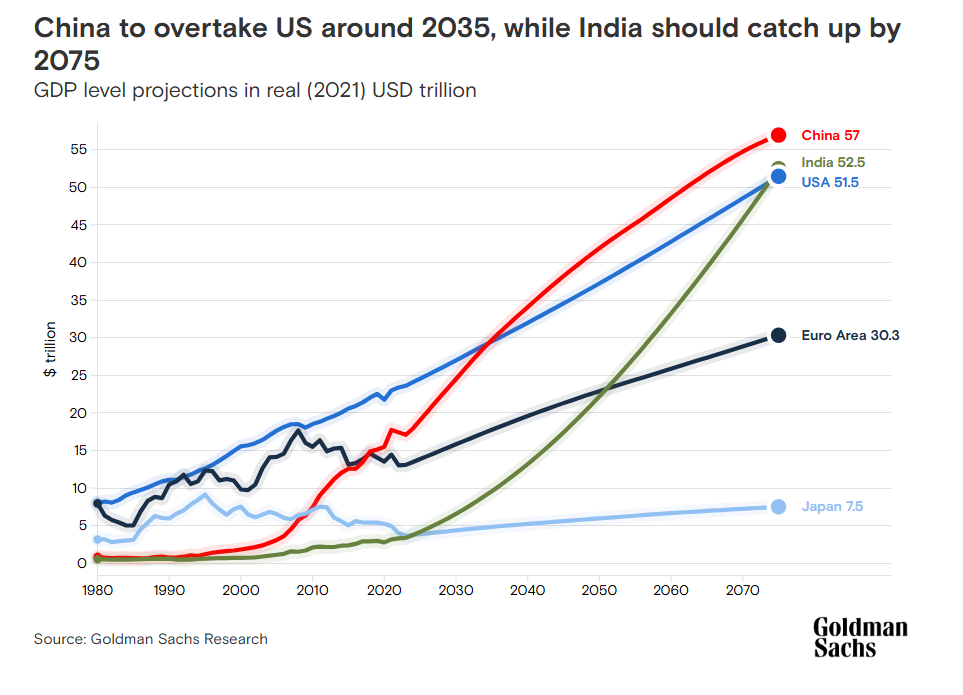
These are projections in real US-dollar terms, conditional on assumptions about productivity, population and convergence. They support Kubilius’s broad ordering but leave considerable uncertainty about timing.
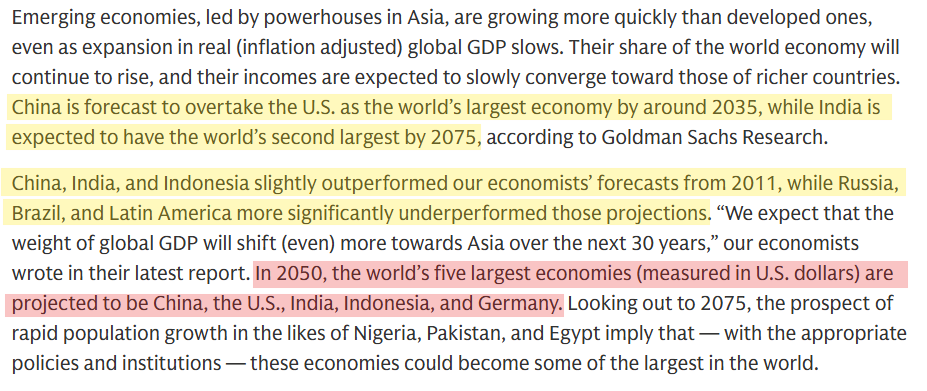
PwC’s The World in 2050 provides another line of support. Its 2017 modeling anticipates China and India taking the first two positions by purchasing power parity, with Indonesia also becoming substantially more important. PPP measures the volume of goods and services an economy can purchase after accounting for price differences. Market-exchange-rate measures better reflect some forms of international purchasing power. The distinction explains why apparently similar forecasts can produce different dates.
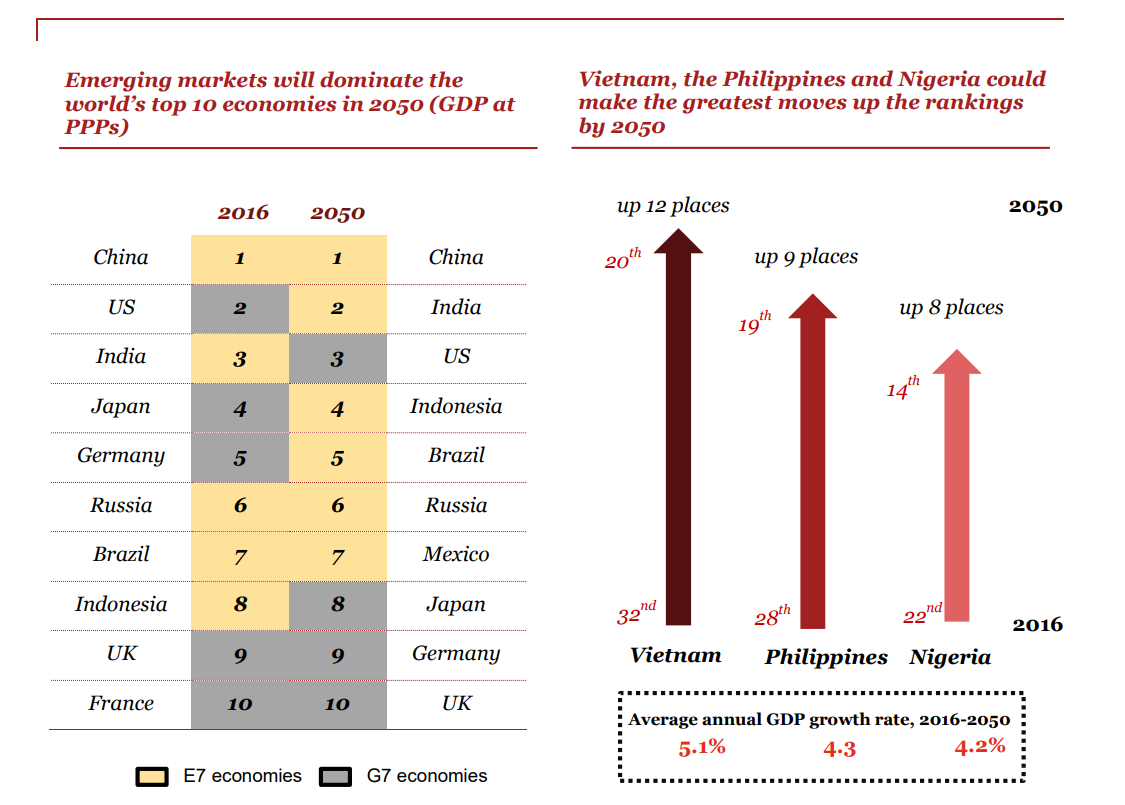
India’s population gives it scale; its youthful population gives it a powerful opportunity to compound growth over decades. As millions enter their working years, they can expand production, consumption, savings and investment, even as aging economies face shrinking workforces and rising dependency burdens.
Goldman Sachs economist Santanu Sengupta emphasizes that capturing this dividend requires skills, higher workforce participation, infrastructure, manufacturing, innovation and capital investment. (Source: How India could rise to the world’s second-biggest economy / Goldman Sachs)
The youth dividend becomes economic strength when young people secure productive employment. India’s rise will therefore depend on enabling hundreds of millions to produce more, earn more and contribute more throughout their working lives and beyond.
Kyunghoon Kim, Head of India & South Asia Team at Korea Institute for International Economic Policy (KIEP) provides an interesting insight into how living standards in India are rising and how its economy is doing vis-à-vis other economic groups including the high income countries.
The Disruption vs the Promise
The above discussion of the future promise rests on one important premise.
Countries need decades of investment, institutional continuity and public confidence to convert their potential into power.
Persistent riots, political intimidation and the delegitimization of institutions can interrupt that process, particularly when governments already face difficult demographic and fiscal choices.
Europe faces a demanding combination: aging populations, pressure on public finances, weak productivity growth and greater responsibility for defense.
The EU itself identifies a prolonged productivity gap and fragmented markets as obstacles to competitiveness. Disorder adds another burden precisely when Europe needs sustained investment and political agreement.
Europe’s demographic challenge becomes a struggle over resource allocation. An aging society must finance pensions and healthcare while investing in schools, housing, infrastructure and defense. Younger citizens can feel that they are paying for a settlement that offers them diminishing opportunities. Older citizens can experience reform as the withdrawal of promises on which they organized their lives.
Migration adds a further governance challenge. It can help replenish workforces, but its economic benefits depend on employment, skills, housing and effective integration. Where these systems fail, competition over services and perceptions of unequal treatment can deepen mistrust. Demographic change creates pressures; political decisions determine whether those pressures become manageable adjustments or entrenched antagonisms.
The ongoing French unrest illustrates how several conflicts can merge. These began as school-related protests that expanded into broader mobilization over living costs and public services. What started out, or at least pretended to start out, as "peaceful protests" has now devolved into anarchy, arson, and widespread violence.
Latest accounts show something more serious is underway.

Here is the current status in France.
The historic 19th-century town hall in Limoges was largely destroyed by fire (roof collapsed). A tourist office in Lyon was torched; city halls in Marseille and Lille were broken into and vandalized. Streets in Paris and other cities (Marseille, Lille, Bordeaux, Nice, etc.) left with shattered glass, debris, and burnt vehicles.
Here are some visuals from France:
The Burning of Limoges.
Some images from across Paris.
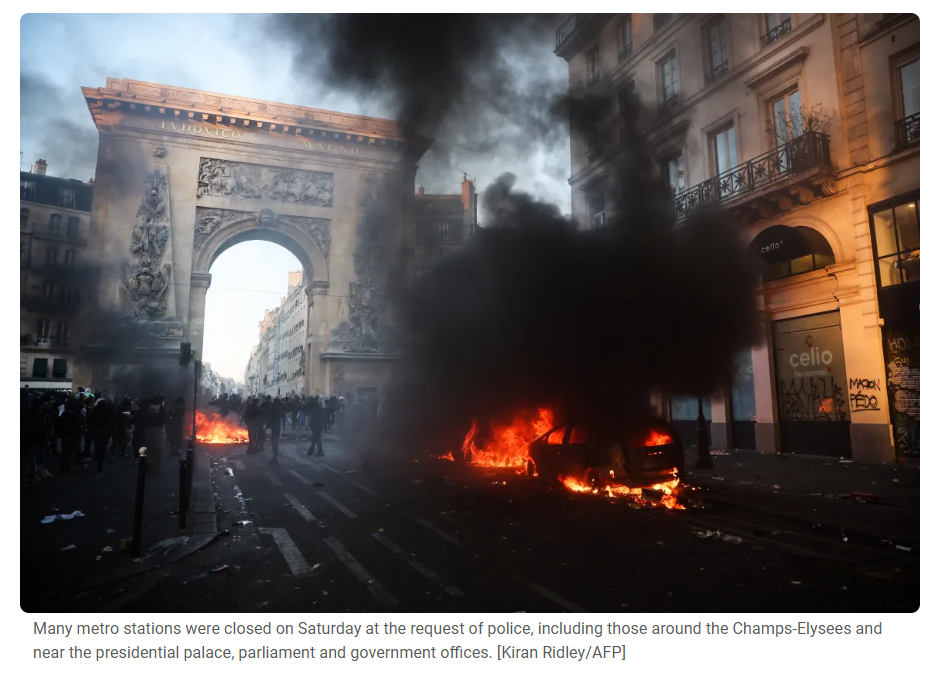
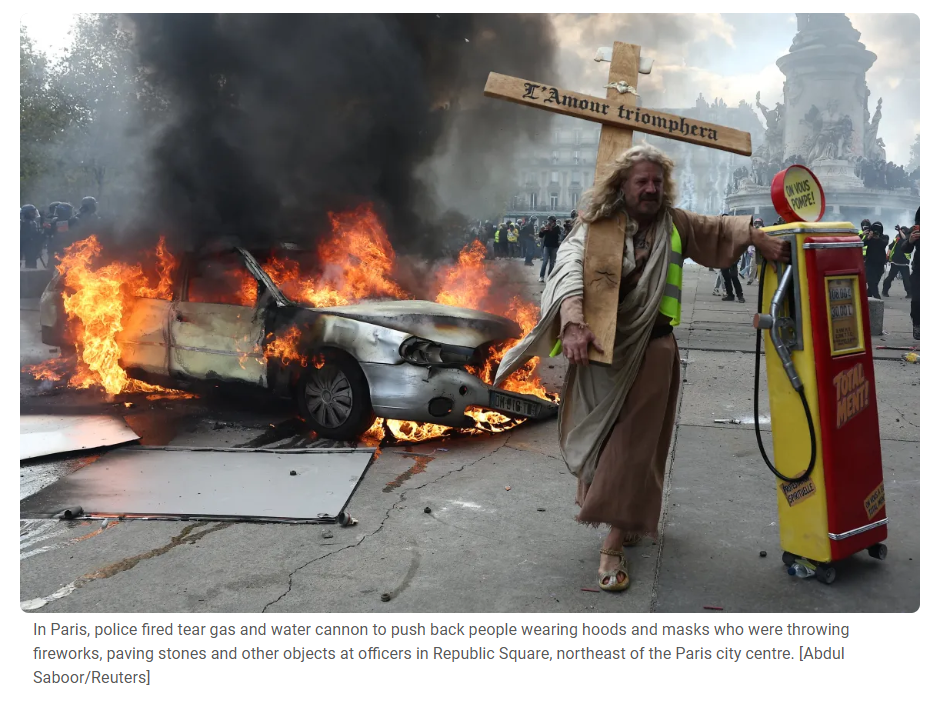
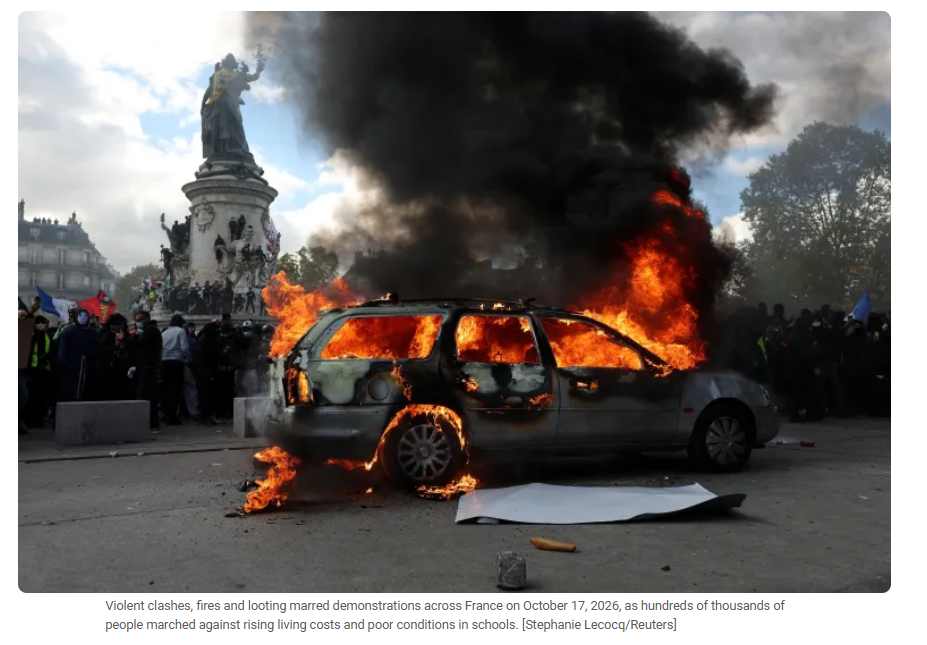
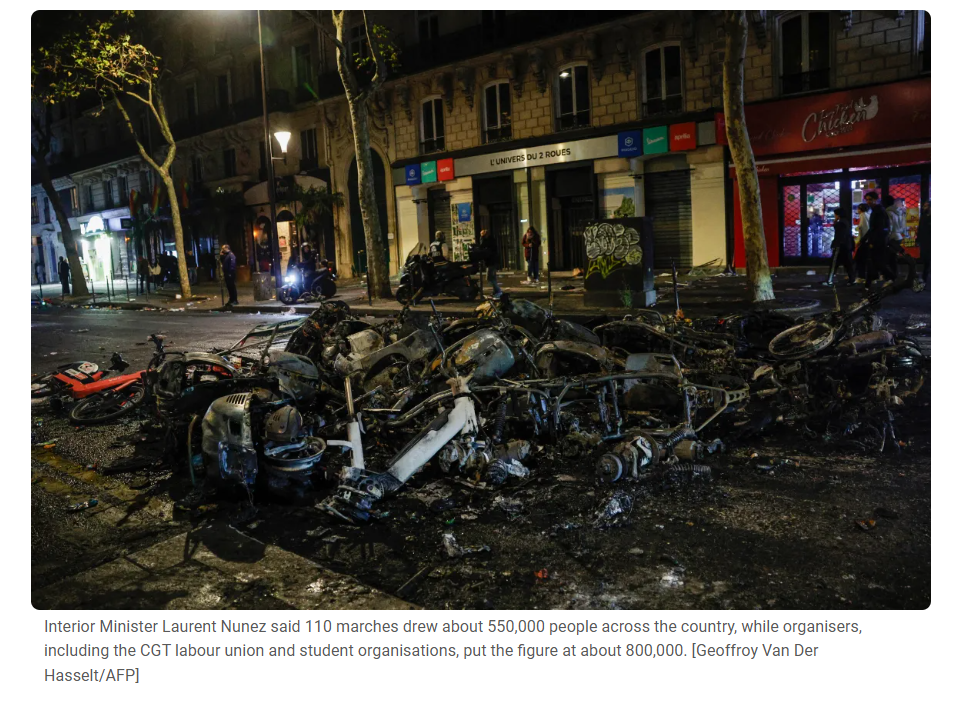
Source: Visuals from Al Jazeera
These kinds of protests - involving arson, clashes with police, looting, and property damage - have spread to many European countries. Albania, Italy, Portugal, Germany, and Belgium are facing these situations to different degrees.
The Strategic Damage
The strategic damage extends beyond the immediate destruction. Repeated unrest can consume administrative attention, discourage investment and make necessary reform politically harder. Governments may retreat from difficult decisions; citizens then experience continued deterioration, generating further anger.
A society can become trapped in a cycle in which its response to stagnation makes renewal increasingly difficult.
For Europe, this would undermine the adaptation Kubilius advocates. Greater defence responsibility requires industrial expansion, reliable budgets and public consent. A government struggling to maintain domestic confidence has less freedom to make commitments abroad.
There are several ways political entrepreneurs can turn dissatisfaction into destabilization:
| Mechanism | What it does |
|---|---|
| Fabrication | Invents an incident, statistic or allegation |
| Distortion | Removes context or presents a limited failure as universal |
| Aggregation | Combines unrelated complaints into a single campaign against the government |
| Escalation | Replaces a specific, achievable demand with demands that continually expand |
| Institutional delegitimisation | Claims that elections, courts and administrative remedies are inherently incapable of delivering justice |
| Coercion | Uses threats, destruction or sustained disruption to compel political outcomes |
Aggregation and opposition mobilization are ordinary features of politics. The destabilizing threshold becomes clearer when falsehoods, intimidation or violence are used to make constitutional decision-making impossible.
The most effective manipulation often attaches itself to a real problem. A genuine administrative failure provides credibility; misleading claims broaden the outrage; organized networks sustain attention; violent actors may then exploit the gathering. Participants can consequently have very different motives within the same movement.
Foreign information manipulation is also a documented security concern: the European External Action Service maintains a dedicated program and reporting framework to counter it. Establishing that such operations exist, however, does not establish foreign direction of any particular protest. That requires evidence of coordination, financing, or operational involvement.
The wider geopolitical implication is substantial. Countries can squander their demographic advantages through failures of political management.
Europe’s wealth cannot compensate indefinitely for paralysis. India’s youthful population cannot generate its full dividend without productive employment and institutional continuity.
The successful response combines credible grievance resolution with consistent enforcement against violence, intimidation and deliberate deception. Institutions must remain capable of correcting mistakes—and capable of making lawful decisions without surrendering to coercion.
In the world Kubilius anticipates, power will depend partly on which societies can sustain that balance long enough to turn their resources into lasting capability.
India Unsettles Other Powers?
In Washington and Beijing, India’s resilience raises an unsettling question: if its economy can grow at nearly 8% a year amid global wars, $100 oil, punitive tariffs and El Niño droughts, what happens when those pressures ease?
If India can sustain such momentum against fierce headwinds, calmer conditions could unleash growth that reshapes the global balance of economic power, and forces both capitals to rethink their assumptions about India’s future potential.
Minhaz Merchant writes in First Post along these lines.
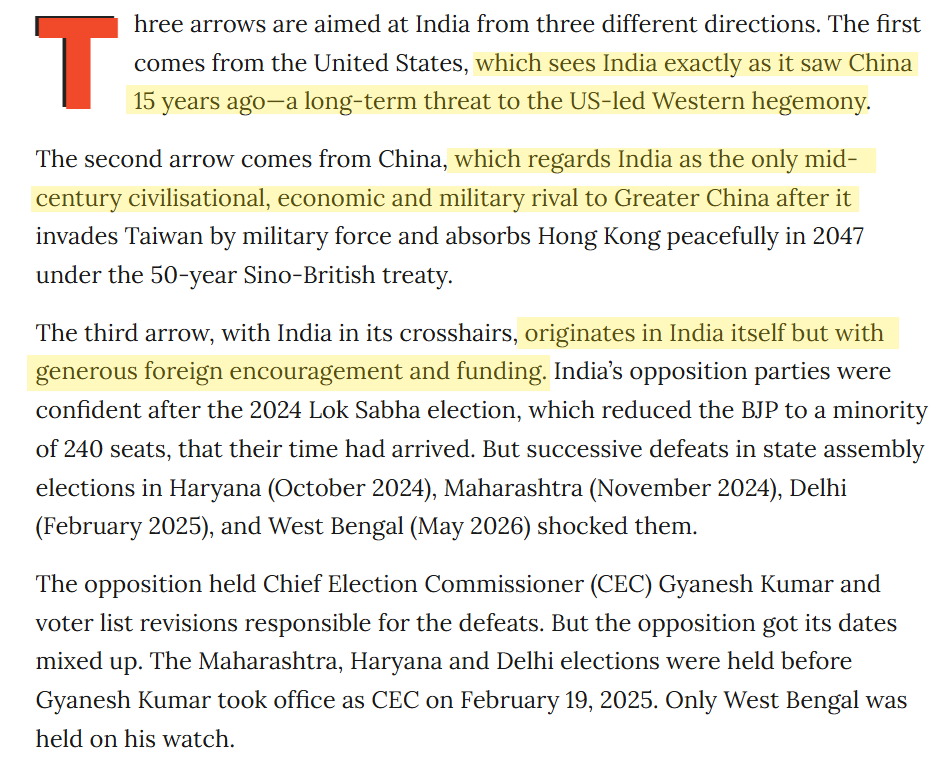
Here are the main takeaways from Merchant's essay:
- India faces pressure from three directions. His “three arrows” framework connects American concern about a future competitor, Chinese anxiety about a powerful Asian rival, and domestic opposition seeking to weaken the government.
- Washington’s embrace of India has limits. Merchant uses Chris Landau’s quoted remarks to argue that America welcomes cooperation with India while resisting policies that could help create another economic challenger comparable to China.
- China sees India as a long-term strategic competitor. In his reading, economic competition, civilizational stature and military capability explain Beijing’s interest in constraining India. He presents Chinese territorial pressure as another instrument in that competition.
- Electoral-roll revision is the immediate domestic flashpoint. Merchant argues that SIR disrupted entrenched electoral advantages in West Bengal, prompting opposition parties to challenge the Election Commission. He also highlights a chronological weakness in criticism of Gyanesh Kumar: several disputed opposition defeats preceded his appointment as CEC.
- Information and public perception are part of the struggle. He portrays Western media coverage as reinforcing a narrative of democratic erosion while overlooking his argument that electoral revisions removed ineligible voters.
- Economic resilience strengthens India’s strategic independence. India’s ability to maintain strong growth despite war, expensive energy and tariffs underpins his argument that New Delhi can withstand pressure over trade and Russian oil.
- The closing question is about India’s unrealized potential. If growth remains strong under adverse conditions, an easing of those pressures could increase India’s economic weight and its capacity to shape international affairs.
That last question connects India’s economic promise to its political vulnerabilities. If sustained growth can alter the global balance of power, then the conditions that sustain that growth take on strategic importance: productive employment, investment, public confidence, and institutions capable of resolving disputes without bringing national life to a halt.
India’s demographic opportunity also has a clock. Young people need education, skills and jobs during their working years. Years lost to paralysis cannot simply be recovered by pointing to the same population figures a decade later. Repeated disruption can consume the very window through which a country hopes to rise.
This makes the political handling of grievances consequential. Unresolved hardship can weaken public confidence; its deliberate exploitation can turn dissatisfaction into hostility toward every institution capable of providing a remedy. The progression matters: a complaint about an administrative decision becomes an accusation against the entire constitutional order, and correcting the original problem ceases to satisfy those directing the mobilization.
We must therefore examine how grievances become instruments of political coercion, and how a movement’s leadership can acquire an interest in perpetuating the suffering it claims to oppose.
Manufactured Grievances: Fuel of the professional protest circuit
A dangerous movement does not always begin by inventing pain. Often, it begins by finding real pain. Then it supplies it with a false explanation.
That is the decisive transformation: a grievance that might have demanded a remedy becomes a mandate for destruction.
Once an institution is declared inherently criminal, its safeguards can be represented as protections for criminals. Due process becomes obstruction. Expertise becomes complicity. Restraint becomes cowardice.
The most revealing feature of such movements is their selective hostility to power. They denounce authority while demanding obedience to their own leaders. They attack inherited loyalties while constructing a more intrusive loyalty to the movement. Under the Khmer Rouge, the destruction of religious, educational, economic, and family independence did not leave Cambodians free of authority. It left them exposed to a state claiming authority over virtually every aspect of life.
The operative principle is substitution: destroy the institutions that can contradict the movement, then install the movement where those institutions once stood.
And that is the warning these histories leave us: the promise to liberate people from every existing restraint can become a demand that they submit to the one authority that permits no restraint upon itself.
Manufactured collective guilt can dissolve the social obligations that ordinarily restrain violence. A neighbor becomes an enemy by category, without anything that individual has done.
Dostoevsky's Demons and Nechayev's Catechism
Dostoevsky’s Demons brings out an interesting insight. The character Shigalyov captures the contradiction between promised emancipation and the resulting order very powerfully:
“Proceeding from unlimited freedom, I end with unlimited despotism.”
His proposed society subjects the overwhelming majority to a ruling minority, enforced through repression and the destruction of intellectual and cultural independence.
The novel provides the language for connecting revolutionary negation to authoritarian order that can follow it.
When one reads Dostoevsky with Nechayev’s Catechism, we come across a powerful pairing: a revolutionary text that treats suffering as an instrument and a novel that paints in detail the destination of supposedly unlimited liberation.
I draw three illustrations from the painful history of revolutions that replaced a grievance with an unbearable, despotic, dystopian society.
- The University that Abolished Expertise: a movement declares examination failures proof of a conspiracy by the teachers and the education system. It abolishes independent assessment in the name of equality. Years later, access to education depends entirely on party certification. The story follows a teacher who initially supports reform but discovers that the movement objects not to unfair judgment, but to judgment it cannot control.
- The Republic of Permanent Emergency: After a genuine disaster, a charismatic leader attributes every administrative failure to a hidden network. Courts demanding evidence are accused of protecting it. The central character is an investigator whose work repeatedly disproves the official theory – thereby making her the next suspect.
- The Village without a Past: Revolutionaries burn land records to erase inherited privilege. The destruction also eliminates tenants’ protections, widows’ claims, and evidence of communal rights. A young activist discovers that the new committee can now distribute everything arbitrarily. What looked like the destruction of hierarchy becomes the destruction of anyone’s ability to challenge the new rulers.
A movement becomes especially dangerous when it converts suffering into unfalsifiable collective accusation, makes institutional destruction a test of moral commitment, and reserves for itself the unaccountable power it condemns in everyone else.
To understand the mind of a leftist revolutionary one needs to delve deeper into Nechayev’s work.
The Revolutionary Who Abolished Conscience
In 1869, the Russian revolutionary Sergey Nechayev produced one of the most chilling political documents of the nineteenth century: The Catechism of a Revolutionary. It was not a manifesto of liberty, a blueprint for justice, or a philosophical argument for a better society. It was a manual for systematically destroying the existing order, written with extraordinary indifference to human suffering.
Its opening declaration captures the entire philosophy:
This is the first principle of Nechayev's revolutionary morality: the individual must cease to be human in any ordinary moral sense and become an instrument of the revolution.
The revolutionary must abandon family, friendship, compassion, gratitude, honor and personal conscience. He must recognize no morality beyond the success of his cause. Indeed, Nechayev declares that whatever advances the revolution is moral, while whatever obstructs it is immoral or criminal.
This is more than a justification for violence. It attempts to abolish every moral restraint that might prevent violence.
Nechayev's ruthlessness becomes especially apparent in how he treats other human beings.
He insists that a revolutionary must be tyrannical toward himself and others. Friendship is permissible only insofar as it serves revolutionary objectives. Even a fellow revolutionary's life must be evaluated according to his usefulness to the movement. Whether a comrade should be rescued is not a question of loyalty, affection or humanity, but a calculation of the resources required against the revolutionary benefit obtained.
Human beings become expendable assets.
The same cold calculation governs Nechayev's treatment of society. He recommends infiltrating institutions, deceiving allies, blackmailing officials, manipulating liberals, compromising intellectuals, and exploiting personal weaknesses. He divides society into categories based on how individuals can be eliminated, manipulated, or deployed to accelerate destruction.
Even the suffering of ordinary people becomes a revolutionary resource.
In Section 22, Nechayev declares that the revolutionary organization must devote its energies to increasing the population's misery until suffering becomes unbearable and produces an uprising.
This is perhaps the most revealing contradiction in the entire document.
The revolutionary claims to fight for the people's happiness while deliberately seeking to intensify their suffering.
The masses are not treated as human beings whose lives must improve. Their desperation becomes the fuel of a political project. Their suffering is useful because it creates anger; their anger is useful because it creates revolt; and revolt is useful because it creates an opportunity to seize or destroy power.
The stated destination is liberation. The prescribed journey is calculated human misery.
Nechayev's Catechism also helps illuminate the psychological mechanisms through which revolutionary movements can transform discontent into permission for destruction.
In the movements that we are seeing that are predicated on manufactured grievances, we often come across a process in which genuine hardship, perceived humiliation or deliberately distorted accusations become the foundation of collective political identity.
Its central formulation is particularly relevant:
Nechayev takes this process to its most extreme conclusion.
First, the existing social order is portrayed as irredeemably corrupt. Next, its institutions and defenders are designated enemies. Then ordinary moral constraints are dismissed as obstacles to liberation. Finally, destruction becomes not merely permissible but obligatory.
Under this logic, evidence matters less than revolutionary usefulness. Compromise becomes betrayal. Compassion becomes weakness. Institutional reform becomes an unacceptable distraction from total transformation.
A powerful mechanism of moral inversion also operates: violence committed by the revolutionary is presented as justice, while resistance to revolutionary violence becomes evidence of oppression.
Once this framework becomes absolute, the movement can justify almost anything without admitting a contradiction.
The revolutionary need not demonstrate that his actions improve society. He needs only to declare that they advance the revolution.
From Nechayev to Lenin, Mao and Naxalbari
The historical significance of Nechayev lies not in proving that every subsequent communist revolutionary consciously followed his writings, but in revealing a recurring method of revolutionary politics: subordinating individuals, morality, and institutions to an allegedly supreme historical objective.
The connections are especially revealing.
Lenin and the Bolshevik Revolution (1917). Lenin's conception of a disciplined revolutionary vanguard shared important organizational characteristics with the tradition of professional revolutionaries associated with Nechayev. Following the overthrow of the old regime, Bolshevik rule developed instruments of political coercion, including the Cheka, the Red Terror and the suppression of rival political movements. The promised emancipation of workers coexisted with the consolidation of one-party power. Historians have identified Lenin's admiration for aspects of Nechayev's revolutionary commitment, although their political theories were not identical.
Mao and the Chinese Revolution (1949). Maoism carried revolutionary struggle into a permanent political project. During the Cultural Revolution beginning in 1966, accusations of ideological disloyalty justified public humiliation, persecution and violence against teachers, intellectuals, officials and ordinary citizens. The Red Guards became instruments of revolutionary purification, while rival factions competed to demonstrate ideological loyalty. The campaign produced extensive social upheaval and human suffering. The movement proclaimed emancipation from oppressive hierarchies while subjecting society to new forms of ideological coercion.
Naxalbari and India's Maoist insurgency (1967 onward). The Naxalbari uprising in West Bengal emerged from real agrarian grievances, including land inequality and exploitation. Yet the revolutionary strategy subsequently associated with Charu Majumdar and sections of the Naxalite movement embraced armed struggle and the targeted killing of designated class enemies. Later Maoist insurgencies also used violence against civilians, political opponents and alleged informants. The claim to represent the oppressed could thus become a justification for denying individuals the protections supposedly sought for society.
These movements differed considerably in their origins, ideologies and outcomes. Nechayev was not the sole intellectual ancestor of Leninism, Maoism or Naxalism, and anarchism itself should not be equated with communism. Nevertheless, the historical comparison exposes a common danger: when revolutionary necessity becomes the highest moral authority, almost any cruelty can be rationalized as a temporary sacrifice for a future utopia.
The central paradox: Liberation through tyranny
Nechayev's most revealing declaration appears near the end of his Catechism. He dismisses the construction of a future political order as a concern for later generations. The immediate revolutionary task is destruction.
This exposes a fundamental weakness in the doctrine.
Destroying institutions does not automatically create just institutions. Eliminating an oppressive ruler does not establish accountability. Mobilizing the masses does not guarantee that the masses will govern.
Indeed, an organization trained to value absolute obedience, secrecy, manipulation and mercilessness may carry those characteristics into government.
The conspiratorial organization becomes the ruling party. Revolutionary discipline becomes political conformity. Identifying enemies becomes an instrument of state repression. The temporary emergency becomes permanent.
Nechayev himself supplied a grim illustration of this mentality. In 1869, he participated in the murder of Ivan Ivanov, a member of his revolutionary circle who had challenged his methods. The episode later helped inspire Dostoevsky's Demons, a literary exploration of revolutionary fanaticism and moral disintegration.
The lesson of Nechayev
Nechayev's enduring significance is that he articulated, without embarrassment, a principle that later revolutionary authoritarianism repeatedly demonstrated in practice: the claim that a sufficiently noble objective can justify unlimited cruelty.
His revolutionary does not seek to persuade society into becoming better. He seeks to destroy its existing foundations. He does not regard compassion as a virtue. He regards it as an impediment. He does not see ordinary people as individuals with independent rights. He sees them as instruments of historical transformation.
The tragedy arises when this method survives the revolution itself.
A movement organized around destroying enemies can keep finding enemies long after it has captured power. A leadership that treats dissent as treachery before victory may be unwilling to tolerate dissent afterward.
The critical question, therefore, is not simply what a revolution promises. It is what its leaders believe they are entitled to do to human beings in order to achieve that promise.
Nechayev's Catechism offers an unusually candid answer. And the histories of revolutionary authoritarian movements show why that answer deserves serious scrutiny.
The danger is not the demand for justice, nor even the overthrow of an oppressive order. It is the belief that justice can be built by people who have deliberately abolished conscience, empathy, and moral accountability from their methods.
A revolution that makes humanity expendable in pursuit of some so-called liberation ends up destroying the very people it claims to liberate.
Constitutional Governance Versus Revolutionary Sovereignty
The ultimate battleground between the revolutionary mindset and the free society is constitutional governance. As argued in foundational democratic theory, a republic does not require its citizens to agree on ultimate ends; it requires them to preserve institutional arrangements through which disagreement can continue without any single faction acquiring an unlimited right to coerce everyone else.
Ambedkar’s "Grammar of Anarchy": We discussed Dr. Ambedkar's warning in November 1949, where he laid out a stern warning against unconstitutional methods of political action.
Ambedkar’s warning was profound, but it rested on an indispensable precondition: the genuine availability and efficacy of constitutional methods. He explicitly warned that political democracy cannot long survive alongside entrenched social and economic degradation, and he cautioned against hero-worship and placing liberty at the feet of charismatic demagogues.
When a state fails to provide accessible justice, tolerates systemic humiliation, or ignores gross economic disparities, it creates the fertile soil in which revolutionary organizers plant the seeds of manufactured grievance. However, as Ambedkar understood, subverting the republic through violent insurrection does not cure injustice; it merely replaces one form of despotism with another infinitely more absolute.
Distinguishing Grievance from Subversive Conduct: To survive, a democratic republic must master a difficult distinction: it must separate legitimate grievances requiring urgent administrative and legal remedy from unlawful, subversive conduct requiring firm enforcement.
- Falling into surrender means letting disruptive minorities dictate public policy irrespective of constitutional rights and majority will.
- Falling into indiscriminate repression means treating all protesters, legitimate complainants, and dissidents as a single hostile insurgency, thereby validating the revolutionary narrative that peaceful reform is impossible.
A healthy republic investigates allegations honestly, punishes identifiable crimes strictly according to due process, protects the rights of peaceful citizens, and ensures that its own governance remains perpetually open to review and correction.
Refusing the Exemption — Keeping the Republic
The enduring danger of the Nechayevian revolutionary mindset is not that it belongs exclusively to nineteenth-century Russian history. Its core premises—that the purity of the cause releases its disciples from universal moral standards, that human beings are mere capital, that misery must be intensified to provoke collapse, and that comrades who question leadership are traitors—have echoed down through the twentieth century in Soviet purges, Chinese cultural destruction, Naxalite annihilation squads, and the ruthless cadre wars of regional communist politics.
A political project is judged not by the grandiosity of its utopian rhetoric, but by how it treats human beings who refuse its authority. Nechayev answered that question with a pistol shot in a Moscow park. A republic worthy of being kept must answer it by upholding the rule of law, protecting the dignity of the individual citizen, and ensuring that no faction—no matter how righteous its manufactured grievance—is ever permitted to sacrifice the unity, integrity, and freedom of the nation at the altar of absolute power.