
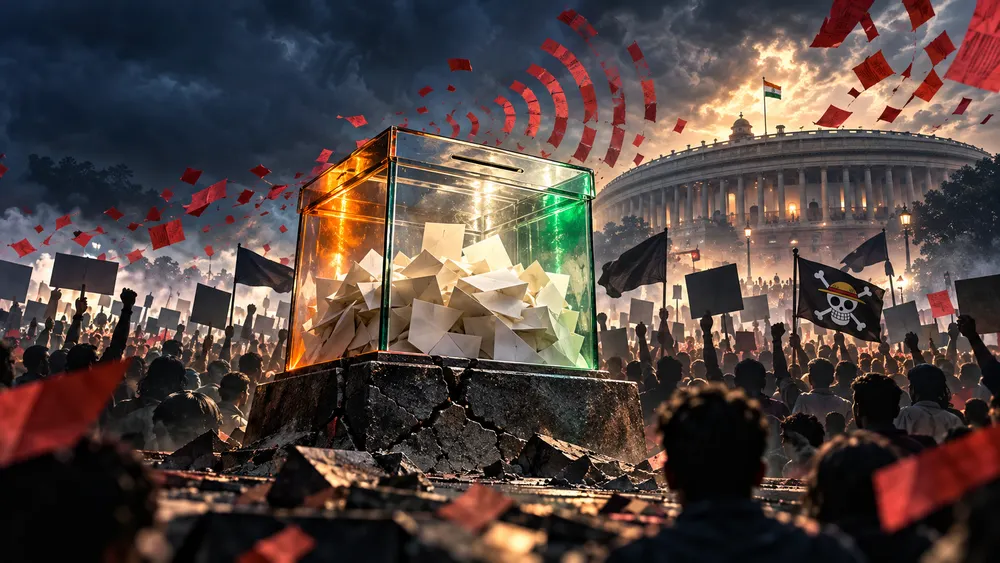
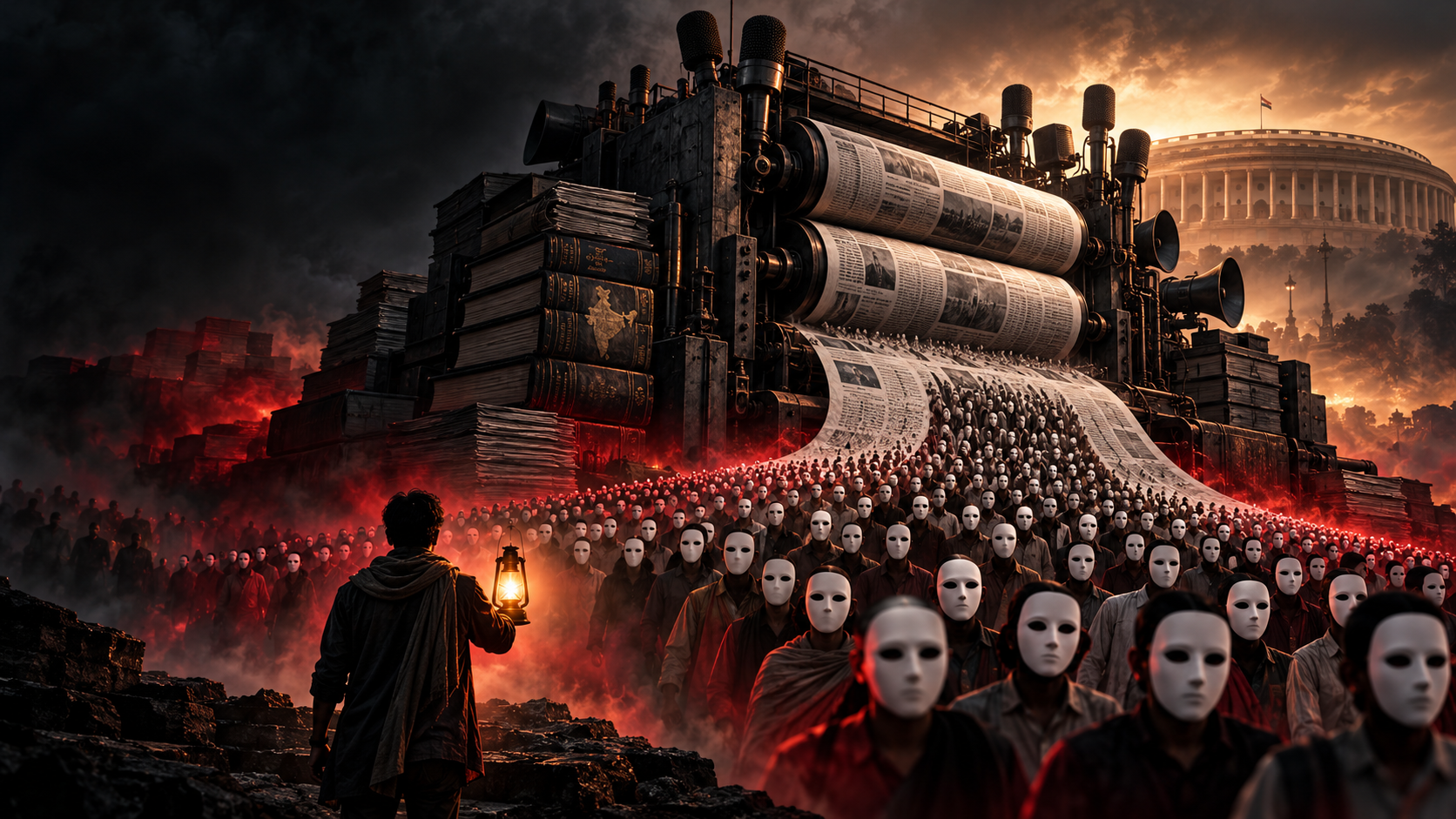
The Water and the Empty Bowls
A monk arrived at a village where everyone was striking empty bowls.
“Why are they doing this?” he asked his master.
“They say the keeper has poisoned the well.”
“Has anyone tested the water?”
The master said nothing.
In the square, a speaker stood beneath a banner.
“Those who drink betray the village!” he cried.
The monk recognized a farmer.
“Yesterday you drank from that well.”
The farmer lowered his eyes. “Yesterday nobody was watching.”
Nearby, a woman whispered that her children were thirsty. When others turned toward her, she began striking her bowl harder.
The monk hurried back.
“Master, the village agrees.”
“Do they?”
“Listen to the noise.”
The master handed him an empty bowl.
“Strike it.”
He obeyed.
“Now tell me what the water tastes like.”
“I cannot.”
“Strike harder.”
The monk hesitated.
Later, they walked to the well. The master drew water into cups.
“Should we drink?” asked the monk.
“First, examine the claim. The keeper may be guilty. The speaker may be mistaken. Neither becomes truthful because a thousand bowls are struck.”
“Then why does nobody ask?”
“Because they fear being left alone in the square.”
The next morning, the monk placed his empty bowl on the ground.
He did not defend the keeper. He did not insult the crowd.
He asked for the water to be tested.
One bowl fell silent.
Then another.
The master listened from the monastery gate.
For the first time, he could hear the questions people had been trying to ask.
When disagreement becomes social blasphemy
A community may treat certain memories as sacred: its founding struggle, its greatest leader, its experience of persecution, or its claim to represent ordinary people. Such attachments are not inherently pathological. They can sustain courage and solidarity. Trouble begins when reverence establishes an exemption from scrutiny.
A factual question then becomes an offense against belonging. Asking whether a law actually says what a platform speaker claims can sound like abandoning a vulnerable community. Asking whether repeal improved farmers’ incomes can sound like insulting their sacrifice. Asking whether an election allegation has been substantiated can sound like siding with theft. Conversely, asking whether police restrictions were proportionate can be branded hostility to the nation.
We will use serious scholarly works on “Social blasphemy,” “respectable citizenship,” and “the manufacture of concurrence” as this article’s analytical framework.
These are concepts that connect many different works by sociology experts to help us understand current events in a coherent manner.
Social blasphemy describes treating a challenge to a cherished public story as a moral transgression. Respectable citizenship describes the standards institutions use to decide whose opinions and affiliations deserve recognition. The manufacture of concurrence describes processes that can make agreement appear more uniform than people’s actual convictions.
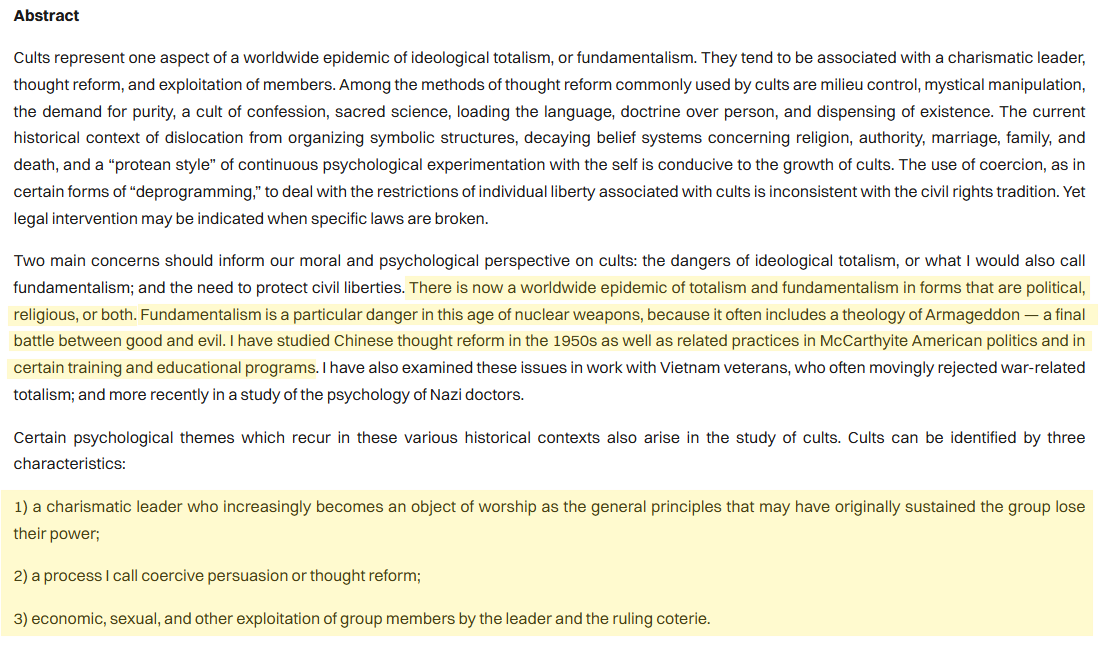
Robert Jay Lifton’s account of ideological totalism gives this distinction a sharper vocabulary. His Thought Reform and the Psychology of Totalism appeared in 1961; his later summary discusses doctrine elevated beyond legitimate questioning, language reduced to decisive formulas, and experience subordinated to an authorized interpretation. He calls the last relationship “doctrine over person.” When what someone knows, or experiences, contradicts doctrine, the environment pressures the person to negate the experience rather than revise the doctrine.
Applied to politics, the questions are concrete.
- Can a supporter acknowledge a false claim while remaining a supporter?
- Can a critic acknowledge an effective government response without being expelled from the opposition’s moral community?
- Can someone criticize a revered historical figure without first establishing personal innocence?
These questions investigate a mechanism; they do not establish that a party, protest, or university is a cult.
Before the barricade: who teaches us what to remember?
Political mobilization rarely begins with an empty mind. People bring inherited accounts of the nation, its heroes, its injuries, and its enemies. Schools, public ceremonies, newspapers, families, and professional institutions help establish those accounts. The question is not whether history teaching selects. Every curriculum does. The question is what the selection makes intelligible—and what it leaves difficult to imagine.
Robert Weatherley and Coirle Magee examine this process in Chinese middle-school history textbooks. Their study argues that selected teachings associated with Confucius, Mencius, and admired emperors form a model of good governance that is later applied to Communist Party leaders. Contemporary authority is thus portrayed as the continuation of an established national tradition. The abstract describes textbooks as “written as a means of legitimizing the rule of the Chinese Communist Party.”
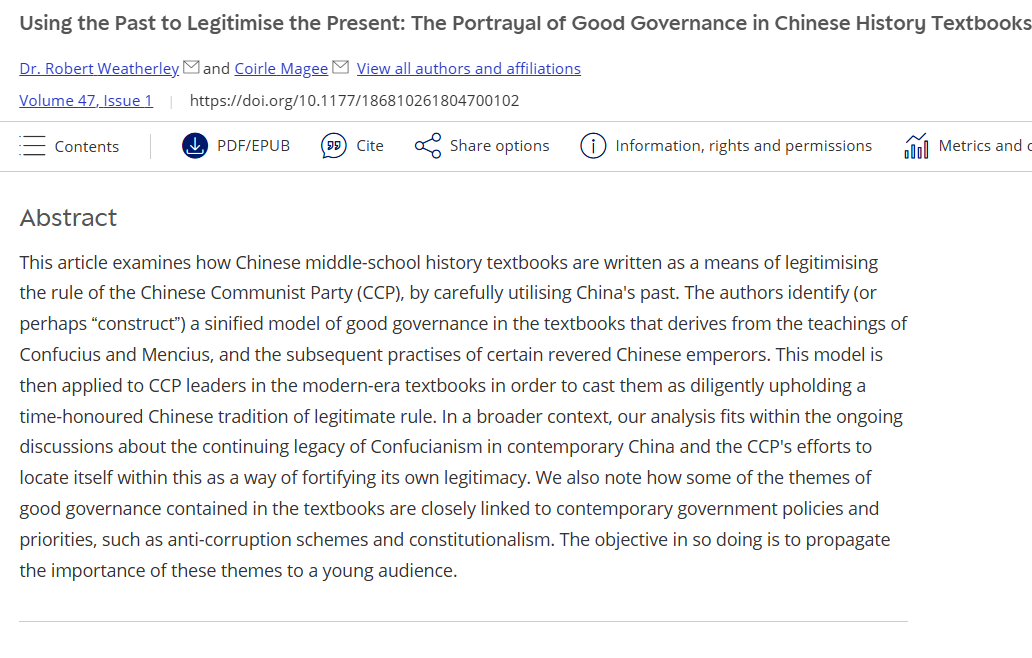
The study matters because it shows how legitimacy can be built through narrative organization, not simply an obvious falsehood. A textbook can connect admirable rulers from the past with present leaders, emphasize continuity, and make alternatives appear as departures from the nation’s authentic character. Its authors analyze Chinese materials in a one-party authoritarian setting. Their findings are not direct evidence about Indian editorial intentions, nor do textual patterns independently measure what children actually believe.
They nevertheless suggest a method: compare editions; identify the space given to particular achievements; examine which actors possess independent agency; distinguish omission, underrepresentation, euphemism, and denial. Those are different practices. Calling every imbalance “negationism” can obscure the specific evidence needed to criticize it.
The Ahom example illustrates the distinction. The dynasty’s conventional span from 1228 to 1826 covers nearly six centuries. UNESCO’s tentative-list description of the Rangpur–Sivasagar ensemble emphasizes a sophisticated political and cultural landscape, state-building, water management, and resistance to Mughal invasions, including the Battle of Saraighat.
An older NCERT treatment includes the Ahoms. It discusses their administration, society, and culture, and describes their defeat by Mir Jumla, adding that direct Mughal control did not last long. The newer chapter Reshaping India’s Political Map explicitly foregrounds Lachit Borphukan and the victory at Saraighat.
That difference matters. A polity remembered mainly through its encounter with an expanding empire occupies a different place in a child’s imagination than one understood through its institutions, cultural production, military adaptation, and successful resistance.
Founders, affiliations, and the price of respectability
National symbolism can transfer reverence into political authority. Admiration for a founder becomes respect for a legacy; a movement claims to administer that legacy; criticism of the movement’s interpretation becomes disrespect for the founder; disrespect for the founder becomes disloyalty to the nation. Several separate questions have been collapsed without argument.
Gandhi illustrates why careful distinctions improve rather than weaken historical criticism. Reports of Home Ministry responses state that “Father of the Nation” was not a title formally conferred by the Government of India. Its cultural power is nevertheless unmistakable. A phrase can shape public reverence without having the status of a legal designation.
At 4.29, Prakhar Srivastava, author of the seminal book on Gandhi - "Hey Ram" - discusses how Gandhi got the title of "Father of the Nation".
Such anointing and reverence forestalled all criticism of Gandhi thereafter. So one needs to ask -
- How did reverence crowd out other contributions, turn a historical question into a loyalty test, or impose professional costs on critics?
- Where did scholarship remain open? Commemoration cannot settle historical causation; neither can the existence of some critical scholarship prove that every institution was equally hospitable to it.
RSS linkages were penalized since Nehru's time in order to cordon off the most significant political and ideological rival to Nehru's rather deviously defined concept of secularism.
So, material restrictions are especially important because they make respectability more than a matter of taste. In Purushottam Gupta v. Union of India, the Madhya Pradesh High Court examined government instructions concerning employees’ association with the RSS.
The judgment reproduces the 1966 memorandum concerning the RSS and Jamaat-e-Islami (forced equivalence?) and its statement that specified association made a government servant “liable to disciplinary action.” It records the removal of the RSS reference in the government’s memorandum of July 9, 2024 and questions the evidentiary basis for the earlier treatment.
The employment restriction was a documented institutional boundary for RSS. It shows that an affiliation could carry material consequences for deviating in political association with an opposition.
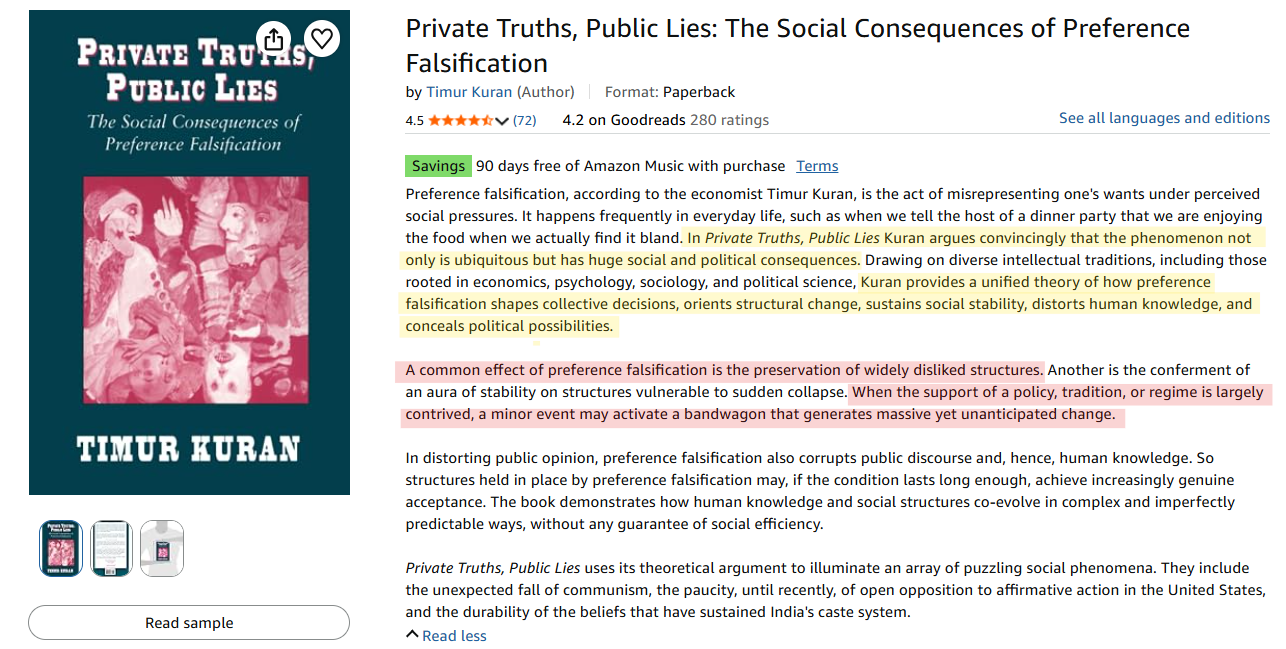
Timur Kuran’s Private Truths, Public Lies helps explain why this distinction matters.
A professional may conform to an affiliation rule without agreeing with its moral judgment; observers may mistake that compliance for conviction.
The Nehruvian Swagger of Entitlement
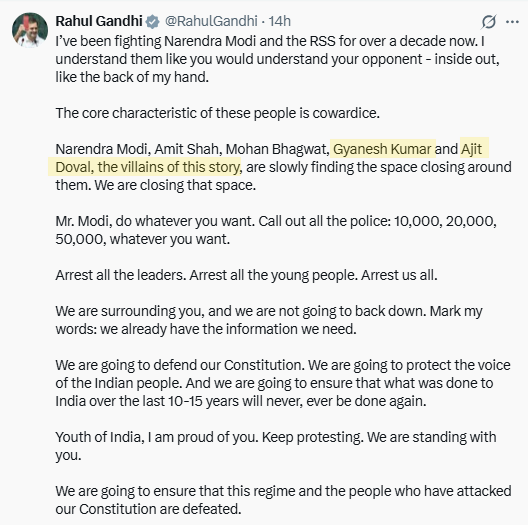
Rahul Gandhi carries on the great tradition of control and fascist execution of power that his family - from Nehru to his own mother - laid out for India.
Listen to what he posted while the Jantar Mantar protest was being organized. He named five men: the Prime Minister, the Home Minister, the RSS chief, the Chief Election Commissioner, and the National Security Advisor, and he called them, in his words, "the villains of this story." He declared, "We are surrounding you. We are closing that space." He dared the government to call out "10,000, 20,000, 50,000" police, to "arrest us all," and then he warned, and I quote, "we already have the information we need."
Pause on that last line, because it deserves to be read twice. We already have the information we need. What information? Supplied by whom? A Leader of the Opposition does not get intelligence briefings on demand. So whose desk did that information come from, and what did they expect in return?
Now look at one name on that list of so-called villains. Ajit Doval. The National Security Advisor whose tenure has been the most successful in India's history at stopping major terror attacks outside Jammu and Kashmir. Attacks funded, planned, and executed across the border by Pakistan's ISI. This is the man whose job, every day, is to prevent the next 26/11. Now his own words force the question on every Indian. Doval's record is written in the attacks that never happened. The bombs that did not go off in our cities. The plots that died in planning rooms in Rawalpindi and Karachi because the man whom Rahul Gandhi calls a villain got there first.
And who sat in those planning rooms?
At a student event in Indore, Gandhi went further. He told thousands of students that Doval, and I quote, "is sitting inside your phone," that he controls India's telephones and WhatsApp, that a six-member system runs this country. And the spectacle around him told its own story: golden chariots, drumbeats, loudspeakers hailing him as the messiah of the youth. A manufactured messiah delivering manufactured paranoia. Understand what was actually being delivered to those first-time voters. This is not criticism of policy. This is the deliberate manufacturing of paranoia: the state is illegitimate, your election was stolen, your NSA is a spy, and the only honest act left is the street.
And he told us, in his own words, that none of this is new. "I've been fighting Narendra Modi and the RSS for over a decade now. I understand them like you would understand your opponent."
A decade.
Ten years of attacking every institution that refused to crown him: the Election Commission, the judiciary, the Army's leadership, and now the security establishment itself.
Gandhi's choice of words and insinuations are not casual or careless. They are carefully crafted and align with the larger project of enabliing social anarchy and violence.
Enablers Beyond Border - of Anarchy and Violence
An entire ecosystem of activists—intellectuals, professors, journalists, lawyers and writers—mobilizes across borders around particular protest movements. Their involvement, in this critique, goes beyond solidarity: they lend visibility, legitimacy and institutional influence to agitation that can descend into disorder and violence.
Vineeta Sharma, an Associate Professor in the Department of Economics at Kirori Mal College, is seen urging young protesters—including women—to bring “Kasab energy” to Jantar Mantar. She is encouraging them to wear kalava threads and tilaks while using stun guns and chilli powder against Delhi Police personnel.
As is obvious, these remarks amount to incitement to violence and deserve serious scrutiny.
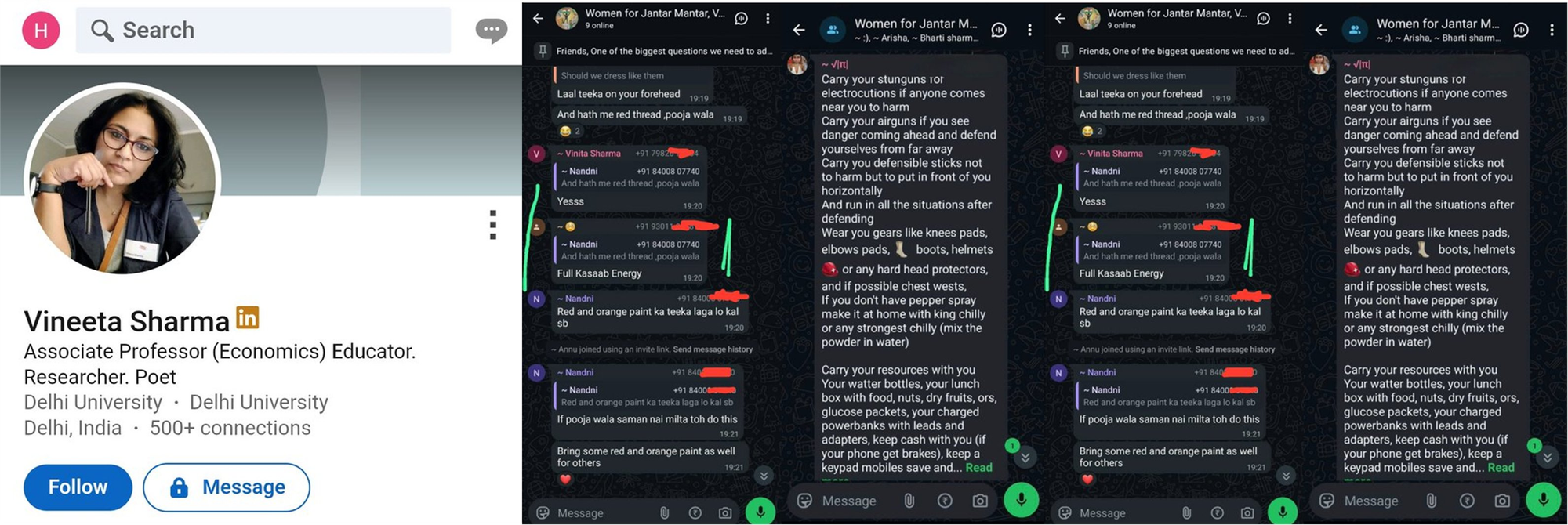
Why “Kasab energy”? Why not Tukaram Omble energy—the courage to confront terror and sacrifice yourself to protect others?
Activists invoking constitutional values should explain how those values accommodate a terrorist as an inspirational symbol—particularly alongside alleged calls to attack police. The question is not merely how forcefully they want protesters to act. It is whose example they want them to follow.
We must be very clear - journalists these days are compromised and are ready to back anarchy and hit at law enforcement personnel. Let me show you a video of a rather brazen act. A French press figure is clearly and deliberately seen tripping a police officer during riots in France.
So the question is why should press, that participates in riots be given immunity?
That is why when figures like Hope Loudon, who call themselves "journalist" (X Post) need to be studied.
Vijay Patel, an OSINT investigative handle on X, shared some disturbing details about a so-called journalist Hope Loudon.
 Office Of Vijay Patel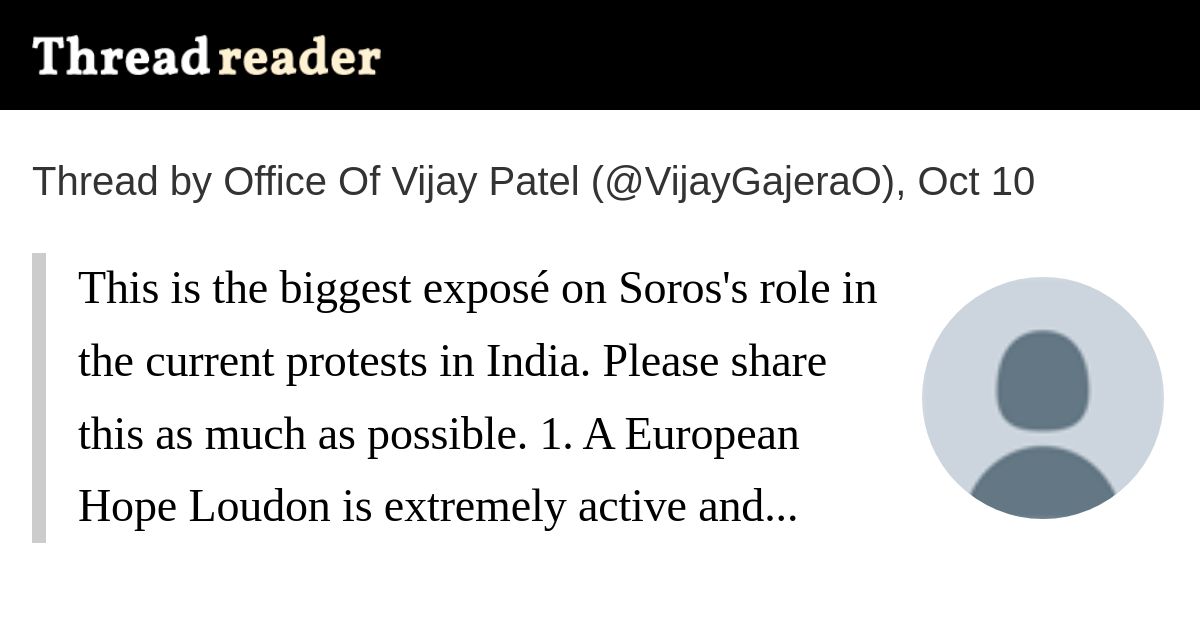
You can download the pdf of the thread from here.
Loudon threatened lawfare against Patel and he returned the favor by bringing out another inconvenient factoid. The person's account is based in Nepal, where a recent regime change operation was enacted. Go figure!
Indian politician?😂
— Office Of Vijay Patel (@VijayGajeraO) October 10, 2026
By the way, why is your X operating from Nepal? https://t.co/uEVjp60gGr pic.twitter.com/0uihnSEdJb
There is another aspect of Loudon's narrative that needs attention. In May 2025, she shared a message that normalizes terror. That should make one sit up and think.
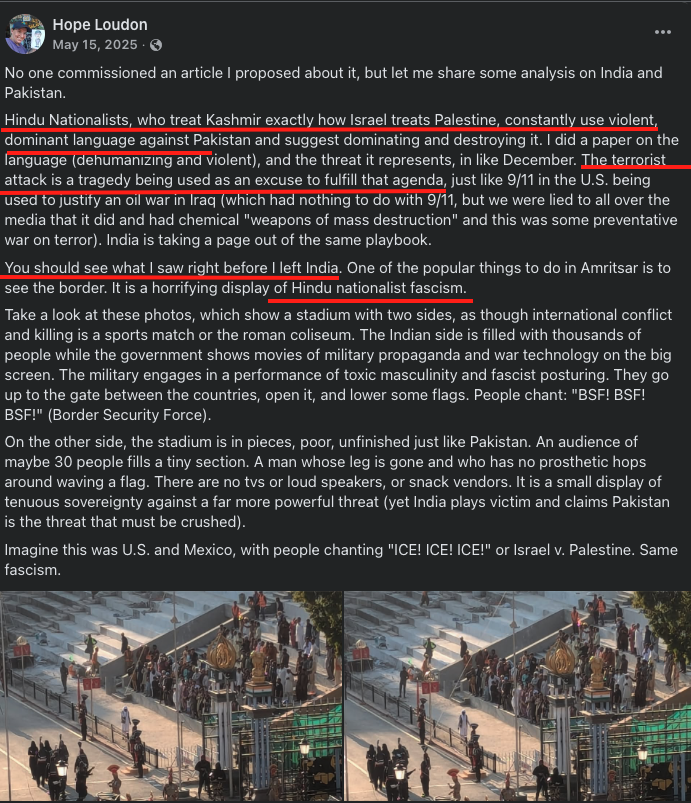
In her message above, Hope gives Pakistan’s vulnerability an emotional foreground while removing its terror infrastructure from the explanatory background. Her note subjects Indian patriotism to suspicion while interpreting Pakistani patriotism sympathetically. The resulting narrative makes India’s response more morally salient than the violence that prompted it. She minimizes Pakistan’s security establishment through selective framing: India’s visible patriotism becomes evidence of aggression, while Pakistan’s quieter, unfinished stadium becomes evidence of innocence.
Let us examine her claims and what it obscures.
| Element | How the post frames it | What that framing obscures |
|---|---|---|
| Terrorist attack | A tragedy supposedly used to advance India’s existing agenda | The perpetrators, their networks, sponsors and responsibility |
| Indian spectators | Crowds and chants signify fascism | Attendance and enthusiasm cannot establish a political system’s character |
| Pakistani spectators | Sparse attendance and an amputee signify vulnerability | Civilian hardship does not establish the innocence of military or intelligence institutions |
| Border ceremony | India’s performance signifies aggression; Pakistan’s signifies sovereignty | Both countries participate in the military spectacle |
| India’s response | Compared with the US invasion of Iraq | The analogy substitutes another conflict’s history for evidence about this one |
Talking of the interest that global activists, journalists and "intellectuals" have in an Indian protest, let us discuss the power of common symbolism that seems to reappear in regime change operations across the world... somehow.
One Piece - A Manga Symbol Appropriated by Regime Change Operations
The Straw Hats’ Jolly Roger, also known as the Straw Hats’ Skull and Crossbones, is the pirate flag of the protagonists in One Piece, the Japanese manga created by Eiichiro Oda in 1997 and later adapted into anime and live-action television. It depicts a grinning skull above two crossed bones, wearing the straw hat associated with the crew’s captain, Monkey D. Luffy.
In the story, the Straw Hat Pirates repeatedly confront oppressive rulers and corrupt authorities, linking their flag to freedom, loyalty, and resistance to injustice.
This fictional emblem has crossed into real-world politics. In Indonesia, it gained prominence ahead of Independence Day in August 2025, appearing on homes, trucks and other vehicles as an expression of dissatisfaction with government policies, corruption and perceived democratic backsliding. Some people displayed it instead of the national flag; others flew it alongside or beneath the national colours. Its appeal was not necessarily a demand to overthrow the government: for some participants, it expressed love for their country combined with opposition to its leadership’s policies.
It has been repeatedly surfaced in the flags and posters used in several regime-change operations in the last few years.
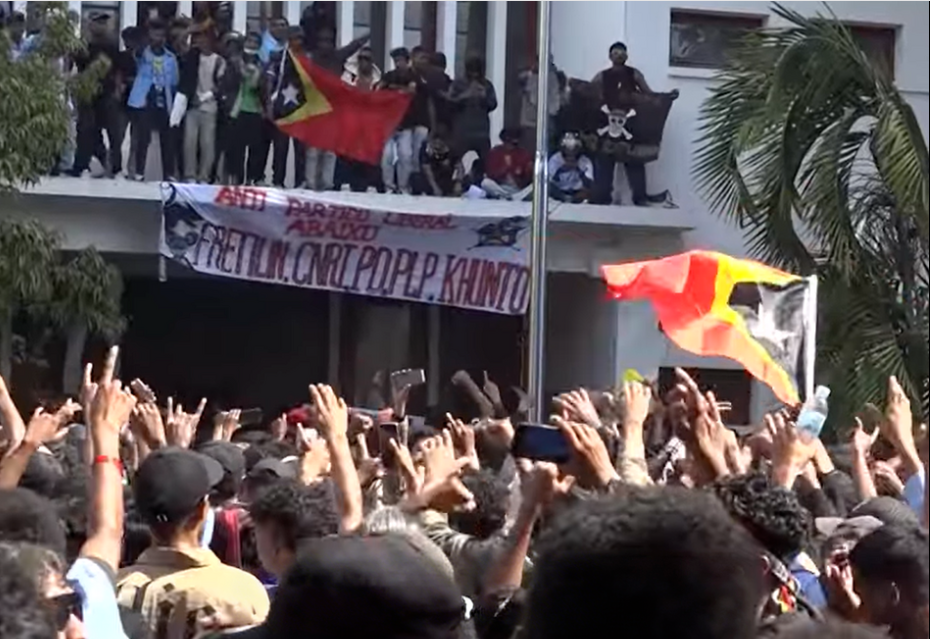
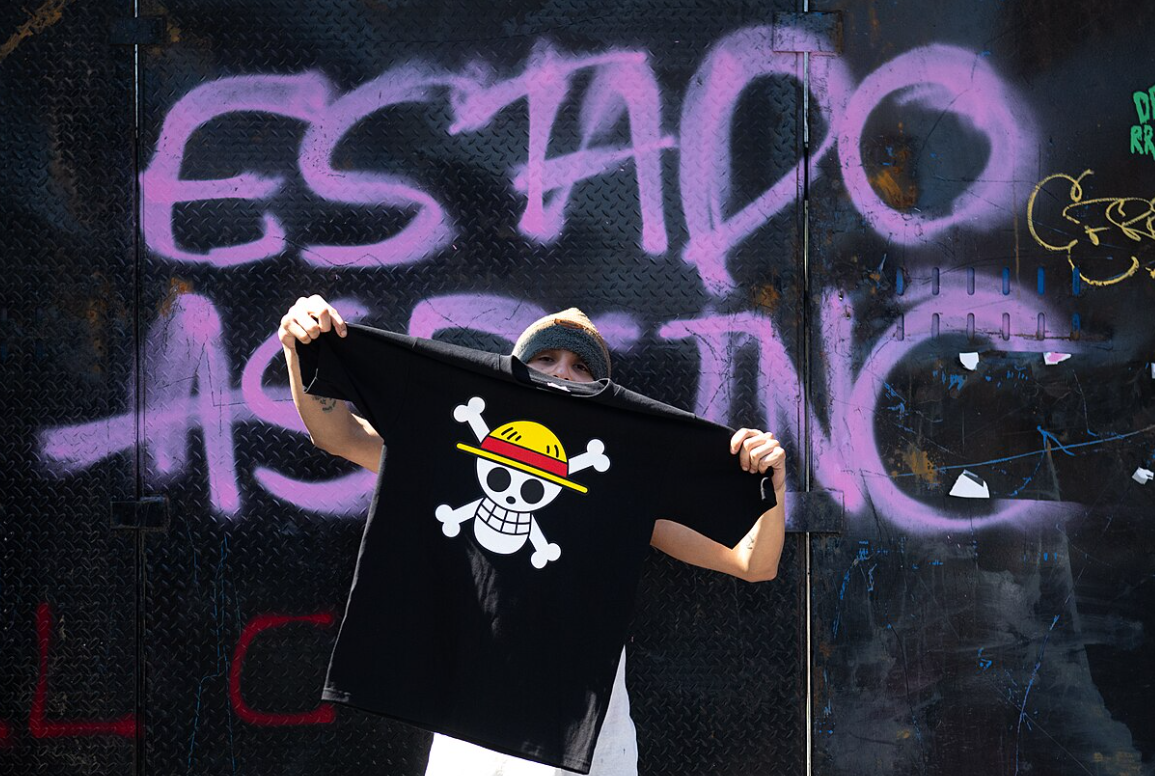
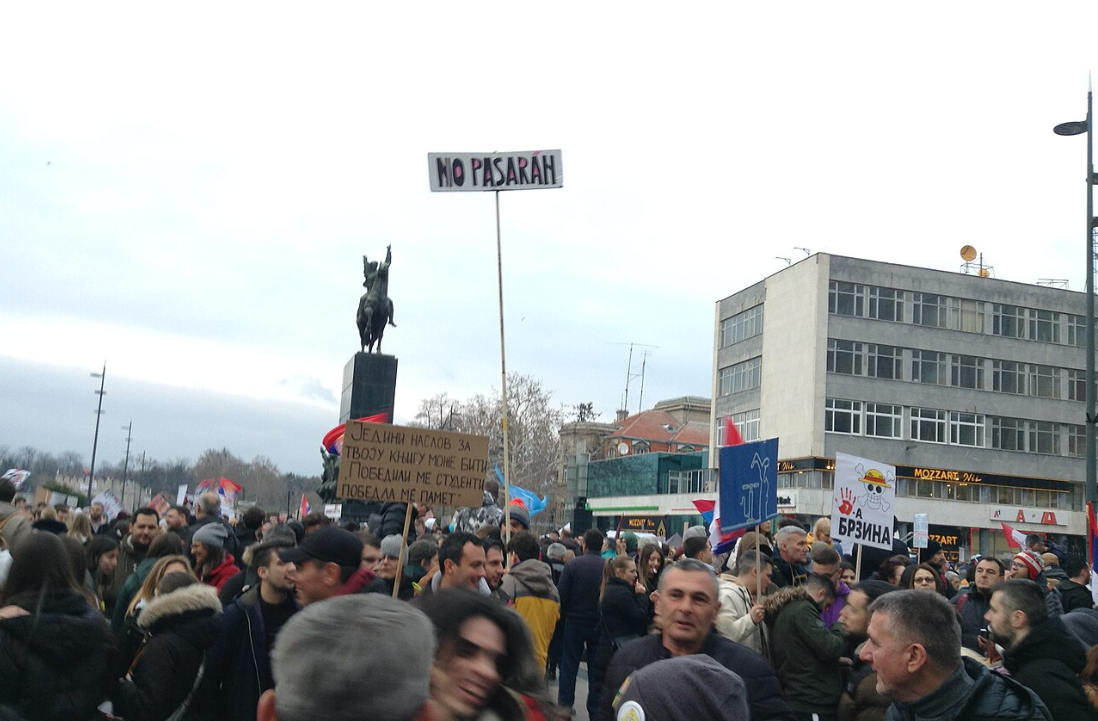
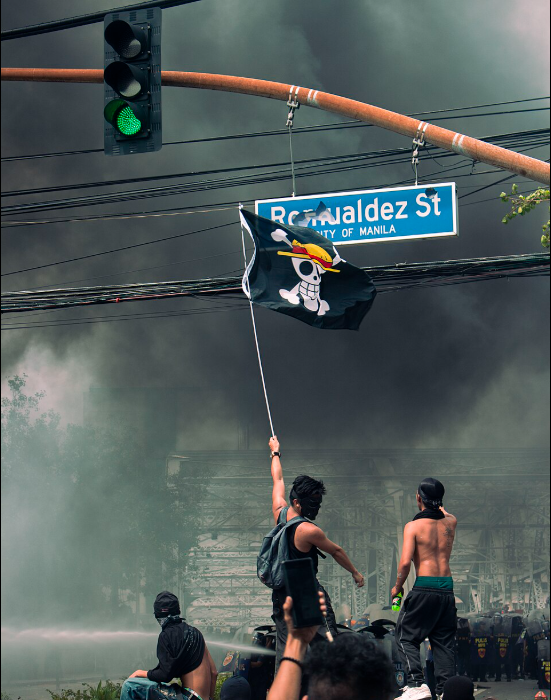

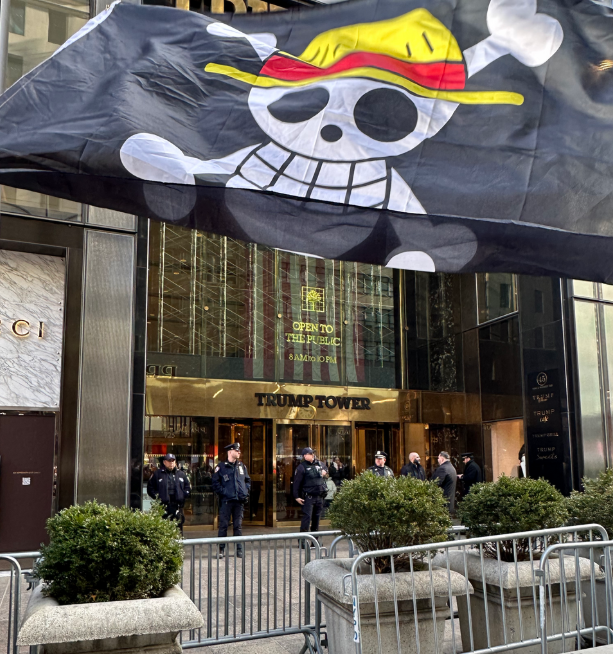
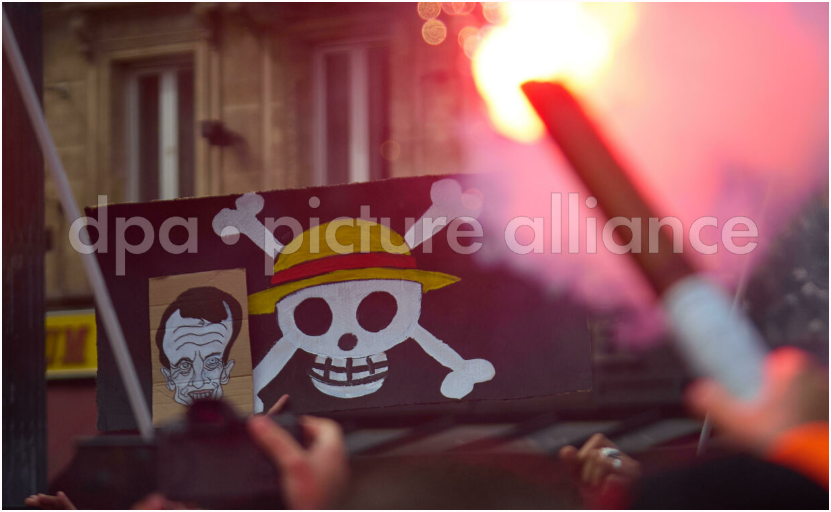
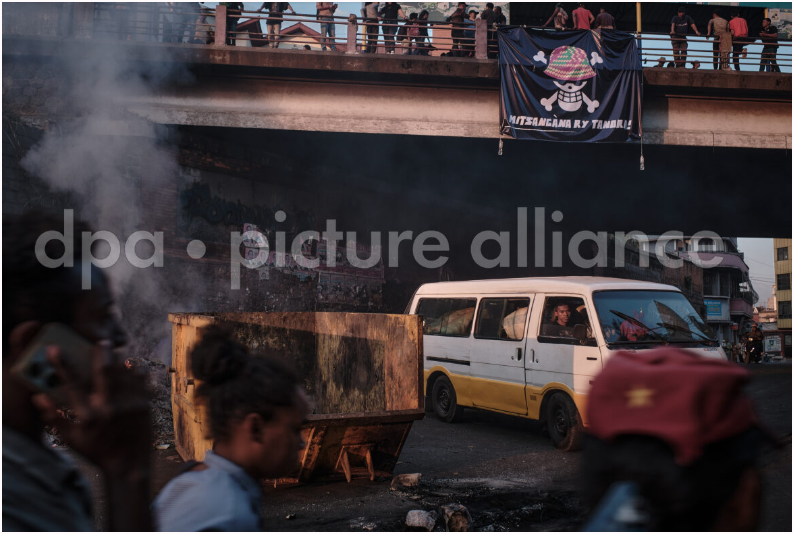
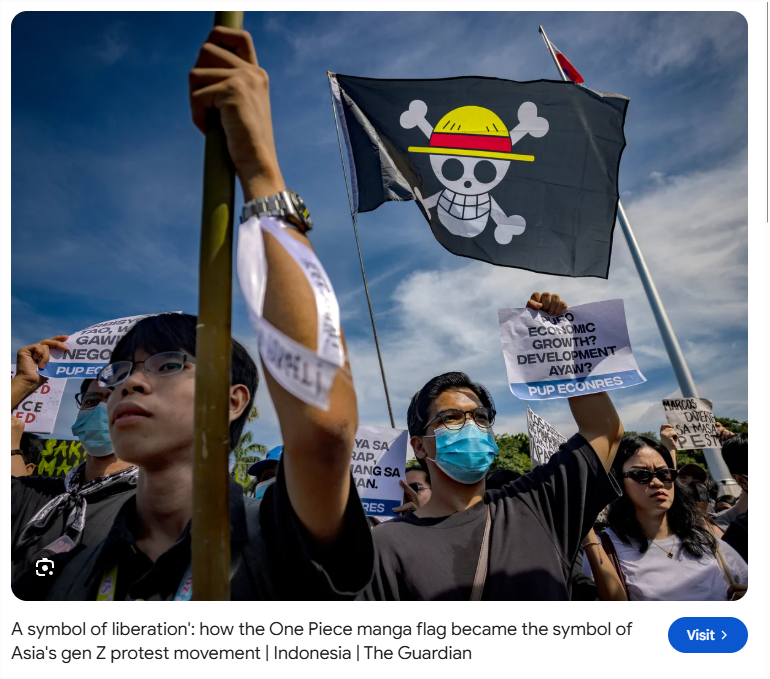
From the top left to right: Timor, Mexico, Niš (Serbia), Manila (Philippines), Anti-Trump, France, Madagascar, Indonesia
So it is interesting that Neha Bora, a Communist activist and one of the spearheads of the current protests in India, uses the same symbolism in her expression.
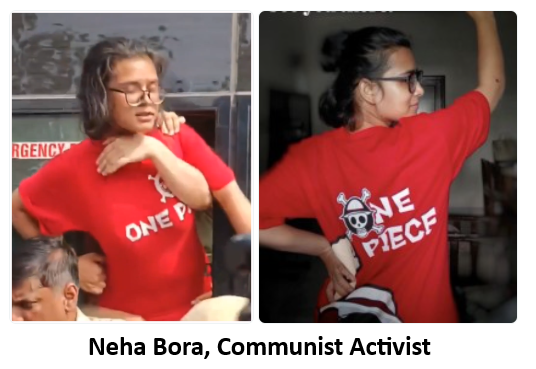
Its appearance in Nepal and Madagascar has associated it with movements that went beyond policy protest and contributed to the removal of governments. In Nepal, demonstrators carried the flag during the September 2025 uprising against a social-media ban, corruption and political privilege. Prime Minister K. P. Sharma Oli resigned on September 9, and an interim government followed. In Madagascar, protesters used the same emblem during demonstrations initially driven by water and electricity shortages, which broadened into demands for President Andry Rajoelina’s resignation. The crisis culminated in his removal and a military takeover in October 2025. These were different political outcomes: Nepal underwent a protest-driven government collapse and interim transition; Madagascar’s uprising culminated in a coup.
The flag therefore has a documented association with regime change. Its presence in movements that brought down governments does not establish that it caused those outcomes, that everyone carrying it sought the same outcome, or that a single organization directed its international spread. It shows how a familiar cultural image can become a shared emblem for movements whose demands range from reform to removing those in power. More often the latter!
How solidarity can blur political purpose
The flag’s attraction is easy to understand.
It offers young people a recognizable identity without requiring membership in a political party or agreement on a detailed program. Reporting on its spread highlights the story’s themes of friendship, resilience and defiance of corrupt authority, qualities that allow protesters in different countries to see their own grievances reflected in the same fictional struggle.
The interpretive danger is that identification can become a substitute for examination. A complicated political conflict acquires a simple moral structure: we are the courageous outsiders; those governing us are the corrupt establishment. Carrying the flag can feel like joining a struggle for liberation even when participants disagree about the movement’s demands, its methods or the political order that should follow.
This is where an evocative symbol becomes useful to those seeking to steer a movement. Organizers, political factions or influential networks can frame the grievance, designate the target and promote the emblem as a tool of solidarity. The participants’ anger may be sincere, while the objectives of those trying to channel it may be less visible. The analytical concern is not that every youth movement has hidden masters, but that shared enthusiasm for a symbol does not guarantee shared understanding of a political project.
Under those conditions, legitimate dissatisfaction can be redirected. A demand for accountability can become a demand for a government’s removal; opposition to particular abuses can widen into hostility toward institutions themselves. The emblem preserves the emotional continuity - “we are fighting injustice” - even as the movement’s objectives change. Whether such redirection occurred in a particular case requires evidence about actual actors, decisions and interests, not merely photographs of the flag.
When the uprising and its outcome diverge
Madagascar illustrates why the distinction between a movement’s aspirations and its eventual beneficiaries matters. Young protesters mobilized around failures of basic services and demands for accountability, but the ensuing political rupture placed military figures in power. Later, Gen Z representatives criticized the appointment of a new prime minister as non-transparent and undertaken without consultation. Removing the old leadership did not mean the young people who helped precipitate it controlled the replacement.
The same caution applies to claims of manipulation. Genuine grievances can coexist with opportunistic intervention, and a just cause can attract actors pursuing less defensible objectives. But describing a movement as “hijacked” requires identifying who redirected it, how they did so, and whose interests the redirection served. The flag itself cannot supply that proof.
The questions the symbol cannot answer
An elected government is not beyond criticism, and electoral legitimacy does not excuse corruption, repression or unlawful force. Equally, a fictional liberation story cannot establish that a real government is tyrannical, that every accusation against it is true, or that removing it will produce a freer and more accountable order.
Those judgments require questions heroic imagery leaves unanswered: Who defines the movement’s narrative and chooses its targets? Which allegations are supported by evidence? What methods are being legitimized? What constitutional process will govern a transition? Who is positioned to take power afterward?
The central concern is not that young people draw inspiration from fiction. It is that the emotional certainty fiction provides can obscure the uncertainty of politics.
A flag may tell participants who they believe they are - brave, loyal, and opposed to injustice - without telling them whose strategy they are advancing or what their victory will actually deliver.
So we now move to those who defend these protestors - at any cost. Literally!
Mystery of a Battery of Unpaid Rich Lawyers for Anti-Modi Protestors
We have seen this phenomenon play out many times in the last few decades. As soon as there is any action by the Modi government, a battery of top, powerful, and highly paid lawyers descends on the Supreme Court and battles for those challenging every action of the Modi Government.
CAA: In March 2024, Kapil Sibal represented the Indian Union Muslim League in proceedings challenging the Citizenship Amendment Act and its implementation rules. Indira Jaising also appeared for a petitioner. Both sought intervention to prevent citizenship being granted while the challenge was pending; the Court declined to issue that interim restraint. (Indian Express)
Farm laws: In January 2021, Dushyant Dave and Prashant Bhushan appeared for farmer unions in Supreme Court proceedings concerning the three farm laws. They told the Court that the unions they represented would not participate in its appointed committee because they wanted the laws repealed. (Livelaw)
Rafale: Prashant Bhushan joined former Union ministers Yashwant Sinha and Arun Shourie in petitioning the Supreme Court over alleged irregularities in the fighter-jet deal, seeking a direction to the CBI to register an FIR. (Economic Times)
Article 370: Kapil Sibal led arguments for petitioner Mohammad Akbar Lone against the abrogation. Supreme Court Observer recorded 17 lawyers arguing for the petitioners during the 2023 hearings, with Sibal accounting for approximately 14 hours of argument. (Pls see the chart below)
14 hours by Kapil Sibal!! Try that sometime and you will see what it takes.
Here are the details.
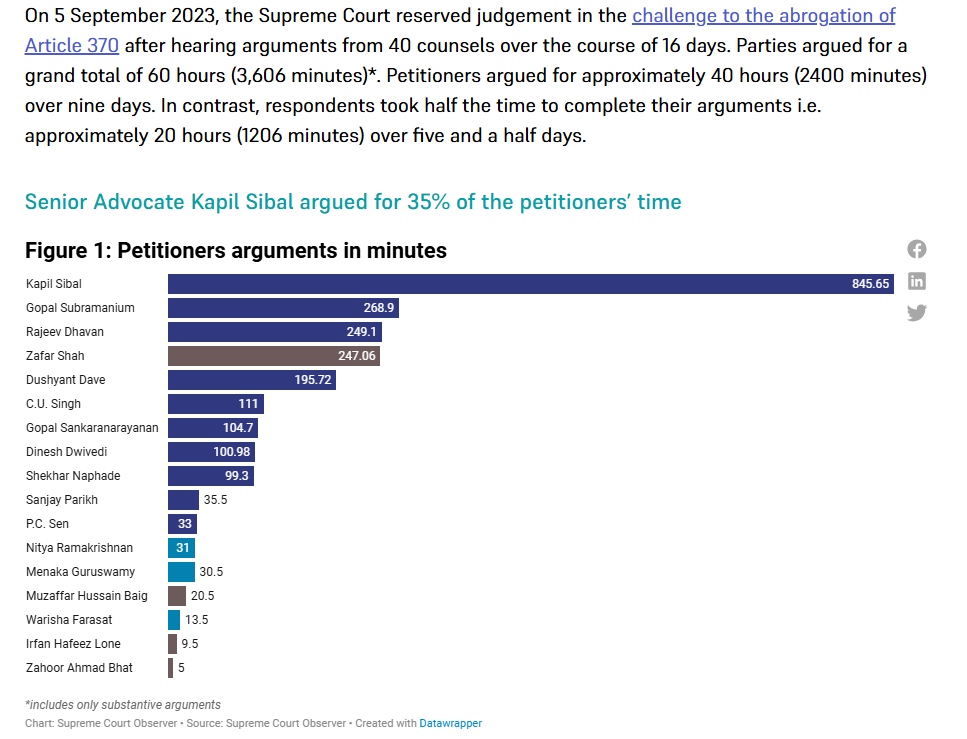
In this case, the group that descended was as large as 15! Some of the names arguing against the abrogation of Article 370 were also among those backing the protesters who have been seeking anarchy.
Fifteen senior lawyers materialized in the Supreme Court for these protesters. Fifteen.
These included Kapil Sibal, Abhishek Manu Singhvi, Gopal Sankaranarayanan, Prashant Bhushan, Vrinda Grover, Sanjay Hegde, Nithya Ramakrishnan.
Lawyers of that standing charge several lakh rupees and more for a single hearing. That would run into crores of rupees and upward, for one morning of staged outrage. Nobody does this pro bono for strangers.
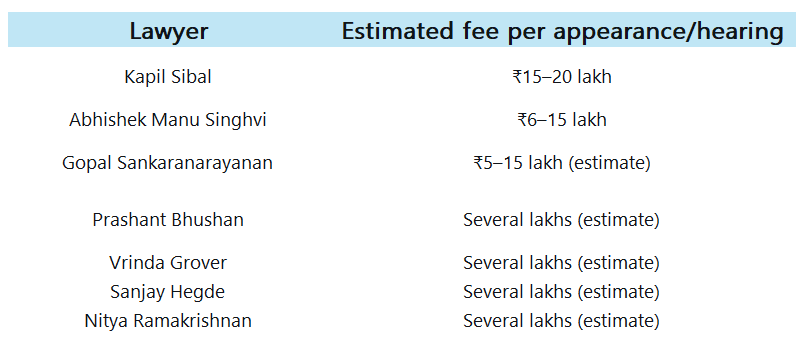
We are looking at several lakhs or crores for just one hearing! So who signed the cheque?
A domestic party hiding behind students? Or a foreign hand that wants India bleeding on its own streets? Movements do not run on slogans. They run on money. And until that money trail is dragged into the light, every tear shed on that stage is a purchased tear.
The involvement of these top lawyers does not end at merely representing CJP.
Here is Kapil Sibal, one of the top lawyers, trying to pressure the Supreme Court by delegitimizing it while it has the case sub judice.
“We won’t get any justice” goes beyond arguing that the Election Commission acted unlawfully. It questions the credibility of the institution hearing that argument. Coming from a prominent senior advocate, it can encourage supporters to treat an adverse ruling as confirmation of institutional failure rather than examine the Court’s reasoning.
It also creates reputational pressure: the Court is implicitly placed in a position where ruling against the speaker’s preferred outcome risks being presented as proof that justice was impossible. That is a defensible criticism of the rhetoric’s effect; it does not establish that the judges were influenced.
Do you see what Sibal is trying to do?
It is time that someone from the judicial community stands up against such bullying.
Thankfully, 42 prominent judges did.
The 42 Judges with Conscience
An open letter dated October 7th, signed by forty-two former judges, warns about attacks on constitutional institutions. Lawbeat’s report reproduces its declaration that the signatories hold no brief for a political party and its distinction between criticism and denigration. It quotes their warning: “Trust is the currency of democracy.”
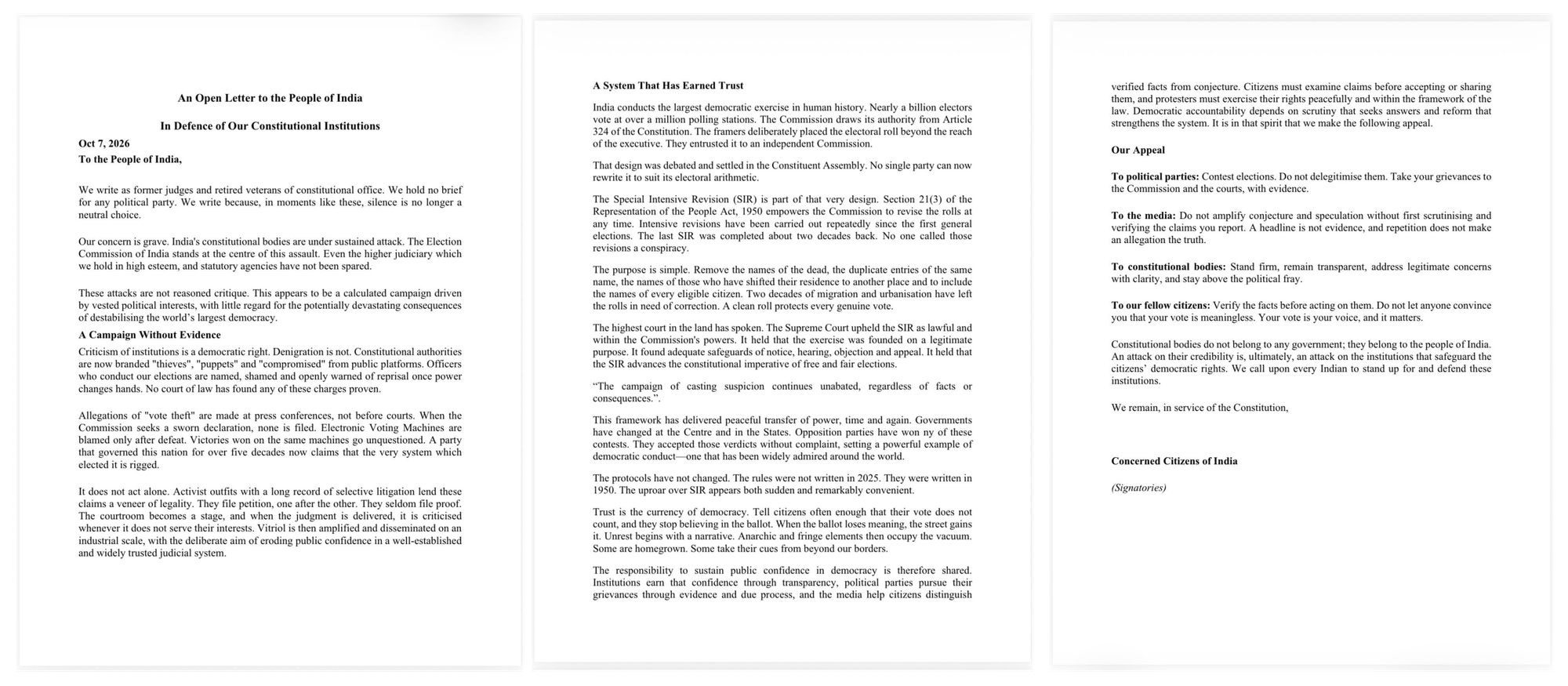
The authors begin with a declaration: "We hold no brief for any political party." Then they explain why they have chosen to speak: "We write because, in moments like these, silence is no longer a neutral choice."
Listen to those words again. "Silence is no longer a neutral choice."
You can oppose the government. You can challenge the Election Commission. But when allegations replace evidence, when officers are threatened, and when citizens are told their vote means nothing, standing aside is not necessarily standing above politics. It can mean leaving the field to those dismantling public trust.
The choice is not between defending a government and opposing it. The choice is between demanding proof through constitutional processes—and letting accusation become the only authority that matters. Speak up. Ask for evidence. Insist on accountability. But do not mistake silence for principle while the institutions that protect your voice are being discredited.
Their concern is not that an institution has been questioned. Institutions must be questioned. Their concern is that questioning is being replaced by a campaign of denunciation—calling constitutional authorities "thieves," "puppets," and "compromised," and threatening officers with reprisals when power changes hands. The distinction these judges ask us to confront is fundamental: where is the evidence, and where is the process that tests it?
The letter accuses political parties of blaming voting machines after defeat while accepting victories delivered by the same system. You cannot make your own victory the test of whether democracy worked. If there is wrongdoing, prove it. An election result is not evidence of fraud merely because you dislike the winner.
On the Special Intensive Revision of electoral rolls—the SIR—the authors point to Article 324 and Section 21(3) of the Representation of the People Act, 1950. They argue that revising the rolls is part of the Commission's lawful responsibility, not a conspiracy merely because it is politically contested. Remove dead voters and duplicate entries. Correct entries when people move. Include every eligible citizen. That last obligation matters just as much as the others. A clean roll must protect genuine voters, not shut them out.
Then comes the sentence that connects this letter to everything we've been discussing: "Trust is the currency of democracy."
The authors warn that if citizens are repeatedly told their vote does not count, they can stop believing in the ballot. In their words: "When the ballot loses meaning, the street gains it."
Think about that alongside the claim that democracy will now be decided by resistance rather than elections. You do not have to cancel an election to weaken democracy. You can weaken it by persuading people that voting is pointless.
And their appeal is not a blank cheque for the Commission. They ask constitutional bodies to remain transparent, address legitimate concerns and stay above the political fray. They ask parties: "Contest elections. Do not delegitimize them." Take grievances to the Commission and the courts, with evidence. They tell the media: "A headline is not evidence, and repetition does not make an allegation the truth."
Their final principle deserves to be heard slowly: "Constitutional bodies do not belong to any government; they belong to the people of India."
That is the point. Defending the Election Commission's independence is not defending a party. Demanding accountability from it is not attacking democracy. But turning an unproven allegation into a campaign to destroy public trust is neither accountability nor reform.
Ask for records. Challenge decisions. Demand answers. Protect every eligible voter's rights. But do not confuse an accusation with a verdict—or the destruction of trust with the delivery of justice.
And the matter is already before the Supreme Court. The courts are open. Parliament is open during its sessions for whoever wants to use it and not abuse it. The next election is just a vote away. Nobody has shut a single door. The opposition doesn't have the numbers, and in a democracy, that's the voters' answer. You may hate it, but it's still the only credible and just answer.
This brings us to the debilitating catastrophe that silence sets into motion.
Why people remain silent, and why silence is not a vote
Public concurrence contains different psychological states. One person agrees because the evidence persuades her. Another repeats a position to avoid professional trouble. A third has encountered no well-developed alternative. A fourth doubts a particular claim but fears that correction will harm friends or a cherished cause. Their public expressions may look identical.
Kuran’s preference-falsification framework helps explain how this difference can distort collective understanding. If people conceal reservations, others may overestimate support for the dominant view. In a hypothetical department, each person’s public endorsement can lead colleagues to believe disagreement would be lonely and costly, even when several privately question the same interpretation. A change in perceived safety can then produce an apparently surprising change in public opinion.
Elisabeth Noelle-Neumann’s spiral-of-silence theory emphasizes the perceived climate of opinion and fear of isolation. People may monitor which views appear to be gaining approval and withhold views that seem socially dangerous. Her 1974 article presents hypotheses and survey work, not a universal law about every silent individual.
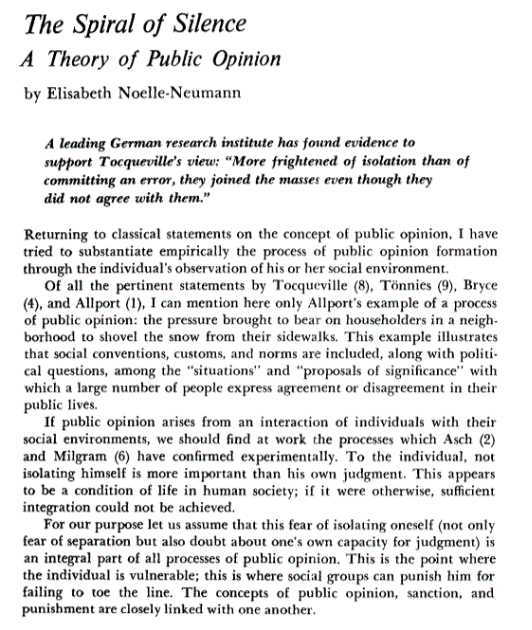
The two contributions are related but distinct. Kuran examines public preferences that differ from private preferences; Noelle-Neumann emphasizes perceptions, isolation, and diminished expression. Neither allows us to infer private dissent from public quiet. Silence can also mean agreement, uncertainty, exhaustion, distraction, or a decision that the dispute is not worth entering. The correct lesson is that silence is ambiguous—not that silent people secretly support our own side.
In movements, these mechanisms can operate through accusations of betraying students, farmers, religion, or the nation. In institutions, they can operate through employment rules, patronage, reputational sanctions, or anticipated professional exclusion. The strongest evidence would involve confidential testimony, documented sanctions, differences between public and private expressions, and repeated observations over time. A photograph of a crowd cannot reveal these hidden distributions of belief.
Authoritarian habits and dictatorship also need to be distinguished. A restrictive employment rule, biased curriculum, or closed professional culture can merit criticism without independently establishing that a country is a dictatorship. Assess reach, severity, persistence, avenues of appeal, and the capacity for correction. Elections do not eliminate every authoritarian practice; institutional bias does not by itself prove total political domination.
A further problem is the narrowing of available questions. Some alternatives are censored before publication; others become difficult to formulate because the educational environment offers too few concepts or examples. Still others remain available but are dismissed automatically. These are different outcomes. The absence of a published challenge cannot establish that nobody ever imagined it.
What we call the manufacture of concurrence is therefore an interaction, not an inevitable sequence:
- selective memory narrows comparison;
- symbols raise emotional stakes;
- repetition supplies familiarity;
- group identity raises the cost of revision;
- stigma discourages expression;
- material sanctions reinforce compliance; and
- public silence can appear to confirm unanimity.
In this entire sequence, different elements may operate without a central plan.
Anarchy by Thousand Cuts
The goal of this ecosystem is anarchy by a thousand cuts: a protest every month, a fresh confrontation at every turn, and a sustained effort to delegitimize the electoral mandate. Let us examine how this strategy works.
Watch this on the program "Reporters off Air". They discuss how regular, planned, and relentless protests will be used to delegitimize the government, which has shown its weakness by making Dharmendra Pradhan resign.
That these so-called journalists ignore the rigors of the process to remove a Constitutional post as Chief Election Commissioner, and that the PM cannot do it, is an interesting aside.
On July 22, Yogendra Yadav gave an interview to BBC Hindi about the ongoing agitation.
Yadav is a former member of the Aam Aadmi Party national executive, a figure with an extensive record of appointments under the previous government, including the Ministry of Human Resource Development's National Advisory Council on the Right to Education and a subcommittee of the National Advisory Council chaired by Sonia Gandhi. He is a vocal supporter of the current protests.
In that interview, he described their intensification as an auspicious moment for Indian democracy.
He also said something considerably more consequential, and he said it in plain language.
Yogendra Yadav’s formulation captures the underlying ambition: resistance, rather than the vote, would determine the future of India’s polity. In this worldview, agitation becomes more than a democratic right—it becomes a rival source of political authority. The danger is not a stronger democracy, but a system in which organized pressure on the streets seeks to override the verdict delivered at the ballot box.
This is an explicit declaration that the world's largest democracy should no longer be governed through its elected Parliament, that the destiny of 1.4 billion people should no longer be decided by universal adult suffrage, and that the substitute mechanism is the crowd.
As a proposition about how India ought to be governed, it is a repudiation of the Constitution stated openly by a man who has spent his career being described as its defender.
The legal profession and law-enforcement institutions must stand firm against intimidation and coercion, while protecting peaceful protest and lawful dissent.
The principle is straightforward: the right to oppose an elected government does not confer the right to substitute mob violence for constitutional democracy.
But that is what we are seeing.
So when the government takes action, what do these mobs do? They take refuge of religion.
Using Religious Places for Politics
That is what happened when the police finally moved in.
The brave "revolutionaries" of the vote ran. The mob did not stand its ground for its cause. Reporters on the ground describe protesters attacking police and then running into Gurudwara Bangla Sahib and toward a nearby mosque to escape detention.
The Hindu reports that when police personnel asked the gurudwara representatives not to shelter the protesters, the representatives refused, telling them, and I quote: "We won't let police enter the premises. Protesters are unarmed and not raising slogans inside the premises, so we are not against them."
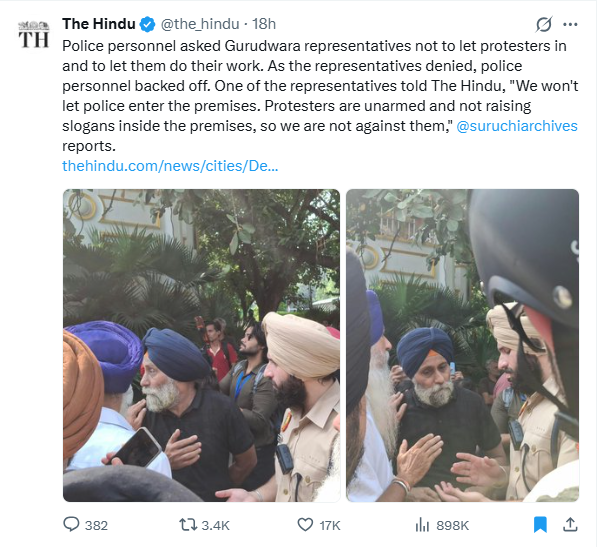
A gurudwara is a house of worship. Shelter and langar for the needy are sacred traditions.
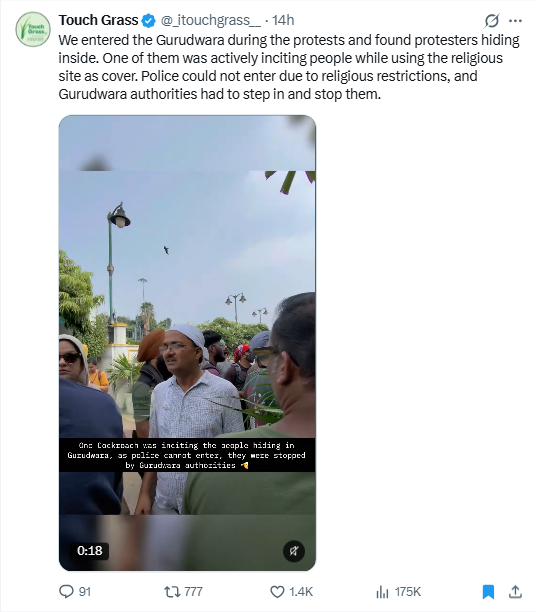
But when a place of worship becomes a sanctuary from law enforcement for people who have just attacked police, that is not seva. That is faith being used as a shield for lawbreaking, and it dishonors the very institution it hides behind. Sanctity was never meant to be a tactical asset in a street operation. And the same question applies to the mosque the mob ran toward.
Once inside Gurudwara Bangla Sahib, the protestors started raising political slogans.
We now know that Gurudwara officials came and asked them to stop and leave the premises. The police came via one gate from Ashok Road and went to the other side without entering the Gurudwara premises - enough to detain these protestors.
Please watch this official statement from the Gurudwara. He says that everyone is welcome inside the Gurudwara for prayers, peaceful congregation, langar, seva etc., but the "Gurughar" (home of the Guru) cannot become the place for political slogans by Aam Aadmi Party and other political agents.
Now let us go to the next level.
Global Orchestra of Regime Change?
Another factor is at work: the strange alignment of a global orchestra of actors that seem to back, push, and encourage these regime-change protests.
As soon as the activists who were ready to push for anarchy were detained, the OHCHR, the Office of the UN High Commissioner for Human Rights, released a high-handed and aggressive message to India.
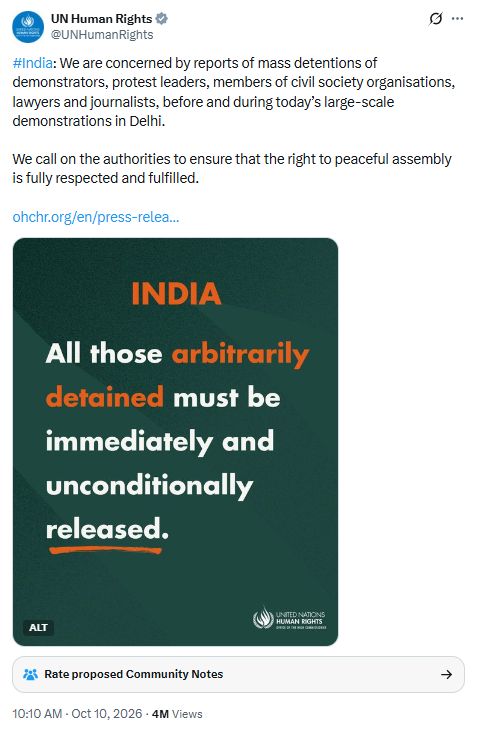
India points out to the selectivity and partial narrative from the UN body. The OHCHR did not bother to provide any publicly demonstrated evidence.
India's response points to three things:
- Constitutional authority: peaceful assembly is protected, alongside reasonable restrictions for public order.
- Institutional competence: Indian courts remain available to examine grievances and government action.
- Equal treatment: OHCHR should apply comparable scrutiny to protests elsewhere.
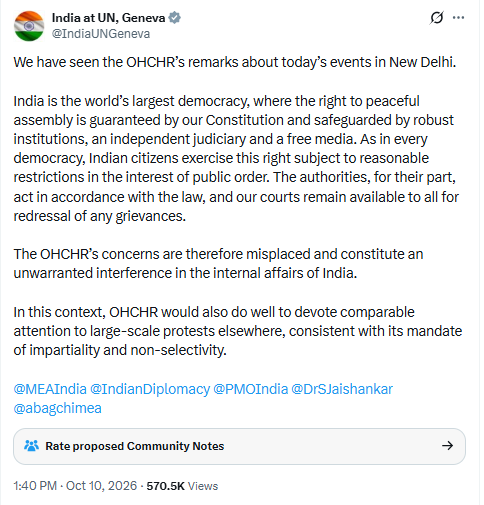
The UN Body's egregious message is especially important because protests are also being held in other countries and the police action there has been of violent suppression, as opposed to "detainment based on Supreme Court order" to prevent such a big meltdown on the streets.
This is from France, the land of “Liberté, Égalité, Fraternité”.
And this comes from Germany.
And this global pressure isn't hidden. People who know, know!
In this video extract, Aleksandar Vučić, Serbia’s former president, says forces are working to destabilize and stall India's rise by undermining PM Narendra Modi's mandate. Ćirilica, hosted by Milomir Marić on TV Prva, broadcast on October 5, 2026.
The full video is here.
Strategic Autonomy Becomes a Global Threat
And this is precisely what Minhas Merchant discusses in his brilliant essay in the First Post.
Merchant identifies a crucial vulnerability: India’s strategic autonomy depends on its ability to withstand pressure both abroad and at home. Foreign powers can exploit narratives that portray Indian self-defense as aggression while removing the terror networks threatening India from scrutiny.
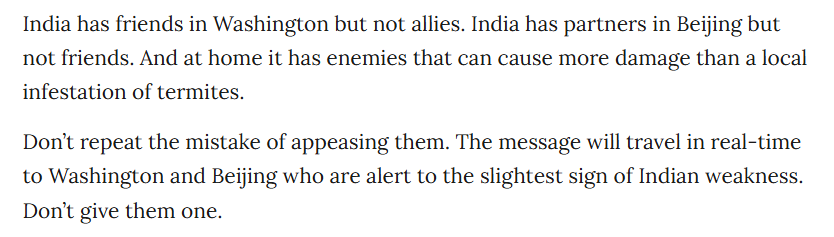
The answer is firm, evidence-based accountability. Identify the falsehoods, expose the omissions, investigate incitement, and document any foreign coordination.


