
The Third Crossing
A carpenter built a bridge so sturdy that merchants from a dozen villages trusted it with their heaviest carts. Years later, the council on the western bank put up a gate and drew up a list of villages allowed to cross.
The lord on the eastern bank built a second bridge. He welcomed every merchant, then raised the toll once the carts started coming.
Downriver, three villages pooled their timber and built a ferry. The old carpenter came to watch them launch it.
“You’ll spend half the morning crossing,” he said. “Either bridge would get you there in minutes.”
A ferryman nodded. “We’ll use them when the gates are open and the toll is fair.”
“Then why go to all this trouble?”
The ferryman eased the boat away from the bank. “Last winter, both keepers changed their terms while our grain was already on the road. This year, we set the ferry’s hours.”
When I started writing my book, I could not find a good app for nonfiction writing. So I mocked up what I wanted and began working with a great development team. We spent almost six months building it.
Today I am introducing Manuscryptz, a writing OS for articles, newsletters, video scripts, and books. A nonfiction book needs a place for the questions you are asking, the claims you want to defend, the passages that support them, and the sources behind them. Manuscryptz keeps all of that next to your draft. I built it for the way I work, and I expect to use it for everything I write from here on.
I have more planned. Features will keep arriving, including AI capabilities, which I deliberately did not want at the start. They are coming, and I will add them carefully.
Here is what Manuscryptz does today.
CAPTURE: Keep a Daily Journal and jot quick notes while you write. Save a claim or a question for a future article or book. Capture sources from the web today; a Chrome extension is coming soon. Ideas stay where you can find them.
RESEARCH: Question, Claim, Evidence, and Source each get their own record. Evidence ties a passage to the claim it supports. Sources become Chicago-style note citations, so your footnotes build from what you have already collected.
WRITE: A powerful editor with the flexibility of Notion and the familiarity of Google Docs. Move journal text straight into your documents, group your documents in Workspaces by type or topic, and search across all of them.
IMPORT AND EXPORT: Bring in your books from MS Word with bulk import. Export to ePUB, HTML, PDF, and DOCX.
Manuscryptz is launching now. Join the waitlist at manuscryptz.com, and tell me what you think once you try it.
Link to the site: Manuscryptz
Thanks,
Desh
Unquitting the CEO
Nothing says rational markets like a petition to un-quit a CEO
Elon Musk wants Jensen Huang back at Nvidia. On November 13, he said on X that he was signing a petition to reinstate the company’s co-founder. The public Stand with Jensen letter lists Musk as a signatory and asks Nvidia’s board to bring Huang back while an independent investigation establishes the facts. The letter’s organizers argue that Huang was removed without meaningful due process. Musk’s post backed reinstatement. He did not make a separate public claim about the board’s process in that post. A day earlier, when someone suggested he hire Huang himself, Musk replied, “That would be an honor.”
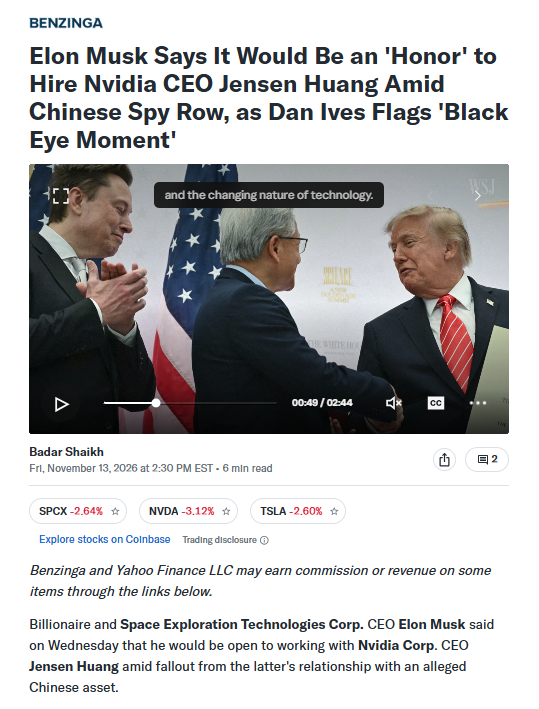
On November 14, Musk gave a business reason for wanting Huang back. He said many of Nvidia’s supply-chain deals were sealed with “a handshake with Jensen, not a written contract,” and predicted that some critical arrangements would be lost. He was responding to a clip in which SemiAnalysis founder Dylan Patel described Huang personally persuading even small suppliers of essential components to commit capacity to Nvidia. Musk named no suppliers or specific deals that had fallen through.
Nvidia’s filings give that warning some scale. The company disclosed $279 billion in supply and capacity commitments as of July 26, mainly for memory and manufacturing facilities.
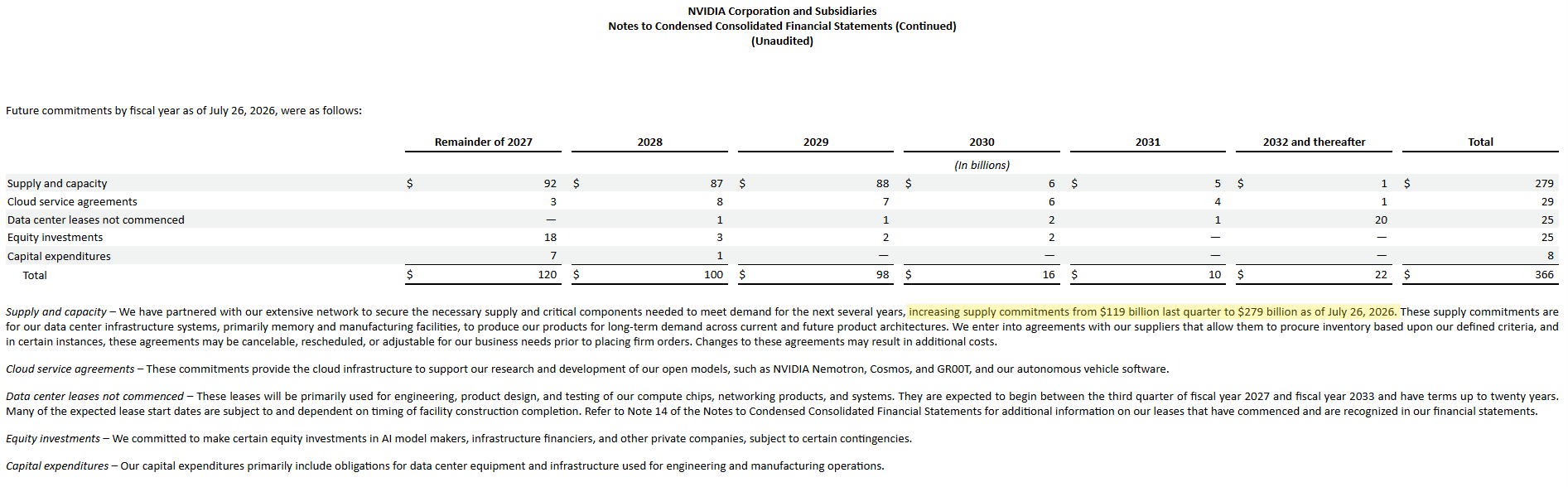
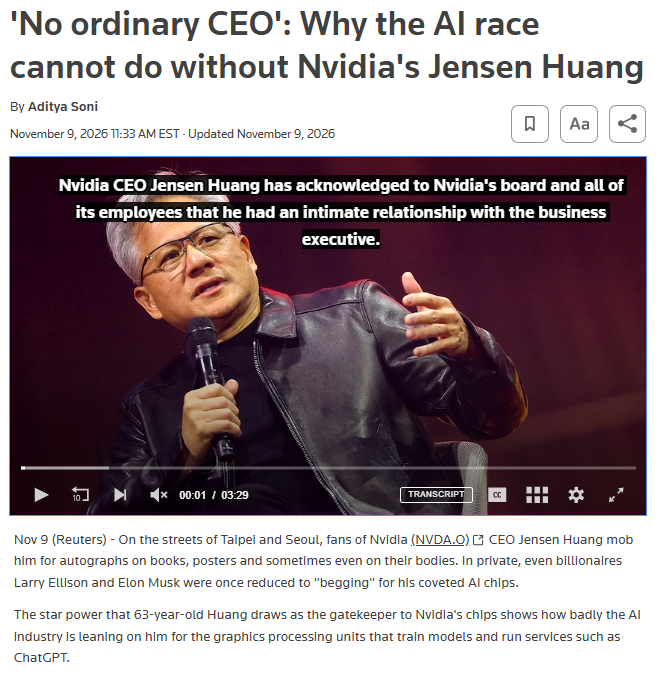
It also said some supplier agreements could be canceled, rescheduled, or adjusted before firm orders were placed. Musk’s warning is most plausible at the next point of negotiation. When capacity is tight, who gets first call on an extra production run? Who can persuade a small supplier to expand before demand is certain? A founder’s relationships can make a difference at precisely those moments. Musk has seen the other side of that bargaining power. Oracle co-founder Larry Ellison once recalled that he and Musk had practically begged Huang for GPUs over dinner.
The board had a different problem to weigh. Nvidia’s SEC filing says directors accepted Huang’s resignation on November 11. The company announced it on November 12 and named CFO Colette Kress interim CEO. Before the announcement, Reuters reported that directors had met to consider whether to oust him.
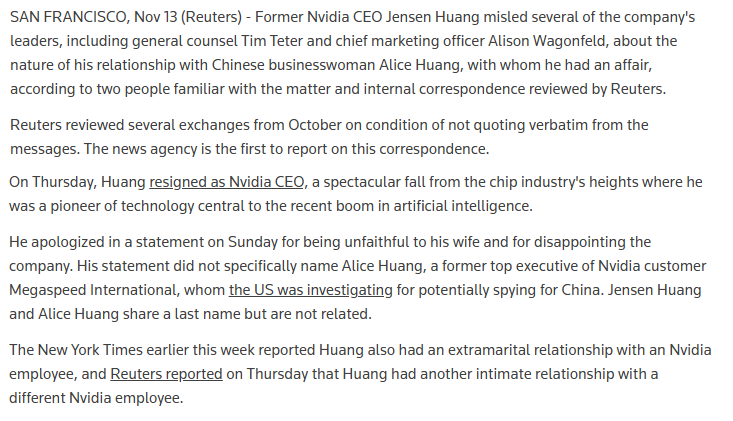
The departure followed scrutiny of Huang’s relationship with a businesswoman whom U.S. authorities suspected of intelligence ties. Beijing denied the allegation, and Nvidia said when it announced its review that it had no reason at that point to believe company secrets or national security had been compromised.
Reuters separately reported that Huang had misled senior Nvidia executives about the nature of the relationship, citing internal correspondence and people familiar with the matter.
Musk has put his finger on a real succession risk. If Nvidia secured scarce capacity because suppliers trusted Huang personally, Kress now has to earn that trust on the company's behalf. The board still has to account for how it handled the investigation and the leadership change. The first test of Musk’s prediction will come when a supplier has new capacity to allocate and Nvidia has to compete for it without Huang making the call.
On November 14, Musk gave a business reason for wanting Huang back. He said many of Nvidia's supply-chain deals were sealed with "a handshake with Jensen, not a written contract," and predicted that some critical arrangements would be lost. He was responding to a clip in which SemiAnalysis founder Dylan Patel described Huang personally persuading even small suppliers of essential components to commit capacity to Nvidia. Musk named no suppliers or specific deals that had fallen through.
Nvidia's filings put that warning in perspective.
The company disclosed $279 billion in supply and capacity commitments as of July 26, mainly for memory and manufacturing facilities. It also said some supplier agreements could be canceled, rescheduled, or adjusted before firm orders were placed.
Musk's warning is most plausible at the next point of negotiation. When capacity is tight, who gets first call on an extra production run? Who can persuade a small supplier to expand before demand is certain? A founder's relationships can make a difference at precisely those moments.
Musk has seen the other side of that bargaining power. Oracle co-founder Larry Ellison once recalled that he and Musk had practically begged Huang for GPUs over dinner.
Reuters reported Musk's warning that Nvidia could lose important supply arrangements following Huang's departure. Musk praised Huang's management of the company's supply chain and argued that significant agreements depended on personal relationships rather than conventional contractual protections. His concern was prospective. Neither Musk nor Reuters identified a specific supplier that had already withdrawn capacity.
(Source: Musk says Nvidia will lose 'critical' deals without Jensen Huang — Reuters)
Nvidia's board, however, had a different problem at hand. Nvidia's SEC filing says directors accepted Huang's resignation on November 11. The company announced it on November 12 and named CFO Colette Kress interim CEO. Before the announcement, Reuters reported that directors had met to consider whether to oust him.
The first test of Musk's prediction will come when a supplier has new capacity to allocate, and Nvidia has to compete for it without Huang making the call.
But the more consequential test may take place somewhere else entirely.
In Washington.
And his departure came just as those restrictions were moving toward Congress's year-end legislative agenda.
The man who sold the machinery
Jensen Huang was not simply running a semiconductor company.
He had become the principal merchant of the artificial intelligence revolution.
The distinction is important because Nvidia occupies an unusual position in the emerging AI economy. OpenAI, Anthropic, Google, Meta, Microsoft, and numerous other companies compete to build or distribute intelligent systems. Nvidia sells much of the computing infrastructure on which their ambitions depend.
The business resembles an extraordinary version of the old California gold rush.
The miners may compete with one another. Some will become wealthy. Others will disappear. But every miner needs tools.
Huang's genius was to turn Nvidia into the supplier of those tools at a moment when demand seemed almost limitless.
Yet he understood something else.
A market in which only a handful of companies could build advanced AI would eventually place limits on Nvidia's growth. A world in which thousands of companies could develop and deploy models would create a much larger demand for computing.
That explains his enthusiasm for open-weight artificial intelligence.
The distinction between proprietary and open-weight models has become central to the industry's commercial future.
A proprietary model is generally accessed through a service controlled by its developer. Customers pay for usage, subscriptions, or enterprise agreements. The developer controls the model's underlying weights and decides how access is provided.
An open-weight model makes its parameters available for others to download and operate, subject to its license. Developers can adapt it, deploy it privately, and potentially avoid paying the original developer for every inference request.
Neither approach is automatically superior. Proprietary providers may offer stronger performance, reliability, security, support, and integration. Open-weight models can provide flexibility, lower costs for certain workloads, and greater independence.
But their economic consequences are very different.
For a proprietary AI provider, a capable open-weight alternative can become a direct competitor.
For Nvidia, both models may generate demand for chips.
Indeed, open-weight models can expand Nvidia's potential market by enabling organizations that would otherwise remain customers of centralized AI services to build their own computing infrastructure.
At CES in January 2026, Huang presented Nvidia's open-model strategy through Nemotron, GR00T, and Cosmos. These were not incidental demonstrations. They represented Nvidia's attempt to participate in the development of the software ecosystem that would generate demand for its hardware.
Huang argued that open models were transforming the industry. He also claimed that 80 percent of startups were building products on open models.
That figure was his own assessment, not an independently established measurement of the entire startup market. But the strategic point was clear.
He wanted AI development to proliferate.
FROM THE REPORTING | TechCrunch, January 2026
TechCrunch described Nvidia's CES presentation as an unusually prominent endorsement of open AI models. Huang introduced model families designed for agentic applications, robotics, and physical AI, while identifying commercial users across cybersecurity and software development. He argued that open models had "really revolutionized artificial intelligence" and cited widespread startup adoption as evidence of their growing importance.
Source: Open source AI models is a theme at the Nvidia keynote — TechCrunch
This created a commercial tension.
The companies building expensive proprietary frontier models needed to recover enormous development and infrastructure costs. Their business depended, at least partly, on customers continuing to pay for access to their capabilities.
Nvidia benefited from the proliferation of models, including those that competed with proprietary services.
The conflict was not absolute. OpenAI and Anthropic remained important customers of the broader computing ecosystem, and Nvidia's success was tied to their growth.
But the companies had different incentives concerning the distribution of AI capabilities.
That difference became particularly important when Chinese developers demonstrated that open models could compete effectively in substantial parts of the market.
The question was no longer whether China could build the world's most powerful AI model.
It was whether China could build models sufficiently capable, inexpensive, and accessible to undermine the economics of American proprietary AI.
That was a different kind of threat.
And it could not be defeated simply by restricting access to the latest Nvidia processor.
The Chinese answer nobody wanted
For years, American technology policy had operated on a straightforward assumption.
Advanced AI required enormous quantities of computing power. The United States and its allies controlled essential parts of the advanced semiconductor supply chain. Restricting China's access to those technologies would slow Chinese AI development.
That calculation held considerable truth.
Nvidia's accelerators were extraordinarily important. American semiconductor design software occupied critical positions in the industry. Taiwan's leading fabrication capabilities were difficult to replicate. Dutch and Japanese equipment manufacturers controlled technologies essential to producing advanced chips.
The semiconductor supply chain had become a network of concentrated capabilities.
Washington possessed considerable influence over that network.
But the Chinese response introduced an uncomfortable variable.
Efficiency.
Chinese AI developers demonstrated that sophisticated models could be developed and deployed using different combinations of hardware, algorithms, training techniques, and engineering resources.
This did not eliminate the importance of advanced chips. Frontier training remained computationally demanding.
But it complicated the assumption that superior hardware would automatically produce an unassailable commercial advantage.
A company that can deliver a useful model at a fraction of its competitor's cost can exert considerable market pressure even if its model is not the most capable in existence.
Most businesses do not need artificial intelligence to solve the most difficult scientific problems.
They need it to classify documents, write software, assist customers, analyze records, automate routine decisions, inspect products, and support research.
For many such tasks, the relevant questions are practical.
- Does the model work?
- Can it be trusted?
- How much does it cost?
- Can it be operated locally?
- Can the customer modify it?
- Does it require dependence on a foreign provider?
An inexpensive Chinese open-weight model could threaten American AI businesses without surpassing their finest technology. Its advantage would be capturing the larger market for affordable, useful intelligence. Huang saw commercial expansion; Washington saw potential strategic dependence.
Developers could adopt Chinese models, companies could build around Chinese standards, and governments could purchase Chinese infrastructure. Universities might train engineers using Chinese tools, embedding those ecosystems across generations.
The stakes therefore extended beyond chip exports or model performance. They concerned who would shape the digital economy’s underlying architecture.
Three bills and the architecture of control
Three main legislative proposals were already moving through Washington before Huang's departure.
- The AI OVERWATCH Act.
- The Chip Security Act.
- The MATCH Act.
Here are the details on those three and other laws that are now being moved.
The Chip Security Act. Sponsored by Reps. Bill Foster (D-Ill.) and Bill Huizenga (R-Mich.), this bill would combat chip smuggling by requiring companies to equip advanced AI processors with location-verification and tracking mechanisms.
The MATCH Act. This proposal aims to tighten restrictions on semiconductor manufacturing equipment and pressure U.S. allies to match American export bans and maintenance limits on equipment destined for China.
The Remote Access Security Act. This legislation would give the Commerce Department explicit authority to prevent Chinese entities from bypassing export bans by renting cloud access to restricted U.S. chips at overseas data centers. It addresses the possibility that restricted customers could obtain computing capacity from overseas data centers without importing the underlying chips.
The GAIN AI Act. Incorporated into the Senate's version of the defense bill by Sen. Jim Banks (R-Ind.), this provision requires major chipmakers to give U.S. customers priority access to cutting-edge microchips before selling them abroad.
These are not interchangeable restrictions. They operate at different points in the technological chain.
One controls the export decision. Another concerns what happens to a chip after shipment. A third addresses the equipment needed to manufacture advanced semiconductors. A fourth concerns access to computing power without physically possessing the hardware.
Taken together, they point toward a layered system of technological control.
Reuters reported that congressional efforts to tighten China's access to advanced AI chips had gained urgency following allegations involving Huang. Three proposals were being considered for inclusion in the annual defense authorization legislation. The measures addressed congressional oversight of chip exports, safeguards against semiconductor diversion, and restrictions on advanced manufacturing equipment supplied through allied countries. (Source: Nvidia spy allegations likely to spur laws to tighten China's access to AI chips — Reuters)
There is an important qualification.
These proposals do not, on their face, establish a universal prohibition on downloading or operating open-weight models. So prima facie, they aren't a bunch of laws intended simply to outlaw open-source AI.
Their direct targets are semiconductor exports, manufacturing equipment, diversion controls, and access to advanced computing.
But the broader effect could still be substantial.
A government does not need to prohibit a model if it can control access to the computing resources required to train or operate models at the technological frontier.
A state can shape which technologies get built by controlling access to the infrastructure developers rely on. Remote computing makes this power easier to see. A team can train an AI model on chips housed in a data center thousands of miles away. Its ability to do so depends on whether a cloud provider can serve it, how much computing capacity it can rent, and what rules govern that access.
A government that can influence those terms can determine whether a team can afford to run an experiment, train a larger model, or bring a product to market at all.
Suppose a Chinese company cannot legally purchase a particular advanced accelerator. It may still be able to rent access to computing infrastructure located in another country.
The chip remains abroad. The computing capability crosses borders through a network connection.
Technology regulation is moving beyond controlling goods to controlling computational capacity.
This raises difficult questions about jurisdiction, commercial freedom, national security, and governments' ability to regulate services delivered across borders.
It also creates a powerful incentive for countries facing restrictions to develop independent infrastructure. The more comprehensive the American system becomes, the more valuable alternatives become strategically.
That is the paradox at the heart of technological containment.
The week Washington moved
The timing of Huang's departure was politically consequential.
On November 10, The Washington Post reported that the scandal had created renewed momentum behind export-control legislation Nvidia had been resisting.
The article described discussions over possible amendments and the prospect of incorporating important measures into the annual defense bill.
This was before Huang formally resigned.
The legislative struggle was already underway.
The newspaper reported that Nvidia's leadership crisis had strengthened the position of lawmakers favoring tougher export controls. Congressional and industry sources described renewed negotiations over AI OVERWATCH and Chip Security, while the MATCH Act faced additional concerns about disruption to international semiconductor supply chains. Nvidia's ability to influence those negotiations was being affected by the allegations surrounding its chief executive. (Source: AI & Tech Brief: Nvidia's Capitol Hill fallout — The Washington Post)
Two days later, the situation had changed further.
Huang was out. Nvidia had an interim chief executive. And OpenAI was reportedly supporting the export-control package.
Bloomberg reporting, republished by the Los Angeles Times on November 13, said OpenAI had been considering support for the measures for months and had confirmed its position to lawmakers during the week of Huang's departure.
That chronology is important here.
It means OpenAI's interest in the legislation cannot reasonably be described as something that suddenly emerged after Huang resigned.
The company had been considering its position earlier.
But the timing of its communication to lawmakers was still notable.
Bloomberg reported that OpenAI had informed lawmakers it supported a bipartisan package of restrictions affecting China's access to advanced AI chips and semiconductor manufacturing equipment. People familiar with the discussions said the company had considered the position for months. The report also described continued resistance from Nvidia's allies, even as the company's own Washington advocacy appeared less prominent after Huang's departure. (Source: OpenAI joins push to curb China's access to AI chips and chipmaking tools — Bloomberg, via Los Angeles Times)
It is rather curious that Jensen Huang's departure, months after the intelligence and government administration became aware of his sexcapades with a Chinese spy, coincided with the flurry of chip legislation.
The significance is that a pre-existing political struggle had reached a decisive moment, and one of its most influential commercial participants had suddenly lost his position.
Interestingly enough, Nvidia's opposition to restrictive export policies had been closely associated with Huang's leadership.
Although Colette Kress has not announced such a reversal, yet, but the writing is clearly on the wall.
So did Jensen grow to big for his shoes and was the sacrificial lamb?
This new scenario has changed the circumstances under which the company would negotiate.
A founder with personal relationships across the industry and government had been replaced by an interim executive facing an immediate governance crisis.
That could affect political influence even if the company's formal policy remained unchanged.
It also gave other participants an opportunity to press their arguments.
The next question is who those participants were.
The lobbyists behind the legislation
Washington's lobbying records provide a useful starting point.
Anthropic's federal disclosures identified the AI OVERWATCH Act, MATCH Act, and Chip Security Act among the matters on which it engaged government.
Its third-quarter 2026 lobbying expenditure was approximately $2.11 million.
Anthropic's third-quarter disclosure identifies federal lobbying on AI policy, export controls, and legislation including AI OVERWATCH, MATCH, and Chip Security. The filing establishes that the company engaged government concerning these matters before Huang resigned. It does not identify every congressional office contacted, disclose the substance of individual meetings, or prove that Anthropic supported every provision of the named bills. (Source: Anthropic Q3 2026 federal lobbying disclosure — U.S. Senate Lobbying Disclosure Act database)
Nvidia's lobbying expenditure during the same quarter was approximately $2.15 million.
OpenAI's was approximately $1.5 million.
These were company-wide expenditures, not amounts devoted exclusively to the three bills.
That distinction matters because lobbying disclosures generally cover multiple issues. They cannot automatically be converted into a precise accounting of how much a company spent supporting or opposing one provision.
Still, the figures demonstrate the scale of the industry's engagement with Washington.
Anthropic retained outside firms including Fierce Government Relations and Aquia Group. Its lobbying network included people with experience in congressional offices, federal agencies, and national-security policy.
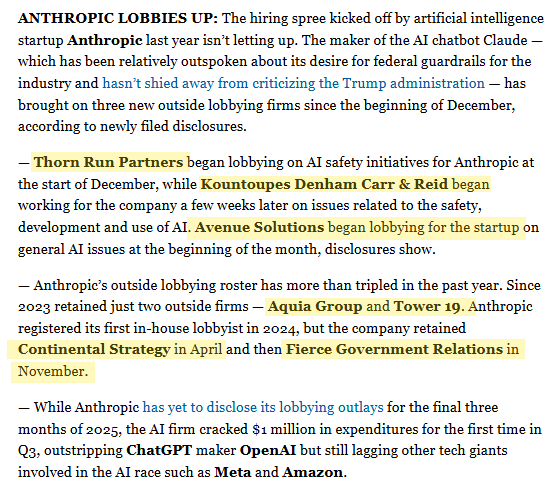
Nvidia's lobbying operation included former congressional and executive-branch personnel. Zachary Isakowitz, for example, had previously worked for Representative Michael McCaul.
OpenAI retained politically connected representation, including Miller Strategies.
Well, in the US , lobbying (as corrupt as the practice inherently is) is common and accepted. Companies routinely hire former government officials because they understand legislative procedures, regulatory institutions, and how government works in practice.
There is an obvious catch here though - lobbying also create channels through which commercial interests can be translated into policy proposals.
The important investigative question is not whether former officials are allowed to lobby.
It is whether particular companies influenced particular legislative provisions, and whether the resulting rules serve the public interest or confer disproportionate commercial advantages.
The distinction between lobbying activity and legislative influence is essential.
A company can report lobbying on a bill because it supports the bill, opposes it, or wants particular provisions amended.
A disclosure establishes engagement. It does not establish the outcome of that engagement.
To understand actual influence, one must compare the company's stated position with the final legislative language, examine amendments, identify the sponsors, and determine whether the provisions reflect recommendations made by the company or its representatives.
That is a more demanding, and revealing, investigation.
The commercial consequences of legislation often lie buried in technical language that attracts little public scrutiny. What appears to be a narrow drafting choice can determine who gains access to critical technologies, which businesses retain lucrative markets, and which countries secure a lasting competitive advantage.
Each clause can put billions of dollars in potential business at stake. Together, such provisions can alter the balance of technological and economic power.
The struggle over artificial intelligence is therefore unfolding not only in laboratories, semiconductor factories, and vast data centers. It is also unfolding in legislative drafting rooms, where seemingly minor wording choices can carry major consequences.
The sequence is the giveaway
The sequence is striking: scrutiny of Huang’s relationship raises national-security questions; Nvidia’s leadership faces turmoil; its Washington influence weakens; export-control legislation advances. OpenAI signals support for restrictions, while Anthropic’s earlier lobbying is already documented.
Three things emerge:
The first is coincidence: independent developments occurred close together, creating the appearance of a connected campaign.
The second is opportunistic convergence: actors pursuing separate interests used an unexpected crisis to accelerate existing agendas.
The third is deliberate coordination: actors planned or orchestrated events to reshape the industry’s political balance.
This leaves us with the two plausible explanations above. It may not, however, establish the third. Proving coordination would require evidence beyond timing: communications revealing advance planning, documented instructions, financial arrangements, credible testimony, or proof that participants knew about the allegations beforehand and coordinated their responses.
That distinction does not diminish the importance of investigating what followed. A crisis need not be manufactured to become politically useful. An unexpected scandal can weaken resistance to policies that institutions or companies already favor.
The $480 billion warning from China
While Washington was debating restrictions, Chinese investors were confronting another problem.
The AI boom was beginning to look financially fragile.
Reuters reported on October 26 that China's STAR50 index, containing prominent technology and semiconductor companies, had fallen approximately 40 percent in less than four months.
The decline erased around $480 billion in market capitalization.
Reuters described a sharp correction in Chinese AI and semiconductor shares following an extended rally. The STAR50 index had fallen roughly 40 percent in less than four months, erasing approximately $480 billion in market value. Investors were reassessing expensive valuations amid uncertainty about AI demand, restrictions on Chinese technology exports, and the sustainability of the sector's earlier enthusiasm. (Source: In China, the AI bubble has already burst — Reuters)
That figure does not represent an equivalent amount of cash disappearing from the economy. It represents a reduction in the market value investors assigned to the affected companies.
But the consequences can still be substantial.
Lower valuations can make it harder for companies to raise capital. They can weaken investor confidence, reduce collateral value, and force companies to reconsider expansion plans.
The correction also raised questions about the relationship between AI investment and actual customer demand.
The correction exposed a vulnerability on both sides of the American and Chinese AI race. The technology can transform economies even as investors overpay for the companies building it. Railways remade nineteenth-century commerce while railway speculation wiped out fortunes.
The internet did much the same a century later. Both changed the world. Plenty of investors still lost their money.
AI is putting that distinction to the test. Data centers need expensive chips, high-bandwidth memory, networking equipment, cooling systems, and enormous amounts of power. Much of that capacity must be secured years before anyone knows how many customers will pay to use it, what they will pay, or how often they will need it. By then, the money has already been committed.
The risk compounds when the industry finances itself. A chipmaker helps a customer raise money to buy its processors. A cloud provider commits to capacity. A model developer rents it. Each deal can make sense on its own. Yet the same demand forecast can sit behind all three balance sheets. If paying customers arrive too slowly, or prices fall too fast, the developer rents less, the cloud provider has idle capacity, and the chipmaker faces weaker orders from a customer it helped finance.
That is where Jensen Huang’s departure becomes more than a succession story. He helped persuade suppliers to expand production, customers to commit early, and investors to believe the demand would be there. Nvidia still has the people and resources to carry those relationships forward. Its partners now have to decide whether to make the next round of commitments without the man who helped secure the last one.
For Washington, that uncertainty goes deeper. It increasingly treats AI infrastructure as essential to national power, even as its expansion depends on private companies betting that tomorrow’s customers will cover today’s bills.
When private infrastructure becomes a national asset
Washington wants American companies to dominate advanced AI. It also wants the power to decide which foreign customers can buy their most capable products. It expects private investors to finance the buildout, even as it comes to regard the resulting infrastructure as essential to national security. Those ambitions can coexist while demand is booming. A downturn would force Washington to decide which one takes priority.
The commercial logic is straightforward. Chipmakers want customers. Cloud providers want their data centers full. Investors want a return on facilities that take years to build. Washington has its own calculation. It may close a lucrative market because it judges the security risk too high.
It may also want computing capacity available for military planning, intelligence analysis, or industrial production when companies see little business reason to keep it in reserve.
America has faced versions of this problem before. Railways, telecommunications, aviation, and energy all became too important for the government to treat their failures as private affairs. Advanced computing is moving in the same direction. Federal contracts could anchor demand. Security requirements could dictate how products are built. Export controls could redraw markets. And if investors pull back, public money could keep projects alive that Washington considers strategically necessary.
A rescue remains hypothetical. The harder question is what Washington would do if spending fell just as federal agencies came to rely on the capacity being built.
Who would qualify for support? Would taxpayers get a stake in the upside if they absorbed the losses? The terms of any intervention could determine who owns America’s computing capacity, who gets to use it, and on whose terms.
Meanwhile, another confrontation is exposing a more immediate vulnerability. A country can have formidable armed forces and still be brought to a standstill if an adversary can disrupt the infrastructure its economy runs on.
The war reaches the refrigerators
On the night of October 11–12, 2026, a cyberattack reached into the refrigeration systems of hundreds of retail locations across France. The targets were ordinary commercial sites, including supermarkets and food storage facilities. The equipment in the attackers’ sights was equally ordinary. It was the industrial controllers that tell refrigeration systems when to run and how cold to keep the food inside.
France stated that cyberattacks during October 11–12 targeted refrigeration controls at more than 700 retail locations. The government reported substantial material damage, fires, and spoiled food worth tens of millions of euros. Following an investigation involving its cybersecurity, intelligence, and military authorities, France attributed the destructive operation to SHAHID KAVEH, an Iranian Revolutionary Guard cyber unit. (Source: Declaration of attribution to Iran of cyber attacks against France — France Diplomatie)
The damage was physical. Equipment broke. Food spoiled. Fires broke out. At a supermarket, the cold chain is easy to take for granted. Customers see milk on the shelf and frozen food behind a glass door. Behind both is a system that has to keep working through the night, when the store is closed and no one is looking. Disrupt the controls and the effects can spread from the machine to the stock it protects and the building that houses them both.
On November 10, the French government formally attributed the operation to Iran. It named Shahid Kaveh, an offensive cyber unit affiliated with Iran’s Islamic Revolutionary Guard Corps, as responsible. France described the operation as unprecedented in scale and aggressiveness. The scale came from doing the same thing across hundreds of locations in a single night. An equipment failure a retailer might normally handle at one store became a problem many sites had to confront at once.
Reuters reported that France had accused Iran's Revolutionary Guards of responsibility for attacks that disabled refrigeration equipment at hundreds of supermarkets. The French government summoned Iran's ambassador and indicated that additional European sanctions could follow. The report placed the incident within a wider pattern of suspected digital disruption during the Iran war, while noting Tehran's rejection of malicious-cyber allegations. (Source: French officials blame Iran for refrigerator hacks, vow retaliation — Reuters)
That is what makes the choice of target so consequential. A refrigeration controller is a small part of a supermarket’s operation. Yet it governs whether much of what the store sells can stay on the shelf. An attacker who can reach enough of those controllers can turn a routine commercial dependency into a source of widespread physical damage.
The choice of target was what made the French attack so consequential. Commercial refrigeration rarely figures in national security debates, yet modern food distribution depends on it. Disable enough refrigeration systems and spoiled inventory is only the first loss. Retailers scramble for replacement stock, deliveries reroute, insurers face claims, and authorities must determine whether food is safe to sell.
That is the economics of asymmetric warfare. A conventional strike on hundreds of commercial sites would take substantial military resources and expose the attacker to considerable risk. A cyber operation can reach across that many locations through weaknesses in connected industrial equipment. The attacker can exploit a vulnerability remotely. The defender has to inspect equipment, replace stock, and restore operations site by site. The bill for recovery can far exceed the cost of the attack.
The timing gave the incident wider significance. Reuters described it as one of the most disruptive cyber incidents linked to the Iran war. Its reporting also pointed to earlier incidents involving American water systems, transportation infrastructure, and maritime assets. The strength of public attribution varied across those cases. Together, they show how a conflict can reach into the ordinary systems that keep civilian life running.
The strategic implications are uncomfortable.
The United States has the stronger military, a global intelligence network, and a far larger technological and industrial base. Iran can still impose costs far from the battlefield by targeting the civilian systems Western economies depend on. A supermarket’s refrigeration controls or a water utility’s pumps can give Tehran leverage where its conventional forces have little reach.
That leverage comes at a price. Attacks on civilian infrastructure can harm the public, invite retaliation, tighten sanctions, and bring together governments that disagree on how to deal with Iran. For Washington, the exposure is especially uncomfortable. The infrastructure it sees as a source of American power also gives a militarily weaker adversary more places to apply pressure.
The day the systems stopped
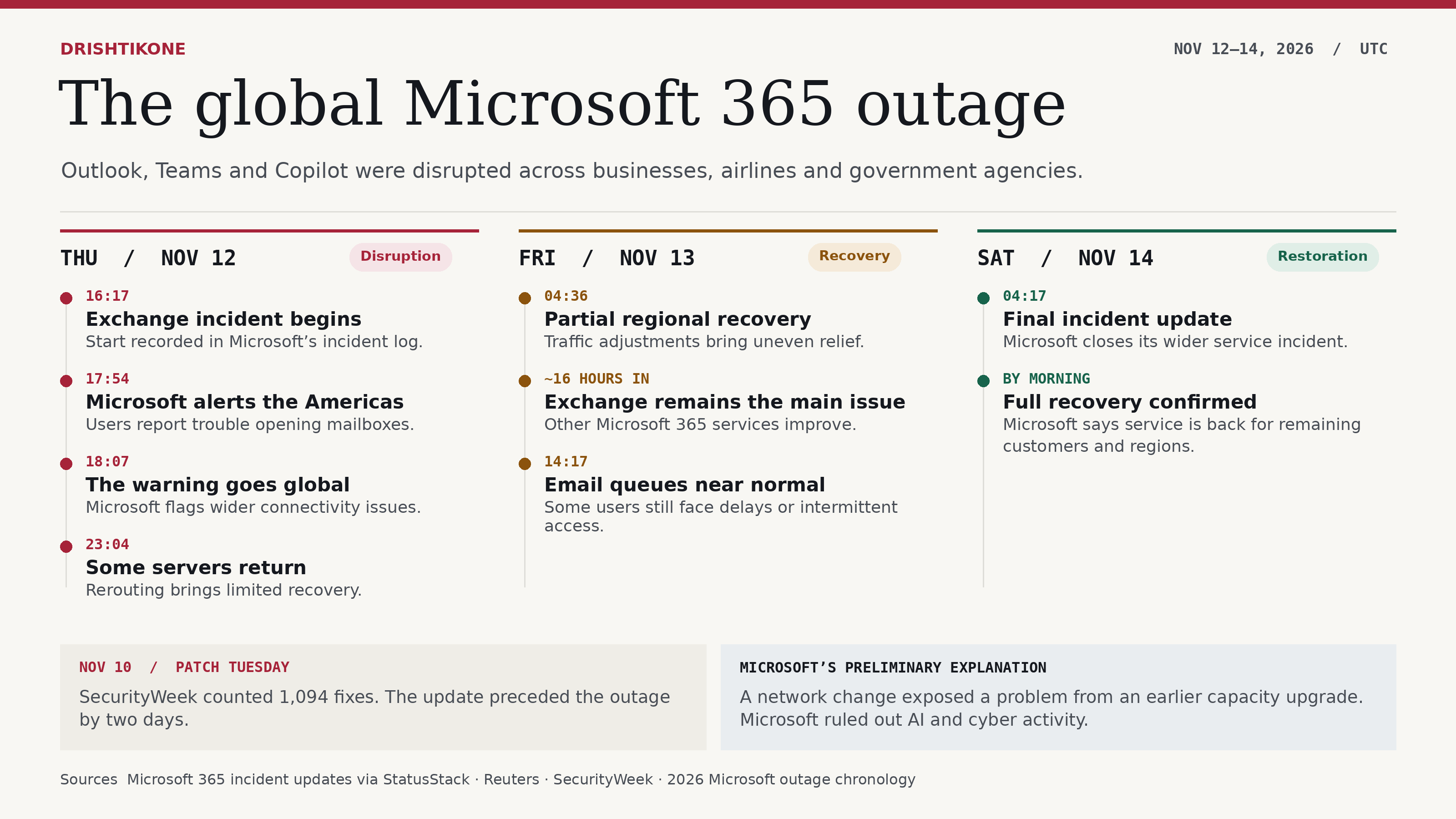
Two days after France officially attributed the attack, Microsoft experienced a major service disruption between November 12 and 14, 2026.
The problems affected several Microsoft 365 services, including Outlook, Teams, and Copilot. The disruption began on November 12 and continued into the following day, affecting users in at least 74 countries. More than 130,000 users reported difficulties accessing software. Microsoft attributed the disruption to elevated infrastructure load after a large number of servers unexpectedly became unavailable. Email access was largely restored on November 13. The incident affected multiple products within Microsoft’s productivity ecosystem, rather than a single application, underscoring the reach of the company’s interconnected online services.
For many organizations, these systems are not optional productivity tools.
They provide communications, calendars, document access, identity services, collaboration, and increasingly AI-assisted workflows.
A single outage can interrupt several functions at once. People trying to organize a response may find that the email, meeting, and document systems they normally use to coordinate it are among the services affected.
The following day, the United States imposed a nationwide ground stop after problems disrupted air traffic control communications. The timing invited a connection. A major American technology platform was struggling to restore service. A failure in aviation communications had halted departures nationwide. France had just attributed destructive attacks on commercial refrigeration to Iran, and warnings about hostile cyber activity were circulating during an active war. With all three events in the headlines, it was easy to read them as parts of the same operation.
SecurityWeek reported that officials had found no evidence of hacking behind the nationwide FAA ground stop. Investigators were examining whether a software update or related technical change contributed to the failure. The incident caused major disruption to American aviation, but the available findings did not support claims that a foreign government had compromised the air traffic control system. (Source: No Signs of Hacking in FAA Ground Stop as FBI Reportedly Probes Software Update — SecurityWeek)
The evidence available at the time did not establish a common cause. U.S. officials reported no indication that a hostile cyberattack had caused the FAA disruption. Investigators were examining technical problems involving telecommunications modernization and software changes. Microsoft, meanwhile, said its service problems were separate from the aviation disruption.
The incidents still raised a shared question about how failures spread. An office can lose email, scheduling, and access to shared work in the same hour because those functions rely on common infrastructure. In aviation, trouble with a communications system can halt departures at airports far from the original fault. An adversary can exploit that dependence, as France’s attribution suggests.
In the United States, investigators examined how changes to the system itself could cause widespread disruption.
This distinction matters.
Several major disruptions occurring close together do not, by themselves, establish coordination. Yet even unrelated incidents can expose a shared vulnerability: modern societies increasingly depend on interconnected systems whose failures can spread far beyond their original source.
A software update can interrupt communications. A telecommunications breakdown can ground aircraft. A compromised industrial controller can turn a digital intrusion into physical damage.
The underlying problem is dependence, not simply technological weakness. Sophisticated systems are not necessarily resilient systems. An advanced network may still rely on a small component whose failure produces consequences across entire industries.
This tension sits at the heart of the emerging artificial intelligence economy. The United States seeks to maintain its advantage in advanced computing and restrict competitors’ access to critical technologies. Meanwhile, Western economies are becoming more reliant on complex digital infrastructure that technological superiority alone cannot make dependable.
Possessing the best processors does not automatically deliver the most resilient communications networks, energy systems, or transportation infrastructure. Military strength cannot ensure that every civilian service will withstand disruption.
National security must therefore encompass more than technological leadership. It must also address redundancy, recovery, operational continuity, and the ability to function when essential systems fail, regardless of the cause.
Iran, North Korea, Russia, and the cyber asymmetry
Iran is not the only state capable of conducting sophisticated cyber operations. North Korea has developed capabilities associated with espionage, financial theft, and support for its strategic programs. Russia possesses substantial capabilities linked to intelligence gathering, influence operations, and disruption. American authorities have accused China of extensive cyber espionage and efforts to gain access to critical infrastructure that could become strategically useful during a confrontation.
That raises an important question: are Russia, China, North Korea, and Iran acting together?
The question deserves investigation, but it should not become a conclusion disguised as a question. Shared adversaries do not automatically establish shared operational planning.
Overlapping interests do not prove coordinated attacks. These states should not be treated as interchangeable parts of a unified command merely because their activities may serve similar strategic objectives.
A credible assessment must distinguish between parallel operations, opportunistic cooperation, and deliberate coordination. Establishing that they are “in this together” would require evidence connecting particular actors to particular operations, and demonstrating cooperation rather than simply a convergence of interests.
These differences matter when asking whether China, Russia, Iran, and North Korea are acting together. Their interests sometimes overlap, but their priorities, vulnerabilities, and tolerance for disruption are not identical.
China depends heavily on international trade and industrial production; widespread disruption of the digital economy could damage its own interests. Russia seeks leverage against Western governments, particularly over European security. Iran, facing military and economic pressure, may view asymmetric capabilities as instruments of deterrence or retaliation. North Korea operates under different constraints, with cyber-enabled revenue generation occupying a prominent place in its activities.
None of this rules out cooperation. But overlapping interests do not establish a shared operational plan.
A crisis can create opportunities for several actors simultaneously. One government may collect intelligence while another attempts sabotage. Criminal groups may exploit distracted defenders. Other organizations may launch attacks for publicity or profit. Independent operations can consequently produce a pattern that looks coordinated.
For governments, that ambiguity creates a dangerous dilemma. During a military confrontation, officials face pressure to identify an attacker quickly. An infrastructure failure may be interpreted through the assumptions of the surrounding conflict before investigators establish what happened.
Responding prematurely risks retaliation against the wrong actor. Waiting too long may allow genuine hostile operations to continue.
Attribution therefore involves more than identifying malicious code or tracing network traffic. It informs political and military decisions whose consequences can extend beyond the original incident.
The stakes rise when digital operations cause physical damage. Governments must determine whether an incident constitutes espionage, sabotage, a criminal offense, an armed attack, or overlapping categories.
That judgment shapes the response. In a wider confrontation, mistaken attribution can turn uncertainty into escalation before responsibility is established.
The American plan is not simply to defeat China
America’s emerging technology strategy is often described as an attempt to prevent China from becoming a technological superpower. That captures part of its purpose, but misses the broader ambition: preserving American influence over the critical inputs on which advanced technological capabilities depend.
These include semiconductors, manufacturing equipment, chip-design software, cloud computing, strategic financing, and international technology standards. They are more than commercial assets. They form the infrastructure through which economic strength and military capability increasingly develop.
Washington does not need to control every artificial intelligence application. It needs decisive influence over capabilities that competitors cannot easily replace.
This is the logic of chokepoint power. In their 2019 work on “weaponized interdependence,” Henry Farrell and Abraham Newman explained how states can exploit central positions within global economic networks. Control over key nodes can confer leverage without requiring dominance over the entire system.
The United States benefits from several such positions: the international role of its financial system, the strength of its companies in software and cloud infrastructure, critical semiconductor-design capabilities, and alliances that connect it to essential manufacturing technologies.
But this leverage contains a contradiction. The same dependencies that create strategic power also encourage others to escape it.
Restrictions on advanced chips strengthen incentives to develop domestic alternatives. Financial sanctions encourage experimentation with alternative settlement systems. Concerns about foreign-controlled cloud services support investment in national computing infrastructure.
Such alternatives may remain expensive, inefficient, or technically inferior. Their development is neither automatic nor assured. Nevertheless, governments may accept commercial disadvantages when technological independence carries strategic value.
Washington therefore faces a difficult balance. Restrictions can protect existing advantages and slow competitors’ progress. Used aggressively, however, they can also strengthen the political commitment and financial support behind rival systems.
The central question is whether today’s leverage can be exercised without accelerating the erosion of the dependencies that sustain it.
American dominance, Chinese Aggression and Global South (led by India) Independence
China’s strongest technological counterstrategy may be to avoid competing on Washington’s preferred terms. A race defined exclusively by the most advanced chips favors the American-led semiconductor ecosystem. A contest over affordable, sufficiently capable artificial intelligence could produce a different outcome.
Beijing can pursue models that cost less to deploy, domestic hardware that reduces exposure to sanctions, and open-weight ecosystems that attract international users. The objective need not be replacing Nvidia everywhere. It can be reducing the circumstances in which Nvidia becomes indispensable. China’s expanding model ecosystem already illustrates this approach.
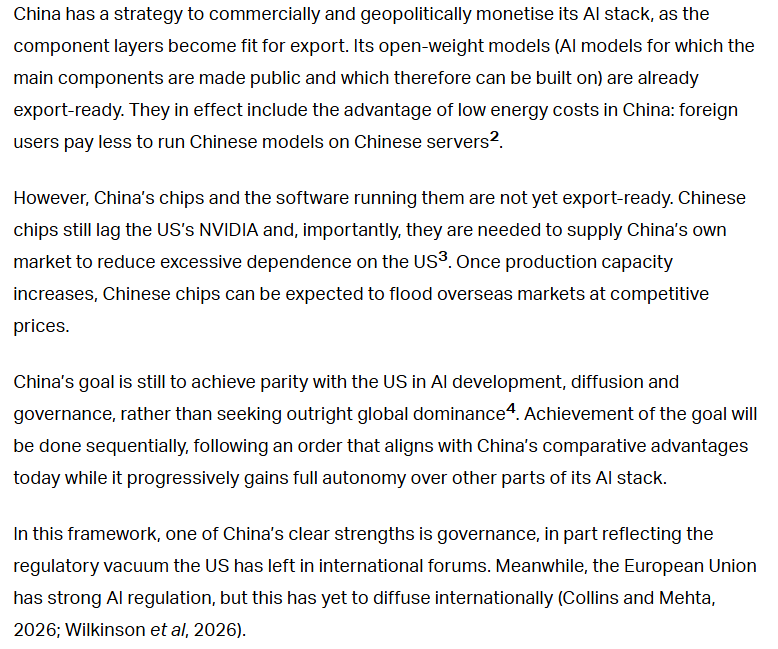
For many developing countries, the decisive question is not who possesses the most powerful model. It is who can provide useful capabilities affordably, reliably, and without unacceptable political conditions. Technological resilience can matter more than technological supremacy.
But China faces a contradiction that could reshape the geopolitical order.
China’s mineral-export controls illustrate the problem: leverage exercised today strengthens incentives to diversify tomorrow. The same contradiction confronts American semiconductor restrictions. Both powers want greater independence for themselves while retaining influence over others.
If China continues pursuing coercive, hegemonic behavior, it will strengthen the forces pushing toward three poles: American dominance, Chinese coercion, and Global South independence.
That outcome is not automatic. But the mechanism is clear. American restrictions encourage alternatives; Chinese pressure makes those alternatives less attractive. Together, they create demand for a third course.
India has an opportunity to help organize that course.
Its proposition should not be that developing countries must exchange American or Chinese leadership for Indian command. It should be that sovereignty requires multiple partnerships, diversified supply chains, domestic capabilities, and the freedom to reject coercion from any direction.
This aligns with India’s pursuit of strategic autonomy and its ambition to serve as a bridge between developing countries and the West. Yet leadership remains contested, and India cannot simply assume that the Global South will follow.
An Indian-led independence pole would therefore need to function differently from a conventional bloc. It would coordinate without demanding obedience. Members could cooperate with Washington on security, purchase Chinese technology where appropriate, and build alternative institutions where existing arrangements constrain their interests.
Its unifying principle would be independence, not equidistance.
Such a coalition would require material foundations: affordable digital infrastructure, manufacturing partnerships, diversified mineral supplies, financing options, research networks, and technologies that countries can operate without permanent foreign permission.
India would have to help deliver these capabilities, not merely articulate dissatisfaction. Its financial resources remain substantially smaller than China’s, making partnerships with other emerging powers essential.
Brazil, Indonesia, South Africa, African states, Gulf economies, and others would need meaningful agency. A coalition defending sovereign choice would contradict itself if it reduced its members to followers.
That is the strategic opening Chinese aggression could widen. Beijing might expect pressure to produce compliance. Instead, sustained coercion could push countries to collaborate to escape dependence.
The resulting order would not necessarily contain three equal superpowers. It could contain three competing organizing principles: American technological primacy, Chinese efforts to convert economic weight into geopolitical compliance, and an India-supported coalition committed to preserving national choice.
For India, success would mean making independence practical. For China, the warning is straightforward: challenging American dominance does not confer the right to reproduce it.
The energy war beneath the technology war
Artificial intelligence is often presented as a software revolution. Its foundations, however, are physical. Data centers require electricity, cooling, and reliable networks. Semiconductor factories depend on stable power, water, specialized materials, and sophisticated industrial facilities. Behind every advanced model stands an infrastructure whose operation depends on continuous access to energy.
This gives American pressure on Iran, Russia, and Venezuela an additional strategic dimension. China remains dependent on imported oil and gas. Russia and Iran supply important portions of its energy needs, while Venezuela offers another source outside Western-aligned arrangements.
It would be misleading to interpret every American action against these countries as an attempt to restrict China’s energy access. Regional conflicts, proliferation concerns, sanctions enforcement, and domestic political considerations have their own histories. Nevertheless, distinct policies can produce overlapping consequences.
Restrictions on advanced computing can increase the difficulty of technological development. Energy disruptions can raise industrial costs. Financial sanctions can complicate transactions and investment. Operating simultaneously, these pressures can reinforce one another without necessarily belonging to a single coordinated strategy.
China has several responses available. It can diversify suppliers, expand strategic reserves, and develop overland supply routes. It can also accelerate nuclear power, renewable generation, electricity storage, and the electrification of transport and industry.
Reducing the amount of imported fossil fuel required for each unit of economic output could prove particularly important. Lower oil dependence can reduce exposure to maritime disruption and foreign pressure. But this requires distinguishing oil security from electricity security: reducing transport fuel imports does not automatically solve the power requirements of AI infrastructure.
Nor does electrification eliminate dependence. It changes its location.
Electricity systems need transmission networks, generating equipment, minerals, storage, and manufacturing capacity. New technologies create new supply chains, and those supply chains introduce different vulnerabilities. The contest shifts from controlling fuel flows toward securing the materials and infrastructure that make electrification possible.
Russia and Iran confront a separate problem. China provides an enormous market for exports constrained by Western pressure. Yet reliance on a dominant buyer can weaken sellers’ bargaining power.
What appears geopolitically to be solidarity among sanctioned or pressured states can become economically asymmetric. China may obtain favorable terms. Russia and Iran may preserve revenues and market access. Neither outcome establishes a partnership of equals.
Their underlying objectives also differ. China prioritizes reliable supplies and continued participation in international commerce. Russia seeks strategic influence and autonomy. Iran seeks security, economic survival, and relief from isolation.
These interests can sustain substantial cooperation without producing a coherent alternative international order.
The struggle over AI therefore extends beyond chips and algorithms. It encompasses electricity, fuel, finance, industrial capacity, and the unequal dependencies linking partners whose cooperation can remain useful without making their long-term interests identical or permanent.
The dollar is the other chokepoint
Technology and energy are only two foundations of geopolitical power. The third is finance: the infrastructure through which countries borrow, invest, settle transactions, and obtain the credit that keeps commerce moving.
American influence rests partly on the dollar’s international role and the institutions surrounding it. A company can manufacture goods outside the United States, sell to non-American customers, and still depend on dollar financing, American banks, or intermediaries exposed to American regulation.
That dependence gives Washington leverage beyond its borders. Sanctions can restrict access to banking, payments, investment, and credit even when products remain physically available. Commercial capacity means little if a business cannot receive payment, finance shipments, or insure transactions.
For Iran and Russia, this vulnerability is immediate. For China, the calculation is more complicated.
China has benefited enormously from integration into international finance. A disorderly collapse of dollar-based commerce would threaten its own commercial interests. Yet Beijing also wants protection against the possibility that financial dependence could become an instrument of coercion during a confrontation.
Its objective is therefore not necessarily to destroy the existing system. It is to develop alternatives that preserve economic activity if access becomes uncertain.
China’s Cross-Border Interbank Payment System, bilateral currency arrangements, and efforts to expand renminbi settlement belong within this broader strategy. They offer ways to diversify financial connections rather than rely exclusively on established dollar-centered networks.
But building payment infrastructure is not the same as creating a reserve currency.
A payment system helps move money. A reserve currency must also provide assets that governments, institutions, and investors trust enough to hold at scale. That requires deep, liquid markets, credible institutions, predictable rules, and confidence in access to capital.
The dollar’s position reflects decades of accumulated infrastructure and international use. China cannot replicate those advantages simply by persuading trading partners to invoice more purchases in renminbi. Capital controls and concerns about institutional predictability complicate its ambitions.
Gradual diversification is therefore more plausible than sudden displacement.
Countries may settle selected transactions in local currencies while continuing to hold dollar reserves, borrow in dollars, and use dollar markets. Alternative channels could reduce exposure to particular restrictions without eliminating American financial influence.
The strategic parallel with technology and energy is clear.
China does not need to replace Nvidia in every application. It needs sufficient alternatives to prevent restricted access from disabling essential capabilities.
It does not need to replace the dollar in every transaction. It needs payment and financing arrangements that can sustain critical commerce under pressure.
It does not need to eliminate imported energy. It needs diversified suppliers, resilient infrastructure, reserves, and greater efficiency to withstand interruptions.
Across all three domains, the ambition is selective insulation, not complete separation.
The challenge is that resilience comes at a cost. Redundant systems can be less efficient, alternative technologies less capable, and protected financial channels less attractive to international investors.
Beijing must therefore balance the gains from global integration against the risks of dependence.
The central objective is neither isolation nor universal supremacy. It is reducing vulnerability wherever external dependence can become coercion.
The Global South may decide the outcome
Reducing vulnerability is not exclusively a Chinese ambition. It also explains why much of the world resists treating American–Chinese competition as a compulsory choice between rival camps.
India, Brazil, Indonesia, Saudi Arabia, the United Arab Emirates, Turkey, and African economies have priorities that neither Washington nor Beijing can fully define. They want advanced technology, reliable energy, investment, export markets, financial flexibility, and bargaining room. Their objective is not choosing a patron. It is preserving the capacity to choose.
These countries are therefore participants in shaping the emerging order, not merely territory over which larger powers compete.
India illustrates the distinction. Its technology sector maintains deep connections with American companies, while its security concerns regarding China create reasons for closer cooperation with Washington. Yet India also maintains relations with Russia and participates in institutions outside conventional Western alliance structures.
The same principle appears elsewhere. A Gulf government can maintain American security partnerships while expanding commerce with China. An African economy can combine Chinese infrastructure with Western development finance. A Southeast Asian manufacturer can use American software alongside Chinese components.
Such combinations are not necessarily transitional arrangements awaiting an inevitable division into hostile camps. They can represent durable strategies for navigating an interconnected economy.
The central ambition is independence through diversified interdependence.
But accessible models do not automatically produce technological sovereignty. Countries still require computing capacity, skilled engineers, electricity, secure networks, maintenance, and sustainable financing. Possessing model weights means little without the infrastructure needed to use them.
Competition will therefore extend across entire ecosystems.
American providers may combine advanced models, cloud platforms, hardware, and enterprise support. Chinese suppliers may compete through affordability, deployment flexibility, manufacturing scale, and financing. European companies may emphasize privacy and regulatory compatibility. Domestic developers may specialize in local languages, public services, and national institutions.
For countries seeking autonomy, the strongest arrangement may combine elements from several sources while developing capabilities at home.
But leadership would require practical delivery and respect for other countries’ agency. The Global South is not a single strategic actor, and its members will not always agree.
A more independent international order would emerge through negotiated cooperation, not uniform alignment.
Its balance would not depend on every country possessing equal power. It would depend on more countries possessing credible alternatives.
That is the significance of technological diversity: it can make dependence less exclusive, bargaining more meaningful, and sovereignty more practical. The issue is not escaping every external relationship, but ensuring that no relationship becomes impossible to refuse.
The strategic paradox
That wider distribution of choice does not erase American strength. The United States enters this period with extraordinary advantages: leading companies in artificial intelligence, cloud computing, semiconductor design, and software; alliances connecting it to essential manufacturing capabilities; financial institutions central to international commerce; and military and intelligence resources that competitors cannot easily reproduce.
But dominance is not invulnerability. Nor does superiority in one domain guarantee control over outcomes in another.
China possesses industrial scale, scientific capacity, manufacturing depth, and a vast domestic market. Russia retains energy resources, military capabilities, and geographic influence. Iran can impose asymmetric costs despite substantial conventional disadvantages.
Neither can simply overturn American power. Equally, Washington cannot assume that restrictions will permanently arrest their technological development or eliminate their ability to adapt.
The decisive struggle may therefore concern not who possesses power, but what it costs to exercise it.
- Can Washington restrict access to advanced technology without weakening the international markets that sustain American companies’ revenues, research, and influence? Restrictions designed to protect leadership can also encourage customers to finance competing suppliers.
- Can Beijing reduce technological dependence without sacrificing the benefits of global integration? Greater insulation may improve security while increasing costs, duplicating investment, and narrowing access to knowledge.
- Can Moscow preserve strategic autonomy while relying more heavily on Chinese markets, financing, and technology? Resistance to Western pressure does not automatically prevent dependence elsewhere.
- Can Tehran secure economic opportunity without repeatedly embracing confrontations that deepen its isolation? The capacity to impose costs is not the same as the capacity to build prosperity.
For middle powers, the challenge is equally difficult. Diversification promises greater independence, but competing technological ecosystems may impose incompatible standards, security requirements, or political conditions. Maintaining options requires resources, institutional competence, and sustained investment.
Finance adds another uncertainty. Alternative payment channels may reduce particular vulnerabilities, yet fragmented arrangements can also complicate settlement, raise transaction costs, and create new points of instability.
There is no frictionless route to autonomy.
Nevertheless, a common mechanism runs through these dilemmas. The more Washington uses technological and financial dominance to pressure others, the stronger their incentive to develop substitutes. The more Beijing uses supply-chain concentration coercively, the stronger the incentive to diversify away from China.
Both powers risk weakening the dependencies that underpin their influence.
This is the central paradox of weaponized interdependence: a chokepoint confers power because alternatives are difficult, expensive, or slow to build. Repeated coercion changes that calculation. What once looked commercially inefficient can become strategically necessary.
The strategic challenge is therefore restraint as much as capability.
Durable leadership depends not only on controlling indispensable networks, but on giving others reasons to remain within them. Reliability, predictable rules, mutual benefit, and confidence can preserve influence where compulsion eventually corrodes it.
The strongest position may belong to the power whose partners retain alternatives, yet continue choosing cooperation because it serves their interests.
The next move
Nvidia’s next earnings announcement will attract familiar questions about revenue, margins, demand, and advanced processors. Yet the consequential questions will lie beyond the income statement.
The answers will help determine whether this crisis marks a leadership transition or the start of a broader reorganization of the AI economy.
Behind those questions sits another: who ultimately governs indispensable technology?
The companies that develop it, the investors who finance it, or the states that increasingly regard it as national infrastructure?
The international contest will continue regardless of Nvidia’s leadership. China will pursue alternatives to restricted technologies. American companies will seek global customers. Governments will struggle to reconcile commercial openness with security. Energy suppliers and financial institutions will adjust as technological competition changes demand and risk.
But none of these adjustments will resolve the vulnerability beneath the contest.
Much of this infrastructure was optimized for efficiency, scale, and convenience rather than sustained confrontation. An adversary need not defeat the entire network. A single vulnerable dependency can transmit consequences far beyond the original breach.
The common thread runs through the war. On November 10, France formally attributed the sabotage of refrigeration controls at more than 700 retail sites to Shahid Kaveh, a cyber unit affiliated with Iran’s Revolutionary Guard. Two days later, Microsoft 365 suffered a global outage. The next day, the FAA stopped departures nationwide. That sequence deserves scrutiny in a war where Washington has weighed renewed strikes on Iran, including against its underground nuclear facilities. In April, Trump warned that “a whole civilization will die tonight” unless Tehran made a deal. The language was extreme. The November reporting describes potential strikes on nuclear facilities and leaves the question of weapon choice open.
The evidence points to different immediate causes. U.S. officials traced the FAA disruption to a telecommunications failure during a copper-to-fiber upgrade and reported no indication of a cyberattack. Microsoft traced its outage to a network change that exposed a problem from an earlier capacity upgrade. Those explanations matter. So does the fact that U.S. security agencies had already warned that Iranian-affiliated actors could target American critical infrastructure. The timing warrants asking whether investigators found signs of attempted access or activity linked to known Iranian groups. Establishing coordination would require evidence from the affected networks, such as common access methods, attacker infrastructure, or other forensic links.
This creates a contradiction at the heart of the AI age.
As computing becomes more powerful, governments will seek greater control over its foundations. As those foundations become more concentrated, disruption becomes more consequential. As access becomes more conditional, competitors will invest more heavily in alternatives.
Fragmentation may reduce some dependencies while making collective security harder.
The choice is therefore not between seamless globalization and perfect technological independence. Neither offers a realistic description of the world ahead. The harder task is building systems that remain useful without becoming inescapable, and interconnected without making every failure contagious.
For Beijing, it means recognizing that resistance to American coercion will not legitimize Chinese coercion. Countries seeking independence will resist exchanging one controlling supplier for another.
For India and other emerging powers, the opportunity is to make strategic autonomy material: diversified suppliers, domestic capabilities, interoperable infrastructure, and partnerships that preserve choice.
Such an order would not eliminate rivalry. It could prevent rivalry from turning every essential service into a potential instrument of compulsion.
Nvidia’s leadership crisis will eventually leave the headlines. Investigations may clarify individual decisions. Markets will reassess the company. Executives will come and go.
The larger transformation will remain.
Computing, energy, finance, and national security are becoming parts of one strategic architecture. Power increasingly belongs to those who control the connections between them.
But control should not be confused with durability.
A system can become indispensable and simultaneously become too dangerous to depend upon. That is when customers become strategists, partners become hedgers, and dependence begins generating resistance.
The defining question is no longer simply who commands the most advanced technology.
It is who can build an order in which others retain the freedom to choose—and still choose to participate.
The power that lasts will not merely make itself indispensable.
It will make continued cooperation preferable to escape.