The Two Granaries
Two lords held neighboring valleys, divided by a river. For years they quarreled over a strip of paddy neither could keep.
One autumn, unable to take the field, the first lord sent men across the water by night to burn the second lord's granaries. "Now his people will hunger," he said, "and he will yield."
The second lord had ten times the archers. He burned every granary in the first lord's valley, and then the storehouses, and then the mills. Soon the villagers of that valley stood before empty baskets, though the war had not moved a single pace.
A traveling monk came to the second lord's gate. "You have won the burning," he said.
"I have," said the lord.
"And what have you won?"
The lord looked toward the smoke rising from both valleys, his own arrows nearly spent, his own rice-store thinned by the effort.
The monk said, "A man who empties his neighbor's bowl to fill his own has only taught his neighbor to empty bowls. You are now both fed by ash."
That night the first lord's minister asked whether they should sue for peace. The lord answered, "How can I stop? I have already burned so much."
Unusual Confluence
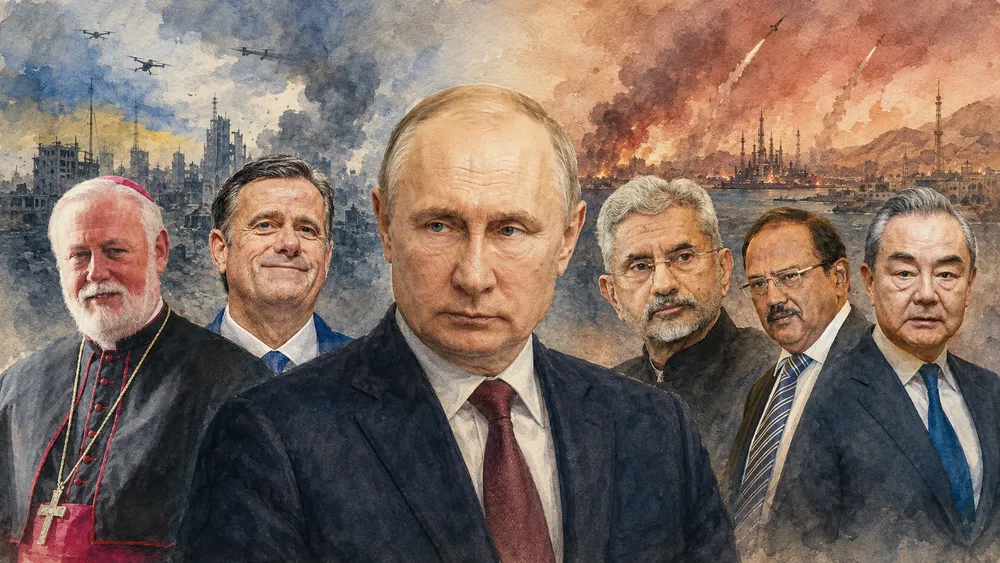
In the last week of August 2026, Moscow received an unusual density of visitors.
No single hand arranged this. Each traveler followed his own calendar and his own logic. Yet the cluster is worth pausing on, because the people who converged on or around Moscow that week are the ones who manage the frictions of the current war, and the near-simultaneity tells us something about how many powers now feel the need to be in the room at once.
Take the dates in order. S. Jaishankar arrived in Moscow on a two-day official visit running August 23 to 24, co-chaired the twenty-seventh session of the India-Russia Inter-Governmental Commission with First Deputy Prime Minister Denis Manturov, held wide-ranging talks with Sergey Lavrov, and called on Vladimir Putin at the Kremlin on August 24, carrying a personal message from Prime Minister Modi (Source: ANI)
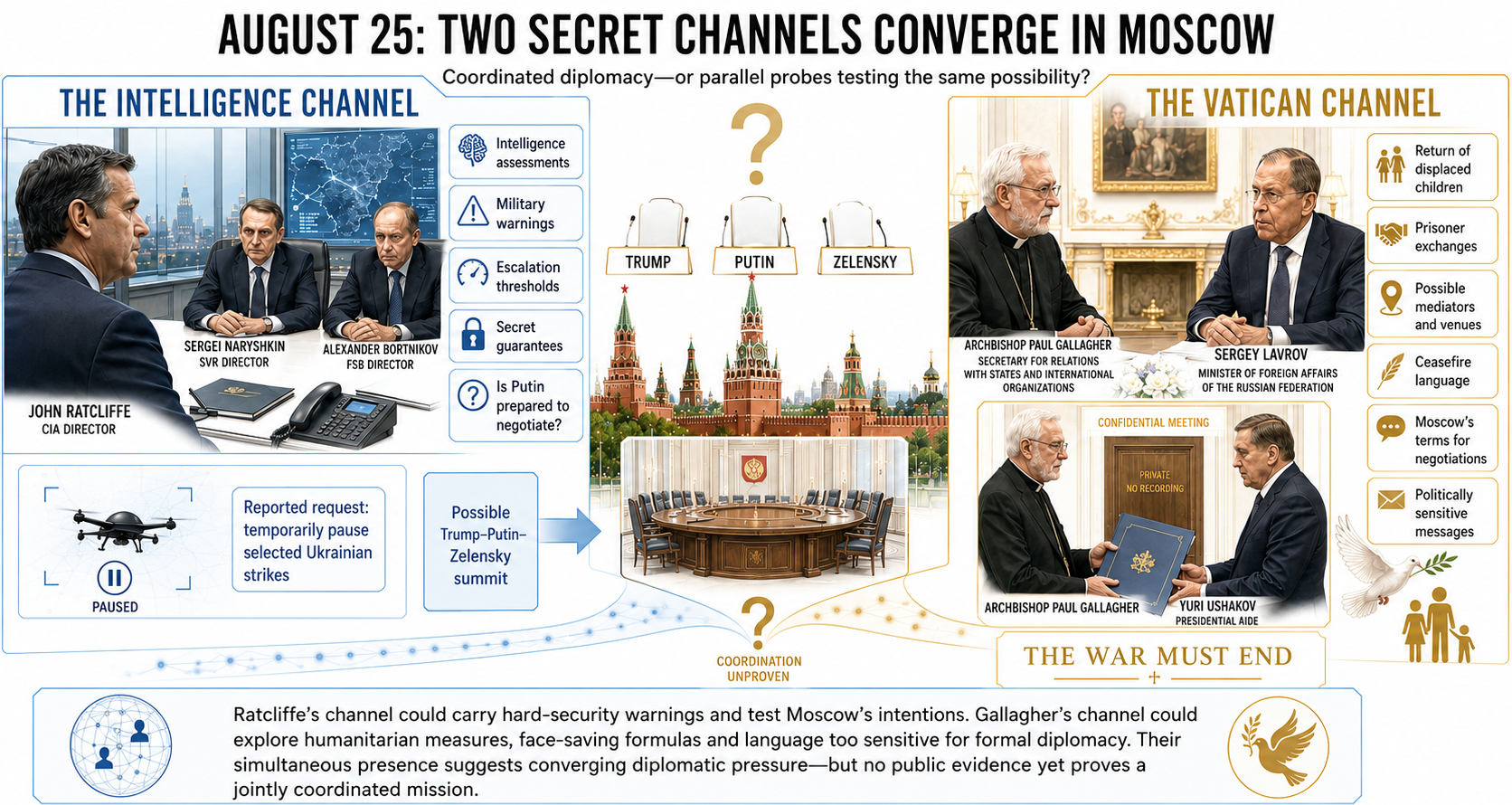
CIA Director John Ratcliffe flew into Moscow on Tuesday, August 25, aboard a C-17A military transport after a stop in Riga, spent roughly 8.5 hours on the ground, and departed by evening.
The surprise visit by the director of the Central Intelligence Agency to Moscow this week was to deliver a warning to Russia not to attack NATO countries, according to people briefed on the visit. The trip was spy-agency chief John Ratcliffe’s first publicly known visit to the Russian capital. It followed new U.S. intelligence assessments, reported earlier by The Wall Street Journal, that Russian President Vladimir Putin could try to test the resolve of the North Atlantic Treaty Organization with a limited assault on an allied country in the next few years. (Source: CIA Chief’s Surprise Moscow Trip Was to Warn Russia Not to Attack NATO / WSJ)
Archbishop Paul Gallagher, the Holy See's Secretary for Relations with States, arrived in Moscow on August 24, the same day as Dr Jaishankar, for a four-day stay, and met Lavrov on August 25. (Source: Vatican News)
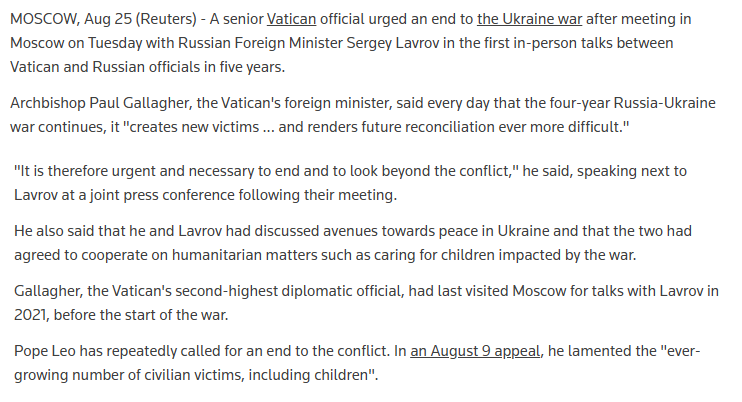
This video shares a view many may have missed: the Vatican’s foreign minister takes the confidential file from his assistant and enters a closed-door meeting with Sergey Lavrov. Completely alone.
Why did Galagher visit Moscow?
The strongest reasonable inference is not that Gallagher was acting as an American courier, but that Washington and the Vatican may have been testing different parts of the same diplomatic problem simultaneously.
Ratcliffe could ask:
Is Moscow prepared to accept a summit, and what happens if the present escalation continues?
Gallagher could ask:
What political or humanitarian steps would allow Moscow to enter such a process without appearing to capitulate?
The Vatican would be especially useful if formal US–Russian diplomacy had become overly politicized. Putin could explore ideas with Gallagher without making a commitment to Trump, Zelensky or the Europeans.
And on that same Tuesday, India's Ajit Doval was in Beijing for the Special Representatives' talks with Wang Yi on the boundary question, and also met Chinese Vice President Han Zheng (Source: Business Standard).
What makes it analytically useful is that each visit maps onto a distinct pressure now bearing on the Russian war, and reading them together produces a sharper picture than reading any one alone.
- Jaishankar and Doval represent the reordering of Eurasia around a multipolar architecture that gives Moscow economic and diplomatic depth. - Gallagher represents the exhausted humanitarian and moral track, the one channel that never fully closes.
- Ratcliffe represents the hard core of the matter: a direct American warning delivered spy chief to spy chief, at a moment when Washington has reason to worry that Putin senses an opening.
The Ratcliffe mission, decoded
It is rare for an American intelligence chief to travel to Moscow. The last confirmed instance was November 2021, when William Burns, then President Biden's CIA director, went to warn the Kremlin against the invasion of Ukraine that came three months later.
 Ewan Palmer
That precedent hangs over Ratcliffe's trip and shapes how it should be read. The 2021 mission failed to change Russian behavior, but it succeeded as a record: it established that Washington had seen the invasion coming and had said so to Putin's face. A warning delivered in person, at the top of the intelligence hierarchy, is partly about deterrence and partly about the archive. It fixes responsibility.
However, given the utter failure of this approach earlier, the CIA's repeated attempt at the maneuver looks intriguing.
In November 2021, William J. Burns, the C.I.A. director in the Biden administration, met face to face in Moscow with Mr. Bortnikov and other top Russian officials to warn Mr. Putin against launching a full-scale invasion of Ukraine. A year later, in November 2022, Turkey hosted a face-to-face meeting in Ankara between Mr. Burns and Sergei Naryshkin, the leader of Russia’s foreign intelligence service. U.S. intelligence agencies had intercepted Russian communications about the possible use of a nuclear device by the Russians to slow Ukrainian advances in that fall’s counteroffensive. Mr. Burns warned Mr. Naryshkin of serious consequences if the Russians acted on the alleged threat. The Turkish hosts wanted the meeting to be the start of a lasting channel of direct communication between Washington and Moscow to reduce tensions. But the C.I.A. was angry at Moscow when, after the meeting, the Russian side made it public. Mr. Burns and Mr. Naryshkin did not have a second face-to-face meeting, though they continued to communicate occasionally by phone. (Source: "C.I.A. Chief Delivered Bleak Assessment of Russia’s War in Secretive Moscow Visit" / New York Times)
Ratcliffe's purpose, according to two people familiar with the matter cited by CNN, ran along two lines. He warned Russia against any overt or covert attack on NATO territory, and he pressed Moscow to cut off economic and military support for Iran
The CIA chief had a broad agenda. He warned Russia against any overt or covert attacks on NATO territory amid growing fears in Europe that Putin might test the alliance’s defenses, two people familiar with the matter told CNN. Ratcliffe also used his meetings with Russian espionage officials to encourage Russia to cut off economic and military support for Iran. (Source: Analysis: Secret CIA visit highlights Putin and Trump’s common strategic trap / CNN)
The Washington Post's account, which broke the story of the intelligence that preceded the trip, added a third element: Ratcliffe told his Russian counterparts that if Putin significantly escalated the war in Ukraine, it would backfire by pushing Trump back toward Ukrainian President Zelensky (Source: Washington Post).
That last point is the most revealing, because it treats American support for Ukraine as a lever that Washington can raise or lower depending on Russian conduct, and it signals to Moscow that the lever is currently set low and could be reset.
The Russian side confirmed the meeting without confirming its substance. Sergei Naryshkin, the head of the SVR, Russia's foreign intelligence service, acknowledged that he personally met Ratcliffe and said there was "nothing unusual" about the talks, describing meetings between intelligence leaders as routine.
Ratcliffe did not meet Putin, according to the Kremlin, and the CIA and White House declined to comment. The choice to route the meeting through Naryshkin rather than the president is itself a message. It keeps the channel deniable and reversible, and it locates the exchange in the intelligence world, where warnings can be delivered and threats calibrated without the theater of a leaders' summit.
Why the intelligence channel, and why now?
The BBC's Washington correspondent offered the most interesting reading on the day the story broke: with Moscow under growing pressure from Ukrainian long-range strikes, there is concern in the West that Putin might try to escalate his way out of the crisis, and the trip may have been a warning from Washington not to mess with NATO.
But the Western officials, who asked not to be named, said recent warnings from Moscow, including that UK forces could be targeted in future or that its weapons factories could be hit, were "nothing new". They were, they suggested, consistent with Russia's military doctrine to apply pressure on the West. The officials suggested that the hostile rhetoric was also a reflection of the growing pressure Putin is facing at home, with slow and costly gains in Ukraine along with the impact of Ukrainian long-range strikes deep inside Russia. Putin and his officials have repeatedly dismissed warnings of Russian plans to attack Nato countries as hysteria. And US President Donald Trump appears to believe the Russian leader – saying this week that "he's not going to attack a Nato territory". (Source: Russia ramps up rhetoric but wants to avoid war with Nato - Western officials tell BBC / BBC)
This entire theater sounds bizarre from every standpoint.
For, essentially what Ratcliff's warning may have come off as would be - "While we have the freedom to hit you at will via Ukraine, you cannot escalate your response beyond getting hit and defending yourself."
Trump’s peace initiative has stalled, making a breakthrough over Ukraine an improbable explanation for Ratcliffe’s mission. Nor does the detainee-exchange channel, which Ratcliffe has managed, appear substantial enough to justify such a sensitive visit: by available indications, there were few cases or mature agreements awaiting closure.
That leaves a more urgent possibility:
...the campaign of Russian gray-zone pressure against NATO states, including sabotage, cyber operations, infrastructure disruption, influence activity, and deniable provocations designed to test how far Moscow can go without triggering a collective military response.
The connecting thread between Ratcliffe’s two reported demands:
- a warning against pressure on NATO and
- a call for Russia to curtail assistance to Iran
...is Russian leverage across multiple theaters.
Moscow’s military, technological, intelligence, or diplomatic support for Tehran gives the Kremlin a means of intensifying Washington’s burdens in the Gulf. An America distracted by Iran, forced to divide air defenses, naval assets, intelligence capacity, and political attention between the Middle East and Europe, may appear less capable of responding to a calibrated Russian probe along NATO’s periphery.
Seen this way, Ratcliffe’s errand was not about two unrelated disputes. It was an attempt to break a strategic linkage Moscow may believe it can exploit or, failing that, to discover the Kremlin’s price for restraint.
Why Washington sent the warning: the depletion argument
The Ratcliffe trip did not arise in a vacuum. The Washington Post reported that it was preceded by fresh U.S. intelligence indicating that the Kremlin sees the United States as weakened by the Iran war, and that this perceived weakness offers Russia an opportunity to escalate against American interests and allies in Europe.
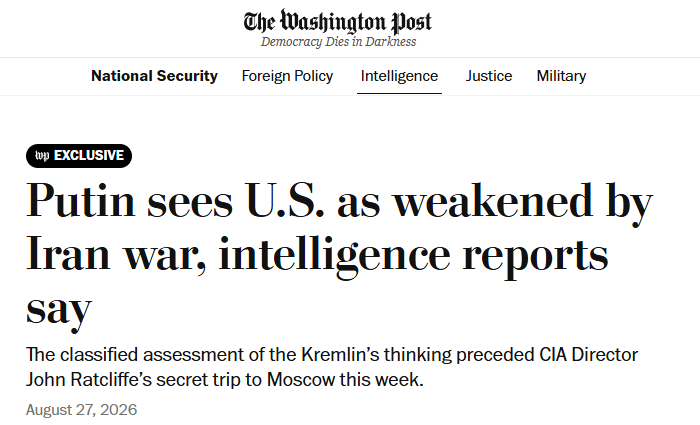
One of the people familiar with the assessment framed the calculus with unusual candor. The trip, this person said, was "less about Putin being in a corner" because his army has failed to break the battlefield stalemate, "and more because Russia assesses we are depleted and can't intervene."
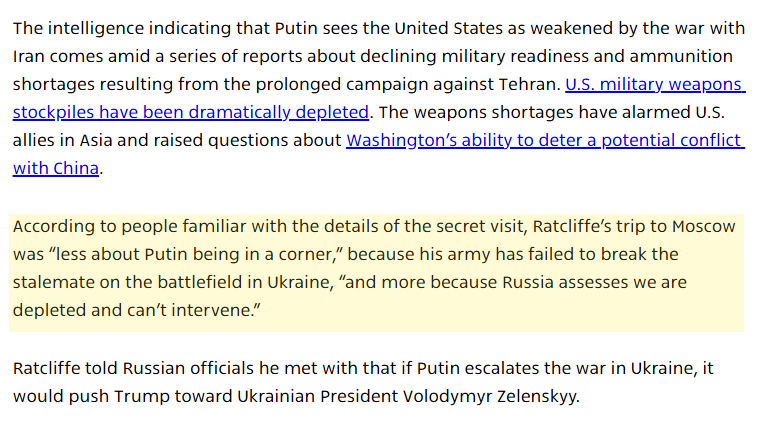
That sentence is the hinge of the entire episode, so it is worth dwelling on. It relocates the source of danger. The conventional worry about Russian escalation runs through Putin's desperation: a cornered autocrat, losing at home and on the battlefield, lashes out to change the subject. The intelligence the Post describes points at something colder and more strategic. Russia may escalate not out of desperation but out of opportunity, because it has calculated that the United States has spent down the military stockpiles it would need to respond to a crisis in Europe, and has spent them in Iran.
Bizarre Theater of Warning while Stockpiles and Money Deplete?
According to the reporting, Ratcliffe told Moscow that escalation would push Trump “toward Zelensky.” That is an extraordinarily weak deterrent formulation.
It does not say:
- NATO forces will be reinforced.
- Ukraine will receive additional weapons or targeting support.
- Restrictions on Ukrainian strikes will be lifted.
- Russian assets or proxies will face retaliation.
- Sanctions will be imposed automatically.
- An attack on NATO territory will trigger a defined military response.
Instead, it effectively says: If you misbehave, Trump may become politically friendlier to your adversary.
That is not a threat Putin must fear. It is a warning that Washington’s Ukraine policy remains negotiable, and that Moscow’s conduct can manipulate Trump’s relationship with Zelensky.
Why issue a warning while visibly depleted?
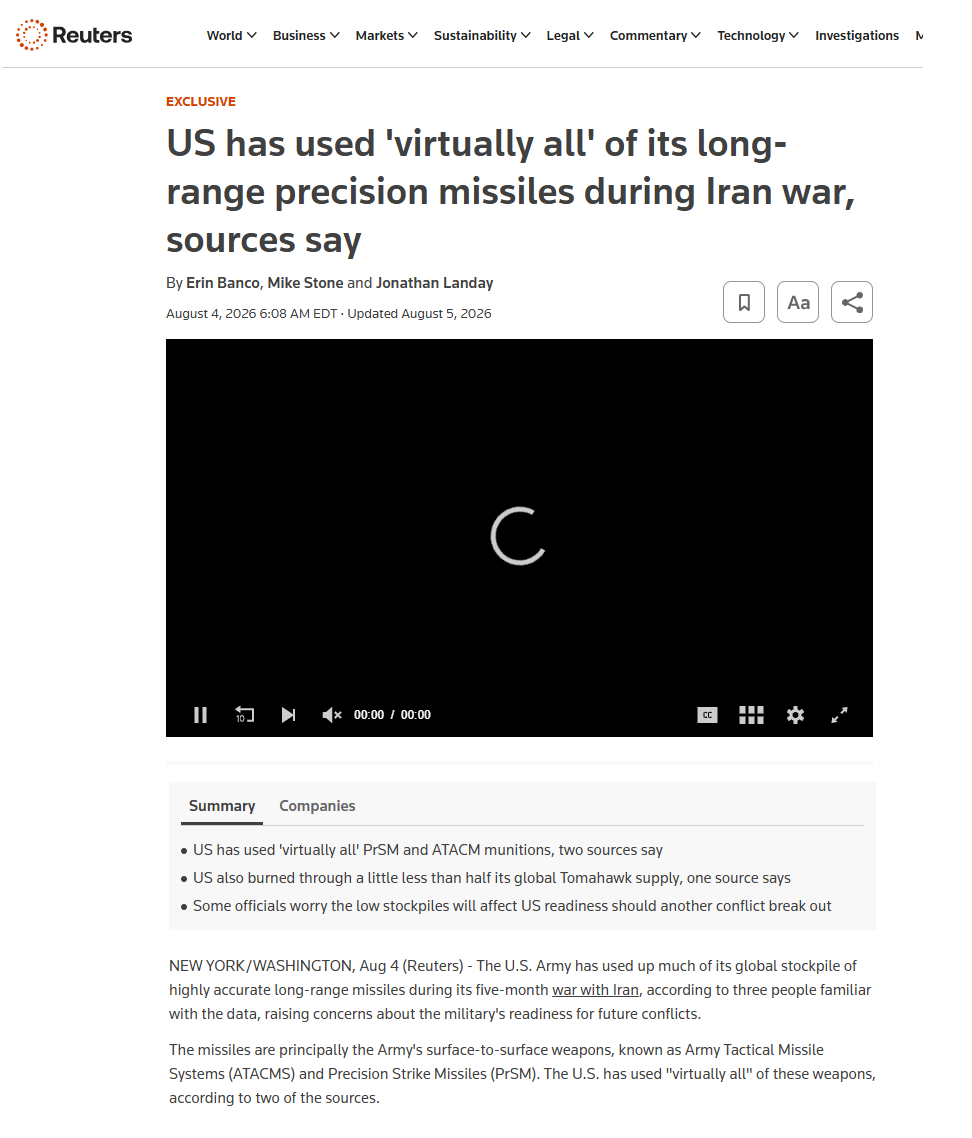
Depletion of particular weapons does not make America militarily helpless. Reuters reported that the Iran war consumed virtually all available PrSM and ATACMS inventory and nearly half the American Tomahawk stockpile, while air-defence interceptors were also severely strained. But the United States still possesses nuclear deterrence, airpower, submarines, cyber capabilities, intelligence networks, financial leverage and the combined conventional strength of NATO.
Therefore, Ratcliffe could still have carried a credible warning—but only if it identified consequences that did not depend upon the depleted inventories. For example:
Any Russian operation against NATO will produce immediate reinforcement of the Baltics, expanded intelligence support to Ukraine, removal of restrictions on Ukrainian targeting and predetermined financial penalties.
A private intelligence channel is actually well suited to communicating such precise red lines. It can reveal enough classified capability to establish credibility without disclosing it publicly.
But that does not appear to be what happened.
The five strategic mistakes
1. Washington exposed its own anxiety: The reported logic of the mission was that Russia believed America was depleted and unable to intervene. Sending the CIA director personally to Moscow to plead against escalation risked confirming exactly that assessment.
Ratcliffe’s physical presence communicated urgency. Moscow could reasonably ask: If the United States possesses overwhelming options, why has its intelligence chief rushed here to ask us not to act?
Diplomacy from weakness can work—but only when it buys time discreetly. Here, the visit became public and advertised the vulnerability it was apparently intended to conceal.
2. The warning lacked an enforcement mechanism: Deterrence requires three things: Capability + Will + Communication
The administration communicated concern while publicly revealing doubts about capability and displaying uncertainty about will.
A warning without a specified consequence becomes information for the adversary: it tells him what frightens you.
3. Trump subsequently contradicted his own emissary: Trump then downplayed the trip as “semi-routine,” denied that Putin would attack NATO and disputed the characterization that Ratcliffe had carried a warning.
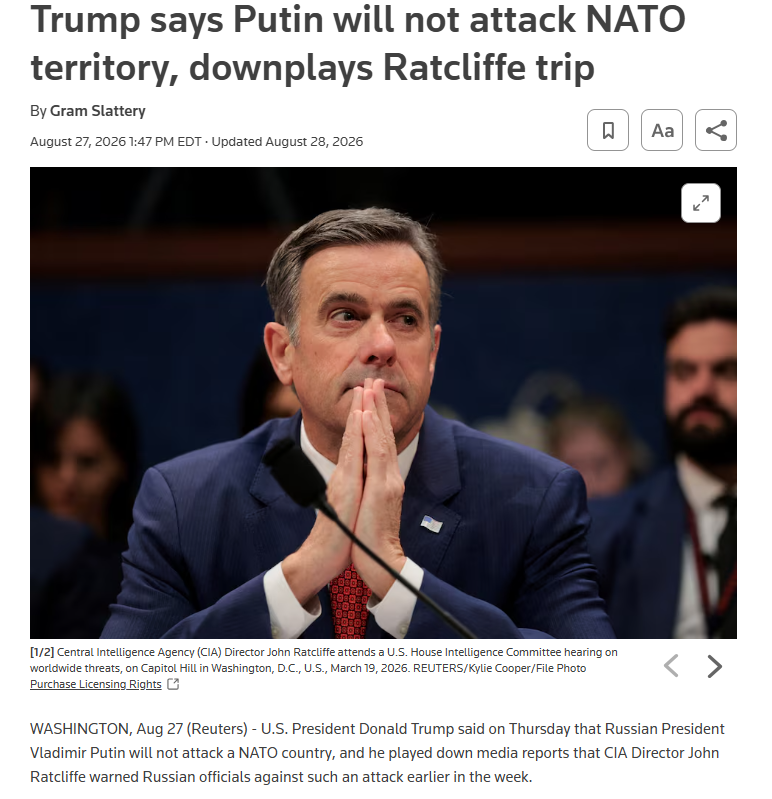
That destroys deterrent coherence. Putin was left with three possibilities:
- Ratcliffe lacked presidential authority.
- Trump was unwilling to acknowledge the threat publicly.
- The administration itself did not agree on the seriousness of the danger.
None makes Washington more intimidating.
A secret warning can remain secret. But once exposed, the president must reinforce it, not publicly neutralize it.
4. The administration substituted personal alignment for national strategy: Saying escalation would push Trump “toward Zelensky” personalized an alliance decision. Ukraine policy appeared to depend not on American interests or on Russian conduct under established rules, but on Trump’s changing attitude toward two individuals.
That invites Putin to manage Trump psychologically: escalate enough to extract attention, pause enough to revive negotiations, offer flattery, then demand concessions.
It converts American policy from a stable deterrent structure into a personality-driven bargaining market.
5. Washington warned before restoring leverage: The proper order should have been:
- Quietly assemble European and American countermeasures.
- Move selected defensive capabilities or NATO forces.
- Pre-authorize sanctions and intelligence responses.
- Accelerate production and announce emergency procurement.
- Then send Ratcliffe to explain exactly what Russia would trigger.
Instead, Washington seemingly disclosed the vulnerability first and supplied the consequences later, if at all.
The deeper failure
This was not classic deterrence. It was closer to crisis supplication disguised as strategic signaling.
Ratcliffe may have gone to determine whether Putin intended to exploit the American window of vulnerability, prevent miscalculation and buy time for depleted inventories to recover. Those are legitimate objectives. But buying time works only when the adversary believes that delay will make you stronger and that immediate aggression will be costly.
The administration instead conveyed:
Putin was unlikely to shiver. He was more likely to hear confirmation that the window existed.
Bluster without Arms
As we discussed, the United States has lost roughly a quarter of its Reaper drones, aircraft that cost between thirty and fifty million dollars apiece and carry the surveillance and targeting load for American operations.
The weapons shortages have alarmed allies in Asia and raised questions about Washington's capacity to deter China, which is the strategic nightmare that sits behind the European one.
Defense Secretary Pete Hegseth and other administration officials have publicly denied that there are serious munitions shortages even as they have pressed arms producers to build more weapons faster.
The denial and the pressure on producers coexist, which tells you how the administration is handling the problem: publicly reassuring, privately scrambling.
The pattern matters because the audience for the reassurance includes Moscow and Beijing, and neither is likely to take Hegseth's word over their own collection. If Russian analysts have concluded that American interceptor inventories are thin, that ATACMS production cannot cover both Ukraine and a Pacific contingency, and that a quarter of America's high-end drone fleet is gone, then the deterrent value of the U.S. arsenal in Europe has fallen in Russian eyes regardless of what the Pentagon says at the podium.
Two structural facts compound the problem.
- First, several of the depleted systems are the same ones Ukraine depends on for survival. Patriot interceptors are the clearest case. Ukraine's stockpile of air-defense interceptors, supplied largely by the United States, has been dwindling, and Russia has taken direct advantage of that by intensifying its missile and drone campaign against Ukrainian cities. European countries have pledged to supply Kyiv with interceptors, but many will not arrive until next year . Trump apparently offered this summer to let Ukraine license production of Patriot systems, then did not follow through (CNN). So the Iran war and the Ukraine war compete for the same scarce interceptors, and every Patriot fired over the Gulf is one not fired over Kyiv.
- Second, Russia is helping Iran, which folds the two wars into a single system. CNN reported in March that Russia has provided Iran with intelligence on the locations and movements of American troops, ships, and aircraft, much of it imagery from Moscow's satellite constellation (Source: CNN).
Democratic Senator Mark Kelly of Arizona put the loop plainly: because Trump went to war against Iran without a strategic goal, a plan, a timeline, or a way out, and is now stuck, that helps the Russians, and the Russians in turn are helping the Iranians.
Here is an illustration of how it may be happening:
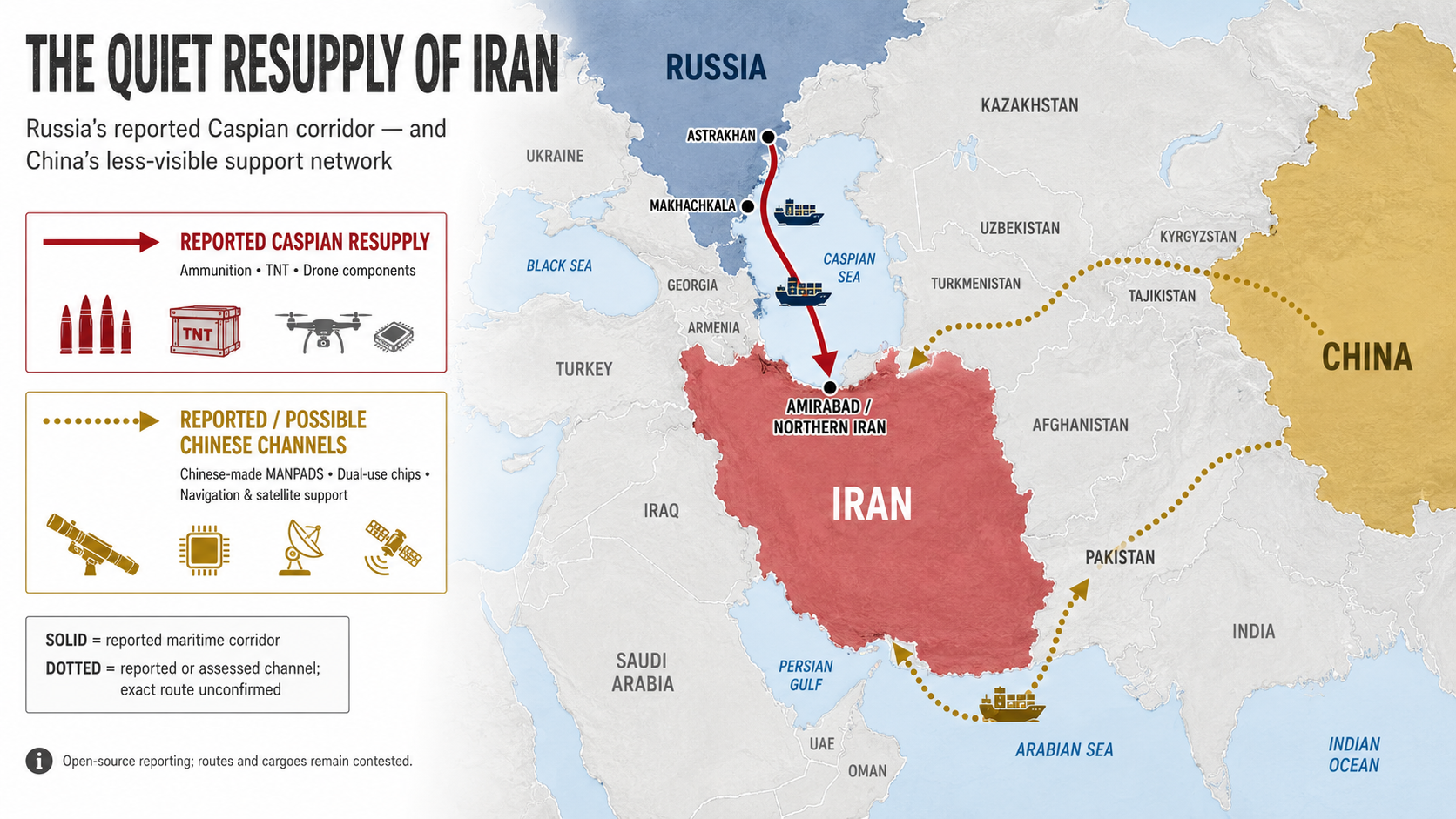
The depletion that weakens American deterrence in Europe is being deepened by a war in which Russia has a supporting hand. From Moscow's vantage, prolonging Washington's entanglement in the Gulf is close to costless and steadily raises the odds that the United States could not mount a serious response to a European provocation.
The munitions ledger and the two-theater problem
It is worth being precise about the arithmetic, because the entire Russian wager rests on it.
The United States has been fighting an air and missile campaign against Iran for six months, since roughly February 2026. That campaign has consumed the categories of ordnance that are hardest to replace quickly: precision interceptors and long-range precision strike.
Interceptors and cruise missiles are not commodities that can be surged on demand. Their supply chains involve specialized solid-rocket motors, seekers, and guidance electronics with lead times measured in quarters and years. When Hegseth presses arms producers to build faster, he is fighting physics and industrial base decay that predate this administration.
Layer the Ukraine demand on top. Ukraine burns through air-defense interceptors at a rate driven by Russia's choice of tempo, and Russia has been raising the tempo precisely because it sees the interceptor shortage. This is a deliberate exhaustion strategy. Russia launches large mixed raids of drones and missiles, forces Ukraine to expend scarce interceptors against them, and counts on the American inventory being unable to backfill fast enough while the same inventory is also feeding the Gulf. European interceptor pledges help on paper, but the timeline gap, deliveries slipping into next year, is exactly the window in which the danger is greatest.
Now add the Pacific. The systems in shortest supply, Patriot, Tomahawk, ATACMS, are the same ones that anchor American deterrence against China in a Taiwan or South China Sea contingency. Allies in Asia have noticed the drawdown and have raised questions about whether Washington could deter Beijing while depleted. This is the deepest layer of the problem and the one that should worry planners most, because it means the Iran war has degraded American deterrence in two theaters it was never fought in. A finite stockpile split across Iran, Ukraine, a European contingency, and a Pacific contingency cannot cover all four at the levels each would demand. The strategic term for this is a one-and-a-half-war or two-war construct exceeding capacity, and the practical consequence is that adversaries in different theaters can each reason that American attention and matériel are committed elsewhere.
This is the trap that gives the Russian assessment its force. Moscow does not need the United States to be defeated. It needs the United States to be visibly stretched, so that a European probe carries a lower risk of a decisive American response. Fresh U.S. intelligence, reported by The Washington Post, indicates that the Kremlin views the Iran war as having weakened the United States and created an opening for greater pressure on American interests and allies in Europe.(Source: washingtonpost)
Ratcliffe's counter-message was that the calculation is wrong, that NATO's tripwire holds even when the American cupboard is bare. The credibility of that counter-message depends on whether Washington can demonstrate, in the months ahead, that it retains the capacity and will to act on the eastern flank. The demonstration, if it comes, will have to be more than a spy chief's assurance.
The money runs out too
The depletion is fiscal as well as physical, and the fiscal side broke into public view in the same week as the Ratcliffe trip. On August 27 the Guardian reported, from Pentagon documents and interviews with Navy officials, contractors, and defense analysts, that Trump's war on Iran has driven the U.S. military into a severe financial crisis, with the Navy transferring money out of its payroll and other accounts to fund combat operations.
 Aram Roston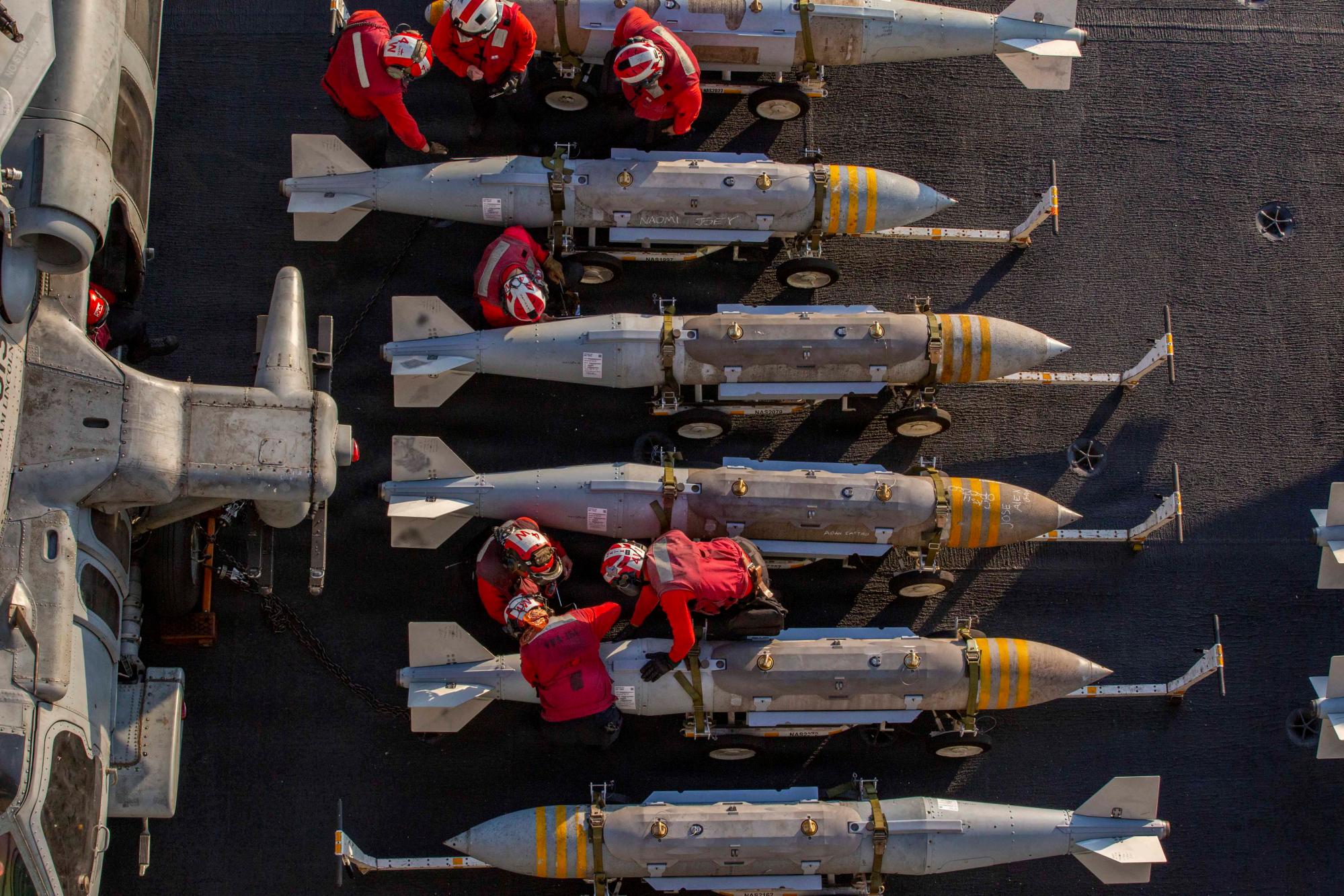
A Pentagon memo seen by the paper warned of "shortfalls in payroll" because the department has been "raiding" those accounts to pay for the fighting.
The Navy's roughly $ 300 billion 2026 budget is divided by Congress into fixed allocations for personnel, shipbuilding, weapons procurement, and operations and maintenance, and federal law limits how far money can be moved among them. That legal rigidity is why an unbudgeted war forces the service to move payroll dollars toward the front, and why the strain surfaces as a solvency problem rather than a simple line item.
The figures are large, and the war is unauthorized, which is a dangerous combination for sustainment. Hegseth told lawmakers in July that the war had already cost $ 35.7 billion, and it is unclear whether that figure captures all related expenses. The administration has asked Congress for nearly 88 billion dollars in supplemental funding, including 67.1 billion for Defense Department war costs, a request whose prospects are slim because Congress never authorized the conflict.
Admiral Daryl Caudle, the Chief of Naval Operations, had warned Congress back in May that the 2026 budget did not account for the Iran campaign and that by July he might have to curtail exercises and routine missions to preserve money for the war.
Senator Susan Collins told a July appropriations hearing that some military services face near-term solvency challenges, and a staffer confirmed the Navy was among them. The Navy publicly disputes that its operations and maintenance accounts have run dry, which is the same posture the Pentagon holds on munitions: deny the shortage at the podium and manage it in the ledger.
Consider what Moscow can read from open sources, without a single agent in place. The United States is moving sailors' pay to cover a war its own legislature never authorized. It has spent down its interceptors and cruise missiles, which it cannot quickly replace. It has gone to Congress for tens of billions in emergency money that may never come. A power in that condition has a doubtful capacity to open a third front on short notice, and that doubt is the material underneath the Russian assessment that the United States is "depleted and can't intervene."
The weakness is legible in the appropriations tables, which no adversary needs to steal.
What Russia is doing: the war of logistics and warehouses
While the diplomatic and intelligence traffic filled Moscow, the war on the ground entered a phase that is easy to underrate because it lacks the drama of a frontal offensive. With the ground war largely stalemated, both sides have shifted to striking each other's economic and logistical rear. This is the escalation that Ratcliffe warned against, and it accelerated in the days leading up to his visit.
The clearest single data point came on August 28, when Taras Vysotskyi, Ukraine's Minister of Agrarian Policy and Food, said at a press conference that Russian strikes had destroyed about 90% of Ukraine's modern warehouse infrastructure.
 Semen Ruban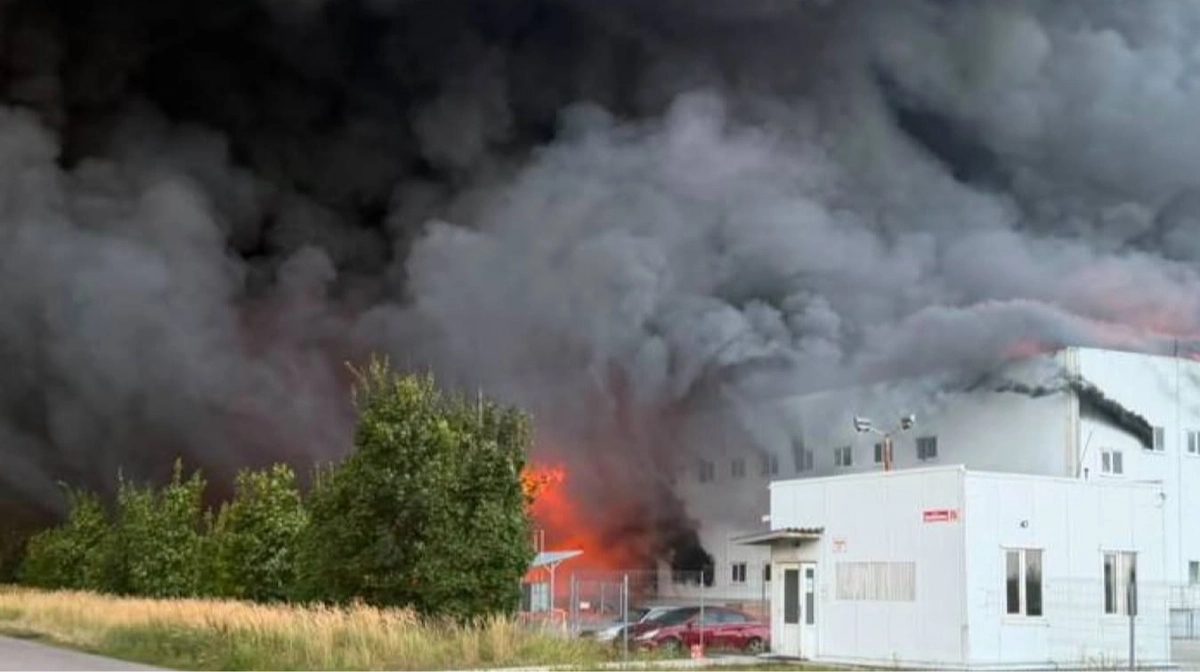
"Ninety per cent have been destroyed," he said, adding that this does not mean Ukrainians will go without food and that there is no threat of famine. The qualifier matters, and honest analysis should keep it in view: the destruction of warehousing degrades the range and reliability of retail supply, forces a shift toward a costly just-in-time system, and pushes businesses to relocate, but it has not produced a food crisis.
Russia's Defense Ministry frames these strikes as attacks on military-linked logistics rather than on civilian food supply, and Ukrainian officials describe civilian retail damage; both framings can capture parts of the same target set, and the reader should treat each ministry's characterization as an interested one.
The consumer effect is real and new.
For the first time since the early months of the 2022 invasion, shelves in Kyiv supermarkets began to empty in mid-August.
After the August 5 strikes, everyday goods such as vegetables, dairy, meat, eggs, sugar, cereals, and pasta went scarce or vanished in stores run by Silpo, Novus, and Fora, and the disruption was worsened by shoppers buying more than usual out of fear that supply would deteriorate further (Source: Kyiv Independent).
Chains taped notices to bare shelves apologizing for delivery delays caused by strikes on their logistics, and some outlets introduced informal purchase limits. The mechanism is specific: with cold storage and distribution capacity destroyed, retailers fall back on direct-to-store delivery, which is more expensive and more easily disrupted.
The campaign is granular and relentless.
On the night of August 4 to 5, Russian strikes destroyed a Nova Poshta sorting center, Ukraine's largest private parcel carrier, along with major facilities of Epicentr, the country's largest home-improvement retailer, and damaged sites belonging to the grocery groups Novus and Fozzy.
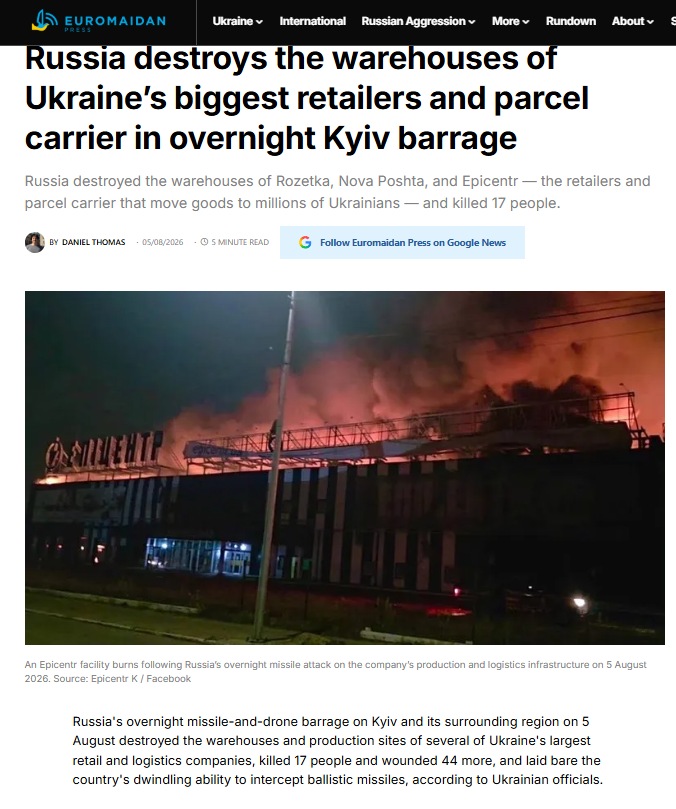
Epicentr lost two warehouse complexes and much of its ceramic-tile production. That August 5 barrage killed at least seventeen people across the broader attack, according to President Zelensky.
For the rest of the month, the pattern repeated at grocery-chain distribution centers serving Silpo, Fora, Novus, and Varus, with several facilities hit within days of opening at their relocated sites.
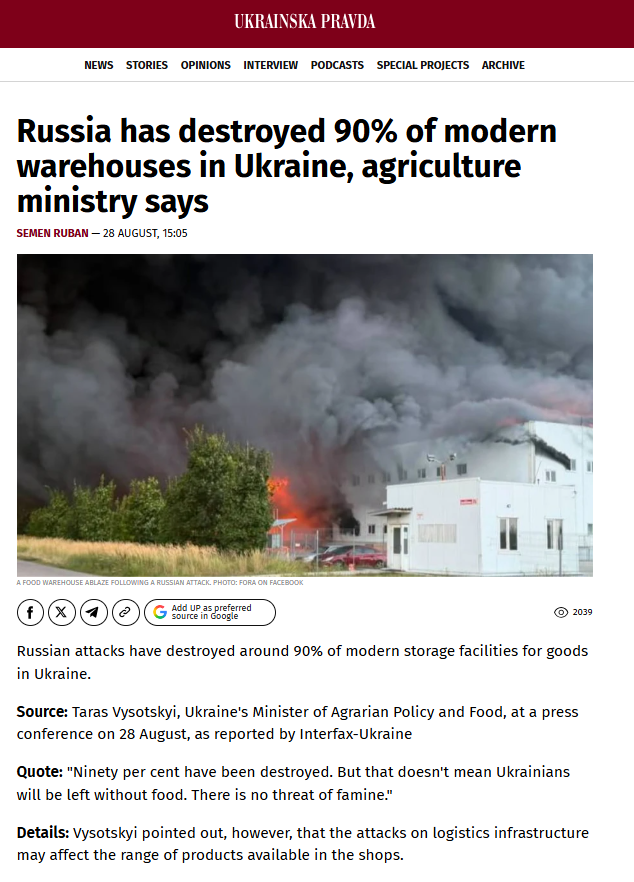
On August 27 a Kolo warehouse and a Fora warehouse in Kyiv Oblast were damaged, the Fora site having been in use for only four days. The relocation-and-restrike pattern is the signature of a deliberate campaign to make Ukrainian logistics economically unsustainable rather than a series of stray hits. By late August the campaign had widened from distribution centers to the retail formats themselves. Russia struck a shopping center in Kharkiv on August 28, and Epicentr, having already lost warehouse complexes and tile production earlier in the month, saw its stores directly hit, part of a stated Russian focus on destroying the largest stores, hubs, and factories outright (Source: Euromaidan Press).
Reciprocal?
Two features of this phase deserve emphasis.
First, it is reciprocal. Ukraine has been running its own version of the same strategy against Russia's economic rear, and doing it with growing reach. Kyiv has targeted key nodes of Russia's energy industry and, increasingly, its online-commerce infrastructure. In late August, Ukrainian strikes forced the temporary closure of a logistics complex run by the Russian online retailer Ozon in Ufa, part of a campaign against e-commerce giants including Wildberries that Ukraine describes as infrastructure underpinning Russia's war effort.
"Overnight, Russia carried out a massive strike against Ukraine, targeting ports, grain storage, energy, industry and other infrastructure with ballistic and hypersonic missiles and combat drones," Foreign Minister Andrii Sybiha said on X. The Ukrainian military said it had shot down seven ballistic missiles, an improved strike rate after Ukrainian President Volodymyr Zelenskyy said this week that Kyiv had received a small batch of U.S.-made Patriot interceptors. The weapons are capable of downing fast-moving ballistic missiles, which are difficult to intercept, but their short supply has left Ukraine increasingly vulnerable to Russia's mounting air war. (Source: Russia hammers Ukrainian ports, warehouses and industrial sites with missiles and drones / CBC
Russia's Defense Ministry, on the same nights, claimed strikes on steelworks in Kryvyi Rih and Zaporizhzhia, an oil refinery in Poltava, logistics centers around Kyiv, and three ports in the Odesa region. Each side is trying to break the other's capacity to move goods, generate revenue, and sustain the war economy. This is attrition relocated from the trench to the distribution center.
Two questions sit underneath the logistics war: who opened it, and who is losing it.
On the first, each capital tells the opposite story, and the honest answer is that economic targeting predates this August on both ledgers.
Ukraine has struck Russian oil refineries and energy nodes for years, and turned to Russian e-commerce and parcel logistics more recently.
Russia has hit Ukrainian energy and infrastructure throughout the war, and turned the full weight of its missile and drone force onto Ukrainian retail and warehousing from August 5.
Moscow's framing is that Kyiv escalated first into civilian commercial infrastructure and that Russia is answering in kind, a line Putin himself pushed when he accused Kyiv of striking Russia's economy and vowed to hit Ukraine's most sensitive economic sectors in return. Kyiv's framing is that Russia has bombarded Ukrainian civilians since the first month of the invasion and that the warehouse campaign is one more chapter of that. Each framing selects the starting point that works for the teller, which is the ordinary condition of a reciprocal war, and a reader should resist awarding a clean first-mover verdict to either side.
The second question, who is losing the logistics war, has a clearer answer, and it runs against Ukraine. The exchange is radically asymmetric in scale and in effect. Russia commands a far larger missile and drone inventory, a mobilized defense-industrial base, and a target set; Ukraine's concentrated retail and logistics network is far easier to wreck than Russia's vast and redundant one. The outcome is the ninety-percent figure on the Ukrainian side set against damage to a handful of Ozon and Wildberries sites on the Russian side. Both sides can strike the other's rear. The difference is that Russia absorbs the blows within a continental economy while Ukraine buckles under them, which is the sense in which the war of the rear favors the larger power.
That asymmetry feeds a harder critique, and it is worth stating in full because it captures a real strain in how the war looks from outside the Western consensus.
The critique holds that Ukraine has been drawn into a war of attrition it cannot win, on a battlefield where its adversary is larger and deeper, and that its Western backers supply enough to keep Ukraine fighting without supplying enough to let it prevail, so that the human and economic cost falls on Ukrainians while the strategic prize, a Russia bled and contained, accrues to the West.
In its sharpest form the charge is that NATO is fighting to the last Ukrainian.
The August logistics collapse hands the argument fresh material. Ukraine opened a front, economic strikes on the enemy's rear, on which it was always going to be outweighed, and the civilian consequences are now landing on Ukrainian shelves while the Patriot interceptors that might blunt the Russian air campaign sit undelivered or diverted to the Gulf.
The munitions and money documented above are the mechanism: the same depletion that emboldens Moscow also starves Kyiv of the air defense it would need to protect the very logistics Russia is destroying.
Well, there is a counter-argument: Ukraine did not wander into this war; it was invaded, and its strikes on Russian logistics are the acts of a state raising the cost of an occupation it did not choose.
The last-Ukrainian line, however sharp, treats Ukrainians as instruments of Western strategy rather than as a people defending their own sovereignty, which is how they overwhelmingly describe the war themselves.
And the Western failure the argument above identifies, arming Ukraine to survive without arming it to win, is at least as consistent with incompetence, domestic politics, and the documented munitions shortage as with a deliberate design to expend Ukrainians.
There is some truth to both the above arguments.
The asymmetry is real and the cost to Ukraine is severe and climbing, and Ukrainians remain the authors of their own resistance rather than the instruments of someone else's plan.
Where a reader settles between those poles is a question of political judgment, and Drishtikone's readers will settle in different places. We are sharing both these plausible arguments in their strongest version.
Kaliningrad: the exclave at the center
If there is a single piece of geography where the NATO-Russia standoff could turn kinetic, it is Kaliningrad. The exclave sits between Poland and Lithuania, surrounded entirely by NATO members, physically separating the two allies along the Baltic coast. It anchors the bulk of Russia's Baltic Fleet aviation, and it packs a dense concentration of missile, naval, and air-defense forces, including Iskander missiles and coastal-defense systems, into a small, isolated territory.
Its isolation is the point. Kaliningrad is at once one of Russia's most heavily defended positions and one of its most exposed, because it can be cut off from the Russian mainland by the Suwalki corridor, the narrow strip of Polish-Lithuanian border that NATO would have to hold and Russia would want to sever in any conflict.
Two things happened around Kaliningrad in August 2026 that fed a rising sense of danger, and they should be separated carefully, because one is a military fact and the other is an information operation built on top of it.
The military fact is a pair of Russian exercises.
On August 26, Russia's Baltic Fleet conducted tactical air-defense drills near Kaliningrad, rehearsing how fleet units would repel a simulated enemy air raid on the Baltiysk naval base, using Su-30 fighters, Mi-24 helicopters, and drones as the mock attacking force and practicing detection, classification, and simulated destruction with anti-aircraft missiles and artillery.
Around the same period, Russia deployed ten Su-30SM2 fighters of the Fourth Guards regiment out of Chernyakhovsk air base for live-fire strike drills, practicing day and night precision strikes against mock command posts, fortifications, troop concentrations, and armored vehicles, and rehearsing operations inside contested air-defense environments.
These drills were real, and they were provocative in the ordinary sense that any large exercise near a contested border is provocative. They followed a large NATO air exercise on August 18 that brought roughly twenty-five allied aircraft together over Poland and the wider Baltic, including U.S., Polish, and Lithuanian aircraft, AH-64 Apache helicopters, an E-3 Sentry providing airborne early warning, and an EA-37B Compass Call electronic-warfare aircraft operating near the Baltic approaches. Each side is signaling readiness to the other in the same crowded airspace. That is the baseline of NATO-Russia relations along the eastern flank, and it has been for years.
The information operation is the framing that Russia has "uncovered NATO's plan to invade Kaliningrad."
This claim circulated widely in late August, amplified through Russian-aligned media and social channels, and it deserves to be traced to its source rather than taken at face value. The kernel of truth is real: in July 2025, General Christopher Donahue, then commanding U.S. Army Europe and Africa, publicly stated that NATO had the capability to neutralize Kaliningrad in a conflict and had already developed a corresponding plan.
 John Pike
Russian presidential aide Nikolai Patrushev responded that any military encroachment on Kaliningrad would be met with an immediate response using all available forces and means, invoking Russia's nuclear-deterrence doctrine.
So NATO does have contingency planning for Kaliningrad, as any serious military alliance would for the most heavily armed adversary position on its border, and it has said so publicly.
That is ordinary defense planning, and a plan to neutralize a threatening exclave in the event of war is categorically different from a plan to invade in peacetime.
So the important question is - are NATO's actions near Kaliningrad really an imminent threat to Russia? Or is it a perception in the Kremlin shared as an alarm?
The buildup itself is documented. A joint investigation by Scandinavian and Baltic media in June 2026 found that Russia is constructing infrastructure capable of accommodating up to 115,000 troops near the borders of Norway, Finland, the Baltic states, and in Kaliningrad.
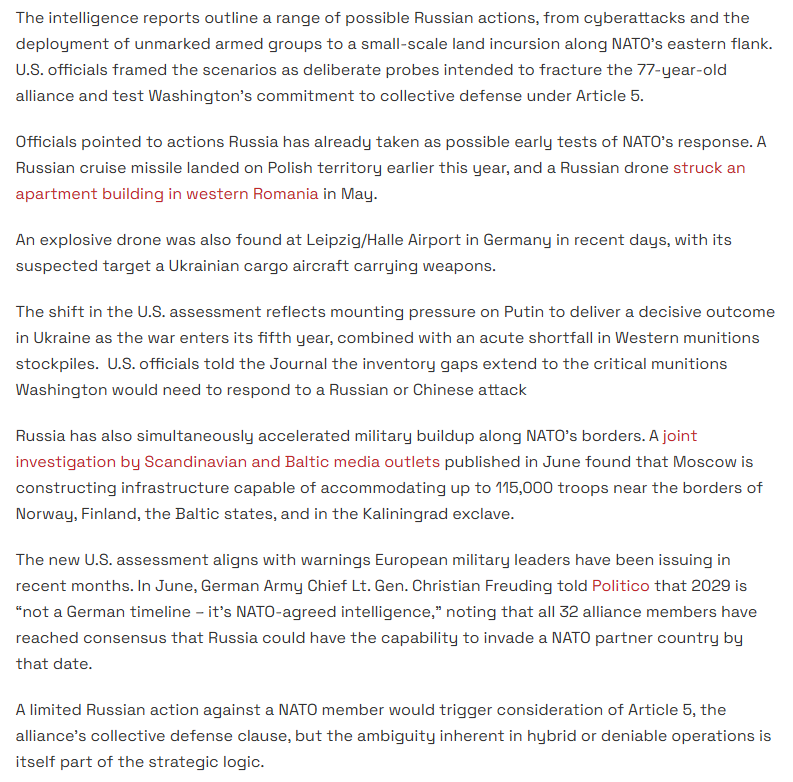
That is the material fact underneath the exercises. Russia is building the capacity for a much larger forward presence on NATO's flank, and the Kaliningrad drills are one visible expression of a longer-term repositioning. The exclave is where geography, forces, and information converge, which is why it is the most likely flashpoint and the most useful barometer of Russian intent.
The NATO test: the sub-Article 5 problem
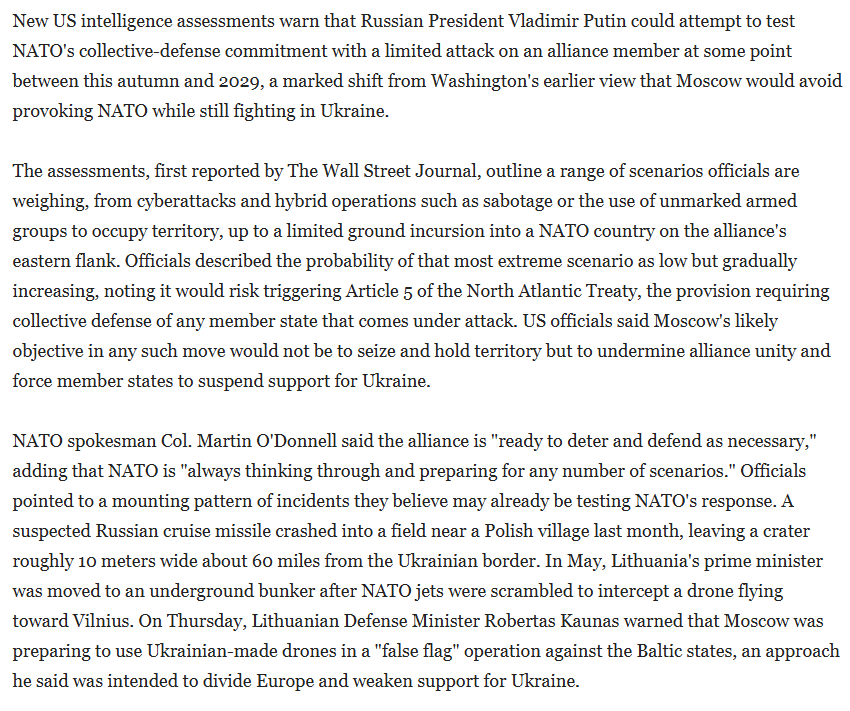
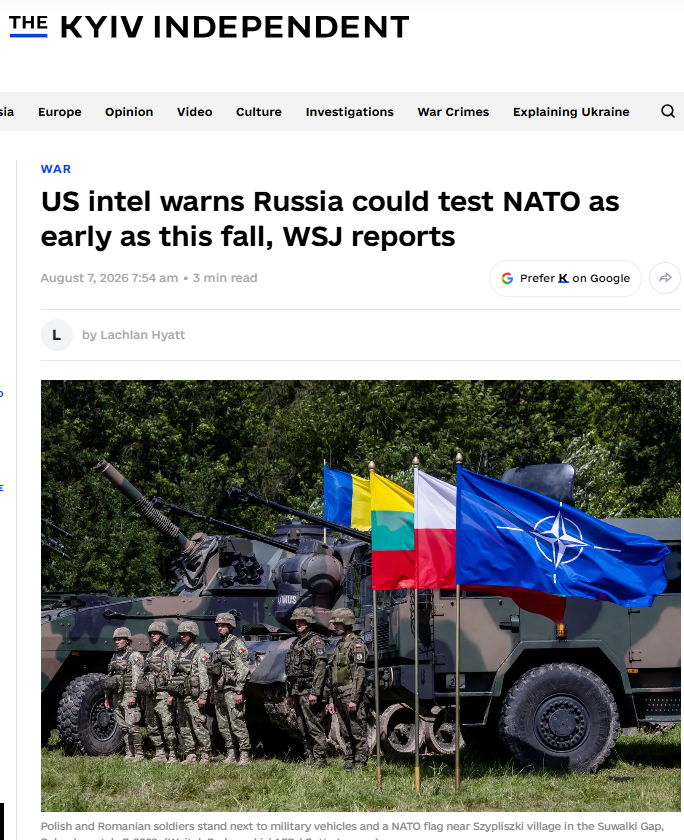
The Ratcliffe warning, the depletion assessment, and the Kaliningrad activity all point at the same scenario, and it is worth stating precisely because it is the scenario Western intelligence now treats as the central risk. On August 6, the Wall Street Journal reported, citing new U.S. intelligence assessments, that Putin could try to test NATO's collective-defense resolve with a limited attack on an allied country at some point between the fall of 2026 and 2029 (Sources: Kyiv Independent; CNN; Fox News).
The assessment marks a shift. Until early 2026, Washington judged that Moscow would avoid provoking NATO while the war in Ukraine continued. It revised that view as battlefield pressure on the Kremlin mounted and, per the later reporting, as Russia came to see the United States as depleted by Iran.
The scenarios the intelligence outlines are deliberately below the threshold of obvious armed attack. They range from a large-scale cyberattack, through covert sabotage and actions by unmarked armed groups, to the seizure of a small area of NATO territory or a limited land incursion on the eastern flank. A land incursion is assessed as the least likely of these, but officials believe the danger rises over time as Moscow rebuilds and adapts from the Ukraine war.
The most immediate danger zone is NATO’s northeastern flank: Estonia, Latvia and Lithuania were the allies reportedly singled out in Washington’s warning to Moscow. Separate reporting on the U.S. assessment said Russia could test NATO with a limited incursion or other escalation involving the Baltic states or Poland.
 Rikard Jozwiak and Current Time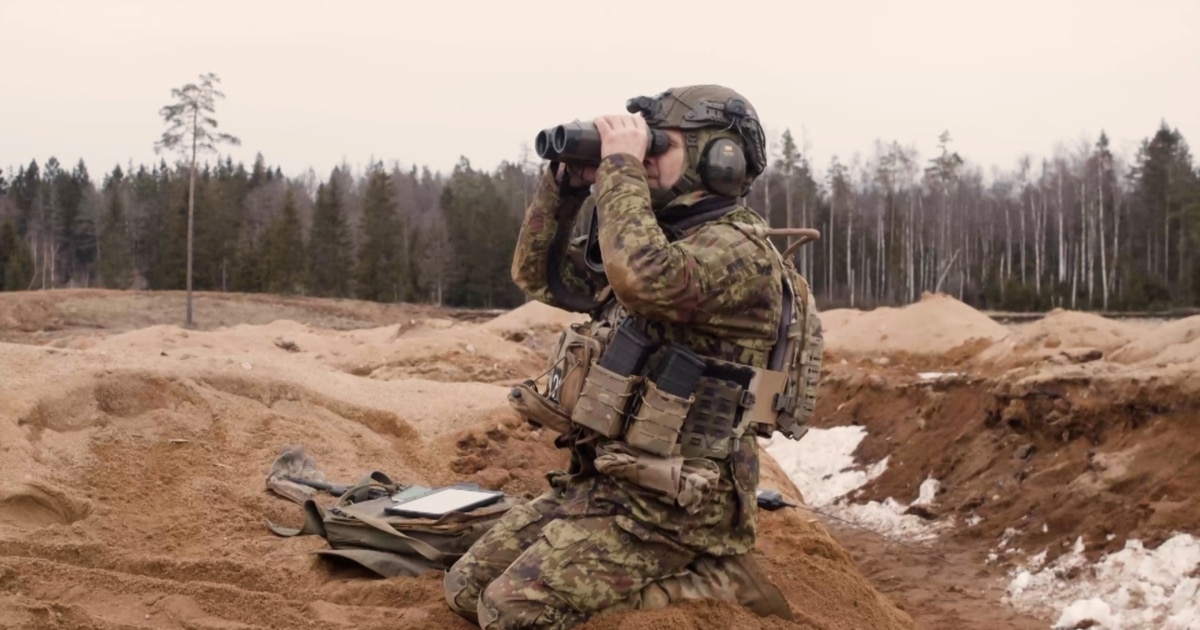
The strategic logic of a sub-Article 5 probe is what makes it dangerous. Article 5 holds that an attack on one member is an attack on all, but it leaves each ally to decide what measures it deems necessary, and it has always been most credible in response to an unambiguous armed assault.
A cyberattack, a sabotage operation, or an incursion by unmarked forces presents NATO with a harder problem, because the alliance must first establish attribution, judge scale, and decide whether the incident crosses the threshold for a collective response. Heather Conley of the American Enterprise Institute put the crux to the Journal: the question is how the United States would respond, and it has always been Russia's goal to challenge NATO's credibility and to separate the United States from its allies.
 Brie Stimson
The recent pattern of gray-zone incidents fills in the texture. As the war drags into its fifth year, Europe has been hit by hybrid attacks widely attributed to Russia.
The clearest August case was an attempted drone strike at Germany's Leipzig/Halle Airport on August 5, where a drone with what was reported to be a Semtex device was found near a Ukrainian-flagged cargo plane, prompting diversions and a bomb-disposal response.
Add Russian cruise missiles falling on Polish territory, drones entering Romania and Moldova, and a Russian warship conducting a live-fire exercise in the English Channel near Plymouth, which the British defense secretary called "performative, irresponsible and designed to provoke" and "the tip of the iceberg."
A specific worry has emerged from Lithuania and other Baltic capitals: that Russia could stage a false-flag operation using Ukrainian-made drones to strike critical infrastructure in the Baltic region, creating an incident with murky attribution that NATO would struggle to answer
Each of these incidents is individually deniable and individually below the threshold of war. Their function is cumulative: to probe how NATO detects, attributes, and responds, and to normalize a level of Russian activity on alliance soil that would have been unthinkable a decade ago.
It is worth registering the counter-view for balance, because the alliance is not monolithic on this. Lithuania's own Defense Ministry said in late June that there were no objective signs Russia was preparing a full-scale military attack on the Baltic states, even as Lithuanian politicians warned about limited probes and false flags
 Alex Stezhensky
The distinction between a full-scale invasion, which few assess as likely, and a limited sub-threshold probe, which the U.S. assessment treats as a real medium-term risk, is the distinction that matters.
Alarmism about Russian tanks rolling into Warsaw obscures the more plausible and more insidious danger: a calibrated incident designed to reveal that the emperor's collective defense has a seam.
Polar Bear and Orcas

On August 29, 2026, during a meeting with teachers and students at Moscow State Pedagogical University, Putin said something very interesting:
A published Kremlin transcript shows that a teacher mentioned seeing polar bears at the North Pole. Putin then introduced the orca story and connected the “food chain” directly to the war. (Source: Kremlin News)
Interestingly, Putin never explicitly identified who was the bear and who was the orca.
Here is what we think Putin meant: The polar bear is Russia; the pod of orcas is the US-led Western coalition. That reading fits Putin’s worldview considerably better than the widespread media interpretation that “Putin compared himself to an orca tearing Ukraine apart.”
Why tell this to children?
Putin was speaking to educators. He was asking them to transmit a particular civic and geopolitical consciousness: Russian children should not grow up assuming that peace, international institutions or good intentions automatically protect a country.
The educational message is approximately:
This moves the justification beyond NATO policy or the Donbas. It makes the war part of a larger existential narrative, something arising from the permanent nature of international life rather than from a particular sequence of negotiable disputes.
The bottomline here is that Putin most probably meant (from his world view):
Russia may look like a formidable polar bear, but the Western alliance can surround, isolate and eventually dismember it; the war in Ukraine is Russia’s attempt to prevent itself from becoming the prey.
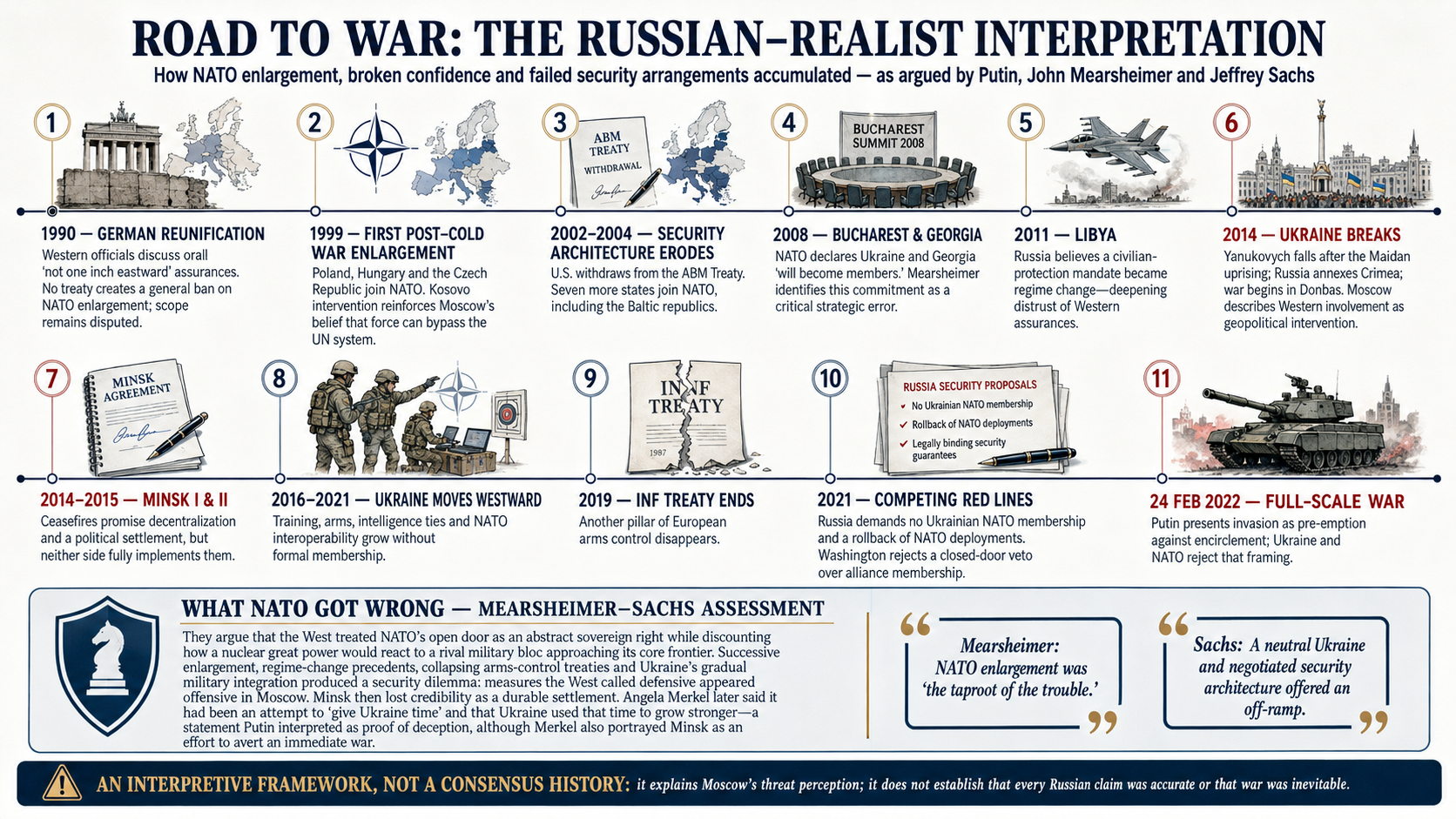
Now, NATO does dispute Putin's claims but credible geopolitical experts such as John Mearsheimer and Jeffrey Sachs have repeatedly suggested that NATO's flawed policies and untrustworthy approach led Putin to attach Ukraine.
We have mapped the war timeline as follows.
The Russian home front: mobilization as signal
There is a domestic dimension to the Russian wager that the exercises and warehouse strikes can obscure, and it surfaced in the same window.
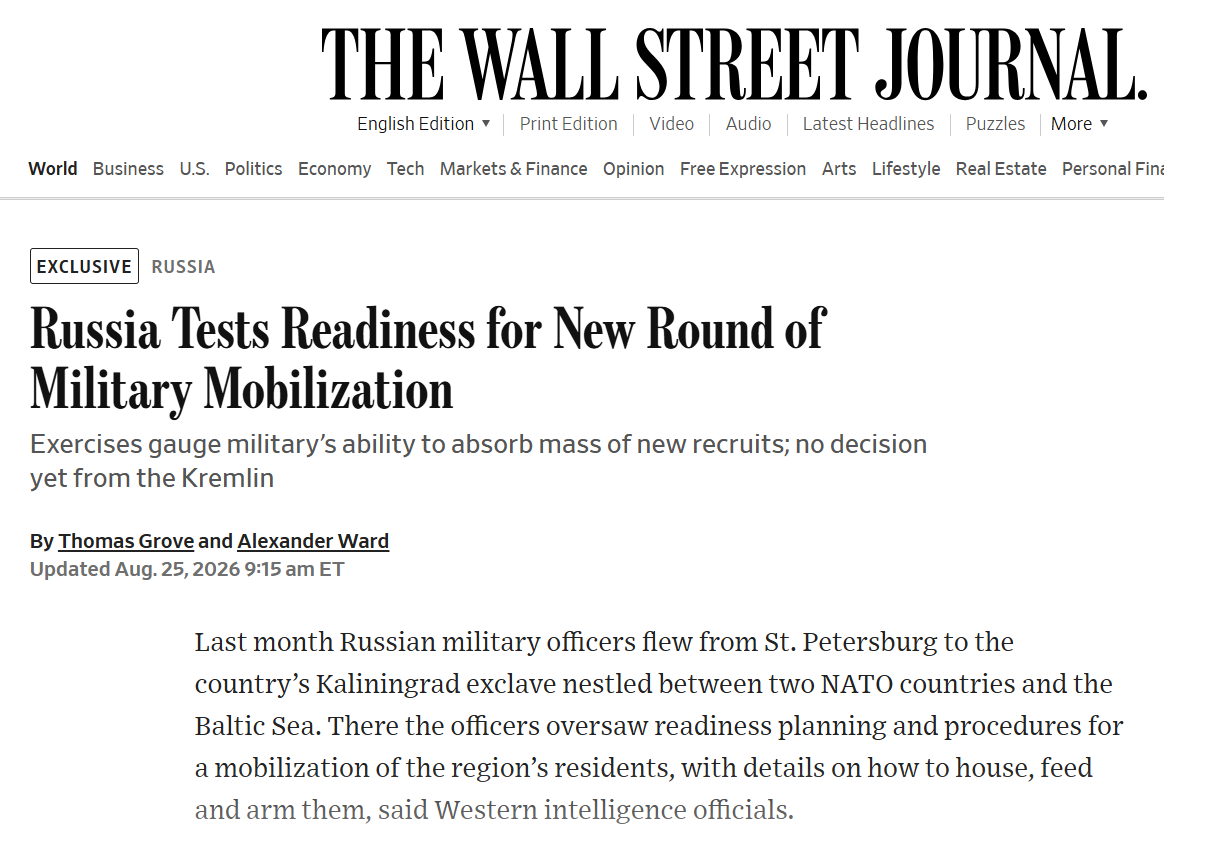
On August 25, the Wall Street Journal reported that Russia is testing its readiness for a new round of military mobilization, running exercises to gauge the military's ability to absorb a mass of new recruits, with no decision yet taken by the Kremlin (Thomas Grove and Alexander Ward, "Russia Tests Readiness for New Round of Military Mobilization," WSJ, Aug 25).
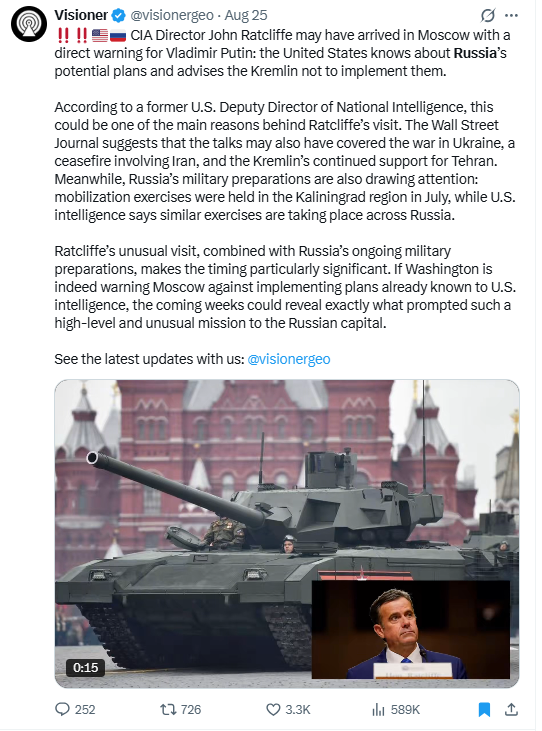
The Visioner summary of the same period noted that mobilization-readiness exercises were held in the Kaliningrad region in July, with similar exercises reported across Russia (Visioner, Aug 25).
Visioner also outlined scenarios in which Russia could test NATO's Eastern flank.
BILD identifies several ways Russia might test or fracture NATO’s eastern flank, making the Baltic region a dangerous flashpoint. One scenario involves sabotaging undersea cables, pipelines or infrastructure while obscuring responsibility.
The “Narva trap” envisions armed groups appearing inside Estonia as Moscow denies involvement. Russia might attempt to seize or neutralize Sweden’s Gotland, disrupting NATO reinforcement routes across the Baltic Sea. Farther north, Moscow could exploit the community in Barentsburg to manufacture a crisis around Norway’s Svalbard archipelago. The gravest scenario concerns the Suwałki corridor: Russian forces advancing rapidly from Belarus toward Kaliningrad could sever the Baltic states’ land connection with NATO before reinforcements arrived.
These possibilities are not predictions, but they explain NATO’s investments in surveillance, air defense, military mobility and forward-deployed forces. Russia would not have to defeat NATO; it would need only enough speed, ambiguity and disruption to delay collective action and expose divisions within the Alliance.
🇩🇪🇷🇺🇪🇪🇱🇻🇱🇹⚠️ BILD has outlined several scenarios in which Russia could attempt to test or fracture NATO’s eastern flank, ranging from covert sabotage beneath the Baltic Sea to a rapid military move through the Suwałki corridor. None are presented as inevitable, but together they… pic.twitter.com/CxNL0RY6uS
— Visioner (@visionergeo) August 29, 2026
Mobilization readiness is a signal that points in two directions at once. Toward Ukraine, it says Russia is preparing to sustain and possibly intensify a war of attrition that has already cost, by the Center for Strategic and International Studies estimate cited by CNN, more than 1.4 million young Russians dead, injured, or missing.
Toward NATO, it says Russia is building the manpower base that a larger forward posture on the eastern flank would require, the human complement to the 115,000-troop infrastructure buildup.
The Kremlin has not decided to mobilize, and testing readiness is not the same as deciding, a distinction Russian officials will stress and analysts should respect. But readiness exercises are also how a state keeps a decision available and lets adversaries know it is available.
The manpower question connects back to the depletion argument in a way that is easy to miss.
The American shortfall is in high-end munitions, the precision interceptors and cruise missiles that take years to build. The Russian constraint is different: Russia has munitions and drones in quantity, produced by a war economy now fully mobilized for it, but it is short on trained manpower, having ground down its professional army in three and a half years of attrition. Each side is running low on the thing the other has more of.
The United States has manpower and a global alliance but a depleted precision arsenal split across theaters. Russia has a deep munitions base and a mobilized economy but a manpower deficit and a stalemated front. The war of the coming year will be shaped by which constraint binds harder and how each side works around its own.
The Indian track: Jaishankar in Moscow, Doval in Beijing
Return now to the visitors who bracketed the Ratcliffe trip, because they represent the strategic depth that lets Russia sustain this posture at all. Jaishankar's two days in Moscow were not about the war directly.
The formal business was the 27th India-Russia Inter-Governmental Commission, and the substance was economic: trade, energy security, fertilizer supplies, and the machinery of a partnership that both sides describe as resilient and adaptable.
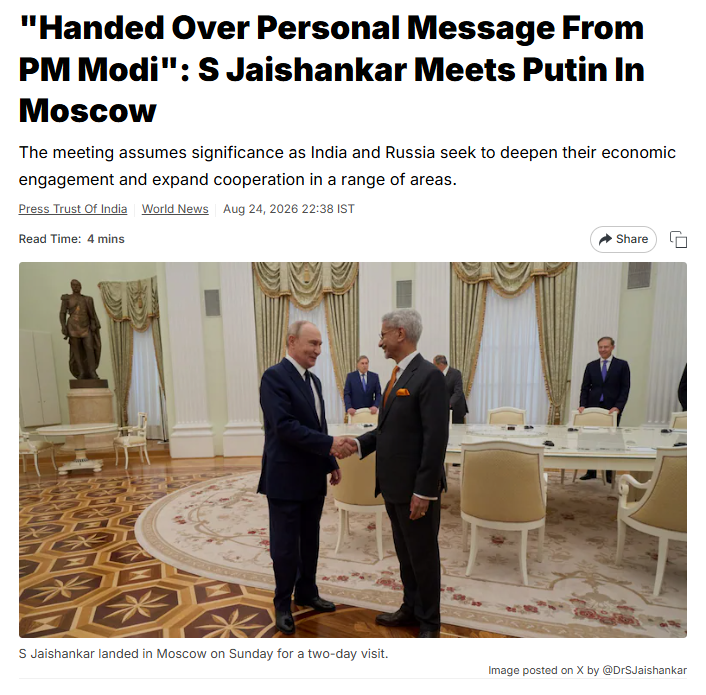
But the economic substance is the strategic substance. India's continued purchase of Russian energy, its resistance to Western pressure to decouple, and its investment in sanctions-resistant transport, logistics, and financial systems are precisely what give Moscow the economic oxygen to keep fighting.
When Jaishankar describes the India-Russia relationship as one of the steadiest of the major postwar relationships, driven by geopolitical convergence, leadership contacts, and popular sentiment, he is describing an insurance policy that Russia holds against Western isolation.
The timing sharpens the point. Jaishankar carried a personal message from Modi to Putin on August 24, one day before Ratcliffe arrived to warn the same Kremlin.
India and the United States are simultaneously courting and pressuring Moscow, and India is on the courting side of that ledger even as it manages its own strained relationship with a Trump administration that has leaned on New Delhi over Russian oil.
The Moscow meetings were also a runway. They set up the Shanghai Cooperation Organization summit in Bishkek on August 31 to September 1, where Modi and Putin were expected to meet on the sidelines, and the BRICS summit in New Delhi on September 12 to 13, where Putin has been invited to India.
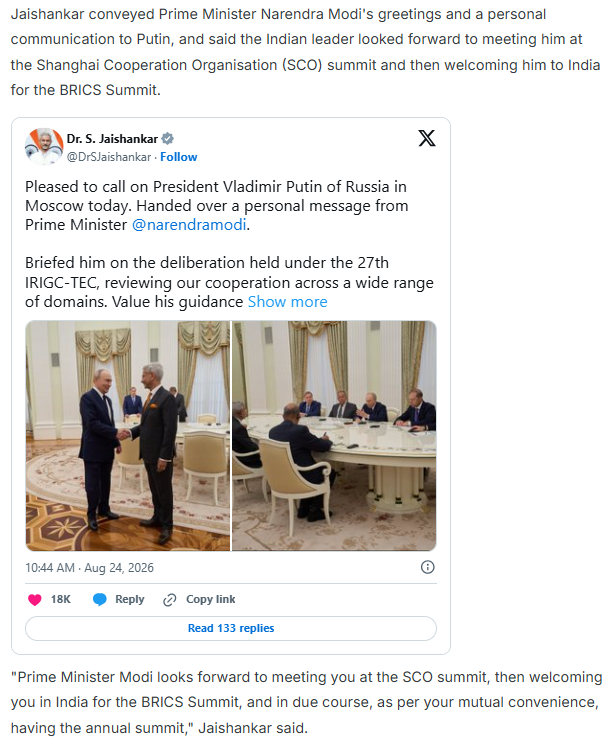
Doval's presence in Beijing on August 25 completes the picture and is arguably the more consequential of the two Indian tracks.
The National Security Adviser held talks with Wang Yi, the Special Representative on the boundary question, and met Vice President Han Zheng, in a meeting both sides described as candid and in-depth, against the backdrop of a visible India-China thaw.
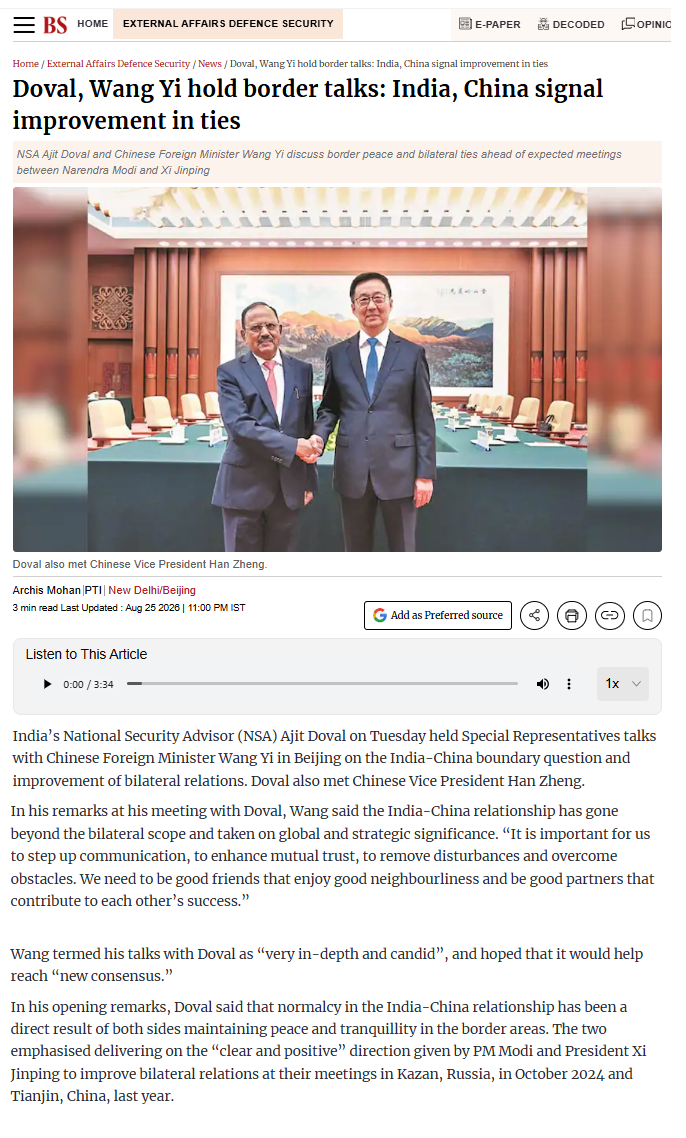
Wang told Doval the relationship had taken on global and strategic significance beyond the bilateral. Modi and Xi were expected to meet at least twice in the following three weeks, at the SCO summit and potentially at BRICS.
The Bishkek summit's guest list, Putin, Iran's Pezeshkian, the Central Asian leaders, alongside the India-China principals, is a portrait of the Eurasian bloc that Western pressure is inadvertently consolidating.
Here is the strategic reading.
India and China are stabilizing their border and normalizing ties. India and Russia are deepening economic integration. Russia and China are locked in a partnership Western sanctions have only tightened.
The SCO and BRICS calendars give this bloc regular occasions to coordinate. None of this makes a formal alliance, and India in particular is practicing multi-alignment rather than picking Moscow and Beijing over Washington.
But the direction of travel matters.
The Iran war and the pressure campaign on Russia are pushing the Eurasian powers toward each other at the same moment that American matériel is stretched thin across theaters.
The depletion that emboldens Russia and the consolidation that gives Russia depth are two faces of the same shift in the balance, and India sits at the hinge, engaged with every side and committed to none.
For India, the calculus is coherent even if it is uncomfortable for Washington.
New Delhi buys Russian energy because it is cheap and available, stabilizes the China border because a two-front confrontation serves no Indian interest, and keeps its lines to Washington open because the American relationship anchors its technology and defense diversification.
The critics of this posture argue that multi-alignment is a polite name for free-riding, that India benefits from the American security order while declining to defend it, and that its Russian energy purchases prolong the war in Ukraine.
The defenders answer that a rising power with a per-capita income a fraction of the West's owes its first duty to its own development and strategic autonomy, and that the alternative, subordinating Indian interests to a Western agenda that has shown itself unreliable under Trump, would be strategic malpractice.
Both positions have force, and India's conduct in the last week of August, courting Moscow and Beijing while managing Washington, is the multi-alignment doctrine in its purest operational form.
The Vatican track: the channel that stays open
Gallagher's four days in Moscow belong to a different register, and they are easy to dismiss as ceremonial.
They should not be.
The Holy See's diplomatic tradition rests on active neutrality and a refusal to break contact with any party to a conflict, and Gallagher's visit was the first by a senior papal diplomat to Russia since November 2021, before the full-scale invasion.
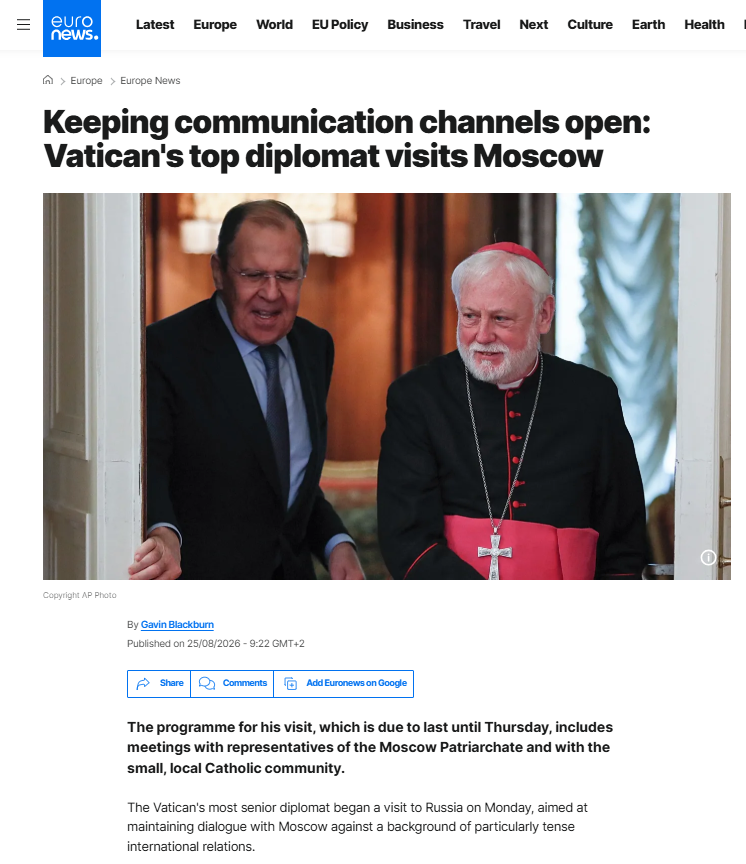
His meeting with Lavrov on August 25 was the first in-person talks between Vatican and Russian officials in five years. He met Putin's foreign-policy aide Yuri Ushakov on August 26 and the Moscow Patriarchate's external-relations head, Metropolitan Anthony of Volokolamsk, and he celebrated Mass for Russia's small Catholic community.
 Vatican News
Gallagher's message was blunt within its diplomatic register. Standing next to Lavrov, he said that every day the war continues "creates new victims and renders future reconciliation ever more difficult," that it is "urgent and necessary to end and to look beyond the conflict," and, crucially, that the war cannot be resolved through military means (Detroit News / Reuters; Crux).
 Crux Now Staff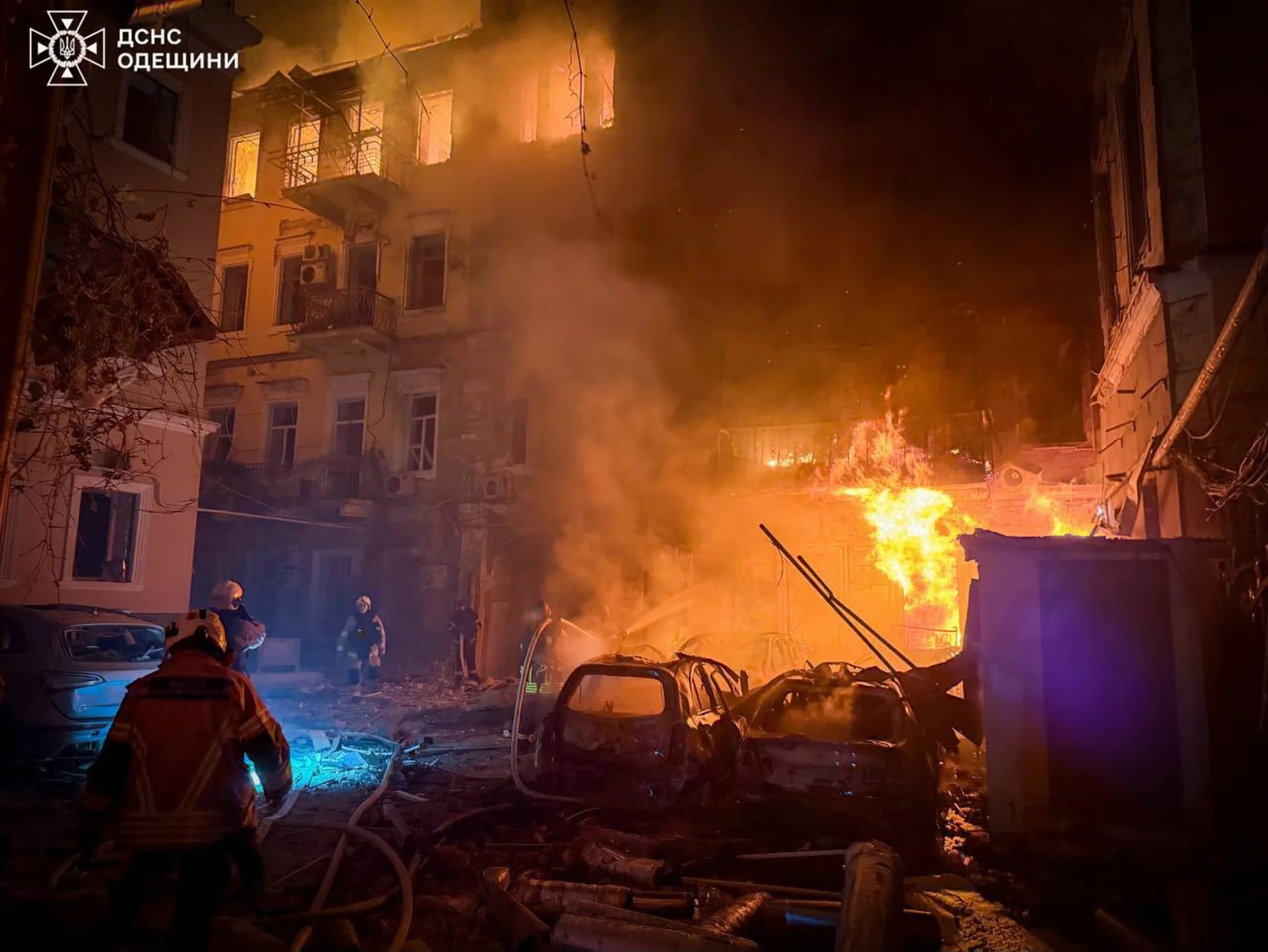
He acknowledged "substantial differences" between Moscow and the Holy See and framed the Vatican's role as offering a space for dialogue and humanitarian cooperation, including on prisoner exchanges and the repatriation of Ukrainian children. Pope Leo XIV has repeatedly called for an end to the conflict.
The value of the Vatican track is not that it will produce a settlement.
It will not, and the timing shows why: the war intensified during Gallagher's stay, with the heaviest warehouse strikes and the Myla ammunition blast falling in the same days he was urging peace.
The value is that it keeps a channel open whose only function is to end the killing. When the intelligence chiefs are trading warnings and the foreign ministers are managing economic partnerships, someone has to be in the room whose only agenda is the humanitarian one and whose only leverage is moral.
The Vatican fills that seat. Its presence in the same week as Ratcliffe and Jaishankar is a reminder that the war is being worked on multiple tracks at once, the coercive, the transactional, and the humanitarian, and that the humanitarian track, for all its impotence, is the one that will still be there when the others exhaust themselves.
Single Strategic System
We have now come to a core insight. Perhaps the right note on which to close.
The Eurasian powers, pushed together by the pressure campaign, give Russia the economic depth to sustain a two-front posture. And the two leaders at the center, each cornered by a war of his own making, each face the same choice between an escalation they cannot win and a withdrawal they cannot survive politically.
The week Moscow filled up was a snapshot of a system under strain, with every major actor trying to manage a piece of it and none able to control the whole.
The near-term test is specific and worth watching for.
It is whether Russia converts its perception of American depletion into a limited probe on NATO's eastern flank, most plausibly a sub-Article 5 incident in the Baltics or Poland, and whether the false-flag scenario the Baltic states fear materializes.
Ratcliffe went to Moscow to make that probe more expensive. Whether he succeeded will not be known from any statement out of Moscow or Washington.