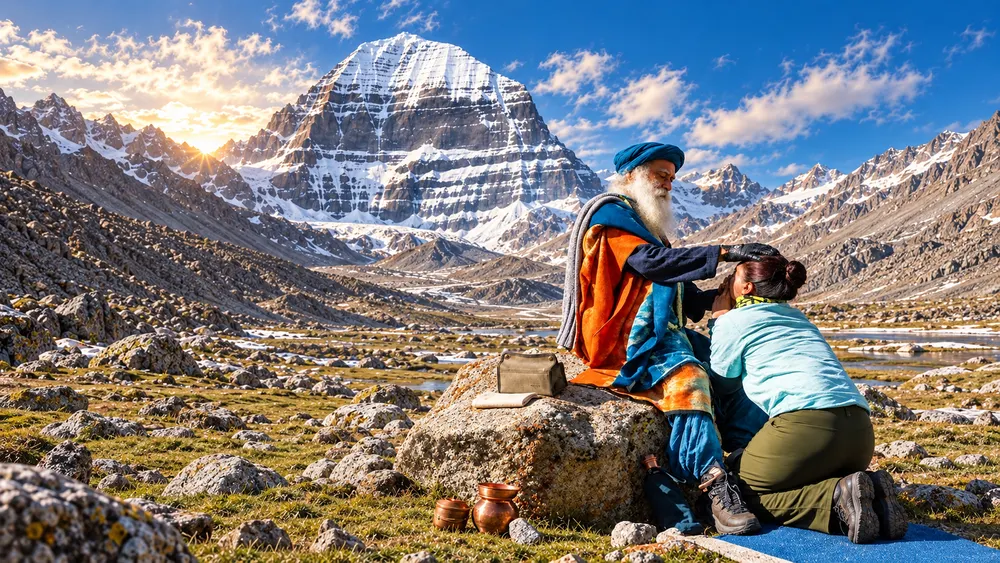
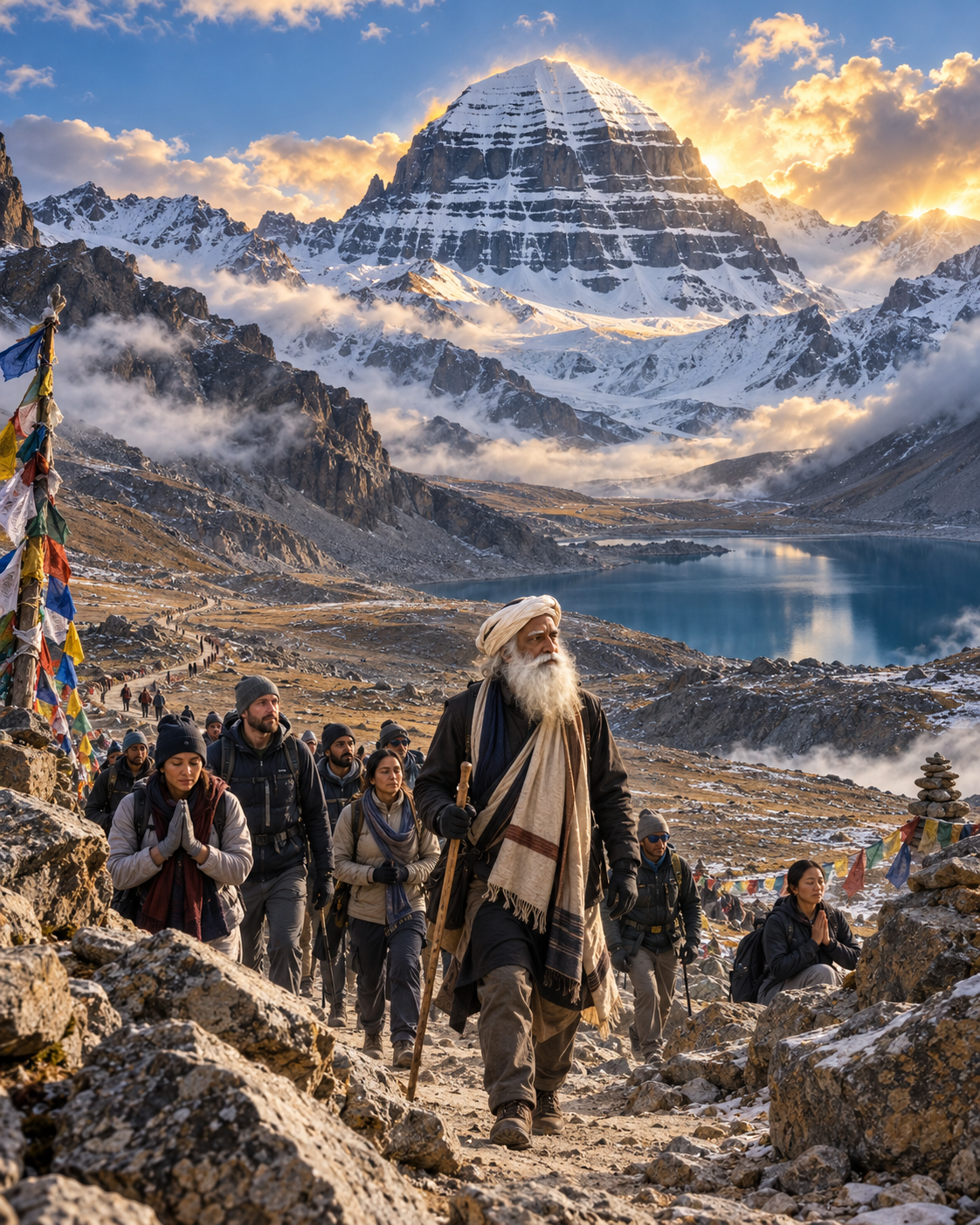
There is a familiar ritual in public discussion whenever a Hindu spiritual organization undertakes something visible, ambitious, and expensive: someone circulates a number, strips it of its context, and declares the moral case closed.
“Look at the price.”
That is often the entire argument.
No attempt is made to ask what the program contains. No curiosity is shown about the route, the permits, the terrain, the medical risk, the staffing, the vehicles, the lodging, the kitchens, the supplies, the emergency systems, the cross-border bureaucracy, or the number of people whose labor makes such a journey possible. Above all, no distinction is made between a cheap tourism package and a high-altitude, cross-border pilgrimage conducted with medical responsibility and a spiritual purpose.
The number is made to do all the work.
This is now being done in partnership with the Isha Foundation and Sadhguru’s Kailash Yatra.
The criticism begins with a fee, often $5,500 for a single type of journey, and then proceeds as if that figure alone reveals fraud, indulgence, spiritual hypocrisy, or exploitation. But a price without a denominator is not analysis. It is insinuation.
A serious question is not: “How can a pilgrimage cost $5,500?”
The serious questions are:
- What precisely does the fee cover?
- What would the trip cost if arranged responsibly from scratch?
- What medical and logistical protections are built into the program?
- What is the quality and scarcity of the services in question?
- What is optional, what is included, and what is excluded?
- What happens to any surplus after direct costs, reserves, refunds, administration, and long-term organizational commitments are accounted for?
- Is the institution transparent enough for participants and donors to make an informed choice?
Those are legitimate questions. They ought to be asked of Isha, of every spiritual organization, of every church, mosque, temple trust, monastery, charity, NGO, university, political foundation, corporate retreat organizer, and commercial tour company.
But ridicule is not accountability. A screenshot is not an audit. And a pilgrimage to Kailash is not a weekend bus ride to a nearby temple.
The rhetorical shortcut
There has long been a peculiar asymmetry in how Hindu institutions are discussed.
When a Hindu teacher, temple institution, or spiritual organization receives money, critics often treat the receipt of money as the scandal.
The number is made to seem self-explanatory. It becomes a substitute for understanding the work, the scale, the voluntary nature of participation, and the delivery costs.
This habit was visible in public discourse around Sathya Sai Baba. Critics repeatedly invoked donations and wealth, as though the mere existence of devotees' contributions were itself proof of wrongdoing. What was often missing from the conversation was a proportionate account of the infrastructure that the associated institutions built and operated: drinking-water projects, educational institutions, hospitals, and other public-welfare initiatives.
 Desh
Desh
The Sri Sathya Sai Central Trust itself describes its mandate as providing relief to the poor through education, health, and wider public utility without discrimination. Its documented water work includes large projects in drought-prone Andhra Pradesh, and the United Nations’ Sustainable Development Goals partnership database says the Trust’s drinking-water projects served a total population of 3.19 million, including expansion to 320 villages in Medak and Mahabubnagar.
The Chennai water project is not a vague claim or devotional folklore. The Trust states that its project, begun in July 2002, involved renovating the Kandaleru–Poondi canal and enlarging Kandaleru reservoir capacity from 16 TMC to 68 TMC. The stated purpose was to strengthen water supply to Chennai and help irrigate approximately 300,000 acres in Nellore and Chittoor. Earlier, water work in Andhra Pradesh was reported by a Sathya Sai-affiliated source to cost more than $63 million and cover around 750 villages, serving approximately 900,000 people.
 Desh Kapoor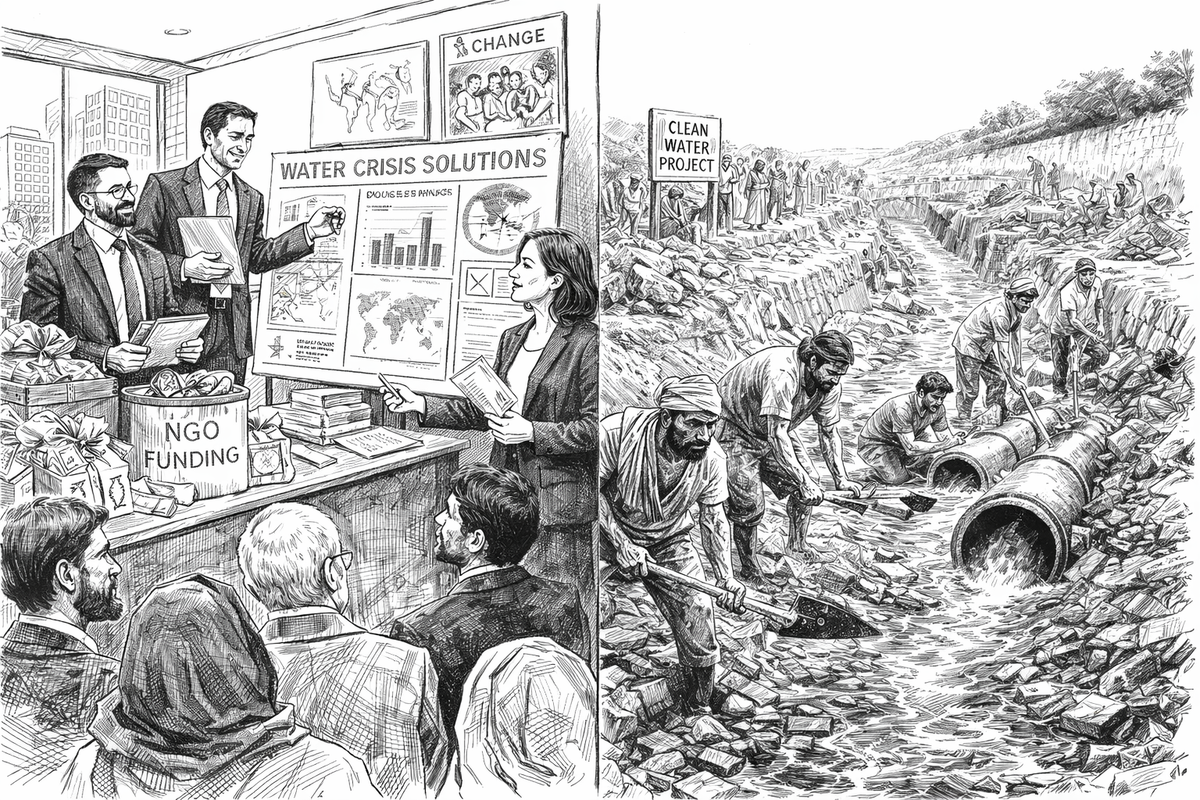
One may debate any religious figure. One may scrutinize governance, finance, ideology, and claims of spiritual authority. But if one invokes money, intellectual honesty requires discussing the entire ledger—not only donations received, but assets created, services delivered, and public goods financed.
The same standard should apply universally.
It is also true that criticism of Mother Teresa and the Missionaries of Charity has existed for decades. Christopher Hitchens’s 1995 book The Missionary Position challenged both Mother Teresa’s public reputation and aspects of the organization’s work; Britannica describes it as a sharp critique that raised questions about effectiveness and ethics. But it would be intellectually lazy to reverse the error and treat a polemical critique as a complete, final accounting of an institution’s work, finances, or legacy.[britannica]
The principle should be simple: no religious organization should receive automatic immunity from scrutiny, and no religious organization should be convicted by insinuation.
Kailash is not ordinary travel
Anyone who has not been to Kailash can be forgiven for underestimating it. Anyone who writes confidently about its cost without first understanding the journey has chosen not to know.
A Kailash–Mansarovar yatra is among the most logistically difficult civilian pilgrimages in Asia. It crosses national borders. It enters Tibet, where travel is not as free as in ordinary tourist cities.
It operates in restricted areas and depends on visas, permits, approved itineraries, local agencies, authorized guides, drivers, border processes, and constantly changing transport conditions.
It also operates at altitude.
Altitude is not a small decorative detail in a brochure. It is the central medical fact of the journey. The route involves travelers moving from Kathmandu into Tibet and then toward Saga, Mansarovar, Darchen, and the Kailash region—areas where the body can become dangerously vulnerable if acclimatization, monitoring, oxygen support, transport, and evacuation decisions are handled casually.
A basic commercial package can appear inexpensive because it minimizes the number of nights, reduces staffing, uses less comprehensive medical support, limits food arrangements, shares sparse accommodation, and places much of the risk-management burden on the traveler. That may be acceptable for some experienced travelers who understand what they are buying. It is not the same as a carefully managed pilgrimage for a large group of people with varied ages, medical histories, fitness levels, and levels of Himalayan experience.
Current commercial packages offer a useful benchmark. Ordinary overland Kailash–Mansarovar packages are often advertised in the broad range of roughly $1,700 to more than $4,000 per person, depending on duration, season, services, accommodation, visa handling, and whether the traveler is part of a group. A current premium-oriented operator lists twin-sharing Kailash journeys at roughly $3,499–$3,999 per traveler.
 Himalayan Glacier Adventure and Travel Company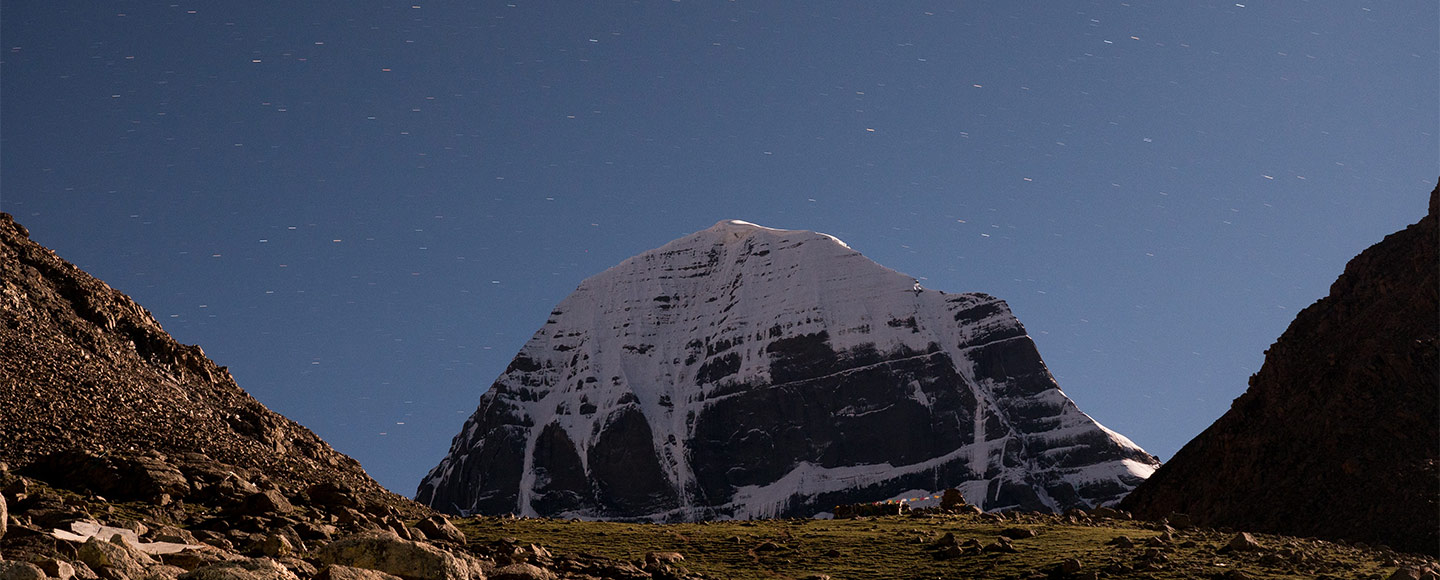
Do go through what the different operators provide and the experience that Isha team offers. My discussion is based on my personal pilgrimage.
 Desh
Desh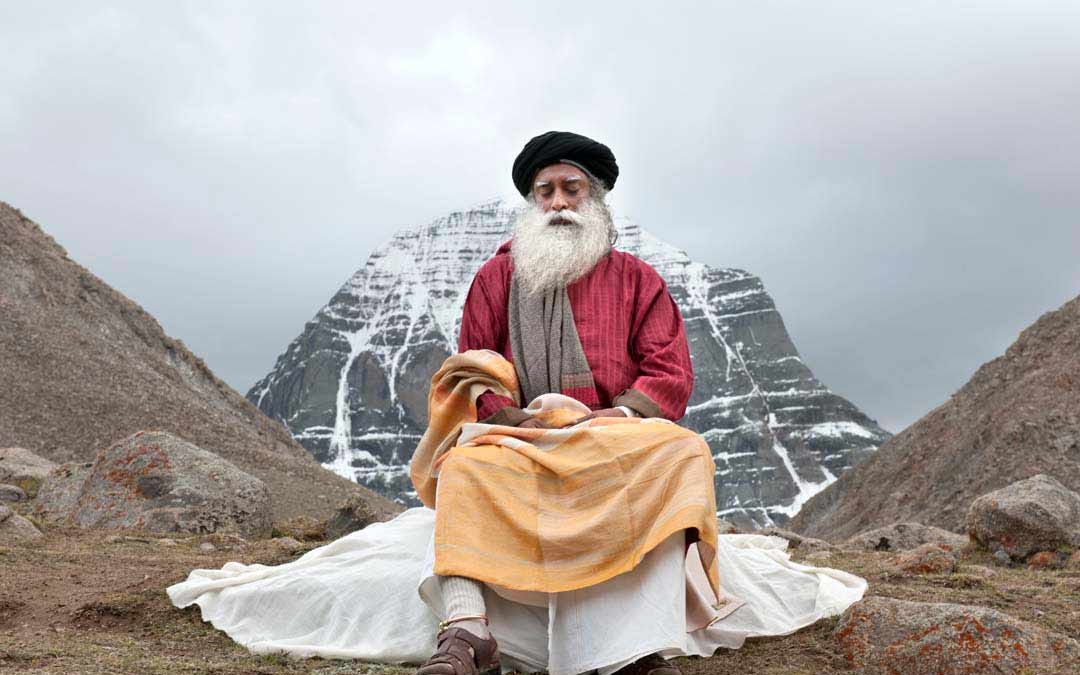
Consider a group of approximately 180–200 pilgrims, broadly comparable to the group I traveled with. Assume a 14-day itinerary through Kathmandu, Zhangmu, Saga, Mansarovar, Kailash, and return. Assume better Kathmandu accommodation, decent hotels where Tibet permits them, group transport, a food truck, fresh vegetarian cooking, medical personnel, oxygen, medicines, support vehicles, guides, permits, and normal administrative reserves.
Before you go through the details, do check out how the journey is undertaken to get a feel of the arrangements.
Now assign real categories of cost.
A leading Kathmandu hotel alone can cost significantly more than budget accommodation. Current estimates for luxury Kathmandu hotels commonly place room rates in the range of $150 to $350 or more per night, depending on the season and negotiated group rates. Even if group contracting reduces the per-room price, the yatra still requires multiple nights, hundreds of room-nights, airport coordination, meetings, baggage handling, local buses, and food.
Then comes cross-border travel.
A group of 180–200 people cannot travel in a single casual van. It requires multiple buses, multiple drivers, support or baggage vehicles, fuel, maintenance, border coordination, parking, staff seats, luggage systems, and local operating partners. In remote Tibetan terrain, one does not simply summon replacement vehicles from an app when something breaks down.
Then come permits and visas.
Kailash travel in Tibet requires an organized framework of visas and permits. The Tibet Travel Permit is required, and travel to restricted regions such as Kailash and Mansarovar also requires additional permissions, including the Alien’s Travel Permit. The paperwork must be prepared accurately and in time. Passport nationality affects visa processing. Group composition affects paperwork. Delays at the border affect hotel nights, meals, staffing, and vehicle schedules. These are not luxuries; they are the price of legal access.
Then comes food.
A standard package may provide basic meals; some may use hotel kitchens; and some may encourage travelers to bring their own snacks and supplements. A traveling fresh-food system is a different operation. It needs cooks, kitchen assistants, procurement, safe water, fuel, food vehicles, storage, utensils, washing systems, contingency supplies, and staff who begin working before most pilgrims wake and continue after most pilgrims sleep.
Then come doctors and oxygen.
A commercial operator may include a medical kit and emergency oxygen. That is useful, but it is not remotely equivalent to a yatra that brings several doctors, repeated health checks, large and portable oxygen capacity, emergency bags, medical tent operations, and the personnel to decide that someone must be removed from risk. Your fee is not only paying for the oxygen you personally consume. It is paying for the whole safety architecture to be present whether you need it or not.
That is how insurance works. That is how responsible group medicine works. That is how expedition safety works.
A participant may say, “I did not need oxygen. Why did I pay for it?”
The obvious answer is: because the group had to be prepared for the person who did.
A participant may say, “I did not see the doctor.”
The answer is: good. The medical team’s value is not measured by the number of people who collapse. It is measured by the system’s readiness to prevent collapse, identify deterioration, and respond before a preventable emergency becomes irreversible.
A participant may say, “I could have traveled more cheaply.”
Of course. One can nearly always travel more cheaply by accepting less support, less comfort, less redundancy, less medical coverage, less food quality, lower accommodation standards, more uncertainty, and more personal responsibility.
But that is not proof that the better-supported option is exploitative. It proves that different products exist.
A realistic cost range
For the kind of journey I experienced, an honest contemporary reconstruction would put direct operating cost in roughly this territory:
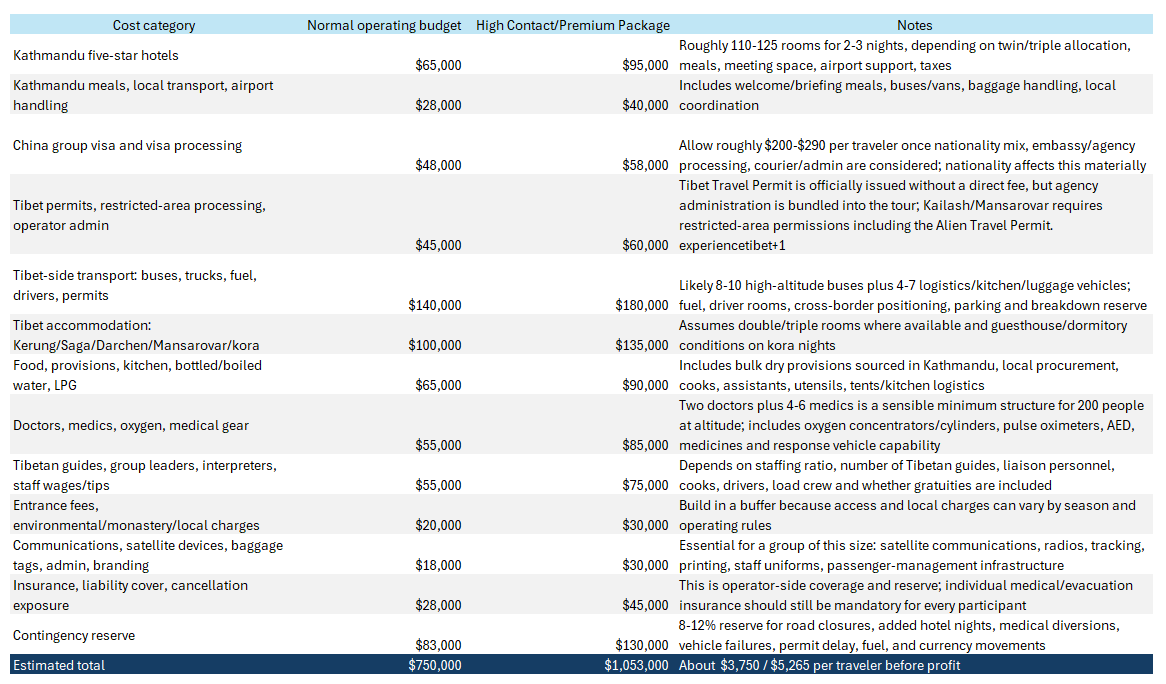
The purpose of this table is not to claim access to Isha’s internal accounts. I do not have them. The purpose is to demonstrate that a $5,500 price is not inherently implausible for a journey with this operational profile.
Indeed, if the operating model includes good Kathmandu lodging, 14 days of travel, fresh catering, a mobile kitchen, doctors, oxygen, medical tents, support trucks, guides, permits, accommodation, event operations, proper staffing, and contingency reserves, $5,500 can be a modest price rather than a scandalous one.
One must also distinguish between the participant fee, direct operating cost, organizational overhead, reserve funds, and surplus. A participant fee is not a transparent window into net profit.
It is simply money collected up front. Some of it may go to suppliers before the trip begins. Some may be committed to visa and permit costs. Some may be used to retain staff, secure vehicles, purchase supplies, fund cancellations, cover the cost of a medical emergency, or absorb the cost of moving someone down from altitude. Some may support wider organizational activity, if that is part of the disclosed model.
What does this show?
That the package that provides for high end stay options, medical facilities, great fresh food throughout the journey can go as high as $5300 per person.
So, does a $5,500 package seem exorbitant?
Those who want to say that $5,500 is exorbitant for a 14-day, cross-border, high-altitude journey with substantial support have no idea of what they are talking about.
Even if one takes the cost structure of a lesser package, one can see that a difference of $1,500 or $2,000 per person disappears very quickly when one adds better Kathmandu lodging, an additional acclimatization day, a mobile kitchen, staff and baggage vehicles, more guides, medical personnel, oxygen, emergency equipment, group-management systems, robust provisioning, contingency arrangements, and the administrative burdens of taking a large group through a tightly regulated region.
That is before one even considers the spiritual-program component of a Sadhguru-led journey.
Because in the end, Kailash yatra with Isha is not just a tourism opportunity, but a pilgrimage with a realized being. And it is grilled into your every day. By the Swamis and the volunteers who make the experience profound with their hard work every moment.
What my Kailash journey involved
Now remember that I do not write this as a theorist of travel pricing. I write as someone who undertook an Isha Kailash journey and saw, day after day, what it takes to move a large group safely through an unforgiving landscape.
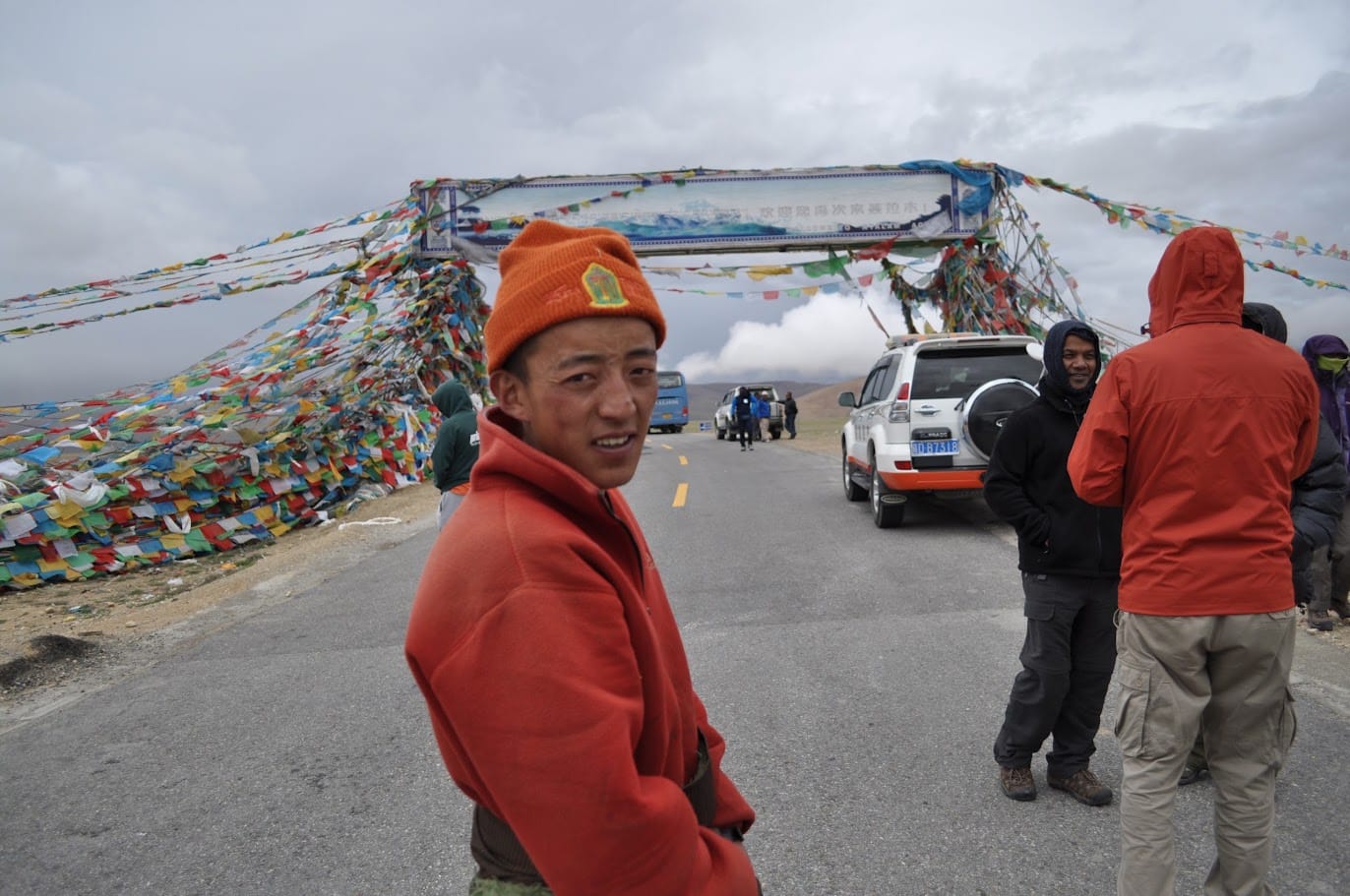
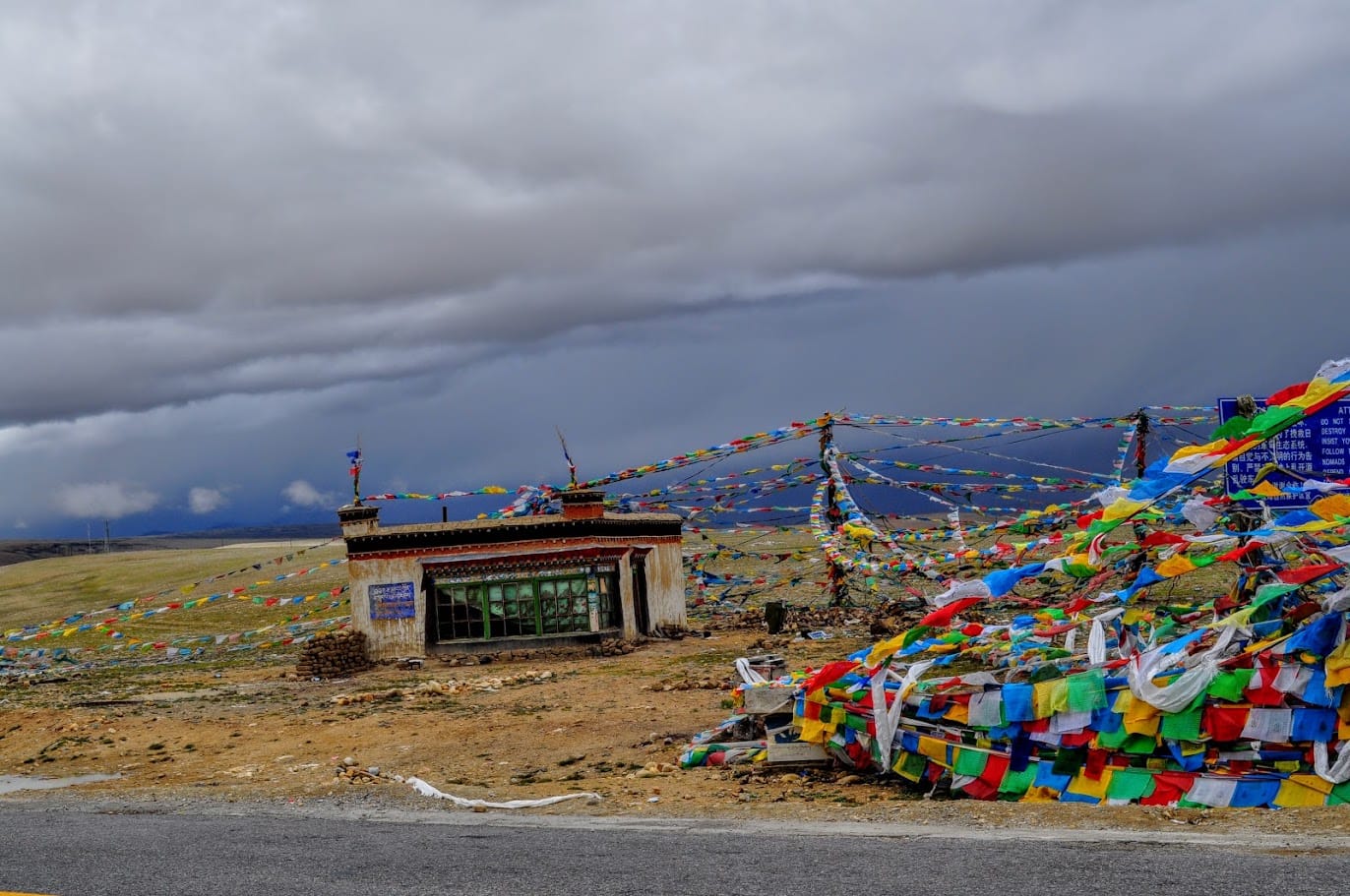
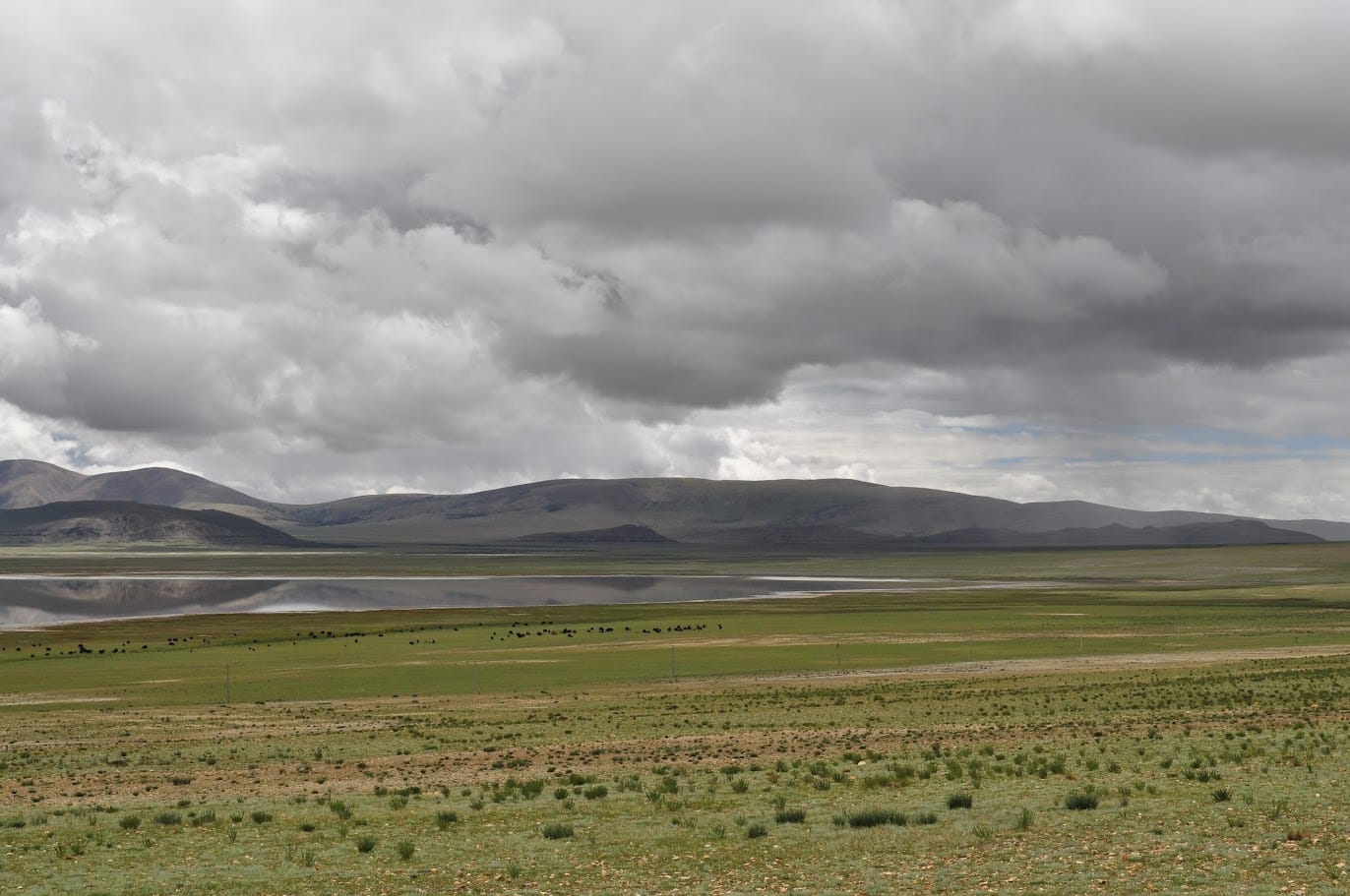
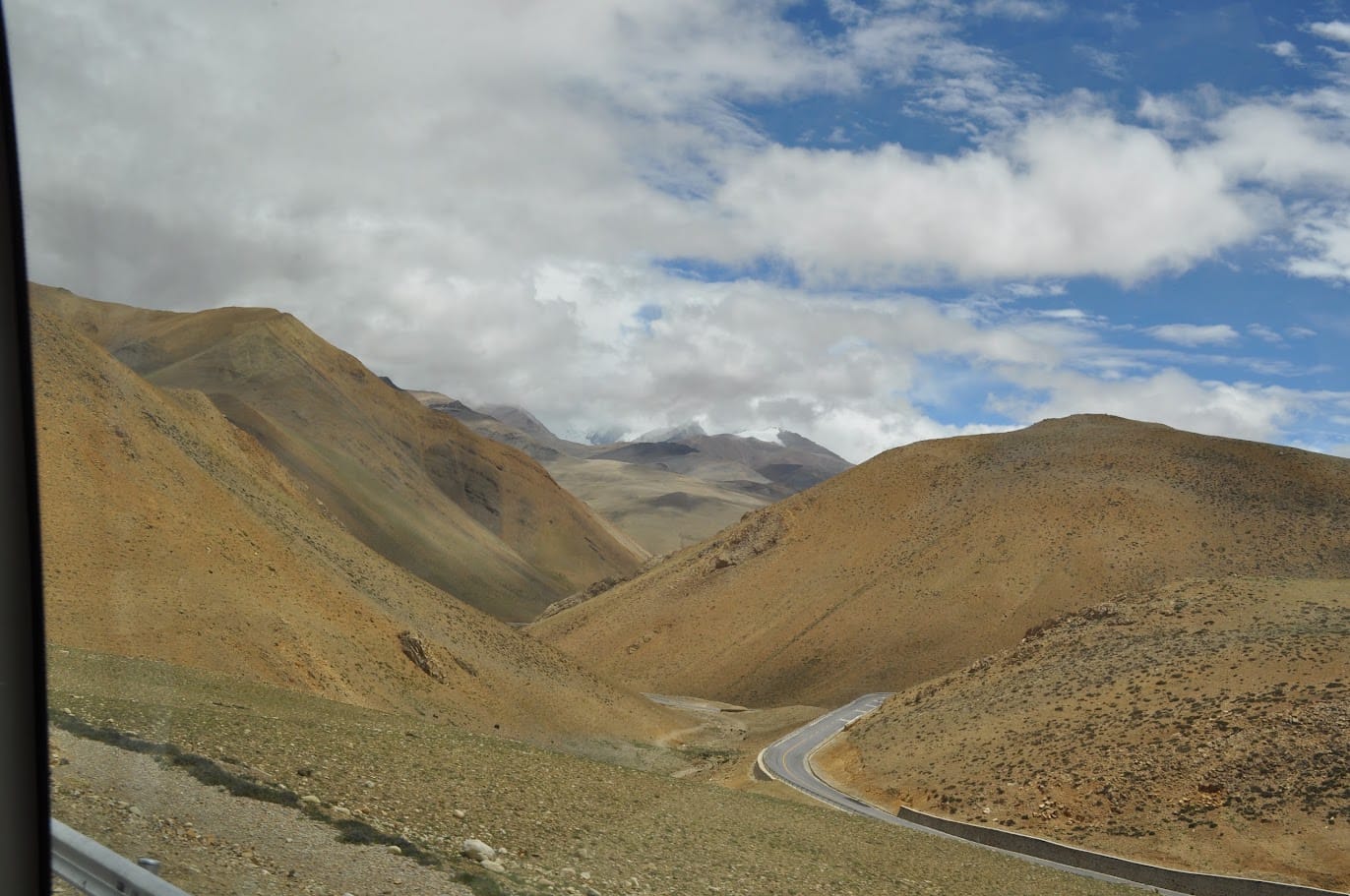
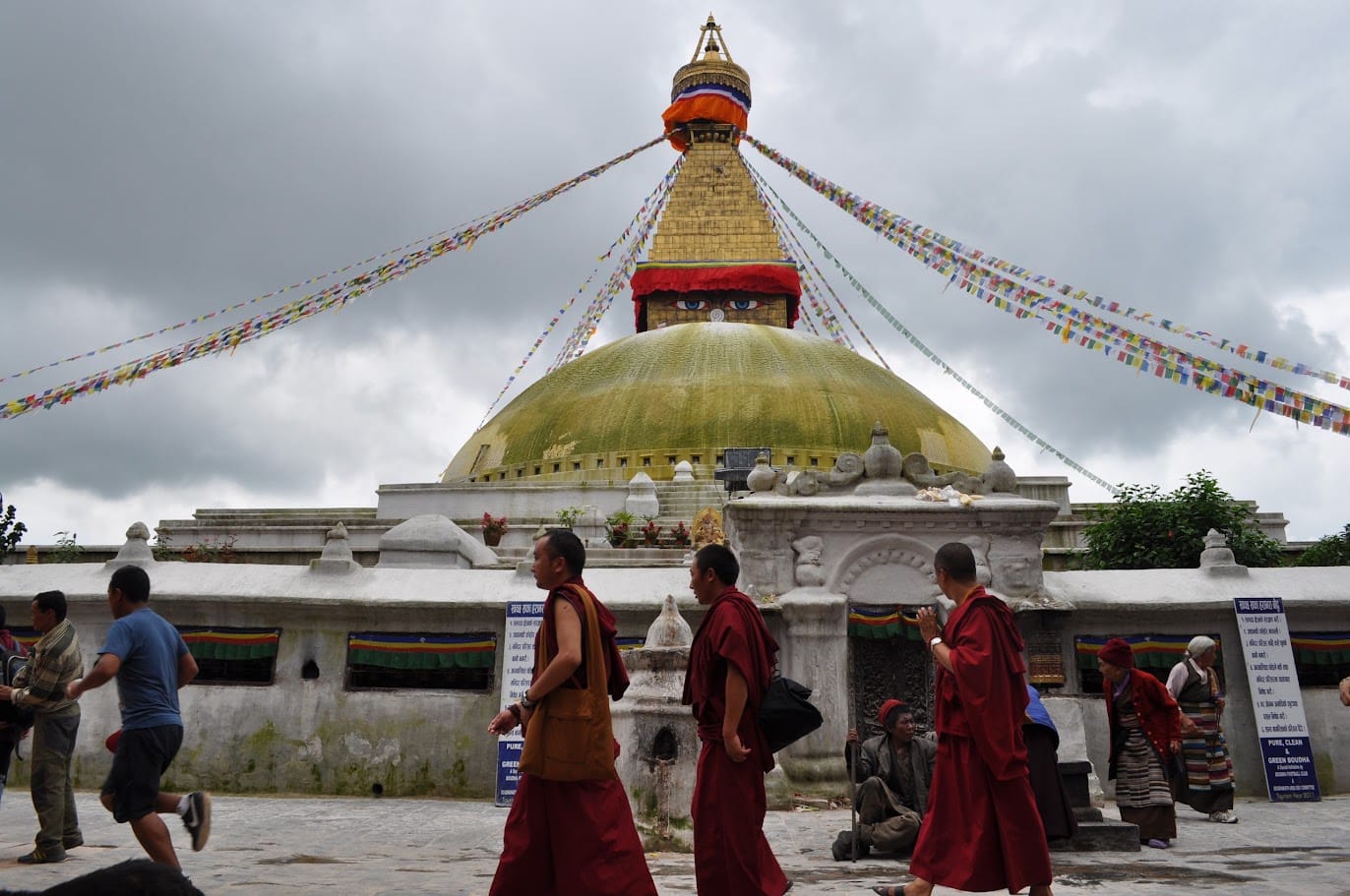
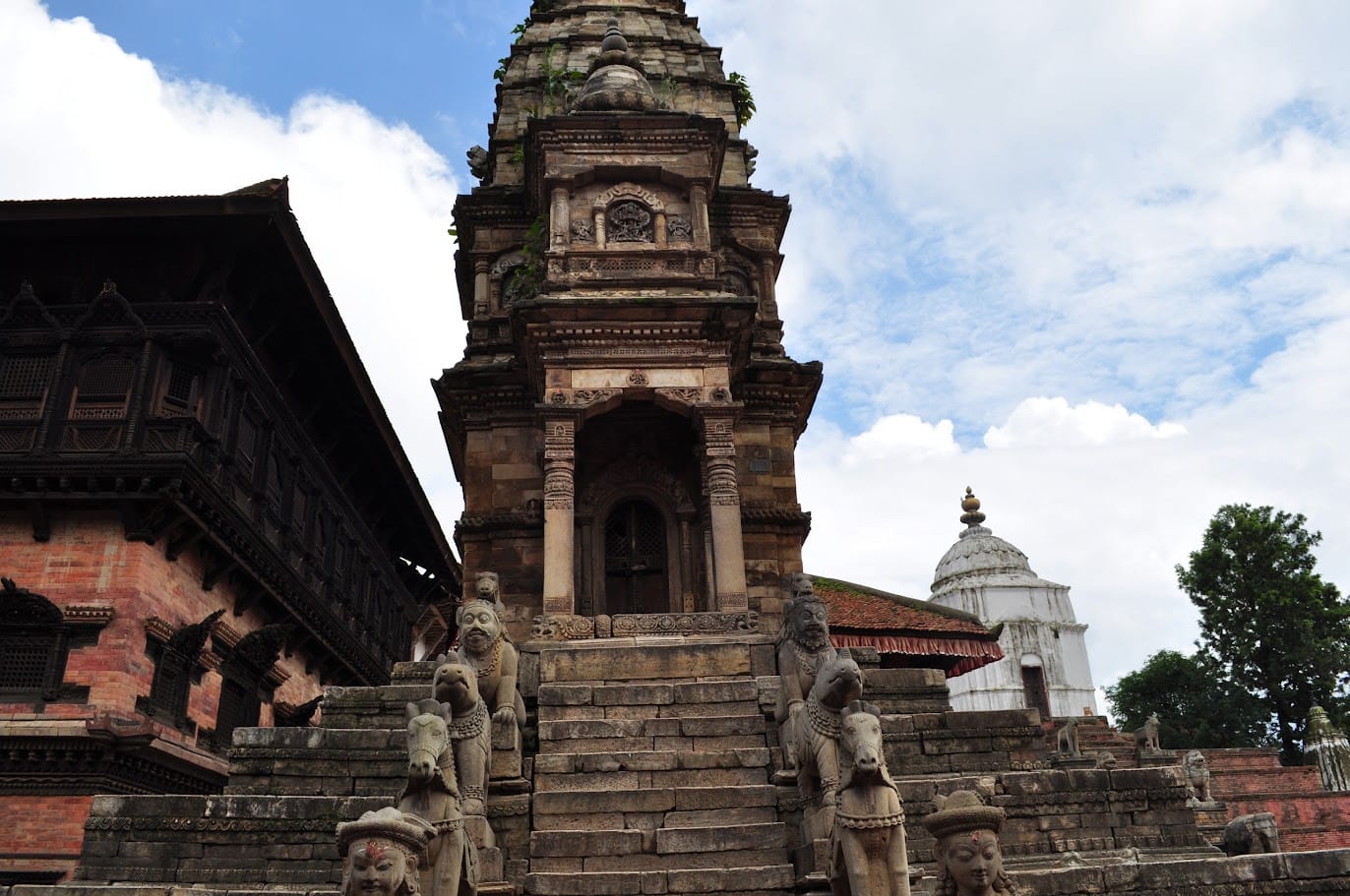
Our journey ran for fourteen days.
It began in Kathmandu with paperwork, accommodation, and preparations. We stayed at the Crowne Plaza/InterContinental-class property in Kathmandu, rather than being placed immediately into the lowest-cost lodging possible. There were days for local visits to Pashupatinath, Boudhanath, and Bhaktapur, as well as the essential last-minute preparations people need before heading into the more demanding portion of the journey.
We then crossed the Kodari border into Tibet, reached Zhangmu, traveled onward to Saga, spent time acclimatizing there, continued to Mansarovar, visited Kailash, and returned through Saga, Zhangmu, and Kathmandu. It was not an impulsive dash toward a sacred photograph.
The itinerary included an acclimatization day in Saga before moving farther up, and it also included time at Mansarovar and Kailash rather than reducing everything to the shortest possible itinerary.
That deliberate pacing matters. Every additional night in remote terrain costs money. Every additional day requires rooms or tents, meals, transport, fuel, guides, staff lodging, water, medical monitoring, equipment, permits, and management. But the extra time also reduces the temptation to move human beings through high altitude as though they were cargo.
The food was not an afterthought.
We had freshly cooked food three times a day at every location. A mobile food truck or kitchen system accompanied the group. At Mansarovar, in difficult weather and an austere environment, the team served a full meal—curries, rotis, rice, salad, and even popcorn. Sherpas prepared fresh jalebis, with frying and syrup stations, in a place where critics sitting behind laptops would struggle even to arrange a cup of tea.
Making fresh jalebis at Mansarovar is not the same as buying jalebis near a city market.
It requires flour, sugar, ghee or oil, fuel, pans, gas or another heat source, water, trained cooks, food storage, sanitary handling, transport capacity, labor, shelter from weather, and enough operational coordination to serve a large group without chaos. The same is true of every hot meal, every cup of tea, every rice pot, every vegetable preparation, and every item distributed safely at altitude.
Many here will want to dismiss jalebi as an indulgence. But that would miss the point. The jalebi is evidence of something larger: a logistics system that maintained food quality, morale, nourishment, and dignity in a place where basic survival itself requires planning.
Then there was the medical infrastructure.
The yatra was not a group sent into extreme altitude with a bottle of aspirin and a pious wish. We had medical checks at different locations; we always had a medical tent, medicines, oxygen cylinders—both large and portable—and emergency systems, including gamma bags for severe altitude conditions.
In our batch, we had approximately 180 participants and a team of five to eight doctors, including doctors associated with the ashram and other medically qualified participants.
The exact physician count may vary from cohort to cohort, year to year, and program to program. What should not be missed is the standard of care implied by the structure: doctors, repeated monitoring, oxygen, portable emergency equipment, an ambulance or medical transport capacity, and the willingness to remove seriously unwell pilgrims from the higher-risk area rather than indulge a fantasy that devotion makes physiology irrelevant.
That is the opposite of reckless spiritual tourism.
In my own experience, several travelers became extremely sick near Kailash. The team identified the risk, provided care, and transported people down toward Mansarovar. This is not a trivial logistical decision.
One needs to remember that a sick traveler at high altitude is not merely a medical problem. He or she becomes a transport problem, a staffing problem, a communication problem, a lodging problem, a permit problem, and sometimes a life-or-death decision.
It is therefore dishonest to compare a medically supported yatra to a low-cost itinerary without doctor coverage and then proclaim that the difference is “profit.”
The false comparison with cheap tours
A critic may find a $2,000 or $2,500 Kailash package online and wave it about as conclusive proof that a $5,500 journey is inflated. This comparison fails for the same reason that comparing an economy airline ticket to a medically supported polar expedition fails.
The destination may be the same. The product is not.
Cheap tours tend to economize somewhere. They may use lower-cost lodging. They may provide a shorter itinerary. They may reduce acclimatization days. They may have one guide where another operation has many. They may not have multiple doctors. They may provide a basic oxygen kit rather than substantial oxygen infrastructure. They may not run a moving kitchen. They may rely on local restaurants, guesthouses, or packed food. They may shift more risk to participants. They may have less ability to absorb a road delay, health crisis, border hold-up, or accommodation failure.
None of this necessarily makes them bad tours. It simply makes them different tours.
If a traveler wants the lowest possible price, that traveler should be free to choose it. If a traveler wants a better-supported, fuller, more carefully managed pilgrimage, that traveler should also be free to choose it. The moral issue is honest disclosure and voluntary choice—not whether every spiritual journey is priced at the lowest available market rate.
Moreover, the high-altitude portion of the journey cannot be made luxurious simply by paying more. That is another misconception. There are places where hotel inventory is constrained, guesthouses are basic, bathrooms are primitive, weather is severe, and a comfortable bed is not guaranteed. No one can truthfully promise uninterrupted five-star luxury along the Mansarovar and Kailash routes. Even premium operators acknowledge that accommodation at Darchen and on the kora is limited; Darchen does not have a five-star hotel, and the Kailash circuit uses basic guesthouse-style arrangements.
So what does a higher fee buy?
It buys better preparation before the hardship. It buys a safer operating system during the hardship. It buys staffing. It buys food. It buys monitoring. It buys redundancy. It buys the ability to respond when someone falls ill. It buys a more orderly group experience. It buys the possibility that a pilgrimage remains a pilgrimage rather than becoming a preventable disaster.
Choices: Kailash as a Tourist or a Pilgrim?
There is another aspect critics miss: value in a pilgrimage is not exhausted by transportation.
No one is obliged to join an Isha Kailash journey. It is not a forced dictate for every Isha meditator.
It is a voluntary offering of time, money, effort, and physical endurance by adults who believe the journey has meaning for them.
Some will find that meaning through a simple, inexpensive journey. Others will want organized support. Some may value the presence of a teacher. Some may want the experience of a larger like-minded social group. Some may want carefully prepared food because they are elderly, have dietary constraints, or cannot tolerate the uncertainty of remote meals. Some may want doctors because they understand the limits of their body. Some may simply want a pilgrimage that is conducted with a certain ethos of care and cleanliness.
That is their choice.
The critical question is not whether an outsider shares that valuation. The critical question is whether the participant receives what was represented.
But let a devotee spend money on a Hindu pilgrimage, and suddenly the language changes. The traveler becomes gullible. The organizer becomes suspect. The spiritual experience becomes a racket by definition.
That double standard deserves to be challenged.
In the market of pilgrimages, just as in the market of safaris, there are various options available. It is up to you what you want to choose. It depends on your sensibilities, view of life, and the particular place that you are on your personal journey.
In the case of Kailash, the more important point is what does that journey really mean to you?
The human beings behind the journey
What I remember most from the journey is not the tariff. It is the people who made the journey possible.
I remember volunteers working after midnight and beginning again at four or five in the morning. I remember cooks and Sherpas who could create order and nourishment in a remote high-altitude setting. I remember the medical team monitoring people who did not fully understand the danger they were in. I remember the labor behind tents, lights, food, buses, luggage, medical supplies, and movement across a difficult landscape.
The individual traveler sees a meal appear. Someone else has been awake preparing it.
The individual traveler sees an oxygen cylinder. Someone else arranged procurement, transport, storage, testing, staffing, and the plan for using it.
The individual traveler sees a tent repaired after rain tears it open. Someone else is already draining water, repairing fabric, resetting equipment, and preparing the next meal.
The individual traveler sees a bus leave on time. Someone else has negotiated routes, checked permits, coordinated drivers, loaded equipment, handled baggage, communicated with multiple teams, and calculated what would happen if the road were to remain closed.
Critics who regard all of this as irrelevant because they have seen a headline figure are not exposing materialism. They are exhibiting a very narrow form of it—the inability to see any labor, care, risk, or meaning that does not fit inside a cynical narrative.
The fresh jalebi at Mansarovar matters because it represents this unseen civilization of service.
It tells us that someone had thought ahead.
It tells us that someone had transported ingredients into a place where nothing is convenient.
It tells us that someone cared enough to offer warmth, familiarity, and nourishment to pilgrims far from home.
It tells us that an organization had built the capacity to do more than issue a ticket and send people onward.
A critic may laugh at the jalebi. A pilgrim understands it.
The real choice
People are free to choose a $2,000 Kailash trip, a $3,500 trip, a $5,500 Isha yatra, or no trip at all.
They are free to travel as tourists, pilgrims, trekkers, photographers, skeptics, believers, or seekers.
They are free to decide that a spiritual journey is not worth the money. They are free to decide that it is worth much more.
But no one should be permitted to make a dishonest argument unchallenged.
A 14-day cross-border pilgrimage through Kathmandu, Tibet, Saga, Mansarovar, and Kailash; with better Kathmandu lodging; freshly cooked food three times daily; a mobile kitchen; several doctors; oxygen; medicines; emergency equipment; medical monitoring; buses and support vehicles; permits; guides; tents; staff; and a spiritual program—is not cheap to organize.
It should not be cheap to organize.
In fact, if it were dramatically cheaper than the market, the responsible question would be: what has been cut?
Was it food?
Was it medical care?
Was it staffing?
Was it vehicle redundancy?
Was it accommodation?
Was it safety?
Was it insurance?
Was it the ability to get a sick person down from a dangerous altitude?
The mockery of Isha’s price therefore rests on a deliberate act of subtraction. It subtracts terrain. It subtracts altitude. It subtracts medicine. It subtracts staff. It subtracts food. It subtracts permits. It subtracts safety. It subtracts organizational responsibility. It subtracts the voluntary nature of the participant’s choice. It subtracts the possibility that a larger institution may use surpluses for wider work. And then it points at the remaining number as though it has discovered a scandal.
That is not a critique of a pilgrimage. It is a refusal to understand one.
The $50,000 special cohort
The special Sadhguru cohort must be assessed on its own terms. It is not a “Kailash bus tour” with an extra zero added to the price. It is a small, expedition-style pilgrimage through one of the world’s most difficult, regulated, high-altitude terrains—organized around direct travel with Sadhguru, over an extended period, in a format that bears little resemblance to a mass-market package.
Take a look at how it goes.
A $50,000 fee may sound dramatic when reduced to a headline. But remember, a headline is not a cost analysis.
The relevant comparison is not between this cohort and the cheapest ordinary Kailash package advertised online. The relevant comparison is between this cohort and a private, high-altitude, cross-border expedition involving a prominent spiritual teacher, a small group, multiple Land Cruisers, remote-route travel, camping, support vehicles, cooks, medical safeguards, specialized staff, communications systems, security, permits, and the financial risks that arise when a small group operates far from ordinary infrastructure.
In my own account of the Kailash journey, I described Sadhguru moving with a small team of roughly fourteen or fifteen people in Land Cruisers across difficult Tibetan terrain. They took unconventional routes, camped, and drove through the Tibetan landscape for several days from Kathmandu toward Mansarovar. Sadhguru traveled onward between Mansarovar, Kailash, Saga, and Kathmandu on a demanding schedule, coordinating with larger batches of pilgrims as well.
That is not a luxury bus tour. It is an expedition.
The arithmetic of a small expedition
A standard yatra of 180–200 pilgrims can divide fixed costs across a large number of participants. Buses carry many people. Food preparation can be centralized. Medical staff can serve a large group. Support trucks, guides, communications equipment, permits, and logistics teams are shared by hundreds.
A small Land Cruiser cohort cannot rely on that economy of scale.
A group of perhaps 12–18 participants may require:
- Four to six Land Cruisers or comparable high-altitude 4x4 vehicles for guests, drivers, guides, supplies, and route flexibility.
- Additional vehicles for luggage, cooking gear, medical equipment, water, tents, recovery equipment, satellite communications, fuel planning, and emergency contingencies.
- Tibetan drivers, guides, interpreters, local liaison personnel, cooks, kitchen assistants, logistics coordinators, medical personnel, camp staff, mechanics or recovery support, and operations leads.
- Expedition tents, sleeping systems, a dining tent, lighting, portable power, water storage and purification, fuel, sanitation arrangements, garbage management, and camp setup/breakdown labor.
- A moving kitchen able to provide safe, freshly cooked food in areas where ordinary hotel and restaurant capacity may be absent, unreliable, or unsuitable.
- Oxygen, medicines, emergency medical equipment, doctors or medics, emergency transport arrangements, and a contingency protocol for altitude illness.
- Radios, GPS devices, satellite connectivity, route reconnaissance, vehicle-recovery equipment, spare tires, maintenance arrangements, security coordination, and permit administration.
- The additional operational requirements that accompany the movement of Sadhguru across remote terrain: schedule coordination, staff movement, event preparation, safe gathering arrangements, communications, and appropriate privacy and security.
Small-group private Tibet travel already costs more per person than ordinary group travel because vehicles, guides, permits, and logistics are divided among far fewer guests. Current Tibet operators describe 4x4 Land Cruisers or comparable SUVs as the appropriate vehicle class for small Kailash groups, while private tours carry a material premium over group tours even before extensive off-road travel, camping, medical capability, or special-event operations are added.tibettour+1
The mathematics is not mysterious. It is simply unforgiving.
What a $50,000 price can cover
No outside observer can responsibly claim to know Isha’s internal cost allocation without its documentation.
But one can say, with confidence, that a $50,000 tariff for a small, extended, high-touch Tibet expedition with Sadhguru is not exorbitantly high by definition.
It is entirely plausible once the actual elements are counted. Here is an attempt to do so.
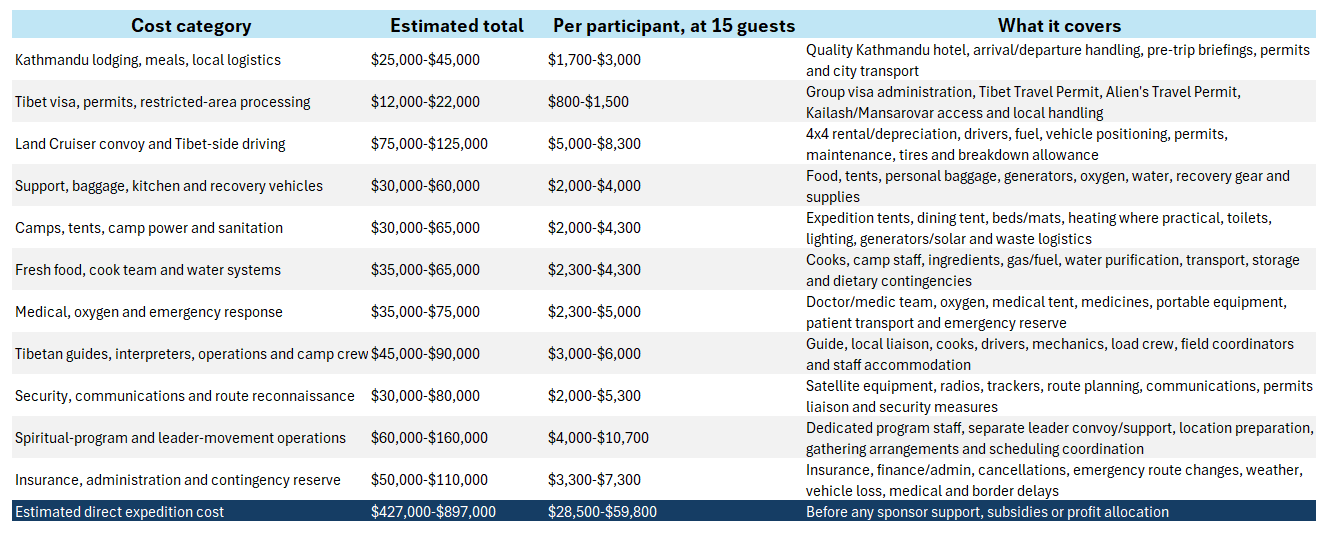
A normal private Kailash journey, even without Sadhguru’s presence, remote camping, a dedicated program staff, or a convoy, can cost several thousand dollars per person. Market references show conventional private or custom Tibet/Kailash products often reaching the high four figures or beyond, with more elaborate variants priced much higher.
Once the trip becomes an extended expedition rather than a conventional itinerary, the cost structure changes radically.
Please remember, we are talking about a terrain which is one of the most rugged high-altitude areas with severe restrictions from the Chinese government.
If the full dedicated leadership, security, event, medical, reconnaissance, and support-convoy costs are charged to a very small number of guests, the economically complete cost can rise further.
That does not mean every dollar of the $50,000 is spent on the road. It means that a $50,000 price is not evidence of extortion.
It is compatible with the real cost of a small, complex, bespoke, high-altitude expedition—and with a program that is not selling transport alone, but access to a carefully structured spiritual journey.
The charitable dimension
There is another issue that critics routinely ignore: a spiritually oriented nonprofit may deliberately structure a premium journey so that it does more than pay travel suppliers.
The most thoughtful critics will ask: “Fine, the direct costs may be substantial. But what about the surplus?”
That is a good question.
Does it go toward administration, reserves, refunds, staff, health systems, facilities, outreach, education, environment, rural welfare, or other charitable activities?
If Isha’s special-cohort materials state that a portion of the contribution supports its wider charitable work, that element should be understood as part of the participant’s voluntary decision—not concealed as though it were a bus surcharge.
Isha identifies itself as a nonprofit, volunteer-run organization focused on human wellbeing and social revitalization.
Isha’s outreach to the communities and indeed across the world is substantial.
- Isha Outreach has three permanent rural clinics in Coimbatore and Salem have treated 473,799 patients since 2007, while mobile health clinics have reached 4,368,695 patients in 1,600 villages. (Source: linkedin)
- Isha has four mobile units served more than 180 villages across Coimbatore and Chikkaballapura districts and reached more than 63,600 patients in 2025, while its rural health clinics served more than 128 villages.(Source: linkedin)
- Isha Vidhya supports more than 9,000 rural students, with nearly 49 percent girls and about 60 percent of students receiving full scholarships.linkedin+1
- Its rural and ecological work includes farmer training and regenerative agriculture initiatives designed to support soil health, livelihoods, and tree-based farming. (Source: linkedin)
- During the COVID period, Isha provided 500 oxygen concentrators, two vehicles, and personal protective equipment to the Tamil Nadu government. (Source: consciousplanet)
I have not discussed the Save Soil, Cauvery calling, and Operation Greenhands here yet.
One need not accept every promotional claim uncritically. One should examine evidence, define metrics, and distinguish the organization’s own claims from independent evaluation. But it is simply false to behave as though the only relevant question is whether money enters a Hindu organization. The relevant question is what the organization does with its resources, how it governs them, and whether it is truthful about its operations.
The same accounting standard should apply to everyone.
If critics want an audit culture, let them consistently demand audits. If they want impact measurement, let them demand it consistently. If they want disclosure of donations and expenditure, let them demand it consistently. If they want to criticize the treatment of vulnerable people in charitable institutions, let them do so consistently—regardless of whether the institution is Hindu, Christian, Muslim, secular, Western, Indian, fashionable, or unfashionable.
Selective skepticism is not skepticism. It is an ideological hitjob.
Consider the NGOs and the work they do. Have you seriously asked any penetrating questions from them? We have.
 Desh Kapoor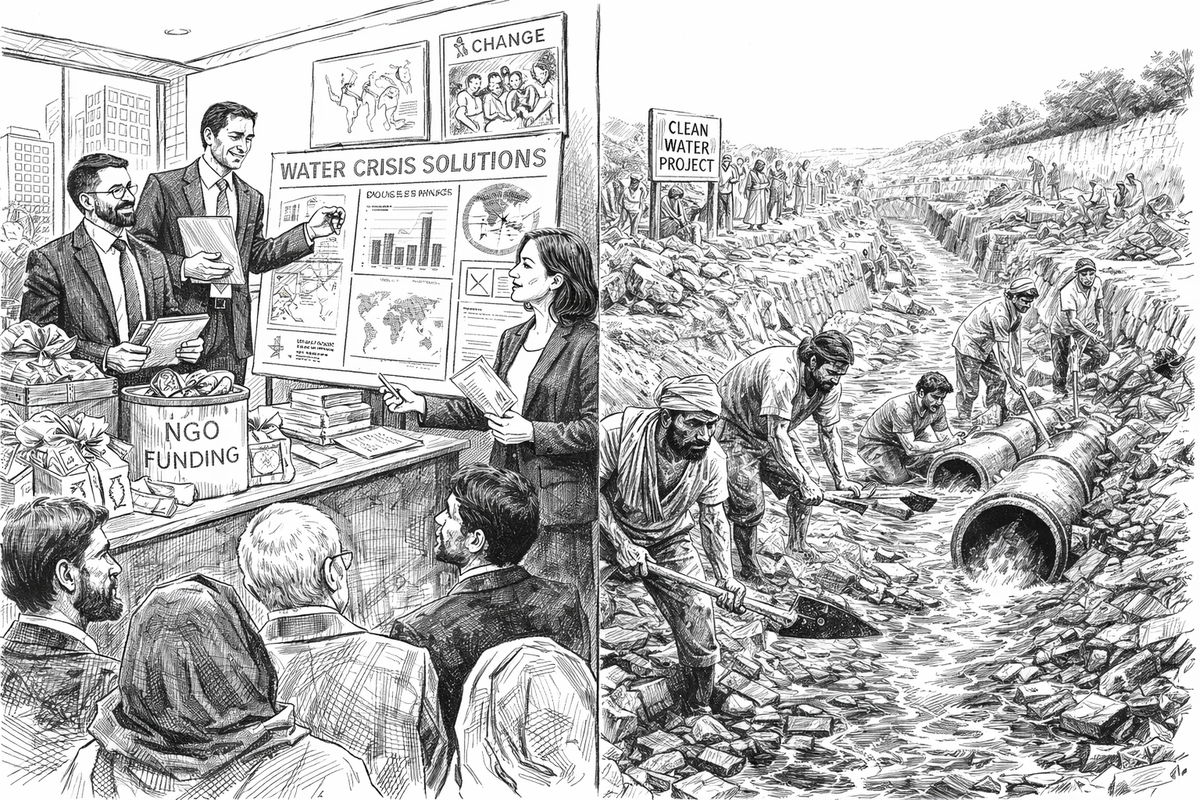
A person may disagree with Isha’s philosophy, priorities, or claims. That person is entitled to seek audited statements, independent evaluations, and clearer disclosure. But it is not intellectually honest to treat a disclosed charitable component as though it were proof of greed. A donor who chooses to participate in a rare spiritual expedition and to contribute toward rural schools, health access, ecology, or community initiatives is making a voluntary philanthropic choice.
The price is therefore not reducible to “the cost of riding in a Land Cruiser.”
Part of it may reflect the considerable cost of the expedition. Part of it may reflect the limited nature of direct participation with Sadhguru. Part of it may represent a contribution to work that is deliberately directed toward people who will never be able to pay for a Kailash pilgrimage: rural children receiving scholarships, patients reached through free clinics and mobile health units, farmers receiving training, and communities receiving support.
That distinction matters.
The conclusion critics avoid
Reducing a $50,000 Sadhguru cohort to a mocking number depends on omitting nearly everything that gives the number meaning.
It leaves out the fact that this is a small group, not a mass group.
It omits the fact that the travelers may travel in Land Cruisers across difficult Tibetan terrain rather than on a fixed bus route.
It leaves out the cost of remote camping, fresh food, cooks, tents, power, water, sanitation, medical readiness, oxygen, communications, guides, drivers, permits, route planning, security, and contingency support.
It leaves out the cost of moving a teacher, staff, and program infrastructure across one of the world’s most remote high-altitude regions.
It leaves out the fact that the journey can be deliberately designed as a spiritual offering rather than a tourism product.
And it overlooks the possibility that an expressly disclosed component of the contribution helps sustain free or subsidized work for people who lack the ability to participate in such a journey themselves.
A critic may decide that they would never pay $50,000. That is their right.
But “I would not pay for it” is not an economic argument. It is a personal preference.
The proper question is whether the participants understand what they are joining, whether the program delivers on its promises, whether the charitable component is honestly disclosed, and whether the organization can demonstrate responsible stewardship of the funds entrusted to it.
If the answer is yes, then $50,000 is not a moral scandal. It is the price of a rare, highly specialized, medically and logistically intensive expedition.
Experience it and then criticize
The correct posture toward Isha’s Kailash Yatra is neither blind devotion nor reflexive contempt.
Ask for clarity. Ask for disclosure. Ask what is included. Ask how many doctors travel. Ask what medical systems are available. Ask about oxygen, evacuation, guides, permits, meals, vehicles, rooms, kitchens, cancellations, group size, support staff, and surplus allocation. Ask whether the program delivers what it promises.
Above all - go experience it for yourself.
But do not throw around a fee as some kind of scandal without any basis.
And do not insult the intelligence of pilgrims who know the difference between a low-cost bus package and a carefully managed journey through one of the world’s most difficult sacred landscapes.
I traveled with a large group. I saw the food truck. I saw the cooks. I saw the doctors, medical tent, medicines, oxygen equipment, health checks, the support systems, and the labor of the volunteers and Sherpas. I saw a damaged tent repaired, a full hot meal laid out, and fresh jalebis prepared at Mansarovar despite the conditions.
That is not an abstraction. It is not public relations. It is experience.
A person may not value that experience. A person may not believe in Kailash. A person may dislike Sadhguru. A person may prefer another path.
All of that is their right.