

had lost the government's confidence
and could only regain it with redoubled effort.
If that is the case, would it not be be simpler,
If the government simply dissolved the people
And elected another?” ― Bertolt Brecht
The Lord and the Lamp Oil
A lord ruled a province from a hilltop castle. In spring he sent his army across the river to punish a neighboring kingdom. The war went on through summer, and the price of lamp oil in the valley tripled.
In autumn he climbed to the monastery and found the old abbot sweeping leaves.
"The village elders gather against me," the lord said. "My captains whisper about my nephew. They speak as if I am already gone. I still hold the seal. How do I make them remember who rules?"
The abbot kept sweeping. "When did you last buy lamp oil?"
"I have servants for that."
"The farmers buy it every evening. Each evening they count their coins, and each evening they remember who sent the army across the river."
"Then I will lower the price."
"You can lower it tomorrow. The farmers will still remember what they paid all summer."
The lord was silent for a long time. "Then what power do I have left?"
The abbot leaned his broom against the gate. "Enough to bring the soldiers home. Whether you use it is the only question the seal can still answer."
The lord looked down at the valley. One by one, the lamps were going dark.
Tide is Turning
Donald Trump's second term will effectively end on November 3, twenty-seven months before he leaves office. The instrument is a midterm his party is on track to lose. The cause is a war whose cost Americans see every time they fill a tank.
Markets are already pricing it in.
With 37 days to go, Democrats are clear favorites to take the House and modest favorites to take the Senate. Averaging Kalshi and Polymarket, traders put a Democratic House at 92% and a Democratic Senate at 62% as of the evening of September 26. A Republican hold of both chambers trades at roughly 8 cents on the dollar.
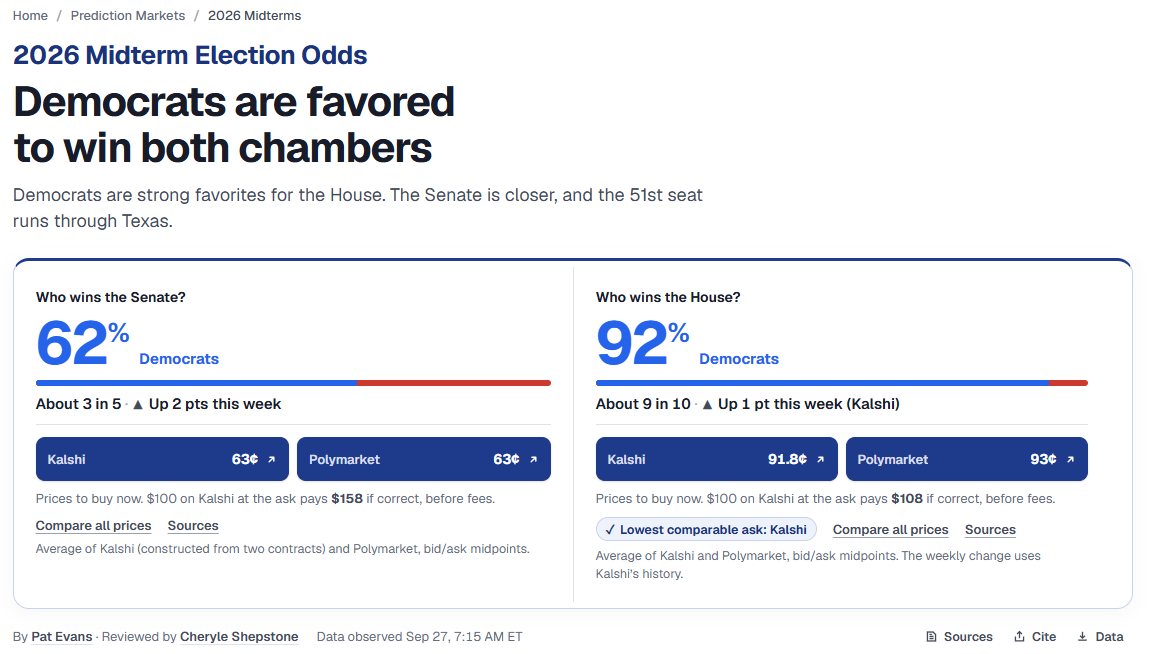
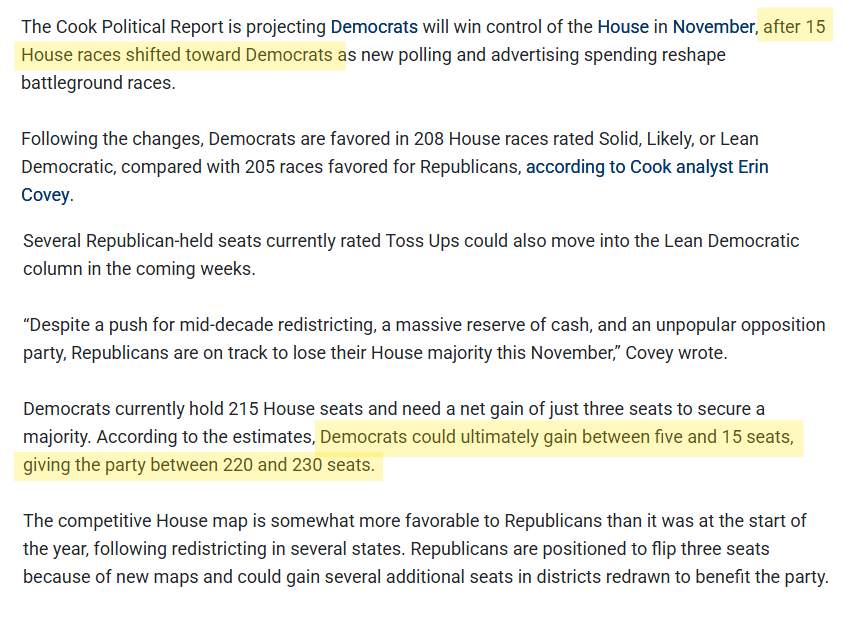
The House call is the firmer one. Democrats need a net gain of three seats. The Cook Political Report now projects a gain of 5 to 15 seats, even after Republican mid-decade redistricting netted the GOP about four seats on paper (Washington Examiner).
Every national signal points the same way: presidential approval in the mid to high 30s, a generic ballot of D+7 to D+9, and a Democratic enthusiasm edge of 16 points in CNN's latest poll
My read: a Democratic House is very likely, a Democratic Senate is more likely than not, and the scale of the House loss will be the real story of the coming midterms.
Reading the tape
Markets, polls and professional handicappers now point the same way. They disagree only on the size of the Senate margin.
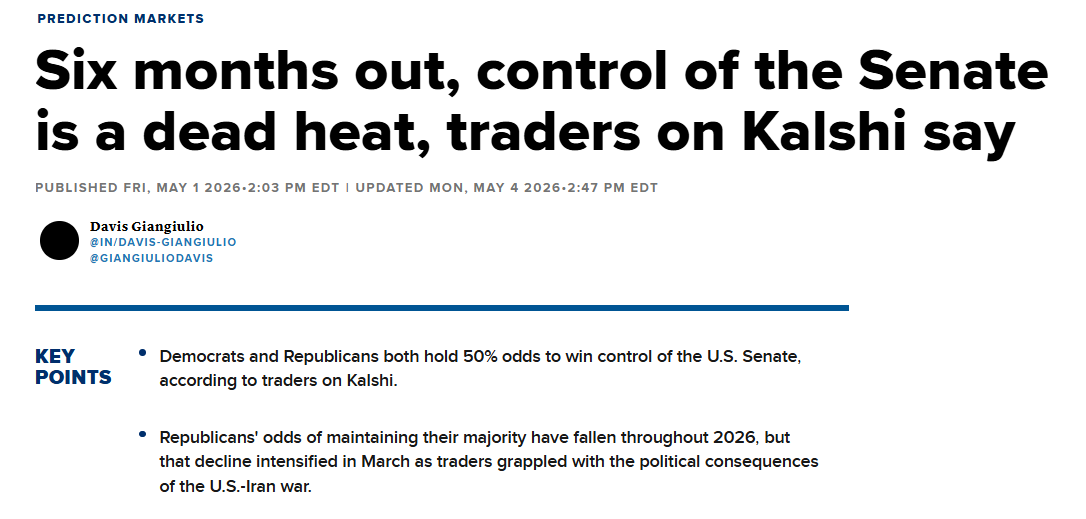
The trend carries more information than the level. Kalshi opened 2026 with Republicans at 67% to hold the Senate. The slide accelerated after the Iran strikes, reached a dead heat by May (CNBC), and has since crossed into a Democratic lead. A 30-point swing in nine months requires a structural cause. The cause is the war.
Trump is weaker today than he was before the 2018 wave. FiftyPlusOne puts his net approval at minus 28. At the same point in 2018 it was minus 13, and Republicans lost 41 House seats.
Intensity decides midterms, and intensity on the right has collapsed. In CNN's September poll, 13% of Americans strongly approve of Trump. Among Republicans, strong approval has fallen from 66% in September 2018 to 35%. Democratic leaners are 16 points more likely to say they are extremely motivated to vote.
But here is a caveat. Several Kalshi state quotes were stale when observed, liquidity is thin, and a federal appeals court ruled on September 25 that prediction markets can be regulated like gambling. The markets are a disciplined crowd, and disciplined crowds still miss.
The House: the firewall held, and it was not enough
Democrats need three seats. Cook now projects five to fifteen. After shifting 15 races toward Democrats on September 25, it shows 208 seats at Solid, Likely or Lean Democratic against 205 Republican, with 23 Toss Ups. 17 of those toss-ups are Republican held.
Watch where the ratings moved. AZ-01 and NJ-07 went to Lean Democratic. FL-22 and NC-11 became toss-ups. NV-02, NY-21, TX-09 and VA-05, seats Republicans treated as safe, slid to Likely Republican (270toWin, Cook ratings).

When a party must defend districts it drew for itself, the wave has reached terrain built to repel it.
Redistricting was the Republicans’ insurance policy for the 2026 House elections. New district lines gave the party a potential advantage in several states, while court rulings narrowed Democrats’ chances to offset those gains. In May, the Virginia Supreme Court voided a voter-approved plan that could have put four Republican-held seats within Democratic reach. Cook Political Report’s redistricting analysis points to an overall Republican benefit of roughly four seats. (Source: Cook redistricting tracker)
That is a meaningful cushion in a closely divided House, but it has limits. A map can improve a party’s starting position; it cannot guarantee that candidates survive a strong national swing. If the electorate moves eight points toward Democrats, seats drawn to favor Republicans may still become competitive.
The GOP would then need more than favorable boundaries: it would need enough candidates to outrun the national mood. Four additional seats could soften a modest backlash. They would be unlikely to absorb a D+8 wave across the country.
History gives Republicans reason to worry. The president’s party lost 47 House seats in 1966, 48 in 1974, 30 in 2006 and 41 in 2018. But those elections don't all follow the same approval-rating pattern: Johnson was around 44% in late 1966, Ford was above 50% in 1974, and Trump was in the low 40s by late 2018. Nixon’s Watergate collapse, rather than Ford’s approval, shaped the 1974 result.
 Franklin D. Roosevelt - Joseph R. Biden
(See analytical graphs below table).
Franklin D. Roosevelt - Joseph R. Biden
(See analytical graphs below table).
This year, fewer competitive districts and a Republican campaign committee with roughly $89 million on hand may limit the damage. (Cook Political Report)
Cook’s current most likely range is a Democratic gain of five to 15 seats, well below the GOP’s 41-seat loss in 2018. Yet 15 is not a ceiling: Cook says its range could move further toward Democrats if Republican prospects worsen before November. Maps and money offer protection, but neither makes a national backlash disappear.
The Senate runs through Texas
Democrats lead in nine of the twelve races that decide the chamber. The arithmetic is unforgiving: hold every Democratic seat, flip four of the 23 Republican seats on the ballot, and reach 51 against a Republican vice president's tiebreak.
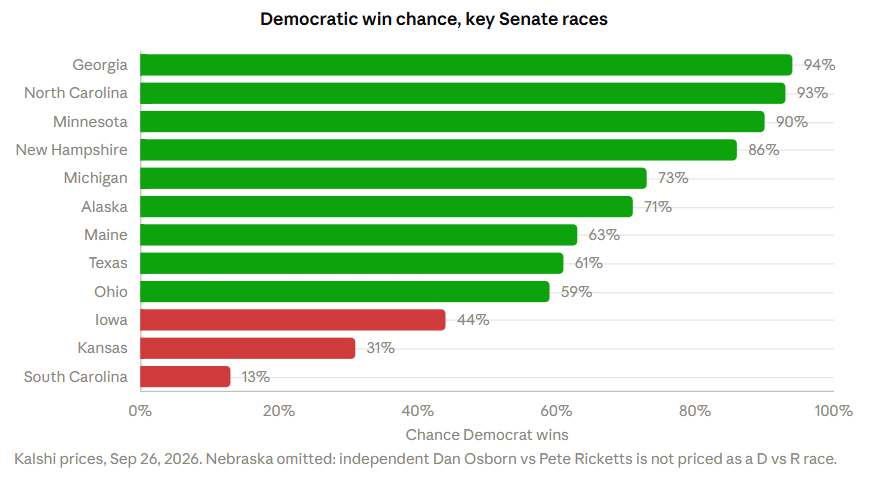
North Carolina and Georgia are becoming serious problems for Republicans. In North Carolina, former governor Roy Cooper is challenging Michael Whatley for the seat Republican Thom Tillis is leaving open. Cooper’s standing has made a Republican hold harder to count on. Georgia poses a different problem: Senator Jon Ossoff is defending a Democratic seat against Mike Collins, so a Collins defeat would deny Republicans a potential pickup rather than cost them a seat they already hold. On September 23, the Cook Political Report’s Senate ratings moved Georgia from Lean Democratic to Likely Democratic.

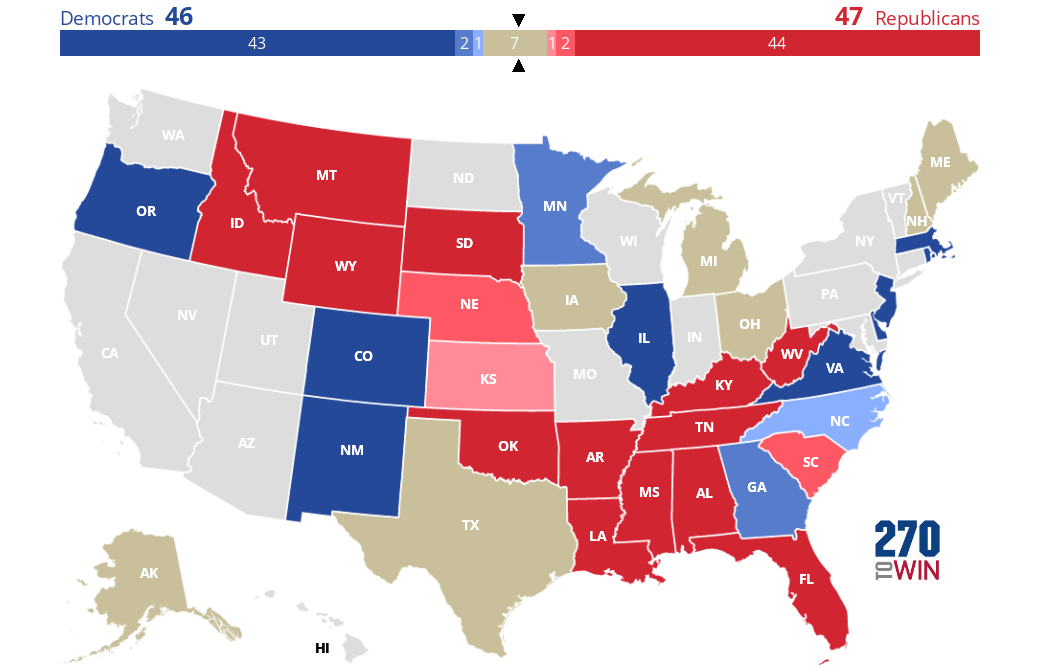
The route to a Democratic majority runs through several races at once. Republicans currently hold 53 seats; Democrats and the two independents who caucus with them hold 47. Democrats therefore need a net gain of four to reach 51 seats. They must defend the open Michigan seat, where Abdul El-Sayed faces Mike Rogers, while seeking gains in North Carolina and Republican-held seats in Alaska, Maine, Texas and Ohio. Winning all five of those Republican seats, while holding their own, would take the Democratic caucus to 52. Winning four would be enough for a majority.
That arithmetic explains why the races cannot be read in isolation. Mary Peltola’s contest with Dan Sullivan in Alaska, Troy Jackson’s challenge to Susan Collins in Maine, James Talarico’s race against Ken Paxton in Texas, and Sherrod Brown’s bid against Jon Husted in Ohio each offers Democrats a path. Each also gives Republicans a chance to close one. Michigan is equally consequential: losing a seat Democrats already hold would raise the number of Republican seats they must capture.
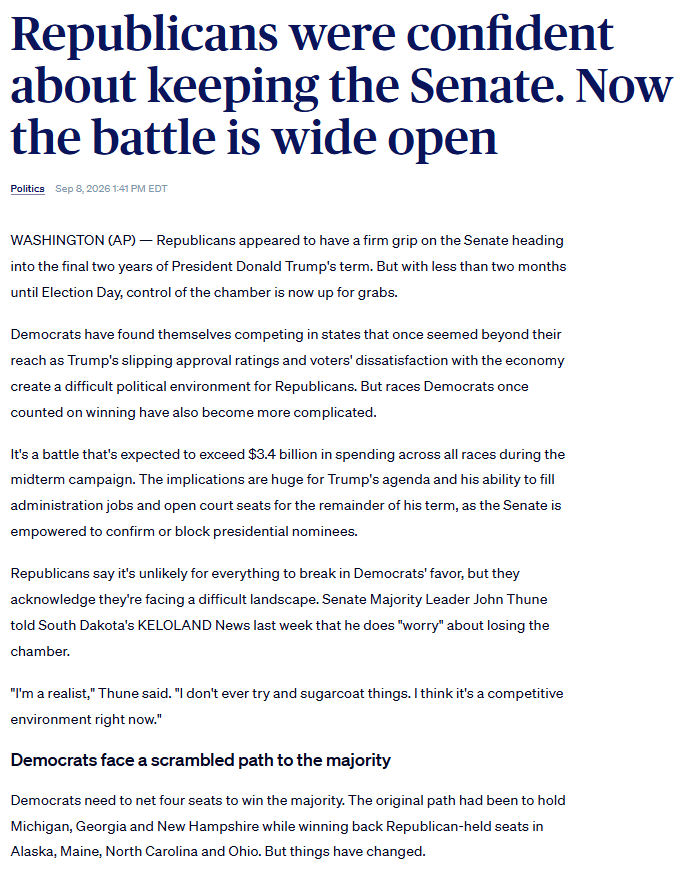
The battlefield is widening. Cook’s September update shifted Kansas from Likely Republican to Lean Republican and South Carolina from Safe Republican to Likely Republican. Those changes signal greater Democratic opportunity, though neither rating makes a flip the expected outcome. Independent Dan Osborn’s challenge to Pete Ricketts in Nebraska adds another uncertainty, particularly because his caucus choice would matter in a closely divided Senate. (Source: 270toWin)
The central question is whether Democratic strength reaches enough states at the same time. A favorable national shift could turn several close races together; Republican recoveries in just a few could preserve the GOP majority.
The Iran War Effect
North Carolina is becoming the clearest Democratic opportunity to take a Republican Senate seat.
Former governor Roy Cooper leads Michael Whatley in the race to replace retiring Republican Thom Tillis. The concern inside the GOP is visible in its spending: Old North Action, a Republican super PAC, cut its North Carolina advertising reservations by roughly a third. That does not mean the party has abandoned Whatley. Other Republican groups have largely maintained their reservations, and Whatley says he expects to have the money he needs. But the cut shows that at least one major supporter is reconsidering where its final campaign dollars will have the greatest effect.
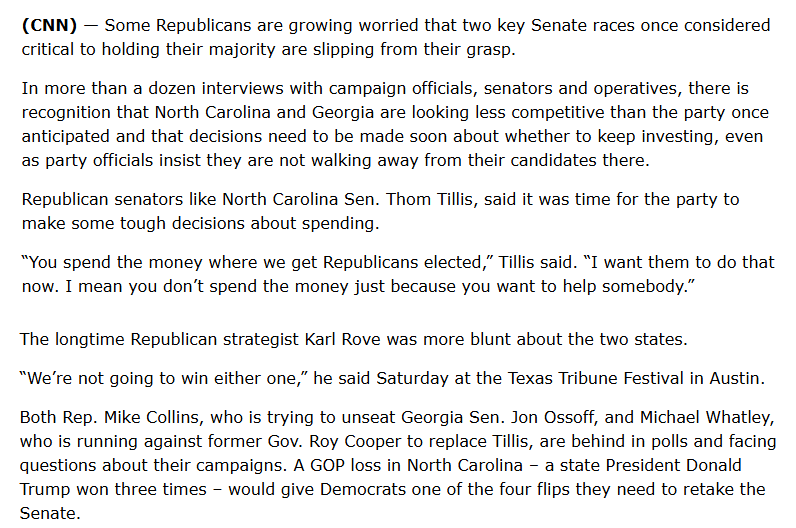
Georgia presents a different problem for Republicans. Jon Ossoff already holds the seat, so a defeat for challenger Mike Collins would deny the GOP a pickup rather than add to its losses. Collins’s campaign has asked allies for more help. It believes some voters who support Republican gubernatorial candidate Rick Jackson could still be persuaded to vote for Collins. That makes Jackson’s campaign a possible source of support, though sharing voters across the ticket is far from automatic. Cook moved the Senate race from Lean Democratic to Likely Democratic on September 23.
The Senate arithmetic
Republicans hold 53 seats. Democrats hold 45, and two independents caucus with them, giving that side 47. Democrats need a net gain of four seats to reach 51. If they defend every seat they hold, a North Carolina victory plus three other Republican seats would deliver control. Winning North Carolina, Alaska, Maine, Texas and Ohio would produce a five-seat gain and a 52–48 Democratic caucus.
“Democrats will need a net gain of four seats.”
(Source: Cook Political Report 2026 Senate Ratings / 270toWin)
That calculation assumes Democrats retain Michigan’s open seat, where Abdul El-Sayed faces Republican Mike Rogers. It also explains the attention on Mary Peltola against Dan Sullivan in Alaska; Troy Jackson against Susan Collins in Maine; James Talarico against Ken Paxton in Texas; and Sherrod Brown against Jon Husted in Ohio’s special election. These races offer several routes to a majority, but none can be counted in advance. Losing Michigan would require Democrats to capture an additional Republican seat simply to restore the starting balance.
The map has expanded beyond the most discussed battlegrounds. Cook shifted Kansas from Likely Republican to Lean Republican and South Carolina from Safe Republican to Likely Republican. Those ratings still favor Republicans, but they signal that the party must pay attention to more territory. Iowa is another possible Democratic opportunity. In Nebraska, independent Dan Osborn is challenging Pete Ricketts; should Osborn win, which party he supports on organizing votes would matter in a closely divided chamber. He should not automatically be counted as a Democratic gain.
Transcript: Hi. I'm Jessica Taylor. I'm the senate and governor's editor here at The Cook Political Report. And this week, we released a six week out outlook of the senate. We are now projecting that Democrats will gain between one and five seats in the upcoming midterm elections. They need four for a majority. We also shifted three ratings in Democrats' direction. We moved Georgia from lean Democrat to likely Democrat. We shifted Kansas from likely Republican to lean Republican, and we moved South Carolina onto the board from solid Republican to likely Republican. All of these are in Democrats' direction and show an increasingly shifting midterm environment in their favor, but we see the Senate as a toss-up right now. Really, everything still has to go right for Democrats. (Source: Six Weeks Out From Election Day, Here’s Our Senate Outlook / Cook Political Report)
The war has become a cost-of-living issue
The Iran war reaches voters through fuel prices. On September 21, the U.S. Energy Information Administration measured regular gasoline at $4.478 a gallon nationally and diesel at $6.529. Five weeks earlier, regular gasoline averaged $4.049. Diesel’s increase also matters to businesses that transport goods, adding pressure beyond the price at the pump.


The wider economic figures give Republicans little room to separate the war from voters’ concerns about prices. Annual inflation was 3.4% in August, while real economic growth slowed to a 1.5% annual rate in the second quarter.
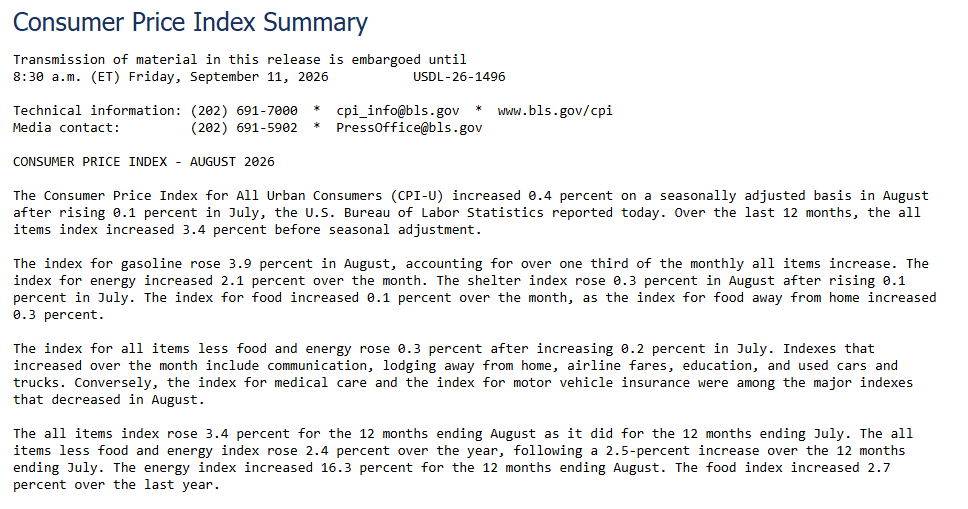
In an NBC News poll, 55% of voters said Trump’s policies had hurt the economy, up from 48% in March. Those figures do not prove that the war caused every increase in living costs. They do explain why expensive fuel threatens a president whose political case rested heavily on making life cheaper.
An immediate reduction in fuel pressure is not assured. Iran proposed a seven-day path to reopening the Strait of Hormuz in exchange for steps including an end to the U.S. naval blockade, relief from oil sanctions and the release of frozen Iranian assets. Trump rejected it on September 26. The dispute over shipping therefore remains unresolved as candidates enter the final weeks of campaigning.

Republican criticism of the war has grown, particularly when candidates discuss fuel costs. It has not translated into enough Senate votes to restrain Trump: a September 24 resolution directing the removal of U.S. forces from hostilities with Iran failed 49–50. That distinction matters. Candidates can distance themselves from the war’s economic consequences while Congress leaves its conduct in the president’s hands. (Source: Senate Roll Call Votes, September 24 / U.S. Senate)
The Senate remains genuinely contestable. North Carolina offers Democrats a strong opening, while Georgia looks increasingly difficult for Republicans to capture. Control still depends on several close races moving together.
A shared polling error, a late shift in fuel prices or a change in the war could alter more than one state at once. That is the case for treating the 52-seat Democratic scenario as a plausible outcome, not a prediction.
Coming Soon - The January Subpoenas
If Democrats win the House in November, January 2027 could mark the start of a sustained investigation into the Trump administration. Committee control would give Democrats the staff, hearing schedules, and subpoena authority to pursue questions they are currently raising through letters.
The likely subjects are already visible: the Trump family’s finances, the Iran war, immigration enforcement, federal law enforcement, and the closure or restructuring of agencies.
An investigation would establish a process for finding facts; it would not establish wrongdoing in advance.
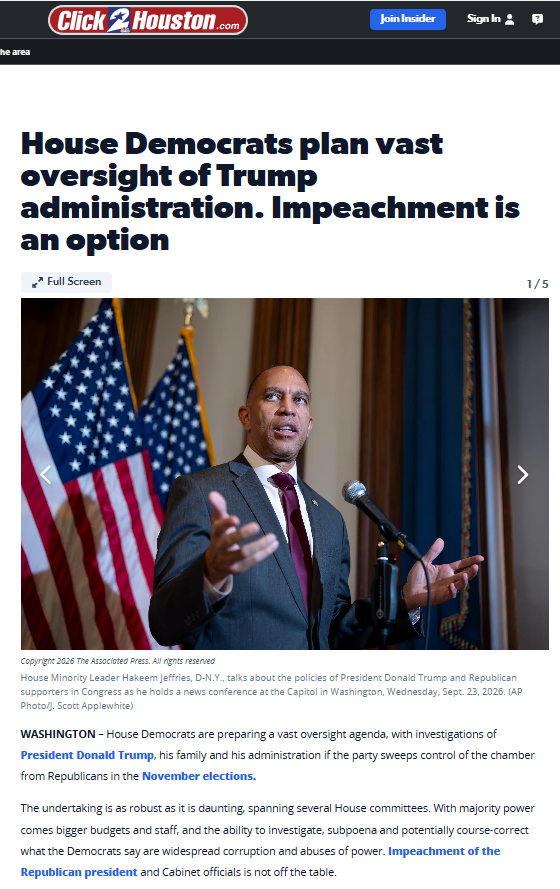
Associated Press reporting says the prospective agenda spans several committees and leaves impeachment of Trump or Cabinet officials possible. Hakeem Jeffries has deliberately avoided committing the party to either course:
“We haven’t ruled anything out ... and we haven’t ruled anything in.”
(Source: House Democrats plan vast oversight of Trump administration. Impeachment is an option / Associated Press via PBS) www.pbs.org
The first inquiry could follow the money. Democrats have questioned the growth of Trump family wealth and the intersection of private business with public office. A concrete example is the wedding celebration for Donald Trump Jr. and Bettina Trump. ProPublica reported that Russian businessman Umar Kremlev paid for parts of the event; the couple later confirmed he hosted the celebrations. The appropriate oversight question is whether any financial relationship created access or influence. The reported payment alone does not answer it.
“Our dear friend Umar very generously hosted two incredible nights of celebrations for us.” (Source: Donald Trump Jr.’s Wedding Bankrolled by Putin-Linked Russian Oligarch / ProPublica, quoting the couple’s statement)
The Iran war would be another major track. A Democratic House could ask what authority the administration relied upon, what objectives it set, how its decisions affected shipping and fuel prices, and what conditions might end the conflict. The Foreign Affairs, Armed Services and Oversight committees could examine different parts of that record. Defense Secretary Pete Hegseth would likely be a witness and a potential impeachment target. Republican Representative Thomas Massie has already filed articles against him over his leadership of the Pentagon and conduct of the war.
Massie “filed articles of impeachment against Defense Secretary Pete Hegseth.” (Source: U.S. Republican lawmaker seeks Hegseth’s impeachment over Iran / Reuters)
Hegseth-first is a plausible strategy, not an announced Democratic plan. Hearings about the war could lead to an impeachment vote against him while keeping attention on military decisions and their consequences. Massie’s action shows that opposition to Hegseth is not confined to Democrats; it does not establish that enough Republicans would support impeachment. Jeffries could instead let committees gather testimony throughout 2027 and reserve any decision about impeaching Trump until they have a record.
The distinction between impeachment and removal is decisive. A House majority can approve articles, but conviction requires two-thirds of senators present—67 votes if all 100 participate. Even a Democratic Senate majority would be far short of that threshold on its own. Impeachment could put evidence before the public and require senators to vote; it should not be described as a likely route to removal.
“No person shall be convicted without the Concurrence of two-thirds of the Members present.” (Source: About Impeachment / U.S. Senate, quoting the Constitution)
Other inquiries would have a more direct legislative purpose. Associated Press reports that Democrats are examining the Kennedy Center closure, private funding of America’s 250th-anniversary celebrations, immigration operations and the shuttering of USAID. Hearings could trace who made each decision, where appropriated money went, and whether Congress needs to change governing law. Jamie Raskin, who would be positioned to lead Judiciary if Democrats take the House, has emphasized both the scale of the questions and the search for legislative remedies.
The FBI and Justice Department could also draw scrutiny. CNN reported that two senior FBI counterterrorism officials, Michael Burgwald and Courtland Rae, were reassigned after investigators decided alleged harassing calls to Katie Miller did not warrant further investigation. A committee might seek the decision record and ask whether it followed normal procedures. It would need evidence before attributing the personnel decision to the Miller family or to improper political pressure. This is a possible line of inquiry, not a subpoena Democrats have announced.
Subpoenas would begin disputes, not end them. The White House could assert executive privilege, resist document requests, and litigate committee demands. Criminal contempt referrals also depend on Justice Department enforcement, making them a limited remedy when the department serves the administration under investigation. Democrats would still have hearings, witness testimony, public documents, and civil enforcement options, but some fights could take months. The useful question for each committee would be which evidence it can obtain soon enough to inform legislation or voters, rather than how many subpoenas it can issue.
A Democratic Senate would add a different kind of leverage. It could withhold consent from Cabinet and judicial nominees, pressing the White House to choose candidates Democrats would confirm. Trump could use qualified acting officials for some executive vacancies, but federal law limits who may serve and for how long. Senate control would therefore constrain appointments without stopping the executive branch from operating.
The two chambers together could also pass a measure limiting the Iran war. Whether it could take effect over Trump’s objection is another question: overriding a presidential veto requires two-thirds in both chambers. A Democratic Congress's likely power, then, would lie in oversight, confirmations, and forcing recorded choices about the war. Its limits would be just as visible in the courts, the veto, and the Senate’s impeachment threshold.
Lame Duck? Trump will not accept the label
Donald Trump cannot run for a third elected term. That constitutional limit does not make him politically powerless after the midterms. He has repeatedly entertained talk of a 2028 campaign, worn a 2028 cap and discussed supposed routes around the limit. Yet he has also acknowledged that his presidency ends in January 2029. The useful question is how he exercises power during the two years between a possible congressional defeat and that departure.
“I’ll be an eight-year president, I’ll be a two-term president.”
(Source: ‘I’ll be an eight-year president’: Trump weighs in on third-term speculation / NBC News, quoting Trump in May 2025)
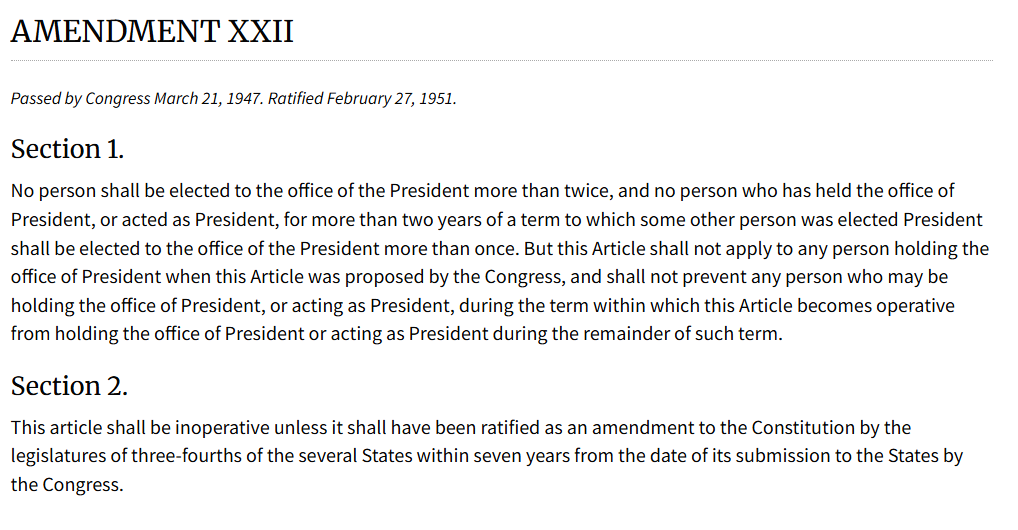
The Twenty-Second Amendment bars anyone from being elected president more than twice. Third-term merchandise and suggestive remarks can keep Trump at the center of Republican attention, but they do not change that rule. By August 2026, he was also speaking publicly about watching a successor from home after his presidency. Taken together, the remarks suggest a politician intent on resisting the political effects of a final term even while recognizing its constitutional endpoint. That interpretation is an inference about his strategy, not something his comments prove by themselves. (Source: Trump still teases seeking a third term. But he’s now talking more about post-presidency life / Associated Press.)
November could sharpen that tension. Trump has urged voters to treat the midterms as a judgment on him. If Republicans lose the House or Senate, he is unlikely to describe the result as the country withdrawing confidence from his presidency. He could blame candidates, congressional leaders, spending decisions or the war’s opponents. He would still be president, with control over the executive branch and a large audience among Republican voters. Losing Congress would change the obstacles he faces; it would not require him to adopt anyone else’s description of his standing.
Governing when Congress says no
Presidents who lose ground in Congress often look for initiatives that do not depend on passing their domestic agenda. The historical examples show different responses rather than a fixed rule. After the 1986 midterms, Ronald Reagan continued arms-control negotiations with Mikhail Gorbachev, leading to the 1987 Intermediate-Range Nuclear Forces Treaty. After the 2014 midterms, Barack Obama pursued the Iran nuclear agreement through negotiations with international partners. Neither example predicts Trump’s choices. Both show that a president can pursue a major foreign-policy outcome while facing a less cooperative Congress.
“We have now presented and explained to the Soviets our draft treaty text.”
(Source: Statement on Soviet–United States Intermediate-Range Nuclear Force Reduction Negotiations / Ronald Reagan Presidential Library, March 1987)
For Trump, the most immediate foreign-policy opening would be Iran. A negotiated reopening of the Strait of Hormuz could reduce pressure on fuel prices and give him a claim of diplomatic success. A wider settlement would be much harder: Washington and Tehran remain divided over sanctions, frozen assets, shipping and the war itself. Trump rejected Iran’s September seven-day roadmap, so a deal after November is a possibility rather than an announced change of course. A Russia arrangement could offer another legacy claim, but its terms and consequences would matter more than the image of a summit.
Domestic policy would be more confrontational if Democrats controlled the House. Trump could continue using executive orders and authority already granted by statute, including powers related to emergencies and trade. He could not, however, replace legislation with a signature. Courts can review executive action, Congress controls appropriations, and a Democratic House could investigate how agencies implement his decisions. Expect fights over what the law permits, what money agencies may spend and what documents lawmakers can obtain.
His first term shows his willingness to sustain such a confrontation. After Republicans lost the House in 2018, a dispute over border-wall funding led to a 35-day partial government shutdown spanning December 2018 and January 2019. It was the longest shutdown at the time; subsequent shutdowns mean it is no longer the longest in history. The episode demonstrates a readiness to absorb substantial disruption over a demand he considered central. It does not establish that another shutdown would follow a 2026 defeat. (Source: Shutdown of the Federal Government: Causes, Processes, and Effects / Congressional Research Service.)
The personal stakes of oversight
A Democratic House could investigate Trump family finances, the Iran war and federal law enforcement. That prospect may affect Trump more directly than an ordinary legislative defeat. Associated Press reporting describes a potential oversight agenda across several committees, while Democratic leader Hakeem Jeffries has left impeachment open without promising it. Subpoenas could provoke executive-privilege claims and court battles; the result of any particular investigation cannot be assumed before evidence is gathered.
Trump might respond with sharper attacks on committee chairs and witnesses, personnel changes inside agencies, or pardons. These are scenarios, not actions already decided. A pardon would require someone to face potential federal criminal exposure; an investigation or an embarrassing revelation alone would not create that need. The reported reassignment of FBI officials Michael Burgwald and Courtland Rae after an inquiry involving calls to Katie Miller could itself become an oversight subject. The reporting does not establish who ordered their reassignment or prove a broader plan to use law enforcement against investigators.
Trump might also choose restraint in one area while escalating in another. Fuel prices have become a political liability. An Iran agreement that reopened shipping would address a problem voters experience each week and offer a result he could present as a victory. He might simultaneously resist congressional investigators and seek that deal. The choices need not follow a single pattern of greater or lesser recklessness.
His hold on the Republican Party is the strongest reason the “lame duck” label will fit imperfectly. Trump cannot appear on the 2028 presidential ballot, but he can endorse a successor, attack contenders he considers disloyal and shape what Republican primary voters demand. Vice President JD Vance would enter that contest with prominence, though no endorsement can award him the nomination. A congressional loss could even intensify competition for Trump’s support as ambitious Republicans decide how closely to identify with him.
Trump turns 82 in June 2028. Age makes succession relevant to every administration, but speculation about a health event is not evidence that one is imminent. The constitutional process distinguishes death or resignation from temporary inability to serve; neither automatically gives a vice president a future party nomination. Trump’s influence in 2028 will depend on his health, public standing, decisions as president and the choices Republican voters make.
A president can lose Congress and still dominate his party. That tension is likely to define Trump’s final two years if November goes against Republicans: less ability to legislate, more scrutiny from Capitol Hill, and continued power to decide which Republicans inherit his movement.
The 2028 starting gun fires November 3
The 2028 presidential election is two years away, but the November 3 midterms will start the practical contest. Prospective candidates will learn whether their party is entering 2027 with momentum, which messages worked, and which governors or senators emerged stronger. Donors and campaign staff will begin making commitments soon afterward. Some candidates could announce within weeks; others can afford to wait until spring. The claim that most major contenders will declare by summer 2027 is a forecast, not a timetable anyone has announced.
Recent open contests show how widely announcement dates can vary. The table measures time from the preceding November midterm election, with intervals rounded.
| Announcement | Candidate | Time after preceding midterm |
|---|---|---|
| January 20, 2007 | Hillary Clinton (D), exploratory committee | About 2½ months |
| February 10, 2007 | Barack Obama (D) | About 3 months |
| December 31, 2018 | Elizabeth Warren (D), exploratory committee | About 8 weeks |
| January 21, 2019 | Kamala Harris (D) | About 2½ months |
| April 25, 2019 | Joe Biden (D) | About 5½ months |
| November 15, 2022 | Donald Trump (R) | One week |
| May 24, 2023 | Ron DeSantis (R) | About 6½ months |
The distinction between an exploratory committee and a formal candidacy matters for Warren and Clinton. The dates are documented in The American Presidency Project’s campaign records, its Biden announcement, and DeSantis’s campaign record. The pattern is clear: an early entrant can try to claim staff, donors, and attention; a better-known contender can wait while the field develops.
Kamala Harris is the first major Democratic decision. She passed on the 2026 California governor’s race and has begun campaigning for midterm candidates, including Michigan Senate nominee Abdul El-Sayed. She has not committed to another presidential run. Some former advisers doubt she will enter; her continuing political activity leaves the possibility open. She can watch November’s results and assess whether Democrats want to renominate their 2024 candidate or begin with a new field. (Source: Kamala Harris launches into the 2026 midterms as her 2028 decision looms / Associated Press; Many ex-aides to Harris betting against a 2028 run / Axios.)
Gavin Newsom has tied his choice unusually closely to hers. The term-limited California governor leaves office in January 2027 and told CNN he would not seek the Democratic nomination if Harris runs. That makes Harris’s decision consequential for both politicians, although Newsom could continue organizing and meeting donors without formally declaring. Their relationship also complicates the assumption that every prominent Democrat will announce quickly after the midterms. (Source: Newsom says he won’t run for president if Harris does / Los Angeles Times.)
November gives other Democrats a test of strength. Pennsylvania Governor Josh Shapiro and Georgia Senator Jon Ossoff are on the ballot. Large victories would bring them national attention, particularly if they outperform other Democrats. But attention should not be mistaken for intention: Ossoff has explicitly rejected 2028 speculation, saying he has “zero interest” in running. Pete Buttigieg, meanwhile, chose not to seek a Michigan Senate or governor’s seat in 2026, leaving himself available for a presidential campaign. That choice preserves an option; it does not constitute an announcement. (Source: Ossoff says he has ‘zero interest’ in running for president in 2028 / WSB-TV; Buttigieg won’t seek Michigan Senate seat / Associated Press.)
South Carolina deserves attention because Democrats have selected it to lead their 2028 primary calendar. Visits there can help a prospective candidate build relationships with local activists and voters. They are still an imperfect indicator: politicians also travel to support the midterm ticket. (Source: Democrats pick South Carolina as first 2028 primary state / Reuters)
The Republican sequence may be slower. Vice President JD Vance has said he will discuss a possible run with his wife, Usha, after the midterms; he has also spoken about discussing his future with Trump. A sitting vice president has little need to launch immediately. His position gives him national visibility, while Trump’s eventual endorsement could shape the field. Other Republicans must decide whether to seek that endorsement, wait for it, or run against Trump’s preferred successor. None of those choices can be settled until the midterm result clarifies Trump’s standing. (Source: Vance says he will discuss 2028 presidential run after midterm elections / CBS News)
November 3, then, is a starting gun for decisions, not necessarily declarations. By summer 2027, the field should be much clearer, but Harris’s choice, the fortunes of candidates on this year’s ballot, and Trump’s role in choosing an heir could each delay an otherwise plausible campaign.
Republicans: Vance’s nomination to lose
JD Vance is the early favorite for the 2028 Republican nomination. He has the vice presidency, a national profile and a close relationship with the voters most committed to Donald Trump. Marco Rubio is the strongest alternative within the administration. Neither has declared, and Trump has not publicly settled the succession. The November 2026 midterms are the next test: their result could strengthen Trump’s ability to designate an heir or give other Republicans reason to explore a challenge.
Prediction markets capture that uncertainty, but their prices are changing assessments by traders, not primary polls or reliable forecasts two years in advance.
| Candidate | Polymarket, Sep. 23 | Kalshi, mid September |
|---|---|---|
| JD Vance | 51% | About 39% |
| Marco Rubio | 15% | About 30% |
| Tucker Carlson | 3% | Under 5% |
| Ron DeSantis | 3% | About 5% |
| Ted Cruz | 2% | Under 5% |
(Sources: PredictMarketCap for Polymarket; Federal News Network for Kalshi. The two venues disagree sharply on Rubio, and the Kalshi figures may lag. That gap is itself informative: traders are unsure whether Trump will anoint a single heir.)
The Polymarket nomination market showed Vance at roughly 51% and Rubio near 16% when retrieved. Federal News Network’s Kalshi roundup, dated September 26, reported approximately 39% for Vance, 30% for Rubio and 5% for DeSantis. Its narrative does not verify precise Kalshi prices for Carlson or Cruz, which is why the table leaves those figures qualified. The two columns are different snapshots from different markets, not simultaneous votes by the same group of traders.
The Rubio gap is still revealing. Traders on one venue see Vance with a substantial lead; those cited from another see something closer to a two-person contest. That does not prove inside knowledge of Trump’s intentions. It reflects how little is settled about who will carry his coalition into an election in which he cannot himself be elected president again.
Vance has the inside lane
Vance’s principal advantage is structural. A vice president can speak for the administration, campaign for its candidates and build relationships with party activists without formally opening a presidential campaign. Trump has also sent encouraging signals. An August report said he privately told donors he wanted Vance elected in 2028, while advisers cautioned that the president had not definitively chosen a successor. Vance says he and his wife, Usha, will discuss a run after the midterms. That gives him a reason to defer a declaration without surrendering his lead. (Sources: Trump tells donors, ‘We need to elect JD’ / The Washington Post; Vance weighs a 2028 decision / CBS News.) The Washington Post
The failure was not his alone to control, but it gives rivals a concrete episode to raise when judging his ability to deliver a settlement.
The talks “finished without a deal.”
(Source: U.S. and Iran end ceasefire talks without agreement / Associated Press)
The war also creates a delicate primary argument. Vance can call for an end and emphasize prices while defending the administration he serves. A rival outside the White House could speak more freely, particularly to Republicans who opposed prolonged intervention from the start. Whether that becomes a viable challenge depends on what happens between now and the primaries: a settlement would change the argument considerably.
Rubio is the alternative inside the room
Rubio’s case rests on experience and Trump’s trust. He serves as secretary of state and has also carried national security adviser duties, a combination last held by Henry Kissinger. Those posts give Rubio direct involvement in the administration’s defining foreign-policy decisions and regular visibility alongside Trump. They also leave him exposed to criticism of those same decisions. (Source: Trump replaces Waltz with Rubio as national security adviser / Reuters.) reuters.com
Trump has praised a Vance–Rubio ticket, and advisers have discussed Vance at the top with Rubio as his running mate. That is a plausible arrangement, not the likeliest outcome established by evidence. Rubio could seek the presidential nomination himself, decline a vice-presidential offer or decide that remaining outside the race better serves him. A separate Polymarket vice-presidential market has put him ahead for that position, but it measures traders’ expectations, not Rubio’s consent. (Sources: Trump says Vance and Rubio teaming up would be unbeatable / Reuters; JD or Marco? / Axios.)
Who could challenge them?
A weak Republican midterm could create openings, but it would not automatically end Trump’s influence with primary voters. Tucker Carlson or Donald Trump Jr. might appeal to voters who want a sharper populist critique of the Iran war. Neither has declared a campaign, and small-market prices cannot establish that they intend to run.
The potential governing candidates would make a different case. Brian Kemp leaves Georgia’s governorship in January 2027 after declining the Senate race. Former Virginia governor Glenn Youngkin could emphasize electability and his executive record; Youngkin’s term ended in January 2026, so he is already out of office. Ted Cruz has visited Iowa, an early sign of interest rather than a declaration. Ron DeSantis retains national recognition from 2024 but would have to show why a second attempt would succeed where his first did not. (Sources: Glenn Youngkin / National Governors Association; Cruz’s Iowa visit fuels speculation / The Texas Tribune.)
The September Senate war-powers vote illustrates the constraint facing every challenger: the measure to limit U.S. hostilities with Iran failed 49–50. Republicans can criticize the war’s duration and fuel costs, but directly repudiating Trump remains a much harder step inside the party. A candidate may promise greater competence or a quicker settlement while presenting that promise as a continuation of Trump’s goals. (Source: Senate Roll Call, September 24, 2026 / U.S. Senate.)
Vance starts ahead, Rubio has the clearest route past him, and November determines whether a broader field sees an opening. Trump’s preference will matter enormously. So will the record his prospective heirs must defend.
Democrats: a field without a favorite
No Democrat trades above 18%. Three names share the top tier, and dozens divide the rest. It is the most open field these exchanges have ever priced.
| Candidate | Polymarket, Sep. 23 | Kalshi, Sep. 3 |
|---|---|---|
| Alexandria Ocasio-Cortez | 18% | 17% |
| Jon Ossoff | 15% | 17% |
| Gavin Newsom | 13% | 13 to 14% |
| Kamala Harris | 6% | 8% |
| Josh Shapiro | 6% | 5% |
| Pete Buttigieg | Not reported | About 5% |
Sources: PredictMarketCap for Polymarket; OddsShopper for Kalshi; Buttigieg from Stokastic, August.
The serious candidates, assessed:
- Ocasio-Cortez has the strongest grassroots and small-dollar base, and the July rallies with Bernie Sanders and El-Sayed in Michigan showed her pull. Her real choice is between 2028 and a Senate primary against Chuck Schumer that same year. A market that prices her first may be overrating how willing primary voters will be to nominate a democratic socialist after a midterm won on affordability by moderates.
- Ossoff is the candidate most dependent on November. A comfortable win in a state Trump carried, as a Senate Democrat who campaigned on the Iran war, affordability and corruption, would make him the electability candidate by default. He says he is not interested; so did Obama in 2006.
- Newsom has the national profile, the donor network and the podcast audience, and he will be free of Sacramento in January. His problem is that he has deferred to Harris and that California is a liability in swing states.
- Harris can clear a large part of the field simply by running, since Newsom has deferred to her. Markets and most analysts doubt she would win a contested primary after 2024.
- Shapiro, Buttigieg and Pritzker form the second tier. Shapiro's reelection margin in Pennsylvania this November is his launch argument. Buttigieg is underpriced relative to his early state work. Pritzker can self-fund.
Other names with real chances of entering include Mark Kelly, Ruben Gallego, Andy Beshear, Wes Moore, Gretchen Whitmer, Chris Murphy, Ro Khanna and Cory Booker. James Talarico, if he wins Texas, becomes an instant national figure, though 2028 is probably too early for him.
2027–28: gridlock, subpoenas, succession
If Democrats take Congress, Trump faces investigations and contested nominations; a Democratic House alone could investigate while Republican senators continue confirming nominees. A GOP hold would preserve his legislative room. The stated 60/32/8 split is only a rough scenario estimate: separate House and Senate prices do not establish joint odds without accounting for correlation.
“With majority power comes bigger budgets and staff, and the ability to investigate, subpoena and potentially course-correct.” (Source: House Democrats plan vast oversight / Associated Press)
Since the 1952 election, only one party has won three consecutive presidential elections: Republicans in 1980, 1984 and 1988, when George H. W. Bush succeeded Ronald Reagan. That history is a warning for Republicans looking toward 2028, but it is not a forecast. Elections turn on candidates and conditions, and November 2026 has not happened yet. The useful question is how a loss of Congress would change each party’s choices during Trump’s final two years. (Source: 1988 Electoral College Results / National Archives.)
George W. Bush offers the closest historical comparison. In 2006, his approval was 37 percent near the midterms; Republicans lost 30 House seats and six Senate seats, surrendering both chambers. Bush then pursued his Iraq strategy despite opposition, while Republicans eventually nominated John McCain, whose political identity was established long before Bush’s second term. The comparison has a limit: McCain could present himself as independent of Bush while still supporting the Iraq troop surge. A successor’s distance from a president is rarely complete. (Source: Seats in Congress Gained/Lost by the President’s Party in Mid-Term Elections / American Presidency Project; George W. Bush Event Timeline / American Presidency Project.)
Trump’s position is different again. A September Reuters/Ipsos poll put his overall approval at 32 percent, yet found substantially stronger support among Republicans. His vice president is also a prospective successor. Losing Congress could weaken Trump’s argument that he helps candidates win without ending his influence over the voters who choose Republican nominees. (Source: Trump approval falls to record low of 32% as high costs bite / Reuters.)
Republicans: distance on policy, loyalty in public
If Democrats take the House, watch retirements first. Members from narrowly Republican districts would face a difficult calculation: spend 2027 and 2028 defending an unpopular administration from the minority, or leave before another presidential election. A wave is plausible, especially if the midterm defeat is large, but it should be treated as a possibility rather than a scheduled event. Some members may instead stay because a Republican presidential nominee could improve their prospects in 2028.
The clearer evidence of repositioning is already visible in the Iran debate. Republican Senate candidates Mike Rogers in Michigan and Ashley Hinson in Iowa have called for a swift end to the conflict as fuel costs squeeze voters. Hinson wrote:
“Iowans are being squeezed and shouldn’t have to foot the bill at the pump or the checkout line for the war in Iran.”
— (Source: Two Republican Senate candidates call for swift end to Iran war, diverging from Trump / Reuters.)
That statement identifies a political pressure point; it does not establish how Hinson would vote in the Senate. Reuters noted that, as a House member, she had repeatedly voted against measures restricting Trump’s authority over the war. In 2027, the meaningful test for Republican senators will be whether campaign language becomes votes on war powers, tariffs or nominees. Candidates facing competitive 2028 races may seek room to disagree on costs while declining to criticize Trump personally.
Governors have more freedom to develop a distinct message because they do not cast congressional votes. They can argue that their states offer a better model for prices, jobs or public services. Meanwhile, the argument inside conservative media over Iran gives prospective candidates competing audiences: voters who want the conflict ended and those who want a more forceful outcome. Reuters reported that the war had tested unity among Trump’s supporters. A settlement could rearrange those factions as quickly as another escalation. (Source: Trump’s Iran strike tests MAGA unity ahead of midterms / Reuters.)
JD Vance faces the hardest balancing act. He can build relationships with donors and activists, describe what he would prioritize in 2028, and promise competence on costs. He also shares the administration’s record, including its Iran policy. At September’s Republican gathering in Dallas, Reuters reported that the party was already debating its future while Trump remained central to it. Vance’s path is therefore a succession campaign that must persuade voters he can improve results without appearing to repudiate the president he serves. (Source: As Trump takes center stage in Dallas, Republicans debate a future without him / Reuters.)
Democrats: oversight and a fight over the mandate
A Democratic House would gain investigative power, but its first dispute may concern how to use it. Members elected on affordability will want hearings that connect administration decisions to household costs. Others will demand inquiries into the war, federal law enforcement and presidential business interests, with impeachment considered where the evidence warrants it. Jeffries has left his options open:
“We haven’t ruled anything out, and we haven’t ruled anything in.”
— (Source: House Democrats plan vast oversight of Trump administration. Impeachment is an option / Associated Press via PBS.)
That is a commitment to examine the evidence, not a timetable for impeachment. A narrow majority would make the distinction consequential: investigations can unite members who disagree over whether impeachment would help them govern or win the next election.
The 2028 nomination fight would sharpen that disagreement. Swing-seat Democrats could argue that a victory on prices calls for a nominee who can hold those voters. Progressives could argue that energetic candidates and a stronger challenge to Trump produced the turnout. Abdul El-Sayed’s result in Michigan would matter to that argument if he wins; no single Senate race, however, could settle a national primary.
South Carolina is set to vote first in the Democratic presidential calendar. That gives prospective nominees an early test with Black voters and makes organizing there more consequential than a burst of attention after the midterms. (Source: Democrats’ 2028 presidential calendar gives Black and Latino voters and union members an early say / Associated Press.)
The largest uncertainties may arrive from outside either party’s plan: an Iran agreement that lowers fuel prices, a recession, a consequential Supreme Court ruling, or a health crisis.
Trump is 80 in September 2026 and turns 81 next June.
Federal use of artificial intelligence is another developing issue; the Government Accountability Office has already identified gaps in guidance for protecting privacy.
Each could change what voters judge the next presidency must do. For now, the strongest conclusion is narrower: a midterm loss would start a succession contest, but it would not by itself settle who controls either party’s future. (Source: OMB Action Needed to Address Privacy-Related Gaps in Government-Wide AI Guidance / U.S. Government Accountability Office.)
What could change the picture?
Five weeks remain before the November 3 midterms. That is enough time for a close Senate race to change direction, particularly when control depends on several states. The House picture would take a broader shift in public opinion. Neither outcome is settled: a national polling lead describes the country’s mood, while seats are decided district by district and state by state.
An Iran agreement is the clearest Republican opportunity. Iran has offered a seven-day path to reopening the Strait of Hormuz, conditioned on steps including an end to the U.S. naval blockade, relief from oil sanctions and the release of frozen Iranian assets. On September 26, Al Jazeera reported, citing The Wall Street Journal’s account of unnamed U.S. officials, that Trump had ruled out the proposal. Its report also made a distinction: the U.S. government had not publicly responded. Indirect talks were continuing. (Source: Trump ‘rejects’ Iran’s seven-day ceasefire proposal. What’s next? / Al Jazeera.)
A revised deal in October could still change the campaign. Reopening Hormuz would give Republicans an argument that the disruption to energy supplies is ending. It would also have to produce visible relief quickly. Oil markets can react to diplomatic news in a day; drivers judge the result at the pump. The Energy Information Administration explains why that distinction matters:
“About half of that price change usually occurs within the first two weeks of the crude oil price change.”
That is a historical rule of thumb, not a forecast for this conflict. Refining and distribution conditions also affect retail prices. A late agreement could therefore improve expectations before it substantially reduces what voters pay. (Source: Gasoline prices—second largest one-week increase since 1990 / U.S. Energy Information Administration.)
Escalation could move opinion in either direction. A major attack on U.S. personnel or shipping might initially produce support for a forceful response. Seven months into the war, it could also renew questions about its cost, duration and purpose. The present polling gives reason to avoid assuming a lasting rally: Reuters/Ipsos found that only 34 percent approved of the strikes on Iran, while 82 percent expected the conflict to continue for an extended period. Those findings measure existing attitudes, not how voters would respond to a new attack. (Source: Trump approval falls to record low of 32% as high costs bite / Reuters.)
Candidates still matter. A poor debate, damaging disclosure or campaign mistake could change a state race even if the national environment holds steady. Maine shows how uncertain one decisive seat remains. On September 26, Kalshi reported that Republican Susan Collins’s price in its Maine winner market had risen 8.7 percentage points since September 24. Democrat Troy Jackson still led that market, 62 percent to 36 percent, even though a newly reported New York Times/Portland Press Herald/Siena poll put Collins ahead 49 percent to 46 percent. A market price, a poll and the eventual vote answer different questions. Their disagreement is a reason to watch Maine closely, rather than call it for either candidate. (Source: Collins’ odds jump 8.7 points in Maine Senate market / Kalshi.)
Polling error is the larger Senate risk. Polls understated Republican support relative to Democratic support in the last three presidential elections, although the scale and causes differed. The American Association for Public Opinion Research draws a careful distinction about 2024:
“Public polling was more accurate in 2024 than in 2020 or 2016, but still underestimated Republican votes relative to Democrats’.”
An error in the same direction this November could change several close Senate results at once. Texas, Ohio and Maine need not behave independently if polls across them have missed the same kind of voter. An error in the opposite direction could give Democrats seats that now look less attainable. The past identifies a risk; it does not tell us the direction of this year’s error. (Source: Polling Accuracy / American Association for Public Opinion Research.)
Election administration is another source of uncertainty. A CNN discussion of its September poll reported that 61 percent considered voting and elections extremely important to their congressional vote. Trump has sought changes to election rules, including restrictions affecting mail voting, and those efforts have faced court challenges. If a Senate contest is exceptionally close, counting, litigation or a recount could delay certainty. A delayed result, however, should not be treated as evidence that the count is improper. (Sources: CNN One World, September 23 transcript / CNN; Court panel declines to block Trump’s mail ballot order / Associated Press.)
How to read the numbers
A quoted 62 percent chance of Democratic Senate control is a market price at a particular time, not a promise that the party wins 62 of every 100 comparable elections. State contracts can move sharply, as Maine’s did, and a state quote captured days earlier may be stale. Markets also reflect trading conditions alongside new information. The most useful approach is to give each figure its observation date, check whether it has changed, and keep it separate from polling.
The same care applies to history. Democrats led Republicans 43 percent to 35 percent among registered voters in the September Reuters/Ipsos congressional preference question. Reuters cautioned that the national figure does not capture all the state and district contests that decide Congress. It supports the case for a difficult Republican environment; it does not establish a House seat total or prove who will control the Senate. (Source: Trump approval falls to record low of 32% as high costs bite / Reuters.)
The verdict
Trump returned to office promising relief from high prices and an end to foreign wars. The Iran conflict has made both promises harder to defend. In the same Reuters/Ipsos survey, his overall approval stood at 32 percent and approval of his handling of the cost of living at 17 percent. Those numbers explain Republican anxiety without deciding what happens on November 3. A diplomatic opening, an economic shift, stronger candidates or a polling miss could still change the result. (Source: Trump approval falls to record low of 32% as high costs bite / Reuters.) Reuters
If Democrats win the House, Trump would face investigations and lose the straightforward route for passing partisan legislation. He would still hold the presidency and its executive powers. If Democrats also win the Senate, they would gain leverage over confirmations and the administration’s personnel choices. These are substantial constraints, though neither chamber alone can compel Trump to abandon his policies.
That is why the election’s consequence may outlast its immediate seat count. A Republican defeat would intensify the party’s argument over who can carry Trump’s movement into 2028 and which parts of his record a successor should defend. Trump would retain the presidency, a powerful endorsement and supporters who still expect him to lead. Whether that leaves him diminished or makes him fight harder to demonstrate his authority is a question the midterm result will begin to answer.