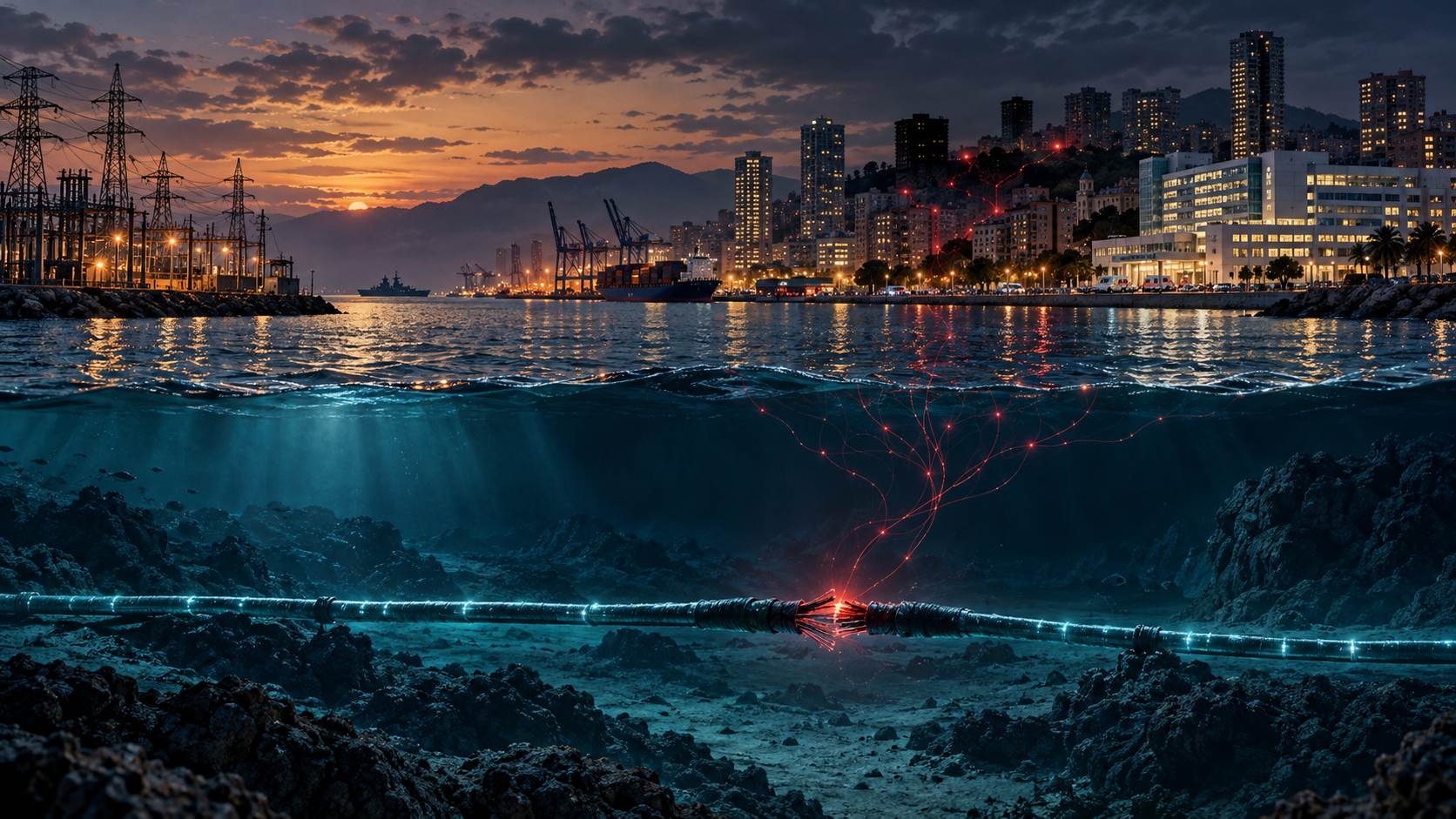
The Coming Storm
Each morning, a monk crossed a wooden bridge to fetch water for his monastery.
One autumn, soldiers appeared on the distant ridge. The youngest novice watched their banners and asked, “Master, will the war reach us?”
The monk handed him two empty buckets.
“First, bring water.”
“But should we not watch the soldiers?”
“We have watched them since sunrise. The kitchen is still empty.”
That evening, a storm swept through the valley. No army came, but the old bridge collapsed.
By morning, the monastery had water because the novice had filled every jar. When frightened villagers arrived, there was enough to share.
“I thought you knew the storm was coming,” the novice said.
“I did not.”
“Then why did you ask me to prepare?”
The monk poured him a cup.
“You were waiting to learn which danger deserved your attention. Meanwhile, you already knew the village had only one bridge.”
The Warnings and the Missile Shield
Joe Rogan, the YouTuber, discusses recent warnings and agency communications urging people to stockpile food and water, along with a heightened threat perception at Mar-a-Lago.
The deployment of military air defenses around President Donald Trump’s Mar-a-Lago estate significantly reinforces presidential protection. NORAD and U.S. Northern Command confirmed that ground-based air defenses and counter-drone capabilities were deployed at the Secret Service’s request. The agency cited a “heightened threat environment,” but officials have not publicly identified a specific plot or imminent attack behind the decision.
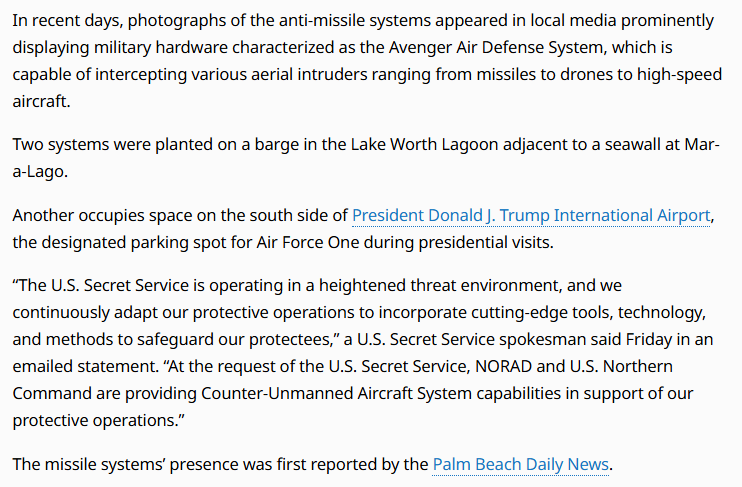
Photographs and local reporting show Avenger short-range surface-to-air missile systems near Mar-a-Lago and the nearby Donald J. Trump International Airport, including equipment aboard a floating platform beside the estate. Counter-drone capabilities were also confirmed. These additions strengthen an existing protective operation involving restricted airspace, surveillance and fighter aircraft. Their significance lies in adding a local defensive response alongside the wider air-security operation.
The threat environment has several dimensions. Trump has survived assassination attempts, while repeated airspace violations create a continuing identification and interception burden. WPTV reported that NORAD had intercepted more than 60 aircraft violating restrictions around Palm Beach since January 2025. Those incidents should not collectively be read as attempted attacks: the recently reported October 24 interception ended when the civilian pilot established communications and left the restricted area. Nevertheless, repeated incursions complicate the task of distinguishing an innocent mistake from a hostile approach.
Did the White House and Camp David take comparable measures? Yes, although the publicly documented arrangements differ. Washington’s National Capital Region has been protected by NASAMS surface-to-air missile systems since 2005, and Avenger defenses have also been publicly documented near the White House. At Camp David, NORAD has long enforced airspace restrictions and provided fighter protection, including during the 2012 G8 summit.
Broadly, the deployment suggests that presidential security increasingly treats aerial threats, including drones, as a problem requiring military support alongside conventional policing.
A reasonable inference from these arrangements is that officials are building capacity to detect, assess, and stop an airborne threat near a frequently used presidential residence. Remember, Mar-a-Lago is a private property that functions as a presidential venue for Donald Trump.
Attack on US Military Bases?
But protecting the skies addresses only part of the problem. A missile battery can defend against an approaching aircraft. It cannot stop someone thousands of miles away from interfering with the equipment inside a military base.
That is what makes the Pentagon’s freezer investigation so unsettling. Here is a report from Reuters.
So what was impacted?
At Fort Huachuca in Arizona, a freezer reportedly entered defrost mode and heated its contents. The Pentagon is investigating a suspected cyberattack, with Cyber Command and military investigators involved. No culprit has been publicly identified, and the cause remains under investigation. These were grocery facilities serving military communities; the reported incidents do not establish that operational military networks were breached.
France offers a disturbing parallel. Reuters reported that an October cyberattack manipulated refrigeration controls at more than 350 commercial establishments, spoiling food and reportedly causing some units to catch fire. Danfoss, whose controllers were used at many affected sites, said obsolete equipment and outdated firmware could have left them vulnerable. American investigators are consulting French authorities, although they have not established a connection between the incidents.
Water systems have faced similar intrusions. In 2023, U.S. agencies warned that CyberAv3ngers, an Iranian Revolutionary Guard-affiliated group, was compromising internet-exposed industrial controllers used by water utilities and other operators. Some devices still used default passwords. Separately, U.S. and allied agencies assessed that China’s Volt Typhoon was positioning itself inside American critical infrastructure to enable disruption during a major crisis or conflict.
The broader danger is easy to underestimate because the targets sound so ordinary: a freezer, a pump, a controller in a maintenance room. Yet those machines keep food safe, water flowing, and facilities running. Connecting them to the internet makes remote maintenance easier. It can also give an intruder a way to cause physical damage without ever approaching the gate.
These incidents do not show a single coordinated campaign. They do show why security now has to reach far beyond fences and air defenses. A country can guard its most prominent buildings and still leave the machinery sustaining everyday life dangerously exposed. The freezer investigation brings that vulnerability straight onto military property.
Governments asking people to Store Food and Water
The missile systems around Mar-a-Lago and the suspected hacking of military-base freezers raise a question much closer to home: how would your family manage if the electricity stopped, the taps ran dry, and shops could no longer process payments?
For most people, national security means soldiers, intelligence agencies and guarded borders. Yet a crisis can arrive through the ordinary machinery of life. A compromised water utility, a damaged electricity network or an interruption to food deliveries can leave households struggling without a shot being fired in their neighborhood.
That is why several governments are asking residents to keep emergency supplies. They recognize that, during a widespread disruption, public services cannot reach everyone immediately. A household with drinking water, food, medicines, and reliable information can manage while responders focus on people in immediate danger.
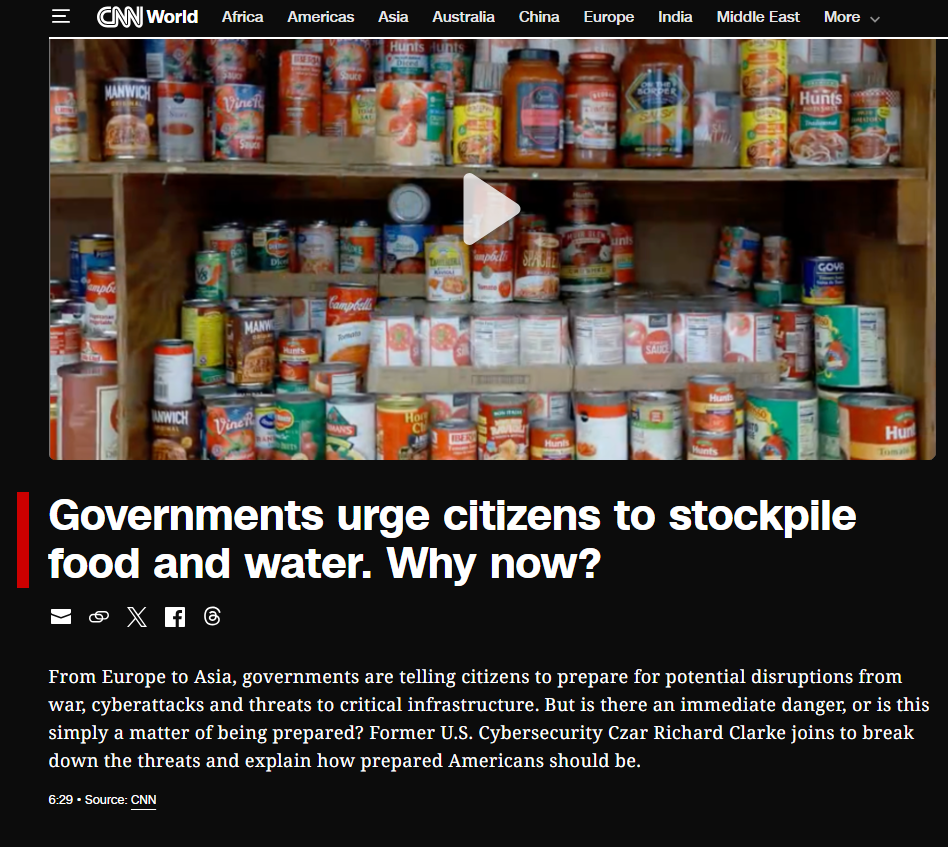
Britain’s security minister, Dan Jarvis, explicitly linked household preparedness to reducing pressure on emergency services when announcing updated guidance in October.
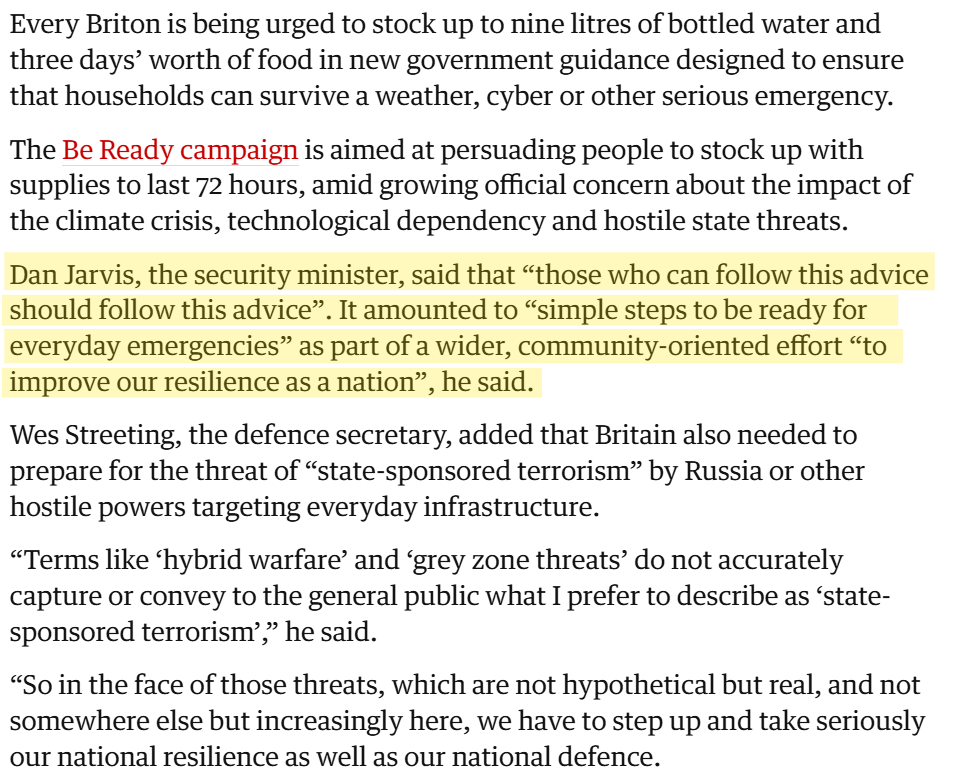
This isn't just one nation.
Across the world, from Europe to Asia, governments are telling their citizens to stock food and water to brace for the large-scale disruptions to public utilities and critical infrastructure via cyberattacks.
Concerns about drinking water are already grounded in real incidents. On July 30, 2026, the FBI and Environmental Protection Agency warned that water and wastewater utilities in at least seven states had reported cyber incidents since July 27. Some attacks had degraded operations. The agencies described intruders accessing internet-connected industrial controllers and changing passwords and network settings, leaving operators unable to monitor or control equipment remotely.
In Minnesota alone, more than 30 municipal water facilities were targeted. A law-enforcement official told NBC News that the activity bore the hallmarks of Iranian involvement. At the time, however, neither Minnesota nor federal authorities had publicly attributed the attacks to a specific actor. Minnesota officials also said there was no indication that municipal drinking water had been contaminated.
President Trump publicly rejected the Iranian explanation on July 31, blaming Minnesota’s leadership instead. His comments differed from the possibility investigators were examining; they did not resolve who carried out the attacks.
For households, the immediate issue is what happens when the water service becomes unreliable. A utility can lose essential control functions even when nobody has poisoned the supply. Operators must restore access, maintain service, and establish that systems are working safely. During that interruption, residents still need drinking water, food preparation, and basic sanitation.
The question is how seriously to take these warnings—and what, exactly, to do about them.
Which governments are asking people to prepare?
The recommendations vary. Some are recent campaigns; others are established practices receiving fresh attention.
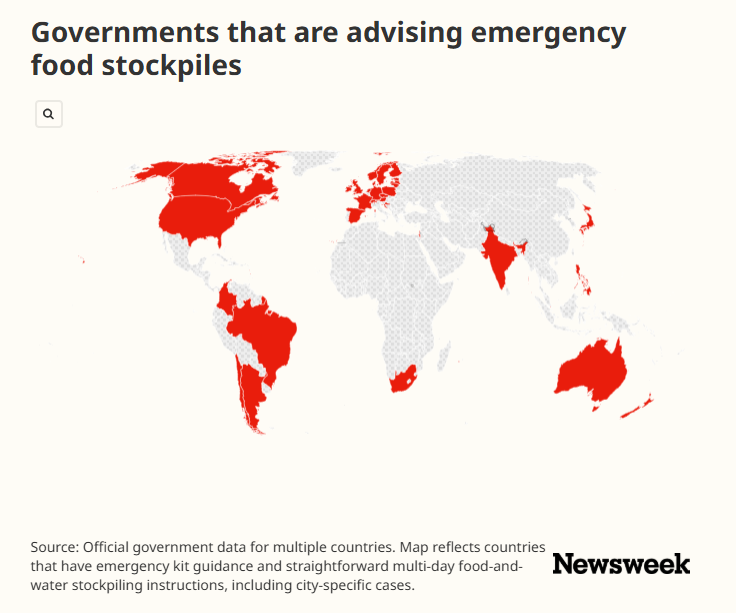
Authorities in 33 countries recommend keeping emergency supplies of food and water, according to a Newsweek map published on October 28, 2026.
Here is another graph showing the country-wise timelines for stock-piling.
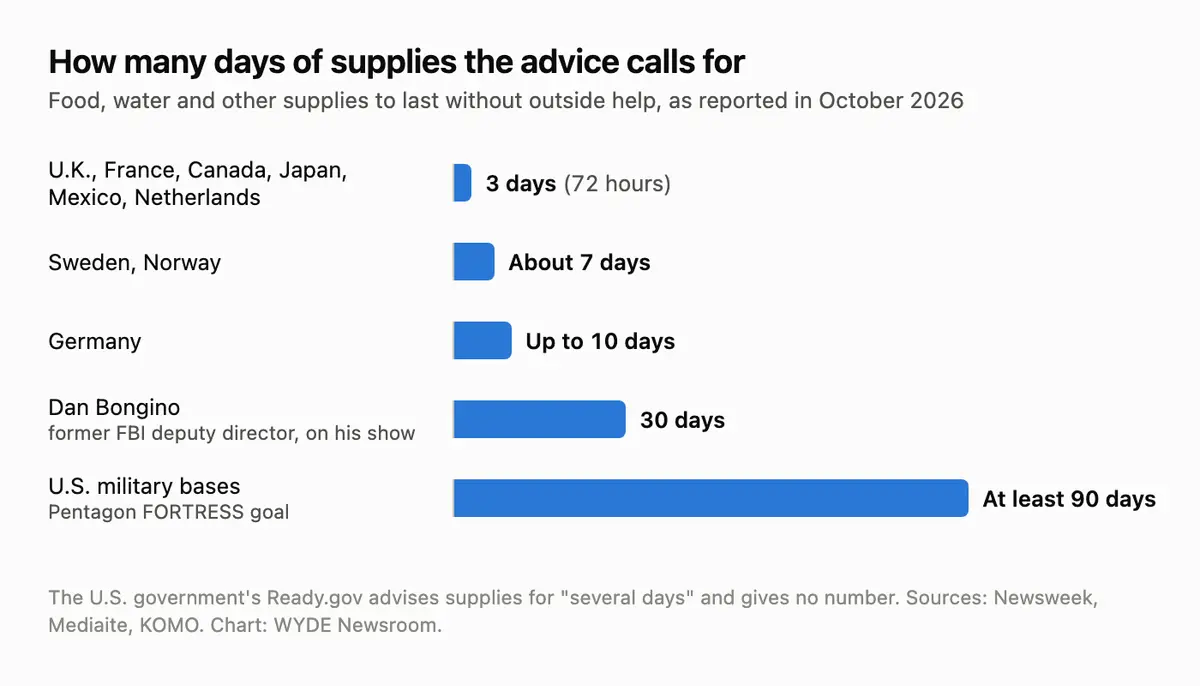
We have shared Former FBI Deputy Director Dan Bongino's warning in the next section. Here is a table detailing the warnings from different administrations.
| Country or jurisdiction | Recommended reserve | What residents are being asked to prepare for |
|---|---|---|
| United Kingdom | Three days | Temporary interruptions to services, including power, water and communications. |
| France, Ireland and the Netherlands | Three days | Britain’s Cabinet Office identifies these countries as using the same household-preparedness period. |
| Sweden | At least one week | Disruptions affecting electricity, water and the ability to buy food. |
| Norway | One week | Loss of essential services; guidance includes approximately 20 litres of drinking water per person. |
| Germany | Ten days | A household reserve of food and drink for emergencies. |
| Japan | At least three days, preferably a week | Disaster-related interruptions to supplies and everyday services. |
| United States | Several days initially; longer where feasible | Georgia recommends a three-day kit. CDC recommends at least three days of water, extending to two weeks if possible. |
These periods come from government guidance. They are not a single, uniform international instruction issued in response to one event.
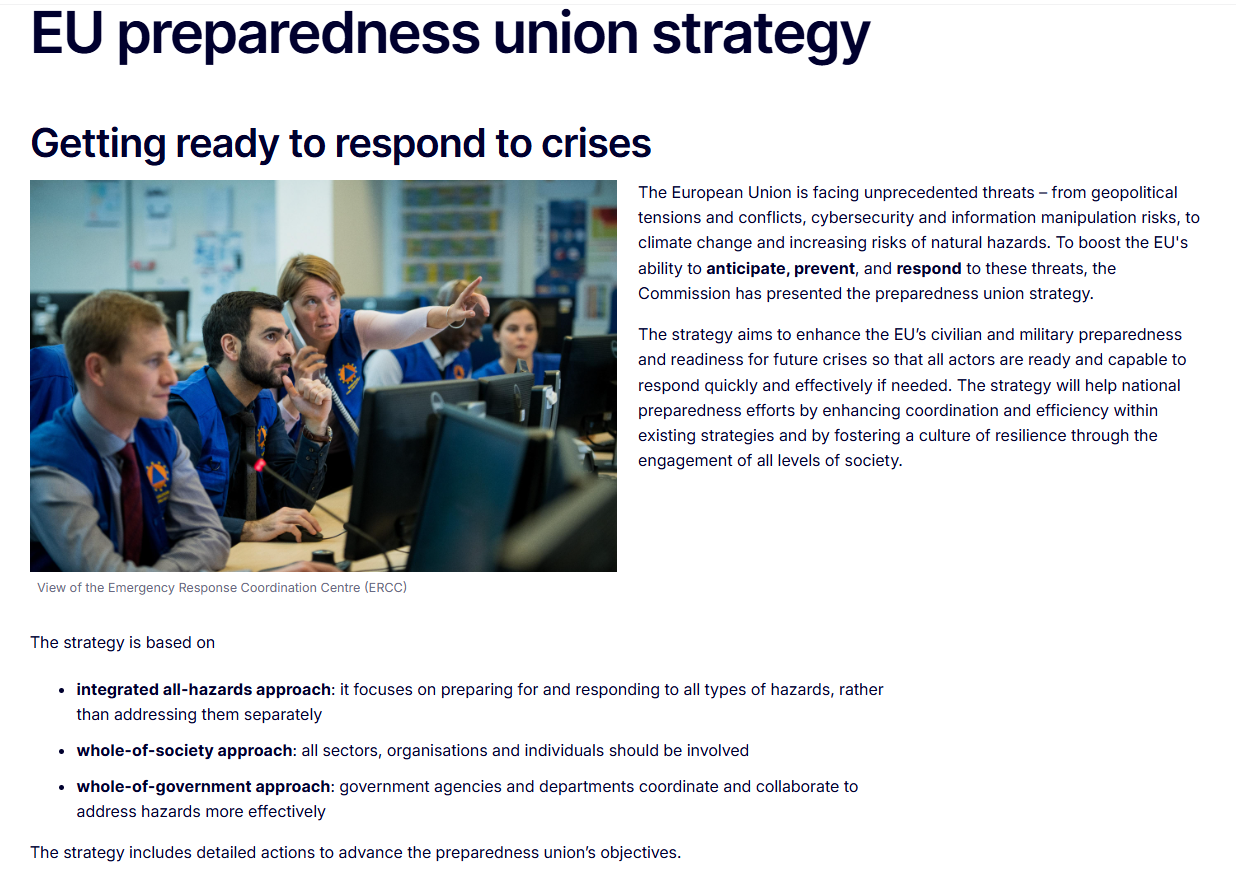
In March 2025, the European Commission’s Preparedness Union Strategy also called for guidelines supporting at least 72 hours of public self-sufficiency. Its approach covers multiple threats, including disasters and security emergencies.
Japan reminds us that emergency stockpiling need not signal an approaching war. Keeping household supplies is a longstanding response to earthquakes and other disasters. Tokyo encourages residents to build reserves through ordinary shopping, gradually increasing supplies of things they already use.
Why Now? Why Urgent?
Because so much depends on the same underlying services.
Electricity keeps refrigerators cold, supports communications, and powers equipment used by water systems. Digital networks support payments, ordering, and distribution. If one fails, the consequences can spread. A shop may have groceries but no functioning checkout. A household may have savings but no working ATM.
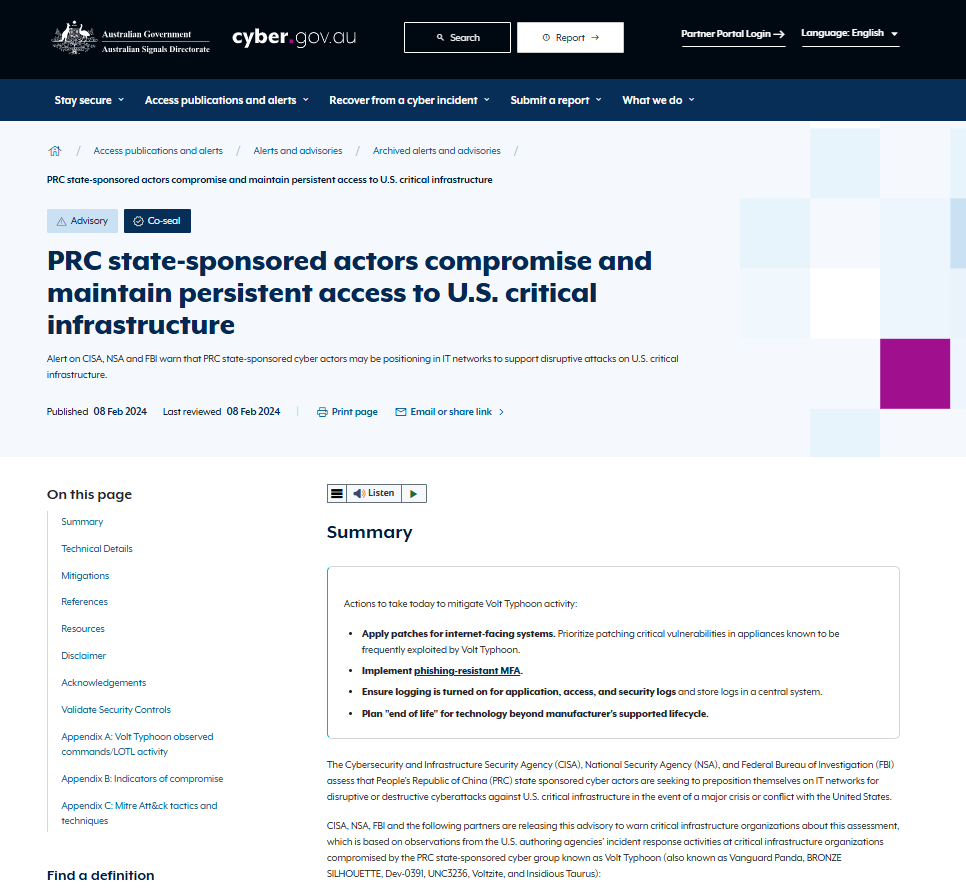
Cybersecurity agencies have documented threats that make these concerns concrete. U.S. and allied authorities assess that China-linked Volt Typhoon has sought access to critical infrastructure that could enable disruption during a major crisis or conflict. That is an assessment of capability and intent, rather than a prediction of a particular attack date.
Weather creates another route to the same problem. Britain’s October campaign specifically addresses interruptions caused by severe weather, including failures affecting power, water, phones and internet access. Emergency supplies remain useful whether the cause is sabotage, a storm or an equipment failure.
Experts Speak
We referred to Dan Bongino's warning in the previous section. Here are the details.
Former FBI Deputy Director Dan Bongino urged Americans to keep 30 days of food and water. He recommended emergency food, radios, batteries, and water-treatment supplies, arguing that preparation reduces panic. His message carried particular weight because of his recent position at the bureau.
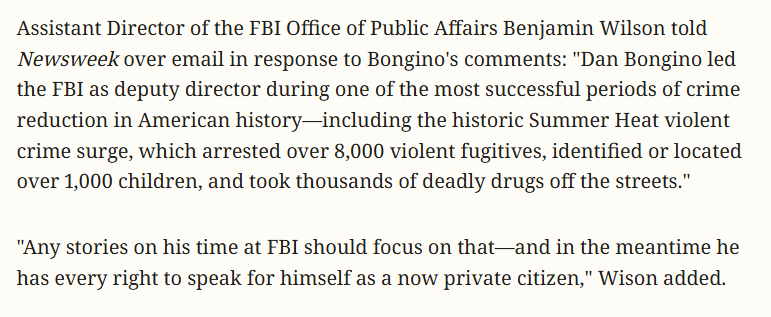
In the response attributed to FBI Office of Public Affairs Assistant Director Benjamin Wilson in Newsweek’s reporting, Wilson defended Bongino’s service and said he was speaking as a private citizen.
Bongino also referred to the Pentagon’s reported 90-day resilience planning for military installations. Bases have operational obligations that differ from household needs. A military planning target should not automatically become a civilian shopping list.
Former SEAL Team commander and SOFX founder Sam Havelock offers another useful perspective: preparedness is fundamentally a problem of obtaining essentials when normal access fails. SOFX reports that he recommends at least two weeks of food, water, fuel and prescription medicines, with a longer reserve where circumstances permit. He also recommends cash for interruptions to electronic payments. These are his recommendations, rather than government requirements.
 SOFX Editor Staff
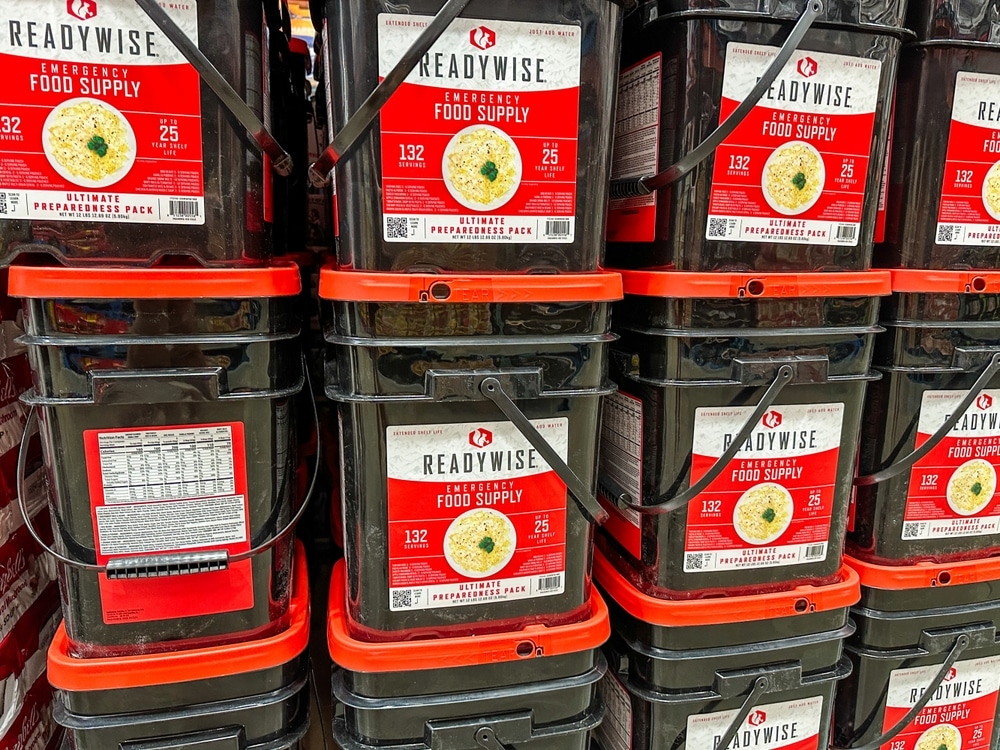
The most useful idea here is to identify what your household needs before considering elaborate equipment.
Ben Robson, A libertarian, economic conservative from Australia also shared his concerns on X.
Dear Australians,
— Ben Robson (@brobson_politic) November 1, 2026
A number of Western governments have advised their citizens to keep emergency supplies of water, non-perishable food, alternative power/lighting (torches, batteries, power banks, battery/wind-up radios), medicines, cash, first-aid kits, and related items.
This…
This is not all. Government is practicing something unprecedented.
US Government Practicing Burying Numerous Dead
A military exercise involving temporary graves for thousands of soldiers deserves public attention. It forces an uncomfortable question into the open: what kind of war would prevent the United States from bringing its dead home promptly?
At Fort Bragg, the Army has been testing precisely that possibility. Operation Dragon Covenant brought engineers, mortuary specialists, preventive-medicine personnel and chaplains together to practice temporary battlefield interment.

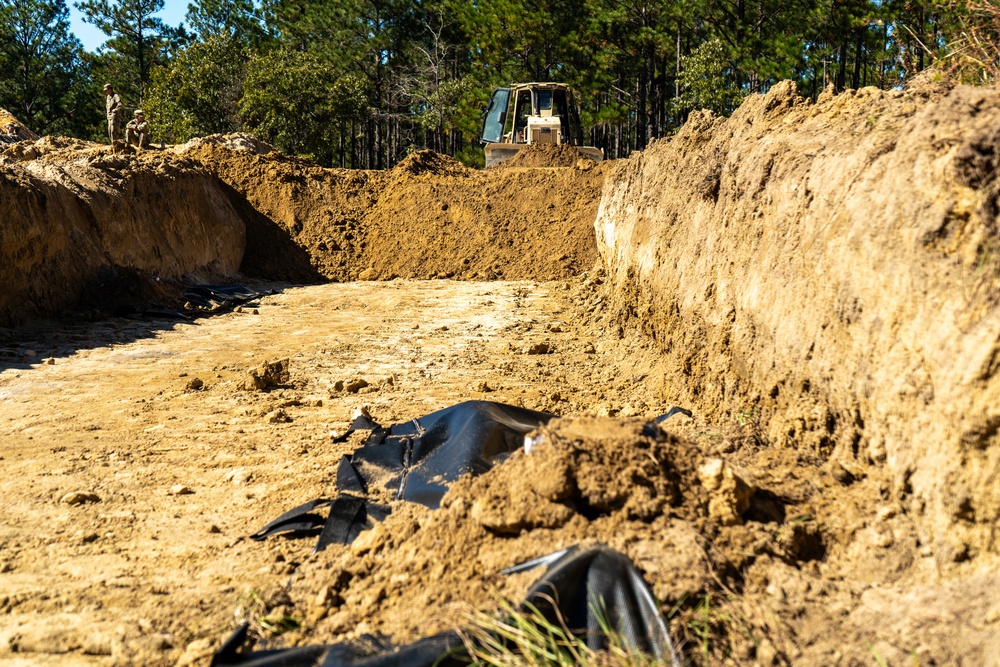
The exercise examined how remains could be buried, preserved and subsequently recovered for identification and return to families.
The underlying concern is serious. American forces could face combat in which evacuation routes are disrupted and the systems supporting casualty recovery cannot keep pace.
But the widely circulated account adds a further conclusion: that President Trump has approved a particular war plan anticipating thousands of American deaths daily, and that burial drills, ketamine procurement and presidential air defenses collectively reveal it.
The public documents establish preparations for severe wartime conditions. They do not establish that specific presidential decision.
Understanding the difference reveals more about the exercise than either dismissing it or treating it as a countdown to war.
What actually happened at Fort Bragg?
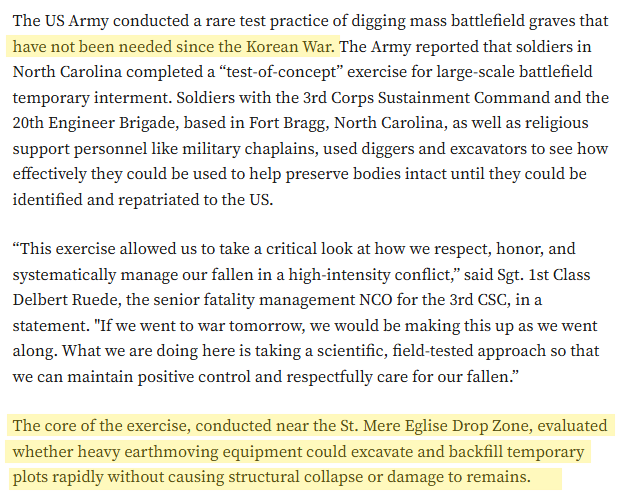
Phase II of Operation Dragon Covenant tested the practical requirements of large-scale temporary burial. Soldiers used simulated remains to examine whether heavy equipment could excavate and close burial sites without damaging material that would later require forensic examination. The Army also identified shortcomings in existing instructions, including dimensions that did not adequately accommodate the equipment being used.
That detail matters. Written procedures can look adequate until someone tries to execute them. Here, the exercise exposed a gap between doctrine and physical practice.
The task was to develop a method for handling the dead under conditions that might make immediate evacuation impossible. Temporary interment is intended to preserve the possibility of eventual recovery. It is not a declaration that soldiers would be abandoned permanently.
There is also an important distinction within the Korean War comparison. The Army says it has not conducted temporary battlefield interment at scale since that conflict. Its account separately says the participating religious-support training was the first of its kind in more than 20 years. “Nothing like this has been rehearsed since 1953” compresses different statements into one.
2400 in 24 hours?
The figure is a projected engineering capacity.
Based on excavation performance, planners estimated what an appropriately equipped engineering company could accomplish during continuous operations. Defense News reported that the resulting estimate was capacity to prepare and close burial trenches for up to 2,400 remains in 24 hours.
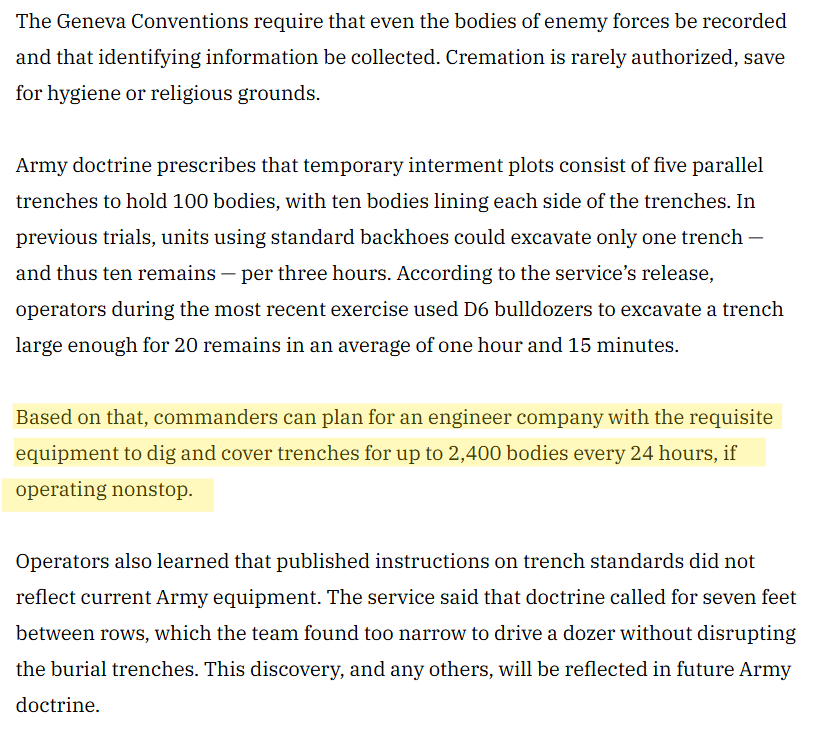
That is a disturbing number. It is also different from a forecast that 2,400 Americans will die every day.
Capacity planning asks how much work a unit could process under specified conditions. A casualty estimate asks how many people a particular operation is expected to kill or injure. Turning one into the other requires evidence about the scenario, force size, duration, and anticipated losses.
A hospital’s emergency capacity does not disclose how many patients officials expect tomorrow. The same distinction applies here, although the subject is considerably grimmer.
The number tells us that the Army wants to understand how it would handle a substantial accumulation of remains. It does not identify the enemy, the battlefield, or an approved operation.
Are American bases already capable of operating independently for 90 days?
The Pentagon’s FORTRESS initiative builds on existing resilience work. Some installations already have substantial backup systems, and the services have been examining prolonged disruptions for years. But Air & Space Forces Magazine reported that officials were still assessing installation requirements, costs and implementation. The project involves improving independence, rather than merely announcing a capability uniformly achieved.
Knowing how to write a continuity plan is different from possessing enough reliable power, fuel, water, maintenance and communications to execute it for three months.
The same reporting quoted former Air Force installations official Ravi Chaudhary, who warned that adversaries could disrupt the civilian services surrounding bases. His assessment links military readiness directly to the vulnerability of local infrastructure.
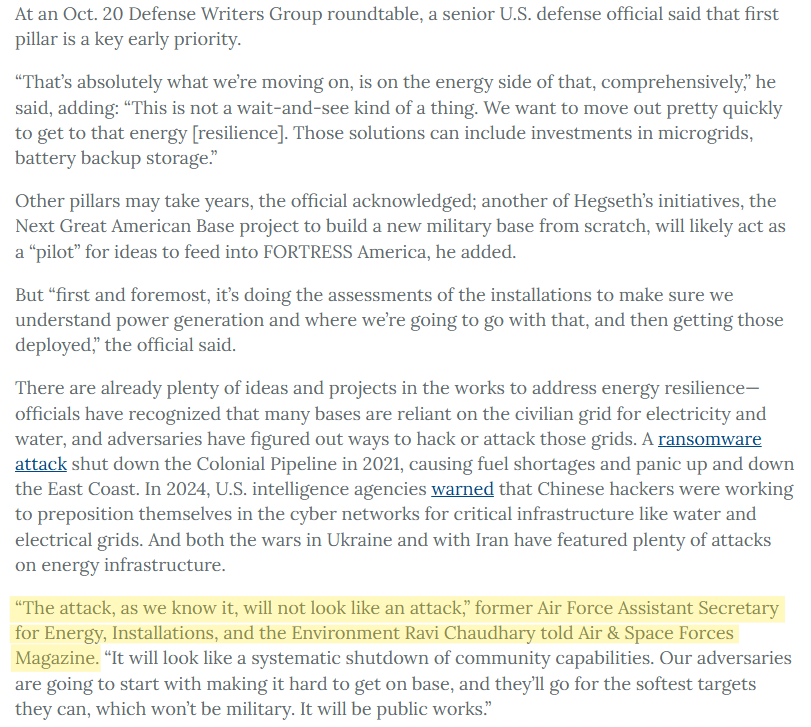
An announcement can certainly send a message to Tehran, or another adversary, that the United States intends to withstand disruption. But signaling and capability-building can go hand in hand. The evidence does not support reducing the entire program to a message aimed at Iran.
Fort Bragg’s exercise demonstrates that the Army is preparing to manage large numbers of dead when prompt evacuation cannot be guaranteed. That alone is consequential.
This is eerily similar to what the French government had warned its hospitals about last year.
 Desh Kapoor

In that discussion on Drishtikone, we shared the communication by the French Government.
French hospitals have been told to prepare a potential armed conflict in Europe by next year, local media reported. In a letter sent to regional health agencies, revealed by Le Canard Enchaîné , the Ministry of Health asked hospitals to prepare for a "major (military) engagement" by March 2026. The newspaper warned that between 10,000 and 50,000 men could be expected in hospitals over a period of 10 to 180 days. (Source: French hospitals told to prepare for war in Europe by next year in leaked Government letter / Yahoo News)
So this threat has been known since last year.
Trump's Iran Plan
Senator Chris Murphy wrote on X that Trump was reportedly preparing to resume war with Iran after the elections. Citing briefings he had received, Murphy condemned the proposed operation as strategically unsound, unlikely to achieve its objectives and likely to trigger further escalation.
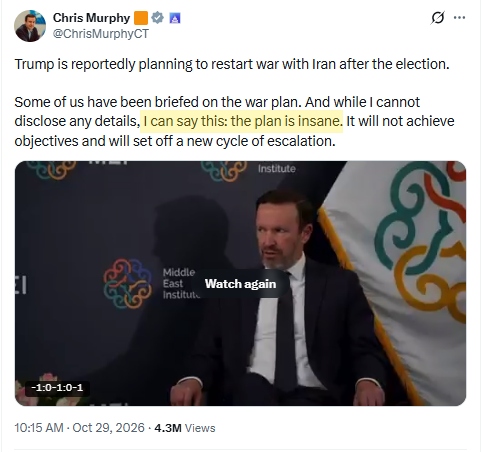
Should he have shared it? Publicly questioning a proposed war is a legitimate part of congressional oversight. But invoking confidential briefings to lend authority to that criticism raises a national security concern: even acknowledging preparations or suggesting a timetable could help an adversary assess American intentions. Well, the wording alone does not establish that Murphy disclosed classified information. He supplied no targets, tactics, or operational details, and framed the timing as already reported. My assessment: he could reasonably voice his opposition, but should be more careful about publicly linking that opposition to privileged military briefings.
Preparations for renewed strikes on Iran raise a consequential question: are the heightened cyber and security warnings across the United States and Europe partly a response to anticipated Iranian retaliation?
Threats to digital networks, undersea cables, and other infrastructure could be part of the same escalation cycle, with preparations beginning before military action. That connection is seems most likely at this time.
Saudi Offensive and Its Ramifications
Saudi-backed Yemeni forces and the Saudi-led coalition are already engaged in an escalating campaign against the Houthis.
CFR’s October 8 article describes a Saudi-backed Yemeni offensive already underway.
As the United States and Iran remain locked in a struggle for control over the Strait of Hormuz, concerns continue to mount about the security of another regional maritime chokepoint: the Red Sea. Since the start of the Iran war, the Houthis have made a concerted effort to restrict oil and gas flows through the vital Mideast waterway. In September 2026, two months after the group declared a complete naval blockade on Saudi Arabia, which relies on the Red Sea to access global oil markets, the Houthis seized control of Yemen’s strategic port city of Mokha and several islands near the Bab el-Mandeb Strait—expanding their control over Yemen’s Red Sea coastline. Now, the Saudi-backed Yemeni government has launched a major offensive against the Houthis, retaking critical areas around the strait. The Red Sea, a 1,400-mile-long inlet between northeastern Africa and the Arabian Peninsula, is one of the world’s most important arteries for global shipping. Each year, approximately 12 to 15 percent of global maritime trade worth more than $1 trillion transits the waterway, which extends from the Suez Canal in the north to the Bab el-Mandeb Strait in the south. Experts say sustained interference in the Red Sea would trigger severe supply-chain delays, drive up energy prices, and further destabilize the global economy. (Source: Another Hormuz? What to Know About the Houthi Threat to the Red Sea / Council on Foreign Relations)
Hudson’s October 28 report says the Saudi-led coalition is already targeting Houthi missile launchers and underground military facilities.
 Can Kasapoğlu
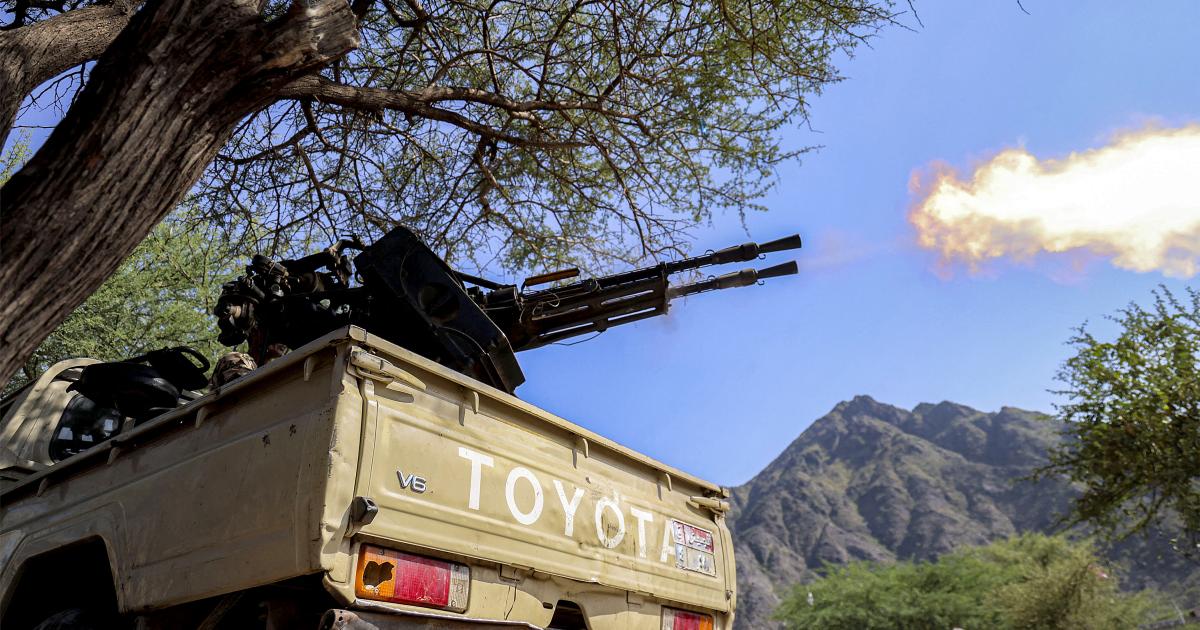
Escalating fighting involving the Houthis, Saudi-backed Yemeni forces, and the Saudi-led coalition raises risks not only to shipping but also to regional digital infrastructure. Recent analyses by the Council on Foreign Relations and the Hudson Institute highlight the Red Sea’s importance as both a maritime and telecommunications chokepoint.
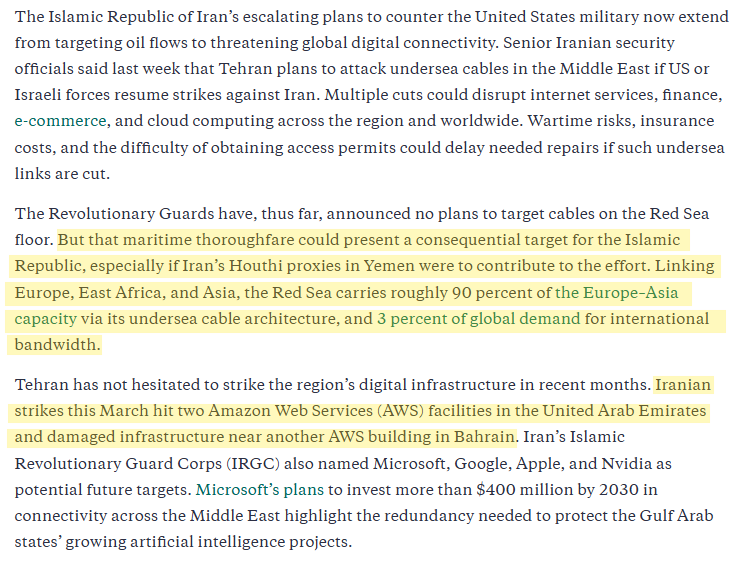
If the Houthis extended their retaliation to undersea cables, the consequences could reach far beyond the ships passing Yemen’s coast. The Red Sea carries roughly 90% of Europe–Asia submarine cable capacity. A sustained disruption there could therefore affect a communications artery supporting businesses and households thousands of miles from the fighting.
Check this map out.
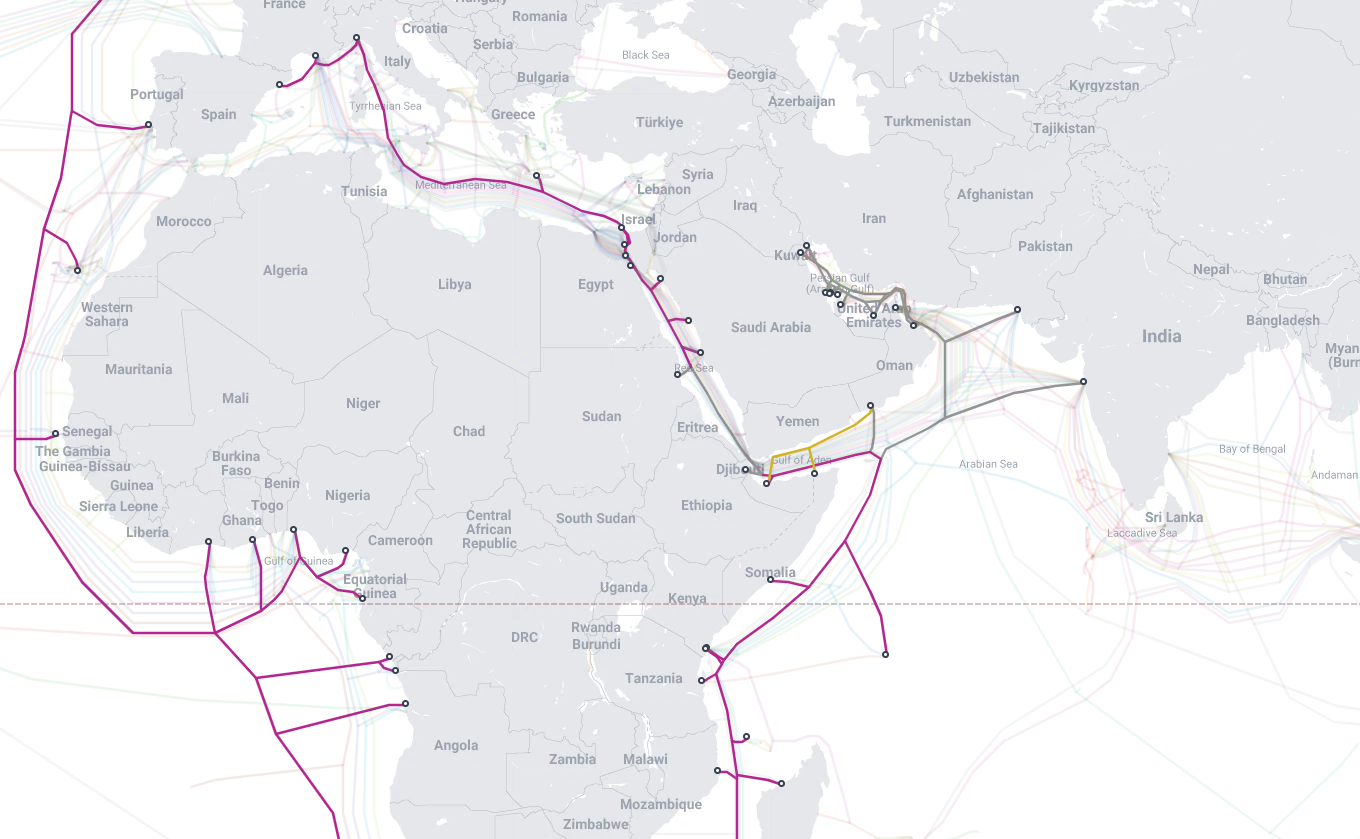
The immediate consequences would depend on the scale of damage. Cutting one cable would not sever the entire corridor. Multiple failures, however, could force operators to shift traffic onto surviving systems and alternative routes, consuming spare capacity and potentially causing congestion, slower connections, and service interruptions.
For businesses, that could mean difficulty accessing cloud applications, coordinating deliveries, processing online transactions or communicating between offices. Financial networks generally have resilience arrangements, but widespread disruption would test those backups alongside everyone else’s. The damage could spread through commercial relationships even in countries whose domestic internet remained functional.
The Rubymar episode illustrates the vulnerability. After a Houthi missile strike forced its crew to abandon ship in February 2024, the vessel’s dragging anchor reportedly severed three telecommunications cables. That was indirect damage associated with an attack on shipping; it does not establish that the Houthis possess a reliable capability to conduct deliberate, coordinated cable sabotage.
Repair would introduce another problem. A damaged cable requires specialist vessels, access permissions, and conditions that allow crews to work safely. Continued attacks on shipping could complicate restoration, extending an interruption beyond the initial incident.
This gives the threat strategic weight. Even without shutting down connectivity altogether, repeated damage could raise costs, reduce reliability and force governments and companies to reconsider their dependence on a concentrated route.
It seems quite certain at this point that Iran’s confrontation with the United States could extend beyond oil routes into the infrastructure carrying the world’s digital communications. Multiple cuts could disrupt banking, internet access, e-commerce and cloud services, while fighting, insurance costs and access restrictions could delay repairs.
Two maritime corridors matter, but their roles differ. Cables passing through the Strait of Hormuz primarily serve Gulf connectivity. The Red Sea and Bab al-Mandeb carry major connections between Europe and Asia. TeleGeography estimates that roughly 90 percent of Europe–Asia submarine cable capacity passes through the Red Sea corridor. Although the Revolutionary Guards have announced no specific Red Sea cable campaign, Iran’s Houthi allies could extend the threat there.
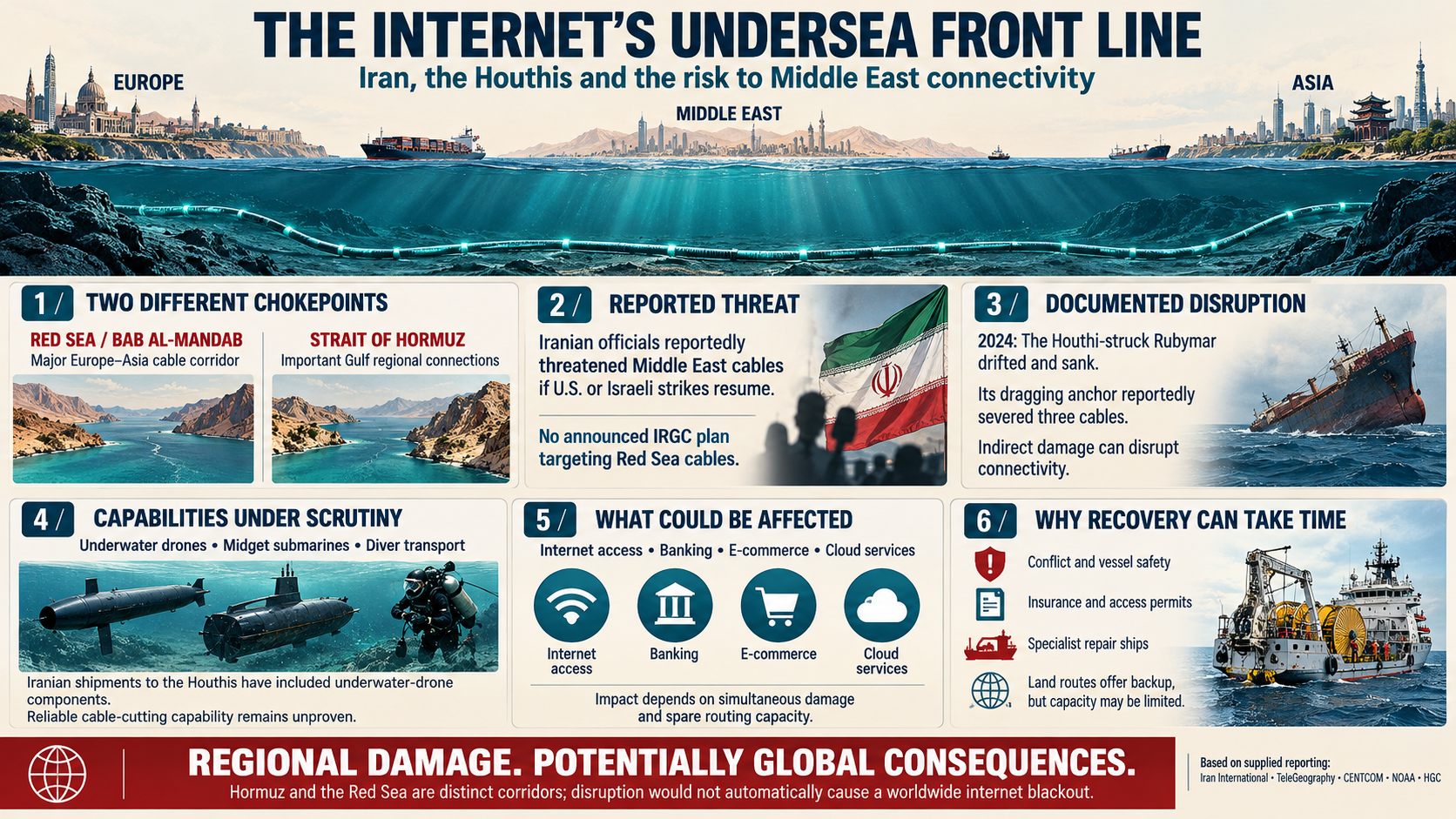
Even in the recent past, Iran has also reportedly struck digital infrastructure ashore. March attacks affected Amazon Web Services facilities in the United Arab Emirates and infrastructure near another facility in Bahrain. Such incidents expose the physical vulnerability behind apparently seamless online services.
Iran’s underwater programs add another concern. Its experimental unmanned underwater vehicles, small submarines and diver-transport platforms suggest interest in reconnaissance, mining and maritime sabotage. However, publicly available evidence does not establish a reliable Iranian capability to locate and systematically disable seabed cables. Experimental platforms should not automatically be treated as operational weapons.
The Houthi connection warrants attention. American forces intercepted Iranian shipments containing underwater-drone components, and CENTCOM reported striking a Houthi unmanned underwater vehicle in February 2024. These developments establish an emerging underwater dimension to the conflict, without proving a demonstrated cable-sabotage capability.
Alternative routes provide some protection. Gulf countries have terrestrial connections through neighboring states, while the UAE’s Fujairah landings sit outside Hormuz. Yet backup routes may lack sufficient spare capacity or face disruption themselves.
The consequences would depend on which cables were damaged, how many failed together and how quickly traffic could be rerouted. A worldwide blackout is not inevitable. But coordinated damage at maritime chokepoints could impose substantial regional disruption and wider economic costs—turning the seabed into another front in a conflict already reaching civilian infrastructure.
All-Around Attack?
Undersea cable damage is only one part of the danger. Add cyberattacks against payment systems, telecommunications, electricity, water and transport, and the consequences could spread well beyond the original target.
These systems depend on one another. Electricity supports communications; communications support payments and logistics; fuel keeps backup generators running; functioning roads and payment systems help deliver that fuel. A failure in one can place several others under pressure.
An attacker would not necessarily need to disable everything. Disrupting a widely used service at the wrong moment could force businesses and public agencies across an entire region into emergency arrangements.
Payments: money you cannot use
Imagine arriving at a supermarket where the shelves are stocked but card payments are unavailable. Your bank balance has not disappeared. Your ability to spend it has.
A disruption affecting payment processing, bank authentication or merchant connectivity could interrupt purchases, payroll and supplier payments. Small businesses with limited cash reserves could quickly struggle if incoming payments stopped while wages and bills remained due.
The 2024 Change Healthcare ransomware attack demonstrated this dependence within healthcare. Disrupted claims and payment processing affected providers nationwide, prompting Medicare to introduce accelerated and advance payments to ease cash-flow pressures. One intermediary’s failure became a problem for organizations far beyond its own offices.
Phone networks: losing the ability to coordinate
A telecommunications outage affects much more than conversation. Depending on its scope, it can disrupt emergency calls, business connections, authentication messages, and repair coordination.
Families may struggle to locate one another. Businesses may lose access to systems they ordinarily reach through mobile connections. Emergency responders can retain dedicated communications, but widespread public-network failures would still complicate their work.
The difficulty becomes greater when an outage coincides with another emergency. People need reliable information precisely when they may be least able to obtain it. Rumours can fill that gap.
Electricity: pressure on almost everything
A substantial electricity disruption could affect water pumping, refrigeration, traffic signals, communications equipment and household heating or cooling.
Backup systems provide protection, but their usefulness depends on what they support, how long they can operate and whether fuel and maintenance remain available. A generator does not eliminate dependence; it changes the supplies needed to keep operating.
The Colonial Pipeline incident illustrates how a cyberattack can reach the physical economy without an attacker directly destroying machinery. In May 2021, the company shut down its pipeline system in response to ransomware. The resulting disruption prompted government action to address fuel-supply problems.
A prolonged electricity outage could create similar secondary demands: more generator use, more fuel deliveries and more pressure on transport.
Aviation: disruption without taking control of an aircraft
Air travel depends on a network of supporting services, including safety information, communications, airport operations and airline scheduling.
An attacker would not have to seize control of aircraft to cause substantial disruption. If essential information became unavailable or unreliable, safety precautions could require flights to stop.
The January 2023 FAA NOTAM outage provides an example of the consequences, although it was attributed to an accidental file deletion, not a cyberattack. The failure of a system supplying safety information led the FAA to order a ground stop. It demonstrated how the loss of one supporting service could interrupt aviation on a national scale.
Cancellations then displace aircraft and crews, disrupt cargo movements, and make schedules hard to restore even after the original system returns.
Water, hospitals and food: disruption becomes a health issue
Water utilities need to monitor equipment and maintain safe operations. Hospitals depend on electricity, communications, clinical records, laboratories and supplies. Food distribution depends on ordering systems, transport and refrigeration.
A disruption in any of these can create consequences that grow with time. Delayed treatment, interrupted medicine access and spoiled food are different problems, but they can converge on the same households and emergency services.
The concern also includes information integrity. Operators need confidence that readings, records and instructions are accurate. Restoring a connection is insufficient if staff cannot establish whether the information passing through it is trustworthy.
Shared suppliers can spread the damage
Organizations that appear independent may use the same software, communications provider, cloud platform or specialist contractor. A failure involving a shared supplier can therefore affect many customers simultaneously.
That concentration helps explain the reach of incidents such as Change Healthcare. The affected service sat inside a much larger chain of organizations providing care. GAO documented widespread consequences for providers and patient care following the attack.
The practical question is how independently an organisation can continue when a supplier becomes unavailable.
The most dangerous scenario is overlapping disruption
Consider a hypothetical regional electricity failure occurring alongside interrupted mobile service and unreliable electronic payments. Shops might have goods but struggle to sell them. Families might have money but struggle to access it. Repair teams might face communications problems while fuel deliveries become harder to arrange.
Undersea cable damage could add another constraint by reducing available communications capacity while operators were already managing cyber incidents.
These are possible interactions, not evidence of an imminent coordinated campaign. Their significance is that each failure could make recovery from the others harder.
The effects would also be unequal. People needing powered medical equipment, refrigerated medicines, regular treatment or immediate assistance could face danger much sooner than households with reserves and alternative accommodation.
That is why resilience requires more than cybersecurity software. It requires tested backups, independent communications, safe manual procedures, dependable supplies and staff who have practiced operating under degraded conditions. For households, water, food, medicines, modest emergency cash and a family communication plan provide the same essential benefit: time to cope while services are restored.
Preparing to Strike Iran—and Preparing for What Comes Back
The reported transfer of a Patriot missile-defense system from Texas to Israel gives the discussion of renewed strikes on Iran a concrete military dimension. According to The Wall Street Journal, Washington has warned Gulf partners about a possible campaign after the November 3 midterms and is reinforcing Israel’s defenses. The report also says President Trump had not made a final decision.
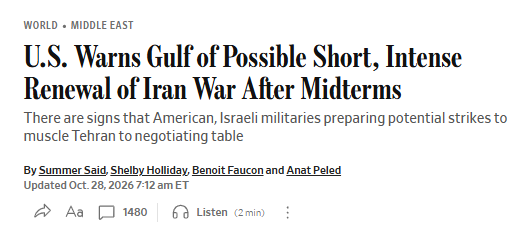
One clarification matters: these missiles are reportedly moving to Israel, not Iran. Patriot is a defensive system designed to intercept aircraft and incoming missiles. Its deployment would strengthen protection against retaliation rather than deliver the proposed strikes.
That distinction makes the movement significant. A government considering offensive action must also consider what the opponent can do afterward. Reinforcing defenses suggests that planners are taking that response seriously.
The operational inference is straightforward: Washington wants greater protection in place before deciding whether to escalate. That is stronger evidence of preparation than political rhetoric alone, although it does not establish that an attack is inevitable.
There is a discussion about moving of the missiles from Texas. It is not as if Texas becomes vulnerable. The larger issue is how scarce defensive resources are distributed across competing commitments.
The vulnerability of American bases changes the calculation
Alongside the strike preparations, Nick Turse’s reporting for The Intercept describes growing concern about the vulnerability of U.S. installations overseas and within the United States. The report connects that concern to inexpensive drones and describes Pentagon interest in concealment, stronger protection and measures that would help installations withstand attacks.
These are related concerns, but their connection requires careful understanding. A warning about domestic-base vulnerability does not establish that Iran possesses a demonstrated capability to attack every American installation. It does show why planners cannot assume that geography and perimeter security provide sufficient protection against every threat.
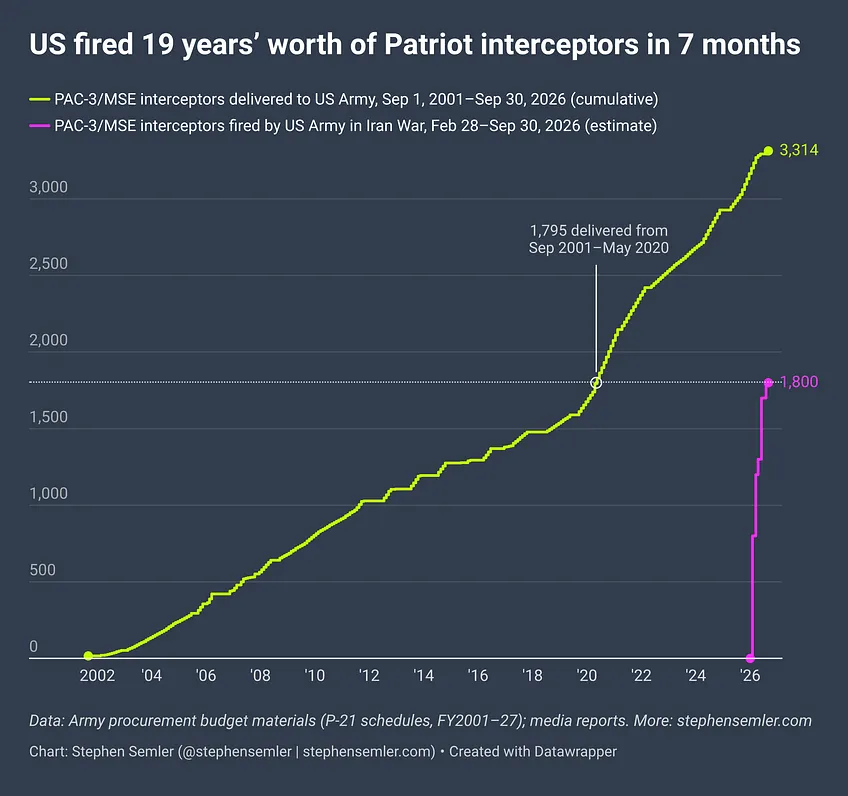
In seven months of war with Iran, the United States may have fired more Patriot interceptors than the Army received during nearly nineteen years of procurement. Researcher Stephen Semler estimates that American forces launched approximately 1,800 Patriot interceptors between February 28 and September 30, 2026. By comparison, the Army received 1,795 modern Patriot interceptors between September 2001 and May 2020. The contrast exposes a central vulnerability in prolonged warfare: weapons accumulated over decades can disappear within months. (Source: stephensemler)
The issue is not simply whether missile defenses can intercept incoming threats. It is whether their sustainability matches the demands placed on them. Successful interceptions protect military personnel, infrastructure, and civilians. But each engagement also consumes expensive ammunition that must eventually be replaced. Tactical success can therefore coexist with growing pressure on the stockpiles needed to sustain a campaign.
An installation concentrates valuable equipment, personnel and supporting infrastructure. Its ability to function also depends on services beyond its boundary. Electricity, water, communications, fuel deliveries and access roads may involve civilian providers.
Former Air Force installations official Ravi Chaudhary made that concern explicit in reporting on the Pentagon’s FORTRESS program: adversaries could disrupt the public services surrounding bases, complicating military operations without beginning with the most heavily defended targets.
This brings the military and civilian dimensions together. The infrastructure supporting a base often supports the surrounding community too.
“Short and intense” describes an intention
Washington may intend a limited campaign. Tehran would still decide how, where, and for how long to respond.
That is the weakness in any reassuring description of a short war: one side controls its opening action, but cannot unilaterally control the opponent’s reaction.
A concentrated strike could be followed by retaliation against military facilities, shipping or infrastructure. Cyber operations could introduce further uncertainty, particularly where responsibility is difficult to establish quickly. These are escalation scenarios, rather than proof that every threatened action is already underway.
Defensive preparations can reduce exposure. They cannot guarantee that retaliation will remain within the boundaries preferred by the side initiating renewed strikes.
Missile defense addresses only part of the risk
Patriot systems cannot substitute for cybersecurity, secure telecommunications or resilient electricity and water services. Different threats require different protections.
This matters because an adversary need not respond symmetrically. It could seek disruption in areas where military strength offers less immediate protection.
The earlier FBI warning about American water utilities illustrates the vulnerability. Federal authorities reported cyber incidents affecting utilities in at least seven states, including activity that degraded operations and deprived operators of monitoring or control functions. That warning establishes an infrastructure risk; it does not establish that those July incidents were triggered by the later reported strike planning.
The chronology matters. Existing attacks, longer-term preparedness programmes and current military movements should not automatically be presented as one coordinated sequence. Nevertheless, a new confrontation could heighten the importance of existing vulnerabilities.
The strategic question is what another round would achieve
A deployment can improve military readiness without resolving the political problem.
What outcome would renewed strikes seek? A negotiated agreement? A temporary reduction in capability? A change in Iranian behavior? Each objective requires a different account of how military action would produce it—and what happens if it does not.
If strikes produce retaliation, followed by further strikes to suppress that retaliation, the original campaign can expand through successive decisions that each appear necessary in isolation.
That is why the Patriot transfer and the base-vulnerability reporting deserve to be discussed together. One concerns protection being added before a possible escalation. The other concerns weaknesses that additional fighting could expose.
Neither report proves that a wider war has been decided. Together, however, they sharpen the question facing Washington: does it have a credible plan for the consequences of renewed fighting, and the capacity to begin it?
The public needs an answer that goes beyond the proposed duration of the bombing. It needs to understand the objective, the likely avenues of retaliation, the protection available to American personnel and civilians, and the conditions under which the fighting would end.
Conflicts powered by Convergence, Not Collaboration
Taken together, these developments suggest a period in which several conflicts, competing powers and vulnerable systems place the United States and its allies under simultaneous pressure.
No single coordinated plan is needed for the consequences to converge.
A confrontation with Iran, continued war in Ukraine, coercion around Taiwan and attacks on civilian infrastructure can reinforce one another through their demands on money, equipment, political attention and public confidence.
The next two years could therefore be defined by prolonged military confrontation, economic disruption and repeated tests of institutional resilience. A wider war remains possible, but it is not the only route to serious damage. Societies can experience considerable insecurity while governments continue to describe each incident as limited, manageable or below the threshold of open conflict.
The most dangerous possibility over the next two years is not simply that several wars intensify. It is that their consequences converge inside societies still assuming that essential services will remain available. This is a conditional scenario, not a prediction that catastrophe is inevitable.
If the warnings materialize, stockpiling ceases to be a symbol of anxiety and becomes a bridge between disruption and recovery. Water, food, medicines and backup power buy time when normal distribution fails. The danger is cascading failure: electricity loss interrupts communications; communications failures obstruct repairs; fuel shortages constrain transport and emergency generation. CISA identifies these dependencies as pathways through which infrastructure failures spread.
When the homeland becomes the battlefield
An attack on American soil would change the crisis. But sabotage, a conventional missile strike and a nuclear detonation are not interchangeable scenarios.
A major infrastructure attack originating within the country could produce geographically uneven paralysis: functioning neighborhoods beside communities without reliable water, payments or emergency communications. Its strategic effect would depend less on spectacular destruction than on duration, repetition and whether authorities could credibly establish that the attack had ended.
An incoming missile would create another danger: decisions compressed into minutes, with uncertainty about origin, payload and whether further launches were coming. In a nuclear scenario, the immediate humanitarian catastrophe would intersect with an attribution crisis. Retaliating against the wrong actor—or treating an isolated launch as the opening of a larger attack—could turn national devastation into international escalation.
One detonation would not automatically mean global nuclear war or nuclear winter. Those outcomes depend on subsequent decisions, the scale of exchanges and environmental effects. Studies distinguish single-weapon use from much larger nuclear conflicts.
The global transmission
Beyond America, a severe attack could trigger simultaneous financial, logistical and strategic shocks: collapsing risk appetite, disrupted aviation and shipping, emergency liquidity measures and pressure on allies to clarify commitments. Markets would price not merely the damage already inflicted, but the probability of the next strike.
Other powers might exploit American distraction—or retreat from confrontation because escalation suddenly looked uncontrollable. Neither response should be assumed.
Inside the United States, the second struggle would concern trust: who receives protection, whether shortages are temporary, and whether emergency powers remain proportionate. Unequal recovery could deepen political fracture.
The decisive distinction is between surviving the initial event and sustaining society afterwards. Reserves, redundant infrastructure and credible communication cannot prevent every catastrophe. They can prevent disruption from becoming abandonment.