What Soldiers did
A ruler summoned the monastery’s bell keeper.
“Tomorrow,” he said, “ring the alarm. Tell the valley that wolves have crossed the northern ridge.”
“Have they?”
“My scouts believe they may.”
At dawn, the bell keeper rang until farmers abandoned their fields. When frightened villagers gathered, he repeated the warning.
By noon, the ruler’s soldiers were marching north.
“The monastery itself has sounded the alarm,” their captain announced. “We must act.”
A young monk watched the departing soldiers.
“Master,” he asked, “did the bell confirm the scouts?”
“No.”
“Then why does everyone speak as though it did?”
The old teacher took him to the pond.
“Shout something.”
“There are wolves!” the monk called.
The hillside returned his words.
“There,” said the teacher. “Another witness.”
The monk lowered his eyes.
That winter, the soldiers returned with timber from the northern villages. Several houses had burned during the search. No wolves had been found.
The ruler sent the monastery a larger bell.
The bell keeper was delighted. Its voice would reach the farthest farms.
The teacher asked him to strike it once.
The sound rolled across the valley.
“Beautiful,” said the bell keeper.
From the courtyard, a child began to cry.
Her father had gone north after hearing the first alarm. He had not returned.
The bell keeper reached for the rope again, then stopped.
For the first time, he listened until the valley was quiet.
The next morning, he walked north to learn what his bell had helped the soldiers do there.
The Aluminum Tubes
On 8 September 2002, Americans were invited to watch a remarkable conversion: a disputed intelligence claim became a newspaper revelation, and the newspaper revelation became an argument for war.
The New York Times published a front-page account by Michael R. Gordon and Judith Miller about Iraq’s pursuit of aluminum tubes. Anonymous American officials presented the tubes as evidence of a renewed nuclear effort. That same morning, Vice President Dick Cheney appeared on NBC’s Meet the Press, invoked the Times story, and used the tubes to support the administration’s case against Saddam Hussein. PBS’s reconstruction places the newspaper report and the television appearance together, showing how public attribution to a prestigious publication helped an official claim acquire a second life.
The technical interpretation was contested. Specialists in the government had questioned whether the tubes were intended for uranium-enrichment centrifuges rather than conventional rockets. Michael Massing’s contemporary examination of the reporting traced how the strongest nuclear interpretation obtained extraordinary prominence while doubts struggled for comparable attention.
The readers however saw a serious and prominent newspaper like the New York Times reporting facts based on experts and intelligence officials while conveying an assurance. Assurance that the facts and reporting are objective and based on facts and not dictated by an interested party. Credibility is central to the reader’s trust.
But in this case, a newspaper became useful to a government precisely because readers believe it stands apart from government even when it didn’t. The authority accumulated through decades of journalism becomes available to a political campaign at its moment of greatest need. An anonymous assertion enters through the reporting process; a named official retrieves the published version; television distributes the result to a mass audience. The sequence transforms an argument that should face interrogation into an apparent meeting of institutional minds.
The people - like those innocents in Iraq or Afghanistan - who later experience the war cannot reverse this sequence by reading a correction. The front page belongs to the moment of decision. The retrospective belongs to a world already changed. The difference between those moments is where media power becomes material power: public consent, parliamentary votes, military deployment, destroyed infrastructure, displaced families, and the long political afterlife of intervention.
We, therefore, face a damning question here - When the press supplies credibility to power, what exactly has it supplied?
So what does media and press do for power? Sometimes it supplies a platform. Sometimes it supplies a vocabulary. Sometimes it supplies silence at a decisive moment. Historical records also show that, in particular periods and arrangements, media institutions supplied intelligence services with personnel, cover, access, or concealed financial channels. Those activities belong in the same examination of power, although they require different evidence.
The public should be able to distinguish a disclosed government statement from an independently verified fact, a journalist’s interpretation from an intelligence assessment, and a newspaper’s institutional interests from universal moral judgment. Too often, those distinctions arrive after the consequences.
Governments possess documents, surveillance capabilities, diplomatic access, and officials authorized to speak. Newsrooms possess audiences, reputations, distribution systems, and the capacity to turn an allegation into the accepted subject of public discussion. Each has something the other wants.
Claudia Hillebrand’s study of intelligence oversight provides a useful framework. She identifies media roles that include carrying information to formal overseers, acting as a substitute watchdog, and conferring legitimacy.
The legitimizing role is perhaps the most important one.
A publication may investigate one agency scandal while accepting the agency’s assumptions in another field. It may defend its right to publish secrets while treating an official interpretation of a foreign society as the natural starting point. Independence in one dispute does not settle independence across an institution’s whole output. The relevant object of analysis is a relationship, sustained through sourcing, access, publication decisions, and professional incentives.
For readers outside the Western centers of media power, that relationship has an additional consequence. A London or New York newsroom is often positioned to define what counts as democratic progress, disorder, modernity, extremism, or legitimate national aspiration elsewhere. Its judgments travel through news agencies, broadcasters, search engines, policy briefs, and university classrooms. People living inside the society become evidence in a story whose organizing questions may have been selected far away.
These institutions possess an unusually large power to decide whose description of reality will circulate as knowledge. Calling that power neutral does not make it neutral.
Let us discuss the work Carl Bernstein - a legendary American investigative journalist who teamed up with Bob Woodward to expose the Watergate.
Carl Bernstein’s October 1977 investigation reported that more than 400 American journalists had secretly performed assignments for the CIA during the preceding quarter-century. He described information sharing, operational assistance, journalistic cover, and management consent in numerous cases. He identified the New York Times, CBS, and Time as especially valuable relationships according to CIA sources. These are his reported findings, based substantially on interviews and agency records described to him.
Why are they important? Because they show how ordinary journalistic privileges can be converted into operational resources.
A reporter is expected to cultivate contacts. A foreign correspondent can ask questions, travel, and approach people who would hesitate to meet an acknowledged intelligence officer. A bureau offers a plausible address. Credentials offer a plausible identity. Confidentiality offers a plausible explanation for protected communications.
Once those privileges serve a concealed second employer, the bargain with the public changes. A source believes a conversation is contributing to journalism. A reader believes a report comes from an institution whose purpose is publication. An undisclosed intelligence relationship can redirect either exchange toward a purpose that the participants never agreed to serve. The ethical injury exists even when no fabricated sentence appears in print.
The Church Committee was a U.S. Senate committee established on January 27, 1975, to investigate illegal domestic and foreign intelligence operations. It’s investigation placed intelligence abuses within an official congressional record. Its final report examined covert influence, including media and publishing relationships. That record matters because it moves the subject beyond an argument over whether a critic dislikes a newspaper. A democratic legislature investigated how information institutions were used as instruments of secret state activity.
The conclusion was clear - journalism’s institutional standing has historically been exploitable by intelligence organizations, and some people inside major media institutions participated. The practical questions follow directly. Who authorized the relationship? What did management know? What did sources believe? Which safeguards existed? Which records remain unavailable? What was the remedy when the arrangement became public?
Prestige cannot answer those questions. A tradition of impressive reporting cannot answer them either. An institution can have produced valuable journalism and still owe the public a full account of compromised relationships. Indeed, the more valuable its reputation, the greater the benefit that a covert partner could extract from borrowing it.
Declassified documents revealed that Britain secretly funded Reuters’ Middle Eastern and Latin American services through inflated BBC subscription payments under a 1969 arrangement involving the Information Research Department, an anti-Soviet propaganda unit.

Reuters acknowledged that this violated its Trust Principles, although the documents did not establish the government’s editorial influence. The case illustrates how concealed subsidies can shape journalism’s infrastructure, reach, and distribution without direct control over reporting. Wire agencies amplify this influence because numerous outlets republish their dispatches, making shared upstream sourcing appear like independent coverage. Concealing state funding within BBC payments obscured the arrangement’s nature. Kevin John McEvoy’s research situates Reuters-related arrangements within Britain’s broader propaganda strategy in Chile between 1960 and 1973, aimed at protecting perceived British interests.
The colonial connection lies in external control over political interpretation. Foreign policymakers decided which developments warranted intervention while targeted populations encountered messages that concealed their origins. An outside power’s strategic interests thus entered domestic debate under another identity.
The issue is sovereignty: who defines conflict as popular wisdom, constitutional crisis, ideological danger, or governmental failure? Concealment lets foreign actors shape these judgments without allowing audiences to assess their underlying interests.
Iran: the press inside a campaign to replace a government
A CIA memorandum dated 8 March 1954 describes the campaign to replace Mohammad Mossadeq’s government with a pro-Western administration under the Shah.


It places propaganda, critical press coverage, covert support for demonstrations, and political preparations within a coordinated strategy. Although this self-justifying intelligence account requires scrutiny, it establishes that information served as an instrument of intervention. This does not prove that every hostile article originated with the CIA; specific relationships require evidence. Rather, it shows how public messaging and concealed activity can jointly undermine legitimacy.
The term “pro-Western” exposes the distinction between strategic objectives and public justifications. Narratives invoking patriotism, constitutionalism, or anticommunism may frame genuine domestic disputes around an external power’s preferences, making its interests the implicit standard of legitimacy.
Culture as a PsyOps Battlefield
The CIA’s historical publication identifies the Congress for Cultural Freedom as a major covert Cold War operation, while Frances Stonor Saunders examines the broader system of secret cultural patronage.
Covert support could shape intellectual life through opportunities, circulation, and recognition rather than censorship, leaving alternatives with fewer institutional resources. This does not mean every beneficiary knowingly followed intelligence instructions.
The central problem was concealment. Audiences could not assess relationships they did not know existed. Unlike openly declared state advocacy, covert patronage benefited from an appearance of independence. This history challenges accounts that portray manipulation as exclusively an adversary’s practice.
A consistent ethical standard must examine hidden sponsorship regardless of its origin, including Western efforts to construct information environments that appeared independent of government.
The historical lesson is uncomfortable for institutions that present influence as something foreign adversaries do to Western publics. Western states have themselves invested in the construction of apparently independent information environments. Any serious account of disinformation must include that history rather than treating the location of the sponsor as a substitute for an ethical standard.
AP, the Washington Post, and the discipline of naming responsibility
The Associated Press requires careful treatment. Bernstein included it in his investigation, but also recorded a strong denial of knowing cooperation from former general manager Wes Gallagher. On the Washington Post, he distinguished the newspaper’s less clearly established connections from more substantial claims concerning Newsweek, which belonged to the same corporate group.
These distinctions identify responsibility. A claim about a journalist, an executive, a subsidiary, or a historical period is not automatically a finding about the entire present organization. Collapsing them would weaken the investigation by making an accusation larger than the evidence that supports it. A forceful argument benefits from precision because institutions can otherwise answer the weakest formulation and evade the stronger record.
For AP, the public question is what specific historical arrangements can be established and what the institution disclosed about them. For the Post, it matters whether the subject is the newspaper’s reporting, an executive’s social relationships, or a magazine under common ownership. For Reuters and the BBC, the concealed funding route is a separate documented British case. For the Times, covert relationships and the amplification of official claims require their own examination.
These institutions should not be allowed to shelter behind the confusion between personal and corporate responsibility. Management can ask to be judged on the evidence while also being required to release the evidence it controls. A denial is relevant testimony; it does not make an archive unnecessary. Equally, an allegation is a reason to investigate rather than a substitute for the investigation.
The larger pattern is a recurring public dependency on disclosures that arrive years after the relationship mattered. At the time, readers lack the knowledge required to discount compromised authority. Later, they receive a historical controversy, often without a full accounting of who benefited, who knew, and which editorial choices were affected.
Problems Ended - But Did they?
Restrictions following earlier revelations did not end the issue. In March 1996, CIA Director John Deutch acknowledged that exceptions to restrictions on using journalists or journalistic cover were possible and had occurred, without identifying cases. At a Senate Intelligence Committee hearing that July, he reaffirmed protections covering American journalists, news organizations, clergy, and the Peace Corps. He reported no circumstances during his tenure prompting use of American journalists or clergy, yet defended retaining exceptional waivers.
Hostage crises and terrorist weapons of mass destruction served as hypothetical justifications, not disclosures of operations. The distinction matters: a general prohibition coexisted with authority to override it, while classified criteria prevented public scrutiny of when institutional assurances could yield to operational demands for such exceptions.
Legal Barrier
An exchange at a Senate intelligence hearing belongs in the American press’s institutional memory. Ted Koppel assumed law barred intelligence use of journalists. Chairman Arlen Specter corrected him: “we have no statute which governs this matter,” leaving it to CIA policy and the Director’s judgment. Koppel replied: “I think that would be unacceptable, sir”. The House had passed a proposal 417–6, including a presidential national-security waiver and an exception for knowing cooperation; the Senate had not considered it. Deutch defended CIA-level decisions under classified guidelines, with notification within 48 hours a goal, not a statutory deadline.
Oversight existed, but audiences could not inspect the criteria. Journalism’s public credibility could serve the state while those rules remained hidden from the public.
Whose Patriotism is Duty?
The hearing also exposed a disagreement about the identity of the press. Senator Bob Kerrey argued that no profession should be permanently excluded from working with intelligence agencies when circumstances and an individual’s willingness justified it. Senator John Glenn likewise emphasized individual choice. Kenneth Adelman, a former arms-control official then working as a columnist, defended voluntary cooperation as a legitimate expression of civic responsibility.
These statements reveal an establishment argument in its own words: a journalist’s nationality could create an obligation that justified stepping outside ordinary professional boundaries. The difficulty for foreign audiences is immediate. They are asked to trust a reporter as an independent observer while being offered a national-security account under which the reporter’s special access might legitimately serve the American state.
An Indian official, an Iranian dissident, or a Latin American community organizer does not consent to that second relationship merely by speaking to an American journalist. Nor does an overseas reader share the institutional definition of national interest invoked to justify it. The consent of a willing journalist cannot supply the missing consent of everyone who relied on the journalist’s independent identity.
Zuckerman addressed precisely this problem. He argued that an individual’s knowing consent was insufficient because the arrangement affected the security, integrity, and credibility of the press as a whole. His defense of independence rested on its institutional value, extending beyond any one employee’s decision.
Costs on People who did not agree
Terry Anderson, the former Associated Press Middle East bureau chief held hostage in Lebanon from 1985 to 1991, brought personal experience to the argument. He testified that his captors suspected him of espionage, interrogated him about an alleged CIA contact inside AP, and refused readily to accept his denials. He firmly denied that alleged relationship. His testimony is evidence of the danger created by the suspicion, not evidence that his captors’ accusation was true.
Anderson rejected the assumption that tightly worded exceptions adequately solved the problem. He argued that the agency’s record of stretching rules justified stricter restraints and called for an absolute public ban on recruiting journalists and on using journalistic cover. In later questioning, he distinguished a citizen’s decision to disclose urgent information from the CIA’s use of professional identities for its own purposes.
The distinction matters for the earlier account of AP. The hearing cannot be recruited as confirmation that Anderson or AP operated an intelligence channel. Its contribution is different and powerful: the misuse of journalistic identity can impose suspicion and danger on journalists who reject such cooperation. The benefits of a particular intelligence operation may be concentrated inside the agency while its reputational costs spread across the profession.
Koppel made the corresponding point about credibility. The decisive issue was how often audiences and foreign authorities would assume that a reporter carried a concealed second agenda, rather than merely how often the CIA actually used journalistic cover. He also argued that Congress should preserve a meaningful boundary and accountability rather than formally accommodate every claim of operational necessity.
Nicholas Daniloff and the use of a reporter’s name
Mortimer Zuckerman’s account of Nicholas Daniloff provides a concrete case of the danger. According to his testimony, Daniloff, the Moscow bureau chief of U.S. News & World Report, had previously forwarded a package to the American ambassador. Inside it was another package for the CIA station chief. When the CIA subsequently attempted to contact the purported source, it used Daniloff’s name, associating him with an intelligence approach.

Zuckerman later described Daniloff as unwitting in the narrow sense of that connection. He believed the CIA’s behavior contributed to an association the Soviets could exploit, while also acknowledging the retaliatory context involving the arrest of a Soviet official in the United States. His account is witness testimony about the episode, not a separately adjudicated finding by the committee.
The significance is the mechanism he describes: a journalist can become associated with intelligence activity through the handling of his name and contacts, even without signing up as an operative. A policy framed only around the journalist’s willingness leaves unanswered what happens to people whose identities are implicated indirectly. The need for protection extends to names, credentials, offices, sources, and communications, not merely employment contracts.
The Gray Lady Winked and the institutional memory
Ashley Rindsberg’s The Gray Lady Winked presents the New York Times as an institution whose historical failures can alter public understanding on a consequential scale. Its declared subjects include reporting under dictatorship, the Soviet famine, and other episodes in which institutional authority and political commitments shaped what readers received. The book’s central challenge is to the assumption that a distinguished masthead reliably corrects the interests and prejudices of the people operating beneath it.
That challenge is useful because institutions accumulate reputational capital more easily than they accumulate public liability. Successes become part of the brand. Failures are assigned to a correspondent, an era, an editor, or an unusual pressure. The enduring institution inherits the prestige while responsibility is distributed into compartments.
The proper response is to examine the compartments together. Did access to powerful officials become a professional asset? Did a favored political interpretation determine which witnesses appeared credible? Did editors recognize contrary evidence but give it less prominence? Did the newspaper’s self-conception prevent it from seeing the moral scale of a developing event? These questions connect historical episodes without assuming that every episode had the same cause.
Duranty and the protection of an authoritative reputation
Walter Duranty’s Soviet reporting remains an important example. In its 2003 statement, the Pulitzer Board acknowledged the grave criticism of his 1932–33 famine coverage and said that the 1931 articles for which he received the 1932 prize fell seriously short by contemporary reporting standards. It nevertheless declined to revoke the award, applying its standard concerning deliberate deception to the specific submitted work.
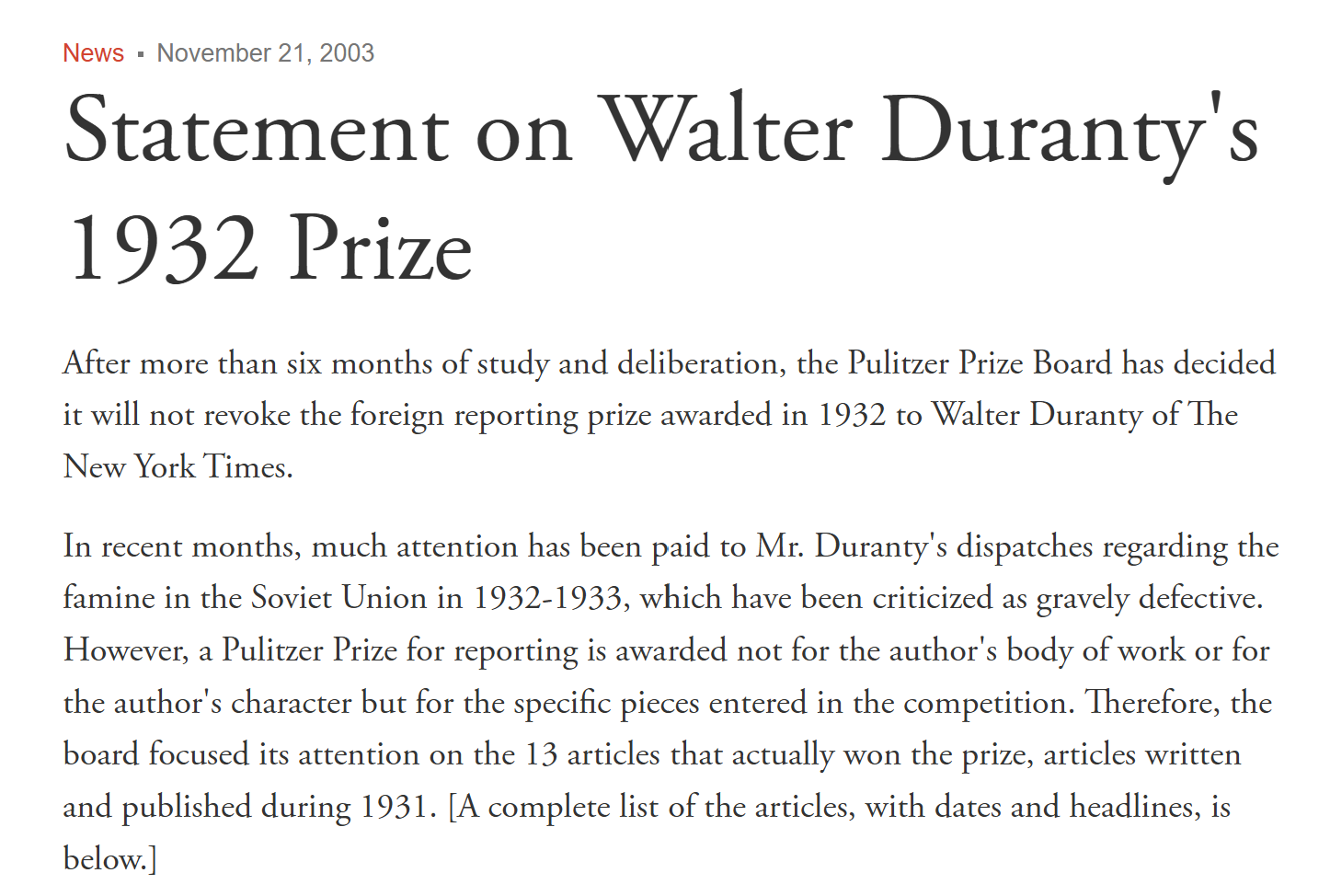
The distinction between the prize-winning articles and the later famine reporting matters historically. It also makes visible an institutional problem: professional recognition can continue to circulate after the authority of the reporting has been profoundly damaged. The public encounters an honor as a shorthand for trust, while the institution explains why the procedural grounds for removing it are narrower than the moral grounds for criticism.
The lesson for contemporary readers is to separate reputation from verification. The impressive correspondent may be wrong. The celebrated newspaper may have privileged access that narrows its imagination. An official’s willingness to speak may reflect a successful relationship rather than a reporter’s independence. None of those possibilities can be settled by the elegance of the prose or the distinction of the byline.
When knowledge exists but significance is suppressed
Laurel Leff’s Buried by the Times examines the newspaper’s treatment of the Holocaust. Her study connects the downplaying of the story to editorial decisions, institutional relationships, the publisher’s outlook, and the surrounding American context. Its significance extends beyond whether particular facts appeared somewhere in the newspaper. It concerns the prominence and meaning those facts were given.
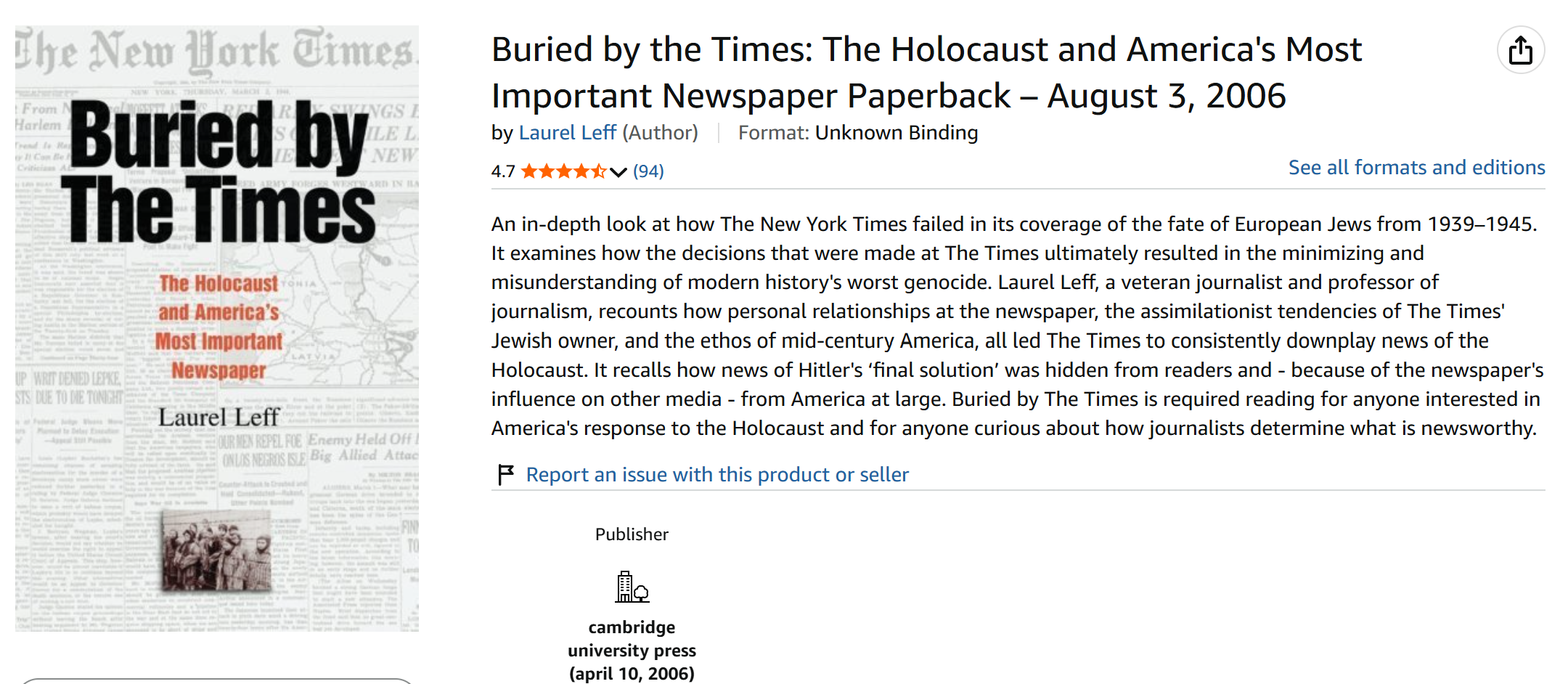
This distinction defeats a common institutional defense: “We covered it.” Coverage is not a binary variable. A report hidden deep inside a publication does not exert the same public force as a front-page account repeatedly followed by editorials, interviews, and demands for action. An atrocity can be recorded while its urgency is muted.
The same applies to contemporary foreign coverage. A newsroom may publish a short report on violence in a strategically inconvenient place while devoting sustained interpretive energy to a different country. The existence of the short report cannot establish equality of attention. Attention has duration, placement, emotional intensity, explanatory ambition, and follow-through.
This is why serious media criticism must examine architecture as well as sentences. Which story leads? Which photograph becomes emblematic? Which death receives a name? Which event generates a question about an entire political system? Which government is permitted to supply a routine explanation, and which is required to prove its moral legitimacy?
Poland, New York Times, Hitler and World War III
The Nazi regime used manufactured incidents and propaganda to portray aggression against Poland as a response to Polish action. The United States Holocaust Memorial Museum documents the staged Gleiwitz incident and the broader deception accompanying the invasion. That is the established historical case of a fabricated pretext for war.
The Times’s 1 September 1939 front page reported the German attack and the claims used to justify it. The surviving page must be read in its chronology and with attention to attribution. Repeating an aggressor’s allegation can amplify it; it does not by itself establish that the newspaper invented the pretext or caused Hitler’s decision to invade.
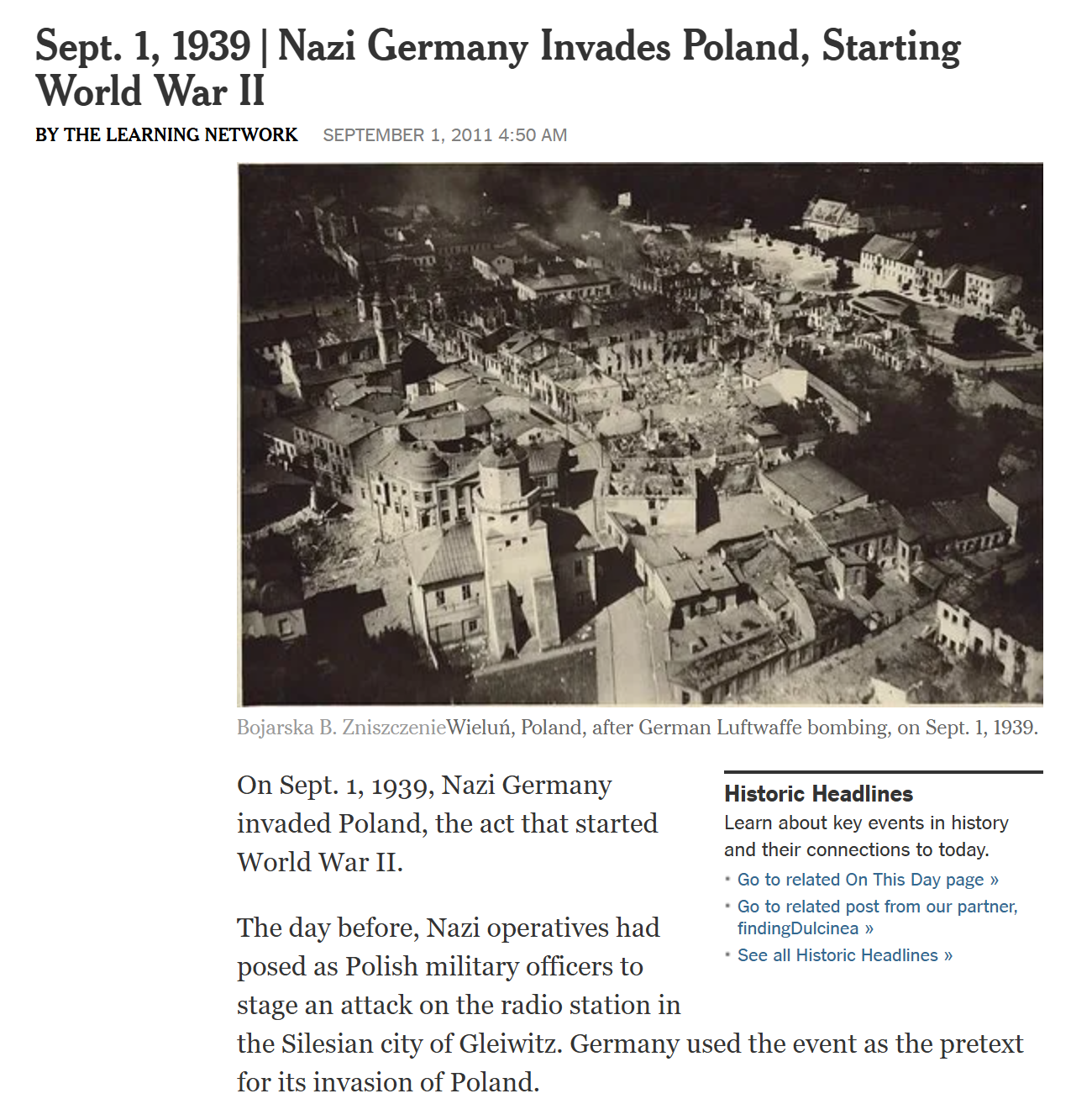
The distinction strengthens the larger argument about narrative power. An aggressor benefits when its explanation travels widely, especially through institutions its audience regards as credible. The press must report what powerful actors say, but it also decides how prominently to identify fabrication, what context accompanies the claim, and whether the structure of the report gives an accusation more authority than the evidence warrants.
The Iraq opening demonstrates a clearer, directly documented circulation between officials and a prestigious newspaper. The Iran record demonstrates propaganda embedded in an intervention. The Reuters record demonstrates a concealed financial arrangement. Each case supports a serious charge on its own terms. There is no need to rest the entire indictment on an unproven claim that the Times furnished Hitler with the decisive spark for the Second World War.
How a narrative becomes the world readers inhabit
The scholarly literature supplies a vocabulary for processes that are often misdescribed as a collection of isolated mistakes. Agenda-setting research, associated with Maxwell McCombs and Donald Shaw’s 1972 study, examines the relationship between the prominence of issues in news and their perceived public importance. It directs attention to the power of selection: the subjects made continuously visible become the subjects around which political judgment is organized.
For a foreign country, repeated selection can become a form of confinement. Readers may encounter it mainly through communal conflict, poverty, authoritarianism, corruption, or environmental disaster. Each report may address something real. Yet the cumulative portrait can exclude the institutions, aspirations, disagreements, and achievements that would make the society intelligible as a full political community.
The question is therefore larger than whether a negative story is justified. It is whether the editorial agenda makes certain countries permanently legible through failure while allowing others a wider range of identities.
Johan Galtung and Mari Holmboe Ruge’s foundational work on foreign news examines selection through news values, including attention to elite nations and elite people.
The continuing analytical question is who possesses the power to become interesting in ordinary circumstances and who must first supply catastrophe, conflict, or an extraordinary departure from expectation. Visibility itself can be stratified.
Robert Entman’s account of framing explains another layer: communication selects aspects of reality and makes them salient in ways that promote particular definitions of problems, explanations of causes, moral judgments, and remedies. The relevant unit is the organizing interpretation, not merely the truth of an individual statement.
Consider two hypothetical descriptions of the same confrontation: “Police restore access after demonstrators block a highway” and “Authorities halt march demanding economic justice.” Neither wording is automatically false. The first establishes disrupted circulation as the problem and policing as the remedy. The second establishes a grievance and state obstruction. The examples are analytical illustrations, not quotations attributed to an outlet. Their difference shows how a story can decide the moral starting point before presenting its evidence.
The first photograph works similarly. A burning vehicle, a wounded demonstrator, a threatened police officer, and a family stranded in traffic each invite a different initial identification. Captioning can reinforce or challenge that invitation. A photograph’s documentary authenticity does not make its selection politically innocent.
This is the everyday power of a news organization: deciding which part of an event will stand for the whole.
The decision is compressed into forms that audiences process quickly. It could be a headline, image, opening sentence, caption, push notification. Later qualifications must compete with an interpretation already installed.
Official sources and the boundaries of respectable disagreement
W. Lance Bennett’s indexing argument examines how mainstream news debate can track the range of disagreement among official political actors. When influential officials agree on an issue, the space available to alternative accounts can narrow; when elites divide, the media debate can widen. The argument concerns an institutional tendency, not an assertion that every reporter behaves identically.
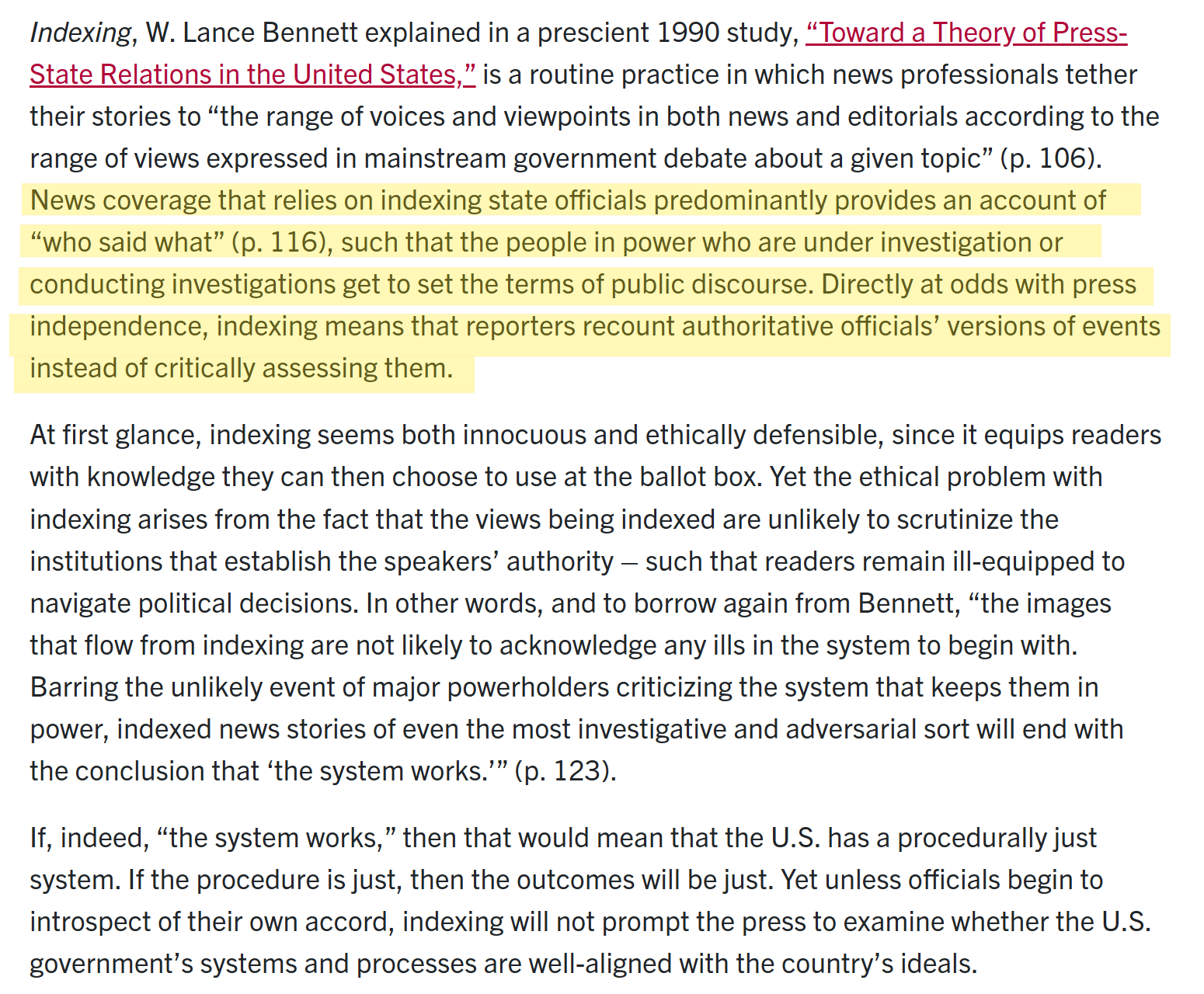
This matters acutely in foreign affairs. An outsider challenging a security claim may possess local knowledge but lack the status that makes the challenge easy to publish. An official with access to classified material can offer an allegation that the journalist cannot independently inspect. The resulting imbalance can privilege institutional position over publicly testable evidence.
Stuart Hall and his co-authors’ Policing the Crisis examines the role of powerful sources as “primary definers.” The concept helps explain how officials can establish an initial interpretation around which subsequent reporting and disagreement take shape.
The advantage of defining the first question is substantial. If the question is “How serious is the foreign threat?”, critics must struggle to introduce the prior question: “What evidence establishes that this is a threat?” If the question is “Why has this government failed to control unrest?”, critics must ask whether control is the appropriate measure. If the question is “Why has unrest not spread?”, they must recover the possibility that citizens have political reasons for choosing other forms of participation.
An institution can permit extensive argument while leaving its deepest premise untouched. The panel is diverse; the question is inherited. Guests disagree vigorously about the speed of intervention, the competence of a foreign leader, or the likely scale of upheaval. They may never examine why an external power’s preferences became the frame within which the society is judged.
That is how elite consensus can present itself as independent common sense. The danger is greatest when newsrooms mistake proximity to powerful sources for access to reality itself. Officials are sources within a political struggle. Treating them as the natural custodians of reality gives them an advantage that journalism ought to test.
Ownership, access, and the price of remaining inside
Edward Herman and Noam Chomsky’s Manufacturing Consent offers a structural account centered on ownership, advertising, sourcing, organized pressure, and prevailing ideological commitments. Its comparative treatment of victims asks why some suffering becomes a sustained moral cause while other suffering receives less forceful attention.

Applied to contemporary media, the demanding question is how an institution’s incentives shape its ordinary decisions. Which sources are inexpensive to reach? Which relationships deliver exclusive information? Which interpretations reassure influential readers? Which controversies create pressure from owners, advertisers, governments, or organized constituencies? Which challenges require expensive reporting that a shrinking newsroom is less able to undertake?
The cost of challenging power need not take the form of an explicit threat. A reporter may lose access. An editor may anticipate a damaging dispute. A publication may prefer a familiar expert whose claims fit a recognizable story. A bureau may lack the language skills and time required to test the account offered by an English-speaking intermediary. These are mechanisms to investigate; their presence in a particular case must be established rather than presumed.
The resulting analysis moves beyond the psychology of a prejudiced journalist. Bias can survive a change of staff because the institution continues to reward the same forms of access, the same conception of importance, and the same audience expectations. Professional sincerity is compatible with institutional distortion.
This is why public accountability cannot depend solely on whether an editor feels fair. Fairness needs observable practices: disclosure, transparent corrections, varied sourcing, comparable treatment of evidence, and a willingness to reopen a premise after it has become editorially comfortable. An institution’s self-image is not an audit.
Colonial authority survives in the right to classify
Colonial narration involves more than an insulting adjective. It assigns unequal authority to the observer and the observed. One society becomes the standard of political adulthood; another becomes a subject whose conduct requires interpretation, instruction, or supervision. The observer’s historical interests disappear from view while the observed society’s defects become explanatory facts.
Edward Said’s Covering Islam examines how media and expert discourse help construct the political reality through which a diverse set of societies is understood. His work directs attention to the authority embedded in representation: who is qualified to explain, which categories organize the explanation, and how heterogeneous populations become a single familiar object of knowledge.
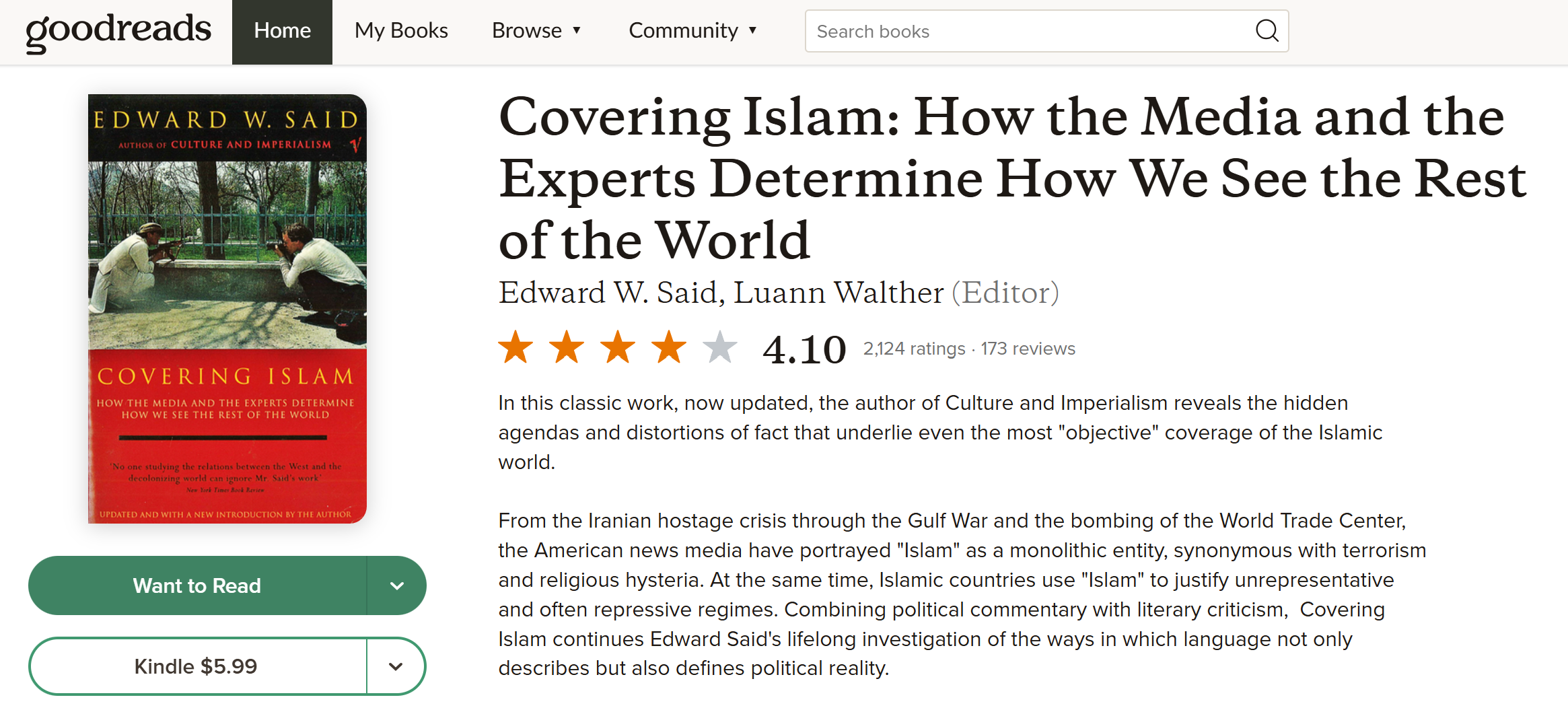
The contemporary application extends beyond any one religion. “The West” often functions as an unmarked location from which judgment is delivered, while other societies are marked by religion, ethnicity, civilizational deficiency, or incomplete modernization. Europe has politics; others have ancient passions. Western violence requires a detailed account of circumstance; violence elsewhere can be invited to reveal a cultural essence. These are patterns to examine in comparative texts, not descriptions of every article.
Teun A. van Dijk’s Racism and the Press studies the reproduction of racial inequality in news discourse, including topic choice, representation, and access to authoritative speech. Its relevance lies in moving the discussion beyond openly racist statements toward routine linguistic and institutional practices.
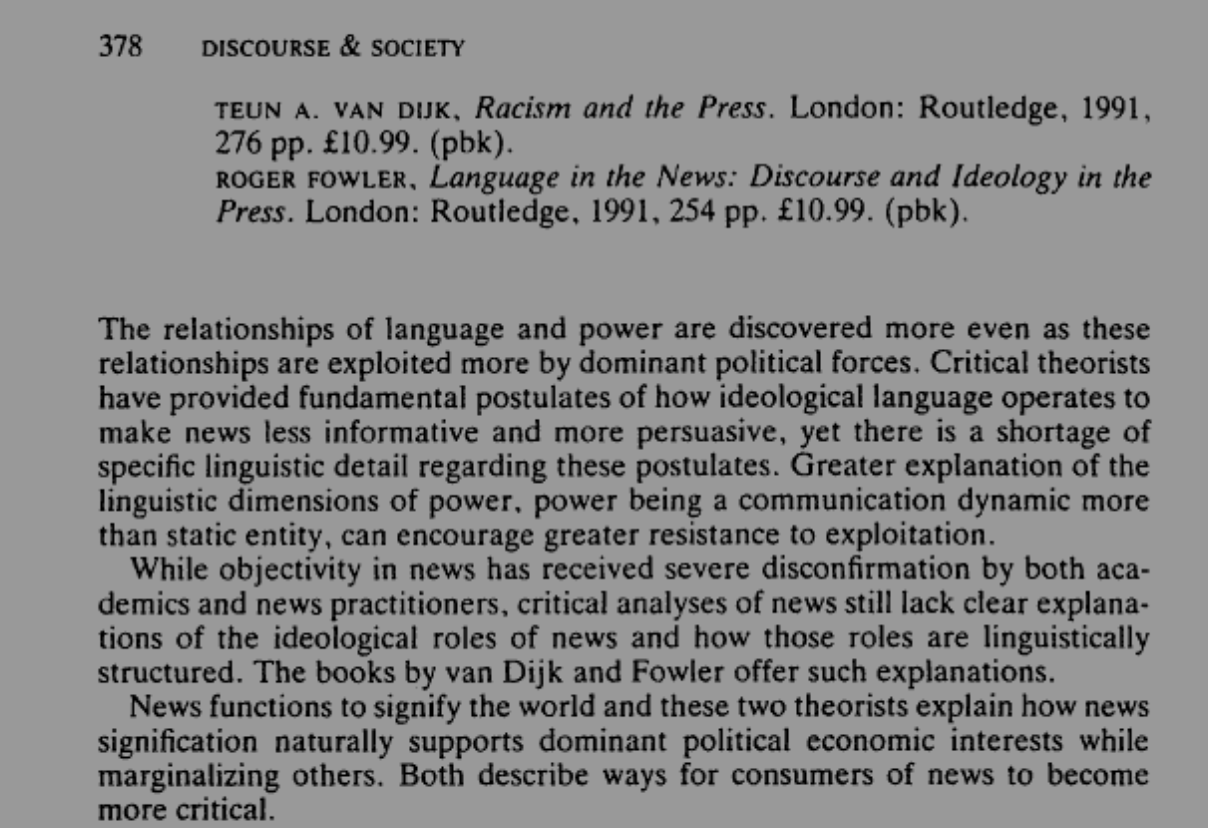
A publication can reject racial prejudice as a declared principle while reproducing a hierarchy in who appears competent, credible, modern, or capable of self-government. The effect can arise through recurring associations rather than explicit biological claims. Readers learn who normally explains and who normally needs explaining.
The demand for decolonization in media is therefore a demand for equal interpretive standing. An Indian, Kenyan, Brazilian, or Indonesian society should be encountered as a site of political thought and agency, not merely a location supplying examples for someone else’s theory. Local citizens can disagree with their governments without consenting to a foreign institution’s claim to rank their civilization.
The developmental gaze and the poverty qualification
Hemant Shah’s The Production of Modernization examines Daniel Lerner’s intellectual work and the Cold War assumptions connecting mass media, development, and the transformation of postcolonial societies. The publisher’s account identifies the model in which exposure to American messages would help “traditional” populations become “modern.”
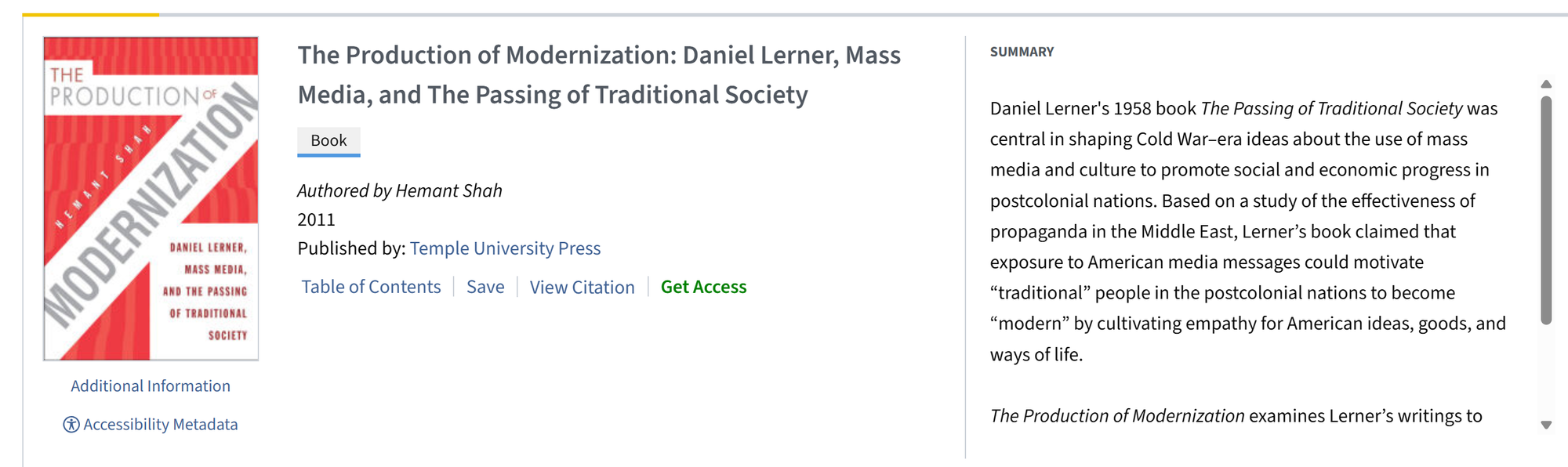
The implication for media criticism is substantial. A developmental hierarchy can persist after its vocabulary changes. The outside observer retains the authority to decide whether a society has advanced enough, become secular enough, consumed appropriately, or assigned its resources correctly. Achievement is then evaluated as evidence in a continuing examination rather than recognized as an exercise of equal agency.
This is the problem with the recurring poverty qualification in coverage of Indian achievement. Poverty is a legitimate subject of reporting. The question is when it becomes an obligatory moral interruption: a reminder that India’s scientific or technological accomplishment requires permission from a social audit that is not comparably imposed on every wealthy state’s achievement.
The appropriate comparison is editorial practice. Does a report on an American launch routinely ask whether homelessness makes it morally inappropriate? Does European technological ambition receive an obligatory recital of deprivation? Sometimes opportunity costs are relevant; that relevance should be established consistently. Poverty should not become a rhetorical device used to keep a postcolonial country in its assigned place.
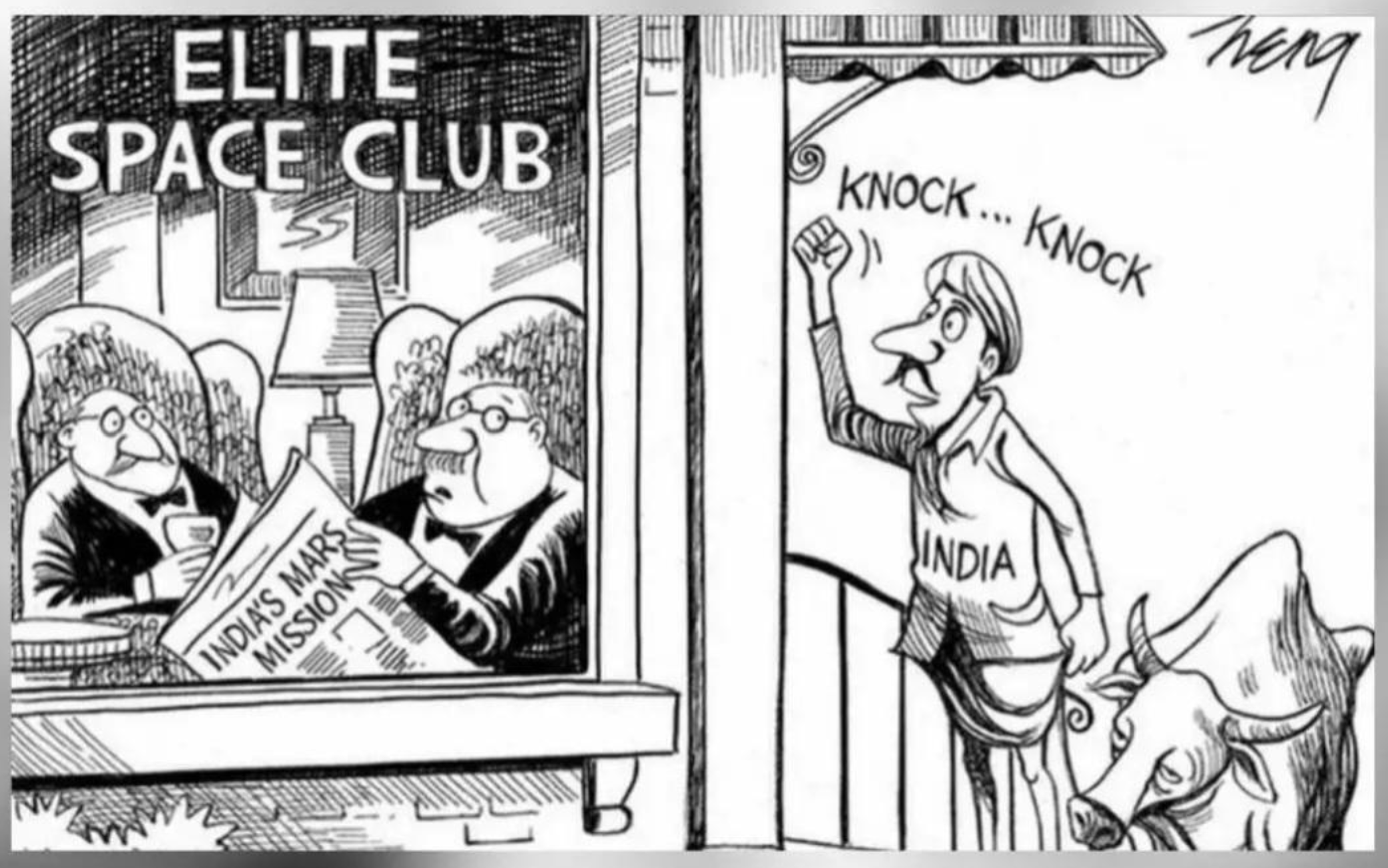
The 2014 New York Times cartoon about India’s Mars mission made the hierarchy visible. It depicted a rural Indian figure with a cow approaching a room marked as an elite space club. The newspaper apologized after criticism that the image insulted India.
 NBC News
The image’s political force came from its allocation of roles: an established interior and an incongruous applicant outside. India’s scientists had accomplished the mission, yet the visual shorthand returned the country to a familiar rural stereotype. Its achievement appeared as entry into a club whose incumbents retained the power to recognize it.
Whether it was the cartoonist’s private intention or not can at best be a speculation. Any art is, however, not made in a moral and / or ideological vacuum.
That is why an apology does not exhaust the issue. The deeper editorial question is how the image passed through a professional system without its hierarchy becoming an obstacle to publication.
Africa and Latin America: reducing societies to useful stories
The collection Africa’s Media Image in the 21st Century, edited by Mel Bunce, Suzanne Franks, and Chris Paterson, examines changing representations of the continent, including the movement between familiar narratives of catastrophe and optimistic accounts of economic emergence. It provides a scholarly setting for questioning both the pessimistic and celebratory simplifications through which Africa is narrated.
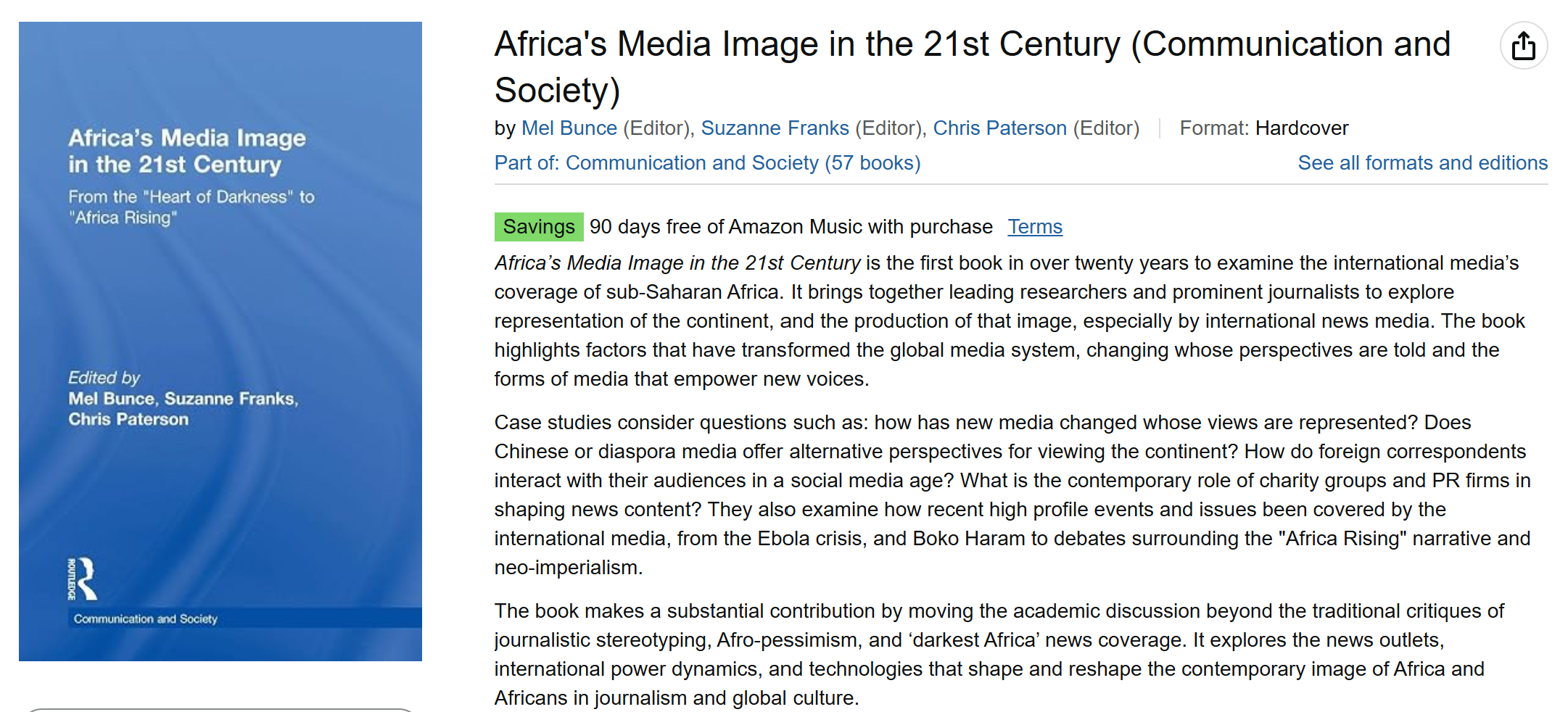
The difficulty with a continent-wide script is that it makes a vast range of political communities available as interchangeable illustrations. A coup becomes evidence about “Africa.” A technological success becomes a surprising exception. Ordinary institutional competence becomes less newsworthy because it does not fit the anticipated drama. The problem is the scale of the category and the repetition of the explanation.
Latin America has faced a related struggle over the vocabulary of legitimacy. The historical material on Chile demonstrates an external propaganda apparatus participating in the region’s political information environment.
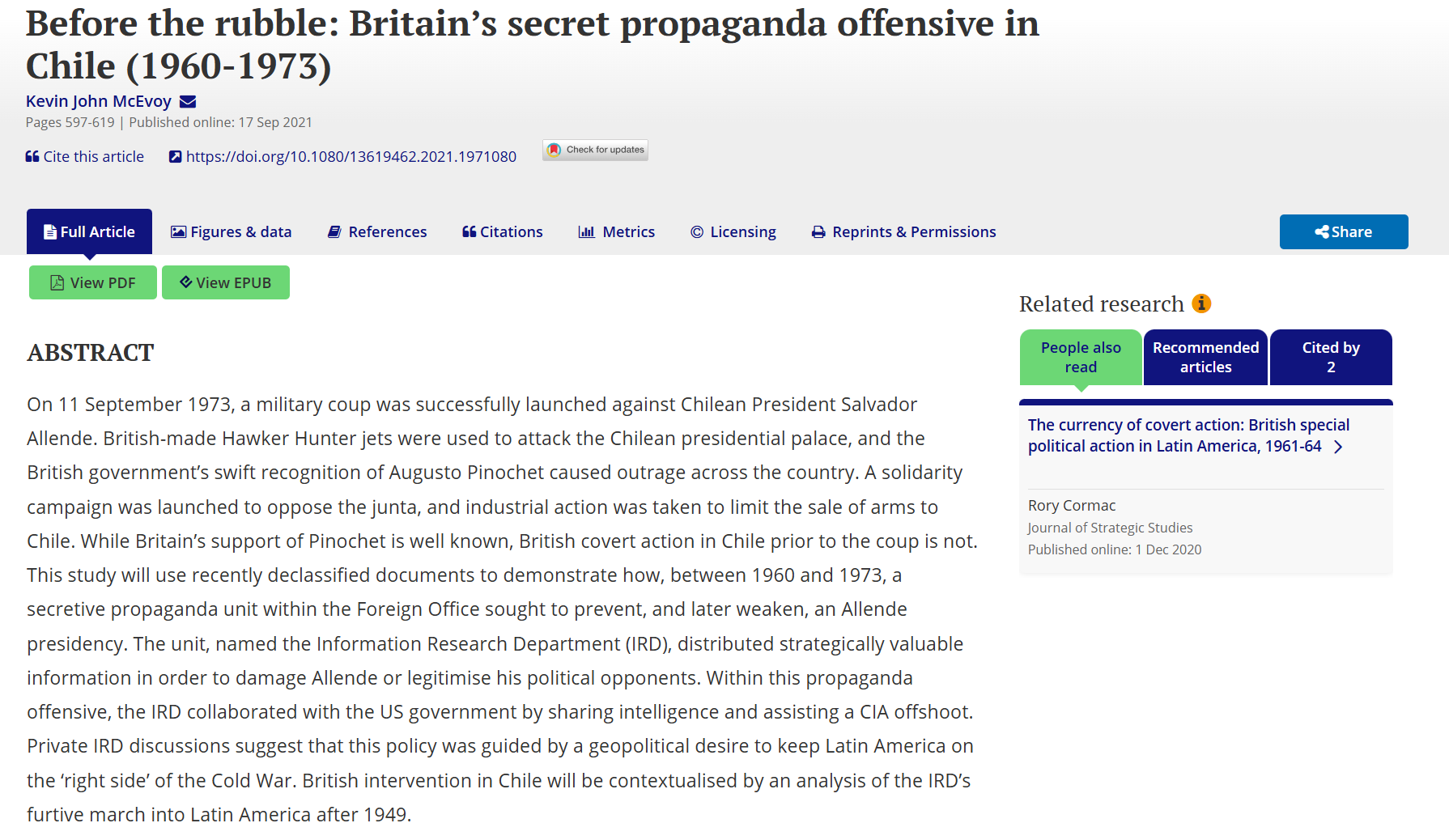
The broader analytical question is how reporting distinguishes democratic mobilization, economic populism, constitutional crisis, and strategic danger. Those labels carry implications for whether outside pressure appears intrusive or necessary.
An audience deserves to know when a society’s political choices are being evaluated against its own constitutional commitments and when they are being evaluated against another state’s preferred alignment. The two standards can overlap, but they should not be silently substituted for one another.
There is a particular violence in the erasure of political reasoning. Citizens may support a policy because of land distribution, historical memory, national industry, religious commitment, or distrust of foreign intervention. Reducing those reasons to manipulation, backwardness, or irrational identity deprives them of intellectual standing before the debate begins.
Covering protests
Protests are an especially revealing test because they force newsrooms to allocate sympathy between competing claims: public order, political participation, bodily safety, property, economic activity, and state authority. The same visual scene can be made to signify democratic courage, criminal disruption, or governmental collapse.
Michael Boyle, Douglas McLeod, and Cory Armstrong’s 2012 study analyzes protest coverage and finds that tactics play a substantial role in shaping treatment, with issue and location also operating through their relationship to tactics.
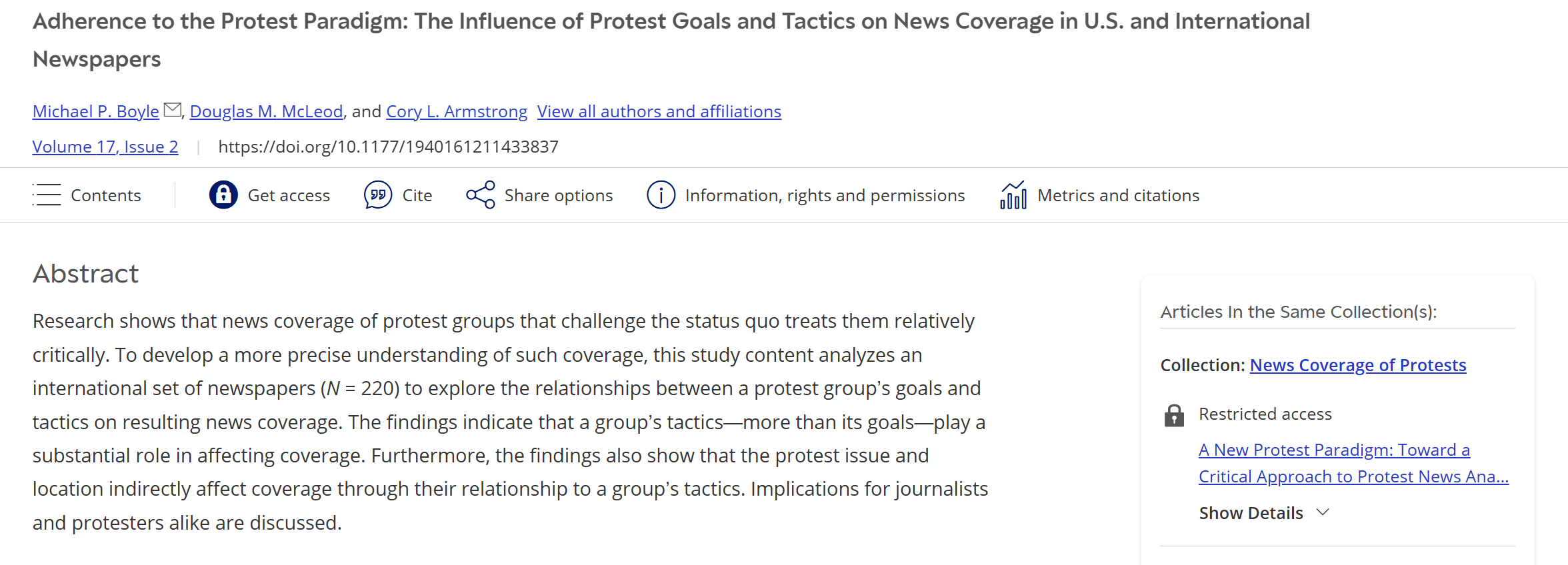
Its importance here is methodological: comparisons must account for what protesters actually did rather than treating all demonstrations as equivalent events.
Danielle Kilgo and Summer Harlow’s 2019 study of coverage in sixteen American newspapers finds a more delegitimizing pattern around protests concerning racial issues than around several other subjects.
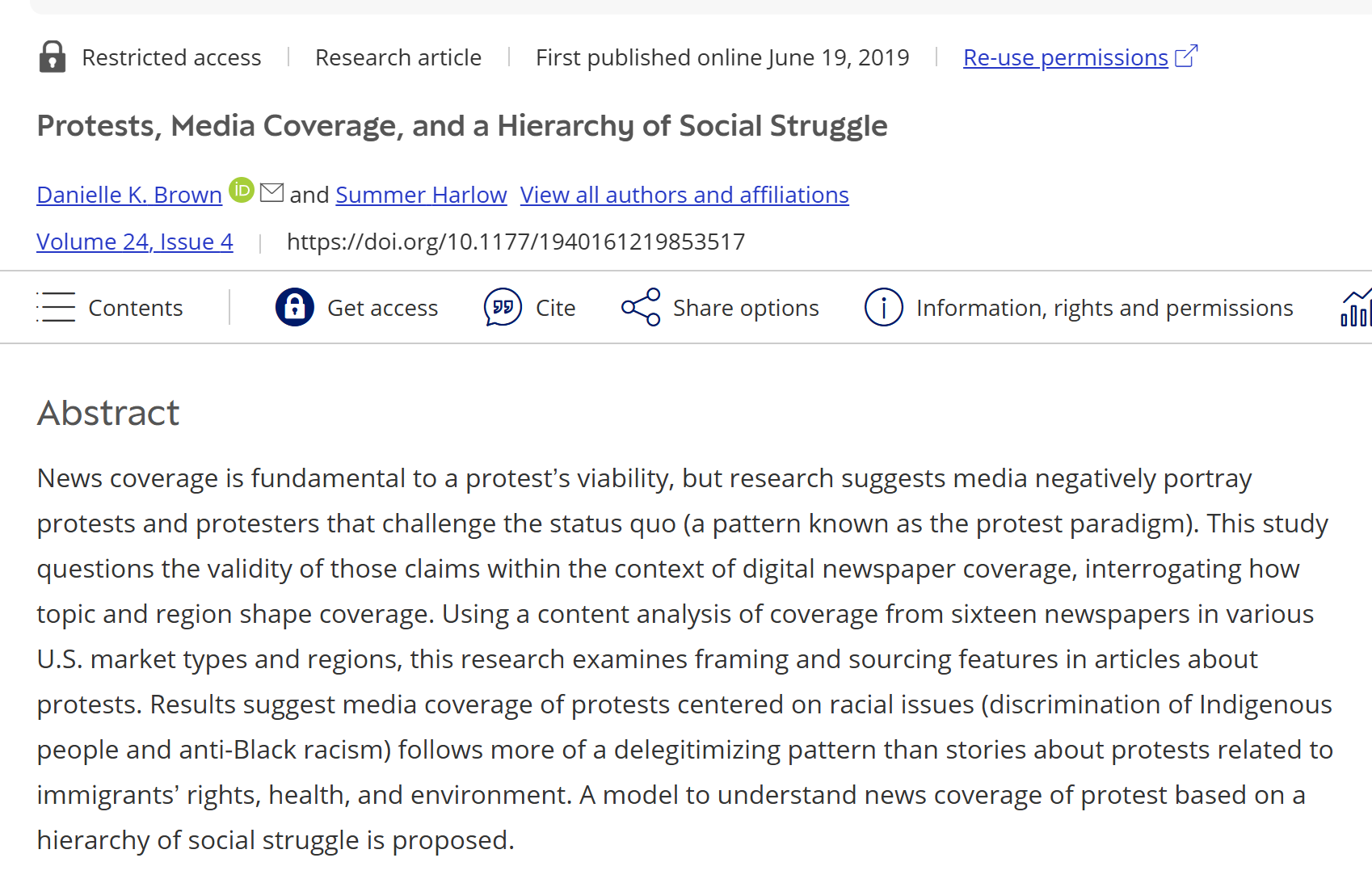
Their proposed hierarchy of social struggle shows that protest legitimacy can be distributed unevenly even within a single national media environment.
These findings help sharpen the argument about Western-centric standards. The division is not exhausted by a map of friendly and unfriendly governments. Racialized and marginalized groups inside Western countries can also be denied legitimacy.
The infographic shown here is best understood as a visual invitation to investigate that question.
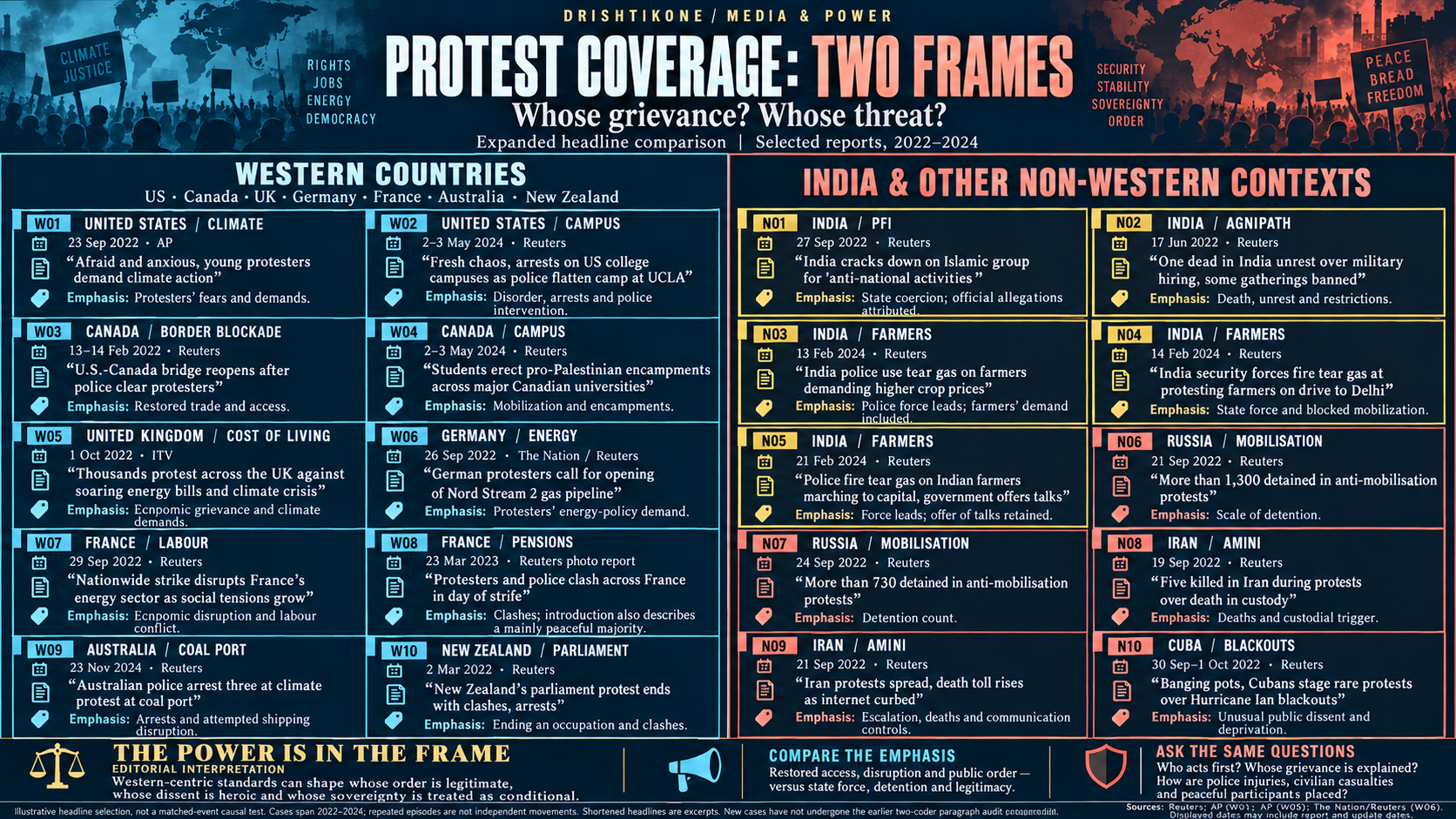
It juxtaposes selected reporting in Western settings (including the United States, Canada, Britain, Germany, France, Australia, and New Zealand) with reporting about India and other non-Western societies. It makes wording and presentation available for direct comparison.
The illustrated selection does not establish a measured rate of bias across these countries. One realizes this is by no stretch exhaustive or comprehensive. But it gives a glimpse of the bias that underlines the reportage of the protests.
That is why its substantive challenge remains valuable.
- When does policing become restoration, and when does it become repression?
- When do injuries to officers establish the moral meaning of the event?
- When is the peaceful majority introduced early enough to shape the account?
- When does an arrest become a statistic, and when does it become evidence about an entire political system?
Those are observable editorial decisions. A newsroom answering only that each headline was factually defensible has answered a narrower question. The comparison concerns the rules governing which defensible facts receive priority.
India: dissent, consent, and the expectation of upheaval
India deserves its own analysis because it unsettles a simple geopolitical division. It has substantial relationships with Western states while also exercising independent political choices. In this essay, its placement beside other non-Western cases concerns the treatment of its legitimacy in the selected reporting; it does not classify India as an officially adversarial government.
There is India-specific scholarship behind this concern. Abhijit Mazumdar’s qualitative study, “Blast from the past,” examines the New York Times’s depiction of India during 1967–91 through indexing theory. Its published abstract reports common themes supporting that theory’s account of the relationship between domestic foreign policy and international reporting.
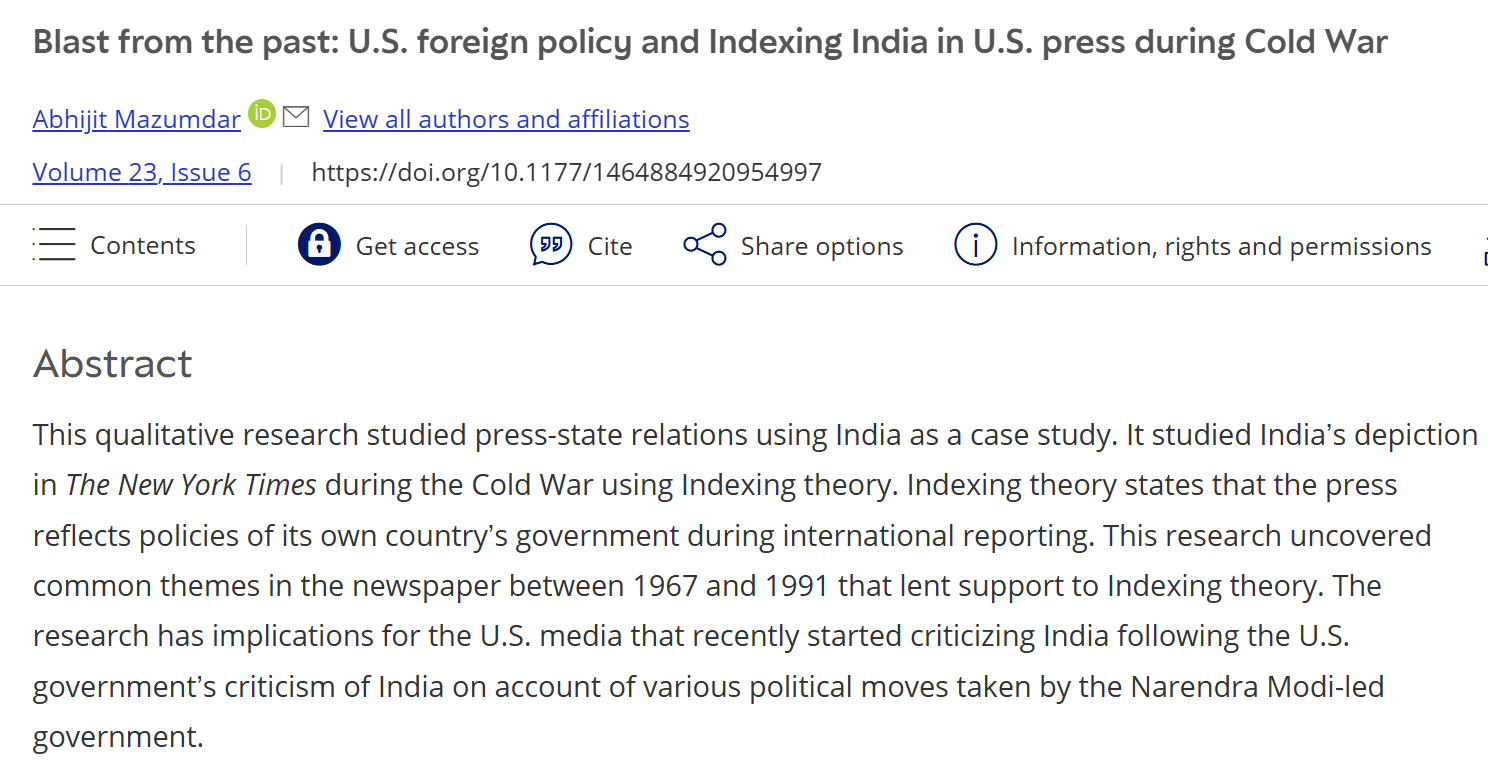
This is a historical study of a particular newspaper and period, rather than a measurement of every current Western outlet. It nevertheless gives the question an empirical research history: the relationship between American strategic preferences and portrayals of India is an object of scholarly investigation, not merely a complaint generated by social media.
The political implication is that readers should ask which Indian choices are treated as intelligible disagreements and which become evidence of dangerous deviation. A country can cooperate with Washington on one issue and resist it on another. If the tone of representation changes alongside those disagreements, the relationship deserves investigation. The causal explanation must be tested, but the comparison itself is entirely legitimate.
The BBC article titled “Why India’s Gen Z is not taking to the streets,” catalogued by ecoi.net in October 2025, supplies a telling question for analysis.
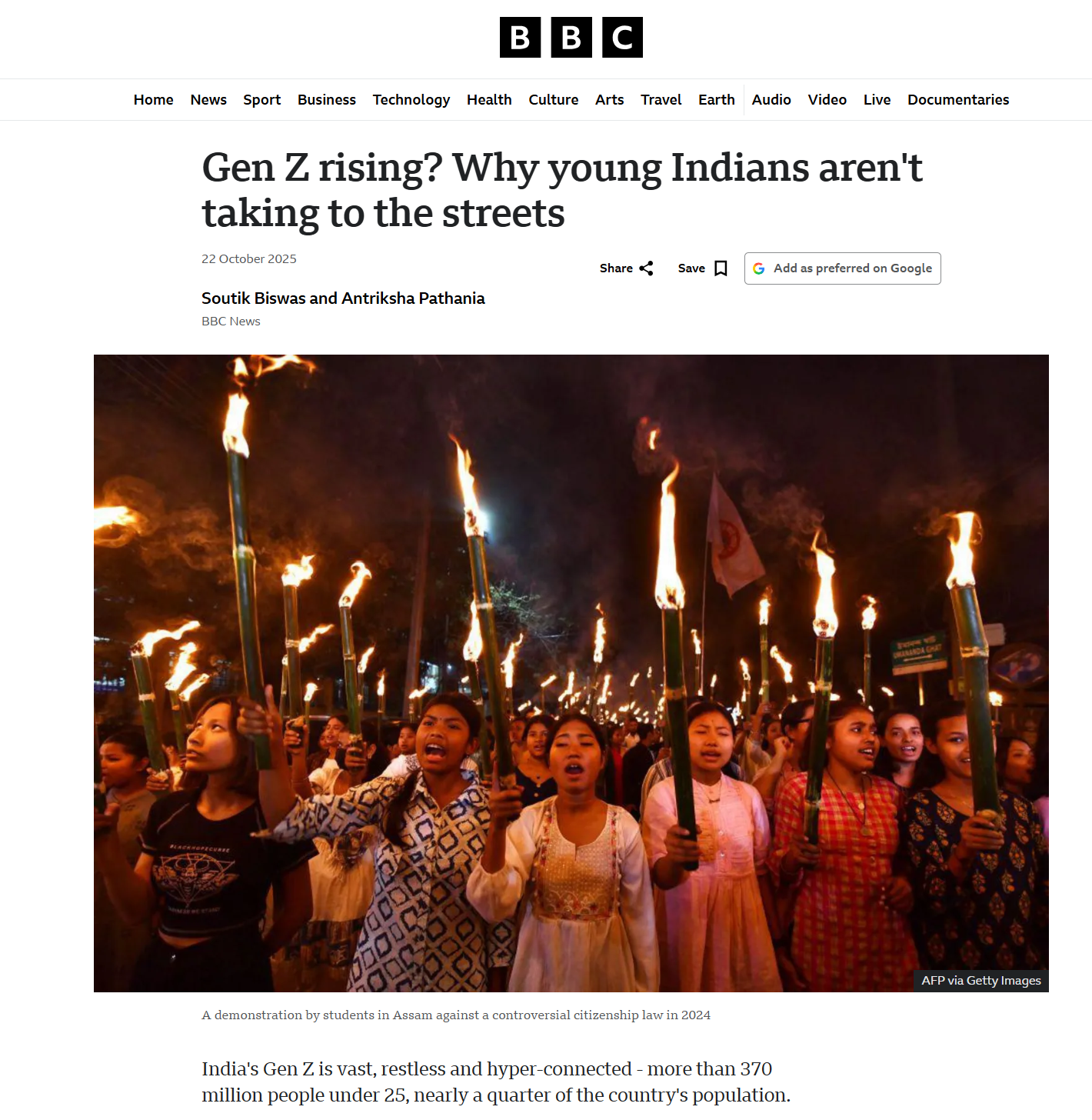
A comparative inquiry into youth politics is legitimate. But the headline’s presupposition can still be examined: widespread street mobilization is the anticipated outcome, and its absence is the phenomenon requiring explanation.
The criticism supported here concerns the organizing expectation: why is the absence of upheaval a puzzle, and would the same question be asked with the same assumptions about young citizens in Britain or Germany?
Other Indian protest episodes offer distinct opportunities for examination. Reporting on the 2020–21 farmers’ movement, the renewed farmers’ mobilization in 2024, protests over the Agnipath recruitment scheme in 2022, and the wrestlers’ protests in 2023 can be compared for whose grievances lead, how tactics are described, and whether policing is judged through a consistent standard.
Those differences matter. A protest about agricultural markets has a different social composition and policy setting from a protest about military recruitment or allegations of sexual misconduct. Treating them as interchangeable evidence of a single national crisis would reproduce the reduction the criticism seeks to expose. The proper question is how each event is made to bear a larger meaning about India.
The most revealing comparison would hold the outlet and genre steady while examining similar tactics and consequences. A blocked road in France and a blocked road in India raise comparable questions about access and public order. Injured officers in Canada and injured officers in India deserve comparable factual attention. A peaceful demonstrator’s injury deserves independent scrutiny in either place. Equal standards require enough context to make the comparison meaningful.
The difference between a report existing and a cause being pursued
There were protests in Pakistan-occupied Kashmir. Reuters and AP did report deadly unrest there in October 2025.
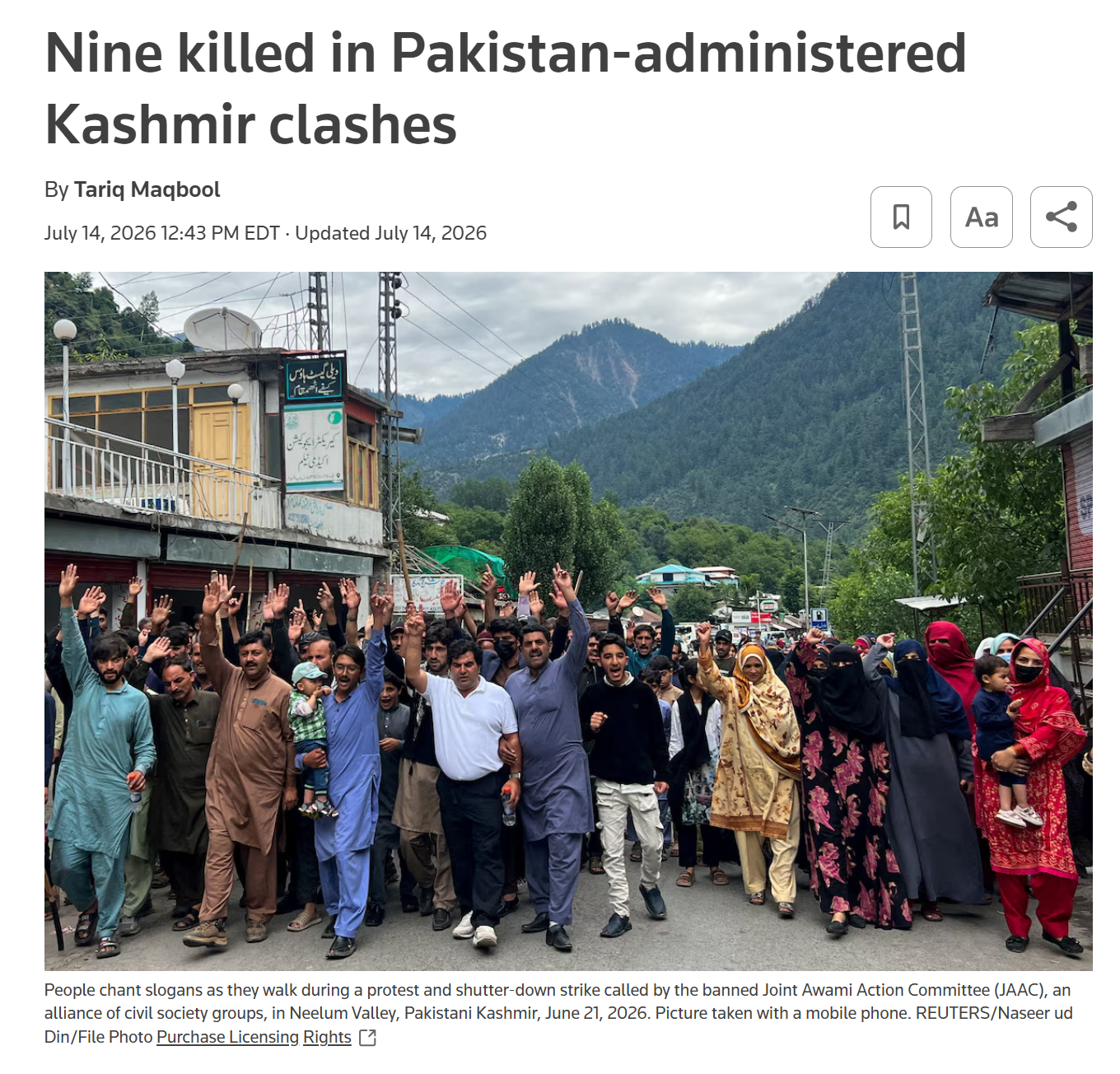
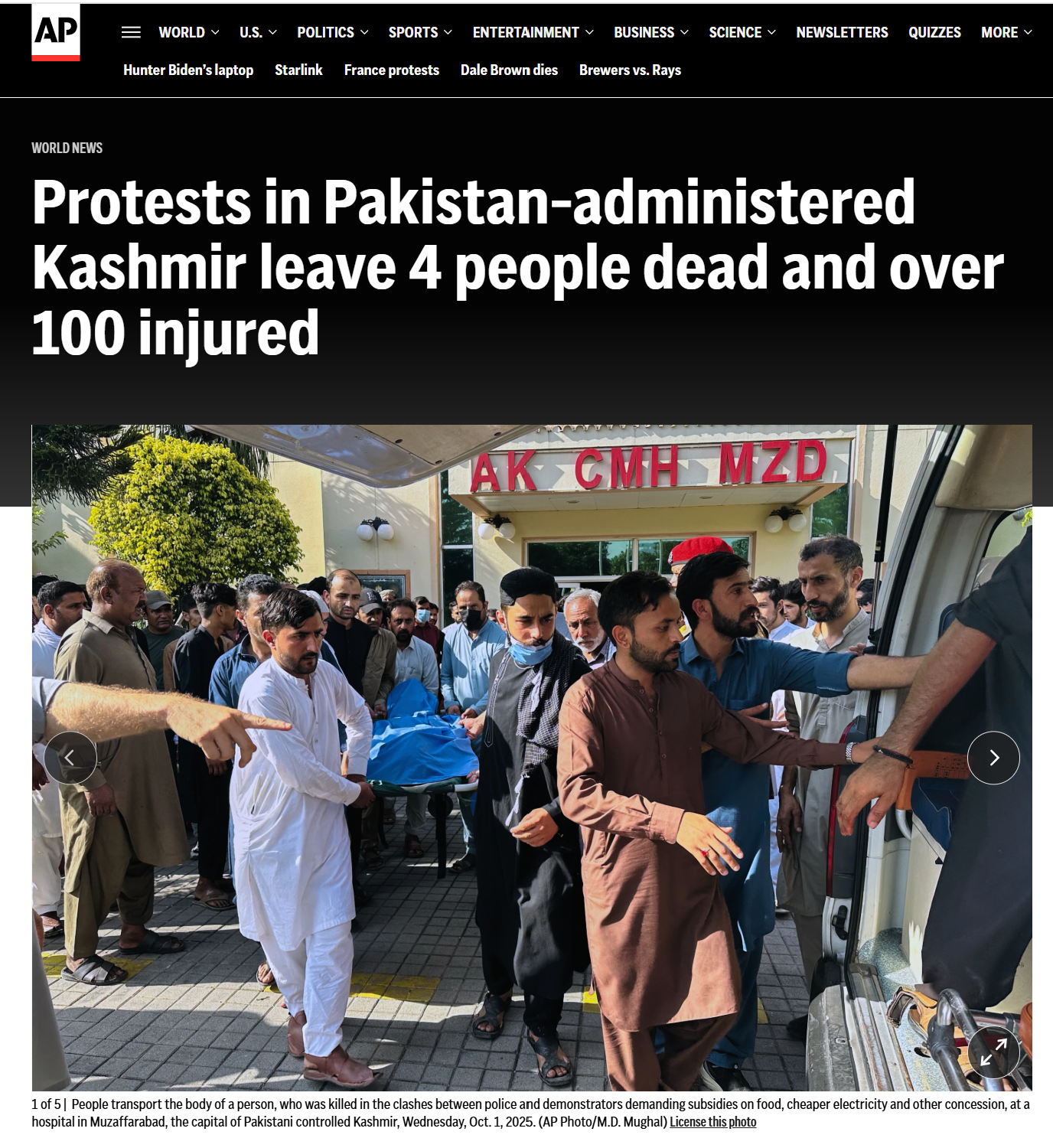
But did any of the news agency portray it with the same level of seriousness as it does a similar actions by police in India (even though such things have not happened).
The answer is no.
Connecting the evidence without giving inference a false identity
There are several defensible connections across this material. Covert media relationships demonstrate that intelligence services have valued journalistic credibility as an operational resource. The Reuters arrangement demonstrates that a trusted information institution’s financing could be concealed through another trusted institution. The Iran memorandum demonstrates that propaganda and public perceptions of legitimacy belonged inside an intervention strategy. Scholarship identifies ordinary editorial processes through which authority and hierarchy can be reproduced.
The inference is that a media system organized around privileged access, concentrated distribution, and Western centers of judgment presents recurring opportunities for strategic influence. An operator benefits from an information environment already inclined to recognize certain officials as authoritative and certain foreign societies as unstable. A dramatic instruction may be unnecessary when the desired argument fits established expectations.
The absence of a complete public trail is unsurprising in covert activity. It is a reason to pursue archives, disclosures, whistleblower testimony, funding records, and publication histories.
What media institutions owe the people they describe
The first obligation is disclosure. An organization claiming independence should explain relevant state financing, intelligence-related arrangements, and the safeguards covering its staff and credentials. Historical disclosure should identify decisions and responsibilities rather than retreat into the passive voice of an unfortunate era.
The second is evidentiary consistency. Anonymous official claims require scrutiny, especially when they can prepare public acceptance of coercion or war. A powerful source’s confidence should not be substituted for evidence accessible to the reporter. If relevant disagreement exists, its prominence should reflect its importance to the claim rather than the source’s institutional rank.
The third is interpretive equality. The same categories of evidence should support judgments about police force, democratic legitimacy, public consent, and national achievement across countries. Context may justify different conclusions. It should not function as a privilege reserved for familiar societies while others receive sweeping diagnoses.
The fourth is accountability for amplification. An institution that repeatedly elevates an allegation cannot repair the damage merely by publishing a later qualification with a fraction of the visibility. Corrections should confront the original frame, explain how it arose, and reach the audience that received it. The object is to repair public understanding, not just the institutional record.
The fifth is a redistribution of explanatory authority. Local citizens and scholars should appear as thinkers whose concepts can shape the story, rather than as quotations inserted after the editorial explanation has already been chosen. Language competence, historical knowledge, and patient reporting are material conditions of that change.
These obligations are practical. They can be examined in newsroom policies, published work, sourcing patterns, and disclosure records. Institutions that claim the right to scrutinize whole societies should accept scrutiny of the procedures through which they construct those societies for the world.