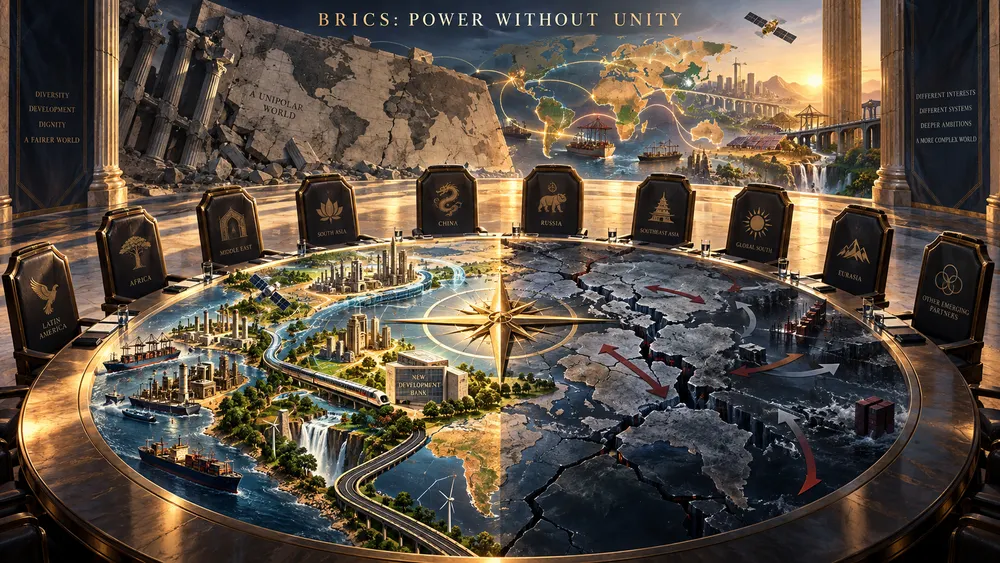
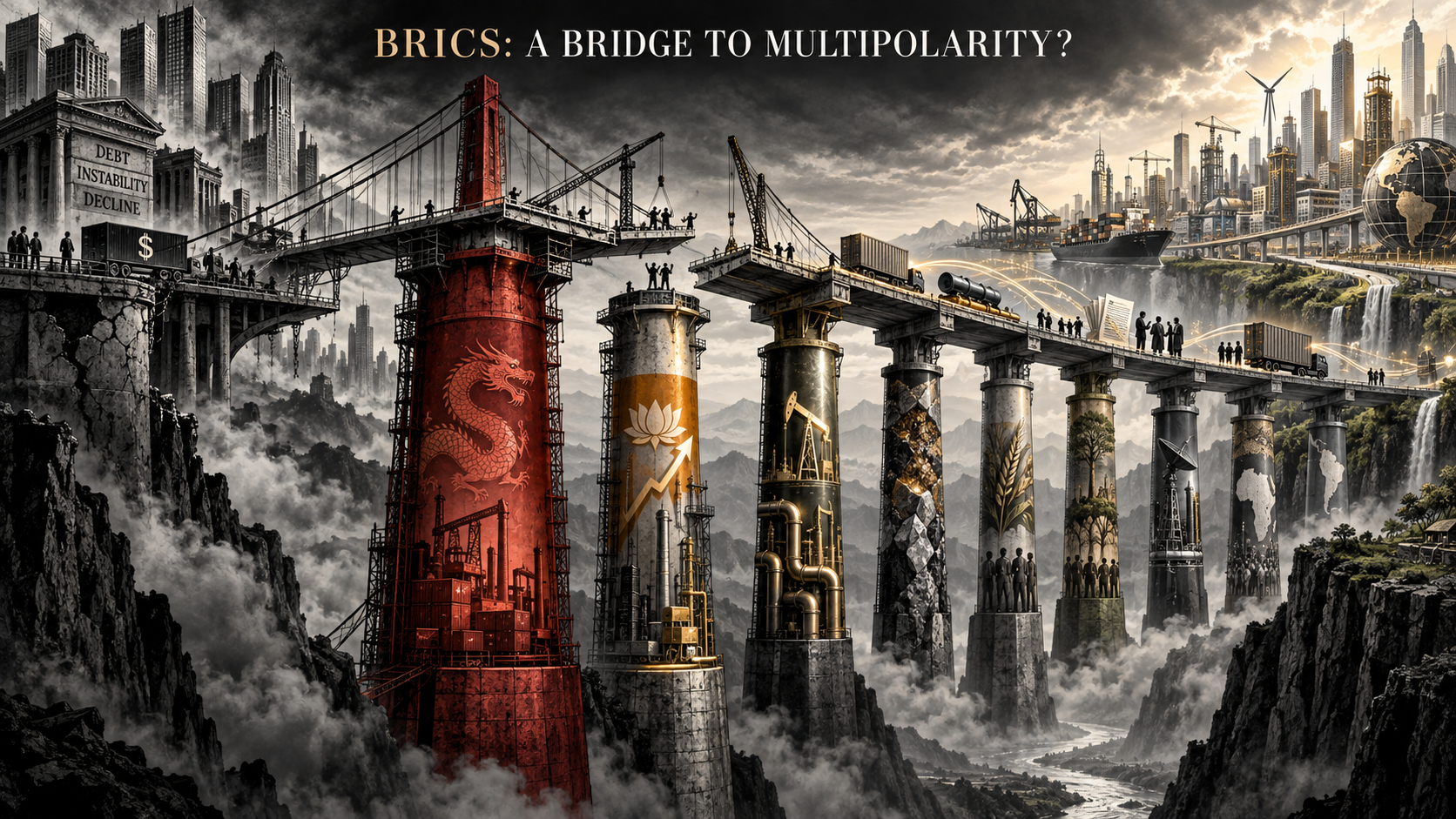
The Two Rivers
A student came to the old master and said, "The great empire has protected the roads for a hundred years. Now merchants speak of new roads, new guards, new coins. Which road is the true one?"
The master led him to where two rivers met. One was wide and settled, moving with the weight of age. The other was many streams braided together, some clear, some muddy, pulling in different directions.
"Which river is stronger?" the master asked.
"The old one," said the student. "It is deep. The other cannot decide where it flows."
The master was quiet for a while. Then he said, "Sit at the meeting place through one season."
The student sat. In the dry months the wide river thinned and the braided streams fed it. In the floods the wide river spilled and the braided channels carried what it could not hold. Neither ever became the other. Boats that trusted only one were often stranded.
At season's end the student said nothing. He had stopped asking which river was true.
The master smiled. "The wise merchant does not choose the river," he said. "He learns to read the confluence."
New Delhi's BRICS Summit 2026
The 18th BRICS Summit is underway in New Delhi on 12–13 September 2026 under India’s fourth chairship. It is being held at Bharat Mandapam with the theme “Building for Resilience, Innovation, Cooperation and Sustainability.”
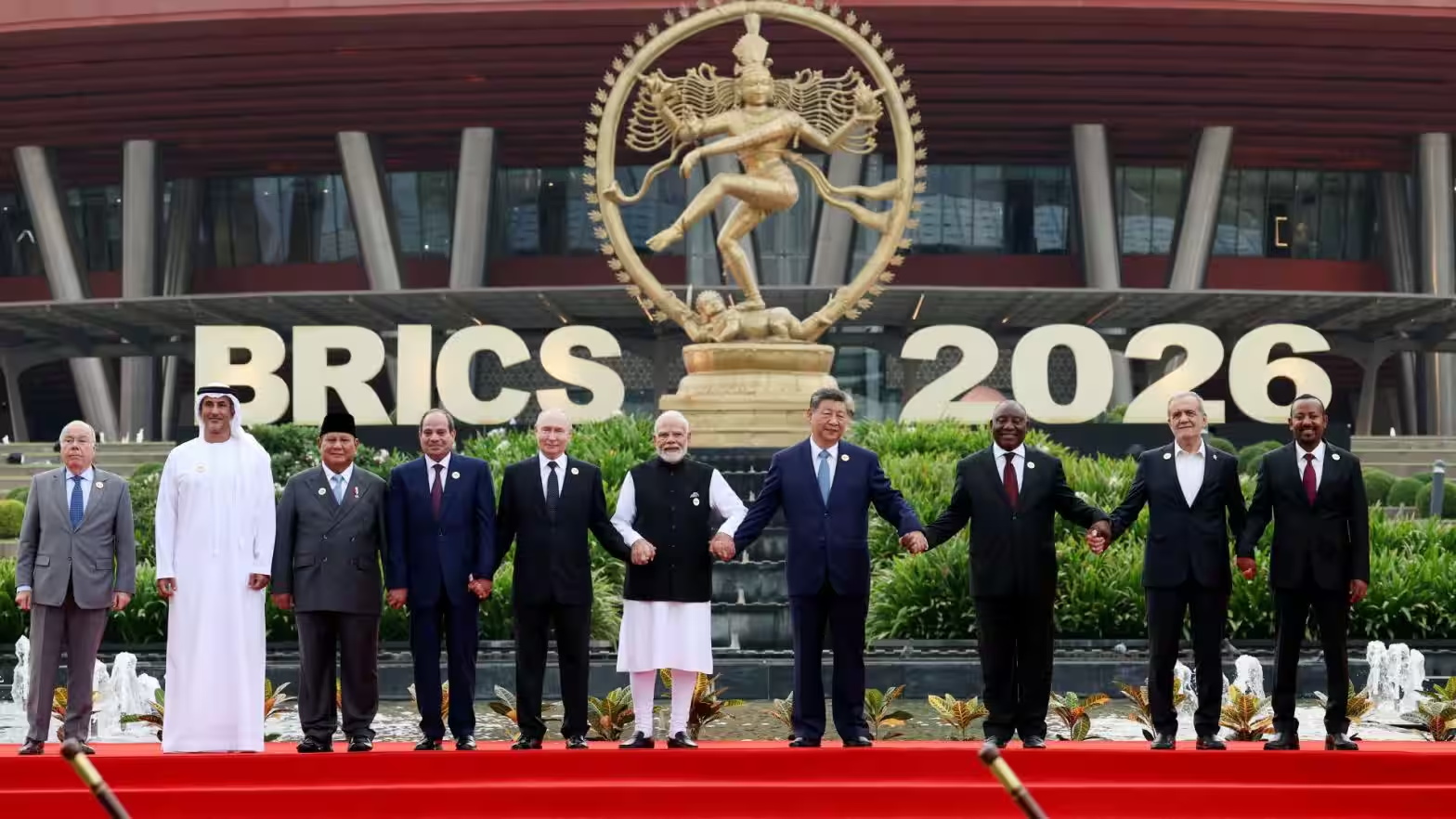
The grouping now has 11 full members (Brazil, Russia, India, China, South Africa, Egypt, Ethiopia, Indonesia, Iran, Saudi Arabia, and the UAE) plus partner/outreach countries. Together they represent roughly half the world’s population and a large share of global GDP and trade.
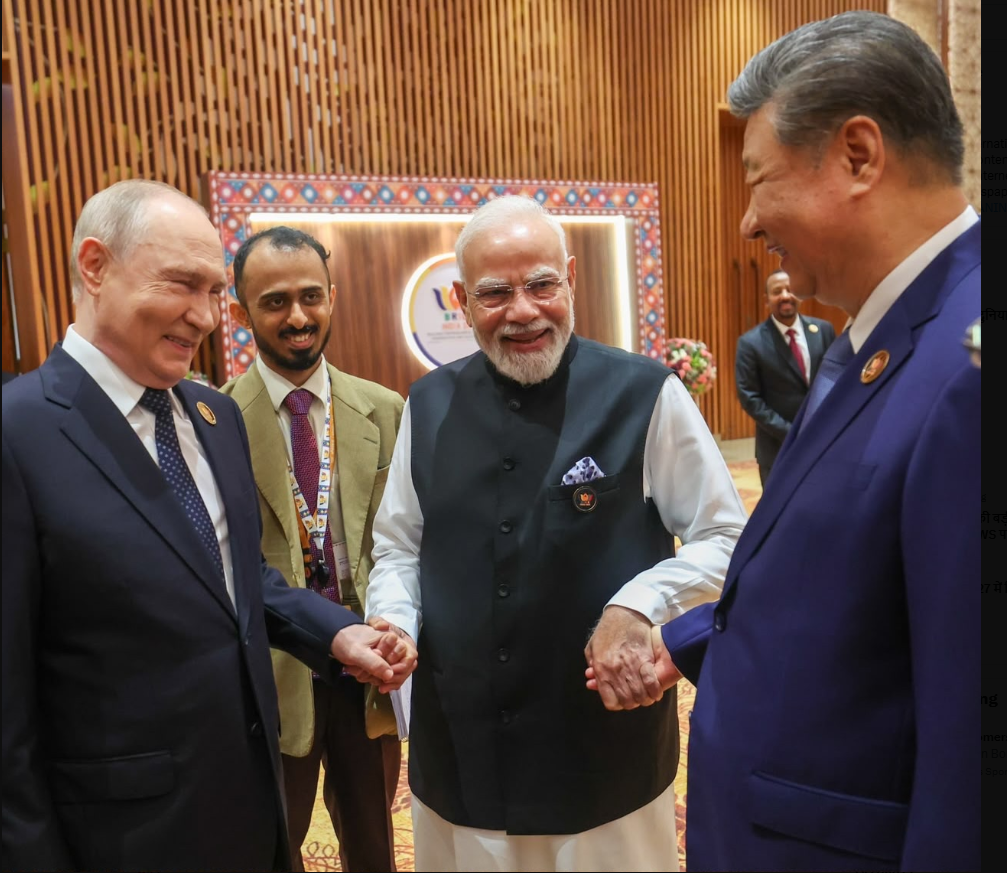
The cameras in New Delhi showed the leaders. Modi between Xi and Putin. Pezeshkian and Ramaphosa. The Abu Dhabi crown prince across a table from the Iranian president. Delegations from the wider Global South arranged around one hall.
Someone will ask the obvious question about a single meeting: what did India actually get from it?
The question misreads the event. This meeting took a year to construct. India began building the machinery for its presidency in November 2025.
Brazil formally handed over the chair in December, and India assumed it on 1 January 2026. On 13 January, it announced the theme, Building for Resilience, Innovation, Cooperation and Sustainability. The original blueprint envisaged 153 engagements: one leaders' summit, foreign ministers' meetings, a national security advisers' meeting, Sherpa rounds, ministerial tracks, agency-head meetings, expert-level sessions, business council engagements, parliamentary exchanges and Track-II dialogues.
Overall, India treated the chairship as a practical, development-focused exercise rather than an anti-Western platform.
It hosted more than 350 meetings across 25 cities during the year and steered the agenda toward economic resilience, digital public infrastructure (DPI), local-currency trade and payments, supply-chain cooperation, startups, energy storage, agriculture, health, and climate.
New Delhi issued chair’s statements when consensus failed (notably at the May 2026 foreign ministers’ meeting), rather than forcing a lowest-common-denominator text.
It also used the summit for high-profile bilateral diplomacy with both Russia and China while keeping the official BRICS language focused on “humanity first,” multilateral reform, and Global South priorities.
To look at the summit as an isolated event, therefore, is a big mistake. One should liken the summit to the "final scene." The film ran for a year, and most of the crew will never appear in the credits.
The deepest story of Delhi 2026 is not BRICS against the West.
The Makkah defense pact insures against declining confidence in American security guarantees.
China's relationships across opposing camps insure its commerce. India's multi-alignment insures against dependence on either Washington or Beijing.
Read this way, the summit marks a longer transition toward a post-alliance order, and India's position within that order is more interesting than any photograph suggests.
The combined power question: what BRICS actually weighs
Before the strategy, the arithmetic, because most commentary gets the arithmetic backward.
On nominal GDP, the measure that best reflects international financial power, the G7 remains considerably larger than the expanded BRICS. Nominal GDP for the expanded grouping sits at roughly $34 to $35 trillion, compared with approximately $54 to $55 trillion for the G7.
That places BRICS at about 28 percent of world nominal output and the G7 at about 44 percent.
In relative terms, BRICS is roughly 62 to 64 percent of the G7, and the G7 economy is about 1.6 times larger. These figures are rounded from the IMF April 2026 World Economic Outlook database.
Another contemporary calculation puts the totals at about $31 trillion and $52 trillion, showing how exchange rates and the treatment of ambiguous members such as Saudi Arabia shift the estimate. Excluding Saudi Arabia alone would cut the BRICS nominal total by roughly $1.4 trillion.
Purchasing-power parity tells the opposite story.
At PPP, the expanded BRICS reaches about 40 to 41 percent of world output, compared with about 28 to 29 percent for the G7. BRICS also contains close to 48 percent of humanity, compared with roughly 10 percent for the G7. This is the source of the commonly cited claim that BRICS accounts for about 40 percent of the global economy. Putin's version of that claim refers to PPP, and without the qualifier, it misleads.
Surjit Bhalla on BRICS as a "One-pony Show"
Indian economist Surjit Bhalla wrote an X thread on BRICS as an economic entity.
It is worth reading. It shares some excellent data but draws some rather immature conclusions not worthy of his scholarship.
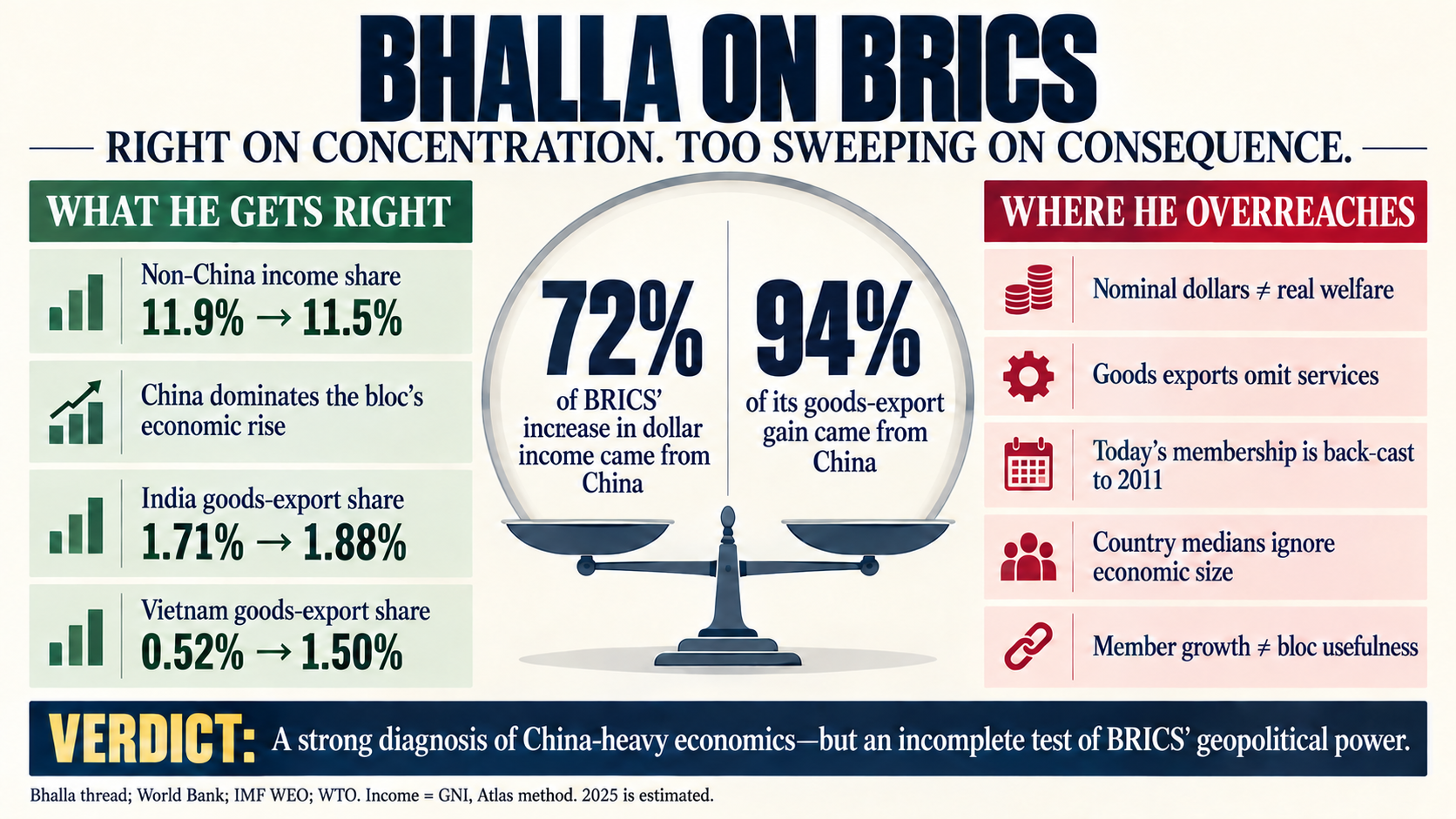
1/ BRICS went from 21.9% of world income in 2011 to 28.9% in 2025.
— Surjit Bhalla (@surjitbhalla) September 13, 2026
Now take out China.
The other ten members went from 11.9% to 11.5%.
They did not rise. They fell. pic.twitter.com/rq18XYMIA1
So here is Bhalla's central thesis:
His broad argument: “BRICS is a club of one” is rather two sweeping and simplistic.
In terms of stats and numbers, you can put it this way.
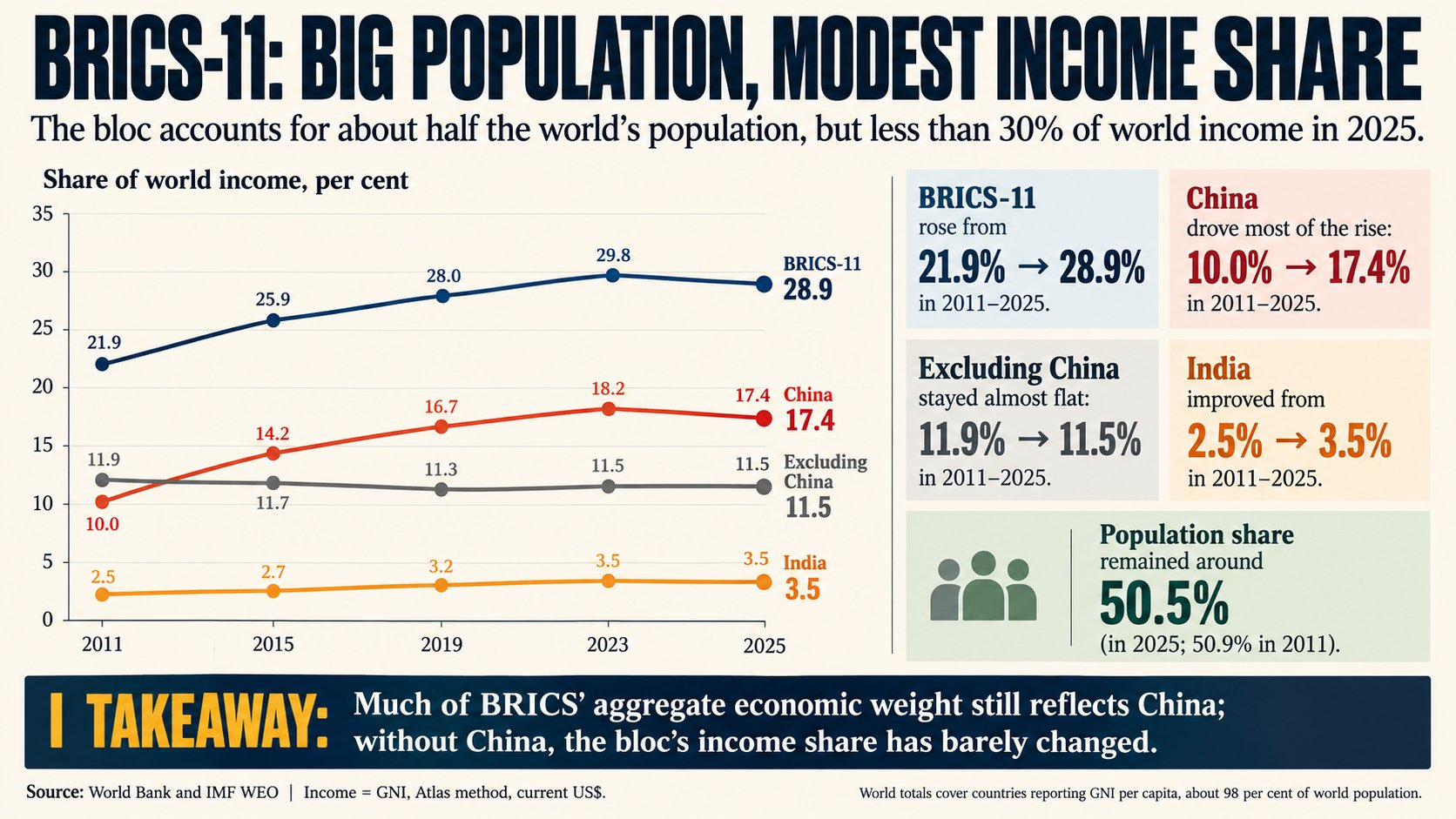
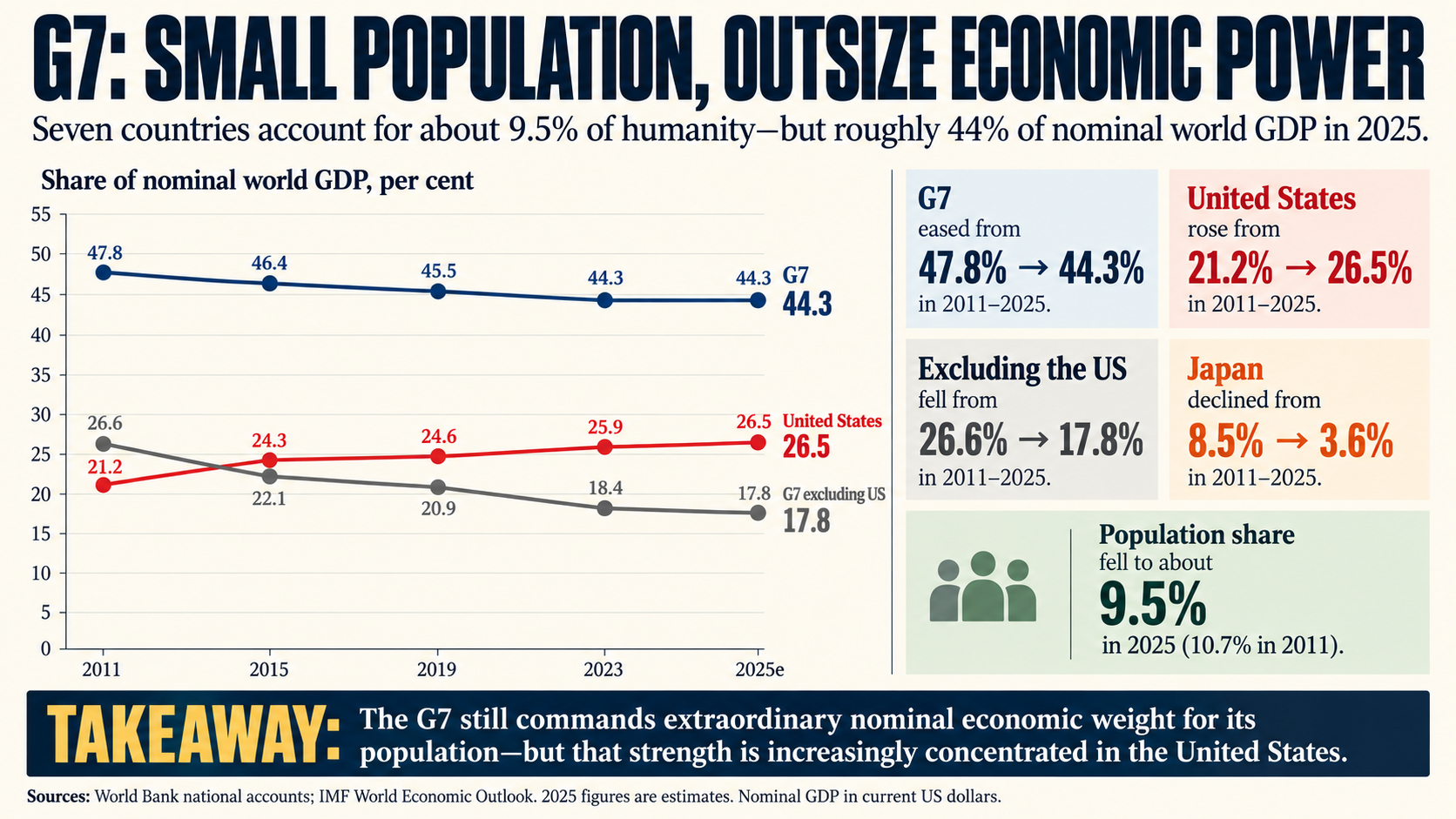
What about G7? Well, the G7 retains roughly 44% of world nominal GDP with only 9.5% of the population, but its economic strength is increasingly concentrated in the United States.
A similar infographic shows that what is true of China within BRICS is largely true of the US within the G7 as well.
Let us analyze Bhalla more closely.
Where Bhalla Is Right, and Where He Overreaches
Bhalla's strongest point stands: BRICS's rise is disproportionately Chinese.
On the thread's own world-share figures, China climbs 10.0 to 17.4 percent, a gain of 7.4 points, while BRICS as a whole gains 7.0 points. The bloc excluding China falls 0.4 points.
China therefore explains more than 100 percent of the net increase, because the other members collectively gave ground.
That is even sharper than his 72 percent headline, which measures China's share of the rise in absolute dollar income.
His India versus Vietnam comparison, looking at mere facts, also seems plausible. India moved 1.71 to 1.88 percent of world goods exports while Vietnam went 0.52 to 1.50, and India's manufacturing underperformance is real.
The overreach lies in what the numbers are asked to prove.
"Poorer in dollar terms" invites a welfare reading the Atlas method cannot support, since dollar GNI falls on currency depreciation, commodity cycles and sanctions without real output falling.
Goods exports omit India's strongest external sector, services, where India now exports 421 billion dollars and ranks seventh in the world. The correct conclusion is that India trails Vietnam in export manufacturing, not that it failed to expand its global economic presence. We will analyze the India vs Vietnam situation in more detail in the next section.
Bhalla also back-casts today's membership into 2011, which answers how this set of countries performed, not what BRICS membership did. His median-country test treats Ethiopia and China alike, burying the population-weighted scale where India and China hold a third of humanity.
Most importantly, PPP cannot be waved away either, since it measures production volume and living standards that nominal figures completely miss.
The deepest error is testing the wrong proposition. BRICS is not a common market or a currency union. It is a coordination forum, and member growth rates do not measure the diplomatic room it provides.
Yes, BRICS is not a uniformly rising economic coalition, and China supplies most of its measurable economic momentum. But to go from here to suggesting BRICS has little value or is merely a “club of one," is quite disingenuous.
The right way to look at BRICS is broader.
India vs Vietnam - Assessing Bhalla's Narrative
What the goods-export number actually measures
A merchandise-export figure counts the value of goods crossing a border. It doesn't tell you who owns the factory, where the components came from, or how much value was created inside the country.
For Vietnam, those distinctions carry most of the weight.
Foreign-invested companies account for roughly 73-75% of Vietnam's merchandise exports. The World Bank finds that foreign firms have dominated Vietnam's trade expansion and produce about three-quarters of its exports.
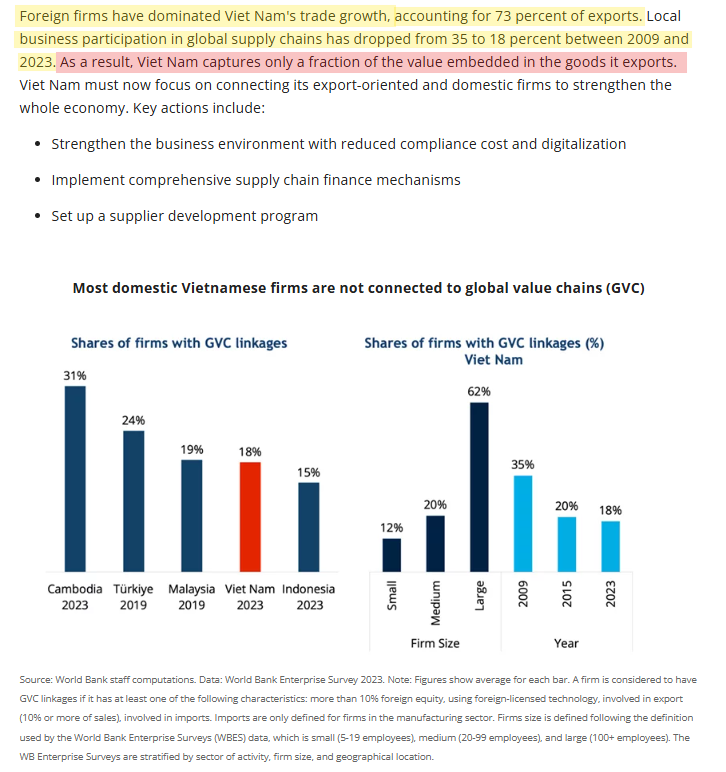
That one line captures what is fundamentally the core of Vietnam's export strength and, at the same time, national weakness.
The OECD reaches the same conclusion and adds the more telling number: close to half of the gross value of Vietnamese exports originates abroad. Foreign value added stood at about 48 percent of gross exports in 2021, meaning barely half of each export dollar is generated within Vietnam, and even that half includes the wages, utilities, logistics, and profits of foreign-owned plants rather than Vietnamese-owned technology or brands.
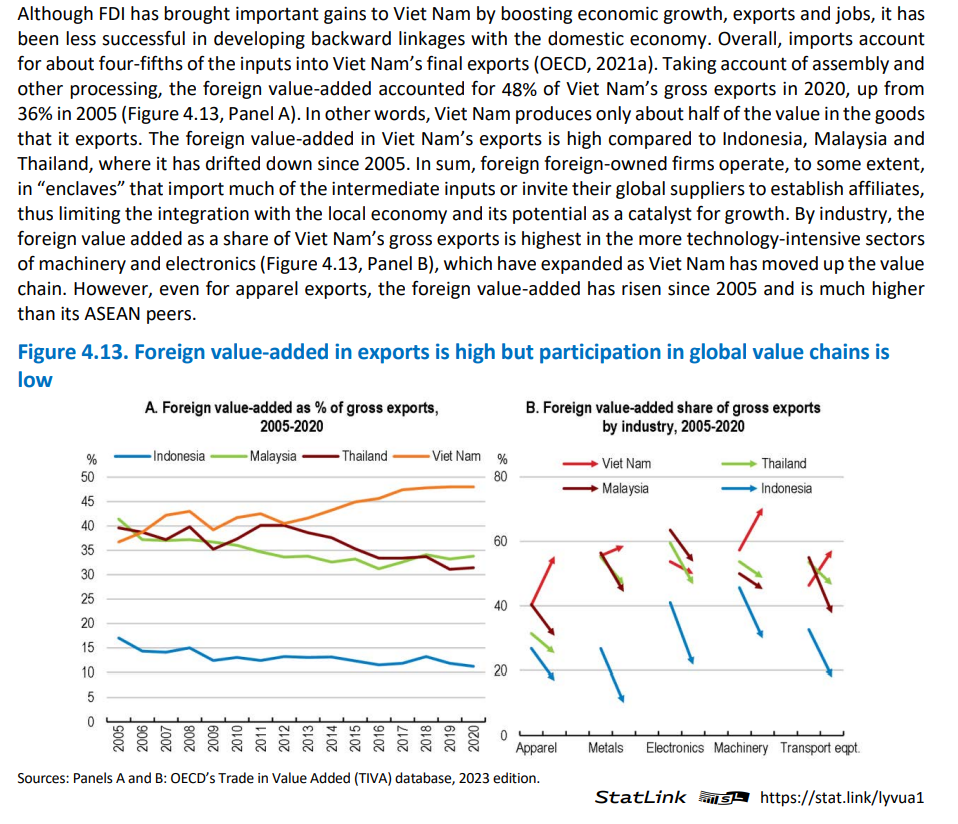
The ownership breakdown sharpens the picture further.
A 2026 Federal Reserve study decomposed Vietnam's exports to the United States and found that, in 2018 and 2019, other foreign-owned firms produced about 56 percent, Vietnamese-owned firms about 33 percent, and Chinese-owned firms about 11 percent.
Chinese-owned firms led the post-2018 increase in Vietnam’s exports to the United States, but they did not produce most Vietnamese exports. Other firms also played a huge part.
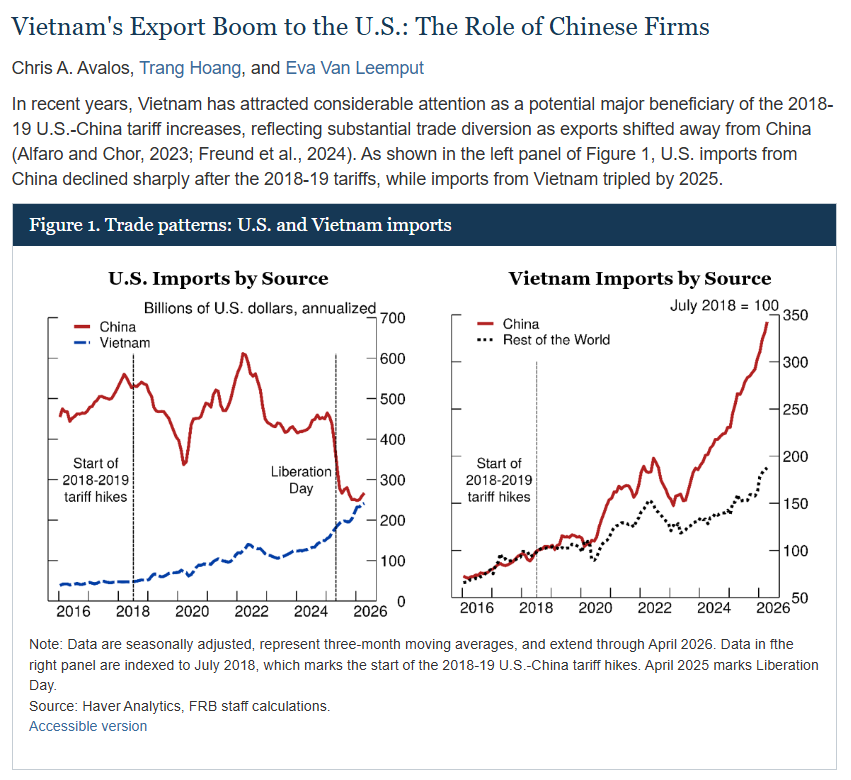
At times, Samsung alone has generated around an eighth of Vietnam's total merchandise exports. Vietnam is best described as a highly efficient assembly and export platform for a wider East Asian production system that happens to be located next to China.
That is a real national accomplishment, built through ports, industrial parks, trade agreements, and disciplined labor policy. It is a different accomplishment from the one the raw export share implies.
Bhalla's comparison treats every export dollar as equivalent. Vietnam's dollars and India's dollars are not, because a much larger fraction of Vietnam's are foreign-owned and import-heavy.
The export India does not get counted for by Bhalla
The second omission is larger than the first. Bhalla compares goods and stops there, which erases the single category in which India is a global power.
India's services exports reached a record 421.3 billion dollars in FY2025-26, up from 387.5 billion the year before, which makes India the world's seventh-largest services exporter.
India recorded highest-ever exports in FY 2025-26 reaching a record US$ 863.1 billion, with merchandise exports reaching US$ 441.8 billion and services exports expanding further to US$ 421.3 billion, reflecting the combined strength of India’s merchandise and services sectors in driving export growth. (Source: Press Information Bureau and Department of Commerce, Government of India, export data for FY2025-26: services exports 421.3 billion dollars, total exports 863.1 billion dollars)
Telecommunications, computer and information services supplied 206.6 billion dollars of that total, and business services another 124.2 billion. Total Indian exports of goods and services hit an all-time high of 863.1 billion dollars in the same year.
Set that against the frame Bhalla chose. On goods alone, Vietnam reached 1.50 percent of world exports, while India reached 1.88 percent.
On services, Vietnam barely registers in the global rankings while India sits seventh and rising. India's services exports alone are the same order of magnitude as Vietnam's total merchandise exports, and they generate far more domestic value because almost none of that 421 billion dollars leaks out as imported components.
Vietnam's platform rests on Chinese inputs
The third point is the most quietly damaging to Bhalla's own argument. His thread indicts BRICS for being China and nothing else. Vietnam's export miracle is tied to the same China.
Ownership and supply-chain dependence are separate things.
A factory in Vietnam may be Korean, Taiwanese or Vietnamese-owned and still import its displays, semiconductors, circuit boards, batteries, machinery, steel and chemicals from China.
The World Bank documents exactly this pattern in Vietnamese electronics, and the OECD notes that the FDI surge since 2018 partly reflects production relocating out of China to dodge United States tariffs.
One estimate put indirect Chinese content at roughly 28 percent of Vietnam's exports to the United States in 2022, up from 9 percent in 2018.
Vietnam's rise in the very years Bhalla measures was powered in part by becoming the preferred waystation for Chinese-linked value heading to American buyers.
The model also depends heavily on United States final demand and is exposed to rules-of-origin enforcement and the policing of transshipment.
Strip out China, the move Bhalla performs to deflate BRICS, and Vietnam's platform wobbles too.
India doing a Vietnam?
Since 2014, India has pursued Make in India as more than an export slogan. At its best, it represents an attempt to build domestic industrial capacity, keep more value within the country, develop Indian suppliers, and reduce strategic dependence on foreign production. That objective is essential.
India should not reproduce Vietnam’s vulnerabilities: an export economy dominated by foreign-owned companies, dependent on imported components, and exposed to decisions made at corporate headquarters abroad.
But strategic autonomy cannot become economic insularity.
India’s manufacturing policy has helped create visible successes in mobile phones, electronics, automobiles, pharmaceuticals and defense.
Yet manufacturing’s share of the economy has not risen as dramatically as promised, and India’s portion of global merchandise exports has moved only modestly.
Yet annualized dollar growth was only about 3.5%.
Progress was uneven: exports fell to $262.29 billion in FY2015-16 and did not sustainably exceed the mid-$300-billion range until the post-pandemic rebound in global trade lifted shipments sharply, not manufacturing transformation by itself.
Clearly, for a country with millions of young people entering the workforce, this is not enough.
High-value services can generate income and foreign exchange, but they cannot alone absorb the vast number of workers moving out of agriculture or entering the labor market without advanced degrees.
India therefore needs a two-track manufacturing strategy.
- The first track should continue building indigenous capability: Indian companies, domestic components, technological knowledge, local intellectual property and resilient supply chains.
- The second should borrow selectively from Vietnam’s success by making India an exceptionally attractive production-and-export base for global companies—including Chinese firms where national-security considerations permit.
That requires more than subsidies.
India needs plug-and-play industrial zones, reliable electricity, rapid customs clearance, predictable taxation, efficient ports, flexible labor deployment, enforceable contracts and easy access to imported components.
Foreign companies should be encouraged to manufacture in India using Indian workers, land, engineering talent and progressively localized suppliers. And then export to the world.
The objective should not be to choose between foreign investment and self-reliance. It should be to use foreign investment as a ladder toward deeper Indian capability.
The winning strategy is to combine both: welcome global production aggressively, capture the jobs and exports immediately, and steadily increase the Indian value embedded in every product leaving an Indian port.
India's manufacturing catch-up is real, partly because it has started doing what Vietnam did.
India's electronics exports reached a record 47 billion dollars in 2025, with roughly 30 billion of that from incentive-driven smartphone exports, making electronics the country's third-largest export category. Smartphone exports rose from 11 billion dollars in FY2022-23 to 29.4 billion in FY2025-26, iPhones alone hit two trillion rupees, and India's share of global iPhone assembly climbed toward 26 to 28 percent. This is the fastest structural shift in India's export basket in a generation.
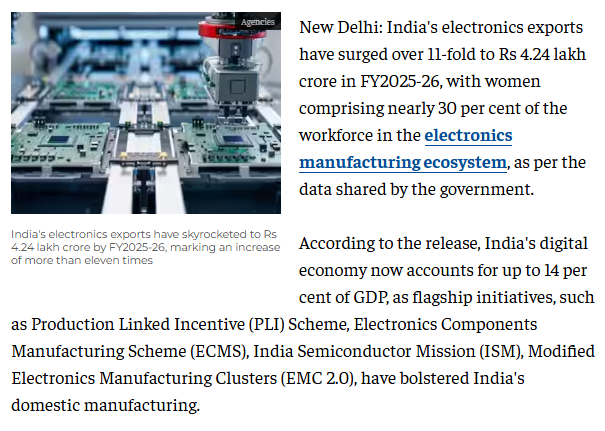
It also inherits Vietnam's vulnerability.
India's smartphone exports run through Foxconn, Pegatron, and Tata assembling for Apple and Samsung; they lean on imported components, and they concentrate on a handful of premium models and one company's production decisions. The value-added and ownership questions that qualify Vietnam's numbers apply to India's smartphone line too.
What differs is context.
Vietnam is building the platform close to its ceiling. India is building it as one floor among several.
Two contests
There are two industrialization contests here. And they are easy to conflate.
- The first is factory location and gross exports, the count of goods leaving the dock. Vietnam won that decisively, and Bhalla's numbers record the win.
- The second is domestic ownership, intellectual property, deep localization and indigenous technological capacity, and for India specifically the conversion of services strength and manufacturing scale into mass employment.
Neither country has conclusively won the second, and it is the second that decides whether an export share becomes national power or stays a parking lot full of other people's cars.
Bhalla's thread is useful precisely because it names a real Indian weakness rather than flattering the country.
Its limitation is that it grades India on the single ruler that hides India's largest export, understates the domestic value inside Indian output, and ignores that Vietnam's scoreboard is stamped, underneath, with the same Chinese label he uses to dismiss the rest of BRICS.
India should take the criticism about jobs and labor-intensive manufacturing and act on it.
It should not accept the verdict that a fifteenth of its population has nearly caught it, because on any measure that counts the whole economy, the gap is widening in India's favor, not closing.
De-dollarization vs De-Americanization
Coverage of BRICS fixates on a common currency and on de-dollarization.
That fixation obscures the larger transformation.
For decades, countries depended on the United States for three connected services: dollar settlement, maritime security, and military protection of energy routes. All three are now being questioned at the same time.
Together they let states assemble security and payment services from different suppliers.
That is what a multipolar order will look like in practice.
Not one replacement hegemon, but a modular marketplace in which a country can settle in rupees or yuan, buy naval reassurance from a regional partner and hold a defense understanding with a nuclear-armed neighbor, without any of those choices requiring the others.
A hard limit exists on how far this can go, and Delhi's own agenda exposed it.
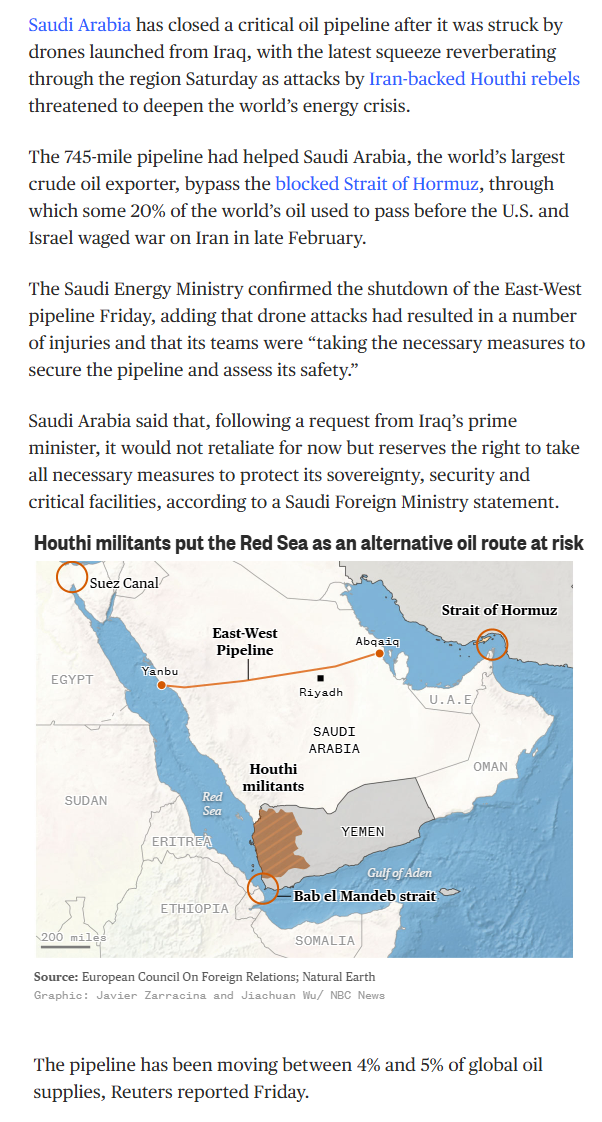
A payment can be settled in any currency, but the oil tanker still has to cross Hormuz, Bab el-Mandeb, the Red Sea and Suez. Alternative payment rails cannot compensate for insecure physical corridors.
China has advanced payment and infrastructure networks. It has not yet demonstrated that it will supply universal maritime security as a public good. BRICS can weaken Western financial leverage faster than it can replace Western security guarantees, and that gap is where the greatest instability of the coming decade will concentrate.
Modi's answer to this was to fold maritime security into the BRICS agenda under humanitarian cover, which we return to below.
The point to remember here is analytical.
BRICS is becoming a conflict-management chamber, not an alliance
The expanded BRICS now contains countries on opposing sides of active conflicts.
Iran and the UAE sit inside the same grouping while confronting each other across the West Asian war.
On its face, that is a weakness. It may instead become a new function.
The UN Security Council is frequently paralyzed because the great powers stand outside or above regional conflicts.
BRICS now contains many of the states actually involved: Iran, the UAE, Saudi Arabia, Russia, China, India and Egypt.
That composition points BRICS away from the NATO model and toward something closer to a permanent negotiating room for adversaries. Its importance would lie less in enforcing peace than in preventing a complete breakdown of communication.
Members could use it to negotiate acceptable language on conflicts, sanctions and trade exemptions, maritime passage, treatment of civilian infrastructure, humanitarian access and escalation thresholds, and to pass unofficial diplomatic messages through confidential channels.
Delhi produced the proof of concept.
The summit's most consequential image was not the family photograph. It was the Abu Dhabi crown prince meeting the Iranian president with India's external affairs minister present, two representatives of warring sides talking on Indian soil. China can talk to Iran, but the UAE distrusts a process Beijing dominates.
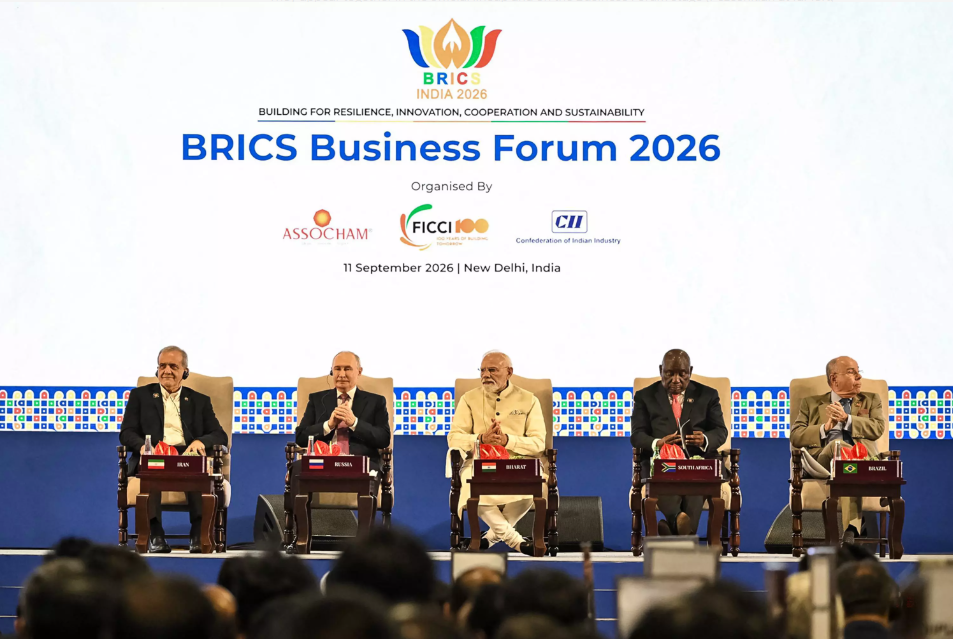
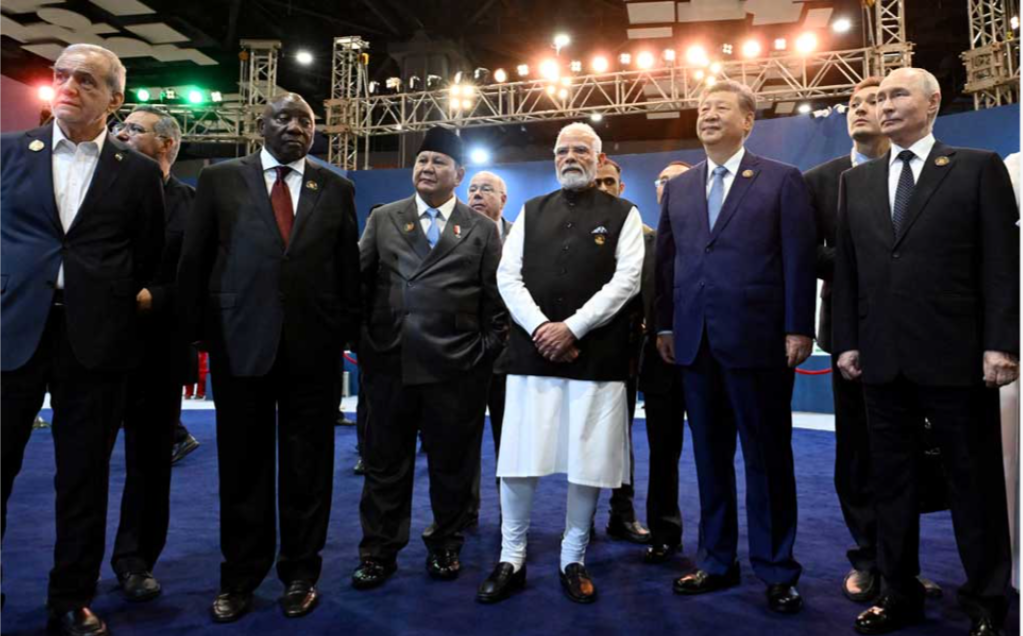
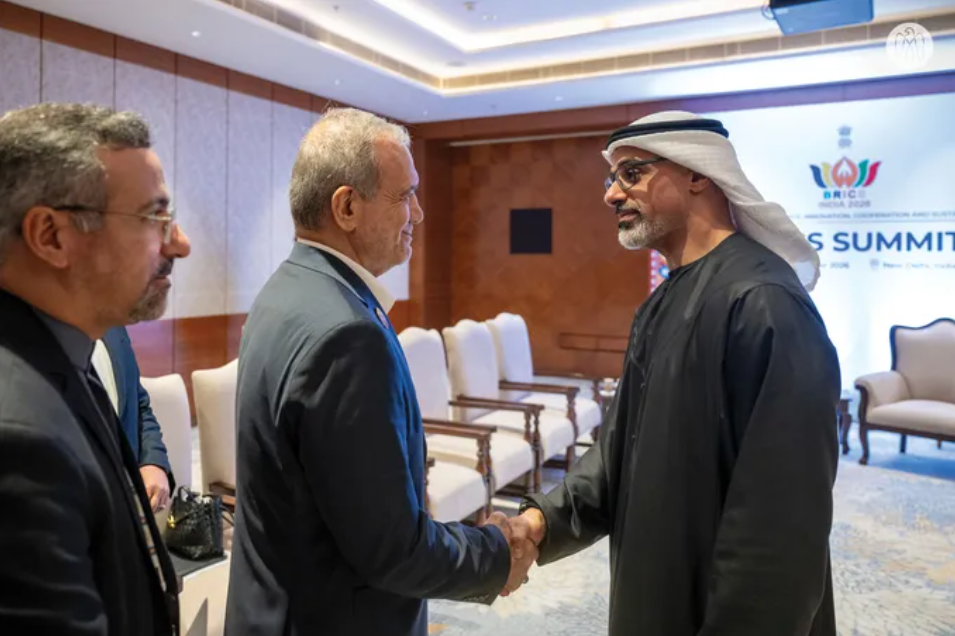
Of course, there were also scenes of Iran's Foreign Minister with those of China and Russia.
BIG: A striking moment at the BRICS Summit in Delhi has sent shockwaves in west 🇮🇳🔥
— Megh Updates 🚨™ (@MeghUpdates) September 13, 2026
China’s FM Wang Yi, Russia’s FM Sergey Lavrov and Iran’s FM Abbas Araghchi were seen in a warm, close exchange. Wang Yi also appeared to take a keen interest in the map-of-Iran sticker on… pic.twitter.com/zUqwEj5sZC
In the current world, Washington can talk to the UAE, but Tehran distrusts American mediation. Russia can engage Iran but lacks credibility with much of the Gulf.
The underlying skill on display was consensus engineering.
The New Delhi Declaration had to accommodate Iran, which wanted condemnation of American and Israeli actions; the UAE, which had itself been attacked; Russia, which wanted opposition to sanctions and Western dominance; China, which wanted a stronger anti-hegemonic platform; India, which wanted strategic autonomy without an anti-American alliance; Gulf members that still rely on US security; and developing economies focused on trade and finance.
Reconciling completely opposing positions into a single document that every member could sign was an extremely challenging exercise in national power.
It is one skill that India is quietly building a comparative advantage in.
What Modi said, and what he was actually signaling
Modi's message ran on two levels. In public he presented BRICS as a constructive, non-confrontational institution for the Global South.
Strategically, he positioned India as the country capable of preventing BRICS from hardening into either a Chinese hierarchy or a Russian-Iranian anti-Western coalition. His central formulation carried the whole design: "We are not against anyone." That sentence marks the sharpest difference between Modi's conception of BRICS and the more confrontational versions promoted by Moscow and Tehran. An alliance requires agreement on enemies.
In Modi's framing, BRICS requires agreement only on the need for alternatives. He was defining it as an autonomy platform.
He called the grouping's twentieth anniversary its coming of age, the point at which ambition must be matched by delivery. He then described the existing order as a pyramid of privilege, with power concentrated at the top and the countries most exposed to global crises seated in the back row of global decision-making.
He proposed a replacement: a platform of partnership.
This is a more precise challenge to Western primacy than a blanket demand for multipolarity. Modi did not call for abolishing the UN, dismantling the IMF and World Bank, or replacing the dollar.
He argued that institutions built around the distribution of power in 1945 no longer represent the realities of 2026. That formulation serves India specifically, because India is too important to remain a rule-taker, not yet powerful enough to write rules alone, unwilling to accept Chinese rule-making, and unwilling to abandon the institutions in which it seeks higher status.
India is demanding redistribution of authority inside global institutions while Russia and Iran often emphasize building systems outside them.
He organized the reform agenda around three headings. Representation meant Security Council reform through text-based negotiations with timelines and outcomes, and more appropriate voting weight in the financial institutions. This quietly challenged Beijing, which supports a larger Global South voice in general terms while withholding an unambiguous endorsement of India for a permanent seat.
Responsiveness meant speed, adequate scale and last-mile impact, a vocabulary Modi imported directly from India's domestic delivery model. Rule-making meant treating artificial intelligence, biotechnology, cyberspace, outer space and critical technologies as the arenas where the rules of the future are being set, and turning the Global South from a rule-taker into a rule-shaper.
Under that last heading came one of his most durable proposals: training young diplomats and policymakers from developing countries in negotiation, treaty-making and legal expertise.
The Global South's disadvantage is not only money or military power. Many states lack the institutional capacity to negotiate AI regulation, climate finance, digital-trade rules, tax treaties and investment contracts.
A network of Global South negotiators whose professional formation runs through Delhi would be a form of influence that compounds over decades, similar in kind to Western scholarship programs and China's Belt and Road training networks.
The most serious institutional proposal addressed BRICS' chronic weakness. Because the chairmanship rotates annually, priorities shift, and momentum dissipates.
Modi proposed a Continuity and Implementation Mechanism: follow-up through the past-present-future chairmanship troika, a secure digital repository of decisions, a named nodal authority for each decision, defined deadlines and recorded implementation status.
This imports project-management discipline into a forum rich in declarations and poor in execution. It also carries a political cost that will surface later, because the more institutionalized BRICS becomes, the more members must decide how much sovereignty and transparency they will surrender, and China and Russia may back stronger execution while resisting systems that constrain their freedom of action.
Two further proposals matter more than they appear to. The Seafarers Emergency Support Network, connecting maritime authorities, missions, distress alerts, medical assistance and evacuation, reads as humanitarian. In the context of Houthi attacks and Red Sea disruption, it is a way to assert freedom of navigation, open supply routes, and the safety of commercial shipping without naming Iran or the Houthis.
It is a geopolitical red line phrased as a public good. And the presentation of UPI as evidence that innovation can be open, scalable, and low-cost offered BRICS members an alternative to both the American private-platform model and the Chinese platform-plus-state model. India's pitch is public digital infrastructure with private innovation built on top.
For members, the appeal is sovereignty over transaction data. For India, exporting these standards creates interoperability, commercial opportunity and long-term regulatory alignment, which is plausibly worth more than a premature common currency.
At the Business Forum, Modi set measurable targets rather than general appeals: identify and recommend removal of the top ten intra-BRICS trade barriers, help 100 BRICS startups a year expand into other member markets, and create 1,000 new business partnerships, all reviewed annually.
The targets are modest against the scale of economies representing nearly half the world's population, and the real test is whether members touch customs friction, non-tariff barriers, payment convertibility, visa restrictions and China's large trade surpluses with several partners. Still, introducing quantified outcomes into a forum usually judged by diplomatic language is a shift in itself.
The omissions were as deliberate as the statements. Modi did not call for abolishing the dollar, endorse an immediate BRICS currency, describe the West as an enemy, endorse Russia's account of Ukraine, endorse Iran's full position in West Asia, name the Houthis, name Pakistan, endorse a China-led security architecture or propose a military alliance.
The restraint preserved India's room to maneuver. Its deepest message was that BRICS should challenge concentrated privilege without becoming another structure of concentrated power, a formulation that serves Delhi precisely because Delhi does not want to trade American primacy for Chinese primacy.
The Makkah pact, the attribution loophole and a realistic reading of Pakistan
Outside the BRICS hall, a second system was taking shape.
Saudi Arabia, Pakistan and Turkiye have been building the Makkah joint defense framework, and it arises from the same condition as BRICS: states no longer trust a single power to meet all their needs.
BRICS insures against sanctions, dollar dependence, and underrepresentation. The Makkah pact insures against uncertain American intervention, Iranian and proxy attacks, and threats to Saudi territory and holy sites. Both are exercises in optionality rather than rupture.
The pact reportedly treats aggression against one member as aggression against all. Its central weakness is the word aggression. Contemporary attacks rarely arrive with a return address.
The attack on Saudi Arabia's East-West pipeline reportedly originated from Iraqi territory, with Iran-aligned militias plausibly involved and Houthi assistance in the mix, while Iran denies directing every operation. This produces attribution arbitrage: Iran supplies or guides a partner, the partner assists another militia, the attack comes from a third country, no state formally accepts responsibility, and the treaty's activation threshold stays unclear.
The pact is strongest against a conventional attack and weakest against exactly the drone, militia, cyber, and maritime-proxy operations Saudi Arabia actually faces. The first institutional requirement, therefore, is not a combined army. It is a shared attribution mechanism integrating Saudi, Turkish and Pakistani intelligence, because without agreed attribution there can be no agreed retaliation.
Pakistan's nuclear status adds weight to this arrangement, and it is widely misread.
Nuclear deterrence raises the cost of an overt state attack on Saudi cities. It does little against Houthi drones, deniable Iraqi militias, strikes on commercial vessels, sabotage, cyberattacks and ambiguous pipeline hits.
The pact could therefore deter the largest war while remaining porous to a stream of smaller attacks, and Iran and its partners will operate inside that gap by design. Pakistan's realistic contribution is air and missile defense for Saudi Arabia, intelligence and attribution, maritime escort, protection of energy infrastructure, electronic warfare, limited retaliation against verified launch sites and mediation with Tehran.
A Pakistani ground war in Yemen is improbable and strategically unwise.
This is where a sober assessment of Pakistan's strategy departs from the alarmist reading.
It is its ability to communicate credibly with all sides. Islamabad holds military credibility with Riyadh, a functional relationship with Tehran, exceptional ties with Beijing, influence with Ankara, long experience in the Gulf, a nuclear deterrent and strong reasons to avoid a sectarian regional war.
If it becomes an immediate combatant, most of that diplomatic value evaporates. Its optimal strategy is armed mediation: deploy forces defensively inside Saudi Arabia, demonstrate naval and air capability, privately establish retaliation thresholds, warn Iran of consequences, keep a de-escalation route open, and strike only if clearly defined lines are crossed.
Carefully maintained ambiguity increases its leverage. The danger is the mirror image of the opportunity: Pakistan risks being pulled in incompatible directions, expected by Riyadh to be automatically committed while expected by Tehran to remain restrained, and it has acquired unexpected leverage alongside the greatest exposure to entrapment of any actor in this system.
The pact is also not simply anti-Iran.
It reflects as much distrust of Washington as fear of Tehran. It hedges against the possibility that the United States will not always intervene militarily, protect Saudi infrastructure, escort shipping, supply weapons without political conditions, or stay strategically focused on the Gulf.
Reported American reluctance to launch another major Houthi campaign makes the pact more credible politically even before it proves itself militarily.
 Shannon K. Kingston and Cindy Smith and Steven Beynon and Isabella Murray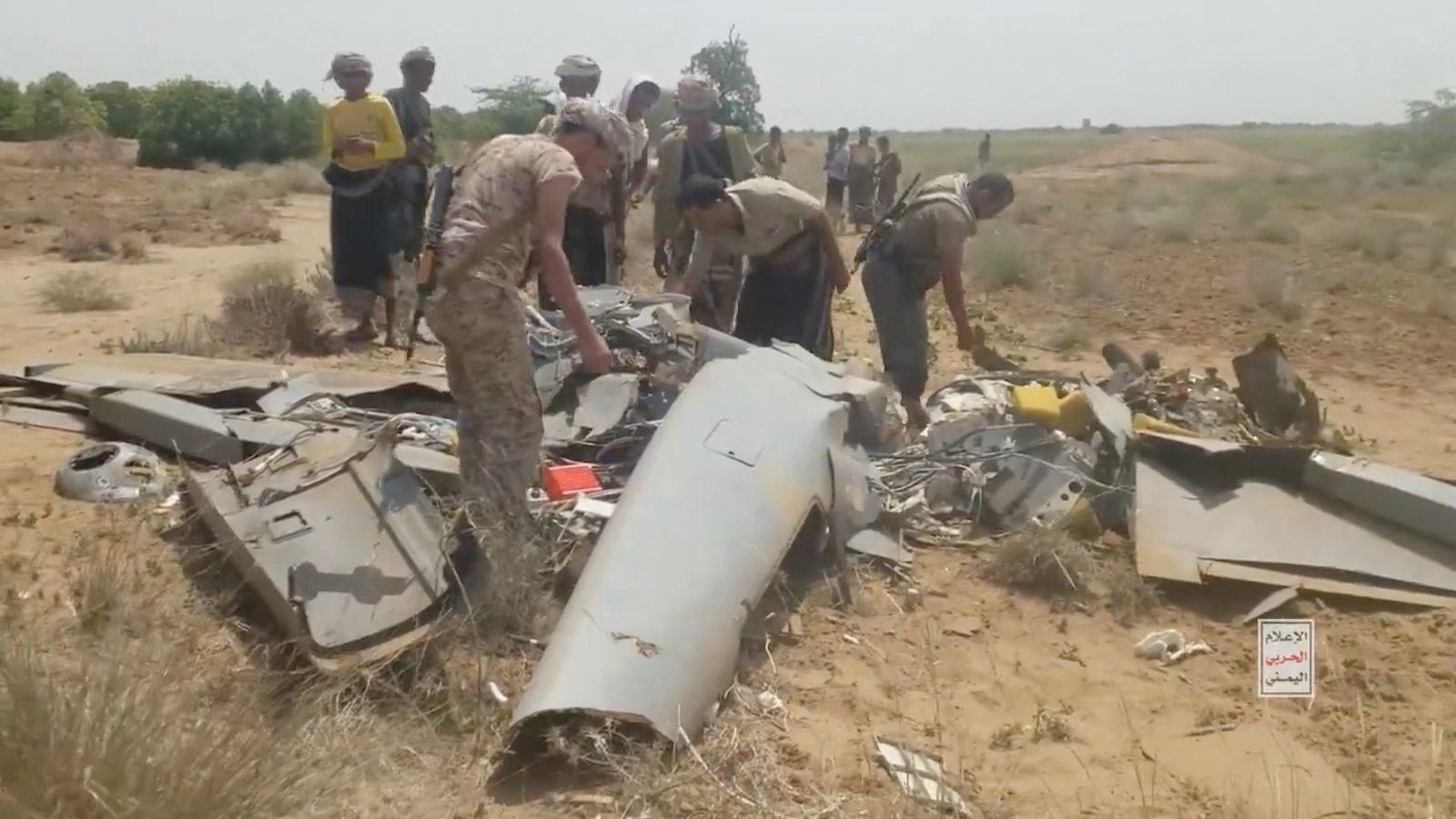
Iran, for its part, is constructing a two-strait bargaining system.
The East-West pipeline is the land bridge between them, and Saudi Arabia built it partly to reduce its exposure to a Hormuz crisis. The Houthi advance threatens the Red Sea destination the pipeline serves, and the pipeline itself has now been struck. Iran's network is not simply attacking Saudi assets. It is degrading Saudi Arabia's strategic redundancy, the very routes the kingdom created to survive a Hormuz shutdown.
Relatively inexpensive drones and proxy forces can place a geopolitical risk premium on millions of barrels of oil without defeating the Saudi military in the field. That is asymmetric warfare operating at the level of global macroeconomics.
China's selective neutrality, and the hidden India-China split
China's position in this landscape may be the most commercially intelligent and the most quietly consequential.
It has a relationship with the Houthis. It isn't, however, an alliance.
Houthi procurement networks have, however, obtained dual-use and military-related components through PRC-based commercial entities, which the US Treasury has documented, though documentation of firms is not evidence of state direction.
This creates a remarkable position. China can seek preferential protection for its commerce without accepting the cost of policing the entire maritime system. The older American model provided a global public good, protecting sea lanes broadly, including competitors' commerce.
China's emerging model looks more transactional: negotiate selective immunity for Chinese-linked trade while allowing insecurity to impose greater costs on Western competitors.
In the short term, that is efficient. It has limits that become dangerous if the system breaks down. China depends heavily on Gulf energy and on Indian Ocean shipping. If Houthi operations cause sustained oil disruption, inflate insurance premiums or close Bab el-Mandeb, opportunistic neutrality becomes self-defeating.
Beijing therefore wants enough Houthi leverage to weaken American dominance and not enough to wreck maritime stability, giving it a reason to quietly restrain the Houthis through Tehran without appearing to join a Western security operation. That is a narrow line to walk.
This exposes a difference inside BRICS that both sides prefer to keep muted. India and China are enormous energy importers and both need stable shipping, yet the present disorder touches them differently.
China can sometimes secure preferential passage through bilateral arrangements with Iran or Houthi-linked authorities. India has less ability, and less desire, to negotiate selective exemptions, and depends on genuinely open waterways. China can benefit from selective access.
India benefits from universal freedom of navigation. Both oppose Western domination of global institutions, but India requires rules that stay relatively neutral while China can operate through negotiated exceptions.
The deeper India-China disagreement inside BRICS is therefore not whether the Western order needs reform. Both agree it does. It is over what replaces it: a China-centered system of negotiated access, or an India-supported system of plural and relatively neutral rules. That difference makes India the more natural defender of the open maritime commons even inside a grouping often described as challenging the West.
Russia's dependence, and India's platform power
Putin's physical presence in Delhi demonstrated that Russia cannot be completely isolated from the non-Western world. It also highlighted Moscow's growing dependence on Beijing for markets, technology, diplomatic protection, financial pathways, and energy demand. India's continued engagement gives Russia a second major Asian option, and that is the less-discussed purpose behind Delhi's refusal to isolate Moscow. Preserving the Russia relationship is not only about discounted oil or historical sentiment.
The capability running through all of this has a name: platform power. India cannot yet match China's financial scale, America's military reach or Russia's energy and nuclear resources. It has accumulated a different asset, the ability to create political space in which mutually incompatible countries can participate without surrendering their identities or alliances.
India can host Putin without accepting Russia's Ukraine narrative, Xi without accepting Chinese leadership, Pezeshkian without abandoning Israel, the UAE without endorsing its confrontation with Iran, and Global South governments without demanding an anti-Western pledge.
Modi's photographs with Putin and Xi matter, but the deeper achievement is structural: neither Moscow nor Beijing can organize the wider non-Western order without Delhi.
To understand Russia's current mindset and its broader view of itself, this discussion by Putin is highly significant. Here he shares his view on German Elections, War with Russia, and Europe’s Energy Crisis.
Where the two systems collide
The uncomfortable fact underneath the summit is that BRICS and the Makkah pact will eventually strain against each other. Saudi Arabia, the UAE, Iran, China and India sit together in BRICS. Saudi Arabia, Pakistan and Turkiye are building a defense framework implicitly concerned with Iran and its partners.
Some states cooperate economically within one system while preparing militarily against one another outside it.
This is not hypocrisy. It is the defining structure of emerging multipolarity. The world is leaving behind exclusive Cold War blocs, and countries are becoming partners in finance, competitors in technology, adversaries in security and collaborators in trade at the same time, holding memberships in overlapping institutions rather than a single permanent camp.
This emerging order is best described as a post-alliance geopolitical order, with five recognizable characteristics.
- Middle powers will belong to overlapping institutions rather than one camp.
- Non-state forces will control strategic geography once monopolized by states, as the Houthis now do around Bab el-Mandeb.
- Security guarantees will become deliberately ambiguous and modular, as the Makkah pact's attribution problem shows.
- China will pursue privileged access more often than universal order.
- And India will gain influence by keeping rival systems connected without submitting to any of them.
The immediate danger in such a system is miscalculation.
Saudi Arabia may believe Pakistan is automatically committed. Iran may assume Pakistan will always remain restrained. The Houthis may overestimate Chinese protection. China may underestimate the economic cost of prolonged maritime disorder.
Each of these misreadings sits inside a structure that lacks the clear signaling of a formal alliance, which is precisely what makes the post-alliance order both flexible and accident-prone.
What India got
Let us state the case clearly. So here it is.
India produced a unanimous New Delhi Declaration from countries that, four months earlier, could not agree on a joint foreign-ministers' statement. Iran and the UAE had blocked consensus in May over the West Asian war.
That was the presidency's principal diplomatic test, and India passed it.
India secured consequential counterterrorism language.
China signed it. Beijing has historically shielded Pakistan from diplomatic isolation and delayed action against Pakistan-based terrorists at the UN, and India has now obtained Chinese assent to language covering cross-border terrorism, financing, safe havens, state responsibility and accountability. The declaration does not name Pakistan, and consensus documents rarely deliver everything one party wants.
The conceptual architecture is unmistakably Indian, and its value lies in future use: whenever a member tries to separate a terrorist organization from its state sponsor, India can point to language they have already accepted. Naming Pakistan would probably have triggered Chinese objections and broken consensus.
India instead won unanimous approval for terminology that maps directly onto its case, and Pakistan was outside the room, unable to negotiate the wording.
India advanced its Security Council objective without completing it. The declaration reiterates support for comprehensive UN reform and recognizes the legitimate aspirations of India, Brazil and African countries to play a greater role, including in the Security Council.
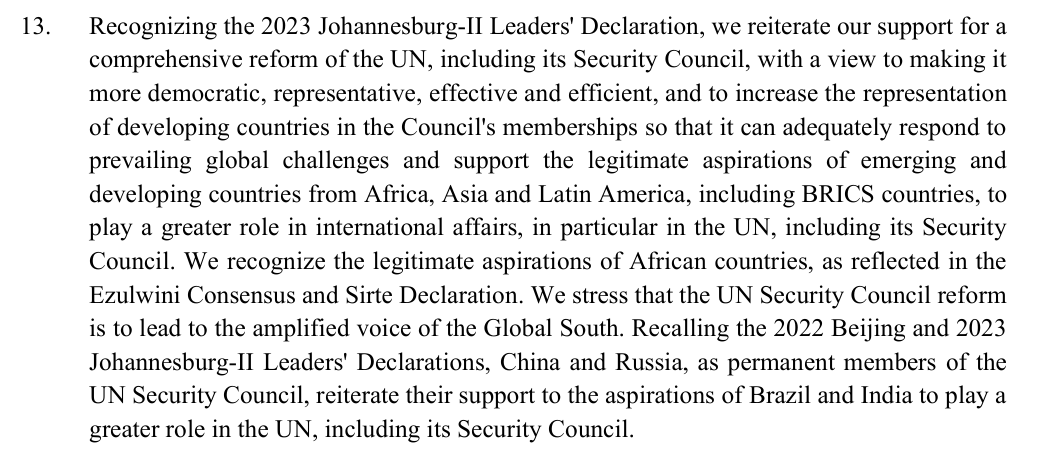
China and Russia have not explicitly endorsed India for a named permanent seat with veto power. They signed language supporting a greater role, which is valuable and deliberately elastic. India has strengthened the legitimacy of its claim and made Chinese opposition more uncomfortable. It has not secured Beijing's unambiguous endorsement of a permanent seat.
India converted maritime security into a BRICS issue. By repeatedly linking economic cooperation to freedom of navigation, secure sea lanes, protection of seafarers, and continuity of global trade, and by proposing the Seafarers Emergency Support Network, Delhi laid the groundwork for arguing that no member's proxies should be allowed to weaponize international waterways selectively.
That pressures Iran without naming Iran, and indirectly places responsibility on China to use its influence rather than enjoy preferential passage while others bear the cost.
Above the specific wins, India demonstrated a capability. Consensus engineering, the conversion of incompatible positions into a single signed document, is becoming one of its most important instruments of national power, and platform power, the ability to be the venue through which rivals transact, is now something India has shown rather than merely claimed.
What the world got
The summit did not overthrow the Western order. It did something more subtle, and the wider system took several lessons from it.
It made it clear that maritime chokepoints, proxies, and drones now connect regional warfare directly to global inflation, interest rates, and fiscal stability, so inexpensive weapons in the hands of non-state actors can move macroeconomic variables.
It also clarified that India is emerging as an indispensable junction connecting rival networks rather than the leader of a rigid bloc.
The world also received a clearer picture of the order's limits. BRICS still lacks a common security framework, a common central bank, enforceable collective obligations, integrated payment infrastructure, institutional machinery comparable to the EU, mutual strategic trust and any mechanism to stop members or their partners from disrupting shared trade routes. A payment settled in rupees, yuan, or digital tokens does nothing for a tanker that still has to cross Hormuz or Bab el-Mandeb. That material constraint is the honest ceiling on financial multipolarity, and naming it is part of what Delhi, however unintentionally, taught anyone paying attention.