The General Who Collected Umbrellas
A young prince once traveled to a mountain monastery to consult an old Zen master.
“My kingdom is surrounded,” the prince said. “To the north stands a powerful emperor who sells weapons to my enemy. To the west, a rising sultan builds flying machines. Beyond the desert, a wealthy king offers gold. Across the mountains, another kingdom is buying arrows for my enemy’s enemy. Everyone is forming alliances. Everyone is preparing for war. Tell me, Master, who is truly with whom?”
The master was repairing an umbrella.
Without looking up, he asked, “Why does a man carry an umbrella?”
“To protect himself from rain,” said the prince.
“And why does he carry two?”
“In case the first one breaks.”
“And five?”
The prince hesitated. “Because he trusts none of them.”
The master nodded.
“In the southern valley,” he said, “there once ruled a general who feared every neighbor. He bought iron from the eastern emperor, flying machines from the western sultan, and borrowed gold from the desert king. Each promised to protect him.
“The eastern emperor told him, ‘My eyes will see your enemies.’
“The western sultan said, ‘My wings will strike them.’
“The desert king declared, ‘My treasure will sustain you.’
“The general was delighted. He placed every soldier, horse, ship and fire-arrow under his personal command. No officer could move without his permission. No adviser dared contradict him. He believed that because every weapon answered to one voice, his kingdom had become invincible.”
“What happened?” asked the prince.
“One night, a watchman saw lights moving beyond the frontier. They were traders carrying lanterns, but he feared they were enemy scouts. He informed his captain. The captain suspected the report was mistaken, but the general had recently dismissed an officer for questioning him.
“So the captain reported an invasion.
“The general ordered the fire-arrows prepared.
“The eastern emperor’s eyes detected the movement and warned of possible danger. The western sultan’s flying machines were placed on alert. The desert king released emergency gold. Across the mountains, the rival kingdom saw these preparations and mobilized its own forces.
“By sunrise, five kingdoms were ready for a war that no one had intended.”
The prince frowned. “Did the general launch his arrows?”
“No. A shepherd arrived carrying one of the traders’ lanterns and explained what had happened.”
“So wisdom prevailed?”
The master smiled. “No. The general executed the watchman for embarrassing him, promoted the frightened captain for loyalty and announced that his strength had forced the enemy to withdraw.”
The prince remained silent.
The master opened the umbrella he had repaired. Several layers of cloth had been stitched over one another. It was so heavy that its wooden ribs bent under their own protection.
“An alliance can prevent war,” the master said. “But an alliance built entirely from fear can also distribute fear. One kingdom’s precaution becomes another kingdom’s threat. A shield appears as a sword when viewed from the other side.”
“Then alliances are useless?”
“Not at all. A wise ruler builds friendships so that fewer weapons are needed. A frightened ruler collects weapons and calls the collection friendship.”
The prince looked at the mountain valley below. Roads ran between the kingdoms like threads in a vast web.
“Which kingdom is the spider?” he asked.
The master handed him the umbrella.
“None of them,” he replied. “Each believes it is weaving the web. Each is also becoming trapped inside it.”
The prince noticed that the umbrella protected him from the rain, but its weight made it difficult to walk.
“What should a ruler do when every neighbour is arming?”
“Prepare carefully,” said the master. “Watch quietly. Strengthen what is yours. But never allow borrowed weapons, wounded pride or a single unquestioned voice to decide what your eyes are permitted to see.”
Thunder sounded beyond the mountains.
The prince looked anxiously toward the horizon.
“Is that the beginning of war?”
The master returned to his work.
“It is thunder,” he said. “The beginning of war comes when men who have forgotten how to listen decide that it must be something else.”
The Internal Operation
Currently, the events in Asia, specifically in India's neighborhood, read like a thriller. Let us piece all of these together.
On August 17th, India's Home Minister, Amit Shah shared how the Indian intelligence agencies had unearthed a terror plot in the lead up to India's Independence Day.
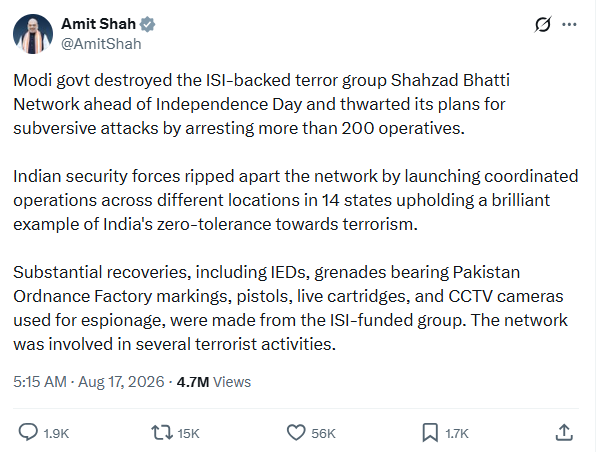
Here is the news report from the First Post.
Shahzad Bhatti, say the Indian investigators, was a Pakistan-based handler who used social media to radicalize, recruit, and remotely direct vulnerable Indian youth. His network reportedly was identifying unemployed or financially distressed young people through platforms such as Instagram and Facebook, gradually building contact with them, and then offering money for seemingly limited assignments.
These may include conducting surveillance, transporting weapons, identifying sensitive locations, arranging accommodation, or assisting individuals connected with planned attacks.
Investigators believe this recruitment model allows handlers operating outside India to create small, compartmentalized cells without establishing a visible organization on the ground. Recruits may initially be unaware of the wider conspiracy and are allegedly drawn into progressively more serious activity through payments, ideological messaging, threats, or promises of status.
The network was being run nationwide. Over 80 FIRs were filed and the operations brought up significant recoveries.
Sharing details on the operation, carried out on August 12, the ministry of home affairs said in a statement that a coordinated multi-state operation was carried out “using a real-time intelligence-sharing system with state police forces”. It led to 253 detentions across 14 states including Uttar Pradesh (62), Haryana (52), Delhi (51), Punjab (44), Rajasthan (15), Maharashtra (8), Uttarakhand (5), Karnataka, Gujarat and Bihar (3 each), and Telangana, Himachal Pradesh, Jammu and Kashmir and Kerala (2 each) — with fresh FIRs registered in Delhi and Karnataka, it said. (Source: 200+ arrests, op spread out to 14 states: How Pak-based terror network was busted before Independence Day / Hindustan Times)
As this was going on, India's foreign policy was making another significant move.
Pralay on the Table? India and Armenia Enter a New Defense Phase
India is making a significant strategic and industrial push in Armenia, and the next major Indian system under consideration could be the Pralay quasi-ballistic missile. Defence Secretary Rajesh Kumar Singh’s August 17–18 visit to Yerevan marked an important expansion of a relationship that has already made Armenia one of the leading buyers of Indian military equipment.
During the visit, India and Armenia signed an MoU designed to deepen defence-industrial cooperation, including research and development, innovation, capacity-building, military-technical collaboration and production in mutually agreed areas. Singh also held discussions with Armenia’s senior defence leadership, including Deputy Defence Minister Karen Brutyan and Chief of the General Staff Lieutenant General Edvard Asryan. The official agreement is confirmed; however, individual missile purchases remain under discussion rather than concluded contracts.
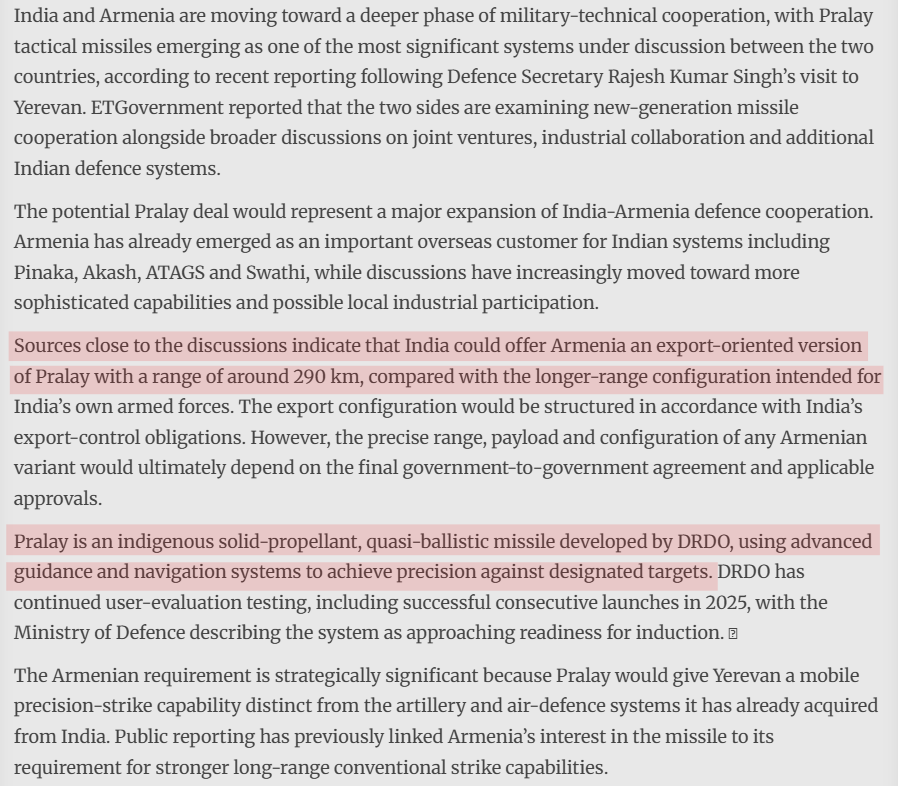
Armenia has already acquired or ordered a substantial range of Indian systems. These reportedly include Pinaka multi-barrel rocket launchers, Akash-1S air-defense systems, ATAGS 155-mm artillery guns, Swathi weapon-locating radars and anti-drone equipment. The relationship serves both sides: Armenia is reducing its traditional dependence on Russian weaponry, while India is gaining an important export market and strategic foothold in the South Caucasus.
The next phase could be considerably more consequential. Reports suggest that Yerevan is examining Pralay, the longer-range Akash-NG air-defense system, and Astra Mk1 beyond-visual-range air-to-air missiles. Armenia is also interested in Indian assistance to modernize its small Su-30SM fighter fleet, which was originally acquired from Russia without an adequate weapons package. India’s experience integrating indigenous radars, electronic warfare suites, Astra missiles, and BrahMos with its Su-30MKI gives it relevant technical expertise.
Pralay would represent a particularly important development. Designed for accurate conventional strikes against command centers, airbases, logistics hubs and air-defense installations, the road-mobile missile would give Armenia a rapid-response deep-strike capability. BrahMos has also appeared in speculative reporting, although no official negotiations or offers have been confirmed.
If these discussions mature into contracts, Armenia could become not merely a customer but a production and development partner—and Pralay could follow BrahMos, Akash and Pinaka as the next major symbol of India’s emergence as a serious defense exporter.
Meanwhile, relative to Turkey, there is another significant military move underway.
Israel–Turkey Tensions: Could Syria Test the Mecca Defense Pact?
Israel’s August 18 strikes on Syria’s Abu al-Duhur airbase transformed a dispute over Syria into a direct strategic warning to Turkey.
Eight strikes damaged the runway and storage facilities without reported casualties.
Washington’s Syria envoy, Tom Barrack, called the operation an “unnecessary escalation,” while the United States began promoting a trilateral deconfliction mechanism.
Mecca Joint Defense Agreement (MJDA)
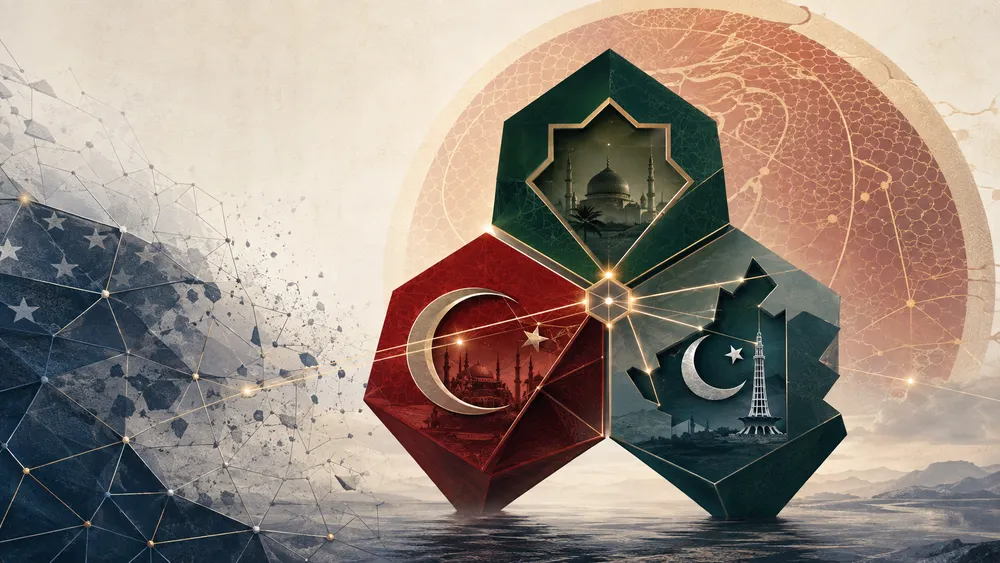
On August 7, 2026, Saudi Arabia, Turkey, and Pakistan signed the Mecca Joint Defense Agreement (MJDA), creating a collective-security framework loosely resembling NATO’s Article 5 principle. Under its central clause, an armed attack on any one signatory would be treated as an attack on all three. The pact is intended to combine the countries’ distinct strengths and establish a more coordinated regional deterrent.
This agreement is not a NATO-like alliance, and it does not signal a discrete new regional bloc. But that does not mean it is not significant. For Riyadh, this agreement bolsters the country’s leverage as it both copes with an emboldened Iran and confronts the limits of US deterrence in the region. By stitching together a web of partnerships, Riyadh assesses it will be better able to anticipate shifting regional threats than relying on any single partner or bloc. But Riyadh is also leveraging a turbulent period to assert its regional leadership: by hosting the signing of a new security agreement with another regional power broker—Turkey—Saudi Arabia is asserting itself as the face of regional stability at a time when the other major regional powers, Iran and Israel, are seen as destabilizing forces. It is worth remembering that Saudi Arabia has had a mutual defense agreement with Pakistan since September 2025 and with the six countries of the Gulf Cooperation Council since 2000. In practice, none of these has translated into the kind of response associated with NATO’s Article 5. While Pakistan and Turkey may mobilize some new security support in response to threats from Iran or the Houthis as a result of the agreement—Pakistan has already sent some troops and air defense to Saudi Arabia—that support is unlikely to be a gamechanger and will be highly context-specific. In particular, Pakistani officials have maintained that their 2025 agreement did not include a nuclear umbrella. The diplomatic edge this agreement provides may prove more impactful than tangible security cooperation: At the beginning of the Iran war, Riyadh was able to leverage its heightened partnership with Islamabad to quietly shape negotiations and manage escalation with Tehran. This new agreement is also further evidence that Riyadh is abandoning its quest for an Article 5–like security guarantee from Washington. (Source: "Why Saudi Arabia, Pakistan, and Turkey just signed a defense pact" / Atlantic Council)
One needs to understand that this alliance is less about how every player thinks that it will contribute to the other and more about what they will extract from the other.
- Saudi Arabia brings enormous financial resources, investment capacity, diplomatic influence, and energy-security infrastructure.
- Turkey contributes an expanding defence-industrial base, particularly in aerospace technology, unmanned systems, missiles, and military electronics.
- Pakistan provides a large, experienced armed force and, most significantly, the deterrent value associated with its nuclear-weapons capability.
Together, the three countries suggest cooperation through joint military exercises, intelligence sharing, defense research, industrial partnerships, and technology transfers.
The agreement emerged amid intensifying instability across West and South Asia. Escalation involving Iran and Israel, uncertainty surrounding Gulf security, and changing regional alliances encouraged the three governments to explore a stronger mechanism for burden-sharing.
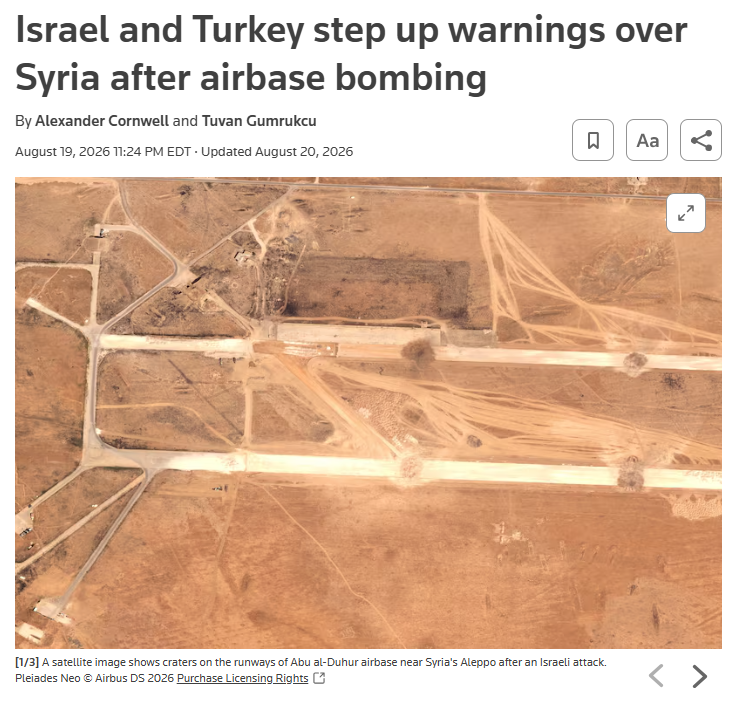
The fundamental conflict concerns the future of Syria. Turkey wants a friendly and 'sympathetic' government in Damascus.
That will enable it to retain substantial influence across northern Syria.
Israel, on the other hand, is determined to prevent Syria from becoming a platform for hostile military forces.
Israeli planners increasingly appear to regard an entrenched Turkish military presence, especially aircraft, missiles, radars or air-defense batteries, as a direct involvement and threat from Turkey.
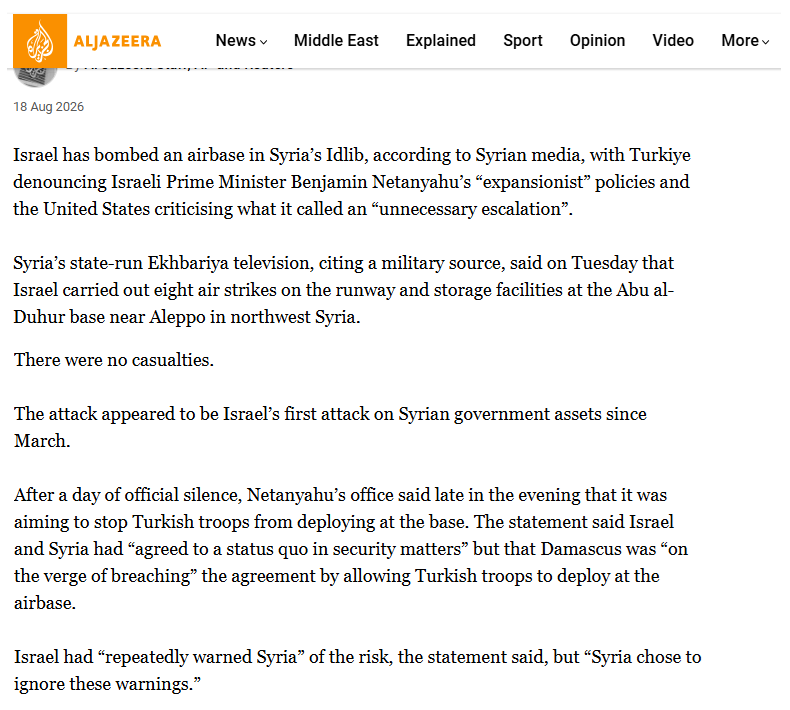
If Israeli-Turkish tensions and aggressive confrontation were to escalate, then one wonders how NATO's Article 5 and provisions of MJDA would kick in?
Turkey is a NATO member, while Israel is Washington’s closest regional military partner.
Of course, NATO’s Article 5 would not automatically apply merely because Israel attacked a Syrian facility visited or supported by Turkey. Even an attack on Turkish personnel outside Turkish territory would generate an intense political dispute over whether it constituted an attack upon Turkey itself. Washington would therefore try to mediate before two of its crucial partners entered an uncontrollable confrontation.
The Mecca Joint Defence Agreement introduces another layer. It declares that an armed attack on Turkey, Saudi Arabia, or Pakistan will be considered an attack on all three, but its implementation remains conditional: the affected country must request assistance, which could range from intelligence and logistics to military deployment.
If Turkey were to be attacked by, say, Russia, the question remains: will Article 5 be invoked? Logically, yes, but in practice, would European countries go directly against Russia on Turkey's behalf?
So there is a strong incentive with Russia to weaken Turkey. Maybe a direct attack would not be a possibility currently but covert operations cannot be ruled out.
We should understand a few things - Israel wants to prevent Turkey from establishing airbases, radar installations, air-defense systems and a dominant military position in Syria. Russia wants to preserve residual influence in Syria, obstruct Turkish control of former Russian strategic space and prevent Ankara from becoming the decisive Black Sea–Caucasus–Levant power.
So what could happen is:
- Israel repeatedly strikes Turkish-supported Syrian installations.
- Turkey deploys air defenses or combat aircraft.
- Israel attacks those systems, possibly killing Turkish personnel.
- Turkey retaliates against Israeli assets, but outside Turkish territory.
- Russia simultaneously increases pressure in the Black Sea, Caucasus or northern Syria.
- NATO debates whether Turkey created the confrontation by operating beyond alliance territory.
That is far more useful to Moscow than attacking Turkey directly. It isolates Ankara politically while forcing it to divide its forces between Syria, the Eastern Mediterranean, the Caucasus and the Black Sea.
In another thread of gaming this scenario, one could logically argue that Russia may not want Israel to destroy Turkey as a regional counterweight. Ankara remains economically important to Moscow and restricts NATO naval access to the Black Sea. Moreover, Israel remains dependent on Washington and could not knowingly facilitate a Russian attack on NATO territory without risking a profound rupture with the United States.
During this time, there have been reports of a significant movements within Pakistan.
The China–Turkey Airlift to Pakistan: Rearmament, Integration and the Post-Sindoor Planning?
Reports of an intensive 60-hour military airlift into Pakistan involving Chinese and Turkish heavy-transport aircraft have been coming in and they have raised significant concerns across the region.
The aircraft reportedly made repeated landings at Nur Khan Airbase near Rawalpindi and Masroor Airbase in Karachi. Although their cargo has not been independently verified, security sources speculate that the flights may have delivered drones, radar systems, electronic-warfare equipment, ammunition, spare parts, or other defense material.
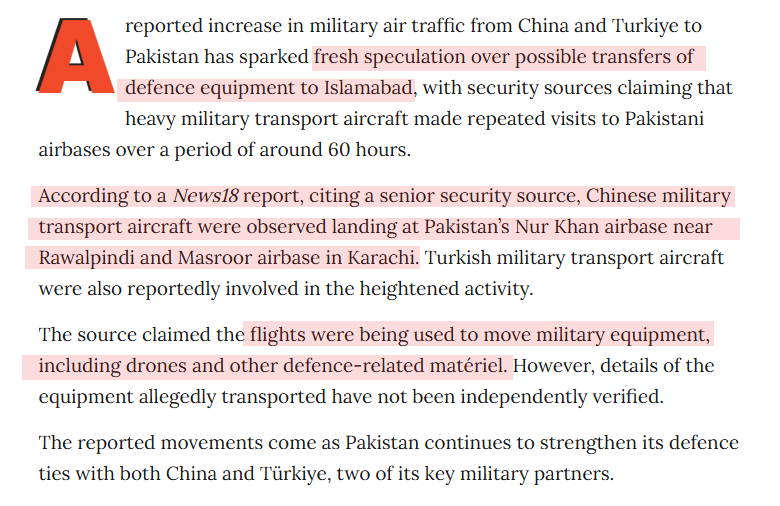
Here is a video report as well.
This unusual concentration of military flights suggests more than routine logistical activity. It may represent emergency replenishment, the delivery of new systems, preparations for joint exercises, or technical support aimed at strengthening Pakistan’s military preparedness. No government has released cargo manifests or officially confirmed that weapons were transported.
Needless to say, one can easily see a deepening trilateral defense relationship among Islamabad, Beijing and Ankara.
China remains Pakistan’s principal military supplier, providing combat aircraft, missiles, air-defense systems, radars and intelligence support. Turkey contributes drones, precision munitions, aerospace technology and operational experience developed in Syria, Libya, Ukraine and Nagorno-Karabakh.
The reported airlift is therefore important even if its contents remain unknown. It indicates that Pakistan could obtain rapid wartime resupply from two major defense-industrial partners.
NATO complications?
Ok, let us look at one thing clearly - Turkey remains strategically indispensable to NATO: it controls the Turkish Straits, fields the alliance’s second-largest army, hosts important facilities and connects the Black Sea, Mediterranean and Middle East.
So, maybe NATO cannot easily isolate Turkey, but suspicions increase.
The difficulty is trust. Cooperation with China and Pakistan could create concerns regarding:
- Chinese access to NATO operational practices through Turkish exercises and training;
- leakage of radar, electronic-warfare or communications knowledge;
- incompatibility between Chinese systems and NATO networks;
- Turkey blocking alliance decisions to protect its outside partnerships;
- Ankara becoming less dependable during a China–West confrontation.
This resembles the earlier S-400 dispute, in which Turkey’s purchase of Russian air defences led Washington to remove it from the F-35 programme.
Impact on China: China gains an indirect bridge to NATO’s military ecosystem without Turkey becoming a Chinese ally. Pakistan can serve as the intermediary: Chinese platforms, Turkish drones and NATO-influenced Turkish doctrine can be tested together without formal China–NATO cooperation.
Beijing also benefits politically whenever Turkey resists Western strategic discipline. A more autonomous Ankara makes a unified NATO position on China, Russia or the Indo-Pacific harder to construct.
Impact on Pakistan: Pakistan becomes the central connector. It can combine Chinese financing, sensors, missiles and aircraft with Turkish drones, naval technology and operational training. This reduces Islamabad’s dependence on any single supplier and makes Pakistan valuable to both Beijing and Ankara.
There is an additional complication here: Article 8 of the North Atlantic Treaty requires members not to enter into international commitments that conflict with NATO obligations. Therefore, Ankara could not legitimately use a China–Pakistan arrangement to avoid defending NATO after a covered attack.
But the real contest lies below Article 5. Turkey can delay consensus, restrict basing, withhold intelligence or remain neutral in disputes it considers unrelated to Turkish security.
The likely outcome is not Turkey abandoning NATO, but “multi-alignment”: NATO guarantees Turkey’s territorial defense, while China, Pakistan, Saudi Arabia and other partners expand Ankara’s freedom of action. This increases Turkey’s leverage—but also Western suspicion.
For India, the concern is particularly serious. New Delhi must increasingly treat Pakistan not as an isolated military opponent but as the operational centre of a wider network: Chinese intelligence and high-end systems, Turkish drones and aerospace expertise, and potentially Saudi financial support. Turkey’s NATO membership may indirectly expose this network to Western-derived doctrine and experience, even if classified NATO technology remains formally protected.
While this was going on, on the western border of India, Sergio Gor (US Ambassador to India) was in Kashmir on August 19th.
He made a significant statement - "Kashmir is an important part of India".
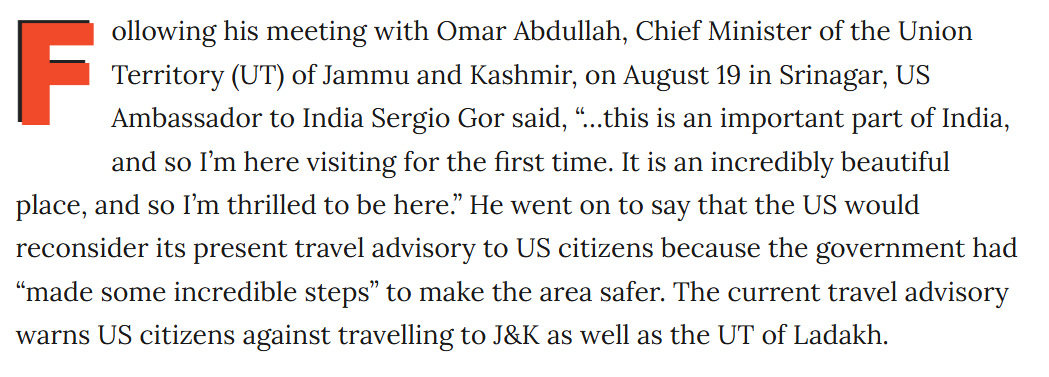
Sergio Gor’s description of Jammu and Kashmir as “an important part of India” was diplomatically significant. It was not an accidental phrase uttered privately: Gor made it publicly in Srinagar, alongside Chief Minister Omar Abdullah, during the first standalone visit to the region by a serving American ambassador since the 2019 reorganization.
He also indicated that Washington could reconsider its “do not travel” advisory because of improving security. Pakistan responded by summoning the senior US diplomat in Islamabad and lodging a formal demarche.
One must however remember that even though Gor said Kashmir was an “important part of India”; he did not formally declare that Washington recognised the entirety of the former princely state as Indian territory or announce a State Department policy revision.
Was Pakistan the principal target?
Almost certainly. The statement effectively challenged Pakistan’s attempt to keep Kashmir internationally categorized primarily as an unresolved territorial dispute. Its location, timing and public delivery made the message more consequential than routine diplomatic language.
The proposed travel-advisory review may be equally important. Reducing the warning would normalize Jammu and Kashmir as a destination administered by India rather than treating it as a permanent conflict zone. That would strengthen India’s post-2019 argument that the central question is now security and development—not territorial status.
It also comes after Operation Sindoor, the American designation of The Resistance Front as a terrorist organization, and growing concern over Pakistan’s military integration with China and Turkey. Washington may be signaling that Pakistan cannot simultaneously deepen its alignment with Beijing and Ankara, support anti-India narratives, and still expect the United States to preserve diplomatic ambiguity on Kashmir indefinitely.
Was it also a message to Turkey?
Possibly—but indirectly. There is no public evidence that Gor’s statement was specifically coordinated as a rebuke to Ankara. Pakistan was the immediate addressee. However, Turkey would understand the secondary message.
President Erdoğan has repeatedly internationalized Kashmir and supported Pakistan’s position. Ankara is also:
- a NATO member pursuing strategic autonomy from Washington;
- Pakistan’s increasingly important drone and aerospace partner;
- a participant in the Mecca Joint Defense Agreement;
- a defense partner of China and Pakistan in selected programs;
- engaged in an escalating strategic confrontation with Israel in Syria.
From Washington’s perspective, Turkey is introducing a serious alliance-management problem. It enjoys NATO protection while constructing overlapping security relationships that can obstruct American objectives involving Israel, India, China and the Eastern Mediterranean.
Gor’s statement may therefore be read as Washington establishing limits: Turkish membership in NATO does not give Ankara a veto over American policy toward India, nor does the Turkey–Pakistan relationship compel Washington to validate their Kashmir position.
The larger US strategic calculation
The United States increasingly faces two overlapping alliance structures.
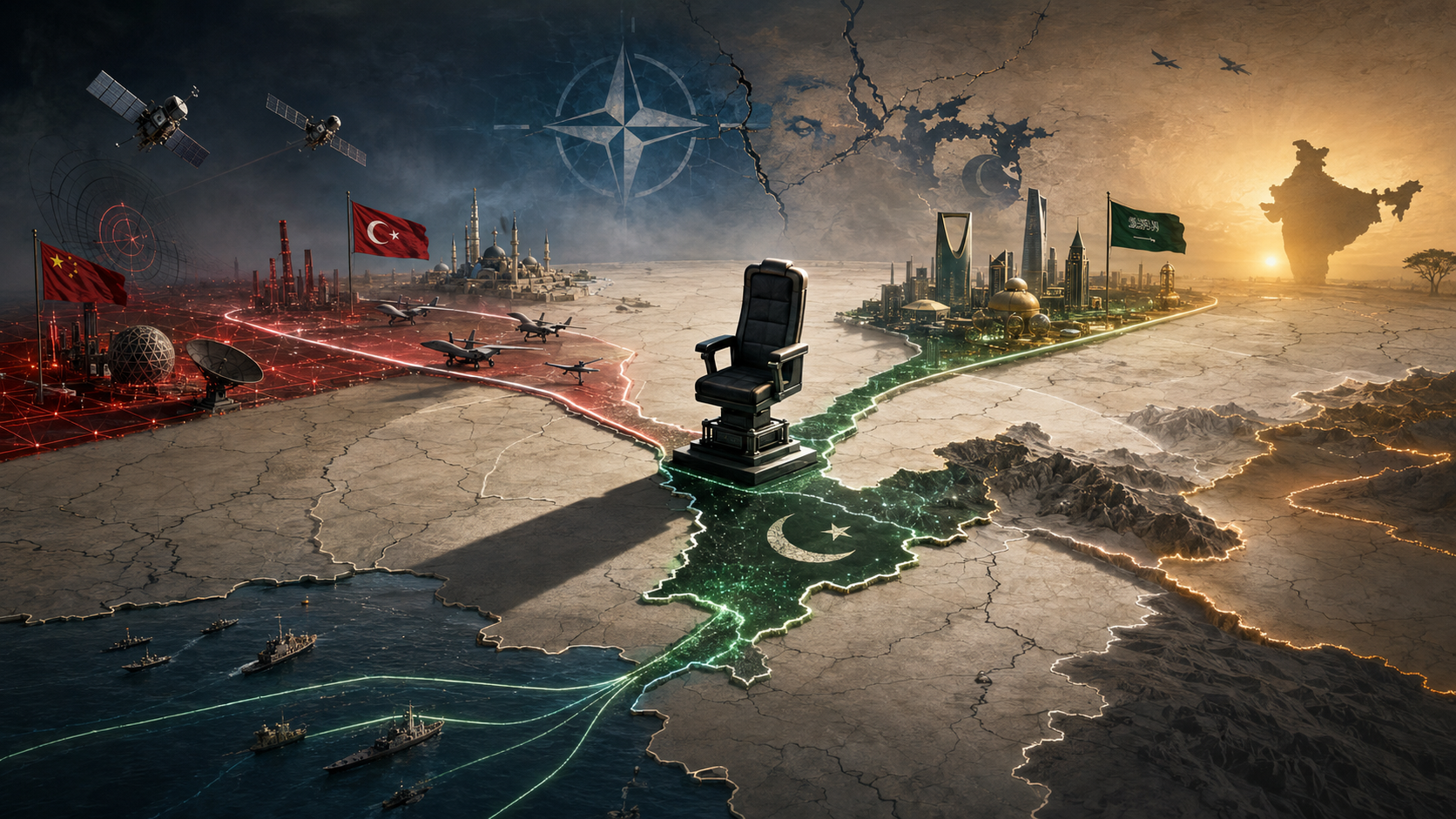
The first is the formal US-led system: NATO, Israel and growing strategic cooperation with India. The second is an emerging network connecting Turkey, Pakistan, Saudi Arabia and—operationally, though not formally—China.
These systems are not yet enemy blocs. Turkey, Pakistan and Saudi Arabia retain important relationships with the United States. But their interests increasingly diverge from Washington:
- Turkey challenges Israel’s freedom of action in Syria.
- Pakistan depends heavily on Chinese military technology.
- MJDA creates security obligations outside American control.
- China can exploit Pakistan as a bridge to Turkish defense expertise.
- Turkey can use NATO membership as strategic insurance while pursuing non-Western partnerships.
Gor’s Kashmir language consequently fits a broader American recalibration: Washington may cooperate with Pakistan tactically, but India is the more important long-term partner in balancing China. Pakistan’s deeper integration with Beijing and Ankara only reinforces that hierarchy.
The best conclusion is therefore that Gor delivered a direct political snub to Pakistan and an indirect strategic warning to Turkey. It was not necessarily designed primarily against Ankara, but it demonstrated that Washington will not allow Turkey–Pakistan coordination—or Turkey’s NATO status—to determine US policy toward India. The critical test will be whether the State Department now institutionalizes the change through its official Kashmir terminology, maps and travel advisory.
There is another critical change that happened within Pakistan that we should discuss here.
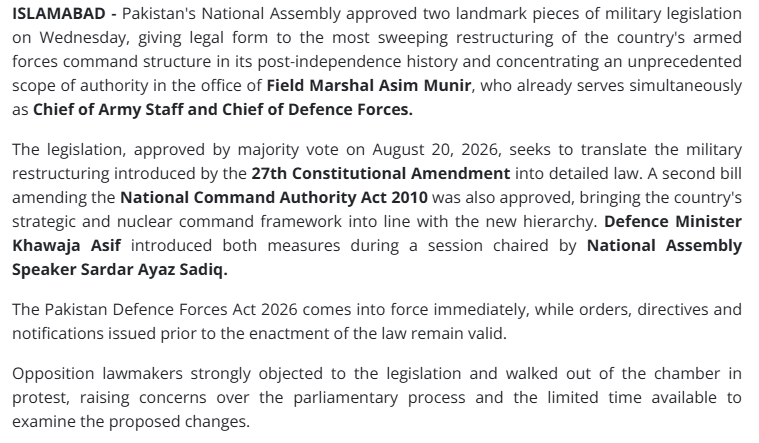
On August 20th, 2026, 27th Constitutional Amendment of Pakistani constitution made sweeping changes in the command structure across the military forces.
Now, all three - Army, Navy, Air Force, and strategic forces - have been put under the command of one man - Field Marshal Asim Munir.
That is a further concentration of power in Pakistan.
The Munir Factor: When Military Centralization Becomes Personalized Risk
Pakistan’s restructuring does more than create a unified military command. It concentrates extraordinary conventional, strategic and personnel authority in one individual: Field Marshal Asim Munir.
As Army Chief and Chief of Defense Forces, Munir sits above the Army, Navy and Air Force, exercises extensive authority over appointments and retirements, advises (euphemism for "directs", if at all!) the prime minister on national security and oversees an architecture connected to Pakistan’s nuclear forces.
Of course, Pakistanis would argue that unified command can improve legitimate military efficiency and reduce inter-service rivalry, accelerate joint planning and improve coordination among missiles, aircraft, drones, naval forces and cyber operations. Sure, if Pakistan was a "normal country".
But in Pakistan’s political system, this is not merely a matter of professional jointness. It is the personalization of national-security decision-making.
That significantly enlarges the margin for error.
Previously, disagreement among service chiefs, civilian authorities, and the joint staff could slow escalation.
This danger is magnified by Munir’s documented ideological rhetoric.
On April 16, 2025, just six days before the Pahalgam massacre, he revived the Two-Nation Theory, emphasizing the allegedly irreconcilable differences between Hindus and Muslims.
He called Kashmir Pakistan’s “jugular vein,” insisted Pakistan would never abandon it, and instructed Pakistanis to transmit this ideological narrative to their children.
The speech contains several elements of ethnoreligious supremacism and militarised nationalism that resemble features found in fascist, and, in some respects, Nazi, political rhetoric. The comparison should nevertheless be precise: Munir does not explicitly advocate biological racial hierarchy or extermination in this speech.
- Explicit claim of ideological and cultural superiority: Munir tells overseas Pakistanis never to forget that they belong to a “superior ideology” and a “superior culture.” This is the clearest supremacist element in the address.
- Hindus constructed as an inherently different civilizational people: He claims Muslims are different from Hindus in “every possible aspect”—religion, customs, traditions, thoughts and ambitions. This denies complex shared histories and reduces two enormous populations to permanently incompatible categories.
- Perpetuation of separation across generations: Parents are instructed to teach this narrative to their children so that even third-, fourth- and fifth-generation Pakistanis remain bound to Pakistan. Identity is presented as inherited and immutable.
- A sacred, exceptional state: Munir describes Pakistan as only the second state in human history (after Medina) to be created on the foundation of the kalma. Pakistan is thereby elevated from an ordinary nation-state into an instrument of divine purpose.
- Manifest destiny: Pakistan’s future is described as a destiny promised by Allah. National advancement therefore becomes religiously ordained rather than subject to ordinary political debate or institutional accountability.
- Militarisation of the diaspora: Overseas Pakistanis are described not merely as citizens or ambassadors, but as “warriors” and “soldiers of Pakistan.” Civilian identity is absorbed into the military-national project.
- The Army equated with the nation: Anyone who “belittles” Pakistan’s security institutions or encourages dissent within them is labelled a “friend of the enemy” and an “enemy of Pakistan.” Criticism of the Army is effectively transformed into treason.
- Demand for a “hard state”: Munir openly argues that Pakistan must become a hard state. In context, this signals stronger coercive authority, social discipline, and reduced tolerance for dissent.
- Glorification of sacrifice and death: Fathers carrying their sons’ coffins and mothers sacrificing sons are presented as proof that Pakistan cannot fall. Death for the state is romanticized as a supreme civic virtue.
- Dehumanizing threats against insurgents: His promise to “beat the hell” out of Baloch militants and assertion that even their “next ten generations” cannot prevail employ collective, annihilatory language rather than distinguishing combatants from communities or addressing political grievances.
- Irredentist treatment of Kashmir: Kashmir is declared Pakistan’s “jugular vein,” while its population is portrayed as engaged in a heroic struggle against “Indian occupation.” This makes permanent confrontation with India central to Pakistan’s national identity.
- Civilizational framing of foreign policy: Kashmir and Gaza are joined within a wider narrative of Pakistan defending Muslims, reinforcing the idea that the state has a transnational religious mission.
The disturbing parallel with fascist rhetoric lies in the combination: a “superior” people and culture, an eternally incompatible Other, a divinely promised destiny, military supremacy, glorified sacrifice, territorial grievance, and the branding of domestic critics as enemies.
The subsequent Pahalgam attack was uncanny in its timing. Many Indian commentators, officials, and some former Pakistani military figures have alleged that the attack was conceived or authorized at the highest level to revive the Kashmir conflict, restore the Army’s domestic legitimacy, and strengthen Munir against Imran Khan’s political movement. The timing, religious selection of victims, and subsequent institutional rewards for Munir give more strength to these assertions.
The strategic danger exists even without proving personal authorship.
Pakistan’s new configuration consequently increases three risks:
- Initiation risk: another terrorist or proxy operation may be authorized under the assumption that India’s response can be contained.
- Miscalculation risk: Munir may underestimate India’s post-Sindoor willingness to strike deep inside Pakistan.
- Escalation risk: personal prestige could make de-escalation appear humiliating, encouraging earlier use of missiles or nuclear threats.
The central concern is therefore not simply that Pakistan is rearming. It is that an increasingly integrated China–Turkey–Pakistan military system is being placed under a highly centralized command headed by a leader whose public rhetoric towards India has been ideological, religiously polarising and confrontational. That combination makes Pakistan operationally faster—but potentially strategically less rational.
The Mecca Pact and the Fragmentation of the American Security Order
In the above discussion, we run the risk of reducing the Gulf realignment to a vague rebellion against “Western control.”
What is occurring is more specific, and possibly more consequential for Washington.
Since the United States and Israel entered open conflict with Iran in February 2026, the regional security environment has changed fundamentally. Saudi territory has faced Iranian and Houthi attacks, energy infrastructure has become vulnerable, and the Strait of Hormuz has again demonstrated its capacity to hold the global economy hostage. Riyadh’s conclusion is not necessarily that America has become an enemy. It is that American power no longer produces predictable protection.
This is the classic alliance dilemma between abandonment and entrapment. Gulf states fear abandonment if Washington declines to defend them decisively. But they also fear entrapment in wars initiated by the United States or Israel and fought partly on Gulf territory.
The Mecca Joint Defence Agreement is an attempt to reduce both vulnerabilities through regional burden-sharing.
The deeper loss for Washington
The Mecca pact does not replace the American security order. It reveals that the order is becoming layered.
Saudi Arabia, Turkey and Pakistan remain connected to the United States, but they are building additional arrangements that Washington neither designed nor controls. These networks can cooperate with America in one theatre while obstructing it in another. Turkey can remain inside NATO while confronting Israel in Syria. Saudi Arabia can depend on American technology while financing an autonomous regional bloc. Pakistan can maintain channels with Washington while integrating its military systems with China.
Why the Abu al-Duhur strike complicates the picture
Another misreading of the above could be that Washington has assembled India and Israel against a consolidated Turkey–Pakistan–China axis.
The American reaction to Israel’s August 18 strike on Abu al-Duhur contradicts that simplicity.
US envoy Tom Barrack publicly called the Israeli attack an “unnecessary escalation.” Washington began pursuing a deconfliction mechanism involving Israel, Turkey and Syria because an Israeli strike killing Turkish personnel could generate a confrontation between a NATO member and America’s closest Middle Eastern ally.
The Trump administration also regards its relationship with Syria’s new government as a diplomatic achievement. It does not want repeated Israeli attacks to weaken Damascus, provoke Turkish retaliation or destroy negotiations over a broader Syrian security settlement.
Washington was therefore performing two apparently contradictory actions during the third week of August:
- In South Asia, Sergio Gor’s Kashmir language signaled greater political sympathy for India and reduced Pakistan’s diplomatic space.
- In the Levant, the administration attempted to restrain Israel and prevent Turkey from being pushed into military confrontation.
These moves are not necessarily incoherent. They reflect a United States trying to manage separate regional balances rather than enforce a single alliance hierarchy.
The emerging order is therefore not “America and India versus MJDA,” nor is it simply a Muslim bloc escaping Western domination.
It is a fragmented security system in which American partners increasingly hedge against one another, and against America itself.
That is the real significance of the Mecca pact. It does not announce the end of US power. It demonstrates Washington's declining ability to convert that power into a coherent regional order. America remains indispensable to nearly every participant, but no participant is any longer willing to make American protection its only line of survival.
Reading the board, actor by actor
Pakistan
Pakistan is the least ambiguous part of this emerging alignment. Operation Sindoor exposed genuine vulnerabilities in May 2025: India struck Pakistani airfields, radar sites, command-and-control targets and air-defence infrastructure during the escalation. Independent analysis supports the conclusion that Pakistan suffered meaningful damage and remains vulnerable to Indian long-range precision strikes, even if the full battle-damage picture remains contested.
Its response is now visible in two tracks: external military replenishment and internal command centralization. China remains overwhelmingly Pakistan’s principal arms supplier—responsible for roughly 78–81 percent of Pakistani arms imports in recent SIPRI-based assessments—and Chinese technical personnel were reportedly present at a Pakistani airbase during the 2025 conflict.
Turkey is the second important pillar. The Pakistan–Turkey defense relationship already spans drones, naval platforms, training, electronics and aerospace cooperation. Nearly 200 Pakistani engineers and officials have reportedly been involved in Türkiye’s KAAN fifth-generation fighter program, while discussion of a formal Pakistani role has continued.
The Mecca Joint Defense Agreement adds political cover for deeper cooperation and potentially adds Saudi financial weight. It commits Saudi Arabia, Pakistan and Türkiye to treat an armed attack on one as an attack on all, while leaving the practical military obligations deliberately unspecified.
Domestically, Pakistan has also moved to centralize military authority. The Defense Forces Act, adopted on August 20, gives Chief of Defense Forces Field Marshal Asim Munir operational command and control over the Army, Navy and Air Force through a new Defense Forces Headquarters. That does not automatically make Pakistan more capable, but it does create a more unified chain of command for a force being re-equipped and modernized.
Read together, these developments point to a Pakistan attempting to rebuild deterrence after 2025 with Chinese hardware, Turkish defence-industrial collaboration, Saudi political and financial support, and a more centralised command structure.
Turkey: Türkiye is the actor that turns this from a set of bilateral partnerships into a potentially wider strategic arrangement. Ankara’s significance lies not merely in its ties with Pakistan, but in its ability to connect the Middle East, the Caucasus and South Asia through defense production, military training and political influence.
The Abu al-Duhur episode illustrates the emerging fault line with Israel. Israel struck the Syrian airbase after alleging that Turkish forces were preparing to deploy there. Ankara rejected the accusation, while Syrian officials said Turkish officers had visited in the context of training and military cooperation—not to establish a permanent Turkish base.
The useful framing is not that Türkiye instantaneously redirected its defense supply chains toward Pakistan after an Israeli strike. That causal claim is too strong. Pakistan–Turkey cooperation has been deepening for years. The stronger argument is that the confrontation in Syria has made Ankara’s broader military posture more visible: it is pursuing influence westward into Syria, eastward into Pakistan, and across the Caucasus through its partnership with Azerbaijan.
A NATO member is therefore expanding defense-industrial and security ties with Pakistan—a state structurally dependent on Chinese weapons—while entering a sharper strategic confrontation with Israel over Syria. This does not mean Türkiye has left NATO or joined a formal China–Pakistan bloc. It does mean NATO’s internal strategic coherence is under greater strain than conventional alliance language suggests.
Saudi Arabia: Saudi Arabia is hedging rather than choosing one camp. The Mecca agreement should be read primarily through Riyadh’s threat environment: Iranian missile and drone pressure, Houthi attacks, and persistent doubts over the reliability and speed of American deterrence in a regional crisis.
For Riyadh, Pakistan offers long-standing military links, trained manpower and symbolic nuclear adjacency. Türkiye offers a large and increasingly export-oriented defence industry. The pact provides an additional security instrument without requiring Saudi Arabia to break with Washington.
That qualification is essential. In November 2025, Riyadh and Washington signed a U.S.–Saudi Strategic Defense Agreement; the United States also designated Saudi Arabia a major non-NATO ally, approved a major defence package that included future F-35 deliveries, and completed a declaration on civil nuclear cooperation.
Saudi policy is thus not a clean pivot away from the United States. It is a classic hedge: retain the American umbrella, acquire more options, and ensure that a regional crisis does not leave the Kingdom dependent on a single external guarantor.
China: China is the quiet strategic beneficiary. Its arms relationship with Pakistan gives Beijing durable influence over the Pakistani military ecosystem, while Islamabad’s dependence on Chinese platforms and technical support deepens the China–Pakistan security connection.
The 2025 conflict also strengthened the Indian concern that Pakistan cannot be assessed in isolation from Chinese support. India’s defense leadership has publicly argued that Beijing provided Pakistan extensive support during Operation Sindoor, while subsequent reporting indicated Chinese technical personnel were present at a Pakistani airbase during the fighting.
Beijing benefits if India must sustain planning and resources for a two-front contingency: China on the northern and eastern frontier, Pakistan on the western front. Turkish systems and Saudi backing do not replace China’s role; they supplement an ecosystem in which China remains the central provider of scale, platforms and strategic depth.
The immediate diplomatic context also matters. The Mecca agreement comes shortly before the SCO summit in Bishkek on August 31–September 1 and India’s BRICS summit on September 12–13. These dates make the pact a political signal as much as a military arrangement: regional states are demonstrating that new security combinations can form outside Western-led structures.
India, the United States and Israel: For India, the strategic problem is structural rather than sudden. The phrase “2.5-front challenge” captures the broad reality: a direct China challenge, a direct Pakistan challenge, and a wider arc of Turkish military technology, Gulf resources and ideological-political alignment that can strengthen Pakistan’s position.
But the danger is overstating the novelty. This architecture did not arise in a week. Chinese dependence in Pakistan, Türkiye’s defense partnership with Islamabad, Saudi–Pakistani military links, and the Turkey–Israel contest over Syria have all been building over years. August made the connections more visible; it did not create them from scratch.
Washington’s position is correspondingly complicated. The United States has strong reasons to develop closer strategic coordination with India as a counterweight to China, yet it must also preserve its ties with Saudi Arabia, manage a volatile relationship with Türkiye, restrain Israeli escalation in Syria, and remain engaged across the Iran conflict, Ukraine, and the Indo-Pacific. The result is not a seamless American embrace of India but a major power trying to manage overlapping crises with finite political and military bandwidth.
Israel, meanwhile, is drawing a hard line against any Turkish military entrenchment in Syria. The Abu al-Duhur strike fits a preventive logic: target Syrian infrastructure before a potential Turkish deployment turns the site into a more dangerous and politically protected foreign military position. Israel says Turkish forces were about to deploy; Ankara and Damascus deny that claim.
That dispute matters beyond Syria. It creates an unusually direct strategic confrontation between Israel and a NATO member, while increasing the perceived value to Ankara of broader regional partnerships—especially arrangements that strengthen its diplomatic and military depth beyond the eastern Mediterranean.
The core point, then, is not that a finished anti-India or anti-Western bloc has suddenly emerged.
It is that several long-running trends that include Pakistan’s dependence on China, Türkiye’s defense-industrial expansion, Saudi hedging, Israel–Turkey rivalry, and American overstretch are beginning to overlap in a way that India cannot ignore.
Implications
A second security pole is beginning to acquire institutional form across the Muslim world. The Mecca Joint Defence Agreement binds Saudi Arabia—the region’s leading oil exporter—Türkiye, NATO’s second-largest military, and Pakistan, the only Muslim-majority nuclear-armed state. Its “attack on one is an attack on all” language does not yet establish a NATO-style integrated command or automatic military intervention. But it creates a standing political framework for exercises, procurement, defense-industrial deals and coordinated signaling from the Eastern Mediterranean to the Arabian Sea.
NATO’s cohesion faces a quiet but consequential internal test. Türkiye remains a treaty ally, yet it is expanding defense-industrial cooperation with Pakistan, whose armed forces are heavily dependent on Chinese-origin platforms, while confronting Israel over military influence in Syria. This is not evidence that Ankara is leaving NATO; it is evidence that Türkiye’s regional priorities increasingly operate independently of the alliance’s political center of gravity.
The Caucasus increasingly reflects the logic of the India–Pakistan competition. India’s defense relationship with Armenia now includes substantial arms agreements and a new framework for defense-industrial cooperation, effective as of August 2026.
Azerbaijan, meanwhile, retains close military and political links with Türkiye and Pakistan. The result is not a literal second India–Pakistan front: Delhi and Islamabad are not direct belligerents in the Caucasus. But it is a widening arena of indirect competition in which leverage, military exports and diplomatic pressure can be applied beyond South Asia.
American deterrence is being repriced, though not abandoned. Saudi Arabia’s decision to join the Mecca framework reflects concern over Iranian and Houthi threats and doubts about whether U.S. power will always be used quickly or decisively in a crisis. At the same time, Riyadh has reinforced—not discarded—its U.S. relationship through a Strategic Defense Agreement, major non-NATO ally designation, prospective F-35 cooperation and civil-nuclear agreements. The more accurate formulation is that Gulf states are diversifying their insurance policies while retaining their American policy.whitehouse+1
Pakistan is becoming more centralized internally while remaining externally dependent. The Defense Forces Act gives Field Marshal Asim Munir, as Chief of Defense Forces, stronger operational authority across Pakistan’s land, naval and air forces.
Chinese platforms and support, Turkish technology partnerships, and Saudi political ties provide additional capacity and backing. In a crisis, a more unified command may act faster. Yet the same force will remain constrained by dependence on foreign supply chains, external financing, maintenance ecosystems and geopolitical patronage.janes+2
What to watch
The next few weeks should clarify whether August marks a genuine strategic hinge or a cluster of events that merely appear interconnected.
- SCO summit, Bishkek, August 31–September 1: Modi’s engagement with China and other SCO members will be an early indicator of whether New Delhi seeks limited stabilisation with Beijing or adopts harder public language on the China–Pakistan challenge. Any meaningful India–China de-escalation language would complicate the clean “two-front” narrative.
- BRICS summit, New Delhi, September 12–13: India will host China, Russia and other major non-Western powers while managing a China-backed Pakistan challenge. The summit’s language on terrorism, sovereignty, connectivity, regional security and multipolarity will matter as much as the bilateral optics.
- Israel–Türkiye–Syria deconfliction: U.S. Special Envoy Tom Barrack has said that Washington is working to establish a deconfliction mechanism among Israel, Türkiye, and Syria following the Abu al-Duhur strike. The purpose is straightforward: prevent miscalculation, accidental escalation and a direct Israeli–Turkish military confrontation. A second strike near a prospective Turkish position—or, more seriously, an incident involving Turkish personnel—would sharply escalate the political stakes for NATO, even though Article 5 would not be automatic in every conceivable scenario.
- Mecca pact implementation: The agreement’s real significance will depend on what follows its signature. Watch for joint exercises, procurement arrangements, training programs, basing access, defense-production partnerships and follow-on ministerial mechanisms. Expansion beyond the original three signatories would be more consequential than rhetorical declarations alone.
- Pakistan’s command consolidation: The Defence Forces Act matters only if it changes behavior under pressure. The first major test will be whether the new structure produces clearer joint planning, faster force employment and more coherent crisis signaling during tensions with India or on Pakistan’s western frontier.
- India–Afghanistan engagement: India’s engagement with Kabul remains a potential geopolitical lever on Pakistan’s western flank. Diplomatic upgrades, humanitarian assistance, connectivity initiatives or development projects would matter because they affect Pakistan’s perception of strategic depth.
- U.S.–Pakistan friction after Sergio Gor’s Kashmir remarks: Pakistan’s formal demarche following U.S. Ambassador Sergio Gor's call of Jammu and Kashmir “an important part of India” showed how quickly language can become a diplomatic issue. The key question is whether Washington sustains a visibly India-leaning posture or reverts to its traditional effort to avoid being perceived as choosing sides on Kashmir.