Wishing everyone a very Happy Diwali!

When I started writing my book, I could not find a good app for nonfiction writing. So I mocked up what I wanted and began working with a great development team. We spent almost six months building it.
Today I am introducing Manuscryptz, a writing OS for articles, newsletters, video scripts, and books. A nonfiction book needs a place for the questions you are asking, the claims you want to defend, the passages that support them, and the sources behind them. Manuscryptz keeps all of that next to your draft. I built it for the way I work, and I expect to use it for everything I write from here on.
I have more planned. Features will keep arriving, including AI capabilities, which I deliberately did not want at the start. They are coming, and I will add them carefully.
Here is what Manuscryptz does today.
CAPTURE: Keep a Daily Journal and jot quick notes while you write. Save a claim or a question for a future article or book. Capture sources from the web today; a Chrome extension is coming soon. Ideas stay where you can find them.
RESEARCH: Question, Claim, Evidence, and Source each get their own record. Evidence ties a passage to the claim it supports. Sources become Chicago-style note citations, so your footnotes build from what you have already collected.
WRITE: A powerful editor with the flexibility of Notion and the familiarity of Google Docs. Move journal text straight into your documents, group your documents in Workspaces by type or topic, and search across all of them.
IMPORT AND EXPORT: Bring in your books from MS Word with bulk import. Export to ePUB, HTML, PDF, and DOCX.
Manuscryptz is launching now. Join the waitlist at manuscryptz.com, and tell me what you think once you try it.
Link to the site: Manuscryptz
Thanks,
Desh
The Forgotten Bridge
Two villages stood on opposite banks of a river. For years, the western village owned the only bridge. Merchants paid a toll to cross, and the village grew wealthy.
Then two families began fighting over who should collect the toll. One locked the gate. The other took away the key. By the third morning, a line of wagons stretched back to the market.
Across the river, the eastern villagers built a ferry. It carried only one wagon at a time, but it ran every morning. Soon merchants began planning their journeys around it.
When the two families finally settled their quarrel, they asked an old monk why the merchants had left. “Our bridge is still faster,” they said.
“It is,” the monk replied. “But last week a woman had to throw away a wagon of peaches while you argued. This week she took the ferry. Her peaches sold by noon.”
The Domestic and Global Dots
An election can tell you whom a country has lost faith in without telling you where it wants to go. America’s midterms did just that. They exposed fractures in the coalition that brought Donald Trump back to power and left both parties with a question the results alone cannot answer. Who can lead a country this divided?
While Washington sorts through the returns, another contest is taking shape far from the campaign trail. It runs through a chip company in California, American households' retirement accounts, and the payment networks that move money across borders. Catherine Austin Fitts’s warning about the AI boom offers one way into that story. China’s efforts to build alternatives to American technology and finance offer another.
What happens when a country struggling to agree on who should govern it is also trying to shape the systems much of the rest of the world will use?
Play of Irony
In April 2016, Rina Shah (Geopolitical Adviser & Strategist. Pro-Freedom Futurist. serial Entrepreneur, POTUS Camp Chief Spokesperson & two-time Capitol Hill senior aide) broke away from the Trump camp to start the "Never Trump" campaign.
The #NeverTrump portion of the Republican Party are willing to take it to the extreme. District of Columbia delegate Rina Shah Bharara appeared on “Real Story with Gretchen Carlson” on Wednesday and said she would actually vote for Hillary Clinton in the general election rather than cast a vote for Donald Trump. She told Carlson Trump was “too far off the deep end” for her to vote for him. “The truth is, I know what I’m getting with Clintonian policies, I don’t know what I’m getting with Donald Trump,” she said. (Source: GOP delegate says she’ll vote Hillary over Trump: My right and duty to stop him / BizPAC Review)
She started receiving threats from the right-wing side of the RNC. Rina Shah says she called Harmeet Dhillon for help after receiving threats. She approached Harmeet Dhillon as she saw Dhillon as a senior Republican from the same Indian-American community. Shah says Dhillon responded by berating her and telling her to “get in line” behind Trump.
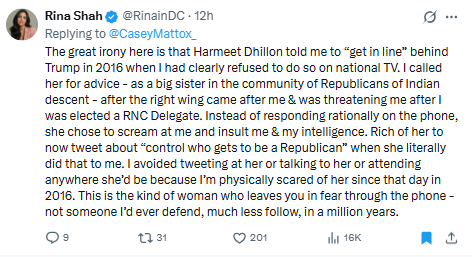
If her account is accurate, Dhillon used a moment when a fellow Republican was asking for support to press her for loyalty to the nominee. That’s what gives Shah’s charge of hypocrisy its force.
Today, Dhillon is going through her own "Rina Shah moment".
Harmeet Dhillon is drawing a public line against MAGA’s religious hard right. After her Justice Department resignation, an X account calling itself Georgia College Republicans posted that “demon worshippers will not be tolerated in the Republican Party.” Dhillon challenged the people behind it to show their faces and explain who gave them the authority to decide who gets to be a Republican.
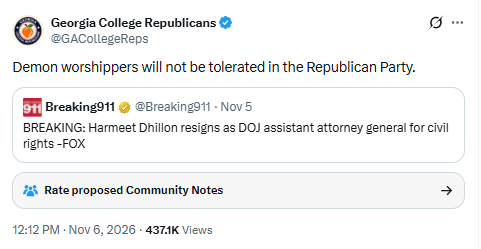
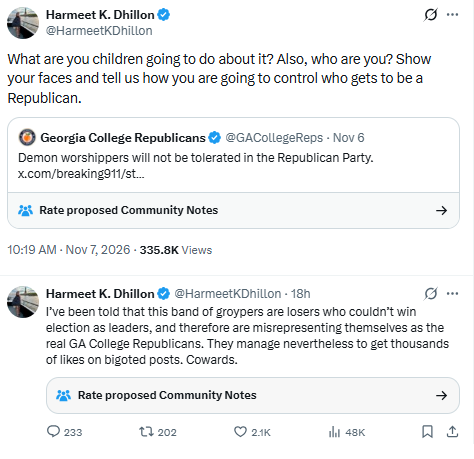
This fight has a history. When Dhillon offered a Sikh prayer at the 2024 Republican National Convention, white nationalist Nick Fuentes called it blasphemy, and accounts aligned with him attacked it as idolatry.
Dhillon’s pushback shows a real rift with that faction. Whether it becomes a wider break with Trumpism is still open.
Rina Shah’s account exposes the irony. Shah says that in 2016, after receiving threats for opposing Trump.
GOP later removed her as a delegate on residency grounds she disputed. Read together, the two episodes show how the test of belonging can change. Shah says they pressed her to prove her loyalty to Trump. A decade later, even Dhillon’s record of loyalty to Trump could not shield her from activists who treated her Sikh faith as grounds for exclusion.
That is where this faction is trying to take the Republican Party. Once a prayer from a fellow Republican can be branded demonic, the argument shifts from what people believe about taxes, immigration, or foreign policy to whether they belong in public life on equal terms. The damage extends beyond the GOP. A country can live with fierce disagreements over policy because citizens can lose an election and still expect to belong on the same terms the next morning. Religious gatekeeping erodes that assurance. It tells Sikh, Hindu, Muslim, and other Americans that their standing can depend on who holds power.
For Trump’s would-be successors, the danger is that a smaller coalition can still win a Republican primary. A candidate can gain standing with hardliners by indulging these attacks while making it harder to earn the trust of voters needed in November. Pew found that Trump’s 2024 coalition was more racially diverse than either of his earlier coalitions.
His support among Hispanic voters rose from 36% in 2020 to 48% in 2024, and among English-speaking Asian voters from 30% to 40%. Meanwhile, PRRI’s 2026 survey classified 59% of Republicans and 26% of independents as adherents or sympathizers of Christian nationalism. Those categories cover a much broader range of views than the rhetoric aimed at Dhillon, but the gap helps explain how appeals that work inside the party can limit its reach outside it.
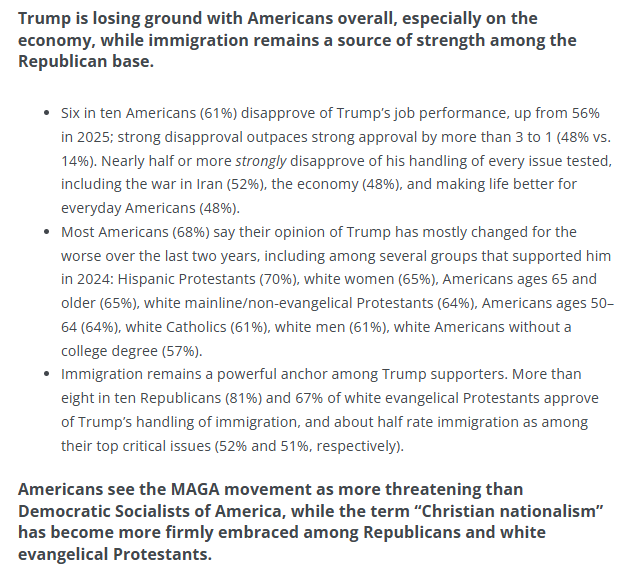
The post-Trump question is whether Republican leaders will defend the full membership of the coalition they needed to win. Dhillon’s response matters because she is asking that question from inside the movement. The real test is whether its next leaders will defend someone like her when doing so costs them support from their own base.
Let us do an exercise to understand the impact of the MAGA's Christian Nationalism base. Here are a few charts from PRRI's "Mapping Christian Nationalism across the 50 states - Insights from PRRI's 2025 American Values Atlas."
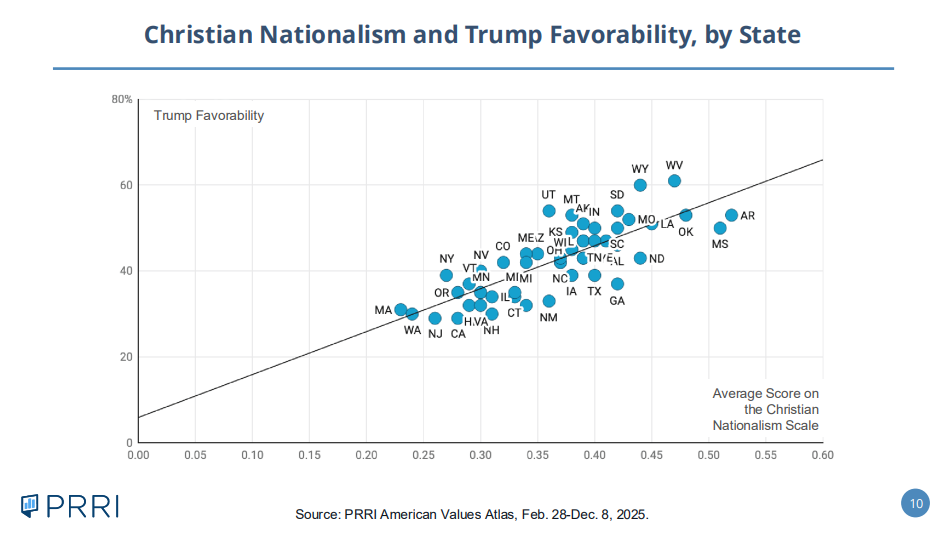
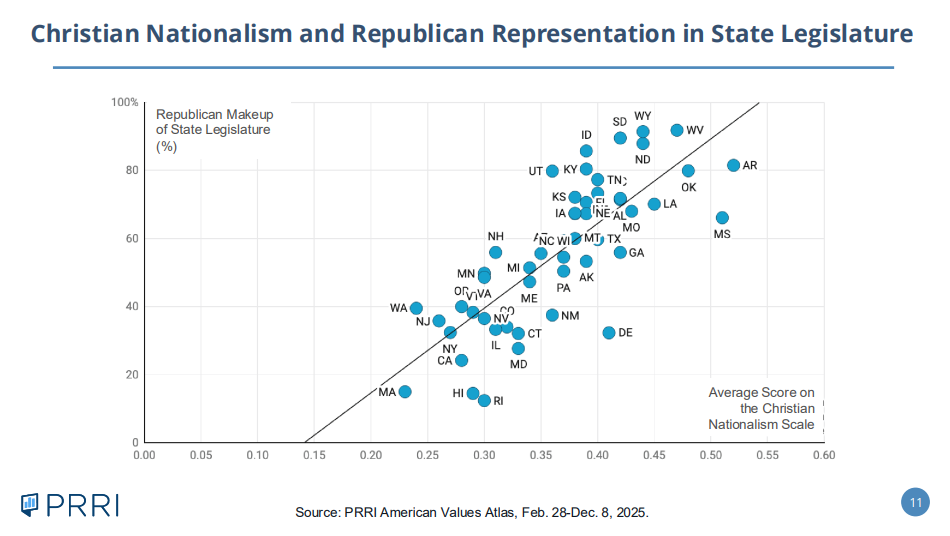
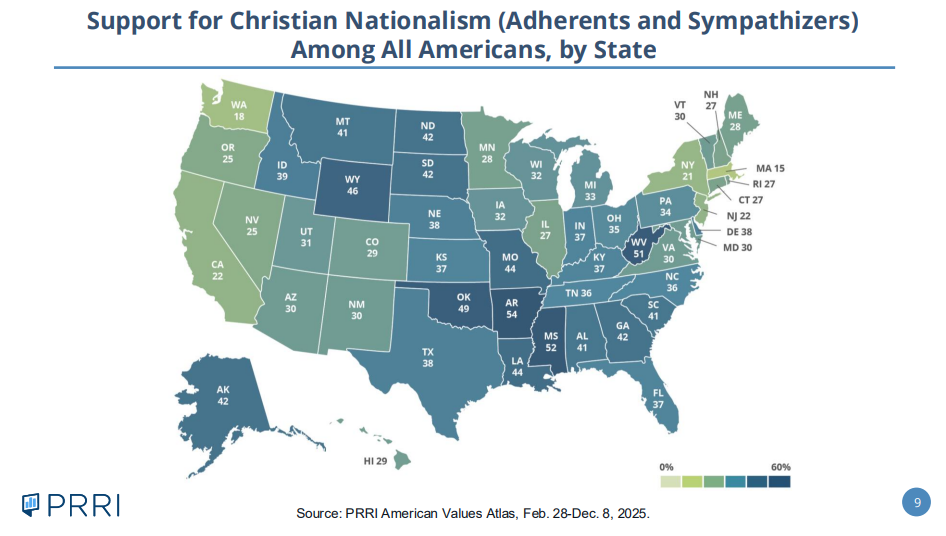
Here is the file.
We used AI to overlay the 2026 midterm Senate results (Source: Google) on PRRI's Support for Christian Nationalism by State map. This is what we get.
Republicans held eight of the ten called Senate races in states where at least 40% of adults qualified as Christian nationalism adherents or sympathizers. But Democrats flipped South Carolina at 41%, held Georgia at 42%, and picked up Texas, Kansas, North Carolina and Ohio, all in the mid-to-high 30s.
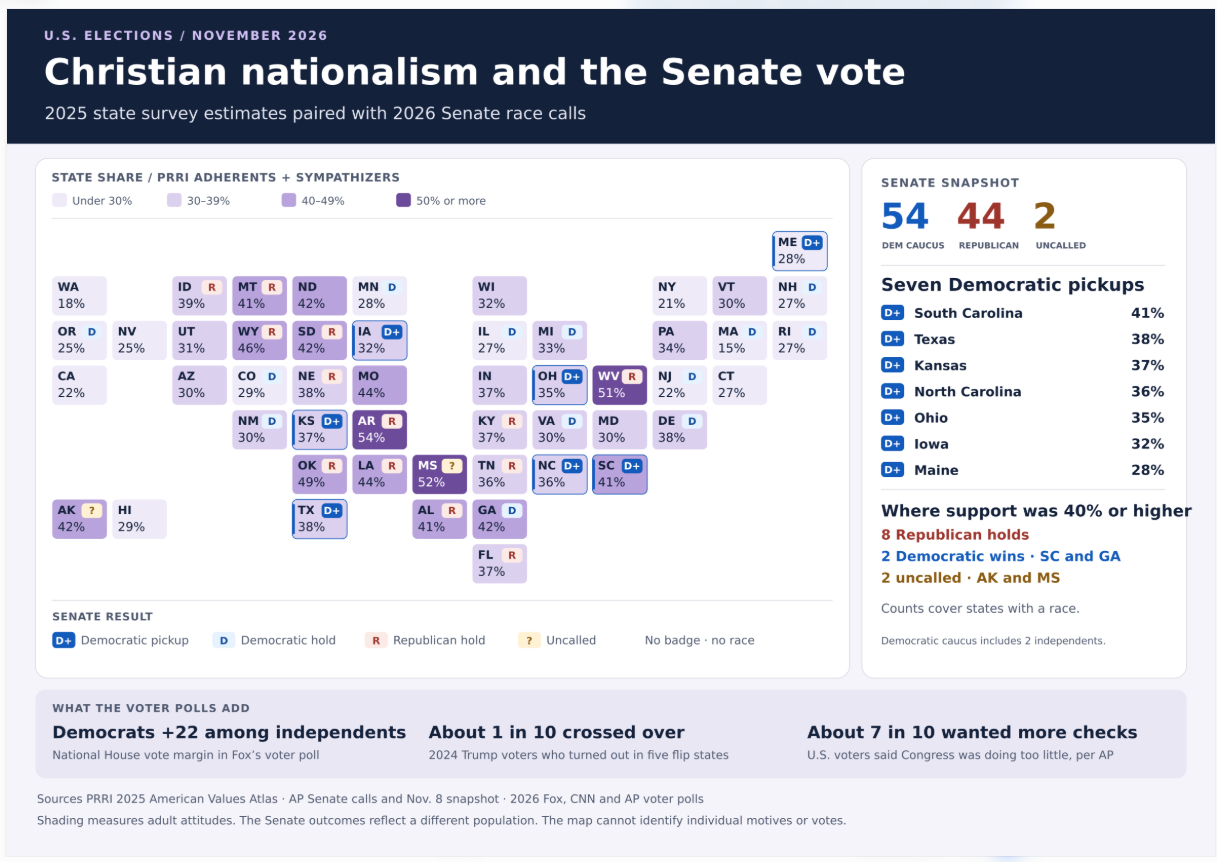
Christian nationalism still marks much of the Republican Senate stronghold. The 2026 midterms showed where that stronghold ends.
The most revealing comparison is South Carolina and Alabama. Both registered 41% on PRRI’s measure. South Carolina flipped Democratic while Alabama stayed Republican.
Kansas and Florida both registered 37% and also split. A state’s level of support for Christian nationalism probably sets the foundation and helps describe the terrain, but candidates can get different results on similar terrain.
Of the seven Democratic pickups, six were in states Trump carried in 2024. Maine was the exception.
How and who countered Trump’s coalition?
- Democrats and independents converged on a check on Trump. Fox’s voter poll put Democrats ahead by 22 points among independents in the national House vote, compared with Harris’s 6-point advantage among independents in 2024. AP found that about 7 in 10 voters, including roughly 4 in 10 Republicans, said Congress was doing too little to check the president. PRRI separately found that only 25% of independents qualified as Christian nationalism adherents or sympathizers in its 2025 survey. Together, those results show why independents were fertile ground for a counter-coalition. The surveys do not tell us exactly how independents outside those PRRI categories voted.
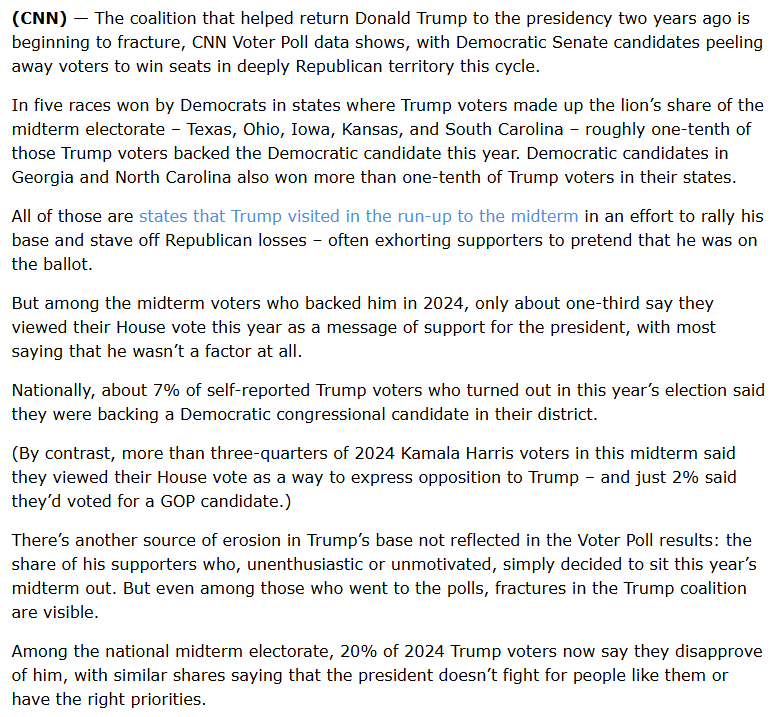
- Some of Trump’s own 2024 voters crossed over. CNN’s voter poll found that about one in ten self-reported 2024 Trump voters who turned out in Texas, Ohio, Iowa, Kansas and South Carolina backed the Democratic Senate candidate. Nationally, one in five returning Trump voters said they now disapproved of him. That is direct evidence of crossover among people who voted in both elections. AP’s polling also points to the cost of living and stronger Democratic support among young and Hispanic voters. The broader shifts can reflect both changed minds and a different mix of people turning out.
- Democrats also challenged the right’s claim to speak for Christian voters. In Texas, seminarian James Talarico, and in Kansas, Methodist pastor Adam Hamilton, spoke openly about their faith and won Republican-held seats. Their campaigns showed how Democrats could challenge religious exclusion while speaking in terms familiar to churchgoing voters. The results establish that this approach could win in those states. They leave open how many voters were persuaded by the religious message itself.
Here is an important insight.
Fox’s poll found that 99% of self-identified MAGA Republicans backed Republican House candidates, compared with 85% of non-MAGA Republicans.
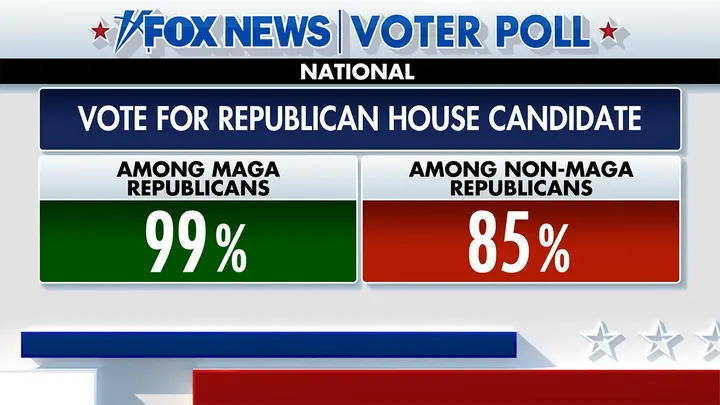
That loyalty gives Trump’s successors a dependable base. It also makes it easy to mistake a loyal base for the broader coalition that won in 2024.
The MAGA and Christian Nationalist power within the Republican Party and the relentless attacks based on race and religion may explain why some Republicans are doubling down after the midterms. A strategy that cost the party seats nationally can still protect an individual Republican in a primary. Senator Thom Tillis warned that repeating the same mistakes would produce the same result. The problem is that the people who can punish a Republican for changing course may have more immediate influence over that candidate’s career than the voters who punished the party in November.
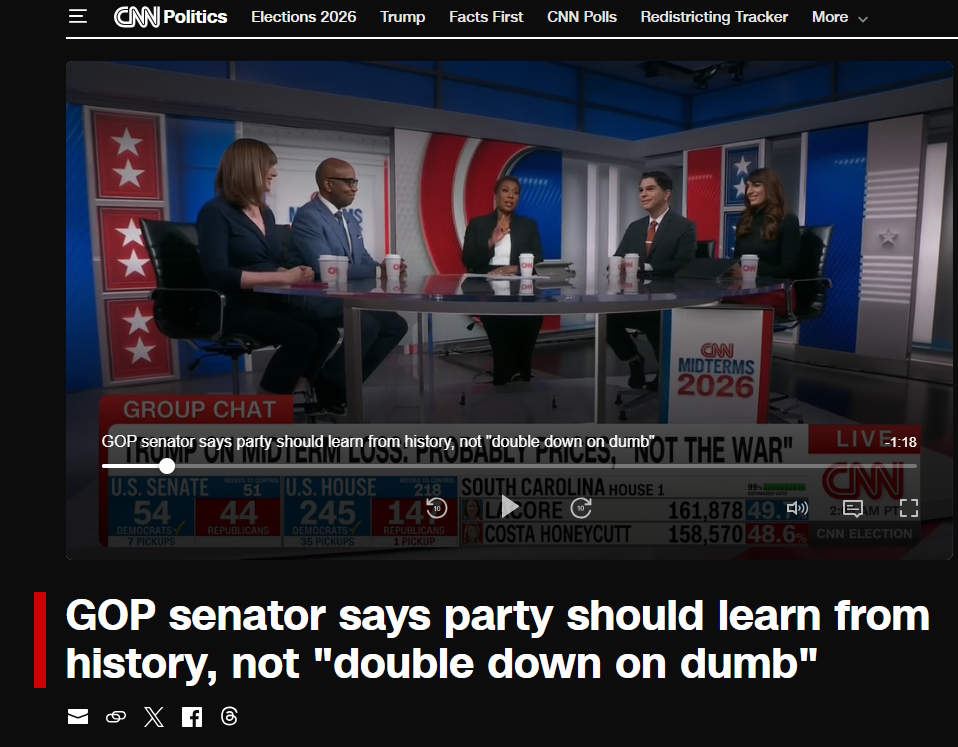
The 99% versus 85% split in the Fox News graphic we shared earlier shows where Republican loyalty held and where it frayed. Nearly every self-identified MAGA Republican who voted backed the Republican House candidate. Non-MAGA Republicans were less loyal, and independents backed Democrats by 22 points. For a party trying to regain a majority, the opportunity is with voters it lost. For a politician worried about a primary challenge, the immediate incentive may be to reassure the voters who stayed. The Fox poll measured general-election choices, so it tells us where loyalty was concentrated. It cannot tell us how those voters would react to a candidate breaking with Trump.
Christian nationalism adds a second pressure.
The attack on Harmeet Dhillon illustrates how the hard edge of that politics can exercise influence. Even a prominent Trump ally could be treated as an outsider because of her Sikh faith.
The viciousness shows the cost activists are willing to impose on people they target. The survey shows how much more receptive the Republican audience is to Christian nationalist ideas than independents are. Those are two different kinds of power.
Evidence suggests a push to double down at the top. Trump elevated Stephen Miller to chief of staff after the defeat, and Steve Bannon called for a more aggressive populist and nationalist agenda.
There’s also open dissent, so it’s too early to say most Republican candidates have chosen that course.
The coalition fight inside the Republican Party sets the domestic terms of the contest. The same week supplied the foreign terms.
Let us turn to that - a racy spy thriller!
China's Nvidia Chip Intelligence Honey-Trap!
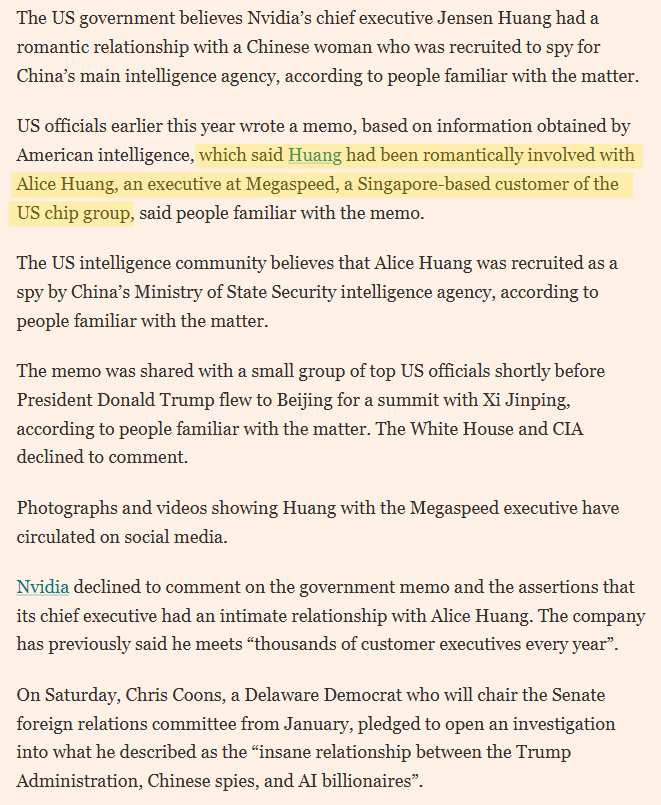
A US intelligence memo describes Alice Huang, a Megaspeed executive, as recruited by China’s Ministry of State Security to spy on Nvidia CEO Jensen Huang.
On October 29, the New York Times reported that US intelligence had identified Alice Huang, a former Megaspeed executive, as a Chinese intelligence asset with a close relationship to Nvidia CEO Jensen Huang. She is also known as Huang Le, and she is not related to him. A week later, the Times and the Financial Times reported on the memo behind the story. It says China’s Ministry of State Security recruited her to spy on him, and that her goal was to convince him to lobby the US government. The FT added that the memo describes a romantic relationship.
The Financial Times reported that the memo also describes a romantic relationship. The Times reports that Trump was briefed and chose not to act. Beijing went after the person who decides who gets the world’s best AI chips, and it was willing to spend years building personal access to do it.
Alice's employer explains why the operation mattered. Megaspeed was created in 2023, when 7Road, a Chinese gaming and cloud firm with state-backed investors, split off its Singapore operation. Its directors are mostly China-based, and most of its clients are Chinese. A Malaysian subsidiary, Speedmatrix, received more than 200 shipments of restricted Nvidia technology between June 2024 and June 2025.
Though Ms. Huang and Megaspeed are little-known players in the A.I. industry, their association with Nvidia and its chief executive has recently become a preoccupation in Washington. Commerce Department officials have been investigating whether Megaspeed, which has close ties to Chinese tech firms, is helping companies in China sidestep American export restrictions, according to more than a half dozen current and former officials and other people familiar with the companies, who spoke on condition of anonymity to discuss an examination that is not public. The inquiry, which is active, calls into question how closely Nvidia is tracking where its A.I. chips end up and highlights the possibility of American export laws easily being sidestepped. Megaspeed is also facing scrutiny from Singaporean police, who told The New York Times in a statement that they are investigating the company for breaching local laws, without elaborating further. As the dominant provider of artificial intelligence chips, Nvidia’s annual revenue has soared nearly sevenfold in the past four years, making it the world’s most valuable publicly traded company. But the Silicon Valley company’s meteoric rise has coincided with U.S. government concerns that its chips could help adversaries like China develop new weapons, surveil dissidents and leap ahead of the United States in A.I. development. Those concerns led both the Biden and Trump administrations to crack down on A.I. chip sales to China. But some Chinese companies employ global networks of middlemen and shell companies to sidestep those limits. In a legal gray area, some have built vast data centers in Southeast Asia that have fueled China’s gains in A.I. Other Chinese companies have set up illegal smuggling networks, moving perhaps hundreds of thousands of blocked chips into China, experts estimate. In April, the House Select Committee on China opened an investigation into Nvidia’s sale of chips to China and Southeast Asia. Nvidia has expanded its operations in Taiwan in recent years, but it remains firmly anchored to Silicon Valley, where it was founded more than three decades ago. (Source: A Mystery C.E.O. and Billions in Sales: Is China Buying Banned Nvidia Chips? / New York Times)
The sequence in the Times reporting is hard to miss. In June 2024, she offered to get Huang to join a group of tech executives at a Taipei bar, and he arrived shortly after. Megaspeed then bought about $1 billion of Nvidia technology in the next three months and nearly $2 billion in all. Most of it came through Aivres, Inspur's US subsidiary, which was placed on the entity list in 2023. In May 2025, the two were photographed leaving a Taipei restaurant after a business dinner. Singapore police arrested nine people in February 2025 for misleading claims about where AI servers were going, and Singapore police say investigations into Megaspeed are ongoing.
The operation targeted the person who decides how Nvidia’s most valuable product is allocated and who also lobbies Washington on where it can be sold. The FT reports that Huang personally pressed Trump to allow H200 sales to Chinese customers. Washington approved those sales in January, and a day later Chinese customs said the chips were not permitted to enter. Beijing wanted the lobbying and wanted to set the terms of the purchase.
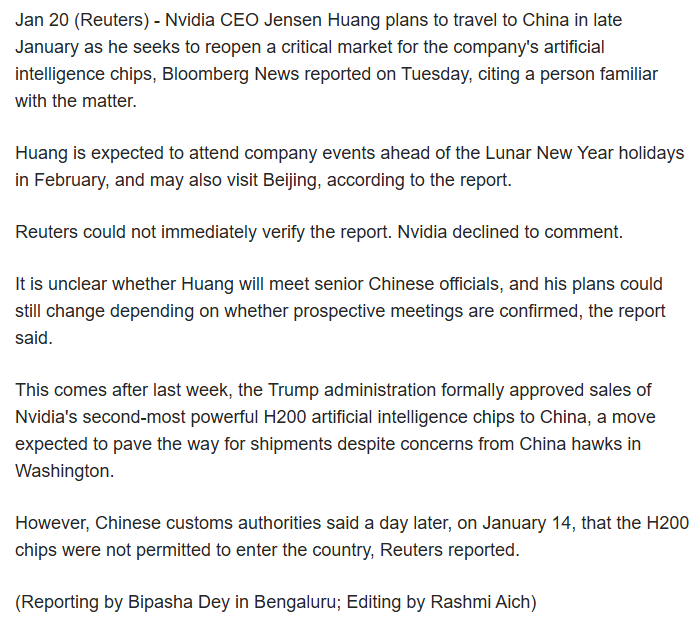
Washington’s reaction shows how it handled the case. The Times reports that Trump was briefed about a year ago and took no action, and Huang was never given a defensive briefing.
On October 31, Trump called Huang “brilliant” after the report. In May, Huang traveled to Beijing as part of Trump’s delegation. In June, he declined a Senate Banking Committee invitation to testify. On November 4, House chairs Brian Mast, John Moolenaar, and Eric Crawford asked him for a closed-door briefing, scheduled for November 18. Senator Chris Coons promised a probe. Nvidia says Huang meets thousands of customer executives every year, and the Chinese embassy dismissed the claims as groundless.
But of course!
The case shows how deep China will go for the chip lead. The Megaspeed channel ran through a Singapore shell, a Malaysian subsidiary, and a US subsidiary of a blacklisted company. A separate Times report found that New Matrix, a Chinese buyer authorized by Commerce, had only a hollow gray shell at its listed address.
The Justice Department has also shut down a China-linked network that allegedly routed tens of millions of dollars of H100 and H200 GPUs to China with falsified documents. The Huang operation sits at the top of that system, with smugglers at the bottom and the CEO’s dinner table at the top. China pursued the same input at every level at once.
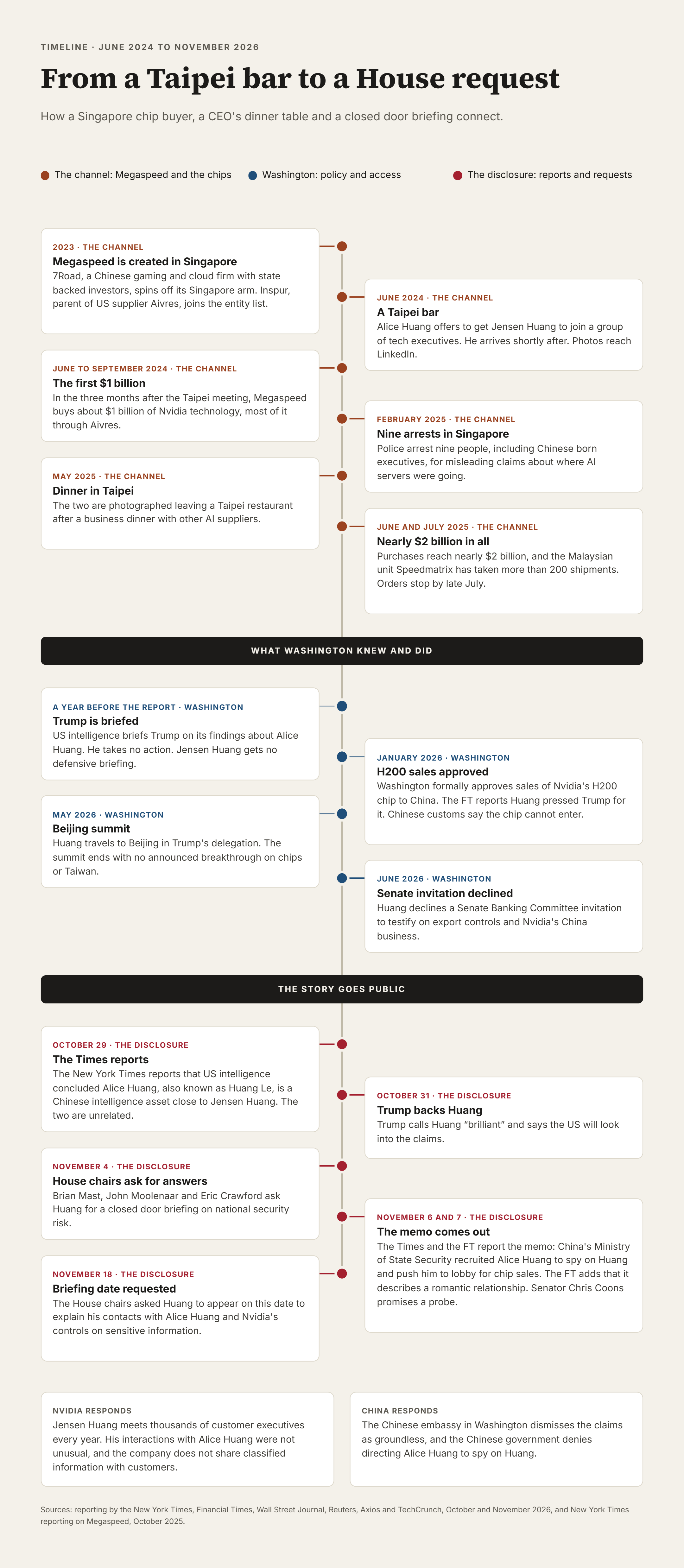
Here's the complete timeline.
The Changing Global Financial System
China’s interest in Huang makes sense once you ask what the chips are for. A compute lead decides who runs the next financial and surveillance system.
Catherine Austin Fitts argues that the money side of that system is the real story. She argues that the data centers, the digital ID, and the programmable money all serve one purpose: to give central bankers control of fiscal policy, and that American retirement accounts are paying for the buildout.
First, who is Catherine?
She now publishes the Solari Report. Her interview with Danny Jones carries several narrations that she ties into one account.
Here is the full video.
Let me take you through some of the insights she shared on different topics:
The harvest. She says the governance of the United States is being re-engineered on a “just do it” basis while the country is harvested. Her anchor is a conversation in spring 1997 with the president of the largest US pension fund. He told her they had given up on the country and would move the money out that fall. She dates the start of the missing federal money to that fall, and says the capital went to Asia and built China.
The tapeworm and the reset. She calls the central banking warfare model the tapeworm. Central bankers print money, and military and intelligence agencies make sure people take it. Every 80 to 120 years, the bankers run a reset. The current one is Going Direct, presented at Jackson Hole in 2019. The Fed injected $5 to 6 trillion directly into the economy. Small businesses were shut, and big firms stayed open, so the money flowed to the big firms. Their purchases of land, assets, and market share in turn produced the inflation people feel now. She calls the second round a closed energy model. The US controls chokepoints and sells LNG above market to Europe and Asia, and the IMF now rates the US as the strongest economy.
Epstein and the covert SWIFT. She traces Rubin taking Epstein to the Clinton White House, the Fed buying shares in the Bank for International Settlements in 1994, the Lutnik townhouse next to Epstein’s, and Cantor Fitzgerald’s records lost on 9/11. She says Epstein was a joint project of US, Israeli, and probably British intelligence. In her account, he ran the equivalent of SWIFT for covert money, and he invested in programmable money, distributed ledger technology, and brain research.
The black budget and the grift. She cites $21 trillion in undocumentable adjustments at HUD and DoD starting in 1997, Rumsfeld’s $2.3 trillion announcement the day before 9/11, and about $100 trillion in technology and data moved to private firms. Her Solari collection “Vectors of Grift” lists 21 models of grift with recent examples, and she argues the grift drains productive investment from the economy.
The dollar plan. The GENIUS Act framework for Treasury-backed stablecoins takes effect in 2027. DTCC is tokenizing stocks and bonds, the NYSE plans 24/7 trading in tokenized shares of 63 large stocks, and she cites one firm offering 20 times margin. The goal is four billion new users on the dollar and a flow of local bank deposits into Treasuries.
The control grid. She calls the end state the automated third lock.
Catherine Austin Fitts’s “automated third lock” is a system in which access to your own money can depend on rules enforced at the moment you try to use it. You and the seller can both agree to a purchase. The third party controlling the payment can still stop it. Her concern is what happens when that third party can draw on data about your life outside the banking system and apply the same decision across multiple institutions.
Banks already apply know your customer and sanctions rules as a third check on a transaction. With enough data centers and surveillance, an algorithm could apply that check to everyone automatically and freeze any account. She calls it taxation with no representation.
Here is the kicker: parts of the third lock already exist. Banks use software to screen for sanctions and may review a flagged match. Under certain U.S. sanctions rules, a bank must freeze covered assets. The customer can retain legal title to the money while losing the ability to withdraw or transfer it. Some stablecoins have a similar capability at the token level. Circle says it can block a blockchain address from sending or receiving USDC or EURC in specified circumstances. Each of those powers operates within a defined system.
It would require three things to work together:
- Link the person to the money. Banks, wallets and payment providers would need to recognize a shared identity or reliably match their separate records. Data about a person’s transactions, location or associations would need to be available to whoever sets or enforces the rule.
- Turn that information into a decision. A system could check a payment against a restriction on the sender, recipient, merchant or location. AI could help infer relationships or assign a risk score. A simple list would be enough to block someone once they were flagged.
- Carry the decision across providers. If one bank declines a payment, the customer may still have another way to pay. If multiple banks, card networks and wallets honor the same restriction, switching providers may accomplish little. The broader the coverage and the fewer practical alternatives, the more coercive the restriction becomes.
Data centers supply computing capacity.
Decisive power comes from who sets the rule, what data they can use, and which institutions must enforce it.
The infrastructure Fitts points to makes parts of the scenario technically plausible. It takes additional policy and institutional choices to make the system she describes.
The bubble. Households hold 48 percent of assets in stocks. Some portfolios carry 35 to 55 percent in a dozen AI companies, and margin debt is 4.5 percent of GDP. She warns that Amazon fell 94 percent after the dot-com peak.
She sees an AI bubble that could get considerably bigger before it breaks. That is the part of her argument that’s easy to miss. She thinks retirement savings and borrowed money have already pushed a small group of stocks to precarious valuations. She also sees a new source of demand coming that could keep those stocks rising and spread the eventual losses to more investors. She gives no date for the break or specific trigger.
She insists that the retirement portfolios can look more diversified than they are. An investor might hold an S&P 500 fund, a growth fund, and a technology fund across a brokerage account, IRA, and 401(k). Looking through the fund names can reveal repeated exposure to the same cloud, chip, and AI companies. In a market-cap-weighted fund, the companies whose prices have risen the most relative to the rest of the market can take a larger share of each new dollar invested. Fitts’s 35–55% illustrates how concentrated a particular portfolio could become. The investor’s actual exposure depends on the funds and their weights.
She thinks the next buyers could come from outside the traditional brokerage system. This is the distinctive part of her forecast. Dollar stablecoins, tokenized shares and round-the-clock trading could make it easier for overseas retail investors to buy exposure to U.S. stocks. If those platforms attract substantial new demand and offer leverage, she thinks some of that money will chase the same familiar megacaps. NYSE has announced plans for a tokenized securities platform with 24/7 trading and stablecoin funding, subject to regulatory approvals. The platform plans are real. Her scenario assumes the scale of investor adoption and where that money would go.
Two figures help explain the transmission. In Q2 2026, directly and indirectly held equities accounted for 48.2% of U.S. household and nonprofit financial assets. That’s an aggregate share of financial assets, which excludes assets such as homes.
Separately, September margin debt of about $1.48 trillion was about 4.5% of annualized nominal GDP. Concentration means the same falling stocks can hit several funds at once. Leverage can accelerate the fall when brokers force borrowers to sell into a declining market. Retirement savers can feel that price pressure even if they never borrowed a dollar.
Her Amazon example gets at the distinction between being right about a technology and being right about the price. Amazon survived the dot-com bust and became one of the defining companies of the internet era. Its shares still fell about 94% from their 1999 peak to their 2001 low and took nearly a decade to regain that peak. AI could transform the economy and today’s leading firms could remain central to it while investors who bought at elevated prices suffered deep, lasting losses.
Fitts also makes a separate political argument. She believes the AI and data-center buildout, combined with digital identity and programmable payments, could create infrastructure for surveillance and financial control. That is why she talks about savers financing a “control grid.” The market argument stands on its own.
The mind. She describes neurowarfare as a ladder from propaganda to dopamine design to entrainment and subliminal programming. Epstein funded parapsychology, and she says a population that discovered the powers of its mind would threaten centralized control. Her answer is cash, local banks, local farms, family enterprise, independent income, and young people trained to see what is happening.
Howard Lutnick - the connector
What is incredible about the above stories is that Lutnick is central to both. In Fitts’s chronology, he is Epstein’s neighbor at Cantor Fitzgerald. He is also the Commerce Secretary who licenses chip exports. Senator Cotton addressed his Megaspeed letter to Lutnik, and Senator Warren called for Huang and Lutnik to testify together.
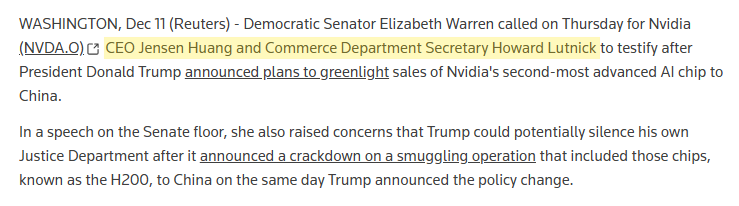
This is the strongest single link between the Nvidia Honey-trap scandal and Catherine's account. A paragraph on Lutnik’s role would tie the money story to the chip story through one person.
Howard Lutnick is the one person who sits on both sides of this story. As Commerce Secretary, he oversees the Bureau of Industry and Security, the office that licenses chip exports to China, and the office Senator Cotton wrote to about Megaspeed.
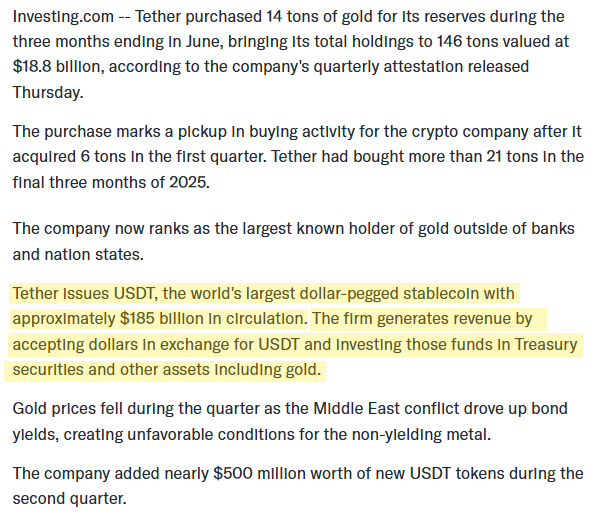
Before that, he ran Cantor Fitzgerald, which has custodied Tether’s Treasury reserves since 2021.
 Jose Antonio Lanz
Tether is the largest dollar stablecoin, with about $185 billion in circulation, and it is the main channel through which the GENIUS Act dollar plan reaches new users abroad.
Lutnick vouched for Tether’s reserves publicly before he took office, and his son Brandon now chairs the firm. Senator Blumenthal has put the figures on it: Cantor’s 5 percent stake in Tether has grown from $600 million to an estimated $10 billion, and Lutnick has made more than $250 million since Trump returned to office. So the same official who decides how fast Nvidia hardware can move toward China also has a family stake in the stablecoin system that Fitts says is built to pull the world onto the dollar.
We covered the sequence earlier: Trump was briefed about a year ago on Jensen Huang's link to Alice Huang. Yet, H200 approval in January, the Beijing summit in May, Huang declining the Senate invitation in June, the NYT story on October 29, the midterms on November 3, the House request on November 4, the briefing on November 18, Democrats seated in January, and GENIUS in effect in 2027. The order does the argument for you.
The power layer. Fitts says data center capacity far exceeds civilization’s needs. One report notes that the Democratic governors’ wins may restrain the US data center buildout. Pair that with her account of Operation Fortress, the Pentagon order for bases to run on their own micro reactors for 90 days. Energy is where the chip race and the dollar plan meet.
Dollarization vs De-Dollarization Battle
If you look at the ongoing turf wars between US and China and the narration of Catherine Fitts, you will see that there is a battle between Dollarization and De-Dollarization going on.
Washington is trying to extend the incumbent currency's reach through private stablecoins.
Beijing is building payment routes that make the dollar optional in some trade corridors. China can gain leverage by making those routes usable in a crisis, even if central banks continue to hold most of their foreign exchange reserves in dollars and euros.
Fitts is right to see an explicit dollarization strategy. Treasury Secretary Scott Bessent said the GENIUS Act would expand access to the dollar economy, reinforce its reserve role and increase demand for Treasuries.
“Stablecoins represent a revolution in digital finance,” said Treasury Secretary Scott Bessent. “The dollar now has an internet-native payment rail that is fast, frictionless, and free of middlemen. This groundbreaking technology will buttress the dollar’s status as the global reserve currency, expand access to the dollar economy for billions across the globe, and lead to a surge in demand for US Treasuries, which back stablecoins. The GENIUS Act provides the fast-growing stablecoin market with the regulatory clarity it needs to grow into a multitrillion-dollar industry. The signing of this bill marks a seminal moment for digital assets and dollar supremacy.” (Source: US Treasury Department)
The distinction is who is doing it. The documented policy comes from the White House, Congress and Treasury, with private companies issuing the stablecoins. The same White House order that encouraged dollar-backed stablecoins directed federal agencies away from developing or promoting a U.S. central bank digital currency.
A merchant in Lagos could accept a dollar stablecoin and retain a dollar balance without opening a U.S. bank account. If that balance represents fresh demand for dollars, and the issuer holds Treasury bills against it, the arrangement connects overseas demand for a payment instrument to demand for U.S. government debt. If the buyer simply moves money out of a dollar money-market fund that already holds Treasury bills, much of the effect is a shift in who holds the bills.
The strategic gain can still be substantial. The merchant begins to price, save or settle in dollars, and the next merchant has one more reason to do the same. For countries with weak currencies, that convenience can come at the cost of some domestic monetary control.
The Chinese Gambit
China starts from a different advantage. It can build payment arrangements around existing trade.
If a buyer and a Chinese supplier agree to invoice in renminbi, and the buyer’s bank can obtain renminbi and settle through CIPS, the transaction can proceed without a dollar leg.
Central bank swap lines can help supply the currency.
mBridge, a separate project developed with several monetary authorities, tests direct cross-border settlement in participating central-bank digital currencies. It had processed more than $55 billion by November 2025, roughly 95% in digital yuan. That establishes real use on the platform. Its concentration also shows how far it is from a broadly balanced multi-currency network.
The harder question comes after the payment.
What does the exporter do with the yuan? It can spend the proceeds on Chinese imports, hold them, invest them or convert them. The arrangement works best when trade flows both ways or when firms have ready access to yuan assets and affordable hedges. China’s remaining capital restrictions, shallower offshore markets and limited supply of globally accessible safe yuan assets constrain those options.
Do you see the incredible picture coming together now?
An importer can pay a Chinese supplier in yuan while a freelancer in the same city holds earnings in a dollar stablecoin. India’s BRICS declaration fits this more flexible picture. It endorsed work on interoperable payments and local-currency settlement while recognizing different national priorities.
[See the BRICS statement here - BRICS New Delhi Declaration: Building for Resilience, Innovation, Cooperation and Sustainability (September 12, 2026)]
A government can want a second trade route without wanting Beijing to control it or the yuan to become its main reserve currency.
Who Controls What?
This also gives Fitts’s “third lock” an international dimension. A transaction routed around U.S. correspondent banks can reduce one point of exposure to Washington. A dollar stablecoin can move outside a traditional bank transfer while its issuer retains the technical ability to block an address.
Compute matters to the systems that process transactions and monitor compliance, but it is too strong to say, as the draft does, that whoever has the chips decides the outcome.
The harder advantage to reproduce is a currency people will hold after the transaction is over, backed by markets deep enough to invest or hedge in and rules they trust in a crisis.
Why is all this important with respect to what is happening in America politically that we discussed earlier?
A Divided America in a Contest for Global Power
The midterms made America’s leadership crisis harder to ignore.
Trump still holds the presidency, but the coalition that returned him to power has fractured. Democrats have won the authority to check him in Congress, while Republicans face a choice between answering the voters who left and appeasing the factions that stayed. A divided country has delivered a verdict without settling who can lead it.
That uncertainty matters abroad. Washington is trying to restrict China’s access to advanced chips while extending the dollar’s reach through stablecoins. Beijing is building domestic computing capacity and payment networks that let more of its trading partners settle without dollars. The dollar still has the deeper markets, and the United States retains powerful technological advantages. China can gain ground without overtaking either. Every trade corridor that can function when Washington closes a financial channel gives Beijing and its partners more room to act.
The contradiction runs through America itself. A country that resents concentrated power at home is extending its influence abroad through infrastructure that can concentrate power in the hands of chipmakers, cloud providers and payment issuers.
As Fitts warns, households can be exposed to the same handful of companies through their retirement funds even as they have little say over how that infrastructure is governed.
America enters this contest with assets China still struggles to match. Its harder task is to turn those advantages into a strategy that can survive an election, command public trust, and give other countries reasons to keep choosing American systems.