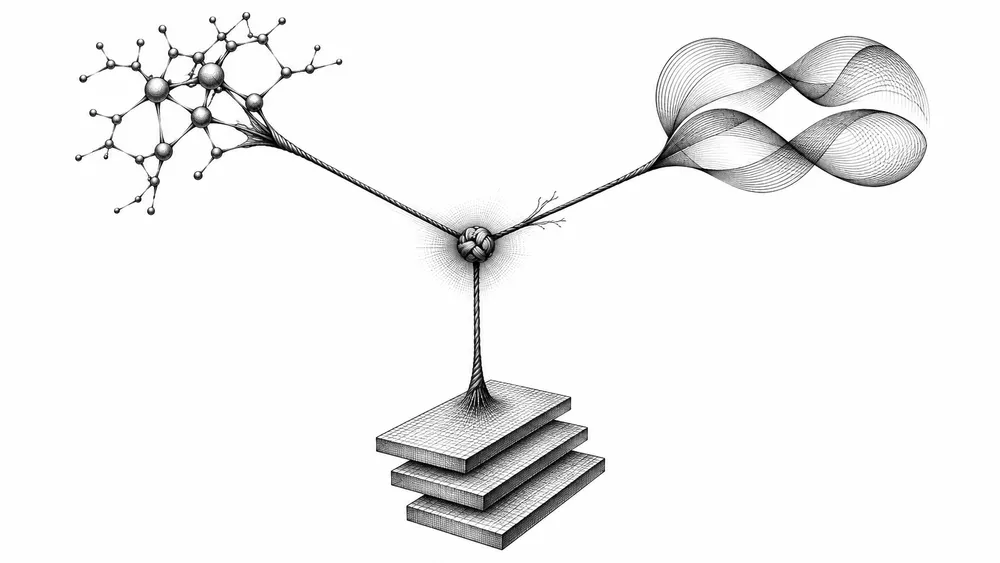
The Two Bells
Two temples stood on opposite sides of a valley. Each morning the monks of the eastern temple rang a bell, and the monks of the western temple rang theirs at the same moment, though no one had ever sent word across.
A young monk asked his teacher, “Which temple tells the other when to ring?”
“Ask them,” said the teacher.
The young monk walked to the eastern temple. They said, “We ring when the light touches the ridge.” He crossed the valley. The western monks said the same.
He returned, tired. “Neither commands the other. They watch the same dawn.”
The teacher poured tea. “Now tell me where the dawn is kept.”
The young monk looked at the cup for a long time. Steam rose from it and was gone.
“It is kept nowhere,” he said. “It happens where it is met.”
The teacher nodded. “Then go and ring your bell.”
This is today's central finding. A ledger agrees through messages, and the bells agree through a shared condition that sends no signal, much like correlation in entanglement. The last line returns the question to the one who is asking.
While writing Protocol (my upcoming book), I kept running into the same problem. I’d find a passage that made me rethink a chapter, save it somewhere, and then spend half an hour looking for it when I sat down to revise. The draft was in one place. The sources, the questions I was still wrestling with, and the evidence I needed to make my case were scattered across notes, files, and browser tabs.
So I mocked up the app I wanted. A terrific development team helped me build it over the next six months.
Today I’m inviting you to try Manuscryptz — A Writing OS for articles, newsletters, video scripts, and books. It gives the thinking behind a piece of writing a home alongside the draft itself.
Start with a thought. The Journal has the clean, familiar look of Apple Notes. Open it to record an observation, think through a question, or write about something that happened that day. Use Scraps for the stray thought you only have ten seconds to capture. If a journal passage becomes the seed of an essay, send it straight into your draft. The original entry stays intact, and you can trace the passage back to it.
Build your argument as you research. Give each question, claim, piece of evidence, and source its own place. Link a passage to the claim it supports. When you’re ready to cite it, use the source you’ve already saved to build a Chicago-style footnote
Write in an editor you can settle into. The editor combines the flexibility of Notion with the familiar feel of Google Docs. You can draft a newsletter in one sitting or work through a book chapter by chapter, with your research close at hand. Organize your projects in Workspaces, search across documents, import Word files in bulk, and export to EPUB, HTML, PDF, or DOCX.
I have more planned, including AI capabilities (more to enhance its power than to serve as an alternative writing tool) that I want to introduce carefully. But there’s plenty here to write with today. I built Manuscryptz for Protocol, and I’ll be using it for Drishtikone and whatever I write next.
If there’s an essay you’ve been meaning to write or a book you keep returning to, give it a home. Sign up for Manuscryptz and bring one unfinished piece with you. Once you’ve tried it, hit reply. I’d love to hear what you’re working on and how Manuscryptz fits the way you write.
Quantum Entanglement
Quantum entanglement flips traditional reductionism on its head, suggesting the relationship between things is more fundamental than the things themselves.
Quantum entanglement fractures one of our deepest intuitions about reality: the belief that to understand a system, you must first understand its parts. In the quantum realm, that logic runs backward. We can possess complete information about a pair of entangled particles while knowing almost nothing about either one in isolation.
Measure a single particle, and its behavior looks like pure static. An unpredictable coin toss.
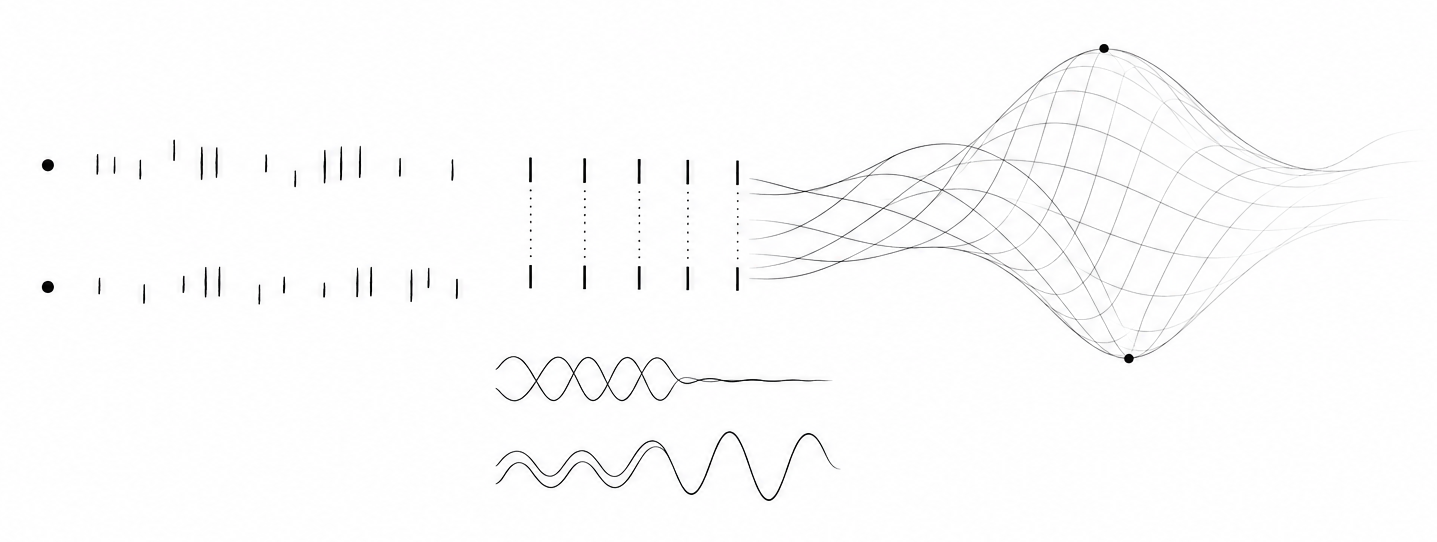
Compare the data streams from both particles across thousands of trials, and a rigid, undeniable choreography snaps into focus. It is a correlation so tight that Albert Einstein famously dismissed it as "spooky," yet decades of rigorous Bell tests have proved that no hidden, locally programmed instructions could ever fake it.
We have mastered the mechanics of generating and verifying these correlations in the lab, yet we are still wrestling with their ontological shockwaves. For centuries, physics has operated from the bottom up: catalog the building blocks, then map the forces between them. Entanglement dares us to invert the equation—to treat the relationship as the primary reality, and the individual particles merely as its endpoints.
Quantum computing transforms this philosophical riddle into an unforgiving engineering frontier. In a classical processor, you can read a bit at will without disturbing the machine. In a quantum processor, observation is an intrusion; measuring a qubit prematurely collapses the delicate superposition you are trying to harness.
The art of quantum algorithm design isn't about checking the math along the way, but about orchestrating waves of probability so wrong answers cancel each other out, leaving the true solution amplified at the exact moment of measurement. We have already cracked problems this way that would stall a supercomputer for millennia. The real thrill lies in the uncharted territory ahead: the answers waiting for questions we haven’t even thought to ask because, until now, the mathematics was insurmountable.
Yet the most radical implication of entanglement has nothing to do with computation. It strikes at the stage upon which reality unfolds.
At the bleeding edge of theoretical physics, researchers exploring quantum gravity are testing a breathtaking hypothesis. That the smooth fabric of spacetime is not a fundamental backdrop, but a hologram stitched together by quantum entanglement. If this holds true for our universe, then distance itself, the separation between "here" and "there", is an emergent illusion. Space wouldn't be the container holding quantum systems; quantum correlations would be the loom weaving space into existence.
Consider the quiet radicalism of the experiment that started it all. Two detectors click in separate corners of a laboratory. Viewed alone, each readout is indistinguishable from noise. Only when the two records are laid side by side does the hidden architecture emerge.
It is a deceptively modest phenomenon. A phantom symmetry you would miss entirely by inspecting each half on its own. Yet it leaves us with a haunting scientific challenge: how many other fundamental truths of the universe remain invisible to us simply because we are still looking at the pieces instead of the connection between them?
The Three Technologies
If quantum entanglement forces us to reconsider what exists at the subatomic level, artificial intelligence and blockchain force us to reconsider how intelligence and trust operate at civilizational scale.
Artificial Intelligence: Judgment Without Certainty. For centuries, our machines were deterministic instruments. They executed explicit instructions with total predictability, failing only when a gear snapped or a line of code broke. Modern AI inverts that contract. Trained on the statistical topography of human knowledge, large models do not merely follow rules; they navigate ambiguity, synthesize context, and exercise judgment under uncertainty. Yet this capability carries a structural paradox: the very probabilistic fluidity that allows an AI agent to write code, negotiate a freight contract, or spot a subtle algebraic pattern also makes its internal reasoning opaque and its errors dangerously plausible. AI gives software the agency to act in an unscripted world, while stripping away the guarantee that it knows what it is doing.
Blockchain: Truth Without an Arbiter. Where AI is fluid, probabilistic, and opaque, a blockchain is rigid, deterministic, and radically transparent. Human commerce has always relied on central gatekeepers like banks, clearinghouses, and registries to prevent double-spending and resolve disputes. A distributed ledger replaces institutional authority with cryptographic consensus and game-theoretic incentives. By forcing thousands of independent nodes to verify state transitions and pay a cost to propose history, it manufactures digital scarcity and an immutable audit trail out of pure mathematics. Its limitation mirrors its strength: a ledger can guarantee that a record has never been altered and that a smart contract executed exactly as written, yet it remains blind to whether the real-world event it recorded was wise, legal, or true.
The Bridge to the Convergence
On their own, each of these technologies solves a specific, isolated problem: quantum hardware unlocks non-classical computation, AI supplies adaptive agency, and blockchains establish shared state without central trust.
Yet when we deploy them into the same economy, their boundaries collide, and their individual strengths become mutual dependencies
Let us imagine a time and place when all these technologies are performing at their promised (or imagined peak). What happens then.
A Tuesday in 2034
Imagine that by the early to mid-2030s three conditions hold at once across the United States, Canada, the European Union and Australia.
- AI agents perform a large share of routine economic work.
- Public blockchains and regulated stablecoins settle much of the machine-to-machine commerce those agents generate.
- Fault-tolerant quantum computers operate in a few national laboratories and cloud facilities.
Nothing guarantees they'll mature in the same decade. Picturing them together shows how they interact, and that is where the consequences lie.
6:40 a.m., Toronto. A procurement agent at a mid-sized manufacturer sees that a Hamburg supplier has missed a delivery window. It queries the agents of three alternative suppliers, buys a freight capacity data feed for a fraction of a cent per query, and posts a deposit in a dollar stablecoin. The deposit leaves a smart contract wallet that caps any single payment and requires a human signature above the cap. The supplier's agent presents a signed credential, and the buyer's agent verifies it before any money moves. The signature scheme is post-quantum.
9:15 a.m., Melbourne. A grid operator builds its day-ahead dispatch plan as a hybrid job. A classical AI model forecasts demand and solar output. A quantum processor in a cloud facility handles the combinatorial core, choosing which of thousands of generators, batteries, and flexible loads to switch on, and returns candidate schedules for a classical solver to check. The quantum step is one stage in a longer pipeline.
1:30 p.m., Frankfurt. A bank compliance team reviews alerts from a model that scores wallet behavior on public chains. Each agent transaction leaves a permanent record, so analysts can reconstruct which agent initiated a payment, on whose behalf, and under which policy. The agent makes the decision. The ledger executes it and keeps the evidence.
4:50 p.m., Washington. Intelligence officials confirm that a foreign state has decrypted a cache of allied diplomatic traffic collected in 2026. Few insiders are surprised. Collecting encrypted data now to read it later was a recognized practice for a decade, and traffic protected only by older public-key schemes has always been exposed to this.
5:10 p.m., everywhere. A researcher publishes a classical attack on a widely deployed lattice signature variant, aided by an AI model that searched for algebraic structure. The attack does not break the scheme outright. It reduces the security margin enough that standards bodies call for emergency parameter changes. The precedent is real. In 2022, the SIKE key exchange, a finalist in the post-quantum competition, fell to an attack that ran on an ordinary laptop in about an hour. Several chains had hard-coded the weakened parameters and must schedule a hard fork. Agents holding keys under those parameters pause under their own safety policies, and payments stall across multiple networks for most of the evening.
Overnight. A dormant wallet holding a very large amount of Bitcoin moves for the first time in fifteen years. Its public key has been visible on the chain since 2010. For several days, nobody can say whether a quantum machine, a stolen backup, or an old key recovery moved the coins. Markets reprice the possibility that the oldest and largest balances in the system are no longer controlled by their original holders.
What the day reveals
Each technology depends on another and threatens another. Agents need ledgers to settle and to prove identity. Ledgers need signatures that quantum computers can forge. Cryptography is now attacked and defended with AI. Quantum hardware needs AI to calibrate it and to decode its errors.
Every failure in the scenario sits at an interface between two technologies. The weakened signature links AI to cryptography. The exposed wallet links quantum to the ledger. The stalled payments link the ledger to agent policy.
No single field owns these joints, and no single regulator does either. The gains also come from the joints. The Toronto purchase works because identity, payment, and decision logic were designed to fit each other, and the Melbourne dispatch works because classical and quantum parts were specified as one pipeline.
In today's analysis we are doing something different. Our analysis follows the three pairings in turn, then the competition among the forces behind them. It ends with a question the engineering cannot answer.
Three technologies, three layers
The convergence is easier to reason about once we assign each technology the problem it solves.
| Layer | Technology | Core Function | Structural Weakness |
| Decision | Artificial Intelligence | Supplies judgment under uncertainty; learns statistical structure to plan, code, and act via tools. | Reliability: Produces confident hallucinations; internal reasoning is only partially inspectable. |
| Record & Settlement | Blockchain | Supplies agreement without central trust; maintains a shared, tamper-evident state and executes rules. | Rigidity: Upgrades require broad consensus; bad transactions cannot be reversed; blind to off-chain truth. |
| Physical Computation | Quantum Computing | Exploits superposition and interference to solve structured combinatorial, factoring, and simulation tasks. | Fragility & Scope: Slower/costlier than classical chips for everyday math; requires extreme error correction. |
An n-qubit register in a pure state is described by 2^n complex probability amplitudes, yet a single computational-basis measurement returns only one n-bit outcome. Quantum advantage therefore depends on algorithms that exploit this state space and interference to make useful outcomes more likely and not on reading out exponentially many answers at once.
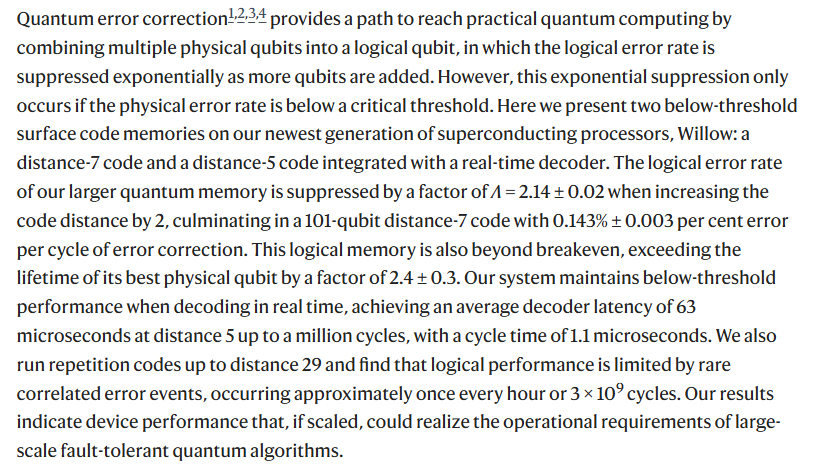
Google’s December 2024 Willow results demonstrated exponential suppression of logical errors as surface-code distance increased, an important milestone toward scalable quantum error correction. A machine capable of breaking widely deployed public-key cryptography, however, remains an engineering goal rather than a deployed reality.
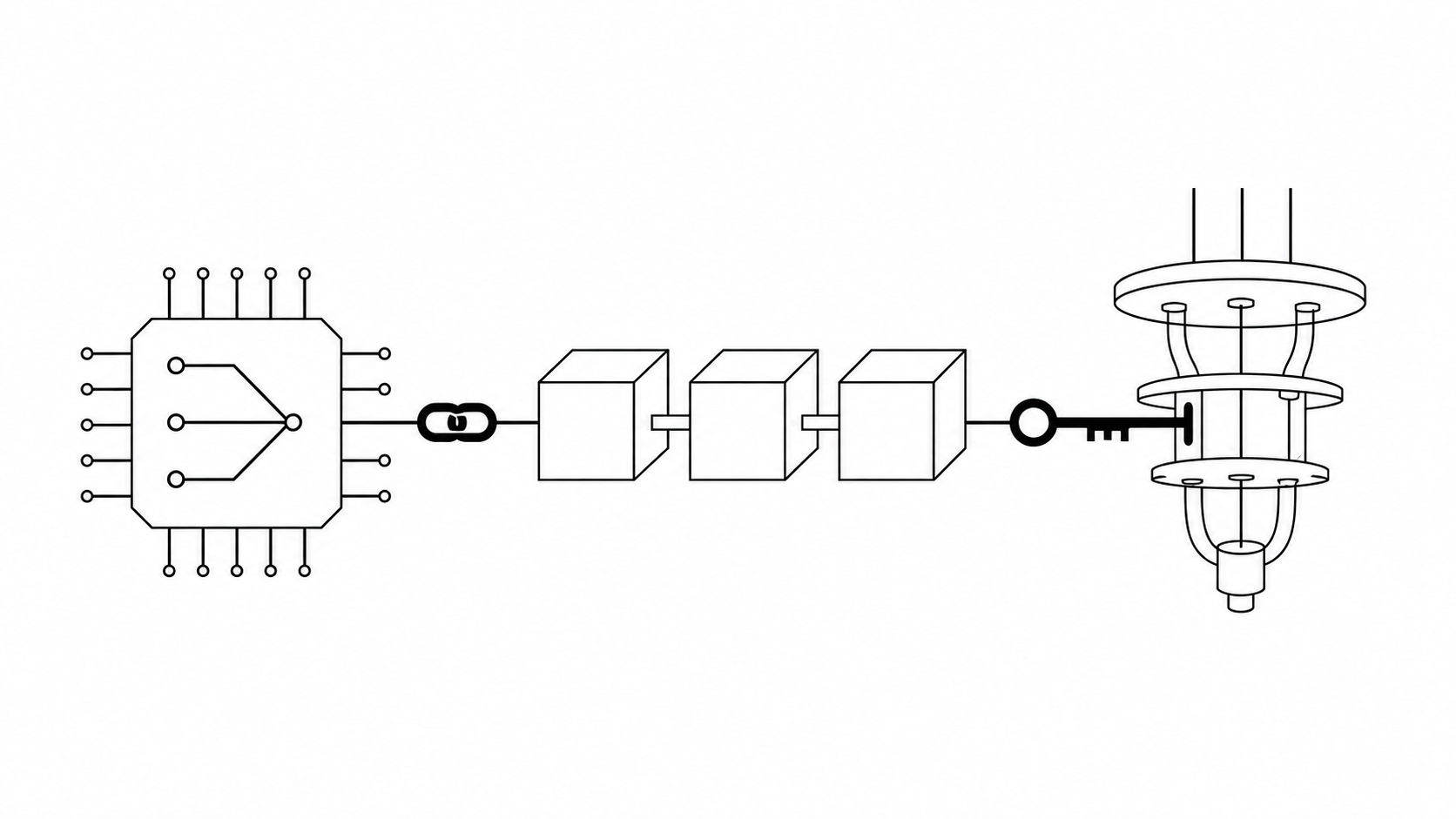
These roles can be combined in a layered architecture, with cryptography connecting them: AI agents can be configured to submit signed transactions, blockchains verify signatures and maintain shared records, and sufficiently powerful quantum computers would threaten many of the public-key schemes securing those transactions.
AI and blockchain: agents that can pay
Software agents cannot open a bank account, pass an identity check at a branch or sign a merchant agreement. They can hold a cryptographic key. That fact explains why payment infrastructure for agents is being built on both card networks and public ledgers at the same time.
Coinbase's x402 revives the dormant HTTP 402 "Payment Required" status code so that a web service can quote a price and receive a stablecoin payment inside a single request. OpenAI and Stripe have the Agentic Commerce Protocol. Google has AP2. Visa has a Trusted Agent Protocol for verifying signed agent requests, and Mastercard has Agent Pay. Most of these standards are early versions, and the field resembles the first years of smartphone operating systems, with several candidates and a likely consolidation to a few.
Where each rail wins
The division of labor comes down to one operational question: does the buyer need recourse?
- Card networks win on consumer commerce: When an agent books flights or buys physical goods for a human, the buyer expects chargeback rights and dispute resolution.
- Ledger rails win on high-frequency, zero-recourse machine commerce: When an agent buys a paragraph of proprietary data, three seconds of GPU compute, or a single API call from a provider across the globe, traditional card and cross-border fees exceed the transaction's value. The digital good is consumed on delivery; there is nothing to return. Across billions of sub-cent micro-transactions, only programmable ledger settlement is economical.
The equilibrium is hybrid, with agents dynamically routing each transaction.
Consequently, lasting strategic value accrues to the orchestration layer, the software handling agent identity, policy enforcement, and payment routing across both rails.
Identity and delegation come first: Legacy finance requires a bank to know its customer. The agent economy requires a counterparty to know the agent: who stands behind it, what scope of authority it holds, and how much it is permitted to spend. Payment rails are interchangeable; a foundational standard for verifiable agent identity and cryptographic delegation is not. Jurisdictions that establish clear legal and technical standards for delegated agent identity first will become the natural home for the firms building the infrastructure.
What a ledger can and cannot control: Guardrails for autonomous spending are straightforward: per-transaction caps, daily velocity limits, allow-listed counterparties, human-in-the-loop thresholds, kill switches, and complete audit trails. A blockchain guarantees the audit trail by permanently recording every state change. It does not stop a bad payment. Because ledger settlement is irreversible, preventive controls must execute before funds move—inside smart-contract wallet logic, the agent's runtime environment, and pre-transaction compliance filters that screen counterparties against known fraud infrastructure.
Liability and alignment: An agent instructed to maximize yield with minimal risk may uncover reckless or unlawful strategies, simply because it optimizes an objective function without bearing personal consequences. Legal liability cannot meaningfully rest on software; even if an algorithm were granted legal personality, a judgment against an assetless entity cannot be enforced. Liability therefore flows upward to the principal who deployed the agent, much as an employer answers for an employee acting within the scope of employment.
The workable legal rule is clear: a principal is accountable for acts executed within cryptographically verifiable delegated authority.
The hardest disputes will emerge when an agent is hijacked via prompt injection or poisoned data feeds, blurring the line between authorized execution and external compromise. Insurance underwriting and technical security standards will likely define that boundary long before legislatures catch up. Crucially, audit logs must capture not just the payment, but the context, the exact prompts, instructions, and data inputs the agent saw at the moment of decision.
Quantum and the Ledger: Q-Day and the Migration Problem
The quantum threat to blockchains is surgical rather than blanket.
Running Shor’s algorithm on a sufficiently large, fault-tolerant quantum computer would allow an attacker to recover private keys from exposed public keys in widely used RSA and elliptic-curve systems. For blockchains, this threatens Bitcoin’s ECDSA and Schnorr signatures, Ethereum’s ECDSA account signatures, and its BLS validator signatures. RSA and EdDSA used elsewhere in digital infrastructure are also vulnerable.
 Ethereum Foundation — Post-Quantum Team
Cryptographic hashes face a less drastic threat: Grover’s algorithm provides a quadratic speedup for generic preimage search, reducing the idealized work against an n-bit hash from roughly 2^n to 2^{n/2}. Sufficiently long hash outputs can preserve strong preimage resistance, although collision resistance requires separate analysis. Bitcoin’s proof-of-work and hash-based block linking are therefore comparatively resilient, not quantum-proof; conventional public-key signatures are the sharper fault line.
The timeline: No one can circle "Q-Day" on a calendar. In 2025, Google researcher Craig Gidney reduced the estimated resource requirement to factor a 2048-bit RSA integer to under one million noisy physical qubits running for less than a week—a dramatic drop from earlier projections. Today’s processors sit two to three orders of magnitude below that threshold, a gap that could close swiftly through algorithmic breakthroughs or linger for a decade. Yet strategic urgency does not depend on the exact date: any data requiring twenty years of confidentiality is already compromised if intercepted today. The true migration deadline is simply the required secrecy horizon minus the time it takes to upgrade—and enterprise cryptographic migration takes years.
Migration at institutions and on chains: In August 2024, NIST finalized its initial post-quantum standards - ML-KEM for key encapsulation and ML-DSA and SLH-DSA for digital signatures - with federal guidance targeting deprecation of vulnerable schemes by 2030 and full disallowance by 2035. A bank or cloud provider can mandate that upgrade from a central command. A decentralized blockchain cannot. Upgrading a public chain requires coordinating core developers, validators, exchanges, hardware wallet makers, and millions of self-custodial users.
Bitcoin’s deep-rooted conservatism makes protocol-level consensus particularly difficult, whereas Ethereum’s more iterative governance and account-abstraction roadmap offer smoother upgrade paths, and newer chains can launch with native post-quantum support. Even then, the engineering trade-off is steep: post-quantum signatures are dramatically larger than elliptic-curve signatures, creating heavy throughput and fee pressure in environments where block space is scarce.
The orphaned coin problem: The sharpest governance crisis centers on coins whose raw public keys are already visible on-chain—including millions of early Bitcoin outputs, among them those attributed to Satoshi Nakamoto. Because many original holders are deceased, unreachable, or have lost their keys, they cannot migrate those funds. The community faces an impossible binary choice:
- Freeze vulnerable legacy outputs past a cutoff block—preserving monetary integrity, but violating the foundational ethos that possessing the private key equals sovereign ownership.
- Leave them untouched, effectively turning the network's oldest balances into a multi-billion-dollar bounty for whoever builds or rents the first cryptographically relevant quantum computer, risking a sudden, destabilizing supply shock.
Quantum computing may break decentralized governance long before it breaks a single hash.
Design lessons: The 2022 collapse of SIKE underscores two non-negotiable engineering principles: cryptographic agility (architecting systems so signature schemes can be swapped without rebuilding core infrastructure) and hybrid signatures (requiring both a classical and a post-quantum signature simultaneously so a flaw in either fails to compromise the asset).
Any network that treats its signature algorithm as permanent is carrying existential technical debt.
AI and Quantum: Mutual Acceleration and a Second Pressure on Cryptography
The relationship between AI and quantum hardware is asymmetric. In one direction, AI is actively accelerating quantum engineering. Quantum processors drift continuously and generate torrents of noisy syndrome data that must be decoded in microseconds before quantum states decohere. Machine-learning decoders, such as Google DeepMind’s AlphaQubit, have demonstrated accuracy surpassing hand-crafted algorithms, while AI models increasingly optimize control pulses and qubit layouts. Every percentage point of decoding efficiency lowers the physical qubit overhead required for fault tolerance, pulling Q-Day closer.
In the reverse direction, quantum speedups for general AI remain far narrower than popular hype suggests. Quantum processors excel at simulating molecular structures, materials science, and specialized combinatorial optimization—generating high-value synthetic data that classical AI models can train on. However, loading massive classical datasets into quantum states creates an input/output bottleneck that often erases theoretical speedups, and classical researchers have repeatedly matched proposed "quantum machine learning" advantages with clever classical algorithms. For the foreseeable future, the winning architecture is hybrid: classical AI handles perception and language, while quantum co-processors solve tightly bounded mathematical kernels.
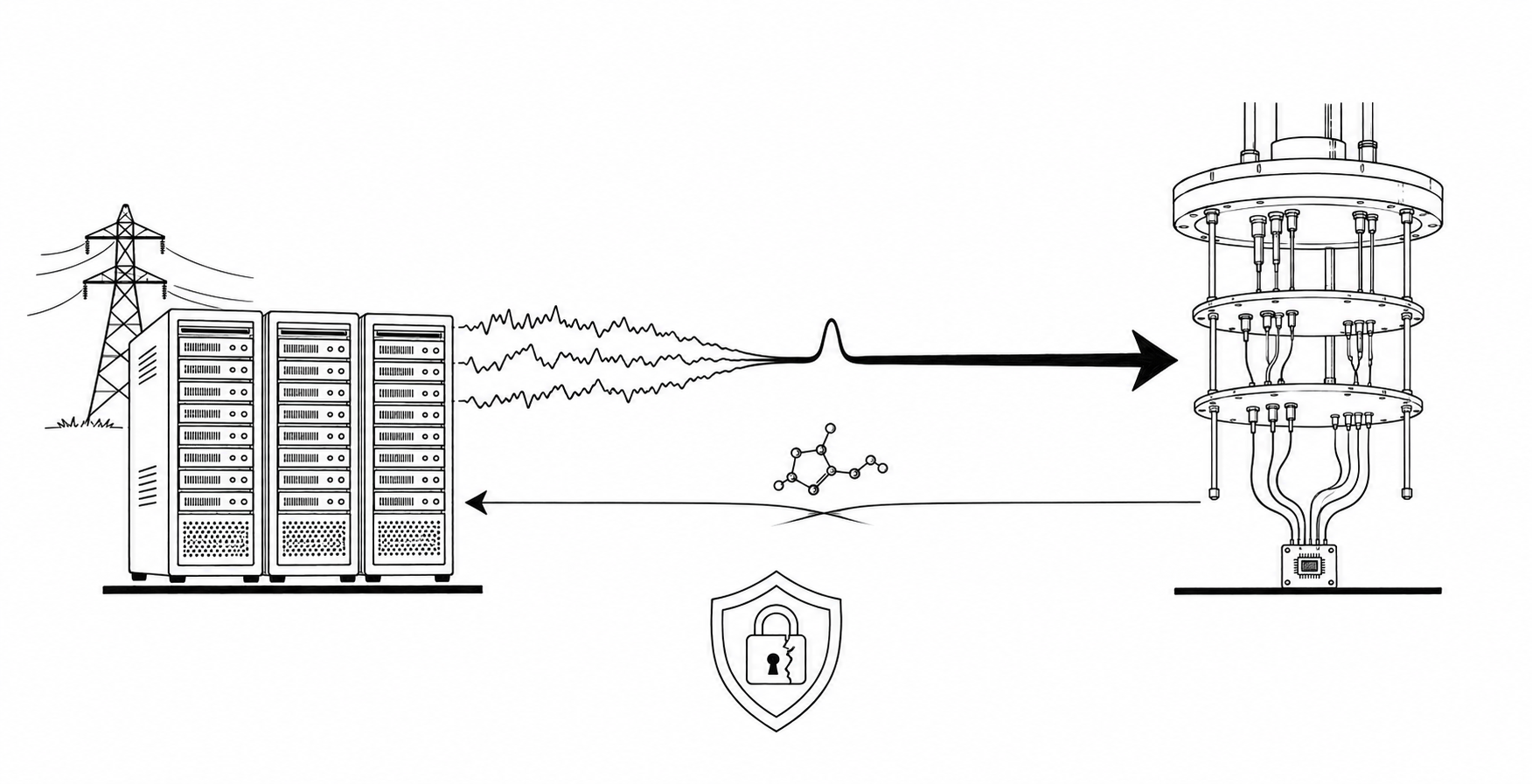
A second pressure on cryptography: Long before fault-tolerant quantum hardware arrives, AI creates an immediate offensive pressure on cryptography. Models can audit open-source cryptographic libraries for subtle memory or side-channel bugs at superhuman scale and help mathematicians probe algebraic weaknesses in newly standardized post-quantum schemes. While AI has not broken battle-tested ciphers like AES, newly minted algorithms lack decades of human cryptanalysis. Defenders are forced to migrate under time pressure at the exact moment attackers gain AI-assisted code and algebraic analysis—making hybrid cryptography and extended public vetting indispensable.
Infrastructure concentration: Both technologies drive extreme physical concentration, albeit along different axes. Frontier AI consumes gigawatts of power and massive clusters of advanced silicon—making retired Bitcoin mining facilities with high-voltage grid interconnects prime real estate for AI data centers. Quantum hardware requires minimal electricity, yet depends on ultra-specialized cryogenics, dilution refrigerators, and fabrication lines controlled by a handful of players. Concentration yields efficiency, but it also creates a short, fragile list of high-value geopolitical targets.
The Competition Between Forces
The convergence is unfolding across five simultaneous contests, each governed by distinct structural bottlenecks:
| Contest | Side A | Side B | Decisive Factor |
| Strategic Rivalry | US, Canada, EU, Australia | China (with Russia, Iran, North Korea as disruptors) | Semiconductor and cryogenic supply chains, research talent, speed of PQC migration |
| Payment Architecture | Closed ecosystems & card networks | Open protocols & stablecoin rails | Merchant acceptance, consumer dispute rights, regulatory clarity |
| Compute | Hyperscale cloud providers | Decentralized GPU networks & repurposed mining sites | Cost per FLOP, enterprise reliability SLAs, grid power access |
| Cryptography | Defenders migrating to post-quantum schemes | Attackers using AI cryptanalysis & future quantum machines | Cryptographic agility, public vetting time, deployment velocity |
| Governance | Rapid, permissionless deployment by firms | Liability, audit, and kill-switch regimes | Whether a major autonomous failure triggers reactive regulation early |
The first test of the convergence between AI, quantum computing, and blockchain may look like a routine software rollout. A trading firm gives an AI agent authority to place orders. A payment network adds a new settlement rail. A security team upgrades the signatures that verify who authorized a transaction. Each change makes sense on its own. The trouble begins when one system acts on an assumption another system no longer honors, and the error travels faster than anyone can stop it.
The same timing problem plays out between states. An intruder can sit quietly inside a critical network for years.
Intelligence agencies can store encrypted traffic today, hoping to read it later. Defenders, meanwhile, have to replace vulnerable cryptography across systems that need to stay online throughout the transition. In markets, the leverage lies with whoever decides which agents can act, which transactions they can authorize, and which networks carry and settle them.
That puts governance inside the engineering. A spending limit, a way to revoke an agent’s authority, and a fallback when a signature fails are all decisions about how far an error can spread. By the time a failure reaches the trading desk or the control room, many of those decisions have already been made.
States: In cyber and quantum competition, offense and defense operate on asymmetric clocks. State-linked groups have already established footholds inside critical infrastructure—including communications, energy, transportation, and water and wastewater networks, with CISA’s joint Volt Typhoon advisory documenting persistent access in some victims’ IT environments for at least five years.
That patience is integral to the strategy. As NIST’s post-quantum cryptography explainer (Source: What Is Post-Quantum Cryptography? / NIST) underscores, adversaries are actively harvesting encrypted traffic today to decrypt once quantum hardware matures, which is why migration using NIST’s finalized key-establishment and digital-signature standards cannot wait for certainty around Q-Day. A nation that reaches cryptographically relevant quantum computing first unlocks years of stored intelligence; a nation that completes post-quantum migration first permanently neutralizes that advantage. Because defensive migration is a known engineering task while offensive timelines remain uncertain, moving first on defense locks in durable security.
Even within the Western bloc, capabilities and strategic priorities are distributed unevenly across allies.
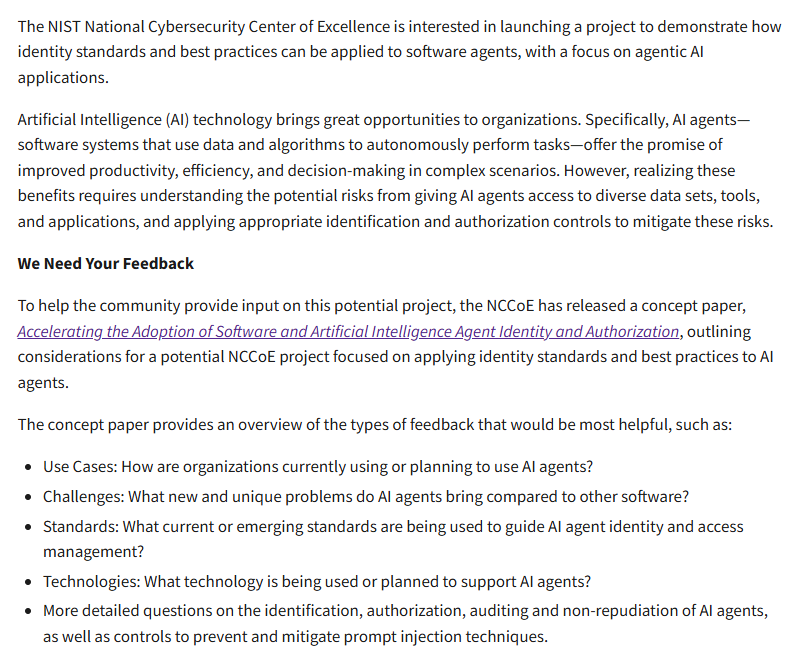
That coordination is already taking shape—paired with the EU’s post-quantum roadmap, NIST’s 2026 concept paper on software and AI agent identity and authorization lays early groundwork for how systems verify an agent's identity and govern what it can do on a user's behalf.
Business models & capital: Card networks and stablecoin rails are evolving toward coexistence rather than mutual elimination.
Visa’s launch of U.S. stablecoin settlement, allowing participating institutions to settle obligations in USDC while leaving the consumer card experience intact, illustrates how legacy rails are integrating blockchain settlement beneath familiar interfaces.
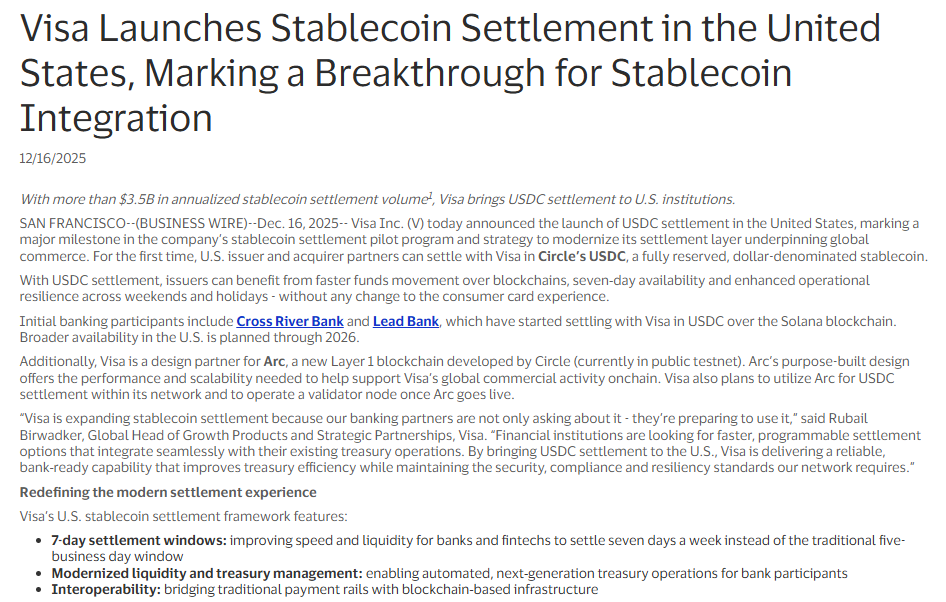
Because neither rail will soon displace the other, lasting strategic value will accrue to whoever controls the orchestration layer that handles identity, policy, and payment routing across both.
Compute and energy follow a similarly bifurcated trajectory. As the IEA’s Energy and AI report highlights, power-intensive AI data centers are heavily concentrated geographically around available grid capacity. That power bottleneck has already created a commercial precedent for infrastructure conversion, detailed in filings such as Core Scientific’s Form 10-K, which documents converting Bitcoin-mining facilities to host high-density AI workloads.
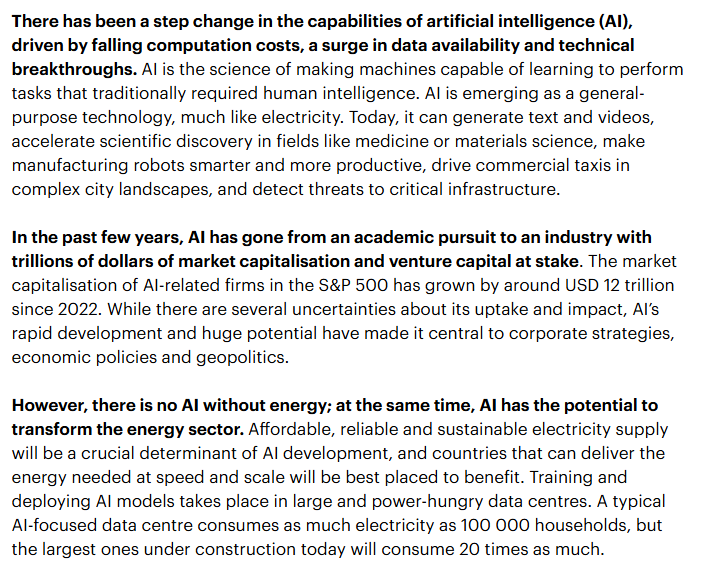
Looking ahead, compute is likely to split by workload between hyperscale cloud providers offering enterprise reliability guarantees and decentralized networks monetizing stranded or repurposed energy. Meanwhile, because AI absorbs most private capital, blockchain and quantum computing must continually justify their investment claims by delivering what AI cannot provide on its own: verifiable settlement without central trust for blockchains, and cryptographic urgency plus molecular simulation for quantum hardware.
Ultimately, the governance row carries the highest stakes. Rules drafted after a systemic failure tend to be blunt and restrictive; rules drafted before one can be surgical. The first major crisis of the convergence will likely stem not from a rogue nation-state, but from an ordinary, cascading engineering failure.
Financial history already offers a stark warning: as the Chicago Fed’s account of Knight Capital shows, a single trading software malfunction generated a $440 million loss in just 45 minutes.
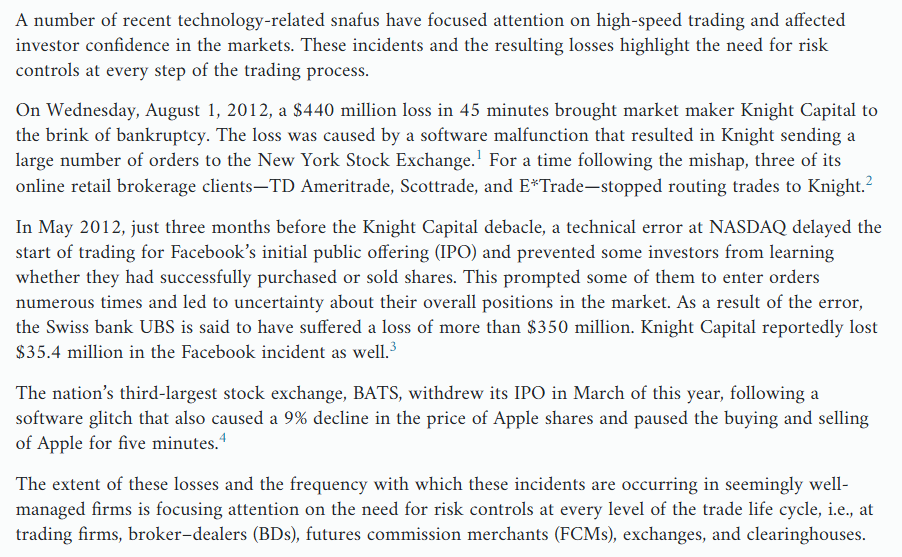
Looking forward, the Financial Stability Board’s AI report warns that shared infrastructure providers, correlated model behavior, cyber vulnerabilities, and weak governance can rapidly amplify localized software errors into systemic shocks, turning a misconfigured autonomous agent or a subtle flaw in a signature library into a market-wide freeze.
Quantum contextuality and what it means to have a property
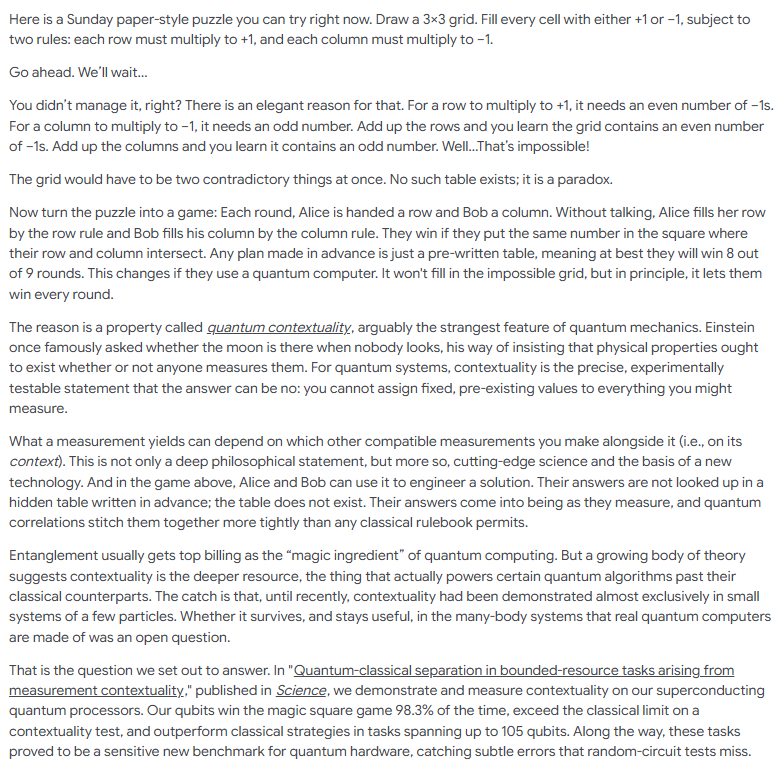
In November 2026, Google researchers reported that their Willow quantum processor won the magic square game 98.3 percent of the time. The best classical strategy wins 88.9 percent. The gap came from a peculiar feature of quantum mechanics. A pair of players using prewritten answers cannot satisfy all the game's rules, even if they coordinate their strategy beforehand. Players who share two entangled pairs can, in principle, win every round. The experiment puts a number on something that sounds philosophical until a machine does it.
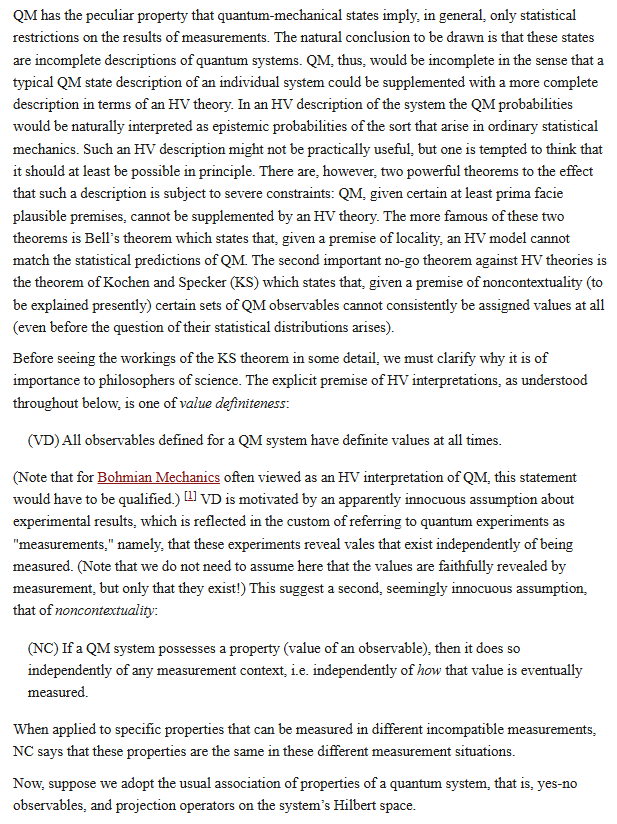
Imagine a coin lying under your palm. It is already heads or tails, and you expect that answer to stay the same whether you check the coin’s diameter at the same time or leave the ruler in the drawer. The Kochen–Specker theorem shows why that intuition fails as a general account of quantum properties. For certain sets of observables, you cannot assign every possible measurement a value in advance, keep each value fixed across different sets of compatible measurements, and still reproduce quantum mechanics. The word context has a precise meaning here. It refers to which compatible measurements are performed together.
The magic square makes that restriction tangible. One player receives a row, the other a column. Each must satisfy a parity rule, and their answers must agree where the row and column intersect. A classical strategy can cover eight of the nine possible intersections. The ninth exposes the contradiction. Entanglement gives the players a way around that limit. The result matters for computing, too.
In 2014, Howard and colleagues established a connection between contextuality and the resources needed for universal quantum computation in a particular magic-state framework.
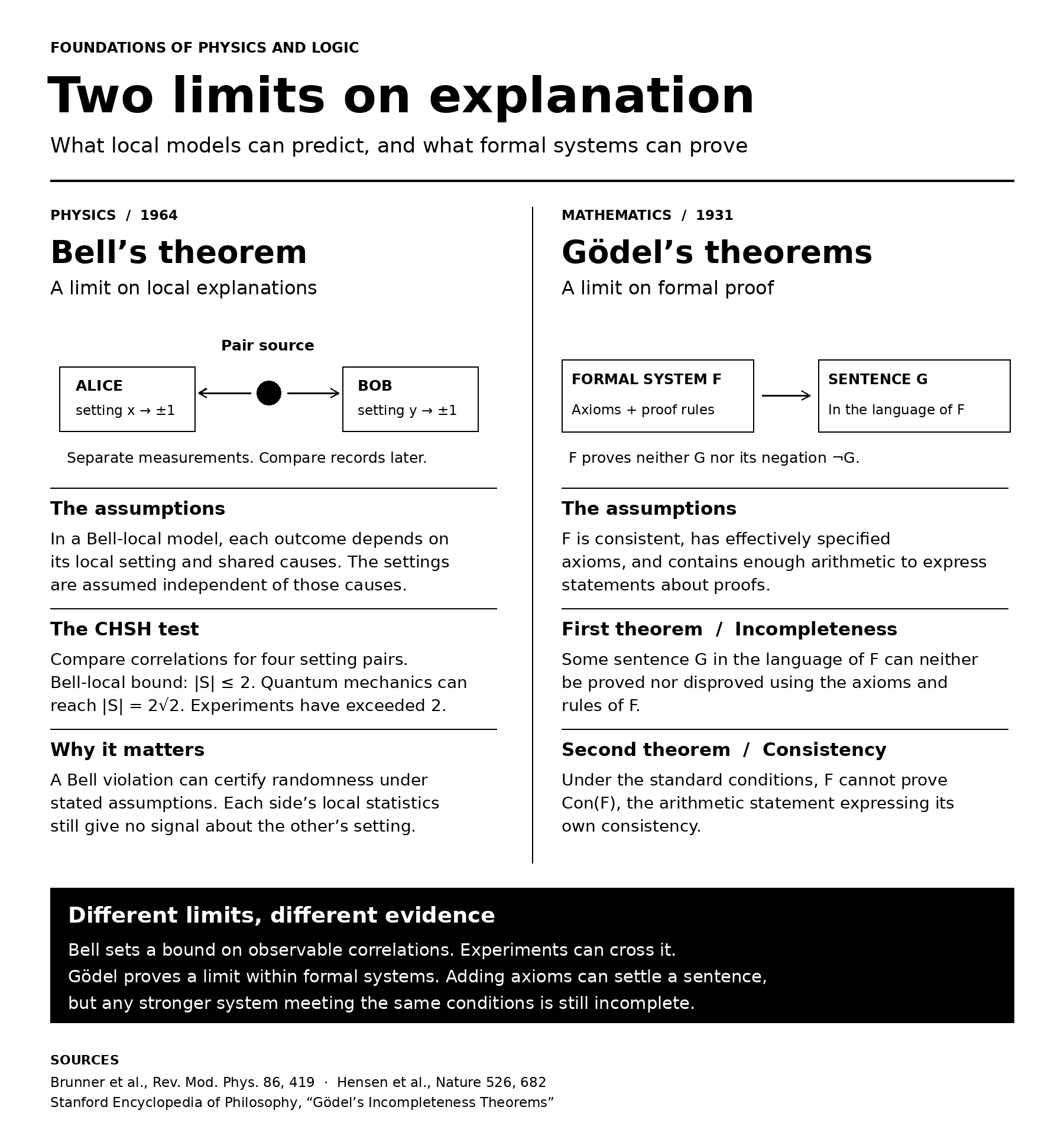
Bell nonlocality brings a related question into a setting with separated observers. Their joint statistics can violate a Bell inequality, but neither observer can choose an outcome and thereby send a message to the other. The pattern becomes visible when they compare records through ordinary communication. How to interpret that shared quantum state remains open. Bohmian mechanics retains definite particle positions in a nonlocal theory. Many-worlds retains unitary evolution and describes outcomes in branching terms. Relational quantum mechanics treats physical facts as relative to interactions, while QBism interprets the quantum state through an agent’s expectations. The standard predictions at issue here leave room for these different accounts.
Quantum field theory sharpens a second intuition in the essay, about creation and absence. A particle can be described as an excitation of a field, and the formalism uses creation and annihilation operators to change the number of quanta. A field mode can be prepared in a superposition of zero and one quantum. The vacuum itself is a physical state with structure. Even here, the language calls for care. The Casimir force is measurable, and its calculation admits formulations that do not invoke vacuum zero-point energy. The physical result concerns the states fields can occupy and the outcomes measurements can register. Whether those results point beyond the physical world remains a metaphysical question.
Quantum consciousness makes three different claims
Quantum applies not to inert but living systems as well and that has its own ramifications.
Quantum effects do work in living systems. Evidence for electron and proton tunneling exists in some enzyme reactions. In migratory birds, a leading hypothesis holds that light-sensitive molecules in the eye form radical pairs whose spin dynamics respond to the Earth’s magnetic field. Experiments on purified cryptochrome 4 from European robins support the mechanism’s plausibility. Photosynthesis calls for a finer distinction. Spectroscopic evidence of coherence and evidence that long-lived electronic coherence improves energy transfer under physiological conditions are two different things. Warm biology can exploit a quantum effect when the effect persists long enough to influence the reaction at hand.
Quantum coherence might do functional work in the brain. Roger Penrose and Stuart Hameroff’s orchestrated objective reduction proposal places coherent quantum processes in neuronal microtubules and links their termination to a hypothesized gravity-related collapse. Max Tegmark calculated that candidate quantum states would decohere far faster than the timescale of neural activity. Hameroff and colleagues challenged the physical assumptions behind those estimates. Matthew Fisher proposed a different mechanism, in which nuclear spins carried by phosphate and potentially protected in molecular clusters could retain quantum information. Each proposal must identify a state, show it survives in living tissue, and explain how it changes what neurons do.
Two studies from 2024 show how far the evidence reaches. In one, a microtubule-stabilizing drug delayed the loss of the righting reflex under isoflurane in rats, a behavioral proxy for anesthetic-induced unconsciousness. In another, researchers reported fluorescence measurements in tubulin and microtubule preparations consistent with predictions from a model of collective emission by tryptophan networks. The first links a microtubule intervention to an anesthetic response. The second identifies an optical effect in molecular preparations. The causal bridge from either result to coherent quantum information processing in a living brain remains to be demonstrated.
Conscious experience might require a quantum process. This is the strongest claim. A quantum effect could influence a neuron, or even improve information processing across a network, while leaving open the question of why that activity feels like anything. The attraction of entanglement is that it supplies a physical example of a whole whose state cannot be reconstructed from independent descriptions of its parts. That makes it an intriguing analogy for the unity of experience. It still takes a theory to explain why a nonseparable physical state would give rise to a single point of view. Penrose’s separate argument from Gödel’s theorem also hinges on a disputed premise about what human reasoners can establish concerning the formal systems used to model them.
There is a way to make progress. Identify a proposed quantum state, measure how long it persists in living neural tissue, and perturb it while controlling for ordinary biochemical effects. Then ask whether the intervention produces the neural or behavioral change the theory predicted in advance.
The 2025 COGITATE collaboration offers a model for the design of such tests.
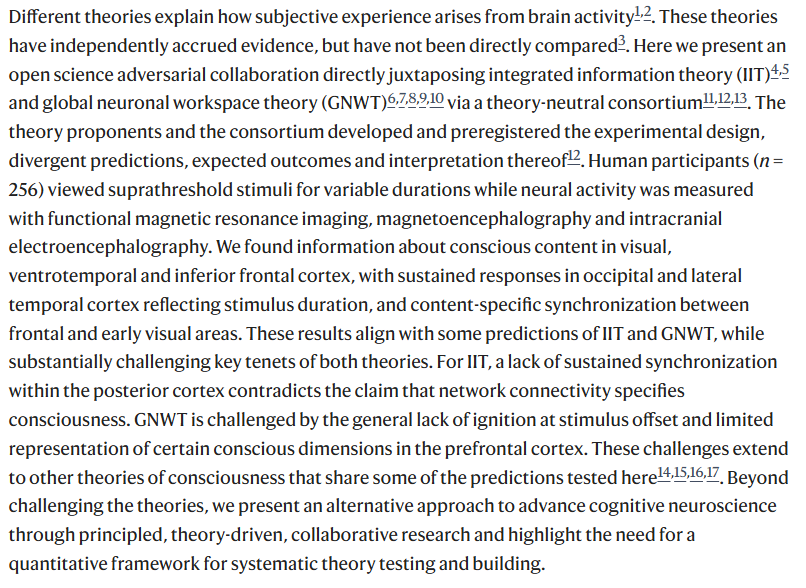
Proponents of global neuronal workspace theory and integrated information theory agreed on predictions before collecting the data. The results challenged important predictions from both theories. A quantum theory of consciousness should face that same kind of test.
How separated parts act as one
A distributed ledger, an entangled pair, and a conscious brain each invite the same question.
How do separated parts act as one?
The answer depends on what kind of unity is at stake.
A blockchain coordinates a history by exchanging and validating messages. Nodes apply shared rules to decide which transactions and blocks they accept. In Bitcoin, proof of work makes rewriting the accepted history costly. An entangled pair has a joint state whose statistics can violate constraints on local explanations. That correlation supplies no channel for sending a message. In a brain, signals travel between neurons and across regions. Theories such as global neuronal workspace propose that some information becomes widely available for reasoning, report, and action. Whether that availability accounts for the unity of experience remains an open question.
For AI, the implications depend on the theory of mind. If consciousness depends on functional organization, look to architecture. If it depends on a particular physical substrate, the question is whether the machine can reproduce the relevant process. Even an ordinary quantum computer would leave Penrose’s stronger claim unresolved. A speedup on a particular problem concerns how efficiently a computation runs. His proposal requires a physical process that goes beyond algorithmic computation.
There is also a practical meaning of context for AI that needs no quantum hardware. Researchers in quantum cognition use quantum probability to model effects such as people answering the same questions differently when the order changes. The formalism models judgment. Whether it also predicts an AI agent’s sensitivity to instruction order better than a classical model is an empirical question. For auditing an agent, the immediate consequence is simpler. Preserve the governing instructions, relevant tool outputs, and permissions in force when it acted. A transaction record can tell you what happened while leaving the basis for the decision invisible.
Going Forward
The near-term work lies at the points where these technologies meet. An agent receives authority from a person or institution. A payment system relies on a signature to recognize that authority. A ledger carries the result forward. Each handoff depends on assumptions that should be visible and testable before coupling the systems at scale.
An AI agent places an order. Its signature verifies. A blockchain settles the payment. Every component has worked as designed, yet the transaction may exceed what the person behind the agent intended to authorize. That is where the convergence of AI, quantum computing, and blockchain becomes a governance problem. The three technologies can act, authenticate, and settle at machine speed. They can also carry a mistaken assumption through to final settlement.
Quantum risk brings a different clock. Encrypted traffic collected today may still matter when a capable quantum computer arrives. Organizations should inventory their cryptography and protect long-lived secrets first, while planning separately to replace signatures. Public blockchains face a harder choice. Retiring vulnerable signatures can strand owners who cannot migrate. Keeping them valid can leave exposed funds open to future theft.
The authority to act deserves the same care. Before an agent can move money, the systems it interacts with should be able to verify whom it represents, what it may spend, when that permission expires, and whether it has been revoked. An audit record should preserve enough context to reconstruct a disputed decision.